





1. Introduction
The proof Landau damping (Landau Reference Landau1946) is actually a collisional plateau regime process (Zakharov & Karpman Reference Zakharov and Karpman1963), and the re-realisation (Catto Reference Catto2025a
) that collisions are never negligible, suggests reconsidering the bump on tail instability (Penrose Reference Penrose1960; Gardner Reference Gardner1963) with diffusive collisions retained to properly treat the collisional boundary layer that arises in the presence of a resonance. By considering a single monochromatic plasma wave, it is found that collisions must always be retained. In particular, the familiar bump on tail behaviour is recovered in the limit in which the collisional boundary layer is wider than an island width, while in the opposite very weak collisionality and finite amplitude limit an explicit dependence on collision frequency ${\nu}$
and electric field amplitude
${\nu}$
and electric field amplitude ${E}_{\|}$
appears. Consequently, once again there is never a collisionless limit. Finally, an estimate in the many mode limit suggests the usual collisional plateau limit (normally obtained by a collisionless treatment) requires overlapping collisional boundary layer regions, but yields a quasilinear diffusion coefficient small compared with collisional diffusion
${E}_{\|}$
appears. Consequently, once again there is never a collisionless limit. Finally, an estimate in the many mode limit suggests the usual collisional plateau limit (normally obtained by a collisionless treatment) requires overlapping collisional boundary layer regions, but yields a quasilinear diffusion coefficient small compared with collisional diffusion ${\nu}{{v}}_{{e}}^{2}$
, with
${\nu}{{v}}_{{e}}^{2}$
, with ${v}_{{e}}$
the electron thermal speed. However, the very weak collision frequency and finite electric field amplitude limit, where bump on tail wave growth depends explicitly on
${v}_{{e}}$
the electron thermal speed. However, the very weak collision frequency and finite electric field amplitude limit, where bump on tail wave growth depends explicitly on ${\nu}/{{E}}_{\|}^{3/2}$
, is also expected to lead to diffusive velocity space transport due to the dissipation in the narrow collisional boundary layers enclosing the island separatrices. In this limit the diffusion due to the interacting stochastic (rather than chaotic) islands suggests a diffusivity larger than
${\nu}/{{E}}_{\|}^{3/2}$
, is also expected to lead to diffusive velocity space transport due to the dissipation in the narrow collisional boundary layers enclosing the island separatrices. In this limit the diffusion due to the interacting stochastic (rather than chaotic) islands suggests a diffusivity larger than ${\nu}{{v}}_{{e}}^{2}$
.
${\nu}{{v}}_{{e}}^{2}$
.
The bump on tail treatment to follow may seem to be of more historic interest than of relevance to magnetic fusion. However, collisional diffusion (that, is non-Krook) effects on resonant particle interactions are vital to understanding radio frequency (rf) heating and current drive, toroidal Alfvén eigenmode (TAE) effects on tokamak confinement and resonant collisional losses in highly optimised stellarators. Insights on the behaviour of rf by Bilato & Brambilla (Reference Bilato and Brambilla2004, Reference Bilato and Brambilla2008) based on a phenomenological quasilinear model with a diffusivity fit to the Landau damping results of Zakharov & Karpman (Reference Zakharov and Karpman1963) hinted at the key role of collisions in rf heating and current drive, while Valentini (Reference Valentini2008) numerically confirmed their results with a Langevin collision model. A more recent treatment of lower hybrid current drive (Catto Reference Catto2025b ) explicitly evaluated the reduction in current drive efficiency in the weak collisionality limit for a finite, applied monochromatic lower hybrid wave. Also, TAE driven transport in tokamaks has dealt with and made progress dealing with resonant particle transport loss for both trapped and passing particles (Hirvijoki et al. Reference Hirvijoki, Snicker, Korpilo, Lauber, Poli, Schneller and Kurki-Suonio2012; Fitzgerald et al. Reference Fitzgerald, Sharapov, Rodrigues and Borba2016; Zhou & White Reference Zhou and White2016; Tolman & Catto Reference Tolman and Catto2021). Early energetic particle work (Berk & Breizman Reference Berk and Breizman1990) indicated small energy losses when source and annihilation terms were retained. The role of resonant particles in well optimised stellarators continues to be extensively investigated (Calvo et al. Reference Calvo, Parra, Velasco and Alonso2017; Catto, Tolman & Parra Reference Catto, Tolman and Parra2023), with recent work (Catto Reference Catto2025c ) able to incorporate and evaluate behaviour similar to that treated here, but with geometrical effects retained as well. Interestingly, a Langevin particle in cell simulation of a one-dimensional Lenard–Bernstein (Reference Lenard and Bernstein1958) model collision operator by Valentini & Veltri (Reference Valentini and Veltri2008) exhibits features in agreement with Zakharov & Karpman (Reference Zakharov and Karpman1963). However, truncation errors in other numerical evaluations (Brodin Reference Brodin1997; Pezzi, Camporeale & Valentini Reference Pezzi, Camporeale and Valentini2016) make it difficult to adequately treat the very low collision frequency limit where fine scale velocity space structure must be resolved. Indeed, any numerical scheme involving the truncation of an expansion will be challenging in the vanishing small collisionality limit, although they are capable of highlighting the differences between various approximations to the full collision operator (Jorge et al. Reference Jorge, Ricci, Brunner, Gamba, Konovets, Loureiro, Perrone and Teixeira2019), as well as interesting temporal evolution phenomenon (Lilley, Breizman & Sharapov Reference Lilley, Breizman and Sharapov2010). In addition, experimental measurements in this low collisionality limit are difficult because of external dissipation (Danielson, Anderegg & Driscoll Reference Danielson, Anderegg and Driscoll2004).
The key insight that the resonance considered by Landau (Reference Landau1946) is collisional dates back to Zakharov & Karpman (Reference Zakharov and Karpman1963), although their proof seems to be under appreciated. Johnston (Reference Johnston1971) and Auerbach (Reference Auerbach1977) adopted the linear collisional echo treatment of Su & Oberman (Reference Su and Oberman1968) to demonstrate in their vanishing collision frequency limit that they recovered Landau’s result, but failed to appreciate Zakharov & Karpman (Reference Zakharov and Karpman1963) had shown there is no collisionless limit for a finite amplitude plasma wave. Only recently has the role of collisions on resonances been rediscovered (Catto Reference Catto2025a ) after attempts to understand related resonance behaviour in Alfvén eigenmode driven alpha particle transport in tokamaks (Catto & Tolman Reference Catto and Tolman2021), lower hybrid current drive by a monochromatic wave (Catto Reference Catto2025b ) and alpha particle transport in a quasisymmetric stellarator with a single helicity error field (Catto Reference Catto2025c ). The efforts of Catto (Reference Catto2025a ,Reference Catto b ,Reference Catto c ) extended the work of Hamilton et al. (Reference Hamilton, Tolman, Arzamasskiy and Duarte2023), whose insights went beyond the less complete attempts of Pao (Reference Pao1988) and Petviachvila (Reference Petviachvili1999). Here, the extension of the techniques of Zakharov & Karpman (Reference Zakharov and Karpman1963) and Catto (Reference Catto2025a ) to the familiar bump on tail instability demonstrate it also should be viewed as a collisional process for which no collisionless limit is possible. The implications of the results are discussed by making some simple estimates. The procedure employed here is a slight extension of Catto (Reference Catto2025a ), but some details are repeated here to keep the presentation self-contained. Similar techniques are employed in the recent work of Devin & Duarte (Reference Devin and Duarte2025), who consider a positive slope region on an otherwise flat background distribution function.
The next three sections explain the bump on tail model employed (§ 2), solve in the usual linear regime, but with resonant electron collisions retained (§ 3), and present a solution in the vanishingly small collisionality limit for a finite amplitude electron plasma wave (§ 4). Section 5 briefly summarises the results and discusses implications. A brief Appendix illustrates how collisions replace the usual plasma dispersion function of linear theory with the collisional generalisation.
2. Formulation
Consider the stability of a homogeneous, unmagnetised, weakly collisional plasma containing a small amplitude, propagating monochromatic electrostatic plasma wave of wave frequency ${\omega}$
and
${\omega}$
and $\boldsymbol {{z}}$
directed wavenumber
$\boldsymbol {{z}}$
directed wavenumber ${k}_{\|}$
for the electric field
${k}_{\|}$
for the electric field
 \begin{align}\boldsymbol {{E}}=\boldsymbol {{z}}\mathrm{Im} [\tilde{{E}}{e}^{{i}{({k}_{\|}}{z}-{\omega} {t})}]\approx \boldsymbol {{z}}{E}_{\|}\sin ({k}_{\|}{z}-{\omega} {t}).\end{align}
For the linear regime of the next section the full complex amplitude $\tilde{{E}}$
enters, while for what will be referred to as the nonlinear case, the lowest-order approximation on the right of (2.1) is adequate. The phase velocity is assumed to satisfy
$\tilde{{E}}$
enters, while for what will be referred to as the nonlinear case, the lowest-order approximation on the right of (2.1) is adequate. The phase velocity is assumed to satisfy ${\omega} /{k}_{\|}\gg {v}_{{e}}=(2{T}/{m})^{1/2}$
and it is convenient to view
${\omega} /{k}_{\|}\gg {v}_{{e}}=(2{T}/{m})^{1/2}$
and it is convenient to view ${E}_{\|}\propto {e}^{{\gamma} {\tau} }$
, with
${E}_{\|}\propto {e}^{{\gamma} {\tau} }$
, with ${E}_{\|}$
the positive amplitude of the lowest order electric field with a small positive growth or negative damping rate
${E}_{\|}$
the positive amplitude of the lowest order electric field with a small positive growth or negative damping rate ${\gamma}$
. The real part of the frequency satisfies
${\gamma}$
. The real part of the frequency satisfies ${\omega} ^{2}={{\omega} }_{{p}}^{2}+3{{k}}_{\|}^{2}{{v}}_{{e}}^{2}/2$
, with
${\omega} ^{2}={{\omega} }_{{p}}^{2}+3{{k}}_{\|}^{2}{{v}}_{{e}}^{2}/2$
, with ${\omega} _{{p}}=(4{\pi} {e}^{2}{n}/{m})^{1/2}\gg {\gamma}$
the plasma frequency. Here and elsewhere n, T, m and e are the electron density, temperature, mass and charge magnitude.
${\omega} _{{p}}=(4{\pi} {e}^{2}{n}/{m})^{1/2}\gg {\gamma}$
the plasma frequency. Here and elsewhere n, T, m and e are the electron density, temperature, mass and charge magnitude.
Assume the initial electron distribution function is ${f}_{0}={f}_{{M}}+{f}_{{b}}$
, where
${f}_{0}={f}_{{M}}+{f}_{{b}}$
, where ${f}_{{M}}$
is the Maxwellian
${f}_{{M}}$
is the Maxwellian
 \begin{align}{f}_{{M}}={f}_{{M}}({v})={n}{\pi} ^{-3/2}{{v}}_{{e}}^{-3/2}{e}^{-{{v{2}}}/{{v}}_{{e}}^{2}}.\end{align}
The bump on the tail contribution to ${f}_{0}$
is assumed to be centred and localised about
${f}_{0}$
is assumed to be centred and localised about ${v}_{\|}={V}\approx {\omega} /{k}_{\|}\gt {v}_{{e}}$
with a form that does not perturb the density. It is convenient to assume
${v}_{\|}={V}\approx {\omega} /{k}_{\|}\gt {v}_{{e}}$
with a form that does not perturb the density. It is convenient to assume
 \begin{align}{f}_{{b}}=\big(2{\Gamma} /{\pi} ^{3/2}{{v}}_{{b}}^{5}\big)({v}_{\|}-{V}){e}^{-{{v}}_{\bot }^{2}/{{v}}_{{b}}^{2}-({{v}_{\|}}-{V}{)^{2}}/{{v}}_{{b}}^{2}},\end{align}
with ${v}_{\|}=\boldsymbol {{z}}\boldsymbol{\cdot }\boldsymbol {{v}}$
and
${v}_{\|}=\boldsymbol {{z}}\boldsymbol{\cdot }\boldsymbol {{v}}$
and ${v}^{2}={{v}}_{\|}^{2}+{{v}}_{\bot }^{2}={{v}}_{\|}^{2}+{{v}}_{{x}}^{2}+{{v}}_{{y}}^{2}$
, and
${v}^{2}={{v}}_{\|}^{2}+{{v}}_{\bot }^{2}={{v}}_{\|}^{2}+{{v}}_{{x}}^{2}+{{v}}_{{y}}^{2}$
, and ${{v}}_{{b}}^{2}\ll {{v}}_{{e}}^{2}$
to provide the desired localisation for the bump. Then
${{v}}_{{b}}^{2}\ll {{v}}_{{e}}^{2}$
to provide the desired localisation for the bump. Then $\int \mathrm{d}^{3}{vf}_{{b}}=0$
, but
$\int \mathrm{d}^{3}{vf}_{{b}}=0$
, but $\int \mathrm{d}^{3}{v}{{v}_{\|}}{f}_{{b}}={\Gamma} \gt 0$
is a
$\int \mathrm{d}^{3}{v}{{v}_{\|}}{f}_{{b}}={\Gamma} \gt 0$
is a $\boldsymbol {{z}}$
directed flux that is assumed to always be small enough to keep
$\boldsymbol {{z}}$
directed flux that is assumed to always be small enough to keep ${f}_{0}\gt 0$
. Picking the bump of this form allows a positive slope region for
${f}_{0}\gt 0$
. Picking the bump of this form allows a positive slope region for ${f}_{{b}}$
about
${f}_{{b}}$
about ${v}_{\|}={V}\gt 0$
, while if
${v}_{\|}={V}\gt 0$
, while if ${\Gamma}$
is small enough to keep the distribution function
${\Gamma}$
is small enough to keep the distribution function ${f}_{0}$
monotonic, then by Gardner’s theorem (1963) stability is assured. However, when
${f}_{0}$
monotonic, then by Gardner’s theorem (1963) stability is assured. However, when ${\Gamma}$
is large enough to make the distribution function
${\Gamma}$
is large enough to make the distribution function ${f}_{0}$
non-monotonic, then the Penrose criterion (1960) means a linearised treatment will lead to instability. Other, less convenient choices can be made for the bump as long as it is localised to the tail of the Maxwellian.
${f}_{0}$
non-monotonic, then the Penrose criterion (1960) means a linearised treatment will lead to instability. Other, less convenient choices can be made for the bump as long as it is localised to the tail of the Maxwellian.
Here, the ultimate task is to solve the full electron kinetic equation
 \begin{align}\partial {f}/\partial {t}+{v}_{\|}\,\partial {f}/\partial {z}-\left({e}/{m}\right)\boldsymbol {{z}}\boldsymbol{\cdot }\boldsymbol {{E}}\partial {f}/\partial {v}_{\|}={C}\{{f}\},\end{align}
where the collision operator retains like and unlike collisions, with the full electron collision operator giving ${C}\{{f}_{{M}}\}=0$
, and
${C}\{{f}_{{M}}\}=0$
, and $\partial {f}_{{M}}/\partial {t}=0=\partial {f}_{{M}}/\partial {z}$
also assumed. The background ions are assumed stationary so a Lorentz operator is adequate for them.
$\partial {f}_{{M}}/\partial {t}=0=\partial {f}_{{M}}/\partial {z}$
also assumed. The background ions are assumed stationary so a Lorentz operator is adequate for them.
The non-Maxwellian bump will be on the tail if ${V}\approx {\omega} /{k}_{\|}\approx {v}_{\|}\gg {v}_{{e}}$
. This limit suggests expanding the electron–electron collision operator for
${V}\approx {\omega} /{k}_{\|}\approx {v}_{\|}\gg {v}_{{e}}$
. This limit suggests expanding the electron–electron collision operator for ${v}^{2}\gg {{v}}_{{e}}^{2}$
. As a result, the following linearised collision operator may be employed (Catto Reference Catto2025b
):
${v}^{2}\gg {{v}}_{{e}}^{2}$
. As a result, the following linearised collision operator may be employed (Catto Reference Catto2025b
):
 \begin{align}{C}\{{f}\}=\boldsymbol{\nabla} _{{v}}\boldsymbol{\cdot }\left\{{\nu}\left[\big({v}^{2}{\mathop{I}\limits^{\leftrightarrow}}-\boldsymbol {{v}}\boldsymbol {{v}}\big)\boldsymbol{\cdot }\boldsymbol{\nabla} _{{v}}{f}+\frac{2\textit{Tf}_{{\!M}}}{({Z}+1){m}}\boldsymbol{\nabla} _{{v}}\left(\frac{{f}}{{f}_{{M}}}\right)\right]\right\}\!,\end{align}
where ${x}={v}/{v}_{{e}}$
,
${x}={v}/{v}_{{e}}$
, ${\nu}_{{e}}=3\sqrt{\pi }(Z+1){\nu}_{{ee}}/4$
,
${\nu}_{{e}}=3\sqrt{\pi }(Z+1){\nu}_{{ee}}/4$
, ${\nu}_{{ee}}=4\sqrt{2{\pi} }{e}^{4}{n}\ell{n}{\Lambda} /3{m}^{1/2}{T}^{3/2}={\nu}_{{ei}}/{Z}$
and
${\nu}_{{ee}}=4\sqrt{2{\pi} }{e}^{4}{n}\ell{n}{\Lambda} /3{m}^{1/2}{T}^{3/2}={\nu}_{{ei}}/{Z}$
and ${\nu}={\nu}_{{e}}/2{x}^{3}$
, with Z the ion charge number and
${\nu}={\nu}_{{e}}/2{x}^{3}$
, with Z the ion charge number and $\ell{n}{\Lambda} \gg 1$
the Coulomb logarithm.
$\ell{n}{\Lambda} \gg 1$
the Coulomb logarithm.
To solve the kinetic equation (2.4) in the linear and nonlinear limits, it is convenient to let ${f}={f}_{0}+{f}_{1}$
with
${f}={f}_{0}+{f}_{1}$
with ${f}_{1}\ll {f}_{0}={f}_{{M}}+{f}_{{b}}$
and allow
${f}_{1}\ll {f}_{0}={f}_{{M}}+{f}_{{b}}$
and allow ${\Gamma} ={\Gamma} ({t})$
to satisfy
${\Gamma} ={\Gamma} ({t})$
to satisfy $\partial {f}_{{b}}/\partial {t}={C}\{{f}_{{b}}\}$
, then
$\partial {f}_{{b}}/\partial {t}={C}\{{f}_{{b}}\}$
, then
 \begin{align}\partial {f}_{1}/\partial {t}+{v}_{\|}\,\partial {f}_{1}/\partial {z}-\left({e}/{m}\right)\boldsymbol {{z}}\boldsymbol{\cdot }\boldsymbol {{E}}\partial \left({f}_{0}+{f}_{1}\right)/\partial {v}_{\|}={C}\left\{{f}_{1}\right\}.\end{align}
The drive for the bump on tail instability is $\partial {f}_{0}/\partial {v}_{\|}=\partial ({f}_{{M}}+{f}_{{b}})/\partial {v}_{\|}$
. The assumption
$\partial {f}_{0}/\partial {v}_{\|}=\partial ({f}_{{M}}+{f}_{{b}})/\partial {v}_{\|}$
. The assumption ${f}_{1}\ll {f}_{0}$
is made to ensure the perturbations
${f}_{1}\ll {f}_{0}$
is made to ensure the perturbations ${E}_{\|}$
and
${E}_{\|}$
and ${f}_{1}$
satisfy Poisson’s equation to lowest order. The nonlinear limit retains the product of the two linear terms
${f}_{1}$
satisfy Poisson’s equation to lowest order. The nonlinear limit retains the product of the two linear terms $\boldsymbol {{z}}\boldsymbol{\cdot }\boldsymbol {{E}}$
and
$\boldsymbol {{z}}\boldsymbol{\cdot }\boldsymbol {{E}}$
and $\partial {f}_{1}/\partial {v}_{\|}$
.
$\partial {f}_{1}/\partial {v}_{\|}$
.
Collisions are assumed weak, but can never be neglected for the resonant electrons (Zakharov & Karpman Reference Zakharov and Karpman1963; Catto Reference Catto2025a
). This means they always must be retained in a narrow collisional boundary layer about resonance. The width of this collisional layer can be estimated by letting ${\Delta} {v}_{\|}={v}_{\|}-{\omega} /{k}_{\|}$
and using
${\Delta} {v}_{\|}={v}_{\|}-{\omega} /{k}_{\|}$
and using ${C}\{{f}_{1}\}\sim {\nu}{{v}}_{{e}}^{2}{f}_{1}/({\Delta} {v}_{\|})^{2}$
, with
${C}\{{f}_{1}\}\sim {\nu}{{v}}_{{e}}^{2}{f}_{1}/({\Delta} {v}_{\|})^{2}$
, with ${\nu}={\nu}_{{e}}/2{x}^{3}$
. Balancing this collisional term with
${\nu}={\nu}_{{e}}/2{x}^{3}$
. Balancing this collisional term with $\partial {f}_{1}/\partial {t}+{v}_{\|}\,\partial {f}_{1}/\partial {z}\sim {f}_{1}{k}_{\|}{\Delta} {v}_{\|}$
gives the narrow collisional boundary layer width to be of the order of
$\partial {f}_{1}/\partial {t}+{v}_{\|}\,\partial {f}_{1}/\partial {z}\sim {f}_{1}{k}_{\|}{\Delta} {v}_{\|}$
gives the narrow collisional boundary layer width to be of the order of
 \begin{align}({\Delta} {v}_{\|})_{{\nu}}\sim \big({\nu}{{v}}_{{e}}^{2}/{k}_{\|}\big)^{1/3}=({\nu}/{k}_{\|}{v}_{{e}})^{1/3}{v}_{{e}}.\end{align}
Assuming $({\Delta} {v}_{\|})_{{\nu}}\ll {v}_{{b}}\ll {v}_{{e}}$
allows the collision operator to be adequately approximated in the vicinity of the resonance by
$({\Delta} {v}_{\|})_{{\nu}}\ll {v}_{{b}}\ll {v}_{{e}}$
allows the collision operator to be adequately approximated in the vicinity of the resonance by
 \begin{align}{C}\{{f}_{1}\}\approx {\nu}\big[{{v}}_{\bot }^{2}+{({Z}+1)^{-1}{v}}_{{e}}^{2}\big]\partial ^{2}{f}_{1}/\partial {{v}}_{\|}^{2}.\end{align}
The preceding assumes localisation of ${f}_{{b}}$
to a width
${f}_{{b}}$
to a width ${v}_{{b}}$
with an effective collision frequency for the bump of
${v}_{{b}}$
with an effective collision frequency for the bump of ${\nu}{{v}}_{{e}}^{2}/{{v}}_{{b}}^{2}$
, which is much slower than the effective collision frequency
${\nu}{{v}}_{{e}}^{2}/{{v}}_{{b}}^{2}$
, which is much slower than the effective collision frequency ${\nu}{{v}}_{{e}}^{2}/({\Delta} {v}_{\|}{)}_{{\nu}}^{2}$
for
${\nu}{{v}}_{{e}}^{2}/({\Delta} {v}_{\|}{)}_{{\nu}}^{2}$
for ${f}_{1}$
so
${f}_{1}$
so ${f}_{{b}}/{{v}}_{{b}}^{2}\ll {f}_{1}/({\Delta} {v}_{\|}{)}_{{\nu}}^{2}$
may be assumed. As a result, bump on tail growth/damping occurs on a faster time scale. Notice velocity space is two-dimensional, but
${f}_{{b}}/{{v}}_{{b}}^{2}\ll {f}_{1}/({\Delta} {v}_{\|}{)}_{{\nu}}^{2}$
may be assumed. As a result, bump on tail growth/damping occurs on a faster time scale. Notice velocity space is two-dimensional, but ${v}_{\bot }$
only enters
${v}_{\bot }$
only enters ${{v}}_{\bot {z}}^{2}={{v}}_{\bot }^{2}+{{v}}_{{e}}^{2}/({Z}+1)$
as a parameter.
${{v}}_{\bot {z}}^{2}={{v}}_{\bot }^{2}+{{v}}_{{e}}^{2}/({Z}+1)$
as a parameter.
When ${\gamma} \ll {\omega} \sim {\omega} _{{p}}$
, only the lowest order kinetic equation
${\gamma} \ll {\omega} \sim {\omega} _{{p}}$
, only the lowest order kinetic equation
 \begin{align}{k}_{\|}{u}\frac{\partial {f}_{1}}{\partial {\phi} }-\frac{{eE}_{\|}}{{m}}\,\sin{\phi}\! \left(\frac{\partial {f}_{1}}{\partial {u}}+\frac{\partial {f}_{0}}{\partial {u}}| _{{u}=0}\right)={{\nu}{v}}_{\bot {z}}^{2}\frac{\partial ^{2}{f}_{1}}{\partial {u}^{2}}\end{align}
need be solved. For a monochromatic wave ${f}_{1}={f}_{1}({\phi} ,{u})$
may be assumed, with
${f}_{1}={f}_{1}({\phi} ,{u})$
may be assumed, with ${u}={v}_{\|}-{\omega} /{k}_{\|}$
, as all spatial and fast time variation is in the phase
${u}={v}_{\|}-{\omega} /{k}_{\|}$
, as all spatial and fast time variation is in the phase ${\phi} ={k}_{\|}{z}-{\omega} {t}$
. The assumption
${\phi} ={k}_{\|}{z}-{\omega} {t}$
. The assumption $({\Delta} {v}_{\|})_{{\nu}}\ll {v}_{{b}}\ll {v}_{{e}}$
means the bump on the tail is slowly varying, implying
$({\Delta} {v}_{\|})_{{\nu}}\ll {v}_{{b}}\ll {v}_{{e}}$
means the bump on the tail is slowly varying, implying
 \begin{align}\partial {f}_{{b}}/\partial {u}| _{{u}=0}=\big(2{\Gamma} /{\pi} ^{3/2}{{v}}_{{b}}^{5}\big){e}^{-{{v}}_{\bot }^{2}/{{v}}_{{b}}^{2}-({V}-{\omega} /{{k}_{\|}}{)^{2}}/{{v}}_{{b}}^{2}}\end{align}
and
 \begin{align}\partial {f}_{{M}}/\partial {u}| _{{u}=0}=-\big(2{n}{\omega} /{\pi} ^{3/2}{k}_{\|}{{v}}_{{e}}^{5}\big){e}^{-{{v}}_{\bot }^{2}/{{v}}_{{e}}^{2}-{{\omega} ^{2}}/{{k}}_{\|}^{2}{{v}}_{{e}}^{2}}\end{align}
are the useful expansions, and give
 \begin{align}\frac{\partial {f}_{0}}{\partial {u}}| _{{u}=0}=-\frac{2}{{\pi} ^{3/2}}\left[\frac{{n}{\omega} }{{k}_{\|}{{v}}_{{e}}^{5}}{e}^{-{{v}}_{\bot }^{2}/{{v}}_{{e}}^{2}-{{\omega} ^{2}}/{{k}}_{\|}^{2}{{v}}_{{e}}^{2}}-\frac{{\Gamma} }{{{v}}_{{b}}^{5}}{e}^{-{{v}}_{\bot }^{2}/{{v}}_{{b}}^{2}-({V}-{\omega} /{{k}_{\|}}{)^{2}}/{{v}}_{{b}}^{2}}\right].\end{align}
The next two sections solve this equation in the linear and nonlinear regimes.
3. Linear regime
To solve in the more familiar linear limit, $\partial {f}_{0}/\partial {u}| _{{u}=0}\gg \partial {f}_{1}/\partial {u}$
must be assumed. This assumption implies the collisional boundary layer width
$\partial {f}_{0}/\partial {u}| _{{u}=0}\gg \partial {f}_{1}/\partial {u}$
must be assumed. This assumption implies the collisional boundary layer width $({\Delta} {v}_{\|})_{{\nu}}$
is being assumed much wider than the island width
$({\Delta} {v}_{\|})_{{\nu}}$
is being assumed much wider than the island width
 \begin{align}({\Delta} {v}_{\|})_{\textit{is}}\sim ({eE}_{\|}/{mk}_{\|})^{1/2}\end{align}
obtained by balancing the resonant and nonlinear terms
 \begin{align}{k}_{\|}({\Delta} {v}_{\|})_{\textit{is}}{f}_{1}\sim {k}_{\|}{u}\frac{\partial {f}_{1}}{\partial {\phi} }\sim \frac{{e}}{{m}}\boldsymbol {{z}}\boldsymbol{\cdot }\boldsymbol {{E}}\frac{\partial {f}_{1}}{\partial {u}}\sim \frac{{eE}_{\|}{f}_{1}}{{m}({\Delta} {v}_{\|})_{\textit{is}}}.\end{align}
The $({\Delta} {v}_{\|})_{{\nu}}\gg ({\Delta} {v}_{\|})_{\textit{is}}$
assumption means only the linear inhomogeneous Airy equation
$({\Delta} {v}_{\|})_{{\nu}}\gg ({\Delta} {v}_{\|})_{\textit{is}}$
assumption means only the linear inhomogeneous Airy equation
 \begin{align}{k}_{\|}{u}\frac{\partial {f}_{1}}{\partial {\phi} }-{{\nu}{v}}_{\bot {z}}^{2}\frac{\partial ^{2}{f}_{1}}{\partial {u}^{2}}=\frac{{eE}_{\|}}{{m}}\sin {\phi} \frac{\partial {f}_{0}}{\partial {u}}| _{{u}=0}\end{align}
need be solved. The Su & Oberman (Reference Su and Oberman1968) solution in the vicinity of the resonance is
 \begin{align} \left.{f}_{1}\right| _{{res}} & =\frac{{e}/{m}}{\big({{k}}_{\|}^{2}{{v}}_{\bot {z}}^{2}{\nu}\big)^{1/3}}\frac{\partial {f}_{0}}{\partial {u}}| _{{u}=0}\mathrm{Im}\left[\tilde{{E}}{e}^{{i}{\phi} }{\int }_{\!\!\!0}^{{\infty }}{\rm d}{\tau} {e}^{-{isu}{\tau} -{{\tau} ^{3}}/3}\right]\nonumber\\[4pt]& \quad \times \underset{{su}\gt 1}{\longrightarrow }\frac{\textit{esE}_{\|}}{{mk}_{\|}}\frac{\partial {f}_{0}}{\partial {u}}| _{{u}=0}\sin {\phi} {\int }_{\!\!\!0}^{{\infty }}{\rm d}{\tau} {e}^{-{{\tau} ^{3}}/3}\cos (\textit{su}{\tau}), \end{align}
as can be verified by direct substitution, with ${s}=({k}_{\|}/{{v}}_{\bot {z}}^{2}{\nu})^{1/3}$
. Far from the resonance,
${s}=({k}_{\|}/{{v}}_{\bot {z}}^{2}{\nu})^{1/3}$
. Far from the resonance, $s| {u}| \gg 1,{\int }_{0}^{{\infty }}{\rm d}{\tau} {e}^{-{isu}{\tau} -{{\tau} ^{3}}/3}\rightarrow 1/{isu}$
giving
$s| {u}| \gg 1,{\int }_{0}^{{\infty }}{\rm d}{\tau} {e}^{-{isu}{\tau} -{{\tau} ^{3}}/3}\rightarrow 1/{isu}$
giving ${f}_{1}| _{{non}}=-({eE}_{\|}\cos {\phi} /{mk}_{\|}{u})$ $\partial {f}_{0}/\partial {u}| _{{u}=0}$
. The delta function behaviour in the resonant contribution leads to
$\partial {f}_{0}/\partial {u}| _{{u}=0}$
. The delta function behaviour in the resonant contribution leads to
 \begin{align}\frac{{s}}{{\pi} }{\int }_{\!\!\!-{\beta} /{s}}^{{\beta} /{s}}{{\rm d}u}{\int }_{\!\!\!0}^{{\infty }}{\rm d}{\tau} {e}^{-{{\tau} ^{3}}/3}\cos (\textit{su}{\tau})=\frac{2}{{\pi} }{\int }_{\!\!\!0}^{{\infty }}\frac{{\rm d}{\tau} }{{\tau} }{e}^{-{{\tau} ^{3}}/3}\sin ({\beta} {\tau})\approx 1\end{align}
for ${\beta} \gg 1$
(see the Appendix). The solution for
${\beta} \gg 1$
(see the Appendix). The solution for ${f}_{1}$
can be adequately estimated using
${f}_{1}$
can be adequately estimated using
 \begin{align}{f}_{1}\sim [{eE}_{\|}/{mk}_{\|}({\Delta} {v}_{\|})]\partial {f}_{0}/\partial {u}| _{{u}=0},\end{align}
with $({\Delta} {v}_{\|})\rightarrow ({\Delta} {v}_{\|})_{{\nu}}$
to obtain the small island restriction
$({\Delta} {v}_{\|})\rightarrow ({\Delta} {v}_{\|})_{{\nu}}$
to obtain the small island restriction
 \begin{align}\frac{\partial {f}_{1}/\partial {u}}{\partial {f}_{0}/\partial {u}}\sim \frac{{v}_{{e}}{f}_{1}}{({\Delta} {v}_{\|})_{{\nu}}{f}_{0}}\sim \frac{{eE}_{\|}}{{mk}_{\|}{{v}}_{{e}}^{2}}\left(\frac{{k}_{\|}{v}_{{e}}}{{\nu}}\right)^{2/3}\sim \frac{({\Delta} {v}_{\|}{)}_{\textit{is}}^{2}}{({\Delta} {v}_{\|}{)}_{{\nu}}^{2}}\ll 1.\end{align}
However, a comparison of the estimated quasilinear and collisional diffusivities reveals a subtle and often overlooked complication. The collisional diffusivity associated with ${f}_{{M}}$
is simply
${f}_{{M}}$
is simply ${D}_{{\nu}}\sim {\nu}{{v}}_{{e}}^{2}$
. To estimate the many overlapping modes quasilinear diffusivity
${D}_{{\nu}}\sim {\nu}{{v}}_{{e}}^{2}$
. To estimate the many overlapping modes quasilinear diffusivity ${D}_{{q}}$
the velocity step
${D}_{{q}}$
the velocity step ${eE}_{\|}/{m}{\nu}_{\textit{eff}}$
in an effective collision time of
${eE}_{\|}/{m}{\nu}_{\textit{eff}}$
in an effective collision time of
 \begin{align}{\nu}_{\textit{eff}}\sim {\nu}{{v}}_{{e}}^{2}/({\Delta} {v}_{\|})^{2}\end{align}
is employed with $({\Delta} {v}_{\|})\rightarrow ({\Delta} {v}_{\|})_{{\nu}}\ll {eE}_{\|}/{m}{\nu}_{\textit{eff}}$
to ignore the nonlinear term and thus
$({\Delta} {v}_{\|})\rightarrow ({\Delta} {v}_{\|})_{{\nu}}\ll {eE}_{\|}/{m}{\nu}_{\textit{eff}}$
to ignore the nonlinear term and thus
 \begin{align}{D}_{{q}}\sim {\nu}_{\textit{eff}}\big({eE}_{\|}/{m}{\nu}_{\textit{eff}}\big)^{2}\sim {\nu}{{v}}_{{e}}^{2}\left(\frac{{eE}_{\|}}{{mk}_{\|}{{v}}_{{e}}^{2}}\right)^{2}\left(\frac{{k}_{\|}{v}_{{e}}}{{\nu}}\right)^{4/3}.\end{align}
Then the ratio of the diffusivities is
 \begin{align}\frac{{D}_{{q}}}{{D}_{{\nu}}}\sim \left(\frac{{eE}_{\|}}{{mk}_{\|}{{v}}_{{e}}^{2}}\right)^{2}\left(\frac{{k}_{\|}{v}_{{e}}}{{\nu}}\right)^{4/3}\sim \frac{({\Delta} {v}_{\|}{)}_{\textit{is}}^{4}}{({\Delta} {v}_{\|}{)}_{{\nu}}^{4}}\ll 1.\end{align}
As a result, if the nonlinear term is ignored as small by assuming $\partial {f}_{1}/\partial {u}\ll \partial {f}_{0}/\partial {u}$
, as in standard quasilinear theory (QLT), then quasilinear flattening must be ignored as small compared with collisional relaxation (Catto & Tolman Reference Catto and Tolman2021; Catto Reference Catto2025b
). Based on the preceding estimates, the bump on tail quasilinear operator is expected to be valid only if
$\partial {f}_{1}/\partial {u}\ll \partial {f}_{0}/\partial {u}$
, as in standard quasilinear theory (QLT), then quasilinear flattening must be ignored as small compared with collisional relaxation (Catto & Tolman Reference Catto and Tolman2021; Catto Reference Catto2025b
). Based on the preceding estimates, the bump on tail quasilinear operator is expected to be valid only if $({\Delta} {v}_{\|})_{\textit{is}}\ll ({\Delta} {v}_{\|})_{{\nu}}$
, and it should only be trusted when it gives small corrections to
$({\Delta} {v}_{\|})_{\textit{is}}\ll ({\Delta} {v}_{\|})_{{\nu}}$
, and it should only be trusted when it gives small corrections to ${f}_{0}$
.
${f}_{0}$
.
Normally, collisions are ignored in QLT and a statistical treatment of a bumpy tailed Maxwellian invoked, as discussed in mathematical detail in Besse et al. (Reference Besse, Elskens, Escande and Bertrand2011). When weak like collisions are retained for plasmas immersed in a bath of imposed stochastic fields (Nastac et al. Reference Nastac, Ewart, Sengupta, Schekochihin, Barnes and Dorland2024, Reference Nastac, Ewart, Juno, Barnes and Schekochihin2025), some features discussed here are recovered even in the presence of the artificial dissipation introduced by a statistical random field approach. It is unclear how to completely reconcile these many-wave, phase mixing treatments to the single wave, collisional model presented here, but the key roles of collisions retained here and in Nastac et al. (Reference Nastac, Ewart, Sengupta, Schekochihin, Barnes and Dorland2024, Reference Nastac, Ewart, Juno, Barnes and Schekochihin2025) leave no doubt they must be retained in standard QLT.
When $\partial {f}_{0}/\partial {u}| _{{u}=0}\gt 0$
the preceding collisional solution is consistent with growth of a bump on tail instability as in Penrose (Reference Penrose1960) treatment without collisions. Moreover, for
$\partial {f}_{0}/\partial {u}| _{{u}=0}\gt 0$
the preceding collisional solution is consistent with growth of a bump on tail instability as in Penrose (Reference Penrose1960) treatment without collisions. Moreover, for $\partial {f}_{0}/\partial {u}| _{{u}=0}\lt 0$
no bump occurs, implying collisional Landau damping dominates and drives
$\partial {f}_{0}/\partial {u}| _{{u}=0}\lt 0$
no bump occurs, implying collisional Landau damping dominates and drives ${f}_{0}$
toward the Maxwellian
${f}_{0}$
toward the Maxwellian ${f}_{{M}}$
consistent with Gardner (Reference Gardner1963). It is tempting to argue that there is no need to retain collisions to obtain the Penrose criterion (1960). However, the limit of weak collisions will be considered shortly, and it will be shown that collisions can never be neglected, as is the case for Landau damping (Zakharov & Karpman Reference Zakharov and Karpman1963; Catto Reference Catto2025a
), for which a plasma wave transfers energy to the background electrons.
${f}_{{M}}$
consistent with Gardner (Reference Gardner1963). It is tempting to argue that there is no need to retain collisions to obtain the Penrose criterion (1960). However, the limit of weak collisions will be considered shortly, and it will be shown that collisions can never be neglected, as is the case for Landau damping (Zakharov & Karpman Reference Zakharov and Karpman1963; Catto Reference Catto2025a
), for which a plasma wave transfers energy to the background electrons.
To evaluate the small wave growth or damping rate, it is convenient to employ the power absorbed (lost) by the growing (damped) plasma wave by using the usual relation
 \begin{align}{P}=-{eE}_{\|}\left\langle \sin {\phi} \int {d}^{3}{vv}_{\|}{f}_{1}\right\rangle _{{\phi} }=-2{\gamma} {{E}}_{\|}^{2}/8{\pi},\end{align}
with $\langle \ldots \rangle _{{\phi} }=\oint {\rm d}{\phi} (\ldots )/2{\pi}$
. In the conventional linear limit, using
$\langle \ldots \rangle _{{\phi} }=\oint {\rm d}{\phi} (\ldots )/2{\pi}$
. In the conventional linear limit, using ${v}_{\|}\approx {\omega} /{k}_{\|}$
gives
${v}_{\|}\approx {\omega} /{k}_{\|}$
gives
 \begin{align}{P}_{0}=-\frac{{e}^{2}{{E}}_{\|}^{2}}{2{m}{{k}}_{\|}^{2}}\int \mathrm{d}^{3}{v}\frac{\partial {f}_{0}}{\partial {u}}| _{{u}=0}{\int }_{\!\!\!0}^{{\infty }}{\rm d}{\tau} {e}^{-{{\tau} ^{3}}/3}\cos (\textit{su}{\tau}),\end{align}
since only the $\sin {\phi}$
term in
$\sin {\phi}$
term in $\left.{f}_{1}\right| _{{res}}$
contributes (the non-resonant term vanishes). As a result,
$\left.{f}_{1}\right| _{{res}}$
contributes (the non-resonant term vanishes). As a result,
 \begin{align}{P}_{0}=\frac{{{\pi} ^{1/2}}{n}{\omega} {e}^{2}{{E}}_{\|}^{2}}{{m}{{k}}_{\|}^{2}{{v}}_{{e}}^{2}}\left[\frac{{\omega} }{{k}_{\|}v_{e}}{e}^{-{{\omega} ^{2}}/{{k}}_{\|}^{2}{{v}}_{{e}}^{2}}-\frac{{\Gamma} {{v}}_{{e}}^{2}}{{n}{{v}}_{{b}}^{3}}{e}^{-({V}-{\omega} /{{k}_{\|}}{)^{2}}/{{v}}_{{b}}^{2}}\right]\end{align}
leads the usual linear growth/damping rate ${\gamma}$
to be
${\gamma}$
to be
 \begin{align}{\gamma} =\frac{{\pi} ^{1/2}{{\omega} }_{{p}}^{2}{\omega} }{{{k}}_{\|}^{2}{{v}}_{{e}}^{2}}\left[\frac{{\Gamma} {{v}}_{{e}}^{2}}{{n}{{v}}_{{b}}^{3}}{e}^{-({V}-{\omega} /{{k}_{\|}}{)^{2}}/{{v}}_{{b}}^{2}}-\frac{{\omega} }{{k}_{\|}{v}_{{e}}}{e}^{-{{\omega} ^{2}}/{{k}}_{\|}^{2}{{v}}_{{e}}^{2}}\right]\!,\end{align}
where ${1\gg {k}}_{\|}^{2}{{v}}_{{e}}^{2}/{{\omega} }_{{p}}^{2}\gg ({\omega} /{{k}_{\|}}{{v}_{{e}}}){e}^{-{{\omega} ^{2}}/{{k}}_{\|}^{2}{{v}}_{{e}}^{2}}\sim {\Gamma} {{v}}_{{e}}^{2}{e}^{-({V}-{\omega} /{{k}_{\|}}{)^{2}}/{{v}}_{{b}}^{2}}/{n}{{v}}_{{b}}^{3}$
allows consideration of the small, localised bump on the tail of the Maxwellian. The exponential
${1\gg {k}}_{\|}^{2}{{v}}_{{e}}^{2}/{{\omega} }_{{p}}^{2}\gg ({\omega} /{{k}_{\|}}{{v}_{{e}}}){e}^{-{{\omega} ^{2}}/{{k}}_{\|}^{2}{{v}}_{{e}}^{2}}\sim {\Gamma} {{v}}_{{e}}^{2}{e}^{-({V}-{\omega} /{{k}_{\|}}{)^{2}}/{{v}}_{{b}}^{2}}/{n}{{v}}_{{b}}^{3}$
allows consideration of the small, localised bump on the tail of the Maxwellian. The exponential ${e}^{-({V}-{\omega} /{{k}_{\|}}{)^{2}}/{{v}}_{{b}}^{2}}$
with
${e}^{-({V}-{\omega} /{{k}_{\|}}{)^{2}}/{{v}}_{{b}}^{2}}$
with ${V}\approx {\omega} /{k}_{\|}$
accounts for the fact that if the resonance is not in the bump, only wave damping will occur (
${V}\approx {\omega} /{k}_{\|}$
accounts for the fact that if the resonance is not in the bump, only wave damping will occur ( ${\gamma} \lt 0)$
. The plasma is bump on tail unstable when an adequate bump is present,
${\gamma} \lt 0)$
. The plasma is bump on tail unstable when an adequate bump is present, $1\gg {\Gamma} {{v}}_{{e}}^{2}{{e}^{-({V}-{\omega} /{{k}_{\|}}{)^{2}}/{{v}}_{{b}}^{2}}}/{n}{{v}}_{{b}}^{3}\gt ({\omega} /{{k}_{\|}}{{v}_{{e}}}){e}^{-{{\omega} ^{2}}/{{k}}_{\|}^{2}{{v}}_{{e}}^{2}}$
(differing from the less precise condition
$1\gg {\Gamma} {{v}}_{{e}}^{2}{{e}^{-({V}-{\omega} /{{k}_{\|}}{)^{2}}/{{v}}_{{b}}^{2}}}/{n}{{v}}_{{b}}^{3}\gt ({\omega} /{{k}_{\|}}{{v}_{{e}}}){e}^{-{{\omega} ^{2}}/{{k}}_{\|}^{2}{{v}}_{{e}}^{2}}$
(differing from the less precise condition $\partial {f}_{0}/\partial {u}| _{{u}=0}\gt 0$
because of the velocity space integration), and the plasma wave damps once the bump satisfies
$\partial {f}_{0}/\partial {u}| _{{u}=0}\gt 0$
because of the velocity space integration), and the plasma wave damps once the bump satisfies ${\Gamma} {e}^{-({V}-{\omega} /{k}_{\|})^{2}/{v}_{b}^{2}}{v}_{e}^{2}/{{nv}}_{{b}}^{3}\lt ({\omega} /{{k}_{\|}}{{v}_{{e}}}){e}^{-{{\omega} ^{2}}/{{k}}_{\|}^{2}{{v}}_{{e}}^{2}}\ll 1$
. Even though they are vital, collisions do not explicitly appear in the preceding expressions, implying the linear limit is a plateau regime. The absence of the collision frequency leads to the confusing belief collisions do not play a role. However, they play a key role as is confirmed next by solving the nonlinear or island problem in the weak collisionality, finite electric field limit.
${\Gamma} {e}^{-({V}-{\omega} /{k}_{\|})^{2}/{v}_{b}^{2}}{v}_{e}^{2}/{{nv}}_{{b}}^{3}\lt ({\omega} /{{k}_{\|}}{{v}_{{e}}}){e}^{-{{\omega} ^{2}}/{{k}}_{\|}^{2}{{v}}_{{e}}^{2}}\ll 1$
. Even though they are vital, collisions do not explicitly appear in the preceding expressions, implying the linear limit is a plateau regime. The absence of the collision frequency leads to the confusing belief collisions do not play a role. However, they play a key role as is confirmed next by solving the nonlinear or island problem in the weak collisionality, finite electric field limit.
4. Nonlinear or island regime
Recalling $\partial {f}_{{b}}/\partial {u}| _{{u}=0}$
is a slowly varying function of
$\partial {f}_{{b}}/\partial {u}| _{{u}=0}$
is a slowly varying function of ${u}$
in the kinetic equation (2.9), and inserting
${u}$
in the kinetic equation (2.9), and inserting
 \begin{align}{f}_{1}={g}({u},{\phi} )-({u}-{\phi} {\alpha} )\partial {f}_{0}/\partial {u}| _{{u}=0},\end{align}
where ${\sigma} ={u}/| {u}| =\pm 1$
(for unbound electrons) or 0 (for island bound electrons), and
${\sigma} ={u}/| {u}| =\pm 1$
(for unbound electrons) or 0 (for island bound electrons), and ${\alpha}$
is a constant speed to be determined, leads to
${\alpha}$
is a constant speed to be determined, leads to
 \begin{align}{k}_{\|}{u}\partial {g}/\partial {\phi} -({eE}_{\|}/{m})\sin {\phi} \partial {g}/\partial {u}={{\nu}{v}}_{\bot {z}}^{2}\partial ^{2}{g}/\partial {u}^{2},\end{align}
where ${E}_{\|}\sin {\phi}$
is the initial applied plasma wave field satisfying the lowest-order Poisson equation
${E}_{\|}\sin {\phi}$
is the initial applied plasma wave field satisfying the lowest-order Poisson equation $\boldsymbol{\nabla }\boldsymbol{\cdot }\boldsymbol {{E}}=-4{\pi} {e}\int \mathrm{d}^{3}{vf}_{\!1}$
. The procedure follows Catto (Reference Catto2025a
) and starts by letting
$\boldsymbol{\nabla }\boldsymbol{\cdot }\boldsymbol {{E}}=-4{\pi} {e}\int \mathrm{d}^{3}{vf}_{\!1}$
. The procedure follows Catto (Reference Catto2025a
) and starts by letting
 \begin{align}{j}=({m}/{eE}_{\|}{k}_{\|})^{1/2}{k}_{\|}{u}=({m}/{eE}_{\|}{k}_{\|})^{1/2}({k}_{\|}{v}_{\|}-{\omega} )\end{align}
and
 \begin{align}{\varDelta} ={\nu}{{k}}_{\|}^{2}{{v}}_{\bot {z}}^{2}({m}/{eE}_{\|}{k}_{\|})^{3/2}\propto {\nu}_{{ee}}/{{E}}_{\|}^{3/2}\end{align}
to find the same equation as the one solved numerically by Hamilton et al. (Reference Hamilton, Tolman, Arzamasskiy and Duarte2023)
 \begin{align}{j}\frac{\partial {g}}{\partial {\phi} }-\sin {\phi} \frac{\partial {g}}{\partial {j}}={\varDelta} \frac{\partial ^{2}{g}}{\partial {j}^{2}},\end{align}
where ${\varDelta} \gt 0$
since
${\varDelta} \gt 0$
since ${{v}}_{\bot }^{2}\approx {v}^{2}-{\omega} ^{2}/{{k}}_{\|}^{2}\gt 0$
in
${{v}}_{\bot }^{2}\approx {v}^{2}-{\omega} ^{2}/{{k}}_{\|}^{2}\gt 0$
in ${{v}}_{\bot {z}}^{2}$
. Incomplete analytic attempts to solve for g appear in Pao (Reference Pao1988) and Petviachvili (Reference Petviachvili1999), as well as Hamilton et al. (Reference Hamilton, Tolman, Arzamasskiy and Duarte2023) for
${{v}}_{\bot {z}}^{2}$
. Incomplete analytic attempts to solve for g appear in Pao (Reference Pao1988) and Petviachvili (Reference Petviachvili1999), as well as Hamilton et al. (Reference Hamilton, Tolman, Arzamasskiy and Duarte2023) for ${\varDelta} \ll 1$
.
${\varDelta} \ll 1$
.
Equation (4.5) treats the island structure as well as collisions. Taking j ∼ 1 gives a velocity space island width of $({\Delta} {v}_{\|})_{\textit{is}}=({v}_{\|}-{\omega} /{k}_{\|})_{\textit{is}}\sim ({eE}_{\|}/{mk}_{\|})^{1/2}$
as before. A linearised treatment is only appropriate when the collisional boundary layer is wider than any island structure, requiring
$({\Delta} {v}_{\|})_{\textit{is}}=({v}_{\|}-{\omega} /{k}_{\|})_{\textit{is}}\sim ({eE}_{\|}/{mk}_{\|})^{1/2}$
as before. A linearised treatment is only appropriate when the collisional boundary layer is wider than any island structure, requiring
 \begin{align}{\varDelta} =[({\Delta} {v}_{\|})_{{\nu}}/({\Delta} {v}_{\|})_{\textit{is}}]^{3}\gg 1.\end{align}
However, for a larger amplitude plasma wave in an extremely weak collisionality plasma, the
 \begin{align}{\varDelta} =[({\Delta} {v}_{\|})_{{\nu}}/({\Delta} {v}_{\|})_{\textit{is}}]^{3}\ll 1\end{align}
limit is of interest. In this case, using $({\Delta} {v}_{\|})_{\textit{is}}$
in (3.6) yields
$({\Delta} {v}_{\|})_{\textit{is}}$
in (3.6) yields
 \begin{align}\frac{\partial {f}_{1}/\partial {u}}{\partial {f}_{0}/\partial {u}}\sim \frac{{v}_{{e}}{f}_{1}}{({\Delta} {v}_{\|})_{\textit{is}}{f}_{0}}\sim 1.\end{align}
The weak collision limit is different than the collisional plateau limit because the island structure must be retained. In this ${\varDelta} \ll 1$
limit
${\varDelta} \ll 1$
limit
 \begin{align}1\gg ({\Delta} {v}_{\|}{)}_{\textit{is}}^{3}/{{v}}_{{e}}^{3}\sim \big({eE}_{\|}/{mk}_{\|}{{v}}_{{e}}^{2}\big)^{3/2}\gg {\nu}/{{k}_{\|}}{v}_{{e}}\sim {\nu}_{{e}}{{k}}_{\|}^{2}{{v}}_{{e}}^{2}/{\omega} ^{3},\end{align}
for ${{v}}_{\bot {z}}^{2}\sim {{v}}_{{e}}^{2}$
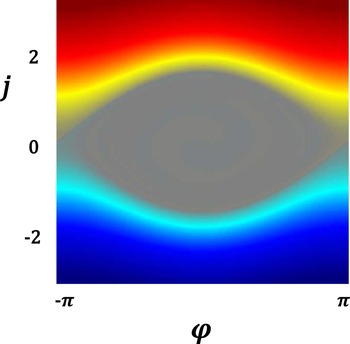
. The collisional boundary layers are now much narrower than the islands. They enclose the separatrix between the bound (or librating) and unbound (or circulating) electron motion. All the collisional dissipation occurs in these narrow boundary layers.
${{v}}_{\bot {z}}^{2}\sim {{v}}_{{e}}^{2}$
. The collisional boundary layers are now much narrower than the islands. They enclose the separatrix between the bound (or librating) and unbound (or circulating) electron motion. All the collisional dissipation occurs in these narrow boundary layers.
Contours of constant ${g}({j},{\varphi} )$
with the separatrix at h = 1. The
${g}({j},{\varphi} )$
with the separatrix at h = 1. The ${g}({j},{\varphi} )=0$
bound region is inside the separatrix. The two unbound regions are above (red and yellow) and below (dark and light blue). The separatrix is surrounded by a narrow collisional boundary layer for this
${g}({j},{\varphi} )=0$
bound region is inside the separatrix. The two unbound regions are above (red and yellow) and below (dark and light blue). The separatrix is surrounded by a narrow collisional boundary layer for this ${\varDelta} =0.001$
case. (Reprinted with permission from Hamilton et al. Reference Hamilton, Tolman, Arzamasskiy and Duarte2023.)
${\varDelta} =0.001$
case. (Reprinted with permission from Hamilton et al. Reference Hamilton, Tolman, Arzamasskiy and Duarte2023.)

The equation for g with slow temporal evolution was solved numerically by Hamilton et al. (Reference Hamilton, Tolman, Arzamasskiy and Duarte2023) for an astrophysical application. The solution is skew symmetric, satisfying ${g}({j},{\phi} )=-{g}(-{j},-{\phi} )$
. By introducing the reduced constant of the motion
${g}({j},{\phi} )=-{g}(-{j},-{\phi} )$
. By introducing the reduced constant of the motion
 \begin{align}{h}({j},{\phi} )={j}^{2}/2-\,{\cos}{\phi},\end{align}
an analytic treatment is possible for ${\varDelta} \ll 1$
. The separatrix at h = 1 is enclosed by a narrow collisional boundary layer separating the bound
${\varDelta} \ll 1$
. The separatrix at h = 1 is enclosed by a narrow collisional boundary layer separating the bound $(-1 \lt h \lt 1)$
and the unbound
$(-1 \lt h \lt 1)$
and the unbound $(h \gt 1)$
electrons. The Hamilton et al. (Reference Hamilton, Tolman, Arzamasskiy and Duarte2023)
$(h \gt 1)$
electrons. The Hamilton et al. (Reference Hamilton, Tolman, Arzamasskiy and Duarte2023) ${\varDelta} =0.001$
solution shown in their figure 2(a) is reproduced here as figure 1 with their kind permission. Its nearly imperceptibly thin collisional boundary layer enclosing the separatrix is consistent with the g solution found analytically in Catto (Reference Catto2025a
–Reference Catto
c
) and obtained as follows. By using the reduced Hamiltonian, the kinetic equation is rewritten in terms of the new variables
${\varDelta} =0.001$
solution shown in their figure 2(a) is reproduced here as figure 1 with their kind permission. Its nearly imperceptibly thin collisional boundary layer enclosing the separatrix is consistent with the g solution found analytically in Catto (Reference Catto2025a
–Reference Catto
c
) and obtained as follows. By using the reduced Hamiltonian, the kinetic equation is rewritten in terms of the new variables ${h},{\phi}$
as
${h},{\phi}$
as
 \begin{align}\left.\frac{\partial {g}}{\partial {\phi} }\right| _{{h}}={\varDelta} \left.\frac{\partial }{\partial {h}}\right| _{{\phi} }\left({j}\!\left.\frac{\partial {g}}{\partial {h}}\right| _{{\phi} }\right).\end{align}
A solution of the form ${g}={g}_{1}({h})+{g}_{2}({h},{\phi} )+\ldots$
exists in the
${g}={g}_{1}({h})+{g}_{2}({h},{\phi} )+\ldots$
exists in the ${\varDelta} \ll 1$
limit as lowest order requires
${\varDelta} \ll 1$
limit as lowest order requires $\partial {g}_{1}/\partial {\phi} | _{{h}}=0$
. To next order
$\partial {g}_{1}/\partial {\phi} | _{{h}}=0$
. To next order
 \begin{align}\left.\frac{\partial {g}_{2}}{\partial {\phi} }\right| _{{h}}={\varDelta} \left.\frac{\partial }{\partial {h}}\right| _{{\phi} }\left({j}\!\left.\frac{\partial {g}_{1}}{\partial {h}}\right| _{{\phi} }\right).\end{align}
The solution ${g}_{1}$
must satisfy the collisional solubility constraint
${g}_{1}$
must satisfy the collisional solubility constraint
 \begin{align}\frac{\partial }{\partial {h}}\bigg| _{{\phi} }\bigg[\bigg(\!\oint _{{h}}{\rm d}{\phi} {j}\bigg)\frac{\partial {g}_{1}}{\partial {h}}\bigg| _{{\phi} }\bigg]=0.\end{align}
The solution ${g}_{1}({h})$
is independent of collision frequency, but its form is collisionally constrained by the form (4.13) of the collision operator. Hamilton et al. (Reference Hamilton, Tolman, Arzamasskiy and Duarte2023) found a partial solution for
${g}_{1}({h})$
is independent of collision frequency, but its form is collisionally constrained by the form (4.13) of the collision operator. Hamilton et al. (Reference Hamilton, Tolman, Arzamasskiy and Duarte2023) found a partial solution for ${\varDelta} \ll 1$
that was completed by Catto (Reference Catto2025c
) for a stellarator transport calculation. The solution for
${\varDelta} \ll 1$
that was completed by Catto (Reference Catto2025c
) for a stellarator transport calculation. The solution for ${g}_{1}$
vanishes for bound (
${g}_{1}$
vanishes for bound ( $\sigma =0$
) orbits. For the unbound (
$\sigma =0$
) orbits. For the unbound ( $\sigma =\pm 1$
) the solution is found in terms of an integral over a complete elliptic integral E(k) of the second kind by using
$\sigma =\pm 1$
) the solution is found in terms of an integral over a complete elliptic integral E(k) of the second kind by using ${\int }_{-{\pi} }^{{\pi} }{\rm d}{\varphi} {j}=\sigma 8{k}^{-1}{E}({k})$
, with
${\int }_{-{\pi} }^{{\pi} }{\rm d}{\varphi} {j}=\sigma 8{k}^{-1}{E}({k})$
, with ${k}=\sqrt{2/({h}+1)}$
.
${k}=\sqrt{2/({h}+1)}$
.
To match to the non-resonant circulating electrons far from the separatrix ( ${k}\rightarrow 0$
or
${k}\rightarrow 0$
or ${h}\rightarrow {\infty }$
) requires
${h}\rightarrow {\infty }$
) requires ${f}_{1}\rightarrow -({eE}_{\|}\cos {\phi} /{mk}_{\|}{u})\partial {f}_{0}/\partial {u}| _{{u}=0}\rightarrow 0$
, giving
${f}_{1}\rightarrow -({eE}_{\|}\cos {\phi} /{mk}_{\|}{u})\partial {f}_{0}/\partial {u}| _{{u}=0}\rightarrow 0$
, giving ${g}_{1}\rightarrow ({u}-{\sigma} {\alpha} )\partial {f}_{0}/\partial {u}| _{{u}=0}$
. Hence,
${g}_{1}\rightarrow ({u}-{\sigma} {\alpha} )\partial {f}_{0}/\partial {u}| _{{u}=0}$
. Hence, $\partial {g}_{1}/\partial {h}| _{{\phi} }\rightarrow {\sigma} ({eE}_{\|}/2{hmk}_{\|})^{1/2}\partial {f}_{0}/\partial {u}| _{{u}=0}$
, and constant
$\partial {g}_{1}/\partial {h}| _{{\phi} }\rightarrow {\sigma} ({eE}_{\|}/2{hmk}_{\|})^{1/2}\partial {f}_{0}/\partial {u}| _{{u}=0}$
, and constant $(\oint _{{h}}{\rm d}{\phi} {j})\partial {g}_{1}/\partial {h}| _{{\phi} }$
gives
$(\oint _{{h}}{\rm d}{\phi} {j})\partial {g}_{1}/\partial {h}| _{{\phi} }$
gives
 \begin{align}\left.\frac{\partial {g}_{1}}{\partial {h}}\right| _{{\phi} }= \left(\frac{{eE}_{\|}}{{mk}_{\|}}\right)^{1/2}\frac{{\sigma} {\pi} {k}}{4{E}({k})}\frac{\partial {f}_{0}}{\partial {u}}| _{{u}=0}.\end{align}
Using ${\mathrm{d}h}=-4{\mathrm{d}k}/{k}^{3}$
to integrate from the separatrix at
${\mathrm{d}h}=-4{\mathrm{d}k}/{k}^{3}$
to integrate from the separatrix at ${k}=1$
results in
${k}=1$
results in
 \begin{align} {g}_{1} & ={\sigma} {\pi} \left(\frac{{eE}_{\|}}{{mk}_{\|}}\right)^{1/2}\frac{\partial {f}_{0}}{\partial {u}}| _{{u}=0}{\int }_{{\!\!k}}^{1}\ \frac{{{\rm d}t}}{{t}^{2}{E}({t})} \underset{{k}\rightarrow 0}{\longrightarrow }{\sigma} \left(\frac{{eE}_{\|}}{{mk}_{\|}}\right)^{1/2}\frac{\partial {f}_{0}}{\partial {u}}| _{{u}=0}\nonumber\\[5pt]& \quad \times \left[\frac{2}{{k}}-1.379-\frac{{k}}{2}+{O}({k}^{3})\right]\approx \left({u}-{\sigma} {\alpha} -\frac{{eE}_{\|}\cos {\phi} }{{mk}_{\|}{u}}\right)\frac{\partial {f}_{0}}{\partial {u}}| _{{u}=0},\end{align}
with ${j}=\pm \sqrt{2({h}+\cos {\phi} )}=\pm (2/{k})\sqrt{1-{k}^{2}{\sin}^{2}({\phi} /2)}$
, and
${j}=\pm \sqrt{2({h}+\cos {\phi} )}=\pm (2/{k})\sqrt{1-{k}^{2}{\sin}^{2}({\phi} /2)}$
, and ${\alpha} =1.379| {eE}_{\|}/{m}{{k}_{\|}}| ^{1/2}$
now determined. The unbound solution satisfies
${\alpha} =1.379| {eE}_{\|}/{m}{{k}_{\|}}| ^{1/2}$
now determined. The unbound solution satisfies ${g}_{1}\rightarrow 0$
at the separatrix (h = 1 = k), but
${g}_{1}\rightarrow 0$
at the separatrix (h = 1 = k), but $\partial {g}_{1}/\partial {h}| _{{\phi} }$
steps across it. The narrow, unresolved collisional boundary layer about the separatrix provides the smooth matching.
$\partial {g}_{1}/\partial {h}| _{{\phi} }$
steps across it. The narrow, unresolved collisional boundary layer about the separatrix provides the smooth matching.
The power loss/absorption is once again evaluated using ${P}=-{eE}_{\|}\langle \sin {\phi} \int$ ${d}^{3}{vv}_{\|}{f}_{1}\rangle _{{\phi} }$
. The details differ only very slightly from a recent lower hybrid current drive (Catto Reference Catto2025b
) and plasma wave evaluation for an unmagnetised plasma (Catto Reference Catto2025a
). Skew symmetry gives
${d}^{3}{vv}_{\|}{f}_{1}\rangle _{{\phi} }$
. The details differ only very slightly from a recent lower hybrid current drive (Catto Reference Catto2025b
) and plasma wave evaluation for an unmagnetised plasma (Catto Reference Catto2025a
). Skew symmetry gives $\langle {\int }_{\!\!\!-{\infty }}^{{\infty }}{{\rm d}uu\sin}{\phi} {f}_{1}({u},{\phi} )\rangle _{{\phi} }=0$
. Using
$\langle {\int }_{\!\!\!-{\infty }}^{{\infty }}{{\rm d}uu\sin}{\phi} {f}_{1}({u},{\phi} )\rangle _{{\phi} }=0$
. Using $2\sin {\phi} =-{{\rm d}j}^{2}/{\rm d}{\phi} | _{{h}}$
at fixed h to integrate by parts, and inserting the kinetic equation leads to
$2\sin {\phi} =-{{\rm d}j}^{2}/{\rm d}{\phi} | _{{h}}$
at fixed h to integrate by parts, and inserting the kinetic equation leads to
 \begin{align}{P} & =\frac{{\omega} {eE}_{\|}}{2{k}_{\|}}\left\langle \int {\mathrm{d}}^{3}{vf}_{\!1}\!\left.\frac{{{\rm d}j}^{2}}{{\rm d}{\phi} }\right| _{{h}}\right\rangle _{{\phi} }=-\frac{{\omega} {eE}_{\|}}{2{k}_{\|}}\left\langle \int {\mathrm{d}}^{3}{vj}^{2}\!\left.\frac{\partial {g}_{2}}{\partial {\phi} }\right| _{{h}}\right\rangle _{{\phi} }\nonumber\\& =-\frac{{\omega} {eE}_{\|}}{2{k}_{\|}}\left\langle \int {\mathrm{d}}^{3}{v}{\Delta} {j}^{2}\!\left.\frac{\partial }{\partial {h}}\right| _{{\phi} }\left({j}\!\left.\frac{\partial {g}_{1}}{\partial {h}}\right| _{{\phi} }\right)\right\rangle _{{\phi} }.\end{align}
To perform the u or j velocity space integral use
 \begin{align}\left\langle {\int}^{\infty}_{\!\!\!-\infty}{{\rm d}\kern1pt\textit{jj}}^{2}\!\left.\frac{\partial }{\partial {h}}\right| _{{\phi} }{j}\!\left.\frac{\partial {g}_{1}}{\partial {h}}\right| _{{\phi} }\right\rangle _{{\phi} }\!=2\left\langle {\int }_{\!\!\!1}^{{\infty }}{\mathrm{d}hj}\!\left.\frac{\partial }{\partial {h}}\right| _{{\phi} }{j}\!\left.\frac{\partial {g}_{1}}{\partial {h}}\right| _{{\phi} }\right\rangle _{{\phi} }\!=0.384\left(\frac{{eE}_{\|}}{{mk}_{\|}}\right)^{1/2}\frac{\partial {f}_{0}}{\partial {u}}| _{{u}=0}.\end{align}
Using $\mathrm{d}^{3}{v}\rightarrow 2{\pi} {v}_{\bot }{{\rm d}v}_{\bot }{{\rm d}j}/({{\rm d}j}/{{\rm d}u})$
, recalling (2.12) and noticing this bump on tail case is just a very minor modification of the plasma wave result of Catto (Reference Catto2025a
) gives the power loss
$\mathrm{d}^{3}{v}\rightarrow 2{\pi} {v}_{\bot }{{\rm d}v}_{\bot }{{\rm d}j}/({{\rm d}j}/{{\rm d}u})$
, recalling (2.12) and noticing this bump on tail case is just a very minor modification of the plasma wave result of Catto (Reference Catto2025a
) gives the power loss $(P \gt 0)$
or absorbed
$(P \gt 0)$
or absorbed $(P \lt 0)$
by the decaying or growing plasma wave as
$(P \lt 0)$
by the decaying or growing plasma wave as
 \begin{align}{P}\approx 0.144({Z}+2){mn}{{v}}_{{e}}^{2}{\nu}_{{ee}}\left(\frac{{eE}_{\|}{k}_{\|}}{{m}{\omega} ^{2}}\right)^{1/2}\left[{e}^{-{{\omega} ^{2}}/{{k}}_{\|}^{2}{{v}}_{{e}}^{2}}-\frac{{\Gamma} {k}_{\|}{{v}}_{{e}}^{3}}{{n}{\omega} {{v}}_{{b}}^{3}}{e}^{-({V}-{\omega} /{{k}_{\|}}{)^{2}}/{{v}}_{{b}}^{2}}\right]\!,\end{align}
and the nonlinear or island limit growth/damping rate as
 \begin{align}{\gamma} =0.144\left({Z}+2\right){\nu}_{{ee}}\left(\frac{{m}{{v}}_{{e}}^{2}{k}_{\|}}{{eE}_{\|}}\right)^{3/2}\frac{{{\omega} }_{{p}}^{2}}{{\omega} ^{2}}\left[\frac{{\Gamma} {{v}}_{{e}}^{2}}{{n}{{v}}_{{b}}^{3}}{e}^{-({V}-{\omega} /{{k}_{\|}}{)^{2}}/{{v}}_{{b}}^{2}}-\frac{{\omega} }{{k}_{\|}{v}_{{e}}}{e}^{-{{\omega} ^{2}}/{{k}}_{\|}^{2}{{v}}_{{e}}^{2}}\right]\!,\end{align}
where ${\omega} ^{2}={{\omega} }_{{p}}^{2}+3{{k}}_{\|}^{2}{{v}}_{{e}}^{2}/2$
. The ratio of the island over the plateau power transfer is
${\omega} ^{2}={{\omega} }_{{p}}^{2}+3{{k}}_{\|}^{2}{{v}}_{{e}}^{2}/2$
. The ratio of the island over the plateau power transfer is
 \begin{align}\frac{{P}}{{P}_{0}}\approx 0.081\left({Z}+2\right)\frac{{{k}}_{\|}^{3}{{v}}_{{e}}^{3}}{{\omega} ^{3}}\frac{{\nu}_{{ee}}/{k}_{\|}{v}_{{e}}}{\big({eE}_{\|}/{mk}_{\|}{{v}}_{{e}}^{2}\big)^{3/2}}\sim \frac{({\Delta} {v}_{\|}{)}_{{\nu}}^{3}}{({\Delta} {v}_{\|}{)}_{\textit{is}}^{3}},\end{align}
and, therefore, the power loss/absorption is reduced as the collisional layer shrinks.
Unlike the earlier plateau result, there is an explicit dependence on collisions and electric field amplitude ${E}_{\|}$
,
${E}_{\|}$
, ${\gamma} \propto {\nu}_{{ee}}/{{E}}_{\|}^{3/2}$
, in the vanishingly small collision frequency limit for a finite amplitude plasma wave. Compared with the plateau limit, this weak collisionality, finite amplitude limit, requires a much longer time for bump on tail instability wave growth when
${\gamma} \propto {\nu}_{{ee}}/{{E}}_{\|}^{3/2}$
, in the vanishingly small collision frequency limit for a finite amplitude plasma wave. Compared with the plateau limit, this weak collisionality, finite amplitude limit, requires a much longer time for bump on tail instability wave growth when ${\Gamma} {{v}}_{{e}}^{2}{{e}^{-({V}-{\omega} /{{k}_{\|}}{)^{2}}/{{v}}_{{b}}^{2}}}/{n}{{v}}_{{b}}^{3}\gt ({\omega} /{{k}_{\|}}{{v}_{{e}}}){e}^{-{{\omega} ^{2}}/{{k}}_{\|}^{2}{{v}}_{{e}}^{2}}$
and
${\Gamma} {{v}}_{{e}}^{2}{{e}^{-({V}-{\omega} /{{k}_{\|}}{)^{2}}/{{v}}_{{b}}^{2}}}/{n}{{v}}_{{b}}^{3}\gt ({\omega} /{{k}_{\|}}{{v}_{{e}}}){e}^{-{{\omega} ^{2}}/{{k}}_{\|}^{2}{{v}}_{{e}}^{2}}$
and ${V}\approx {\omega} /{k}_{\|}$
. Similarly, collisional decay of a stable plasma wave occurs very slowly when
${V}\approx {\omega} /{k}_{\|}$
. Similarly, collisional decay of a stable plasma wave occurs very slowly when ${\Gamma} {{v}}_{{e}}^{2}{{e}^{-({V}-{\omega} /{{k}_{\|}}{)^{2}}/{{v}}_{{b}}^{2}}}/{{nv}}_{{b}}^{3}\lt ({\omega} /{{k}_{\|}}{{v}_{{e}}}){e}^{-{{\omega} ^{2}}/{{k}}_{\|}^{2}{{v}}_{{e}}^{2}}\ll 1$
. It is important to realise there is no limit in which
${\Gamma} {{v}}_{{e}}^{2}{{e}^{-({V}-{\omega} /{{k}_{\|}}{)^{2}}/{{v}}_{{b}}^{2}}}/{{nv}}_{{b}}^{3}\lt ({\omega} /{{k}_{\|}}{{v}_{{e}}}){e}^{-{{\omega} ^{2}}/{{k}}_{\|}^{2}{{v}}_{{e}}^{2}}\ll 1$
. It is important to realise there is no limit in which ${\nu}_{{ee}}=0$
may be assumed at the onset! As
${\nu}_{{ee}}=0$
may be assumed at the onset! As ${\nu}_{{ee}}\rightarrow 0$
the very small growth or damping rate in this limit might look somewhat like saturation for a single wave. For comparison, the long time, collisionless phase mixing limit of O’Neil (Reference O’neil1965) gives a vanishing damping rate in (34), rather than
${\nu}_{{ee}}\rightarrow 0$
the very small growth or damping rate in this limit might look somewhat like saturation for a single wave. For comparison, the long time, collisionless phase mixing limit of O’Neil (Reference O’neil1965) gives a vanishing damping rate in (34), rather than ${{\gamma} \propto {\nu}_{{ee}}{E}}_{\|}^{-3/2}$
.
${{\gamma} \propto {\nu}_{{ee}}{E}}_{\|}^{-3/2}$
.
In this large island width, weak collision limit ${f}_{1}\sim [{eE}_{\|}/{mk}_{\|}({\Delta} {v}_{\|})_{\textit{is}}]\partial {f}_{0}/\partial {u}| _{{u}=0}$
and
${f}_{1}\sim [{eE}_{\|}/{mk}_{\|}({\Delta} {v}_{\|})_{\textit{is}}]\partial {f}_{0}/\partial {u}| _{{u}=0}$
and
 \begin{align}\frac{\partial {f}_{1}/\partial {u}}{\partial {f}_{0}/\partial {u}}\sim \frac{{v}_{{e}}{f}_{1}}{({\Delta} {v}_{\|})_{\textit{is}}{f}_{0}}\sim \frac{{eE}_{\|}/{mk}_{\|}{{v}}_{{e}}^{2}}{({\Delta} {v}_{\|}{)}_{\textit{is}}^{2}}\sim 1\end{align}
as expected, and the effective collision frequency is ${\nu}_{\textit{eff}}\sim {\nu}{{v}}_{{e}}^{2}/({\Delta} {v}_{\|}{)}_{\textit{is}}^{2}\sim {\nu}{{v}}_{{e}}^{2}({mk}_{\|}/{eE}_{\|})$
. The step size
${\nu}_{\textit{eff}}\sim {\nu}{{v}}_{{e}}^{2}/({\Delta} {v}_{\|}{)}_{\textit{is}}^{2}\sim {\nu}{{v}}_{{e}}^{2}({mk}_{\|}/{eE}_{\|})$
. The step size ${eE}_{\|}/{m}{\nu}_{\textit{eff}}\sim ({\Delta} {v}_{\|})_{\textit{is}}/{\varDelta}$
is many island widths
${eE}_{\|}/{m}{\nu}_{\textit{eff}}\sim ({\Delta} {v}_{\|})_{\textit{is}}/{\varDelta}$
is many island widths $({\Delta} {v}_{\|})_{\textit{is}}\sim ({eE}_{\|}/{mk}_{\|})^{1/2}$
as
$({\Delta} {v}_{\|})_{\textit{is}}\sim ({eE}_{\|}/{mk}_{\|})^{1/2}$
as ${\varDelta} \ll 1$
. For many modes instead of a single mode, there will be large velocity space diffusion due to collisionally stochastic electron motion in the overlapping islands having narrow collisional dissipation regions enclosing their separatrices. The nonlinear island diffusivity is
${\varDelta} \ll 1$
. For many modes instead of a single mode, there will be large velocity space diffusion due to collisionally stochastic electron motion in the overlapping islands having narrow collisional dissipation regions enclosing their separatrices. The nonlinear island diffusivity is
 \begin{align}{D}_{\textit{is}}\sim {\nu}_{\textit{eff}}({eE}_{\|}/{m}{\nu}_{\textit{eff}})^{2}\sim ({eE}_{\|}/{m})^{3}/{\nu}{{v}}_{{e}}^{2}{k}_{\|},\end{align}
giving
 \begin{align}\frac{{D}_{\textit{is}}}{{D}_{{\nu}}}\sim \frac{({eE}_{\|}/{m})^{3}}{{\nu}^{2}{{v}}_{{e}}^{4}{k}_{\|}}\sim \left(\frac{{eE}_{\|}}{{mk}_{\|}{{v}}_{{e}}^{2}}\right)^{3}\left(\frac{{k}_{\|}{v}_{{e}}}{{\nu}}\right)^{2}\sim \frac{({\Delta} {v}_{\|}{)}_{\textit{is}}^{6}}{({\Delta} {v}_{\|}{)}_{{\nu}}^{6}}\gg 1,\end{align}
which is seen to be large. Consequently, it is only when the $\partial {f}_{1}/\partial {u}$
term as well as collisions are retained in the kinetic equation that islands with narrow dissipative separatrices lead to stochastic diffusivity competing with,
$\partial {f}_{1}/\partial {u}$
term as well as collisions are retained in the kinetic equation that islands with narrow dissipative separatrices lead to stochastic diffusivity competing with, $({\Delta} {v}_{\|})_{\textit{is}}\sim ({\Delta} {v}_{\|})_{{\nu}}$
, or dominating over,
$({\Delta} {v}_{\|})_{\textit{is}}\sim ({\Delta} {v}_{\|})_{{\nu}}$
, or dominating over, $({\Delta} {v}_{\|})_{\textit{is}}\gg ({\Delta} {v}_{\|})_{{\nu}}$
, Fokker–Planck diffusion (
$({\Delta} {v}_{\|})_{\textit{is}}\gg ({\Delta} {v}_{\|})_{{\nu}}$
, Fokker–Planck diffusion ( ${D}_{{\nu}}\sim {\nu}{{v}}_{{e}}^{2}$
), and perhaps even allowing the many plasma waves to locally modify
${D}_{{\nu}}\sim {\nu}{{v}}_{{e}}^{2}$
), and perhaps even allowing the many plasma waves to locally modify ${f}_{0}$
away its initial form in velocity space.
${f}_{0}$
away its initial form in velocity space.
5. Discussion
Collisions are the mechanism by which energy is transferred from (to) the electrons to (from) a growing (damped) wave. To properly treat this transfer, the details of the collisional boundary layers need to be resolved (as in the single mode limit). The combined collisional and nonlinear island generation mechanism smears the fine structure associated with phase mixing and properly treats the energy transfer between the plasma wave and the electrons. Consequently, in simulations it may sometimes be necessary to resolve the details of the resonances and islands rather than introducing artificial damping. The sensitivity of $({\Delta} {v}_{\|})_{{\nu}}$
,
$({\Delta} {v}_{\|})_{{\nu}}$
, $({\Delta} {v}_{\|})_{\textit{is}}$
and phase
$({\Delta} {v}_{\|})_{\textit{is}}$
and phase ${\phi} ={k}_{\|}{z}-{\omega} {t}$
for a single mode, to wavenumber and frequency implies there is fine structure in phase as well velocity space, due to collisions providing stochasticity in the boundary layers enclosing island separatrices and/or resonances as well as smearing linear phase mixing. As a result, once there are many overlapping modes, with enough islands of width
${\phi} ={k}_{\|}{z}-{\omega} {t}$
for a single mode, to wavenumber and frequency implies there is fine structure in phase as well velocity space, due to collisions providing stochasticity in the boundary layers enclosing island separatrices and/or resonances as well as smearing linear phase mixing. As a result, once there are many overlapping modes, with enough islands of width $({\Delta} {v}_{\|})_{\textit{is}}$
and collisional boundary layers of width
$({\Delta} {v}_{\|})_{\textit{is}}$
and collisional boundary layers of width $({\Delta} {v}_{\|})_{{\nu}}$
, neighbouring resonances provide a route to collisionally enhance diffusion because of all the collisionally generated fine scale velocity and phase structure associated with collisional boundary layers.
$({\Delta} {v}_{\|})_{{\nu}}$
, neighbouring resonances provide a route to collisionally enhance diffusion because of all the collisionally generated fine scale velocity and phase structure associated with collisional boundary layers.
Summarising the key points, the overarching message and perhaps surprising result is that collisions always matter when there is a small, localised bump on tail distribution. In the very weak collision, finite amplitude limit when the velocity space island width is larger than the collisional boundary layer width the nonlinear or island growth/damping rate (4.19) is proportional to the collision frequency divided by the plasma wave amplitude to the three halves power. In the more collisional plateau limit where the velocity space collisional boundary layer is wider than the island width, the expected linear growth/damping rate (3.14) independent of collision frequency is recovered even though collisions are vital. The last finding is in line with the usual Penrose (Reference Penrose1960) picture, but the physical basis for growth/damping is collisional rather than collisionless. Finally, perhaps the realisation collisions always play a key role in stochasticity whenever resonances and/or islands occur means that, when there are many resonant modes interacting, they provide a clear path to enhance the effect of collisions by allowing small scale velocity space diffusive effects to enter directly, provided collisions are carefully treated and wave–particle resonances fully resolved.
Acknowledgements
The author is grateful to A. Schekochihin for extended, discerning and stimulating discussions and to M. Barnes for interest, insight and supportive conversations during a visit to the Rudolf Peierls Centre for Theoretical Physics at Oxford University, where a significant portion of the work was performed. He is grateful for the incomparable hospitality of Merton College during his October 2025 visit. Once again, the author is grateful to the JPP reviewers for their suggestions that noticeably improved the presentation. This work was supported by the U.S. Department of Energy under contract number DE-FG02-91ER-54109. The United States Government retains a non-exclusive, paid-up, irrevocable, worldwide licence to publish or reproduce the published form of this manuscript, or allow others to do so, for United States Government purposes.
Editor Alex Schekochihin thanks the referees for their advice in evaluating this article.
Declaration of interests
The authors report no conflict of interest.
Appendix A. The Z function replacement
The Z function of conventional linear theory,
 \begin{align}{Z}({\varsigma})={\pi} ^{-1/2}{\int }_{\!\!\!-{\infty }}^{{\infty }}\frac{{{\rm d}ue}^{-{{u{2}}}}}{{u}-{\varsigma} }\underset{{\varsigma} \rightarrow \text{ real}}{\rightarrow }{e}^{-{{\varsigma} ^{2}}}\left[{i}\sqrt{{\pi} }-2{\int }_{\!\!\!0}^{{\varsigma} }{{\rm d}ue}^{{{u{2}}}}\right],\end{align}
with ${\varsigma} ={\omega} /| {k}_{\|}| {v}_{{e}}$
and
${\varsigma} ={\omega} /| {k}_{\|}| {v}_{{e}}$
and $\mathrm{Im}({\varsigma} )\gt 0$
, no longer appears once collisions have to be retained. Making the replacement
$\mathrm{Im}({\varsigma} )\gt 0$
, no longer appears once collisions have to be retained. Making the replacement
 \begin{align}1/({u}-{\varsigma})\underset{{\varsigma} \rightarrow \text{ real}}{\rightarrow }{i}{\Upsilon} {\int }_{\!\!\!0}^{{\infty }}{\rm d}{\tau} {e}^{-{i}({u}-{\varsigma} ){\Upsilon} {\tau} -{{\tau} ^{3}}/3}\end{align}
leads to the collisional replacement
 \begin{align}{Z}_{{\nu}}({\varsigma} )={i}{\pi} ^{-1/2}{\Upsilon} {\int }_{\!\!\!0}^{{\infty }}{\rm d}{\tau} {e}^{-{{\tau} ^{3}}/3}{\int }_{\!\!\!-{\infty }}^{{\infty }}{{\rm d}ue}^{-{{u{2}}}-{i}({u}-{\varsigma} ){\Upsilon} {\tau} },\end{align}
where, for the collision operator used here, ${\Upsilon} =| {k}_{\|}| ^{1/3}{v}_{{e}}/{{v}}_{\bot {z}}^{2/3}{\nu}^{1/3}$
. The collisional replacement (A2) for
${\Upsilon} =| {k}_{\|}| ^{1/3}{v}_{{e}}/{{v}}_{\bot {z}}^{2/3}{\nu}^{1/3}$
. The collisional replacement (A2) for $1/({u}-{\varsigma} )$
is valid near and away from resonance. Letting
$1/({u}-{\varsigma} )$
is valid near and away from resonance. Letting ${U}=({u}-{\varsigma} ){\Upsilon}$
and integrating from
${U}=({u}-{\varsigma} ){\Upsilon}$
and integrating from $-{U}_{0}$
to
$-{U}_{0}$
to ${U}_{0}\gg {\Upsilon} \gg 1$
leads to the imaginary part
${U}_{0}\gg {\Upsilon} \gg 1$
leads to the imaginary part
 \begin{align}\mathrm{Im}[{Z}_{{\nu}}({\varsigma})] & \approx \mathrm{Im}\!\left[\frac{{ie}^{-{{\varsigma} ^{2}}}}{\sqrt{{\pi} }}{\int }_{\!\!\!0}^{{\infty }}{\rm d}{\tau} {e}^{-{{\tau} ^{3}}/{3}}{\int }_{\!\!\!-{U}_{0}}^{{U}_{0}}{\mathrm{d}Ue}^{-{iU}{\tau} }\right]\nonumber\\[5pt]& =\mathrm{Im}\!\left[\frac{2{ie}^{-{{\varsigma} ^{2}}}}{\sqrt{{\pi} }}{\int }_{\!\!\!0}^{{\infty }}\frac{{\rm d}{\tau} }{{\tau} }{e}^{-{{\tau} ^{3}}/{3}}\sin ({U}_{0}{\tau})\right]\approx \sqrt{{\pi} }{e}^{-{{\varsigma} ^{2}}},\end{align}
as desired. For the real part, all that is required is to let ${\Xi} ={\Upsilon} \tau$
and use
${\Xi} ={\Upsilon} \tau$
and use ${\Upsilon} \gg 1$
 \begin{align}\mathrm{Re}[{Z}_{{\nu}}({\varsigma} )] & =\mathrm{Re}\left[\frac{{i}}{\sqrt{{\pi} }}{\int }_{\!\!\!-{\infty }}^{{\infty }}{{\rm d}ue}^{-{{u{2}}}}{\int }_{\!\!\!0}^{{\infty }}{\rm d}{\Xi} {e}^{-{{\Xi} ^{3}}/3{{\Upsilon} ^{3}}-{i}({u}-{\varsigma} ){\Xi} }\right]\approx {PV}\left[\frac{1}{\sqrt{{\pi} }}{\int }_{\!\!\!-{\infty }}^{{\infty }}\frac{{{\rm d}ue}^{-{{u{2}}}}}{{u}-{\varsigma} }\right]\nonumber\\[5pt]& ={PV}[{Z}({\varsigma} )],\end{align}
with PV denoting the principal value of the usual Z function. Collisions provide the proper treatment of the resonance in $\mathrm{Im}[{Z}_{{\nu}}({\varsigma} )]$
to resolve the singularity, while collisions are not needed in
$\mathrm{Im}[{Z}_{{\nu}}({\varsigma} )]$
to resolve the singularity, while collisions are not needed in $\mathrm{Re}[{Z}_{{\nu}}({\varsigma} )]$
as only the principal value matters. The details of the collision operator that pertains will alter
$\mathrm{Re}[{Z}_{{\nu}}({\varsigma} )]$
as only the principal value matters. The details of the collision operator that pertains will alter ${\Upsilon}$
, but these details are unimportant for the linear solution.
${\Upsilon}$
, but these details are unimportant for the linear solution.
The full electron plasma wave dispersion relation from Poisson’s equation with collisions retained is the same as the usual collisionless linear form to the requisite order
 \begin{align}\frac{{{k}}_{\|}^{2}{{v}}_{{e}}^{2}}{{{\omega} }_{{p}}^{2}} & =-2[1+{\varsigma} {Z}_{{\nu}}({\varsigma})]\rightarrow -2[1+{\varsigma} {Z}({\varsigma})]\underset{{\varsigma} \gg 1}{\rightarrow }\frac{{{k}}_{\|}^{2}{{v}}_{{e}}^{2}}{{\omega} ^{2}}\left(1+\frac{3{{k}}_{\|}^{2}{{v}}_{{e}}^{2}}{2{\omega} ^{2}}+\ldots \right)\nonumber\\[5pt]& \quad -{i}\frac{2\sqrt{{\pi} }{\omega} }{| {k}_{\|}| {v}_{{e}}}{e}^{-{{\omega} ^{2}}/{{k}}_{\|}^{2}{{v}}_{{e}}^{2}}.\end{align}
With the bump on tail retained, the imaginary part is altered by replacement (3.14).

 g(j,φ)
 g(j,φ)=0
 Δ=0.001
 Open access

