





1 Introduction
Let $m, n, c \in \mathbb {Z}$
with
$m, n, c \in \mathbb {Z}$
with $c \ge 1$
, and consider the classical Kloosterman sums
$c \ge 1$
, and consider the classical Kloosterman sums
 $$ \begin{align} S(m, n; c) := \sum_{x \in (\mathbb{Z}/c\mathbb{Z})^\times} e\left(\frac{mx + n\bar{x}}{c}\right), \end{align} $$
where $e(\alpha ) := \exp (2\pi i \alpha )$
and
$e(\alpha ) := \exp (2\pi i \alpha )$
and $x\bar {x} \equiv 1 \pmod {c}$
. A great number of results in analytic number theory, particularly on the distribution of primes [Reference Bombieri, Friedlander and Iwaniec2, Reference Maynard34, Reference Maynard35, Reference Maynard36, Reference Deshouillers and Iwaniec9, Reference de La Bretèche and Drappeau8, Reference Merikoski37, Reference Lichtman32] and properties of Dirichlet L-functions [Reference Deshouillers and Iwaniec11, Reference Deshouillers and Iwaniec12, Reference Watt46, Reference Young48, Reference Drappeau, Pratt and Radziwiłł15, Reference Topacogullari45], rely on bounding exponential sums of the form
$x\bar {x} \equiv 1 \pmod {c}$
. A great number of results in analytic number theory, particularly on the distribution of primes [Reference Bombieri, Friedlander and Iwaniec2, Reference Maynard34, Reference Maynard35, Reference Maynard36, Reference Deshouillers and Iwaniec9, Reference de La Bretèche and Drappeau8, Reference Merikoski37, Reference Lichtman32] and properties of Dirichlet L-functions [Reference Deshouillers and Iwaniec11, Reference Deshouillers and Iwaniec12, Reference Watt46, Reference Young48, Reference Drappeau, Pratt and Radziwiłł15, Reference Topacogullari45], rely on bounding exponential sums of the form
 $$ \begin{align} \sum_{m \sim M} a_m \sum_{n \sim N} b_n \sum_{(c, r) = 1} g\left(\frac{c}{C}\right) S(m\bar{r}, \pm n; sc), \end{align} $$
where $(a_m)$
and
$(a_m)$
and $(b_n)$
are rough sequences of complex numbers, g is a compactly-supported smooth function, and
$(b_n)$
are rough sequences of complex numbers, g is a compactly-supported smooth function, and $r, s$
are coprime positive integers. One can often (but not always [Reference Merikoski37, Reference de La Bretèche and Drappeau8, Reference Maynard34]) leverage some additional averaging over r and s, if one of the sequences
$r, s$
are coprime positive integers. One can often (but not always [Reference Merikoski37, Reference de La Bretèche and Drappeau8, Reference Maynard34]) leverage some additional averaging over r and s, if one of the sequences $(a_m), (b_n)$
is independent of
$(a_m), (b_n)$
is independent of $r, s$
.
$r, s$
.
Estimates for sums like (1.2) are typically obtained via the spectral theory of automorphic forms [Reference Iwaniec25, Reference Iwaniec24], following Deshouillers–Iwaniec [Reference Deshouillers and Iwaniec10]; this allows one to bound (1.2) by certain averages of the sequences $(a_m)$
,
$(a_m)$
, $(b_n)$
with the Fourier coefficients of automorphic forms for
$(b_n)$
with the Fourier coefficients of automorphic forms for $\Gamma _0(rs)$
. Often in applications, the limitation in these bounds comes from our inability to rule out the existence of exceptional Maass cusp forms, corresponding to exceptional eigenvalues
$\Gamma _0(rs)$
. Often in applications, the limitation in these bounds comes from our inability to rule out the existence of exceptional Maass cusp forms, corresponding to exceptional eigenvalues $\lambda \in (0, \tfrac {1}{4})$
of the hyperbolic Laplacian. This is measured by a parameter
$\lambda \in (0, \tfrac {1}{4})$
of the hyperbolic Laplacian. This is measured by a parameter $\theta = \max _\lambda \max (0, \tfrac {1}{4} - \lambda )^{1/2}$
; under Selberg’s eigenvalue conjecture there would be no exceptional eigenvalues [Reference Selberg41], so one could take
$\theta = \max _\lambda \max (0, \tfrac {1}{4} - \lambda )^{1/2}$
; under Selberg’s eigenvalue conjecture there would be no exceptional eigenvalues [Reference Selberg41], so one could take $\theta = 0$
. But unconditionally, the record is Kim–Sarnak’s bound
$\theta = 0$
. But unconditionally, the record is Kim–Sarnak’s bound $\theta \le \tfrac {7}{64}$
, based on the automorphy of symmetric fourth power L-functions [Reference Kim28, Appendix 2].
$\theta \le \tfrac {7}{64}$
, based on the automorphy of symmetric fourth power L-functions [Reference Kim28, Appendix 2].
This creates a power-saving gap between the best conditional and unconditional results in various arithmetic problems, for example, on the prime factors of quadratic polynomials [Reference de La Bretèche and Drappeau8, Reference Merikoski37], the exponents of distribution of primes [Reference Lichtman32] and smooth numbers [Reference Pascadi39] in arithmetic progressions, and low-lying zeros of Dirichlet L-functions [Reference Drappeau, Pratt and Radziwiłł15]. Improvements to the dependency on $\theta $
, which help narrow this gap, come from large sieve inequalities for the Fourier coefficients of exceptional Maass cusp forms (see [Reference Deshouillers and Iwaniec10, Theorems 5, 6, 7] and their optimizations in [Reference Drappeau14, Reference Assing, Blomer and Li1, Reference Lichtman32, Reference Pascadi39]), which function as weak on-average substitutes for Selberg’s eigenvalue conjecture. However, in the key setting of fixed
$\theta $
, which help narrow this gap, come from large sieve inequalities for the Fourier coefficients of exceptional Maass cusp forms (see [Reference Deshouillers and Iwaniec10, Theorems 5, 6, 7] and their optimizations in [Reference Drappeau14, Reference Assing, Blomer and Li1, Reference Lichtman32, Reference Pascadi39]), which function as weak on-average substitutes for Selberg’s eigenvalue conjecture. However, in the key setting of fixed $r, s$
and sequences
$r, s$
and sequences $(a_n)$
of length
$(a_n)$
of length $N \approx rs$
, no such savings were previously available.
$N \approx rs$
, no such savings were previously available.
Luckily, for many of the most important applications, we don’t need to handle (1.2) for completely arbitrary sequences, but only for those arising from variations of Linnik’s dispersion method [Reference Linnik33, Reference Friedlander and Iwaniec18, Reference Bombieri, Friedlander and Iwaniec2, Reference Bombieri, Friedlander and Iwaniec3, Reference Bombieri, Friedlander and Iwaniec4]; these often have the rough form
 $$ \begin{align} a_m = e(m\alpha) \qquad\qquad \text{and} \qquad\qquad b_n = \sum_{\substack{h_1, h_2 \sim H \\ h_1\ell_1 - h_2\ell_2 = n}} 1, \end{align} $$
for $\alpha \in \mathbb {R}/\mathbb {Z}$
and
$\alpha \in \mathbb {R}/\mathbb {Z}$
and $\ell _1 \asymp \ell _2 \gg H$
with
$\ell _1 \asymp \ell _2 \gg H$
with $(\ell _1, \ell _2) = 1$
. Our main results in this paper are new large sieve inequalities for such sequences, with Fourier transforms that obey strong concentration conditions. These are obtained by combining the framework of Deshouillers–Iwaniec with combinatorial ideas – specifically, with new estimates for bilinear sums of Kloosterman sums, stemming from a counting argument of Cilleruelo–Garaev [Reference Cilleruelo and Garaev7]. The resulting improved bounds for (1.2) can then feed through to the strongest results on several well-studied arithmetic problems.
$(\ell _1, \ell _2) = 1$
. Our main results in this paper are new large sieve inequalities for such sequences, with Fourier transforms that obey strong concentration conditions. These are obtained by combining the framework of Deshouillers–Iwaniec with combinatorial ideas – specifically, with new estimates for bilinear sums of Kloosterman sums, stemming from a counting argument of Cilleruelo–Garaev [Reference Cilleruelo and Garaev7]. The resulting improved bounds for (1.2) can then feed through to the strongest results on several well-studied arithmetic problems.
Figure 1 summarizes the results outlined above, which go from counting problems (on the top row), to exponential sums (middle row), to automorphic forms (bottom row), and then backwards. The transition between the first two rows is mostly elementary (using successive applications of Poisson summation, Cauchy–Schwarz, combinatorial decompositions, and/or sieve methods), while the transition between the last two rows uses the Kuznetsov trace formula [Reference Kuznetsov31, Reference Deshouillers and Iwaniec10].
Structure of paper (arrows signify logical implications).

Before we dive into the large sieve inequalities, let us motivate our discussion with applications.
Theorem 1.1. For infinitely many $n \in \mathbb {Z}_+$
, the greatest prime factor of
$n \in \mathbb {Z}_+$
, the greatest prime factor of $n^2+1$
is larger than
$n^2+1$
is larger than $n^{1.3}$
.
$n^{1.3}$
.
This result makes progress on a longstanding problem, approximating the famous conjecture that there exist infinitely many primes of the form $n^2+1$
. Back in 1967, Hooley [Reference Hooley23] proved the same result with an exponent of
$n^2+1$
. Back in 1967, Hooley [Reference Hooley23] proved the same result with an exponent of $1.1001$
, using the Weil bound for Kloosterman sums. In 1982, Deshouillers–Iwaniec [Reference Deshouillers and Iwaniec9] used their bounds on multilinear forms of Kloosterman sums [Reference Deshouillers and Iwaniec10] to improve this substantially, up to an exponent of
$1.1001$
, using the Weil bound for Kloosterman sums. In 1982, Deshouillers–Iwaniec [Reference Deshouillers and Iwaniec9] used their bounds on multilinear forms of Kloosterman sums [Reference Deshouillers and Iwaniec10] to improve this substantially, up to an exponent of $1.2024$
. More recently, using Kim–Sarnak’s bound
$1.2024$
. More recently, using Kim–Sarnak’s bound $\theta \le \tfrac {7}{64}$
[Reference Kim28, Appendix 2], de la Bretèche and Drappeau [Reference de La Bretèche and Drappeau8] optimized the exponent to
$\theta \le \tfrac {7}{64}$
[Reference Kim28, Appendix 2], de la Bretèche and Drappeau [Reference de La Bretèche and Drappeau8] optimized the exponent to $1.2182$
. Finally, Merikoski [Reference Merikoski37] proved a new bilinear estimate (still relying on the bounds of Deshouillers–Iwaniec [Reference Deshouillers and Iwaniec10]), and used Harman’s sieve to reach the exponent
$1.2182$
. Finally, Merikoski [Reference Merikoski37] proved a new bilinear estimate (still relying on the bounds of Deshouillers–Iwaniec [Reference Deshouillers and Iwaniec10]), and used Harman’s sieve to reach the exponent $1.279$
; assuming Selberg’s eigenvalue conjecture, Merikoski also reached the conditional exponent
$1.279$
; assuming Selberg’s eigenvalue conjecture, Merikoski also reached the conditional exponent $1.312$
. With our new large sieve inequalities (Theorems 1.5 and 1.7), we can improve the arithmetic information due to both Merikoski [Reference Merikoski37] and de la Bretèche–Drappeau [Reference de La Bretèche and Drappeau8], leading to the unconditional result in Theorem 1.1. As in [Reference Merikoski37, Reference de La Bretèche and Drappeau8], by adapting our proof, it should be possible to obtain similar results for other irreducible quadratic polynomials.
$1.312$
. With our new large sieve inequalities (Theorems 1.5 and 1.7), we can improve the arithmetic information due to both Merikoski [Reference Merikoski37] and de la Bretèche–Drappeau [Reference de La Bretèche and Drappeau8], leading to the unconditional result in Theorem 1.1. As in [Reference Merikoski37, Reference de La Bretèche and Drappeau8], by adapting our proof, it should be possible to obtain similar results for other irreducible quadratic polynomials.
Additionally, we announce applications to the distribution of primes and smooth numbers in arithmetic progressions to large moduli. In [Reference Pascadi38], the author will show that the primes have exponent of distribution $5/8-\varepsilon $
using “triply-well-factorable” weights
$5/8-\varepsilon $
using “triply-well-factorable” weights $(\lambda _q)$
[Reference Maynard35], in the sense that
$(\lambda _q)$
[Reference Maynard35], in the sense that
 $$\begin{align*}\sum_{\substack{q \le x^{5/8-\varepsilon} \\ (q, a) = 1}} \lambda_q \left(\pi(x; q, a) - \frac{\pi(x)}{\varphi(q)}\right) \ll_{\varepsilon,A,a} \frac{x}{(\log x)^A}, \end{align*}$$
where $\pi (x; q, a)$
denotes the number of primes up to x which are congruent to a mod q. A similar result, with the same exponent of
$\pi (x; q, a)$
denotes the number of primes up to x which are congruent to a mod q. A similar result, with the same exponent of $5/8-\varepsilon $
, will be established for smooth numbers, using arbitrary
$5/8-\varepsilon $
, will be established for smooth numbers, using arbitrary $1$
-bounded weights
$1$
-bounded weights $(\lambda _q)$
. These will improve results of Maynard [Reference Maynard35] and Lichtman [Reference Lichtman32], respectively Drappeau [Reference Drappeau13] and the author [Reference Pascadi39]. Notably, our large sieve inequalities will suffice to completely eliminate the dependency on Selberg’s eigenvalue conjecture in these cases.
$(\lambda _q)$
. These will improve results of Maynard [Reference Maynard35] and Lichtman [Reference Lichtman32], respectively Drappeau [Reference Drappeau13] and the author [Reference Pascadi39]. Notably, our large sieve inequalities will suffice to completely eliminate the dependency on Selberg’s eigenvalue conjecture in these cases.
We also note that an extension of our large sieve inequalities to Maass forms with a general nebentypus should have consequences to counting smooth values of irreducible quadratic polynomials [Reference de La Bretèche and Drappeau8, Reference Harman21, Reference Harman22] (by improving de la Bretèche–Drappeau’s [Reference de La Bretèche and Drappeau8, Théorème 5.2]), and to enlarging the Fourier support in one-level density estimates for Dirichlet L-functions [Reference Drappeau, Pratt and Radziwiłł15].
1.1 The large sieve inequalities
We now turn to our main technical results. The sums of Kloosterman sums from (1.2) are related to the Fourier coefficients of $\mathrm {GL}_2$
automorphic forms of level
$\mathrm {GL}_2$
automorphic forms of level $q = rs$
by the Kuznetsov trace formula [Reference Kuznetsov31, Reference Deshouillers and Iwaniec10] for the congruence group
$q = rs$
by the Kuznetsov trace formula [Reference Kuznetsov31, Reference Deshouillers and Iwaniec10] for the congruence group $\Gamma _0(q)$
.
$\Gamma _0(q)$
.
More precisely, the spectral side of the Kuznetsov formula contains three terms, corresponding to the contribution of holomorphic forms, Maass forms, and Eisenstein series. The exceptional Maass forms are eigenfunctions of the hyperbolic Laplacian on $L^2(\Gamma _0(q) \backslash {\mathbb {H}})$
with eigenvalues
$L^2(\Gamma _0(q) \backslash {\mathbb {H}})$
with eigenvalues $0 < \lambda < 1/4$
; this (conjecturally empty) exceptional spectrum typically produces losses of the form
$0 < \lambda < 1/4$
; this (conjecturally empty) exceptional spectrum typically produces losses of the form $X^{\theta (q)}$
, where X is a large parameter and
$X^{\theta (q)}$
, where X is a large parameter and $\theta (q) := \max _\lambda \sqrt {\max (0, \tfrac {1}{4} - \lambda )}$
. The aforementioned large sieve inequalities for exceptional Maass forms can help alleviate this loss, by incorporating factors of
$\theta (q) := \max _\lambda \sqrt {\max (0, \tfrac {1}{4} - \lambda )}$
. The aforementioned large sieve inequalities for exceptional Maass forms can help alleviate this loss, by incorporating factors of $X^{\theta }$
. Below we state a known result for general sequences
$X^{\theta }$
. Below we state a known result for general sequences $(a_n)$
(the values
$(a_n)$
(the values $X \in \{1, q/N\}$
corresponding to [Reference Deshouillers and Iwaniec10, Theorems 2 and 5]), which we aim to improve; we detail our notation in Section 3.
$X \in \{1, q/N\}$
corresponding to [Reference Deshouillers and Iwaniec10, Theorems 2 and 5]), which we aim to improve; we detail our notation in Section 3.
Theorem 1.2 (Large sieve with general sequences [Reference Deshouillers and Iwaniec10])
Let $\varepsilon> 0$
,
$\varepsilon> 0$
, $X> 0$
,
$X> 0$
, $N \ge 1/2$
, and
$N \ge 1/2$
, and $(a_n)_{n \sim N}$
be a complex sequence. Let
$(a_n)_{n \sim N}$
be a complex sequence. Let $q \in \mathbb {Z}_+$
,
$q \in \mathbb {Z}_+$
, $\mathfrak {a}$
be a cusp of
$\mathfrak {a}$
be a cusp of $\Gamma _0(q)$
with
$\Gamma _0(q)$
with $\mu (\mathfrak {a}) = q^{-1}$
, and
$\mu (\mathfrak {a}) = q^{-1}$
, and $\sigma _{\mathfrak {a}} \in \mathrm {PSL}_2(\mathbb {R})$
be a scaling matrix for
$\sigma _{\mathfrak {a}} \in \mathrm {PSL}_2(\mathbb {R})$
be a scaling matrix for $\mathfrak {a}$
. Consider an orthonormal basis of Maass cusp forms for
$\mathfrak {a}$
. Consider an orthonormal basis of Maass cusp forms for $\Gamma _0(q)$
, with eigenvalues
$\Gamma _0(q)$
, with eigenvalues $\lambda _j$
and Fourier coefficients
$\lambda _j$
and Fourier coefficients $\rho _{j\mathfrak {a}}(n)$
around the cusp
$\rho _{j\mathfrak {a}}(n)$
around the cusp $\mathfrak {a}$
(via
$\mathfrak {a}$
(via $\sigma _{\mathfrak {a}}$
). Then with
$\sigma _{\mathfrak {a}}$
). Then with $\theta _j := \sqrt {\tfrac {1}{4} - \lambda _j}$
, one has
$\theta _j := \sqrt {\tfrac {1}{4} - \lambda _j}$
, one has
 $$ \begin{align} \sum_{\lambda_j < 1/4} X^{2\theta_j} \left\vert \sum_{n \sim N} a_n\, \rho_{j\mathfrak{a}}(n) \right\vert^2 \ll_\varepsilon (qN)^\varepsilon \left(1 + \frac{N}{q}\right) \|a_n\|_2^2, \end{align} $$
for any
 $$ \begin{align} X \ll \max\left(1, \frac{q}{N}, \frac{q^2}{N^3}\right). \end{align} $$
Remark 1.3. As in [Reference Maynard34, Reference Pascadi39, Reference Lichtman32], we use Deshouillers–Iwaniec’s normalization [Reference Deshouillers and Iwaniec10] for the Fourier coefficients $\rho _{j\mathfrak {a}}(n)$
of Maass forms. In various other works [Reference Topacogullari45, Reference Drappeau14, Reference de La Bretèche and Drappeau8, Reference Merikoski37],
$\rho _{j\mathfrak {a}}(n)$
of Maass forms. In various other works [Reference Topacogullari45, Reference Drappeau14, Reference de La Bretèche and Drappeau8, Reference Merikoski37], $\rho _{j\mathfrak {a}}(n)$
are rescaled by
$\rho _{j\mathfrak {a}}(n)$
are rescaled by $n^{-1/2}$
.
$n^{-1/2}$
.
Remark 1.4. An equivalent (and more common [Reference Deshouillers and Iwaniec10, Reference Drappeau14]) way to phrase results like Theorem 1.2 is that
 $$\begin{align*}\sum_{\lambda_j < 1/4} X^{2\theta_j} \left\vert \sum_{n \sim N} a_n\, \rho_{j\mathfrak{a}}(n) \right\vert^2 \ll_\varepsilon (qN)^\varepsilon \left(1 + \frac{X}{X_0}\right)^{2\theta(q)} \left(1 + \frac{N}{q}\right) \|a_n\|_2^2, \end{align*}$$
for any $X> 0$
, and
$X> 0$
, and $X_0 = X_0(N, q)$
given by the right-hand side of (1.5). We prefer to state our large sieve inequalities in terms of the maximal value of X which does not produce any losses in the right-hand side, compared to the regular spectrum (i.e.,
$X_0 = X_0(N, q)$
given by the right-hand side of (1.5). We prefer to state our large sieve inequalities in terms of the maximal value of X which does not produce any losses in the right-hand side, compared to the regular spectrum (i.e., $X \ll X_0$
). We note that in applications, one usually has
$X \ll X_0$
). We note that in applications, one usually has $\sqrt {q} \ll N \ll q$
, and the best choice in (1.5) for this range is
$\sqrt {q} \ll N \ll q$
, and the best choice in (1.5) for this range is $X \asymp q/N$
. But in the critical range
$X \asymp q/N$
. But in the critical range $N \asymp q$
, Theorem 1.2 is as good as the large sieve inequalities for the full spectrum [Reference Deshouillers and Iwaniec10, Theorem 2], since the limitation
$N \asymp q$
, Theorem 1.2 is as good as the large sieve inequalities for the full spectrum [Reference Deshouillers and Iwaniec10, Theorem 2], since the limitation $X \ll 1$
forestalls any savings in the
$X \ll 1$
forestalls any savings in the $\theta $
-aspect.
$\theta $
-aspect.
When some averaging over levels $q \sim Q$
is available,
$q \sim Q$
is available, $\mathfrak {a} = \infty $
, and
$\mathfrak {a} = \infty $
, and $(a_n)$
,
$(a_n)$
, $\sigma _\infty $
are independent of q, Deshouillers–Iwaniec [Reference Deshouillers and Iwaniec10, Theorem 6] improved the admissible range to
$\sigma _\infty $
are independent of q, Deshouillers–Iwaniec [Reference Deshouillers and Iwaniec10, Theorem 6] improved the admissible range to $X \ll \max (1, (Q/N)^2)$
; Lichtman [Reference Lichtman32] recently refined this to
$X \ll \max (1, (Q/N)^2)$
; Lichtman [Reference Lichtman32] recently refined this to $X \ll \max (1, \min ((Q/N)^{32/7}, Q^2/N))$
, by making
$X \ll \max (1, \min ((Q/N)^{32/7}, Q^2/N))$
, by making $\theta $
-dependencies explicit in [Reference Deshouillers and Iwaniec10, §8.2]. We note that these results are still limited at
$\theta $
-dependencies explicit in [Reference Deshouillers and Iwaniec10, §8.2]. We note that these results are still limited at $X \ll 1$
when
$X \ll 1$
when $N \asymp Q$
.
$N \asymp Q$
.
Although it seems difficult to improve Theorem 1.2 in general (see Section 2.1), one can hope to do better for special sequences $(a_n)$
; for instance, the last term in (1.5) can be improved if the sequence
$(a_n)$
; for instance, the last term in (1.5) can be improved if the sequence $(a_n)$
is sparse. In this paper, we consider the “dual” setting when
$(a_n)$
is sparse. In this paper, we consider the “dual” setting when $(a_n)$
is sparse in frequency space, that is, when the Fourier transform
$(a_n)$
is sparse in frequency space, that is, when the Fourier transform $\hat {a}(\xi ) := \sum _n a_n\, e(-n\xi )$
is concentrated on a subset of
$\hat {a}(\xi ) := \sum _n a_n\, e(-n\xi )$
is concentrated on a subset of $\mathbb {R}/\mathbb {Z}$
. We give a general result of this sort in Theorem 5.2, which also depends on rational approximations to the support of
$\mathbb {R}/\mathbb {Z}$
. We give a general result of this sort in Theorem 5.2, which also depends on rational approximations to the support of $\hat {a}$
. Below we state the two main cases of interest, corresponding to the sequences in (1.3) (we also incorporate a scalar a in the Fourier coefficients, but on a first read one should take
$\hat {a}$
. Below we state the two main cases of interest, corresponding to the sequences in (1.3) (we also incorporate a scalar a in the Fourier coefficients, but on a first read one should take $a = 1$
).
$a = 1$
).
Theorem 1.5 (Large sieve with exponential phases)
Let $\varepsilon , X> 0$
,
$\varepsilon , X> 0$
, $N \ge 1/2$
,
$N \ge 1/2$
, $\alpha \in \mathbb {R}/\mathbb {Z}$
, and
$\alpha \in \mathbb {R}/\mathbb {Z}$
, and $q, a \in \mathbb {Z}_+$
. Then with the notation of Theorem 1.2 and the choice of scaling matrix in (3.9), the bound
$q, a \in \mathbb {Z}_+$
. Then with the notation of Theorem 1.2 and the choice of scaling matrix in (3.9), the bound
 $$ \begin{align} \sum_{\lambda_j < 1/4} X^{2\theta_j} \left\vert \sum_{n \sim N} e(n\alpha)\, \rho_{j\mathfrak{a}}(an) \right\vert^2 \ll_\varepsilon (qaN)^\varepsilon \left(1 + \frac{aN}{q}\right) N \end{align} $$
holds for all
 $$ \begin{align} X \ll \frac{\max\left(N, \frac{q}{a}\right)}{\min_{t \in \mathbb{Z}_+} \left(t + N\|t\alpha\| \right)}. \end{align} $$
In particular, this implies the range $X \ll \max (\sqrt {N}, \tfrac {q}{a\sqrt {N}})$
, uniformly in
$X \ll \max (\sqrt {N}, \tfrac {q}{a\sqrt {N}})$
, uniformly in $\alpha $
and
$\alpha $
and $\sigma _{\mathfrak {a}}$
. The same result holds if
$\sigma _{\mathfrak {a}}$
. The same result holds if $e(n\alpha )$
is multiplied by
$e(n\alpha )$
is multiplied by $\Phi (n/N)$
, for any smooth function
$\Phi (n/N)$
, for any smooth function $\Phi : (0, 4) \to \mathbb {C}$
with
$\Phi : (0, 4) \to \mathbb {C}$
with $\Phi ^{(j)} \ll _j 1$
.
$\Phi ^{(j)} \ll _j 1$
.
Here, $\|\alpha \|$
denotes the distance from
$\|\alpha \|$
denotes the distance from $\alpha $
to
$\alpha $
to $0$
inside
$0$
inside $\mathbb {R}/\mathbb {Z}$
; the fact that the worst (“minor-arc”) range covered by (1.7) is
$\mathbb {R}/\mathbb {Z}$
; the fact that the worst (“minor-arc”) range covered by (1.7) is $X \ll \max (\sqrt {N}, \tfrac {q}{a\sqrt {N}})$
follows from a pigeonhole argument. The best range,
$X \ll \max (\sqrt {N}, \tfrac {q}{a\sqrt {N}})$
follows from a pigeonhole argument. The best range, $X \ll \max (N, \tfrac {q}{a})$
, is achieved when
$X \ll \max (N, \tfrac {q}{a})$
, is achieved when $\alpha $
is
$\alpha $
is $O(N^{-1})$
away from a rational number with bounded denominator. In particular, Theorem 1.5 obtains significant savings in the
$O(N^{-1})$
away from a rational number with bounded denominator. In particular, Theorem 1.5 obtains significant savings in the $\theta $
-aspect in the critical case
$\theta $
-aspect in the critical case $N \asymp q$
, for an individual level q, which was previously impossible to the best of our knowledge.
$N \asymp q$
, for an individual level q, which was previously impossible to the best of our knowledge.
Remark 1.6. As detailed in Section 3.2, altering the scaling matrix $\sigma _{\mathfrak {a}}$
in bounds like (1.6) is equivalent to altering the phase
$\sigma _{\mathfrak {a}}$
in bounds like (1.6) is equivalent to altering the phase $\alpha $
; the canonical choice in (3.9) leads to several simplifications in practice.
$\alpha $
; the canonical choice in (3.9) leads to several simplifications in practice.
When $a = 1$
,
$a = 1$
, $\mathfrak {a} = \infty $
, and
$\mathfrak {a} = \infty $
, and $\alpha $
is independent of q, Deshouillers–Iwaniec [Reference Deshouillers and Iwaniec10, Theorem 7] showed that the bound in (1.6) holds on average over levels
$\alpha $
is independent of q, Deshouillers–Iwaniec [Reference Deshouillers and Iwaniec10, Theorem 7] showed that the bound in (1.6) holds on average over levels $q \sim Q$
in the larger range
$q \sim Q$
in the larger range $X \ll \max (N, Q^2/N)$
. In this on-average setting, we also mention the large sieve inequality of Watt [Reference Watt46, Theorem 2], which saves roughly
$X \ll \max (N, Q^2/N)$
. In this on-average setting, we also mention the large sieve inequality of Watt [Reference Watt46, Theorem 2], which saves roughly $X = Q^2/N^{3/2}$
when
$X = Q^2/N^{3/2}$
when $a_n$
is a smoothed divisor-type function.
$a_n$
is a smoothed divisor-type function.
For the second sequences mentioned in (1.3), we state a bound which also incorporates exponential phases $e(h_i\alpha _i)$
. The reader should keep in mind the case of parameter sizes
$e(h_i\alpha _i)$
. The reader should keep in mind the case of parameter sizes $N \asymp HL$
,
$N \asymp HL$
, $H \asymp L$
, and
$H \asymp L$
, and $\alpha _i = 0$
, when the X-factor saved below can be as large as
$\alpha _i = 0$
, when the X-factor saved below can be as large as $\max (\sqrt {N}, \tfrac {q}{a\sqrt {N}})$
.
$\max (\sqrt {N}, \tfrac {q}{a\sqrt {N}})$
.
Theorem 1.7 (Large sieve with dispersion coefficients)
Let $\varepsilon , X> 0$
,
$\varepsilon , X> 0$
, $N \ge 1/2$
,
$N \ge 1/2$
, $L, H \gg 1$
,
$L, H \gg 1$
, $\alpha _1, \alpha _2 \in \mathbb {R}/\mathbb {Z}$
, and
$\alpha _1, \alpha _2 \in \mathbb {R}/\mathbb {Z}$
, and $q, a, \ell _1, \ell _2 \in \mathbb {Z}_+$
satisfy
$q, a, \ell _1, \ell _2 \in \mathbb {Z}_+$
satisfy $\ell _1, \ell _2 \asymp L$
,
$\ell _1, \ell _2 \asymp L$
, $(\ell _1, \ell _2) = 1$
. Consider the sequence
$(\ell _1, \ell _2) = 1$
. Consider the sequence $(a_n)_{n \sim N}$
given by
$(a_n)_{n \sim N}$
given by
 $$\begin{align*}a_n := \sum_{\substack{h_1, h_2 \in \mathbb{Z} \\ h_1 \ell_1 - h_2 \ell_2 = n}} \Phi_1\left(\frac{h_1}{H}\right) \Phi_2\left(\frac{h_2}{H}\right) e(h_1 \alpha_1 + h_2 \alpha_2), \end{align*}$$
where $\Phi _i : (-\infty , \infty ) \to \mathbb {C}$
are smooth functions supported in
$\Phi _i : (-\infty , \infty ) \to \mathbb {C}$
are smooth functions supported in $(-O(1),O(1))$
, with
$(-O(1),O(1))$
, with $\Phi _i^{(j)} \ll _j 1$
,
$\Phi _i^{(j)} \ll _j 1$
, $\forall j \ge 0$
. Then with the notation of Theorem 1.2 and the choice of scaling matrix in (3.9), if
$\forall j \ge 0$
. Then with the notation of Theorem 1.2 and the choice of scaling matrix in (3.9), if $q \gg L^2$
, one has
$q \gg L^2$
, one has
 $$ \begin{align} \sum_{\lambda_j < 1/4} X^{2\theta_j} \left\vert \sum_{n \sim N} a_n\, \rho_{j\mathfrak{a}}(an) \right\vert^2 \ll_\varepsilon (qaH)^{\varepsilon} \left(1 + \frac{aN}{q}\right) \left(\|a_n\|_2^2 + \gcd(a, q) N \left(\frac{H}{L} + \frac{H^2}{L^2}\right)\right), \end{align} $$
whenever
 $$ \begin{align} X \ll \max\left(1, \frac{q}{aN}\right) \max\left(1, \frac{NH}{(H+L)LM}\right), \qquad\quad M := \min_{\substack{t \in \mathbb{Z}_+ \\ i \in \{1, 2\}}} \left(t + \frac{N}{L} \|t\alpha_i\|\right). \end{align} $$
Remark 1.8. In Theorem 1.7, when $N \asymp HL$
and
$N \asymp HL$
and $\alpha _i = 0$
, the norm
$\alpha _i = 0$
, the norm $\|a_n\|_2^2$
is on the order of
$\|a_n\|_2^2$
is on the order of $N(\frac {H}{L} + \frac {H^2}{L^2})$
. So in this setting, which is the limiting case for our applications, the right-hand side of (1.8) produces no important losses over the regular-spectrum bound of
$N(\frac {H}{L} + \frac {H^2}{L^2})$
. So in this setting, which is the limiting case for our applications, the right-hand side of (1.8) produces no important losses over the regular-spectrum bound of $(qN)^\varepsilon (1 + \tfrac {aN}{q})\, \|a_n\|_2^2$
.
$(qN)^\varepsilon (1 + \tfrac {aN}{q})\, \|a_n\|_2^2$
.
Remark 1.9. Some instances of the dispersion method [Reference Drappeau, Pratt and Radziwiłł15, Reference Drappeau14, Reference Assing, Blomer and Li1] use coefficients roughly of the shape
 $$ \begin{align} b_n = \sum_{\substack{h \sim H \\ h(\ell_1-\ell_2) = n}} 1, \end{align} $$
where $\ell _1 \asymp \ell _2 \gg H$
,
$\ell _1 \asymp \ell _2 \gg H$
, $\ell _1 \neq \ell _2$
, and the level is
$\ell _1 \neq \ell _2$
, and the level is $q = \ell _1 \ell _2$
. Although these resemble the second sequence from (1.3) (treated by Theorem 1.7), one should actually handle this case using Theorem 1.5, with
$q = \ell _1 \ell _2$
. Although these resemble the second sequence from (1.3) (treated by Theorem 1.7), one should actually handle this case using Theorem 1.5, with $\alpha = 0$
,
$\alpha = 0$
, $N = H$
, and
$N = H$
, and $a = |\ell _1 - \ell _2|$
. In particular, for these ranges we have
$a = |\ell _1 - \ell _2|$
. In particular, for these ranges we have $aN = |\ell _1-\ell _2|H \ll \ell _1\ell _2 = q$
, so the
$aN = |\ell _1-\ell _2|H \ll \ell _1\ell _2 = q$
, so the $1$
-term in the right-hand side of (1.6) is dominant, and the range in (1.7) becomes
$1$
-term in the right-hand side of (1.6) is dominant, and the range in (1.7) becomes $X \ll \ell _1\ell _2/|\ell _1 - \ell _2|$
.
$X \ll \ell _1\ell _2/|\ell _1 - \ell _2|$
.
Remark 1.10. For simplicity, we state and prove our results in the setting of arbitrary bases of classical Maass forms, following the original work of Deshouillers–Iwaniec [Reference Deshouillers and Iwaniec10]. However, our work should admit two independent extensions, which are relevant for some applications. The first is handling Maass forms with a nontrivial nebentypus, following Drappeau [Reference Drappeau14]; this leads to bounds for sums like (1.2) with c restricted to an arithmetic progression. The second is considering Hecke–Maass forms which are exceptional with respect to the Ramanujan–Petersson conjecture at finite places, the non-Archimedean analogue of Selberg’s conjecture; this should improve the dependency on the scalar a when $aN> q$
. One could either follow Assing–Blomer–Li [Reference Assing, Blomer and Li1] to ‘factor out’ a from
$aN> q$
. One could either follow Assing–Blomer–Li [Reference Assing, Blomer and Li1] to ‘factor out’ a from $\rho _{j\mathfrak {a}}(an)$
(and apply Kim–Sarnak’s bound [Reference Kim28] at places dividing a before using our large sieve inequalities), or treat the exceptional forms at places dividing a similarly to the Archimedean case, to match the regular-spectrum bound whenever
$\rho _{j\mathfrak {a}}(an)$
(and apply Kim–Sarnak’s bound [Reference Kim28] at places dividing a before using our large sieve inequalities), or treat the exceptional forms at places dividing a similarly to the Archimedean case, to match the regular-spectrum bound whenever $aX$
is at most a function of q and N (this option should work better when a is well-factorable).
$aX$
is at most a function of q and N (this option should work better when a is well-factorable).
2 Informal overview
Let us summarize the key ideas behind our work, ignoring a handful of technical details such as smooth weights, GCD constraints, or keeping track of $x^{o(1)}$
factors.
$x^{o(1)}$
factors.
2.1 Large sieve with general sequences
Let $q \in \mathbb {Z}_+$
and consider the simplified version
$q \in \mathbb {Z}_+$
and consider the simplified version
 $$ \begin{align} \sum_{\lambda_j < 1/4} X^{2\theta_j} \left\vert \sum_{n \sim N} a_n\, \rho_{j\infty}(n) \right\vert^2 \lesssim \left(1 + \frac{N}{q}\right) \|a_n\|_2^2 \end{align} $$
of the large sieve inequality from Theorem 1.2, for $\mathfrak {a} = \infty $
, ignoring
$\mathfrak {a} = \infty $
, ignoring $(qN)^{o(1)}$
factors. Here
$(qN)^{o(1)}$
factors. Here $(a_n)$
are arbitrary complex coefficients, and the reader may pretend that
$(a_n)$
are arbitrary complex coefficients, and the reader may pretend that $|a_n| \approx 1$
for each n, so that
$|a_n| \approx 1$
for each n, so that $\|a_n\|_2^2 \approx N$
. Such an inequality follows from [Reference Deshouillers and Iwaniec10, Theorem 2] when
$\|a_n\|_2^2 \approx N$
. Such an inequality follows from [Reference Deshouillers and Iwaniec10, Theorem 2] when $X = 1$
, but we need larger values of X to temper the contribution of exceptional eigenvalues. The Kuznetsov trace formula [Reference Kuznetsov31] in Proposition 3.5, combined with large sieve inequalities for the regular spectrum [Reference Deshouillers and Iwaniec10, Theorem 2], essentially reduces the problem to bounding (a smoothed variant of) the sum
$X = 1$
, but we need larger values of X to temper the contribution of exceptional eigenvalues. The Kuznetsov trace formula [Reference Kuznetsov31] in Proposition 3.5, combined with large sieve inequalities for the regular spectrum [Reference Deshouillers and Iwaniec10, Theorem 2], essentially reduces the problem to bounding (a smoothed variant of) the sum
 $$ \begin{align} \sum_{\substack{c \sim NX \\ c \equiv 0 \pmod{q}}} \frac{1}{c} \sum_{m \sim N} \bar{a_m} \sum_{n \sim N} a_n\, S(m, n; c) \end{align} $$
by the same amount as in the right-hand side of (2.1) – see Corollary 3.10 for a formal statement in this direction. The left-hand side vanishes for $X < q/(2N)$
, so we immediately obtain (2.1) for
$X < q/(2N)$
, so we immediately obtain (2.1) for $X \ll q/N$
, which is the content of [Reference Deshouillers and Iwaniec10, Theorem 5]. Alternatively, we can plug in the pointwise Weil bound for
$X \ll q/N$
, which is the content of [Reference Deshouillers and Iwaniec10, Theorem 5]. Alternatively, we can plug in the pointwise Weil bound for $S(m, n; c)$
and apply Cauchy–Schwarz, to obtain an upper bound of roughly
$S(m, n; c)$
and apply Cauchy–Schwarz, to obtain an upper bound of roughly
 $$ \begin{align} \frac{NX}{q} \frac{1}{NX} N \|a_n\|_2^2 \sqrt{NX} = \frac{N^{3/2} X^{1/2}}{q} \|a_n\|_2^2. \end{align} $$
This is acceptable in (2.1) provided that $X \le q^2/N^3$
, which completes the range from Theorem 1.2.
$X \le q^2/N^3$
, which completes the range from Theorem 1.2.
Improving the range $X \le \max (1, q/N, q^2/N^3)$
turns out to be quite difficult. Indeed, it is not clear how to exploit the averaging over c without the Kuznetsov formula, so any savings are more likely to come from bounding bilinear forms of Kloosterman sums
$X \le \max (1, q/N, q^2/N^3)$
turns out to be quite difficult. Indeed, it is not clear how to exploit the averaging over c without the Kuznetsov formula, so any savings are more likely to come from bounding bilinear forms of Kloosterman sums $\sum _{m \sim N} a_m \sum _{n \sim N} b_n\, S(m, n; c)$
; this is a notoriously hard problem for general sequences
$\sum _{m \sim N} a_m \sum _{n \sim N} b_n\, S(m, n; c)$
; this is a notoriously hard problem for general sequences $(a_m), (b_n)$
[Reference Kowalski, Michel and Sawin29, Reference Kowalski, Michel and Sawin30, Reference Kerr, Shparlinski, Wu and Xi27, Reference Xi47]. For example, an extension of the work of Kowalski–Michel–Sawin [Reference Kowalski, Michel and Sawin29] to general moduli should improve Theorem 1.2 in the critical range
$(a_m), (b_n)$
[Reference Kowalski, Michel and Sawin29, Reference Kowalski, Michel and Sawin30, Reference Kerr, Shparlinski, Wu and Xi27, Reference Xi47]. For example, an extension of the work of Kowalski–Michel–Sawin [Reference Kowalski, Michel and Sawin29] to general moduli should improve Theorem 1.2 in the critical range $q \approx N^2$
, but even then the final numerical savings would be relatively small.
$q \approx N^2$
, but even then the final numerical savings would be relatively small.
The other critical case encountered in applications is $q \approx N$
, where Theorem 1.2 gives no nontrivial savings in the
$q \approx N$
, where Theorem 1.2 gives no nontrivial savings in the $\theta $
-aspect (i.e.,
$\theta $
-aspect (i.e., $X \ll 1$
), and where such savings should in fact be impossible for general sequences
$X \ll 1$
), and where such savings should in fact be impossible for general sequences $(a_n)$
. Indeed, we expect
$(a_n)$
. Indeed, we expect $|\rho _j(n)|$
to typically be of size
$|\rho _j(n)|$
to typically be of size $\approx q^{-1/2}$
, so by picking
$\approx q^{-1/2}$
, so by picking $a_n = q\, \bar {\rho _1(n)}$
, the left-hand side of (2.1) is at least
$a_n = q\, \bar {\rho _1(n)}$
, the left-hand side of (2.1) is at least $X^{2\theta (q)} N^2$
, while the right-hand side is
$X^{2\theta (q)} N^2$
, while the right-hand side is $(1 + \frac {N}{q}) qN$
; this limits the most optimistic savings for general sequences at
$(1 + \frac {N}{q}) qN$
; this limits the most optimistic savings for general sequences at $X = (1 + \frac {q}{N})^{1/(2\theta (q))}$
.
$X = (1 + \frac {q}{N})^{1/(2\theta (q))}$
.
The key idea in our work is to make use of the special structure of the sequences $(a_n)$
which show up in variations of the dispersion method [Reference Linnik33]. Often, such sequences have sparse Fourier transforms, and using Fourier analysis on the corresponding exponential sums leads to a combinatorial problem.
$(a_n)$
which show up in variations of the dispersion method [Reference Linnik33]. Often, such sequences have sparse Fourier transforms, and using Fourier analysis on the corresponding exponential sums leads to a combinatorial problem.
2.2 Exponential phases and a counting problem
Let us focus on the case $a_n = e(n\alpha )$
, for some
$a_n = e(n\alpha )$
, for some $\alpha \in [0, 1)$
. Expanding the Kloosterman sums from (2.2) and Fourier-completing in
$\alpha \in [0, 1)$
. Expanding the Kloosterman sums from (2.2) and Fourier-completing in $m, n$
leads to a variant of the identity
$m, n$
leads to a variant of the identity

Taking absolute values and ignoring the outer averaging over c, we are left with the task of bounding

for $c \sim NX$
, which is just a count of points on a modular hyperbola in short intervals (as considered in [Reference Cilleruelo and Garaev7]). When
$c \sim NX$
, which is just a count of points on a modular hyperbola in short intervals (as considered in [Reference Cilleruelo and Garaev7]). When $\alpha = 0$
, one can directly use the divisor bound to write
$\alpha = 0$
, one can directly use the divisor bound to write

up to a factor of $X^{o(1)}$
, which leads to a variant of
$X^{o(1)}$
, which leads to a variant of
 $$\begin{align*}\sum_{m,n \sim N} S(m, n; c) \lesssim c + N^2 = NX + N^2. \end{align*}$$
(This type of bound was also observed by Shparlinski and Zhang [Reference Shparlinski and Zhang43].) Overall, we roughly obtain
 $$ \begin{align} \sum_{\substack{c \sim NX \\ c \equiv 0 \pmod{q}}} \frac{1}{c} \sum_{m, n \sim N} S(m, n; c) \lesssim \frac{NX + N^2}{q}, \end{align} $$
which is at most $(1 + \frac {N}{q}) N$
, as required in (2.1), provided that
$(1 + \frac {N}{q}) N$
, as required in (2.1), provided that
 $$\begin{align*}X \le \max(N, q). \end{align*}$$
This gives the best-case range from (1.7) (when $a = 1$
). The analogue of this argument for other values of
$a = 1$
). The analogue of this argument for other values of $\alpha \in \mathbb {R}/\mathbb {Z}$
depends on the quality of the best rational approximations to
$\alpha \in \mathbb {R}/\mathbb {Z}$
depends on the quality of the best rational approximations to $\alpha $
, due to a rescaling trick of Cilleruelo–Garaev [Reference Cilleruelo and Garaev7]. For an arbitrary value of
$\alpha $
, due to a rescaling trick of Cilleruelo–Garaev [Reference Cilleruelo and Garaev7]. For an arbitrary value of $\alpha $
, a pigeonhole argument (Dirichlet approximation) leads to a bound of the shape
$\alpha $
, a pigeonhole argument (Dirichlet approximation) leads to a bound of the shape
 $$ \begin{align} \sum_{\substack{c \sim NX \\ c \equiv 0 \pmod{q}}} \frac{1}{c} \sum_{m \sim N} e(-m\alpha) \sum_{n \sim N} e(n\alpha)\, S(m, n; c) \lesssim \frac{N^{3/2} X + N^2}{q}, \end{align} $$
and ultimately to the range $X \le \max (\sqrt {N}, q/\sqrt {N})$
, which is the worst (and average) case in (1.7) when
$X \le \max (\sqrt {N}, q/\sqrt {N})$
, which is the worst (and average) case in (1.7) when $a = 1$
. Incorporating a scalar a inside
$a = 1$
. Incorporating a scalar a inside $\rho _{j\infty }(an)$
is not too difficult, since a similar argument handles the analogous bilinear sums of
$\rho _{j\infty }(an)$
is not too difficult, since a similar argument handles the analogous bilinear sums of $S(am, an; c)$
, up to a loss of
$S(am, an; c)$
, up to a loss of $\gcd (a, c)$
.
$\gcd (a, c)$
.
Remark 2.1. A consequence of not leveraging the exponential phases in the right-hand side of (2.4) is that the same argument extends to sums over $|m|, |n| \le N$
. In particular, the term
$|m|, |n| \le N$
. In particular, the term $m = n = 0$
already gives a contribution of about
$m = n = 0$
already gives a contribution of about $c \asymp NX$
, which produces a term of
$c \asymp NX$
, which produces a term of $NX/q$
in (2.6) with a linear growth in X (as opposed to the square-root growth from (2.3), coming from the Weil bound).
$NX/q$
in (2.6) with a linear growth in X (as opposed to the square-root growth from (2.3), coming from the Weil bound).
2.3 Sequences with frequency concentration
It will probably not come as a surprise that one can extend the preceding discussion by Fourier-expanding other sequences $(a_n)$
, given a strong-enough concentration condition for their Fourier transforms, but there are some subtleties in how to do this optimally. If
$(a_n)$
, given a strong-enough concentration condition for their Fourier transforms, but there are some subtleties in how to do this optimally. If $a_n = \check {\mu }(n) = \int _{\mathbb {R}/\mathbb {Z}} e(n\alpha )\, d\mu (\alpha )$
for all
$a_n = \check {\mu }(n) = \int _{\mathbb {R}/\mathbb {Z}} e(n\alpha )\, d\mu (\alpha )$
for all $n \sim N$
and some bounded-variation complex measure
$n \sim N$
and some bounded-variation complex measure $\mu $
, then there are at least two ways to proceed – depending on whether the integral over
$\mu $
, then there are at least two ways to proceed – depending on whether the integral over $\alpha $
is kept inside or outside of the square.
$\alpha $
is kept inside or outside of the square.
Indeed, by applying Cauchy–Schwarz in $\alpha $
and our Theorem 1.5 for exponential phases as a black-box, one can directly obtain a bound like
$\alpha $
and our Theorem 1.5 for exponential phases as a black-box, one can directly obtain a bound like
 $$ \begin{align} \sum_{\lambda_j < 1/4} X^{2\theta_j} \left\vert \sum_{n \sim N} a_n\, \rho_{j\mathfrak{a}}(n) \right\vert^2 \lesssim \left(1 + \frac{N}{q}\right) N |\mu|(\mathbb{R}/\mathbb{Z})^2, \end{align} $$
for all $X \le \max (\sqrt {N}, q/\sqrt {N})$
(and this range can be slightly improved given more information about the support of
$X \le \max (\sqrt {N}, q/\sqrt {N})$
(and this range can be slightly improved given more information about the support of $\mu $
near rational numbers of small denominators). Unfortunately, this replaces the norm
$\mu $
near rational numbers of small denominators). Unfortunately, this replaces the norm $\|a_n\|_2$
from Theorem 1.2 with
$\|a_n\|_2$
from Theorem 1.2 with $\sqrt {N} |\mu |(\mathbb {R}/\mathbb {Z})$
, which produces a significant loss unless
$\sqrt {N} |\mu |(\mathbb {R}/\mathbb {Z})$
, which produces a significant loss unless $\mu $
is very highly concentrated – and it is difficult to make up for this loss through gains of
$\mu $
is very highly concentrated – and it is difficult to make up for this loss through gains of $X^{2\theta }$
.
$X^{2\theta }$
.
The alternative approach is to expand the square in the left-hand side of (2.8), pass to a sum of Kloosterman sums as in (2.2) by Kuznetsov, and only then Fourier-expand (two instances of) the sequence $(a_n)$
. Using similar combinatorial ideas as for (2.7), we can then essentially bound
$(a_n)$
. Using similar combinatorial ideas as for (2.7), we can then essentially bound
 $$ \begin{align} \sum_{\substack{c \sim NX \\ c \equiv 0 \pmod{q}}} \frac{1}{c} \sum_{m \sim N} e(m\alpha) \sum_{n \sim N} e(n\beta)\, S(m, n; c) \lesssim \frac{N^{5/3} X + N^2}{q}, \end{align} $$
for arbitrary values of $\alpha , \beta \in \mathbb {R}/\mathbb {Z}$
. With no further information about the support of
$\alpha , \beta \in \mathbb {R}/\mathbb {Z}$
. With no further information about the support of $\mu $
, this ultimately gives a bound like
$\mu $
, this ultimately gives a bound like
 $$\begin{align*}\sum_{\lambda_j < 1/4} X^{2\theta_j} \left\vert \sum_{n \sim N} a_n\, \rho_{j\mathfrak{a}}(n) \right\vert^2 \lesssim \left(1 + \frac{N}{q}\right) \|a_n\|_2^2 + \frac{N^{5/3}X + N^2}{q} |\mu|(\mathbb{R}/\mathbb{Z})^2, \end{align*}$$
which is acceptable in (2.1), in particular, whenever $X < N^{1/3}$
and
$X < N^{1/3}$
and $\sqrt {N} |\mu |(\mathbb {R}/\mathbb {Z}) \le \sqrt {q/N} \|a_n\|_2$
. Compared to the first approach, this generally gains less in the X-aspect, but it relaxes the concentration condition on
$\sqrt {N} |\mu |(\mathbb {R}/\mathbb {Z}) \le \sqrt {q/N} \|a_n\|_2$
. Compared to the first approach, this generally gains less in the X-aspect, but it relaxes the concentration condition on $\mu $
if
$\mu $
if $N < q$
. This second approach turns out to be better for our applications; the resulting large sieve inequality is Theorem 5.2, which particularizes to Theorems 1.5 and 1.7.
$N < q$
. This second approach turns out to be better for our applications; the resulting large sieve inequality is Theorem 5.2, which particularizes to Theorems 1.5 and 1.7.
What is perhaps more surprising, though, is that strong-enough frequency concentration (i.e., $\sqrt {N} |\mu |(\mathbb {R}/\mathbb {Z})^2 \le \sqrt {q/N} \|a_n\|_2$
) arises in applications, beyond the case of exponential sequences. A key observation is that the aforementioned dispersion coefficients
$\sqrt {N} |\mu |(\mathbb {R}/\mathbb {Z})^2 \le \sqrt {q/N} \|a_n\|_2$
) arises in applications, beyond the case of exponential sequences. A key observation is that the aforementioned dispersion coefficients
 $$ \begin{align} a_n = \sum_{\substack{h_1, h_2 \sim H \\ h_1 \ell_1 - h_2 \ell_2 = n}} 1, \end{align} $$
with $\ell _1 \asymp \ell _2 \asymp L$
, come from a convolution of two “arithmetic progressions”
$\ell _1 \asymp \ell _2 \asymp L$
, come from a convolution of two “arithmetic progressions”  . The Fourier transform of each of these two sequences has $\ell _i$
periodic peaks of height H and width
$\ell _i$
periodic peaks of height H and width $(H \ell _i)^{-1}$
, supported around multiples of
$(H \ell _i)^{-1}$
, supported around multiples of $1/\ell _i$
. When
$1/\ell _i$
. When $(\ell _1, \ell _2) = 1$
, multiplying these two Fourier transforms results in cancellation everywhere away from a small number (
$(\ell _1, \ell _2) = 1$
, multiplying these two Fourier transforms results in cancellation everywhere away from a small number ( $\le 1 + \frac {L}{H}$
) of rational points (and thus, in frequency concentration on a set of size
$\le 1 + \frac {L}{H}$
) of rational points (and thus, in frequency concentration on a set of size $\frac {1}{HL} + \frac {1}{H^2}$
); see Lemma 4.11.
$\frac {1}{HL} + \frac {1}{H^2}$
); see Lemma 4.11.
2.4 Multilinear forms of Kloosterman sums
Consider once again the sums (1.2), in the ranges
 $$\begin{align*}M, N \le rs, \qquad\qquad X := \frac{s\sqrt{r} C}{\sqrt{MN}} \ge 1, \end{align*}$$
which are relevant for most applications. An additional use of the Kuznetsov formula, for the level $q = rs$
and the cusps
$q = rs$
and the cusps $\infty , 1/s$
(with suitable scaling matrices), gives a variant of the bound
$\infty , 1/s$
(with suitable scaling matrices), gives a variant of the bound
 $$\begin{align*}\begin{aligned} &\sum_{m \sim M} a_m \sum_{n \sim N} b_n \sum_{(c, r) = 1} g\left(\frac{c}{C}\right) S(m\bar{r}, \pm n; sc) \\ &\quad\lesssim s\sqrt{r}C \sum_{\lambda_j < 1/4} X^{2\theta_j} \left\vert \sum_{m \sim M} a_m\, \rho_{j\infty}(m) \right\vert \left\vert \sum_{n \sim N} b_n\, \rho_{j\, 1/s}(n)\right\vert \ + \ \ldots \end{aligned} \end{align*}$$
Here we omitted the contribution of the regular Maass forms, Eisenstein series and holomorphic forms (which will not be dominant). A priori, this arrangement introduces a factor of $X^{2\theta (q)}$
in our bounds, recalling that
$X^{2\theta (q)}$
in our bounds, recalling that $\theta (q) = \max _{\lambda _j(q) < 1/4} \theta _j(q)$
(if the maximum is nonempty, and
$\theta (q) = \max _{\lambda _j(q) < 1/4} \theta _j(q)$
(if the maximum is nonempty, and $\theta (q) = 0$
otherwise). However, the value of X in this loss can be decreased through the large sieve inequalities for exceptional Maass forms. Indeed, after splitting
$\theta (q) = 0$
otherwise). However, the value of X in this loss can be decreased through the large sieve inequalities for exceptional Maass forms. Indeed, after splitting $X = X_0 \sqrt {X_1 X_2}$
, taking out a factor of only
$X = X_0 \sqrt {X_1 X_2}$
, taking out a factor of only $(1 + X_0)^{2\theta (q)}$
, and applying Cauchy–Schwarz, we reach
$(1 + X_0)^{2\theta (q)}$
, and applying Cauchy–Schwarz, we reach
 $$\begin{align*}s\sqrt{r}C\, (1 + X_0)^{2\theta(q)} \left(\sum_{\lambda_j < 1/4} X_1^{2\theta_j} \left\vert \sum_{m \sim M} a_m\, \rho_{j\infty}(m) \right\vert^2 \right)^{1/2} \left(\sum_{\lambda_j < 1/4} X_2^{2\theta_j} \left\vert \sum_{n \sim N} b_n\, \rho_{j\, 1/s}(n) \right\vert^2 \right)^{1/2}. \end{align*}$$
Above, we can choose $X_1$
and
$X_1$
and $X_2$
as the maximal values that can be fully incorporated in large sieve inequalities like (2.1) without producing losses in the right-hand side, for the specific sequences
$X_2$
as the maximal values that can be fully incorporated in large sieve inequalities like (2.1) without producing losses in the right-hand side, for the specific sequences $(a_m)$
and
$(a_m)$
and $(b_n)$
. In this case, we roughly obtain a final bound of
$(b_n)$
. In this case, we roughly obtain a final bound of
 $$\begin{align*}s\sqrt{r} C \left(1 + \frac{s\sqrt{r}C}{\sqrt{MN X_1 X_2}}\right)^{2\theta(q)} \|a_m\|_2\, \|b_n\|_2. \end{align*}$$
For example, if $a_m = e(m\alpha _{r,s})$
for some
$a_m = e(m\alpha _{r,s})$
for some $\alpha _{r,s} \in \mathbb {R}/\mathbb {Z}$
, then we may take
$\alpha _{r,s} \in \mathbb {R}/\mathbb {Z}$
, then we may take $X_1 = \max (\sqrt {N}, q/\sqrt {N})$
by Theorem 1.5, which ultimately saves a factor of
$X_1 = \max (\sqrt {N}, q/\sqrt {N})$
by Theorem 1.5, which ultimately saves a factor of $N^{\theta /2}$
. Similarly, if
$N^{\theta /2}$
. Similarly, if $(b_n)$
are of the form in (2.10), where
$(b_n)$
are of the form in (2.10), where $H \asymp L \asymp \sqrt {N}$
, then by Theorem 1.7 we may also take
$H \asymp L \asymp \sqrt {N}$
, then by Theorem 1.7 we may also take $X_2 = \max (\sqrt {N}, q/\sqrt {N})$
.
$X_2 = \max (\sqrt {N}, q/\sqrt {N})$
.
If some averaging over $r \sim R, s \sim S$
is available and the sequence
$r \sim R, s \sim S$
is available and the sequence $(a_m)$
does not depend on
$(a_m)$
does not depend on $r, s$
, then larger values of
$r, s$
, then larger values of $X_1$
are available due to Deshouillers–Iwaniec [Reference Deshouillers and Iwaniec10, Theorems 6, 7]. In this setting, if
$X_1$
are available due to Deshouillers–Iwaniec [Reference Deshouillers and Iwaniec10, Theorems 6, 7]. In this setting, if $a_m = e(m\omega )$
for a fixed
$a_m = e(m\omega )$
for a fixed $\omega \in \mathbb {R}/\mathbb {Z}$
, one can combine the essentially-optimal value
$\omega \in \mathbb {R}/\mathbb {Z}$
, one can combine the essentially-optimal value $X_1 = Q^2/N$
(see Theorem 3.11 below) with our savings in the
$X_1 = Q^2/N$
(see Theorem 3.11 below) with our savings in the $X_2$
-aspect. Following [Reference Deshouillers and Iwaniec10, Theorem 12], similar estimates can be deduced for multilinear forms of incomplete Kloosterman sums, simply by Fourier-completing them and appealing to the estimates for complete sums; see our Corollary 5.14. Such bounds feed directly into the dispersion method and its applications, as we shall see in Section 6.
$X_2$
-aspect. Following [Reference Deshouillers and Iwaniec10, Theorem 12], similar estimates can be deduced for multilinear forms of incomplete Kloosterman sums, simply by Fourier-completing them and appealing to the estimates for complete sums; see our Corollary 5.14. Such bounds feed directly into the dispersion method and its applications, as we shall see in Section 6.
2.5 Layout of paper
In Section 3, we cover notation and preliminary results, including several key lemmas from the spectral theory of automorphic forms. Section 4 only contains elementary arguments, from counting points on modular hyperbolas in Lemma 4.4 (following Cilleruelo–Garaev [Reference Cilleruelo and Garaev7]), to the bilinear Kloosterman bounds in Proposition 4.9 (which may be of independent interest to the reader). In Section 5.1, we combine these combinatorial inputs with the Deshouillers–Iwaniec setup [Reference Deshouillers and Iwaniec10] to prove a general large sieve inequality in Theorem 5.2, which can be viewed as our main technical result; we then deduce Theorems 1.5 and 1.7 from it. Section 5.3 contains the corollaries of these large sieve inequalities: various bounds for multilinear forms of Kloosterman sums, with improved dependencies on the $\theta $
parameter. Finally, in Section 6 we will use these bounds to prove Theorem 1.1, building on the work of Merikoski [Reference Merikoski37] and de la Bretèche–Drappeau [Reference de La Bretèche and Drappeau8].
$\theta $
parameter. Finally, in Section 6 we will use these bounds to prove Theorem 1.1, building on the work of Merikoski [Reference Merikoski37] and de la Bretèche–Drappeau [Reference de La Bretèche and Drappeau8].
3 Notation and preliminaries
3.1 Standard analytic notation
We write $\mathbb {Z}, \mathbb {Q}, \mathbb {R}, \mathbb {C}, {\mathbb {H}}$
for the sets of integers, rational numbers, real numbers, complex numbers, respectively complex numbers with positive imaginary part. We may scale these sets by constants, and may add the subscript
$\mathbb {Z}, \mathbb {Q}, \mathbb {R}, \mathbb {C}, {\mathbb {H}}$
for the sets of integers, rational numbers, real numbers, complex numbers, respectively complex numbers with positive imaginary part. We may scale these sets by constants, and may add the subscript $+$
to restrict to positive numbers; so for example
$+$
to restrict to positive numbers; so for example $2\mathbb {Z}_+$
denotes the set of even positive integers, while
$2\mathbb {Z}_+$
denotes the set of even positive integers, while $i\mathbb {R}$
is the imaginary line. For
$i\mathbb {R}$
is the imaginary line. For $\alpha \in \mathbb {R}$
(or
$\alpha \in \mathbb {R}$
(or $\mathbb {R}/\mathbb {Z}$
), we denote
$\mathbb {R}/\mathbb {Z}$
), we denote $e(\alpha ) := \exp (2 \pi i \alpha )$
, and set
$e(\alpha ) := \exp (2 \pi i \alpha )$
, and set $\|\alpha \| := \min _{n \in \mathbb {Z}} |\alpha - n|$
, which induces a metric on
$\|\alpha \| := \min _{n \in \mathbb {Z}} |\alpha - n|$
, which induces a metric on $\mathbb {R}/\mathbb {Z}$
. We write
$\mathbb {R}/\mathbb {Z}$
. We write $\mathbb {Z}/c\mathbb {Z}$
for the ring of residue classes modulo a positive integer c,
$\mathbb {Z}/c\mathbb {Z}$
for the ring of residue classes modulo a positive integer c, $(\mathbb {Z}/c\mathbb {Z})^\times $
for its multiplicative group of units, and
$(\mathbb {Z}/c\mathbb {Z})^\times $
for its multiplicative group of units, and $\bar {x}$
for the inverse of
$\bar {x}$
for the inverse of $x \in (\mathbb {Z}/c\mathbb {Z})^\times $
. We may use the latter notation inside congruences, with
$x \in (\mathbb {Z}/c\mathbb {Z})^\times $
. We may use the latter notation inside congruences, with $x \equiv y\bar {z} \pmod {c}$
meaning that
$x \equiv y\bar {z} \pmod {c}$
meaning that $xz \equiv y \pmod {c}$
(for
$xz \equiv y \pmod {c}$
(for $\gcd (z, c) = 1$
). We may also use the notation
$\gcd (z, c) = 1$
). We may also use the notation $(a, b)$
for
$(a, b)$
for $\gcd (a, b)$
, and
$\gcd (a, b)$
, and $[a, b]$
for
$[a, b]$
for $\mathrm {lcm}(a, b)$
, when it is clear from context to not interpret these as pairs or intervals. We write
$\mathrm {lcm}(a, b)$
, when it is clear from context to not interpret these as pairs or intervals. We write  for the indicator function of a set S (or for the truth value of a statement S), $n \sim N$
for the statement that
$n \sim N$
for the statement that $N < n \le 2N$
(so, e.g.,
$N < n \le 2N$
(so, e.g.,  ), and interpret sums like $\sum _{n \sim N}$
,
$\sum _{n \sim N}$
, $\sum _{n \equiv 0 \pmod {q}}$
, or
$\sum _{n \equiv 0 \pmod {q}}$
, or $\sum _{d \mid n}$
with the implied restrictions that
$\sum _{d \mid n}$
with the implied restrictions that $n, d \in \mathbb {Z}_+$
. For
$n, d \in \mathbb {Z}_+$
. For $n \in \mathbb {Z}_+$
, we define the divisor-counting function by
$n \in \mathbb {Z}_+$
, we define the divisor-counting function by $\tau (n) := \sum _{d \mid n} 1$
, and Euler’s totient function by
$\tau (n) := \sum _{d \mid n} 1$
, and Euler’s totient function by  . We say that a complex sequence $(a_n)$
is divisor-bounded iff
$(a_n)$
is divisor-bounded iff $|a_n| \ll \tau (n)^{O(1)}$
. We also write
$|a_n| \ll \tau (n)^{O(1)}$
. We also write $P^+(n)$
and
$P^+(n)$
and $P^-(n)$
for the largest and smallest prime factors of a positive integer n, and recall that n is called y-smooth iff
$P^-(n)$
for the largest and smallest prime factors of a positive integer n, and recall that n is called y-smooth iff $P^+(n) \le y$
.
$P^+(n) \le y$
.
We use the standard asymptotic notation $f \ll g$
,
$f \ll g$
, $f \asymp g$
,
$f \asymp g$
, $f = O(g)$
,
$f = O(g)$
, $f = o_{x \to \infty }(g)$
from analytic number theory, and indicate that the implicit constants depend on some parameter
$f = o_{x \to \infty }(g)$
from analytic number theory, and indicate that the implicit constants depend on some parameter $\varepsilon $
through subscripts (e.g.,
$\varepsilon $
through subscripts (e.g., $f \ll _\varepsilon g$
,
$f \ll _\varepsilon g$
, $f = O_\varepsilon (g)$
). In particular, one should read bounds like
$f = O_\varepsilon (g)$
). In particular, one should read bounds like $f(x) \ll x^{o(1)}$
as
$f(x) \ll x^{o(1)}$
as $\forall \varepsilon> 0, f(x) \ll _\varepsilon x^\varepsilon $
. Given
$\forall \varepsilon> 0, f(x) \ll _\varepsilon x^\varepsilon $
. Given $\ell \in \mathbb {Z}_+$
, we write
$\ell \in \mathbb {Z}_+$
, we write $f^{(\ell )}$
for the
$f^{(\ell )}$
for the $\ell $
th derivative of a function
$\ell $
th derivative of a function $f : \mathbb {R} \to \mathbb {C}$
, and
$f : \mathbb {R} \to \mathbb {C}$
, and $f^{(0)} = f$
. For
$f^{(0)} = f$
. For $q \in [1, \infty ]$
, we denote by
$q \in [1, \infty ]$
, we denote by $\|f\|_{L^q}$
the
$\|f\|_{L^q}$
the $L^q$
-norm of a function
$L^q$
-norm of a function $f : \mathbb {R} \to \mathbb {C}$
(or
$f : \mathbb {R} \to \mathbb {C}$
(or $f : \mathbb {R}/\mathbb {Z} \to \mathbb {C}$
), and by
$f : \mathbb {R}/\mathbb {Z} \to \mathbb {C}$
), and by $\|a\|_q$
(or
$\|a\|_q$
(or $\|a_n\|_q$
) the
$\|a_n\|_q$
) the $\ell ^q$
norm of a sequence
$\ell ^q$
norm of a sequence $(a_n)$
.
$(a_n)$
.
We require multiple notations for the Fourier transforms of $L^1$
functions
$L^1$
functions $f, \Phi : \mathbb {R} \to \mathbb {C}$
,
$f, \Phi : \mathbb {R} \to \mathbb {C}$
, $\varphi : \mathbb {R}/\mathbb {Z} \to \mathbb {C}$
, and
$\varphi : \mathbb {R}/\mathbb {Z} \to \mathbb {C}$
, and $a : \mathbb {Z} \to \mathbb {C}$
(the latter could be, e.g., a finite sequence
$a : \mathbb {Z} \to \mathbb {C}$
(the latter could be, e.g., a finite sequence $(a_n)_{n \sim N}$
extended with zeroes elsewhere). These are given by
$(a_n)_{n \sim N}$
extended with zeroes elsewhere). These are given by
 $$ \begin{align} \begin{aligned} f : \mathbb{R} \to \mathbb{C} \qquad \leadsto \qquad\,\, \hat{f} : \mathbb{C} \to \mathbb{C}, \qquad\quad &\hat{f}(\xi) := \int_{\mathbb{R}} f(t)\, e(-\xi t)\ dt, \\ \Phi : \mathbb{R} \to \mathbb{C} \qquad \leadsto \qquad\, \check{\Phi} : \mathbb{C} \to \mathbb{C}, \qquad\quad &\check{\Phi}(t) := \int_{\mathbb{R}} \Phi(\xi)\, e(\xi t)\ d\xi, \\ a : \mathbb{Z} \to \mathbb{C} \quad\ \ \, \, \leadsto \ \ \, \, \hat{a} : \mathbb{R}/\mathbb{Z} \to \mathbb{C}, \qquad\quad &\hat{a}(\alpha) := \sum_{n \in \mathbb{Z}} a_n\, e(-n\alpha), \qquad \\ \varphi : \mathbb{R}/\mathbb{Z} \to \mathbb{C} \qquad \leadsto \qquad \ \check{\varphi} : \mathbb{Z} \to \mathbb{C}, \qquad\quad &\check{\varphi}(n) := \int_{\mathbb{R}/\mathbb{Z}} \varphi(\alpha)\, e(n\alpha)\, d\alpha. \end{aligned} \end{align} $$
Note that the first two and the last two of these transforms are inverse operations under suitable conditions; in particular, if $\Phi $
is Schwarz, a is
$\Phi $
is Schwarz, a is $L^1$
, and
$L^1$
, and $\varphi $
is smooth (so
$\varphi $
is smooth (so $\check {\varphi }(n)$
decays rapidly as
$\check {\varphi }(n)$
decays rapidly as $|n| \to \infty $
), one has
$|n| \to \infty $
), one has
 $$ \begin{align} \check{\hat{\Phi}} \Big\vert_{\mathbb{R}} = \hat{\check{\Phi}} \Big\vert_{\mathbb{R}} = \Phi, \qquad\qquad \check{\hat{a}} = a, \qquad\qquad \hat{\check{\varphi}} = \varphi. \end{align} $$
We also denote the Fourier transform of a bounded-variation complex Borel measure $\mu $
on
$\mu $
on $\mathbb {R}/\mathbb {Z}$
by
$\mathbb {R}/\mathbb {Z}$
by $\check {\mu }(n) := \int _{\mathbb {R}/\mathbb {Z}} e(n\alpha )\, d\mu (\alpha )$
. For instance, one has
$\check {\mu }(n) := \int _{\mathbb {R}/\mathbb {Z}} e(n\alpha )\, d\mu (\alpha )$
. For instance, one has  for the Lebesgue measure $\lambda $
, and
$\lambda $
, and $\check {\delta }_{A}(n) = \sum _{\alpha \in A} e(n\alpha )$
for the Dirac delta measure on a finite set
$\check {\delta }_{A}(n) = \sum _{\alpha \in A} e(n\alpha )$
for the Dirac delta measure on a finite set $A \subset \mathbb {R}/\mathbb {Z}$
. Moreover, if
$A \subset \mathbb {R}/\mathbb {Z}$
. Moreover, if $d\mu = \varphi \, d\lambda $
for some
$d\mu = \varphi \, d\lambda $
for some $L^1$
function
$L^1$
function $\varphi : \mathbb {R}/\mathbb {Z} \to \mathbb {C}$
, then
$\varphi : \mathbb {R}/\mathbb {Z} \to \mathbb {C}$
, then $\check {\mu } = \check {\varphi }$
. Finally, with our notation, the Parseval–Plancherel identity reads
$\check {\mu } = \check {\varphi }$
. Finally, with our notation, the Parseval–Plancherel identity reads $\|a_n\|_2^2 = \|\hat {a}\|_{L^2}^2$
(and
$\|a_n\|_2^2 = \|\hat {a}\|_{L^2}^2$
(and $\|f\|_{L^2} = \|\hat {f}\|_{L^2}$
), while Poisson summation states that for any Schwarz function f,
$\|f\|_{L^2} = \|\hat {f}\|_{L^2}$
), while Poisson summation states that for any Schwarz function f,
 $$ \begin{align} \sum_{n \in \mathbb{Z}} f(n) = \sum_{n \in \mathbb{Z}} \hat{f}(n) = \sum_{n \in \mathbb{Z}} \check{f}(n). \end{align} $$
In practice it will be useful to truncate the Poisson summation formula; we combine this with a smooth dyadic partition of unity and a separation of variables, in the following lemma.
Lemma 3.1 (Truncated Poisson with extra steps)
Let $x, N, Q \gg 1$
with
$x, N, Q \gg 1$
with $N, Q \ll x^{O(1)}$
,
$N, Q \ll x^{O(1)}$
, $q \asymp Q$
be a positive integer,
$q \asymp Q$
be a positive integer, $a \in \mathbb {Z}$
(or
$a \in \mathbb {Z}$
(or $\mathbb {Z}/q\mathbb {Z}$
), and
$\mathbb {Z}/q\mathbb {Z}$
), and $\Phi : (0, \infty ) \to \mathbb {C}$
be a smooth function with
$\Phi : (0, \infty ) \to \mathbb {C}$
be a smooth function with $\Phi (t)$
supported in
$\Phi (t)$
supported in $t \asymp 1$
and
$t \asymp 1$
and $\Phi ^{(j)} \ll _j 1$
for
$\Phi ^{(j)} \ll _j 1$
for $j \ge 0$
. Then for any
$j \ge 0$
. Then for any $A, \delta> 0$
and
$A, \delta> 0$
and $H := x^\delta N^{-1} Q$
, one has
$H := x^\delta N^{-1} Q$
, one has
 $$\begin{align*}\begin{aligned} \sum_{n \equiv a \pmod{q}} \Phi\left(\frac{n}{N}\right) &= \frac{N}{q} \hat{\Phi}(0) + O_{A,\delta}\left(x^{-A}\right) \\ &\quad + \frac{N}{Q} \int \sum_{\substack{H_j = 2^j \\ 1 \le H_j \le H}} \sum_{\frac{1}{2} H_j \le |h| \le 2H_j} c_{j,u}(h)\, \Phi\left(\frac{uq}{Q}\right) e\left(\frac{ah}{q}\right) du, \end{aligned} \end{align*}$$
where the support of the integral in u is bounded, and
 $$ \begin{align} c_{j,u}(h) := \Psi_j\left(\frac{|h|}{H_j}\right) e\left(-h \frac{uN}{Q} \right), \end{align} $$
for some compactly-supported smooth functions $\Psi _j : (\frac {1}{2}, 2) \to \mathbb {C}$
with
$\Psi _j : (\frac {1}{2}, 2) \to \mathbb {C}$
with $\Psi _j^{(k)} \ll _k 1$
for
$\Psi _j^{(k)} \ll _k 1$
for $k \ge 0$
.
$k \ge 0$
.
Proof. The Poisson identity (3.3) with a change of variables yields
 $$\begin{align*}\sum_{n \equiv a \pmod{q}} \Phi\left(\frac{n}{N}\right) = \frac{N}{q} \sum_{h \in \mathbb{Z}} \hat{\Phi}\left(\frac{hN}{q}\right) e\left(\frac{ah}{q}\right). \end{align*}$$
We take out the main term at $h = 0$
, put
$h = 0$
, put $|h| \ge 1$
in dyadic ranges via a smooth partition of unity
$|h| \ge 1$
in dyadic ranges via a smooth partition of unity

and bound the contribution of $H_j> H = x^\delta N^{-1} Q$
by
$H_j> H = x^\delta N^{-1} Q$
by $O_{A,\delta }(x^{-A})$
using the Schwarz decay of
$O_{A,\delta }(x^{-A})$
using the Schwarz decay of $\Phi $
. In the remaining sum
$\Phi $
. In the remaining sum
 $$\begin{align*}\begin{aligned} \frac{N}{q} \sum_{\substack{H_j = 2^j \\ 1 \le H_j \le H}} \sum_{\frac{1}{2}H_j \le |h| \le 2H_j} \Psi_j\left(\frac{|h|}{H_j}\right) \hat{\Phi}\left(\frac{hN}{q}\right) e\left(\frac{ah}{q}\right), \end{aligned} \end{align*}$$
we separate the $h, q$
variables via the Fourier integral
$h, q$
variables via the Fourier integral
 $$\begin{align*}\hat{\Phi}\left(\frac{hN}{q}\right) = \int \Phi(t)\, e\left(-h \frac{tN}{q}\right)\, dt = \frac{q}{Q} \int \Phi\left(\frac{uq}{Q}\right)\, e\left(-h \frac{uN}{Q}\right)\, du, \end{align*}$$
where we let $t = uq/Q$
. Swapping the (finite) sums with the integral completes our proof.
$t = uq/Q$
. Swapping the (finite) sums with the integral completes our proof.
We also highlight the nonstandard Notation 4.1, pertaining to rational approximations. Further analytic notation specific to each section is described therein (see, for example, Notations 5.1, 6.2 and 6.7). For the rest of this section, we recount the main concepts relevant to bounding sums of Kloosterman sums via the Kuznetsov trace formula, mostly to clarify our notation (in particular, to point out small changes to the notation in [Reference Deshouillers and Iwaniec10]), and to explicitate a few useful lemmas.
3.2 Cusps, automorphic forms, Kloosterman sums
Recall that $\mathrm {PSL}_2(\mathbb {R}) := \mathrm {SL}_2(\mathbb {R})/\{\pm 1\}$
acts naturally on
$\mathrm {PSL}_2(\mathbb {R}) := \mathrm {SL}_2(\mathbb {R})/\{\pm 1\}$
acts naturally on $\mathbb {C} \cup \{\infty \}$
by
$\mathbb {C} \cup \{\infty \}$
by  . For
. For $q \in \mathbb {Z}_+$
, we denote by
$q \in \mathbb {Z}_+$
, we denote by $\Gamma _0(q)$
the modular subgroup of level q, consisting of those matrices
$\Gamma _0(q)$
the modular subgroup of level q, consisting of those matrices  with
with $c \equiv 0 \pmod {q}$
. A number
$c \equiv 0 \pmod {q}$
. A number $\mathfrak {a} \in \mathbb {C} \cup \{\infty \}$
is called a cusp of
$\mathfrak {a} \in \mathbb {C} \cup \{\infty \}$
is called a cusp of $\Gamma _0(q)$
iff it is the unique fixed point of some
$\Gamma _0(q)$
iff it is the unique fixed point of some $\sigma \in \Gamma _0(q)$
; we write
$\sigma \in \Gamma _0(q)$
; we write $\Gamma _{\mathfrak {a}} := \{ \sigma \in \Gamma _0(q) : \sigma \mathfrak {a} = \mathfrak {a}\}$
for the stabilizer of
$\Gamma _{\mathfrak {a}} := \{ \sigma \in \Gamma _0(q) : \sigma \mathfrak {a} = \mathfrak {a}\}$
for the stabilizer of $\mathfrak {a}$
inside
$\mathfrak {a}$
inside $\Gamma _0(q)$
. Two cusps are equivalent iff they lie in the same orbit of
$\Gamma _0(q)$
. Two cusps are equivalent iff they lie in the same orbit of $\Gamma _0(q)$
; the corresponding stabilizers are then conjugate inside
$\Gamma _0(q)$
; the corresponding stabilizers are then conjugate inside $\Gamma _0(q)$
. By [Reference Deshouillers and Iwaniec10, Lemma 2.3], the fractions
$\Gamma _0(q)$
. By [Reference Deshouillers and Iwaniec10, Lemma 2.3], the fractions
 $$ \begin{align} \left\{\frac{u}{w}\ : \ u, w \in \mathbb{Z}_+,\ (u, w) = 1,\ w \mid q,\ u \le \gcd\left(w, \frac{q}{w}\right) \right\} \end{align} $$
form a maximal set of inequivalent cusps of $\Gamma _0(q)$
. Following [Reference Deshouillers and Iwaniec10, (1.1)], given a cusp
$\Gamma _0(q)$
. Following [Reference Deshouillers and Iwaniec10, (1.1)], given a cusp $\mathfrak {a}$
of
$\mathfrak {a}$
of $\Gamma _0(q)$
and its equivalent representative
$\Gamma _0(q)$
and its equivalent representative $u/w$
from (3.5), we denote
$u/w$
from (3.5), we denote
 $$ \begin{align} \mu(\mathfrak{a}) := \frac{\gcd\left(w, \frac{q}{w}\right)}{q}, \end{align} $$
(Like most of our notation involving cusps, this implicitly depends on the level q as well.) In particular, the cusp at $\infty $
of
$\infty $
of $\Gamma _0(q)$
is equivalent to the fraction
$\Gamma _0(q)$
is equivalent to the fraction $1/q$
, so we have
$1/q$
, so we have $\mu (\infty ) = q^{-1}$
. More generally, we have
$\mu (\infty ) = q^{-1}$
. More generally, we have $\mu (1/s) = q^{-1}$
whenever
$\mu (1/s) = q^{-1}$
whenever $q = rs$
with
$q = rs$
with $\gcd (r, s) = 1$
, and it is these cusps which account for most applications to sums of Kloosterman sums; thus for simplicity, we restrict all of our main results to cusps with
$\gcd (r, s) = 1$
, and it is these cusps which account for most applications to sums of Kloosterman sums; thus for simplicity, we restrict all of our main results to cusps with $\mu (\mathfrak {a}) = q^{-1}$
. Following [Reference Deshouillers and Iwaniec10, (1.2)], a scaling matrix
$\mu (\mathfrak {a}) = q^{-1}$
. Following [Reference Deshouillers and Iwaniec10, (1.2)], a scaling matrix $\sigma _{\mathfrak {a}}$
for a cusp
$\sigma _{\mathfrak {a}}$
for a cusp $\mathfrak {a}$
is an element of
$\mathfrak {a}$
is an element of $\mathrm {PSL}_2(\mathbb {R})$
such that
$\mathrm {PSL}_2(\mathbb {R})$
such that

Scaling matrices will allow us to expand $\Gamma _{\mathfrak {a}}$
-invariant functions
$\Gamma _{\mathfrak {a}}$
-invariant functions $f : {\mathbb {H}} \to \mathbb {C}$
as Fourier series around the cusp
$f : {\mathbb {H}} \to \mathbb {C}$
as Fourier series around the cusp $\mathfrak {a}$
, via the change of coordinates
$\mathfrak {a}$
, via the change of coordinates $z \gets \sigma _{\mathfrak {a}} z$
(note that if f is
$z \gets \sigma _{\mathfrak {a}} z$
(note that if f is $\Gamma _{\mathfrak {a}}$
-invariant, then
$\Gamma _{\mathfrak {a}}$
-invariant, then $z \mapsto f(\sigma _{\mathfrak {a}} z)$
is
$z \mapsto f(\sigma _{\mathfrak {a}} z)$
is $\Gamma _\infty $
-invariant). For a given cusp
$\Gamma _\infty $
-invariant). For a given cusp $\mathfrak {a}$
, the choice of
$\mathfrak {a}$
, the choice of $\sigma _{\mathfrak {a}}$
can only vary by simple changes of coordinates
$\sigma _{\mathfrak {a}}$
can only vary by simple changes of coordinates

for $\alpha \in \mathbb {R}$
(which result in multiplying the Fourier coefficients by exponential phases
$\alpha \in \mathbb {R}$
(which result in multiplying the Fourier coefficients by exponential phases $e(n\alpha )$
). When
$e(n\alpha )$
). When $\mu (\mathfrak {a}) = q^{-1}$
, we must have
$\mu (\mathfrak {a}) = q^{-1}$
, we must have $\mathfrak {a} = \tau (1/s)$
for some
$\mathfrak {a} = \tau (1/s)$
for some $\tau \in \Gamma _0(q)$
and
$\tau \in \Gamma _0(q)$
and $rs = q$
with
$rs = q$
with $(r, s) = 1$
; in this case, inspired by Watt [Reference Watt46, p. 195], we will use the canonical choice of scaling matrix
$(r, s) = 1$
; in this case, inspired by Watt [Reference Watt46, p. 195], we will use the canonical choice of scaling matrix

where $\bar {r}, \bar {s}$
are integers such that
$\bar {r}, \bar {s}$
are integers such that $r\bar {r} + s\bar {s} = 1$
(for definiteness, let us say we pick
$r\bar {r} + s\bar {s} = 1$
(for definiteness, let us say we pick $\bar {s} \ge 0$
to be minimal). This is different from the choice in [Reference Deshouillers and Iwaniec10, (2.3)], and leads to the simplification of certain extraneous exponential phases. For the cusp
$\bar {s} \ge 0$
to be minimal). This is different from the choice in [Reference Deshouillers and Iwaniec10, (2.3)], and leads to the simplification of certain extraneous exponential phases. For the cusp  , (3.9) reduces back to the identity matrix.
We refer the reader to the aforementioned work of Deshouillers–Iwaniec [Reference Deshouillers and Iwaniec10] for a brief introduction to the classical spectral theory of $\mathrm {GL}_2$
automorphic forms, to [Reference Iwaniec25, Reference Iwaniec24, Reference Iwaniec and Kowalski26] for a deeper dive into this topic, to [Reference Drappeau14, Reference Topacogullari45, Reference Drappeau, Pratt and Radziwiłł15, Reference de La Bretèche and Drappeau8, Reference Lichtman32, Reference Pascadi39] for follow-up works and optimizations, and to [Reference Bump6] for the modern viewpoint of automorphic representations. For our purposes, an automorphic form of level q and integer weight
$\mathrm {GL}_2$
automorphic forms, to [Reference Iwaniec25, Reference Iwaniec24, Reference Iwaniec and Kowalski26] for a deeper dive into this topic, to [Reference Drappeau14, Reference Topacogullari45, Reference Drappeau, Pratt and Radziwiłł15, Reference de La Bretèche and Drappeau8, Reference Lichtman32, Reference Pascadi39] for follow-up works and optimizations, and to [Reference Bump6] for the modern viewpoint of automorphic representations. For our purposes, an automorphic form of level q and integer weight $k \ge 0$
will be a smooth function
$k \ge 0$
will be a smooth function $f : {\mathbb {H}} \to \mathbb {C}$
satisfying the transformation law
$f : {\mathbb {H}} \to \mathbb {C}$
satisfying the transformation law

as well as moderate (at-most-polynomial) growth conditions near every cusp. We say that f is square-integrable iff $\left \langle f, f \right \rangle _k < \infty $
, where
$\left \langle f, f \right \rangle _k < \infty $
, where $\left \langle f, g \right \rangle _k := \iint _{\Gamma _0(q) \backslash {\mathbb {H}}} f(x+iy)\, \bar {g(x+iy)}\, y^{k-2}\, dx\, dy$
is the Petersson inner product. We denote by
$\left \langle f, g \right \rangle _k := \iint _{\Gamma _0(q) \backslash {\mathbb {H}}} f(x+iy)\, \bar {g(x+iy)}\, y^{k-2}\, dx\, dy$
is the Petersson inner product. We denote by $L^2(\Gamma _0(q) \backslash {\mathbb {H}}, k)$
the space of square-integrable automorphic forms of level q and weight k; when we drop the dependency on k, it should be understood that
$L^2(\Gamma _0(q) \backslash {\mathbb {H}}, k)$
the space of square-integrable automorphic forms of level q and weight k; when we drop the dependency on k, it should be understood that $k = 0$
. Finally, we call f a cusp form iff it is square-integrable and vanishes at all cusps.
$k = 0$
. Finally, we call f a cusp form iff it is square-integrable and vanishes at all cusps.
Kloosterman sums show up in the Fourier coefficients of Poincaré series, which are useful in detecting the Fourier coefficients of other automorphic forms via inner products (see [Reference Deshouillers and Iwaniec10, (1.8), (1.18)]). In fact, by Fourier expanding a Poincaré series corresponding to a cusp $\mathfrak {a}$
around another cusp
$\mathfrak {a}$
around another cusp $\mathfrak {b}$
, one is led to a more general family of Kloosterman-type sums, depending on both
$\mathfrak {b}$
, one is led to a more general family of Kloosterman-type sums, depending on both $\mathfrak {a}$
and
$\mathfrak {a}$
and $\mathfrak {b}$
.
$\mathfrak {b}$
.
More specifically (following [Reference Deshouillers and Iwaniec10, (1.3)], [Reference Drappeau14, §4.1.1], [Reference Iwaniec24]), given two cusps $\mathfrak {a}, \mathfrak {b}$
of
$\mathfrak {a}, \mathfrak {b}$
of $\Gamma _0(q)$
, we first let
$\Gamma _0(q)$
, we first let

Here $\sigma _{\mathfrak {a}}$
and
$\sigma _{\mathfrak {a}}$
and $\sigma _{\mathfrak {b}}$
are arbitrary scaling matrices for
$\sigma _{\mathfrak {b}}$
are arbitrary scaling matrices for $\mathfrak {a}$
and
$\mathfrak {a}$
and $\mathfrak {b}$
, but the set
$\mathfrak {b}$
, but the set $\mathcal {C}_{\mathfrak {a}\mathfrak {b}}$
actually depends only on
$\mathcal {C}_{\mathfrak {a}\mathfrak {b}}$
actually depends only on $\mathfrak {a}$
and
$\mathfrak {a}$
and $\mathfrak {b}$
(since multiplication by matrices
$\mathfrak {b}$
(since multiplication by matrices  does not affect the bottom-left entry). Then we let

for any $c \in \mathbb {R}_+$
(although this is only nonempty when
$c \in \mathbb {R}_+$
(although this is only nonempty when $c \in \mathcal {C}_{\mathfrak {a} \mathfrak {b}}$
). By this definition, the set
$c \in \mathcal {C}_{\mathfrak {a} \mathfrak {b}}$
). By this definition, the set $\mathcal {D}_{\mathfrak {a}\mathfrak {b}}(c)$
is finite, does not depend on
$\mathcal {D}_{\mathfrak {a}\mathfrak {b}}(c)$
is finite, does not depend on $\sigma _{\mathfrak {a}}$
, and only depends on
$\sigma _{\mathfrak {a}}$
, and only depends on $\sigma _{\mathfrak {b}}$
up to translations. It turns out that a given
$\sigma _{\mathfrak {b}}$
up to translations. It turns out that a given $\tilde {d} \in \mathcal {D}_{\mathfrak {a} \mathfrak {b}}(c)$
uniquely determines the value of
$\tilde {d} \in \mathcal {D}_{\mathfrak {a} \mathfrak {b}}(c)$
uniquely determines the value of $\tilde {a} \in \mathbb {R}/c\mathbb {Z}$
such that
$\tilde {a} \in \mathbb {R}/c\mathbb {Z}$
such that  for some $a \in \tilde {a}$
,
$a \in \tilde {a}$
, $d \in \tilde {d}$
(see [Reference Deshouillers and Iwaniec10, p. 239]). Symmetrically, this
$d \in \tilde {d}$
(see [Reference Deshouillers and Iwaniec10, p. 239]). Symmetrically, this $\tilde {a}$
does not depend on
$\tilde {a}$
does not depend on $\sigma _{\mathfrak {b}}$
, and only depends on
$\sigma _{\mathfrak {b}}$
, and only depends on $\sigma _{\mathfrak {a}}$
up to translations. Thus given
$\sigma _{\mathfrak {a}}$
up to translations. Thus given $c \in \mathbb {R}_+$
and
$c \in \mathbb {R}_+$
and $m, n \in \mathbb {Z}$
, it makes sense to define
$m, n \in \mathbb {Z}$
, it makes sense to define
 $$ \begin{align} S_{\mathfrak{a} \mathfrak{b}}(m, n; c) := \sum_{\tilde{d} \in \mathcal{D}_{\mathfrak{a} \mathfrak{b}}(c)} e\left(\frac{m \tilde{a} + n \tilde{d}}{c}\right), \end{align} $$
where $\tilde {a}$
and
$\tilde {a}$
and $\tilde {d}$
are corresponding values mod c; note that this vanishes unless
$\tilde {d}$
are corresponding values mod c; note that this vanishes unless $c \in \mathcal {C}_{\mathfrak {a}\mathfrak {b}}$
. Since varying the choices of
$c \in \mathcal {C}_{\mathfrak {a}\mathfrak {b}}$
. Since varying the choices of $\sigma _{\mathfrak {a}}$
and
$\sigma _{\mathfrak {a}}$
and $\sigma _{\mathfrak {b}}$
has the effect of uniformly translating
$\sigma _{\mathfrak {b}}$
has the effect of uniformly translating $\tilde {a}$
, respectively
$\tilde {a}$
, respectively $\tilde {d}$
, it follows that
$\tilde {d}$
, it follows that $S_{\mathfrak {a} \mathfrak {b}}(m, n; c)$
only depends on
$S_{\mathfrak {a} \mathfrak {b}}(m, n; c)$
only depends on $\sigma _{\mathfrak {a}}, \sigma _{\mathfrak {b}}$
up to multiplication by exponential phases
$\sigma _{\mathfrak {a}}, \sigma _{\mathfrak {b}}$
up to multiplication by exponential phases $e(m\alpha )$
,
$e(m\alpha )$
, $e(n\beta )$
. In fact, the same holds true when varying
$e(n\beta )$
. In fact, the same holds true when varying $\mathfrak {a}$
and
$\mathfrak {a}$
and $\mathfrak {b}$
in equivalence classes of cusps [Reference Deshouillers and Iwaniec10, p. 239]. We also note the symmetries
$\mathfrak {b}$
in equivalence classes of cusps [Reference Deshouillers and Iwaniec10, p. 239]. We also note the symmetries
 $$ \begin{align} S_{\mathfrak{a}\mathfrak{b}}(m, -n; c) = \bar{S_{\mathfrak{a}\mathfrak{b}}(-m, n; c)}, \qquad\qquad S_{\mathfrak{a}\mathfrak{b}}(m, n; c) = \bar{S_{\mathfrak{b}\mathfrak{a}}(n, m; c)}, \end{align} $$
the second one following from the fact that

Let us now relate these sums to the classical Kloosterman sums from (1.1).
Lemma 3.2 (Explicit Kloosterman sums [Reference Watt46])
Let $q = rs$
with
$q = rs$
with $r, s \in \mathbb {Z}_+$
,
$r, s \in \mathbb {Z}_+$
, $\gcd (r, s) = 1$
. Then for any
$\gcd (r, s) = 1$
. Then for any $c \in \mathbb {R}_+$
and
$c \in \mathbb {R}_+$
and $m, n \in \mathbb {Z}$
, with the choice of scaling matrices from (3.9), one has
$m, n \in \mathbb {Z}$
, with the choice of scaling matrices from (3.9), one has

Moreover, let $\mathfrak {a}$
be any cusp of
$\mathfrak {a}$
be any cusp of $\Gamma _0(q)$
with
$\Gamma _0(q)$
with $\mu (\mathfrak {a}) = q^{-1}$
, and
$\mu (\mathfrak {a}) = q^{-1}$
, and $\sigma _{\mathfrak {a}}$
be as in (3.9). Then one has
$\sigma _{\mathfrak {a}}$
be as in (3.9). Then one has

Varying the choice of scaling matrix as in (3.8) would result in an additional factor of $e((n-m)\alpha )$
.
$e((n-m)\alpha )$
.
Proof. These identities are precisely [Reference Watt46, (3.5) and (3.4)], at least when $\mathfrak {a} = 1/s$
for some
$\mathfrak {a} = 1/s$
for some $rs = q$
, with
$rs = q$
, with $(r, s) = 1$
. For a general cusp with
$(r, s) = 1$
. For a general cusp with $\mu (\mathfrak {a}) = q^{-1}$
, we have
$\mu (\mathfrak {a}) = q^{-1}$
, we have $\mathfrak {a} = \tau (1/s)$
for some
$\mathfrak {a} = \tau (1/s)$
for some $\tau \in \Gamma _0(q)$
, but the presence of
$\tau \in \Gamma _0(q)$
, but the presence of $\tau $
in the scaling matrix from (3.9) does not affect the set
$\tau $
in the scaling matrix from (3.9) does not affect the set $\sigma _{\mathfrak {a}}^{-1} \Gamma _0(q)\, \sigma _{\mathfrak {a}}$
, nor the generalized Kloosterman sum
$\sigma _{\mathfrak {a}}^{-1} \Gamma _0(q)\, \sigma _{\mathfrak {a}}$
, nor the generalized Kloosterman sum $S_{\mathfrak {a}\mathfrak {a}}(m, n; c)$
. For explicit computations of this type, see [Reference Deshouillers and Iwaniec10, §2].
$S_{\mathfrak {a}\mathfrak {a}}(m, n; c)$
. For explicit computations of this type, see [Reference Deshouillers and Iwaniec10, §2].
3.3 The Kuznetsov formula and exceptional eigenvalues
We now recognize some important classes of $\mathrm {GL}_2$
automorphic forms of level q:
$\mathrm {GL}_2$
automorphic forms of level q:
-
(1). Classical modular forms, which are holomorphic with removable singularities at all cusps, and can only have even weights $k \in 2\mathbb {Z}_+$
(except for the zero form). A holomorphic cusp form f additionally vanishes at all cusps; such forms have Fourier expansions (3.14)
$$ \begin{align} j(\sigma_{\mathfrak{a}}, z)^{-k} f(\sigma_{\mathfrak{a}} z) = \sum_{n=1}^\infty \psi_{\mathfrak{a}}(n)\, e(n z) \end{align} $$
$k \in 2\mathbb {Z}_+$
(except for the zero form). A holomorphic cusp form f additionally vanishes at all cusps; such forms have Fourier expansions (3.14)
$$ \begin{align} j(\sigma_{\mathfrak{a}}, z)^{-k} f(\sigma_{\mathfrak{a}} z) = \sum_{n=1}^\infty \psi_{\mathfrak{a}}(n)\, e(n z) \end{align} $$
around each cusp
$\mathfrak {a}$
of
$\Gamma _0(q)$
(see [Reference Deshouillers and Iwaniec10, (1.7)]). We mention that the space of holomorphic cusp forms of weight k is finite-dimensional, and denote its dimension by
$h_k = h_k(q)$
. -
(2). Maass forms (of weight
$0$
), which are invariant under the action of
$\Gamma _0(q)$
, and are eigenfunctions of the hyperbolic Laplacian
$\Delta = -y^2 \left (\partial _x^2 + \partial _y^2\right )$
. These include:-
(a). Maass cusp forms, which additionally vanish at all cusps and are square-integrable. These (plus the constant functions) correspond to the discrete spectrum of the hyperbolic Laplacian on
$L^2\left (\Gamma _0(q) \backslash {\mathbb {H}}\right )$
, consisting of eigenvalues
$0 = \lambda _0 < \lambda _1 \le \lambda _2 \le \lambda _3 \le \ldots $
with no limit point. Around a given cusp
$\mathfrak {a}$
, Maass cusp forms have Fourier expansions (see [Reference Deshouillers and Iwaniec10, (1.15)]) (3.15)
$$ \begin{align} u(\sigma_{\mathfrak{a}} z) = y^{1/2} \sum_{n \neq 0} \rho_{\mathfrak{a}}(n) K_{i\kappa}(2\pi |n| y)\, e(mx), \end{align} $$
where
$z = x + iy$
and K is the Whittaker function normalized as in [Reference Deshouillers and Iwaniec10, p. 264]. -
(b). Eisenstein series, explicitly defined by
$E_{\mathfrak {a}}(z; s) := \sum _{\tau \in \Gamma _{\mathfrak {a}} \backslash \Gamma _0(q)} {\mathrm {Im}}^s\left (\sigma _{\mathfrak {a}}^{-1} \tau z\right )$
for
${\mathrm {Re}}\, s> 1$
, and meromorphically continued to
$s \in \mathbb {C}$
. Although not square-integrable themselves, “incomplete” versions of Eisenstein series with
$s = \frac {1}{2} + ir$
(and
$r \in \mathbb {R}$
) can be used to describe the orthogonal complement in
$L^2\left (\Gamma _0(q) \backslash {\mathbb {H}}\right )$
of the space of Maass cusp forms, corresponding to the continuous spectrum of the hyperbolic Laplacian. Sharing similarities with both Maass cusp forms and Poincaré series, the Eisenstein series
$E_{\mathfrak {a}}$
have Fourier expansions [Reference Deshouillers and Iwaniec10, (1.17)] around any cusp
$\mathfrak {b}$
, involving the Whittaker function and the Kloosterman-resembling coefficients (for
$n \in \mathbb {Z}$
,
$n \neq 0$
) (3.16)
$$ \begin{align} \varphi_{\mathfrak{a}\mathfrak{b}}(n; s) := \sum_{c \in \mathcal{C}_{\mathfrak{a}\mathfrak{b}}} c^{-2s} \sum_{\tilde{d} \in \mathcal{D}_{\mathfrak{a}\mathfrak{b}}(c)} e\left(\frac{n \tilde{d}}{c}\right). \end{align} $$
-


We are particularly interested in the exceptional Maass cusp forms, which have eigenvalues $\lambda _j \in (0, 1/4)$
; there can only be finitely many such forms of each level q, and Selberg conjectured [Reference Selberg41] that there are none. With implicit dependencies on q, we denote
$\lambda _j \in (0, 1/4)$
; there can only be finitely many such forms of each level q, and Selberg conjectured [Reference Selberg41] that there are none. With implicit dependencies on q, we denote
 $$ \begin{align} \kappa_j^2 := \lambda_j - \frac{1}{4} \qquad\qquad \text{and} \qquad\qquad \theta_j := i \kappa_j, \end{align} $$
where $\kappa _j$
is chosen such that
$\kappa _j$
is chosen such that $i \kappa _j> 0$
or
$i \kappa _j> 0$
or $\kappa _j \ge 0$
; thus exceptional forms correspond to imaginary values of
$\kappa _j \ge 0$
; thus exceptional forms correspond to imaginary values of $\kappa _j$
and positive values of
$\kappa _j$
and positive values of $\theta _j$
. Letting
$\theta _j$
. Letting
 $$\begin{align*}\theta(q) := \sqrt{\max\left(0, \tfrac{1}{4} - \lambda_1(q)\right)} = \begin{cases} \theta_1(q), & \theta_1(q)> 0 \\ 0, & \text{otherwise}. \end{cases}, \qquad\qquad \theta_{\max} := \sup_{q \ge 1}\, \theta(q), \end{align*}$$
Selberg’s eigenvalue conjecture asserts that $\theta _{\max } = 0$
, and the best result towards it is due to Kim–Sarnak [Reference Kim28, Appendix 2]. This deep unconditional result requires the theory of
$\theta _{\max } = 0$
, and the best result towards it is due to Kim–Sarnak [Reference Kim28, Appendix 2]. This deep unconditional result requires the theory of $\mathrm {GL}_n$
automorphic representations [Reference Bump6], but it is a very useful black-box input to spectral methods, where various bounds have exponential dependencies on
$\mathrm {GL}_n$
automorphic representations [Reference Bump6], but it is a very useful black-box input to spectral methods, where various bounds have exponential dependencies on $\theta $
.
$\theta $
.
Theorem 3.3 (Kim–Sarnak’s eigenvalue bound [Reference Kim28])
One has $\theta _{\max } \le \tfrac {7}{64}$
.
$\theta _{\max } \le \tfrac {7}{64}$
.
Based on earlier work of Kuznetsov [Reference Kuznetsov31], Deshouillers–Iwaniec [Reference Deshouillers and Iwaniec10] developed a trace formula relating weighted sums over c of the generalized Kloosterman sums from (3.10) to (sums of products of) the Fourier coefficients of holomorphic cusp forms, Maass cusp forms, and Eisenstein series, around any two cusps $\mathfrak {a}, \mathfrak {b}$
of
$\mathfrak {a}, \mathfrak {b}$
of $\Gamma _0(q)$
. Roughly speaking, this follows by summing two applications of Parseval’s identity for the aforementioned Poincaré series: one in the space of holomorphic cusp forms (summing over all weights
$\Gamma _0(q)$
. Roughly speaking, this follows by summing two applications of Parseval’s identity for the aforementioned Poincaré series: one in the space of holomorphic cusp forms (summing over all weights $k \in 2\mathbb {Z}_+$
), and one in the space
$k \in 2\mathbb {Z}_+$
), and one in the space  of square-integrable automorphic forms of weight $0$
, via the spectral decomposition of the hyperbolic Laplacian (leading to the terms from Maass cusp forms and Eisenstein series).
$0$
, via the spectral decomposition of the hyperbolic Laplacian (leading to the terms from Maass cusp forms and Eisenstein series).
One can arrange the resulting Kuznetsov trace formula so that the Kloosterman sums in the left-hand side are weighted by an arbitrary compactly-supported smooth function $\varphi $
; in the right-hand side, the Fourier coefficients of automorphic forms are consequently weighted by Bessel transforms of
$\varphi $
; in the right-hand side, the Fourier coefficients of automorphic forms are consequently weighted by Bessel transforms of $\varphi $
, defined for
$\varphi $
, defined for $r \in \mathbb {R} \setminus \{0\}$
by
$r \in \mathbb {R} \setminus \{0\}$
by
 $$ \begin{align} \begin{aligned} \tilde{\mathcal{B}}_\varphi(r) &:= \int_0^\infty J_r(y)\, \varphi(y) \frac{dy}{y}, \\ \hat{\mathcal{B}}_\varphi(r) &:= \frac{\pi}{\sinh(\pi r)} \int_0^\infty \frac{J_{2ir}(x) - J_{-2ir}(x)}{2i} \varphi(x) \frac{dx}{x}, \\ \check{\mathcal{B}}_\varphi(r) &:= \frac{4}{\pi} \cosh(\pi r) \int_0^\infty K_{2ir}(x)\, \varphi(x) \frac{dx}{x}, \end{aligned} \end{align} $$
where $K_{it}$
is the aforementioned Whittaker function, and the Bessel functions
$K_{it}$
is the aforementioned Whittaker function, and the Bessel functions $J_\ell $
,
$J_\ell $
, $J_{it}$
are defined as in [Reference Deshouillers and Iwaniec10, p. 264–265] (above we slightly departed from the notation in [Reference Deshouillers and Iwaniec10, Reference Drappeau14], to avoid confusion with Fourier transforms). All we will need to know about these transforms are the following bounds.
$J_{it}$
are defined as in [Reference Deshouillers and Iwaniec10, p. 264–265] (above we slightly departed from the notation in [Reference Deshouillers and Iwaniec10, Reference Drappeau14], to avoid confusion with Fourier transforms). All we will need to know about these transforms are the following bounds.
Lemma 3.4 (Bessel transform bounds [Reference Deshouillers and Iwaniec10])
Let $Y> 0$
and
$Y> 0$
and $\varphi : \mathbb {R} \to \mathbb {C}$
be a smooth function with compact support in
$\varphi : \mathbb {R} \to \mathbb {C}$
be a smooth function with compact support in $y \asymp Y$
, satisfying
$y \asymp Y$
, satisfying $\varphi ^{(j)}(y) \ll _j Y^{-j}$
for
$\varphi ^{(j)}(y) \ll _j Y^{-j}$
for $j \ge 0$
. Then one has
$j \ge 0$
. Then one has
 $$ \begin{align} \hat{\mathcal{B}}_\varphi(ir),\ \check{\mathcal{B}}_{\varphi}(ir) &\ll \frac{1 + Y^{-2r}}{1+Y}, \qquad\qquad\ \ \text{ for }\ 0 < r < \frac{1}{2}, \end{align} $$
 $$ \begin{align} \tilde{\mathcal{B}}_\varphi(r),\ \hat{\mathcal{B}}_\varphi(r),\ \check{\mathcal{B}}_{\varphi}(r) &\ll \frac{1 + |\log Y|}{1+Y}, \qquad\qquad \text{ for }\ r \in \mathbb{R} \setminus \{0\}, \end{align} $$
 $$ \begin{align} \tilde{\mathcal{B}}_\varphi(r),\ \hat{\mathcal{B}}_\varphi(r),\ \check{\mathcal{B}}_{\varphi}(r) &\ll |r|^{-5/2} + |r|^{-3}Y, \qquad \text{ for }\ r \in \mathbb{R},\ |r| \ge 1, \end{align} $$
Moreover, if $\varphi $
is nonnegative with
$\varphi $
is nonnegative with $\int \varphi (y)\, dy \gg Y$
, and
$\int \varphi (y)\, dy \gg Y$
, and $Y < c$
for some constant
$Y < c$
for some constant $c \ll 1$
(depending on the implied constants so far), then one has
$c \ll 1$
(depending on the implied constants so far), then one has
$$ \begin{align} \hat{\mathcal{B}}_\varphi(\kappa) &\ll (\kappa^2+1)^{-1}, \qquad \text{ for }\ \kappa \in \mathbb{R} \setminus \{0\}, \end{align} $$
 $$ \begin{align} \hat{\mathcal{B}}_\varphi(\kappa) &\asymp Y^{-2i\kappa}, \qquad\qquad \, \text{ for }\ 0 < i \kappa < \frac{1}{2}. \end{align} $$
Proof. The bounds in (3.19) to (3.21) constitute [Reference Deshouillers and Iwaniec10, Lemma 7.1] (note that $\varphi $
satisfies the requirements in [Reference Deshouillers and Iwaniec10, (1.43) and (1.44)] for
$\varphi $
satisfies the requirements in [Reference Deshouillers and Iwaniec10, (1.43) and (1.44)] for $(Y, 1)$
in place of
$(Y, 1)$
in place of $(X, Y)$
). Similarly, (3.22) and the lower bound in (3.23) are [Reference Deshouillers and Iwaniec10, (8.2) and (8.3), following from (8.1)], using an appropriate choice of the constants
$(X, Y)$
). Similarly, (3.22) and the lower bound in (3.23) are [Reference Deshouillers and Iwaniec10, (8.2) and (8.3), following from (8.1)], using an appropriate choice of the constants $\eta _1, \eta _2$
. The upper bound in (3.23) also follows from [Reference Deshouillers and Iwaniec10, (8.1)], but is in fact already covered by (3.19) (using
$\eta _1, \eta _2$
. The upper bound in (3.23) also follows from [Reference Deshouillers and Iwaniec10, (8.1)], but is in fact already covered by (3.19) (using $r = -i\kappa $
and the fact that
$r = -i\kappa $
and the fact that $\hat {\mathcal {B}}_\varphi $
is even).
$\hat {\mathcal {B}}_\varphi $
is even).
Finally, let us state the Kuznetsov trace formula, following the notation of Deshouillers–Iwaniec [Reference Deshouillers and Iwaniec10].
Proposition 3.5 (Kuznetsov trace formula [Reference Deshouillers and Iwaniec10, Reference Kuznetsov31])
Let $\varphi : \mathbb {R} \to \mathbb {C}$
be a compactly-supported smooth function,
$\varphi : \mathbb {R} \to \mathbb {C}$
be a compactly-supported smooth function, $q \in \mathbb {Z}_+$
, and
$q \in \mathbb {Z}_+$
, and $\mathfrak {a}, \mathfrak {b}$
be cusps of
$\mathfrak {a}, \mathfrak {b}$
be cusps of $\Gamma _0(q)$
. Then for any positive integers
$\Gamma _0(q)$
. Then for any positive integers $m, n$
and
$m, n$
and $\mathrm {sgn} \in \{1, -1\}$
, one has
$\mathrm {sgn} \in \{1, -1\}$
, one has
$$ \begin{align} \sum_{c \in \mathcal{C}_{\mathfrak{a}\mathfrak{b}}} \frac{S_{\mathfrak{a}\mathfrak{b}}(m, \mathrm{sgn}\cdot n; c)}{c} \varphi \left(\frac{4 \pi \sqrt{mn}}{c}\right) = \begin{cases} \mathcal{H} + \mathcal{M} + \mathcal{E}, & \mathrm{sgn} = 1, \\ \mathcal{M}' + \mathcal{E}', & \mathrm{sgn} = -1, \end{cases} \end{align} $$
with the following notations. Firstly, the holomorphic contribution is
 $$ \begin{align} \mathcal{H} = \frac{1}{2\pi} \sum_{k \in 2\mathbb{Z}_+} \tilde{\mathcal{B}}_\varphi(k-1) \frac{i^k (k-1)!}{(4\pi \sqrt{mn})^{k-1}} \sum_{j = 1}^{h_k(q)} \bar{\psi_{jk\mathfrak{a}}(m)}\, \psi_{jk\mathfrak{b}}(n), \end{align} $$
for any orthonormal bases of level-q holomorphic cusp forms $(f_{jk})_j$
of weight
$(f_{jk})_j$
of weight $k \in 2\mathbb {Z}_+$
, with Fourier coefficients
$k \in 2\mathbb {Z}_+$
, with Fourier coefficients $\psi _{jk\mathfrak {a}}(n)$
as in (3.14). Secondly, the Maass contributions are
$\psi _{jk\mathfrak {a}}(n)$
as in (3.14). Secondly, the Maass contributions are
$$ \begin{align} \mathcal{M} = \sum_{j = 1}^\infty \frac{\hat{\mathcal{B}}_\varphi(\kappa_j)}{\cosh(\pi \kappa_j)}\, \bar{\rho_{j\mathfrak{a}}(m)}\, \rho_{j\mathfrak{b}}(n), \qquad\quad \mathcal{M}' = \sum_{j = 1}^\infty \frac{\check{\mathcal{B}}_\varphi(\kappa_j)}{\cosh(\pi \kappa_j)}\, \rho_{j\mathfrak{a}}(m)\, \rho_{j\mathfrak{b}}(n), \end{align} $$
for any orthonormal basis $(u_j)_j$
of level-q Maass cusp forms, with eigenvalues
$(u_j)_j$
of level-q Maass cusp forms, with eigenvalues $\lambda _j$
(and
$\lambda _j$
(and $\kappa _j, \theta _j$
as in (3.17)), and Fourier coefficients
$\kappa _j, \theta _j$
as in (3.17)), and Fourier coefficients $\rho _{j\mathfrak {a}}(n)$
as in (3.15). Thirdly, the Eisenstein contributions are
$\rho _{j\mathfrak {a}}(n)$
as in (3.15). Thirdly, the Eisenstein contributions are
 $$ \begin{align} \begin{aligned} \mathcal{E} &= \frac{1}{\pi} \sum_{\mathfrak{c}} \int_{-\infty}^\infty \hat{\mathcal{B}}_\varphi(r)\left(\frac{m}{n}\right)^{-ir} \bar{\varphi_{\mathfrak{c}\mathfrak{a}}\left(m; \frac{1}{2} + ir\right)} \varphi_{\mathfrak{c}\mathfrak{b}}\left(n; \frac{1}{2} + ir\right)\, dr, \\ \mathcal{E}' &= \frac{1}{\pi} \sum_{\mathfrak{c}} \int_{-\infty}^\infty \check{\mathcal{B}}_\varphi(r)\left(mn\right)^{ir} \varphi_{\mathfrak{c}\mathfrak{a}}\left(m; \frac{1}{2} + ir\right) \varphi_{\mathfrak{c}\mathfrak{b}}\left(n; \frac{1}{2} + ir\right)\, dr, \end{aligned} \end{align} $$
where the Fourier coefficients $\varphi _{\mathfrak {a}\mathfrak {b}}(n; s)$
are as in (3.16), and
$\varphi _{\mathfrak {a}\mathfrak {b}}(n; s)$
are as in (3.16), and $\mathfrak {c}$
varies over the cusps of
$\mathfrak {c}$
varies over the cusps of $\Gamma _0(q)$
.
$\Gamma _0(q)$
.
Proof. This is [Reference Deshouillers and Iwaniec10, Theorem 2].
Remark 3.6. Upon inspecting the Maass contribution (3.26) in light of the bounds (3.19) and (3.23), the losses due to the exceptional spectrum are apparent. Indeed, if $\varphi (y)$
is supported in
$\varphi (y)$
is supported in $y \asymp Y \asymp \frac {\sqrt {mn}}{C}$
for some
$y \asymp Y \asymp \frac {\sqrt {mn}}{C}$
for some $C> 0$
(indicating the size of c), then the Bessel transforms bounds for exceptional eigenvalues are (a priori) worse by a factor of
$C> 0$
(indicating the size of c), then the Bessel transforms bounds for exceptional eigenvalues are (a priori) worse by a factor of
 $$\begin{align*}\max\left(1, Y^{-2\theta(q)}\right) \asymp \left(1 + \frac{C}{\sqrt{mn}}\right)^{2\theta(q)}, \end{align*}$$
compared to the regular (nonexceptional) spectrum.
3.4 Bounds for Fourier coefficients
If one is interested in a particular holomorphic or Maass cusp form (ideally, a Hecke eigenform), then various bounds for its Fourier coefficients follow from the theory of automorphic representations and their L-functions [Reference Deshouillers and Iwaniec10, Reference Sarnak40, Reference Kim28, Reference Bump6, Reference Goldfeld and Hundle19, Reference Goldfeld and Hundley20]. Here we are interested in bounding averages over bases of automorphic forms, resembling those that show up in (3.25) to (3.27); naturally, these would be useful in combination with the Kuznetsov formula.
Remarkably, such bounds are often derived using the Kuznetsov formula once again (with different parameters, including the support range of the smooth function $\varphi $
), together with various bounds for sums of Kloosterman sums, such as the Weil bound below.
$\varphi $
), together with various bounds for sums of Kloosterman sums, such as the Weil bound below.
Lemma 3.7 (Weil–Ramanujan bound)
For any $c \in \mathbb {Z}_+$
and
$c \in \mathbb {Z}_+$
and $m, n \in \mathbb {Z}$
, one has
$m, n \in \mathbb {Z}$
, one has
 $$\begin{align*}S(m, n; c) \ll \tau(c)\, (m, n, c)^{1/2} c^{1/2}. \end{align*}$$
Also, for $m = 0$
, one has
$m = 0$
, one has $|S(0, n; c)| \le (n, c)$
.
$|S(0, n; c)| \le (n, c)$
.
Proof. See [Reference Iwaniec and Kowalski26, Corollary 11.12] for the first bound; the second bound, concerning Ramanujan sums, is classical and follows by Möbius inversion.
The first results that we mention keep the index n of the Fourier coefficients fixed, while varying the automorphic form.
Lemma 3.8 (Fourier coefficient bounds with fixed n)
Let $K \gg 1$
and
$K \gg 1$
and $\varepsilon> 0$
. With the notation of Proposition 3.5, each of the three expressions
$\varepsilon> 0$
. With the notation of Proposition 3.5, each of the three expressions
 $$\begin{align*}\sum_{\substack{k \in 2\mathbb{Z}_+ \\ k \le K}} \frac{(k-1)!}{(4\pi n)^{k-1}} \sum_{j = 1}^{h_k(q)} |\psi_{jk\mathfrak{a}}(n)|^2, \qquad\quad \sum_{|\kappa_j| \le K} \frac{|\rho_{j\mathfrak{a}}(n)|^2}{\cosh(\pi \kappa_j)}, \qquad\quad \sum_{\mathfrak{c}} \int_{-K}^K \left\vert \varphi_{\mathfrak{c}\mathfrak{a}}\left(n; \frac{1}{2} + ir\right) \right\vert^2\, dr \end{align*}$$
is bounded up to a constant depending on $\varepsilon $
by
$\varepsilon $
by
 $$\begin{align*}K^2 + (qnK)^{\varepsilon}\, (q, n)^{1/2}\, \mu(\mathfrak{a})\, n^{1/2}. \end{align*}$$
Moreover, for the exceptional spectrum we have
 $$ \begin{align} \sum_{\lambda_j < 1/4} X^{2\theta_j}\, |\rho_{j\mathfrak{a}}(n)|^2 \ll_\varepsilon (qN)^\varepsilon \left(1 + (q, n)^{1/2}\, \mu(\mathfrak{a})\, n^{1/2}\right), \end{align} $$
for any $X \ll \max \left (1, \left ((q, n)\, \mu (\mathfrak {a})^2\, n\right )^{-1}\right )$
.
$X \ll \max \left (1, \left ((q, n)\, \mu (\mathfrak {a})^2\, n\right )^{-1}\right )$
.
Proof. These bounds roughly follow by combining Lemma 3.7 with trace formulas like Proposition 3.5, for $m = n$
and suitable choices of
$m = n$
and suitable choices of $\varphi $
. See for example [Reference Topacogullari44, Lemmas 2.7 and 2.9] with
$\varphi $
. See for example [Reference Topacogullari44, Lemmas 2.7 and 2.9] with $q_0 = 1$
and
$q_0 = 1$
and $X = X_0$
, noting the different normalizations of the Fourier coefficients.
$X = X_0$
, noting the different normalizations of the Fourier coefficients.
One of the key insights of Deshouillers–Iwaniec [Reference Deshouillers and Iwaniec10] was that the bounds in Lemma 3.8 can be improved when averaging over $n \sim N$
, by exploiting the bilinear structure in
$n \sim N$
, by exploiting the bilinear structure in $m, n$
of the spectral side of the Kuznetsov formula (3.24). This leads to the so-called weighted large sieve inequalities for the Fourier coefficients of automorphic forms, involving arbitrary sequences
$m, n$
of the spectral side of the Kuznetsov formula (3.24). This leads to the so-called weighted large sieve inequalities for the Fourier coefficients of automorphic forms, involving arbitrary sequences $(a_n)$
; for
$(a_n)$
; for $1$
-bounded sequences, the result below saves a factor of roughly N over the pointwise bounds in Lemma 3.8.
$1$
-bounded sequences, the result below saves a factor of roughly N over the pointwise bounds in Lemma 3.8.
Lemma 3.9 (Deshouillers–Iwaniec large sieve for the regular spectrum [Reference Deshouillers and Iwaniec10])
Let $K, N \ge 1/2$
,
$K, N \ge 1/2$
, $\varepsilon> 0$
, and
$\varepsilon> 0$
, and $(a_n)$
be a sequence of complex numbers. With the notation of Proposition 3.5, each of the three expressions
$(a_n)$
be a sequence of complex numbers. With the notation of Proposition 3.5, each of the three expressions
 $$ \begin{align*} \sum_{\substack{k \in 2\mathbb{Z}_+ \\ k \le K}} \frac{(k-1)!}{(4\pi)^{k-1}} & \sum_{j = 1}^{h_k(q)} \left\vert \sum_{n \sim N} a_n n^{-(k-1)/2}\, \psi_{jk\mathfrak{a}}(n) \right\vert ^2, \qquad\qquad \sum_{|\kappa_j| \le K} \frac{1}{\cosh(\pi \kappa_j)} \left\vert \sum_{n \sim N} a_n\, \rho_{j\mathfrak{a}}(n) \right\vert^2, \\ & \sum_{\mathfrak{c}} \int_{-K}^K \left\vert \sum_{n \sim N} a_n\, n^{ir}\, \varphi_{\mathfrak{c}\mathfrak{a}}\left(n; \frac{1}{2} + ir\right) \right\vert^2\, dr \end{align*} $$
is bounded up to a constant depending on $\varepsilon $
by
$\varepsilon $
by
 $$\begin{align*}\left(K^2 + \mu(\mathfrak{a}) N^{1+\varepsilon} \right) \|a_n\|_2^2. \end{align*}$$
Proof. This is [Reference Deshouillers and Iwaniec10, Theorem 2].
Lemma (3.9) includes the contribution of the exceptional Maass cusp forms, but is not the optimal result for handling it. Indeed, to temper the growth of the Bessel functions weighing the exceptional Fourier coefficients in (3.26), one needs to incorporate factors of $X^{2\theta _j}$
into the sum over Maass forms, as in (3.28). The following is a preliminary result toward such bounds.
$X^{2\theta _j}$
into the sum over Maass forms, as in (3.28). The following is a preliminary result toward such bounds.
Corollary 3.10 (Preliminary bound for exceptional forms [Reference Deshouillers and Iwaniec10])
Let $X, N \ge 1/2$
,
$X, N \ge 1/2$
, $\varepsilon> 0$
,
$\varepsilon> 0$
, $(a_n)_{n \sim N}$
be a complex sequence. Let
$(a_n)_{n \sim N}$
be a complex sequence. Let $\Phi (t)$
be a nonnegative smooth function supported in
$\Phi (t)$
be a nonnegative smooth function supported in $t \asymp 1$
, with
$t \asymp 1$
, with $\Phi ^{(j)}(t) \ll _j 1$
for
$\Phi ^{(j)}(t) \ll _j 1$
for $j \ge 0$
, and
$j \ge 0$
, and $\int \Phi (t)\, dt \gg 1$
. Then with the notation of Proposition 3.5, one has
$\int \Phi (t)\, dt \gg 1$
. Then with the notation of Proposition 3.5, one has
 $$ \begin{align} \begin{aligned} \sum_{\lambda_j < 1/4} X^{2\theta_j} \left\vert \sum_{n \sim N} a_n\, \rho_{j\mathfrak{a}}(n) \right\vert^2 &\ll \left\vert \sum_{c \in \mathcal{C}_{\mathfrak{a}\mathfrak{a}}} \frac{1}{c} \sum_{m,n \sim N} \bar{a_m}\, a_n\, S_{\mathfrak{a} \mathfrak{a}}(m, n; c)\, \Phi\left(\frac{\sqrt{mn}}{c} X \right) \right\vert \\ &+ O_\varepsilon\left(1 + \mu(\mathfrak{a}) N^{1+\varepsilon}\right) \|a_n\|_2^2. \end{aligned} \end{align} $$
Proof. This is essentially present in [Reference Deshouillers and Iwaniec10] (see [Reference Deshouillers and Iwaniec10, first display on p. 271], and [Reference Deshouillers and Iwaniec10, (8.7)] for the case $\mathfrak {a} = \infty $
), but let us give a short proof for completion. If
$\mathfrak {a} = \infty $
), but let us give a short proof for completion. If $X \ll 1$
, the result follows immediately from Lemma (3.9) with
$X \ll 1$
, the result follows immediately from Lemma (3.9) with $K = 1/4$
, and the bound
$K = 1/4$
, and the bound $\cosh (\pi \kappa ) \asymp 1$
for
$\cosh (\pi \kappa ) \asymp 1$
for $i\kappa \in [0, 1/4]$
(recall that
$i\kappa \in [0, 1/4]$
(recall that $i \kappa _j = \theta _j \le \tfrac {7}{64}$
by Theorem 3.3, but the weaker Selberg bound
$i \kappa _j = \theta _j \le \tfrac {7}{64}$
by Theorem 3.3, but the weaker Selberg bound $\theta _j \le \tfrac {1}{4}$
suffices here).
$\theta _j \le \tfrac {1}{4}$
suffices here).
Otherwise, let $\varphi (y) := \Phi (yX(4\pi )^{-1})$
, which satisfies all the assumptions in Lemma 3.4 for
$\varphi (y) := \Phi (yX(4\pi )^{-1})$
, which satisfies all the assumptions in Lemma 3.4 for $Y = 4\pi X^{-1}$
; in particular, we have
$Y = 4\pi X^{-1}$
; in particular, we have
 $$ \begin{align} \max(\hat{\mathcal{B}}_\varphi(r), \tilde{\mathcal{B}}_\varphi(r)) &\ll |r|^{-5/2}, \qquad\qquad\quad \text{for } |r| \ge 1, \end{align} $$
 $$ \begin{align} \hat{\mathcal{B}}_\varphi(\kappa) &\ll \left(\kappa^2 + 1\right)^{-1}, \qquad\quad \text{for } \kappa \in \mathbb{R} \setminus \{0\}, \end{align} $$
 $$ \begin{align} \hat{\mathcal{B}}_\varphi(\kappa) &\gg X^{2i\kappa}, \qquad\qquad\qquad \text{for } 0 < i \kappa < 1/2.\end{align} $$
Now apply Proposition 3.5 with this choice of $\varphi $
and
$\varphi $
and $\mathfrak {a} = \mathfrak {b}$
, multiply both sides by
$\mathfrak {a} = \mathfrak {b}$
, multiply both sides by $\bar {a_m}\, a_n$
, and sum over
$\bar {a_m}\, a_n$
, and sum over $m, n \sim N$
, to obtain
$m, n \sim N$
, to obtain
 $$\begin{align*}\begin{aligned} \sum_{c \in \mathcal{C}_{\mathfrak{a}\mathfrak{a}}} \frac{1}{c} \sum_{m,n \sim N} \bar{a_m}\, a_n\, S_{\mathfrak{a} \mathfrak{a}}(m, &n; c)\, \varphi\left(\frac{4\pi \sqrt{mn}}{c} \right) \\ &= \sum_{j \ge 1} \frac{\hat{\mathcal{B}}_\varphi(\kappa_j)}{\cosh(\pi \kappa_j)} \left\vert \sum_{n \sim N} a_n\, \rho_{j\mathfrak{a}}(n) \right\vert^2 \\ &\quad + \frac{1}{\pi} \sum_{\mathfrak{c}} \int_{-\infty}^\infty \hat{\mathcal{B}}_\varphi(r) \left\vert \sum_{n \sim N} a_n\, n^{ir}\, \varphi_{\mathfrak{c} \mathfrak{a}}\left(n; \frac{1}{2} + ir\right) \right\vert^2 dr \\ &\quad +\frac{1}{2\pi} \sum_{k \in 2\mathbb{Z}_+} \tilde{\mathcal{B}}_\varphi(k-1) \frac{(k-1)!}{(4\pi)^{k-1}} \sum_{1 \le j \le h_k(q)} \left\vert \sum_{n \sim N} a_n\, n^{-\frac{k-1}{2}} \psi_{jk\mathfrak{a}}(n) \right\vert^2. \end{aligned} \end{align*}$$
Bounding the contribution of nonexceptional Maass cusp forms, holomorphic cusp forms, and Eisenstein series via (3.30), (3.31), and Lemma (3.9) (in dyadic ranges $K = 2^p$
), this reduces to
$K = 2^p$
), this reduces to
 $$ \begin{align} \begin{aligned} \sum_{c \in \mathcal{C}_{\mathfrak{a}\mathfrak{a}}} \frac{1}{c} \sum_{m,n \sim N} \bar{a_m}\, a_n\, S_{\mathfrak{a} \mathfrak{a}}(m, n; c)\, \Phi\left(\frac{\sqrt{mn}}{c} X\right) &= \sum_{\lambda_j < 1/4} \frac{\hat{\mathcal{B}}_\varphi(\kappa_j)}{\cosh(\pi \kappa_j)} \left\vert \sum_{n \sim N} a_n\, \rho_{j\mathfrak{a}}(n) \right\vert^2 \\ &+ O_\varepsilon\left(1 + \mu(\mathfrak{a}) N^{1+\varepsilon}\right) \|a_n\|_2^2. \end{aligned} \end{align} $$
Combining this with the lower bound $\hat {\mathcal {B}}_\varphi (\kappa _j) \gg X^{2\theta _j}$
(due to (3.32)), we recover the desired bound in (3.29).
$\hat {\mathcal {B}}_\varphi (\kappa _j) \gg X^{2\theta _j}$
(due to (3.32)), we recover the desired bound in (3.29).
Finally, for the results with averaging over the level q, we will also need the following result of Deshouillers–Iwaniec [Reference Deshouillers and Iwaniec10].
Theorem 3.11 (Deshouillers–Iwaniec’s large sieve with level averaging [Reference Deshouillers and Iwaniec10])
Let $\varepsilon> 0$
,
$\varepsilon> 0$
, $X> 0$
,
$X> 0$
, $N, Q \ge 1/2$
, and
$N, Q \ge 1/2$
, and $\omega \in \mathbb {R}/\mathbb {Z}$
. Let
$\omega \in \mathbb {R}/\mathbb {Z}$
. Let $q \in \mathbb {Z}_+$
and
$q \in \mathbb {Z}_+$
and $\infty _q$
denote the cusp at
$\infty _q$
denote the cusp at $\infty $
of
$\infty $
of $\Gamma _0(q)$
, with the choice of scaling matrix
$\Gamma _0(q)$
, with the choice of scaling matrix $\sigma _{\infty _q} = \mathrm {Id}$
. Then with the notation of Proposition 3.5, one has
$\sigma _{\infty _q} = \mathrm {Id}$
. Then with the notation of Proposition 3.5, one has
 $$ \begin{align} \sum_{q \sim Q} \sum_{\lambda_j(q) < 1/4} X^{2\theta_j(q)} \left\vert \sum_{n \sim N} e(n\omega)\, \rho_{j\infty_q}(n) \right\vert^2 \ll_\varepsilon (QN)^\varepsilon \left(Q + N\right) N, \end{align} $$
for any
 $$ \begin{align} X \ll \max\left(N, \frac{Q^2}{N}\right). \end{align} $$
Proof. This follows immediately from [Reference Deshouillers and Iwaniec10, Theorem 1.7] with $X \gets X^{1/2}$
. As noted in previous works [Reference Pascadi39, Reference Bombieri, Friedlander and Iwaniec3, Reference de La Bretèche and Drappeau8], although [Reference Deshouillers and Iwaniec10, Theorem 7] was only stated for
$X \gets X^{1/2}$
. As noted in previous works [Reference Pascadi39, Reference Bombieri, Friedlander and Iwaniec3, Reference de La Bretèche and Drappeau8], although [Reference Deshouillers and Iwaniec10, Theorem 7] was only stated for $\alpha = 0$
, the same proof holds uniformly in
$\alpha = 0$
, the same proof holds uniformly in $\alpha \in \mathbb {R}/\mathbb {Z}$
.
$\alpha \in \mathbb {R}/\mathbb {Z}$
.
4 Combinatorial bounds
In this section, we obtain bounds for bilinear sums of the form $\sum _m a_m \sum _n b_n\, S(m, n; c)$
(say, in the range
$\sum _m a_m \sum _n b_n\, S(m, n; c)$
(say, in the range $c^{1/4} \ll N \ll c$
), saving over the Pólya–Vinogradov and Weil bounds if the Fourier transforms
$c^{1/4} \ll N \ll c$
), saving over the Pólya–Vinogradov and Weil bounds if the Fourier transforms $\hat {a}$
and
$\hat {a}$
and $\hat {b}$
are concentrated enough. Our computations here are elementary (not requiring the spectral theory of automorphic forms yet, nor any other prerequisites beyond Section 3.1), and use a combinatorial argument inspired by [Reference Cilleruelo and Garaev7]; the latter was also used, for example, in [Reference Kerr, Shparlinski, Wu and Xi27].
$\hat {b}$
are concentrated enough. Our computations here are elementary (not requiring the spectral theory of automorphic forms yet, nor any other prerequisites beyond Section 3.1), and use a combinatorial argument inspired by [Reference Cilleruelo and Garaev7]; the latter was also used, for example, in [Reference Kerr, Shparlinski, Wu and Xi27].
We highlight the following nonstandard notation.
Notation 4.1 (Rational approximation)
Given $M, N> 0$
, let
$M, N> 0$
, let $T_{M,N} : (\mathbb {R}/\mathbb {Z})^2 \to \mathbb {R}$
denote the function
$T_{M,N} : (\mathbb {R}/\mathbb {Z})^2 \to \mathbb {R}$
denote the function
 $$ \begin{align} \begin{gathered} T_{M,N}(\alpha, \beta) := \min_{t \in \mathbb{Z}_+} \left(t + M\|\alpha t\| + N\|\beta t\|\right) \\ (\text{abbreviating } T_N := T_{N,N}, \, T_N(\alpha) := T_N(\alpha, \alpha)). \end{gathered} \end{align} $$
This measures how well $\alpha $
and
$\alpha $
and $\beta $
can be simultaneously approximated by rational numbers with small denominators t, in terms of the balancing parameters
$\beta $
can be simultaneously approximated by rational numbers with small denominators t, in terms of the balancing parameters $M, N$
. The inverses of these parameters indicate the scales at which
$M, N$
. The inverses of these parameters indicate the scales at which $T_{M,N}(\alpha , \beta )$
has roughly constant size, due to the following lemma.
$T_{M,N}(\alpha , \beta )$
has roughly constant size, due to the following lemma.
Lemma 4.2 (Basic properties of
$T_{M,N}$
)

Let $M, N> 0$
and
$M, N> 0$
and $\alpha , \beta , \gamma , \delta \in \mathbb {R}/\mathbb {Z}$
. One has
$\alpha , \beta , \gamma , \delta \in \mathbb {R}/\mathbb {Z}$
. One has $T_{N,M}(\beta , \alpha ) = T_{M,N}(\alpha , \beta ) = T_{M,N}(\pm \alpha , \pm \beta )$
and
$T_{N,M}(\beta , \alpha ) = T_{M,N}(\alpha , \beta ) = T_{M,N}(\pm \alpha , \pm \beta )$
and
 $$ \begin{align} T_N(\alpha, \beta \pm \alpha) \asymp T_N(\alpha, \beta). \end{align} $$
Moreover,
 $$ \begin{align} T_{M,N}(\alpha + \gamma, \beta) \le (1 + M\|\gamma\|)\, T_{M,N}(\alpha, \beta). \end{align} $$
In particular, if $\|\gamma \| \ll M^{-1}$
and
$\|\gamma \| \ll M^{-1}$
and $\|\delta \| \ll N^{-1}$
, then
$\|\delta \| \ll N^{-1}$
, then
 $$ \begin{align} T_{M,N}\left(\alpha + \gamma, \beta + \delta \right) \asymp T_{M,N}(\alpha, \beta). \end{align} $$
Proof. The first equalities are obvious, and (4.2) follows from the triangle inequalities
 $$\begin{align*}\|(\beta \pm \alpha)t\| \le \|\alpha t\| + \|\beta t\|, \qquad \qquad \|\beta t\| \le \|\alpha t\| + \|(\beta \pm \alpha)t\|. \end{align*}$$
For (4.3), we note that
 $$\begin{align*}\begin{aligned} t + M\|(\alpha + \gamma) t\| + N\|\beta t\| &\le t + M\|\gamma t\| + M\|\alpha t\| + N\|\beta t\| \\ &\le t(1 + M\|\gamma\|) + M\|\alpha t\| + N\|\beta t\| \\ &\le (1 + M\|\gamma\|) \left(t + M\|\alpha t\| + N\|\beta t\|\right), \end{aligned} \end{align*}$$
and take a minimum of both sides over $t \in \mathbb {Z}_+$
. Finally, (4.4) follows immediately from (4.3).
$t \in \mathbb {Z}_+$
. Finally, (4.4) follows immediately from (4.3).
Lemma 4.3 (Dirichlet-style approximation)
Let $\alpha , \beta \in \mathbb {R}/\mathbb {Z}$
. Given any parameters
$\alpha , \beta \in \mathbb {R}/\mathbb {Z}$
. Given any parameters $A, B \gg 1$
, there exists a positive integer t such that
$A, B \gg 1$
, there exists a positive integer t such that
 $$\begin{align*}t \ll AB, \qquad\qquad \|\alpha t\| \ll \frac{1}{A}, \qquad\qquad \|\beta t\| \ll \frac{1}{B}. \end{align*}$$
In particular, for $N \ge 1/2$
, one has
$N \ge 1/2$
, one has
 $$ \begin{align} T_N(\alpha, \beta) \ll \min \left(\sqrt{N(1 + \|\alpha-\beta\| N)}, N^{2/3} \right). \end{align} $$
Proof. Consider the sequence of points $\{(t\alpha , t\beta )\}_{t \le \lceil A \rceil \lceil B \rceil + 2}$
in
$\{(t\alpha , t\beta )\}_{t \le \lceil A \rceil \lceil B \rceil + 2}$
in $(\mathbb {R}/\mathbb {Z})^2$
; by the pigeonhole principle, at least two of these must lie in a box of dimensions
$(\mathbb {R}/\mathbb {Z})^2$
; by the pigeonhole principle, at least two of these must lie in a box of dimensions $A^{-1} \times B^{-1}$
, say
$A^{-1} \times B^{-1}$
, say $(t_i \alpha , t_i \beta )$
for
$(t_i \alpha , t_i \beta )$
for $i \in \{1, 2\}$
. Then we can pick
$i \in \{1, 2\}$
. Then we can pick $t := |t_1 - t_2|$
to establish the first claim.
$t := |t_1 - t_2|$
to establish the first claim.
Using $A = B = N^{1/3}$
, we find that
$A = B = N^{1/3}$
, we find that
 $$\begin{align*}T_N(\alpha, \beta) \ll N^{2/3}, \end{align*}$$
uniformly in $\alpha , \beta \in \mathbb {R}/\mathbb {Z}$
. Using
$\alpha , \beta \in \mathbb {R}/\mathbb {Z}$
. Using $A = \sqrt {N/(1+ \|\beta \| N)}$
and
$A = \sqrt {N/(1+ \|\beta \| N)}$
and $B = 1$
, we also have
$B = 1$
, we also have
 $$\begin{align*}\begin{aligned} T_N(\alpha, \beta) \le \min_{t \in \mathbb{Z}_+} \left(t + N\left(\|\alpha t\| + \|\beta\| t\right) \right) &\ll A + \frac{N}{A} + N \|\beta\| A \\ &\ll \sqrt{N(1 + \|\beta\|N)}, \end{aligned} \end{align*}$$
and thus
 $$\begin{align*}T_N(\alpha, \beta) \ll T_N(\alpha, \alpha - \beta) \ll \sqrt{N(1 + \|\alpha - \beta\|N)}. \end{align*}$$
This proves (4.5).
Lemma 4.4 (Concentration of points on modular hyperbolas, following Cilleruelo–Garaev [Reference Cilleruelo and Garaev7])
Let $c \in \mathbb {Z}_+$
,
$c \in \mathbb {Z}_+$
, $a, b, \lambda \in \mathbb {Z}/c\mathbb {Z}$
,
$a, b, \lambda \in \mathbb {Z}/c\mathbb {Z}$
, $0 < X,Y \ll c$
, and
$0 < X,Y \ll c$
, and $I, J \subset \mathbb {R}$
be intervals of lengths
$I, J \subset \mathbb {R}$
be intervals of lengths $|I| = X$
,
$|I| = X$
, $|J| = Y$
. Then for any
$|J| = Y$
. Then for any $\varepsilon> 0$
and any
$\varepsilon> 0$
and any $(c\alpha , c\beta ) \in I \times J$
, one has
$(c\alpha , c\beta ) \in I \times J$
, one has
 $$ \begin{align} \# \left\{ (x, y) \in (I \cap \mathbb{Z}) \times (J \cap \mathbb{Z}) : xy \equiv \lambda \pmod{c} \right\} \ll_\varepsilon c^\varepsilon \left(\frac{XY}{c}\, T_{\frac{c}{X}, \frac{c}{Y}}\left(\alpha, \beta\right) + \gcd(\lambda, c)\right), \end{align} $$
with $T_{M,N}(\alpha , \beta )$
as in Notation 4.1.
$T_{M,N}(\alpha , \beta )$
as in Notation 4.1.
Remark 4.5. Lemma 4.4 counts solutions to the congruence $xy \equiv \lambda \pmod {c}$
in short intervals. On average over intervals of length
$xy \equiv \lambda \pmod {c}$
in short intervals. On average over intervals of length $X, Y\gg \sqrt {c}$
, one should expect around
$X, Y\gg \sqrt {c}$
, one should expect around $XY/c$
solutions; (4.6) essentially recovers this average bound when
$XY/c$
solutions; (4.6) essentially recovers this average bound when $\alpha $
and
$\alpha $
and $\beta $
can be simultaneously approximated by rational numbers with a bounded denominator.
$\beta $
can be simultaneously approximated by rational numbers with a bounded denominator.
Remark 4.6. One can also interpret Lemma 4.4 in terms of sum-product phenomena over $\mathbb {Z}/c\mathbb {Z}$
. Indeed, the intervals
$\mathbb {Z}/c\mathbb {Z}$
. Indeed, the intervals $a + [-X, X]$
and
$a + [-X, X]$
and $b + [-Y, Y]$
have many “additive collisions” of the form
$b + [-Y, Y]$
have many “additive collisions” of the form $x_1 + y_1 \equiv x_2 + y_2 \pmod {c}$
(with
$x_1 + y_1 \equiv x_2 + y_2 \pmod {c}$
(with $x_1, x_2 \in a + [-X, X]$
and
$x_1, x_2 \in a + [-X, X]$
and $y_1, y_2 \in b + [-Y, Y]$
), so they should have few “multiplicative collisions” of the form
$y_1, y_2 \in b + [-Y, Y]$
), so they should have few “multiplicative collisions” of the form $x_1 y_1 \equiv \lambda \equiv x_2 y_2 \pmod {c}$
.
$x_1 y_1 \equiv \lambda \equiv x_2 y_2 \pmod {c}$
.
Proof. If $I \cap \mathbb {Z} = \emptyset $
or
$I \cap \mathbb {Z} = \emptyset $
or $J \cap \mathbb {Z} = \emptyset $
, the claim is trivial. So let
$J \cap \mathbb {Z} = \emptyset $
, the claim is trivial. So let $a \in I \cap \mathbb {Z}$
and
$a \in I \cap \mathbb {Z}$
and $b \in J \cap \mathbb {Z}$
; by a change of variables, we have
$b \in J \cap \mathbb {Z}$
; by a change of variables, we have
 $$\begin{align*}\#\{(x, y) \in I \times J : xy \equiv \lambda \pmod{c}\} \le \# S(a, b), \end{align*}$$
where
 $$\begin{align*}S(a, b) := \{(x, y) \in ([-X, X] \cap \mathbb{Z}) \times ([-Y, Y] \cap \mathbb{Z}) : (x+a)(y+b) \equiv \lambda \pmod{c}\}. \end{align*}$$
The key idea, borrowed from [Reference Cilleruelo and Garaev7, Theorem 1] (and also used, for example, in [Reference Kerr, Shparlinski, Wu and Xi27, Lemma 5.3]), is to effectively reduce the size of a and b by appropriately scaling the congruence $(x+a)(y+b) \equiv \lambda \pmod {c}$
, and then to pass to an equation in the integers. Indeed, let
$(x+a)(y+b) \equiv \lambda \pmod {c}$
, and then to pass to an equation in the integers. Indeed, let $t \in \mathbb {Z}_+$
be a scalar, and let
$t \in \mathbb {Z}_+$
be a scalar, and let $a', b'$
be the integers with minimal absolute values such that
$a', b'$
be the integers with minimal absolute values such that
 $$ \begin{align} a t \equiv a' \pmod{c} \qquad\quad \text{and} \qquad\quad b t \equiv b' \pmod{c}. \end{align} $$
Then any given pair $(x, y) \in S(a, b)$
also satisfies the scaled congruence
$(x, y) \in S(a, b)$
also satisfies the scaled congruence
 $$\begin{align*}t(x+a)(y+b) \equiv t\lambda \pmod{c} \qquad \iff \qquad txy + b'x + a'y \equiv t(\lambda - ab) \pmod{c}. \end{align*}$$
Denoting by $r \in \{0, 1, \ldots , c-1\}$
the residue of
$r \in \{0, 1, \ldots , c-1\}$
the residue of $t(\lambda -ab) \pmod {c}$
, and
$t(\lambda -ab) \pmod {c}$
, and
 $$\begin{align*}z = z(x, y) := \frac{txy + b'x + a'y - r}{c}, \end{align*}$$
it follows that $(x, y, z)$
is an integer solution to the equation
$(x, y, z)$
is an integer solution to the equation
 $$\begin{align*}txy + b'x + a'y = cz + r \qquad \Leftrightarrow \qquad (tx + a')(ty + b') = t(cz+r) + a'b'. \end{align*}$$
Note that
 $$\begin{align*}\begin{aligned} z &\ll \frac{tXY + |b'|X + |a'| Y + c}{c} \\ &\ll \frac{t}{c}XY + \left\| \frac{bt}{c}\right\| X + \left\| \frac{at}{c}\right\| Y + 1 =: Z(t). \end{aligned} \end{align*}$$
Now let $n(z) := t(cz+r) + a'b'$
. The number of pairs
$n(z) := t(cz+r) + a'b'$
. The number of pairs $(x, y) \in S(a, b)$
with
$(x, y) \in S(a, b)$
with $n(z) \neq 0$
is at most
$n(z) \neq 0$
is at most
 $$\begin{align*}\begin{aligned} \sum_{\substack{z \ll Z(t) \\ n(z) \neq 0}} \sum_{\substack{x, y \in \mathbb{Z} \\ (tx+a')(ty+b') = n(z) \\ (x+a)(y+b) \equiv \lambda \pmod{c}}} 1 \ll_\varepsilon (ct)^\varepsilon Z(t), \end{aligned} \end{align*}$$
by the divisor bound. On the other hand, if $(x, y) \in S(a, b)$
satisfies
$(x, y) \in S(a, b)$
satisfies $n(z) = (tx + a')(ty + b') = 0$
, this forces
$n(z) = (tx + a')(ty + b') = 0$
, this forces $tx = -a'$
or
$tx = -a'$
or $ty = -b'$
, determining one of x and y uniquely. Suppose x is determined; the condition
$ty = -b'$
, determining one of x and y uniquely. Suppose x is determined; the condition $c \mid (x + a)(y + b) - \lambda $
implies
$c \mid (x + a)(y + b) - \lambda $
implies $d := \gcd (x+a, c) \mid \gcd (\lambda , c)$
, so
$d := \gcd (x+a, c) \mid \gcd (\lambda , c)$
, so
 $$\begin{align*}\frac{c}{d}\ \bigg\vert \ \frac{x+a}{d} (y+b) - \frac{\lambda}{d}. \end{align*}$$
Since $\gcd (c/d, (x+a)/d) = 1$
, this uniquely determines the value of
$\gcd (c/d, (x+a)/d) = 1$
, this uniquely determines the value of $y \pmod {c/d}$
, leading to a total contribution of
$y \pmod {c/d}$
, leading to a total contribution of $1 + Yd/c$
. Putting things together, we conclude that
$1 + Yd/c$
. Putting things together, we conclude that
 $$\begin{align*}\begin{aligned} \# S(a, b) &\ll_\varepsilon c^\varepsilon \min_{t \in \mathbb{Z}_+} \left(t^\varepsilon Z(t) \right) + 1 + \frac{X+Y}{c} \gcd(\lambda, c) \\ &\ll c^\varepsilon \left(\frac{XY}{c} \min_{t \in \mathbb{Z}_+} t^\varepsilon \left(t + \frac{c}{X}\left\| \frac{at}{c}\right\| + \frac{c}{Y}\left\| \frac{bt}{c}\right\|\right) + 1 + \frac{X+Y}{c} \gcd(\lambda, c) \right) \\ &\ll c^{2\varepsilon} \left(\frac{XY}{c} T_{\frac{c}{X},\frac{c}{Y}} \left(\frac{a}{c}, \frac{b}{c}\right) + \gcd(\lambda, c)\right), \end{aligned} \end{align*}$$
where we used that $X, Y \ll c$
in the last line (and implicitly that the minimum of
$X, Y \ll c$
in the last line (and implicitly that the minimum of $t + \frac {c}{X} \|at/c\| + \frac {c}{Y} \|bt/c\|$
is attained for
$t + \frac {c}{X} \|at/c\| + \frac {c}{Y} \|bt/c\|$
is attained for $t \ll c$
). Now if
$t \ll c$
). Now if $\alpha , \beta \in \mathbb {R}$
satisfy
$\alpha , \beta \in \mathbb {R}$
satisfy $(c\alpha , c\beta ) \in I \times J$
, then we have
$(c\alpha , c\beta ) \in I \times J$
, then we have $|a - c\alpha | \le X$
and
$|a - c\alpha | \le X$
and $|b - c\beta | \le Y$
, that is,
$|b - c\beta | \le Y$
, that is,
 $$\begin{align*}\left\vert\frac{a}{c} - \alpha \right\vert \le \frac{X}{c}, \qquad\qquad \left\vert\frac{b}{c} - \beta \right\vert \le \frac{Y}{c}. \end{align*}$$
So by (4.4), we have
 $$\begin{align*}T_{\frac{c}{X}, \frac{c}{Y}}\left(\frac{a}{c}, \frac{b}{c}\right) \asymp T_{\frac{c}{X}, \frac{c}{Y}}(\alpha, \beta). \end{align*}$$
We thus obtain the desired bound, up to a rescaling of $\varepsilon $
.
$\varepsilon $
.
We now work towards our bilinear Kloosterman bound for sequences with sparse Fourier transforms, reminding the reader of the Fourier-analytic notation in Section 3.1. The connection to counting solutions to congruences of the form $xy \equiv 1 \pmod {c}$
comes from the identity
$xy \equiv 1 \pmod {c}$
comes from the identity

obtained by expanding $S(m, n; c)$
and swapping sums. One can interpret this as a Parseval–Plancherel identity, the Kloosterman sum
$S(m, n; c)$
and swapping sums. One can interpret this as a Parseval–Plancherel identity, the Kloosterman sum $S(m, n; c)$
being dual to the function
$S(m, n; c)$
being dual to the function  ; this duality is often exploited in the converse direction (see, e.g., [Reference Maynard35, Chapter 6] and [Reference Fouvry, Kowalski and Michel17]), but it turns out to also be a useful input for methods from the spectral theory of automorphic forms.
Proposition 4.7 (Bilinear Kloosterman bound with exponential phases)
Let $c, a \in \mathbb {Z}_+$
,
$c, a \in \mathbb {Z}_+$
, $\alpha , \beta \in \mathbb {R}/\mathbb {Z}$
,
$\alpha , \beta \in \mathbb {R}/\mathbb {Z}$
, $1 \ll M, N \ll c$
, and
$1 \ll M, N \ll c$
, and $I, J \subset \mathbb {Z}$
be nonempty discrete intervals of lengths
$I, J \subset \mathbb {Z}$
be nonempty discrete intervals of lengths $|I| = M$
,
$|I| = M$
, $|J| = N$
. Then for any
$|J| = N$
. Then for any $\varepsilon> 0$
, one has
$\varepsilon> 0$
, one has
 $$\begin{align*}\sum_{m \in I} e(m\alpha) \sum_{n \in J} e(n\beta)\, S(am, an; c) \ll_\varepsilon c^\varepsilon \left(c\, T_{M,N}(\alpha, \beta) + \gcd(a, c) MN\right). \end{align*}$$
Remark 4.8. When $\alpha = \beta = 0$
, this recovers a result of Shparlinski and Zhang [Reference Shparlinski and Zhang43]. A similar argument produces the more general bound
$\alpha = \beta = 0$
, this recovers a result of Shparlinski and Zhang [Reference Shparlinski and Zhang43]. A similar argument produces the more general bound
 $$\begin{align*}\sum_{m \in I} e(m\alpha) \sum_{n \in J} e(n\beta)\, S(am+r, bn+s; c) \ll_\varepsilon c^\varepsilon \left(c\, T_{M,N}(\alpha, \beta) + \gcd\left(\frac{ab}{\gcd(a,b,c)}, c\right)MN\right), \end{align*}$$
for entries of Kloosterman sums in arithmetic progressions, where $a, b \in \mathbb {Z} \setminus \{0\}$
,
$a, b \in \mathbb {Z} \setminus \{0\}$
, $r, s \in \mathbb {Z}$
.
$r, s \in \mathbb {Z}$
.
Proof. We first note that if $\gcd (a, c)> 1$
and
$\gcd (a, c)> 1$
and $a' := a/\gcd (a,c)$
,
$a' := a/\gcd (a,c)$
, $c' := c/\gcd (a, c)$
, the Chinese remainder theorem yields
$c' := c/\gcd (a, c)$
, the Chinese remainder theorem yields $S(am, an; c) = \frac {\varphi (c)}{\varphi (c')} S(a'm, a'n; c')$
. Since
$S(am, an; c) = \frac {\varphi (c)}{\varphi (c')} S(a'm, a'n; c')$
. Since $\frac {\varphi (c)}{\varphi (c')} \le \frac {c}{c'} = \gcd (a, c)$
, one can deduce the desired bound from the same bound for
$\frac {\varphi (c)}{\varphi (c')} \le \frac {c}{c'} = \gcd (a, c)$
, one can deduce the desired bound from the same bound for $(a, c) \mapsto (a', c')$
. This allows us to assume without loss of generality that
$(a, c) \mapsto (a', c')$
. This allows us to assume without loss of generality that $\gcd (a, c) = 1$
.
$\gcd (a, c) = 1$
.
Let $\mathcal {S}$
denote the sum in Proposition 4.7; as in (4.8), we expand
$\mathcal {S}$
denote the sum in Proposition 4.7; as in (4.8), we expand $S(am, an; c)$
and swap sums to obtain
$S(am, an; c)$
and swap sums to obtain
 $$\begin{align*}\mathcal{S} = \sum_{x \in (\mathbb{Z}/c\mathbb{Z})^\times} \sum_{m \in I} e\left(m\alpha + m\frac{ax}{c}\right) \sum_{n \in J} e\left(n\beta + n\frac{a\bar{x}}{c}\right). \end{align*}$$
We note that
 $$\begin{align*}\sum_{m \in I} e\left(m\alpha + m\frac{ax}{c}\right) \ll \min\left(M, \left\| \alpha + \frac{ax}{c}\right\|^{-1}\right), \end{align*}$$
and put $M \|\alpha + \tfrac {ax}{c}\|$
into dyadic ranges
$M \|\alpha + \tfrac {ax}{c}\|$
into dyadic ranges
 $$\begin{align*}A_0 := \left[0, 2\right], \qquad\qquad A_j := \left(2^j, 2^{j+1} \right]. \end{align*}$$
Proceeding similarly for the sum over n, we obtain

where we noted that for any $x_0, y_0 \in \mathbb {Z}/c\mathbb {Z}$
, there exist
$x_0, y_0 \in \mathbb {Z}/c\mathbb {Z}$
, there exist $x, y \in \mathbb {Z}$
with
$x, y \in \mathbb {Z}$
with $x \equiv x_0 \pmod {c}$
,
$x \equiv x_0 \pmod {c}$
, $y \equiv y_0 \pmod {c}$
, and
$y \equiv y_0 \pmod {c}$
, and $\|\alpha + \frac {x_0}{c}\| = |\alpha + \frac {x}{c}|$
,
$\|\alpha + \frac {x_0}{c}\| = |\alpha + \frac {x}{c}|$
, $\|\beta + \frac {y_0}{c}\| = |\beta + \frac {y}{c}|$
.
$\|\beta + \frac {y_0}{c}\| = |\beta + \frac {y}{c}|$
.
We can bound the inner sum using Lemma 4.4 with $X = c 2^{j+2} M^{-1}$
,
$X = c 2^{j+2} M^{-1}$
, $Y = c 2^{k+2} N^{-1}$
, and
$Y = c 2^{k+2} N^{-1}$
, and $\lambda = a^2$
. Since the function
$\lambda = a^2$
. Since the function $T_{M,N}$
is nondecreasing in
$T_{M,N}$
is nondecreasing in $M, N$
, this gives
$M, N$
, this gives
 $$\begin{align*}\begin{aligned} \mathcal{S} &\ll_\varepsilon c^\varepsilon \sum_{\substack{0 \le j \le \log_2 M \\ 0 \le k \le \log_2 N}} \frac{MN}{2^{j+k}} \left(\frac{(c 2^j M^{-1})(c 2^k N^{-1})}{c} T_{\frac{M}{2^{j+1}}, \frac{N}{2^{k+1}}}\left(-\alpha, -\beta\right) + \gcd(a^2, c)\right) \\ &\ll_\varepsilon c^{2\varepsilon} \left(c T_{M, N}\left(\alpha, \beta\right) + MN\right). \end{aligned} \end{align*}$$
This yields the desired bound up to a rescaling of $\varepsilon $
.
$\varepsilon $
.
Proposition 4.9 (Bilinear Kloosterman bound with frequency concentration)
Let $c, a \in \mathbb {Z}_+$
,
$c, a \in \mathbb {Z}_+$
, $1 \ll M, N \ll c$
, and
$1 \ll M, N \ll c$
, and $I, J \subset \mathbb {Z}$
be nonempty discrete intervals of lengths
$I, J \subset \mathbb {Z}$
be nonempty discrete intervals of lengths $|I| = M$
,
$|I| = M$
, $|J| = N$
. Let
$|J| = N$
. Let $(a_m)_{m \in I}, (b_n)_{n \in J}$
be complex sequences, and
$(a_m)_{m \in I}, (b_n)_{n \in J}$
be complex sequences, and $\mu , \nu $
be bounded-variation complex Borel measures on
$\mu , \nu $
be bounded-variation complex Borel measures on $\mathbb {R}/\mathbb {Z}$
, such that
$\mathbb {R}/\mathbb {Z}$
, such that $\check {\mu }(m) = a_m$
for
$\check {\mu }(m) = a_m$
for $m \in I$
and
$m \in I$
and $\check {\nu }(n) = b_n$
for
$\check {\nu }(n) = b_n$
for $n \in J$
. Then for any
$n \in J$
. Then for any $\varepsilon> 0$
, one has
$\varepsilon> 0$
, one has
 $$ \begin{align} \sum_{m \in I} a_m \sum_{n \in J} b_n\, S(am, an; c) \ll_\varepsilon c^\varepsilon \iint_{(\mathbb{R}/\mathbb{Z})^2} \left(c\, T_{M,N}(\alpha, \beta) + \gcd(a, c) MN\right) d|\mu|(\alpha)\, d|\nu|(\beta), \end{align} $$
By (4.5), when $M = N$
, this bound is
$M = N$
, this bound is $\ll c^\varepsilon (cN^{2/3} + \gcd (a, c) N^2)\, |\mu |(\mathbb {R}/\mathbb {Z})\, |\nu |(\mathbb {R}/\mathbb {Z})$
.
$\ll c^\varepsilon (cN^{2/3} + \gcd (a, c) N^2)\, |\mu |(\mathbb {R}/\mathbb {Z})\, |\nu |(\mathbb {R}/\mathbb {Z})$
.
Proof. By Fourier inversion, expand
 $$\begin{align*}a_m = \int_{\mathbb{R}/\mathbb{Z}} e(m\alpha)\, d\mu(\alpha), \qquad\qquad b_n = \int_{\mathbb{R}/\mathbb{Z}} e(n\beta)\, d\mu(\beta), \end{align*}$$
then swap sums and integrals, and apply Proposition 4.7.
Remark 4.10. Suppose $M = N$
and
$M = N$
and $a = 1$
. By comparison, the pointwise Weil bound would yield a right-hand side in (4.9) of roughly
$a = 1$
. By comparison, the pointwise Weil bound would yield a right-hand side in (4.9) of roughly $N \sqrt {c}\, \|a_m\|_2 \|b_n\|_2$
, while applying Cauchy–Schwarz after (4.8) gives the bound
$N \sqrt {c}\, \|a_m\|_2 \|b_n\|_2$
, while applying Cauchy–Schwarz after (4.8) gives the bound $c \|a_m\|_2 \|b_n\|_2$
(these essentially lead to the ranges in Theorem 1.2). It is a very difficult problem [Reference Kowalski, Michel and Sawin29, Reference Kerr, Shparlinski, Wu and Xi27] to improve these bounds for general sequences
$c \|a_m\|_2 \|b_n\|_2$
(these essentially lead to the ranges in Theorem 1.2). It is a very difficult problem [Reference Kowalski, Michel and Sawin29, Reference Kerr, Shparlinski, Wu and Xi27] to improve these bounds for general sequences $(a_m), (b_n)$
, but it becomes easier given suitable information in the frequency space. Indeed, with the natural choice of measures
$(a_m), (b_n)$
, but it becomes easier given suitable information in the frequency space. Indeed, with the natural choice of measures $d\mu = \hat {a}\, d\lambda $
,
$d\mu = \hat {a}\, d\lambda $
, $d\nu = \hat {b}\, d\lambda $
(where
$d\nu = \hat {b}\, d\lambda $
(where $\lambda $
is the Lebesgue measure), Proposition 4.9 saves over the relevant bound
$\lambda $
is the Lebesgue measure), Proposition 4.9 saves over the relevant bound $c \|a_m\|_2 \|b_n\|_2 = c \|\hat {a}\|_{L^2} \|\hat {b}\|_{L^2}$
whenever
$c \|a_m\|_2 \|b_n\|_2 = c \|\hat {a}\|_{L^2} \|\hat {b}\|_{L^2}$
whenever $\hat {a}, \hat {b}$
satisfy the concentration inequality
$\hat {a}, \hat {b}$
satisfy the concentration inequality
 $$\begin{align*}\frac{\|\hat{a}\|_{L^1}}{\|\hat{a}\|_{L^2}} \cdot \frac{\|\hat{b}\|_{L^1}}{\|\hat{b}\|_{L^2}} = o\left(\frac{1}{N^{2/3} + N^2 c^{-1}}\right). \end{align*}$$
For reference, the left-hand side is always $\gg N^{-1}$
. One may do better by treating the integral in (4.9) more carefully, or by including the contribution of other frequencies into
$\gg N^{-1}$
. One may do better by treating the integral in (4.9) more carefully, or by including the contribution of other frequencies into $\mu $
and
$\mu $
and $\nu $
(this liberty is due to the handling of sharp cutoffs in Proposition 4.7). For instance, one could extend the sequences
$\nu $
(this liberty is due to the handling of sharp cutoffs in Proposition 4.7). For instance, one could extend the sequences $(a_m), (b_n)$
with a smooth decay beyond I and J before taking their Fourier transforms, or one could construct
$(a_m), (b_n)$
with a smooth decay beyond I and J before taking their Fourier transforms, or one could construct $\mu , \nu $
out of Dirac delta measures (in particular, one recovers Proposition 4.7 this way).
$\mu , \nu $
out of Dirac delta measures (in particular, one recovers Proposition 4.7 this way).
We will ultimately use Proposition 4.9 for sequences $(a_n)$
of the shape in (1.3), so it is necessary to understand their Fourier transforms. The case of exponential phases
$(a_n)$
of the shape in (1.3), so it is necessary to understand their Fourier transforms. The case of exponential phases $a_n = e(n\alpha )$
is trivial, but the dispersion coefficients from Theorem 1.7 are more interesting, warranting a separate lemma.
$a_n = e(n\alpha )$
is trivial, but the dispersion coefficients from Theorem 1.7 are more interesting, warranting a separate lemma.
Lemma 4.11 (Fourier transform of dispersion coefficients)
Let $\varepsilon> 0$
and
$\varepsilon> 0$
and $H, L \gg 1$
. For
$H, L \gg 1$
. For $i \in \{1, 2\}$
, let
$i \in \{1, 2\}$
, let $\ell _i \in \mathbb {Z}_+$
with
$\ell _i \in \mathbb {Z}_+$
with $\ell _i \asymp L$
and
$\ell _i \asymp L$
and $(\ell _1, \ell _2) = 1$
,
$(\ell _1, \ell _2) = 1$
, $\alpha _i \in \mathbb {R}/\mathbb {Z}$
, and
$\alpha _i \in \mathbb {R}/\mathbb {Z}$
, and $\Phi _i : (-\infty , \infty ) \to \mathbb {C}$
be smooth functions, with
$\Phi _i : (-\infty , \infty ) \to \mathbb {C}$
be smooth functions, with $\Phi _i(t)$
supported in
$\Phi _i(t)$
supported in $t \ll 1$
and
$t \ll 1$
and $\Phi _i^{(j)} \ll _j 1$
for all
$\Phi _i^{(j)} \ll _j 1$
for all $j \ge 0$
. Then for any
$j \ge 0$
. Then for any $\varepsilon> 0$
, the sequence
$\varepsilon> 0$
, the sequence
 $$\begin{align*}a_n := \sum_{\substack{h_1, h_2 \in \mathbb{Z} \\ h_1 \ell_1 + h_2 \ell_2 = n}} \Phi_1\left(\frac{h_1}{H}\right) \Phi_2\left(\frac{h_2}{H}\right) e(h_1 \alpha_1 + h_2 \alpha_2), \end{align*}$$
supported in $n \ll HL$
, has Fourier transform bounds
$n \ll HL$
, has Fourier transform bounds
 $$ \begin{align} \hat{a} \ll H^2, \qquad\qquad \hat{a}(\alpha) \ll_\varepsilon H^{-100} \ \text{ unless } \ \|\ell_i \alpha - \alpha_i\| \le H^{\varepsilon-1}\ \forall i \in \{1, 2\}. \end{align} $$
In consequence,
 $$\begin{align*}\|\hat{a}\|_{L^1} \ll_\varepsilon H^{\varepsilon} \left(1 + \frac{H}{L}\right), \qquad\qquad \|\hat{a}\|_{L^2} \ll_\varepsilon H^{\varepsilon} \left(H + \frac{H^{3/2}}{L^{1/2}}\right). \end{align*}$$
Proof of Lemma 4.11
We take $\varepsilon \in (0, 1)$
without loss of generality. The sequence
$\varepsilon \in (0, 1)$
without loss of generality. The sequence $(a_n)$
can be expressed as a discrete convolution,
$(a_n)$
can be expressed as a discrete convolution,
 $$ \begin{align} a_n = a(n) = \sum_{m \in \mathbb{Z}} b_1(m)\, b_2(n-m) \qquad\quad \Rightarrow \qquad\quad \hat{a}(\alpha) = \hat{b_1}(\alpha) \cdot \hat{b_2}(\alpha), \end{align} $$
where for $i \in \{1, 2\}$
,
$i \in \{1, 2\}$
,

But we further have
 $$ \begin{align} \hat{b_i}(\alpha) = \hat{c_i}(\ell_i \alpha - \alpha_i), \end{align} $$
where $c_i(h) := \Phi _i(h/H)$
. By Poisson summation and the Schwarz decay of
$c_i(h) := \Phi _i(h/H)$
. By Poisson summation and the Schwarz decay of $\hat {\Phi }_i$
, identifying
$\hat {\Phi }_i$
, identifying $\alpha \in \mathbb {R}/\mathbb {Z}$
with
$\alpha \in \mathbb {R}/\mathbb {Z}$
with $\alpha \in (-1/2, 1/2]$
, we have
$\alpha \in (-1/2, 1/2]$
, we have
 $$\begin{align*}\begin{aligned} \hat{c_i}(\alpha) = \sum_{h \in \mathbb{Z}} \Phi_i\left(\frac{h}{H}\right) e(-h\alpha) &= \sum_{n \in \mathbb{Z}} H\hat{\Phi}_i\left(H(n + \alpha) \right) \\ &= H\hat{\Phi}_i(H\alpha) + O\left(H^{-200}\right). \end{aligned} \end{align*}$$
In fact, we also have $H\hat {\Phi _i}(H\alpha ) = O_\varepsilon (H^{-200})$
when
$H\hat {\Phi _i}(H\alpha ) = O_\varepsilon (H^{-200})$
when $|H\alpha |> H^{\varepsilon }$
. So overall,
$|H\alpha |> H^{\varepsilon }$
. So overall,
 $$\begin{align*}\begin{aligned} \hat{c_i}(\alpha) &\ll H, \qquad\qquad\quad\ \ \, \forall\, \alpha \in \mathbb{R}/\mathbb{Z}, \\ \hat{c_i}(\alpha) &\ll O_\varepsilon(H^{-200}), \qquad \text{if } \|\alpha\|> H^{\varepsilon-1}. \end{aligned} \end{align*}$$
Thus by (4.11) and (4.12), we obtain
 $$ \begin{align} \hat{a}(\alpha) \ll \begin{cases} H^2, & \max\left(\|\ell_1 \alpha - \alpha_1\|, \|\ell_2 \alpha - \alpha_2\|\right) \le H^{\varepsilon-1}, \\ O_\varepsilon(H^{-100}), & \max\left(\|\ell_1 \alpha - \alpha_1\|, \|\ell_2 \alpha - \alpha_2\|\right)> H^{\varepsilon-1}, \end{cases} \end{align} $$
which proves (4.10). Now suppose that $\max \left (\|\ell _1 \alpha - \alpha _1\|, \|\ell _2 \alpha - \alpha _2\|\right ) \le H^{\varepsilon -1}$
; we would like to estimate how often this happens. Identifying
$\max \left (\|\ell _1 \alpha - \alpha _1\|, \|\ell _2 \alpha - \alpha _2\|\right ) \le H^{\varepsilon -1}$
; we would like to estimate how often this happens. Identifying $\alpha , \alpha _i \in \mathbb {R}/\mathbb {Z}$
with
$\alpha , \alpha _i \in \mathbb {R}/\mathbb {Z}$
with $\alpha , \alpha _i \in (-1/2, 1/2]$
, there must exist integers
$\alpha , \alpha _i \in (-1/2, 1/2]$
, there must exist integers $m_i(\alpha ) \ll L$
such that
$m_i(\alpha ) \ll L$
such that
 $$\begin{align*}\ell_1 \alpha - \alpha_1 = m_1 + O\left(H^{\varepsilon-1}\right), \qquad\qquad \ell_2 \alpha - \alpha_2 = m_2 + O\left(H^{\varepsilon-1}\right), \end{align*}$$
so in particular,
 $$ \begin{align} \ell_1 m_2 - \ell_2 m_1 = \ell_2\alpha_1 - \ell_1 \alpha_2 + O\left(H^{\varepsilon-1} L\right). \end{align} $$
Since $\gcd (\ell _1, \ell _2) = 1$
, as
$\gcd (\ell _1, \ell _2) = 1$
, as $m_1, m_2 \ll L$
vary, the difference
$m_1, m_2 \ll L$
vary, the difference $\ell _1 m_2 - \ell _2 m_1$
can only cover any given integer
$\ell _1 m_2 - \ell _2 m_1$
can only cover any given integer $O(1)$
times; thus there are a total of
$O(1)$
times; thus there are a total of $O(1 + H^{\varepsilon -1} L)$
pairs
$O(1 + H^{\varepsilon -1} L)$
pairs $(m_1, m_2) \in \mathbb {Z}^2$
satisfying (4.14). Moreover, to each such pair
$(m_1, m_2) \in \mathbb {Z}^2$
satisfying (4.14). Moreover, to each such pair $(m_1, m_2)$
there can correspond an interval of
$(m_1, m_2)$
there can correspond an interval of $\alpha $
’s of length at most
$\alpha $
’s of length at most $O(H^{\varepsilon -1} L^{-1})$
, since
$O(H^{\varepsilon -1} L^{-1})$
, since
 $$\begin{align*}\alpha = \frac{m_1(\alpha) + \alpha_1}{\ell_1} + O\left(H^{\varepsilon-1} L^{-1}\right). \end{align*}$$
Overall, we obtain that the set
 $$\begin{align*}\left\{\alpha \in \mathbb{R}/\mathbb{Z} : \max\left(\|\ell_1 \alpha - \alpha_1\|, \|\ell_2 \alpha - \alpha_2\|\right) \le H^{\varepsilon-1} \right\} \end{align*}$$
has Lebesgue measure at most
 $$\begin{align*}O\left(\left(1 + H^{\varepsilon-1} L\right) \cdot H^{\varepsilon-1}L^{-1}\right) = O\left(H^{\varepsilon-1} L^{-1} + H^{2\varepsilon-2}\right). \end{align*}$$
By (4.13), we conclude that for any $p \ge 1$
,
$p \ge 1$
,
 $$\begin{align*}\begin{aligned} \|\hat{a}\|_{L^p} &\ll_\varepsilon H^{O(\varepsilon)} \left(H^{2p} \left(H^{-1} L^{-1} + H^{-2}\right) + 1\right)^{\frac{1}{p}} \\ &\ll_p H^{O(\varepsilon)} \left(H^{2-\frac{2}{p}} + \frac{H^{2-\frac{1}{p}}}{L^{\frac{1}{p}}}\right), \end{aligned} \end{align*}$$
which completes our proof up to a rescaling of $\varepsilon $
.
$\varepsilon $
.
Remark 4.12. As in [Reference Shparlinski42], the arguments in this subsection extend immediately to sums of weighted Kloosterman sums
 $$\begin{align*}S_w(m, n; c) := \sum_{x \in (\mathbb{Z}/c\mathbb{Z})^\times} w(x)\, e\left(\frac{mx + n\bar{x}}{c}\right), \end{align*}$$
for arbitrary $1$
-bounded coefficients
$1$
-bounded coefficients $w(x)$
. In particular, choosing
$w(x)$
. In particular, choosing $w(x)$
in terms of a Dirichlet character
$w(x)$
in terms of a Dirichlet character $\chi $
mod
$\chi $
mod $q_0$
, where
$q_0$
, where $q_0 \mid q \mid c$
, should ultimately extend our large sieve inequalities to the exceptional Maass forms of level q associated to a general nebentypus
$q_0 \mid q \mid c$
, should ultimately extend our large sieve inequalities to the exceptional Maass forms of level q associated to a general nebentypus $\chi $
, rather than the trivial one.
$\chi $
, rather than the trivial one.
5 Spectral bounds
We now combine the combinatorial arguments from the previous section with techniques from the spectral theory of automorphic forms (inspired by [Reference Deshouillers and Iwaniec10]), to prove new large sieve inequalities for exceptional Maass cusp forms, and then to deduce bounds for multilinear forms of Kloosterman sums. The reader should be familiar with the prerequisites in all of Section 3, especially Section 3.4.
5.1 A general large sieve for exceptional Maass forms
Our common generalization of Theorems 1.5 and 1.7 requires the following notation, applied to the Fourier transform of a sequence $(a_n)$
.
$(a_n)$
.
Notation 5.1 (Rational-approximation integrals)
Given $N \ge 1/2$
and a bounded-variation complex Borel measure
$N \ge 1/2$
and a bounded-variation complex Borel measure $\mu $
on
$\mu $
on $\mathbb {R}/\mathbb {Z}$
, we denote
$\mathbb {R}/\mathbb {Z}$
, we denote
 $$\begin{align*}\mathcal{I}_N(\mu) := \iint_{(\mathbb{R}/\mathbb{Z})^2} T_N(\alpha, \beta)\, d|\mu|(\alpha)\, d|\mu|(\beta), \end{align*}$$
recalling the definition of $T_N(\alpha , \beta )$
from Notation 4.1.
$T_N(\alpha , \beta )$
from Notation 4.1.
In general, the bound in (4.5) ensures that
 $$ \begin{align} \mathcal{I}_N(\mu) \ll \iint_{(\mathbb{R}/\mathbb{Z})^2} \min \left(\sqrt{N(1 + \|\alpha-\beta\| N)}, N^{2/3} \right)\, d|\mu|(\alpha)\, d|\mu|(\beta), \end{align} $$
which is invariant under translations of $\mu $
. Noting the trivial lower bound
$\mu $
. Noting the trivial lower bound $T_N(\alpha , \beta ) \ge 1$
, this implies
$T_N(\alpha , \beta ) \ge 1$
, this implies
 $$ \begin{align} |\mu|(\mathbb{R}/\mathbb{Z})^2 \ll \mathcal{I}_N(\mu) \ll N^{2/3} |\mu|(\mathbb{R}/\mathbb{Z})^2. \end{align} $$
Theorem 5.2 (Large sieve with frequency concentration)
Let $\varepsilon> 0$
,
$\varepsilon> 0$
, $X, A> 0$
,
$X, A> 0$
, $N \ge 1/2$
,
$N \ge 1/2$
, $q, a \in \mathbb {Z}_+$
, and
$q, a \in \mathbb {Z}_+$
, and $(a_n)_{n \sim N}$
be a complex sequence. Let
$(a_n)_{n \sim N}$
be a complex sequence. Let $f : (0, 4) \to \mathbb {C}$
be a smooth function with
$f : (0, 4) \to \mathbb {C}$
be a smooth function with $f^{(j)} \ll _j 1$
for
$f^{(j)} \ll _j 1$
for $j \ge 0$
, and
$j \ge 0$
, and $\mu $
be a bounded-variation complex Borel measure on
$\mu $
be a bounded-variation complex Borel measure on $\mathbb {R}/\mathbb {Z}$
, such thatFootnote
1
$\mathbb {R}/\mathbb {Z}$
, such thatFootnote
1
 $$\begin{align*}a_n = f\left(\frac{n}{N}\right) \check{\mu}\left(n\right), \end{align*}$$
for all $n \sim N$
(in particular, one can take
$n \sim N$
(in particular, one can take $f \equiv 1$
,
$f \equiv 1$
, $d\mu = \hat {a}\, d\lambda $
). Let
$d\mu = \hat {a}\, d\lambda $
). Let $\mathfrak {a}, \rho _{j\mathfrak {a}}(n), \lambda _j,\theta _j$
be as in Theorem 1.2, with
$\mathfrak {a}, \rho _{j\mathfrak {a}}(n), \lambda _j,\theta _j$
be as in Theorem 1.2, with $\mu (\mathfrak {a}) = q^{-1}$
and the choice of scaling matrix
$\mu (\mathfrak {a}) = q^{-1}$
and the choice of scaling matrix $\sigma _{\mathfrak {a}}$
in (3.9). Then one has
$\sigma _{\mathfrak {a}}$
in (3.9). Then one has
 $$ \begin{align} \sum_{\lambda_j < 1/4} X^{2\theta_j} \left\vert \sum_{n \sim N} a_n\, \rho_{j\mathfrak{a}}(an) \right\vert^2 \ll_\varepsilon (qaNX)^{2\varepsilon} \left(1 + \frac{aN}{q}\right) A^2, \end{align} $$
provided that both of the following hold:
 $$ \begin{align} & A \gg \|a_n\|_2 + \frac{\sqrt{\gcd(a, q)} N}{\sqrt{q+aN}} |\mu|(\mathbb{R}/\mathbb{Z}), \end{align} $$
 $$ \begin{align} & X \ll \max\left(1, \frac{q}{aN}\right) \max\left(1, \frac{A^2}{\mathcal{I}_N(\mu)}\right). \end{align} $$
Remark 5.3. Theorem 5.2 obtains a saving over Theorem 1.2 whenever we can take $A \ll (qN)^{o(1)}\|a_n\|_2$
and
$A \ll (qN)^{o(1)}\|a_n\|_2$
and $X> \max (1, \tfrac {q}{aN})$
. To satisfy (5.4) and (5.5) in this context, assuming
$X> \max (1, \tfrac {q}{aN})$
. To satisfy (5.4) and (5.5) in this context, assuming $\gcd (a, q) = 1$
, we need
$\gcd (a, q) = 1$
, we need
 $$ \begin{align} |\mu|(\mathbb{R}/\mathbb{Z}) \ll (qN)^{o(1)} \frac{\sqrt{q+aN}}{N} \|a_n\|_2 \qquad\quad \text{and} \qquad\quad \mathcal{I}_N(\mu) = o\left(\|a_n\|_2^2\right). \end{align} $$
These should be compared with the lower bound
 $$ \begin{align} |\mu|(\mathbb{R}/\mathbb{Z}) \gg N^{-1/2}\, \|a_n\|_2, \end{align} $$
which always holds, by Fourier expansion and Cauchy–Schwarz. This has the following implications:
-
(1). From (5.7) and the lower bound in (5.2), we have
$\mathcal {I}_N(\mu ) \gg N^{-1/2} \|a_n\|_2$
. With
$A \ll (qN)^{o(1)}\|a_n\|_2$
, this limits the range of X in (5.5) to the best-case scenario
$X \ll \max (N, \tfrac {q}{a})$
. This is indeed achieved by Theorem 1.5 when
$\alpha = 0$
. -
(2). When
$a \ll 1$
and
$q \approx N$
, (5.6) requires nearly-optimal concentration for
$\mu $
, in the sense that
$|\mu |(\mathbb {R}/\mathbb {Z})$
is almost as small as possible; this happens to hold for the sequences in (2.10). -
(3). Using the upper bound
$\mathcal {I}_N(\mu ) \ll N^{2/3}|\mu |(\mathbb {R}/\mathbb {Z})^2$
from (5.2) and choosing
$f \equiv 1$
,
$d\mu = \hat {a}\, d\lambda $
(so that
$|\mu |(\mathbb {R}/\mathbb {Z}) = \|\hat {a}\|_{L^1}$
and
$\|a_n\|_2 = \|\hat {a}\|_{L^2}$
), we see that (5.6) holds in particular when
$$\begin{align*}\frac{\|\hat{a}\|_{L^1}}{\|\hat{a}\|_{L^2}} = o\left(\frac{\min(q^{1/2+o(1)}, (aN)^{1/2+o(1)}, N^{2/3})}{N}\right), \end{align*}$$
which gives a more palpable concentration condition on the Fourier transform
$\hat {a}$
. The weights of
$T_N(\alpha , \beta )$
inside
$\mathcal {I}_N(\mu )$
, combined with the liberty to choose other measures
$\mu $
and functions f, allow for additional flexibility when more information about the sequence
$(a_n)$
is available.





Proof of Theorem 5.2
We assume without loss of generality that $\varepsilon < 1$
, and that f is supported in
$\varepsilon < 1$
, and that f is supported in $[0.5, 3]$
(otherwise, multiply f by a fixed smooth function supported in
$[0.5, 3]$
(otherwise, multiply f by a fixed smooth function supported in $[0.5, 3]$
and equal to
$[0.5, 3]$
and equal to $1$
on
$1$
on $[1, 2]$
; then the identity
$[1, 2]$
; then the identity $a_n = f(n/N)\, \check {\mu }(n)$
remains true for
$a_n = f(n/N)\, \check {\mu }(n)$
remains true for $n \sim N$
).
$n \sim N$
).
In light of Lemma (3.9), we are immediately done if $X \le 1$
, so assume
$X \le 1$
, so assume $X> 1$
. Let
$X> 1$
. Let $\Phi $
be a fixed nonnegative smooth function supported in
$\Phi $
be a fixed nonnegative smooth function supported in $[2, 4]$
, with positive integral. Then by Corollary 3.10 and the fact that
$[2, 4]$
, with positive integral. Then by Corollary 3.10 and the fact that $A \gg \|a_n\|_2$
(from (5.4)), it suffices to show that
$A \gg \|a_n\|_2$
(from (5.4)), it suffices to show that
 $$ \begin{align} \mathcal{S} := \sum_{c \in \mathcal{C}_{\mathfrak{a}\mathfrak{a}}} \frac{1}{c} \sum_{m,n \sim N} \bar{a_m}\, a_n\, S_{\mathfrak{a} \mathfrak{a}}(am, an; c)\, \Phi\left(\frac{a\sqrt{mn}}{c} X \right) \ll_\varepsilon (qaNX)^{2\varepsilon} \left(1 + \frac{aN}{q}\right) A^2, \end{align} $$
subject to (5.4) and (5.5). Since $\mu (\mathfrak {a}) = q^{-1}$
, Lemma 3.2 implies that
$\mu (\mathfrak {a}) = q^{-1}$
, Lemma 3.2 implies that
 $$ \begin{align} \mathcal{S} = \sum_{\substack{c \in (aNX/4, aNX) \\ c \equiv 0 \pmod{q} \\ }} \frac{\mathcal{S}(c)}{c}, \end{align} $$
where
 $$\begin{align*}\mathcal{S}(c) := \sum_{m,n \sim N} \bar{a_m} \, a_n\, S(am, an; c)\, \Phi\left(\frac{a\sqrt{mn}}{c} X \right). \end{align*}$$
If $aNX \le q$
, the sum over c is void; so we may assume that
$aNX \le q$
, the sum over c is void; so we may assume that $X> \max \left (1, \frac {q}{aN}\right )$
, which by (5.5) implies
$X> \max \left (1, \frac {q}{aN}\right )$
, which by (5.5) implies
 $$ \begin{align} \mathcal{I}_N(\mu) \ll A^2. \end{align} $$
We aim to bound each of the $\asymp aNX/q$
inner sums
$\asymp aNX/q$
inner sums $\mathcal {S}(c)$
separately, using Proposition 4.9. To this end, we need to separate the variables
$\mathcal {S}(c)$
separately, using Proposition 4.9. To this end, we need to separate the variables $m, n, c$
; we can rewrite
$m, n, c$
; we can rewrite
$$ \begin{align} \mathcal{S}(c) = \sum_{m,n \sim N} \bar{\check{\mu}(m)} \, \check{\mu}(n)\, S(am, an; c)\, \Psi_c\left(\frac{m}{N}, \frac{n}{N}\right), \end{align} $$
where
 $$\begin{align*}\Psi_c(x_1, x_2) := \bar{f(x_1)} f(x_2)\, \Phi\left(\sqrt{x_1 x_2} \frac{aNX}{c} \right) \end{align*}$$
is a compactly-supported smooth function with bounded derivatives (since $c \asymp aNX$
and we assumed WLOG that f is supported in
$c \asymp aNX$
and we assumed WLOG that f is supported in $[0.5, 3]$
). By two-dimensional Fourier inversion, we have
$[0.5, 3]$
). By two-dimensional Fourier inversion, we have
 $$\begin{align*}\Psi_c(x_1, x_2) = \iint_{\mathbb{R}^2} \hat{\Psi_c}(t_1, t_2)\, e(t_1 x_1 + t_2 x_2)\, dt_1\, dt_2, \end{align*}$$
where
 $$\begin{align*}\hat{\Psi_c}(t_1, t_2) = \iint_{(0, \infty)^2} \Psi_c(x_1, x_2)\, e(- t_1 x_1 - t_2 x_2)\, dx_1\, dx_2. \end{align*}$$
Since $\Psi _c(x_1, x_2)$
is Schwarz, so is
$\Psi _c(x_1, x_2)$
is Schwarz, so is $\hat {\Psi }(t_1, t_2)$
; in particular, we have
$\hat {\Psi }(t_1, t_2)$
; in particular, we have $\hat {\Psi _c}(t_1, t_2) \ll (1+t_1^4)^{-1}(1+t_2^4)^{-1}$
with an absolute implied constant. Plugging the inversion formula into (5.11) and swapping sums and integrals, we obtain
$\hat {\Psi _c}(t_1, t_2) \ll (1+t_1^4)^{-1}(1+t_2^4)^{-1}$
with an absolute implied constant. Plugging the inversion formula into (5.11) and swapping sums and integrals, we obtain
 $$ \begin{align} \mathcal{S}(c) = \iint_{\mathbb{R}^2} \hat{\Psi_c}(t_1, t_2)\, \mathcal{S}(c, t_1, t_2)\, dt_1\, dt_2, \end{align} $$
where
 $$\begin{align*}\mathcal{S}(c, t_1, t_2) := \sum_{m,n \sim N} \bar{\check{\mu}(m)\, e\left(\frac{-mt_1}{N}\right)} \, \check{\mu}(n)\, e\left(\frac{nt_2}{N}\right) S(am, an; c). \end{align*}$$
Note that translating $\mu $
corresponds to multiplying
$\mu $
corresponds to multiplying $\check {\mu }(n)$
by exponential factors
$\check {\mu }(n)$
by exponential factors $e(n\alpha )$
, so Proposition 4.9 and a change of variables yield
$e(n\alpha )$
, so Proposition 4.9 and a change of variables yield
 $$\begin{align*}\begin{aligned} &\mathcal{S}(c, t_1, t_2) \\ &\ll_\varepsilon c^\varepsilon \iint_{(\mathbb{R}/\mathbb{Z})^2} \left(c T_N(\alpha, \beta) + \gcd(a, c) N^2 \right) d|\mu|\left(-\alpha+\frac{t_1}{N}\right) d|\mu|\left(\beta-\frac{t_2}{N}\right) \\ &= c^\varepsilon \iint_{(\mathbb{R}/\mathbb{Z})^2} \left(c T_N\left(-\alpha + \frac{t_1}{N}, \beta + \frac{t_2}{N}\right) + \gcd(a, c) N^2 \right) d|\mu|(\alpha)\, d|\mu|(\beta). \end{aligned} \end{align*}$$
Recalling that $T_N(\alpha , \beta ) = T_N(-\alpha , \beta )$
and the bound (4.3), we have
$T_N(\alpha , \beta ) = T_N(-\alpha , \beta )$
and the bound (4.3), we have
 $$\begin{align*}T_N\left(-\alpha + \frac{t_1}{N}, \beta + \frac{t_2}{N}\right) \ll (1 + |t_1|)(1 + |t_2|)\, T_{N}(\alpha, \beta), \end{align*}$$
so that
 $$\begin{align*}\mathcal{S}(c, t_1, t_2) \ll_\varepsilon (1 + |t_1|)(1 + |t_2|)\,c^\varepsilon\, \left(c\, \mathcal{I}_{N} (\mu) + \gcd(a, c) N^2 |\mu|(\mathbb{R}/\mathbb{Z})^2 \right). \end{align*}$$
Together with (5.12) and the bound $\hat {\Psi _c}(t_1, t_2) \ll (1+t_1^4)^{-1}(1+t_2^4)^{-1}$
, we obtain
$\hat {\Psi _c}(t_1, t_2) \ll (1+t_1^4)^{-1}(1+t_2^4)^{-1}$
, we obtain
 $$\begin{align*}\mathcal{S}(c) \ll_\varepsilon c^\varepsilon\, \left(c\, \mathcal{I}_N \left(\mu\right) + \gcd(a, c) N^2 |\mu|(\mathbb{R}/\mathbb{Z})^2 \right), \end{align*}$$
and by (5.9) we conclude that
 $$ \begin{align} \mathcal{S} \ll_\varepsilon (aNX)^{2\varepsilon} \left(\frac{aNX}{q} \mathcal{I}_{N} (\mu) + \frac{\gcd(a, q) N^2}{q} |\mu|(\mathbb{R}/\mathbb{Z})^2 \right). \end{align} $$
By the assumed lower bound for A in (5.4), the contribution of the second term is
 $$\begin{align*}\ll_\varepsilon (aNX)^{2\varepsilon} \left(1 + \frac{aN}{q}\right) A^2, \end{align*}$$
which is acceptable in (5.8). Similarly, the first term in (5.13) is acceptable provided that
 $$\begin{align*}\frac{aNX}{q} \mathcal{I}_N(\mu) \ll \left(1 + \frac{aN}{q}\right) A^2, \end{align*}$$
that is,
 $$\begin{align*}X \ll \max\left(1, \frac{q}{aN}\right) \frac{A^2}{\mathcal{I}_N(\mu)}, \end{align*}$$
5.2 Proofs of Theorems 1.5 and 1.7
We can now deduce the large sieve inequalities promised in Section 1.1, starting from Theorem 5.2.
Proof of Theorem 1.5
Consider the sequence $a_n := \Phi (n/N)\, e(n\alpha )$
for
$a_n := \Phi (n/N)\, e(n\alpha )$
for $n \sim N$
and some
$n \sim N$
and some $\alpha \in \mathbb {R}/\mathbb {Z}$
, which has
$\alpha \in \mathbb {R}/\mathbb {Z}$
, which has $\|a_n\|_2 \asymp \sqrt {N} =: A$
. Choosing
$\|a_n\|_2 \asymp \sqrt {N} =: A$
. Choosing $\mu := \delta _{\{\alpha \}}$
, we have
$\mu := \delta _{\{\alpha \}}$
, we have $a_n = \Phi (n/N)\, \check {\mu }(n)$
for
$a_n = \Phi (n/N)\, \check {\mu }(n)$
for $n \sim N$
, and
$n \sim N$
, and $|\mu |(\mathbb {R}/\mathbb {Z}) = 1$
. In particular, the lower bound for A in (5.4) holds for any values of q and a, since
$|\mu |(\mathbb {R}/\mathbb {Z}) = 1$
. In particular, the lower bound for A in (5.4) holds for any values of q and a, since
 $$\begin{align*}|\mu|(\mathbb{R}/\mathbb{Z}) = 1 \ll N^{-1/2}\, \|a_n\|_2. \end{align*}$$
Finally, we have
 $$\begin{align*}\mathcal{I}_{N}(\mu) = T_N(\alpha, \alpha) \asymp \min_{t \in \mathbb{Z}_+} \left(t + N\|t\alpha\|\right), \end{align*}$$
so Theorem 5.2 (i.e., (5.5)) recovers the large sieve range
 $$\begin{align*}X \ll \max\left(1, \frac{q}{aN}\right) \frac{N}{\min_{t \in \mathbb{Z}_+} \left(t + N\|t\alpha\|\right)} \end{align*}$$
from (1.7). In particular, we can recall from (4.5) that $T_N(\alpha , \alpha ) \ll \sqrt {N}$
, so this includes the range
$T_N(\alpha , \alpha ) \ll \sqrt {N}$
, so this includes the range $X \ll (\sqrt {N}, \tfrac {q}{a\sqrt {N}})$
uniformly in
$X \ll (\sqrt {N}, \tfrac {q}{a\sqrt {N}})$
uniformly in $\alpha $
. Since varying the choice of scaling matrix
$\alpha $
. Since varying the choice of scaling matrix $\sigma _{\mathfrak {a}}$
is equivalent to varying
$\sigma _{\mathfrak {a}}$
is equivalent to varying $\alpha $
, we can use the same range
$\alpha $
, we can use the same range $X \ll (\sqrt {N}, \tfrac {q}{a\sqrt {N}})$
for an arbitrary scaling matrix.
$X \ll (\sqrt {N}, \tfrac {q}{a\sqrt {N}})$
for an arbitrary scaling matrix.
Proof of Theorem 1.7
Assume without loss of generality that $\varepsilon \in (0, 1)$
. By changing
$\varepsilon \in (0, 1)$
. By changing $h_2 \leftrightarrow -h_2$
,
$h_2 \leftrightarrow -h_2$
, $\Phi _2(t) \leftrightarrow \Phi _2(-t)$
and
$\Phi _2(t) \leftrightarrow \Phi _2(-t)$
and $\alpha _2 \leftrightarrow -\alpha _2$
, we can equivalently consider the sequence
$\alpha _2 \leftrightarrow -\alpha _2$
, we can equivalently consider the sequence $(a_n)_{n \sim N}$
given by
$(a_n)_{n \sim N}$
given by
 $$\begin{align*}a_n = \sum_{\substack{h_1, h_2 \in \mathbb{Z} \\ h_1\ell_1 + h_2\ell_2 = n}} \Phi_1\left(\frac{h_1}{H}\right) \Phi_2\left(\frac{h_2}{H}\right) e(h_1 \alpha_1 + h_2 \alpha_2). \end{align*}$$
We may of course assume that $N \ll HL$
, since otherwise
$N \ll HL$
, since otherwise $(a_n)_{n\sim N}$
vanishes. Note that the extension
$(a_n)_{n\sim N}$
vanishes. Note that the extension $(a_n)_{n \in \mathbb {Z}}$
is exactly the sequence considered in Lemma 4.11. Thus letting
$(a_n)_{n \in \mathbb {Z}}$
is exactly the sequence considered in Lemma 4.11. Thus letting $\varphi : \mathbb {R}/\mathbb {Z} \to \mathbb {C}$
be the Fourier transform of
$\varphi : \mathbb {R}/\mathbb {Z} \to \mathbb {C}$
be the Fourier transform of $(a_n)_{n \in \mathbb {Z}}$
, and
$(a_n)_{n \in \mathbb {Z}}$
, and $d\mu := \varphi \, d\lambda $
(where
$d\mu := \varphi \, d\lambda $
(where $\lambda $
is the Lebesgue measure on
$\lambda $
is the Lebesgue measure on $\mathbb {R}/\mathbb {Z}$
), we have
$\mathbb {R}/\mathbb {Z}$
), we have
 $$\begin{align*}\check{\mu}(n) = \check{\varphi}(n) = a_n, \qquad \forall n \sim N. \end{align*}$$
Moreover, Lemma 4.11 implies that
 $$ \begin{align} \varphi \ll H^2, \qquad\qquad \varphi(\alpha) \ll_\varepsilon H^{-100} \ \text{ unless } \ \|\ell_i \alpha - \alpha_i\| \le H^{\varepsilon-1}\ \forall i \in \{1, 2\}, \end{align} $$
and
 $$ \begin{align} |\mu|(\mathbb{R}/\mathbb{Z}) = \|\varphi\|_{L^1} \ll_\varepsilon H^\varepsilon \left(1 + \frac{H}{L}\right). \end{align} $$
To compute the integral
 $$\begin{align*}\mathcal{I}_N(\mu) = \iint_{(\mathbb{R}/\mathbb{Z})^2} T_N(\alpha, \beta)\, \varphi(\alpha)\, \varphi(\beta)\, d\alpha\, d\beta, \end{align*}$$
we first consider the contribution of $\alpha , \beta $
which have
$\alpha , \beta $
which have $\|\ell _i \alpha - \alpha _i\|> H^{\varepsilon -1}$
or
$\|\ell _i \alpha - \alpha _i\|> H^{\varepsilon -1}$
or $\|\ell _i \beta - \alpha _i\|> H^{\varepsilon -1}$
for some
$\|\ell _i \beta - \alpha _i\|> H^{\varepsilon -1}$
for some $i \in \{1, 2\}$
. By (5.14), either
$i \in \{1, 2\}$
. By (5.14), either $\varphi (\alpha )$
or
$\varphi (\alpha )$
or $\varphi (\beta )$
is
$\varphi (\beta )$
is $\ll _\varepsilon H^{-100}$
in this case, so the total contribution to
$\ll _\varepsilon H^{-100}$
in this case, so the total contribution to $\mathcal {I}_{N}(\mu )$
is
$\mathcal {I}_{N}(\mu )$
is
 $$\begin{align*}\ll_\varepsilon N^{2/3} H^{-100} H^2 \ll L H^{-90}. \end{align*}$$
On the other hand, when $\max _{i \in \{1,2\}} \max (\|\ell _i \alpha - \alpha _i\|, \|\ell _i \beta - \alpha _i\|) \le H^{\varepsilon -1}$
, we have by definition (Notation 4.1) that for any
$\max _{i \in \{1,2\}} \max (\|\ell _i \alpha - \alpha _i\|, \|\ell _i \beta - \alpha _i\|) \le H^{\varepsilon -1}$
, we have by definition (Notation 4.1) that for any $t \in \mathbb {Z}_+$
,
$t \in \mathbb {Z}_+$
,
 $$\begin{align*}\begin{aligned} T_N(\alpha, \beta) &\le t\ell_i + N \|t\ell_i \alpha\| + N \|t\ell_i \beta\| \\ &\ll tL + N \|t(\ell_i \alpha - \alpha_i)\| + N \|t(\ell_i \beta - \alpha_i)\| + N \|t\alpha_i\| \\ &\ll tL + N tH^{\varepsilon-1} + N \|t\alpha_i\| \\ &\ll H^\varepsilon t L + N\|t\alpha_i\| \\ &\ll H^\varepsilon L \left(t + \frac{N}{L}\|t\alpha_i\|\right). \end{aligned} \end{align*}$$
Taking a minimum over $t \in \mathbb {Z}_+$
and
$t \in \mathbb {Z}_+$
and $i \in \{1, 2\}$
, we obtain
$i \in \{1, 2\}$
, we obtain
 $$\begin{align*}T_N(\alpha, \beta) \ll H^\varepsilon L M, \qquad\qquad M := \min_{i \in \{1, 2\}} T_{N/L}(\alpha_i). \end{align*}$$
Using (5.15), we conclude that
 $$ \begin{align} \begin{aligned} \mathcal{I}_{N}(\mu) = \iint_{(\mathbb{R}/\mathbb{Z})^2} T_{N}(\alpha, \beta)\, d|\mu|(\alpha)\, d|\mu|(\beta) &\ll_{\varepsilon} L H^{-90} + H^\varepsilon L M\, |\mu|(\mathbb{R}/\mathbb{Z})^2 \\ &\ll_{\varepsilon} H^{2\varepsilon} L M\left(1 + \frac{H}{L}\right)^2. \end{aligned} \end{align} $$
We are now in a position to apply Theorem 5.2, with
 $$\begin{align*}\frac{A}{C_\varepsilon H^\varepsilon} := \|a_n\|_2 + \sqrt{\gcd(a, q) N} \left(\sqrt{\frac{H}{L}} + \frac{H}{L}\right), \end{align*}$$
where $C_\varepsilon $
is a sufficiently large constant. Note that by (5.15), the assumption
$C_\varepsilon $
is a sufficiently large constant. Note that by (5.15), the assumption $q \gg L^2$
, and the fact that
$q \gg L^2$
, and the fact that $N \ll HL$
, we have
$N \ll HL$
, we have
 $$\begin{align*}\begin{aligned} |\mu|(\mathbb{R}/\mathbb{Z}) &\ll C_\varepsilon H^\varepsilon \left(1 + \frac{H}{L}\right) \\ &\ll C_\varepsilon H^\varepsilon \frac{L + \sqrt{N}}{\sqrt{N}} \left(\sqrt{\frac{H}{L}} + \frac{H}{L}\right) \ll \frac{\sqrt{q + aN}}{\sqrt{\gcd(a, q)} N} A, \end{aligned} \end{align*}$$
so the lower bound for A in (5.4) holds (above we used that $\frac {L}{\sqrt {N}} \sqrt {\frac {H}{L}} = \sqrt {\frac {HL}{N}} \gg 1$
). It follows that the large sieve bound (5.3) holds for all
$\frac {L}{\sqrt {N}} \sqrt {\frac {H}{L}} = \sqrt {\frac {HL}{N}} \gg 1$
). It follows that the large sieve bound (5.3) holds for all
 $$\begin{align*}X \ll \max \left(1, \frac{q}{aN}\right) \max\left(1, \frac{A^2}{\mathcal{I}_{N}(\mu)}\right), \end{align*}$$
where by (5.16),
 $$\begin{align*}\frac{A^2}{\mathcal{I}_{N}(\mu)} \gg \frac{H^{2\varepsilon} N \left(\frac{H}{L} + \frac{H^2}{L^2}\right)}{H^{2\varepsilon} L M\left(1 + \frac{H}{L}\right)^2} = \frac{NH}{(H+L)LM}. \end{align*}$$
This proves (1.8).
5.3 Multilinear Kloosterman bounds
In contrast to the “vertical” bilinear averages of Kloosterman sums $S(m, n; c)$
over
$S(m, n; c)$
over $m, n$
from Section 4 (or from [Reference Kowalski, Michel and Sawin29, Reference Kerr, Shparlinski, Wu and Xi27]), the bounds in this subsection also require “horizontal” averaging over the modulus c – crucially, with a smooth weight in this variable. Generally, it is such horizontal averages that make use of the Kuznetsov trace formula for
$m, n$
from Section 4 (or from [Reference Kowalski, Michel and Sawin29, Reference Kerr, Shparlinski, Wu and Xi27]), the bounds in this subsection also require “horizontal” averaging over the modulus c – crucially, with a smooth weight in this variable. Generally, it is such horizontal averages that make use of the Kuznetsov trace formula for $\Gamma _0(q)$
, leading to dependencies on the spectral parameter
$\Gamma _0(q)$
, leading to dependencies on the spectral parameter $\theta (q) = \sqrt {\max (0, \tfrac {1}{4}-\lambda _1(q))} \le \tfrac {7}{64}$
; we recall that the purpose of large sieve inequalities for the exceptional spectrum, like Theorem 5.2, is to improve the dependency on
$\theta (q) = \sqrt {\max (0, \tfrac {1}{4}-\lambda _1(q))} \le \tfrac {7}{64}$
; we recall that the purpose of large sieve inequalities for the exceptional spectrum, like Theorem 5.2, is to improve the dependency on $\theta (q)$
.
$\theta (q)$
.
Throughout this subsection, we will work with sequences obeying the following condition.
Assumption 5.4 (Large sieve for the tuple
$(q, N, Z, (a_n)_{n \sim N}, A_N, Y_N)$
)

This applies to complex sequences $(a_n)_{n \sim N}$
and parameters
$(a_n)_{n \sim N}$
and parameters $q \in \mathbb {Z}_+$
,
$q \in \mathbb {Z}_+$
, $N \ge 1/2$
,
$N \ge 1/2$
, $Z \gg 1$
,
$Z \gg 1$
, $A_N \gg \|a_n\|_2$
,
$A_N \gg \|a_n\|_2$
, $Y_N> 0$
. For any
$Y_N> 0$
. For any $\varepsilon> 0, \xi \in \mathbb {R}$
, any cusp
$\varepsilon> 0, \xi \in \mathbb {R}$
, any cusp $\mathfrak {a}$
of
$\mathfrak {a}$
of $\Gamma _0(q)$
with
$\Gamma _0(q)$
with $\mu (\mathfrak {a}) = q^{-1}$
and
$\mu (\mathfrak {a}) = q^{-1}$
and $\sigma _{\mathfrak {a}}$
chosen as in (3.9), and any orthonormal basis of Maass cusp forms for
$\sigma _{\mathfrak {a}}$
chosen as in (3.9), and any orthonormal basis of Maass cusp forms for $\Gamma _0(q)$
, with eigenvalues
$\Gamma _0(q)$
, with eigenvalues $\lambda _j$
and Fourier coefficients
$\lambda _j$
and Fourier coefficients $\rho _{j\mathfrak {a}}(n)$
, one has
$\rho _{j\mathfrak {a}}(n)$
, one has
 $$ \begin{align} \sum_{\lambda_j < 1/4} X^{2\theta_j} \left\vert \sum_{n \sim N} e\left(\frac{n}{N} \xi \right) a_n\, \rho_{j\mathfrak{a}}(n) \right\vert^2 \ll_\varepsilon (qNZ)^\varepsilon \left(1 + \frac{N}{q}\right) A_N^2, \end{align} $$
for all $X \ll \max \left (1, \frac {q}{N}\right ) \frac {Y_N}{1+|\xi |^2}$
.
$X \ll \max \left (1, \frac {q}{N}\right ) \frac {Y_N}{1+|\xi |^2}$
.
For example, Theorem 1.2 shows that the tuple $(q, N, 1, (a_n)_{n \sim N}, \|a_n\|_2^2, 1)$
satisfies Assumption 5.4 for any
$(q, N, 1, (a_n)_{n \sim N}, \|a_n\|_2^2, 1)$
satisfies Assumption 5.4 for any $q \in \mathbb {Z}_+$
,
$q \in \mathbb {Z}_+$
, $N \ge 1/2$
and any complex sequence
$N \ge 1/2$
and any complex sequence $(a_n)_{n \sim N}$
; attaining higher values of
$(a_n)_{n \sim N}$
; attaining higher values of $Y_N$
requires more information about
$Y_N$
requires more information about $(a_n)$
. Theorem 1.5 implies that another suitable choice of parameters is
$(a_n)$
. Theorem 1.5 implies that another suitable choice of parameters is
 $$ \begin{align} a_n := e(n\alpha), \qquad\qquad Y_N := \frac{N}{T_N(\alpha)} \gg \sqrt{N}, \qquad\qquad A_N := \sqrt{N}, \end{align} $$
for any $\alpha \in \mathbb {R}/\mathbb {Z}$
and
$\alpha \in \mathbb {R}/\mathbb {Z}$
and $q \in \mathbb {Z}_+$
,
$q \in \mathbb {Z}_+$
, $N \ge 1/2$
,
$N \ge 1/2$
, $Z = 1$
; note that the phase
$Z = 1$
; note that the phase $\xi /N$
can be incorporated into
$\xi /N$
can be incorporated into $\alpha $
, and we implicitly used that
$\alpha $
, and we implicitly used that $T_N(\alpha + \xi /N) \ll (1 + |\xi |^2)\, T_N(\alpha )$
by (4.3). Likewise, incorporating
$T_N(\alpha + \xi /N) \ll (1 + |\xi |^2)\, T_N(\alpha )$
by (4.3). Likewise, incorporating $\ell _i \xi /N$
into
$\ell _i \xi /N$
into $\alpha _i$
, Theorem 1.7 shows that we can choose
$\alpha _i$
, Theorem 1.7 shows that we can choose
 $$ \begin{align} \begin{gathered} a_n := \sum_{\substack{h_1, h_2 \in \mathbb{Z} \\ h_1\ell_1 - h_2\ell_2 = n}} \Phi_1\left(\frac{h_1}{H}\right) \Phi_2\left(\frac{h_2}{H}\right) e(h_1\alpha_1 + h_2\alpha_2), \\ Y_N := \max\left(1, \frac{NH}{(H+L)L \min_i T_H(\alpha_i)}\right) , \qquad A_N := \|a_n\|_2 + \sqrt{N}\sqrt{\frac{H}{L} + \frac{H^2}{L^2}}, \end{gathered} \end{align} $$
where $1 \ll L^2 \ll q$
,
$1 \ll L^2 \ll q$
, $1 \ll H \ll Z$
,
$1 \ll H \ll Z$
, $\alpha _i \in \mathbb {R}/\mathbb {Z}$
,
$\alpha _i \in \mathbb {R}/\mathbb {Z}$
, $\ell _i \asymp L$
,
$\ell _i \asymp L$
, $(\ell _1, \ell _2) = 1$
, and
$(\ell _1, \ell _2) = 1$
, and $\Phi _i(t)$
are smooth functions supported in
$\Phi _i(t)$
are smooth functions supported in $t \ll 1$
with
$t \ll 1$
with $\Phi _i^{(j)} \ll _j 1$
. Other than the input from Assumption 5.4 (and implicitly Theorems 1.5 and 1.7), all arguments in this subsection are fairly standard [Reference Deshouillers and Iwaniec10, Reference Drappeau14, Reference de La Bretèche and Drappeau8].
$\Phi _i^{(j)} \ll _j 1$
. Other than the input from Assumption 5.4 (and implicitly Theorems 1.5 and 1.7), all arguments in this subsection are fairly standard [Reference Deshouillers and Iwaniec10, Reference Drappeau14, Reference de La Bretèche and Drappeau8].
Corollary 5.5 (Kloosterman bounds with averaging over
$n, c$
)

Let $(q, N, Z, (a_n)_{n \sim N}, A_N, Y_N)$
satisfy Assumption 5.4. Let
$(q, N, Z, (a_n)_{n \sim N}, A_N, Y_N)$
satisfy Assumption 5.4. Let $\varepsilon> 0$
,
$\varepsilon> 0$
, $C \gg 1$
,
$C \gg 1$
, $m \in \mathbb {Z}_+$
, and
$m \in \mathbb {Z}_+$
, and $\mathfrak {a}, \mathfrak {b}$
be cusps of
$\mathfrak {a}, \mathfrak {b}$
be cusps of $\Gamma _0(q)$
, with
$\Gamma _0(q)$
, with $\mu (\mathfrak {a}) = \mu (\mathfrak {b}) = q^{-1}$
and
$\mu (\mathfrak {a}) = \mu (\mathfrak {b}) = q^{-1}$
and $\sigma _{\mathfrak {b}}$
as in (3.9). Let
$\sigma _{\mathfrak {b}}$
as in (3.9). Let $\Phi : (0, \infty )^2 \to \mathbb {C}$
be a smooth function, with
$\Phi : (0, \infty )^2 \to \mathbb {C}$
be a smooth function, with $\Phi (x, y)$
supported in
$\Phi (x, y)$
supported in $x, y \asymp 1$
, and
$x, y \asymp 1$
, and $\partial _x^j \partial _y^k \Phi (x, y) \ll _{j,k,\varepsilon } Z^{j\varepsilon }$
for
$\partial _x^j \partial _y^k \Phi (x, y) \ll _{j,k,\varepsilon } Z^{j\varepsilon }$
for $j, k \ge 0$
. Then with a consistent choice of the
$j, k \ge 0$
. Then with a consistent choice of the $\pm $
sign, one has
$\pm $
sign, one has
 $$ \begin{align} \begin{aligned} \sum_{n \sim N} a_n \sum_{c \in \mathcal{C}_{\mathfrak{a}\mathfrak{b}}} \Phi\left(\frac{n}{N}, \frac{c}{C}\right) S_{\mathfrak{a}\mathfrak{b}}(m, \pm n; c) \ll_\varepsilon (qmNCZ)^{O(\varepsilon)} \left(1 + T\right)^{2\theta(q)} \frac{C^2 A_N}{C + \sqrt{mN}} \\ \times \left(1 + \frac{mN}{C^2} +\frac{\sqrt{(q,m)m}}{q} \right)^{1/2} \left(1 + \frac{mN}{C^2} + \frac{N}{q}\right)^{1/2} , \end{aligned} \end{align} $$
for
 $$\begin{align*}T = \frac{T_0}{\sqrt{Y_N}}, \qquad\qquad T_0 := \frac{C}{\max\left(m, q^2 (q, m)^{-1} \right)^{1/2}\max\left(N, q\right)^{1/2}} \le \frac{C}{q^{3/2} (q,m)^{-1/2}}. \end{align*}$$
Remark 5.6. The parameter $T_0$
indicates the best known dependency on
$T_0$
indicates the best known dependency on $\theta = \theta (q)$
that one could achieve without our large sieve inequalities; for example, when
$\theta = \theta (q)$
that one could achieve without our large sieve inequalities; for example, when $a_n = e(n\alpha )$
and
$a_n = e(n\alpha )$
and $Y_N = \sqrt {N}$
, Corollary 5.5 saves a total factor of
$Y_N = \sqrt {N}$
, Corollary 5.5 saves a total factor of $N^{\theta /2}$
over previous bounds (and up to
$N^{\theta /2}$
over previous bounds (and up to $N^{\theta }$
if
$N^{\theta }$
if $\alpha $
is close to a rational number of small denominator). We note that in practice, the second term in each maximum from
$\alpha $
is close to a rational number of small denominator). We note that in practice, the second term in each maximum from $T_0$
is usually dominant, and the factors in the second line of (5.20) are typically
$T_0$
is usually dominant, and the factors in the second line of (5.20) are typically $\asymp 1$
.
$\asymp 1$
.
Remark 5.7. While the smooth weight in the c variable is necessary here (stemming from Proposition 3.5), the smooth weight in n only confers additional flexibility. Indeed, one can take $\Phi (x, y) = f(x) g(y)$
for compactly-supported functions
$\Phi (x, y) = f(x) g(y)$
for compactly-supported functions $f, g : (0, \infty ) \to \mathbb {C}$
, where
$f, g : (0, \infty ) \to \mathbb {C}$
, where $f \equiv 1$
on
$f \equiv 1$
on $(1, 2)$
; this effectively replaces
$(1, 2)$
; this effectively replaces $\Phi (n/N, c/C)$
with
$\Phi (n/N, c/C)$
with $g(c/C)$
in (5.20). The same remark applies to the next results.
$g(c/C)$
in (5.20). The same remark applies to the next results.
Proof of Corollary 5.5
Denote by $\mathcal {S}$
the sum in (5.20). Letting
$\mathcal {S}$
the sum in (5.20). Letting $\Psi (x; y) := \sqrt {x}\, \Phi (x, \sqrt {x}/y)$
, we can Fourier expand
$\Psi (x; y) := \sqrt {x}\, \Phi (x, \sqrt {x}/y)$
, we can Fourier expand
 $$\begin{align*}\sqrt{x}\, \Phi\left(x, \frac{\sqrt{x}}{y} \right) = \int_{\mathbb{R}} \hat{\Psi}(\xi; y) \, e(x\xi)\, d\xi, \end{align*}$$
where the Fourier transform is taken in the first variable. Integrating by parts in x, we note that for $k \ge 0$
,
$k \ge 0$
,
 $$\begin{align*}\partial_y^k\, \hat{\Psi}(\xi; y) \ll_{j,\varepsilon} \frac{Z^{O(\varepsilon)}}{1 + \xi^4}, \end{align*}$$
where the implied constant in $O(\varepsilon )$
(say,
$O(\varepsilon )$
(say, $K> 0$
) does not depend on k. Then we can let
$K> 0$
) does not depend on k. Then we can let
 $$\begin{align*}\varphi_{\xi}(y) := Z^{-K\varepsilon}\, \left(1 + \xi^4 \right) \hat{\Psi}\left(\xi; y \frac{C}{4\pi \sqrt{mN}} \right) \frac{4\pi \sqrt{mN}}{C y}, \end{align*}$$
which is supported in $y \asymp X^{-1}$
and satisfies
$y \asymp X^{-1}$
and satisfies $\varphi _\xi ^{(k)} \ll _{k,\varepsilon } X^k$
, for
$\varphi _\xi ^{(k)} \ll _{k,\varepsilon } X^k$
, for
 $$ \begin{align} X := \frac{C}{\sqrt{mN}}. \end{align} $$
This way, we can rewrite
 $$\begin{align*}\begin{aligned} \Phi\left(\frac{n}{N}, \frac{c}{C}\right) &= \int_{\mathbb{R}} \sqrt{\frac{N}{n}} \hat{\Psi}\left(\xi; \frac{C}{c} \sqrt{\frac{n}{N}}\right) e\left(\frac{n}{N} \xi \right)\, d\xi \\ &= Z^{K\varepsilon} \frac{C}{c} \int_{\mathbb{R}} \frac{1}{1 + \xi^4} e\left(\frac{n}{N} \xi \right) \varphi_\xi\left(\frac{4\pi \sqrt{mn}}{c}\right) d\xi, \end{aligned} \end{align*}$$
and thus
 $$ \begin{align} \mathcal{S} \ll_\varepsilon Z^{O(\varepsilon)} C \int_{\mathbb{R}} \frac{|S(\xi)|\, d\xi}{1+\xi^4}, \end{align} $$
where
 $$\begin{align*}\mathcal{S}(\xi) := \sum_{n \sim N} e\left(\frac{n}{N} \xi\right) a_n \sum_{c \in \mathcal{C}_{\mathfrak{a}\mathfrak{b}}}\, \frac{\mathcal{S}_{\mathfrak{a}\mathfrak{b}}(m, \pm n; c)}{c} \varphi_\xi\left(\frac{4\pi \sqrt{mn}}{c}\right). \end{align*}$$
The inner sum is in a suitable form to apply the Kuznetsov trace formula from Proposition 3.5. We only show the case when the choice of the $\pm $
sign is positive; the negative case is analogous (and in fact simpler due to the lack of holomorphic cusp forms). The resulting contribution of the Maass cusp forms to
$\pm $
sign is positive; the negative case is analogous (and in fact simpler due to the lack of holomorphic cusp forms). The resulting contribution of the Maass cusp forms to $\mathcal {S}(\xi )$
is
$\mathcal {S}(\xi )$
is
 $$\begin{align*}\begin{aligned} \mathcal{S}_{\mathcal{M}}(\xi) &\ll \sum_{j=1}^\infty \frac{|\hat{\mathcal{B}}_{\varphi_\xi}(\kappa_j)|}{\cosh(\pi \kappa_j)} |\rho_{j\mathfrak{a}}(m)| \left\vert \sum_{n \sim N} e\left(\frac{n}{N} \xi\right) a_n\, \rho_{j\mathfrak{b}}(n)\right\vert =: \mathcal{S}_{\mathcal{M},\text{exc}}(\xi) + \mathcal{S}_{\mathcal{M},\text{reg}}(\xi), \end{aligned} \end{align*}$$
where $\mathcal {S}_{\mathcal {M},\text {exc}}$
contains the terms with
$\mathcal {S}_{\mathcal {M},\text {exc}}$
contains the terms with $\lambda _j < 1/4$
and
$\lambda _j < 1/4$
and $\mathcal {S}_{\mathcal {M},\text {reg}}$
contains the rest. We first bound
$\mathcal {S}_{\mathcal {M},\text {reg}}$
contains the rest. We first bound $\mathcal {S}_{\mathcal {M},\text {reg}}$
; the contribution of the holomorphic cusp forms and Eisenstein series is bounded analogously. For the Bessel transforms, we apply (3.20) if
$\mathcal {S}_{\mathcal {M},\text {reg}}$
; the contribution of the holomorphic cusp forms and Eisenstein series is bounded analogously. For the Bessel transforms, we apply (3.20) if $|r| \le R$
and (3.21) otherwise, where
$|r| \le R$
and (3.21) otherwise, where $R \ge 1$
will be chosen shortly. Together with Cauchy–Schwarz and the bounds in Lemma 3.8 (in m) and Lemma (3.9) (in
$R \ge 1$
will be chosen shortly. Together with Cauchy–Schwarz and the bounds in Lemma 3.8 (in m) and Lemma (3.9) (in $n \sim N$
), this yields
$n \sim N$
), this yields
 $$\begin{align*}\begin{aligned} \mathcal{S}_{\mathcal{M},\text{reg}}(\xi) \ll_\varepsilon (qmNR)^\varepsilon &\left(\frac{1 + |\log X|}{1 + X^{-1}} + R^{-5/2} + R^{-3} X^{-1}\right) \\ &\times \left(R^2 + \frac{\sqrt{(q,m)m}}{q}\right)^{1/2} \left(R^2 + \frac{N}{q}\right)^{1/2} \|a_n\|_2. \end{aligned} \end{align*}$$
Picking $R := 1 + X^{-1}$
, we get
$R := 1 + X^{-1}$
, we get
 $$ \begin{align} \mathcal{S}_{\mathcal{M},\text{reg}}(\xi) \ll_\varepsilon (qmNC)^{O(\varepsilon)} \frac{1}{1 + X^{-1}} \left(1 + X^{-2} + \frac{\sqrt{(q,m)m}}{q}\right)^{1/2} \left(1 + X^{-2} + \frac{N}{q}\right)^{1/2} \|a_n\|_2. \end{align} $$
For the exceptional spectrum, we let $X = X_0 \sqrt {X_1 X_2}$
for
$X = X_0 \sqrt {X_1 X_2}$
for $X_1, X_2 \gg 1$
to be chosen shortly, and note the bound
$X_1, X_2 \gg 1$
to be chosen shortly, and note the bound
 $$\begin{align*}1 + X^{2\theta_j} \ll (1 + X_0)^{2\theta_j} X_1^{\theta_j} X_2^{\theta_j} \ll (1 + X_0)^{2\theta(q)} X_1^{\theta_j} X_2^{\theta_j}. \end{align*}$$
Then by (3.19) and Cauchy–Schwarz, we obtain
 $$ \begin{align} \begin{aligned} \mathcal{S}_{\mathcal{M},\text{exc}}(\xi) &\ll \frac{1}{1+X^{-1}} \sum_{\lambda_j < 1/4} \frac{1 + X^{2\theta_j}}{\cosh(\pi \kappa_j)} |\rho_{j\mathfrak{a}}(m)| \left\vert \sum_{n \sim N} e\left(\frac{n}{N} \xi\right) a_n\, \rho_{j\mathfrak{b}}(n)\right\vert \\ &\ll \frac{(1 + X_0)^{2\theta(q)}}{1+X^{-1}} \left( \sum_{\lambda_j < 1/4} X_1^{2\theta_j} |\rho_{j\mathfrak{a}}(m)|^2 \right)^{1/2} \left( \sum_{\lambda_j < 1/4} X_2^{2\theta_j} \left\vert \sum_{n \sim N} e\left(\frac{n}{N} \xi\right) a_n\, \rho_{j\mathfrak{b}}(n)\right\vert^2 \right)^{1/2}. \end{aligned} \end{align} $$
We pick $X_1$
and
$X_1$
and $X_2$
as large as (3.28) and Assumption 5.4 allow, specifically
$X_2$
as large as (3.28) and Assumption 5.4 allow, specifically
 $$ \begin{align} X_1 := \max\left(1, \frac{q^2}{(q,m) m}\right), \qquad\qquad X_2(\xi) := \max\left(1, \frac{q}{N}\right) \frac{Y_N}{1 + |\xi|^2}. \end{align} $$
Then by Lemma 3.8 and Assumption 5.4, we obtain
 $$ \begin{align} \mathcal{S}_{\mathcal{M},\text{exc}}(\xi) \ll_\varepsilon (qmNC)^{O(\varepsilon)} \left(1 + \frac{X}{\sqrt{X_1 X_2(\xi)}} \right)^{2\theta(q)} \frac{1}{1+X^{-1}} \left(1 + \frac{\sqrt{(q,m)m}}{q} \right)^{1/2} \left(1 + \frac{N}{q}\right)^{1/2} A_N. \end{align} $$
Putting together (5.23) (and the identical bounds for Eisenstein series and holomorphic cusp forms) with (5.26) and (5.22), while noting that $\|a_n\|_2 \ll A_N$
by Assumption 5.4, we conclude that
$\|a_n\|_2 \ll A_N$
by Assumption 5.4, we conclude that
 $$ \begin{align} \begin{aligned} \mathcal{S} \ll_\varepsilon (qmNCZ)^{O(\varepsilon)} &\left(1 + \frac{X}{\sqrt{X_1 X_2(0)}} \right)^{2\theta(q)} \frac{C}{1+X^{-1}} \\ &\times \left(1 + X^{-2} +\frac{\sqrt{(q,m)m}}{q} \right)^{1/2} \left(1 + X^{-2} + \frac{N}{q}\right)^{1/2} A_N, \end{aligned} \end{align} $$
where the factor of $1 + |\xi |^2$
inside
$1 + |\xi |^2$
inside $X_2(\xi )$
disappeared in the integral over
$X_2(\xi )$
disappeared in the integral over $\xi $
with a greater decay. This recovers the desired bound after plugging in the values of
$\xi $
with a greater decay. This recovers the desired bound after plugging in the values of $X, X_1, X_2$
from (5.21) and (5.25).
$X, X_1, X_2$
from (5.21) and (5.25).
Remark 5.8. In treating the regular spectrum, we picked a slightly suboptimal value of R (following [Reference Deshouillers and Iwaniec10, p. 268]), to simplify the final bounds; in practice, this does not usually matter since one has $X \gg 1$
.
$X \gg 1$
.
Corollary 5.9 (Kloosterman bounds with averaging over
$m, n, c$
)

Let $(q, M, Z, (a_m)_{m \sim M}, A_M, Y_M)$
and
$(q, M, Z, (a_m)_{m \sim M}, A_M, Y_M)$
and $(q, N, Z, (b_n)_{n \sim N}, A_N, Y_N)$
satisfy Assumption 5.4. Let
$(q, N, Z, (b_n)_{n \sim N}, A_N, Y_N)$
satisfy Assumption 5.4. Let $\varepsilon> 0$
,
$\varepsilon> 0$
, $C \gg 1$
,
$C \gg 1$
, $m \in \mathbb {Z}_+$
, and
$m \in \mathbb {Z}_+$
, and $\mathfrak {a}, \mathfrak {b}$
be cusps of
$\mathfrak {a}, \mathfrak {b}$
be cusps of $\Gamma _0(q)$
, with
$\Gamma _0(q)$
, with $\mu (\mathfrak {a}) = \mu (\mathfrak {b}) = q^{-1}$
and
$\mu (\mathfrak {a}) = \mu (\mathfrak {b}) = q^{-1}$
and $\sigma _{\mathfrak {a}}, \sigma _{\mathfrak {b}}$
as in (3.9). Let
$\sigma _{\mathfrak {a}}, \sigma _{\mathfrak {b}}$
as in (3.9). Let $\Phi : (0, \infty )^3 \to \mathbb {C}$
be a smooth function, with
$\Phi : (0, \infty )^3 \to \mathbb {C}$
be a smooth function, with $\Phi (x, y, z)$
supported in
$\Phi (x, y, z)$
supported in $x, y, z \asymp 1$
, and
$x, y, z \asymp 1$
, and $\partial _x^j \partial _y^k \partial _z^\ell \Phi (x, y, z) \ll _{j,k,\ell ,\varepsilon } Z^{(j+k)\varepsilon }$
for
$\partial _x^j \partial _y^k \partial _z^\ell \Phi (x, y, z) \ll _{j,k,\ell ,\varepsilon } Z^{(j+k)\varepsilon }$
for $j, k, \ell \ge 0$
. Then with a consistent choice of the
$j, k, \ell \ge 0$
. Then with a consistent choice of the $\pm $
sign, one has
$\pm $
sign, one has
 $$ \begin{align} \begin{aligned} \sum_{m \sim M} a_m \sum_{n \sim N} b_n \sum_{c \in \mathcal{C}_{\mathfrak{a}\mathfrak{b}}} \Phi\left(\frac{m}{M}, \frac{n}{N}, \frac{c}{C}\right) S_{\mathfrak{a}\mathfrak{b}}(m, \pm n; c) \ll_\varepsilon (qMNCZ)^{O(\varepsilon)} \left(1 + T\right)^{2\theta(q)} \\ \times\ \frac{C^2 A_M A_N}{C + \sqrt{MN}} \left(1 + \frac{MN}{C^2} + \frac{M}{q} \right)^{1/2} \left(1 + \frac{MN}{C^2} + \frac{N}{q}\right)^{1/2}, \end{aligned} \end{align} $$
for
 $$\begin{align*}T = \frac{T_0}{\sqrt{Y_M Y_N}}, \qquad\qquad T_0 := \frac{C}{\max\left(M, q \right)^{1/2}\max\left(N, q\right)^{1/2}} \le \frac{C}{q}. \end{align*}$$
In particular, for relatively prime positive integers $r, s$
with
$r, s$
with $rs = q$
, one has
$rs = q$
, one has
 $$ \begin{align} \begin{aligned} \sum_{m \sim M} a_m \sum_{n \sim N} b_n \sum_{(c, r) = 1} \Phi\left(\frac{m}{M}, \frac{n}{N}, \frac{c}{C}\right) S(m\bar{r}, \pm n; sc) \ll_\varepsilon (rsMNCZ)^{O(\varepsilon)} \left(1 + \frac{C}{\sqrt{r Y_M Y_N}} \right)^{2\theta(q)} \\ \times\ A_M A_N \frac{\left(s\sqrt{r}C + \sqrt{MN} + \sqrt{sM} C\right)\left(s\sqrt{r}C + \sqrt{MN} + \sqrt{sN} C\right)}{s\sqrt{r}C + \sqrt{MN}}. \end{aligned} \end{align} $$
Remark 5.10. Once again, $T_0$
represents the smallest value of T that one could use prior to this work; see [Reference Deshouillers and Iwaniec10, Theorem 9]. When
$T_0$
represents the smallest value of T that one could use prior to this work; see [Reference Deshouillers and Iwaniec10, Theorem 9]. When $a_m = e(m\alpha )$
and
$a_m = e(m\alpha )$
and $b_n = e(n\beta )$
, Corollary 5.9 saves a factor of
$b_n = e(n\beta )$
, Corollary 5.9 saves a factor of $(MN)^{\theta /2}$
over previous bounds (and up to
$(MN)^{\theta /2}$
over previous bounds (and up to $(MN)^{\theta }$
if
$(MN)^{\theta }$
if $\alpha , \beta $
are close to rational numbers with small denominators).
$\alpha , \beta $
are close to rational numbers with small denominators).
Proof of Corollary 5.9
We only mention what changes from the proof of Corollary 5.5. We expand the sum $\mathcal {S}$
in the left-hand side of (5.28) as a double integral in
$\mathcal {S}$
in the left-hand side of (5.28) as a double integral in $\zeta , \xi $
, using the Fourier inversion formula
$\zeta , \xi $
, using the Fourier inversion formula
 $$\begin{align*}\sqrt{xy}\,\Phi\left(x, y, \frac{\sqrt{xy}}{z} \right) = \iint_{\mathbb{R}^2} \hat{\Psi}(\zeta, \xi; z) \, e(x\zeta + y\xi)\, d\zeta\, d\xi, \end{align*}$$
for $\Psi (x, y; z) := \sqrt {xy}\, \Phi (x, y, \sqrt {xy}/z)$
, where the Fourier transform is taken in the first two variables. This yields
$\Psi (x, y; z) := \sqrt {xy}\, \Phi (x, y, \sqrt {xy}/z)$
, where the Fourier transform is taken in the first two variables. This yields
 $$\begin{align*}\mathcal{S} \ll_\varepsilon Z^{O(\varepsilon)} C \iint_{\mathbb{R}^2} \frac{|S(\zeta, \xi)|\, d\zeta\, d\xi}{(1 + \zeta^4)(1 + \xi^4)}, \end{align*}$$
where
 $$\begin{align*}\mathcal{S}(\zeta, \xi) := \sum_{m \sim M} a_m\, e\left(m\frac{\zeta}{M}\right) \sum_{n \sim N} b_n\, e\left(n\frac{\xi}{N}\right) \sum_{c \in \mathcal{C}_{\mathfrak{a}\mathfrak{b}}}\, \frac{\mathcal{S}_{\mathfrak{a}\mathfrak{b}}(m, \pm n; c)}{c} \varphi_{\zeta,\xi}\left(\frac{4\pi \sqrt{mn}}{c}\right), \end{align*}$$
and $\varphi _{\zeta ,\xi }(z)$
is a smooth function supported in
$\varphi _{\zeta ,\xi }(z)$
is a smooth function supported in $z \asymp X^{-1}$
, satisfying
$z \asymp X^{-1}$
, satisfying $\varphi _{\zeta ,\xi }^{(\ell )} \ll _\ell X^\ell $
for
$\varphi _{\zeta ,\xi }^{(\ell )} \ll _\ell X^\ell $
for
 $$\begin{align*}X := \frac{C}{\sqrt{MN}}. \end{align*}$$
We proceed as before, applying the Kuznetsov formula from Proposition 3.5 to the inner sum, then using the Bessel transform bounds from Lemma 3.4. When applying Cauchy–Schwarz we keep the variable m inside (as for n), and in consequence we use large sieve inequalities for the sequence $(a_m)$
(i.e., Lemma (3.9) and Assumption 5.4). The resulting bounds are symmetric in
$(a_m)$
(i.e., Lemma (3.9) and Assumption 5.4). The resulting bounds are symmetric in $M, N$
, with
$M, N$
, with
 $$\begin{align*}X_1(\zeta) := \max\left(1, \frac{q}{M}\right) \frac{Y_M}{1 + |\zeta|^2} \qquad \text{and} \qquad X_2(\xi) := \max\left(1, \frac{q}{N}\right) \frac{Y_N}{1 + |\xi|^2}. \end{align*}$$
Instead of (5.27), we thus obtain
 $$ \begin{align} \begin{aligned} \mathcal{S} \ll_\varepsilon (qMNCZ)^{O(\varepsilon)} &\left(1 + \frac{X}{\sqrt{X_1(0) X_2(0)}} \right)^{2\theta(q)} \frac{C}{1+X^{-1}} \\ &\times \left(1 + X^{-2} + \frac{M}{q}\right)^{1/2} \left(1 + X^{-2} + \frac{N}{q}\right)^{1/2} \|a_m\|_2\, \|b_n\|_2, \end{aligned} \end{align} $$
which recovers (5.28) after plugging in the values of $X, X_1, X_2$
.
$X, X_1, X_2$
.
Finally, to prove (5.29) for $q = rs$
, we pick
$q = rs$
, we pick $\mathfrak {a} = \infty $
, and
$\mathfrak {a} = \infty $
, and $\mathfrak {b} = 1/s$
, keeping the scaling matrices in (3.9), and use (3.12) to rewrite
$\mathfrak {b} = 1/s$
, keeping the scaling matrices in (3.9), and use (3.12) to rewrite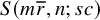 $S(m\bar {r}, n; sc)$
as
$S(m\bar {r}, n; sc)$
as $S_{\infty \,1/s}(m, \pm n; s\sqrt {r}c)$
when
$S_{\infty \,1/s}(m, \pm n; s\sqrt {r}c)$
when $(c, r) = 1$
. After substituting
$(c, r) = 1$
. After substituting $C \gets s\sqrt {r}C$
, the value of T inside the
$C \gets s\sqrt {r}C$
, the value of T inside the $\theta $
-factor becomes
$\theta $
-factor becomes
 $$\begin{align*}\frac{s\sqrt{r} C}{\max(M, q)^{1/2} \max(N, q)^{1/2} \sqrt{Y_MY_N}} \le \frac{s\sqrt{r} C}{rs \sqrt{Y_M Y_N}} = \frac{C}{\sqrt{rY_MY_N}}, \end{align*}$$
Corollary 5.11 (Kloosterman bounds with averaging over
$q, m, n, c$
)

Let $Q, M, N \ge 1/2$
,
$Q, M, N \ge 1/2$
, $C, Z \gg 1$
,
$C, Z \gg 1$
, $Y_N> 0$
,
$Y_N> 0$
, $\varepsilon> 0$
, and
$\varepsilon> 0$
, and $\omega \in \mathbb {R}/\mathbb {Z}$
. For each
$\omega \in \mathbb {R}/\mathbb {Z}$
. For each $q \sim Q$
, let
$q \sim Q$
, let $(q, N, Z, (a_{n,q})_{n \sim N}, A_{N,q}, Y_N)$
satisfy Assumption 5.4,
$(q, N, Z, (a_{n,q})_{n \sim N}, A_{N,q}, Y_N)$
satisfy Assumption 5.4, $w_q \in \mathbb {C}$
,
$w_q \in \mathbb {C}$
, $\mathfrak {b}_q$
be a cusp of
$\mathfrak {b}_q$
be a cusp of $\Gamma _0(q)$
, and
$\Gamma _0(q)$
, and $\Phi _q : (0, \infty )^3 \to \mathbb {C}$
be a smooth function, with
$\Phi _q : (0, \infty )^3 \to \mathbb {C}$
be a smooth function, with $\Phi _q(x, y, z)$
supported in
$\Phi _q(x, y, z)$
supported in $x, y, z \asymp 1$
, and
$x, y, z \asymp 1$
, and $\partial _x^j \partial _y^k \partial _z^\ell \Phi _q(x, y, z) \ll _{j,k,\ell ,\varepsilon } Z^{(j+k)\varepsilon }$
for
$\partial _x^j \partial _y^k \partial _z^\ell \Phi _q(x, y, z) \ll _{j,k,\ell ,\varepsilon } Z^{(j+k)\varepsilon }$
for $j, k, \ell \ge 0$
. Then with the choice of scaling matrices in (3.9) and a consistent choice of the
$j, k, \ell \ge 0$
. Then with the choice of scaling matrices in (3.9) and a consistent choice of the $\pm $
sign, one has
$\pm $
sign, one has
 $$ \begin{align}& \sum_{q \sim Q} w_q \sum_{m \sim M} e(m\omega) \sum_{n \sim N} a_{n,q} \sum_{c \in \mathcal{C}_{\infty\mathfrak{b}_q}} \Phi_q\left(\frac{m}{M}, \frac{n}{N}, \frac{c}{C}\right) S_{\infty\mathfrak{b}_q}(m, \pm n; c) \ll_\varepsilon (QMNCZ)^{O(\varepsilon)}\nonumber \\ &\quad \times \left(1 + T\right)^{2\theta_{\max}} \frac{\sqrt{QM} \|w_q A_{N,q}\|_2 C^2}{C + \sqrt{MN}} \left(1 + \frac{MN}{C^2} + \frac{M}{Q} \right)^{1/2} \left(1 + \frac{MN}{C^2} + \frac{N}{Q}\right)^{1/2}, \end{align} $$
for
 $$\begin{align*}T = \frac{T_0}{\sqrt{Y_N}}, \qquad\qquad T_0 := \frac{C}{\max\left(M, Q \right) \max\left(N, Q\right)^{1/2}} \le \frac{C}{Q^{3/2}}. \end{align*}$$
In particular, let $R, S \ge 1/2$
; for every
$R, S \ge 1/2$
; for every $r \sim R, s \sim S$
with
$r \sim R, s \sim S$
with $(r, s) = 1$
, let
$(r, s) = 1$
, let $w_{r,s} \in \mathbb {C}$
,
$w_{r,s} \in \mathbb {C}$
, $\Phi _{r,s}$
be as above, and
$\Phi _{r,s}$
be as above, and $(rs, N, Z, (a_{n,r,s})_{n \sim N}, A_{N,r,s}, Y_N)$
satisfy Assumption 5.4. Then one has
$(rs, N, Z, (a_{n,r,s})_{n \sim N}, A_{N,r,s}, Y_N)$
satisfy Assumption 5.4. Then one has
 $$ \begin{align} &\sum_{\substack{r \sim R \\ s \sim S \\ (r, s) = 1}} w_{r,s} \sum_{m \sim M} e(m\omega) \sum_{n \sim N} a_{n,r,s} \sum_{(c, r) = 1} \Phi_{r,s}\left(\frac{m}{M}, \frac{n}{N}, \frac{c}{C}\right) S(m\bar{r}, \pm n; sc) \ll_\varepsilon (RSMNCZ)^{O(\varepsilon)} \nonumber\\ &\quad\times \left(1 + \frac{C}{R \sqrt{S Y_N}}\right)^{2\theta_{\max}} \sqrt{RSM} \|w_{r,s} A_{N,r,s}\|_2 \nonumber\\ &\quad\times \frac{\left(S\sqrt{R}C + \sqrt{MN} + \sqrt{SM} C\right)\left(S\sqrt{R}C + \sqrt{MN} + \sqrt{SN} C\right)}{S\sqrt{R}C + \sqrt{MN}}. \end{align} $$
Remark 5.12. The norms $\|w_q A_{N,q}\|_2$
and
$\|w_q A_{N,q}\|_2$
and $\|w_{r,s} A_{N,r,s}\|_2$
refer to sequences indexed by
$\|w_{r,s} A_{N,r,s}\|_2$
refer to sequences indexed by $q \sim Q$
, respectively
$q \sim Q$
, respectively $r \sim R$
,
$r \sim R$
, $s \sim S$
(but not
$s \sim S$
(but not $n \sim N$
). In practice, it is often helpful to follow (5.32) with the bound
$n \sim N$
). In practice, it is often helpful to follow (5.32) with the bound
 $$ \begin{align} &\frac{\left(S\sqrt{R}C + \sqrt{MN} + \sqrt{SM} C\right)\left(S\sqrt{R}C + \sqrt{MN} + \sqrt{SN} C\right)}{S\sqrt{R}C + \sqrt{MN}} \nonumber\\ &\quad \ll S\sqrt{R}C + \sqrt{MN} + \sqrt{SM}C + \sqrt{SN}C + \frac{\sqrt{SM} C \sqrt{SN} C}{S\sqrt{R} C} \nonumber\\ &\quad \ll \left(\frac{C^2}{R} (M + RS)(N + RS) + MN \right)^{1/2}. \end{align} $$
Remark 5.13. Corollary 5.11 should be compared with [Reference Deshouillers and Iwaniec10, Theorem 11], the relevant saving being $Y_N^{\theta _{\max }}$
. One can state a similar result, to be compared with [Reference Deshouillers and Iwaniec10, Theorem 10], using a general sequence
$Y_N^{\theta _{\max }}$
. One can state a similar result, to be compared with [Reference Deshouillers and Iwaniec10, Theorem 10], using a general sequence $(b_m)_{m \sim M}$
instead of
$(b_m)_{m \sim M}$
instead of $b_m = e(m\omega )$
; one would need to replace a factor of
$b_m = e(m\omega )$
; one would need to replace a factor of $\sqrt {M}$
with
$\sqrt {M}$
with $\|b_m\|_2$
, and adjust the value of
$\|b_m\|_2$
, and adjust the value of $T_0$
using [Reference Deshouillers and Iwaniec10, Theorem 6] (or rather, its optimization in [Reference Lichtman32]) instead of [Reference Deshouillers and Iwaniec10, Theorem 7].
$T_0$
using [Reference Deshouillers and Iwaniec10, Theorem 6] (or rather, its optimization in [Reference Lichtman32]) instead of [Reference Deshouillers and Iwaniec10, Theorem 7].
Proof of Corollary 5.11
We proceed as in the proof of Corollary 5.9, swapping the sum over q with the integral to bound the sum $\mathcal {S}$
in the left-hand side of (5.28) by
$\mathcal {S}$
in the left-hand side of (5.28) by
 $$\begin{align*}\mathcal{S} \ll_\varepsilon Z^{O(\varepsilon)} C \iint_{\mathbb{R}^2} \frac{S(\zeta, \xi)\, d\zeta\, d\xi}{(1 + \zeta^4)(1 + \xi^4)}, \end{align*}$$
where
 $$\begin{align*}\begin{aligned} &\mathcal{S}(\zeta, \xi) \\ &\quad:= \sum_{q \sim Q} |w_q| \left\vert \sum_{m \sim M}e\left(m\left(\omega + \frac{\zeta}{M}\right)\right) \sum_{n \sim N} a_{n,q}\, e\left(n\frac{\xi}{N}\right) \sum_{c \in \mathcal{C}_{\infty\mathfrak{b}_q}}\, \frac{\mathcal{S}_{\infty\mathfrak{b}_q}(m, \pm n; c)}{c} \varphi_{\zeta,\xi,q}\left(\frac{4\pi \sqrt{mn}}{c}\right) \right\vert, \end{aligned} \end{align*}$$
and $\varphi _{\zeta ,\xi ,q}(z)$
are smooth functions supported in
$\varphi _{\zeta ,\xi ,q}(z)$
are smooth functions supported in $z \asymp X^{-1}$
, satisfying
$z \asymp X^{-1}$
, satisfying $\varphi _{\zeta ,\xi ,q}^{(\ell )} \ll _\ell X^\ell $
for
$\varphi _{\zeta ,\xi ,q}^{(\ell )} \ll _\ell X^\ell $
for $X := \frac {C}{\sqrt {MN}}$
. After applying the Kuznetsov formula, we bound the contribution of the regular spectrum to
$X := \frac {C}{\sqrt {MN}}$
. After applying the Kuznetsov formula, we bound the contribution of the regular spectrum to $\mathcal {S}(\zeta , \xi )$
pointwise in q, as in the previous proofs (leading only to an extra factor of
$\mathcal {S}(\zeta , \xi )$
pointwise in q, as in the previous proofs (leading only to an extra factor of $\|w_q A_{N,q}\|_1 \le \|w_q A_{N,q}\|_2 \sqrt {Q}$
instead of
$\|w_q A_{N,q}\|_1 \le \|w_q A_{N,q}\|_2 \sqrt {Q}$
instead of $A_N$
). As in (5.24), the contribution of the exceptional spectrum is
$A_N$
). As in (5.24), the contribution of the exceptional spectrum is
 $$\begin{align*}\begin{aligned} &\mathcal{S}_{\mathcal{M},\text{exc}}(\zeta, \xi) \ll \\ &\frac{1}{1+X^{-1}} \sum_{q \sim Q} |w_q| \sum_{\lambda_j < 1/4} \frac{1 + X^{2\theta_j(q)}}{\cosh(\pi \kappa_j)} \left\vert \sum_{m \sim M} e\left(m \left(\omega + \frac{\zeta}{M}\right) \right) \bar{\rho_{j\infty_q}(m)} \right\vert \left\vert \sum_{n \sim N} a_{n,q}\, e\left(n\frac{\xi}{N}\right) \rho_{j\mathfrak{b}_q}(n)\right\vert. \end{aligned} \end{align*}$$
We then apply Cauchy–Schwarz in the double sum over q and j, splitting $X = X_0 \sqrt {X_1 X_2}$
for
$X = X_0 \sqrt {X_1 X_2}$
for $X_2(\xi )$
as in (5.25); but this time we choose
$X_2(\xi )$
as in (5.25); but this time we choose
 $$ \begin{align} X_1 := \max\left(M, \frac{Q^2}{M}\right), \end{align} $$
corresponding to the allowable range in Theorem 3.11. Keeping $|w_q|$
only in the second sum, this yields
$|w_q|$
only in the second sum, this yields
 $$\begin{align*}\begin{aligned} \mathcal{S}_{\mathcal{M},\text{exc}}(\zeta, \xi) \ll \sqrt{\frac{(1 + X_0)^{2\theta_{\max}}}{1+X^{-1}} \mathcal{S}_M(\zeta, \xi)\, \mathcal{S}_N(\zeta, \xi)}, \end{aligned} \end{align*}$$
where
 $$\begin{align*}\begin{aligned} \mathcal{S}_M(\zeta, \xi) &:= \sum_{q \sim Q} \sum_{\lambda_j < 1/4} \frac{X_1^{2\theta_j(q)}}{\cosh(\pi \kappa_j)} \left\vert \sum_{m \sim M} e\left(m \left(\omega + \frac{\zeta}{M}\right) \right) \bar{\rho_{j\infty_q}(m)} \right\vert^2, \\ \mathcal{S}_N(\zeta, \xi) &:= \sum_{q \sim Q} |w_q|^2 \sum_{\lambda_j < 1/4} \frac{X_2^{2\theta_j(q)}}{\cosh(\pi \kappa_j)} \left\vert \sum_{n \sim N} a_{n,q}\, e\left(n\frac{\xi}{N}\right) \rho_{j\mathfrak{b}_q}(n)\right\vert^2. \end{aligned} \end{align*}$$
The treatment of $\mathcal {S}_N$
remains the same as before, pointwise in q, leading to an extra factor of
$\mathcal {S}_N$
remains the same as before, pointwise in q, leading to an extra factor of $\|w_q A_{N,q}\|_2^2$
instead of
$\|w_q A_{N,q}\|_2^2$
instead of $A_N^2$
. For
$A_N^2$
. For $\mathcal {S}_M$
, we apply Theorem 3.11 (which allowed the choice of
$\mathcal {S}_M$
, we apply Theorem 3.11 (which allowed the choice of $X_1$
from (5.34)), leading to an extra factor of
$X_1$
from (5.34)), leading to an extra factor of $\sqrt {Q}$
. Overall, instead of (5.30), we obtain
$\sqrt {Q}$
. Overall, instead of (5.30), we obtain
 $$\begin{align*}\begin{aligned} \mathcal{S} \ll_\varepsilon (QMNCZ)^{O(\varepsilon)} &\left(1 + \frac{X}{\sqrt{X_1 X_2(0)}} \right)^{2\theta_{\max}} \frac{C}{1+X^{-1}} \\ &\times \left(1 + X^{-2} + \frac{M}{Q}\right)^{1/2} \left(1 + X^{-2} + \frac{N}{Q}\right)^{1/2} \sqrt{QM} \|w_q A_{N,q}\|_2, \end{aligned} \end{align*}$$
and plugging in the values of $X, X_1, X_2$
yields (5.31).
$X, X_1, X_2$
yields (5.31).
To prove (5.32), let $Q := RS$
. By the divisor bound, the left-hand side is at most
$Q := RS$
. By the divisor bound, the left-hand side is at most
 $$\begin{align*}x^{o(1)} \sum_{Q < q \le 4Q} \max_{\substack{r \sim R \\ s \sim S \\ (r, s) = 1 \\ rs = q}} |w_{r,s}| \left\vert \sum_{m \sim M} e(m\omega) \sum_{n \sim N} a_{n,r,s} \sum_{(c, r) = 1} \Phi_{r,s} \left(\frac{m}{M}, \frac{n}{N}, \frac{c}{C}\right) S(m\bar{r}, \pm n; sc) \right\vert, \end{align*}$$
where we interpret any empty maximum as $0$
. For each q, let
$0$
. For each q, let $r = r(q), s = s(q)$
attain the maximum (if there are no such
$r = r(q), s = s(q)$
attain the maximum (if there are no such $r, s$
, pick
$r, s$
, pick $w_q := 0$
and disregard the rest of this paragraph). Then let
$w_q := 0$
and disregard the rest of this paragraph). Then let $w_q := w_{r,s}$
,
$w_q := w_{r,s}$
, $a_{n,q} := a_{n,r,s}$
,
$a_{n,q} := a_{n,r,s}$
, $\Phi _q(x, y, z) := \Phi _{r,s}(x, y, z\, (S/s) \sqrt {R/r})$
, and
$\Phi _q(x, y, z) := \Phi _{r,s}(x, y, z\, (S/s) \sqrt {R/r})$
, and $\mathfrak {b}_q := 1/s$
, with the scaling matrix in (3.9).
$\mathfrak {b}_q := 1/s$
, with the scaling matrix in (3.9).
Due to Lemma 3.2, after the change of variables $c \gets c/(s\sqrt {r})$
, this leaves us with the sum
$c \gets c/(s\sqrt {r})$
, this leaves us with the sum
 $$\begin{align*}x^{o(1)} \sum_{Q < q \le 4Q} |w_q| \left\vert \sum_{m \sim M} e(m\omega) \sum_{n \sim N} a_{n,q} \sum_{c \in \mathcal{C}_{\infty \mathfrak{b}_q}} \Phi_q \left(\frac{m}{M}, \frac{n}{N}, \frac{c}{S\sqrt{R}C}\right) S_{\infty \mathfrak{b}_q}(m, \pm n; c) \right\vert. \end{align*}$$
Incorporating $1$
-bounded coefficients into
$1$
-bounded coefficients into $(w_q)$
to remove absolute values, the desired bound now follows from (5.31). We note that the T parameter becomes
$(w_q)$
to remove absolute values, the desired bound now follows from (5.31). We note that the T parameter becomes
 $$\begin{align*}T \ll \frac{S\sqrt{R} C}{Q^{3/2} \sqrt{Y_N}} \asymp \frac{C}{R\sqrt{S Y_N}}, \end{align*}$$
as in (5.31).
As a direct consequence of Corollary 5.11 and standard techniques, one can also deduce a result for sums of incomplete Kloosterman sums, improving [Reference Deshouillers and Iwaniec10, Theorem 12].
Corollary 5.14 (Incomplete Kloosterman bounds with averaging over
$r, s, n, c, d$
)

Let $R, S, N \ge 1/2$
,
$R, S, N \ge 1/2$
, $C, D, Z \gg 1$
,
$C, D, Z \gg 1$
, $Y_N> 0$
, and
$Y_N> 0$
, and $\varepsilon> 0$
. For each
$\varepsilon> 0$
. For each $r \sim R, s \sim S$
with
$r \sim R, s \sim S$
with $\gcd (r, s) = 1$
, let the tuple
$\gcd (r, s) = 1$
, let the tuple $(rs, N, Z, (a_{n,r,s})_{n \sim N}, A_{N,r,s}, Y_N)$
satisfy Assumption 5.4,
$(rs, N, Z, (a_{n,r,s})_{n \sim N}, A_{N,r,s}, Y_N)$
satisfy Assumption 5.4, $w_{r,s} \in \mathbb {C}$
, and
$w_{r,s} \in \mathbb {C}$
, and $\Phi _{r,s} : (0, \infty )^3 \to \mathbb {C}$
be a smooth function, with
$\Phi _{r,s} : (0, \infty )^3 \to \mathbb {C}$
be a smooth function, with $\Phi _{r,s}(x, y, z)$
supported in
$\Phi _{r,s}(x, y, z)$
supported in $x, y, z \asymp 1$
, and
$x, y, z \asymp 1$
, and $\partial _x^j \partial _y^k \partial _z^\ell \Phi _q(x, y, z) \ll _{j,k,\ell ,\varepsilon } Z^{j\varepsilon }$
for
$\partial _x^j \partial _y^k \partial _z^\ell \Phi _q(x, y, z) \ll _{j,k,\ell ,\varepsilon } Z^{j\varepsilon }$
for $j, k, \ell \ge 0$
. Then with a consistent choice of the
$j, k, \ell \ge 0$
. Then with a consistent choice of the $\pm $
sign, one has
$\pm $
sign, one has
 $$ \begin{align} \sum_{\substack{r \sim R \\ s \sim S \\ (r, s) = 1}} w_{r,s} \sum_{n \sim N} a_{n,r,s} \sum_{\substack{c, d \\ (rd, sc) = 1}} \Phi_{r,s}\left(\frac{n}{N}, \frac{d}{D}, \frac{c}{C}\right) e\left(\pm n \frac{\bar{rd}}{sc}\right) \ll_\varepsilon (RSNCDZ)^{O(\varepsilon)}\, \|w_{r,s} A_{N,r,s}\|_2 \mathscr{I}, \end{align} $$
where
 $$\begin{align*}\mathscr{I}^2 := D^2 NR + \left(1 + \frac{C^2}{R^2 S Y_N}\right)^{2\theta_{\max}} CS(C + DR)(RS + N). \end{align*}$$
Proof of Corollary 5.14
This follows from Corollary 5.11 (specifically, (5.32)) by completing Kloosterman sums, passing from the d-variable to a variable m of size $\ll _\varepsilon (CDS)^\varepsilon CS/D$
; this is completely analogous to how [Reference Deshouillers and Iwaniec10, Theorem 12] follows from [Reference Deshouillers and Iwaniec10, Theorem 11] in [Reference Deshouillers and Iwaniec10, §9.2]. We note that [Reference Deshouillers and Iwaniec10, Theorem 12] has a minor error (replacing
$\ll _\varepsilon (CDS)^\varepsilon CS/D$
; this is completely analogous to how [Reference Deshouillers and Iwaniec10, Theorem 12] follows from [Reference Deshouillers and Iwaniec10, Theorem 11] in [Reference Deshouillers and Iwaniec10, §9.2]. We note that [Reference Deshouillers and Iwaniec10, Theorem 12] has a minor error (replacing $D^2 N R$
with
$D^2 N R$
with $D^2 N R S^{-1}$
), which has been corrected in [Reference Bombieri, Friedlander and Iwaniec5].
$D^2 N R S^{-1}$
), which has been corrected in [Reference Bombieri, Friedlander and Iwaniec5].
6 The greatest prime factor of
$n^2+1$

Here we use our new inputs from Section 5.3 in the computations of Merikoski [Reference Merikoski37] and de la Bretèche–Drappeau [Reference de La Bretèche and Drappeau8], in order to prove Theorem 1.1. We begin with a brief informal sketch.
6.1 Sketch of the argument
We will ultimately prove a lower bound of the shape
 $$\begin{align*}\sum_{n \sim x} \sum_{\substack{p \text{ prime} \\ p \mid n^2+1 \\ p> x^{1.3}}} \log p > \varepsilon\, x \log x, \end{align*}$$
which implies that for some (in fact, for many) $n \sim x$
, we must have
$n \sim x$
, we must have $P^+(n^2+1)> x^{1.3}$
. As in previous works [Reference Merikoski37, Reference de La Bretèche and Drappeau8, Reference Deshouillers and Iwaniec9, Reference Hooley23], we use an idea of Chebyshev to estimate the full sum
$P^+(n^2+1)> x^{1.3}$
. As in previous works [Reference Merikoski37, Reference de La Bretèche and Drappeau8, Reference Deshouillers and Iwaniec9, Reference Hooley23], we use an idea of Chebyshev to estimate the full sum
 $$\begin{align*}\sum_{n \sim x} \sum_{\substack{p \text{ prime} \\ p \mid n^2+1}} \log p \approx \sum_{n \sim x} \sum_{d \mid n^2+1} \Lambda(d) = \sum_{n \sim x} \log(n^2+1) = 2x\log x + O(x), \end{align*}$$
where $\Lambda $
is the von Mangoldt function. It then remains to upper bound
$\Lambda $
is the von Mangoldt function. It then remains to upper bound

Following Merikoski [Reference Merikoski37], we use repeated applications of Buchstab’s identity inside the Harman sieve method, to reduce estimating the above sum over primes to bounding “Type I” and “Type II” sums of the form

respectively

for various ranges of $D, Q, Q_i$
with
$D, Q, Q_i$
with $Q_1 Q_2 = Q \le x^{1.3}$
, aiming to win over the trivial bound of x.
$Q_1 Q_2 = Q \le x^{1.3}$
, aiming to win over the trivial bound of x.
Let us sketch our improvement of the Type I information. As in [Reference de La Bretèche and Drappeau8, Reference Merikoski37], we separate n into residue classes $\nu \pmod {q}$
and apply a truncated version of Poisson summation to the sum over n; the principal frequency
$\nu \pmod {q}$
and apply a truncated version of Poisson summation to the sum over n; the principal frequency $h = 0$
cancels with the subtracted main term, leading to a sum like
$h = 0$
cancels with the subtracted main term, leading to a sum like
 $$\begin{align*}\sum_{d \le D} \lambda_d \sum_{\substack{q \sim Q \\ q \equiv 0 \pmod{d}}} \sum_{\substack{\nu \pmod{q} \\ \nu^2 \equiv -1\ (q)}}\ \sum_{h \sim \frac{Q}{x}} e\left(\frac{h\nu}{q}\right). \end{align*}$$
We can then parametrize the solutions to $\nu ^2 \equiv -1 \pmod {q}$
by the Gauss correspondence (see [Reference Deshouillers and Iwaniec9, Lemma 2]), which gives
$\nu ^2 \equiv -1 \pmod {q}$
by the Gauss correspondence (see [Reference Deshouillers and Iwaniec9, Lemma 2]), which gives $q = r^2 + s^2$
and
$q = r^2 + s^2$
and $\tfrac {\nu }{q} \approx \tfrac {\bar {r}}{s} \pmod {1}$
. In the critical range
$\tfrac {\nu }{q} \approx \tfrac {\bar {r}}{s} \pmod {1}$
. In the critical range $r, s \sim \sqrt {Q}$
, this leaves us with the sum
$r, s \sim \sqrt {Q}$
, this leaves us with the sum
 $$\begin{align*}\sum_{d \le D} \lambda_d \sum_{\substack{r, s \sim \sqrt{Q}\\ r^2 \equiv -s^2 \pmod{d}}} \sum_{h \sim \frac{Q}{x}} e\left(\frac{h\bar{r}}{s}\right). \end{align*}$$
Separating $r \bar {s}$
into residue classes
$r \bar {s}$
into residue classes $\varrho \mod d$
and Fourier-completing the sum over r yields a dual variable k of size D, and inner sums of the shape
$\varrho \mod d$
and Fourier-completing the sum over r yields a dual variable k of size D, and inner sums of the shape
 $$\begin{align*}\sum_{k \sim D} \sum_{h \sim \frac{Q}{x}} e\left(\frac{k\varrho}{d}\right) \sum_{s \sim \sqrt{Q}} S(h, k\bar{d}; s), \end{align*}$$
where $\varrho $
is a solution to
$\varrho $
is a solution to $\varrho ^2 \equiv -1 \pmod {d}$
; compare these to (1.2). Since the sequence
$\varrho ^2 \equiv -1 \pmod {d}$
; compare these to (1.2). Since the sequence $(e(\tfrac {k\varrho }{d}))_{k \sim D}$
depends on the level d and its length is as large as the level, the large sieve inequality for general sequences from Theorem 1.2 cannot produce any savings in the
$(e(\tfrac {k\varrho }{d}))_{k \sim D}$
depends on the level d and its length is as large as the level, the large sieve inequality for general sequences from Theorem 1.2 cannot produce any savings in the $X^\theta $
-aspect for this sequence. However, our large sieve inequality for exponential phases from Theorem 1.5 will save a factor of
$X^\theta $
-aspect for this sequence. However, our large sieve inequality for exponential phases from Theorem 1.5 will save a factor of $D^{\theta /2}$
, which follows through to the sieve computations. This improves the results of de la Bretèche–Drappeau [Reference de La Bretèche and Drappeau8, §8], based in turn on Duke–Friedlander–Iwaniec [Reference Duke, Friedlander and Iwaniec16], and is nearly enough to remove the dependency on Selberg’s eigenvalue conjecture in the relevant Type I ranges, as illustrated in Fig. 2 (left).
$D^{\theta /2}$
, which follows through to the sieve computations. This improves the results of de la Bretèche–Drappeau [Reference de La Bretèche and Drappeau8, §8], based in turn on Duke–Friedlander–Iwaniec [Reference Duke, Friedlander and Iwaniec16], and is nearly enough to remove the dependency on Selberg’s eigenvalue conjecture in the relevant Type I ranges, as illustrated in Fig. 2 (left).
Type I (left) and Type II (right) ranges. Previous results in gray; our improvements in blue; conditional ranges in red (assuming Selberg’s eigenvalue conjecture).

Following Merikoski [Reference Merikoski37], the Type II sums can be treated similarly using an additional Cauchy–Schwarz step. Once again, this leads to trilinear forms of Kloosterman sums as in (1.2), where both sequences $(a_m)$
and
$(a_m)$
and $(b_n)$
depend on the level. Using our large sieve inequalities, we can leverage the fact that
$(b_n)$
depend on the level. Using our large sieve inequalities, we can leverage the fact that $(a_m)$
happen to be exponential phases as in Theorem 1.5, while
$(a_m)$
happen to be exponential phases as in Theorem 1.5, while $(b_n)$
have the shape in Theorem 1.7 (if the sum over h is kept inside the Cauchy–Schwarz step). This ultimately produces three admissible Type II ranges, all gathered in Proposition 6.4 and illustrated in Fig. 2 (right).
$(b_n)$
have the shape in Theorem 1.7 (if the sum over h is kept inside the Cauchy–Schwarz step). This ultimately produces three admissible Type II ranges, all gathered in Proposition 6.4 and illustrated in Fig. 2 (right).
By carefully plugging in these Type I and II estimates into Merikoski’s Harman sieve computations, which require the numerical calculation of multidimensional integrals, we deduce Theorem 1.1.
6.2 Arithmetic information
We aim to improve the dependency on the $\theta $
parameter in the arithmetic information from [Reference Merikoski37, Propositions 1 and 2]; to do so, we first improve a lemma of de la Bretèche–Drappeau [Reference de La Bretèche and Drappeau8, Lemme 8.3].
$\theta $
parameter in the arithmetic information from [Reference Merikoski37, Propositions 1 and 2]; to do so, we first improve a lemma of de la Bretèche–Drappeau [Reference de La Bretèche and Drappeau8, Lemme 8.3].
Lemma 6.1 (De la Bretèche–Drappeau-style exponential sums)
Let $\varepsilon> 0$
,
$\varepsilon> 0$
, $M \gg 1$
, and
$M \gg 1$
, and $\theta := \tfrac {7}{64}$
.
$\theta := \tfrac {7}{64}$
.
-
(i). Let
$q, h \in \mathbb {Z}$
and
$1 \le |h| \ll q$
. Given a smooth function
$f : (0, \infty ) \to \mathbb {C}$
supported in
$v \asymp 1$
, with
$f^{(j)} \ll _j 1$
for
$j \ge 0$
, one has (6.1)
$$ \begin{align} \sum_{(m, q) = 1} f\left(\frac{m}{M}\right) \sum_{\nu^2 \equiv -1 \pmod{mq}} e\left(\frac{h\nu}{mq}\right) \ll_\varepsilon (qhM)^\varepsilon \left( |h| + \sqrt{qM}\left(1 + (q, h)^{\theta} q^{- 3\theta/2} M^{\theta} \right) \right). \end{align} $$
-
(ii). Let
$Q \ge 1/2$
,
$1/2 \le H \ll QM$
, and
$t \in \mathbb {R}/\mathbb {Z}$
. Given smooth functions
$(f_q(v))_{q \sim Q}$
supported in
$v \asymp 1$
, with
$f_q^{(j)} \ll _j 1$
for
$j \ge 0$
, one has (6.2)
$$ \begin{align} \begin{aligned} \frac{1}{Q} \sum_{q \sim Q} &\left\vert \frac{1}{H} \sum_{h \sim H} e(th) \sum_{(m, q) = 1} f_q\left(\frac{m}{M}\right) \sum_{\nu^2 \equiv -1 \pmod{mq}} e\left(\frac{h\nu}{mq}\right) \right\vert \\ &\qquad \qquad \ll_\varepsilon (QHM)^\varepsilon \left( H + \sqrt{M} \left(1 + H^{-2\theta} Q^{\theta/2} M^{\theta}\right) + \sqrt{\frac{QM}{H}}\left(1 + Q^{-3\theta/2} M^{\theta} \right)\right). \end{aligned} \end{align} $$


Proof. This is a refinement of the first and third bounds in [Reference de La Bretèche and Drappeau8, Lemme 8.3], winning factors of about $q^{\theta /2}$
via our Corollaries 5.5 and 5.11. We only mention what changes from the proof in [Reference de La Bretèche and Drappeau8, §8.1], working in the particular case
$q^{\theta /2}$
via our Corollaries 5.5 and 5.11. We only mention what changes from the proof in [Reference de La Bretèche and Drappeau8, §8.1], working in the particular case $d = r = 1$
,
$d = r = 1$
, $D = -1$
. We note that for
$D = -1$
. We note that for $D = -1$
, the relevant cusps
$D = -1$
, the relevant cusps $\mathfrak {a}$
from [Reference de La Bretèche and Drappeau8, §8.1] are equivalent to
$\mathfrak {a}$
from [Reference de La Bretèche and Drappeau8, §8.1] are equivalent to $0/1$
, and thus have
$0/1$
, and thus have $\mu (\mathfrak {a}) = q^{-1}$
(which is also why Merikoski’s bounds in [Reference Merikoski37, §3.8] only require such cusps too).
$\mu (\mathfrak {a}) = q^{-1}$
(which is also why Merikoski’s bounds in [Reference Merikoski37, §3.8] only require such cusps too).
For part $(i)$
, we consider the sums of Kloosterman sums from [Reference de La Bretèche and Drappeau8, (8.30)], given (with notation to be explained below) by
$(i)$
, we consider the sums of Kloosterman sums from [Reference de La Bretèche and Drappeau8, (8.30)], given (with notation to be explained below) by
 $$\begin{align*}V_N = V_N(q, h) := \sum_{N/2 \le |n| \le 2N} \sum_{\gamma \in \mathcal{C}_{\infty\mathfrak{a}}} S_{\infty\mathfrak{a}}(h, n; \gamma)\, G_N(\gamma, n). \end{align*}$$
Here, the n-variable came from a completion of Kloosterman sums, and was localized to a dyadic range of size $N \ll q^{1+\eta } M^\eta $
(where
$N \ll q^{1+\eta } M^\eta $
(where $\eta> 0$
is a small parameter), while
$\eta> 0$
is a small parameter), while $G_N(\gamma , n)$
is a smooth function normalized such that
$G_N(\gamma , n)$
is a smooth function normalized such that
 $$\begin{align*}\Phi(x, y) := q\, G_N\left(yq\sqrt{M}, xN\right) \end{align*}$$
satisfies the assumptions of Corollary 5.5 with $Z = qM$
and
$Z = qM$
and $\varepsilon \asymp \eta $
. Also,
$\varepsilon \asymp \eta $
. Also, $\mathfrak {a}$
is a cusp of
$\mathfrak {a}$
is a cusp of $\Gamma _0(q)$
, and the scaling matrix
$\Gamma _0(q)$
, and the scaling matrix $\sigma _{\mathfrak {a}}$
used implicitly in the Kloosterman sum
$\sigma _{\mathfrak {a}}$
used implicitly in the Kloosterman sum $S_{\infty \mathfrak {a}}(h, n; \gamma )$
hides an exponential phase of the form
$S_{\infty \mathfrak {a}}(h, n; \gamma )$
hides an exponential phase of the form $e(n\alpha _q)$
; the value of
$e(n\alpha _q)$
; the value of $\alpha _q$
is arbitrary for our purposes.
$\alpha _q$
is arbitrary for our purposes.
We can now apply Corollary 5.5 (equivalently, we can bound $\mathscr {M}_N^{\mathrm {exc}}$
in [Reference de La Bretèche and Drappeau8, (8.40)] using Theorem 1.5), using
$\mathscr {M}_N^{\mathrm {exc}}$
in [Reference de La Bretèche and Drappeau8, (8.40)] using Theorem 1.5), using $a_n = e(n\alpha _q)$
,
$a_n = e(n\alpha _q)$
, $Y_N = A_N = \sqrt {N}$
(corresponding to (5.18)),
$Y_N = A_N = \sqrt {N}$
(corresponding to (5.18)), $C = q\sqrt {M}$
, and
$C = q\sqrt {M}$
, and $m = |h|$
. This yields
$m = |h|$
. This yields
 $$\begin{align*}V_N \ll_{\eta} (qhM)^{O(\eta)} \left(1 + \frac{q\sqrt{M}}{q^{3/2} (q, h)^{-1/2} N^{1/4}}\right)^{2\theta} \sqrt{NM}, \end{align*}$$
where we used that $q^\eta C = q^{1+\eta }\sqrt {M} \gg \sqrt {hN}$
, that
$q^\eta C = q^{1+\eta }\sqrt {M} \gg \sqrt {hN}$
, that $\sqrt {(q, h)|h|} \le |h| \le q$
, and that
$\sqrt {(q, h)|h|} \le |h| \le q$
, and that $N \ll q^{1+\eta } M^\eta $
(in particular, the
$N \ll q^{1+\eta } M^\eta $
(in particular, the $1$
-term is dominant in the last two parentheses from (1.1), up to factors of
$1$
-term is dominant in the last two parentheses from (1.1), up to factors of $(qhM)^{o(1)}$
).
$(qhM)^{o(1)}$
).
This bound is increasing in N, so using $N \ll q^{1+\eta } M^\eta $
once again, we get
$N \ll q^{1+\eta } M^\eta $
once again, we get
 $$\begin{align*}V_N \ll_\eta (qhM)^{O(\eta)} \sqrt{qM} \left(1 + (q, h)^{\theta} q^{-3\theta/2} M^{\theta}\right), \end{align*}$$
which gives the second term claimed in the upper bound from (6.1).
Part $(ii)$
follows similarly using Corollary 5.11 (or equivalently, by bounding
$(ii)$
follows similarly using Corollary 5.11 (or equivalently, by bounding $\mathscr {M}_N^{\mathrm {exc}}$
in [Reference de La Bretèche and Drappeau8, §8.1.12] using Theorem 1.5 once again). Indeed, with the similar choices
$\mathscr {M}_N^{\mathrm {exc}}$
in [Reference de La Bretèche and Drappeau8, §8.1.12] using Theorem 1.5 once again). Indeed, with the similar choices $a_{n,q} = e(n\alpha _q)$
,
$a_{n,q} = e(n\alpha _q)$
, $Y_N = A_{N,q} = \sqrt {N}$
,
$Y_N = A_{N,q} = \sqrt {N}$
, $Z = QM$
, and
$Z = QM$
, and $C = Q\sqrt {M}$
, our bound (5.31) yields
$C = Q\sqrt {M}$
, our bound (5.31) yields
 $$\begin{align*}\frac{1}{Q} \sum_{q \sim Q} \frac{1}{H} \left\vert \sum_{h \sim H} e(th)\, V_N(q, h)\right\vert \ll_\eta (QHM)^{O(\eta)} \left(1 + \frac{Q\sqrt{M}}{\max(Q, H)\, Q^{1/2} N^{1/4}}\right)^{2\theta} \sqrt{\frac{NM}{H}} \left(1 + \frac{H}{Q}\right)^{1/2}. \end{align*}$$
Again, this bound is increasing in N, so plugging in $N \ll Q^{1+\eta } M^\eta $
gives a right-hand side of
$N \ll Q^{1+\eta } M^\eta $
gives a right-hand side of
 $$\begin{align*}\begin{aligned} &\ll_\eta (QHM)^{O(\eta)} \sqrt{\frac{M}{H}} \max(Q, H)^{1/2} \left(1 + \max(Q, H)^{-2\theta} Q^{\theta/2} M^{\theta}\right) \\ &\ll (QHM)^{O(\eta)} \sqrt{\frac{M}{H}} \left(H^{1/2} + Q^{1/2} + \left(H^{(1/2)-2\theta} + Q^{(1/2)-2\theta}\right) Q^{\theta/2} M^{\theta}\right), \end{aligned} \end{align*}$$
which gives all but the first term in the upper bound from (6.2). As in [Reference de La Bretèche and Drappeau8], the first terms of $|h|$
and H from our bounds in (6.1) and (6.2) could be improved via partial summation, but we omit this optimization too since it will not be relevant for our computations.
$|h|$
and H from our bounds in (6.1) and (6.2) could be improved via partial summation, but we omit this optimization too since it will not be relevant for our computations.
Notation 6.2 (Set-up for arithmetic information)
Let $x \ge 1$
,
$x \ge 1$
, $\alpha \in [1, 3/2)$
, and
$\alpha \in [1, 3/2)$
, and
 $$\begin{align*}P := x^\alpha. \end{align*}$$
Let $\Phi , \Psi $
be smooth functions supported in
$\Phi , \Psi $
be smooth functions supported in $[1, 4]$
, satisfying
$[1, 4]$
, satisfying $\Phi \ge 0$
and
$\Phi \ge 0$
and $\Phi ^{(j)}, \Psi ^{(j)} \ll _j 1$
for
$\Phi ^{(j)}, \Psi ^{(j)} \ll _j 1$
for $j \ge 0$
(in [Reference Merikoski37, §2.1], Merikoski uses
$j \ge 0$
(in [Reference Merikoski37, §2.1], Merikoski uses $b(t) = \Phi (t/x)$
and
$b(t) = \Phi (t/x)$
and $\Psi (t) \gets \Psi (t/P)$
). For
$\Psi (t) \gets \Psi (t/P)$
). For $q \in \mathbb {Z}_+$
, define
$q \in \mathbb {Z}_+$
, define
 $$\begin{align*}|\mathcal{A}_q| := \sum_{n^2 \equiv -1 \pmod{q}} \Phi\left(\frac{n}{x}\right), \qquad\qquad X := \int \Phi\left(\frac{t}{x}\right)\, dt = x \int \Phi, \end{align*}$$
 $$\begin{align*}\rho(q) := \# \left\{ \nu \in \mathbb{Z}/q\mathbb{Z} : \nu^2 \equiv -1 \pmod{q} \right\}. \end{align*}$$
We will estimate the difference
 $$\begin{align*}|\mathcal{A}_q| - X\frac{\rho(q)}{q} \end{align*}$$
in “Type I” and “Type II” sums with $q \asymp P$
. The Type I sums average over moduli in arithmetic progressions, say
$q \asymp P$
. The Type I sums average over moduli in arithmetic progressions, say $q \equiv 0 \pmod {d}$
and
$q \equiv 0 \pmod {d}$
and $d \le D$
, with arbitrary divisor-bounded coefficients
$d \le D$
, with arbitrary divisor-bounded coefficients $\lambda _d$
; the Type II sums average over moduli with a conveniently-sized factor, say
$\lambda _d$
; the Type II sums average over moduli with a conveniently-sized factor, say $q = mn$
with
$q = mn$
with $n \sim N$
(and
$n \sim N$
(and $m \asymp P/N$
), with divisor-bounded coefficients
$m \asymp P/N$
), with divisor-bounded coefficients $a_m, b_n$
. One can also view the Type I sums as special Type II sums where
$a_m, b_n$
. One can also view the Type I sums as special Type II sums where $a_m = 1$
, except that Type II estimates typically require a lower bound on N.
$a_m = 1$
, except that Type II estimates typically require a lower bound on N.
The strength of the resulting Type I and Type II information is given by the ranges of parameters D and N (in terms of x and P) for which we can obtain power-savings over the trivial bound – that is, for which the sums over $|\mathcal {A}_q|$
have an asymptotic formula. Fig. 2 illustrates the (previous unconditional, new unconditional, and conditional) admissible choices of
$|\mathcal {A}_q|$
have an asymptotic formula. Fig. 2 illustrates the (previous unconditional, new unconditional, and conditional) admissible choices of $\log _x D$
and
$\log _x D$
and $\log _x N$
in terms of
$\log _x N$
in terms of $\alpha = \log _x P$
; both graphs continue downwards, the second region being lower-bounded by the function
$\alpha = \log _x P$
; both graphs continue downwards, the second region being lower-bounded by the function $\alpha - 1$
. The previous unconditional and the conditional ranges are due to Merikoski [Reference Merikoski37] and de la Bretèche–Drappeau [Reference de La Bretèche and Drappeau8]; our improvements are Propositions 6.3 and 6.4.
$\alpha - 1$
. The previous unconditional and the conditional ranges are due to Merikoski [Reference Merikoski37] and de la Bretèche–Drappeau [Reference de La Bretèche and Drappeau8]; our improvements are Propositions 6.3 and 6.4.
Proposition 6.3 (Type I estimate)
For any sufficiently small $\varepsilon> 0$
there exists
$\varepsilon> 0$
there exists $\delta> 0$
such that the following holds. With Notation 6.2,
$\delta> 0$
such that the following holds. With Notation 6.2, $1 \le \alpha \le 1.4$
,
$1 \le \alpha \le 1.4$
, $\theta := \tfrac {7}{64}$
, and
$\theta := \tfrac {7}{64}$
, and $D \ge 1$
, one has
$D \ge 1$
, one has
 $$ \begin{align} \sum_{d \le D} \lambda_d \sum_{q \equiv 0 \pmod{d}} \left(|\mathcal{A}_q| - X\frac{\rho(q)}{q}\right) \Psi\left(\frac{q}{P}\right) \log q \ll_\varepsilon x^{1-\delta}, \end{align} $$
for any divisor-bounded coefficients $(\lambda _d)$
, provided that
$(\lambda _d)$
, provided that
 $$\begin{align*}D \ll_\varepsilon x^{-\varepsilon} \min \left(x^{1/2}, x^{(1-2\theta\alpha)/(2-5\theta)}\right). \end{align*}$$
Proof. This is a refinement of Merikoski’s [Reference Merikoski37, Prop. 1] (which explicitated the computations in de la Bretèche–Drappeau’s [Reference de La Bretèche and Drappeau8, §8.4]), using our Lemma 6.1. $(ii)$
instead of [Reference de La Bretèche and Drappeau8, (8.7)]. Indeed, in the first display on [Reference de La Bretèche and Drappeau8, p. 1620], by applying (6.2) for
$(ii)$
instead of [Reference de La Bretèche and Drappeau8, (8.7)]. Indeed, in the first display on [Reference de La Bretèche and Drappeau8, p. 1620], by applying (6.2) for $H \gets P X^{-1+\delta }$
(for
$H \gets P X^{-1+\delta }$
(for $\delta = \delta (\varepsilon )$
to be chosen shortly),
$\delta = \delta (\varepsilon )$
to be chosen shortly), $Q \gets D \le x^{1/2}$
and
$Q \gets D \le x^{1/2}$
and $M \gets P/D$
, we instead obtain the bound
$M \gets P/D$
, we instead obtain the bound
 $$\begin{align*}\begin{aligned} &R_H(x, P, D) \\ &\quad\ll_{\delta} x^{1+O(\delta)} P^{-1} D H\left( H + \sqrt{\frac{P}{D}} \left(1 + H^{-2\theta} D^{\theta/2} \left(\frac{P}{D}\right)^{\theta}\right) + \sqrt{\frac{P}{H}}\left(1 + D^{-3\theta/2} \left(\frac{P}{D}\right)^{\theta} \right)\right) \\ &\quad= x^{O(\delta)} \left( \frac{PD}{x} + \sqrt{PD} \left(1 + x^{2\theta} P^{-\theta} D^{-\theta/2}\right) + \sqrt{x}D \left(1 + D^{-5\theta/2} P^{\theta}\right) \right). \end{aligned} \end{align*}$$
Here, $R_H(x, P, D)$
resulted from our Type I sum after putting d in dyadic ranges, expanding and Fourier-completing
$R_H(x, P, D)$
resulted from our Type I sum after putting d in dyadic ranges, expanding and Fourier-completing $|\mathcal {A}_q|$
; see [Reference de La Bretèche and Drappeau8, §8.4] and then [Reference Deshouillers and Iwaniec9, §4, 5]. Overall, this bound is acceptable in (6.3) (i.e.,
$|\mathcal {A}_q|$
; see [Reference de La Bretèche and Drappeau8, §8.4] and then [Reference Deshouillers and Iwaniec9, §4, 5]. Overall, this bound is acceptable in (6.3) (i.e., $\ll _\varepsilon x^{1-\delta }$
) provided that for an absolute constant K, one has
$\ll _\varepsilon x^{1-\delta }$
) provided that for an absolute constant K, one has
 $$\begin{align*}\begin{aligned} D &\ll_\varepsilon x^{-K\delta} \min \left( x^2 P^{-1}, x^{1/2}, x^{2(1-2\theta)/(1-\theta)} P^{-(1-2\theta)/(1-\theta)}, x^{1/(2-5\theta)} P^{-2\theta/(2-5\theta)} \right) \\ &= x^{-\varepsilon} \min \left(x^{2-\alpha}, x^{1/2}, x^{(2-\alpha)(1-2\theta)/(1-\theta)}, x^{(1-2\theta\alpha)/(2-5\theta)}\right), \end{aligned} \end{align*}$$
where we picked $\delta := \varepsilon /K$
and substituted
$\delta := \varepsilon /K$
and substituted $P = x^\alpha $
. A quick numerical verification shows that for
$P = x^\alpha $
. A quick numerical verification shows that for $1 \le \alpha \le 1.4$
and
$1 \le \alpha \le 1.4$
and $\theta = \tfrac {7}{64}$
, the first and the third term do not contribute to the minimum.
$\theta = \tfrac {7}{64}$
, the first and the third term do not contribute to the minimum.
Proposition 6.4 (Type II estimate)
For any sufficiently small $\varepsilon> 0$
there exists
$\varepsilon> 0$
there exists $\delta> 0$
such that the following holds. With Notation 6.2,
$\delta> 0$
such that the following holds. With Notation 6.2, $\theta := \tfrac {7}{64}$
, and
$\theta := \tfrac {7}{64}$
, and $MN = P$
with
$MN = P$
with $M, N \ge 1$
, one has
$M, N \ge 1$
, one has
 $$ \begin{align} \sum_{\substack{m \sim M \\ n \sim N}} a_m b_n \left(|\mathcal{A}_{mn}| - X \frac{\rho(mn)}{mn}\right) \Psi\left(\frac{mn}{P}\right) \log (mn) \ll_\varepsilon x^{1-\delta}, \end{align} $$
for any divisor-bounded coefficients $(a_m)$
and
$(a_m)$
and $(b_n)$
, provided that one of the following holds:
$(b_n)$
, provided that one of the following holds:
-
(i).
$(b_n)$
is supported on square-free integers, and (6.5)
$$ \begin{align} x^{\alpha-1+\varepsilon} \ll_\varepsilon N \ll_\varepsilon x^{-\varepsilon} \max \left(x^{(2-(1+2\theta)\alpha)/(3-4\theta)}, x^{(2-\alpha)(1-2\theta)/(3-2\theta)}\right); \end{align} $$
-
(ii).
$(b_n)$
is supported on primes, and (6.6)
$$ \begin{align} x^{\alpha-1+\varepsilon} \ll_\varepsilon N \ll_\varepsilon x^{(4-3\alpha)/3 - \varepsilon}. \end{align} $$


Remark 6.5. The upper range in Proposition 6.4. $(ii)$
, which completely removes the dependency on Selberg’s eigenvalue conjecture, wins over that in Proposition 6.3.
$(ii)$
, which completely removes the dependency on Selberg’s eigenvalue conjecture, wins over that in Proposition 6.3. $(i)$
only for
$(i)$
only for $\alpha < 136/129 \approx 1.054$
. As in [Reference Merikoski37], assuming Selberg’s eigenvalue conjecture, the full admissible range in part
$\alpha < 136/129 \approx 1.054$
. As in [Reference Merikoski37], assuming Selberg’s eigenvalue conjecture, the full admissible range in part $(i)$
is
$(i)$
is $N \ll _\varepsilon x^{(2-\alpha )/3}$
, which includes the range in part
$N \ll _\varepsilon x^{(2-\alpha )/3}$
, which includes the range in part $(ii)$
.
$(ii)$
.
Proof of Proposition 6.4.
$(ii)$
, assuming
$(i)$


This is a refinement of Merikoski’s [Reference Merikoski37, Prop. 4.(ii)], using our Lemma 6.1. $(i)$
instead of de la Bretèche–Drappeau’s bound [Reference de La Bretèche and Drappeau8, (8.5)].
$(i)$
instead of de la Bretèche–Drappeau’s bound [Reference de La Bretèche and Drappeau8, (8.5)].
We briefly recall that in [Reference Merikoski37, §3], Merikoski expanded and Fourier-completed $|\mathcal {A}_{mn}|$
(resulting in a sum over
$|\mathcal {A}_{mn}|$
(resulting in a sum over $1 \le |h| \le H := P x^{-1+\delta }$
), removed the smooth cross-conditions in
$1 \le |h| \le H := P x^{-1+\delta }$
), removed the smooth cross-conditions in $h, m, n$
, and inserted the condition
$h, m, n$
, and inserted the condition $(m, n) = 1$
to reach Type II sums
$(m, n) = 1$
to reach Type II sums $\Sigma (M, N)$
. Then they applied Cauchy–Schwarz with the sum over n inside, to obtain
$\Sigma (M, N)$
. Then they applied Cauchy–Schwarz with the sum over n inside, to obtain $\Sigma (M, N) \ll M^{1/2}\, \Xi (M, N)^{1/2}$
, and trivially bounded the ‘diagonal’ contribution of
$\Sigma (M, N) \ll M^{1/2}\, \Xi (M, N)^{1/2}$
, and trivially bounded the ‘diagonal’ contribution of $n_1 = n_2$
using the condition
$n_1 = n_2$
using the condition $N \gg _\varepsilon x^{2(\alpha -1)+\varepsilon }$
. To estimate the remaining sum
$N \gg _\varepsilon x^{2(\alpha -1)+\varepsilon }$
. To estimate the remaining sum $\Xi _0(M, N)$
from the second-to-last display in [Reference Merikoski37, §3.10], we apply our bound (6.1) with
$\Xi _0(M, N)$
from the second-to-last display in [Reference Merikoski37, §3.10], we apply our bound (6.1) with $q \gets n_1 n_2$
and
$q \gets n_1 n_2$
and $h \gets h(n_1 - n_2)$
; this gives the refined bound
$h \gets h(n_1 - n_2)$
; this gives the refined bound
 $$\begin{align*}\begin{aligned} \Xi_0(M, N) &\ll_\delta x^{O(\delta)} \sum_{\substack{n_1, n_2 \sim N \\ (n_1, n_2) = 1}} \frac{1}{H} \sum_{1 \le |h| \le H} \left(HN + \sqrt{MN^2} \left(1 + (n_1n_2, h(n_1-n_2))^{\theta} N^{-3\theta} M^{\theta} \right)\right) \\ &\ll_\delta x^{O(\delta)} N^2\left(HN + M^{1/2} N + M^{(1+2\theta)/2} N^{1-3\theta} \right). \end{aligned} \end{align*}$$
This results in a contribution to $\Sigma (M, N)$
of
$\Sigma (M, N)$
of
 $$\begin{align*}\begin{aligned} &\ll_\delta x^{O(\delta)} M^{1/2} N \left(H^{1/2} N^{1/2} + M^{1/4} N^{1/2} + M^{(1+2\theta)/4} N^{(1-3\theta)/2} \right) \\ &\ll x^{O(\delta)} \left(x^{-1/2} PN + P^{3/4} N^{3/4} + P^{(3+2\theta)/4} N^{(3-8\theta)/4} \right), \end{aligned} \end{align*}$$
which is acceptable (i.e., $\ll _\varepsilon x^{1-\delta }$
) provided that for a large enough absolute constant K,
$\ll _\varepsilon x^{1-\delta }$
) provided that for a large enough absolute constant K,
 $$\begin{align*}N \ll_\varepsilon x^{-K\delta} \min \left(x^{3/2} P^{-1}, x^{4/3} P^{-1}, x^{4/(3-8\theta)} P^{-(3+2\theta)/(3-8\theta)}\right). \end{align*}$$
Trivially removing the first term, picking $\delta := \varepsilon /K$
, and substituting
$\delta := \varepsilon /K$
, and substituting $P = x^\alpha $
, this proves (6.4) in the range
$P = x^\alpha $
, this proves (6.4) in the range
 $$\begin{align*}x^{2(\alpha-1)+\varepsilon} \ll_\varepsilon N \ll_\varepsilon x^{-\varepsilon} \min \left(x^{(4-3\alpha)/3}, x^{(4-(3+2\theta)\alpha)/(3-8\theta)} \right), \end{align*}$$
when $(b_n)$
is supported on primes. The remaining ranges to consider are
$(b_n)$
is supported on primes. The remaining ranges to consider are
 $$ \begin{align} x^{\alpha - 1 + \varepsilon} \ll_\varepsilon N \ll_\varepsilon \min\left( x^{2(\alpha-1)+\varepsilon}, x^{(4-3\alpha)/3 - \varepsilon}\right) \end{align} $$
and
 $$ \begin{align} \min \left( x^{\alpha-1+\varepsilon}, x^{(4-(3+2\theta)\alpha)/(3-8\theta)-\varepsilon} \right) \ll_\varepsilon N \ll_\varepsilon x^{(4-3\alpha)/3 - \varepsilon}, \end{align} $$
both of which are (barely) covered by Proposition 6.4. $(i)$
. Indeed, for (6.7), a quick numerical verification shows that
$(i)$
. Indeed, for (6.7), a quick numerical verification shows that
 $$\begin{align*}\min\left(2(\alpha-1), \frac{4-3\alpha}{3}\right) < \frac{2-(1+2\theta)\alpha}{3-4\theta} \end{align*}$$
for $\theta = \tfrac {7}{64}$
and all
$\theta = \tfrac {7}{64}$
and all $\alpha $
, the smallest gap being
$\alpha $
, the smallest gap being $\approx 0.07$
, at
$\approx 0.07$
, at $a = 10/9$
. In (6.8), we have a nontrivial range only when
$a = 10/9$
. In (6.8), we have a nontrivial range only when
 $$\begin{align*}\frac{4-(3+2\theta)\alpha}{3-8\theta} \le \frac{4-3\alpha}{3} \qquad \iff \qquad \alpha \ge \frac{16}{15} \ge 1.066, \end{align*}$$
and for such $\alpha $
, we have
$\alpha $
, we have
 $$\begin{align*}\frac{4-3\alpha}{3} < \frac{2-(1+2\theta)\alpha}{3-4\theta}. \end{align*}$$
Remark 6.6. As in [Reference Merikoski37, §3.10], the bound for $\Xi _0(M, N)$
in the proof above does not leverage any cancellation over h. One can attempt to do this using Corollary 5.9 with
$\Xi _0(M, N)$
in the proof above does not leverage any cancellation over h. One can attempt to do this using Corollary 5.9 with $a_m = e(m\alpha _q)$
and
$a_m = e(m\alpha _q)$
and $b_n$
as in (1.10), but the gain in the H-aspect would be smaller than the loss in the
$b_n$
as in (1.10), but the gain in the H-aspect would be smaller than the loss in the $\theta $
-aspect in our computations. This is because Proposition 6.4.
$\theta $
-aspect in our computations. This is because Proposition 6.4. $(ii)$
is only relevant for
$(ii)$
is only relevant for $\alpha $
close to
$\alpha $
close to $1$
, that is, for small values of H.
$1$
, that is, for small values of H.
Proof of Proposition 6.4.
$(i)$

This is a refinement of Merikoski’s [Reference Merikoski37, Prop. 4. (i)], using Corollary 5.9 (plus Theorem 1.7) instead of Deshouillers–Iwaniec’s bound [Reference Deshouillers and Iwaniec10, Theorem 9].
We very briefly recall the relevant parts of Merikoski’s argument and the sizes of the parameters therein, pointing the reader to [Reference Merikoski37, §3] for details. In [Reference Merikoski37, §3.4], one expanded and Fourier-completed $|\mathcal {A}_{mn}|$
, resulting in a sum over
$|\mathcal {A}_{mn}|$
, resulting in a sum over $1 \le |h| \le H$
with
$1 \le |h| \le H$
with
 $$ \begin{align} H := P x^{-1+\delta}, \end{align} $$
as before. Then, one removed the smooth cross-conditions in $h, m, n$
, and separated
$h, m, n$
, and separated $k = (m, n)$
to reach the type-II sums
$k = (m, n)$
to reach the type-II sums $\Sigma _k(M, N)$
from the first display on [Reference Merikoski37, p. 1275]; we need to bound these by
$\Sigma _k(M, N)$
from the first display on [Reference Merikoski37, p. 1275]; we need to bound these by $\ll _\varepsilon x^{1-\delta }/k$
, for
$\ll _\varepsilon x^{1-\delta }/k$
, for $\delta = \delta (\varepsilon )$
to be chosen.
$\delta = \delta (\varepsilon )$
to be chosen.
In [Reference Merikoski37, §3.5], one applied Cauchy–Schwarz keeping the sums over $h, n$
inside, to obtain
$h, n$
inside, to obtain
 $$ \begin{align} \Sigma_k(M, N) \ll \left(\frac{M}{k}\right)^{1/2} \Xi_k(M, N)^{1/2}, \end{align} $$
and trivially bounded the contribution of $h_2 n_1 = h_1 n_2$
to
$h_2 n_1 = h_1 n_2$
to $\Xi _k$
, using the condition
$\Xi _k$
, using the condition $N \gg _\varepsilon x^{\alpha -1+\varepsilon }$
; then they separated
$N \gg _\varepsilon x^{\alpha -1+\varepsilon }$
; then they separated $n_0 = (n_1, n_2)$
(and let
$n_0 = (n_1, n_2)$
(and let $n_i \gets n_i/n_0$
). We note that considering nontrivial values of the GCD-parameters k and
$n_i \gets n_i/n_0$
). We note that considering nontrivial values of the GCD-parameters k and $n_0$
was not necessary in the proof of Proposition 6.4.
$n_0$
was not necessary in the proof of Proposition 6.4. $(ii)$
, since then
$(ii)$
, since then $(b_n)$
was supported on primes; in a first pass the reader can pretend that
$(b_n)$
was supported on primes; in a first pass the reader can pretend that $k = n_0 = 1$
.
$k = n_0 = 1$
.
In [Reference Merikoski37, §3.6], one expanded the condition $(m, n_0n_1n_2) = 1$
by Möbius inversion, resulting in a sum over
$(m, n_0n_1n_2) = 1$
by Möbius inversion, resulting in a sum over $d \mid n_0 n_1 n_2$
(we switched notation from
$d \mid n_0 n_1 n_2$
(we switched notation from $\delta $
to d). Then, one applied Gauss’ lemma ([Reference Merikoski37, Lemma 9]), resulting in sums
$\delta $
to d). Then, one applied Gauss’ lemma ([Reference Merikoski37, Lemma 9]), resulting in sums $\Psi _k(R, S)$
of incomplete Kloosterman sums, ranging over
$\Psi _k(R, S)$
of incomplete Kloosterman sums, ranging over $r, s$
of sizes
$r, s$
of sizes
 $$ \begin{align} 1 \ll R, S \ll \sqrt{\frac{P N}{k n_0}}. \end{align} $$
In [Reference Merikoski37, §3.7], one completed Kloosterman sums, resulting in a sum over $|t| \le T$
with
$|t| \le T$
with
 $$ \begin{align} T = x^{\delta} \frac{Sd N^2}{Rn_0}, \end{align} $$
and trivially bounded the contribution of $t = 0$
. This ultimately leads to the sums of Kloosterman sums
$t = 0$
. This ultimately leads to the sums of Kloosterman sums $\tilde {\Psi }_k(R, S)$
from [Reference Merikoski37, p. 1279], which have a relevant level of
$\tilde {\Psi }_k(R, S)$
from [Reference Merikoski37, p. 1279], which have a relevant level of
 $$ \begin{align} \varrho := dk^2 n_0 n_1 n_2 \asymp \frac{dN^2}{n_0}. \end{align} $$
Finally, in [Reference Merikoski37, §3.8], Merikoski used [Reference Deshouillers and Iwaniec9, Theorem 9] to bound the trilinear sums of Kloosterman sums
 $$\begin{align*}\mathcal{K} = \mathcal{K}(d, n_0, n_1, n_2) := \max_{\alpha \pmod{\varrho}} \left\vert \sum_{m \sim \mathcal{M}} a_m \sum_{n \sim \mathcal{N}} b_n \sum_{(c, \varrho) = 1} \Phi\left(\frac{m}{\mathcal{M}}, \frac{n}{\mathcal{N}}, \frac{c}{\mathcal{C}}\right) S\left(m \bar{\varrho}, \pm n; c\right) \right\vert, \end{align*}$$
where $\Phi $
is a smooth function as in Corollary 5.9 with
$\Phi $
is a smooth function as in Corollary 5.9 with $Z = 1$
,
$Z = 1$
, $(c_h)$
are bounded coefficients,
$(c_h)$
are bounded coefficients,
 $$ \begin{align} a_m := e\left(-m\frac{\alpha}{\varrho}\right), \qquad\qquad b_n := \sum_{\substack{h_1 \sim H_1 \\ h_2 \sim H_2 \\ n = h_1 n_2 - h_2 n_1}} c_{h_1} \bar{c_{h_2}}, \end{align} $$
both of which depend on the level $\varrho $
,
$\varrho $
,
 $$ \begin{align} \mathcal{M} \ll T, \qquad\qquad \mathcal{N} \ll \frac{HN}{kn_0}, \qquad\qquad \mathcal{C} \ll S, \end{align} $$
and $1/2 \le H_2 \le H_1 \le H$
. We will achieve better bounds for
$1/2 \le H_2 \le H_1 \le H$
. We will achieve better bounds for $\mathcal {K}$
by leveraging the structure of the coefficients
$\mathcal {K}$
by leveraging the structure of the coefficients $(a_m)$
and
$(a_m)$
and $(b_n)$
. To do so, we note that the coefficients
$(b_n)$
. To do so, we note that the coefficients $c_h$
(obtained by removing the cross-condition in
$c_h$
(obtained by removing the cross-condition in $h, m, n$
on [Reference Merikoski37, p. 1274]) are smooth functions of h. In fact, expanding
$h, m, n$
on [Reference Merikoski37, p. 1274]) are smooth functions of h. In fact, expanding $|\mathcal {A}_{mn}| - \frac {\rho (mn)}{mn}$
via Lemma 3.1 and fixing
$|\mathcal {A}_{mn}| - \frac {\rho (mn)}{mn}$
via Lemma 3.1 and fixing $j, u$
up to a logarithmic loss, we can use the coefficients
$j, u$
up to a logarithmic loss, we can use the coefficients
 $$\begin{align*}c_h := \Psi_j\left(\frac{|h|}{H_j}\right) e\left(-h\frac{ux}{P}\right), \end{align*}$$
from (3.4), where $1 \le 2^j = H_j \le H = P x^{-1+\delta }$
,
$1 \le 2^j = H_j \le H = P x^{-1+\delta }$
, $u \asymp 1$
, and
$u \asymp 1$
, and $\Psi _j : (\frac {1}{2}, 2) \to \mathbb {C}$
are compactly-supported smooth functions with bounded derivatives. In particular, through Lemma 3.1 we put
$\Psi _j : (\frac {1}{2}, 2) \to \mathbb {C}$
are compactly-supported smooth functions with bounded derivatives. In particular, through Lemma 3.1 we put $|h|$
in (smooth) dyadic ranges, and then separate into positive and negative values of h, all before applying Cauchy–Schwarz; so the resulting variables
$|h|$
in (smooth) dyadic ranges, and then separate into positive and negative values of h, all before applying Cauchy–Schwarz; so the resulting variables $h_1, h_2$
are of the same size. The coefficients
$h_1, h_2$
are of the same size. The coefficients $(b_n)$
from (6.14) become
$(b_n)$
from (6.14) become
 $$\begin{align*}b_n := \sum_{\substack{h_1, h_2 \in \mathbb{Z} \\ n = h_1 n_2 - h_2 n_1}} c_{h_1} \bar{c_{h_2}}, \end{align*}$$
which are in a suitable form to use Theorem 1.7 (see also (5.19)), with $a = 1$
,
$a = 1$
, $H = H_j$
,
$H = H_j$
, $\alpha _i = \pm ux/P \ll x^\delta H^{-1}$
, and
$\alpha _i = \pm ux/P \ll x^\delta H^{-1}$
, and
 $$ \begin{align} L := \frac{N}{k n_0} \asymp n_1 \asymp n_2. \end{align} $$
In particular, since $\varrho \ge n_1 n_2 \asymp L^2$
, the tuple
$\varrho \ge n_1 n_2 \asymp L^2$
, the tuple $(\varrho , \mathcal {N}, x, (b_n)_{n \sim \mathcal {N}}, A_{\mathcal {N}}, Y_{\mathcal {N}})$
satisfies Assumption 5.4 with
$(\varrho , \mathcal {N}, x, (b_n)_{n \sim \mathcal {N}}, A_{\mathcal {N}}, Y_{\mathcal {N}})$
satisfies Assumption 5.4 with

where we used that $T_{\mathcal {N}/L}(\alpha _i) \ll T_H(\alpha _i) \ll 1 + H |\alpha _i| \ll x^\delta $
. On the other hand, by Theorem 1.5 (see also (5.18)), the tuple
$T_{\mathcal {N}/L}(\alpha _i) \ll T_H(\alpha _i) \ll 1 + H |\alpha _i| \ll x^\delta $
. On the other hand, by Theorem 1.5 (see also (5.18)), the tuple $(\varrho , \mathcal {M}, x, (a_m)_{m \sim \mathcal {M}}, A_{\mathcal {M}}, Y_{\mathcal {M}})$
satisfies Assumption 5.4, with
$(\varrho , \mathcal {M}, x, (a_m)_{m \sim \mathcal {M}}, A_{\mathcal {M}}, Y_{\mathcal {M}})$
satisfies Assumption 5.4, with
 $$ \begin{align} Y_{\mathcal{M}} := \sqrt{\mathcal{M}} \qquad\quad \text{and} \qquad\quad A_{\mathcal{M}} := \sqrt{\mathcal{M}}. \end{align} $$
By Corollary 5.9, specifically (5.29), it follows that
 $$\begin{align*}\mathcal{K} \ll_\delta x^{O(\delta)} \left(1 + \frac{\mathcal{C}}{\sqrt{\varrho Y_{\mathcal{M}} Y_{\mathcal{N}}}} \right)^{2\theta} A_{\mathcal{M}} A_{\mathcal{N}} \frac{\left(\sqrt{\varrho}\mathcal{C} + \sqrt{\mathcal{M}\mathcal{N}} + \sqrt{\mathcal{M}} \mathcal{C}\right)\left(\sqrt{\varrho}\mathcal{C} + \sqrt{\mathcal{M} \mathcal{N}} + \sqrt{\mathcal{N}} \mathcal{C}\right)}{\sqrt{\varrho}\mathcal{C} + \sqrt{\mathcal{M} \mathcal{N}}}, \end{align*}$$
and substituting (6.17) and (6.18) gives

Since $\mathcal {N} \ll \varrho $
(which follows from
$\mathcal {N} \ll \varrho $
(which follows from $H \ll N$
), the term on the second line of (6.19) is at most
$H \ll N$
), the term on the second line of (6.19) is at most $\ll \sqrt {\rho } \mathcal {C} + \sqrt {\mathcal {M}} \mathcal {C} + \sqrt {\mathcal {M} \mathcal {N}}$
, as in [Reference Merikoski37, p. 1280]. The resulting bound is nondecreasing in
$\ll \sqrt {\rho } \mathcal {C} + \sqrt {\mathcal {M}} \mathcal {C} + \sqrt {\mathcal {M} \mathcal {N}}$
, as in [Reference Merikoski37, p. 1280]. The resulting bound is nondecreasing in $\mathcal {M}, \mathcal {C}$
, so we can plug in their upper bounds from (6.15), as well as (6.12) and (6.13) to obtain
$\mathcal {M}, \mathcal {C}$
, so we can plug in their upper bounds from (6.15), as well as (6.12) and (6.13) to obtain

where none of the remaining variables have implicit dependencies on d. The right-hand side is seen to be nonincreasing in d, so we can plug in $d = 1$
for an upper bound. Moreover, when summing over
$d = 1$
for an upper bound. Moreover, when summing over $n_1, n_2 \sim L = N/(kn_0)$
, we have the same bound as in [Reference Merikoski37, bottom of p. 1280] (by [Reference Merikoski37, Lemma 7]) for the contribution of
$n_1, n_2 \sim L = N/(kn_0)$
, we have the same bound as in [Reference Merikoski37, bottom of p. 1280] (by [Reference Merikoski37, Lemma 7]) for the contribution of $A_{\mathcal {N}}$
:
$A_{\mathcal {N}}$
:

The resulting bound for $\sum _{n_1, n_2 \sim L} \sum _{d \mid n_0 n_1 n_2} \frac {1}{TH^2} \mathcal {K}(d, n_0, n_1, n_2)$
is nondecreasing in
$\sum _{n_1, n_2 \sim L} \sum _{d \mid n_0 n_1 n_2} \frac {1}{TH^2} \mathcal {K}(d, n_0, n_1, n_2)$
is nondecreasing in $\mathcal {N}, H_j$
, so we can plug in the upper bounds in
$\mathcal {N}, H_j$
, so we can plug in the upper bounds in $\mathcal {N} \ll HL$
and
$\mathcal {N} \ll HL$
and $H_j \ll H$
and simplify the resulting expression to obtain
$H_j \ll H$
and simplify the resulting expression to obtain
 $$\begin{align*}\begin{aligned} \sum_{n_1, n_2 \sim L} \sum_{d \mid n_0 n_1 n_2} \frac{1}{TH^2} \mathcal{K}(d, n_0, n_1, n_2)& \ll_\delta x^{O(\delta)} \left(1 + \frac{S^{3/4} R^{1/4} n_0^{3/4}}{N^{3/2}} \min\left(1, \frac{\sqrt{H+L}}{H}\right) \right)^{2\theta} \\ &\times \max\left(H^{1/2} L^{3/2}, L^2\right) \left(\frac{\sqrt{RS}}{H} + \frac{S}{H} + \sqrt{\frac{L}{H}}\right). \end{aligned} \end{align*}$$
Summing over $n_0$
and plugging in the bounds for
$n_0$
and plugging in the bounds for $R, S, L$
from (6.11) and (6.16), we get
$R, S, L$
from (6.11) and (6.16), we get
 $$\begin{align*}\begin{aligned} \Upsilon_k &:= \sum_{n_0 \ll N} \rho(n_0) \sum_{n_1, n_2 \sim L} \sum_{d \mid n_0 n_1 n_2} \frac{1}{TH^2} \mathcal{K}(d, n_0, n_1, n_2) \\ &\ll_\delta x^{O(\delta)} \sum_{n_0 \ll N} \left(1 + \frac{\sqrt{PN} n_0^{1/4}}{\sqrt{k} N^{3/2}} \min\left(1, \frac{\sqrt{H+\frac{N}{kn_0}}}{H}\right) \right)^{2\theta} \\ &\times \max\left(H^{1/2} \left(\frac{N}{kn_0}\right)^{3/2}, \left(\frac{N}{kn_0}\right)^2\right) \left(\frac{\sqrt{PN}}{\sqrt{k n_0} H} + \sqrt{\frac{N}{kn_0 H}}\right). \end{aligned} \end{align*}$$
Using that $H \ll N$
, this further yields
$H \ll N$
, this further yields
 $$\begin{align*}\begin{aligned} \Upsilon_k &\ll_\delta \frac{x^{O(\delta)}}{k} \sum_{n_0 \ll N} \frac{1}{n_0^{2-(\theta/2)}} \left(1 + \frac{\sqrt{PN}}{N^{3/2}} \min\left(1, \frac{\sqrt{N}}{H}\right) \right)^{2\theta} N^2 \left(\frac{\sqrt{PN}}{H} + \sqrt{\frac{N}{H}}\right) \\ &\ll_\delta \frac{x^{O(\delta)}}{k} \left(1 + \min\left(\frac{\sqrt{P}}{N}, \frac{\sqrt{P}}{\sqrt{N} H}\right) \right)^{2\theta} \left( \frac{\sqrt{P} N^{5/2}}{H} + \frac{N^{5/2}}{\sqrt{H}} \right). \end{aligned} \end{align*}$$
Since we have $N \le \sqrt {x} \le \sqrt {P}$
and
$N \le \sqrt {x} \le \sqrt {P}$
and $\sqrt {N}H \le x^{1/4} P x^{-1+\delta } \le x^{1/4 + 3/4 -1 + \delta } \sqrt {P}$
for the ranges in Proposition 6.4.
$\sqrt {N}H \le x^{1/4} P x^{-1+\delta } \le x^{1/4 + 3/4 -1 + \delta } \sqrt {P}$
for the ranges in Proposition 6.4. $(i)$
, we may ignore the
$(i)$
, we may ignore the $1$
-term in the
$1$
-term in the $\theta $
-factor; plugging in (6.9), we obtain
$\theta $
-factor; plugging in (6.9), we obtain
 $$\begin{align*}\Upsilon_k \ll_\delta \frac{x^{1+O(\delta)} N^{5/2}}{k \sqrt{P}} \min\left(\frac{\sqrt{P}}{N}, \frac{x}{\sqrt{NP}}\right)^{2\theta}, \end{align*}$$
which improves [Reference Merikoski37, (3.7)]. In light of (6.10) and $MN = P$
, this gives a contribution to
$MN = P$
, this gives a contribution to $\Sigma _k(M, N)$
of
$\Sigma _k(M, N)$
of
 $$\begin{align*}\ll_\delta \frac{x^{1/2+O(\delta)}}{k} P^{1/4} N^{3/4} \min\left(\frac{\sqrt{P}}{N}, \frac{x}{\sqrt{NP}}\right)^{\theta}, \end{align*}$$
which is acceptable (i.e., $\ll _\varepsilon x^{1-\delta }/k$
) provided that for a large enough absolute constant K,
$\ll _\varepsilon x^{1-\delta }/k$
) provided that for a large enough absolute constant K,
 $$\begin{align*}N \ll_\varepsilon x^{-K\delta} \max\left(x^{2/(3-4\theta)} P^{-(1+2\theta)/(3-4\theta)}, x^{2(1-2\theta)/(3-2\theta)} P^{-(1-2\theta)/(3-2\theta)} \right). \end{align*}$$
Choosing $\delta := \varepsilon /K$
and substituting
$\delta := \varepsilon /K$
and substituting $P = x^\alpha $
completes our proof.
$P = x^\alpha $
completes our proof.
6.3 Sieve computations
To complete the proof of Theorem 1.1, it remains to adapt the calculation in [Reference Merikoski37, §2] with our Type I and Type II information.
Notation 6.7 (Set-up for sieve computations)
Further to Notation 6.2, we follow [Reference Merikoski37, p. 1257] and let $P_x := P^+\left (\prod _{x\le n \le 2x}(n^2+1)\right )$
, then use a smooth dyadic partition of unity to split
$P_x := P^+\left (\prod _{x\le n \le 2x}(n^2+1)\right )$
, then use a smooth dyadic partition of unity to split
 $$\begin{align*}S(x) := \sum_{\substack{x < p \le P_x \\ p \text{ prime}}} |\mathcal{A}_p| \log p \end{align*}$$
into a sum over $x \le P \le P_x$
,
$x \le P \le P_x$
, $P = P_j = 2^j x$
of
$P = P_j = 2^j x$
of
 $$\begin{align*}S(x, P) := \sum_{p \text{ prime}} \Psi_j \left(\frac{p}{P}\right) |\mathcal{A}_p| \log p, \end{align*}$$
up to an error of $O(x)$
. Here
$O(x)$
. Here $\Psi _j$
are smooth functions supported on
$\Psi _j$
are smooth functions supported on $[1, 4]$
, with
$[1, 4]$
, with $\Psi _j^{(k)} \ll _k 1$
for all
$\Psi _j^{(k)} \ll _k 1$
for all $k \ge 0$
. Following [Reference Merikoski37, p. 1259], given
$k \ge 0$
. Following [Reference Merikoski37, p. 1259], given $z \ge 1$
and
$z \ge 1$
and $u \in \mathbb {Z}_+$
, we also let
$u \in \mathbb {Z}_+$
, we also let $P(z) := \prod _{\text {prime } p < z} p$
and
$P(z) := \prod _{\text {prime } p < z} p$
and
 $$\begin{align*}S(\mathcal{A}(P)_u, z) := \sum_{(n, P(z)) = 1} |\mathcal{A}_{un}| \Psi\left(\frac{un}{P}\right) \log(un), \end{align*}$$
so that $S(x, P) = S(\mathcal {A}(P), 2\sqrt {P})$
(where dropping the u index means that
$S(x, P) = S(\mathcal {A}(P), 2\sqrt {P})$
(where dropping the u index means that $u = 1$
). This has a corresponding main term of
$u = 1$
). This has a corresponding main term of
 $$\begin{align*}S(\mathcal{B}(P)_u, z) := X \sum_{(n, P(z)) = 1} \frac{\rho(un)}{un} \Psi\left(\frac{un}{P}\right) \log(un), \end{align*}$$
sums of which can be computed via [Reference Merikoski37, Lemma 1]. Finally, the linear sieve upper bound will require the solutions $F(s), f(s)$
to the delay-differential equation system from [Reference Merikoski37, p. 1263], while the Harman sieve computations will require the Buchstab function
$F(s), f(s)$
to the delay-differential equation system from [Reference Merikoski37, p. 1263], while the Harman sieve computations will require the Buchstab function $\omega (u)$
, bounded as in [Reference Merikoski37, (2.5)].
$\omega (u)$
, bounded as in [Reference Merikoski37, (2.5)].
As in [Reference Merikoski37, p. 1257], we aim to find the greatest $\bar {\omega }$
for which
$\bar {\omega }$
for which
 $$ \begin{align} \sum_{\substack{x \le P \le x^{\bar{\omega}} \\ P = 2^j x}} S(x, P) \le (1-\varepsilon)\, X \log x. \end{align} $$
Since $S(x) = X \log x + O(x)$
(see [Reference Merikoski37, (2.1)]), this will imply the lower bound
$S(x) = X \log x + O(x)$
(see [Reference Merikoski37, (2.1)]), this will imply the lower bound $P_x \ge x^{\bar {\omega }}$
.
$P_x \ge x^{\bar {\omega }}$
.
Lemma 6.8 (Linear sieve upper bound)
For any $\varepsilon> 0$
there exists
$\varepsilon> 0$
there exists $\delta> 0$
such that the following holds. With
$\delta> 0$
such that the following holds. With $\theta := \tfrac {7}{64}$
, Notation 6.2, Notation 6.7, and
$\theta := \tfrac {7}{64}$
, Notation 6.2, Notation 6.7, and $D := x^{-\varepsilon } \min \left (x^{1/2}, x^{(1-2\theta \alpha )/(2-5\theta )}\right )$
, one has
$D := x^{-\varepsilon } \min \left (x^{1/2}, x^{(1-2\theta \alpha )/(2-5\theta )}\right )$
, one has
 $$\begin{align*}S(\mathcal{A}(P), z) \le (1 + \delta)\, X \int \Psi\left(\frac{u}{P}\right) \frac{\alpha \log x}{e^\gamma \log z} F\left(\frac{\log D}{\log z}\right) \frac{du}{u}, \end{align*}$$
for any $x^\varepsilon < z < D$
, where
$x^\varepsilon < z < D$
, where $\gamma $
is the Euler–Mascheroni constant.
$\gamma $
is the Euler–Mascheroni constant.
Proof. This is just [Reference Merikoski37, Lemma 2] with the updated parameter D from our Type I information (Proposition 6.3).
Proposition 6.9 (Asymptotics for Harman sieve sums)
For any $\varepsilon> 0$
there exists
$\varepsilon> 0$
there exists $\delta> 0$
such that the following hold. With
$\delta> 0$
such that the following hold. With $\theta := \tfrac {7}{64}$
, Notation 6.2 and Notation 6.7, let
$\theta := \tfrac {7}{64}$
, Notation 6.2 and Notation 6.7, let
 $$\begin{align*}D := x^{-\varepsilon} \min\left(x^{1/2}, x^{(1-2\theta \alpha)/(2-5\theta)}\right), \qquad\qquad U := Dx^{1-\alpha-\varepsilon} =: x^\xi, \end{align*}$$
and $(\lambda _u)$
be divisor-bounded coefficients. Also, let
$(\lambda _u)$
be divisor-bounded coefficients. Also, let
 $$ \begin{align} \sigma_0 := \max \left(\frac{2-(1+2\theta)\alpha}{3-4\theta}, \frac{(1-2\theta)(2-\alpha)}{3-2\theta}\right) \end{align} $$
be the exponent from Proposition 6.4. $(i)$
.
$(i)$
.
-
(i). For
$1 \le \alpha < 228/203 - O(\varepsilon )$
and (6.22)
$$ \begin{align} \sigma := \max \left(\frac{4-3\alpha}{3}, \sigma_0 \right) - \varepsilon, \end{align} $$
one has
$$\begin{align*}\sum_{u \le U} \lambda_u \left( S\left(\mathcal{A}(P)_u, x^\sigma\right) - S\left(\mathcal{B}(P)_u, x^\sigma\right)\right) \ll_\varepsilon x^{1-\delta}. \end{align*}$$
-
(ii). For
$1 \le \alpha < 139/114 -O(\varepsilon )$
and (6.23)
$$ \begin{align} \gamma := \sigma_0 - (\alpha-1) - 2\varepsilon, \end{align} $$
one has
$$\begin{align*}\sum_{u \le U} \lambda_u \left( S\left(\mathcal{A}(P)_u, x^\gamma\right) - S\left(\mathcal{B}(P)_u, x^\gamma\right)\right) \ll_\varepsilon x^{1-\delta}. \end{align*}$$


Proof. These are just [Reference Merikoski37, Propositions 3 and 4], adapted with our Type II information from Proposition 6.4; the additional term of $(4-3\alpha )/3$
from (6.22) comes from Proposition 6.4.
$(4-3\alpha )/3$
from (6.22) comes from Proposition 6.4. $(ii)$
. We note that the proof of [Reference Merikoski37, Proposition 3] requires
$(ii)$
. We note that the proof of [Reference Merikoski37, Proposition 3] requires
 $$\begin{align*}2(\alpha - 1) < \sigma_0 - O(\varepsilon) = \max \left(\frac{2-(1+2\theta)\alpha}{3-4\theta}, \frac{(1-2\theta)(2-\alpha)}{3-2\theta}\right) - O(\varepsilon), \end{align*}$$
which happens for $\alpha < 228/203 - O(\varepsilon )$
. Similarly, the proof of [Reference Merikoski37, Proposition 4] requires
$\alpha < 228/203 - O(\varepsilon )$
. Similarly, the proof of [Reference Merikoski37, Proposition 4] requires
 $$\begin{align*}\alpha - 1 < \sigma_0 - O(\varepsilon) = \max \left(\frac{2-(1+2\theta)\alpha}{3-4\theta}, \frac{(1-2\theta)(2-\alpha)}{3-2\theta}\right) - O(\varepsilon), \end{align*}$$
which happens for $\alpha < 139/114 - O(\varepsilon )$
.
$\alpha < 139/114 - O(\varepsilon )$
.
We are now ready to prove our Theorem 1.1, in a very similar manner to [Reference Merikoski37, §2.6].
Proof of Theorem 1.1
We follow the Harman sieve computations in [Reference Merikoski37, §2.4], applying Buchstab’s identity in the same ways (with adapted ranges corresponding to the values of $D, U, \sigma _0, \sigma , \gamma , \xi $
from Lemma 6.8 and Proposition 6.9). The five ranges relevant in the proof are now
$D, U, \sigma _0, \sigma , \gamma , \xi $
from Lemma 6.8 and Proposition 6.9). The five ranges relevant in the proof are now $\alpha < 25/24$
,
$\alpha < 25/24$
, $25/24 \le \alpha < 228/203$
,
$25/24 \le \alpha < 228/203$
, $228/203 \le \alpha < 7/6$
,
$228/203 \le \alpha < 7/6$
, $7/6 \le \alpha < 139/114$
, and
$7/6 \le \alpha < 139/114$
, and $\alpha \ge 139/114$
. Here, the values
$\alpha \ge 139/114$
. Here, the values $228/203$
and
$228/203$
and $139/114$
come from Proposition 6.9, while
$139/114$
come from Proposition 6.9, while $25/24$
and
$25/24$
and $7/6$
are the thresholds deciding the inequalities
$7/6$
are the thresholds deciding the inequalities $\alpha < \xi + 2\sigma $
, respectively
$\alpha < \xi + 2\sigma $
, respectively $2(\alpha -1) < \xi $
, up to
$2(\alpha -1) < \xi $
, up to $o(1)$
factors. Indeed, we recall that
$o(1)$
factors. Indeed, we recall that
 $$\begin{align*}\xi = \min\left(\frac{1}{2}, \frac{(1-2\theta \alpha)}{2-5\theta}\right) - (\alpha-1) - 2\varepsilon, \end{align*}$$
and only the first term in the minimum is relevant for the aforementioned inequalities. We thus obtain
 $$\begin{align*}\sum_{\substack{x \le P \le x^{139/114} \\ P = 2^j x}} S(x, P) \le \left(\frac{7}{6}-1 + G_1 + G_2 + G_3 + G_4 + G_5 - G_6 + o(1)\right) X \log x, \end{align*}$$
where
 $$\begin{align*}\begin{aligned} G_1 &:= \int_1^{25/24} \alpha \left(\int_\sigma^{\alpha-2\sigma} \omega\left(\frac{\alpha}{\beta}-1\right) \frac{d\beta}{\beta^2} + \int_\xi^{\alpha/2} \omega\left(\frac{\alpha}{\beta}-1\right) \frac{d\beta}{\beta^2}\right) d\alpha < 0.02093, \\ G_2 &:= \int_{25/24}^{228/203} \alpha \int_\sigma^{\alpha/2} \omega\left(\frac{\alpha}{\beta}-1\right) \frac{d\beta}{\beta^2} d\alpha < 0.10528, \\ G_3 &:= \int_{228/203}^{7/6} \alpha \int_{\sigma_0}^{\alpha/2} \omega\left(\frac{\alpha}{\beta}-1\right) \frac{d\beta}{\beta^2} d\alpha < 0.07319, \\ G_4 &:= \int f_4\left(\alpha, \vec{\beta}\right) \alpha\, \omega\left(\frac{\alpha-\beta_1-\beta_2-\beta_3}{\beta_3}\right) \frac{d\beta_1\, d\beta_2\, d\beta_3}{\beta_1 \beta_2 \beta_3^2} d\alpha < 0.00163, \\ G_5 &:= 4 \int_{7/6}^{139/114} \alpha\, d\alpha < 0.25116, \\ G_6 &:= \int_{7/6}^{139/114} \alpha \int_{\alpha-1}^{\sigma_0} \omega\left(\frac{\alpha}{\beta} - 1\right) \frac{d\beta}{\beta^2} d\alpha> 0.02789. \end{aligned} \end{align*}$$
Here, $f_4$
denotes the characteristic function of the set
$f_4$
denotes the characteristic function of the set
 $$\begin{align*}\begin{aligned} \Big \{\frac{228}{203} < \alpha < \frac{7}{6},\ &\gamma < \beta_3 < \beta_2 < \beta_1 < \alpha-1, \\ &\beta_1 + \beta_2, \beta_1 + \beta_3, \beta_2 + \beta_3, \beta_1 + \beta_2 + \beta_3 \not\in [\alpha-1, \sigma_0] \Big \}. \end{aligned} \end{align*}$$
We computed the integrals $G_i$
(for
$G_i$
(for $i \neq 5$
) by directly adapting the ranges in Merikoski’s Python 3.7 code files (see [Reference Merikoski37, p. 1268]). In the expression for
$i \neq 5$
) by directly adapting the ranges in Merikoski’s Python 3.7 code files (see [Reference Merikoski37, p. 1268]). In the expression for $G_5$
, we implicitly used the value
$G_5$
, we implicitly used the value $D = x^{1/2-\varepsilon }$
since
$D = x^{1/2-\varepsilon }$
since $\frac {1}{2} < \frac {(1-2\theta \alpha )}{2-5\theta }$
for
$\frac {1}{2} < \frac {(1-2\theta \alpha )}{2-5\theta }$
for $\alpha \le 139/114$
, and the fact that
$\alpha \le 139/114$
, and the fact that $1 < 1/(2(\alpha -1)) \le 3$
for
$1 < 1/(2(\alpha -1)) \le 3$
for $7/6 \le \alpha \le 139/114$
. Thus
$7/6 \le \alpha \le 139/114$
. Thus
 $$\begin{align*}\sum_{\substack{x \le P \le x^{139/114} \\ P = 2^j x}} S(x, P) < 0.59097\, X \log x. \end{align*}$$
For the remaining range $\alpha \ge 139/114$
, we apply Lemma 6.8 to obtain (as in [Reference Merikoski37, (2.8)])
$\alpha \ge 139/114$
, we apply Lemma 6.8 to obtain (as in [Reference Merikoski37, (2.8)])
 $$\begin{align*}\sum_{\substack{x^{139/114} \le P \le x^{\bar{\omega}} \\ P = 2^j x}} S(x, P) \le \left(4 \int_{139/114}^{1.25} \alpha\, d\alpha + (4-10\theta) \int_{1.25}^{\bar{\omega}} \frac{\alpha}{1-2\theta\alpha} d\alpha \right) X \log x, \end{align*}$$
where $\alpha = 1.25 = 5/4$
is the threshold at which the expression for D changes (i.e., when
$\alpha = 1.25 = 5/4$
is the threshold at which the expression for D changes (i.e., when $\frac {1}{2} = \frac {(1-2\theta \alpha )}{2-5\theta }$
). We conclude that (6.20) holds (for small enough
$\frac {1}{2} = \frac {(1-2\theta \alpha )}{2-5\theta }$
). We conclude that (6.20) holds (for small enough $\varepsilon $
) provided that
$\varepsilon $
) provided that
 $$\begin{align*}(4-10\theta) \int_{1.25}^{\bar{\omega}} \frac{\alpha}{1-2\theta\alpha} d\alpha < 1 - 0.59097 - 4 \int_{139/114}^{1.25} \alpha\, d\alpha, \end{align*}$$
where the right-hand side is at least $0.257406$
. This inequality (barely) holds true when
$0.257406$
. This inequality (barely) holds true when $\bar {\omega } = 1.30008$
, which proves Theorem 1.1.
$\bar {\omega } = 1.30008$
, which proves Theorem 1.1.
Acknowledgments
The author is grateful to his PhD advisor, James Maynard, for his kind guidance, to Sary Drappeau for many thoughtful discussions, and to Jori Merikoski, Lasse Grimmelt, Jared Duker Lichtman, and the referees, for helpful comments and suggestions.
Competing interest
The author has no competing interests to declare.
Financial support
For the duration of this project, the author was sponsored by EPSRC Scholarship 2580868 at University of Oxford.


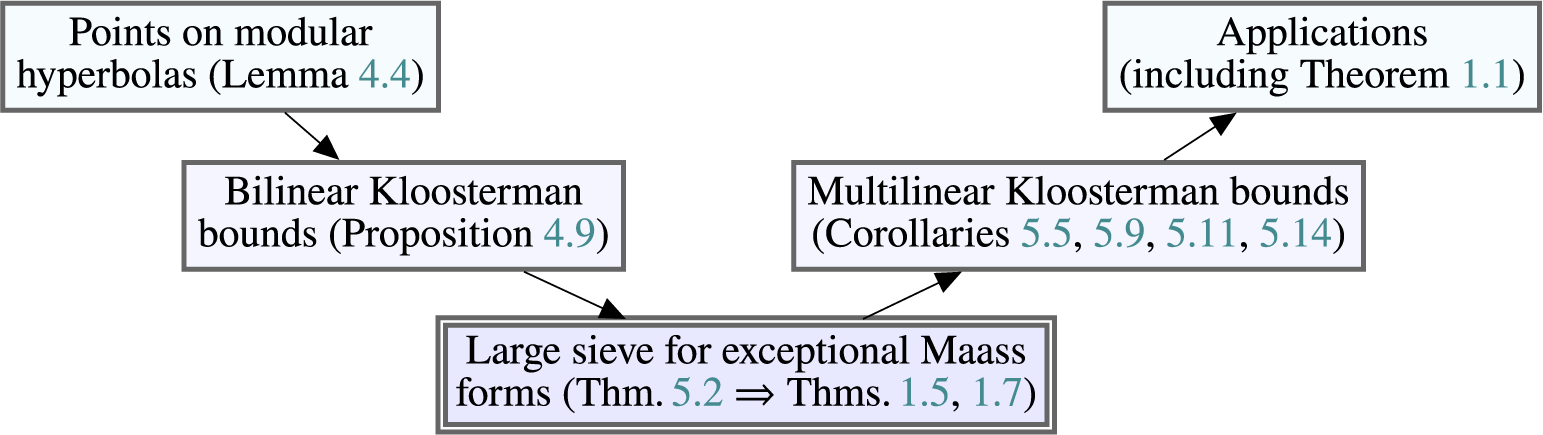


 Open access

