

INTRODUCTION
The rapidly increasing need for an adequately prepared science, technology, engineering, and mathematics (STEM) workforce in the twenty-first century requires meaningful integration of STEM disciplines in K–12 education. It is widely recognized that this is an important, but highly challenging, goal (Honey et al., Reference Honey, Pearson and Schweingruber2014). Historically, students in the U.S. have learned individual STEM disciplines in isolation, which is counter to the common practices in the professional STEM fields today (Roehrig et al., Reference Roehrig, Moore, Wang and Park2012), and STEM teaching in the U.S. has not succeeded in integrating underrepresented groups (Meyer et al., Reference Meyer, Capps, Crawford and Ross2012). In this paper, we describe our work to expand and extend understanding of integrated STEM learning with fossils and paleontology while exploring the associated benefits and challenges. Specifically, we propose a novel curricular model for integrating all four STEM domains in K–12 education. This is being done through the lens of using three-dimensional (3-D) scanning and printing technologies that are increasingly finding their way into K–12 schools (Thornburg et al., Reference Thornburg, Thornburg and Armstrong2014). This integration can be achieved in the context of a highly relevant, but heretofore unexplored, educational pathway to STEM in K–12 education using fossils and paleontology.
The relevant background on STEM learning, 3-D scanning and printing technologies, and paleontology as they relate to the goal of advancing integrated STEM education in K–12 is reviewed, and we describe the design and implementation of a paleontology-focused STEM curricular unit centered around analyzing 3-D printed teeth of the extinct Neogene shark Carcharocles megalodon Agassiz, Reference Agassiz1843 that we successfully piloted in K–12 schools in California and Florida. The potential use of 3-D scanning and printing technology and paleontology concepts and practices as they relate to the Next Generation Science Standards (NGSS) and Common Core State Standards (CCSS) are also discussed.
In this paper, we review the relevant background on STEM learning, 3D scanning and printing technologies, and paleontology as they relate to the goal of advancing integrated STEM education in K-12. We then describe the design and implementation of a paleontology-focused STEM curricular unit centered around analyzing 3D printed teeth of the extinct Neogene shark Carcharocles megalodon that we have successfully piloted in K-12 schools in California and Florida. The paper ends with a discussion of the potential use of 3D scanning and printing technology and paleontology concepts and practices as they relate to the Next Generation Science Standards (NGSS) and Common Core State Standards (CCSS).
THE ALLURE OF FOSSILS AND INTEGRATIVE NATURE OF PALEONTOLOGY
As most paleontologists know—whether with dinosaurs, fossil sharks, extinct humans, or fossils in general—paleontology represents a charismatic gateway to engage K–12 learners in STEM. Many paleontologists have brought fossils into our local classrooms to great effect. Rather than being a specialized field, paleontology is a multidisciplinary science that integrates concepts and content from diverse disciplines including biology, environmental science, geology, oceanography, and anthropology. It is the only science that documents the immense record of biodiversity in ‘Deep Time,’ accounting for more than 99% of the species that have ever existed on Earth.
Paleontology in the 21st century also harnesses the resources and tools available from other fields of STEM, including ‘Big Data’ in the cloud and 3-D scanning (Callaway, Reference Callaway2011), engineering concepts of advanced analytical 3-D imaging and digital manufacturing (Hooper, Reference Hooper2013), and mathematical modeling and statistical algorithms (Elewa, Reference Elewa2011), the latter including R (R Core Team, 2016). Through its documentation of Earth history, paleontology is uniquely positioned to provide evidence of ‘hot topics’ (Leshner, Reference Leshner2010) of great relevance in modern society, including evolution and global climate change. As a multidisciplinary science, paleontology offers opportunities to truly integrate STEM in K–12 education, an outcome that is both highly desired and challenging to achieve in practice.
CURRENT CHALLENGES WITH TEACHING INTEGRATED STEM AT K–12
The United States is facing a greater need to increase the STEM workforce to address grand challenges of the 21st century, e.g., adapting to climate change, rapid urbanization, food and energy security, and environmental protection (Honey et al., Reference Honey, Pearson and Schweingruber2014). The Science Framework for the 2011 National Assessment of Educational Progress (NAEP) reports that eighth-grade students have improved since 2009 in their content knowledge in science, especially those students who were given opportunities to learn through hands-on activities (National Assessment Governing Board, 2010). Nonetheless, according to the Program for International Student Assessment (PISA), a report on 15-year-old-student performance in science literacy and proficiency levels indicated that on a scale from 1–6, the United States scored 7% above level 5 and 17% below level 2 in comparison with 66 other countries (Kelly et al., Reference Kelly, Nord, Jenkins, Chan and Kastberg2013). These results placed the U.S. below 26 other countries scoring 5 and above, indicating that U.S. students lag behind in science literacy and proficiency.
Despite the fact that STEM disciplines are highly integrated in the workplace, no clear guidelines exist on how to effectively integrate these disciplines in K–12 contexts, while at the same time focusing on both the Common Core State Standards (National Governors Association Center for Best Practices, 2010) and Next Generation Science Standards (NGSS Lead States, 2013). According to the National Academies Press (NAP) recommendations (Honey et al., Reference Honey, Pearson and Schweingruber2014), curricular design is a critical component of this effort. Although there are many institutions and instructional designers already working toward this endeavor, NAP suggests that emphasis should be placed on developing curricula that highlights the connections existing within STEM disciplines. Despite this, relatively little effort has been made toward achieving STEM integration in K–12 classrooms.
When it comes to scientific content, most schools in America rely on textbook and on-line images, and when available, replicas of certain specimens. The availability and budget to acquire a wide range of replicas is limited and many of the resources shared among schools are typically insufficient for every student to have a meaningful opportunity for scientific inquiry and analysis.
CONCEPTUAL FRAMEWORK FOR INTEGRATED STEM LEARNING IN K–12
Integrated STEM teaching and learning in K–12 can be conceptualized as a curricular model that is grounded in the teacher technological and pedagogical content knowledge (Mishra and Koehler, Reference Mishra and Koehler2006), and includes several interacting components: 1) national educational reform initiatives, 2) development of learner interest and motivation in STEM, 3) relevant technology applications in education and science, and 4) national digitization efforts. These interacting components, if grounded in theoretical knowledge, can lead to new ideas and implementation models for successful STEM integration in K–12 education.
NATIONAL EDUCATIONAL REFORM INITIATIVES: NGSS, CCSS, AND 21ST CENTURY SKILLS
Recent national educational reform initiatives, including NGSS and CCSS, were introduced to transform the teaching and learning of STEM disciplines in K–12 education. The CCSS were designed by education leaders in 48 states, and have been officially adopted by 42 states. NGSS is a research-based initiative that outlines the scientific concepts and practices all K–12 students should know and understand. In order to achieve scientific proficiency, the tripartite NGSS framework includes: 1) the content areas of physical science, Earth science, life science, and engineering (disciplinary core ideas), to be analyzed through the dimensions of 2) practices and 3) cross-cutting concepts. Practices highlight the activities and behaviors scientists engage in to implement the scientific method. According to the NGSS, practices are broader than skills because they provide evidence of the types of behaviors a practicing scientist needs to have in order to conduct research. These types of behaviors include: 1) asking questions, 2) developing and using models, 3) planning and implementing investigations, etc. Cross-cutting concepts are defined as “fundamental to an understanding of science and engineering” (NGSS Lead States, 2013, p. 83) because they create connections among the different STEM disciplines, including: 1) patterns; 2) cause and effect; 3) scale, proportion, and quantity; 4) systems and system models; 5) energy and matter; 6) structure and function; and 7) stability and change. These connections are based on what scientists continuously do to draw conclusions about phenomena. There is clear overlap between NGSS and CCSS because the latter provide educators with the standards to improve reading comprehension of STEM, which is necessary to satisfy the performance expectations of NGSS (CCSS; National Governors Association Center for Best Practices, 2010).
DEVELOPMENT OF LEARNER INTEREST AND IDENTITY IN STEM
Effective STEM teaching should result in enhanced development of student interest, which is an important outcome of integrated STEM experiences (Maltese et al., Reference Maltese, Melki and Wiebke2014). Interest and identity are thought to lead to continued engagement in STEM-related activities as reflected in course selection and choice of out-of-school activities, college major, and career path. A recent National Science Foundation (NSF)-funded study with a representative national sample of ~6,000 students explored how the trajectories of STEM career interest change during high school, and showed that little has changed in terms of K–12 student career aspirations since the first studies of STEM career interest a decade ago (Sadler et al., Reference Sadler, Sonnert, Hazari and Tai2012). Large gender differences in career plans were found, with males showing far more interest in STEM careers. There was an additional effect of gender, indicating both a lower retention of STEM-career interest among females and a greater difficulty in attracting females to STEM fields during high school. The percentage of male high schoolers interested in a STEM career remained stable (from 39.5% to 39.7%), whereas for females it declined from 15.7% to 12.7%. The key factor predicting STEM-career interest at the end of high school was interest at the start of high school (Sadler et al., Reference Sadler, Sonnert, Hazari and Tai2012).
Relevant implications for practice of cultivation of STEM interest in K–12 include experiences that trigger student interest in STEM must be provided as early as elementary and middle school (Tai et al., Reference Tai, Liu, Maltese and Fan2006), and STEM interest must be sustained through high school (Maltese and Tai, Reference Maltese and Tai2011). Triggering experiences must be designed to be relevant to female students and other groups currently underrepresented in STEM (Sadler et al., Reference Sadler, Sonnert, Hazari and Tai2012). Such triggering experiences can include interactions with race- and gender-matched role models (e.g., Buck et al., Reference Buck, Plano Clark, Leslie-Pelecky, Cerda and Lu2008), interactions with scientists (Harnik and Ross, Reference Harnik and Ross2003), and the use of media and technologies that are perceived as captivating and compelling by young learners. 3-D scanning and printing technologies in particular provide a potentially effective pathway for triggering K–12 student interest in STEM and integrating STEM disciplines.
3-D PRINTING AND SCANNING APPLICATIONS TODAY: CHALLENGES AND OPPORTUNITIES
Three-dimensional printing technology has been in use in the industrial and commercial sectors since the 1980s (Snyder et al., Reference Snyder, Andrews, Weislogel, Moeck, Stone-Sundberg, Birkes and Graft2014). As this technology has advanced in terms of printing materials, the complexity of printed items, and the emergence of consumer-grade 3-D printers, the amount of interest and applications of 3-D printing in STEM fields has increased significantly (Dimitrov et al., Reference Dimitrov, Schreve and De Beer2006; Campbell et al., Reference Campbell, Williams, Ivanova and Garrett2011; Chiu et al., Reference Chiu, Bull, Berry and Kjellstrom2013; Bull et al., Reference Bull, Chiu, Berry, Lipson and Xie2014; Snyder et al., Reference Snyder, Andrews, Weislogel, Moeck, Stone-Sundberg, Birkes and Graft2014). The emergent trend of incorporating 3-D printing into core industries and research (Lipson and Kurman, Reference Lipson and Kurman2013) suggests that this technology will continue to increase as an integral and cost-effective component to STEM careers, research, and education in the near future.
Although K–12 schools are late adopters of this emerging technology, some schools already have 3-D printers (Thornburg et al., Reference Thornburg, Thornburg and Armstrong2014). Affordable and accessible hardware, e.g., the Fab@Home 3-D printing kit, Makerbot™ 3-D printers, Next Engine Scanner and Scan Studio™, and open-source software, e.g., 3DView™, SketchUp™, Tinkercad™, and Meshlab©, make it possible to engage K–12 students in the complex process of design, modeling, and manufacturing. The ease of use of this new generation of hardware and software promotes wide access without sacrificing the rigor of design and modeling where scientific and mathematical reasoning, artistic sensibility, and engineering processes are important. The preliminary evidence collected by our project team during recent 3-D scanning and printing workshops in Florida and California (Grant et al., Reference Grant, Antonenko, Tovani, Wood and MacFadden2015) suggests that both students and teachers are highly engaged when they scan, print, and analyze 3-D data from fossils (e.g., Megalodon teeth) to learn about evolution, extinction, and global climate change.
IMPLEMENTING 3-D SCANNING, PRINTING, AND PALEONTOLOGY IN K–12
Although the use of 3-D technology is exploding in K–12, little has been published in the peer-reviewed literature that evaluates programs, assesses learning, and provides guidance through best practices with regard to paleontology (Hasiuk, Reference Hasiuk2014). As such, this specific focus has immense potential for the future. Our work is a prototype case example of how 3-D fossils can be used to trigger student interest in science and enhance STEM learning in the context of K–12 education.
As in many natural history museums in the United States, the Florida Museum of Natural History (FLMNH) has a large collection of fossils that will likely never be available for K–12 classroom use because they are rare, delicate, or not readily accessible. Emerging 3-D technologies provide clear opportunities to share these fossils with a K–12 audience without the risks associated with managing delicate specimens, and provide students with opportunities to replicate science and scientific research, or to make their own discoveries. Harnik and Ross (Reference Harnik and Ross2003) emphasized the educational benefits for teachers and students when they engage in authentic scientific inquiries. As such, 3-D scanning and printing technologies open new opportunities for such investigations. There are several resources nationwide in the process of sharing 3-D raw data, including those of paleontological relevance. These initiatives have great potential to allow students to develop deeper understanding of morphological changes demonstrated in specimens (Boyer et al., Reference Boyer, Gunnell, Kaufman and McGeary2017). This is an enormous shift in how science can be taught. Preliminary outcomes show that K–12 students appreciate the opportunity for discovery resulting in deep learning and increased engagement. With regard to a recently initiated integrated paleontology class (J. Tovani, personal communication, 30 May 2015) at a charter school in California, one high school student noted:
“I really liked [the teacher] Jason’s paleontology class mainly because of the introduction of 3D printers. Having access to a 3D printer allowed us to grasp things differently. Being able to physically hold something in your hand cannot be underrated; it is definitely very engaging. I have never been to a science class where everyone was so engaged on what was going on. We started talking about climate change, which is a hot topic for people my age. Because everyone was so interested in the topic of climate change, the next lesson on fossil horse teeth, which a lot of people my age might not find so interesting, a bunch of fossil horse teeth, but being able to look back and see how climate change was similar or not similar to what we have today, would have let the teeth grow in the way they did and come up with the horses we have today. I know if we had not had the 3D models of the teeth to actually interact and measure and to think about our previous experiences with climate change, people would have not been quite engaged.” (Anonymous Student, 2015).
Similar to students, teachers also expressed enthusiasm about 3-D technology in their classroom: “During the [3-D] demonstration session, several students shared the reasons for their interest in this technology, and these reasons were as diverse as they were—fashion, engineering, video game design, medicine and sports, among others. It would be exciting to see what they would do with a solid foundation in 3-D modeling at such a young age” (Tovani, in Grant et al., Reference Grant, Antonenko, Tovani, Wood and MacFadden2015, p. 103). The educational potential of 3-D fossils as a context for learning is explored in more detail in the activity for high school students provided below.
Teaching about paleontology in K–12 classrooms has become an attainable goal due to the large number of institutions sharing 3-D data, and emerging interest among teachers. The uses of 3-D models have made significant changes in the way science is done. For instance, specimens in the past were analyzed in large part through standard, 2-D photographs (Lauridsen et al., Reference Lauridsen, Hansen, Nørgård, Wang and Pedersen2016). Thanks to 3-D data available today, not only do scientists have the opportunity to produce high fidelity descriptions, but K–12 students can also learn complex concepts, e.g., evolution and extinction, by visually analyzing changes that occur over time (Boyer et al., Reference Boyer, Gunnell, Kaufman and McGeary2017).
Prototypes for the unit we describe below have been implemented in two middle and two high schools in California and Florida with diverse demographics, including a large proportion of English Learners (ELs). Students had the opportunity to measure, collaborate, and make scientific predictions.
In addition, a charter high school in California, composed of students that had not previously found success in traditional schools, participated in the Megalodon prototype curriculum. Due to the charter school curricular flexibility and previous collaboration of the science teacher with professional paleontologists, a year-long course in paleontology was implemented (Tovani, 2014–Reference Tovani2015). The FLMNH contribution included a half-time student with a master’s degree in geology to provide weekly virtual support and occasional, on-site support. In Florida, a teacher implemented this lesson in sixth- and seventh-grade classes in a private school with a mostly white population of students, making the appropriate modifications to meet the corresponding standards and learning progressions for each group of students. As in California, the lesson was co-taught with a graduate student in geology to provide content support to the teacher and students. All participating schools were recruited as a result of previous collaboration with the FLMNH via two NSF-funded projects, including Research Experiences for Teachers. The participant teachers have received professional development in biology and earth sciences focusing on the Great American Biotic Interchange (www.gabiret.com). For the purpose of this short course, we describe the activity as it was implemented in the year-long paleontology class offered as an elective at the charter school in California (Tovani, Reference Tovani2014–2015).
HIGH SCHOOL LEARNING ACTIVITY: HOW BIG WAS THE GIANT SHARK CARCHAROCLES MEGALODON?
This activity uses 3-D scanning, printing, and analysis of teeth of the Neogene shark Carcharocles megalodon as an example of how paleontology has the potential to integrate all four STEM disciplines and to help develop student interest and motivation in STEM. Additional documentation of this and related 3-D fossil lesson plans are compiled at www.paleoteach.org and 3-D files can be viewed or downloaded from www.morphosource.org. The activity and lesson plans developed from it are aligned with a variety of grade-specific NGSS and CCSS standards (Appendix 1).
This activity engaged students in the authentic process that scientists use to estimate the body length of Megalodon. Student inquiry was focused and stimulated through a discussion-oriented presentation, which is available at www.paleoteach.org with instructor notes. In the initial pilots of this lesson, a co-author of this study (VP) led the students through the activity using the presentation to inform the instructor notes. The lesson builds off of two driving questions: 1) how can scientists determine the total body length of Megalodon using fossil teeth? and 2) how do scientists use modern sharks to help them gain an understanding of fossil sharks? The intent of these questions was to spark engagement, discussion, critical thinking, problem solving, and collaboration. Students then calculated the body length of the animal using an associated set of 46 3-D printed Megalodon teeth from the same individual from the Pliocene of North Carolina (Fig. 1).
Set of 46 3-D printed Carcharocles megalodon teeth, UF 311000.

Isolated shark teeth are common occurrences in the fossil record because sharks grow and shed their teeth continuously throughout their lifetime. Associated dentitions are exceedingly rare. UF (Vertebrate Paleontology Collection) 311000 from the early Pliocene Yorktown Formation of the Lee Creek Mine in Aurora, North Carolina, is one of only a few known associated dentitions of Carcharocles megalodon (G. Hubbell, personal communication, 2015). In addition to paleontological content knowledge, a goal of this lesson was to integrate the pillars of STEM, as discussed below.
During the discussion embedded in the prototype curriculum, students are introduced to previous body-length estimates for Carcharocles megalodon, illustrating that the range of estimates for an average adult varies from ~15–20 m, and that the largest living Great White Shark is just over 6 m in length (Gottfried et al., Reference Gottfried, Compagno and Bowman1996; Shimada, Reference Shimada2003; Pimiento et al., Reference Pimiento, Ehret, MacFadden and Hubbell2010). This not only puts the massive size of C. megalodon into perspective, but also highlights that uncertainty exists in science. It is crucial for students to understand that science is an iterative process and that content knowledge can change as new information and/or technologies emerge.
With this in mind, how do paleontologists derive body-length estimates solely based on fossil teeth? This leads to the comparative method of morphology and the use of modern analogs as a tool for inferring the life history of extinct organisms; these directly address the LS2 and LS4 NGSS Core Ideas (Appendix 1). In the case of Megalodon, the living Great White Shark Carcharodon carcharias has traditionally been regarded as the best ecological analog; however, most research now suggests that the two species represent separate clades and are evolutionarily distinct (Nyberg et al., Reference Nyberg, Ciampaglio and Wray2006; Ehret et al., Reference Ehret, MacFadden, Jones, Devries, Foster and Salas-Gismondi2012). Despite the distant relationship between the two species, because of their shared status as apex macropredators and the convergence in their tooth morphology, the Great White Shark is most commonly used as the basis for estimating the body length of Megalodon (Gottfried et al., Reference Gottfried, Compagno and Bowman1996; Shimada, Reference Shimada2003; Pimiento et al., Reference Pimiento, Ehret, MacFadden and Hubbell2010). Through this lesson, students test whether use of the Great White Shark as a living analog for Megalodon is appropriate.
Once the students are engaged in the discussion outlined above, they are introduced to the set of 46 3-D printed teeth with the authentic research challenge of calculating the body length of that specific individual using dental measurements. Shimada (Reference Shimada2003) developed a series of linear equations correlating tooth-crown height for each tooth position to body length in the living Great White Shark, and proposed that the same linear relationship existed in Megalodon. The original work of Shimada (Reference Shimada2003) illustrates to students how a scatter plot can be used to view and analyze data from two variables (e.g., body length and crown height), and subsequently, how a line of best fit (i.e., linear regression) can be used to determine whether a relationship exists between those two variables.
The equations that Shimada (Reference Shimada2003) devised have two variables (i.e., tooth position and crown height) that must be determined to estimate body length. The crown height of a tooth can be objectively measured, as will be described below, however, determining tooth position is more difficult. The identification of an isolated tooth of Carcharocles megalodon to an exact position is oftentimes impossible because of the gradual morphological variation that occurs within the dentition. This is illustrated through an overview of the dental anatomy: upper teeth are typically broader than lower teeth, anterior teeth are larger than posterior teeth, and anterior teeth are more bilaterally symmetrical than lateral and posterior teeth (Kent, Reference Kent1994). Students are thus exposed to the scientific terminology used to describe dentition (increasing their scientific literacy), while aligning this portion of the activity with CCSS, HS-LS2-6 (Appendix 1).
After receiving this introduction to dental morphology, students are assigned 3-D printed teeth at random and asked to predict their tooth positions. Students then come together with their predicted tooth positions to reconstruct the entire dentition. As all of the teeth are arranged in order, it becomes obvious that: 1) most of the predictions are incorrect because the gradual morphological change is interrupted, and 2) oftentimes there is more than one tooth (incorrectly) assigned to the same position. On the back of each tooth (hidden beneath tape) is the actual tooth position, which only the scientists know because these teeth came from an associated dentition. Students now have two tooth positions to work with for estimating body length; their prediction and the actual position. By calculating the body length using the equations provided for both of the tooth positions, students can see the potential error that misidentifying the tooth position can cause, reaffirming the uncertainty of science.
Each student (depending on classroom size) is assigned the task of measuring one to three teeth (Fig. 2). They are instructed to convert the tooth into a triangle by connecting three specific landmark points: (A) where the crown meets the left root lobe; (B) where the crown meets the right root lobe; and (C) the tip of the crown. They measure a perpendicular line from the crown tip C to the line segment AB, which represents crown height. This use of homologous linear measurements to make comparisons between different species introduces students to traditional morphometrics (Marcus, Reference Marcus1990), and represents a practical application of basic geometry, and thus integration of STEM.
High school students manually converting tooth crown into a triangle and measuring crown height from a 3-D printed tooth.

Students then plug their crown height measurements into the linear equations developed for their specific tooth positions (Shimada, Reference Shimada2003) and solve for the estimated body length. For example, below is the equation for upper lateral tooth position, L6 (Shimada, Reference Shimada2003).
 $${\rm TL}{\equals}{\minus}71.915{\plus}50.205{\rm CH}$$
The equations are set up so that students are required to use centimeter-gram-second (CGS) units. The crown height (CH) measurement is taken in millimeters, but the resulting body length (TL) estimate is in centimeters. Students are instructed to convert the total length in centimeters to meters and then to feet. Each individual tooth provides a body-length estimate. Given that all the teeth came from a single individual, if the equations are accurate, then each body-length estimates should be similar. However, the students find that there is extreme variability in total body-length estimates depending on what tooth position was used. Estimates for this single individual ranged from 12 to 45 m. No one had ever before tested the body-length estimates proposed by Shimada (Reference Shimada2003) on an associated dentition of Megalodon; therefore, the investigation was an authentic research experience that was exclusively student driven. The students were also able to illustrate that the living Great White Shark does not offer a very good proxy for determining body length in Megalodon, despite numerous studies suggesting otherwise (Gottfried et al., Reference Gottfried, Compagno and Bowman1996; Shimada, Reference Shimada2003; Pimiento et al., Reference Pimiento, Ehret, MacFadden and Hubbell2010).
An additional important component of this activity is the use of open-source 3-D modeling software in which students import a .stl (Standard Triangle Language or STereoLithography) file and calculate measurements using the software tools. This method allows students to compare results of their data gathered manually using standard calipers or via 3-D modeling software using online measuring tools. In this case, high school students used the educational version (open-source) of Sketchup© in order to measure each individual tooth and collect data. Then, students compared computer-gathered with manually gathered data, finding that the results were consistent and concluding that their manual data were as precise as those gathered through Sketchup©. Although the use of computer-based measurements is not required for this activity, it scaffolds students into 3-D modeling and gives them the opportunity to experience an example of how technology (STEM) can integrate with the life and Earth sciences, i.e., the content domains of paleontology.
PARTICIPANT REACTIONS AND EXPERIENCES
As described above, the activity ‘How Big was Megalodon?’ was piloted in high schools and middle schools in California and Florida. The initial data analysis, in addition to teacher observations, are based on a preliminary survey of initial impressions and reactions from students about implementing scientific processes using 3-D printed fossils. We used an anonymous survey designed and managed by the school administration for course and teacher evaluation purposes. It consisted of both multiple-choice and open-ended responses. From a total of 26 high school students who voluntarily and anonymously responded to the survey, the results indicate that 73.9% of students agreed that hands-on activities represent an effective method of instruction, particularly when preceded by guest speakers and films. The great majority of the activity ‘How Big was Megalodon?’ is hands-on either via analyzing teeth using computer modeling software or holding and measuring a 3-D printed tooth. When students were asked the open-ended question of what topics were the most interesting and informative, based on the students (N=23) who answered the question, Megalodon and Titanoboa (both using 3-D printed fossils, the latter not discussed here) were the most interesting and informative topics to students, compared to topics taught with no 3-D fossils, because the former, by replicating science, helped them understand concepts relating to climate change and evolution. In addition to student views, teacher observations reported that students showed increased enthusiasm in the topic as a result of the use of 3-D printed fossils. Although some students (N=5) felt frustrated with the mathematical component or showed no interest in paleontology, it is possible that their prior knowledge of algebra was not sufficient and that they had difficulties understanding the relevance of paleontology. However, all participants (N=65), regardless of age and content knowledge, enjoyed the activity and learned about the process of science. In addition, students learned to make connections of how 3-D printed fossils can support science and allow for new discoveries that would not otherwise be possible in K–12 classes if the fossils were not in 3-D printed format. As such, 3-D printed material also presents an additional visual component to classroom instruction, i.e., tangible objects that can be held, analyzed, and measured. In this sense, the use of 3-D printed fossils can reduce student cognitive load by touching and feeling versus viewing a picture in a book (Hasiuk and Harding, Reference Hasiuk and Harding2016). One of the class reflections posted in a student notebook stated: “3D printing would help me very much in class by giving us a strong visual and something to hold and move around with our own hands. An actual replica of the object or subject we’re learning about” (anonymous student).
We realize that our surveys, their results, and our observations presented above are preliminary and not systematic in terms of what is expected for the design of a learning research project. We nevertheless view these as preliminary data from which more rigorous evaluations will be conducted as we move forward with lessons involving 3-D scanning and printing implementation in the future. In particular, using formalized and validated survey design, we plan to rigorously test the efficacy of 3-D printing and scanning of fossils in STEM integration, student motivation, and resultant learning gains through a recently NSF-funded ITEST (Innovative Technology Experiences for Students and Teachers) project.
The Megalodon teeth described here have been made available by the FLMNH at www.morphosource.org. In addition, a set of 12 fossil horse teeth that are key to the understanding of horse evolution in response to climate change have also been made available in conjunction with lessons (Bokor et al., Reference Bokor, Broo and Mahoney2016). The latest addition to this initiative is a set of three Titanoboa cerrejonensis (Head et al., Reference Head, Bloch, Hastings, Bourque, Cadena, Herrera and Jaramillo2009) vertebrae, two ribs, and 1 Eunectes murinus (Linnaeus, Reference Linnaeus1758) vertebra with the purpose to replicate the process of scientific discovery by paleontologists in the search for answers regarding climate change (Head et al., Reference Head, Bloch, Hastings, Bourque, Cadena, Herrera and Jaramillo2009).
CONCLUSIONS, IMPLICATIONS, AND THE FUTURE OF 3-D FOSSILS IN K–12
Within the content domain of paleontology, it is well known that natural history museums contribute to society through informal STEM support to educators. This support is specially reflected with opportunities to provide fossils for classroom use (Allmon et al., Reference Allmon, Ross, Kendrick and Kissel2012). However, it is likely that many important specimens that are kept in collections for further scientific research will never be available for K–12 classrooms. As such, 3-D scanning and printing provide a unique opportunity to promote broad access to highly relevant fossils. Moreover, 3-D printing has become increasingly affordable, and schools situated far from natural history museums, e.g., in rural areas, could also have access to 3-D printed kits and associated curricula. Although there is a limit to how many fossils a museum can provide to school districts, there is no limit on how many fossil kits a school district could print in 3-D. Thus, this increased access can potentially promote inquiry-based geoscience education in rural communities (Harnik and Ross, Reference Harnik and Ross2004). The use of 3-D scanning and printing is rapidly growing among professional scientists and is starting to expand into K–12 education. We assert that learning experiences such as the Megalodon size estimation activity described above offer great potential for improving student content knowledge and discipline-specific skills in biological and Earth sciences, while also affecting student interest in integrated STEM practices through authentic use of 3-D scanning and printing technologies. Specifically, paleontology-focused and 3-D technology-infused learning experiences provide students with opportunities to: 1) analyze 3-D printed fossils, gather data and draw conclusions; 2) develop basic 3-D modeling knowledge by analyzing 3-D fossil files using open-source software; 3) model and predict mathematical estimations; 4) understand the connections between STEM disciplines; and 5) develop twenty-first-century skills. These learning experiences introduce students to the important STEM aspects of paleontology while at the same time expose them to new terminology and information processing skills that contribute to the development of student scientific and technological literacy. Additionally, paleontology provides an excellent gateway to integrating and reinforcing mathematical concepts within a real-world scientific scenario. Students also engage in experimentation as they collect and analyze data, produce predictions, and interpret and compare their results. The use of 3-D fossils as a unifying strategy to help students understand how scientists use technology and mathematics reflects the intent of the NGSS and CCSS. Furthermore, because the nature of this activity is collaborative, students engage in communication of their ideas, critical thinking and problem solving, all of which are twenty-first-century skills (Partnership for 21st Century Skills, 2011).
As in most learning activities, the curricular ideas presented in this paper are potentially limited by the lack of adequate prior knowledge of students and teacher ability to activate this knowledge to spark interest in the topic (Hmelo-Silver, Reference Hmelo-Silver2004). However, building on student experiences with the scaffolding of 3-D printing and scanning, students can develop STEM-relevant technological content knowledge and skills, resulting in enhanced student interest in STEM. Another possible limitation is the availability of 3-D printing and scanning technologies because the required hardware can be expensive and require specialized expertise, but similar arguments were used when computers were first made available to the public a few decades ago (Blikstein, Reference Blikstein2013) and now computer use is commonplace.
In summary, 3-D fossils and paleontology represent a charismatic gateway to K–12 student interest and engagement in STEM learning, and potentially, in post-secondary education and careers in STEM fields such as paleontology, geology, biology, and other related disciplines. As Wysession et al. (Reference Wysession, Ladue, Budd, Campbell, Conklin, Kappel and Taber2012) noted, it is our responsibility to help students understand the many layers of scientific knowledge and practice. The potential of an approach that integrates 3-D technology with paleontology to engage students in STEM will be further tested empirically with the continued development and implementation of other learning activities using charismatic fossils.
Acknowledgments
This work was funded by U.S. National Science Foundation (NSF) grant 089887 (OISE, EAR, DRL) and Duke University (www.morphosource.org). We also acknowledge the generosity of G. Hubbell for donating the specimen to the FLMNH for K–12 outreach and education. S. Moran contributed to the project via unit development and classroom implementation time. FLMNH interns A. de Renzis and J. Alicea processed CT data, thus making the digital files available for 3-D printing. Teachers M. Hendrickson (Florida) and K. Schmidt and J. Tovani (California) implemented this unit in their classrooms and contributed much to the development of this unit. We also appreciate the support and advice of J. Bloch (UF) and D. Boyer (Duke).
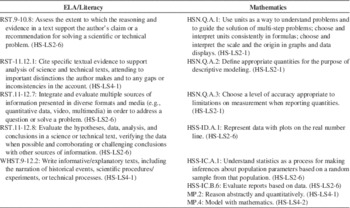
APPENDIX 1.—An overview of the NGSS and CCSS standards that the Megalodon activity is designed to address
NGSS PERFORMANCE EXPECTATIONS
HS-LS2-1: Use mathematical and/or computational representations to support explanations of factors that affect carrying capacity of ecosystems at different scales.
HS-LS2-6: Evaluate the claims, evidence, and reasoning that the complex interactions in ecosystems maintain relatively consistent numbers and types of organisms in stable conditions, but changing conditions may result in a new ecosystem.
HS-LS3-3: Apply concepts of statistics and probability to explain the variation and distribution of expressed traits in a population.
HS-LS4-1: Communicate scientific information that common ancestry and biological evolution are supported by multiple lines of empirical evidence.
HS-LS4-2: Construct an explanation based on evidence that the process of evolution primarily results from four factors: 1) the potential for a species to increase in number, 2) the heritable genetic variation of individuals in a species due to mutation and sexual reproduction, 3) competition for limited resources, and 4) the proliferation of those organisms that are better able to survive and reproduce in the environment.
HS-LS4-3: Apply concepts of statistics and probability to support explanations that organisms with an advantageous heritable trait tend to increase in proportion to organisms lacking this trait.
HS-LS4-4: Construct an explanation based on evidence for how natural selection leads to adaptation of populations.

COMMON CORE STATE STANDARDS CONNECTIONS