





Introduction
Attention-deficit/hyperactivity disorder (ADHD) has been extensively studied in many fields. Earlier studies highlighted behaviors (Tannock, Reference Tannock2013) and genetics (Biederman et al., Reference Biederman, Faraone, Keenan, Knee and Tsuang1990), as well as focused on children populations and subtyping the condition (e.g., Barkley, Reference Barkley2006). In contrast, recent studies have explored adult populations (e.g., see Prakash et al., Reference Prakash, Chatterjee, Guha, Srivastava and Chauhan2021) and sex-related variations of symptoms (e.g., Attoe & Climie, Reference Attoe and Climie2023; Young et al., Reference Young, Adamo, Ásgeirsdóttir, Branney, Beckett, Colley, Cubbin, Deeley, Farrag, Gudjonsson, Hill, Hollingdale, Kilic, Lloyd, Mason, Paliokosta, Perecherla, Sedgwick, Skirrow, Tierney and Woodhouse2020). Since recent studies have also explored affective factors and self-perception among individuals with ADHD (e.g., Breaux et al., Reference Breaux, Dvorsky, Marsh, Green, Cash, Shroff, Buchen, Langberg and Becker2021; Cueli et al., Reference Cueli, Rodríguez, Cañamero, Núñez and González-Castro2020), the present study attempts to learn about the beliefs of individuals with ADHD about their additional language learning and use. The study is in light of the interactionist perspective that brings together “contrasting theoretical frameworks” (Kormos, Reference Kormos2017) to acknowledge the interactive and flexible nature of possible challenges an individual with ADHD may experience.
Although it is still in its nascency (Silawi et al., Reference Silawi, Degani and Prior2025), research on ADHD in additional language acquisition is growing; yet, none of the existing studies has directly investigated the beliefs of individuals with ADHD about their additional language learning and use. Learning additional language processes of learners with specific learning difficulties from their own perspectives has not been frequently studied (Kormos, Reference Kormos2020); however, this perspective is paramount to providing valuable insights for learner-centered teaching methodology. Hence, this study explores the effect of ADHD on the knowledge of additional languages from a multilingual perspective. Although the study focuses on ADHD, it offers insights into the co-occurrence of neurodevelopmental conditions, such as Autism spectrum disorder (ASD) and dyslexia, and additional language acquisition in light of neurodiversity approaches (Dwyer, Reference Dwyer2022), Education for All (UNESCO, 2015), and universal design in language education (Tsagari et al., Reference Tsagari, Nijakowska and Guz2022).
Background
Attention-deficit/hyperactivity disorder
ADHD is a neurodevelopmental condition that presents itself with inattention, hyperactivity, and impulsivity. The symptoms of inattention include a lack of attention to details, inability to keep attention for a longer time or follow instructions, poor organizational strategies, forgetfulness, and being easily distracted by an external stimulus. Hyperactivity may cause, for example, frequent hand and leg movement, walking or running, and fidgeting. Impulsivity, on the other hand, is associated with lower self-control, impatience, excessive talking, unintentional destruction and disturbing others. An individual with ADHD can exhibit either a combined presentation of inattention and hyperactivity-impulsivity, predominant inattention, or predominant hyperactivity/impulsivity presentation. Symptoms can be either severe, moderate, or mild, affecting social and occupational functioning to different degrees (American Psychiatric Association [APA], 2013).
The occurrence of ADHD is estimated to be between 5.29 and 7.1% of people under the age of 18 worldwide (Polanczyk et al., Reference Polanczyk, Willcutt, Salum, Kieling and Rohde2014) and 2.5% in adults (Ginsberg et al., Reference Ginsberg, Quintero, Anand, Casillas and Upadhyaya2014). However, many individuals are still underdiagnosed and undertreated (Kooij et al., Reference Kooij, Bijlenga, Salerno, Jaeschke, Bitter, Balázs, Thome, Dom, Kasper, Nunes Filipe, Stes, Mohr, Leppämäki, Casas, Bobes, Mccarthy, Richarte, Kjems Philipsen, Pehlivanidis, Niemela and Asherson2019), especially women who were not adequately diagnosed in their childhood (Da Silva et al., Reference Da Silva, Malloy-Diniz, Garcia, Rocha, Renno, Valadres, Cantilino, Mendes-Ribeiro, Rocha and da Silva2020), since ADHD symptoms present differently in women than in men (Mowlem et al., Reference Mowlem, Rosenqvist, Martin, Lichtenstein, Asherson and Larsson2018; Nussbaum, Reference Nussbaum2012).
Additionally, diagnostic appropriateness is limited by the criteria for neurodevelopmental conditions and related ones that show considerable co-occurrence and overlap (Morris-Rosendahl & Crocq, Reference Morris-Rosendahl and Crocq2020). For example, the bidirectional co-occurrence of ADHD and ASD is estimated to be 38 to 70% (Hours et al., Reference Hours, Recasens and Baleyte2022; Rong et al., Reference Rong, Yang, Jin and Wang2021), and ADHD and dyslexia between 25 and 40% (DuPaul et al., Reference DuPaul, Gormley and Laracy2013). The overlap in the latter may stem from shared cognitive correlates in executive functions and/or procedural learning (McGrath & Stoodley, Reference McGrath and Stoodley2019). In this regard, ADHD should be studied from the perspective of the multiple deficit model (MDM; Pennington, Reference Pennington2006). The model assumes that various predictors are highly contributory to any neurodevelopmental disorder, enhancing the risk factors of co-occurrence within a four-level framework: etiology, brain mechanisms, neuropsychology, and behavior. However, specific causality cannot be established because of the high heterogeneity of neurodevelopmental disorders (McGrath et al., Reference McGrath, Peterson and Pennington2020).
Academic, affective, and cognitive impacts of ADHD in the L1 context
A meta-analysis study (Martinussen et al., Reference Martinussen, Hayden, Hogg-Johnson and Tannock2005) shows that ADHD-like manifestations are caused by deficits in the executive function of working memory. These findings are confirmed by recent studies (Karalunas et al., Reference Karalunas, Gustafsson, Dieckmann, Tipsord, Mitchell and Nigg2017; Karr et al., Reference Karr, Rodriguez, Goh, Martel and Rast2022; Kofler et al., Reference Kofler, Irwin, Soto, Groves, Harmon and Sarver2019, Reference Kofler, Singh, Soto, Chan, Miller, Harmon and Spiegel2020). Impairment in the executive function of working memory may lead to reading and writing difficulties (Adi-Japha et al., Reference Adi-Japha, Landau, Frenkel, Teicher, Gross-Tsur and Shalev2007; Cain & Bignell, Reference Cain and Bignell2014; Miller et al., Reference Miller, Keenan, Betjemann, Willcutt, Pennington and Olson2013) and limited monitoring of comprehension while receiving oral instructions (McInnes et al., Reference McInnes, Humphries, Hogg-Johnson and Tannock2003). However, it must be noted that literacy difficulties in ADHD have different cognitive bases than those in literacy disorders or dyslexia since studies on ADHD showed that phonological short-term memory is intact (Kofler et al., Reference Kofler, Singh, Soto, Chan, Miller, Harmon and Spiegel2020). Similarly, no significant effect was found on the phonological loop (Martinussen et al., Reference Martinussen, Hayden, Hogg-Johnson and Tannock2005; Song et al., Reference Song, Zhang, Xu, Ju and Jiang2024) in individuals with ADHD. Research also showed that individuals with ADHD had reduced response selection capacity (Roberts et al., Reference Roberts, Milich and Fillmore2012) and limited selectivity regarding the value of the items they recall; however, they did not differ in the total number of words recalled (Castel et al., Reference Castel, Lee, Humphreys and Moore2011). Research (Bishop & Baird, Reference Bishop and Baird2001; Staikova et al., Reference Staikova, Gomes, Tartter, McCabe and Halperin2013) also found that children with ADHD have poorer pragmatic language skills than their peers without ADHD.
Some individuals with ADHD have reported so-called “hyperfocus,” which is an experience of intensified attention to a specific activity or subjects of interest (Brown, Reference Brown2005; Hupfeld et al., Reference Hupfeld, Abagis and Shah2019). Ashinoff and Abu-Akel (Reference Ashinoff and Abu-Akel2021) suggest that this phenomenon overlaps with the concept of flow, which may be critical for learning experiences as it is conditioned by self-perceived challenges and/or opportunities for the given action and clear short-term objectives and requirements for immediate feedback on progress (Nakamura & Csikszentmihalyi, Reference Nakamura, Csikszentmihalyi, Lopez and Snyder2009). Studies showed salient differences between the specific ADHD presentations. For example, Castel et al. (Reference Castel, Lee, Humphreys and Moore2011) found that the participants with the combined presentation were less strategic and did not efficiently encode and recall high-value words compared to those with the inattention presentation. In contrast, studies by Kibby et al. (Reference Kibby, Vadnais and Jagger-Rickels2019) and Nigg et al. (Reference Nigg, Blaskey, Huang-Pollock and Rappley2002) found that information processing was more impaired in individuals with predominant inattention than in those with the combined presentation.
Individuals with ADHD may experience affective issues. Students with ADHD experience more frequent emotional dysregulation (Shaw et al., Reference Shaw, Stringaris, Nigg and Leibenluft2014; Soler-Gutiérrez et al., Reference Soler-Gutiérrez, Pérez-González and Mayas2023), mental difficulties (Pisula et al., Reference Pisula, Płatos, Banasiak, Danielewicz, Gosztyła, Podgórska-Jachnik, Pyszkowska, Rumińska and Winczura2024), and lower self-esteem (Harpin et al., Reference Harpin, Mazzone, Raynaud, Kahle and Hodgkinsm2016; Pedersen et al., Reference Pedersen, Edvardsen, Messina, Volden, Weyandt and Lundervold2024). More specifically, the study by Cueli et al. (Reference Cueli, Rodríguez, Cañamero, Núñez and González-Castro2020) indicated that trait anxiety in individuals with ADHD mediated the relationship between inattention and emotional, social, and physical self-concept; however, it did not moderate this relationship. In contrast, this trait does not mediate or moderate the relationship between hyperactivity/impulsivity symptoms and self-concept. A direct relation was found between inattention and academic self-concept—when the former increases, the latter decreases. However, an indirect decrease occurs in the emotional, social, and physical self-concept due to trait anxiety. Castagna et al. (Reference Castagna, Calamia and Davis2017) found that young individuals with the combined presentation of ADHD, unlike those with the inattention presentation, reported more frequent personal failure, hostile intent, and less favorable self-statements due to higher anxiety.
The academic failure of students with ADHD is highlighted by Pisula et al. (Reference Pisula, Płatos, Banasiak, Danielewicz, Gosztyła, Podgórska-Jachnik, Pyszkowska, Rumińska and Winczura2024)—university students with ADHD tend to change their studies, repeat their study year, and frequently take their exams in alternative terms or are unable to pass all their exams in the exam sessions. Similarly, the study by Henning et al. (Reference Henning, Summerfeldt and Parker2022) indicated that students with more severe inattention symptoms at the beginning of their academic studies experienced poorer long-term academic success.
ADHD in the L2 context
Undoubtedly, the deficits in the central executive working memory (e.g., Karalunas et al., Reference Karalunas, Gustafsson, Dieckmann, Tipsord, Mitchell and Nigg2017; Kofler et al., Reference Kofler, Irwin, Soto, Groves, Harmon and Sarver2019, Reference Kofler, Singh, Soto, Chan, Miller, Harmon and Spiegel2020) will have various effects on additional language (L2) acquisition and use (Kałdonek-Crnjaković, Reference Kałdonek-Crnjaković2018). ADHD has been associated with poor linguistic functioning (Bellani et al., Reference Bellani, Moretti, Perlini and Brambilla2011). Individuals with ADHD may have difficulty in reading comprehension, especially at the proficient level when more complex mental activities are employed (Miller & Keenan, Reference Miller and Keenan2011). Difficulties in processing verbal material (e.g., Cain & Bignell, Reference Cain and Bignell2014) may affect L2 listening comprehension skills since performing listening tasks requires the engagement of various linguistic aspects, including sounds, grammar, lexis, and discourse structure, as well as context, interlocutors, and the purpose of communication (Goh, Reference Goh2000). Students with ADHD may struggle with completing L2 listening tasks, especially those that require them to focus for a longer time, select specific information, and process this information in a particular context (Kałdonek-Crnjaković, Reference Kałdonek-Crnjaković2018).
The weaker capacity for information storage from different stimuli in individuals with ADHD (Alloway et al., Reference Alloway, Gathercole and Elliot2010; Martinussen & Tannock, Reference Martinussen and Tannock2006) may affect grammar and vocabulary learning, especially in memorization. Regarding spoken production, individuals with ADHD in L2 may struggle with coherence and relevance (Kałdonek-Crnjaković, Reference Kałdonek-Crnjaković2018). They may also find it challenging to employ politeness strategies, formal registers, and nonverbal communication cues as they tend to misinterpret emotions (Cadesky et al., Reference Cadesky, Mota and Schachar2000), and their reactions may be impulsive.
English language teachers in Poland reported the effect of ADHD on all L2 language skills, however, with varying intensity and significance. The participants in the study by Kałdonek-Crnjaković (Reference Kałdonek-Crnjaković and McCallum2022) reported an equal effect of inattention and hyperactivity/impulsivity manifestations on listening, reading, and writing skills, whereas hyperactivity/impulsivity manifestations were reported to have a more significant impact on speaking, grammar, and vocabulary. In contrast, a study by Kałdonek-Crnjaković (Reference Kałdonek-Crnjaković2024) reported that only speaking was more affected by hyperactivity/impulsivity. The observed differences might stem from the specific teaching context of the study participants.
Regarding academic achievement in language classes, Ferrari and Palladino (Reference Ferrari and Palladino2007) found that lower achievement in English as a foreign language (EFL) of primary school students was correlated with inattention. By contrast, university students with ADHD can achieve high scores in foreign language classes (Sparks et al., Reference Sparks, Javorsky and Philips2004, Reference Sparks, Javorsky and Philips2005). Their performance in memorization, grammatical structure analysis, and reading comprehension tasks was comparable to that of high-achievers in the cohort. On the other hand, they were found to make more spelling mistakes. Therefore, individuals with ADHD have a diverse cognitive and linguistic profile (Sparks et al., Reference Sparks, Humbach and Javorsky2008).
The findings of Sparks et al. (Reference Sparks, Humbach and Javorsky2008) align with the recent interview study that explored additional language learning and use experience of multilingual learners with ADHD (Kałdonek-Crnjaković & Błaszczak, Reference Kałdonek-Crnjaković2024). On the one hand, the participants positioned themselves as autonomous, engaged, motivated, and passionate language learners. As a result, they developed high additional language fluency with advanced social and communication skills. On the other hand, they admitted that their engagement and motivation might frequently fluctuate. They described their learning as chaotic.
In a similar vein, the multilingual adult participants with ADHD in the study by Köder et al. (Reference Köder, Rummelhoff and Garraffa2024a) reported various effects of the condition on language learning and use, including code-switching, concentration, hyperfocus, impulsivity, memory, and pragmatic difficulties.
Research findings of Köder et al. (Reference Köder, Rummelhoff and Garraffa2025) showed that multilingual adult individuals with ADHD reported more pragmatic difficulties than participants without ADHD; however, these difficulties were reduced in additional languages in the context of hyperactivity and impulsivity symptoms. Similarly, Azaiez et al. (Reference Azaiez, Loberg, Hämäläinen and Leppänen2023) reported different effects of ADHD in L1 (Finnish) and L2 (English) for the P3a component, that is, a cognitive neuromarker of the attentional processes. A larger P3a response was observed in the participants with inattention than in the control group. However, the response differed between the groups in L1 but not in L2 processing. The authors explain that sensitivity to L2 phonology is reduced because of shifting attentional processes to the meaning processes, or both groups had weak phonetic representation for L2, and the difference could not be detected in the brain’s electrical response.
The current study
This study aimed to investigate the views of multilingual adult individuals with ADHD about their language learning and use. The study also inquired about the effect of ADHD on the participants’ knowledge of additional languages. In this way, this study relates to the studies by Kałdonek-Crnjaković and Błaszczak (Reference Kałdonek-Crnjaković2024) and Köder et al. (Reference Köder, Rummelhoff and Garraffa2024a) and makes a contribution to the understanding of language learning and use in individuals with ADHD.
The study sought to answer these questions:
-
1. What effects do the specific ADHD presentations (inattention, hyperactivity/impulsivity, and combined) have on the participants’ views on their additional language learning and use?
-
2. What effects do the specific ADHD presentations (inattention, hyperactivity/impulsivity, and combined) have on the participants’ knowledge of additional languages?
-
3. What effects do additional conditions, such as dyslexia or ASD, have on the participants’ views on their additional language learning and use?
-
4. What effects do additional conditions, such as dyslexia or ASD, have on the participants’ knowledge of additional languages?
The following was hypothesized:
-
1. For RQ1, the participants with combined and inattention ADHD presentations will report less favorable views than the participants with the hyperactivity/impulsivity presentation, based on the research findings of Castel et al. (Reference Castel, Lee, Humphreys and Moore2011), Cueli et al. (Reference Cueli, Rodríguez, Cañamero, Núñez and González-Castro2020), Kibby et al. (Reference Kibby, Vadnais and Jagger-Rickels2019), and Nigg et al. (Reference Nigg, Blaskey, Huang-Pollock and Rappley2002).
-
2. For RQ2, the participants with combined and inattention ADHD presentations will report knowledge of fewer additional languages than the participants with the hyperactivity/impulsivity presentation, based on the research findings of Castel et al. (Reference Castel, Lee, Humphreys and Moore2011), Cueli et al. (Reference Cueli, Rodríguez, Cañamero, Núñez and González-Castro2020), Kibby et al. (Reference Kibby, Vadnais and Jagger-Rickels2019), and Nigg et al. (Reference Nigg, Blaskey, Huang-Pollock and Rappley2002).
-
3. For RQ3, the participants with the co-occurrence of the conditions (ADHD and dyslexia and/or ASD) will view their language learning and use less favorably than those who have only ADHD, considering the multiple effects of different conditions, according to the MDM (Pennington, Reference Pennington2006).
-
4. For RQ4, based on, for example, research findings of Helland and Kaasa (Reference Helland and Kaasa2005), Łockiewicz and Jaskulska (Reference Łockiewicz and Jaskulska2016), and Palladino et al. (Reference Palladino, Cismondo, Ferrari, Ballagamba and Cornoldi2016), the participants with the co-occurrence of dyslexia will report knowledge of fewer additional languages.
Following the recommendations of the ethics committee for research involving human participants at the institution of this paper’s author, participants were explicitly informed that their participation was anonymous and voluntary. Informed consent was obtained through an initial checklist that participants were required to read and confirm before proceeding with the completion of the questionnaire.
Method
Participants
Participants were recruited via Facebook’s adult ADHD group, operating in Poland. An open call was made to address adult individuals who had a diagnosis of ADHD and knew additional languages apart from the Polish language, L1 of potential participants (See Appendix 1 for further information about the call to participate in the study.) Two hundred and fifty-two individuals responded to the call. The responses were inspected, and the final sample consisted of 226 participants. Only completed answers were considered for further analysis. The participants’ age was between 18 and 56 years and more, with the majority of those in the age category of 21–25 years (76, 34%). More women were in the final sample (146, 65%). Most of the participants reported receiving an official diagnosis of ADHD in their adulthood (219, 97%; Mage = 29.98, SD = 10.50); seven participants received a diagnosis in their childhood (Mage = 8.57, SD = .78).
Thirty-six per cent (82) reported additional conditions such as dyslexia and/or ASD. All the participants had experience of knowing and learning more than two additional languages. The majority of the participants declared communicative knowledge in English (217), followed by French (48), German (43), Japanese (25), Russian (23), Spanish (16), Italian (11), Korean (9), Chinese (3), and other languages—Czech, Finish, Hungarian, Slovak, Norwegian, and Ukrainian (17). The learning experience without reaching communicative competence included German (114), Russian (72), Italian (62), French (59), Spanish (21), Korean (20), Japanese (19), Chinese (7), and other languages—Czech, Dutch, Greek, Latin, and Norwegian (23).
Table 1 contains detailed information about the participants, including the reported dominant ADHD presentation and additional conditions—ASD, dyslexia (including dysorthographia and dysgraphia, according to the Polish classification—see the Polish Dyslexia Association, https://www.ptd.edu.pl/cotojest.html), and the co-occurrence of dyslexia and ASD.
Description of the sample

Data collection
Data were collected via an online questionnaire in a Google form, which was administered in Polish. In the first part, the participants were asked to answer demographic questions, questions regarding their ADHD diagnosis, and questions on their language learning experiences. The second part consisted of 12 questions that asked the participants about their views on the effect of ADHD on their language learning and use on a seven-point Likert-type scale with six statements presenting a positive view (2, 4, 7, 8, 10, 11) and six presenting a less favorable or negative view (statements 1, 3, 5, 6, 9, 12) (see Appendix 1 for more details.)
The seven-point scale was chosen considering the recommendations in the literature (e.g., Iwaniec, Reference Iwaniec, McKinley and Rose2019): It was assumed that the participants had a mixed attitude toward their language learning and use experience and may feel indecisive about whether their experience is positive or less favorable.
Data analysis
We ran linear mixed models (GLMMs) to answer RQ1 (“What effects do the specific ADHD presentations (inattention, hyperactivity/impulsivity, and combined) have on the participants’ views on their additional language learning and use?”) and RQ3 (“What effects do additional conditions, such as dyslexia or ASD, have on the participants’ views on their additional language learning and use?”). The fixed effect (FE) of interest was ADHD Presentation (RQ1) and Additional Condition (RQ3). Age was entered as a covariate in both models.Footnote 1 The predictors were dummy coded, and Age was standardized. The random effects (REs) were the intercepts for participants and questionnaire items and the slopes for the predictors of interest: ADHD Presentation by items (RQ1) and Additional Condition by items (RQ3). The dependent variable in both models was the answer in the online questionnaire (1–7), which was analyzed as a continuous variable. The scale was reversed for the negative statements (see above); thus, an increase in the dependent variable score now represents a more positive view on language learning. The models were estimated using restricted maximum likelihood (REML), and Kenward-Roger was chosen as the approximation of degrees of freedom.
To answer RQ2 (“What effects do the specific ADHD presentations (inattention, hyperactivity/impulsivity, and combined) have on the participants’ knowledge of additional languages?”) and RQ4 (“What effects do additional conditions, such as dyslexia or ASD, have on the participants’ knowledge of additional languages?”), we used a binomial dependent variable. This dependent variable was extracted from the background questionnaire as follows: Participants who had communicative competence in one additional language were coded as 0; participants with communicative competence in more than one additional language were coded as 1. Therefore, we ran logistic regressions predicting the likelihood of being multilingual (code 1). It was not possible to run mixed models to answer RQ2 and RQ4. This is because each participant would only have one score (0 if having communicative competence only in one additional language, 1 if having communicative competence in more than one additional language), irrespective of the number of rows. We thus aggregated the data per participant. The predictors of interest (dummy coded) were ADHD Presentation for RQ2 and Additional Condition for RQ4; Age (standardized) was entered as a covariate in both cases. All data were analyzed using IBM SPSS v. 28 (2021), and the alpha value was set at 0.05. When multiple comparisons were performed, a Bonferroni correction was applied to control for Type I error (see von der Malsburg & Angele, Reference von der Malsburg and Angele2017).
Bootstrapping
All four models were bootstrapped so we could obtain more precise standard errors and confidence intervals. Bootstrapping creates additional samples by resampling data from the original sample with replacement (i.e., once individual cases are sampled, they are returned to the pool of possible samples), and thus any case could appear once or multiple times in a new sample, or not at all (McCormick et al., Reference McCormick, Salcedo and Poh2016). Bootstrapping does not require assumptions such as normality and heteroscedastic, is less sensitive to the presence of outliers, and “can provide more accurate inferences when the data are not well behaved or when the sample size is small” (Efron & Tibshirani, Reference Efron and Tibshirani1993, p. 587; see also LaFlair et al., Reference LaFlair, Egbert, Plonsky and Plonsky2015; McCormick et al., Reference McCormick, Salcedo and Poh2016), as was the case with our data.Footnote 2
We utilized 95% CI bias-corrected and accelerated (BCa) stratified bootstrap with 1000 samples. BCa bootstraps are more accurate than percentile bootstraps (the other option provided by IBM SPSS) as BCa better corrects for skewness and heteroscedasticity (Efron &Tibshirani, Reference Efron and Tibshirani1993; IBM SPSS, 2021; LaFlair et al., Reference LaFlair, Egbert, Plonsky and Plonsky2015). We employed stratified (not simple) BCa bootstraps because we wanted to ensure that the resampling occurred from each group separately, and proportionally to group sizes, which varied considerably (Efron & Tibshirani, Reference Efron and Tibshirani1993; LaFlair et al., Reference LaFlair, Egbert, Plonsky and Plonsky2015). Finally, we considered 1000 samples sufficient for accurate estimates. Efron and Tibshirani (Reference Efron and Tibshirani1993) recommended up to 1000 samples, and Deng et al.’s (Reference Deng, Allison, Fang, Ash and Ware2013) simulation study found no improvement in the accuracy of estimates after 500 samples.
Results
ADHD presentations and views on language learning and use
The estimated marginal means relevant to RQ1 can be found in Table 2 below. The mean scores (ranged 1–7) are similar, except for perhaps the difference between Hyperactivity/impulsivity and Combined (.592).
Estimated marginal means for ADHD Presentation for attitude towards language learning and use

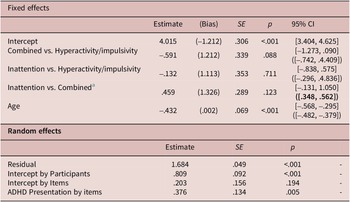
The results of the linear mixed model (LMM) can be found in Table 3. It seems that all ADHD presentations (combined, inattention, and hyperactivity/impulsivity) have a similarly positive attitude toward language learning and use. The results of the 95% CIs cross zero, indicating statistical nonsignificance. However, the bootstrap results suggest that participants with the combined ADHD presentation may have a less positive attitude toward learning a language than participants with the inattention presentation (95% CIs do not even approach zero). Still, as mentioned above, the results of the bootstrap cannot replace the original estimates. Even so, if a difference exists between the ADHD presentations, this difference is likely to be minimal.
LMM results for RQ1 (marginal pseudo R2 = .062; conditional pseudo R2 = .486)

Note: Participants N = 226; Items per participant = 12. Reference category for ADHD Presentation = Hyperactivity/impulsivity. 95% BCa Bootstrap results shown between round brackets. Results that differ from the original results are in bold.
a Reference category changed to category “Combined” to obtain the comparison with “Inattention”. Thus, only ps <.025 may be considered significant.
Importantly, the bootstrap did not fully validate the results of the LMMs, pointing to problems in the data. Also, the bootstrap bias (difference between the original estimates and the average of the 1000 bootstrap estimates) is large, and most confidence intervals are very wide, which also suggests issues with the data. One reason may be the small sample size, especially for the participants with the hyperactivity/impulsivity presentation (n = 21; 12 test items per participant). Further research is needed to verify this.
Finally, it is noteworthy that the random effects explained most of the variance in the model (random effects = 42.4%; fixed effects = 6.2%). If Age is removed from the model, the fixed effects (now only ADHD presentation) explain only 1.2% of the variance (Marginal Pseudo R2 = .012). As a result, although LMM’s effect sizes should be interpreted with caution, taken together, the results suggest that ADHD presentation may have little impact on attitudes toward additional language learning and use.
ADHD presentations and knowledge of additional languages
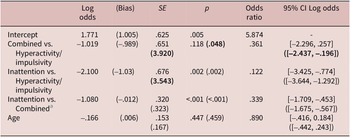
Overall, the descriptive statistics show that participants with the hyperactivity/impulsivity presentation are proportionally more multilingual than others: Hyperactivity/impulsivity = 85.71%; combined = 68.38%; inattention = 40.58%. The results of the logistic regression employed to answer RQ2 are shown in Table 4. Estimated marginal means for Additional Conditions for attitude toward language learning and use are shown in Table 5.
Logistic regression results for RQ2 (Nagelkerke’s R2 = .124)

Note: Reference category for ADHD Presentation = Hyper/Impulsive. 95% BCa Bootstrap results shown between round brackets. Results that differ from the original results are in bold.
a Reference category changed to category “Combined” to obtain the comparison with “Inattention.” Thus, only ps <.025 may be considered significant.
Estimated marginal means for Additional Conditions for attitude toward language learning and use

Note: “No” refers to participants with no conditions other than ADHD. “ASD” = Autism spectrum disorder.
The results show that participants with the inattention presentation are 87.8% less likely to be multilingual than the participants with the hyperactivity/impulsivity presentation and 66.1% less likely to be multilingual than learners with the combined presentation. The difference between Hyperactivity/impulsivity and Combined did not reach statistical significance (although see below).
The bootstrap confirmed the findings of the logistic regression, except for the comparison between Hyperactivity/impulsivity and Combined, which became significant as the 95% CIs do not cross zero. This indicates that learners with the combined presentation are 63.9% less likely to be multilingual than learners with the hyperactivity/impulsivity presentation. Of note, the bootstrapped SEs (and thus the 95% CIs) of both comparisons with the Hyperactivity/impulsivity category were very large, indicating a large degree of uncertainty in the results. This is likely because, of the 21 participants with the hyperactivity/impulsivity presentation, only three participants reported knowledge of one additional language (18 declared communicative knowledge of more than two additional languages). Further research with more data is thus needed. The model effect size Nagelkerke’s R2 = .124, assuming it is comparable to eta squared, is small (Plonsky & Oswald, Reference Plonsky and Oswald2014). When Age is removed from the model, the effect size decreases slightly to .121. This is in line with findings from RQ1 and shows that ADHD type may have little impact on multilingualism.
Additional conditions and views on language learning and use
When answering RQ3 (and RQ4), we decided to exclude from analysis the seven participants (3% of the data) that made up the category Co-occurrence (see Table 1). We did so because the group was too small for statistical analyses.
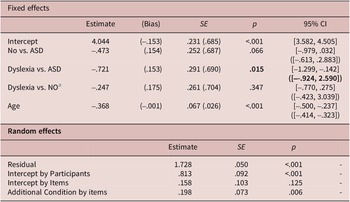
Regarding RQ3, the estimated marginal means do not show much difference between participants with conditions in addition to ADHD in terms of attitude towards language learning and use. The LMMs (see Table 6 below) found a significant difference only between participants with dyslexia and ASD, showing that learners with ASD have a more positive attitude towards language learning and use than those with dyslexia. Nevertheless, the 95% CI BCa stratified bootstrap found no difference between the groups (95% CI crosses zero), which may be explained by the high SEs found by the bootstrapping. Similarly to the model for RQ1 (see above), the high bias and SEs (thus wide 95% CIs) may point to issues with the data, likely because of the low number of test items per participant (n = 12). Future studies would benefit from employing larger questionnaires.
LMM results for RQ3 (marginal pseudo R2 = .063; conditional pseudo R2 = .441)

Note: Participants N = 219; Items per participant = 12. Reference category for Additional Condition = ASD. 95% BCa Bootstrap results shown between round brackets. Results that differ from the original results are in bold.
a Reference category changed to category “No” to obtain the comparison with “Dyslexia.” Thus, only ps <.025 may be considered significant.
Also, similarly to the model for RQ1, the fixed effects in the current analysis explain only 6.3% of the variance. This number drops to 2% when Age is removed from the models. This shows that conditions, such as dyslexia and ASD, in addition to ADHD, may have minimal influence on attitudes toward additional language learning and use.
Additional conditions and knowledge of additional languages
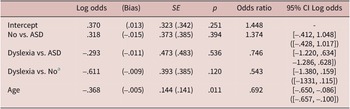
Finally, to answer RQ4, we compared participants with no conditions other than ADHD (No), participants with ASD, and participants with dyslexia in terms of their likelihood of being multilingual. (The Co-occurrence category was excluded from the analysis due to lack of data; see Table 1) Overall, the descriptive statistics show that participants with no additional conditions are proportionally more multilingual than others (65.28%), followed by those with ASD (60.98%) and dyslexia (52.94%). The results of the logistic regression employed to answer RQ4 are shown in Table 7.
Logistic regression results for RQ4 (Nagelkerke’s R2 = .052)

Note. Reference category for Additional Condition = ASD. 95% BCa Bootstrap results shown between round brackets. Results that differ from the original results are in bold.
a Reference category changed to category “No” to obtain the comparison with “Dyslexia.” Thus, only ps <.025 may be considered significant.
There are no differences in multilingualism between any of the groups. This finding is reinforced by the very low effect size of the model (Plonsky & Oswald, Reference Plonsky and Oswald2014): Nagelkerke’s R2 = .052. Without Age, the only significant predictor in the model, the effect size decreases to .011. This shows that the impact of an additional condition on multilingualism is negligible, which aligns well with the results from RQ3. Importantly, this time the BCa bootstrap confirmed all results, with low bias and similar SEs (and 95% CIs) to those of the original analysis.
Discussion
For the first RQ, it was hypothesized that the participants with the combined and inattention ADHD presentations would report less favorable views than the participants with the hyperactivity/impulsivity presentation, considering the research findings of Castel et al. (Reference Castel, Lee, Humphreys and Moore2011), Cueli et al. (Reference Cueli, Rodríguez, Cañamero, Núñez and González-Castro2020), Kibby et al. (Reference Kibby, Vadnais and Jagger-Rickels2019), and Nigg et al. (Reference Nigg, Blaskey, Huang-Pollock and Rappley2002). The results do not confirm this hypothesis, as all the participants shared a similarly positive view. In other words, the specific ADHD presentations have no impact on attitudes toward additional language learning and use. Considering the averages of the participants’ responses (M between 3.423 and 4.015), it can be concluded that multilingual individuals with ADHD hold a rather neutral view of their additional language learning and use experiences. To some extent, such a view may be impacted by low self-esteem, frequently experienced by individuals with ADHD (cf. Harpin et al., Reference Harpin, Mazzone, Raynaud, Kahle and Hodgkinsm2016; Pedersen et al., Reference Pedersen, Edvardsen, Messina, Volden, Weyandt and Lundervold2024), as well as fluctuating motivation for learning (cf. Kałdonek-Crnjaković & Błaszczak, Reference Kałdonek-Crnjaković2024) and experiencing specific difficulties in additional language learning and use (cf. Köder et al., Reference Köder, Rummelhoff and Garraffa2024a; Sparks et al., Reference Sparks, Humbach and Javorsky2008), considering that multilingual individuals without ADHD would hold rather a positive view of their additional language learning and use.
Yet, it is worth considering the results of bootstrapping and the possibility that learners with the hyperactivity/impulsivity presentation may hold a slightly more positive experience of language learning and use, since the participants with the hyperactivity/impulsivity presentation are significantly more multilingual than those with the combined and inattention presentations. This finding corroborates the second hypothesis and aligns with the research findings of Castel et al. (Reference Castel, Lee, Humphreys and Moore2011), Cueli et al. (Reference Cueli, Rodríguez, Cañamero, Núñez and González-Castro2020), Kibby (Reference Kibby, Vadnais and Jagger-Rickels2019), and Nigg et al. (Reference Nigg, Blaskey, Huang-Pollock and Rappley2002). Frequent limb movements, walking, running, and fidgeting that are associated with hyperactivity in ADHD, and rashness, recklessness, and spontaneity that feature impulsivity in ADHD, may positively affect additional language learning and use. This contrasts the theoretical assumptions of the effect of hyperactivity/impulsivity on additional language learning proposed by Kałdonek-Crnjaković (Reference Kałdonek-Crnjaković2018), but aligns to some extent with the findings of Köder et al. (Reference Köder, Rummelhoff and Garraffa2024a)—on the one hand, some study participants reported a negative impact of hyperactivity and impulsivity on oral communication; on the other hand, some participants highlighted “the positive side effect” (p. 5) of impulsivity, helping them initiate conversation with others, and in this way, helping them practice speaking in an additional language.
In contrast, the results imply that language learners with the inattention presentation may struggle with additional language learning—a lack of attention to details, inability to keep attention for a longer time or follow instructions, poor organizational strategies, forgetfulness, and being easily distracted by an external stimulus may have a detrimental effect on additional language learning and use. This highlights the importance of attention and attentional load in language acquisition (e.g., Crespo & Kaushanskaya, Reference Crespo and Kaushanskaya2022; Rogers & Yang, Reference Rogers, Yang, Cirocki, Indrarathne and McCulloch2024; Wallace, Reference Wallace2022).
Yet, the complexity and dynamicity of working memory in second language acquisition, and thus its various effects on language learning (Jackson, Reference Jackson2020; Serafini, Reference Serafini, Kersten and Winsler2023), need to be recognized. It is important to consider that phonological short-term memory and the phonological loop of the working memory in individuals with ADHD were found intact (Kofler et al., Reference Kofler, Singh, Soto, Chan, Miller, Harmon and Spiegel2020; Martinussen et al., Reference Martinussen, Hayden, Hogg-Johnson and Tannock2005; Song et al., Reference Song, Zhang, Xu, Ju and Jiang2024).
Also, individuals with ADHD may experience flow while learning languages, as it is an intrinsically rewarding endeavor for them (cf. Ashinoff & Abu-Akel, Reference Ashinoff and Abu-Akel2021). Flow is related to hyperfocus, or excessive attention, which stems from inattention. Both concepts are characterized by an inability to maintain an adequate level of attention during a task or activity. Hyperfocus may result in the neglect of important tasks and fatigue (Köder et al., Reference Köder, Rummelhoff and Garraffa2024a, p. 4) and can lead to a transient learning experience (Kałdonek-Crnjaković & Błaszczak, Reference Kałdonek-Crnjaković2024).
For the third research question, it was hypothesized that the participants with the co-occurrence of the conditions (ADHD and dyslexia and/or ASD) would view their language learning and use less favorably than those who have only ADHD, considering the multiple effects of different conditions, according to the MDM (Pennington, Reference Pennington2006). The results do not confirm this hypothesis—all the participants shared similar views on their additional language learning and use.
Yet, the LMMs’ findings that suggest that the participants with ASD hold a more positive view may be considered in light of the findings for the fourth research question—the participants with ASD are more likely to be multilingual than those with dyslexia (60.98% versus 52.94%, respectively). However, the differences are statistically not significant, meaning that ASD or dyslexia does not impact much additional language knowledge in the context of ADHD. This finding does not corroborate the fourth hypothesis—it was expected that the participants with dyslexia would report knowledge of fewer additional languages, based on the research findings of Helland and Kaasa (Reference Helland and Kaasa2005), Łockiewicz and Jaskulska (Reference Łockiewicz and Jaskulska2016), and Palladino et al. (Reference Palladino, Cismondo, Ferrari, Ballagamba and Cornoldi2016). Considering this finding, it would be worth investigating the effect of dyslexia in isolation and dyslexia in the context of additional conditions such as ADHD and ASD—Would multiple effects of different conditions act as a deficit or a benefit? Do ADHD and ASD act as compensatory factors in the context of dyslexia? (Kałdonek-Crnjaković, Reference Kałdonek-Crnjaković2023).
Overall, adult individuals with ADHD may be successful language learners (cf. Kałdonek-Crnjaković & Błaszczak, Reference Kałdonek-Crnjaković2024; Köder et al., Reference Köder, Rummelhoff and Garraffa2025; Sparks et al., Reference Sparks, Javorsky and Philips2004, Reference Sparks, Javorsky and Philips2005, Reference Sparks, Humbach and Javorsky2008). However, in children, inattention may have a greater effect on additional language learning (cf. Ferrari & Palladino, Reference Ferrari and Palladino2007). In the present study, age was the only significant predictor in the model; when removed from the model, the effect size decreased. This may suggest that older participants had lower knowledge of languages. No further interpretation should be offered since age was only a covariate to obtain more precise estimates of the predictors of interest. The model was not designed to verify the age effect.
Conclusion
This study explored the beliefs about additional language learning and use and knowledge of additional languages of 226 multilingual adults with ADHD with Polish L1. The findings show that ADHD presentations have no effect on attitudes toward additional language learning and use, and multilingual individuals with ADHD hold a neutral view of their additional language learning and use experiences. The important finding of this study is that the hyperactivity/impulsivity presentation may positively affect additional language learning, and that ASD or dyslexia does not impact much additional language knowledge in the context of ADHD. Conclusively, the diverse cognitive and linguistic profile of multilingual individuals with ADHD, with its strengths and weaknesses, in light of different ADHD presentations and co-occurrence with other conditions, needs to be recognized. With this statement in mind, potential ADHD-like additional language difficulties should not be regarded through the language-or-disability filter (Kangas, Reference Kangas2021), whereas the multilevel framework of MDM (McGrath et al., Reference McGrath, Peterson and Pennington2020; Pennington, Reference Pennington2006) has implications for instructions and future research on the issue presented in this study (cf. Silawi et al., Reference Silawi, Degani and Prior2025) in light of neurodiversity approaches (Dwyer, Reference Dwyer2022), Education for All (UNESCO, 2015), and universal design in language education (Tsagari et al., Reference Tsagari, Nijakowska and Guz2022).
The generalizability of this study’s findings is limited. The participants were only Polish native speakers, and the results may be affected by culture-related issues, which in the context of ADHD should be considered (see APA, 2013). Moreover, the findings reflect self-reported views about the effect of ADHD. Finally, a sampling bias might occur—the call was responded to by individuals with ADHD with a specific profile (the knowledge of foreign/second languages), who were members of an interest group on Facebook. However, it must be noted that learning additional languages is compulsory from the early stages of school education in Poland. Thus, knowledge of additional languages in Poland is common.
Another limitation of this study is the content of the data collection instrument. The questionnaire statements were general and did not explore more specific effects of ADHD on additional language learning and use, which resulted in a low number of test items per participant. Drawing on the qualitative findings of the studies of Kałdonek-Crnjaković and Błaszczak (Reference Kałdonek-Crnjaković2024) and Köder et al. (Reference Köder, Rummelhoff and Garraffa2024a), future studies should quantitatively explore different effects of, for example, hyperfocus, impulsivity, and memory difficulties. The statistical analysis was also affected by the number of participants in each ADHD presentation group and by the additional conditions. Therefore, the analysis should be treated as exploratory.
Data availability statement
The experiment in this article earned Open Data, Open Materials, and Pre-Registered Badges for transparent practices. The data are available at https://data.mendeley.com/datasets/hjkpkxy2v4/1/files/607a936a-5949-4fa8-a56d-90e7f18e1ddb.
Acknowledgments
The author would like to thank Dr Breno B. Silva for assistance with the statistical analysis. My appreciation also goes to the issue’s Handling Editors, Caitlin Cornell and Robert Randez, and anonymous reviewers for their insightful comments. The statistical analysis in the study was funded by a grant received from the II.3.7. Increasing the effectiveness and internationalization of research projects within the area of the multilingualism program (the University of Warsaw).
Competing interests
The author declares no conflict of interest.
Appendix 1
The online questionnaire (translated from the Polish language)
I
-
1. At what age were you diagnosed with ADHD?
-
2. What is your age range?
18–20/21–25/26–30/31–35/36–40/41–45/46–50/51–55/56 or more
-
3. Do you have any other conditions such as dyslexia or ASD (autism spectrum disorder/Asperger’s)? If so, please specify.
-
4. What languages do you know? (Please list all the languages you know and are able to communicate in, apart from your native language.)
English/Chinese/French/Spanish/Japanese/Korean/German/Portuguese/Russian/Italian/Other
If you selected “Other,” please specify:
-
5. What other languages have you learned/are you learning besides the ones mentioned above?
English/Chinese/French/Spanish/Japanese/Korean/German/Portuguese/Russian/Italian/Other
If you selected “Other,” please specify:
II
To what extent do you agree with these statements?

-
1. ADHD negatively affects learning and using foreign/second languages. 1 2 3 4 5 6 7
-
2. Thanks to ADHD, I learn foreign/second languages well. 1 2 3 4 5 6 7
-
3. Because of ADHD, I cannot effectively use my knowledge and skills in foreign/second languages. 1 2 3 4 5 6 7
-
4. ADHD helps me develop my knowledge and skills in foreign/second languages. 1 2 3 4 5 6 7
-
5. ADHD is a specific difficulty that affects learning and using a foreign/second language. 1 2 3 4 5 6 7
-
6. ADHD is more of an obstacle than a help in learning a foreign/second language. 1 2 3 4 5 6 7
-
7. Hyperactivity associated with ADHD helps me learn foreign/second languages. 1 2 3 4 5 6 7
-
8. I learn foreign/second languages easily. 1 2 3 4 5 6 7
-
9. Learning foreign/second languages takes me longer than my peers who do not have ADHD. 1 2 3 4 5 6 7
-
10. I consider ADHD a gift in the context of learning and using foreign/second languages. 1 2 3 4 5 6 7
-
11. Thanks to ADHD, I am better at learning foreign/second languages than my peers without ADHD. 1 2 3 4 5 6 7
-
12. I am not good at learning foreign/second languages. 1 2 3 4 5 6 7
Please leave a comment regarding the above statements.




 Open access

