


Introduction
The Tibetan Plateau (TP) is one of the most imposing topographic features on the Earth’s surface. With a mean elevation of ∼4.5 km and an area of 2.5 x 10⁶ km2, it is one-third the size of the United States. Climate studies there are plagued by the absence of data, particularly in the central region. Since 1987, four long, high-quality ice-core histories have been obtained from the TP by the Ice Core Paleoclimate Research Group at the Byrd Polar Research Center (BPRC): (1) the Dunde ice cap in the Qilian Shan along the northeastern margin, (2) the Guliya ice cap in the Kunlun Shan in the northwest, (3) Dasuopu glacier in the central Himalaya on the southern margin, and (4) the Puruogangri ice cap in the western Tanggula Shan in the center (Fig. 1). The physical and chemical data from these ice cores have contributed significantly to the paleoclimatic history of this region (Reference ThompsonThompson and others, 1989, Reference Thompson1990, Reference Thompson1995, Reference Thompson1997, Reference Thompson, Yao, Mosley-Thompson, Davis, Henderson and Lin2000). They have highlighted the complexity of the climate regime here, suggesting that tropical water vapor is an important mechanism forcing global-scale (glacial/inter-glacial) climate changes and providing evidence that the high plateau may be quite sensitive to the 20th-century warming. Reference Liu and ChenLiu and Chen (2000) compiled the annual mean surface temperature anomaly trends from 1961 to 1990 for 178 stations that reveal an increase in the rate of warming per decade with increasing elevation.
Map of China showing the outline of the Qinghai–Tibetan Plateau (shaded area) and the location of the Puruogangri ice cap, along with the other sites discussed in the text.

The TP is a major heat source for the lower atmosphere, and thus it significantly affects the hemispheric circulation (Reference FlohnFlohn, 1965; Reference Luo and YanaiLuo and Yanai, 1983; Reference Lau and LiLau and Li, 1984; Reference Yanai, Li and SongYanai and others, 1992; Reference WebsterWebster and others, 1998; Reference Hansen, Ruedy, Glascoe and SatoHansen and others, 1999). The summer monsoon circulation is driven by the latitudinal temperature gradient produced between the warm Asian land mass and cooler surrounding oceans (Reference Webster, Fein and StephensWebster, 1987). Precipitation in eastern Asia is controlled primarily by a combination of the resulting thermal and dynamical forcing. Sensible-heat flux over the semi-arid interior western region of the TP, and latent-heat release above the Himalaya provide strong tropospheric heating which maintains the large-scale Asian monsoon circulation. The Puruogangri ice cap (33˚55’ N, 89˚05’ E; 6072 ma.s.l.) lies directly under the ascending atmospheric motion during the warmest months of June, July and August (Reference Yanai, Li and SongYanai and others, 1992; Reference WebsterWebster and others, 1998).
The precipitation over the southern half of the TP is dominated in summer by the southwest Asian monsoon and in winter by westerly cyclonic activity. The strength of the monsoon is determined by a number of forcing mechanisms that operate over a spectrum of timescales. Over the past 10 000 years (10 kyr), Northern Hemisphere (NH) insolation has been higher, with correspondingly greater monsoon activity than during the late glacial stage (LGS). During the LGS the reduced differential heating between the Indian Ocean and the Asian continent contributed to the weakening of the summer circulation, producing cooler, drier conditions over Asia and across the southern TP (Reference Clemens, Prell, Murray, Shimmield and WeedonClemens and others, 1991; Reference Casal, Kutzbach and ThompsonCasal and others, 2004). On shorter timescales, variations in the strength of the southwest Asian monsoon have been explained by changes in boundary conditions, such as increasing tropical sea surface temperatures (Reference WebsterWebster and others, 1998), variations in Eurasian snow cover (Reference Barnett, Dümenil, Schlese, Roeckner and LatifBarnett and others, 1989), and the El Niño–Southern Oscillation (ENSO) (Reference Rasmusson and CarpenterRasmusson and Carpenter, 1983).
The TP, including the Himalaya, contains the largest volume of ice outside the polar regions, and the meltwater from its glaciers forms the headwaters of such important rivers as the Yangtze, the Yellow, the Indus, the Brahmaputra and the Ganges. The climate systems that feed or starve these glaciers affect the welfare of nearly two billion people, so it is very important to understand their annual- to decadal-scale variability. The distinct annual dust layers in the Puruogangri ice cores and the chemical composition of the ice offer the potential of an annually resolved climate history for hundreds of years.
Materials and Methods
The geophysical and ice-core drilling program on the Puruogangri ice cap in 2000 was a collaborative effort by the Laboratory of Ice Core and Cold Regions Environment, Cold and Arid Regions Environmental and Engineering Research Institute (LICCRE) and the BPRC. Two cores, core 1 (henceforth C1, 118.4m long) and core 2 (henceforth C2, 214.7m long) were drilled by BPRC on Domes B and A, respectively, which are 1.35 km apart. A third core (C3) was drilled by LICCRE to 152 m below the surface (mbs). C1 and C3 were returned whole to their respective institutes, and C2 was split equally between the groups. Annual dust layers are visible along the margin of the ice cap (Fig. 2a), and can also be seen in the ice cores (Fig. 2b). Ice temperatures (Fig. 2c) were −9.7˚C at 10 mbs and −5˚C at the ice/bedrock contact in the C1 borehole (5961 ma.s.l.) and −6˚C at 10m and −0.9˚C at the bottom of the C2 borehole (5980ma.s.l.) that did not reach bedrock.
(a,b) The edge of the Puruogangri ice cap reveals distinctive dust layers (a) that are also visible in the ice cores (b). (c) Borehole temperature profiles for C1 and C2.

Cores were recovered using an electromechanical drill with conventional cutters that achieved an average production rate of ∼7.0 m h−1 down to 125 mbs. Below that depth, the core quality was compromised by ice stresses and an increase in ice temperature from −3.0˚C to −0.8˚C. During a typical day, the core quality decreased during the warmest hours (1300−1600h). As the drilling rates decreased toward the bottom of the C2 borehole (below 200 mbs), core sections averaged about 0.4m in length. For a full description of the drilling system and core quality control, see Reference Zagorodnov, Thompson, Ginot and MikhalenkoZagorodnov and others (2005).
At BPRC, C1 and C2 were cut into 4114 and 6303 samples, respectively. Both cores are composed of ice throughout (i.e. they lack firn at the top) and were analyzed for stable-isotopic ratios of oxygen (δ18O) and hydrogen (dD). Only C2 was analyzed for insoluble dust concentrations and size distributions and for concentrations of major anions (F–, Cl–, SO42 - , NO3–) and cations (Na+, K+, NH4 + , Mg2 + , Ca2+) in a class 100 clean room. Samples were cut at sub-annual resolution until the depth where annual layers were no longer discernible. Stable isotopes were measured using Finnigan Mat Delta Plus mass spectrometers; dust concentrations and size distributions were measured with a Coulter Counter Model TAII; and the ion concentrations were measured with Dionex DX-500 ion chromatographs equipped with A/S 40 auto-samplers. A Tennelec LB 1000 series alpha/beta counter identified the distinct 1962/63 beta (β) radioactivity horizon produced by massive Soviet atmospheric thermonuclear testing.
Figure 3 illustrates the 1 m averages of δ18O (for both cores) and the ionic and insoluble dust concentrations for C2. The highest insoluble and soluble aerosol concentrations in C2 occur between 35 and 60 m and between 80 and 125 m, with an interval of low aerosols and δ18O in between. δ18O variability is relatively uniform in both cores, but increases abruptly at ∼30 mbs in C2 and ∼23 mbs in C1, coincident with reduced aerosol concentrations. Calcium concentrations gradually increase from 214.7mbs up to 35 mbs, before decreasing along with the other ions.
One-meter averages of (a) δ18O for C1 (118 m long) and (b–l) δ18O, insoluble dust and soluble ionic species for the longer (215 m) C2. Three calibrated radiocarbon dates are included (bottom), and their depths in the cores are indicated as RC1–RC3.

Timescale Development
The most recent four centuries of the record
The annually resolved timescale for the upper part of C2 was developed back to AD 1600 by counting peaks in the concentration of dust particles that are deposited during the late winter/early spring. Figure 4a and b illustrate δ18O and dust concentrations for each sample in the top 20 m of C2, along with the 1962/63 β radioactivity peak (Fig. 4c) at 14.5 mbs. This provides a reference horizon for calibrating the annual dating of the upper part of the record, and confirms that the average annual net balance (An) over the most recent 38 years is 382 mm ice equivalent. Every fifth year is marked (Fig. 4b), showing that, in general, dust peaks are often associated with low δ18O, consistent with the seasonal δ18O distribution in the region of the TP north of (and including) the Tanggula Shan (Reference Araguás-Araguás, Froelich and RozanskiAraguas-Araguas and others, 1998; Reference Tian, Masson-Delmotte, Stievenard, Yao and JouzelTian and others, 2001) as well as on the Dunde ice cap (Reference Davis, Thompson, Yao and WangDavis and others, 2005). Sublimation at the surface of the glacier may be smoothing the isotopic variations and causing some annual dust layer compaction, which makes layer counting less straightforward than in colder, higher-accumulation regions. Layer thinning with depth is evident by comparing seasonal variations in dust and δ18O in the upper 20 m (Fig. 4a and b) with those in 10 m of the core from 90 to 100 mbs (Fig. 4d and e). Annual dust peaks were counted down to 107.6 mbs (AD 1600), below which annual resolution became problematic due to the increasing rate of thinning. The degree of uncertainty in the timescale increases with depth, from ±1 year above the 1962/63 horizon to ±15 years at AD 1600.
(a, b) The δ18O and dust concentrations shown as individual samples for the top 20 m of C2. The seasonal variations used to date the core are shown from 1955 to 2000 along with the β profile (c) that illustrates the radioactivity peak in 1962/63, that resulted from atmospheric thermonuclear testing. (d, e) The δ18O and dust variations from 90 to 100 mbs (AD 1634−76) illustrate annual layer thinning with depth.

To reconstruct the original thicknesses of the annual layers counted in C2, and thereby produce the An record from AD 1600 to 2000, the thinning with depth was estimated. Here a steady-state flow model that takes into account the rapid thinning of layers near a glacier’s flow divide (Reference ThompsonThompson and others, 1989, Reference Thompson1990) is used for C2. The reconstructed annual layer thickness as a function of depth is given by the relationship
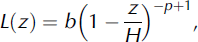
where H is the length from surface to bedrock, b is the measured thickness of each annual layer, and z is the corresponding ice equivalent depth. Under steady-state conditions, a unique value of the exponent p (a thinning parameter) can be calculated by substituting the depths (z 1 and z 2) of two well-dated horizons at times T 1 and T 2 into Equation (2):

For C2 the two time horizons used for the model were T1 = 37years at 14.5 mbs, which is the β horizon, and T 2 = 400 years at 107.6 mbs obtained from layer counting.
The Holocene timescale development
The low relief between the top of Puruogangri and the surrounding terrain facilitates deposition of plant fragments on the ice cap; consequently, three such samples were recovered from the cores (see asterisks in Fig. 3). The radiocarbon dates near the bottom of C1 (RC1) and C2 (RC3) were useful for the development of the longer-term Holocene records. The two-parameter model (Equation (2)) was used to construct a timescale for C2 from z1 = 107.6 mbs (corresponding to T 1 =400yearsBP) to z 2 = 210.5 mbs, which was radiocarbon-dated at 6440± 160years (calibrated) before AD 1950 (T 2 is 6490 yearsBP). The model unrealistically assumes a constant accumulation rate over the modeled timescales. When the time and depth values for the two horizons were inserted into Equation (2), the exponent p was calculated to be 0.54. The model was then solved for T2 at various values of z 2, using p = 0.54, T 1=400yearsBP and z1 = 107.6 mbs. The resulting age/ depth relationship is shown in Figure 5a. As the oldest 14C date (RC3 in C2) is 4 m above the core bottom, there is no way to constrain the model below 210.5 m, so the dating is extrapolated only another 50cm further down-core to 7000 years BP.
Age/depth relationships as calculated by the two-parameter model (Equation (2)) for (a) C2 down to 7kyr BP and (b) C1 down to 2.3 kyr BP. The range of errors as computed by the model for each core, based on the error ranges of the cores’ respective 14C dates (as depicted), are shown as insets.

Since both the layer-counted date of 400 yearsBP at 107.6 mbs and the radiocarbon date of 6490 years BP at 210.50 mbs contain uncertainty ranges (±15 and ±60years, respectively), the two-parameter model was used to determine the range of errors throughout the Holocene timescale. Figure 5a (inset) illustrates how the range of error calculated by the model changes from ±15 years at 400 years BP to ±68 years at ∼4630 years BP, and then decreases to the radiocarbon-constrained error of ±60 years at 6490 years BP.
The timescale for C1 was calculated in the same manner; the upper horizon (z1 = 23.07 mbs at T1 84 years BP) was transferred from the annually dated part of C2 by δ18O curve matching. The lower horizon at 114.0 mbs was radiocarbon dated at 2200 ± 110years before AD 1950. With the value of p calculated from these two points as 0.35, the resulting age/ depth relationship with the model-calculated error curve is shown in Figure 5b.
The Puruogangri Climate Record Since AD 1600
The 5 year averages of δ18O from C1 and C2 are shown in Figure 6a and b, along with the C2 records of reconstructed net accumulation (An) (Fig. 6c), dust (Fig. 6d) and the ion concentrations of soluble aerosols (Fig. 6e-m) for the last four centuries (AD 1600−2000). Except for fluoride (Fig. 6e), the soluble aerosol concentrations are in good agreement with each other. Both the δ18O records capture similar decadal- to centennial-scale variability, although the 20th-century 18O enrichment is more pronounced in C1. Previous research in the northern region of the TP indicates that it is reasonable to consider δ18O as a proxy for temperature (Reference Yao, Thompson, Mosley-Thompson, Yang, Zhang and LinYao and others, 1996; Reference Thompson, Mosley-Thompson, Davis, Lin, Henderson and MashiottaThompson and others, 2003; Reference Thompson, Davis, Aggarwal, Gat and FroehlichThompson and Davis, 2005).
The 5 year averages for the last 400 years shown for δ18O in both C1 and C2, along with the concentrations of insoluble dust and soluble species from C2. The four climatic periods (1–4) discussed in the text are marked.

Four major periods (marked in Fig. 6) are identified: period 1 from 1600 to ∼1730 was slightly warmer and much wetter than the 400 year average as suggested by above-average δ18O and An; period 2 from 1730 to 1780 was cool (lower δ18O) but wet; period 3 (1780 to ∼1915) had intermittent cool/warm and mostly dry conditions; and period 4 (∼1915 to the present) was wetter and warmer. Insoluble dust (henceforth dust) concentrations were lower in periods 1 and 2, but increased sharply after a large, abrupt event in ∼1790. This complements the An record which implies higher accumulation rates during periods 1 and 2, followed by below-average rates beginning around 1775, just prior to the increase in dust deposition. Period 1 was unusual, in that the soluble aerosol concentrations were above average at a time when An was also high but dust was low. This was not consistent with either the relationship (high A n and low aerosols) found in periods 2 and 4, nor the reverse relationship (low A n and high aerosols) found in period 3, the end of the last neoglacial period commonly called the ‘Little Ice Age’ (LIA).
The Puruogangri A n record is similar to those from two previous northern Tibet ice-core records, Dunde at 38˚ N (Reference Thompson, Bradley and JonesThompson, 1992) and Guliya at 35˚N (Reference ThompsonThompson and others, 1995) (Fig. 1), but opposite to that in Dasuopu glacier at 28˚N (Reference Thompson, Yao, Mosley-Thompson, Davis, Henderson and LinThompson and others, 2000; Reference Davis, Thompson, Cecil, Green and ThompsonDavis and Thompson, 2004; Reference Davis, Thompson, Yao and WangDavis and others, 2005). At the northern core sites, A n was above average before 1800, below average from ∼1800 to the late 19th to early 20th centuries, and then above average over most of the 20th century. The resemblance among the low-frequency An records from the three northern ice cores, and their anti-phase relationship with the southernmost record from the Himalaya, suggests a climatic dichotomy across the TP. The region north of ∼33° N may be more strongly dominated by westerly continental air masses than the southern region, which is more strongly influenced by tropical monsoon circulation. These relationships, however, may have varied through time (Reference Davis, Thompson, Yao and WangDavis and others, 2005).
An abrupt warming (inferred from higher δ18O values) occurred between 1910 and 1920 (Fig 6a and b) and was accompanied by higher A n (Fig. 6c) and lower soluble aerosol concentrations (except F–), suggesting a transition to a warmer, wetter climate. Both cores show post-1920 enrichment in 18O, although this is more prominent in C1 than in C2. This difference may be attributed to post-depositional processes such as differences in ice flow at depth on the adjacent domes of the ice cap. Fluoride concentration began to increase markedly above its 400 year baseline around 1930 (Fig. 6e), but whether this was related to the changing climate conditions is unknown. With the recent warming of the TP, many glaciers are now undergoing wasting and deterioration of their surfaces, and on Puruogangri the trend in net balance has been decreasing over the last few decades (Fig. 6c). This ice cap, like Guliya, lacks an upper firn layer and is mainly ice to the surface, perhaps due to melting caused by increasing air temperatures.
The Puruogangri Record Over the Last 7000 Years
The last 400 years of the Puruogangri ice-core record can be viewed from a much longer perspective in Figure 7, which depicts the chemical and physical species as 100 year averages. This millennial-scale view shows more variability in all the parameters (except Ca2+) before ∼2.5 kyr BP than after. Dust and ion concentration peaks occur in the record at 6.5, 4.7, 3.8 and 3.3 kyr BP, although these events are not always uniformly expressed in all the parameters. The aerosol peaks are not associated with any particular trend in δ18O, and increases in soluble and insoluble dust were not always consistently associated with warm or cold climates. Calcium (Fig. 7l) also shows high concentrations during these four events; however, Holocene concentrations rose gradually until an abrupt increase ∼1.2 kyr BP, after which it remained at elevated levels to the present.
The 100 year averages of (a) δ18O for C1 for the last 2300 years and (b) δ18O, (c) dust and (d–l) ion concentrations for C2 for the last 7000 years.

Since 7 kyr BP, precipitation on Puruogangri has gradually become more depleted in 18O as the isotopic record from C2 suggests (Fig. 7b), but both C2 and C1 (Fig. 7a) show enrichment during the last 100 years. As in the 400 year time series discussed above, the enrichment is more pronounced in C1. Likewise, F– also abruptly increased to nearly twice the average Holocene levels in the most recent century, unlike the other aerosols.
Discussion
The recent record
The records from the Puruogangri ice cap help fill the information gap for the middle of the TP, where high-resolution histories of climatic and environmental change are scarce. It lies close to the boundary between the monsoon-dominated south and the continental westerly-dominated north. In winter the climate is influenced by westerly storm tracks originating in the Arctic and North Atlantic. The seasonal relationship between high/low mineral dust concentration and low/high δ18O is similar to that in the Dunde ice cores to the north, and opposite that on Dasuopu in the Himalaya, suggesting that Puruogangri is influenced more by the continental climatic processes than by the monsoon, although summer snow is likely recycled through convective activity driven by the heated high-altitude surface.
Over the last four centuries no significant relationship is evident between temperature and precipitation around this ice sheet. Likewise, the ionic species do not vary inversely with either δ18O or An in a consistent manner. This may suggest that either the provenance of the soluble aerosols changed before 1730 when the western Tanggula Shan experienced greater snowfall, or average middle tropospheric circulation strength and/or patterns changed. The concentrations of the ionic constituents of salts (e.g. Cl–, SO4 2–, Na+ and K+), which may have been derived from nearby lake beds, have similarly varied from one period to another. These were more abundant during period 3, or the end of the LIA, when the local climate was cold and dry, and were less abundant during the higher-accumulation conditions of periods 2 and 4.
Dasuopu glacier records a major historically documented monsoon failure that produced devastating droughts in India from 1790 to 1796 (Reference LambLamb, 1982) and is believed to have been a response to a period of severe El Nino events (Reference Quinn, Diaz and MarkgrafQuinn, 1992). It is recorded in the Himalayan glacier by sharp increases in dust and anion concentrations, especially Cl– (Reference Thompson, Yao, Mosley-Thompson, Davis, Henderson and LinThompson and others, 2000). In the Puruogangri C2 dust time series the strongest peak of the 400 year record is seen close to that time (Fig. 6d). If this is the same event, its temporal offset in the two cores may be due to timescale uncertainties, which range up to ±10years at this depth in C2. Interestingly, dust concentrations in both Dasuopu and Puruogangri remain higher thereafter. While the concentration in Dasuopu continued to increase toward the top of the core as the An decreased, dust concentrations in Puruogangri have slowly decreased as An has increased.
The combination of higher temperatures, as seen in the isotopic records of C2 and especially C1 (Fig. 6a and b), and wetter climate since ∼1920 is unprecedented in the last four centuries in the Puruogangri record. Similar trends in recent warming, especially after 1920, have been noted in circum-Arctic climate records (Reference OverpeckOverpeck and others, 1997). This may be significant, since linkages between the Arctic and monsoon-dominated regions of Asia have been observed in several studies (e.g. Reference Gupta, Anderson and OverpeckGupta and others, 2003; Reference Wang, Thompson, Davis, Mosley-Thompson, Yao and PuWang and others, 2003; Reference Davis, Thompson, Cecil, Green and ThompsonDavis and Thompson, 2004).
Climatic and Environmental Variations Since the Middle Holocene
The general trend in δ18O in C2 since the Early Holocene (Fig. 7b) is consistent with the Northern Hemisphere summer insolation curve, suggesting that the stable isotopes reflect the gradual cooling since the ‘climatic optimum’ of the Early Holocene until the onset of the recent warming over much of the TP. Since the Tanggula Shan lie close to a climate regime boundary (Reference Araguás-Araguás, Froelich and RozanskiAraguas-Araguas and others, 1998; Reference Tian, Masson-Delmotte, Stievenard, Yao and JouzelTian and others, 2001), their glaciers may be well positioned to record the southward migration of the summer monsoon trough from its northernmost position at maximum NH summer insolation intensity.
A prominent Mid-Holocene event (∼4.7 kyr BP) is recorded by very high concentrations in dust (Fig. 7c) and in nearly all soluble aerosols except NO3– (Fig. 7f). It is difficult to determine from this record whether this reflects an arid interval in the center of the TP since An cannot be reconstructed at this depth and, as Figure 6 illustrates, high ion concentrations can occur coincidentally with high An. However, this peak occurs near the time of a well-studied climatic disruption, most likely a drought, that has been observed in many climate proxy records from eastern China (Reference Morrill, Overpeck and ColeMorrill and others, 2003; Reference WangWang and others, 2005), Tibet (Reference Gasse, Fontes, van Campo and WeiGasse and others, 1996), the Indus valley (Reference Staubwasser, Sirocko, Grootes and SeglStaubwasser and others, 2003), the Middle East (Reference WeissWeiss and others, 1993; Reference Bar-Matthews, Ayalon, Kaufman and WasserburgBar-Matthews and others, 1999; Reference Cullen, deMenocal, Hemming and HemmingCullen and others, 2000) and northern and eastern Africa (Reference GasseGasse, 2000; Reference ThompsonThompson and others, 2002). Failure of the Asian/Indian/African monsoon is strongly implicated as the driver of this event, which lasted several decades to centuries and began and ended abruptly. If this Middle Holocene aridity event is recorded in Puruogangri, it demonstrates that its effects penetrated deeply into the TP.
Calcium concentrations (Fig. 7l) have increased over the Late Holocene since 3.5 kyr BP, while dust and δ18O (Fig. 7a and b), and to a lesser extent other ion species, have all decreased gradually. Analyses of carbonates from the Bangong Co basin, located south of the Kunlun Shan and directly west of Puruogangri, show very low δ18O values in the Early Holocene, which become more 18O-enriched towards the present. The lacustrine isotope record resembles the ice-core calcium record (Fig. 7l) in which Ca2+ levels increase slowly until ∼1.2 kyr BP, then rise abruptly and remain high to the present (Reference Fontes, Gasse and GilbertFontes and others, 1996). Likewise, at the horizon dated ∼1.3 kyr BP in the lake core the abundance of aragonite abruptly increases at the expense of calcite, while the δ18O of the carbonates abruptly decreases (Reference Gasse, Fontes, van Campo and WeiGasse and others, 1996), both signaling the onset of more arid and possibly windier conditions. The Puruogangri ice cap is surrounded by sand dunes composed of carbonates, and the Ca2+ levels are among the highest ever measured in an ice core. Thus, the calcium source is probably more local than that for the ions that compose other salts, and its abundance may vary in response to changes in the immediate environment. Thus, some of the chemical species in Puruogangri may reflect climatic changes in more distant locations, while others record more proximal climate variations.
The Puruogangri Record in the Context of Other TP Ice-Core Records
To illustrate larger temporal- and spatial-scale changes from the other ice-core sites across the TP, Figure 8 compares the decadal averages of δ18O over the last 2000 years for Dunde, Guliya, the two new Puruogangri cores and Dasuopu (see Fig. 1 for locations). Since 70−80% of the snowfall over Tibet arrives during the Northern Hemisphere summer, the isotopic mean compositions in the ice cores represent mainly the summer months. These δ18O records show that Dasuopu, the highest site (7200 m a.s.l.), has the lowest isotopic average (−20.32%), while the lowest site, Dunde (5325 ma.s.l.), has the highest isotopic average (−10.77%). The average for Guliya at 6200 m a.s.l. is −14.96%. The cores from Puruogangri (6000 m a.s.l.), which is close to Guliya in elevation, have average isotopic values of −15.13% for C2 and −14.85% for C1. The varying lengths of the records reflect the ages down to which we have confidence in the decadal-timescale reconstructions.
Comparison of the 10year δ18O averages from the four ice-core sites across the TP for the last 2000 years.

These time series of isotopic variations reflect the variability that exists across the TP. The timescales, based on combinations of annual-layer counting and flow modeling, are believed to be reasonably accurate at low (centennial-scale) frequencies. However, they are subject to refinement as more datable horizons are identified. Viewed together, there is not a clear, consistent signal marking either the ‘Medieval Warm Period’ from AD∼1100 to 1300, or the LIA from AD∼1400 to 1900. With the exception of Puruogangri C2, the records show the abrupt onset of the recent warming in the early 20th century, suggesting that this trend is widespread throughout high Asia regardless of the regional level of effective moisture. While the exact factors driving the 18O enrichment in the 20th century may be debated, it is clear that this enrichment is common to all four sites, albeit to varying degrees. This coherence is unusual within the 2000year perspective provided by these records.
Conclusions
The records of climatic and environmental variation from the Puruogangri ice cap contribute to ongoing efforts to reconstruct the temporally and spatially complex climate history of the TP over millennial to annual timescales. The differences in the δ18O record from the central TP since the Middle Holocene compared with those from the margins suggest that the boundary between the monsoon- and continental-climate regimes may have migrated in the past, partially in response to the intensity of Northern Hemisphere summer insolation. Despite differences over much of their histories, Puruogangri, like Dunde, Guliya and Dasuopu, demonstrates an unambiguous, abrupt warming that began in the early 20th century and continues today. This has ramifications for glacier health and the future of water resources in those areas of Asia with several billion inhabitants who rely on the rivers and streams that rise from the rapidly receding glaciers of the TP.
Acknowledgements
The authors thank the participants in the Puruogangri 1999 and 2000 field programs. We also acknowledge T. Guilder-son of Lawrence Livermore National Laboratory, Livermore, CA, USA, for providing radiocarbon dates. We appreciate the valuable comments of two anonymous reviewers and our editor, M. Bender. The fieldwork was funded by The Ohio State University, and the laboratory analyses and interpretation were funded by the US National Science Foundation’s Earth System History Program (NSF-ATM-0117113). This is Byrd Polar Research Center publication No. 1324.



