


There has been increasing evidence that diet plays an important role in the development of various chronic diseases( Reference Nishida, Uauy and Kumanyika 1 ). Changes in the dietary patterns and nutritional status of Koreans due to economic growth and the introduction of Western lifestyles have caused significant changes in disease patterns in Korea( Reference Kim, Moon and Popkin 2 ). This distinct nutritional transition in Korea, characterized by the coexistence of Westernized and traditional dietary patterns, can be explained by the speed of modernization in Korea compared with most other Asian countries( Reference Lee, Popkin and Kim 3 ). Typical Korean dishes involve a mixture of various foods, cooking oils and seasonings( Reference Kim, Kim and Lee 4 ). Thus, collecting accurate estimates of dietary intake using instruments specifically designed for the Korean diet is essential for nutritional epidemiological studies that investigate the relationship between diet and disease among Koreans.
Although it is possible to quantify nutrient intake relatively accurately by 24h recall (24HR) or dietary record (DR)( Reference Resnicow, Odom and Wang 5 – Reference Subar, Kipnis and Troiano 7 ), multiple measurements are necessary to estimate an individual’s usual intake( Reference Basiotis, Welsh and Cronin 8 ). Because of the high cost and burden imposed on subjects to collect multiple dietary intake data, these methods may not be feasible for large-scale surveys, such as the Korea National Health and Nutrition Examination Survey (KNHANES). The FFQ has been used as an alternative method to measure long-term usual intake, but the FFQ must be developed and validated for specific target populations( Reference Ortiz-Andrellucchi, Sánchez-Villegas and Doreste-Alonso 9 – Reference Ortiz-Andrellucchi, Doreste-Alonso and Henríquez-Sánchez 11 ).
Multiple 24HR or DR are often used in FFQ validation studies as a reference method for estimating usual nutrient intakes, as there is currently no gold standard method available. Calculating average nutrient intakes from multiple 24HR or DR can diminish within-individual variation, which can attenuate the association between dietary intake and disease risk. The number of days required to estimate usual intake depends on the type of nutrient being measured and the characteristics of the population( Reference Huybrechts, De Bacquer and Cox 12 , Reference Oh and Hong 13 ). Recently, validation studies of FFQ have adopted 2 d to 12d 24HR or DR as reference methods( Reference Brinkman, Kellen and Zeegers 14 – Reference van Dongen, Lentjes and Wijckmans 19 ). A meta-analysis of forty articles on FFQ validation by Molag et al.( Reference Molag, de Vries and Ocke 20 ) indicated that the correlation coefficients were significantly higher when the reference method was used for 8 to 14 d than for 1 to 7 d.
The present study assessed the reproducibility and validity of a newly developed FFQ for KNHANES designed to estimate the usual nutrient intake of Korean adults and estimated the calibration factors of the FFQ with 12 d DR to correct raw intake data.
Experimental methods
FFQ
The KNHANES is a nationwide survey designed by the Korea Centers for Disease Control and Prevention to assess the health and nutritional status of Koreans( 21 ). In 2007, the KNHANES became a continuous survey system using an integrated sampling method that increased the sample size( 22 ). The fourth KNHANES surveyed approximately 30 000 individuals using a 1 d 24HR and a simple FFQ to measure dietary intake during 2007 to 2009.
A new FFQ was developed in 2009 by the KNHANES team of the Korea Centers for Disease Control and Prevention based on 1 d 24HR data collected from adults aged >19 years in the fourth KNHANES (2007–2009). The procedure for developing the FFQ has been described elsewhere( Reference Yun, Shim and Kweon 23 ). Briefly, the food and dish items that contributed 90 % of the energy and thirteen nutrients (carbohydrates, protein, fat, Ca, P, Fe, Na, K, vitamin A, thiamin, riboflavin, niacin and vitamin C) or explained 90 % of the between-individual variation were selected. Food items that were consumed by less than 1 % of the total population were excluded. Similar food and dish items were combined to reduce the number of items. Ultimately, the FFQ list consisted of 109 food and dish items. The response categories for the frequency of consumption during the previous year were divided into nine levels: none, 1 time/month, 2–3 times/month, 1 time/week, 2–4 times/week, 4–6 times/week, 1 time/d, 2 times/d and ≥3 times/d. Participants were also asked to select one of three portion sizes: small (0·5), medium (1·0) and large (1·5–2·0), which were determined based on the distribution of portion sizes from the dietary data in the fourth KNHANES.
The nutrient database used to calculate nutrient intake for the present study was the seventh edition of the food composition table from the Korean National Academy of Agricultural Science( 24 ). The database consists of 5112 food items and provides energy and nutrient values for each of the foods listed. To calculate the daily nutrient intakes, the reported FFQ frequency data were coded as daily frequencies. For example, the 2–4 times/week option was transformed into 0·43 times/d, as estimated by the formula (2+4)/(2/7).
Participants and study design
A convenience sample of 140 healthy adults (aged 20–65 years) residing in the Seoul metropolitan area participated in the study. The sample size was determined based on the minimum correlation coefficient for nutrient intake between the FFQ and 12 d DR in previous reports( Reference Willett 25 ). For twelve replicates of daily intake, a sample size of 110 persons was estimated to be sufficient to maintain constant precision in the correlation coefficient (assuming a correlation of 0·5 with a variance of 0·14) between the FFQ and the average of multiple DR( Reference Willett 25 ). Assuming a potential dropout rate of 20 % during the follow-up period, the final recruited sample size was 140.
Among the 140 participants, 126 (90 %) completed both FFQ and 12 d DR. The first FFQ (FFQ1) and the first 3 d DR were administered by an interviewer in August 2009. Three additional 3 d DR were conducted every three months, and the second FFQ (FFQ2) was conducted in May 2010 to evaluate the reproducibility of the FFQ. Demographic information, including sex and age, was collected from the participants using a structured questionnaire. The study was conducted according to the guidelines in the Declaration of Helsinki and all procedures involving human subjects were approved by the Institutional Review Board of Seoul National University on 20 July 2009. Written informed consent was obtained from all participants.
Collection of dietary records
The 3 d DR were completed four times during the 9-month period following the administration of FFQ1 to account for seasonal variations in consumption. The participants were asked to write down every food and dish consumed on three non-consecutive days, including two weekdays and one weekend day. Detailed guidelines, including visual two-dimensional household measurement tools, were distributed to the participants to assist them in completing the DR when FFQ1 was conducted. To improve the quality of the DR, the records were reviewed by nutritionists and missing values or vague answers were clarified by telephone interview. The same nutrient database that was used for the FFQ was used to calculate individual nutrient intakes from the 12d DR. In addition, the standard recipe database used for the KNHANES was applied to convert the reported dishes into constituent foods. A total of 3596 dishes were included in the standard recipe database, which provided a list of food items and standard weights of each food in a dish.
Calculation of nutrient and food group intakes
Means and standard deviations were calculated for total energy and thirteen nutrients (protein, fat, carbohydrates, Ca, P, Fe, K, Na, vitamin A, thiamin, riboflavin, niacin and vitamin C) in each of the FFQ and 12 d DR. Means and standard deviations of intake for eleven food groups (rice; noodles and dumplings; breads and rice cakes; soups and stews; soyabeans, eggs, meat and fish; vegetables, seaweed and potatoes; milk and dairy products; fruits; beverages; snacks; alcoholic beverages) were also calculated. Log (natural) transformations were performed before statistical analysis to improve the normality of the distribution of the crude data.
Data from the 12 d DR were used to estimate within- and between-individual variances according to the Multiple Source Method and de-attenuation was computed according to the equation from Willett( Reference Willett 25 ). Subsequently, the calculations of nutrient intake were adjusted for total energy intake using the residual method( Reference Willett 25 ) for both the FFQ and the 12 d DR (energy-adjusted data).
Reproducibility
Reproducibility was evaluated by comparing the data on energy intake, intakes of thirteen nutrients and intakes of eleven food groups from FFQ1 and FFQ2. Because the log-transformed data showed a normal distribution for energy and all nutrients of FFQ1 and FFQ2, Pearson correlation coefficients were used to compare FFQ1 and FFQ2 as a measure of reproducibility( Reference Willett, Sampson and Stampfer 26 ). On the other hand, the log-transformed data did not show a normal distribution for the majority of the food group intake data; therefore, Spearman correlation coefficients were used to compare the food group intake data. We also calculated a ratio of the geometric means to estimate changes in mean intake levels between FFQ1 and FFQ2( Reference Johansson, Hallmans and Wikman 27 ), and the ratios were multiplied by 100 to be expressed as a percentage, with 100 % representing an ideal agreement( Reference Villegas, Yang and Liu 28 ). To evaluate the joint classification, the intakes of nutrients and food groups estimated by FFQ1 and FFQ2 were classified into quartiles. The percentage of participants classified in the same quartile, in adjacent quartiles and in opposite quartiles by the two FFQ was analysed.
Validity
The validity of the FFQ was assessed by comparing the average intake estimates from the 12 d DR with those from FFQ1. FFQ1 was used instead of FFQ2 to limit possible bias due to a training effect( Reference Johansson, Hallmans and Wikman 27 ) and to replicate typical administration of the FFQ where participants have no experience quantifying their dietary intake. Validation of the FFQ in the present study used three methods: Pearson correlation coefficients, joint classification analysis and the Bland–Altman method( Reference Bland and Altman 29 ). Pearson correlation and joint classification analysis were conducted in the same manner as described for the reproducibility analysis. To apply the Bland–Altman method, for each nutrient and participant, the difference in intake between the two methods and the average intake of the two methods (FFQ1 and 12 d DR) were calculated and plotted. Because the exponential of a difference is a ratio, we calculated the mean difference (given as a percentage) and the limits of agreement (LOA). The LOA were calculated using the following equation:
 $$\hskip-6pc\rm LOA=\,&{\rm mean\ difference}\,\pm\,1 \!\cdot\! 96$$
× standard deviation of the difference. The LOA ranged from 50 % to 200 %, which indicates that 95 % of participants’ FFQ data were between half and two times their 12 d DR data. Therefore, in the present study, we considered LOA between 50 % and 200 % suitable( Reference Ambrosini, van Roosbroeck and Mackerras 30 ).
Calibration
The FFQ was calibrated using multivariate linear regression associating the data obtained from the 12 d DR (dependent variable) with the data obtained from FFQ1 (independent variable). The regression model also included sex and age as independent variables. The regression intercepts (α), regression line slopes (λ) and 95 % confidence interval were estimated. Calibrated values (mean and standard deviation) for energy and each nutrient were calculated based on λ and α using following equation:
 $${\rm Calibrated\ FFQ}=\alpha {\plus}\lambda _{1} ({\rm FFQ1}){\plus}\lambda _{2} ({\rm sex}){\plus}\lambda _{3} ({\rm age}).$$
The statistical software package SAS for Windows version 9·2 was used for all statistical analyses. Statistical significance was determined based on P values (<0·05) and 95 % confidence intervals.
Results
The study group consisted of sixty-three men (50·0 %) and sixty-three women (50·0 %) between 20 and 65 years of age, while the 2007 KNHANES was conducted with adults between 20 and 103 years of age (40·9 % male). The mean age of participants in the present validation study was 42·7 (sd 13·1) years, while the 2007 KNHANES sample had a mean age of 50·0 (sd 16·6) years. There were significant differences in the distribution of participants by age and gender between the current sample and the KNHANES sample.
Table 1 shows the reproducibility of the FFQ over a 9-month period (FFQ1 v. FFQ2). The average energy and nutrient intakes from the FFQ2 were somewhat lower than those from FFQ1 (percentage agreement ranging from 103 % to 110 %). The Pearson correlation coefficients for nutrients between FFQ1 and FFQ2 ranged from 0·53 to 0·62 for crude intake data (mean r=0·56). After adjusting nutrient intake for total energy intake, the correlation coefficients for nutrients (mean r=0·55) increased for some nutrients (fat, carbohydrate, Ca, P, K and vitamin C), but decreased for others. For the food groups, Spearman correlation coefficients between FFQ1 and FFQ2 ranged from 0·33 (rice) to 0·87 (alcoholic beverages) for crude intake data, and energy-adjusted correlation coefficients were higher for alcoholic beverages, fruit and milk and dairy products (0·87, 0·71 and 0·71, respectively) than for other food groups. Joint classification into quartiles mostly showed good agreement (same+adjacent quartile) for nutrient and food group categories (approximately 80 %); the highest proportions of participants correctly classified into the same intake quartile were observed for fat (51 %) and alcoholic beverages (67 %).
Daily energy, nutrient and food intakes measured by the first and second administration of the FFQ and the reproducibility between FFQ administrations among Korean adults (n 126) aged 20–65 years residing in the Seoul metropolitan area, August 2009–May 2010

FFQ1, FFQ administered at baseline; FFQ2, FFQ administered 9 months after FFQ1; RE, retinol equivalents.
* Geometric mean of individual ratios between intakes as recorded by FFQ1 and FFQ2.
† All coefficients were significant.
‡ Pearson correlation coefficients estimated from log-transformed intakes (crude) and energy-adjusted intakes by the residual method as estimated by FFQ1 and FFQ2.
§ Spearman correlation coefficients estimated from log-transformed intakes (crude) and energy-adjusted intakes by the residual method as estimated by FFQ1 and FFQ2.
Table 2 shows the validity of the FFQ1 in terms of Pearson correlation coefficients, joint classification into quartiles and the results of the Bland–Altman procedure. The significant Pearson correlation coefficients between FFQ1 and the 12 d DR ranged from 0·27 to 0·45 using the crude data (mean r=0·38) and from 0·22 to 0·64 using the energy-adjusted data (mean r=0·41). Adjusting for total energy intake, the correlations for eight nutrients such as fat, carbohydrate, Ca, P, Fe, K, riboflavin and vitamin C were improved. In the joint-classification analysis (Table 2), 63 % (thiamin) to 86 % (carbohydrate) of participants were classified into the same or adjacent quartile groups for FFQ1 and 12 d DR (mean=75 %). The proportion grossly misclassified (i.e. ranked in the lowest or highest quartile of the FFQ1 data but in the opposite quartile of the 12 d DR) was small (1–10 %, mean=5 %).
Daily energy and nutrient intakes estimated by the 12 d dietary record (DR) and the validity between the 12 d DR and the first administration of the FFQ among Korean adults (n 126) aged 20–65 years residing in the Seoul metropolitan area, August 2009–May 2010
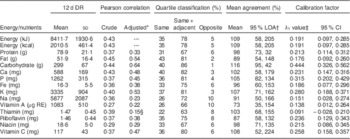
LOA, limit of agreement; RE, retinol equivalents.
* Natural log-transformed, de-attenuated and energy-adjusted intake of nutrients by the Multiple Source Method.
† LOA determined as the mean difference±1·96×sd of the difference.
‡ Natural log-transformed energy intake estimated from the FFQ1 (independent variable) and from the mean of 12 d DR (dependent variable).
All coefficients were significant except those marked with §.
Table 2 also shows the coefficients of the calibration analysis. For all nutrients except for thiamin, the linear calibration coefficients for the slope estimates (linear regression of 12 d DR v. FFQ1) were significant. The means from the calibrated FFQ were similar to those from the 12 d DR, but the calibrated FFQ had reduced standard deviation estimates for energy and most nutrients (data not shown).
The mean agreement between FFQ1 and the 12 d DR ranged from 73 % for vitamin A to 116 % for carbohydrate. The LOA for almost all nutrients ranged between 50 % and 200 %, except for energy, vitamin A and vitamin C. The narrowest LOA was found for carbohydrate and the widest LOA was found for vitamin C. Figure 1 illustrates the Bland–Altman plots for carbohydrate and vitamin A, the nutrients with the best and worst validity results, respectively. A regression analysis (linear regression of the difference between the two methods v. the average of the two methods) indicated a significant linear trend for both nutrients (slope=0·277 for carbohydrate and 0·431 for vitamin A), implying that agreement between the methods varied according to the magnitude of intake.
Bland–Altman plots showing the relationship between the differences in daily intake of (a) carbohydrate and (b) vitamin A estimated by the first administration of the FFQ (FFQ1) and the 12 d dietary record (DR) and the corresponding mean daily intakes estimated by the two methods among Korean adults (n 126) aged 20–65 years residing in the Seoul metropolitan area, August 2009–May 2010. ——— indicates the mean difference and – – – – indicate the 95 % limits of agreement between FFQ1 and the 12 d DR in natural log scale

For validity of the FFQ compared with the 12 d DR, the correlations of energy intake and intake of most nutrients were higher in females (mean r=0·45) compared with males (mean r=0·30) using the energy-adjusted data (Table 3). The correlation coefficients for protein, Na, vitamin A, thiamin, riboflavin and niacin were not significant in males, but the correlation coefficients for energy intake and intake of all nutrients except niacin were significant in females. Among the participants aged 20–45 years (mean r=0·46), the energy-adjusted correlations were higher for most nutrients compared with the higher age group aged 46–65 years (mean r=0·28), except for three macronutrients.
Pearson correlation coefficients between daily energy and nutrient intakes estimated with the first administration of the FFQ and the 12 d dietary record according to gender and age group among Korean adults (n 126) aged 20–65 years residing in the Seoul metropolitan area, August 2009–May 2010

*Natural log-transformed, de-attenuated and energy-adjusted intake of nutrients by the Multiple Source Method.
All coefficients were significant except those marked with †.
The validity was also evaluated with FFQ2 and the mean of FFQ1 and FFQ2 compared with the 12 d DR (see online supplementary material, Supplemental Table 1). The Pearson correlation coefficients between FFQ2 and 12 d DR ranged from 0·21 for thiamin to 0·61 for fat (mean r=0·38 for energy-adjusted data), and those between the mean of FFQ1 and FFQ2 and 12 d DR ranged from 0·20 for thiamin to 0·69 for carbohydrate (mean r=0·43 for energy-adjusted data). The average correlation coefficient found in comparing the mean of FFQ1 and FFQ2 with 12 d DR was similar to that found in comparing FFQ1 with 12 d DR, but the validity assessed with FFQ2 was slightly lower than that found with FFQ1 and the mean of FFQ1 and FFQ2.
Discussion
The purpose of the present study was to assess the reproducibility and validity of the newly developed FFQ for estimating usual dietary intake in KNHANES using 12 d DR as the reference method. We found acceptable reproducibility between FFQ1 and FFQ2, which were conducted over a 9-month period, and modest validity of FFQ compared with the 12 d DR. The validity of the FFQ was slightly higher in females and younger participants compared with males and older participants.
The interval between the administration of FFQ1 and FFQ2 was an important factor in the design of the present FFQ validation study, as it was important to avoid seasonal variation and to stay within the period defined by the FFQ( Reference Marques-Vidal, Ross and Wynn 31 ). If the interval was too short, the second FFQ might have been influenced by the participants’ memory of the first FFQ and thus the reproducibility would be overestimated( Reference Fernandez-Ballart, Pinol and Zazpe 32 ). In contrast, if the interval were too long, the dietary patterns of individuals may have changed, leading to an underestimation of the reproducibility( Reference Tsubono, Nishino and Fukao 33 ). Although the time intervals used in other studies varied from 2 h to 15 years( Reference Cade, Thompson and Burley 34 ), we chose a time interval of almost one year because dietary intake among Koreans has shown significant seasonal changes( Reference Shahar, Yerushalmi and Lubin 35 ). In the present study, a significant difference in mean nutrient intake was not observed for nutrients except fat, riboflavin, niacin and vitamin C between the first 3 d DR and the fourth 3 d DR (see online supplementary material, Supplemental Table 2); therefore we can assume that the dietary intake of individuals was not significantly different over the 9-month period. The range of correlation coefficients for reproducibility in our study was similar to those reported in previous studies that have been conducted using the same time interval in Western countries( Reference Johansson, Hallmans and Wikman 27 ) and Korea (0·50 < r < 0·60)( Reference Park, Noh and Song 36 ).
The correlation coefficients between FFQ1 and the 12 d DR were high for macronutrients such as fat and carbohydrates and were low for vitamins after adjusting for total energy intake. Similarly, the proportion of agreement in exact and adjacent quartiles using joint-classification analysis was higher for fat and carbohydrate (i.e. above 80 %) and relatively low for vitamins, ranging from 67 % to 79 %. Similar to the correlation coefficients, the joint classification indicated that the FFQ adequately ranked participants according to their intakes of fat and carbohydrates; however, the intakes of vitamin A and thiamin (percentage of same plus adjacent quartiles <70 %) were not well classified by the FFQ. Another recent FFQ validation study conducted in Korea reported that correlations between macronutrient measurements were high, but those for micronutrients were relatively low, which was similar to our results( Reference Hong, Choi and Lee 37 ).
The correlations between FFQ1 and the 12 d DR in our study were somewhat lower than those reported in Western countries( Reference Johansson, Hallmans and Wikman 27 , Reference Fernandez-Ballart, Pinol and Zazpe 32 ) but were comparable to other Korean studies( Reference Park, Noh and Song 36 – Reference Yang, Kim and Hwang 39 ). In 2010, a validation study (n 85, age 33–70 years) conducted in Korea reported that correlation coefficients between FFQ and 3d DR ranged from 0·27 (Fe) to 0·60 (carbohydrate)( Reference Hong, Choi and Lee 37 ). Another validation study conducted with a relatively large sample size and many days of DR (n 288, 12d DR, aged over 30 years) reported that the median correlation coefficients were 0·31 for nutrients and 0·29 for foods( Reference Park, Noh and Song 36 ), which were similar to ours. On the other hand, a recent validation study (n 305, 3d DR, age 38–78 years) in Korean adults reported that the median correlation coefficient value was 0·55 and more than 75 % of the participants were classified into the same or adjacent quartiles( Reference Na and Lee 40 ), which were slightly higher than ours, most likely because participants were recruited from a health promotion centre following a medical check-up; therefore, participants may have been more concerned about their health or food intake.
The reasons for lower validity in Korea than in Western countries may be related to Koreans’ eating habits, which include sharing main and side dishes with multiple people. This difference may negatively influence Koreans’ ability to report consumption frequency and portion sizes. Moreover, averaging the amount of intake over almost one year may lead to over- or underestimation using the FFQ. Another traditional measurement error for the FFQ items that contained multiple foods and dishes can be noted. Those food groups composed of only one food or dish item (‘alcoholic beverages’, ‘fruits’ and ‘milk and dairy products’) showed higher correlation coefficients for reproducibility (above 0·70) compared with those composed of multiple foods.
Correlation coefficients have been widely used in FFQ validation studies; however, they can assess the degree of relative association between two methods, but not the degree of agreement( Reference Bland and Altman 29 ). Thus, joint classification and the Bland–Altman method were applied in the present study to assess agreement. The classification of participants by nutrient intake level is often useful for comparing disease risk across categories of intake in epidemiological studies. In our study, the mean percentage of participants classified into the same or adjacent quartiles by the two methods was approximately 75 %, a level comparable to those reported in previous studies( Reference Ogawa, Tsubono and Nishino 41 – Reference Torheim, Barikmo and Hatloy 43 ). In addition, the percentage of participants classified into the opposite quartile tended to be low. Our results showed that the FFQ is acceptable for classifying participants’ nutrient intake, which may be useful for studying diet–disease relationships. Using the Bland–Altman method, there was no systematic bias for most of the nutrients and the dispersion estimated by the Bland–Altman procedure suggested good concordance, except for energy, vitamin A and vitamin C.
In the present study, we adjusted the 12d DR data into de-attenuated data to correct for day-to-day variations and energy-adjusted data to remove partial error related to energy intake. We found that the correlation coefficients between the de-attenuated and energy-adjusted FFQ data and the average of the 12 d DR showed an improvement for eight nutrients compared with the results obtained with the crude data. Similar improvements were previously reported after adjusting for total energy intake( Reference Subar, Thompson and Kipnis 44 ), but contrasting results have also been reported( Reference Araujo, Yokoo and Pereira 45 , Reference Slater, Philippi and Fisberg 46 ). The results may suggest that the variability of nutrient intake in the present study population was related to energy intake and therefore the adjustment for total energy intake using the residual method improved the correlation coefficients for some nutrients. Previous studies reported that energy adjustment decreased correlation coefficients when the variability depended on systematic errors of over/underestimation( Reference Willett and Stampfer 47 ).
We estimated calibration parameters by linear regression using 12 d DR and the FFQ to correct for quantitative differences in nutrient intake levels( Reference Kaaks, Riboli and van Staveren 48 ). The calibration of the FFQ resulted in similar average intake estimations compared with the 12 d DR at the group level. Although calibration was needed to correct the mean nutrient intakes of the groups that were similar to those estimated by the 12 d DR, decreased standard deviations in the intake estimates from FFQ appeared for energy intake and intakes of most nutrients. Despite this shrinking tendency of standard deviations, which was also reported in an FFQ calibration study in Brazil( Reference Araujo, Yokoo and Pereira 45 ), a calibration factor is useful in correcting biases, particularly when dietary intake is the instrumental variable in a study of the association between diet and disease.
Several limitations need to be considered in the interpretation of our findings. First, both the DR and FFQ methods may have been biased with measurement errors, including erroneous recalls or changing diet, compared with other methods that use biomarkers such as doubly labelled water, urinary nitrogen and nutrient plasma concentration, which can be used in validation studies to improve the accuracy and objectivity of the results. Second, some relevant information including BMI, education levels, income and smoking status were not collected in the study; thus, we did not analyse the influence of these factors on the reproducibility and validity of the FFQ. Third, because participants were recruited in the Seoul metropolitan area only, selection bias may be present.
Conclusion
In conclusion, the 109-item interviewer-administered FFQ developed for assessing nutrient intake in the KNHANES has acceptable reproducibility and modest validity. The results indicate that the newly developed FFQ can be a useful dietary instrument to rank energy and nutrient intakes of Korean adults living in a metropolitan area. Further study is necessary to assess whether this FFQ produces similar results in other areas of Korea.
Acknowledgements
Financial support: The present study was supported by the Korea Centers for Disease Control and Prevention (grant number 2009E3301600). The Korea Centers for Disease Control and Prevention had no role in the design, analysis or writing of this article. Conflict of interest: None. Authorship: The author’s contributions are as follows. D.W.K. contributed to the data collection and data analysis and the interpretation of the study, and wrote the manuscript draft; S.S., J.S. and S.K. contributed to the data collection and data analysis; J.E.L., K.O. and H.Y.P. contributed to the conception and design of the study and the review of the manuscript; H.Y.P. contributed to the data interpretation and the review of the manuscript; H.J. contributed to the draft outline, data interpretation and manuscript review. All the authors read and approved the final manuscript. Ethics of human subject participation: The study was conducted according to the guidelines in the Declaration of Helsinki and all procedures involving human subjects were approved by the Institutional Review Board of Seoul National University on 20 July 2009. Written informed consent was obtained from all participants.
Supplementary material
To view supplementary material for this article, please visit http://dx.doi.org/10.1017/S1368980014001712



