

Archaeologcal research began in southern Belize in the 1920s but until 1970, when Norman Hammond (Reference Hammond1975) excavated at Lubaantun, the Maya sites of the southern Belize region (SBR) were largely forgotten (Figure 1). Sporadic work was conducted in the inland SBR until the end of the last century, but it has only been since 2001 that three of the major sites—Pusilha, Nim li Punit, and Uxbenka—have seen significant archaeological investigation. All five major sites have carved monuments with inscriptions describing local dynasts, and the corpus from Pusilha and Nim li Punit are both especially detailed and still legible (e.g., Braswell Reference Braswell and Braswell2022a; Prager et al. Reference Prager, Volta, Braswell and Braswell2014). Nonetheless, because the sites are so closely spaced on the landscape, we must ask if they formed distinct polities or were somehow integrated into one or more larger states with a common economy.
Major archaeological sites of the Southern Belize Region, Toledo, Belize. Figure by Mark Irish. (Color online)

Key to understanding how the sites related to each other is the development of their chronologies as determined from hieroglyphs, radiocarbon dates, and most critically ceramic analyses. Pottery from four of the five major sites has now been used to build ceramic chronologies that allow their occupations to be compared. Based on ceramics, we now know that Nim li Punit was occupied from the Terminal Preclassic until the Terminal Classic (AD 150–830+; Stroth et al. Reference Stroth, Borrero and Braswell2024); the oldest pottery at Uxbenka dates to the Early Classic and the site witnessed much less Terminal Classic activity (AD 250–790+; Jordan Reference Jordan2019); Pusilha was essentially a Late Classic site with a somewhat limited Terminal Classic occupation (AD 573–790+; Bill and Braswell Reference Bill and Braswell2005; Prager et al. Reference Prager, Volta, Braswell and Braswell2014); and Lubaantun, founded by settlers from a contracting Uxbenka (Braswell Reference Braswell and Braswell2022b:152), was occupied for a brief time toward the end of the Classic period (AD 700/750–830+; Hammond Reference Hammond1975).
I focus on three questions related to Nim li Punit’s relations external to and within the SBR, all from an economic perspective. First, where did the obsidian at Nim li Punit come from, how does this compare with the other sites in the SBR, and what does this tell us about relations among them? Second, how did procurement patterns at Nim li Punit change over time? Third, what can we discern about the production of obsidian artifacts at Nim li Punit; specifically, were its inhabitants producing prismatic blades for consumption at the other sites of the SBR?
Obsidian Source Data for Southern Belize
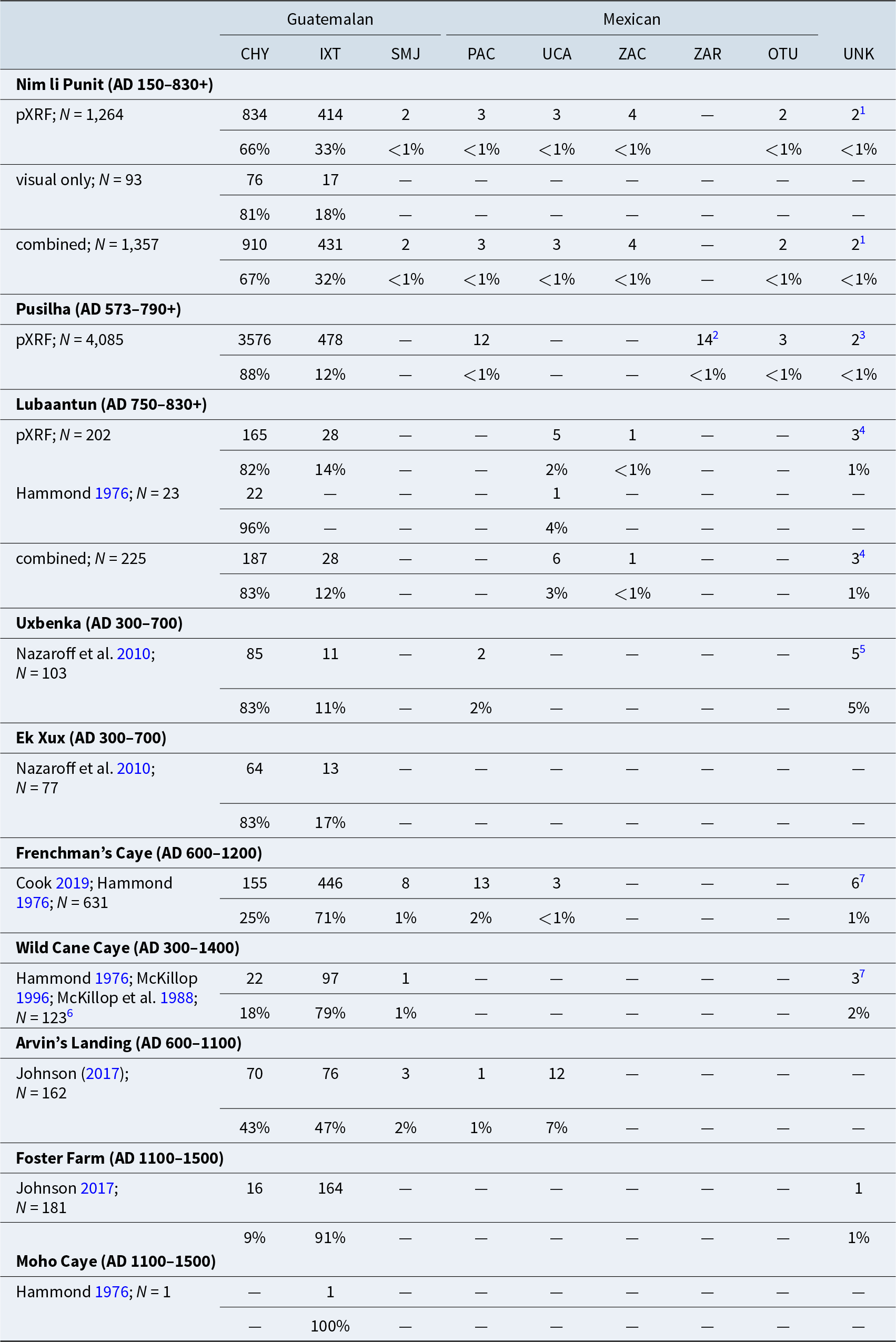
Members of our project have conducted portable X-ray fluorescence (pXRF) analyses of a total of 5,551 obsidian artifacts from three sites in the SBR with the goal of learning from which geological sources they originated so that we can better understand regional procurement patterns (Table 1; see Supplementary Material 1 for our methodology). These sites are Nim li Punit (n = 1,264), Pusilha (n = 4,085), and Lubaantun (n = 202). An additional 93 obsidian artifacts from Nim li Punit were too small (often <0.1 g and <0.1 mm thick) to source using pXRF and were given provisional source assignments according to visual characteristics. To put our pXRF sample in perspective, the only one of similar size in the Maya area is from Ceibal (n = 5,375) and was analyzed by Kazuo Aoyama (Reference Aoyama2017).
Geological Sources of Obsidian Artifacts from the Southern Belize Region (n = 6,945) as Determined in This Study by pXRF (n = 5,551) and Previous Results from Other Projects (n = 1,301).

1 Potential ZAR far outliers but see Supplementary Material 1.
2 Seven sourced by NAA.
3 Two eccentrics not chemically sourced, probably ZAR because a third in same set was sourced to ZAR by NAA.
4 One potential ZAR far outlier, two from either ZAC/UCA.
5 Most likely CHY or IXT chemical outliers.
6 Four additional black pieces were sourced by NAA because of their color; two were assigned to “Source Z,” one to Ucareo, and one to La Esperanza, Honduras. These cannot be included here because of the nonrandom nature of the sampling strategy. However, it is notable that both Ucareo and La Esperanza obsidian are found at Wild Cane Caye.
7 Assigned to “Source Z,” an XRF chemical group recognized by Lawrence Berkeley Lab and most likely a chemical and geological far outlier of the El Chayal source area.
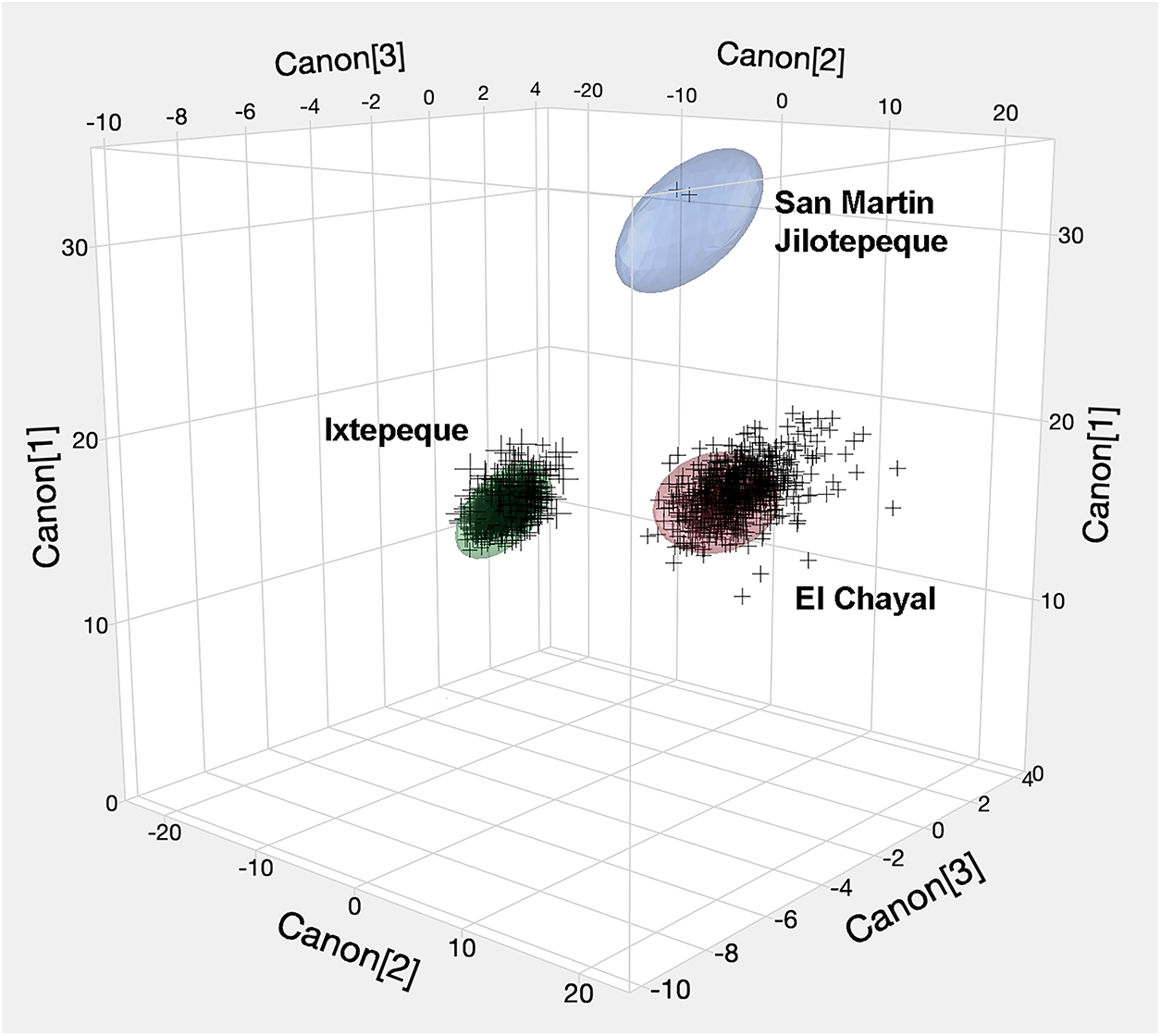
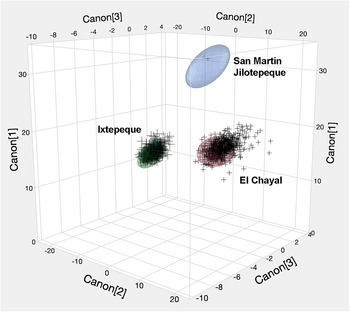
By count, fully 99% of the analyzed artifacts from Nim li Punit come from sources in Guatemala (Figure 2): El Chayal (n = 910; 67%), Ixtepeque (n = 431; 32%), and San Martin Jilotepeque (n = 2; <1%). Overall, the high frequencies of both El Chayal and Ixtepeque obsidian are rather surprising; most Classic lowland Maya sites received almost all their obsidian from El Chayal, but others in southwestern Honduras and western El Salvador received almost all their material from Ixtepeque (Braswell Reference Braswell, Smith and Berdan2003; for a map showing all obsidian sources discussed in this report, see Braswell Reference Braswell, Smith and Berdan2003:Figure 20.1). For example, Lucas Johnson (Reference Johnson2016:Table 4-2) has noted that in a pXRF sample of 1,768 pieces from Caracol, Belize, fully 90.2% (n = 1,595) come from El Chayal and only 8.3% (n = 147) from Ixtepeque. In a large sample from Tikal, Hattula Moholy-Nagy and colleagues (Reference Moholy-Nagy, Meierhoff, Golitko and Kestle2013:Table 2) report an ubiquity of El Chayal of 90.8% (2,073 of 2,283 artifacts). Similarly, Michael Glascock and I have noted that at Calakmul, 86.3% (389 of 451 obsidian artifacts) come from El Chayal. A final large sample (n = 4,748) from Aguateca was visually sourced by Kazuo Aoyama (Reference Aoyama, Hruby, Braswell and Mazariegos2011:46), and 96.2% (n = 4,569) come from El Chayal. In great contrast to this Peten-centric procurement sphere focused on El Chayal, Aoyama (Reference Aoyama, Hruby, Braswell and Mazariegos2011:40) has observed that over all phases at Copan, nearly all obsidian artifacts came from Ixtepeque. In a visually sourced collection of 57,815 artifacts, he assigned 98.5% (n = 56,961) to Ixtepeque, a figure that agrees closely with my own visual analysis of roughly 30,000 additional obsidian artifacts from Group 10L-2 of Copan.
Nim li Punit obsidian source assignments by pXRF. First three canonical discriminant functions of elemental data used to assign obsidian artifacts to Guatemalan sources (n = 1,250). Ellipsoids indicate 95% probability of inclusion in a particular source. Figure by Alexandra Bazarsky. (Color online)
The presence of significant amounts of obsidian from the two sources at Nim li Punit is therefore noteworthy because it is numerically intermediate between a Classic period Peten-centric sphere and that of the southeastern Maya area. One might attribute this to Nim li Punit’s position in the southeast periphery of the Maya lowlands, perhaps on or near a frontier dividing different procurement spheres (Braswell Reference Braswell, Smith and Berdan2003; Hammond Reference Hammond1972), but as we shall see this pattern is not typical for other sites in the SBR. At Nim li Punit, obsidian procurement patterns were dynamic and changed over time as different economic and political relations gained or lost importance.
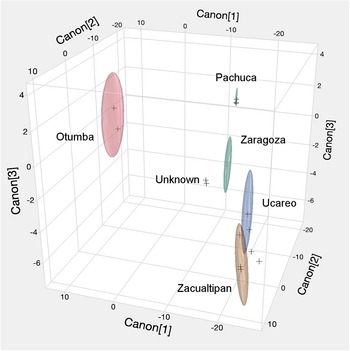
Of the analyzed obsidian from Nim li Punit, 12 more artifacts came from distant obsidian sources in central and west Mexico (Figure 3): four from Zacualtipan, three each from Pachuca and Ucareo, and two from Otumba. Of these 12 Mexican obsidian artifacts, 10 were recovered from surface contexts. Seven come from Structure 50, which was built after AD 790, and two of the three proximal blade fragments from Mexico have pecked-and-ground platforms. All this strongly implies that most of the exotic obsidian dates to the Terminal Classic, a period when trade with central Mexico dramatically increased. Nonetheless, one blade made of green Pachuca obsidian found on the surface has a plain facet platform suggesting manufacture at Classic Teotihuacan, and the only two Mexican pieces recovered from below the surface come from sealed Early Classic contexts. Unique in southern Belize, six Teotihuacan-related vessels have been found at Nim li Punit (Braswell Reference Braswell and Braswell2022a:Figure 5.4), also demonstrating limited indirect interaction with, or knowledge of, the Mexican city during the late Early Classic Chok phase (AD 400–600). Finally, two obsidian artifacts from Nim li Punit could not be sourced definitively by pXRF but cluster closer to several Mexican sources than to those from Guatemala (see Supplementary Material 1).
Nim li Punit obsidian source assignments by pXRF. First three canonical discriminant functions of elemental data used to assign obsidian artifacts to Mexican sources (n = 14). Ellipsoids indicate 95% probability of inclusion in a particular source. Figure by Alexandra Bazarsky. (Color online)

We also have used pXRF to source 4,285 obsidian artifacts from two other inland sites of the SBR: Pusilha and Lubaantun (Table 1). In addition, Hammond (Reference Hammond, Hester and Hammond1976) previously analyzed 23 obsidian artifacts from Lubaantun. The vast majority of obsidian at both sites comes from El Chayal (88% at Pusilha and 83% at Lubaantun). This is significantly different from Nim li Punit. A smaller set of pXRF data has been published for Uxbenka and for Ek Xux in the Maya Mountains. These too exhibit significantly different procurement patterns from Nim li Punit. In contrast, five coastal sites demonstrate much greater reliance on Ixtepeque than do any of the inland sites (Table 1).
Either the sites had distinct procurement patterns implying different local economic and political systems, or the contrasts in procurement relate to differences in their overlapping chronologies. Remember that while Pusilha was essentially a Late Classic site, Lubaantun had both Late and strong Terminal Classic components. In contrast, Nim li Punit was occupied from the Terminal Preclassic until the Terminal Classic collapse. The five coastal and offshore sites overlapped with Nim li Punit during the Classic period but also had substantial Postclassic occupations that postdate the collapse of the inland sites. All five coastal/offshore sites have very strong Middle to Late Postclassic occupations (AD 1200–1500) when Ixtepeque obsidian dominated collections throughout the Maya lowlands (Braswell Reference Braswell, Smith and Berdan2003:154). The significant presence of Ucareo at Arvin’s Landing implies a particularly important occupation during the tenth to early eleventh century.
Despite strong evidence for a chronological pattern, I argue that both chronologies and distinct trade relations contributed to the differences in procurement seen at the ancient sites of the Toledo District.
Temporal Variation in Procurement Patterns at Nim Li Punit
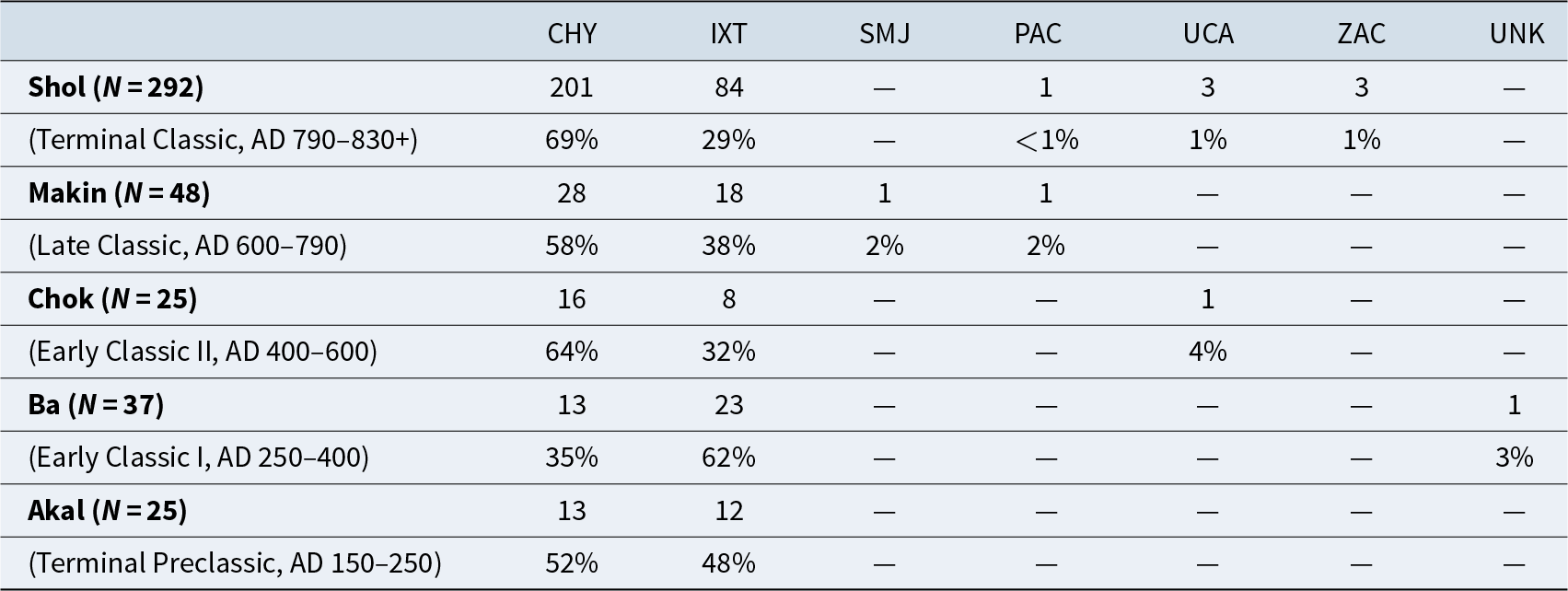
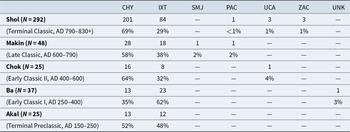
We recovered 427 obsidian artifacts from single-phase contexts at Nim li Punit. Our Terminal Preclassic collection of the Akal phase is small (Table 2). Half the Akal artifacts come from El Chayal (n = 13) and half from Ixtepeque (n = 12). Thirty-seven more artifacts were recovered from sealed contexts dating to the ensuing Early Classic Ba phase. Fully two-thirds of these come from Ixtepeque, while only one-third come from El Chayal. This pattern reverses in later Early Classic and Late Classic times; of the 73 artifacts from sealed Chok and Makin contexts, El Chayal obsidian appears at nearly twice the frequency as Ixtepeque material (44:26). Finally, in Terminal Classic Shol-phase contexts, the ratio of El Chayal to Ixtepeque obsidian is even greater than two to one (201:84). These temporal differences are statistically meaningful and are strong chronological markers. During the first half of the Early Classic period, Nim li Punit had significantly greater access to Ixtepeque obsidian than material from El Chayal, but this reversed toward the end of the Early Classic period. Years ago, I noticed this same pattern in our test-pitting program, and Stroth and colleagues’ (Reference Stroth, Borrero and Braswell2024) recent study of single-component ceramics from sealed architectural contexts allows us to pinpoint this change or inflexion point to the second half of the Early Classic period.
Obsidian Sources at Nim li Punit by Ceramic Phase.
What does this imply for the external relations of Nim li Punit? Could it be that greater access to Ixtepeque during the Ba phase implied closer economic ties to sites to the south, especially with Copan and Quirigua around the time of the founding of their dynasties? Might Early Classic obsidian trade with Copan also explain the presence of Teotihuacan-related pottery at Nim li Punit? Could it be that later in the Early Classic and throughout the Late Classic, Nim li Punit focused more on trade with partners to the north and west? The Wind Jewel of Nim li Punit demonstrates political ties with the Belize Valley and Caracol during the first century of the Late Classic (Prager and Braswell Reference Prager and Braswell2016), perhaps suggesting a shift in exchange relations.
In contrast to Nim li Punit, Late Classic Pusilha appears to have even more greatly relied on a Peten-centric obsidian procurement network, even though we know of marriage relations with the Copan region (Somerville et al. Reference Somerville, Schoeninger and Braswell2016). The Early to Terminal Classic kingdom of Uxbenka/Lubaantun is more similar to Pusilha than Nim li Punit in terms of procurement patterns. In sum, trade relations between Nim li Punit and the outside world shifted over time, and procurement patterns at Nim li Punit differed from and were more complex than at the three other sites of the SBR.
Lithic Industries and Typological Analysis
Typological analysis, to be discussed in more detail elsewhere, reveals that four lithic industries were practiced at Nim li Punit. Because lithic production is a reductive process, pieces made in one industry can be reworked by other techniques or further reduced through recycling. For this reason, a single artifact may be assigned to more than one industry and type. Reflecting this, the total number of typological assignments reported here is 1,379 even though there are only 1,357 analyzed obsidian artifacts.
Of the artifacts (10.1% of the obsidian collection), 137 pertain to the expedient casual percussion industry. At Nim li Punit, this industry was practiced largely using exhausted cores and other debitage from prismatic blade production but also reflects the recycling of used and broken tools. More than half of these pieces come from the Ixtepeque source (n = 73) followed by El Chayal (n = 60), Zacualtipan (n = 2), and San Martín Jilotepeque (n =1). The higher-than-expected relative frequency of Ixtepeque obsidian used for recycling seems to reflect a choice; perhaps this material was more highly valued than El Chayal obsidian and therefore further reduced through casual percussion.
An additional 36 artifacts (2.7% of the collection) are bipolar cores and flakes, and most of these are very small artifacts made of Ixtepeque obsidian (n = 25). These are not limited to the Early Classic Ba phase when Ixtepeque material was most common, and hence again suggest that obsidian from this source was saved and preferentially reworked using the hammer-and-anvil technique across all phases.
The biface or retouch industry is represented by just 32 artifacts (2.4% of the collection). These are mostly retouch/sharpening flakes or pieces of broken bifaces. Two patterns are particularly noteworthy. First, most of this material (n = 21) again comes from the Ixtepeque source demonstrating a clear preference of this material for bifaces and other retouched tools. Of the 10 El Chayal artifacts, nine are retouch/sharpening flakes; the only flaked artifact sourced to El Chayal is a worked sequin. A final retouch/sharpening flake is of Otumba obsidian. Second, 17 of the 32 artifacts pertaining to this industry come from single-component Shol-phase contexts dating to the Terminal Classic period and five more were recovered from the surface of the site. The only complete obsidian biface recovered is a small prismatic-blade point diagnostic of the Terminal Classic and later periods. Thus, the biface or retouch industry was most important at Nim li Punit at the end of the Classic period.
Despite the practice of these other three industries, the focus of obsidian was prismatic blade manufacture using imported cores. Fully 1,174 artifacts (86.5% of the collection) pertain to this industry. These represent a minimum number of individuals of 220 complete prismatic blades made of Chayal obsidian and 78 blades made of Ixtepeque material. Put another way, the prismatic blades in our sample could be made from one large El Chayal blade core and a single Ixtepeque core that was more than halfway to being exhausted. The metrics of the blades, regardless of source, are about the same. I have reconstructed a modal blade that is 88.7 mm long and was snapped on average into about 4.3 fragments.
Obsidian was brought to Nim li Punit in an already heavily modified condition. Only three of the 1,357 artifacts (0.2%) retain any trace of cortex. The principal imported form of El Chayal was the prismatic blade core; few other artifact types were brought to Nim li Punit from that source. In contrast, Ixtepeque obsidian was imported as prismatic blade cores and, in much lower numbers, as bifaces made on macroblades or large percussion blades. It is possible that some larger Ixtepeque percussion blades arrived as preforms, but the limited quantity of thinning/retouch flakes suggests that the resharpening and curation of existing bifaces was much more common than local production.
Production and Consumption of Blades
Except for a few blades from San Martin Jilotepeque and the Mexican sources, production and consumption of prismatic blades were both local. That is, Nim li Punit neither imported nor exported prismatic blades but instead formed its own community of production and consumption. The same can also be said of Lubaantun and, to a lesser degree, Pusilha. This argument is based on the morphology of prismatic blades. The distal tips of finished blades, unless they were specialized perforators, were generally snapped off and discarded near the place of production. This is because they are too curved to be hafted and far too fragile for most daily use. Contexts that have more distal tips than proximal fragments reflect production, local discard, and the use of blade fragments in another place. In contrast, contexts with many more proximal fragments than less-useful tips reflect an emphasis on localized consumption, and we can argue that at least some blades were brought in from their place of production.
Lubaantun and Nim li Punit have balanced proximal to distal ratios (Table 3). Neither site seems to have used significantly more blades than they produced and do not exhibit a pattern of production for distribution to another site. It may be that consumption was slightly more important than production at Nim li Punit, but distal tips can be quite small, are hard to collect, and are more prone to fall through a screen. Moreover, our excavations have focused on elite contexts, and perhaps a fraction of the blades we have collected were produced elsewhere within the site. Pusilha has a significantly higher proximal to distal fragment ratio, but this may be because the great majority of our sample comes from the acropolis where elites consumed more blades than were produced in that portion of the site. In contrast, unpublished data from Pook’s Hill in the Belize Valley (Stemp et al. Reference Stemp, Braswell, Helmke and Awe2018, Reference Stemp, Braswell, Helmke and Awe2019, Reference Stemp, Helmke, Braswell and Awe2024) reveal a proximal to distal ratio of 2.2, suggesting that the lithic consumers at this small and rather humble site acquired at least some of their blades elsewhere.
Prismatic Blades and Blade Fragments from Southern Belize and Pook’s Hill, Cayo District.

Conclusions
Nim li Punit received almost all the obsidian it consumed from the El Chayal and Ixtepeque sources, generally at a 2:1 ratio. Nonetheless, there is marked chronological period, the Early Classic Ba phase, when the relative importance of these two sources reversed and Ixtepeque obsidian was more prevalent. Other sites in the southern Belize region exhibit reliance on the same two sources, but in relative terms both Lubaantun and Pusilha consumed far less obsidian from Ixtepeque. Finally, prismatic blade production and consumption patterns at Nim li Punit and Lubaantun imply that blades were made and used there, not traded out in significant quantities to other sites in the region. Put another way, I can find no evidence for a producer-consumer model as has been argued for chert-tool production in northern Belize (e.g., McAnany Reference McAnany1989) or of tribute from one site in the region to another. The royal acropolis of Pusilha consumed more blades than it produced, but these may have been made elsewhere within the city rather than imported from another place in the SBR. Overall, the obsidian data from three of the largest capitals imply distinct trade relations, the absence of economic specialization at the site level, and the lack of integration within a regional market.
What can we infer for the external relations of Nim li Punit? Could it be that greater access to Ixtepeque during the Ba phase implied closer economic ties to sites to the south, especially with Copan and Quirigua around the time of the founding of their dynasties? Might Early Classic obsidian trade with Copan also explain the presence of Teotihuacan-related pottery at Nim li Punit? Could it be that later in the Early Classic and throughout the Late Classic, Nim li Punit focused more on trade with partners in the Peten and western Belize? The Wind Jewel of Nim li Punit suggests political ties with the Belize Valley and Caracol during the first century of the Late Classic (Prager and Braswell Reference Prager and Braswell2016), perhaps also indicating that changes in trade relations took place at that time.
In contrast to Nim li Punit, Late Classic Pusilha appears to have even more greatly relied on a Peten-centric obsidian procurement network, even though we know of marriage relations with the Copan region (Somerville et al. Reference Somerville, Schoeninger and Braswell2016). The Early to Terminal Classic kingdom of Uxbenka/Lubaantun is closer to Pusilha than Nim li Punit in terms of procurement patterns. In sum, trade relations between Nim li Punit and the outside world shifted over time, and procurement patterns at Nim li Punit were more complex than at the three other sites of the SBR. Rather than participating in the same homogenizing market, these capitals had overlapping yet distinct procurement networks, supporting the notion that despite their proximity, they were independent polities.
These economic conclusions derived from obsidian agree with ceramic data and even with the royal propaganda of carved monuments. The variety and richness of ceramics at Lubaantun is quite limited, the pottery of Pusilha stands alone as distinct from the rest of the SBR, while the inventory of Nim li Punit exhibits the greatest variety and economic interaction with other regions (Bill and Braswell Reference Bill and Braswell2005; Hammond Reference Hammond1975; Jordan Reference Jordan2019; Stroth et al. Reference Stroth, Borrero and Braswell2024). Only two of the SBR sites, Pusilha and Nim li Punit, have a rich hieroglyphic corpus that is still legible, and both interacted with sites in the Copan/Quirigua region, with the “Water Scroll” site (presumably Altun Ha), and in the case of Nim li Punit, with western Belize and Caracol (Prager and Braswell Reference Prager and Braswell2016). I view the SBR as a frontier zone where each small polity—perhaps best considered to be principalities—separately and differently negotiated their political and economic sovereignty under competing claims of suzerainty made by powerful states to the north and south.
Acknowledgments
I thank Ada Colocho, James T. Daniels Jr., and Luke R. Stroth for conducting the pXRF analysis, and Alexandra F. Bazarsky for the statistical analyses of the pXRF data. I also thank the various graduate students who have contributed directly to this work in the field and laboratory, particularly Mario R. Borrero and Luke R. Stroth. I also thank the many supportive members of the Institute of Archaeology, NICH, Belize, for all the help and friendship they have shown over the past 25 years. Finally, a large debt of gratitude is owed to the people of Indian Creek, San Benito Poité, and San Pedro Columbia villages.
Funding Statement
Excavations at Nim li Punit have been generously supported by the National Geographic Society (#9027-11) and grants from the Faculty Senate of the University of California, San Diego.
Data Availability Statement
Raw data for this report are available in the form of a spreadsheet curated by the Mesoamerican Archaeology Laboratory of the University of California, San Diego.
Competing Interests
The author declares none.
Supplementary Material
The supplementary material for this article can be found at https://doi.org/10.1017/laq.2025.10124.
Supplementary Material 1. Portable XRF Methodology and Statistical Interpretation.




 Open access

