




1. Introduction
‘Sign languages and creoles are two kinds of young languages, and, as such, may be expected to be less complex than their older counterparts’ (Gil Reference Gil, Newmeyer and Preston2014: abstract). This and similar claims illustrate cross-fertilisation of ideas between creole and sign language linguistics that has led to predictions that sign language structure should be simple like creole structure is claimed to be. However, sign language structure, namely its morphology, has been discussed as complex: For example, Aronoff, Meir & Sandler (Reference Aronoff, Meir and Sandler2005: 304) suggested that sign languages ‘…seem to present the impossible combination of Navajo-like and Tok-Pisin-like languages, a typological puzzle’, while Napoli (Reference Napoli, Audring and Masini2018: 603) explained ‘…on the one hand, sign language morphology appears complex, given verb inflections and classifier constructions’ but ‘on the other hand, sign language morphology appears simple in that there is little affixation’. In this paper, we show that the theoretical and empirical foundations of claims that sign language morphology is paradoxical are flawed and concretise theoretical and practical recommendations for studying morphological complexity. We show that the argumentation and evidence in analogies between creole and sign language complexity adopt theoretically contested and ideologically problematic assumptions about creoles and uncritically apply them to sign languages.
The idea that sign languages are like creoles is typically attributed to Fischer (Reference Fischer and Siple1978), who argued that American Sign Language is a creole, based on a comparison with Hawaiian Creole (see Lupton & Salmons Reference Lupton and Salmons1996 for critique and Deuchar Reference Deuchar1984 and Adone Reference Adone, Pfau, Steinbach and Woll2012 for other comparisons). This idea appears regularly in the sign language literature, especially with reference to Bickerton’s (Reference Bickerton1984) proposal that creoles develop from pidgins: For example, Ladd & Edwards (Reference Ladd and Edwards1982: 112) suggest that ‘BSL [British Sign Language] should be recognized as a creole’. Senghas (Reference Senghas1995: 543) observed of isolated deaf signers in Nicaragua that soon after contact with each other ‘they developed a now partially crystallised pidgin called Lenguaje de Signos Nicaragüense (LSN)’ and later from ‘this impoverished language input they produced something richer: the new creole Idioma de Signos Nicaragüense (ISN)’. Based on this, Emmorey (Reference Emmorey and Emmorey2003: 7) suggests that the case of Nicaraguan Sign Language ‘…is unprecedented because researchers have been able to observe the creolization process firsthand’. Nyst (Reference Nyst and Brentari2010: 419) remarks that ‘Kamei (2006) claims a creole status for ASL [American Sign Language]-based sign languages in francophone African countries’ due to the ‘(1) the integration of French elements and (2) the integration of local or “natural” signs’. Underlying these quotes are assumptions about similarities in the relationship between language age, grammatical structure, and linguistic typology in creoles and sign languages, despite an early warning from Washabaugh:
The use of the terms creole and creolization as labels for sign language phenomena is, at this point in the development of both sign language studies and creole language studies, uncautious. It may well be that both sign languages and creole languages are produced by similar processes (though radically different characterizations of those processes have been advanced in creole language studies); but the recognition of that similarity should do no more than guide research…It should not be used as a justification for identifying sign language phenomena and creole language phenomena (Washabaugh Reference Washabaugh1981: 244).
In dissecting the transfer of ideas about creole complexity to sign languages, we limit ourselves to morphology (see Adone Reference Adone, Pfau, Steinbach and Woll2012 for a structural comparison). We identify four flaws in argumentation: (i) use of limited morphological data to generate claims about global complexity, (ii) association of binary language categories with categorical complexity differences, (iii) use of language age to motivate predictions about morphological complexity, and (iv) extrapolating from creole complexity to sign language complexity. These flaws guide our discussion of theoretical and empirical issues common to the study of sign language and creole complexity and motivate the recommendations (listed below and elaborated in Section 5) we make to avoid them:
-
1. Assume heterogeneity in structural and social criteria within groups and build up categories that are meant to represent structural properties of creoles and sign languages incrementally by taking ecological context into consideration (Bisnath Reference Bisnath2024, Mufwene Reference Mufwene, Neumann-Holzschuh and Schneider2000).
-
2. Limited examples of morphology should not be used as proxies for the global complexity of languages (Bonami & Luís Reference Bonami and Luís2013).
-
3. Be aware that notions of linguistic complexity may be used to argue for or against the legitimacy of ‘languages’ vs. ‘non-language’, e.g. by non-specialists (Fusellier-Souza Reference Fusellier-Souza2006).
-
4. Reflect on positionality and academic tradition when working with and making claims about differences in complexity, particularly when referencing minoritised groups. This includes critically engaging with one’s own positionality in doing research and seeking out literature and insights from community insiders and outsiders.
-
5. Avoid assuming that complexity (structure), time depth, and sociolinguistic typology are straightforwardly related. For sign languages, this may mean that village sign languages (those used in smaller rural communities)Footnote 1 or ‘younger’ sign languages should not be assumed to be on a developmental pathway towards grammatical properties the same as those identified in older deaf community sign languages (used across entire nation states) (Kusters & Hou Reference Kusters and Hou2020).
-
6. Explain and motivate the usefulness of complexity.
-
7. Actively avoid reductive, provocative rhetoric.
-
8. Be clear that complexity measures are a product of linguistic analysis and not a natural property of languages or forms in languages.
-
9. Avoid uncritically transferring ideas between fields – ideas about creole complexity should not be uncritically applied to sign languages.
This paper is directly informed by our personal and academic experiences as linguists. We are a team of sign language researchers working on intersections of sign language linguistics, language evolution, typology, language documentation, variation, and language acquisition. We are all hearing and have acquired signing skills in one or more sign languages as adults. FB is an Indo-Trinidadian cis woman who grew up in Trinidad. Her research on sign–spoken language contact is informed by creole linguistics. HL is a white woman who grew up in Germany and studies the acquisition of and variation within the sign language of a Balinese village. MJ is a Palestinian woman who grew up in Nazareth and currently living in the UK. She researches Kufr Qassem Sign Language, the local sign language of a Palestinian deaf community in what is now known as Israel. RO is a Trinidadian woman living in Europe whose research has focused on documenting and describing Providence Island Sign Language, a sign language used in a small Caribbean island. AS is a white Australian cis man living in the UK who has investigated the linguistics of Auslan and British Sign Language. As creole speakers and citizens of the global south and occupied territories working in the global north, we are acutely aware of linguistic minoritisation and how resource inequalities across the world condition research and narratives in linguistics. As community-focused sign language linguists, we have first-hand knowledge of the linguistic and cultural diversity that is at the risk of being homogenised or exoticised.
This paper is structured as follows. Section 2 reviews selected approaches to measuring morphological complexity in spoken languages before narrowing to how it has been theorised, measured, and critiqued in literature on creoles (Section 3) and sign languages (Section 4). We summarise influential positions in the literature and review their theoretical, empirical, and ideological foundations. In Section 5, we identify key flaws common to creole and sign language linguistics and work towards a set of recommendations for more accurate and mindful analysis of how language age, typology, and morphological complexity might interact. Finally, we summarise the impact of these recommendations and provide future directions.
2. What is morphological complexity?
Complexity has two main meanings in everyday usage: Something complex is either (i) made up of many smaller parts, with intricate connections between them (i.e. formal complexity) and/or (ii) difficult to do or understand (Miestamo Reference Miestamo2017). While both meanings are used in linguistics to discuss morphological structuresFootnote 2 ( Kusters Reference Kusters2003, Dahl Reference Dahl2004), we focus on (i) because of its central role in the creole complexity debate (Section 3) and its influence on sign language linguistics (Section 4). Formal complexity is defined on individual lexical items and takes a quantitative approach (i.e. counting ‘the many smaller parts’ but not always accounting for the ‘intricate connections between them’). Formal complexity metrics compare languages by contrasting the number of distinctions they contain with comparisons targeting inflectional, as opposed to derivational, morphology (Schlegel Reference Schlegel1808; Sapir Reference Sapir1921; Baerman, Brown & Corbett Reference Baerman, Brown, Corbett, Baerman, Brown and Corbett2015). We exemplify five approaches to measuring morphological complexity: (i) counting morphemes in lexical items; (ii) counting meanings associated with each morpheme; (iii) counting how many features are morphologically marked and how many values/contrasts are available in each feature (overspecification); (iv) predictability of allomorphy; and (v) counting how often the same meaning is expressed within a phrase/clause (syntagmatic redundancy).
2.1 Counting morphemes in lexical items
These approaches enumerate the average number of morphemes in lexical items (Arkadiev & Gardani Reference Arkadiev, Gardani, Arkadiev and Gardani2020) and compare languages by contrasting this. Thus, words in Kasong (example 1), which typically consist of single morphemes, are considered lower in complexity than words in Alutor (example 2), which are often polymorphemic.


2.2 Counting meanings in each morpheme
A language that tends to have one morpheme per meaning, such as Turkish (example 3), is considered less complex than a language with inflectional morphemes, such as Spanish (example 4), in which many meanings may be associated with one form:


2.3 Counting how many features are morphologically marked and how many values/contrasts are available in each feature (overspecification)
Languages may overtly and obligatorily mark semantic distinctions (e.g. noun classes, obviatives, person/number, inalienable possession, tense, aspect, case, gender, animacy, definiteness; Baerman, Brown & Corbett Reference Baerman, Brown, Corbett, Baerman, Brown and Corbett2015). English is considered less complex than Yagua because it marks past and non-past distinctions in its verbs only (example 5) while Yagua has five different types of temporal distance in its past tense morphology (examples 6a–e).


2.4 Predictability of allomorphy
Whether allomorphy is predictable or not in complexity measures (Baerman, Brown & Corbett Reference Baerman, Brown, Corbett, Baerman, Brown and Corbett2015) aligns with irregularity (i.e. the extent to which irregular forms and rules, such as grammatical gender, irregular roots, suppletion, etc., need to be learned). Plural marking in German is considered more complex than in Spanish; Spanish consistently marks plural with the same suffix -(e)s (example 7) while German plurals involve different strategies depending on the gender of the noun and some phonological characteristics, in addition to some exceptions. For example, the German noun Frau ‘woman’ is pluralised as Frauen by adding the plural suffix -en and the noun Buch ‘book’ is pluralised as Bücher by both an affix and a vowel change in the root (example 8).


2.5 Counting how often the same meaning is expressed within a phrase/clause (known as syntagmatic redundancy)
East Flemish is considered more complex than standard Dutch in subject marking as the subject is tripled in the first-person plural in East Flemish (example 9) but appears once in standard Dutch (example 10; Vogelaer Reference Vogelaer and Kortmann2003).


This non-exhaustive review of approaches to morphological complexity illustrates that working definitions of complexity include a range of different grammatical characteristics, demonstrating a lack of consensus in the aspects of morphology considered relevant in defining morphological complexity and in how to compare morphological properties across languages (Arkadiev & Gardani Reference Arkadiev, Gardani, Arkadiev and Gardani2020). It is also clear that morphological complexity is a comparative concept.
3. Complexity and creoles
Notions of complexity shape creole literature and are closely linked to overt and covert characterisations of creoles. Definitions of what a creole is differ in the properties they foreground: sociohistorical vs. structural vs. temporal, etc. The most well-described creoles are the Atlantic Creoles (the ‘Classic Creoles’), which are often implicitly and explicitly used as a representative of all creoles, despite the emergence of creoles in other contexts (Meakins Reference Meakins2023). The Atlantic Creoles emerged on the West Coast of Africa and plantations in the Caribbean during the transatlantic slave trade in a context where large groups of enslaved peoples using West/Central African languages were subjugated by smaller groups of settlers using European languages, especially English, French, Portuguese, and Dutch (usually non-standard varieties). The form of the lexicons primarily draws on the European language(s) and both European and West African languages influence the grammatical system. Creoles are typically less prestigious compared to standard varieties of European languages; however, they are often de facto national languages and strongly associated with cultural identity.
Creole complexity is much-discussed in linguistics and exemplifies problems in using complexity to theorise typology. Complexity metrics are by nature comparative (see Section 2) and motivate typological separation of creoles from non-creoles (referred to as ʻCreole Exceptionalism’ in DeGraff Reference DeGraff2005: 533). Below, we discuss complexity in the debate about creole simplicity to exemplify how typology intersects with ideology and motivates the creole vs. non-creole binary. We first summarise the creole complexity debate focussing on formal complexity and inflectional morphology and follow with how empiricism has been pitted against ideology. We do not provide a comprehensive account of creole complexity but use key aspects of the debate to draw out issues in argumentation that are relevant to sign language complexity (Sections 4 and 5). We refer readers to the citations for more nuance.
3.1. Creoles are simple – or not?
The debate about creole complexity is multifaceted, but we distil it into two major positions that can be thought of as a proposal and a response, or an older and a newer approach, respectively. We then move to discussing what the debate has drawn out about complexity as it relates to measurement, typology, and ideology.Footnote 4
As mentioned above, the older proposal has been referred to as ‘Creole Exceptionalism’ and ‘distinctivism’ (DeGraff Reference DeGraff2005, Bakker Reference Bakker2014), defined as ‘a set of beliefs, widespread among both linguists and non-linguists, that creole languages form an exceptional class on phylogenetic and/or typological grounds’ (DeGraff Reference DeGraff2005: 533). It has two major distinct, but related, facets: (i) Creoles are structurally simpler than other languages, or that a language is simple if it is a creole, and (ii) Creoles are a structurally identifiable class of languages (McWhorter Reference McWhorter2001, Reference McWhorter2011; Parkvall Reference Parkvall, Miestamo, Sinnemäki and Karlsson2008; Bakker, Daval-Markussen, Parkvall & Plag Reference Bakker, Daval-Markussen, Parkvall and Plag2011). Related to this is an assumption that creoles develop from pidgins, where pidgins are makeshift communicative systems without native speakers (Birkeland, Block, Craft, Sedarous, Wang, Wu & Namboodiripad Reference Birkeland, Block, Craft, Sedarous, Wang, Wu and Namboodiripad2024 problematise nativeness), and creoles are the restructured output of children who receive a pidgin as input during language acquisition (Figure 1) (Bickerton Reference Bickerton1984, Todd Reference Todd1990; see Mufwene Reference Mufwene, Adamou and Matras2020 for critique). A driving idea in these proposals is that creoles are young/new languages, both in the historical linguistics sense (not arising from gradual changes in a single ancestral language) and in the historical sense (relatively recent emergence of the classic creoles between the seventeenth and nineteenth centuries). Creole youth is used to argue that their purported grammatical simplicity arises from a lack of historical time needed for the processes of grammaticalisation to produce the complexity of other languages (McWhorter Reference McWhorter2001).
Adapted Pidgin-creole lifecycle (Bakker Reference Bakker, Kouwenberg and Singler2008: 131) (only creoles are considered languages).

The newer proposal is roughly aligned with Uniformitarianism (elaborated in Walkden Reference Walkden2019), which is the idea that ‘languages of the past […] are not different in nature from those of the present’ (Croft Reference Croft2002: 233). Here, creoles are a sociohistorical grouping and are typically aligned with the context of emergence of the Atlantic Creoles, despite the existence of creoles in other contexts (Ansaldo Reference Ansaldo2012; Michaelis, Haspelmath & Huber Reference Michaelis, Haspelmath and Huber2013). DeGraff (Reference DeGraff2005: 541–542) defines creole as varieties that developed on colonies and plantations in the New World from the seventeenth to nineteenth centuries, e.g. Haitian Creole. The core idea is that previous claims that creoles are structurally simpler than other languages and/or form a distinct typological grouping are theoretically and empirically unsound (Blasi, Michaelis & Haspelmath Reference Blasi, Michaelis and Haspelmath2017; Meakins Reference Meakins2022). Furthermore, some argue that such a claim is rooted in a racist, colonial history that has sought to separate creoles from other languages (DeGraff Reference DeGraff2005; Ansaldo, Matthews & Lim Reference Ansaldo, Matthews and Lim2007).
3.2. Issues that the creole complexity debate draws out
Discussions of creole complexity target inflectional morphologyFootnote 5 and use formal complexity measures, regardless of theoretical and descriptive orientation. The creole debate draws out issues with purely formal complexity metrics and their use to characterise entire languages and groups. We first illustrate how inflectional morphology is invoked and then describe issues relevant to sign language linguistics (Sections 4 and 5): (i) arbitrariness of complexity metrics, (ii) use of morphology as a proxy for the structure of entire languages, (iii) documentation and sampling, and (iv) separating ideology from science.
Morphology, and specifically a lack of inflectional morphology, is core in the creole complexity debate. Velupillai (Reference Velupillai2015) compiles features used to characterise creoles – of the 29 features, 16 are morphological. A well-known creole complexity metric is found in McWhorter (Reference McWhorter2001) (elaborated elsewhere, including McWhorter Reference McWhorter2007, Reference McWhorter2018) and was developed to support the claim that creoles are less grammatically complex than other languages.Footnote 6 In it, the presence of inflectional morphology marks complexification, which is understood as referring to processing and learning difficulty (McWhorter Reference McWhorter2001: 137–138). Other components of grammar are named, specifically phonemic inventories, syntax, and semantics/pragmatics; however, their complexity is proportional to the number of components or rules (McWhorter Reference McWhorter2001). Inflectional morphology is used to argue for overspecification, structural elaboration, and irregularity (defined in Section 2), as it ‘vividly [embodies] all the types of complexity’ (McWhorter Reference McWhorter2007: 35; for alternative positions, see Dressler Reference Dressler2011, Prado Martín & Fermín Reference Prado Martín2011, Ackerman & Malouf Reference Ackerman and Malouf2013, Bonami & Luís Reference Bonami and Luís2013, Stump Reference Stump2017). In the comparison between Estonian and Saramaccan shown in (11) and (12), Estonian’s specification of partitive marking (glossed here as part) is argued to influence the grammar of Estonian in a way that Saramaccan’s analytic means does not.


Similar prioritisation of inflectional morphology is replicated in work arguing against creole simplicity. Plural marking, attributive use of numerals and colour terms, property concepts, and case-marking and pronoun agreement are used to argue that Pichi (English Creole: Equatorial Guinea) is at least as complex as English (Yakpo Reference Yakpo, Faraclas and Klein2009). Similarly, Smith (Reference Smith2021) considers habitual marking in Palanquero Creole (Spanish Creole: Colombia) and other (non-creole) spoken languages and argues for structural resemblances between these languages.
A crucial issue in metrics targeting inflectional morphology is their arbitrariness: (i) the focus on inflection rather than other morphological features and (ii) the lack of an independent motivation for units of analysis. First, why is inflectional morphology targeted and not derivational morphology? This choice is questionable as some classic/Atlantic Creoles have origins in languages that make limited use of inflection like English. Furthermore, Bonami & Luís (Reference Bonami and Luís2013) note that metrics targeting grammatical properties should not be applied to languages without those properties; therefore, metrics targeting inflection should only be applied to languages, including creoles, that show (any degree of) inflection. Second, the aspects of inflectional morphology that are chosen are biased. As DeGraff (Reference DeGraff2001) points out, the components of complexity metrics should be derived from an independent theory of complexity (see Andrason Reference Andrason2014 for a complex systems theory view), which does not yet exist. Without that, there is no independent motivation for which units of analysis should and should not be included.
A second issue is the use of morphology as a proxy for global complexity that is found in the separation of creoles from non-creoles. As we show, there is an unmotivated use of inflectional morphology as a proxy for the structure of entire languages (global complexity). Echoes of this assumption surface at all levels of the complexity debate as inflectional data is used to support various proposals, implying a tacit acceptance of grading languages based on their morphology. While there may be good rhetorical and empirical reasons to take this route, characterising morphological structure is more appropriate and more aligned with general linguistics practice (Bonami & Luís Reference Bonami and Luís2013).
The issues of creole complexity and creoles as a typological group are separate but closely linked as the former has been used to motivate the latter (McWhorter Reference McWhorter2001). Large databases of structural features have been used to argue for (Bakker et al. Reference Bakker, Daval-Markussen, Parkvall and Plag2011) and against a creole group (Blasi, Michaelis & Haspelmath Reference Blasi, Michaelis and Haspelmath2017), but critiques of this work have raised issues of documentation and sampling. First, Aboh (Reference Aboh2016) points out that 30% of the data on Ewegbe (Niger-Congo: Togo, Ghana, Benin) and Yoruba (Niger-Congo: Nigeria, Benin) used in Bakker et al. (Reference Bakker, Daval-Markussen, Parkvall and Plag2011) are disputable. This discrepancy may be due to variation and binary coding, a well-known limitation in typology. However, the problems with the Ewegbe and Yoruba data suggest further flaws as these languages are relatively well-studied – the error rate for lesser-studied languages is likely to be higher. A reviewer rightly points out, though, that the effect of potential errors on complexity metrics is unknown, and further, it is unclear why errors would skew in making creoles score lower on complexity metrics. We view these issues as important but separate from the issue of reliability.
Second, Blasi, Michaelis & Haspelmath (Reference Blasi, Michaelis and Haspelmath2017) show that the statistical evidence of a structural creole profile that Bakker et al. (Reference Bakker, Daval-Markussen, Parkvall and Plag2011) find is due to over-representation of Western European and West African languages in sampling.Footnote 7 They identify two types of creole profile in the literature – one rule-based and one probabilistic – and evaluate them with data from the Atlas of Pidgin and Creole Language Structures (APiCS) (Michaelis, Haspelmath & Huber Reference Michaelis, Haspelmath and Huber2013) and the World Atlas of Language Structures (WALS) (Dryer & Haspelmath Reference Dryer and Haspelmath2013) using data mining and machine learning. They find differences in languages classed as creole vs. non-creole but suggest that most target features can be linked to contributing languages.
Meakins (Reference Meakins2022) picks up on a different thread, arguing that the creole profile that Bakker et al. (Reference Bakker, Daval-Markussen, Parkvall and Plag2011) and Blasi, Michaelis & Haspelmath (Reference Blasi, Michaelis and Haspelmath2017) report is due to an ascertainment bias in the features targeted by these studies. Both investigations use databases that only contain creoles – Bakker et al. (Reference Bakker, Daval-Markussen, Parkvall and Plag2011) code features from 18 creole languages found in a publication on comparative creole syntax (Holm & Patrick Reference Holm and Patrick2007), and Blasi, Michaelis & Haspelmath (Reference Blasi, Michaelis and Haspelmath2017) use the APiCS (Michaelis, Haspelmath & Huber Reference Michaelis, Haspelmath and Huber2013). Meakins (Reference Meakins2022) argues that selecting which features to compare based on a sample of creoles would necessarily return a creole signal and that features should instead be selected randomly from all languages.
Apart from these theoretical and empirical issues, the creole complexity debate raises issues of ideology vs. empiricism (Meakins Reference Meakins2022). As we mention in Section 3.1, arguments for the simplicity of creoles and their status as a typological group have an ideological dimension dating back to early publications on creoles, as they align with the racist, colonial aspects of the history of modern linguistics (DeGraff Reference DeGraff2005). In the debate, we see naming of this history, and theoretical and empirical arguments against creole simplicity and distinctiveness, being framed as sociopolitically motivated and emotionally driven (Bakker, Daval-Markussen, Parkvall & Plag Reference Bakker, Daval-Markussen, Parkvall and Plag2011; McWhorter Reference McWhorter2018). For instance, McWhorter (Reference McWhorter2018: 108) describes the newer perspective on creoles as imbued with a ‘quiet moral threat’. We also see reification of data-heavy methods and claims that such methods are free of ideology (Bakker Reference Bakker2014, Reference Bakker2016: 431): ‘I have no hidden agenda, no ideology, no prejudice… Facts about language should be our guide, not some ideology’. As noted in Meakins (Reference Meakins2022) and Clemons (Reference Clemons, Hudley, Mallinson and Bucholtz2024), no empiricism or linguistics is ever completely free of (political) ideology. (see Section 5.2 for suggestions).
This subsection summarised the creole complexity debate to outline issues that are relevant to the discussion of sign languages (Section 4). The complexity debate is multi-faceted but can be reduced to claims for and against creole simplicity and the related claim that creoles form a distinct typological class. Our discussion identifies assumptions and ideological baggage taken on when sign languages are uncritically compared to creoles, which we elaborate next.
4. Complexity and sign languages
Sign languages have been compared to creoles in terms of morphological complexity based on assumptions about similarity in language ageFootnote 8 (Section 5.3) (Aronoff, Meir & Sandler Reference Aronoff, Meir and Sandler2005; Dachkovsky, Stamp & Sandler Reference Dachkovsky, Stamp and Sandler2018; Schembri, Fenlon, Cormier & Johnston Reference Schembri, Fenlon, Cormier and Johnston2018). Below, we discuss sign language morphology (Section 4.1) and how complexity figures in sign language linguistics, focusing on the opposing positions of whether sign language morphology is seen as highly complex and/or relatively simple (Section 4.2). We also explain how ideology comes into play as illustrated by the fallacy of assuming sign language types and correlating them with complexity (Section 4.3).
4.1. Sign language morphology
Sign languages, like spoken languages, show derivational and inflectional morphology (Klima & Bellugi Reference Klima and Bellugi1979) and have been classified as falling into the agglutinative or polysynthetic morphological type (Pfau & Steinbach Reference Pfau, Steinbach, Ackema, Bendjaballah, Bonet and Fábregas2023). Derivational morphology is exemplified by the use of movement to distinguish nouns and verbs (Supalla & Newport Reference Supalla, Newport and Siple1978) and lexical compounding (Tkachman & Hudson Kam Reference Tkachman and Kam2020), while inflectional morphology is exemplified by marking aspect with movement (Oomen Reference Oomen2016) or verb directionality to identify verb arguments (Johnston & Schembri Reference Johnston and Schembri2007). There has also been an interest in morphological form-meaning resemblances in signed language morphology (Börstell, Lepic & Belsitzman Reference Börstell, Lepic and Belsitzman2016; Lepic, Börstell, Belsitzman & Sandler Reference Lepic, Börstell, Belsitzman and Sandler2016). However, most research on morphology has centred around sequential and simultaneous morphology (Sandler & Lillo-Martin Reference Sandler and Lillo-Martin2006), of which the latter is framed as special to the affordances of the visual-spatial modality.
Sequential morphology parallels structures in spoken languages where different words/signs or morphemes are concatenated and includes (i) lexical compounding, (ii) affixation, (iii) cliticisation, and (iv) reduplication. In lexical compounds, two (or more) signs are sequenced and often undergo phonological reduction or assimilation (e.g. in handshape) (Klima & Bellugi Reference Klima and Bellugi1979; Aronoff, Meir, Padden & Sandler Reference Aronoff, Meir, Padden and Sandler2008; Meir, Sandler, Padden & Aronoff Reference Meir, Sandler, Padden, Aronoff, Marschark and Spencer2010; Santoro Reference Santoro2018; Tkachman & Meir Reference Tkachman and Meir2018; and see Lepic Reference Lepic2016 for critique) (Figure 2A).Footnote 9 Modifying the meaning of signs through affixation is relatively uncommon in sign languages (Figure 2B, 2C) and so is the use of clitics (Zeshan & Palfreyman Reference Zeshan, Palfreyman, Aikhenvald and Robert2017); where clitics are found, they include completives (Palfreyman Reference Palfreyman2019) and negatives (Figure 2D) (Johnston & Schembri Reference Johnston and Schembri2007). Plurality may be marked through reduplication of movement with different signs showing restrictions in how movement can be repeated (Pfau & Steinbach Reference Pfau and Steinbach2006).
Examples of sequential morphology (A) Lexical compound in Israeli Sign Language: ‘cockroach spray’ (Tkachman & Kam Reference Tkachman and Kam2020: 215) (B) Affixation in American Sign Language: ‘teacher’ (Hochgesang, Crasborn & Lillo-Martin Reference Hochgesang, Onno A. and Diane2017) (C) Negative affix in Ugandan Sign Language (Zeshan & Palfreyman Reference Zeshan, Palfreyman, Aikhenvald and Robert2017: 196) (D) Clitic in Turkish Sign Language (Türk İşaret Dili) (Zeshan Reference Zeshan2004: 46)

Simultaneous morphology capitalises on the potential of the visual-spatial modality to allow concurrent use of articulators, e.g. two hands, face, body (Loos, German & Meier Reference Loos, German and Meier2022). Examples include (i) number marking on nouns (numeral incorporation) and (ii) classifier constructions/depicting signs. Numeral incorporation, integrating a number handshape into a base sign, is common cross-linguistically and frequent in signs related to time and money (Zeshan & Sagara Reference Zeshan and Sagara2016, Semushina & Mayberry Reference Semushina and Mayberry2019) (Figure 3A). Classifier constructions/depicting signs describe motion events or spatial relationships between referents, using handshapes that incorporate properties of a class of referents (Figure 3B), and are found across sign languages. Simultaneous morphology in sign languages show cross-linguistic similarities in form and frequency and has been described as specific to sign languages (Meier, Cormier & Quinto-Pozos Reference Meier, Cormier and Quinto-Pozos2002; Aronoff, Meir & Sandler Reference Aronoff, Meir and Sandler2005; Zeshan & Palfreyman Reference Zeshan, Palfreyman, Aikhenvald and Robert2017); however, parallels can be made with tone in spoken languages (Nespor & Sandler Reference Nespor and Sandler1999; Pfau Reference Pfau, Andrew, Trousdale and Waltereit2015, Reference Pfau2016) or templatic morphology in Semitic languages (Sandler & Lillo-Martin Reference Sandler and Lillo-Martin2006). Additionally, simultaneous constructions may share parallels with multimodal constructions in spoken languages (Hoffmann Reference Hoffmann, Xu and Taylor2021, Hodge & Ferrara Reference Hodge and Ferrara2022).
Examples of simultaneous morphology (A) Numeral incorporation in New Zealand Sign Language: two-weeks (McKee Reference McKee, Zeshan and Sagara2016: 364) (B) Classifier construction in Nepali Sign Language: ‘legged entity moving up inside a cylindrical entity’

In sum, two types of distinctions have been made in sign language morphology: (i) Inflectional vs. derivational morphology draws on differences in grammatical function, and (ii) Simultaneous vs. sequential morphology focuses on differences in form. The latter may or may not be specific to sign languages given cross-modal parallels, particularly with tone and multimodal constructions in spoken languages.
4.2. Is sign language morphology simple or complex?
Examination of sign language morphology as inflectional vs. derivational and sequential vs. simultaneous undergirds the debate about the complexity or simplicity of sign language morphology (Aronoff, Meir & Sandler Reference Aronoff, Meir and Sandler2005; Schembri et al. Reference Schembri, Cormier and Fenlon2018). Disagreements are rooted in the (i) status of inflectional morphology, (ii) role of simultaneity and sequentiality, (iii) status of morphological complexity, and (iv) relation between social factors and complexity.
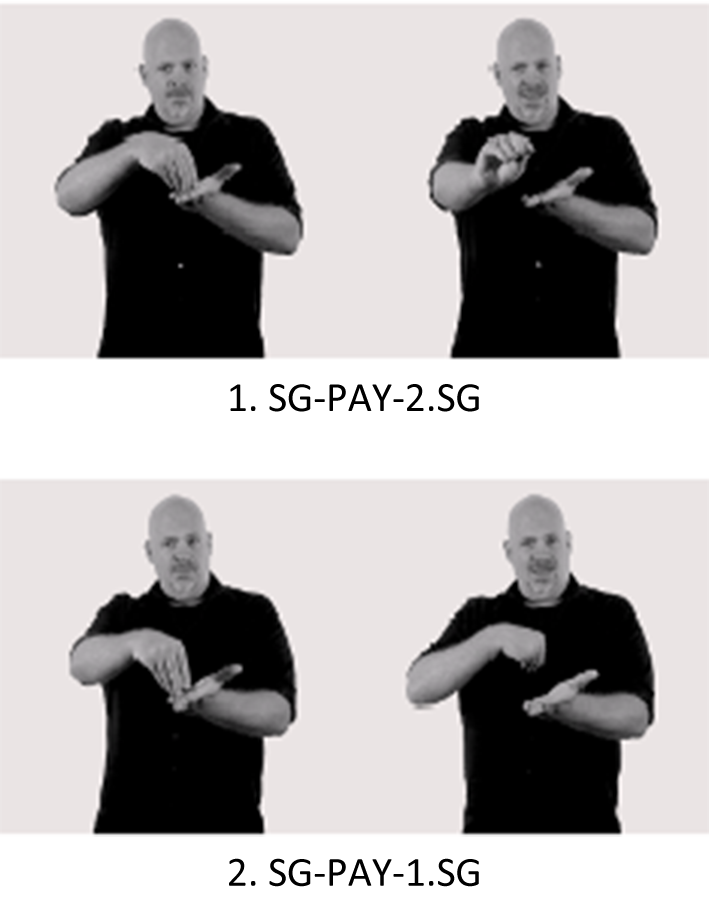
First, inflection is considered a hallmark of complex morphology in spoken languages (see Sections 2 and 3) and the focus of most complexity measures (Bjerva & Börstell Reference Bjerva, Börstell, Brunato, Dell’Orletta, Venturi, François and Blache2016 is an exception). Researchers, however, do not agree whether sign languages have extensive inflectional morphology (Liddell Reference Liddell2003, Johnston & Schembri Reference Johnston and Schembri2007, Napoli Reference Napoli, Audring and Masini2018). Some argue that sign languages have complex morphological structural organisation (unlike creoles) that is both inflectional and derivational in nature (Sandler & Lillo-Martin Reference Sandler and Lillo-Martin2006). Others are more conservative, arguing for low to moderate complexity based on little inflectional morphology (Gil Reference Gil, Newmeyer and Preston2014, Schembri et al. Reference Schembri, Cormier and Fenlon2018). This is because there is no consensus on the analysis of certain so-called inflectional phenomena, like use of space in verb directionality. Directionality refers to spatial modifications of verb signs (e.g. British Sign Language pay, Figure 4) to mark reference to the agent and the patient. In Figure 4, the beginning point and endpoint of the verb reflect the locations of the signer and the addressee representing the agent and patient arguments. Directionality can be analysed as inflection, namely person agreement marking (Lillo-Martin & Meier Reference Lillo-Martin and Meier2011), or as derivation, namely as different verb forms with different meanings (Liddell Reference Liddell2003).
Two spatially modified forms of British Sign Language pay (Schembri et al. Reference Schembri, Fenlon, Cormier and Johnstonforthcoming).

In addition, the status of simultaneous morphology is unclear given the affordances of the visual-spatial modality. Simultaneity is used to argue for high complexity, as in reports of sign languages using rich and complex simultaneous morphology and more simple sequential morphology (Aronoff, Meir & Sandler Reference Aronoff, Meir and Sandler2005: 303). This is at odds with approaches to morphological complexity in spoken languages that use formal complexity metrics (Sections 2 and 3) and that are likely biased to spoken Indo-European languages. Schembri et al. (Reference Schembri, Cormier and Fenlon2018) applied the sociolinguistic typological framework (Trudgill Reference Trudgill2011; Shcherbakova, Michaelis, Haynie, Passmore, Gast, Gray, Greenhill, Blasi & Skirgård Reference Shcherbakova, Michaelis, Haynie, Passmore, Gast, Gray, Greenhill, Blasi and Skirgård2023 for an alternative), to explore the relative complexity of four morphosyntactic features identified by Trudgill as varying between spoken language communities having different social structures. This approach targets sequential morphology and concludes that sign language morphology is low to moderately complex (Schembri et al. Reference Schembri, Cormier and Fenlon2018); however, this work did not fully address modality-specific aspects of morphology in sign languages that have been framed as highly complex.
A broader issue with sign language complexity claims is their foundation in limited evidence as opposed to controlled and systematic studies of sign languages. First, examples from different sign languages are used piecemeal without broader contextualisation about their representativeness or usage. Empirical evidence from naturalistic data may show that complex morphological forms are infrequent or restricted in everyday signing. This is the case for verb directionality in British Sign Language, which is less commonly used in spontaneous discourse than previously assumed (Fenlon, Schembri & Cormier Reference Fenlon, Schembri and Cormier2018; Hochgesang & Becker Reference Hochgesang and Becker2019 for absence of reduplication of nominal plural in American Sign Language). Meir (Reference Meir2016: 115) makes a similar point, generalising across American Sign Language, Danish Sign Language, Auslan, and British Sign Language to say that verb inflection/agreement is variable (although see Oomen Reference Oomen2021 for a different claim regarding German Sign Language). This questions the representativeness of verb agreement structures in American Sign Language, which have been used to illustrate complexity (Aronoff, Meir & Sandler Reference Aronoff, Meir and Sandler2005). More general questions are: How frequently is a feature used by language users, given alternatives? How widespread across the community is that feature? and Is the existence of a feature enough to make a claim about a language as a whole? This questioning is not intended to devalue the place of uncommon phenomena in linguistic theory but to point out that features are often not contextualised and that contextualisation is relevant to what they can represent about a sign language as a whole on a descriptive level. Second, examples from different sign languages are used to argue for complexity of sign languages more generally. The studies mentioned above do not systematically examine sign language(s) but concatenate evidence from different sign languages (see Section 4.1) to make generalisations about sign language morphology. For example, Schembri et al. (Reference Schembri, Cormier and Fenlon2018) base claims about sign language morphology on individual examples from Auslan, New Zealand Sign Language, and British Sign Language. It thus remains unclear whether these morphological phenomena are found in multiple sign languages and how generalisable they are.
This discussion shows that definitions of complexity differ in the morphological units they target and how they can be applied to sign languages. There is also dissociation in the study of sign and spoken languages: In creoles, low presence of inflection is an argument for low complexity (simplicity), while in sign languages, low complexity is predicted but defied by simultaneous morphology, which is complex but not necessarily inflectional. Across all studies the empirical data is scarce; evidence is collected from different sign languages, and cross-linguistic and typological studies rarely focus on morphological phenomena, making it premature to extrapolate to sign language morphology more generally.
4.3. Complexity and the sociolinguistic profile of sign languages – how ideological biases surface
The debate about sign language complexity is fuelled by discussions of how morphological complexity is driven by sociodemographic characteristics of language communities, like language age (Aronoff, Meir & Sandler Reference Aronoff, Meir and Sandler2005; McWhorter Reference McWhorter2005) or community size and social structure (Lupyan & Dale Reference Lupyan and Dale2010, Trudgill Reference Trudgill2011). Sign language communities vary in their demographic and social characteristics and factors like geographical location (de Vos Reference de Vos2011, Reference de Vos2012, 2014; Zeshan, Delgado, Dikyuva, Panda & de Vos Reference Zeshan, Delgado, Dikyuva, Panda and de Vos2013), community size (Schembri et al. Reference Schembri, Cormier and Fenlon2018), time depth (Coppola & Senghas Reference Coppola, Senghas and Brentari2010, Meir et al. Reference Meir, Sandler, Padden, Aronoff, Marschark and Spencer2010), social features of the emergence process (Meir et al. Reference Meir, Sandler, Padden, Aronoff, Marschark and Spencer2010), association with a country and/or an educational setting (Woodward Reference Woodward, Emmorey and Lane2000, Aronoff et al. Reference Aronoff, Meir, Padden and Sandler2008), opportunities for social interaction (Morgado Reference Morgado2024), and degree of usage by both deaf and hearing people (Nonaka Reference Nonaka2007, Reference Nonaka2009; Kisch Reference Kisch, Zeshan and de Vos2012) are sometimes linked to differences in language structure (Aronoff, Meir & Sandler Reference Aronoff, Meir and Sandler2005; Lupyan & Dale Reference Lupyan and Dale2010; Meir et al. Reference Meir, Israel, Sandler, Padden and Aronoff2012; de Vos & Pfau Reference de Vos and Pfau2015; Nichols Reference Nichols, Hippisley and Stump2016; Schembri et al. Reference Schembri, Cormier and Fenlon2018; Nichols & Bentz Reference Nichols, Bentz, Harvati and Jäger2019).
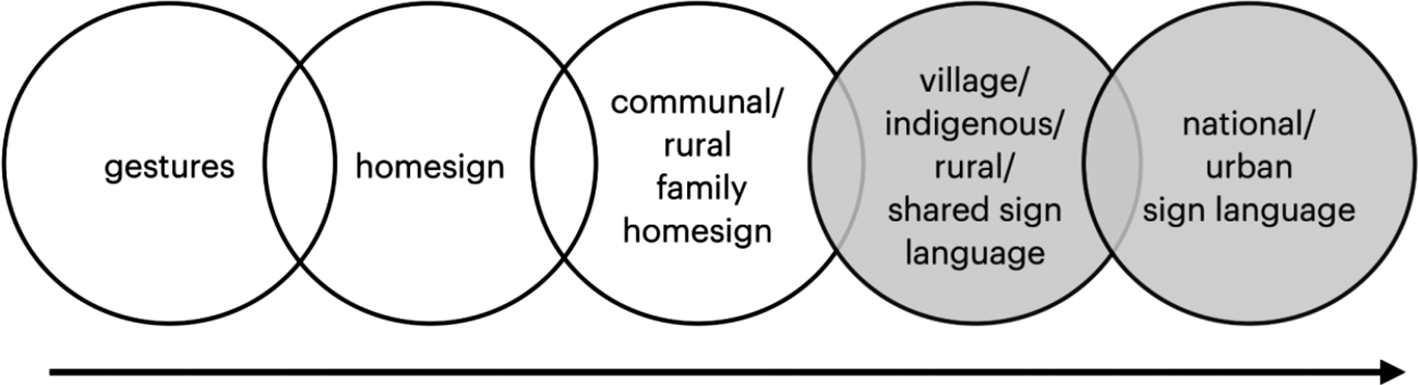
Some argue for a direct relationship between social and linguistic structure in terms of complexification and simplification (Sampson, Gil & Trudgill Reference Sampson, Gil and Trudgill2009; Trudgill Reference Trudgill, Sampson, Gil and Trudgill2009). There, smaller language communities with high social stability and low contact with adult language learners are associated with increased complexification, whereas larger communities with, for example, more adult second language speakers, tend to undergo simplification (Wray & Grace Reference Wray and Grace2007, Schembri et al. Reference Schembri, Cormier and Fenlon2018). This argument is echoed in the sign language literature with social properties used to classify sign languages into types (Israel Reference Israel2009; Meir et al. Reference Meir, Sandler, Padden, Aronoff, Marschark and Spencer2010; Padden, Meir, Aronoff & Sandler Reference Padden, Meir, Aronoff, Sandler and Brentari2010; Meir et al. Reference Meir, Israel, Sandler, Padden and Aronoff2012; de Vos Reference de Vos2012), and linked to structural properties (Aronoff, Meir & Sandler Reference Aronoff, Meir and Sandler2005; Meir et al. Reference Meir, Israel, Sandler, Padden and Aronoff2012; Schembri et al. Reference Schembri, Cormier and Fenlon2018). In this reasoning, structural properties of older and/or more widespread sign languages are (implicitly or explicitly) placed at the endpoint of a developmental cline, implying that such languages and their linguistic features are an end goal for younger and/or smaller sign languages whose structures are viewed as still developing. Kusters & Hou (Reference Kusters and Hou2020) identify and critique this practice as reflecting an ideological bias that marks certain kinds of language as more language-like than others (Figure 5) (also Hou & de Vos Reference Hou and de Vos2022). A similar developmental cline is found in the pidgin-creole life cycle (Figure 1); however, in the case of sign languages, it is not tied to persistence in time but to an ideology of maturity. Thus, when a sign language classed as rural but diachronically older is placed in contrast with a diachronically younger national sign language, the latter is typically treated as the baseline.
Adaptation of ‘A visualisation of different forms of signing arranged on a developmental cline’ (Kusters & Hou Reference Kusters and Lucas2022: 566). Highlighted types are considered languages. Homesign refers to signing that emerges among individual deaf children and their hearing family members. Family homesign often describes such situations with multiple deaf people in the (extended) family.

Given assumptions about the relative youth of sign languages and the time needed for grammaticalisation processes (Lichtenberk Reference Lichtenberk, Traugott and Heine1991), sign languages have been expected to show low morphological complexity (Aronoff, Meir & Sandler Reference Aronoff, Meir and Sandler2005; Schembri et al. Reference Schembri, Cormier and Fenlon2018; Napoli Reference Napoli, Audring and Masini2018) by analogy with creoles. Aronoff, Meir & Sandler (Reference Aronoff, Meir and Sandler2005) claim that emerging or younger sign languages have lower morphological complexity compared to established or older sign languages based on cross-linguistic differences in verb directionality and classifier constructions in American Sign Language, Israeli Sign Language, and Al-Sayyid Bedouin Sign Language. This is because they find different patterns despite similar time depth of the two latter languages and a longer time depth of the former language (discussed in Section 5.3). Language age is directly invoked in their argument by contrasting sign languages and creoles: ‘sign languages, unlike young creoles, have complex inflectional systems’ (Aronoff, Meir & Sandler Reference Aronoff, Meir and Sandler2005: 3). Although inflectional morphology is expected to be relatively absent at the early stages of language emergence (Lillo-Martin & Meier Reference Lillo-Martin and Meier2011), they argue that sign languages show some ‘mature’ morphology despite their young age based on claims about creoles. In contrast, Kastner, Meir, Sandler & Dachkovsky (Reference Kastner, Meir, Sandler and Dachkovsky2014) argue that emerging or micro-community sign languages do not have complex syntactic and morphological structures like verb directionality systems and syntactic embedding at all. These conflicting claims are conflated with (i) divergences in measuring time depth and (ii) typological variation. First, while rural/village sign languages are often assumed to be examples of particularly young languages, there are several examples that appear to be in fact older than national/urban sign languages (e.g. Kata Kolok: de Vos Reference de Vos2012). Second, the absence of certain features might not necessarily indicate a lack of morphological structure but fundamental typological differences, e.g. verb directionality in Kata Kolok is linked to the use of an absolute frame of reference (de Vos Reference de Vos2012).
The foundations for much of the discussion are strategic essentialisms rooted in legitimising sign languages (Kusters & Lucas Reference Kusters and Lucas2022). Showing that sign language morphology includes derivational and inflectional processes validates them as languages on par with spoken languages (upon which the study of morphology was founded). Showing that sign language morphology is equally or more complex than that of spoken languages adds to this validation. Finally, showing that some sign languages are more complex than others may be used to suggest that specific sign languages are more ‘mature’ or ‘established’ than others (Lillo-Martin & Meier Reference Lillo-Martin and Meier2011; Schembri, Cormier & Fenlon Reference Schembri, Cormier and Fenlon2018). Reasons for this might be due to privileges that are also reflective of the creole debate (Section 3.2): (i) Most of what we know is biased towards data from sign languages used in the global north, defined as ‘historic and current geographical centres of academic wealth and power’ (Braithwaite Reference Braithwaite2020: 182; see also Blum Reference Blum2017, Ameka & Terkourafi Reference Ameka and Terkourafi2019; Andringa & Godfroid Reference Andringa and Godfroid2020), greatly limiting the linguistic diversity in linguistics; (ii) Most researchers working on sign languages are hearing, lacking the shared experience of being deaf and being primary sign language users that deaf researchers would have with their participants (Dikyuva Reference Dikyuva, Zeshan and de Vos2012, Kusters Reference Kusters, Zeshan and de Vos2012); and (iii) Many sign language researchers working on micro-community sign languages are community-outsiders without valuable shared cultural knowledge (Dikyuva Reference Dikyuva, Zeshan and de Vos2012, Kusters Reference Kusters, Zeshan and de Vos2012, Braithwaite Reference Braithwaite2020).Footnote 10 Note that the status of researchers as hearing outsiders does not preclude them from sign language research but requires active interrogation of subconscious biases.
5. Complexity in creoles and sign languages: Flaws and recommendations
We have shown how sociolinguistic typology has been linked to notions of morphological complexity in two cases: creoles (Section 3) and sign languages (Section 4). In this section, we summarise four key flaws in the reasoning behind claims that sign language morphology is paradoxical: (i) use of limited data to generate claims about global complexity (Section 5.1), (ii) association of binary language categories with categorical complexity differences (Section 5.2), (iii) use of language age to motivate predictions about morphological complexity (Section 5.3), and (iv) extrapolating from creole complexity to sign language complexity or why the paradox of sign language morphology is not a paradox at all (Section 5.4). In discussing the shared issues between creoles and sign languages, we motivate recommendations (bolded text below, listed in Section 1) about how to change and improve typological research.
5.1. Flaw 1: Use of limited data to generate claims about global complexity
The underlying assumption in the approach taken with sign languages and Exceptionalist views of creoles is that languages within each group share enough structural features to support using individual members as representatives of groups. Stated differently, any individual language can represent the group without considering the sociodemographic conditions of individual languages. For sign languages, this assumption may be related to being primarily expressed in the visual-spatial modality – it has been argued that sign language morphology shows great cross-linguistic similarities because of the shared affordances for iconic representation (Aronoff, Meir & Sandler Reference Aronoff, Meir and Sandler2005; but, see later work for a revised account). However, as it has been argued for creoles, there is no a priori reason to assume that categories identified based on social characteristics will be structurally the same (Mufwene Reference Mufwene2001). This is because the same properties in different contexts can have different structural outcomes and vice versa (see Thomason Reference Thomason2007 on deliberate change, Bisnath Reference Bisnath2024 on the need for causal links between social and structural characteristics). Therefore, the beginning assumption should be of heterogeneity in structural and social criteria within groups, and categories meant to represent structural properties of creoles and sign languages should be built up incrementally by taking ecological context into consideration (Mufwene Reference Mufwene2001, Bisnath Reference Bisnath2024). A reviewer points out that this is the approach taken with languages that are more established in the literature like the Romance varieties – creoles and sign languages receive unequal treatment due to their relatively recent emergence, both diachronically and in linguistics.
Limited evidence has been used to make conclusions about global complexity. In one of the best-known arguments for creole simplicity, evidence comes from ad hoc comparison of creole and non-creole languages as opposed to randomly sampling; see examples (10) and (11) (McWhorter Reference McWhorter2001). In sign language linguistics too, random sampling is rare – often, two to three sign languages are selected that differ in many aspects with one aspect highlighted as the main difference. For example, Sandler, Aronoff, Meir & Padden (Reference Sandler, Aronoff, Meir and Padden2011) highlight language age as the key difference between Al-Sayyid Bedouin Sign Language, American Sign Language, and Israeli Sign Language, despite other major differences among the three languages, like community size (Section 4.2). Furthermore, generalisations about sign languages are made based on examples from British Sign Language, American Sign Language, and Auslan, two of which are historically related (Schembri et al. Reference Schembri, Cormier and Fenlon2018). These examples reflect a general problem in sign language linguistics of a lack of controlled comparisons with signed and spoken languages, possibly because frequent morphological features in spoken languages may be infrequent in sign languages (cf. Gil Reference Gil, Newmeyer and Preston2014). Eschewing random sampling goes against common practice in typology, where doing so and controlling for genetic relationship is standard (Miestamo, Bakker & Arppe Reference Miestamo, Bakker and Arppe2016). We thus also recommend that limited examples of morphology should not be used as proxies for the global complexity of languages (see Brentari, Ergin, Senghas, Whan Cho, Owens & Coppola Reference Brentari, Ergin, Senghas, Cho, Owens and Coppola2021 for an account of phonology distributed through a grammar). This aligns with Bonami & Luís’ (Reference Bonami and Luís2013) recommendation that measurements of morphological complexity should not be used to make claims about global complexity. Relatedly, we also suggest that more theorising be done on what random sampling should look like when working with minoritised and under-documented languages (relevant discussion in Omardeen Reference Omardeen2021). If isolated examples are used as illustrations, we suggest that authors mark their prevalence or explicitly say that they do not know their prevalence.
5.2. Flaw 2: Association of binary language categories with categorical complexity differences
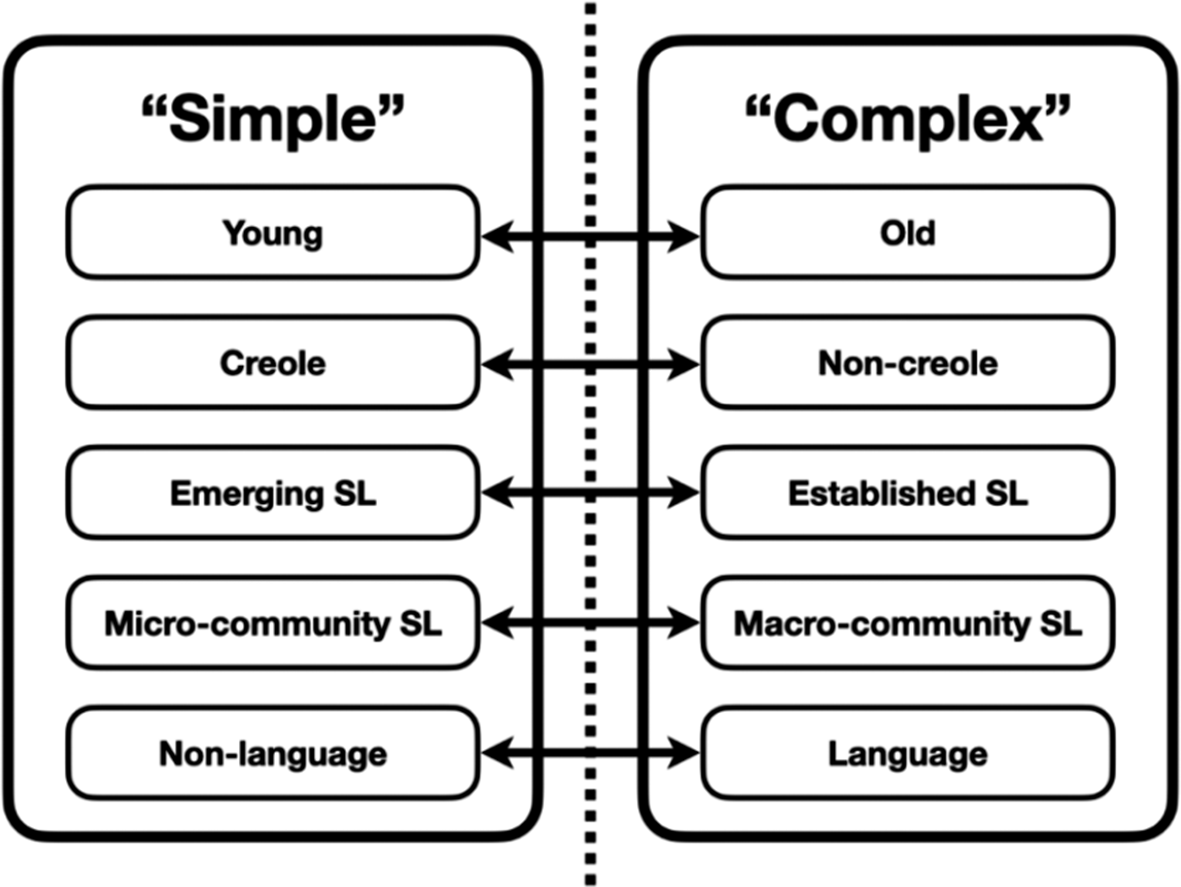
Binary categorisation is often rooted in unacknowledged ideologies (illustrated in Figure 6). First, the creole vs. non-creole divide has been extensively discussed as linked to colonialism (DeGraff Reference DeGraff2005). A similar exceptionalisation is found in divisions like macro- vs. micro-community sign language; the former is roughly associated with the global north as the ecological conditions under which micro-community sign languages develop are more likely in the global south (Braithwaite Reference Braithwaite2020, Bisnath Reference Bisnath2024). This is intensified in ideologically loaded terminology for categories (e.g. village vs. urban sign language) that do not accurately represent ecological characteristics (Kusters & Hou Reference Kusters and Hou2020). Core in these debates about binary divisions is a separation between non-language and language. This is reflected in the pidgin-creole life cycle, in which pidgins are considered a transitory stage to creoles and creoles are considered ‘fully fledged’ languages because they are acquired as a first language by the children of pidgin speakers (Figure 1). In sign languages, this is paralleled by the developmental cline from gesture to sign (Figure 5), where gesture, homesign, and communal/rural family homesign are separated from village and urban sign languages, but only the latter are given the status of fully fledged languages (also Koulidobrova & Pichler Reference Koulidobrova and Pichler2021, Goico & Horton Reference Goico and Horton2023). The coincidence of these terminological practices with developmental cline ideology can threaten the legitimacy of linguistic practices, leading to reduced provision of language support from governmental bodies. Complexity then should not be used to argue for the legitimacy of ‘languages’ vs. ‘non-language’ (also Fusellier-Souza Reference Fusellier-Souza2006).
Examples of binary categories found in the literature on morphological complexity in creoles and sign languages. This figure is not an endorsement of these categories.

This is particularly important since in both cases the languages that are considered simple are often minoritised relative to their opposite. Creoles and sign languages are commonly framed as young languages and so separated from all other non-young languages. There is also a material difference in that minoritised groups are often documented less (Bonami & Luís Reference Bonami and Luís2013, Bisnath Reference Bisnath2024) and users of languages in these groups often are not included in how their languages are referred to and may be stereotyped. Active efforts must then be made to present claims about such languages in a nuanced manner that leaves little room for misinterpretation or essentialism. The importance of this cannot be stressed enough when we consider the minoritisation of these languages in the history of linguistics and their communities of use (DeGraff Reference DeGraff2005, Henner & Robinson Reference Henner and Robinson2023). Indeed, empiricism and ideology are not opposites, as the former is rarely free of ideology, despite claims to the contrary (Section 3.2). As research is heavily biased towards hearing views from the global north, ideology must be acknowledged and integrated into our research practise and interpretation (also Henner & Robinson Reference Henner and Robinson2023). We suggest that researchers reflect on their positionality and academic tradition (Obasi Reference Obasi2014; Ameka & Terkourafi Reference Ameka and Terkourafi2019; Jamieson, Govaart & Pownall Reference Jamieson, Govaart and Pownall2023; cf. Savolainen, Casey, McBrayer & Schwerdtle Reference Savolainen, Casey, McBrayer and Schwerdtle2023) when working with and making claims about differences in complexity, particularly when referencing minoritised groups. Although positionality statements are increasingly common, it is not enough to simply include one (King Reference King2024). Researchers should engage with the literature with their positionality in mind and seek out insider perspectives. Excellent examples of positionality statements include Gibson, Jerro, Namboodiripad & Riedel (Reference Gibson, Jerro, Namboodiripad, Riedel, Hudley, Mallinson and Bucholtz2024); Plumb, Dubcovsky, Lillehaugen & Lope (Reference Plumb, Dubcovsky, Lillehaugen, Lopez, Hudley, Mallinson and Bucholtz2024); Lydner (Reference Lydner, Charity Hudley, Mallinson and Bucholtz2024); and Morgado (Reference Morgado2024) (see Bucholtz, Campbell, Cevallos, Cruz, Fawcett, Guerrero, Lyndon, Mendoza & Reyes Basurto Reference Bucholtz, Campbell, Cevallos, Cruz, Fawcett, Guerrero, Lyndon, Mendoza and Basurto2023 for guidelines).
5.3. Flaw 3: Use of language age to motivate predictions about morphological complexity
In creoles and sign languages, youth is used to motivate predictions about their morphological complexity (e.g. Fischer Reference Fischer, Bowern and Evans2014). This comes from the idea that complexity takes time to develop, with older languages expected to show more complex morphology than younger ones (Section 3.1). Creoles are described as ‘young’ or ‘new’ because they emerge out of language contact, and the classic/Atlantic Creoles arose relatively recently during the transatlantic slave trade. Sign languages are described as young, as it has been possible to track the emergence of some, like Nicaraguan Sign Language (Senghas & Coppola Reference Senghas and Coppola2001) and because similar patterns of emergence are assumed for many other sign languages (often linked to the opening of schools for deaf children). This commonality is used to frame research and motivate predictions that sign language morphology should be simple, neglecting that in other cases aging leads to loss of morphological contrasts, as in the case of Latin developing into the Romance languages (Dressler Reference Dressler2011; analysed as creolisation in Goyette Reference Goyette and McWhorter2000).
Youth as it has to do with languages is nearly impossible to measure (DeGraff Reference DeGraff2001), and straightforward correlation between age and complexity, as a reviewer notes, can only be assumed if the social context of change is ignored. The latter cannot be assumed broadly as system internal and external (social) factors may (Woods Reference Woods2001 on New Zealand English) or may not (Sano Reference Sano2011 on Japanese) interact in language change, and the distinction between internally and externally motivated change is questionable (Thomason Reference Thomason2007, Hickey Reference Hickey, Hernández-Campoy and Conde-Silvestre2012). In the study of sign language emergence, multiple means of estimating age (or time depth) are in use, like biological generations, cohorts of signers in a deaf school, age groups, birth of the first deaf individual, etc. (Kisch Reference Kisch, Zeshan and de Vos2012). In lieu of a principled way of determining language age, various types of languages are identified that are then associated with a notion of time. We see similar developmental clines like the pidgin to creole life cycle, in which the former is a pre-stage of the latter (Bickerton Reference Bickerton1984; cf. Mufwene Reference Mufwene, Adamou and Matras2020) (Figure 1; Section 3.1), and the gesture to macro-community sign language pathway (Figure 5; Section 4.2). Crucially, older age is equated with the ‘most developed’, ‘established’, or ‘mature’ language (Aronoff, Meir & Sandler Reference Aronoff, Meir and Sandler2005; Lillo-Martin & Meier Reference Lillo-Martin and Meier2011; Schembri, Cormier & Fenlon Reference Schembri, Cormier and Fenlon2018) and the highest levels of complexity.
These developmental clines reflect not only temporal differences but also social differences and power inequalities. For instance, Meir et al. (Reference Meir, Israel, Sandler, Padden and Aronoff2012) explain structural differences in verb directionality in three sign languages of the same age used in Israel (Israeli Sign Language, Al-Sayyid Bedouin Sign Language, Kufr Qassem Sign Language) by differences in sociodemographic background. They argue that Israeli Sign Language is more complex due to its exoteric (as opposed to esoteric) nature. In this case, we risk making Israeli Sign Language and American Sign Language baselines for what verb directionality should be in Kufr Qassem Sign Language and Al-Sayyid Bedouin Sign Language; however, as Israeli Sign Language and American Sign Language exist in different ecological contexts, there is no principled reason to use them as a joint reference point. What Israeli Sign Language and American Sign Language do share is that they are better-researched compared to Al-Sayyid Bedouin Sign Language and Kufr Qassem Sign Language, so their use as a reference point is more reflective of power differentials (see Bisnath Reference Bisnath2024 on de facto prototypes). There is no a priori reason to think (i) that a village sign language should eventually begin to show properties of a deaf community sign language without an accompanying change in social properties or (ii) that a change in social properties would be one that progresses from village to deaf sign language.Footnote 11
Based on these issues, we recommend that researchers avoid assuming that complexity (structure), time depth, and sociolinguistic typology are straightforwardly related. For sign languages, this means that village sign languages should not be assumed to develop into deaf community sign languages (Kusters & Hou Reference Kusters and Hou2020) and that specific comparisons between languages assigned to those categories that invoke complexity should be well-motivated. This aligns with Pallotti’s (Reference Pallotti2015: 119) recommendation to adopt ‘a simple view of complexity, treating it as a purely descriptive category, limiting its use to structural complexity’ and importantly excluding ‘….from its definition any theoretical assumption about when, how and why it increases or remains constant’ (also Andrason Reference Andrason2014). For those researchers committed to associating complexity with language type, we suggest that they explain and motivate the usefulness of complexity, due to its contentious nature (Sections 3.2, 4.3, 5.2). Researchers should also actively avoid reductive, provocative rhetoric, like referring to creole languages as having ‘the world’s simplest grammars’ (McWhorter Reference McWhorter2001). This framing masks the complexity metric in use and the data and may instead evoke non-technical denotations and connotations of simplicity (see Raviv, Peckre & Boeckx Reference Raviv, Peckre and Boeckx2022 for discussion). This is also relevant to Section 5.1 about limited evidence to make claims about global complexity – claims should be tempered due to the current data available for sign languages and the methods that are possible. An example of a more measured, alternate title to ‘The world’s simplest grammars are creole grammars’ (McWhorter Reference McWhorter2001) could be ‘A study of three creoles and three non-creoles shows differences in one measure of complexity’. The latter phrasing is preferable as it identifies the domain of investigation and specifies the direct comparison between specific languages. Rhetorically foregrounding the use of a complexity metric does additional work in making it clear that complexity measures are a product of linguistic analysis and not a natural property of linguistic forms.
5.4. Flaw 4: Extrapolating from creole complexity to sign language complexity
The literature on morphological complexity in creoles and sign languages diverges in how complexity is formulated, making analogies between the two groups weak. In creole metrics, inflectional morphology and formal complexity are targeted, while in sign languages, no metric has yet been developed or applied (cf. Schembri et al. Reference Schembri, Cormier and Fenlon2018) (Sections 3 and 4). Rather, there is a division between sequential and simultaneous morphology, in which the latter is considered ‘complex’ (Brentari, Horton & Goldin-Meadow Reference Brentari, Horton and Goldin-Meadow2020). Despite this divergence, predictions about sign language morphology make analogies with creoles because of their shared youth (Section 5.3). Instead of applying creole metrics, or metrics applied to spoken languages (Schembri et al. Reference Schembri, Cormier and Fenlon2018), new metrics are created, or absolute terms are used, e.g. framing sign language structure in a non-technical way as having ‘amazing complexity’ (Lackner Reference Lackner2017). These formulations are not comparable as the specific type and degree of simultaneous morphology (i) may be modality specific to sign languages, making it unclear if they can be found in creoles (however, Section 4.1), and (ii) may be inflectional or derivational. This suggests that researchers avoid transferring ideas from one field to another uncritically. Specifically, ideas about creole complexity should not be uncritically applied to sign languages.
6. Conclusion
This paper shows that the theoretical and empirical foundations of claims that sign language morphology is paradoxical are flawed and develops concrete theoretical and practical recommendations for working with morphological complexity. Recall that the so-called complexity of sign language morphology has been viewed as paradoxical due to analogies that have been made between creoles and sign languages. We show that the argumentation and evidence behind this claim adopts theoretically contested and ideologically driven assumptions about creoles and applies them to sign languages. We identified four flaws in the uncritical transfer of ideas about creole complexity to sign languages: (i) use of limited morphological data to generate claims about global complexity, (ii) association of binary language categories with categorical complexity differences, (iii) use of language age to motivate predictions about morphological complexity, and (iv) extrapolating from creole complexity to sign language complexity.
We presented and motivated a set of recommendations based on discussing the identified flaws (Section 5). Our discussion notably does not have a processing dimension, as we restricted ourselves to descriptive complexity that has been the primary thrust in creole and sign language morphology research. Processing is alluded to in McWhorter (Reference McWhorter2001: 137–138), where complexification is meant to mark processing and learning difficulty, and much of sign language and creole literature is linked to cognition given its focus on child language acquisition and cognitive universals. We believe that researchers should avoid conflating descriptive and psycholinguistic complexity, avoid propagating work that does so in research and teaching, and question for whom their metrics differ, as Mithun (Reference Mithun2020) does (also Duffield & Menn Reference Duffield and Menn2014). We leave more detailed discussion of this issue to future work. Second, it has been suggested that ‘complexity’ be abandoned for more specific terminology like ‘compositionality’, ‘redundancy’, ‘irregularity’, and ‘opacity’ (Raviv, Peckre & Boeckx Reference Raviv, Peckre and Boeckx2022). While we agree that more specific terminology is necessary, a reviewer points out that a more immediate question to be addressed is if global complexity can be associated with a metric at all. Again, approaches that provide proxies for processing costs could be useful as well as artificial language learning and agent-based modelling (Jansson, Parkvall & Strimling Reference Jansson, Parkvall and Strimling2015). Language users are argued to use more processing resources for some structures compared to others (Hyönä & Vainio Reference Hyönä and Vainio2009), and morphological processing differs in languages with different levels of morphological productivity (Beyersmann, Mousikou, Javourey-Drevet, Schroeder, Ziegler & Grainger Reference Beyersmann, Mousikou, Javourey-Drevet, Schroeder, Ziegler and Grainger2020), but questions relevant to this paper include: How can processing of an entire language be characterised? What would a meaningful comparison of processing of structures in one language to processing of the absence of that structure in another language look like? How does processing interact with frequency? Note that studies of processing typical suffer from relying on decontextualised linguistic behaviour and thus should be combined with studies of naturalistic communication, like those found in ethnography (Kusters, Spotti, Swanwick & Tapio Reference Kusters, Spotti, Swanwick and Tapio2017; German Reference German2024).
This paper shows that it is necessary not only to engage with the literature of diverse fields but also to actively contribute to change by adding critical reflection to the process of cross-disciplinary transfer of ideas. The recommendations we present are a first step; given the dynamic nature of communities, languages, and science, these should be seen as beginning points that should be re-evaluated, updated, and adapted as needed.
Acknowledgements
Thank you to Nick Palfreyman and Susanne Maria Michaelis from the CrossMoGram (Cross-modal Grammaticalisation) project for comments on an early draft of this paper. Thanks to Arjun Shrestha for the Nepali Sign Language illustration in Figure 3. We are also grateful to the anonymous reviewers for their engagement with our work and insightful feedback.
Author contribution
FB: conceptualisation, writing – original draft (lead), and writing – review and editing (lead); HL: conceptualisation, writing – original draft (lead), writing – review and editing (lead), and project coordination; MJ: conceptualisation, writing – original draft, and writing – review and editing; RO: conceptualisation; and AS: conceptualisation, writing – original draft, writing – review & editing, and funding acquisition.
Funding information
This work was supported by a European Research Council Advanced Grant (ERC-ADG 885220 SignMorph) awarded to Adam Schembri.
Competing interests
The authors declare none.




 Open access

