


Introduction
A common discourse on ageing emphasizes the need to avoid becoming a burden to loved ones, particularly younger family members. This fear is widespread among middle-aged and older adults, often surpassing actual levels of reliance on care (e.g. AARP 2024; Pew Research Center 2015). In a survey of older adults in Italy, Germany and the United States, fewer than 20 per cent reported needing assistance with personal care or daily tasks, yet about 40 per cent feared becoming a burden to their children (Pew Research Center 2015). The framing of family care work as burdensome also appears in gerontological research, which has tended to focus more on its negative than positive effects for both care providers and care recipients (e.g. Barken Reference Barken2017; Cahill et al. Reference Cahill, Lewis, Barg and Bogner2009; Collins and Kishita Reference Collins and Kishita2020; Purkis and Ceci Reference Purkis and Ceci2015). What remains largely unexamined, however, is how the construction of care work as a burden may reflect and reinforce age inequality (or ageism) – the system that devalues older people relative to younger people.
Like other forms of inequality, age inequality is widespread and operates through various mechanisms – yet it remains among the most overlooked or unacknowledged (e.g. Barrett Reference Barrett2022; Calasanti Reference Calasanti, Biggs, Lowenstein and Hendricks2003; Johfre and Saperstein Reference Johfre and Saperstein2023). It can shape taken-for-granted assumptions about ageing, such as the belief that receiving care from younger family members imposes a burden on them and should therefore be avoided. Analysing how care work is framed as a burden can yield insight into the subtle ways that age inequality functions, by revealing the structural elements and interactive processes that sustain it.
Our study explores how age inequality influences the construction of care work as a burden, drawing on interviews conducted with older Italians. The next section outlines the Italian context of ageing and care work, followed by a discussion of the age-as-inequality framework that informs our analysis. We then review the gerontological literature on care work and explain our study’s contribution to it.
Ageing and care work in Italy
Italy offers a compelling setting in which to explore perceptions of care work as a burden. The cross-national study of older adults in Italy, Germany and the US revealing that concern about becoming a burden outweighed actual reliance on care found that over 60 per cent of Italians – twice as many as in Germany and the US – worried about burdening their children (Pew Research Center 2015). This sentiment was especially pronounced among Italian women, nearly 75 per cent of whom – versus about 50 per cent of Italian men – reported this fear (Pew Research Center 2015).
One factor that may contribute to heightened concerns about becoming a burden is Italy’s shifting age demographics. Over one-fifth of the population is 65 or older, a proportion projected to reach one-third by 2050 (Mazzola et al. Reference Mazzola, Rimoldi, Rossi, Noale, Rea, Facchini, Maggi, Corrao and Annoni2016; Pew Research Center 2015). This trend is propelled by the country’s high life expectancy, averaging 83 years, and its low and declining fertility rate, averaging 1.27 children per woman (Istat 2016; World Health Organization 2019). These trends raise concerns for many Italians, with 40 per cent viewing ageing as a major problem for their country (Pew Research Center 2014). A critical policy issue for Italy (and many other nations) centres on caring for an ageing population.
Italy’s approach to older adults’ care has historically relied on the family, which may amplify older Italians’ concerns about becoming a burden. Often described as a ‘familialist’ (Esping-Anderson Reference Esping-Anderson1990) or ‘implicit familialist’ (Leitner Reference Leitner2003) model of care, this system places both a social and a legal responsibility on families to care for older relatives – a duty reflected in patterns of co-residence and intergenerational support (Albertini and Kohli Reference Albertini and Kohli2013; Albertini et al. Reference Albertini, Kohli and Vogel2007; Meda Reference Meda2014). More than half of Italians aged 60 or older live with an adult child, a rate two to six times higher than in many other European nations (Hank Reference Hank2007). Research also shows that Italian families tend to provide less frequent but more intensive support – such as financial help, personal care and household assistance – even when living apart (Albertini et al. Reference Albertini, Kohli and Vogel2007). Reinforcing the family’s central role, adult children are the most named source of support in the event of illness, a reliance made possible by the fact that most older Italians have children living in the same town (Gagliardi et al. Reference Gagliardi, Di Rosa, Melchiorre, Spazzafumo, Marcellini and Jaworski2012).
By focusing on Italy, our study offers insight into perceptions of care work within a context where shifting age demographics intersect with a family-centred care model, potentially intensifying older adults’ concerns about imposing on younger family members. This feature makes Italy an ideal setting for examining how care work comes to be seen as a burden – and how age inequality may contribute to and reinforce this view.
Age-as-inequality framework
We draw on an age-as-inequality framework, which outlines how age inequality operates at multiple levels, paralleling other social categories that are bases of inequality, including race, class and gender (Barrett Reference Barrett2022). This framework integrates insights from several fields of study often examined in isolation – lifecourse sociology, age studies and gerontology. Although numerous studies in each of these fields have given attention to age inequality, they vary in the extent to which they address its operation at different levels, ranging from structural (or macro) to individual (or micro) levels (e.g. Butler Reference Butler1969; Hopf et al. Reference Hopf, Walsh and Georgantzi2024; Laz Reference Laz2003; Levy Reference Levy2009; MacRae Reference MacRae2022; Wong et al. Reference Wong, Dara, Yan, Liu, Yan and Terry2024). While noting the complex interplay between these levels, an age-as-inequality framework offers conceptual clarity to the study of age inequality by outlining age as operating at the macro-level as an institution, at a meso-level as a performance and at the individual-level as an identity (Barrett Reference Barrett2022; Barrett Reference Barrettforthcoming).
Central to our study is the understanding of age as an institution. This perspective highlights how the construction of later-life care work as a burden is shaped by the age hierarchy and the structures that sustain it, including age ideologies and age norms (Barrett Reference Barrettforthcoming). Age ideologies – belief systems about specific life stages and the significance of ageing – justify the devaluation of older adults. In contemporary Western culture, dominant ideologies frame age as a key axis of social difference and define ageing as a process of decline (Gullette Reference Gullette1997). These beliefs uphold age inequality and likely contribute to framing care work as burdensome, a connection that has received limited scholarly attention. Also underexamined is the role of age norms – cultural expectations about age-appropriate behaviour, enforced by formal or informal sanctions. These norms may reinforce the burden narrative by encouraging younger family members to prioritize leisure and paid work over caring for older family members.
Another relevant component of the age-as-inequality framework is the view of age as a performance (Barrett Reference Barrett2022). This perspective builds on the recognition that inequalities tied to other social statuses – such as gender, race and class – are reinforced through everyday interactions (e.g. Schwalbe Reference Schwalbe2015; West and Zimmerman Reference West and Zimmerman1987). Applied to age, this view emphasizes that age is not simply a biological fact but something ‘continually performed or accomplished’ (Laz Reference Laz2003, 506). The performative aspect of age also highlights how inequality can be resisted through an ‘undoing’ of age (e.g. Ben Dori and Kemp Reference Ben Dori and Kemp2020; Höppner et al. Reference Höppner, Wanka and Endter2022). Viewing age as a performance sheds light on the interactional processes that help construct care work as a burden – for instance, when older adults discuss potential future care needs with younger relatives in ways that reinforce the notion of care as burdensome.
Gerontological research on care work as a burden
Guided by the age-as-inequality framework, our study extends the gerontological research on care work, which is extensive but gives limited attention to how the devaluation of older adults may contribute to the framing of care work as burdensome. Several areas of scholarship address the issue of care work as a burden. After briefly reviewing them, we assess how they engage with age inequality as a contributing factor and then discuss how our study advances this literature.
Burden experienced by family care-givers
Numerous studies have examined the experiences of family care-givers, with a theme of burden permeating this literature. Research reveals that feeling overburdened – physically, emotionally and financially – is common (e.g. Chappell et al. Reference Chappell, Penning, Kadlec and Browning2023; Collins and Kishita Reference Collins and Kishita2020; Lilleheie et al. Reference Lilleheie, Debesay, Bye and Bergland2020; Purkis and Ceci Reference Purkis and Ceci2015). For example, a meta-analysis of 43 studies of informal care-givers of individuals with dementia, who are most often family members, found that approximately half viewed their role as burdensome (Collins and Kishita Reference Collins and Kishita2020). This observation aligns with the framing of bodywork, a key aspect of care, as ‘dirty work’ – hidden, devalued and often performed by women (Twigg Reference Twigg2000). The centrality of burden is reflected in the development of multiple scales of care-giver burden (e.g. Burden Scale for Family Caregivers [Graessel et al. Reference Graessel, Berth, Lichte and Grau2014]; Zarit Burden Interview [Zarit et al. Reference Zarit, Reever and Bach-Peterson1980]; Caregiver Strain Index [Robinson Reference Robinson1983]). Burden’s salience in care-givers’ experiences also is evident in their desire to avoid being a burden in their own later years (Pope et al. Reference Pope, Riley, Haberkorn and Ely2016). For instance, an interview-based study with 15 women who had been family care-givers found an emphasis on ‘being easy’, which involved acknowledging limitations, accepting help and being cooperative (Pope et al. Reference Pope, Riley, Haberkorn and Ely2016).
The literature’s focus on the burdens of care work is reinforced by its comparatively limited attention to its positive dimensions. However, research has shown that family care providers report a range of benefits such as strengthened family ties, personal growth, increased self-efficacy and spiritual development (e.g. Fabius et al. Reference Fabius, Wolff and Kasper2020; Hovland and Mallett Reference Hovland and Mallett2021; Pope et al. Reference Pope, Baldwin, Gibson and Smith2018; Yu et al. Reference Yu, Sheung-Tak and Jungfang2018). For example, an interview study of 22 individuals who had been family care-givers in young adulthood found that the experience fostered closer family relationships, facilitated personal growth and even yielded material gains (Pope et al. Reference Pope, Riley, Haberkorn and Ely2016).
Burden experienced by care recipients
Consistent with research on family care-giving, the theme of burden often appears in the smaller literature on the experience of receiving care (e.g. Barken Reference Barken2017; Cahill et al. Reference Cahill, Lewis, Barg and Bogner2009; Lilleheie et al. Reference Lilleheie, Debesay, Bye and Bergland2020; Lutz et al. Reference Lutz, Katz, Gallegos, Spalding and Edelstein2022; Miller et al. Reference Miller, Sinding, Griffith, Shannon and Raina2016; Nieuwenhuis et al. Reference Nieuwenhuis, Beach and Schulz2018). In quantitative studies, this theme is evident, for example, in the development of scales to measure care recipients’ feelings of burdensomeness, including older care recipients’ (e.g. Geriatric Feelings of Burdensomeness Scale [Lutz et al. Reference Lutz, Katz, Gallegos, Spalding and Edelstein2022]; Self-Perceived Burden Scale [Simmons Reference Simmons2007]). Feelings of burden engendered by care receipt is also found in qualitative studies (e.g. Barken Reference Barken2017; Cahill et al. Reference Cahill, Lewis, Barg and Bogner2009; Lilleheie et al. Reference Lilleheie, Debesay, Bye and Bergland2020). For example, interviews with 50 adults aged 65 and older found that they conceptualized their feelings of being a burden in three ways: a desire not to complicate the busy lives of adult children, guilt about the limitations caused by their illness, and concern that the children would worry too much about them (Cahill et al. Reference Cahill, Lewis, Barg and Bogner2009). Other studies explore how care recipients navigate feelings of burden (e.g. Barken Reference Barken2017; Miller et al. Reference Miller, Sinding, Griffith, Shannon and Raina2016; Moorman Reference Moorman2011; Sulik Reference Sulik2007). For example, an interview-based study of 34 older care recipients revealed their experience of tension between having their needs met and feeling like a burden (Barken Reference Barken2017). They reported several strategies for navigating it, including turning to formal home care as a first choice, coordinating formal and informal care, engaging in reciprocity and struggling with unmet needs (Barken Reference Barken2017). This tension can be especially challenging for women. Interviews with 60 women with breast cancer found that they often struggled to break gender norms that prioritize others’ needs over their own (Sulik Reference Sulik2007). They minimized it by trying to be as self-reliant as possible, while also reciprocating the support they received by giving back to other women with breast cancer (Sulik Reference Sulik2007).
Fear of becoming a burden
Underscoring its salience, the fear of becoming a burden is common even among those who are not currently receiving care (e.g. AARP 2024; Pew Research Center 2015). Like the cross-national study comparing Italians, Germans and Americans, other research – though limited – also finds this concern to be widespread (e.g. AARP 2024; Mackenstadt and Adams-Price Reference Mackenstadt and Adams-Price2025). For example, a survey of nearly 2,000 Americans aged 45 and older found that 63 per cent reported being concerned about becoming a physical burden to family or friends and 45 per cent about becoming a financial burden (AARP 2024). This fear is also linked with poorer mental health. A recent study of fear of dependency found that stronger agreement with statements such as ‘If I ask for help I am a burden to others’ was associated with more symptoms of depression and anxiety (Mackenstadt and Adams-Price Reference Mackenstadt and Adams-Price2025).
Unpacking care work’s construction as a burden
Gerontological research has provided valuable insight into the experiences and consequences of feelings of burden, but few studies critically examine the assumptions underlying the construction of care work as a burden – and, to our knowledge, none explicitly link it to the broader system of age inequality that devalues older adults. Purkis and Ceci (Reference Purkis and Ceci2015), for example, critique the dominant framing of care as a burden, emphasizing the literature’s neglect of the social, organizational and spatial contexts in which care takes place. However, they do not address how age inequality may shape and reinforce the construction of care as a burden.
Some empirical studies of care work hint at this possibility, but it remains largely unexamined (e.g. Barken Reference Barken2017; Cahill et al. Reference Cahill, Lewis, Barg and Bogner2009; Miller et al. Reference Miller, Sinding, Griffith, Shannon and Raina2016). Barken (Reference Barken2017), for example, found that older adults often expressed a desire to remain independent by prioritizing the paid work and family obligations of younger relatives – yet the underlying values driving this prioritization were not analysed, including those tied to age inequality. Similarly, Cahill et al. (Reference Cahill, Lewis, Barg and Bogner2009) noted that feelings of burden often stemmed from a wish to avoid disrupting the busy lives of adult children, but the study did not explore how age-based hierarchies might inform this dynamic. Miller et al. (Reference Miller, Sinding, Griffith, Shannon and Raina2016, 251) likewise observed that older adults frequently excused younger family members from providing care, viewing them as having ‘plans and responsibilities and the right to pursue them’. Whether their decision to exclude themselves from these plans and responsibilities was influenced by age inequality, however, was not addressed.
Research question
Our study responds to this limitation of prior studies by addressing the following research question: How does age inequality influence the construction of care work as a burden? Drawing on interviews with older Italians, it uses an age-as-inequality framework, which brings into focus the age ideologies and norms that contribute to views of care work, as well as the age performances that can reinforce, or challenge, them. It highlights the dominant cultural view of ageing as decline that underlies the devaluation of older adults relative to those in other age groups – including not only middle-aged adults, who are likely to be care providers, but also infants and children, who are the other primary recipients of care. These relative valuations can contribute to a view of the work of caring for older adults as burdensome. Although all care work is demanding, regardless of who is providing and who is receiving it, care for older adults tends to be framed as particularly burdensome, a view likely compounded by the lack of state and workplace policies to facilitate caring for older adults (Barrett et al. Reference Barrett, Douglas, Noblitt, Poggio and Bertolini2021a). Our study sheds light on the construction of this care as a burden by identifying the assumptions underlying it that stem from the devaluation of older adults.
Data and methods
Data
The data analysed for this article were collected as part of two interview-based projects that focused on older Italians’ care networks. Both projects were approved by the Florida State University Institutional Review Board. The initial project, conducted between December 2018 and February 2019, involved interviews with 20 participants at a senior centre in a mid-sized city in northern Italy. Participants were recruited with the assistance of senior centre staff members, who provided details about this research opportunity to senior centre participants and collected the names and contact information of volunteers. Staff also assisted with the scheduling of interviews, all of which occurred at the senior centre. The second project, conducted between April 2022 and May 2022, involved 23 interviews with participants from the same senior centre – none of whom had been interviewed in the earlier study. Participants were recruited in a similar way; however, some of the interviews occurred in locations other than the senior centre (i.e. three in participants’ homes and three in restaurants).
The interviews, which totalled 43, were conducted in person and in Italian by the authors. They were conducted individually, except one married couple that was interviewed together. Written consent was obtained from all participants. Interviews averaged 59 minutes in duration and ranged from 20 minutes to 1 hour and 50 minutes. All participants consented to the audio-recording of interviews, which were transcribed verbatim. The excerpts used in this article were translated into English by the authors. To preserve participants’ anonymity, all names have been replaced with pseudonyms.
The interviews conducted in 2018/2019 and 2022 focused on family care work, capturing participants’ observations during their childhood and adolescence and their experiences as care providers or recipients over adulthood. Participants were asked who cared for – and possibly lived with – their great-grandparents, grandparents, parents, aunts and uncles. Questions addressed various forms of support (e.g. personal care, cooking, financial management) and sources (e.g. family, friends, paid providers). Interviews also explored support that older adults gave younger family members, such as childcare or financial help. Other questions focused on participants’ desired sources of care, should they require it in the future. Because the sample consisted of senior centre participants who required minimal daily assistance and did not perform intensive care work, references to care work as a burden – central to our article – mainly arose in accounts of past care-giving for older relatives or anticipated future needs. Notably, the theme of burden surfaced in both sets of interviews, even though it was not directly prompted.
While the two sets of interviews shared similarities, they also reflected some changes brought about by the onset of the Covid-19 pandemic in 2020. In addition to addressing participants’ lifelong experiences and expectations of family care work, the 2022 interviews explored how the pandemic had shaped both. A key concern was whether the severe impact of Covid-19 on nursing home residents – both in Italy and globally – had heightened older adults’ reluctance to rely on such facilities in the future. Although the second project was motivated by a desire to explore differences, references to the burden of family care work were remarkably similar across both sets of interviews. Consequently, this article does not centre on comparison but rather uses the interviews to develop the concept of altruistic ageing.
Data analysis
We used thematic analysis, a qualitative method that identifies overarching patterns by uncovering topics and ideas found in the data (Boyatzis Reference Boyatzis1998; Braun and Clarke Reference Braun and Clarke2006, Reference Braun and Clarke2022, Reference Braun and Clarke2023; Terry and Hayfield Reference Terry, Hayfield, Ward and Delamont2020). Often described as a family of methods rather than a single, uniform approach, thematic analysis is marked by its flexibility – in terms of both the types of qualitative data it can be applied to and its analytic orientation. Scholars have outlined several approaches to thematic analysis – coding reliability, codebook and reflexive – which span a spectrum from more quantitative and positivist techniques to more qualitative and interpretive ones (Braun and Clarke Reference Braun and Clarke2022). Despite these variations, all share the goal of identifying themes – recurring patterns or meanings that illuminate something significant about the data in relation to the research question (Braun and Clarke Reference Braun and Clarke2006). The process involves several steps, including familiarization with the data; coding; generating initial themes; reviewing and refining themes; defining and naming themes; and producing the analysis (Braun and Clarke Reference Braun and Clarke2006).
Our analysis proceeded as follows. In analysing each of the two datasets, we began by reading the transcripts closely to immerse ourselves in the material, a process that shaped our initial coding categories. They included both semantic codes – capturing participants’ own words and stated meanings – and latent codes, which were more interpretative and conceptually informed (Braun and Clarke Reference Braun and Clarke2023; Terry and Hayfield Reference Terry, Hayfield, Ward and Delamont2020). We then applied these codes to the transcripts – incorporating additional codes that emerged from the more in-depth coding phase. In the first project, two researchers collaboratively developed and applied the codes; in the second, three researchers contributed to code development and two to coding. Throughout the process, we met regularly to discuss coding observations, refine codes and resolve discrepancies. When differences in interpretation arose, we revisited the relevant transcript segments in context to reach a shared understanding.
While our coding framework was broad, reflecting the larger projects’ focus on care work, this article draws on a focused subset of codes related to family care work as a burden. After collecting these segments of text, we analysed them to explore how and why participants described this work as burdensome. This analysis involved not only identifying themes from the data but also engaging in a reflexive process that situated the finding within our analytic lens – one that views age as a key axis of inequality (Barrett Reference Barrett2022; Braun and Clarke Reference Braun and Clarke2023).
Findings
Table 1 summarizes demographics of the participants. Participants’ age averaged 78 and ranged from 65 to 93. Seventy-seven per cent of participants were women, 84 per cent were parents and 51 per cent lived alone.
Sample demographics
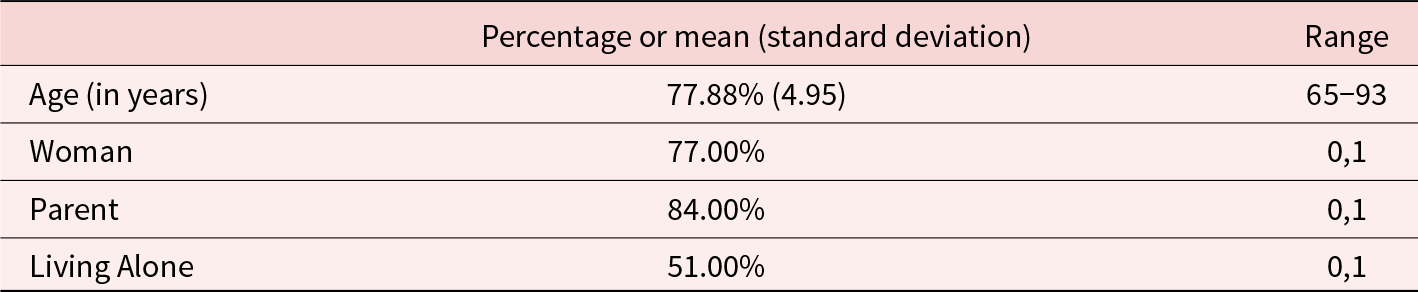
Note: N = 43
Analyses of participants’ descriptions of care as burdensome revealed a privileging of younger people’s interests over older people’s. This pattern informed our development of the concept of altruistic ageing – an orientation that centres younger people’s needs by expecting older adults to adopt a selfless concern for others’ wellbeing. We examine how this orientation surfaced in the interviews, how participants accounted for their adherence to it and how it shaped both their present choices and their visions of the future.
Defining care work as a burden
The concept of altruistic ageing emerged from participants’ constructions of burden, which often centred on receiving long-term or intensive assistance or co-residing with younger family members. Above all, participants expressed a strong desire not to burden their children. For instance, Assunta, a 68-year-old divorced woman, articulated this tension in describing why she would not turn to her daughter (and only child) for help:
‘Why not? Because I see it like throwing another weight [zavorra, a ballast] on her. I would feel badly. But she would [help me], huh?! I’m sure she would. In fact, that time we talked about it, she was also hurt. ‘Mum, what do you think, Mum?’ But I would feel bad in that situation.’
Assunta’s self-restraint underscores a moral economy in which the ageing parent prioritizes the adult child’s life demands over her own needs, aiming to protect rather than depend on them.
Similarly, Roberta, an 81-year-old widow with no children, extended this ethic of non-interference to her nieces and nephews:
Well, I don’t want them to hate me [Laughs]. That is, as long as I can afford to call someone, though. I don’t want to be a burden … to leave a good memory [Laughs]. Here, in such a sudden case, yes, but if it is a long thing, you cannot. You cannot weigh on others.
As Roberta’s reference to ‘a long thing’ implies, burden has a temporal dimension – help is acceptable if it is short term, but prolonged reliance on family is morally unacceptable. This temporal logic was echoed by Luisa and Davide, a married couple, aged 81 and 79, respectively, who distinguished between occasional help and sustained care:
Luisa: You can’t ask.
Davide: Because, above all, everyone works.
Luisa: They all work. He [the son] has three children and … That is, we won’t feel like asking him for help, will we?
Davide: If it’s for once.
Luisa: Also …
Davide: Every now and then. Occasionally.
Their joint assertion that you cannot ask for more than intermittent assistance illustrates a shared cultural script that views prolonged support from children as overreach, even when the children are willing.
Participants generally agreed that while family should be the first line of support, there was a threshold beyond which institutional care became the preferred – and more ethical – option. Carlotta, a 67-year-old participant with two daughters and one son, expressed this balancing act: ‘It depends on the help you need … To my children first of all and then I think that … I would try not to remain on the shoulders of my children. I would rather try to go to a nursing home.’
None of the participants expressed a desire to live with their children, should they need additional care in the future. Co-residence was described as a situation that would overburden their children. Costanza, a 74-year-old married woman with a daughter and a son, explained that her family would welcome her into their home but she would not want that arrangement: ‘Even the daughter-in-law told me, “When you need, I am happy to host you.” They have a big house. But I would not like it … because I would seem to weigh on them.’ This response reflects the symbolic weight of co-residence as a visible, enduring form of dependency that contradicts the value of altruistic ageing.
Privileging younger people’s interests over older people’s
Our analyses revealed that the framing of care as a burden was supported by values and norms that prioritize younger people’s interests over those of older people. These values and norms appeared in discussions of several dimensions of younger people’s lives, including their time, personal freedom, social relationships and commitment to paid work.
Participants often linked the idea of care work as a burden to younger people’s lack of time. Younger generations were described as especially ‘busy’ now – too busy to provide care work. Costanza, for example, followed up on her assessment of co-residence as burdensome to younger family members by explaining that it was ‘because their life is very lively and busy’. Mara, an 81-year-old widow with three daughters and three sons, similarly highlighted her children’s busy lives but also referenced her own schedule – although she downplayed it in comparison. In her comments, she moved fluidly between noting their own limited availability, acknowledging her own activities and reaffirming that ‘they don’t have time’.
Participants also emphasized the importance of preserving their children’s freedom, which they saw as incompatible with care work. Mara, for instance, explained her reluctance to live with her children by saying, ‘With my children? No. I want to give them their freedom, I don’t want to affect them.’ Similarly, Anna, an 84-year-old widow, described intentionally limiting her reliance on her daughters:
You always try not to weigh on them too much, right? … Because they are young and have the right to live their lives. Now, when my daughter leaves, for example for 15 to 20 days, I feel like I’m an orphan. But that’s the way it is [Laughs]. You have to adapt because it’s not that they can always be there to keep you company. … My daughter always comes if I need it. She pretends it’s nothing, but she comes. But I can’t expect that. In short, she has to do her life too. I said, ‘Don’t be a care-giver.’ I always tell them.
Such statements reflect an internalized ethic of non-interference, where older adults positioned their needs as secondary to their children’s autonomy – further reinforcing the logic of altruistic ageing.
Our analyses also revealed a strong prioritization of younger generations’ social relationships, particularly those with spouses and children. For example, Paolo, a 75-year-old married man, explained that he would hesitate to ask his daughter (and only child) for help:
‘[Sigh] No … to this day I think I will never ask her. Because I would not like to make myself or become a burden, more than for her, for her family. Her husband and children, that is … especially if I will eventually be in conditions of physical or mental discomfort.’
Here, Paolo’s reluctance stems from concern not just for his daughter but for her immediate family – underscoring a broader norm in which older adults position themselves in relation to the needs of the younger family unit. This logic reflects how care burdens are evaluated not only in terms of time or labour but also through the lens of potential disruption to valued family roles and relationships.
Participants also frequently cited younger adults’ paid work as a central reason for not expecting care. Employment was seen as fundamentally incompatible with care-giving and was used to justify the anticipated need for formal care arrangements. Loretta, a 77-year-old widow, described how entering a nursing home would protect her children from care-giving pressures:
‘Ah, it’s going to be a little hard … Very hard! But at least I know I’m fine. Because my kids aren’t able to assist me. They would be able to work easily without having to say ‘Well, we have to run home because Mom is there.’ I’m sure. I already told my children.
Similarly, Luisella, a 71-year-old widow, noted her daughters’ work obligations:
Interviewer: If, at some point, you should need some help, who would you turn to?
Luisella: Ha! I do not know.
Interviewer: To your children?
Luisella: If they ask, but … also … If I need it, yes, they can help me. But … they told me … If I hurt myself, I fell … or if … if I was in a cast, like that. They have to leave me at home. That is, they work. I would take from them.
In both cases, participants framed their future care needs as a potential disruption to their children’s professional lives – again emphasizing a moral orientation in which older adults seek to avoid imposing on younger generations. These narratives show how paid work is not just a logistical barrier to care but a culturally legitimized rationale for minimizing intergenerational dependence.
Consequences of altruistic ageing
Our analyses also revealed that older adults’ adoption of an altruistic ageing orientation shaped both their present-day decisions and their visions of the future. Specifically, it influenced their current health behaviours, their views on long-term care and their understanding of what constitutes a ‘good death’.
Altruistic ageing encouraged some participants to engage in health-enhancing behaviours to reduce the likelihood of needing care from others. Mara described staying healthy as a way to avoid troubling her children: ‘Being alone, I have to try to keep myself healthy so as not to disturb my children. I don’t want to worry them: “Oh, my mum is not well, and this and that.” If I can, I try to feel good to make them feel good as a result.’
Similarly, Roberta, an 81-year-old widow without children, framed her decision to get vaccinated against Covid-19 as a way of maintaining independence and avoiding burdening her extended family:
At a certain point for me the vaccination, just like for the flu … was also because I do not [want to] be a burden to the nieces and nephews who have to do the shopping, the doctor … then, being alone, if the doctor comes, I have to get up and open the door, if I need something … huh. I don’t want to be a burden to anyone. And I have to try to feel good. And so it seemed right to do a vaccination.
These accounts illustrate how health decisions are not merely about individual wellbeing but shaped by a moral imperative to minimize one’s imposition on younger family members.
Altruistic ageing also shaped participants’ expectations around long-term care. Many narrowed their options to those they saw as least disruptive to their families. Loretta, for example, anticipated moving into a nursing home so that her children could work without the worry of her care needs. Pia, a 75-year-old married woman with three adult children, generalized this logic to society at large. ‘Today it’s a bit … In my opinion, it is becoming a problem. The elderly. They are, they are becoming … Because everyone is working. So where do you end up? Either home eldercare workers or in a nursing home. In fact, I think about it too, but who knows how it will end [Laughs].’
Other participants were more definitive in their endorsement of institutional care. Anna spoke admiringly of a neighbour who moved into a nursing home after a fall:
A lady who lives above me has now gone [to the nursing home]. You think that she who is 94 years old stayed at home until the last day, huh? But unfortunately she fell and … Now they have put her in the nursing home. I find this a commendable thing, because then there she lacks nothing. They have the doctor, the nurse. They find lunch ready, they are warm. They do a lot of stuff. It’s not that they leave them alone there abandoned. I find it good, really.
These examples reveal how altruistic ageing can shape long-term care preferences, with institutional options framed not as last resorts but as responsible, selfless choices that protect younger kin from care-work burdens.
Participants also described a ‘good death’ as one that avoided burdening others. Ida, an 80-year-old divorced woman with two sons, described her hope for a death like those of her parents and grandmother – quiet, solitary and non-disruptive:
Nobody took care of my grandmother because she died as she wanted. [She] always said ‘Look, I hope I don’t need anyone, right? I hope to die without needing anyone’ because she says ‘Everyone has a family, everyone has their problems, everyone has, right?’ … They [family members] go there to tell her, ‘Come on, now, the car has arrived’, [but] she was dead. Without even saying a word. So she made the death she wanted and my dad the same and my mum too: all of cardiac arrest. … They died as they wanted; they did not want to disturb anyone like my grandmother, and they did not disturb. I hope it will be the same for me too.
In some cases, this logic extended to mentions – often casual or indirect – of self-harm as a way to avoid becoming a burden. Assunta, for instance, alluded to the mythologized tradition of older adults removing themselves from the community to avoid imposing on others:
Assunta: I don’t want to get old like that. No. Do you know how I’m going to do it? I hope. I hope I have the strength, because from saying to doing there is the sea. Do you know what the old Native Americans did?
Interviewer: No.
Assunta: No, well, [Laughs] study it, because I don’t want to say it.
Such remarks hint at the depth of the commitment to the ideal of non-burden – a commitment so strong that it can make extreme or even harmful actions seem preferable to dependence.
Discussion
The framing of family care work as burdensome is pervasive, reflected in widespread fears among middle-aged and older adults about becoming a burden and a substantial gerontological literature on the burden of giving or receiving care (e.g. AARP 2024; Barken Reference Barken2017; Cahill et al. Reference Cahill, Lewis, Barg and Bogner2009; Collins and Kishita Reference Collins and Kishita2020; Pew Research Center 2015; Purkis and Ceci Reference Purkis and Ceci2015). Yet relatively few studies critically interrogate this framing, and none, to our knowledge, examine how it is shaped by age inequality – a system that devalues older adults. Age inequality not only limits workplace and state support for care, exacerbating care-giver burden (Barrett et al. Reference Barrett, Douglas, Noblitt, Poggio and Bertolini2021a) but also promotes age ideologies, norms and practices that reinforce care’s construction as a burden.
We examine this construction using an age-as-inequality perspective (Barrett Reference Barrett2022), which reveals an orientation – altruistic ageing – that contributes to this view of care. Rooted in cultural expectations, altruistic ageing both reflects and reinforces age inequality by emphasizing age as a social category and upholding a hierarchy that privileges the young over the old. This perspective highlights age ideologies, norms and practices that sustain inequality. In our study, dominant ideologies framing ageing as decline, and thus devaluing older adults, contributed to the construction of care as burdensome. Age norms about life-stage priorities also played a role: Participants often expressed that younger family members should focus on paid work and relationships with spouses and children, rather than care-giving. The age-as-inequality perspective also understands age as a performance. Older adults enacted altruistic ageing in interviews, describing themselves as potential burdens and recounting conversations with younger relatives that reinforced this view.
Our findings align with existing research on the burden of care but extend it by illuminating its roots in age inequality. As in prior studies, we found that care for older adults was commonly viewed as burdensome. Reflecting the dominance of this view, we identified references to the burden of care in interviews that not only lacked direct questions about it but also focused on the hypothetical receipt of care in the future rather than, like most studies, the current provision or receipt of care (e.g. Collins and Kishita Reference Collins and Kishita2020; Lutz et al. Reference Lutz, Katz, Gallegos, Spalding and Edelstein2022; Miller et al. Reference Miller, Sinding, Griffith, Shannon and Raina2016). Echoing past research, participants often prioritized younger adults’ interests, referencing how care might disrupt their work or personal lives (e.g. Barken Reference Barken2017; Cahill et al. Reference Cahill, Lewis, Barg and Bogner2009; Miller et al. Reference Miller, Sinding, Griffith, Shannon and Raina2016). Our study extends these insights by linking them explicitly with age inequality, revealing how aspects of younger family members’ lives – time, freedom, social relationships and paid work – were used to justify framing care as a burden.
Our analysis also reveals the broader consequences of orientations towards ageing, such as altruistic ageing. While some participants reported adopting healthy behaviours to avoid burdening younger family members, this orientation also narrowed their perceived long-term care options and constrained their definition of a ‘good death’. That these varied outcomes stem from altruistic ageing underscores the pervasiveness of age inequality and suggests that its influence may extend further. For instance, it may shape family dynamics, potentially straining relationships if older family members fail to meet the expectation that they prioritize younger family members’ interests over their own. Altruistic ageing may also help explain more explicit forms of ageism. It could serve as a cultural rationale for ‘calculated ageism’, such as the Covid-19 era proposal that older adults sacrifice themselves to protect the economy (Barrett et al. Reference Barrett, Michael and Padavic2021b). Although public support for this idea was limited, its emergence illustrates how ageism can breach moral boundaries (Barrett et al. Reference Barrett, Michael and Padavic2021b). Our study suggests that such breaches may be rooted in a culturally sanctioned, taken-for-granted expectation – that older adults should prioritize the wellbeing of younger generations over their own.
Altruistic ageing also offers a critical lens on age differences in altruism. A meta-analysis found that older adults tend to be more altruistic than younger adults (Sparrow et al. Reference Sparrow, Swirsky, Kudus and Spaniol2021), a pattern often explained by developmental psychology theories emphasizing ego-transcendence or generativity in later life (Brandtstädter et al. Reference Brandtstädter, Rothermund, Kranz and Kühn2010; Erikson Reference Erikson1982). Our findings suggest an alternative possibility: Older adults’ heightened altruism may partly reflect internalized ageism, which encourages them to prioritize younger people’s interests over their own. At the same time, age-related increases in altruism could also help explain why older adults view care as a burden – particularly to younger family members. Further research is needed to disentangle these interpretations and explore how older adults’ perceptions of care as a burden relate to internalized ageism, motivational goals and broader cultural narratives about ageing.
Strengths and limitations
This study’s primary strength lies in its conceptual innovation, introducing and empirically grounding the construct of altruistic ageing as a cultural mechanism that sustains age inequality. This perspective advances gerontological theory by linking moral logics to structural disadvantage, thereby offering a novel way to interrogate how cultural narratives operate within age relations. Another strength is the empirical richness of the qualitative data, which captured spontaneous references to the burden of care in interviews not explicitly designed to elicit them. This approach uncovered orientations that might remain invisible in studies using only structured questions or quantitative measures. In addition, by examining perceptions of hypothetical future care rather than only current care arrangements, the study broadens the analytical lens on the burden-of-care discourse.
Nonetheless, the study is limited by its focus on older adults from a single national context – Italy – raising questions about transferability to other cultural and policy settings. Altruistic ageing may be even more pronounced in countries like the United States, where individual responsibility for later-life wellbeing is emphasized, compared with countries like Italy, which emphasize family or state responsibility (Esping-Anderson Reference Esping-Anderson1990; Leitner Reference Leitner2003; Pew Research Center 2015). Other potential sources of variation were also beyond the scope of this study. For instance, norms of family care in Black communities in the US – along with lower reported stress and greater rewards from care work – may suggest a weaker salience of altruistic ageing among Black than White individuals (Fabius et al. Reference Fabius, Wolff and Kasper2020). Gender deserves further attention as well. Gender norms that encourage women to prioritize others’ interests over their own suggest that women may be more likely than men to adopt an altruistic orientation towards ageing. This prediction is supported by research revealing women’s greater fear of becoming a burden, as well as their struggle to receive care, even when their health demands it (AARP 2024; Sulik Reference Sulik2007). Health status also warrants attention. Our participants were senior centre participants with minimal care needs. Future studies could examine whether older adults with declining health – and a greater likelihood of receiving care – are less likely to embrace altruistic ageing.
Conclusion
Our study shows how age inequality shapes perceptions of later life in ways that can create blind spots in gerontological research. It underscores the importance of critically examining taken-for-granted notions about ageing, which may reflect and reinforce age inequality. By unpacking the assumption that older adults are burdens, we reveal a key mechanism through which age inequality operates: It promotes a cultural orientation – altruistic ageing – that morally legitimizes privileging young people over older ones. This orientation was evident in participants’ framing of themselves as potential burdens, their prioritization of younger relatives’ time, work and personal lives, and their adoption of health behaviours and end-of-life preferences designed to avoid imposing on others. These patterns show how ostensibly benevolent narratives can constrain older adults’ options and reinforce their subordinate social position.
Our analysis advances understanding of how cultural narratives sustain structural disadvantage, highlighting the need for gerontological research and policy to confront – not reproduce – the moral logics that justify age inequality. For researchers, this means interrogating cultural narratives that appear altruistic but operate to the detriment of older adults, and investigating how such narratives intersect with internalized ageism, gender norms and other social inequalities. For policy makers and practitioners, it requires reframing public discourse on ageing to emphasize reciprocity and mutual benefit between generations, ensuring that anti-ageism strategies address both hostile and benevolent forms of ageism and designing intergenerational programmes that value older adults’ needs and contributions on equal terms.
Acknowledgements
This research was supported by a Fulbright Senior Scholar Research Award to Anne Barrett. It also was supported by the Claude Pepper Center and Pepper Institute on Aging and Public Policy at Florida State University in Tallahassee, Florida and the Department of Sociology and Social Research and Center for the Interdisciplinary Study of Gender at the University of Trento in Trento, Italy. The authors thank the staff members at the senior center where we conducted interviews. Most of all, we thank the participants in our study.
Competing interests
The authors declare none.
Ethical standards
The data analysed for this article were collected as part of two larger projects that were approved by the Florida State University Institutional Review Board.

 Open access

