





1. From Carathéodory to Krasnoselskii and beyond
This paper investigates the local behaviour of nonautonomous evolutionary differential equations under parameter variation. In contrast to the classical theory of dynamical systems, one cannot expect that such explicitly time-variant problems possess constant solutions (equilibria). For this reason, the recent nonautonomous bifurcation theory investigates changes in the structure of (forward or pullback) attractors or in the set of bounded entire solutions [Reference Anagnostopoulou, Pötzsche and Rasmussen2]. Apparently both approaches are related because pullback attractors consist of bounded entire solutions.
More detailed, we study parametrized nonautonomous differential equations
 \begin{align}
\dot x=f(t,x,\lambda)
\end{align}
\begin{align}
\dot x=f(t,x,\lambda)
\end{align} in  ${\mathbb R}^d$ allowing merely measurable dependence on the time variable (one speaks of Carathéodory equations [Reference Aulbach, Wanner, Aulbach and Colonius4, Reference Kurzweil25]). These problems naturally occur in the field of Random Dynamical Systems as pathwise realization of random differential equations [Reference Arnold3], in Control Theory when working with essentially bounded control functions [Reference Colonius and Kliemann6], and clearly include the special case of nonautonomous ordinary differential equations. Aiming to detect bifurcations in Carathéodory equations (Cλ), our strategy to locate their bounded entire solutions is to characterize them as zeros of an abstract parametrized operator between suitable spaces of bounded functions. This allows to employ corresponding tools from the functional analysis of Fredholm operators. In this setting, both sufficient, but also necessary conditions for local bifurcations of bounded entire solutions were already established in [Reference Pötzsche36] (see also [Reference Anagnostopoulou, Pötzsche and Rasmussen2, pp. 42ff]). Nonetheless, although [Reference Pötzsche36] contains precise information on the local bifurcation structure of solutions, it is restricted to a particular form of nonyperbolicity and requires specific smoothness and further assumptions on the partial derivatives of f.
In contrast to [Reference Pötzsche36], the contribution at hand is less focussed on a detailed description of bifurcation diagrams. We rather intend to introduce a more general and easily applicable tool to detect changes in the set of bounded entire solutions to (Cλ), when λ varies. A starting point for such an endeavour might be the classical result of Krasnoselskii that odd algebraic multiplicity of critical eigenvalues for the linearization of a parametrized nonlinear equation implies bifurcation. This can be seen as an initial contribution to abstract analytical bifurcation theory (cf. [Reference Krasnosel’skij24] or e.g. [Reference Kielhöfer22, p. 204, Theorem II.3.2]). It is nevertheless restricted to nonlinear fixed-point problems involving completely continuous operators. In nonautonomous bifurcation theory the operators characterizing bounded entire solutions to ordinary differential or Carathéodory equations (Cλ) leave this classical set-up. Hence, the Leray–Schauder degree and specifically the classical Krasnoselskii bifurcation theorem cannot be applied. One rather needs a degree theory, a concept of multiplicity and ambient bifurcation results tailor-made for our more general class of nonlinear operators. We demonstrate that the parity developed in [Reference Fitzpatrick, Furi and Zecca12, Reference Fitzpatrick and Pejsachowicz13, Reference Fitzpatrick and Pejsachowicz16, Reference Fitzpatrick, Pejsachowicz and Rabier17] is indeed a tool suitable for these purposes. This topological invariant applies to a continuous path of index 0 Fredholm operators and plays a fundamental role in the degree and abstract bifurcation theory of nonlinear Fredholm mappings [Reference Fitzpatrick and Pejsachowicz14, Reference Pejsachowicz32–Reference Pejsachowicz and Skiba34] or [Reference Esquinas10, Reference Esquinas and López-Gómez11, Reference López-Gómez and Sampedro28]. Yet, explicit parity computations depend on the particular problems and are nontrivial.
In our situation, Fredholmness means that variation equations of (Cλ) along continuous families of bounded solutions possess compatible exponential dichotomies on both semiaxes [Reference Palmer30, Lemma 4.2]. The alert reader might realize that a related constellation is also met in the stability theory for traveling wave solutions (pulses, shock layers) of various types of evolutionary PDEs (see e.g. [Reference Kapitula and Promislow21, Reference Sandstede and Fiedler37]). In this area the Evans function is a complex-valued analytical function, whose set of zeros coincides with the point spectrum of a differential operator arising as linearization along the wave. The order of the zero gives the algebraic multiplicity of the eigenvalues and based on the Argument Principle one even obtains information on the total number of zeros. Thus, the Evans function is of crucial importance in this field and allows explicit computations.
In contrast, for the sake of nonautonomous bifurcation theory we associate real Evans functions E to variation equations of (Cλ) along a given continuous family of bounded entire solutions. Here it suffices to demand that E is continuous in the real bifurcation parameter λ. Now the benefit of an Evans function is twofold: First, their zeros indicate parameters where critical intervals of the dichotomy spectrum [Reference Siegmund42] instantly split into a hyperbolic situation (cf. Corollary 3.5). Second, as our essential contribution we establish in Theorem 3.6 that the parity of a path of Fredholm operators can be expressed as product of the signs of Evans functions evaluated at the boundary points of the path. Hence, based on an abstract bifurcation result culminating from [Reference Fitzpatrick, Furi and Zecca12, Reference Fitzpatrick and Pejsachowicz14, Reference Pejsachowicz32, Reference Pejsachowicz33] it results that a sign change of E is even sufficient for a whole continuum of bounded entire solutions to bifurcate. In addition, we note that E can be numerically approximated [Reference Dieci, Elia and van Vleck9].
Let us point out that the parity is not the only topological invariant, which can be associated to the Evans function. For instance, [Reference Alexander, Gardner and Jones1] provide a relation to Chern numbers. The papers [Reference Gesztesy, Latushkin and Makarov18, Theorem 9.4] and [Reference Das and Latushkin8, Reference Latushkin and Sukhtayev26] (among others) connect the Evans function to (modified) Fredholm determinants of integral operators on Hilbert spaces, which however are not natural to contain solutions to (Cλ). Furthermore, [Reference Kollár and Miller23] establishes a connection of an Evans-like function to the Krein signature theory. Nevertheless, per contra to the parity, the precise role of all these tools in bifurcation theory is not immediately evident to us.
This paper is structured as follows. The subsequent § 2 contains necessary basics on Carathéodory equations (Cλ) and introduces an abstract parametrized operator (between spaces of essentially bounded functions), whose zeros characterize the bounded solutions of (Cλ). Based on exponential dichotomy assumptions for a variation equation associated to (Cλ) we establish that this operator is Fredholm. Here, large parts of the required Fredholm theory are admittedly akin to results for ordinary differential equations due to [Reference Coppel7, Reference Palmer30, Reference Palmer31], but also for the sake of later reference beyond this text and a self-contained presentation, we provide rather detailed proofs. Then an Evans function tailor-made for our bifurcation theory is introduced and studied in § 3, which results in the crucial Theorem 3.6 relating parity and Evans function. Its proof is based on the reduction property of the parity [Reference Fitzpatrick and Pejsachowicz16, Reference Fitzpatrick, Pejsachowicz and Rabier17], which we experience as more elegant and suitable than a Lyapunov-Schmidt approach, which would require an intermediate step to obtain the reduced equation.
As application, § 4 features a rather general sufficient condition for the bifurcation of bounded solutions to Carathéodory equations (Cλ) from a prescribed branch ϕλ in Theorem 4.2. The solutions contained in this bifurcating continuum are in fact perturbations of the ϕλ vanishing at  $t=\pm\infty$ (one speaks of homoclinic solutions). This bifurcation criterion is illustrated by means of two concrete examples, where the first one involves a Fredholm operator of arbitrary kernel dimension. An outlook to the scope of our approach is given in § 5. Finally, for the convenience of the reader, Appendix A describes constructions of the parity, its properties and particularly the reduction property in Lemma A.2, while Appendix B presents an abstract bifurcation result suitable for applications to (Cλ).
Notation
We write  ${\mathbb R}_+:=[0,\infty)$, ${\mathbb R}_-:=(-\infty,0]$ for the semiaxes and δij for the Kronecker symbol. The interior and boundary of a subset Λ of a metric space are denoted by $\Lambda^\circ$ resp. $\partial\Lambda$; the distance of a point x to Λ is $\operatorname{dist}_\Lambda(x):=\inf_{\lambda\in\Lambda}d(x,\lambda)$.
If  $X,Y$ are Banach spaces, then $L(X,Y)$ are the linear bounded, $GL(X,Y)$ are the bounded invertible and $F_0(X,Y)$ are the index 0 Fredholm operators from X to Y; IX is the identity map on X. Moreover, N(T) is the kernel, R(T) is the range of $T\in L(X,Y)$ and $\operatorname{ind} T:=\dim N(T)-\operatorname{codim} R(T)$ for Fredholm operators T.
On the Euclidean space  ${\mathbb R}^d$ we employ the canonical unit vectors $e_i:=(\delta_{ij})_{j=1}^d$ for $1\leq i\leq d$, the inner product $\langle x,y\rangle:=\sum_{j=1}^dx_jy_j$ with induced norm $\left|x\right|:=\sqrt{\langle x,x\rangle}$ and denote the orthogonal complement of a subspace $V\subseteq{\mathbb R}^d$ by $V^\perp$. Moreover, Id and 0d is the identity resp. zero matrix in ${\mathbb R}^{d\times d}$, and AT is the transpose of $A\in{\mathbb R}^{d\times d}$. We equip ${\mathbb R}^{d\times d}$ with the norm induced by the Euclidean norm $\left|\cdot\right|$.
Given a function  $\phi:{\mathbb R}\to{\mathbb R}^d$ and ρ > 0 we define the open ρ-neighborhood of its graph as
  $
{\mathcal B}_\rho(\phi):=\left\{(t,x)\in{\mathbb R}\times{\mathbb R}^d:\,\left|x-\phi(t)\right| \lt \rho\right\}.
$
$
{\mathcal B}_\rho(\phi):=\left\{(t,x)\in{\mathbb R}\times{\mathbb R}^d:\,\left|x-\phi(t)\right| \lt \rho\right\}.
$
2. Carathéodory equations and Fredholm theory
Let  $\Omega\subseteq{\mathbb R}^d$ be nonempty, open, convex and assume $(\tilde\Lambda,d)$ is a metric space. Our investigations centre around parameter-dependent Carathéodory equations
 \begin{align}
\dot x=f(t,x,\lambda),
\end{align}
\begin{align}
\dot x=f(t,x,\lambda),
\end{align} whose right-hand side  $f:{\mathbb R}\times\Omega\times\tilde\Lambda\to{\mathbb R}^d$ is a Carathéodory function, i.e. for every parameter value $\lambda\in\tilde\Lambda$ and
• for every $x\in\Omega$ the mapping
$f(\cdot,x,\lambda):{\mathbb R}\to{\mathbb R}^d$ is measurable,
$x\in\Omega$ the mapping
$f(\cdot,x,\lambda):{\mathbb R}\to{\mathbb R}^d$ is measurable,• for almost every
$t\in{\mathbb R}$ the mapping
$f(t,\cdot,\lambda):\Omega\to{\mathbb R}^d$ is continuous.


Throughout, measurability and integrability are understood in the Lebesgue sense. More precisely, we work under the following standing assumptions:
Hypothesis (H0). The right-hand side  $f:{\mathbb R}\times\Omega\times\tilde\Lambda\to{\mathbb R}^d$ of (Cλ) is a Carathéodory function with the following properties: For almost every $t\in{\mathbb R}$ and each $\lambda\in\tilde\Lambda$ the function $f(t,\cdot,\lambda):\Omega\to{\mathbb R}^d$ is differentiable with continuous partial derivative $D_2f(t,\cdot):\Omega\times\tilde\Lambda\to{\mathbb R}^{d\times d}$ such that for all bounded $B\subseteq\Omega$ one has
 \begin{equation}
{\mathop{\textrm{ess sup}}\limits_{t\in{\mathbb R}}}
\sup_{x\in B}\left|D_2^jf(t,x,\lambda)\right| \lt \infty
\;\text{for all }\lambda\in\tilde\Lambda
\end{equation}
\begin{equation}
{\mathop{\textrm{ess sup}}\limits_{t\in{\mathbb R}}}
\sup_{x\in B}\left|D_2^jf(t,x,\lambda)\right| \lt \infty
\;\text{for all }\lambda\in\tilde\Lambda
\end{equation} for all  $j\in\left\{0,1\right\}$. Moreover, for each $\lambda_0\in\tilde\Lambda$ and ɛ > 0 there exists a δ > 0 with
 \begin{equation*}
\left|x-y\right| \lt \delta
\quad\Rightarrow\quad
{\mathop{\textrm{ess sup}}\limits_{t\in{\mathbb R}}}\left|D_2^jf(t,x,\lambda)-D_2^jf(t,y,\lambda_0)\right| \lt \varepsilon
\end{equation*}
\begin{equation*}
\left|x-y\right| \lt \delta
\quad\Rightarrow\quad
{\mathop{\textrm{ess sup}}\limits_{t\in{\mathbb R}}}\left|D_2^jf(t,x,\lambda)-D_2^jf(t,y,\lambda_0)\right| \lt \varepsilon
\end{equation*} for all  $x,y\in\Omega$ and $\lambda\in B_\delta(\lambda_0)$.
Keeping  $\lambda\in\tilde\Lambda$ fixed, a solution to (Cλ) is a continuous function $\phi:I\to\Omega$ defined on an interval $I\subseteq{\mathbb R}$ satisfying the Volterra integral equation (cf. [Reference Aulbach, Wanner, Aulbach and Colonius4, Def. 2.3])
 \begin{equation}
\phi(t)=\phi(\tau)+\int_\tau^tf(s,\phi(s),\lambda)\,{\mathrm d} s\;\text{for all }\tau,t\in I.
\end{equation}
\begin{equation}
\phi(t)=\phi(\tau)+\int_\tau^tf(s,\phi(s),\lambda)\,{\mathrm d} s\;\text{for all }\tau,t\in I.
\end{equation} In case  $I={\mathbb R}$ one speaks of an entire solution and then we denote ϕ as permanent, provided $\inf_{t\in{\mathbb R}}\operatorname{dist}_{\partial\Omega}(\phi(t)) \gt 0$ holds, that is, the solution values $\phi(t)$ keep a positive distance from the boundary of Ω. We denote the unique solution to (Cλ) satisfying $x(\tau)=\xi$ as general solution $\varphi_\lambda(\cdot;\tau,\xi)$, where $(\tau,\xi)\in{\mathbb R}\times\Omega$.
Hypothesis (H1). The Carathéodory equation (Cλ) has a family  $(\phi_\lambda)_{\lambda\in\tilde\Lambda}$ of bounded permanent solutions $\phi_\lambda:{\mathbb R}\to\Omega$ such that for every ɛ > 0, $\lambda_0\in\tilde\Lambda$ there is a δ > 0 with
 \begin{equation*}
d(\lambda,\lambda_0) \lt \delta
\quad\Rightarrow\quad
\sup_{t\in{\mathbb R}}\left|\phi_\lambda(t)-\phi_{\lambda_0}(t)\right| \lt \varepsilon\;\text{for all }\lambda\in\tilde\Lambda,
\end{equation*}
\begin{equation*}
d(\lambda,\lambda_0) \lt \delta
\quad\Rightarrow\quad
\sup_{t\in{\mathbb R}}\left|\phi_\lambda(t)-\phi_{\lambda_0}(t)\right| \lt \varepsilon\;\text{for all }\lambda\in\tilde\Lambda,
\end{equation*}
and there exists a  $\bar\rho \gt 0$ with $\inf_{t\in{\mathbb R}}\operatorname{dist}_{\partial\Omega}(\phi_\lambda(t)) \gt \bar\rho$ for all $\lambda\in\tilde\Lambda$.
In this context, an entire solution  $\phi:{\mathbb R}\to\Omega$ to (Cλ) is called homoclinic to ϕλ, provided the limit relations $\lim_{t\to\pm\infty}\left|\phi(t)-\phi_\lambda(t)\right|=0$ hold.
Central parts of our theory are based on linearization. This involves the variation equations corresponding to the solution family  $(\phi_\lambda)_{\lambda\in\tilde\Lambda}$ given by
 \begin{align}
\dot x&=A(t,\lambda)x,&
A(t,\lambda)&:=D_2f(t,\phi_\lambda(t),\lambda),
\end{align}
\begin{align}
\dot x&=A(t,\lambda)x,&
A(t,\lambda)&:=D_2f(t,\phi_\lambda(t),\lambda),
\end{align} with coefficient matrices  $A:{\mathbb R}\times\tilde\Lambda\to{\mathbb R}^{d\times d}$ having the immediate properties:
Lemma 2.1. If Hypotheses  $(H_0$– $H_1)$ hold, then
(a)
$A(\cdot,\lambda):{\mathbb R}\to{\mathbb R}^{d\times d}$ is essentially bounded and locally integrable for
$\lambda\in\tilde\Lambda$,(b)
$A(t,\cdot):\tilde\Lambda\to{\mathbb R}^{d\times d}$ is continuous for a.a.
$t\in{\mathbb R}$.


Hence, the transition matrix  $\Phi_\lambda(t,s)\in GL({\mathbb R}^d,{\mathbb R}^d)$, $t,s\in{\mathbb R}$, of (Vλ) is well-defined and due to [Reference Aulbach, Wanner, Aulbach and Colonius4, Lemma 2.9] of bounded growth, i.e.
 \begin{equation*}
\left|\Phi_\lambda(t,s)\right|\leq\exp\left({\mathop{\textrm{ess sup}}\limits_{t\in{\mathbb R}}}\left|A(r,\lambda)\right|\left|t-s\right|\right)\;\text{for all } s,t\in{\mathbb R},\,\lambda\in\tilde\Lambda.
\end{equation*}
\begin{equation*}
\left|\Phi_\lambda(t,s)\right|\leq\exp\left({\mathop{\textrm{ess sup}}\limits_{t\in{\mathbb R}}}\left|A(r,\lambda)\right|\left|t-s\right|\right)\;\text{for all } s,t\in{\mathbb R},\,\lambda\in\tilde\Lambda.
\end{equation*} For  $\lambda\in\tilde\Lambda$ fixed again, a solution $\phi_\lambda:{\mathbb R}\to\Omega$ is understood as hyperbolic on a subinterval $I\subseteq{\mathbb R}$, if the associated variation equation (Vλ) is exponentially dichotomic on I. This means there exist reals $K\geq 1$, growth rates α > 0 and a projection-valued function $P_{\lambda}:I\to{\mathbb R}^{d\times d}$ such that
 \begin{equation}
\Phi_\lambda(t,s)P_\lambda(s)=P_\lambda(t)\Phi_\lambda(t,s)
\end{equation}
\begin{equation}
\Phi_\lambda(t,s)P_\lambda(s)=P_\lambda(t)\Phi_\lambda(t,s)
\end{equation}(one speaks of an invariant projector) and
 \begin{align}
\left|\Phi_\lambda(t,s)P_\lambda(s)\right|&\leq Ke^{-\alpha(t-s)},&
\left|\Phi_\lambda(s,t)[I_d-P_\lambda(t)]\right|&\leq Ke^{-\alpha(t-s)}
\end{align}
\begin{align}
\left|\Phi_\lambda(t,s)P_\lambda(s)\right|&\leq Ke^{-\alpha(t-s)},&
\left|\Phi_\lambda(s,t)[I_d-P_\lambda(t)]\right|&\leq Ke^{-\alpha(t-s)}
\end{align} for all  $s\leq t$, $t,s\in I$. The dichotomy spectrum of (Vλ) is given by (cf. [Reference Siegmund42])
 \begin{equation*}
\Sigma(\lambda)
:=
\left\{\gamma\in{\mathbb R}:\,\dot x=[A(t,\lambda)-\gamma I_d]x \ \text{has no exponential dichotomy on }{\mathbb R}\right\}
\end{equation*}
\begin{equation*}
\Sigma(\lambda)
:=
\left\{\gamma\in{\mathbb R}:\,\dot x=[A(t,\lambda)-\gamma I_d]x \ \text{has no exponential dichotomy on }{\mathbb R}\right\}
\end{equation*} and consist of  $d_0\in\left\{1,\ldots,d\right\}$ compact spectral intervals $\sigma_j\subseteq{\mathbb R}$, i.e. $\Sigma(\lambda)=\bigcup_{j=1}^{d_0}\sigma_j$ (cf. [Reference Siegmund42, Theorem 3.1]). To each σj one associates a spectral manifold ${\mathcal V}_j\subseteq{\mathbb R}\times{\mathbb R}^d$, which is an invariant bundle of subspaces of ${\mathbb R}^d$ having constant dimension called algebraic multiplicity $\mu_j\in\left\{1,\ldots,d\right\}$ of the spectral interval σj, $1\leq j\leq d_0$.
Note that the  $R(P_\lambda(\tau))$, $\tau\in I$, are uniquely determined on intervals I unbounded above, while the $N(P_\lambda(\tau))$, $\tau\in I$, are unique on intervals I unbounded below. Given this, we introduce the Morse index (note that it is independent of $\tau\in I$)
 \begin{equation*}
m_\lambda
:\equiv
\begin{cases}
\dim N(P_\lambda(\tau)),&\text{if}\ I\text{ is unbounded below},\\
d-\dim R(P_\lambda(\tau)),&\text{if}\ I\text{ is unbounded above}.
\end{cases}
\end{equation*}
\begin{equation*}
m_\lambda
:\equiv
\begin{cases}
\dim N(P_\lambda(\tau)),&\text{if}\ I\text{ is unbounded below},\\
d-\dim R(P_\lambda(\tau)),&\text{if}\ I\text{ is unbounded above}.
\end{cases}
\end{equation*}In particular, one has the respective dynamical characterizations (cf. [Reference Coppel7, p. 19])
 \begin{align}
\begin{split}
R(P_\lambda(\tau))
&=
\left\{\xi\in{\mathbb R}^d:\,\sup_{\tau\leq t}e^{\gamma(\tau-t)}|\Phi_\lambda(t,\tau)\xi| \lt \infty\right\}
\;\text{for all }\gamma\in[-\alpha,\alpha),\\
N(P_\lambda(\tau))
&=
\left\{\xi\in{\mathbb R}^d:\,\sup_{t\leq\tau}e^{\gamma(\tau-t)}|\Phi_\lambda(t,\tau)\xi| \lt \infty\right\}
\;\text{for all }\gamma\in(-\alpha,\alpha]
\end{split}
\end{align}
\begin{align}
\begin{split}
R(P_\lambda(\tau))
&=
\left\{\xi\in{\mathbb R}^d:\,\sup_{\tau\leq t}e^{\gamma(\tau-t)}|\Phi_\lambda(t,\tau)\xi| \lt \infty\right\}
\;\text{for all }\gamma\in[-\alpha,\alpha),\\
N(P_\lambda(\tau))
&=
\left\{\xi\in{\mathbb R}^d:\,\sup_{t\leq\tau}e^{\gamma(\tau-t)}|\Phi_\lambda(t,\tau)\xi| \lt \infty\right\}
\;\text{for all }\gamma\in(-\alpha,\alpha]
\end{split}
\end{align} and  $\tau\in I$. Eventually, it is convenient to introduce the Green’s function
 \begin{equation}
\Gamma_{P_\lambda}(t,s)
:=
\begin{cases}
\Phi_\lambda(t,s)P_\lambda(s),&s\leq t,\\
-\Phi_\lambda(t,s)[I_d-P_\lambda(s)],&t \lt s
\end{cases}
\;\text{for all } s,t\in I.
\end{equation}
\begin{equation}
\Gamma_{P_\lambda}(t,s)
:=
\begin{cases}
\Phi_\lambda(t,s)P_\lambda(s),&s\leq t,\\
-\Phi_\lambda(t,s)[I_d-P_\lambda(s)],&t \lt s
\end{cases}
\;\text{for all } s,t\in I.
\end{equation} Our approach requires a suitable setting of functions defined on an interval  $I\subseteq{\mathbb R}$. We write $L^\infty(I,\Omega)$ for the essentially bounded and $W^{1,\infty}(I,\Omega)$ for $L^\infty$-functions $x: I\to\Omega$ with essentially bounded (weak) derivatives. In case $\Omega={\mathbb R}^d$ we write $L^\infty(I):=L^\infty(I,{\mathbb R}^d)$ and proceed accordingly with further function spaces. Note that $L^\infty(I)$ is a Banach space w.r.t. the norm
  $
\left\|x\right\|_\infty:={\operatorname{ess\,sup}}_{t\in I}\left|x(t)\right|.
$
$
\left\|x\right\|_\infty:={\operatorname{ess\,sup}}_{t\in I}\left|x(t)\right|.
$
Each  $x\in W^{1,\infty}(I)$ has a bounded Lipschitz continuous representative (cf. [Reference Leoni27, p. 224, Theorem 7.17]), while Rademacher’s theorem [Reference Leoni27, p. 343, Theorem 11.49] yields that the (strong) derivative $\dot x:I\to{\mathbb R}^d$ exists a.e. in $I\subseteq{\mathbb R}$. Due to [Reference Leoni27, p. 224, Example 7.18], $W^{1,\infty}(I)$ is a Banach space with
  $
\left\|x\right\|_{1,\infty}:=\max\left\{\left\|x\right\|_\infty,\left\|\dot x\right\|_\infty\right\},
$ as norm.
$
\left\|x\right\|_{1,\infty}:=\max\left\{\left\|x\right\|_\infty,\left\|\dot x\right\|_\infty\right\},
$ as norm.
Clearly,  $W^{1,\infty}(I)\subseteq L^\infty(I)$ is a continuous embedding. Finally, on the interval $I={\mathbb R}$ and for $0\in\Omega$ we introduce the respective subsets
 \begin{align*}
L_0^\infty({\mathbb R},\Omega)
&:=
\left\{x\in L^\infty({\mathbb R},\Omega)\mid\forall\varepsilon \gt 0\exists T \gt 0:\,\left|x(t)\right| \lt \varepsilon\ \text{a.e.\ in }{\mathbb R}\setminus(-T,T)\right\},\\
W_0^{1,\infty}({\mathbb R},\Omega)
&:=
\left\{x\in W^{1,\infty}({\mathbb R},\Omega)\mid x,\dot x\in L_0^\infty({\mathbb R})\right\}.
\end{align*}
\begin{align*}
L_0^\infty({\mathbb R},\Omega)
&:=
\left\{x\in L^\infty({\mathbb R},\Omega)\mid\forall\varepsilon \gt 0\exists T \gt 0:\,\left|x(t)\right| \lt \varepsilon\ \text{a.e.\ in }{\mathbb R}\setminus(-T,T)\right\},\\
W_0^{1,\infty}({\mathbb R},\Omega)
&:=
\left\{x\in W^{1,\infty}({\mathbb R},\Omega)\mid x,\dot x\in L_0^\infty({\mathbb R})\right\}.
\end{align*} Then the continuous embeddings  $W^{1,\infty}({\mathbb R})\subseteq L^\infty({\mathbb R})$ and $W_0^{1,\infty}({\mathbb R})\subseteq L_0^\infty({\mathbb R})$ hold.
We characterize bounded entire solutions of Carathéodory equations (Cλ), as well as solutions being homoclinic to the family ϕλ from Hypothesis  $(H_1)$, as zeros
 \begin{align}
G(x,\lambda)=0
\end{align}
\begin{align}
G(x,\lambda)=0
\end{align}of the formally defined abstract nonlinear operator
 \begin{equation*}
[G(x,\lambda)](t):=\dot x(t)-f(t,x(t)+\phi_\lambda(t),\lambda)+f(t,\phi_\lambda(t),\lambda).
\end{equation*}
\begin{equation*}
[G(x,\lambda)](t):=\dot x(t)-f(t,x(t)+\phi_\lambda(t),\lambda)+f(t,\phi_\lambda(t),\lambda).
\end{equation*} One clearly obtains the identity  $G(0,\lambda)\equiv 0$ on $\tilde\Lambda$.
Theorem 2.2. If Hypotheses  $(H_0$– $H_1)$ hold, then
(a)
$G:U\times\tilde\Lambda\to L^\infty({\mathbb R})$ is well-defined on
$U:=\bigl\{x\in W^{1,\infty}({\mathbb R}):\,\left\|x\right\|_\infty \lt \bar\rho\bigr\}$, continuous and the partial derivative
$D_1G:U^\circ\times\tilde\Lambda\to L(W^{1,\infty}({\mathbb R}),L^\infty({\mathbb R}))$ exists as a continuous function,(b)
$G:U\times\tilde\Lambda\to L_0^\infty({\mathbb R})$ is well-defined on
$U:=\bigl\{x\in W_0^{1,\infty}({\mathbb R}):\,\left\|x\right\|_\infty \lt \bar\rho\bigr\}$, continuous and the partial derivative
$D_1G:U^\circ\times\tilde\Lambda\to L(W_0^{1,\infty}({\mathbb R}),L_0^\infty({\mathbb R}))$ exists as a continuous function.


Moreover, in both cases and for  $\lambda\in\tilde\Lambda$ the partial derivative is given by
 \begin{equation}
[D_1G(x,\lambda)y](t)=\dot y(t)-D_2f(t,x(t)+\phi_\lambda(t),\lambda)y(t)
\quad\text{for a.a.\ }t\in{\mathbb R}.
\end{equation}
\begin{equation}
[D_1G(x,\lambda)y](t)=\dot y(t)-D_2f(t,x(t)+\phi_\lambda(t),\lambda)y(t)
\quad\text{for a.a.\ }t\in{\mathbb R}.
\end{equation}Proof. The argument essentially follows [Reference Pötzsche36, Corollary 2.1].
Theorem 2.3. If Hypotheses  $(H_0$– $H_1)$ hold, then $\phi_\lambda\in W^{1,\infty}({\mathbb R},\Omega)$ and also the following is true for all parameters $\lambda\in\tilde\Lambda$:
(a) If
$\phi:{\mathbb R}\to\Omega$ is a bounded solution of (Cλ) in
${\mathcal B}_{\bar\rho}(\phi_\lambda)$, then
$\phi-\phi_\lambda$ is contained in
$W^{1,\infty}({\mathbb R})$ and satisfies (Oλ). Conversely, if
$\psi\in L^\infty({\mathbb R})$ has a (strong) derivative a.e. in
${\mathbb R}$ with
$\left\|\psi\right\|_\infty \lt \bar\rho$ and satisfies
$G(\psi,\lambda)=0$, then
$\psi\in W^{1,\infty}({\mathbb R})$ and
$\psi+\phi_\lambda$ is a bounded entire solution of (Cλ) in
${\mathcal B}_{\bar\rho}(\phi_\lambda)$.(b) If
$\phi:{\mathbb R}\to\Omega$ is a solution of (Cλ) in
${\mathcal B}_{\bar\rho}(\phi_\lambda)$ homoclinic to ϕλ, then
$\phi-\phi_\lambda$ is contained in
$W_0^{1,\infty}({\mathbb R})$ and satisfies (Oλ). Conversely, if
$\psi\in L_0^\infty({\mathbb R})$ has a (strong) derivative a.e. in
${\mathbb R}$ with
$\left\|\psi\right\|_\infty \lt \bar\rho$ and satisfies
$G(\psi,\lambda)=0$, then
$\psi\in W_0^{1,\infty}({\mathbb R})$ and
$\psi+\phi_\lambda$ is a solution of (Cλ) in
${\mathcal B}_{\bar\rho}(\phi_\lambda)$ homoclinic to ϕλ.


Proof. Let  $\lambda\in\tilde\Lambda$ be fixed. The assumption $(H_1)$ directly yields $\phi_\lambda\in L^\infty({\mathbb R},\Omega)$. As a solution to (Cλ), ϕλ is absolutely continuous, hence the strong derivative $\dot\phi_\lambda$ exists a.e. in ${\mathbb R}$ with $\dot\phi_\lambda(t)\equiv f(t,\phi_\lambda(t),\lambda)$. Thus, since (2.1) yields that $f(\cdot,\phi_\lambda(\cdot),\lambda)$ is essentially bounded on ${\mathbb R}$ and we deduce $\dot\phi_\lambda\in L^\infty({\mathbb R})$, i.e. $\phi_\lambda\in W^{1,\infty}({\mathbb R},\Omega)$.
(a) Assume  $\phi\in L^\infty({\mathbb R},\Omega)$ is an entire solution of (Cλ) in ${\mathcal B}_{\bar\rho}(\phi_\lambda)$. Then ϕ and ϕλ both satisfy (2.2) and the Fundamental Theorem of Calculus [Reference Leoni27, p. 85, Theorem 3.30] yields that $\phi,\phi_\lambda$ are absolutely continuous (on any bounded subinterval of ${\mathbb R}$). This yields that the strong derivatives $\dot\phi$, $\dot\phi_\lambda$ exist a.e. in ${\mathbb R}$. Thus, $\delta:=\phi-\phi_\lambda\in L^\infty({\mathbb R})$ fulfills the identity $\dot\delta(t)+\dot\phi_\lambda(t)\equiv f(t,\delta(t)+\phi_\lambda(t),\lambda)$ a.e. on ${\mathbb R}$. Hence, $\left\|\phi-\phi_\lambda\right\|_\infty \lt \bar\rho$ and the fact
  $
\dot\delta(t)
\equiv
f(t,\delta(t)+\phi_\lambda(t),\lambda)-f(t,\phi_\lambda(t),\lambda),
$ a.e. on
$
\dot\delta(t)
\equiv
f(t,\delta(t)+\phi_\lambda(t),\lambda)-f(t,\phi_\lambda(t),\lambda),
$ a.e. on  ${\mathbb R}$ has two consequences: First, there exists a bounded set $B\subseteq\Omega$ such that the inclusion $\phi_\lambda(t)+\theta\delta(t)\in B$ holds for all $t\in{\mathbb R}$, $\theta\in[0,1]$ due to the convexity of Ω. Whence the Mean Value Theorem [Reference Zeidler46, p. 243, Theorem 4.C for n = 1] implies
 \begin{align*}
\left|\dot\delta(t)\right|
&=
\left|\int_0^1D_2f(t,\theta\delta(t)+\phi_\lambda(t),\lambda)\,{\mathrm d}\theta\delta(t)\right|\\
&\leq
\int_0^1\left|D_2f(t,\theta\delta(t)+\phi_\lambda(t),\lambda)\,{\mathrm d}\theta\right|\left\|\delta\right\|_\infty
\end{align*}
\begin{align*}
\left|\dot\delta(t)\right|
&=
\left|\int_0^1D_2f(t,\theta\delta(t)+\phi_\lambda(t),\lambda)\,{\mathrm d}\theta\delta(t)\right|\\
&\leq
\int_0^1\left|D_2f(t,\theta\delta(t)+\phi_\lambda(t),\lambda)\,{\mathrm d}\theta\right|\left\|\delta\right\|_\infty
\end{align*} and thanks to  $(H_0)$ the right-hand side of this inequality is essentially bounded in $t\in{\mathbb R}$, i.e. $\delta\in W^{1,\infty}({\mathbb R})$ holds. Second, δ defines an entire solution of the equation of perturbed motion $\dot x=f(t,x+\phi_\lambda(t),\lambda)-f(t,\phi_\lambda(t),\lambda)$, which implies $G(\delta,\lambda)=0$.
Conversely, let  $\psi\in L^\infty({\mathbb R})$ be strongly differentiable a.e. in ${\mathbb R}$ with $\left\|\psi\right\|_\infty \lt \bar\rho$ and $G(\psi,\lambda)=0$, i.e. $\dot\psi(t)=f(t,\psi(t)+\phi_\lambda(t),\lambda)-f(t,\phi_\lambda(t),\lambda)$ holds for a.a. $t\in{\mathbb R}$. First, $\dot\psi(t)+\dot\phi_\lambda(t)=f(t,\psi(t)+\phi_\lambda(t),\lambda)$ a.e. in ${\mathbb R}$ implies that $\psi+\phi_\lambda$ is a bounded entire solution of (Cλ) in ${\mathcal B}_{\bar\rho}(\phi_\lambda)$. Second, as above one establishes $\dot\psi\in L^\infty({\mathbb R})$ and therefore the inclusion $\psi\in W^{1,\infty}({\mathbb R})$ results.
(b) can be shown analogously.
Theorem 2.4 (admissibility)
If Hypotheses  $(H_0$– $H_1)$ hold, then the following are equivalent for all parameters $\lambda\in\tilde\Lambda$:
(a)
$D_1G(0,\lambda)\in GL(W^{1,\infty}({\mathbb R}),L^\infty({\mathbb R}))$,(b)
$D_1G(0,\lambda)\in GL(W_0^{1,\infty}({\mathbb R}),L_0^\infty({\mathbb R}))$,(c) the bounded entire solution
$\phi_\lambda:{\mathbb R}\to\Omega$ to (Cλ) is hyperbolic on
${\mathbb R}$.


Proof. Throughout, let  $\lambda\in\tilde\Lambda$ be fixed. $(c)\Rightarrow(a)$ Because ϕλ is hyperbolic, (Vλ) has an exponential dichotomy on ${\mathbb R}$ with projector Pλ and growth rate α > 0. Due to the explicit form (2.7) from Theorem 2.2 the invertibility of the Fréchet derivative $D_1G(0,\lambda)$ means that for each $g\in L^\infty({\mathbb R})$ there exists a unique solution $\psi\in W^{1,\infty}({\mathbb R})$ of the perturbed variation equation
 \begin{align}
\dot x=A(t,\lambda)x+g(t).
\end{align}
\begin{align}
\dot x=A(t,\lambda)x+g(t).
\end{align}In order to verify this, with Green’s function (2.6) we define
 \begin{align*}
\psi:{\mathbb R}&\to{\mathbb R}^d,&
\psi(t)&:=\int_{\mathbb R}\Gamma_{P_\lambda}(t,s)g(s)\,{\mathrm d} s.
\end{align*}
\begin{align*}
\psi:{\mathbb R}&\to{\mathbb R}^d,&
\psi(t)&:=\int_{\mathbb R}\Gamma_{P_\lambda}(t,s)g(s)\,{\mathrm d} s.
\end{align*} As in [Reference Aulbach, Wanner, Aulbach and Colonius4, proof of Lemma 3.2] one shows that ψ is actually a solution of (Vλ,g). Moreover, the dichotomy estimates (2.4) yield  $\psi\in L^\infty({\mathbb R})$. Hence, since the solution identity $\dot\psi(t)\equiv A(t,\lambda)\psi(t)+g(t)$ holds a.e. in ${\mathbb R}$ we obtain from Lemma 2.1 and the inclusion $g\in L^\infty({\mathbb R})$ that also $\dot\psi$ is essentially bounded, i.e. $\psi\in W^{1,\infty}({\mathbb R})$. It remains to show that ψ is uniquely determined by the inhomogeneity $g\in L^\infty({\mathbb R})$. If $\bar\psi\in L^\infty({\mathbb R})$ is another bounded entire solution to (Vλ,g), then the difference $\psi-\bar\psi\in L^\infty({\mathbb R})$ solves the variation equation (Vλ). Due to our hyperbolicity assumption, (Vλ) has exponential dichotomies on ${\mathbb R}_+$ and on ${\mathbb R}_-$ with projector Pλ satisfying ${\mathbb R}^d=R(P_\lambda(0))\oplus N(P_\lambda(0))$. This yields $R(P_\lambda(0))\cap N(P_\lambda(0))=\left\{0\right\}$ and the dynamical characterization (2.5) implies that the trivial solution is the unique bounded entire solution to the variation equation (Vλ); thus $\psi=\bar\psi$. This shows that $D_1G(0,\lambda):W^{1,\infty}({\mathbb R})\to L^\infty({\mathbb R})$ is invertible and Banach’s Isomorphism Theorem [Reference Zeidler46, pp. 179–180, Proposition 1] yields the claim. $(a)\Rightarrow(b)$ Repeating the arguments yielding (a) it remains to show that inhomogeneities $g\in L_0^\infty({\mathbb R})$ imply $\psi\in W_0^{1,\infty}({\mathbb R})$. Thereto, note $\psi=\psi_1+\psi_2$ with
 \begin{align*}
\psi_1(t)&:=\int_{-\infty}^t\Phi_\lambda(t,s)P_\lambda(s)g(s)\,{\mathrm d} s,&
\psi_2(t)&:=-\int_t^{\infty}\Phi_\lambda(t,s)[I_d-P_\lambda(s)]g(s)\,{\mathrm d} s,
\end{align*}
\begin{align*}
\psi_1(t)&:=\int_{-\infty}^t\Phi_\lambda(t,s)P_\lambda(s)g(s)\,{\mathrm d} s,&
\psi_2(t)&:=-\int_t^{\infty}\Phi_\lambda(t,s)[I_d-P_\lambda(s)]g(s)\,{\mathrm d} s,
\end{align*} and choose ɛ > 0. Then, there exists a real T > 0 such that  $\left|g(s)\right| \lt \tfrac{\alpha}{K}\tfrac{\varepsilon}{2}$ holds for a.a. $s\in{\mathbb R}\setminus(-T,T)$. On the one hand, provided we choose $T_1\geq T$ sufficiently large that $\tfrac{K}{\alpha}\left\|g\right\|_\infty e^{\alpha(T-t)} \lt \tfrac{\varepsilon}{2}$ for all $t\geq T_1$, then this leads to the estimates
 \begin{align*}
\left|\psi_1(t)\right|
&\leq
\int_{-\infty}^T\left|\Phi_\lambda(t,s)P_\lambda(s)g(s)\,{\mathrm d} s\right|+\int_T^\infty\left|\Phi_\lambda(t,s)P_\lambda(s)g(s)\,{\mathrm d} s\right|\\
&\stackrel{(2.4)}{\leq}
K\int_{-\infty}^Te^{-\alpha(t-s)}\left|g(s)\right|\,{\mathrm d} s+K\int_T^\infty e^{-\alpha(t-s)}\left|g(s)\right|\,{\mathrm d} s\\
&\leq
K\int_{-\infty}^Te^{-\alpha(t-s)}\,{\mathrm d} s\left\|g\right\|_\infty+\alpha\int_T^\infty e^{-\alpha(t-s)}\,{\mathrm d} s\frac{\varepsilon}{2}\\
&\leq
\frac{K}{\alpha}e^{\alpha(T-t)}\left\|g\right\|_\infty+\frac{\varepsilon}{2} \lt \varepsilon\;\text{for all } t\geq T_1,\\
\left|\psi_1(t)\right|
&\leq
\int_{-\infty}^t\left|\Phi_\lambda(t,s)P_\lambda(s)g(s)\right|\,{\mathrm d} s
\stackrel{(2.4)}{\leq}
\int_{-\infty}^te^{-\alpha(t-s)}\,{\mathrm d} s\varepsilon
=
\varepsilon\;\text{for all } t\leq-T
\end{align*}
\begin{align*}
\left|\psi_1(t)\right|
&\leq
\int_{-\infty}^T\left|\Phi_\lambda(t,s)P_\lambda(s)g(s)\,{\mathrm d} s\right|+\int_T^\infty\left|\Phi_\lambda(t,s)P_\lambda(s)g(s)\,{\mathrm d} s\right|\\
&\stackrel{(2.4)}{\leq}
K\int_{-\infty}^Te^{-\alpha(t-s)}\left|g(s)\right|\,{\mathrm d} s+K\int_T^\infty e^{-\alpha(t-s)}\left|g(s)\right|\,{\mathrm d} s\\
&\leq
K\int_{-\infty}^Te^{-\alpha(t-s)}\,{\mathrm d} s\left\|g\right\|_\infty+\alpha\int_T^\infty e^{-\alpha(t-s)}\,{\mathrm d} s\frac{\varepsilon}{2}\\
&\leq
\frac{K}{\alpha}e^{\alpha(T-t)}\left\|g\right\|_\infty+\frac{\varepsilon}{2} \lt \varepsilon\;\text{for all } t\geq T_1,\\
\left|\psi_1(t)\right|
&\leq
\int_{-\infty}^t\left|\Phi_\lambda(t,s)P_\lambda(s)g(s)\right|\,{\mathrm d} s
\stackrel{(2.4)}{\leq}
\int_{-\infty}^te^{-\alpha(t-s)}\,{\mathrm d} s\varepsilon
=
\varepsilon\;\text{for all } t\leq-T
\end{align*} and in conclusion  $\lim_{t\to\pm\infty}\left|\psi_1(t)\right|=0$. On the other hand, if we furthermore choose $T_1\geq T$ so large that $\frac{K}{\alpha}\left\|g\right\|_\infty e^{\alpha(t+T)} \lt \frac{\varepsilon}{2}$ for all $t\leq-T_1$, then
 \begin{align*}
\left|\psi_2(t)\right|
&\leq
\int_t^{\infty}\left|\Phi_\lambda(t,s)[I_d-P_\lambda(s)]g(s)\right|\,{\mathrm d} s
\stackrel{(2.4)}{\leq}
\alpha\int_t^\infty e^{\alpha(t-s)}\varepsilon
=
\varepsilon
\;\text{for all } t\geq T,\\
\left|\psi_2(t)\right|
&\leq
\int_t^{-T}\left|\Phi_\lambda(t,s)[I_d-P_\lambda(s)]g(s)\right|\,{\mathrm d} s+
\int_{-T}^\infty\left|\Phi_\lambda(t,s)[I_d-P_\lambda(s)]\right|\,{\mathrm d} s\\
&\stackrel{(2.4)}{\leq}
K\int_{-T}^\infty e^{\alpha(t-s)}\left|g(s)\right|\,{\mathrm d} s+K\int_{-T}^\infty e^{\alpha(t-s)}\left|g(s)\right|\,{\mathrm d} s\\
&\leq
\alpha\int_{-T}^\infty e^{\alpha(t-s)}\,{\mathrm d} s\frac{\varepsilon}{2}+K\int_{-T}^\infty e^{\alpha(t-s)}\,{\mathrm d} s\left\|g\right\|_\infty\\
&\leq
\frac{\varepsilon}{2}+\frac{K}{\alpha}e^{\alpha(t+T)}\left\|g\right\|_\infty \lt \varepsilon
\;\text{for all } t\leq-T
\end{align*}
\begin{align*}
\left|\psi_2(t)\right|
&\leq
\int_t^{\infty}\left|\Phi_\lambda(t,s)[I_d-P_\lambda(s)]g(s)\right|\,{\mathrm d} s
\stackrel{(2.4)}{\leq}
\alpha\int_t^\infty e^{\alpha(t-s)}\varepsilon
=
\varepsilon
\;\text{for all } t\geq T,\\
\left|\psi_2(t)\right|
&\leq
\int_t^{-T}\left|\Phi_\lambda(t,s)[I_d-P_\lambda(s)]g(s)\right|\,{\mathrm d} s+
\int_{-T}^\infty\left|\Phi_\lambda(t,s)[I_d-P_\lambda(s)]\right|\,{\mathrm d} s\\
&\stackrel{(2.4)}{\leq}
K\int_{-T}^\infty e^{\alpha(t-s)}\left|g(s)\right|\,{\mathrm d} s+K\int_{-T}^\infty e^{\alpha(t-s)}\left|g(s)\right|\,{\mathrm d} s\\
&\leq
\alpha\int_{-T}^\infty e^{\alpha(t-s)}\,{\mathrm d} s\frac{\varepsilon}{2}+K\int_{-T}^\infty e^{\alpha(t-s)}\,{\mathrm d} s\left\|g\right\|_\infty\\
&\leq
\frac{\varepsilon}{2}+\frac{K}{\alpha}e^{\alpha(t+T)}\left\|g\right\|_\infty \lt \varepsilon
\;\text{for all } t\leq-T
\end{align*} also guarantee  $\lim_{t\to\pm\infty}\left|\psi_2(t)\right|=0$. We conclude that $\psi\in L_0^\infty({\mathbb R})$ holds. Moreover, from the identity $\dot\psi(t)\equiv A(t,\lambda)\psi(t)+g(t)$ a.e. on ${\mathbb R}$, Lemma 2.1(a) and $g\in L_0^\infty({\mathbb R})$ results $\lim_{t\to\pm\infty}|\dot\psi(t)|=0$ and consequently $\psi\in W_0^{1,\infty}({\mathbb R})$. $(b)\Rightarrow(c)$ We first note that the transition matrix $\Phi_\lambda:{\mathbb R}\times{\mathbb R}\to{\mathbb R}^{d\times d}$ of (Vλ) is an evolution family on the Banach space ${\mathbb R}^d$ in the language of e.g. [Reference Sasu39, Reference Sasu40] (note that the essential boundedness guaranteed by Lemma 2.1(a) and [Reference Aulbach, Wanner, Aulbach and Colonius4, Lemma 2.9] yield that there exists a $\omega\geq 0$ so that $\left|\Phi_\lambda(t,s)\right|\leq e^{\omega(t-s)}$ for all $s\leq t$). In particular, the proof of [Reference Sasu39, Theorem 4.8] establishes that for each $g\in L_0^\infty({\mathbb R})$ there exists a unique solution $\phi\in L_0^\infty({\mathbb R})$ of the integral equation
 \begin{equation}
\phi(t)=\Phi_\lambda(t,\tau)\phi(\tau)+\int_\tau^t\Phi_\lambda(t,s)g(s)\,{\mathrm d} s\;\text{for all }\tau\leq t.
\end{equation}
\begin{equation}
\phi(t)=\Phi_\lambda(t,\tau)\phi(\tau)+\int_\tau^t\Phi_\lambda(t,s)g(s)\,{\mathrm d} s\;\text{for all }\tau\leq t.
\end{equation} Indeed, the abstract setting of [Reference Sasu40, Theorem 1.2] is met, because the function space  $L_0^\infty({\mathbb R})$ possesses the following properties:
• For each
$x\in L_0^\infty({\mathbb R})$ and
$\tau\in{\mathbb R}$ the shifted function
$x_\tau:=x(\tau+\cdot)$ satisfies that
$x_\tau\in L_0^\infty({\mathbb R})$ and
$\left\|x\right\|_\infty=\left\|x_\tau\right\|_\infty$,•
$L_0^\infty({\mathbb R})$ contains the continuous functions
$x:{\mathbb R}\to{\mathbb R}^d$ having compact support,•
$\int_\tau^t\left|x(s)\right|\,{\mathrm d} s\leq\int_\tau^t\left\|x\right\|_\infty\,{\mathrm d} s=(t-\tau)\left\|x\right\|_\infty$ for all
$\tau\leq t$ and
$x\in L_0^\infty({\mathbb R})$,• e.g.
$x_0:{\mathbb R}\to{\mathbb R}$,
$x_0(t):=\tfrac{1}{1+\left|t\right|}$ is continuous with
$x_0\in L_0^\infty({\mathbb R})\setminus L^1({\mathbb R})$,• if
$x,y:{\mathbb R}\to{\mathbb R}$ are measurable with
$\left|x(t)\right|\leq\left|y(t)\right|$ for a.a.
$t\in{\mathbb R}$ and
$y\in L_0^\infty({\mathbb R})$, then
$x\in L_0^\infty({\mathbb R})$.


It remains to show  $\phi\in W_0^{1,\infty}({\mathbb R})$. Thereto, by the Variation of Constants [Reference Aulbach, Wanner, Aulbach and Colonius4, Theorem 2.10] the unique solution $\phi\in L_0^\infty({\mathbb R})$ of (2.8) is also the unique solution to the perturbed variation equation (Vλ,g) (satisfying $x(\tau)=\phi(\tau)$) and hence absolutely continuous on each bounded subinterval of ${\mathbb R}$. Moreover, the solution identity for (Vλ,g) implies $\dot\phi\in L_0^\infty({\mathbb R})$ due to Lemma 2.1(a). In conclusion, it results that $\phi\in W_0^{1,\infty}({\mathbb R})$.
Lemma 2.5 (dual variation equation)
Let Hypotheses  $(H_0$– $H_1)$ hold and $\lambda\in\tilde\Lambda$. If $\phi_\lambda:{\mathbb R}\to\Omega$ is hyperbolic on an interval $I$ with projector $P_\lambda$, then the dual variation equation
 \begin{align}
\dot x=-D_2f(t,\phi_\lambda(t),\lambda)^Tx
\end{align}
\begin{align}
\dot x=-D_2f(t,\phi_\lambda(t),\lambda)^Tx
\end{align} has an exponential dichotomy on  $I$ with projector
 \begin{equation}
Q_\lambda(t):=I_d-P_\lambda(t)^T\;\text{for all } t\in I.
\end{equation}
\begin{equation}
Q_\lambda(t):=I_d-P_\lambda(t)^T\;\text{for all } t\in I.
\end{equation} In particular, one has  $N(P_{\lambda}(t))^{\bot}=N(Q_{\lambda}(t))$ for all $t\in I$.
Proof. Fix  $\lambda\in\tilde\Lambda$. Above all, one can easily show that the dual variation equation (Vλ*) has the transition matrix $\Phi_\lambda^\ast(t,s):=\phi_\lambda(s,t)^T$ for all $t,s\in I$. Consequently,
 \begin{align*}
\Phi_\lambda^\ast(t,s)Q_\lambda(s)
&\stackrel{(2.9)}{=}
\phi_\lambda(s,t)^T\left[I_d-P_{\lambda}(s)^T\right]
\stackrel{(2.3)}{=}
(\left[I_d-P_{\lambda}(s)\right]\phi_\lambda(s,t))^T\\
&=\left(\phi_\lambda(s,t)[I_d-P_{\lambda}(t)]\right)^T
=
\left[I_d-P_{\lambda}(t)^T\right]\phi_\lambda(s,t)^T
\stackrel{(2.9)}{=}
Q_{\lambda}(t)\Phi_\lambda^\ast(t,s),
\end{align*}
\begin{align*}
\Phi_\lambda^\ast(t,s)Q_\lambda(s)
&\stackrel{(2.9)}{=}
\phi_\lambda(s,t)^T\left[I_d-P_{\lambda}(s)^T\right]
\stackrel{(2.3)}{=}
(\left[I_d-P_{\lambda}(s)\right]\phi_\lambda(s,t))^T\\
&=\left(\phi_\lambda(s,t)[I_d-P_{\lambda}(t)]\right)^T
=
\left[I_d-P_{\lambda}(t)^T\right]\phi_\lambda(s,t)^T
\stackrel{(2.9)}{=}
Q_{\lambda}(t)\Phi_\lambda^\ast(t,s),
\end{align*} as well as the required dichotomy estimates (note  $\left|C\right|=\left|C^T\right|$ for $C\in{\mathbb R}^{d\times d}$)
 \begin{align*}
\left|\Phi_\lambda^\ast(t,s)Q_\lambda(s)\right|
&\stackrel{(2.9)}{=}
\left|\left(\phi_\lambda(s,t)\left[I_d-P_{\lambda}(t)\right]\right)^T\right|\\
& =
\left|\phi_\lambda(s,t)\left[I_d-P_{\lambda}(t)\right]\right|
\stackrel{(2.4)}{\leq}
Ke^{-\alpha(t-s)},\\
\left|\Phi_\lambda^\ast(s,t)\left[I_d-Q_\lambda(t)\right]\right|
&\stackrel{(2.9)}{=}
\left|\left(\phi_\lambda(t,s)P_{\lambda}(s)\right)^T\right|\\
& =
\left|\phi_\lambda(t,s)P_{\lambda}(s)\right|
\stackrel{(2.4)}{\leq}
Ke^{-\alpha(t-s)}
\end{align*}
\begin{align*}
\left|\Phi_\lambda^\ast(t,s)Q_\lambda(s)\right|
&\stackrel{(2.9)}{=}
\left|\left(\phi_\lambda(s,t)\left[I_d-P_{\lambda}(t)\right]\right)^T\right|\\
& =
\left|\phi_\lambda(s,t)\left[I_d-P_{\lambda}(t)\right]\right|
\stackrel{(2.4)}{\leq}
Ke^{-\alpha(t-s)},\\
\left|\Phi_\lambda^\ast(s,t)\left[I_d-Q_\lambda(t)\right]\right|
&\stackrel{(2.9)}{=}
\left|\left(\phi_\lambda(t,s)P_{\lambda}(s)\right)^T\right|\\
& =
\left|\phi_\lambda(t,s)P_{\lambda}(s)\right|
\stackrel{(2.4)}{\leq}
Ke^{-\alpha(t-s)}
\end{align*} for all  $s\leq t$, $s,t\in I$, result, which prove that (Vλ*) has an exponential dichotomy on I with projector Qλ. The last statement follows from [Reference Zeidler46, p. 294, Proposition 6(ii)].
The following result was already partly stated in [Reference Pötzsche36, Proposition 3.1]:
Theorem 2.6 (Fredholmness)
If Hypotheses  $(H_0$– $H_1)$ hold, then the following are equivalent for all parameters $\lambda\in\tilde\Lambda$:
(a)
$D_1G(0,\lambda)\in L(W^{1,\infty}({\mathbb R}),L^\infty({\mathbb R}))$ is Fredholm,(b)
$D_1G(0,\lambda)\in L(W_0^{1,\infty}({\mathbb R}),L_0^\infty({\mathbb R}))$ is Fredholm,(c) the bounded entire solution
$\phi_\lambda:{\mathbb R}\to\Omega$ to (Cλ) is hyperbolic on
${\mathbb R}_+$ with the Morse index
$m_\lambda^+$ and on
${\mathbb R}_-$ with Morse index
$m_\lambda^-$,


where  $\operatorname{ind} D_1G(0,\lambda)=m_\lambda^--m_\lambda^+$.
Although the proof literally follows the lines of [Reference Palmer30, Lemma 4.2], for further reference in the subsequent text we provide some necessary details.
Proof. Throughout, let  $\lambda\in\tilde\Lambda$ be fixed. $(c)\Rightarrow(a)$ Our assumptions imply that (Vλ) has exponential dichotomies on ${\mathbb R}_\pm$ with projectors $P_\lambda^\pm$; the corresponding growth rates may be denoted by α > 0. We establish that $D_1G(0,\lambda):W^{1,\infty}({\mathbb R})\to L^\infty({\mathbb R})$ is Fredholm.
(I) Claim:  $\dim N(D_1G(0,\lambda)) \lt \infty$.
Thanks to the dynamical characterization (2.5), if we abbreviate
 \begin{align*}
X_+&:=R(P_\lambda^+(0)),&
X_-&:=N(P_\lambda^-(0)),
\end{align*}
\begin{align*}
X_+&:=R(P_\lambda^+(0)),&
X_-&:=N(P_\lambda^-(0)),
\end{align*} then  $X_+\cap X_-$ is precisely the subspace of all initial values $\xi\in{\mathbb R}^d$ for bounded entire solutions $\Phi_\lambda(\cdot,0)\xi$ to (Vλ). By means of the isomorphism $\xi\mapsto\Phi_\lambda(\cdot,0)\xi$ from ${\mathbb R}^d$ onto the solution space of (Vλ) one has $\dim(X_+\cap X_-)=\dim N(D_1G(\lambda,0))$.
(II) Claim: If  $g\in R(D_1G(0,\lambda))$, then for all solutions $\psi\in L^\infty({\mathbb R})$ of the dual variation equation (Vλ*) one has
 \begin{equation}
\int_{{\mathbb R}}\langle\psi(s),g(s)\rangle\,{\mathrm d} s=0.
\end{equation}
\begin{equation}
\int_{{\mathbb R}}\langle\psi(s),g(s)\rangle\,{\mathrm d} s=0.
\end{equation} First of all, Lemma 2.5 implies that the dual variation equation (Vλ*) has dichotomies on  ${\mathbb R}_\pm$ with projectors $Q_\lambda^\pm(t)=I_d-P_\lambda^\pm(t)^T$ and growth rate α > 0. Hence the following orthogonal complements allow the dynamical characterization
 \begin{align}
\begin{split}
X_+^\perp&=R(Q_\lambda^+(0))
=
\left\{\eta\in{\mathbb R}^d:\,\sup_{0\leq t}e^{-\gamma t}|\Phi_\lambda^\ast(t,0)\eta| \lt \infty\right\}
\text{for }\gamma\in[-\alpha,\alpha),\\
X_-^\perp&=N(Q_\lambda^-(0))
=
\left\{\eta\in{\mathbb R}^d:\,\sup_{t\leq 0}e^{-\gamma t}|\Phi_\lambda^\ast(t,0)\eta| \lt \infty\right\}
\text{for }\gamma\in(-\alpha,\alpha].
\end{split}
\end{align}
\begin{align}
\begin{split}
X_+^\perp&=R(Q_\lambda^+(0))
=
\left\{\eta\in{\mathbb R}^d:\,\sup_{0\leq t}e^{-\gamma t}|\Phi_\lambda^\ast(t,0)\eta| \lt \infty\right\}
\text{for }\gamma\in[-\alpha,\alpha),\\
X_-^\perp&=N(Q_\lambda^-(0))
=
\left\{\eta\in{\mathbb R}^d:\,\sup_{t\leq 0}e^{-\gamma t}|\Phi_\lambda^\ast(t,0)\eta| \lt \infty\right\}
\text{for }\gamma\in(-\alpha,\alpha].
\end{split}
\end{align} Therefore the intersection  $X_+^\perp\cap X_-^\perp$ consists of initial values η giving rise to bounded entire solutions $\Phi_\lambda^\ast(\cdot,0)\eta$ to the dual variation equation (Vλ*). For each function $g\in R(D_1G(0,\lambda))$ there exists a preimage $\phi\in W^{1,\infty}({\mathbb R})$ such that the identity $g(t)\equiv\dot\phi(t)-D_2f(t,\phi_\lambda(t),\lambda)\phi(t)$ holds a.e. on ${\mathbb R}$. If $\psi\in L^\infty({\mathbb R})$ denotes a solution of (Vλ*), then the product rule implies
 \begin{align*}
\int_{-T}^T\langle\psi(s),g(s)\rangle\,{\mathrm d} s
&=
\int_{-T}^T\langle\psi(s),\dot\phi(s)-D_2f(s,\phi_\lambda(s),\lambda)\phi(s)\rangle\,{\mathrm d} s\\
&=
\int_{-T}^T\langle\psi(s),\dot\phi(s)\rangle+\langle\dot\psi(s)\phi(s)\rangle\,{\mathrm d} s
=
\int_{-T}^T\frac{\,{\mathrm d}}{\,{\mathrm d} s}\langle\psi(s),\phi(s)\rangle\,{\mathrm d} s\\
&=
\langle\psi(T),\phi(T)\rangle-\langle\psi(-T),\phi(-T)\rangle
\;\text{for all } T \gt 0.
\end{align*}
\begin{align*}
\int_{-T}^T\langle\psi(s),g(s)\rangle\,{\mathrm d} s
&=
\int_{-T}^T\langle\psi(s),\dot\phi(s)-D_2f(s,\phi_\lambda(s),\lambda)\phi(s)\rangle\,{\mathrm d} s\\
&=
\int_{-T}^T\langle\psi(s),\dot\phi(s)\rangle+\langle\dot\psi(s)\phi(s)\rangle\,{\mathrm d} s
=
\int_{-T}^T\frac{\,{\mathrm d}}{\,{\mathrm d} s}\langle\psi(s),\phi(s)\rangle\,{\mathrm d} s\\
&=
\langle\psi(T),\phi(T)\rangle-\langle\psi(-T),\phi(-T)\rangle
\;\text{for all } T \gt 0.
\end{align*} Since the dynamical characterization (2.11) guarantees that  $\psi(t)$ decays to 0 as $t\to\pm\infty$ exponentially and $\phi\in L^\infty({\mathbb R})$ holds, one obtains (2.10) from
 \begin{equation*}
\int_{{\mathbb R}}\langle\psi(s),g(s)\rangle\,{\mathrm d} s=\lim_{T\to\infty}\left(\langle\psi(T),\phi(T)\rangle-\langle\psi(-T),\phi(-T)\rangle\right)=0.
\end{equation*}
\begin{equation*}
\int_{{\mathbb R}}\langle\psi(s),g(s)\rangle\,{\mathrm d} s=\lim_{T\to\infty}\left(\langle\psi(T),\phi(T)\rangle-\langle\psi(-T),\phi(-T)\rangle\right)=0.
\end{equation*} (III) Claim: If (2.10) holds for all solutions  $\psi\in L^\infty({\mathbb R})$ of the dual variation equation (Vλ*), then $g\in R(D_1G(0,\lambda))$.
Let  $g\in L^\infty({\mathbb R})$. For $\eta\in{\mathbb R}^d$ satisfying
 \begin{equation}
\eta^T\left[P_\lambda^+-(I_d-P_\lambda^-)\right]=0,
\end{equation}
\begin{equation}
\eta^T\left[P_\lambda^+-(I_d-P_\lambda^-)\right]=0,
\end{equation}we define
 \begin{align*}
\psi:{\mathbb R}&\to{\mathbb R}^{d\times d},&
\psi(t)&:=
\begin{cases}
\Phi_\lambda^\ast(t,0)Q_\lambda^+(t)\eta,&t\geq 0,\\
\Phi_\lambda^\ast(t,0)Q_\lambda^-(t)\eta,&t\leq 0.
\end{cases}
\end{align*}
\begin{align*}
\psi:{\mathbb R}&\to{\mathbb R}^{d\times d},&
\psi(t)&:=
\begin{cases}
\Phi_\lambda^\ast(t,0)Q_\lambda^+(t)\eta,&t\geq 0,\\
\Phi_\lambda^\ast(t,0)Q_\lambda^-(t)\eta,&t\leq 0.
\end{cases}
\end{align*}Then ψ is a bounded entire solution of the dual variation equation (Vλ*) and
 \begin{equation*}
\langle\eta,\int_{-\infty}^0P_\lambda^-(0)\Phi_\lambda(0,s)g(s)\,{\mathrm d} s+\int_0^\infty(I_d-P_\lambda^+(0))\Phi_\lambda(0,s)g(s)\,{\mathrm d} s\rangle=0
\end{equation*}
\begin{equation*}
\langle\eta,\int_{-\infty}^0P_\lambda^-(0)\Phi_\lambda(0,s)g(s)\,{\mathrm d} s+\int_0^\infty(I_d-P_\lambda^+(0))\Phi_\lambda(0,s)g(s)\,{\mathrm d} s\rangle=0
\end{equation*} for all  $\eta\in{\mathbb R}^d$ such that (2.12) holds. This, in turn, is equivalent to the fact that the linear algebraic equation
 \begin{align*}
&\left[P_\lambda^+(0)-(I_d-P_\lambda^-(0))\right]\xi\\
&= \int_{-\infty}^0P_\lambda^-(0)\Phi_\lambda(0,s)g(s)\,{\mathrm d} s+\int_0^\infty(I_d-P_\lambda^+(0))\Phi_\lambda(0,s)g(s)\,{\mathrm d} s
\end{align*}
\begin{align*}
&\left[P_\lambda^+(0)-(I_d-P_\lambda^-(0))\right]\xi\\
&= \int_{-\infty}^0P_\lambda^-(0)\Phi_\lambda(0,s)g(s)\,{\mathrm d} s+\int_0^\infty(I_d-P_\lambda^+(0))\Phi_\lambda(0,s)g(s)\,{\mathrm d} s
\end{align*} for  $\xi\in{\mathbb R}^d$ has a solution. Consequently, with Green’s function (2.6),
 \begin{align*}
\phi:{\mathbb R}&\to{\mathbb R}^d,&
\phi(t)
&:=
\begin{cases}
\Phi_\lambda(t,0)P_\lambda^+(0)\xi+\int_0^\infty\Gamma_{P_\lambda^+}(t,s)g(s)\,{\mathrm d} s,&t\geq 0,\\
\Phi_\lambda(t,0)[I_d-P_\lambda^-(0)]\xi+\int_{-\infty}^0\Gamma_{P_\lambda^-}(t,s)g(s)\,{\mathrm d} s,&t\leq 0
\end{cases}
\end{align*}
\begin{align*}
\phi:{\mathbb R}&\to{\mathbb R}^d,&
\phi(t)
&:=
\begin{cases}
\Phi_\lambda(t,0)P_\lambda^+(0)\xi+\int_0^\infty\Gamma_{P_\lambda^+}(t,s)g(s)\,{\mathrm d} s,&t\geq 0,\\
\Phi_\lambda(t,0)[I_d-P_\lambda^-(0)]\xi+\int_{-\infty}^0\Gamma_{P_\lambda^-}(t,s)g(s)\,{\mathrm d} s,&t\leq 0
\end{cases}
\end{align*} defines a solution of the perturbed variation equation (Vλ,g) in  $W^{1,\infty}({\mathbb R})$. Due to (2.7) this means $D_1G(0,\lambda)\phi=g$, i.e. $g\in R(D_1G(0,\lambda))$.
(IV) Claim:  $\operatorname{codim} R(D_1G(0,\lambda)) \lt \infty$.
For each bounded entire solution ψ of (Vλ*) we define a functional
 \begin{align*}
x_\psi'&\in W^{1,\infty}({\mathbb R})',&
x_\psi'(x)&:=\int_{{\mathbb R}}\langle\psi(s),x(s)\rangle\,{\mathrm d} s.
\end{align*}
\begin{align*}
x_\psi'&\in W^{1,\infty}({\mathbb R})',&
x_\psi'(x)&:=\int_{{\mathbb R}}\langle\psi(s),x(s)\rangle\,{\mathrm d} s.
\end{align*} This gives an isomorphism between  $X_+^\perp\cap X_-^\perp$ and a finite-dimensional subspace of the dual space $L^\infty({\mathbb R})'$. In other words, $R(D_1G(0,\lambda))$ is the subspace of $L^\infty({\mathbb R})$ annihilated by this finite-dimensional subspace of $L^\infty({\mathbb R})'$. Thus, $R(D_1G(0,\lambda))$ is closed, $\operatorname{codim} R(D_1G(0,\lambda))=\dim(X_+^\perp\cap X_-^\perp) \lt \infty$ and $D_1G(0,\lambda)$ is Fredholm.
(V) It remains to determine the index of  $D_1G(0,\lambda)$ as
 \begin{align*}
&
\operatorname{ind} D_1G(0,\lambda)\\
&=
\dim\bigl(R(P_\lambda^+(0))\cap N(P_\lambda^-(0))\bigr)-\dim\bigl(N(P_\lambda^-(0))+R(P_\lambda^+(0))\bigr)^{\perp}\\
&=
\dim\left(R(P_\lambda^+(0))\cap N(P_\lambda^-(0))\right)-\left(d-\dim\bigl(N(P_\lambda^-(0))+R(P_\lambda^+(0))\bigr)\right)\\
&=
\dim\left(R(P_\lambda^+(0))\cap N(P_\lambda^-(0))\right)\\
&\quad\quad\quad-\left(d-[\dim N(P_\lambda^-(0))+\dim R(P_\lambda^+(0))-\dim R(P_\lambda^+(0))\cap N(P_\lambda^-(0)) ]\right)\\
&=\dim R(P_\lambda^+(0))-\bigl(d-\dim N(P_\lambda^-(0))\bigr)
=
m_\lambda^--m_\lambda^+.
\end{align*}
\begin{align*}
&
\operatorname{ind} D_1G(0,\lambda)\\
&=
\dim\bigl(R(P_\lambda^+(0))\cap N(P_\lambda^-(0))\bigr)-\dim\bigl(N(P_\lambda^-(0))+R(P_\lambda^+(0))\bigr)^{\perp}\\
&=
\dim\left(R(P_\lambda^+(0))\cap N(P_\lambda^-(0))\right)-\left(d-\dim\bigl(N(P_\lambda^-(0))+R(P_\lambda^+(0))\bigr)\right)\\
&=
\dim\left(R(P_\lambda^+(0))\cap N(P_\lambda^-(0))\right)\\
&\quad\quad\quad-\left(d-[\dim N(P_\lambda^-(0))+\dim R(P_\lambda^+(0))-\dim R(P_\lambda^+(0))\cap N(P_\lambda^-(0)) ]\right)\\
&=\dim R(P_\lambda^+(0))-\bigl(d-\dim N(P_\lambda^-(0))\bigr)
=
m_\lambda^--m_\lambda^+.
\end{align*}  $(a)\Rightarrow(b)$ In order to show that $D_1G(0,\lambda)\in L(W_0^{1,\infty}({\mathbb R}),L_0^\infty(R))$ is Fredholm, we mimic the arguments in (a). This additionally only requires to establish the inclusions $\phi,\psi\in W_0^{1,\infty}({\mathbb R})$, provided that $g\in L_0^\infty({\mathbb R})$ holds, but the corresponding estimates result as in the proof of Theorem 2.4(b). $(b)\Rightarrow(c)$ Referring to Lemma 2.1(a), the coefficient matrices $A(\cdot,\lambda):{\mathbb R}\to{\mathbb R}^{d\times d}$ are essentially bounded. Then the proof of [Reference Palmer31, Theorem] given for continuous $A(\cdot,\lambda)$ and the spaces $(BC^1({\mathbb R}),BC({\mathbb R}))$ literally carries over to our situation.
3. Evans function and parity
This section contains our main result. It relates two seemingly independent concepts, namely the Evans function of a parametrized family of variation equations (Vλ) to the parity of an abstract path of index 0 Fredholm operators (cf. Appendix A). As basis for the Fredholm properties we impose
Hypothesis (H2). There is a critical parameter  $\lambda^\ast\in\tilde\Lambda$ so that the entire solution $\phi^\ast:=\phi_{\lambda^\ast}$ of $(C_{\lambda^\ast})$ is hyperbolic on ${\mathbb R}_+$ with projector $P_{\lambda^\ast}^+:{\mathbb R}_+\to{\mathbb R}^{d\times d}$ (Morse index $m^+$) and on ${\mathbb R}_-$ with projector $P_{\lambda^\ast}^-:{\mathbb R}_-\to{\mathbb R}^{d\times d}$ (Morse index $m^-$).
This local assumption extends to a neighborhood of  $\lambda^\ast$ as follows:
Lemma 3.1 (roughness)
Let Hypotheses  $(H_0$– $H_2)$ hold, where the exponential dichotomies on the semiaxes have the growth rate $\alpha^\ast \gt 0$. If $\alpha\in(0,\alpha^\ast)$, then there exists a $\rho_0 \gt 0$ such that for each $\lambda\in\bar B_{\rho_0}(\lambda^\ast)$ the solution ϕλ is hyperbolic on both ${\mathbb R}_+$ with a projector $P_\lambda^+$ and on ${\mathbb R}_-$ with a projector $P_\lambda^-$ and common growth rate α. Moreover, the projection mappings $(t,\lambda)\mapsto P_\lambda^+(t)$ and $(t,\lambda)\mapsto P_\lambda^-(t)$ are continuous with
 \begin{align*}
\dim R(P_\lambda^+(0))&\equiv d-m^+,&
\dim N(P_\lambda^-(0))&\equiv m^-\;\text{on } B_{\rho_0}(\lambda^\ast).
\end{align*}
\begin{align*}
\dim R(P_\lambda^+(0))&\equiv d-m^+,&
\dim N(P_\lambda^-(0))&\equiv m^-\;\text{on } B_{\rho_0}(\lambda^\ast).
\end{align*} The characterization in Theorem 2.6 provides an easy proof that the hyperbolicity of  $\phi^\ast$ extends to the bounded entire solutions ϕλ for parameters λ near $\lambda^\ast$. Thereto, Hypothesis $(H_2)$ implies that $D_1G(0,\lambda^\ast)$ is Fredholm. Since the Fredholm operators form an open subset of $L(W^{1,\infty}({\mathbb R}),L^\infty({\mathbb R}))$ (cf. [Reference Zeidler46, p. 300, Proposition 1]) and $\lambda\mapsto D_1G(0,\lambda)$ is continuous by Theorem 2.2, also $D_1G(0,\lambda)$ is Fredholm (preserving the index). This, in turn, ensures that ϕλ is hyperbolic on both semiaxes for λ in a neighborhood of $\lambda^\ast$.
Proof. As in [Reference Sandstede38, S. 8, Lemma 1.1] the projectors  $P_\lambda^\pm$ are characterized via fixed points of Lyapunov–Perron operators. Then their continuous dependence on the parameter λ is a consequence of the Uniform Contraction Principle.
Under Hypothesis  $(H_2)$ we now fix a growth rate $\alpha\in(0,\alpha^\ast)$ and based on $\rho_0 \gt 0$ from Lemma 3.1 consider the parameter space
  $
\Lambda:=\left\{\lambda\in\tilde\Lambda:\,d(\lambda,\lambda^\ast)\leq\rho_0\right\}.
$
$
\Lambda:=\left\{\lambda\in\tilde\Lambda:\,d(\lambda,\lambda^\ast)\leq\rho_0\right\}.
$
Lemma 3.2. Under Hypotheses  $(H_0$– $H_2)$ the sets
 \begin{align*}
\mathrm{R}[P^{+}(t)]&:=\left\{(\lambda,\xi)\in\Lambda\times{\mathbb R}^d\mid \xi\in R(P_\lambda^+(t))\right\}\;\text{for all } t\in{\mathbb R}_+,\\
\mathrm{N}[P^{-}(t)]&:=\left\{(\lambda,\xi)\in\Lambda\times{\mathbb R}^d\mid \xi\in N(P_\lambda^-(t))\right\}\;\text{for all } t\in{\mathbb R}_-
\end{align*}
\begin{align*}
\mathrm{R}[P^{+}(t)]&:=\left\{(\lambda,\xi)\in\Lambda\times{\mathbb R}^d\mid \xi\in R(P_\lambda^+(t))\right\}\;\text{for all } t\in{\mathbb R}_+,\\
\mathrm{N}[P^{-}(t)]&:=\left\{(\lambda,\xi)\in\Lambda\times{\mathbb R}^d\mid \xi\in N(P_\lambda^-(t))\right\}\;\text{for all } t\in{\mathbb R}_-
\end{align*} are vector bundles of dimension  $d-m^+$ resp. $m^-$ over Λ.
Proof. Since  $\lambda\mapsto P_\lambda^{\pm}(t)$ is continuous for any $t\in{\mathbb R}_\pm$ by Lemma 3.1, the assertion follows directly from [Reference Fitzpatrick and Pejsachowicz16, Proposition 6.21].
Proposition 3.3 (Evans function)
Let Hypotheses  $(H_0$– $H_2)$ hold with Morse indices $m^+=m^-$. If Λ is contractible, then there exist continuous functions $\xi^+_1,\ldots,\xi_{d-m^+}^+:\Lambda\to{\mathbb R}^d$ and $\xi^-_1,\ldots,\xi_{m^-}^-:\Lambda\to{\mathbb R}^d$ such that
(a)
$\xi^+_1(\lambda),\ldots,\xi_{d-m^+}^+(\lambda)$ is a base of
$R(P_\lambda^+(0))\subseteq{\mathbb R}^d$,(b)
$\xi^-_1(\lambda),\ldots,\xi_{m^-}^-(\lambda)$ is a base of
$N(P_\lambda^-(0))\subseteq{\mathbb R}^d$,(c)
$\xi^+_1(\lambda),\ldots,\xi_{d-m^+}^+(\lambda),\xi^-_1(\lambda),\ldots,\xi_{m^-}^-(\lambda)$ is a basis of
${\mathbb R}^d$ if and only if one has the direct sum
$R(P_\lambda^+(0))\oplus N(P_\lambda^-(0))={\mathbb R}^d$


holds for all  $\lambda\in\Lambda$. Given this, an Evans function for (Vλ) is defined by
 \begin{align*}
E:\Lambda&\to{\mathbb R},&
E(\lambda)&:=\det\bigl(\xi^+_1(\lambda),\ldots,\xi_{d-m^+}^+(\lambda),\xi^-_1(\lambda),\ldots,\xi_{m^-}^-(\lambda)\bigr).
\end{align*}
\begin{align*}
E:\Lambda&\to{\mathbb R},&
E(\lambda)&:=\det\bigl(\xi^+_1(\lambda),\ldots,\xi_{d-m^+}^+(\lambda),\xi^-_1(\lambda),\ldots,\xi_{m^-}^-(\lambda)\bigr).
\end{align*} Evans functions clearly depend on the choice of  $\xi^+_i(\lambda)$ and $\xi^-_j(\lambda)\in{\mathbb R}^d$. However, any two Evans functions differ only by a product with a nonvanishing function (this factor is a determinant of the transformation matrices that describe the change of bases). Furthermore, all subsequent statements involving zeros of the Evans function do not depend on the choice of the basis vectors.
Proof. We write  ${\mathbb R}^d=({\mathbb R}^{d-m^+}\times\{0\})\oplus(\{0\}\times{\mathbb R}^{m^-})$ and consider the sets $\mathrm{R}[P^{+}(0)]$ and $\mathrm{N}[P^{-}(0)]$ introduced in Lemma 3.2. Since they are are vector bundles over a contractible space, [Reference Husemoller19, p. 30, Corollary 4.8] yields the existence of morphism bundles
 \begin{align*}
\psi^1:\Lambda\times{\mathbb R}^{d-m^+}&\to\mathrm{R}[P^{+}(0)],&
\psi^2:\Lambda\times{\mathbb R}^{m^-}&\to\mathrm{N}[P^{-}(0)]
\end{align*}
\begin{align*}
\psi^1:\Lambda\times{\mathbb R}^{d-m^+}&\to\mathrm{R}[P^{+}(0)],&
\psi^2:\Lambda\times{\mathbb R}^{m^-}&\to\mathrm{N}[P^{-}(0)]
\end{align*}such that the following diagrams are commutative:

where the vertical arrows represent the corresponding projections, and for any  $\lambda\in\Lambda$ the maps $\psi^1(\lambda,\cdot):{\mathbb R}^{d-m^+}\to R(P_\lambda^+(0))$ and $\psi^2(\lambda,\cdot):{\mathbb R}^{m^-}\to N(P_\lambda^-(0))$ are linear isomorphisms. Then it is not hard to see that the functions
 \begin{align*}
\xi^+_1,\ldots,\xi_{d-m^+}^+:\Lambda&\to{\mathbb R}^d,&
\xi^+_i(\lambda)&:=\psi^1(\lambda,e_i)\;\text{for all } 1\leq i\leq d-m^+,\\
\xi^-_1,\ldots,\xi_{m^-}^-:\Lambda&\to {\mathbb R}^d,&
\xi^-_j(\lambda)&:=\psi^2(\lambda,e_{d-m^++j})\;\text{for all } 1\leq j\leq m^-
\end{align*}
\begin{align*}
\xi^+_1,\ldots,\xi_{d-m^+}^+:\Lambda&\to{\mathbb R}^d,&
\xi^+_i(\lambda)&:=\psi^1(\lambda,e_i)\;\text{for all } 1\leq i\leq d-m^+,\\
\xi^-_1,\ldots,\xi_{m^-}^-:\Lambda&\to {\mathbb R}^d,&
\xi^-_j(\lambda)&:=\psi^2(\lambda,e_{d-m^++j})\;\text{for all } 1\leq j\leq m^-
\end{align*} satisfy the claimed properties  $(a$–
$(a$– $c)$ with the sets $\{e_1,\ldots,e_{d-m^+}\}\subset{\mathbb R}^{d-m^+}\times\{0\}$ and $\left\{e_{d-m^++1},\ldots,e_d\right\}\subset\left\{0\right\}\times{\mathbb R}^{m^-}$ derived from the standard basis $e_1,\ldots,e_d$ of ${\mathbb R}^d$. In particular, $E:\Lambda\to{\mathbb R}$ is well-defined.
The following observations recommend Evans functions  $\lambda\mapsto E(\lambda)$ as tool to locate non-trivial intersections of the stable and unstable vector bundles to (Vλ) (transversality). In addition, it extends the admissibility Theorem 2.4:
Proposition 3.4 (properties of Evans functions)
Let Hypotheses  $(H_0$– $H_2)$ hold with Morse indices $m^+=m^-$. If Λ is contractible, then an Evans function $E:\Lambda\to{\mathbb R}$ of (Vλ) is continuous. Moreover, for each $\lambda\in\Lambda$ the following are equivalent:
(a)
$E(\lambda)\neq 0$,(b)
$R(P_\lambda^+(0))\oplus N(P_\lambda^-(0))={\mathbb R}^d$,(c) a bounded entire solution ϕλ of (Cλ) is hyperbolic on
${\mathbb R}$, i.e.
$0\not\in\Sigma(\lambda)$.


Proof. The continuity of the Evans function follows immediately from Proposition 3.3 and the continuity of the determinant  $\det:{\mathbb R}^{d\times d}\to{\mathbb R}$. $(a)\Leftrightarrow(b)$ is an immediate consequence of Linear Algebra. $(b)\Leftrightarrow(c)$ Arguing as in [Reference Coppel7, p. 19], a variation equation (Vλ) possesses an exponential dichotomy on ${\mathbb R}$ if and only if the projections satisfy (b).
An Evans function serves as indicator when spectral intervals split (see Fig. 1):
To Corollary 3.5: Dichotomy spectra  $\Sigma(\lambda)$ of (Vλ): At zeros $\lambda^\ast$ of an Evans function E the critical spectral interval of $\Sigma(\lambda^\ast)$ is not a singleton. For $E(\lambda)\neq 0$ the interval splits, which results in $0\not\in\Sigma(\lambda)$ and hyperbolic solutions ϕλ to (Cλ).

Corollary 3.5 (Evans function and dichotomy spectrum)
The following are equivalent:
(a)
$E(\lambda^\ast)=0$,(b) there exists a
$\alpha^\ast \gt 0$ such that
$[-\alpha^\ast,\alpha^\ast]\subseteq\Sigma(\lambda^\ast)$.


Moreover, if (a) (or (b)) holds for some  $\lambda^\ast\in\Lambda$, then for all $\lambda\in\Lambda$ one has
(c)
$0 \lt m^+,m^- \lt d$ and each solution ϕλ of (Cλ) is unstable,(d) in case
$\lambda\in\Lambda\setminus E^{-1}(0)$ it is
$0\not\in\Sigma(\lambda)$ such that both
$(-\infty,0)$ and
$(0,\infty)$ contain at least one spectral interval of
$\Sigma(\lambda)$.


Proof. (I) We first establish the claimed equivalence: $(a)\Rightarrow(b)$ The assumption $(H_2)$ implies that $(V_{\lambda^\ast})$ has exponential dichotomies on both semiaxes with growth rate $\alpha^\ast \gt 0$. Now if $E(\lambda^\ast)=0$, then Proposition 3.4 shows that $\phi^\ast$ is nonhyperbolic, i.e. $0\in\Sigma(\lambda^\ast)$. Due to Theorem 2.4, $D_1G(0,\lambda^\ast)$ is noninvertible, but because of Theorem 2.6 Fredholm of index 0. Hence, $D_1G(0,\lambda^\ast)$ has a nontrivial kernel and from step (I) in the proof for Theorem 2.6 one obtains $\left\{0\right\}\neq R(P_{\lambda^\ast}^+(0))\cap N(P_{\lambda^\ast}^-(0))$. Because the transition matrices of (Vλ) and $\Phi_\lambda^\gamma$ of $\dot x=[A(t,\lambda)-\gamma I_d]x$ are related by $\Phi_\lambda^\gamma(t,s)=e^{\gamma(s-t)}\Phi_\lambda(t,s)$ for all $t,s\in{\mathbb R}$, the dynamical characterization (2.5) implies
 \begin{equation*}
\left\{0\right\}
\neq
\left\{\xi\in{\mathbb R}^d:\,\sup_{t\in{\mathbb R}}e^{-\gamma t}\left|\Phi_{\lambda^\ast}(t,0)\xi\right| \lt \infty\right\}
=
\left\{\xi\in{\mathbb R}^d:\,\sup_{t\in{\mathbb R}}\left|\Phi_{\lambda^\ast}^\gamma(t,0)\xi\right| \lt \infty\right\}
\end{equation*}
\begin{equation*}
\left\{0\right\}
\neq
\left\{\xi\in{\mathbb R}^d:\,\sup_{t\in{\mathbb R}}e^{-\gamma t}\left|\Phi_{\lambda^\ast}(t,0)\xi\right| \lt \infty\right\}
=
\left\{\xi\in{\mathbb R}^d:\,\sup_{t\in{\mathbb R}}\left|\Phi_{\lambda^\ast}^\gamma(t,0)\xi\right| \lt \infty\right\}
\end{equation*} for each  $\gamma\in(-\alpha^\ast,\alpha^\ast)$. Consequently, the shifted equation $\dot x=[A(t,\lambda^\ast)-\gamma I_d]x$ has nontrivial bounded solutions and thus cannot possess an exponential dichotomy on ${\mathbb R}$, i.e. $\gamma\in\Sigma(\lambda^\ast)$. Since $\gamma\in(-\alpha^\ast,\alpha^\ast)$ was arbitrary, we deduce $(-\alpha^\ast,\alpha^\ast)\subseteq\Sigma(\lambda^\ast)$ and (b) results due to the compactness of spectral intervals. $(b)\Rightarrow(a)$ Because obviously $0\in\Sigma(\lambda^\ast)$ holds, the bounded entire solution $\phi^\ast$ is nonhyperbolic and Proposition 3.4 yields (a).
(II) Let  $\lambda\in\Lambda$. By means of contradiction we assume $P_{\lambda^\ast}^+(0)=I_d$ and hence the $\xi^+_1(\lambda),\ldots,\xi_d^+(\lambda)\in{\mathbb R}^d$ from Proposition 3.3 are linearly independent. Thus, $E(\lambda)\neq 0$ contradics $E(\lambda^\ast)=0$, we deduce $\dim R(P_{\lambda^\ast}^+(0)) \lt d$, hence
 \begin{equation*}
m^+=d-\dim R(P_{\lambda^\ast}^+(0)) \gt 0.
\end{equation*}
\begin{equation*}
m^+=d-\dim R(P_{\lambda^\ast}^+(0)) \gt 0.
\end{equation*} Using a similar argument, also the assumption  $P_{\lambda^\ast}^+(0)=0_d$ yields a contradiction, which yields $m^+ \lt d$. With $m^-=m^+$ it is $0 \lt m^+,m^- \lt d$.
This implies that the projectors  $P_\lambda^+$ for the exponential dichotomy of (Vλ) on ${\mathbb R}_+$ are nontrivial. Then [Reference Anagnostopoulou, Pötzsche and Rasmussen2, pp. 32–33, Proposition 2.2.1] implies that ϕλ is unstable.
Now let  $E(\lambda)\neq 0$ and hence $0\not\in\Sigma(\lambda)$ results by Proposition 3.4. First, the assumption $\Sigma(\lambda)\subset(-\infty,0)$ implies that (Vλ) has an exponential dichotomy on ${\mathbb R}_+$ with $P_\lambda(t)\equiv I_d$ resulting in the contradiction $m^+=0$. Second, assuming $\Sigma(\lambda)\subset(0,\infty)$ leads to the contradiction $m^+=d$. In conclusion, both the positive and the negative reals contains at least one spectral interval of $\Sigma(\lambda)$.
As an interim conclusion, note that Evans functions have a clear geometric interpretation and are accessible in practice (cf. [Reference Dieci, Elia and van Vleck9]). Furthermore, referring to Thms. 2.4 and 2.6, as well as Proposition 3.4, they allow to distinguish invertibility from merely Fredholmness of the partial derivatives  $D_1G(0,\lambda)$ given in (2.7). We thus aim to relate Evans functions to abstract bifurcation theory. Here the concept of parity, explained in Appendix A and Appendix B, is crucial. In our present framework, we further restrict to interval neighborhoods
 \begin{equation*}
\Lambda:=[a,b]\quad\text{with reals }a \lt b,\,a,b\in \bar B_{\rho_0}(\lambda^\ast)
\end{equation*}
\begin{equation*}
\Lambda:=[a,b]\quad\text{with reals }a \lt b,\,a,b\in \bar B_{\rho_0}(\lambda^\ast)
\end{equation*}and arrive at our central result involving the parity σ:
Theorem 3.6 (Evans function and the parity)
Let Hypotheses  $(H_0$– $H_2)$ hold with Morse indices $m^+=m^-$. If $E(a)\cdot E(b)\neq 0$, then both mappings
(a)
$T\colon [a,b]\to L(W^{1,\infty}({\mathbb R}),L^{\infty}({\mathbb R}))$,(b)
$T\colon [a,b]\to L(W_0^{1,\infty}({\mathbb R}),L_0^{\infty}({\mathbb R}))$,


given by  $T(\lambda):=D_1G(0,\lambda)$ define paths of index 0 Fredholm operators with invertible endpoints and parity $\sigma(T,[a,b])=\operatorname{sgn} E(a)\cdot\operatorname{sgn} E(b)$.
Proof. (a) The mapping  $T:[a,b]\to L(W^{1,\infty}({\mathbb R}),L^{\infty}({\mathbb R}))$ is continuous because of Theorem 2.2(a). Due to Lemma 3.1 the variation equations (Vλ) have exponential dichotomies on both semiaxes ${\mathbb R}_\pm$ with respective projectors $P_\lambda^\pm$ for all $\lambda\in\Lambda$. Thus, the inclusion $T(\lambda)\in F_0(W^{1,\infty}({\mathbb R}),L^{\infty}({\mathbb R}))$ results from Theorem 2.6(a) combined with (2.2). Hence, T is a path of index 0 Fredholm operators. Furthermore, $E(a)E(b)\neq 0$ and Proposition 3.4 yield that both bounded entire solutions ϕa and ϕb are hyperbolic, i.e. the variation equations $(V_a)$ and $(V_b)$ have an exponential dichotomy on ${\mathbb R}$. Then Theorem 2.4(a) implies the inclusions
 \begin{equation*}
T(a),T(b)\in GL(W^{1,\infty}({\mathbb R}),L^{\infty}({\mathbb R}))
\end{equation*}
\begin{equation*}
T(a),T(b)\in GL(W^{1,\infty}({\mathbb R}),L^{\infty}({\mathbb R}))
\end{equation*}and T has invertible endpoints.
We first prepare some properties of  $T(\lambda)$ needed in the further steps of the proof. Throughout, we again abbreviate $A(t,\lambda):=D_2f(t,\phi_\lambda(t),\lambda)$.
(I) Claim:  $N(T(\lambda))\cong R(P_\lambda^+(0))\cap N(P_\lambda^-(0))$.
This is shown in the proof of Theorem 2.6(a).
(II) Consider the formally dual operators
 \begin{align*}
T(\lambda)^{\ast}&:W^{1,\infty}({\mathbb R})\to L^{\infty}({\mathbb R}),&
[T(\lambda)^{\ast}y](t)&:=\dot{y}(t)+A(t,\lambda)^Ty(t)
\end{align*}
\begin{align*}
T(\lambda)^{\ast}&:W^{1,\infty}({\mathbb R})\to L^{\infty}({\mathbb R}),&
[T(\lambda)^{\ast}y](t)&:=\dot{y}(t)+A(t,\lambda)^Ty(t)
\end{align*} for a.a.  $t\in{\mathbb R}$ associated to the dual variation equation (Vλ*). Thanks to Lemma 2.5, the dual variation equation (Vλ*) has exponential dichotomies on both ${\mathbb R}_\pm$ with the projectors $Q_{\lambda}^{\pm}(t):=I_d-P_{\lambda}^{\pm}(t)^T$.
(II.1) Claim:  $\dim N(T(\lambda))=\dim N(T(\lambda)^\ast)$.
As in the proof of Theorem 2.6(a) (cf. (2.11)) one has
 \begin{equation*}
N(T(\lambda)^{\ast})
\cong
R(Q^+_{\lambda}(0))\cap N(Q_\lambda^-(0))
\stackrel{(2.9)}{=}
R(P_\lambda^-(0)^T)\cap N(P_\lambda^+(0)^T),
\end{equation*}
\begin{equation*}
N(T(\lambda)^{\ast})
\cong
R(Q^+_{\lambda}(0))\cap N(Q_\lambda^-(0))
\stackrel{(2.9)}{=}
R(P_\lambda^-(0)^T)\cap N(P_\lambda^+(0)^T),
\end{equation*} while  $R(P_\lambda^-(0)^T)=N(P_\lambda^-(0))^\perp$, $N(P_\lambda^+(0)^T)=R(P_\lambda^+(0))^\perp$ result from [Reference Zeidler46, p. 294, Proposition 6(ii)] and consequently the claim is established by
 \begin{align*}
&
\dim N(T(\lambda)^\ast)
=
\dim\left(R(P_\lambda^-(0)^T)\cap N(P_\lambda^+(0)^T)\right)\\
&=
\dim\left(N(P_\lambda^-(0))^\perp\cap R(P_\lambda^+(0))^\perp\right)
=
\dim\left(N(P_\lambda^-(0))+R(P_\lambda^+(0))\right)^\perp\\
&=
\dim\bigl(R(P_\lambda^+(0))\cap N(P_\lambda^-(0))\bigr)
\stackrel{(I)}{=}
\dim N(T(\lambda)).
\end{align*}
\begin{align*}
&
\dim N(T(\lambda)^\ast)
=
\dim\left(R(P_\lambda^-(0)^T)\cap N(P_\lambda^+(0)^T)\right)\\
&=
\dim\left(N(P_\lambda^-(0))^\perp\cap R(P_\lambda^+(0))^\perp\right)
=
\dim\left(N(P_\lambda^-(0))+R(P_\lambda^+(0))\right)^\perp\\
&=
\dim\bigl(R(P_\lambda^+(0))\cap N(P_\lambda^-(0))\bigr)
\stackrel{(I)}{=}
\dim N(T(\lambda)).
\end{align*} (II.2) Claim:  $R(T(\lambda))\oplus N(T(\lambda)^{\ast})=L^{\infty}({\mathbb R})$.
First of all, observe that since  $W^{1,\infty}({\mathbb R})\subset L^{\infty}({\mathbb R})$, it follows that $N(T(\lambda)^\ast)$ is a subset of $L^{\infty}({\mathbb R})$. Furthermore, if $g\in R(T(\lambda))$ with preimage $\phi\in W^{1,\infty}({\mathbb R})$ and functions $u\in N(T(\lambda)^{\ast})\subseteq W^{1,\infty}({\mathbb R})$, then
 \begin{align*}
&\int_{{\mathbb R}}\langle u(s),g(s)\rangle\,{\mathrm d} s
=
\int_{{\mathbb R}}\langle u(s),\dot{\phi}(s)-A(t,\lambda)\phi(s)\rangle\,{\mathrm d} s\\
&=
\int_{{\mathbb R}}\langle u(s),\dot{\phi}(s)\rangle-\langle u(s),A(t,\lambda)\phi(s)\rangle\,{\mathrm d} s\\
&=\int_{{\mathbb R}}\langle u(s),\dot{\phi}(s)\rangle+\langle-u(s)A(t,\lambda)^T,\phi(s)\rangle\,{\mathrm d} s\\
&=\int_{{\mathbb R}}\langle u(s),\dot{\phi}(s)\rangle+\langle\dot{u}(s),\phi(s)\rangle\,{\mathrm d} s
=
\int_{{\mathbb R}}\frac{\,{\mathrm d}\langle u(s),\phi(s)\rangle}{\,{\mathrm d} s}\,{\mathrm d} s
\end{align*}
\begin{align*}
&\int_{{\mathbb R}}\langle u(s),g(s)\rangle\,{\mathrm d} s
=
\int_{{\mathbb R}}\langle u(s),\dot{\phi}(s)-A(t,\lambda)\phi(s)\rangle\,{\mathrm d} s\\
&=
\int_{{\mathbb R}}\langle u(s),\dot{\phi}(s)\rangle-\langle u(s),A(t,\lambda)\phi(s)\rangle\,{\mathrm d} s\\
&=\int_{{\mathbb R}}\langle u(s),\dot{\phi}(s)\rangle+\langle-u(s)A(t,\lambda)^T,\phi(s)\rangle\,{\mathrm d} s\\
&=\int_{{\mathbb R}}\langle u(s),\dot{\phi}(s)\rangle+\langle\dot{u}(s),\phi(s)\rangle\,{\mathrm d} s
=
\int_{{\mathbb R}}\frac{\,{\mathrm d}\langle u(s),\phi(s)\rangle}{\,{\mathrm d} s}\,{\mathrm d} s
\end{align*}due to the product rule. Now, reasoning as in the proof Theorem 2.6, one obtains
 \begin{align*}
&
\int_{{\mathbb R}}\langle u(s),g(s)\rangle\,{\mathrm d} s
=
\int_{-\infty}^0\frac{\,{\mathrm d}\langle u(s),\phi(s)\rangle}{\,{\mathrm d} s}\,{\mathrm d} s+
\int_0^{\infty}\frac{\,{\mathrm d}\langle u(s),\phi(s)\rangle}{\,{\mathrm d} s}\,{\mathrm d} s\\
&=
\langle u(0),\phi(0)\rangle-\lim_{t\to-\infty}\langle u(t),\phi(t)\rangle+
\lim_{t\to\infty}\langle u(t),\phi(t)\rangle-\langle u(0),\phi(0)\rangle
=
0.
\end{align*}
\begin{align*}
&
\int_{{\mathbb R}}\langle u(s),g(s)\rangle\,{\mathrm d} s
=
\int_{-\infty}^0\frac{\,{\mathrm d}\langle u(s),\phi(s)\rangle}{\,{\mathrm d} s}\,{\mathrm d} s+
\int_0^{\infty}\frac{\,{\mathrm d}\langle u(s),\phi(s)\rangle}{\,{\mathrm d} s}\,{\mathrm d} s\\
&=
\langle u(0),\phi(0)\rangle-\lim_{t\to-\infty}\langle u(t),\phi(t)\rangle+
\lim_{t\to\infty}\langle u(t),\phi(t)\rangle-\langle u(0),\phi(0)\rangle
=
0.
\end{align*} In particular, from this we obtain  $R(T(\lambda))\cap N(T(\lambda)^{\ast})=\left\{0\right\}$, and combined with $\operatorname{ind} T(\lambda)=0$ and (II.1) we arrive at the desired splitting.
(III) We construct a finite-dimensional subspace  $V\subseteq L^{\infty}({\mathbb R})$ complementary to each $R(T(\lambda))$, i.e., $R(T(\lambda))+V=L^{\infty}({\mathbb R})$ holds for $\lambda\in [a,b]$. Thereto, if $\lambda_0\in[a,b]$ is fixed, then because of $\dim N(T(\lambda_0)) \lt \infty$ there is a complement $W_{\lambda_0}\subset W^{1,\infty}({\mathbb R})$ with $N(T(\lambda_0))\oplus W_{\lambda_0}=W^{1,\infty}({\mathbb R})$. Now consider the bilinear operator
 \begin{align*}
\Sigma_{\lambda}: W_{\lambda_0}\times N(T(\lambda_0)^\ast)&\to L^{\infty}({\mathbb R}),&
\Sigma_{\lambda}(w,v):=T(\lambda)w+v.
\end{align*}
\begin{align*}
\Sigma_{\lambda}: W_{\lambda_0}\times N(T(\lambda_0)^\ast)&\to L^{\infty}({\mathbb R}),&
\Sigma_{\lambda}(w,v):=T(\lambda)w+v.
\end{align*} Because of  $\Sigma_{\lambda_0}\in GL(W_{\lambda_0}\times N(T(\lambda_0)^\ast),L^{\infty}({\mathbb R}))$ it follows from the continuity of T and the openness of the set of bounded invertible operators that there exists a neighborhood $U_{\lambda_0}$ of λ 0 in $[a,b]$ such that $\Sigma_{\lambda}\in GL(W_{\lambda_0}\times N(T(\lambda_0)^\ast),L^{\infty}({\mathbb R}))$ and
 \begin{equation*}
R(T(\lambda))+N(T(\lambda_0)^\ast)= L^{\infty}({\mathbb R})\;\text{for all }\lambda\in U_{\lambda_0}
\end{equation*}
\begin{equation*}
R(T(\lambda))+N(T(\lambda_0)^\ast)= L^{\infty}({\mathbb R})\;\text{for all }\lambda\in U_{\lambda_0}
\end{equation*} results. By compactness we can now cover the interval  $[a,b]$ with a finite number of such neighborhoods $U_{\lambda_1},\ldots,U_{\lambda_n}\subseteq{\mathbb R}$. If
 \begin{align}
V:=N(T(\lambda_1)^\ast)+N(T(\lambda_2)^\ast)+\ldots+N(T(\lambda_n)^\ast)\subset L^\infty({\mathbb R}),
\end{align}
\begin{align}
V:=N(T(\lambda_1)^\ast)+N(T(\lambda_2)^\ast)+\ldots+N(T(\lambda_n)^\ast)\subset L^\infty({\mathbb R}),
\end{align} then  $\dim V \lt \infty$ and $R(T(\lambda))+ V= L^{\infty}({\mathbb R})$ for all $\lambda\in [a,b]$.
(IV) This step is inspired by Step 3 in the proof of [Reference Waterstraat45, Theorem 5.3]. Keeping τ > 0 fixed, consider the family of operators
 \begin{align*}
S(\lambda):D(S(\lambda))&\to L^{\infty}[-\tau,\tau],&
[S(\lambda)y](t)&:=\dot{y}(t)-A(t,\lambda)y(t)
\end{align*}
\begin{align*}
S(\lambda):D(S(\lambda))&\to L^{\infty}[-\tau,\tau],&
[S(\lambda)y](t)&:=\dot{y}(t)-A(t,\lambda)y(t)
\end{align*} for a.a.  $t\in[-\tau,\tau]$, which due to Lemma 2.1(a) is well-defined on the domain
 \begin{equation*}
D(S(\lambda))
:=
\left\{u\in W^{1,\infty}[-\tau,\tau]\mid u(-\tau)\in N(P_\lambda^-(-\tau)),\, u(\tau)\in R(P_\lambda^+(\tau))\right\}.
\end{equation*}
\begin{equation*}
D(S(\lambda))
:=
\left\{u\in W^{1,\infty}[-\tau,\tau]\mid u(-\tau)\in N(P_\lambda^-(-\tau)),\, u(\tau)\in R(P_\lambda^+(\tau))\right\}.
\end{equation*} (IV.1) Claim:  $\dim N(S(\lambda))=\dim N(T(\lambda)) \lt \infty$.
Consider the commutative diagram
(3.2)

where p abbreviates the restriction of functions in  $L^{\infty}({\mathbb R})$ to $L^{\infty}[-\tau,\tau]$ given by $p(u):=u|_{[-\tau,\tau]}$ and a canonical map $i_\lambda:D(S(\lambda))\to W^{1,\infty}({\mathbb R})$ defined by extending a given function $u\in D(S(\lambda))$ to the intervals $(-\infty,-\tau)$ and $(\tau,\infty)$ as solution of (Vλ). Observe that iλ is injective and
  $
i_{\lambda}\bigl(N(S(\lambda))\bigr)=N(T(\lambda)),
$ holds, where the inclusion
$
i_{\lambda}\bigl(N(S(\lambda))\bigr)=N(T(\lambda)),
$ holds, where the inclusion  $i_{\lambda}\bigl(N(S(\lambda))\bigr)\subseteq N(T(\lambda))$ results directly due to the construction of iλ, while $i_{\lambda}\bigl(N(S(\lambda))\bigr)\supseteq N(T(\lambda))$ as converse inclusion follows from the fact that provided $u\in N(T(\lambda))$, then $u(\tau)\in R(P_\lambda^+(\tau))$ and $u(-\tau)\in N(P_\lambda^-(-\tau))$ for any τ > 0 (recall (2.3)). Finally, this yields the assertion.
(IV.2) We decompose  $[-\tau,\tau]=[-\tau,0]\cup [0,\tau]$ and define the spaces
 \begin{align*}
X_+&:=\{u\in W^{1,\infty}[0,\tau]\mid u(\tau)\in R(P_\lambda^+(\tau))\,\},&
Y_+&:=L^{\infty}[0,\tau],\\
X_-&:=\{u\in W^{1,\infty}[-\tau,0]\mid u(-\tau)\in N(P_\lambda^-(-\tau))\,\},&
Y_-&:=L^{\infty}[-\tau,0].
\end{align*}
\begin{align*}
X_+&:=\{u\in W^{1,\infty}[0,\tau]\mid u(\tau)\in R(P_\lambda^+(\tau))\,\},&
Y_+&:=L^{\infty}[0,\tau],\\
X_-&:=\{u\in W^{1,\infty}[-\tau,0]\mid u(-\tau)\in N(P_\lambda^-(-\tau))\,\},&
Y_-&:=L^{\infty}[-\tau,0].
\end{align*} Consider the following linear operators  $S^\pm(\lambda):X_{\pm}\to Y_{\pm}$ pointwise defined as
 \begin{equation*}
[S^\pm(\lambda)y](t)=\dot y(t)-D_2f(t,\phi_\lambda(t),\lambda)y(t)\quad\text{for a.e.\ }t\in{\mathbb R}_\pm.
\end{equation*}
\begin{equation*}
[S^\pm(\lambda)y](t)=\dot y(t)-D_2f(t,\phi_\lambda(t),\lambda)y(t)\quad\text{for a.e.\ }t\in{\mathbb R}_\pm.
\end{equation*}Next consider the following commutative diagram
(3.3)

where the mappings  $J\colon L^{\infty}[-\tau,\tau]\to Y_-\oplus Y_+$ and $J_{\lambda}\colon D(S(\lambda))\to X_-\oplus X_+$ are defined by $Ju:=(u_-,u_+)$ and $J_{\lambda}v:=(v_-,v_+)$ with $u_+$ and $v_+$ (resp. $u_-$ and $v_-$) being the corresponding restrictions to $[0,\tau]$ (resp. to $[-\tau,0])$. It is clear that J is an isomorphism, while Jλ is injective with range $R(J_{\lambda})=\left\{(v_-,v_+)\mid v_-(0)=v_+(0)\right\}$. Defining the mapping $\Sigma\colon X_-\oplus X_+\to {\mathbb R}^d$ by $\Sigma(v_-,v_+)=v_-(0)-v_+(0)$, one obtains that $R(J_{\lambda})=N(\Sigma)$. What is more, since Σ is an epimorphism, one can conclude that
  $
\operatorname{coker} J_{\lambda}=X_-\oplus X_+/R(J_{\lambda})=X_-\oplus X_+/N(\Sigma)\cong {\mathbb R}^d,
$ and hence Jλ is Fredholm with
$
\operatorname{coker} J_{\lambda}=X_-\oplus X_+/R(J_{\lambda})=X_-\oplus X_+/N(\Sigma)\cong {\mathbb R}^d,
$ and hence Jλ is Fredholm with  $\operatorname{ind} J_{\lambda}=\dim N(J_{\lambda})-\dim \operatorname{coker} J_{\lambda}=0-d=-d$. Since J is an isomorphism, it follows $\operatorname{ind} J^{-1}=0$.
(IV.3) Claim:  $S^+(\lambda)\colon X_+\to Y_+$ and $S^-(\lambda)\colon X_-\to Y_-$ are Fredholm with index $d-m^+$ resp. $m^-$.
For  $S^+(\lambda)$ it suffices to prove that $S^+(\lambda)$ is surjective and $N(S^+(\lambda))\cong R(P_\lambda^+(\tau))$, which results from the following arguments: Consider the perturbed variation equation (Vλ,g) with inhomogeneity $g\in L^{\infty}[0,\tau]$. Due to [Reference Aulbach, Wanner, Aulbach and Colonius4, Theorem 2.10] the general solution $\bar\varphi_\lambda$ of (Vλ,g) is expressed via the Variation of Constants as
 \begin{equation*}
\bar\varphi_\lambda(t;\tau,\xi)
=
\Phi_\lambda(t,\tau)\xi+\int_{\tau}^t\Phi_\lambda(t,s)g(s)\,{\mathrm d} s\;\text{for all } t\in [0,\tau],\,\xi\in{\mathbb R}^d.
\end{equation*}
\begin{equation*}
\bar\varphi_\lambda(t;\tau,\xi)
=
\Phi_\lambda(t,\tau)\xi+\int_{\tau}^t\Phi_\lambda(t,s)g(s)\,{\mathrm d} s\;\text{for all } t\in [0,\tau],\,\xi\in{\mathbb R}^d.
\end{equation*} Since  $\Phi_\lambda$ is a bounded function on $[0,\tau]\times [0,\tau]$ and $g\in L^{\infty}[0,\tau]$ holds, standard calculations yield $\bar\varphi_\lambda(\cdot;\tau,\xi)\in W^{1,\infty}[0,\tau]$, which proves that $S^+(\lambda)$ is onto. Concerning the kernel $N(S^+(\lambda))$, note that $\Phi_\lambda(\cdot,\tau)\xi\in N(S^+(\lambda))$, we conclude
 \begin{equation*}
N(S^+(\lambda))\cong R(P_\lambda^+(\tau)),
\end{equation*}
\begin{equation*}
N(S^+(\lambda))\cong R(P_\lambda^+(\tau)),
\end{equation*} and finally arrive at  $\operatorname{ind} S^+(\lambda)=\dim R(P_\lambda^+(\tau))=d-m^+$ because the invariance relation (2.3) implies $\dim R(P_\lambda^+(\tau))=\dim R(P_\lambda^+(0))=d-m^+$.
The argument for  $S^-(\lambda)$ is dual to the above proof. Now it suffices to show that $S^-(\lambda)$ is surjective and $N(S^-(\lambda))\cong N(P_\lambda^-(-\tau))$. Thereto, for $g\in L^{\infty}[-\tau,0]$ it is
 \begin{equation*}
\bar\varphi_\lambda(t;-\tau,\xi)=\Phi_\lambda(t,-\tau)\xi+\int_{-\tau}^t\Phi_\lambda(t,s)g(s)\,{\mathrm d} s
\;\text{for all } t\in[-\tau,0],\,\xi\in{\mathbb R}^d.
\end{equation*}
\begin{equation*}
\bar\varphi_\lambda(t;-\tau,\xi)=\Phi_\lambda(t,-\tau)\xi+\int_{-\tau}^t\Phi_\lambda(t,s)g(s)\,{\mathrm d} s
\;\text{for all } t\in[-\tau,0],\,\xi\in{\mathbb R}^d.
\end{equation*} From the boundedness of  $\Phi_\lambda$ on the square $[-\tau,0]\times [-\tau,0]$ and $g\in L^{\infty}[-\tau,0]$ results that $\bar\varphi_\lambda(\cdot;-\tau,\xi)\in W^{1,\infty}[-\tau,0]$, which shows that $S^-(\lambda)$ is surjective. Addressing the kernel $N(S^-(\lambda))$ we have $\Phi_\lambda(\cdot,-\tau)\xi\in N(S^-(\lambda))$ and therefore $N(S^-(\lambda))\cong N(P_\lambda^-(-\tau))$, leading to $\operatorname{ind} S^-(\lambda)=\dim N(P_\lambda^-(-\tau))=m^-$ by (2.3).
(IV.4) Claim:  $S(\lambda):D(S(\lambda))\to L^{\infty}[-\tau,\tau]$ is Fredholm of index 0.
Due to the composition  $S(\lambda)=J^{-1}\circ (S^-(\lambda)\oplus S^+(\lambda))\circ J_{\lambda}\colon D(S(\lambda)) \to L^{\infty}[-\tau,\tau]$ the commutativity of the diagram (3.3) shows that $S(\lambda)$ is Fredholm with
 \begin{align*}
\operatorname{ind} S(\lambda)
& =
\operatorname{ind}(J^{-1}\circ (S^-(\lambda)\oplus S^+(\lambda))\circ J_{\lambda})\\
& =
\operatorname{ind}(J^{-1})+\operatorname{ind} (S^-(\lambda)\oplus S^+(\lambda))+\operatorname{ind} J_{\lambda}\\
& \stackrel{(IV.2)}{=}
\operatorname{ind} (S^-(\lambda)\oplus S^+(\lambda))-d\\
& =
\operatorname{ind} S^-(\lambda)+\operatorname{ind} S^+(\lambda))-d
\stackrel{(IV.3)}{=}
n+r-d=0.
\end{align*}
\begin{align*}
\operatorname{ind} S(\lambda)
& =
\operatorname{ind}(J^{-1}\circ (S^-(\lambda)\oplus S^+(\lambda))\circ J_{\lambda})\\
& =
\operatorname{ind}(J^{-1})+\operatorname{ind} (S^-(\lambda)\oplus S^+(\lambda))+\operatorname{ind} J_{\lambda}\\
& \stackrel{(IV.2)}{=}
\operatorname{ind} (S^-(\lambda)\oplus S^+(\lambda))-d\\
& =
\operatorname{ind} S^-(\lambda)+\operatorname{ind} S^+(\lambda))-d
\stackrel{(IV.3)}{=}
n+r-d=0.
\end{align*}(V) Keeping τ > 0 fixed consider the family of operators
 \begin{align*}
S(\lambda)^\ast:D(S(\lambda)^\ast)&\to L^{\infty}[-\tau,\tau],&
[S(\lambda)^\ast y](t)&:=\dot{y}(t)+A(t,\lambda)^Ty(t)
\end{align*}
\begin{align*}
S(\lambda)^\ast:D(S(\lambda)^\ast)&\to L^{\infty}[-\tau,\tau],&
[S(\lambda)^\ast y](t)&:=\dot{y}(t)+A(t,\lambda)^Ty(t)
\end{align*} for a.a.  $t\in[-\tau,\tau]$ on the domain
 \begin{equation*}
D(S(\lambda)^\ast)
:=
\left\{u\in W^{1,\infty}[-\tau,\tau]\mid u(-\tau)\in N(P_\lambda^-(-\tau))^{\perp},u(\tau)\in R(P_\lambda^+(\tau))^{\perp}\right\}.
\end{equation*}
\begin{equation*}
D(S(\lambda)^\ast)
:=
\left\{u\in W^{1,\infty}[-\tau,\tau]\mid u(-\tau)\in N(P_\lambda^-(-\tau))^{\perp},u(\tau)\in R(P_\lambda^+(\tau))^{\perp}\right\}.
\end{equation*}Then the diagram

commutes, where  $i_{\lambda}^{\ast}$ is defined according to (3.2). As above, $S(\lambda)^{\ast}$ is Fredholm of index 0 and $i_{\lambda}(N(S(\lambda)^{\ast}))=N(T(\lambda)^{\ast})$ with $\dim N(S(\lambda)^{\ast})=\dim N(T(\lambda)^{\ast})$.
(VI) Claim:  $N(S(\lambda)^{\ast})\cap R(S(\lambda))=\{0\}$.
If  $g\in R(S(\lambda))$ with preimage $\phi\in D(S(\lambda)^\ast)$ and $u\in N(S(\lambda)^{\ast})$, then
 \begin{align*}
&\int_{-\tau}^{\tau}\langle u(s),g(s)\rangle\,{\mathrm d} s=\int_{-\tau}^{\tau}\langle u(s),\dot{\phi}(s)-A(t,\lambda)\phi(s)\rangle\,{\mathrm d} s\\
&=\int_{-\tau}^{\tau}\langle u(s),\dot{\phi}(s)\rangle-\langle u(s),A(t,\lambda)\phi(s)\rangle\,{\mathrm d} s\\
&=\int_{-\tau}^{\tau}\langle u(s),\dot{\phi}(s)\rangle+\langle-u(s)A(t,\lambda)^T,\phi(s)\rangle\,{\mathrm d} s\\
&=\int_{-\tau}^{\tau}\langle u(s),\dot{\phi}(s)\rangle+\langle\dot{u}(s),\phi(s)\rangle\,{\mathrm d} s=\int_{-\tau}^{\tau}\frac{\,{\mathrm d}\langle u(s),\phi(s)\rangle}{\,{\mathrm d} s}\,{\mathrm d} s\\
&=\langle u(\tau),\phi(\tau)\rangle-\langle u(-\tau),\phi(-\tau)\rangle=0,
\end{align*}
\begin{align*}
&\int_{-\tau}^{\tau}\langle u(s),g(s)\rangle\,{\mathrm d} s=\int_{-\tau}^{\tau}\langle u(s),\dot{\phi}(s)-A(t,\lambda)\phi(s)\rangle\,{\mathrm d} s\\
&=\int_{-\tau}^{\tau}\langle u(s),\dot{\phi}(s)\rangle-\langle u(s),A(t,\lambda)\phi(s)\rangle\,{\mathrm d} s\\
&=\int_{-\tau}^{\tau}\langle u(s),\dot{\phi}(s)\rangle+\langle-u(s)A(t,\lambda)^T,\phi(s)\rangle\,{\mathrm d} s\\
&=\int_{-\tau}^{\tau}\langle u(s),\dot{\phi}(s)\rangle+\langle\dot{u}(s),\phi(s)\rangle\,{\mathrm d} s=\int_{-\tau}^{\tau}\frac{\,{\mathrm d}\langle u(s),\phi(s)\rangle}{\,{\mathrm d} s}\,{\mathrm d} s\\
&=\langle u(\tau),\phi(\tau)\rangle-\langle u(-\tau),\phi(-\tau)\rangle=0,
\end{align*} where the last equality follows from  $u(\tau)\perp \phi(\tau)$ and $u(-\tau)\perp \phi(-\tau)$, which shows that $N(S(\lambda)^{\ast})\cap R(S(\lambda))=\{0\}$. Thanks to this result and $\operatorname{ind} S(\lambda)=0$ together with $\dim N(S(\lambda))=\dim N(S(\lambda)^{\ast})$, we conclude $R(S(\lambda))\oplus N(S(\lambda)^{\ast})=L^{\infty}[-\tau,\tau]$.
(VII) Repeating the arguments from Claim III, one has
 \begin{equation*}
R(S(\lambda))+ W= L^{\infty}[-\tau,\tau],
\end{equation*}
\begin{equation*}
R(S(\lambda))+ W= L^{\infty}[-\tau,\tau],
\end{equation*} where  $W:=N(S(\lambda_1)^\ast)+\ldots+N(S(\lambda_n)^\ast)$ and the parameters $\lambda_1,\ldots,\lambda_n\in [a,b]$ are the same as in (3.1). Due to $p(N(T(\lambda)^\ast))=N(S(\lambda)^\ast)$ we conclude $p(V)=W$ with a subspace V as in (3.1). Thus the vector bundles
 \begin{align*}
E(T,V)&:=\left\{(\lambda,x)\in [a,b]\times W^{1,\infty}({\mathbb R})\mid T(\lambda)x\in V\right\},\\
E(S,W)&:=\left\{(\lambda,x)\in [a,b]\times D(S(\lambda))\mid S(\lambda)x\in W\right\},
\end{align*}
\begin{align*}
E(T,V)&:=\left\{(\lambda,x)\in [a,b]\times W^{1,\infty}({\mathbb R})\mid T(\lambda)x\in V\right\},\\
E(S,W)&:=\left\{(\lambda,x)\in [a,b]\times D(S(\lambda))\mid S(\lambda)x\in W\right\},
\end{align*}are well-defined and the following diagram commutes:
(3.4)

where  $(i_E)_{\lambda}(x)=i_{\lambda}(x)$ and iλ is as in (3.2).
(VIII) Claim:  $\sigma(T,[a,b])=\sigma(S,[a,b])$.
We observe that  $\dim W\leq\dim V$ and $i_E:E(S,W)\to E(T,V)$ is an injective bundle morphism. Then $E^0:=i_E(E(S,W))$ is a subbundle of $E(T,V)$, and since $\Lambda=[a,b]$ is compact, there is a complementary bundle E 1 to E 0, i.e., $E(T,V)=E^0\oplus E^1$. We decompose $V=W_0\oplus W_1$, where $W_0:=\{\chi_{[-\tau,\tau]}u\mid\, u\in V\,\}$ and $W_1:=\{\chi_{{\mathbb R}\setminus[-\tau,\tau]}u\mid u\in V\,\}$. It follows from the construction of V and W that $p|_{W_0}:W_0\to W$ is an isomorphism, and hence $\dim W_0 =\dim W$. Now, given $\lambda\in[a,b]$ taking account the above splittings, the diagram (3.4) has the following form:

and  $T(\lambda): E^0_{\lambda}\oplus E^1_{\lambda}\to W_0\oplus W_1$ can be written as operator matrix
 \begin{equation*}
T(\lambda)
=
\begin{pmatrix}
T(\lambda)_{11}&T(\lambda)_{12}\\
T(\lambda)_{21}&T(\lambda)_{22}
\end{pmatrix}.
\end{equation*}
\begin{equation*}
T(\lambda)
=
\begin{pmatrix}
T(\lambda)_{11}&T(\lambda)_{12}\\
T(\lambda)_{21}&T(\lambda)_{22}
\end{pmatrix}.
\end{equation*} We prove that both mappings  $T(\lambda)_{12}:E^1_{\lambda}\to W_0$ and $T(\lambda)_{21}:E^0_{\lambda}\to W_1$ are trivial. Indeed, take $u\in E^0_{\lambda}$. Since there exists a $v\in E(S,W)_{\lambda}$ with $(i_E)_{\lambda}v=u$, it follows that $T(\lambda)u$ admits the property $(T(\lambda)u)(t)=0$ for all $t\in{\mathbb R}\setminus[-\tau,\tau]$, which yields $T(\lambda)u\in W_0$. But $T(\lambda)u=(T(\lambda)_{11}u,T(\lambda)_{21}u)$, and therefore $T(\lambda)_{21}$ is trivial.
As for  $T(\lambda)_{12}$, take $w\in R(T(\lambda)_{12})\subseteq W_0$. Then there is $u\in E^1_\lambda\subset W^{1,\infty}({\mathbb R})$ such that $T(\lambda)_{12} u=w$. Since $T(\lambda)_{12}u\in W_0$, it follows that $\dot{u}(t)-A(t,\lambda)u(t)=0$ for all $t\in(-\infty,-\tau)$ and for $t\in(\tau,\infty)$, which particularly shows that
 \begin{align*}
u(-\tau)&\in N(P_\lambda^-(-\tau)),&
u(\tau)&\in R(P_\lambda^+(\tau)).
\end{align*}
\begin{align*}
u(-\tau)&\in N(P_\lambda^-(-\tau)),&
u(\tau)&\in R(P_\lambda^+(\tau)).
\end{align*} Hence, there exists a  $v\in E(S,W)_\lambda$ such that $(i_E)_\lambda(v)=u$, which implies $u\in E^0_{\lambda}$. Thus, $u\in E^0_{\lambda}\cap E^1_{\lambda}=\{0\}$, and hence $w=T(\lambda)_{12}0=0$, establishing $T(\lambda)_{12}\equiv 0$.
Thus we have proved that  $T(\lambda): E(T,V)_{\lambda}\to V$ allows the decomposition:
 \begin{equation}
T(\lambda)=T(\lambda)_{11}\oplus T(\lambda)_{22}: E^0_{\lambda}\oplus E^1_{\lambda}\to W_0\oplus W_1=V.
\end{equation}
\begin{equation}
T(\lambda)=T(\lambda)_{11}\oplus T(\lambda)_{22}: E^0_{\lambda}\oplus E^1_{\lambda}\to W_0\oplus W_1=V.
\end{equation}Now, we have
•
$N(T(\lambda)_{22})=\{0\}$ since
$N(T(\lambda))=(i_E)_{\lambda}\bigl(N(S(\lambda))\bigr)\subseteq E^0_{\lambda}$,•
$\dim W=\dim E(S,W)_{\lambda}$ because
$\operatorname{ind} S(\lambda)=0$ and
$E(S,W)_{\lambda}=S(\lambda)^{-1}(W)$,•
$\dim W_0\oplus W_1=\dim E^0_{\lambda}\oplus E^1_{\lambda}$ since
$\operatorname{ind} T(\lambda)=0$,•
$\dim E^0_{\lambda}=\dim (i_E)_{\lambda}(E(S,V))_{\lambda}=\dim E(S,V)_{\lambda}$ because
$(i_E)_{\lambda}$ is injective.


Thus,  $\dim E^0_{\lambda}=\dim W_0 \lt \infty$, $\dim E^1_{\lambda}=\dim W_1 \lt \infty$, and $T(\lambda)_{11}: E^0_{\lambda}\to W_0$ and $T(\lambda)_{22}:E^1_{\lambda}\to W_1$ are Fredholm of index 0. Moreover, from $N(T(\lambda)_{22})=\{0\}$ results that $T(\lambda)_{22}$ is an isomorphism and by means of (3.5) and Lemma A.1 and A.2, we obtain
 \begin{align}
\begin{split}
\sigma(T,[a,b])&=\sigma(T\circ\hat T,[a,b])
=
\sigma((T_{11}\oplus T_{22})\circ (\hat T_1\oplus \hat T_2),[a,b])
\\ &=\sigma(T_{11}\circ\hat T_1,[a,b])\cdot\sigma(T_{22}\circ\hat T_2,[a,b])\\
&=\sigma(T_{11}\circ\hat T_1,[a,b])\cdot 1
=
\sigma(T_{11}\circ\hat T_1,[a,b]),
\end{split}
\end{align}
\begin{align}
\begin{split}
\sigma(T,[a,b])&=\sigma(T\circ\hat T,[a,b])
=
\sigma((T_{11}\oplus T_{22})\circ (\hat T_1\oplus \hat T_2),[a,b])
\\ &=\sigma(T_{11}\circ\hat T_1,[a,b])\cdot\sigma(T_{22}\circ\hat T_2,[a,b])\\
&=\sigma(T_{11}\circ\hat T_1,[a,b])\cdot 1
=
\sigma(T_{11}\circ\hat T_1,[a,b]),
\end{split}
\end{align} where  $\hat T: [a,b]\times V\to E(T,V)$,
 \begin{align*}
\hat T_1: [a,b]\times W_0&\to E(T_{11},W_0),&
\hat T_2: [a,b]\times W_1\to E(T_{22},W_1)
\end{align*}
\begin{align*}
\hat T_1: [a,b]\times W_0&\to E(T_{11},W_0),&
\hat T_2: [a,b]\times W_1\to E(T_{22},W_1)
\end{align*}are arbitrary bundle trivializations. If we consider

then again Lemma A.1 and A.2 imply that
 \begin{align}
\sigma(T_{11}\circ\hat T_1,[a,b])=\sigma(S\circ\hat T_0,[a,b])=\sigma(S,[a,b]),
\end{align}
\begin{align}
\sigma(T_{11}\circ\hat T_1,[a,b])=\sigma(S\circ\hat T_0,[a,b])=\sigma(S,[a,b]),
\end{align} where also  $\hat T_0: [a,b]\times W\to E(S,W)$ is an arbitrary bundle trivialization. Finally, taking into account (3.6) and (3.7), we derive the claimed equality.
(IX) Claim:  $\sigma(S,[a,b])=\sigma(Q,[a,b])$ for the operator
 \begin{equation*}
Q(\lambda):D(Q(\lambda))\subset W^{1,\infty}[-\tau,\tau]\to L^{\infty}[-\tau,\tau],\quad [Q(\lambda)u](t)=\dot{u}(t),
\end{equation*}
\begin{equation*}
Q(\lambda):D(Q(\lambda))\subset W^{1,\infty}[-\tau,\tau]\to L^{\infty}[-\tau,\tau],\quad [Q(\lambda)u](t)=\dot{u}(t),
\end{equation*}defined on the domain
 \begin{align}
D(Q(\lambda))=\left\{u\in W^{1,\infty}[-\tau,\tau]\mid u(-\tau)\in N(P_\lambda^-(0)),\, u(\tau)\in R(P_\lambda^+(0))\right\}.
\end{align}
\begin{align}
D(Q(\lambda))=\left\{u\in W^{1,\infty}[-\tau,\tau]\mid u(-\tau)\in N(P_\lambda^-(0)),\, u(\tau)\in R(P_\lambda^+(0))\right\}.
\end{align} We abbreviate  $\Phi_\lambda(t):=\Phi_\lambda(t,0)$, $S_\lambda:=S(\lambda)$ and similarly for further paths. With
 \begin{align*}
M(\lambda)&\in GL(W^{1,\infty}[-\tau,\tau]),&
[M(\lambda) u](t)=\Phi_\lambda(t)u(t)\;\text{for all } t\in [-\tau,\tau],
\end{align*}
\begin{align*}
M(\lambda)&\in GL(W^{1,\infty}[-\tau,\tau]),&
[M(\lambda) u](t)=\Phi_\lambda(t)u(t)\;\text{for all } t\in [-\tau,\tau],
\end{align*} we observe that  $M_\lambda^{-1}S_\lambda M_\lambda$ are Fredholm of index 0 (cf. (IV.5)) and defined on
 \begin{align*}
&D(M_\lambda^{-1} S_\lambda M_\lambda)=\{M_\lambda^{-1}u\in W^{1,\infty}[-\tau,\tau]: u\in D(S_\lambda)\,\}\\
&=\{M_\lambda^{-1}u\in W^{1,\infty}[-\tau,\tau] : u(-\tau)\in N(P_\lambda^-(-\tau)),\, u(\tau)\in R(P_\lambda^+(\tau))\,\}\\
&=\{v\in W^{1,\infty}[-\tau,\tau] : (M_\lambda v)(-\tau)\in N(P_\lambda^-(-\tau)),\, (M_\lambda v)(\tau)\in R(P_\lambda^+(\tau))\,\}\\
&=\left\{v\in W^{1,\infty}[-\tau,\tau]:\, v(-\tau)\in N(P_\lambda^-(0)), v(\tau)\in R(P_\lambda^+(0))\right\},
\end{align*}
\begin{align*}
&D(M_\lambda^{-1} S_\lambda M_\lambda)=\{M_\lambda^{-1}u\in W^{1,\infty}[-\tau,\tau]: u\in D(S_\lambda)\,\}\\
&=\{M_\lambda^{-1}u\in W^{1,\infty}[-\tau,\tau] : u(-\tau)\in N(P_\lambda^-(-\tau)),\, u(\tau)\in R(P_\lambda^+(\tau))\,\}\\
&=\{v\in W^{1,\infty}[-\tau,\tau] : (M_\lambda v)(-\tau)\in N(P_\lambda^-(-\tau)),\, (M_\lambda v)(\tau)\in R(P_\lambda^+(\tau))\,\}\\
&=\left\{v\in W^{1,\infty}[-\tau,\tau]:\, v(-\tau)\in N(P_\lambda^-(0)), v(\tau)\in R(P_\lambda^+(0))\right\},
\end{align*} where we used  $\Phi_\lambda(t)P_\lambda^\pm(0)\phi_\lambda(t)^{-1}=P_{\lambda}^{\pm}(t)$ for $t\in{\mathbb R}_\pm$ in the last equality (for this see (2.3)). Moreover, for $u\in D(M_\lambda^{-1} S_\lambda M_\lambda)$ one has the identity
 \begin{align*}
[M_\lambda^{-1} S_\lambda M_\lambda u](t)
&\equiv
\Phi_\lambda(t)^{-1}(\dot{\Phi}_\lambda(t)u(t)+\Phi_\lambda(t)\dot{u}(t)-A(t,\lambda)\Phi_\lambda(t)u(t))\\
&\equiv
\dot{u}(t)+\Phi_\lambda(t)^{-1}(\dot{\Phi}_\lambda(t)-A(t,\lambda)\Phi_\lambda(t))u(t)
\equiv
\dot{u}(t)
\end{align*}
\begin{align*}
[M_\lambda^{-1} S_\lambda M_\lambda u](t)
&\equiv
\Phi_\lambda(t)^{-1}(\dot{\Phi}_\lambda(t)u(t)+\Phi_\lambda(t)\dot{u}(t)-A(t,\lambda)\Phi_\lambda(t)u(t))\\
&\equiv
\dot{u}(t)+\Phi_\lambda(t)^{-1}(\dot{\Phi}_\lambda(t)-A(t,\lambda)\Phi_\lambda(t))u(t)
\equiv
\dot{u}(t)
\end{align*} a.e. on  ${\mathbb R}$, i.e. $M_\lambda^{-1} S_\lambda M_\lambda=Q(\lambda)$. Hence, we obtain from Lemma A.1(c) that
 \begin{align*}
\sigma(S,[a,b])
&=
\sigma(M^{-1},[a,b])\cdot\sigma(S,[a,b])\cdot\sigma(M,[a,b])\\
&=\sigma(M^{-1}S M,[a,b])=\sigma(Q,[a,b]).
\end{align*}
\begin{align*}
\sigma(S,[a,b])
&=
\sigma(M^{-1},[a,b])\cdot\sigma(S,[a,b])\cdot\sigma(M,[a,b])\\
&=\sigma(M^{-1}S M,[a,b])=\sigma(Q,[a,b]).
\end{align*} (X) It is not hard to see that  $L^{\infty}[-\tau,\tau]=Y_0\oplus Y_1$, where Y 0 is the d-dimensional space of constant ${\mathbb R}^d$-valued functions and
 \begin{align*}
Y_1=\left\{u\in L^{\infty}[-\tau,\tau] : \int^{\tau}_{-\tau}u(s)\,{\mathrm d} s=0\,\right\}.
\end{align*}
\begin{align*}
Y_1=\left\{u\in L^{\infty}[-\tau,\tau] : \int^{\tau}_{-\tau}u(s)\,{\mathrm d} s=0\,\right\}.
\end{align*}What is more, let us observe that Y 0 is transversal to the image of Q, i.e.,
 \begin{equation}
R(Q(\lambda))+Y_0=L^{\infty}[-\tau,\tau].
\end{equation}
\begin{equation}
R(Q(\lambda))+Y_0=L^{\infty}[-\tau,\tau].
\end{equation} Indeed, let  $u\in L^{\infty}[-\tau,\tau]$. If we define $c,v:[-\tau,\tau]\to{\mathbb R}^d$ as
 \begin{align*}
c(t)&:\equiv\frac{1}{2\tau}\int_{-\tau}^{\tau}u(s)\,{\mathrm d} s,&
v(t)&:=\int^{t}_{-\tau}\left(u(s)-c(s)\right)\,{\mathrm d} s,
\end{align*}
\begin{align*}
c(t)&:\equiv\frac{1}{2\tau}\int_{-\tau}^{\tau}u(s)\,{\mathrm d} s,&
v(t)&:=\int^{t}_{-\tau}\left(u(s)-c(s)\right)\,{\mathrm d} s,
\end{align*} then v belongs to  $D(Q(\lambda))$, defined in (3.8) for all $\lambda\in [a,b]$, and
 \begin{equation*}
[Q(\lambda)v](t)+c(t)=u(t)-c(t)+c(t)=u(t)\;\ \text{for all } t\in[-\tau,\tau]
\end{equation*}
\begin{equation*}
[Q(\lambda)v](t)+c(t)=u(t)-c(t)+c(t)=u(t)\;\ \text{for all } t\in[-\tau,\tau]
\end{equation*} proves (3.9). Thus  $E(Q,Y_0)$ is well-defined with the fibres
 \begin{align*}
&
E(Q,Y_0)_\lambda
=
Q(\lambda)^{-1}Y_0=\{u\in D(Q(\lambda)): \dot{u}(t)\equiv\text{constant}\}\\
&=
\left\{u_\xi^\eta:\,u_\xi^\eta(t)=\tfrac{1}{2}\left(1+\tfrac{t}{\tau}\right)\eta+\tfrac{1}{2}\left(1-\tfrac{t}{\tau}\right)\xi\ \text{for }\xi\in N(P_\lambda^-(0)),\,\eta\in R(P_\lambda^+(0))\right\}.
\end{align*}
\begin{align*}
&
E(Q,Y_0)_\lambda
=
Q(\lambda)^{-1}Y_0=\{u\in D(Q(\lambda)): \dot{u}(t)\equiv\text{constant}\}\\
&=
\left\{u_\xi^\eta:\,u_\xi^\eta(t)=\tfrac{1}{2}\left(1+\tfrac{t}{\tau}\right)\eta+\tfrac{1}{2}\left(1-\tfrac{t}{\tau}\right)\xi\ \text{for }\xi\in N(P_\lambda^-(0)),\,\eta\in R(P_\lambda^+(0))\right\}.
\end{align*} Moreover,  $Q(\lambda)$ acts on the fibers $E(Q,Y_0)_\lambda$ into Y 0 by $Q(\lambda)u_\xi^\eta=\frac{1}{2\tau}(\eta-\xi)$. Now we are in a position to introduce the following commutative diagram:

where the mappings eλ,  $\hat L_{\lambda}$ and m are defined as follows
 \begin{align*}
e_\lambda:E(Q,Y_0)_{\lambda}&\to N(P_\lambda^-(0))\oplus R(P_\lambda^+(0)),&
e_{\lambda}(u)&:=(u(-\tau),u(\tau))\\
m:Y_0&\to {\mathbb R}^d,&
m(u)&:=2\tau u\\
\hat L_{\lambda}:N(P_\lambda^-(0))\oplus R(P_\lambda^+(0))&\to {\mathbb R}^d,&
\hat L_{\lambda}(u,v)&=v-u.
\end{align*}
\begin{align*}
e_\lambda:E(Q,Y_0)_{\lambda}&\to N(P_\lambda^-(0))\oplus R(P_\lambda^+(0)),&
e_{\lambda}(u)&:=(u(-\tau),u(\tau))\\
m:Y_0&\to {\mathbb R}^d,&
m(u)&:=2\tau u\\
\hat L_{\lambda}:N(P_\lambda^-(0))\oplus R(P_\lambda^+(0))&\to {\mathbb R}^d,&
\hat L_{\lambda}(u,v)&=v-u.
\end{align*}Hence, in view of Lemma A.1 and A.2, we deduce the desired conclusion
 \begin{equation}
\sigma(Q,[a,b])=\sigma(Q\circ\hat T,[a,b])=\sigma(\hat L\circ\hat T^{\hat L},[a,b]),
\end{equation}
\begin{equation}
\sigma(Q,[a,b])=\sigma(Q\circ\hat T,[a,b])=\sigma(\hat L\circ\hat T^{\hat L},[a,b]),
\end{equation} where  $\hat T: [a,b]\times Y_0\to E(Q,Y_0)$ is any bundle trivialization with second bundle trivialization $\hat T^{\hat L}:[a,b]\times ({\mathbb R}^{d-m^+}\times\left\{0\right\}\oplus\left\{0\right\}\times{\mathbb R}^{m^-})\to \mathrm{N}(P^-(0))\oplus\mathrm{R}(P^+(0))$,
 \begin{equation*}
\hat T^{\hat L}(\lambda,x,y)
:=
\left(\sum_{i=1}^{d-m^+} x_i \xi^+_i(\lambda), \sum_{j=1}^{m^-} y_j\xi^-_j(\lambda)\right)
\end{equation*}
\begin{equation*}
\hat T^{\hat L}(\lambda,x,y)
:=
\left(\sum_{i=1}^{d-m^+} x_i \xi^+_i(\lambda), \sum_{j=1}^{m^-} y_j\xi^-_j(\lambda)\right)
\end{equation*} and the functions  $\xi^+_i$, $\xi^-_j$ from Proposition 3.3 with $m^+=m^-$.
(XI) Claim:  $\sigma(\hat L\circ\hat T^{\hat L},[a,b])=\operatorname{sgn} E(a)\cdot \operatorname{sgn} E(b)$.
By Lemma A.1 it results  $\sigma(\hat L\circ\hat T^{\hat L},[a,b])= \operatorname{sgn}\det(\hat L_a\circ\hat T^{\hat L}_a)\cdot \operatorname{sgn} \det(\hat L_b\circ\hat T^{\hat L}_b), $ where using Proposition 3.3 one has for $\lambda\in\left\{a,b\right\}$ that
 \begin{align*}
&
\det(\hat L_\lambda\circ\hat T^{\hat L}_\lambda)
=
\det(-\xi^+_1(\lambda),\ldots,-\xi_{d-m^+}^+(\lambda),\xi^-_1(\lambda),\ldots,\xi_{m^-}^-(\lambda))\\
&=
(-1)^{d-m^+}\det (\xi^+_1(\lambda),\ldots,\xi_{d-m^+}^+(\lambda),\xi^-_1(\lambda),\ldots,\xi_{m^-}^-(\lambda))
=
(-1)^{d-m^+} E(\lambda)
\end{align*}
\begin{align*}
&
\det(\hat L_\lambda\circ\hat T^{\hat L}_\lambda)
=
\det(-\xi^+_1(\lambda),\ldots,-\xi_{d-m^+}^+(\lambda),\xi^-_1(\lambda),\ldots,\xi_{m^-}^-(\lambda))\\
&=
(-1)^{d-m^+}\det (\xi^+_1(\lambda),\ldots,\xi_{d-m^+}^+(\lambda),\xi^-_1(\lambda),\ldots,\xi_{m^-}^-(\lambda))
=
(-1)^{d-m^+} E(\lambda)
\end{align*} and thus  $
\sigma(\hat L\circ\hat T^{\hat L},[a,b])
=
(\operatorname{sgn} (-1)^{d-m^+})^2\operatorname{sgn} E(a)\operatorname{sgn} E(b)
=
\operatorname{sgn} E(a)\operatorname{sgn} E(b).
$
$
\sigma(\hat L\circ\hat T^{\hat L},[a,b])
=
(\operatorname{sgn} (-1)^{d-m^+})^2\operatorname{sgn} E(a)\operatorname{sgn} E(b)
=
\operatorname{sgn} E(a)\operatorname{sgn} E(b).
$
(XII) Finally, taking into account the previous steps, one obtains
 \begin{eqnarray*}
\sigma(T,[a,b])
& \stackrel{\text{(VIII)}}{=} &
\sigma(S,[a,b])
\stackrel{\text{(IX)}}{=}
\sigma(Q,[a,b])
\stackrel{(3.10)}{=}
\sigma(\hat L\circ\hat T^{\hat L},[a,b])\\
& \stackrel{\text{(XI)}}{=} &
\operatorname{sgn} E(a)\cdot \operatorname{sgn} E(b),
\end{eqnarray*}
\begin{eqnarray*}
\sigma(T,[a,b])
& \stackrel{\text{(VIII)}}{=} &
\sigma(S,[a,b])
\stackrel{\text{(IX)}}{=}
\sigma(Q,[a,b])
\stackrel{(3.10)}{=}
\sigma(\hat L\circ\hat T^{\hat L},[a,b])\\
& \stackrel{\text{(XI)}}{=} &
\operatorname{sgn} E(a)\cdot \operatorname{sgn} E(b),
\end{eqnarray*}which completes the proof of (a).
(b) The arguments from the above proof of part (a) carry over to the present situation with the spaces  $W^{1,\infty}({\mathbb R})$ and $L^\infty({\mathbb R})$ replaced by $W_0^{1,\infty}({\mathbb R})$ resp. $L_0^\infty({\mathbb R})$, provided the respective statements (b) of Theorem 2.2, 2.4 and 2.6 are employed.
We conclude with a local version of Theorem 3.6 involving the parity index  $\sigma(T,\lambda^\ast)$ (see Appendix A). Thereto, we say that an Evans function E for (Vλ) changes sign at a parameter value $\lambda^\ast\in\Lambda^\circ$, if there exists a neighborhood $\Lambda_0\subseteq\tilde\Lambda$ of $\lambda^\ast$ so that $E(\lambda)\neq 0$ for all $\lambda\in\Lambda_0\setminus\left\{\lambda^\ast\right\}$ and
 \begin{equation*}
\lim_{\varepsilon\searrow 0}\operatorname{sgn} E(\lambda^\ast-\varepsilon)\cdot\operatorname{sgn} E(\lambda^\ast+\varepsilon)=-1
\end{equation*}
\begin{equation*}
\lim_{\varepsilon\searrow 0}\operatorname{sgn} E(\lambda^\ast-\varepsilon)\cdot\operatorname{sgn} E(\lambda^\ast+\varepsilon)=-1
\end{equation*} hold. Then the Intermediate Value Theorem yields  $E(\lambda^\ast)=0$. Moreover, for smooth Evans functions a sign change occurs, if $\lambda^\ast$ is a zero of odd order.
Corollary 3.7 (Evans function and parity index)
If an Evans function  ${E}$ of (Vλ) changes sign at $\lambda^\ast$, then $\sigma(T,\lambda^\ast)=-1$.
Proof. By assumption there exits a neighborhood Λ0 of  $\lambda^\ast$ such that $E(\lambda)\neq 0$ holds on $\Lambda_0\setminus\left\{\lambda^\ast\right\}$ and hence Theorem 2.4 combined with Proposition 3.4 yield that $T(\lambda)$ are nonsingular for $\lambda\neq\lambda^\ast$. Therefore, Theorem 3.6 implies
 \begin{equation*}
\sigma(T,[\lambda^\ast-\varepsilon,\lambda^\ast+\varepsilon])
=
\operatorname{sgn}\sigma(T,[\lambda^\ast-\varepsilon,\lambda^\ast+\varepsilon])
=
\operatorname{sgn} E(\lambda^\ast-\varepsilon)\cdot\operatorname{sgn} E(\lambda^\ast+\varepsilon)
\end{equation*}
\begin{equation*}
\sigma(T,[\lambda^\ast-\varepsilon,\lambda^\ast+\varepsilon])
=
\operatorname{sgn}\sigma(T,[\lambda^\ast-\varepsilon,\lambda^\ast+\varepsilon])
=
\operatorname{sgn} E(\lambda^\ast-\varepsilon)\cdot\operatorname{sgn} E(\lambda^\ast+\varepsilon)
\end{equation*} and passing to the limit  $\varepsilon\searrow 0$ yields the claim.
Remark 3.8 (multiplicities)
With the closed operators
 \begin{equation*}
T(\lambda):D(T(\lambda))\subseteq L^\infty({\mathbb R})\to L^\infty({\mathbb R})\;\text{for all }\lambda\in\Lambda
\end{equation*}
\begin{equation*}
T(\lambda):D(T(\lambda))\subseteq L^\infty({\mathbb R})\to L^\infty({\mathbb R})\;\text{for all }\lambda\in\Lambda
\end{equation*} on the domains  $D(T(\lambda)):=W^{1,\infty}({\mathbb R})$ (or with the spaces $L_0^\infty({\mathbb R})$ and $W_0^{1,\infty}({\mathbb R})$, resp.) it is due to [Reference Van Minh44] that the dichotomy spectrum $\Sigma(\lambda)$ of (Vλ) is related to the spectrum $\sigma(T(\lambda))\subseteq{\mathbb C}$ of the operator $T(\lambda)$ via $\Sigma(\lambda)=\sigma(T(\lambda))\cap{\mathbb R}$.
The assumption  $(H_2)$ and $E(\lambda^\ast)=0$ yield $0\in\Sigma(\lambda^\ast)$ and we denote the spectral interval containing 0 as critical. More precisely, 0 is an eigenvalue of $T(\lambda^\ast)$ with geometric multiplicity $\mu_g:=\dim N(T(\lambda^\ast))=\dim\bigl(R(P_{\lambda^\ast}^+(0))\cap N(P_{\lambda^\ast}^-(0))\bigr)$. In relation to the algebraic multiplicity µ of the critical spectral interval it is $\mu_g\leq\mu\leq d$.
4. Bifurcation in Carathéodory equations
We now establish Evans functions as a tool to detect bifurcations of bounded entire solutions to Carathéodory equations (Cλ). An entire solution  $\phi^\ast=\phi_{\lambda^\ast}$ of $(C_{\lambda^\ast})$ is said to bifurcate at the parameter $\lambda^\ast\in\tilde\Lambda$, if there exists a sequence $(\lambda_n)_{n\in{\mathbb N}}$ in $\tilde\Lambda$ converging to $\lambda^\ast$ such that each $(C_{\lambda_n})$ has a bounded entire solution $\psi_n\neq\phi_{\lambda_n}$ with
 \begin{equation*}
\lim_{n\to\infty}\sup_{t\in{\mathbb R}}\left|\psi_n(t)-\phi^\ast(t)\right|=0.
\end{equation*}
\begin{equation*}
\lim_{n\to\infty}\sup_{t\in{\mathbb R}}\left|\psi_n(t)-\phi^\ast(t)\right|=0.
\end{equation*} In other words,  $\phi^\ast$ is an accumulation point of bounded entire solutions not contained in the family $(\phi_\lambda)_{\lambda\in\tilde\Lambda}$. For $\Lambda\subseteq\tilde\Lambda$ the subset ${\mathfrak B}_\Lambda$ of parameters $\lambda\in\Lambda$ so that there occurs a bifurcation at $(\phi_\lambda,\lambda)$ is denoted as set of bifurcation values for (Cλ).
Theorem 4.1 (necessary bifurcation condition)
Let  $\lambda^\ast\in\tilde\Lambda$ and suppose that Hypotheses $(H_0$– $H_1)$ hold. If $\lambda^\ast\in {\mathfrak B}_{\tilde\Lambda}$, i.e. the bounded, permanent, entire solution $\phi^\ast$ of $(C_{\lambda^\ast})$ bifurcates at $\lambda^\ast$, then $\phi^\ast$ is not hyperbolic on ${\mathbb R}$, i.e. $0\in\Sigma(\lambda^\ast)$.
Proof. This consequence of the Implicit Function Theorem [Reference Kielhöfer22, pp. 7–8, Theorem I.1.1] is established akin to [Reference Pötzsche35, Theorem 3.8] in the context of ordinary differential equations.
Note that our approach requires Hypotheses  $(H_0$– $H_2)$ to hold with a parameter space $\tilde\Lambda\subseteq{\mathbb R}$ containing a neighborhood of $\lambda^\ast$. Then Proposition 3.3 guarantees the existence of an Evans function $E:[\lambda^{\ast}-\bar\varepsilon,\lambda^{\ast}+\bar\varepsilon]\to{\mathbb R}$ for the variation equation (Vλ).
A combination of Theorem 2.2 with Proposition 3.4 yields the implications
 \begin{equation*}
\lambda^\ast\in{\mathfrak B}_\Lambda
\quad\Rightarrow\quad
0\in\Sigma(\lambda^\ast)
\quad\Leftrightarrow\quad
E(\lambda^\ast)=0,
\end{equation*}
\begin{equation*}
\lambda^\ast\in{\mathfrak B}_\Lambda
\quad\Rightarrow\quad
0\in\Sigma(\lambda^\ast)
\quad\Leftrightarrow\quad
E(\lambda^\ast)=0,
\end{equation*} while the converse holds when E has an actual sign change at  $\lambda^\ast$. Note that we impose no further assumption and thus extend the sufficient bifurcation conditions from [Reference Pötzsche36], which were limited to critical spectral intervals containing a geometrically simple eigenvalue 0. For the sake of a compact notation in the next result we introduce the prescribed branch
 \begin{equation*}
{\mathcal T}:=\{(\phi_{\lambda},\lambda)\in W^{1,\infty}(\mathbb{R},\Omega)\times \tilde\Lambda\mid \phi_{\lambda}\ \text{is as in }(H_1)\}
\end{equation*}
\begin{equation*}
{\mathcal T}:=\{(\phi_{\lambda},\lambda)\in W^{1,\infty}(\mathbb{R},\Omega)\times \tilde\Lambda\mid \phi_{\lambda}\ \text{is as in }(H_1)\}
\end{equation*} of solutions to (Cλ) and its subset  ${\mathcal T}_{\mathrm{H}}:=\left\{(\phi_\lambda,\lambda)\in {\mathcal T}\mid\phi_\lambda\ \text{is hyperbolic on }{\mathbb R}\right\}$.
Theorem 4.2 (bifurcation of bounded solutions homoclinic to
${\mathcal T}$)

Let Hypotheses  $(H_0$– $H_2)$ hold with Morse indices $m^+=m^-$. If an Evans function
 \begin{equation*}
E:[\lambda^{\ast}-\bar\varepsilon,\lambda^{\ast}+\bar\varepsilon]\to{\mathbb R}
\end{equation*}
\begin{equation*}
E:[\lambda^{\ast}-\bar\varepsilon,\lambda^{\ast}+\bar\varepsilon]\to{\mathbb R}
\end{equation*} for (Vλ) changes sign at  $\lambda^\ast$, then the entire solution $\phi^\ast$ to $(C_{\lambda^\ast})$ bifurcates at $\lambda^\ast$ in the following sense:
(a) There is a
$\delta_0 \gt 0$ so that for each
$\delta\in(0,\delta_0)$ there is a connected component
\begin{equation*}
{\mathcal C}
\subseteq
\left\{(\phi,\lambda)\in W^{1,\infty}({\mathbb R})\times\Omega\mid\phi:{\mathbb R}\to\Omega\ \text{solves } (C_{\lambda})\right\}
\setminus {\mathcal T}_{\mathrm{H}}
\end{equation*}containing the pair
$(\phi^\ast,\lambda^\ast)$, which joins the complement
${\mathcal T}\setminus{\mathcal T}_{\mathrm{H}}$ with the set
$\bigl\{(x,\lambda)\in W^{1,\infty}({\mathbb R})\times\Lambda\mid\left\|x-\phi_\lambda\right\|_{1,\infty}=\delta\bigr\}$ (see Fig. 2).(b) For all
$(\phi,\lambda)\in{\mathcal C}$ the bounded entire solution
$\phi:{\mathbb R}\to\Omega$ is homoclinic to ϕλ.


Theorem 4.2: At  $(\phi^\ast,\lambda^\ast)\in W^{1,\infty}({\mathbb R})\times\Lambda$ a continuum of solutions homoclinic to ϕλ (dark grey shaded) bifurcates from the prescribed branch ${\mathcal T}$ (dashed line) connecting it to the tube given in terms of the set $\bigl\{(x,\lambda)\in W^{1,\infty}({\mathbb R})\times\Lambda\mid\left\|x-\phi_\lambda\right\|_{1,\infty}=\delta\bigr\}$ (light grey shaded) for sufficiently small δ > 0.

Using the examples below, it is not hard to see that a sign change of an Evans function is a sufficient, but not a necessary condition for bifurcation in the sense of Theorem 4.2. Furthermore, the fact that  $E(\lambda^\ast)=0$ and Corollary 3.5(c) imply that d > 1, i.e. Theorem 4.2 does not apply to scalar Carathéodory equations (Cλ) (where d = 1).
Proof. Above all,  $\phi_\lambda\in W^{1,\infty}({\mathbb R},\Omega)$ for each $\lambda\in\tilde\Lambda$ holds due to Theorem 2.3.
We apply the abstract bifurcation Theorem A.1 to (Oλ) with the parametrized operator G from Theorem 2.2 and the Banach spaces  $X=W_0^{1,\infty}({\mathbb R})$, $Y=L_0^\infty({\mathbb R})$. Indeed, because of Theorem 2.2(b) the mapping $G:U\to L_0^\infty({\mathbb R})$ is well-defined and continuous on a product $U:=\bigl\{x\in W_0^{1,\infty}({\mathbb R}):\,\left\|x\right\|_\infty \lt \rho\bigr\}^\circ\times\Lambda$. Furthermore, the partial derivative $D_1G:U\to L(W_0^{1,\infty}({\mathbb R}),L_0^\infty({\mathbb R}))$ exists as continuous function, $G(0,\lambda)\equiv 0$ holds on Λ, while Theorem 2.6(b) shows that $\lambda\mapsto D_1G(0,\lambda)$ defines a path of Fredholm operators with index 0. Since an Evans function E is assumed to change sign at $\lambda^\ast$, we readily derive from Corollary 3.7 that $\sigma(D_1G(0,\cdot),\lambda^\ast)=-1$ holds. Consequently, Theorem A.1 (with $\lambda_0=\lambda^\ast$) shows that $(0,\lambda^\ast)$ is a bifurcation point of (Oλ) and that there exists a $\delta_0 \gt 0$ and a connected set of nonzero solutions to (Oλ) in $W_0^{1,\infty}({\mathbb R})$ emanating from $(0,\lambda^\ast)$ to the surface $\left\|x\right\|_{1,\infty}=\delta$ for $\delta\in(0,\delta_0)$. Note in this context that Theorem 4.1 guarantees the equivalence
 \begin{equation*}
D_1G(0,\lambda)\in GL(W_0^{1,\infty}({\mathbb R}),L_0^\infty({\mathbb R}))
\quad\Leftrightarrow\quad
(\phi_\lambda,\lambda)\in{\mathcal T}_H.
\end{equation*}
\begin{equation*}
D_1G(0,\lambda)\in GL(W_0^{1,\infty}({\mathbb R}),L_0^\infty({\mathbb R}))
\quad\Leftrightarrow\quad
(\phi_\lambda,\lambda)\in{\mathcal T}_H.
\end{equation*} Then Theorem 2.3(b) implies that  $\phi^\ast$ to $(C_{\lambda^\ast})$ bifurcates at $\lambda=\lambda^\ast$ into a set of solutions to (Cλ) homoclinic to ϕλ. In particular, the statements on the continuum of bifurcating bounded entire solutions to (Cλ) holds.
The following example illustrates the generality and applicability of Theorem 4.2.
Example 4.3. Let  $n\in{\mathbb N}$, α > 0 and $\tilde\Lambda={\mathbb R}$. Consider a Carathéodory equation (Cλ) in $\Omega={\mathbb R}^{2n}$ with right-hand side $f:{\mathbb R}\times{\mathbb R}^{2n}\times{\mathbb R}\to{\mathbb R}^{2n}$,
 \begin{align*}
f(t,x,\lambda)
&:=
\begin{pmatrix}
a(t)I_n & 0\\
C(\lambda) & -a(t)I_n
\end{pmatrix}x
+F(t,x,\lambda),&
a(t)&:=
\begin{cases}
-\alpha,&t\geq 0,\\
\alpha,&t \lt 0
\end{cases}
\end{align*}
\begin{align*}
f(t,x,\lambda)
&:=
\begin{pmatrix}
a(t)I_n & 0\\
C(\lambda) & -a(t)I_n
\end{pmatrix}x
+F(t,x,\lambda),&
a(t)&:=
\begin{cases}
-\alpha,&t\geq 0,\\
\alpha,&t \lt 0
\end{cases}
\end{align*} with a continuous function  $C:{\mathbb R}\to{\mathbb R}^{n\times n}$ and a nonlinearity $F:{\mathbb R}\times{\mathbb R}^d\times{\mathbb R}\to{\mathbb R}^d$ such that the resulting right-hand side f might fulfill both Hypothesis $(H_0)$ and
 \begin{align}
F(t,0,\lambda)&\equiv 0,&
D_2F(t,0,\lambda)&\equiv 0\;\text{on }{\mathbb R}\times{\mathbb R}.
\end{align}
\begin{align}
F(t,0,\lambda)&\equiv 0,&
D_2F(t,0,\lambda)&\equiv 0\;\text{on }{\mathbb R}\times{\mathbb R}.
\end{align} Consequently, (Cλ) has the trivial solution for all parameters  $\lambda\in {\mathbb R}$, i.e., we can choose the continuous branch $\phi_\lambda(t):\equiv 0$ on ${\mathbb R}$ and assumption $(H_1)$ holds. For each $\gamma\in{\mathbb R}$ the shifted variation equation (Vλ) along the trivial solution becomes
 \begin{equation}
\dot x
=
\begin{pmatrix}
(a(t)-\gamma)I_n & 0_n\\
C(\lambda) & (-a(t)-\gamma)I_n
\end{pmatrix}x.
\end{equation}
\begin{equation}
\dot x
=
\begin{pmatrix}
(a(t)-\gamma)I_n & 0_n\\
C(\lambda) & (-a(t)-\gamma)I_n
\end{pmatrix}x.
\end{equation} We first determine the dichotomy spectrum  $\Sigma(\lambda)$ of (Vλ). Thereto, note that (4.2) is piecewise autonomous which on the respective semiaxes ${\mathbb R}_+$ and ${\mathbb R}_-$ becomes
 \begin{align*}
\dot x&=
\begin{pmatrix}
(-\alpha-\gamma)I_n & 0_n\\
C(\lambda) & (\alpha-\gamma)I_n
\end{pmatrix}x,&
\dot x&=
\begin{pmatrix}
(\alpha-\gamma)I_n & 0_n\\
C(\lambda) & (-\alpha-\gamma)I_n
\end{pmatrix}x.
\end{align*}
\begin{align*}
\dot x&=
\begin{pmatrix}
(-\alpha-\gamma)I_n & 0_n\\
C(\lambda) & (\alpha-\gamma)I_n
\end{pmatrix}x,&
\dot x&=
\begin{pmatrix}
(\alpha-\gamma)I_n & 0_n\\
C(\lambda) & (-\alpha-\gamma)I_n
\end{pmatrix}x.
\end{align*} In case  $\gamma \lt -\alpha$ it is $-\alpha-\gamma \gt 0$, $\alpha-\gamma \gt 0$ and thus (4.2) has an exponential dichotomy with projector $P(t)\equiv I_{2n}$ on ${\mathbb R}$. In case $\gamma \gt \alpha$ it holds $-\alpha-\gamma \lt 0$, $\alpha-\gamma \lt 0$ and (4.2) is exponentially dichotomic with projector $P(t)\equiv 0_{2n}$ on ${\mathbb R}$. In conclusion, this implies that $\Sigma(\lambda)\subseteq[-\alpha,\alpha]$. For $\gamma\in\left\{-\alpha,\alpha\right\}$ one sees that (4.2) has nontrivial bounded entire solutions, which yields $\left\{-\alpha,\alpha\right\}\subseteq\Sigma(\lambda)$. In the remaining situation $\gamma\in(-\alpha,\alpha)$ the equation (4.2) has an exponential dichotomy on the semiaxis ${\mathbb R}_+$ with projector
 \begin{align*}
P_\lambda^+(t)
&\equiv\begin{pmatrix}
I_n & 0_n\\
-\tfrac{1}{2\alpha}C(\lambda) & 0_n
\end{pmatrix},&
R(P_\lambda^+(0))
&=
\left\{\binom{\xi}{\eta}\in{\mathbb R}^{2n}:\,\eta=-\tfrac{1}{2\alpha}C(\lambda)\xi\right\}
\end{align*}
\begin{align*}
P_\lambda^+(t)
&\equiv\begin{pmatrix}
I_n & 0_n\\
-\tfrac{1}{2\alpha}C(\lambda) & 0_n
\end{pmatrix},&
R(P_\lambda^+(0))
&=
\left\{\binom{\xi}{\eta}\in{\mathbb R}^{2n}:\,\eta=-\tfrac{1}{2\alpha}C(\lambda)\xi\right\}
\end{align*} (and Morse index  $m^+=n$), as well as on the semiaxis ${\mathbb R}_-$ with projector
 \begin{align*}
P_\lambda^-(t)
&\equiv\begin{pmatrix}
0_n & 0_n\\
-\tfrac{1}{2\alpha}C(\lambda) & I_n
\end{pmatrix},&
N(P_\lambda^-(0))
&=
\left\{\binom{\xi}{\eta}\in{\mathbb R}^{2n}:\,\eta=\tfrac{1}{2\alpha}C(\lambda)\xi\right\}
\end{align*}
\begin{align*}
P_\lambda^-(t)
&\equiv\begin{pmatrix}
0_n & 0_n\\
-\tfrac{1}{2\alpha}C(\lambda) & I_n
\end{pmatrix},&
N(P_\lambda^-(0))
&=
\left\{\binom{\xi}{\eta}\in{\mathbb R}^{2n}:\,\eta=\tfrac{1}{2\alpha}C(\lambda)\xi\right\}
\end{align*} (and Morse index  $m^-=n$). Hence, $m^-=m^+$ and according to Proposition 3.3 a globally defined Evans function for the variation equation (Vλ) can be constructed as
 \begin{align*}
E:{\mathbb R}&\to{\mathbb R},&
E(\lambda)
&=
\det\begin{pmatrix}
I_n & I_n\\
-\tfrac{1}{2\alpha}C(\lambda) & \tfrac{1}{2\alpha}C(\lambda)
\end{pmatrix}
=
\frac{\det C(\lambda)}{\alpha^n},
\end{align*}
\begin{align*}
E:{\mathbb R}&\to{\mathbb R},&
E(\lambda)
&=
\det\begin{pmatrix}
I_n & I_n\\
-\tfrac{1}{2\alpha}C(\lambda) & \tfrac{1}{2\alpha}C(\lambda)
\end{pmatrix}
=
\frac{\det C(\lambda)}{\alpha^n},
\end{align*}which results in the following two observations:
(1) The equation (4.2) with a nontrivial bounded entire solution is equivalent to
 \begin{equation*}
R(P_\lambda^+(0))\cap N(P_\lambda^-(0))\neq\left\{0\right\}
\quad\Leftrightarrow\quad
N(C(\lambda))\neq\left\{0\right\}
\quad\Leftrightarrow\quad
E(\lambda)\neq 0,
\end{equation*}
\begin{equation*}
R(P_\lambda^+(0))\cap N(P_\lambda^-(0))\neq\left\{0\right\}
\quad\Leftrightarrow\quad
N(C(\lambda))\neq\left\{0\right\}
\quad\Leftrightarrow\quad
E(\lambda)\neq 0,
\end{equation*}which leads to the dichotomy spectrum
 \begin{equation*}
\Sigma(\lambda)
=
\begin{cases}
[-\alpha,\alpha],&\lambda\in E^{-1}(0),\\
\left\{-\alpha\right\}\cup\left\{\alpha\right\},&\lambda\not\in E^{-1}(0),
\end{cases}
\end{equation*}
\begin{equation*}
\Sigma(\lambda)
=
\begin{cases}
[-\alpha,\alpha],&\lambda\in E^{-1}(0),\\
\left\{-\alpha\right\}\cup\left\{\alpha\right\},&\lambda\not\in E^{-1}(0),
\end{cases}
\end{equation*} of the variation equation (Vλ) (cf. Corollary 3.5). In detail, if an Evans function E has an isolated zero  $\lambda^\ast\in{\mathbb R}$, then the critical spectral interval $\Sigma(\lambda^\ast)=[-\alpha,\alpha]$ of algebraic multiplicity 2n splits into two spectral intervals $\left\{-\alpha\right\},\left\{\alpha\right\}$ (in fact singletons) of algebraic multiplicity n for $\lambda\neq\lambda^\ast$. Here, the critical spectral interval $\Sigma(\lambda^\ast)$ consists of eigenvalues to $T(\lambda^\ast)$ from Remark 3.8 with geometric multiplicity $\dim N(C(\lambda^\ast))$.
(2) If  $E:{\mathbb R}\to{\mathbb R}$ changes sign at $\lambda^\ast$, then Theorem 4.2 implies for any nonlinearity F satisfying (4.1) that nontrivial bounded entire solution to (Cλ) being homoclinic to 0 bifurcate at $\lambda^\ast$ from the zero branch, i.e. ${\mathfrak B}_{\mathbb R}=\left\{\lambda\in{\mathbb R}:\,E\ \text{changes sign at }\lambda\right\}$. Note that the bifurcation criteria from [Reference Pötzsche36] do not apply to such Carathéodory equations (Cλ) unless $\dim N(C(0))=1$.
Preparing further examples we introduce a prototypical equation:
Lemma 4.4. Let  $\nu,\mu\in{\mathbb R}$. The general solution of the ordinary differential equation
 \begin{equation}
\dot x
=
\begin{pmatrix}
-\tanh t & 0 \\
0 & \tanh t
\end{pmatrix}x
+
\begin{pmatrix}
0\\
\nu x_1^2
\end{pmatrix}
+
\begin{pmatrix}
0\\
\mu
\end{pmatrix}
\end{equation}
\begin{equation}
\dot x
=
\begin{pmatrix}
-\tanh t & 0 \\
0 & \tanh t
\end{pmatrix}x
+
\begin{pmatrix}
0\\
\nu x_1^2
\end{pmatrix}
+
\begin{pmatrix}
0\\
\mu
\end{pmatrix}
\end{equation} satisfies for all  $t\in{\mathbb R}$ and initial values $\xi\in{\mathbb R}^2$ that
 \begin{equation*}
\varphi(t;0,\xi)
=
\begin{pmatrix}
\tfrac{1}{\cosh t}\xi_1\\
\tfrac{\nu\xi_1^2}{2}\tanh t+
\cosh t\bigl[\xi_2+(\nu\xi_1^2+2\mu)\arctan\tanh\tfrac{t}{2}\bigr]
\end{pmatrix}.
\end{equation*}
\begin{equation*}
\varphi(t;0,\xi)
=
\begin{pmatrix}
\tfrac{1}{\cosh t}\xi_1\\
\tfrac{\nu\xi_1^2}{2}\tanh t+
\cosh t\bigl[\xi_2+(\nu\xi_1^2+2\mu)\arctan\tanh\tfrac{t}{2}\bigr]
\end{pmatrix}.
\end{equation*} Moreover, the equivalence  $\varphi(\cdot;0,\xi)\in L^\infty({\mathbb R})\Leftrightarrow \nu\xi_1^2+2\mu=0 \text{and }\xi_2=0$ holds.
Proof. Because equation (4.3) is of lower triangular form the given expression for the general solution φ is due to the Variation of Constants Formula [Reference Aulbach, Wanner, Aulbach and Colonius4, Theorem 2.10]. In order to identify the bounded entire solutions of (4.3) we first note the limits
 \begin{equation}
\lim_{t\to\pm\infty}\cosh t\left(\arctan\tanh\tfrac{t}{2}\mp\tfrac{\pi}{4}\right)=\mp\tfrac{1}{2}.
\end{equation}
\begin{equation}
\lim_{t\to\pm\infty}\cosh t\left(\arctan\tanh\tfrac{t}{2}\mp\tfrac{\pi}{4}\right)=\mp\tfrac{1}{2}.
\end{equation}On the one hand, the representation
 \begin{align*}
&
\cosh t\bigl[\xi_2+(\nu\xi_1^2+2\mu)\arctan\tanh\tfrac{t}{2}\bigr]\\
=&
\cosh t\bigl[(\nu\xi_1^2+2\mu)\left(\arctan\tanh\tfrac{t}{2}-\tfrac{\pi}{4}\right)\bigr]
+
\cosh t\bigl[\xi_2+(\nu\xi_1^2+2\mu)\tfrac{\pi}{4}\bigr]
\end{align*}
\begin{align*}
&
\cosh t\bigl[\xi_2+(\nu\xi_1^2+2\mu)\arctan\tanh\tfrac{t}{2}\bigr]\\
=&
\cosh t\bigl[(\nu\xi_1^2+2\mu)\left(\arctan\tanh\tfrac{t}{2}-\tfrac{\pi}{4}\right)\bigr]
+
\cosh t\bigl[\xi_2+(\nu\xi_1^2+2\mu)\tfrac{\pi}{4}\bigr]
\end{align*} and (4.4) guarantee that  $\sup_{t\geq 0}\left|\varphi(t;0,\xi)\right| \lt \infty$ is equivalent to
 \begin{equation}
0
=
\xi_2+(\nu\xi_1^2+2\mu)\tfrac{\pi}{4}.
\end{equation}
\begin{equation}
0
=
\xi_2+(\nu\xi_1^2+2\mu)\tfrac{\pi}{4}.
\end{equation}On the other hand,
 \begin{align*}
&\cosh t\bigl[\xi_2+(\nu\xi_1^2+2\mu)\arctan\tanh\tfrac{t}{2}\bigr]\\
= & \cosh t\bigl[(\nu\xi_1^2+2\mu)\left(\arctan\tanh\tfrac{t}{2}+\tfrac{\pi}{4}\right)\bigr]
+\cosh t\bigl[\xi_2-(\nu\xi_1^2+2\mu)\tfrac{\pi}{4}\bigr]
\end{align*}
\begin{align*}
&\cosh t\bigl[\xi_2+(\nu\xi_1^2+2\mu)\arctan\tanh\tfrac{t}{2}\bigr]\\
= & \cosh t\bigl[(\nu\xi_1^2+2\mu)\left(\arctan\tanh\tfrac{t}{2}+\tfrac{\pi}{4}\right)\bigr]
+\cosh t\bigl[\xi_2-(\nu\xi_1^2+2\mu)\tfrac{\pi}{4}\bigr]
\end{align*} combined with (4.4) ensure that  $\sup_{t\leq 0}\left|\varphi(t;0,\xi)\right| \lt \infty$ holds if and only if
 \begin{equation}
0
=
\xi_2-(\nu\xi_1^2+2\mu)\tfrac{\pi}{4}.
\end{equation}
\begin{equation}
0
=
\xi_2-(\nu\xi_1^2+2\mu)\tfrac{\pi}{4}.
\end{equation} The relations (4.5) and (4.6) in turn are equivalent to  $\nu\xi_1^2+2\mu=0$ and $\xi_2=0$.
We proceed to an example with a nontrivial continuous branch of nontrivial bounded solutions ϕλ. It exhibits a transcritical bifurcation, which can also be verified in terms of the degenerate fold bifurcation from [Reference Pötzsche36, Theorem 4.2].
Example 4.5. Let  $\tilde\Lambda={\mathbb R}$. Consider an ordinary differential equation (Cλ) in the domain $\Omega={\mathbb R}^2$ with the right-hand side
 \begin{align*}
f(t,x,\lambda)
&:=
\begin{pmatrix}
-\tanh t & 0 \\
0 & \tanh t
\end{pmatrix}x
+
\begin{pmatrix}
0\\
x_1^2
\end{pmatrix}
-
\begin{pmatrix}
0\\
\lambda^2
\end{pmatrix}.
\end{align*}
\begin{align*}
f(t,x,\lambda)
&:=
\begin{pmatrix}
-\tanh t & 0 \\
0 & \tanh t
\end{pmatrix}x
+
\begin{pmatrix}
0\\
x_1^2
\end{pmatrix}
-
\begin{pmatrix}
0\\
\lambda^2
\end{pmatrix}.
\end{align*} It fits in the framework of (4.3) with ν = 1,  $\mu=-\lambda^2$ and hence Lemma 4.4 implies that the initial values $\xi^\pm(\lambda)=\pm\binom{\sqrt{2}\lambda}{0}$ yield two continuous branches of bounded entire solutions to (Cλ). Here, $\xi^+(\lambda)$ leads to the branch of bounded solutions
 \begin{align*}
\phi_\lambda:{\mathbb R}&\to{\mathbb R}^2,&
\phi_\lambda(t)
&:=
\lambda
\begin{pmatrix}
\frac{\sqrt{2}}{\cosh t}\\
\lambda\tanh t
\end{pmatrix}\;\text{for all }\lambda\in{\mathbb R}.
\end{align*}
\begin{align*}
\phi_\lambda:{\mathbb R}&\to{\mathbb R}^2,&
\phi_\lambda(t)
&:=
\lambda
\begin{pmatrix}
\frac{\sqrt{2}}{\cosh t}\\
\lambda\tanh t
\end{pmatrix}\;\text{for all }\lambda\in{\mathbb R}.
\end{align*} It intersects the branch of bounded entire solutions emanating from the initial values  $\xi^-(\lambda)$ and is given by
 \begin{align*}
\phi_\lambda^-:{\mathbb R}&\to{\mathbb R}^2,&
\phi_\lambda^-(t)
&:=
\lambda
\begin{pmatrix}
-\frac{\sqrt{2}}{\cosh t}\\
\lambda\tanh t
\end{pmatrix}\;\text{for all }\lambda\in{\mathbb R};
\end{align*}
\begin{align*}
\phi_\lambda^-:{\mathbb R}&\to{\mathbb R}^2,&
\phi_\lambda^-(t)
&:=
\lambda
\begin{pmatrix}
-\frac{\sqrt{2}}{\cosh t}\\
\lambda\tanh t
\end{pmatrix}\;\text{for all }\lambda\in{\mathbb R};
\end{align*} note that each  $\phi_\lambda^-$ is homoclinic to ϕλ. Consequently, a branch of homoclinic solutions bifurcates from $\phi^\ast=0$ at $\lambda^\ast=0$ (see Fig. 3). In order to confirm this scenario by means of Theorem 4.2 we compute the partial derivative
 \begin{equation*}
D_2f(t,x,\lambda)=\begin{pmatrix}
-\tanh t & 0\\
2x_1 & \tanh t
\end{pmatrix}
\end{equation*}
\begin{equation*}
D_2f(t,x,\lambda)=\begin{pmatrix}
-\tanh t & 0\\
2x_1 & \tanh t
\end{pmatrix}
\end{equation*}Bifurcation of solutions homoclinic to ϕλ: The blue branch  $\phi_\lambda^-$ bifurcates from the gray branch $\phi_\lambda=(\phi^1(\lambda),\phi^2(\lambda))$ at $\lambda^\ast=0$ and the trivial solution (black line).

leading to the variation equation  $(V_{\lambda^\ast})$ explicitly given by
 \begin{equation*}
\dot x
= D_2f(t,\phi^\ast(t),\lambda^\ast)x=
\begin{pmatrix}
-\tanh t & 0\\
0 & \tanh t
\end{pmatrix}x
\end{equation*}
\begin{equation*}
\dot x
= D_2f(t,\phi^\ast(t),\lambda^\ast)x=
\begin{pmatrix}
-\tanh t & 0\\
0 & \tanh t
\end{pmatrix}x
\end{equation*}with the diagonal transition matrix
 \begin{align*}
\Phi_{\lambda^\ast}(t,\tau)
&=
\begin{pmatrix}
\tfrac{\cosh \tau}{\cosh t} & 0\\
0 & \tfrac{\cosh t}{\cosh \tau}
\end{pmatrix}
\;\text{for all }\tau,t\in{\mathbb R}.
\end{align*}
\begin{align*}
\Phi_{\lambda^\ast}(t,\tau)
&=
\begin{pmatrix}
\tfrac{\cosh \tau}{\cosh t} & 0\\
0 & \tfrac{\cosh t}{\cosh \tau}
\end{pmatrix}
\;\text{for all }\tau,t\in{\mathbb R}.
\end{align*} Therefore, the variation equation  $(V_{\lambda^\ast})$ has exponential dichotomies on ${\mathbb R}_+$ with
 \begin{align*}
P_{\lambda^\ast}^+(t)&\equiv
\begin{pmatrix}
1 & 0\\
0 & 0
\end{pmatrix},&
R(P_{\lambda^\ast}^+(t))&\equiv\operatorname{span}\left\{e_1\right\}
\end{align*}
\begin{align*}
P_{\lambda^\ast}^+(t)&\equiv
\begin{pmatrix}
1 & 0\\
0 & 0
\end{pmatrix},&
R(P_{\lambda^\ast}^+(t))&\equiv\operatorname{span}\left\{e_1\right\}
\end{align*} and also on the semiaxis  ${\mathbb R}_-$ with
 \begin{align*}
P_{\lambda^\ast}^-(t)&\equiv
\begin{pmatrix}
0 & 0\\
0 & 1
\end{pmatrix},&
N(P_{\lambda^\ast}^-(t))&\equiv\operatorname{span}\left\{e_1\right\}.
\end{align*}
\begin{align*}
P_{\lambda^\ast}^-(t)&\equiv
\begin{pmatrix}
0 & 0\\
0 & 1
\end{pmatrix},&
N(P_{\lambda^\ast}^-(t))&\equiv\operatorname{span}\left\{e_1\right\}.
\end{align*} Now  $(H_2)$ holds with $m^+=m^-=1$. Having established the Hypotheses $(H_0$– $H_2)$ we can compute an Evans function $E: {\mathbb R}\to{\mathbb R}$ defined on the entire real axis. Indeed, the variation equation (Vλ) along ϕλ has the solutions
 \begin{equation*}
\Phi_\lambda(t,0)\xi
=
\begin{pmatrix}
\xi_1/\cosh t\\
\sqrt{2}\lambda\tanh t\xi_1+\cosh t(2\sqrt{2}\lambda\arctan\tanh\tfrac{t}{2}\xi_1+\xi_2)
\end{pmatrix}
\end{equation*}
\begin{equation*}
\Phi_\lambda(t,0)\xi
=
\begin{pmatrix}
\xi_1/\cosh t\\
\sqrt{2}\lambda\tanh t\xi_1+\cosh t(2\sqrt{2}\lambda\arctan\tanh\tfrac{t}{2}\xi_1+\xi_2)
\end{pmatrix}
\end{equation*}and consequently (2.5) induces the dynamical characterizations:
 \begin{align*}
\left\{\xi\in{\mathbb R}^2:\,\sup_{0\leq t}\left|\Phi_\lambda(t,0)\xi\right| \lt \infty\right\}
&=
\left\{\xi\in{\mathbb R}^2:\,\xi_2=-\sqrt{2}\lambda\tfrac{\pi}{2}\xi_1\right\},\\
\left\{\xi\in{\mathbb R}^2:\,\sup_{t\leq 0}\left|\Phi_\lambda(t,0)\xi\right| \lt \infty\right\}
&=
\left\{\xi\in{\mathbb R}^2:\,\xi_2=\sqrt{2}\lambda\tfrac{\pi}{2}\xi_1\right\}.
\end{align*}
\begin{align*}
\left\{\xi\in{\mathbb R}^2:\,\sup_{0\leq t}\left|\Phi_\lambda(t,0)\xi\right| \lt \infty\right\}
&=
\left\{\xi\in{\mathbb R}^2:\,\xi_2=-\sqrt{2}\lambda\tfrac{\pi}{2}\xi_1\right\},\\
\left\{\xi\in{\mathbb R}^2:\,\sup_{t\leq 0}\left|\Phi_\lambda(t,0)\xi\right| \lt \infty\right\}
&=
\left\{\xi\in{\mathbb R}^2:\,\xi_2=\sqrt{2}\lambda\tfrac{\pi}{2}\xi_1\right\}.
\end{align*}In conclusion, with Proposition 3.3 it follows that
 \begin{equation*}
E(\lambda)
=
\det\begin{pmatrix}
1 & 1\\
-\sqrt{2}\lambda\tfrac{\pi}{2} & \sqrt{2}\lambda\tfrac{\pi}{2}
\end{pmatrix}
=
\sqrt{2}\pi\lambda
\;\text{for all }\lambda\in{\mathbb R}
\end{equation*}
\begin{equation*}
E(\lambda)
=
\det\begin{pmatrix}
1 & 1\\
-\sqrt{2}\lambda\tfrac{\pi}{2} & \sqrt{2}\lambda\tfrac{\pi}{2}
\end{pmatrix}
=
\sqrt{2}\pi\lambda
\;\text{for all }\lambda\in{\mathbb R}
\end{equation*} is an Evans function. First, due to  $E^{-1}(0)=\left\{0\right\}$ the splitting of the critical spectral interval guaranteed by Corollary 3.5 is illustrated (even upper semicontinuously) as
 \begin{equation*}
\Sigma(\lambda)
=
\begin{cases}
[-1,1],&\lambda=0,\\
\left\{-1\right\}\cup\left\{1\right\},&\lambda\neq 0;
\end{cases}
\end{equation*}
\begin{equation*}
\Sigma(\lambda)
=
\begin{cases}
[-1,1],&\lambda=0,\\
\left\{-1\right\}\cup\left\{1\right\},&\lambda\neq 0;
\end{cases}
\end{equation*} the critical spectral interval  $[-1,1]$ of algebraic multiplicity 2 splits into the singletons $\left\{-1\right\},\left\{1\right\}$ having algebraic multiplicity 1. Second, because E changes sign at $\lambda^\ast=0$, by Theorem 4.2 there is a bifurcation of bounded entire solutions $\phi_\lambda^-$ to (Cλ) being homoclinic to ϕλ. As demonstrated explicitly above, both branches ϕλ and $\phi_\lambda^-$ exist for all parameters; one has ${\mathfrak B}_{{\mathbb R}}=\left\{0\right\}$.
5. Outlook, comparison and connections
We introduced the Evans function as a tool in nonautonomous bifurcation theory, where  $W^{1,\infty}({\mathbb R})$ or $W_0^{1,\infty}({\mathbb R})$ are natural spaces to look for bifurcating solutions of (Cλ). Neverthless, the basic Fredholm theory from § 2, as well as the proof of Theorem 3.6 extends to further paths $T:[a,b]\to F_0(X,Y)$ of differential operators
 \begin{equation}
[T(\lambda)y](t):=\dot y(t)-A(t,\lambda)y(t)\ \text{with coefficients }
A(t,\lambda)\in{\mathbb R}^{d\times d}
\end{equation}
\begin{equation}
[T(\lambda)y](t):=\dot y(t)-A(t,\lambda)y(t)\ \text{with coefficients }
A(t,\lambda)\in{\mathbb R}^{d\times d}
\end{equation}between appropriate pairs (X, Y) of function spaces beyond those suitable for Carathéodory equations (Cλ). This adds the parity (and its applications) to the toolbox available for further areas, as discussed in e.g. [Reference Alexander, Gardner and Jones1, Reference Kapitula and Promislow21, Reference Sandstede and Fiedler37] addressing PDEs or [Reference Secchi and Stuart41] tackling nonautonomous Hamiltonian systems.
Ordinary differential equations
Our central results literally carry over to nonautonomous ordinary differential equations (Cλ), provided Hypothesis  $(H_0)$ holds with continuous functions f and $D_2f$ in their full set of variables. Then the functional analytical machinery presented here applies with $W^{1,\infty}({\mathbb R})$ and $L^\infty({\mathbb R})$ replaced by the corresponding subspaces of bounded continuous resp. continuously differentiable functions $BC^1({\mathbb R})$ and $BC({\mathbb R})$ resp. their subspaces of functions vanishing at $\pm\infty$; this is met in Example 4.5.
Difference equations
Similarly, linearizing difference equations  $x_{t+1}=f_t(x_t,\lambda)$ near branches of bounded entire solutions gives rise to operators
 \begin{equation*}
[T(\lambda)y]_t:=y_{t+1}-A_t(\lambda)y_t\ \text{with }A_t(\lambda)\in{\mathbb R}^{d\times d}.
\end{equation*}
\begin{equation*}
[T(\lambda)y]_t:=y_{t+1}-A_t(\lambda)y_t\ \text{with }A_t(\lambda)\in{\mathbb R}^{d\times d}.
\end{equation*} Under corresponding dichotomy assumptions (cf. [Reference Anagnostopoulou, Pötzsche and Rasmussen2, pp. 101ff, Section 6.2]),  $T(\lambda)$ can be shown to be an index 0 Fredholm endomorphism on the spaces $\ell^\infty({\mathbb Z})$ of bounded sequences and the limit zero sequences $\ell_0({\mathbb Z})$. This allows to introduce an Evens function in this framework with the corresponding ramifications.
Parity and multiplicity
The parity unifies several approaches extending the algebraic multiplicity  $\bar\mu$ of critical parameters λ 0 from compact operators to paths of index 0 Fredholm operators with invertible endpoints in terms of the relation
 \begin{equation*}
\sigma(T,[\lambda_0-\varepsilon,\lambda_0+\varepsilon])=(-1)^{\bar\mu}
\quad\text{for sufficiently small }\varepsilon \gt 0.
\end{equation*}
\begin{equation*}
\sigma(T,[\lambda_0-\varepsilon,\lambda_0+\varepsilon])=(-1)^{\bar\mu}
\quad\text{for sufficiently small }\varepsilon \gt 0.
\end{equation*} Among them are the crossing number [Reference Kielhöfer22, pp. 203ff] or the multiplicities from Izé [Reference Izé, Matzeu and Birkhauser20], Magnus [Reference Magnu29] and Esquinas & López-Gómez [Reference Esquinas and López-Gómez11]; their relation was studied in [Reference Esquinas10, Theorem 1.4] and [Reference Fitzpatrick and Pejsachowicz15]. Indeed, the parity is invariant under Lyapunov–Schmidt reduction (cf. [Reference Fitzpatrick and Pejsachowicz15]). In our situation of paths of the form (5.1), Theorem 3.6 connects the Evans function with these multiplicities via the relation  $\sigma(T,\lambda_0)=(-1)^{\bar\mu}$ resp.
 \begin{equation*}
(-1)^{\bar\mu}
=
\operatorname{sgn} E(\lambda_0-\varepsilon)\operatorname{sgn} E(\lambda_0+\varepsilon)
\quad\text{for sufficiently small }\varepsilon \gt 0.
\end{equation*}
\begin{equation*}
(-1)^{\bar\mu}
=
\operatorname{sgn} E(\lambda_0-\varepsilon)\operatorname{sgn} E(\lambda_0+\varepsilon)
\quad\text{for sufficiently small }\varepsilon \gt 0.
\end{equation*}In addition, the product representation [Reference Benevieri and Furi5, Proposition 5.6] of the parity in terms of the sign of oriented Fredholm operators implies
 \begin{equation*}
\operatorname{sgn} T(\lambda_0-\varepsilon)\operatorname{sgn} T(\lambda_0+\varepsilon)
=
\operatorname{sgn} E(\lambda_0-\varepsilon)\operatorname{sgn} E(\lambda_0+\varepsilon)\
\text{for small }\varepsilon \gt 0.
\end{equation*}
\begin{equation*}
\operatorname{sgn} T(\lambda_0-\varepsilon)\operatorname{sgn} T(\lambda_0+\varepsilon)
=
\operatorname{sgn} E(\lambda_0-\varepsilon)\operatorname{sgn} E(\lambda_0+\varepsilon)\
\text{for small }\varepsilon \gt 0.
\end{equation*}Evans function and Fredholm determinants
Several contributions such as [Reference Das and Latushkin8, Reference Gesztesy, Latushkin and Makarov18, Reference Latushkin and Sukhtayev26] relate the Evans function to Fredholm determinants, and to be precise, to the 2-modified perturbation determinant  $\det_2(I_H+K(\lambda))$ for an analytical path $\lambda\mapsto K(\lambda)\in L(H,H)$ of Hilbert-Schmidt integral operators over a Green’s function (as in (2.6)) and a L 2-Hilbert space H. In [Reference Latushkin and Sukhtayev26, Section 3] it is established that the algebraic multiplicity of an isolated eigenvalue for the respective operators coincides with the order of the zeros to the Evans function for certain coefficient matrices $A(t,\lambda)$. For general $A(t,\lambda)$, [Reference Das and Latushkin8] use this approach to obtain formulas for the derivatives of Evans functions, which allow to establish sign changes of E based on linearization. While a Hilbert space setting is not natural to locate bifurcating solution in Carathéodory equations (Cλ), we nonetheless point out that these results combined with a Hilbert space version of Theorem 3.6 link the above Fredholm determinants to the parity and therefore make them a tool in bifurcation theory.
We finally point out a useful extension of results stemming from the abstract set-up of Appendix B. Indeed, [Reference Fitzpatrick and Pejsachowicz15, Theorem 6.18] establishes that provided a path  $T:[a,b]\to F_0(X,Y)$ is differentiable in $\lambda_0\in(a,b)$ and satisfies the splitting
 \begin{equation}
\dot T(\lambda_0)N(T(\lambda_0))\oplus R(T(\lambda_0))=Y,
\end{equation}
\begin{equation}
\dot T(\lambda_0)N(T(\lambda_0))\oplus R(T(\lambda_0))=Y,
\end{equation}then λ 0 is an isolated singular point of T and for sufficiently small ɛ > 0 one has
 \begin{equation}
\sigma(T,[\lambda_0-\varepsilon,\lambda_0+\varepsilon])=(-1)^{\dim N(T(\lambda_0))}.
\end{equation}
\begin{equation}
\sigma(T,[\lambda_0-\varepsilon,\lambda_0+\varepsilon])=(-1)^{\dim N(T(\lambda_0))}.
\end{equation}Observe that under (5.2) and (5.3) one has the equivalence
 \begin{equation*}
\sigma(T,[\lambda_0-\varepsilon,\lambda_0+\varepsilon])=-1
\quad\Leftrightarrow\quad
\dim N(T(\lambda_0))\ \text{is odd.}
\end{equation*}
\begin{equation*}
\sigma(T,[\lambda_0-\varepsilon,\lambda_0+\varepsilon])=-1
\quad\Leftrightarrow\quad
\dim N(T(\lambda_0))\ \text{is odd.}
\end{equation*} In contrast, based on our approach a path T neither has to be differentiable nor must satisfy (5.2) in λ 0. Beyond that  $\sigma(T,[\lambda_0-\varepsilon,\lambda_0+\varepsilon])=-1$ may hold for even dimensions of $N(T(\lambda_0))$. Example 4.3 above illustrates that such a situation occurrs.
Example 5.1. Let  $X=W^{1,\infty}({\mathbb R})$ and $Y=L^{\infty}({\mathbb R})$. In the framework of Example 4.3 the path $T:[a,b]\to L(W^{1,\infty}({\mathbb R}),L^{\infty}({\mathbb R}))$ discussed in Theorem 3.6 becomes explicitly
 \begin{equation*}
[T(\lambda)y](t)
=
\dot{y}(t)-\begin{pmatrix}
a(t)I_n & 0\\
C(\lambda) & -a(t)I_n
\end{pmatrix}y(t)\quad\text{for a.a.\ }t\in{\mathbb R}
\end{equation*}
\begin{equation*}
[T(\lambda)y](t)
=
\dot{y}(t)-\begin{pmatrix}
a(t)I_n & 0\\
C(\lambda) & -a(t)I_n
\end{pmatrix}y(t)\quad\text{for a.a.\ }t\in{\mathbb R}
\end{equation*} and  $y\in W^{1,\infty}({\mathbb R})$. Even if the coefficient function $C:[a,b]\to{\mathbb R}^{n\times n}$ is merely assumed to be continuous, an Evans function for (Vλ) can be constructed. Yet, unless C is differentiable in some $\lambda_0\in(a,b)$, the condition (5.2) cannot be employed. Beyond that, even for C being differentiable at λ 0, but $\dot C(\lambda_0)\not\in GL({\mathbb R}^n,{\mathbb R}^n)$, then also the path T is differentiable in λ 0 with $\dot T(\lambda_0)\in L(W^{1,\infty}({\mathbb R}),L^{\infty}({\mathbb R}))$ given by
 \begin{equation*}
[\dot T(\lambda_0)y](t)
=
-\begin{pmatrix}
0 & 0\\
\dot C(\lambda_0) & 0
\end{pmatrix}y(t) \quad\text{for a.a.\ }t\in{\mathbb R}.
\end{equation*}
\begin{equation*}
[\dot T(\lambda_0)y](t)
=
-\begin{pmatrix}
0 & 0\\
\dot C(\lambda_0) & 0
\end{pmatrix}y(t) \quad\text{for a.a.\ }t\in{\mathbb R}.
\end{equation*}But it is clear that this derivative does not fulfill a splitting (5.2).
Appendices
Assume that  $X,Y$ are real Banach spaces. For the convenience of the reader we briefly review the construction of the parity for a path of Fredholm operators and provide its properties, as well as applications in bifurcation theory from [Reference Fitzpatrick, Furi and Zecca12, Reference Fitzpatrick and Pejsachowicz14–Reference Fitzpatrick, Pejsachowicz and Rabier17].
Appendix A. The parity
We denote a continuous function  $T: [a,b]\to L(X,Y)$ as a path. It is said to have invertible endpoints, if moreover $T(a),T(b)\in GL(X,Y)$ holds. Referring to [Reference Fitzpatrick and Pejsachowicz13], for each path $T: [a,b]\to F_0(X,Y)$ there exists a path $P:[a,b]\to GL(Y,X)$ having the property that $P(\lambda)T(\lambda)-I_X\in L(X,X)$ is a compact operator for every $\lambda\in[a,b]$; such a function P is called parametrix for T. In case $T: [a,b]\to F_0(X,Y)$ has invertible endpoints, then its parity on $[a,b]$ is defined as
 \begin{equation*}
\sigma(T,[a,b]):=\deg_{LS}(P(a)T(a))\cdot \deg_{LS}(P(b)T(b))\in\left\{-1,1\right\},
\end{equation*}
\begin{equation*}
\sigma(T,[a,b]):=\deg_{LS}(P(a)T(a))\cdot \deg_{LS}(P(b)T(b))\in\left\{-1,1\right\},
\end{equation*} where the symbol  $\deg_{LS}$ denotes the Leray–Schauder degree (cf. e.g. [Reference Kielhöfer22, pp. 199ff]).
We understand paths  $T,S:[a,b]\to F_0(X,Y)$ with invertible endpoints as homotopic, if there is a continuous map $h:[0,1]\times [a,b]\to F_0(X,Y)$ with the properties
•
$h(0,\lambda)=T(\lambda)$ and
$h(1,\lambda)=S(\lambda)$ for all
$\lambda\in[a,b]$,•
$h(t,\cdot):[a,b]\to F_0(X,Y)$ has invertible endpoints for all
$t\in(0,1)$.


Lemma A.1 (properties of the parity)
Let  $E,F$ and $Z$ be further real Banach spaces and assume $T: [a,b]\to F_0(X,Y)$ is a path with invertible endpoints.
(a) Homotopy invariance [Reference Fitzpatrick and Pejsachowicz16, p. 54, (6.11)]: If
$T$ is homotopic to a further path
$S:[a,b]\to F_0(X,Y)$ with invertible endpoints, then
$\sigma(T,[a,b])=\sigma(S,[a,b])$.(b) Multiplicativity under partition of
$[a,b]$ [Reference Fitzpatrick and Pejsachowicz16, p. 53, (6.9)]: If
$T(c)\in GL(X,Y)$ for some
$c\in(a,b)$, then
$\sigma(T,[a,b])=\sigma(T,[a,c])\cdot \sigma(T,[c,b])$.(c) Multiplicativity under composition [Reference Fitzpatrick and Pejsachowicz16, p. 54, (6.10)]: If
$S:[a,b]\to F_0(Y,Z)$ is a path with invertible endpoints, thenFootnote 1
\begin{equation*}
\sigma(ST,[a,b])=\sigma(S,[a,b])\cdot\sigma(T,[a,b]).
\end{equation*}(d) Multiplicativity under direct sum [Reference Fitzpatrick and Pejsachowicz16, p. 54, (6.12)]: If
$S:[a,b]\to F_0(E,F)$ is a path with invertible endpoints, then
\begin{equation*}
\sigma(T\oplus S,[a,b])=\sigma(T,[a,b])\cdot \sigma(S,[a,b]).
\end{equation*}(e) Finite-dimensional case [Reference Fitzpatrick and Pejsachowicz16, p. 53, (6.8)]: If
$X=Y$ and
$\dim X \lt \infty$, then
$
\sigma(T,[a,b])=\operatorname{sgn} \det T(a)\cdot\operatorname{sgn} \det T(b).
$(f) Triviality property [Reference Fitzpatrick and Pejsachowicz16, p. 52, Theorem 6.4]:
$\sigma(T,[a,b])=1$ if and only if the path
$T:[a,b]\to F_0(X,Y)$ can be deformed in
$F_0(X,Y)$ to a path in
$GL(X,Y)$ through a homotopy with invertible endpoints. In particular, if
$T(\lambda)\in GL(X,Y)$ for all
$\lambda\in [a,b]$, then
$\sigma(T,[a,b])=1$.


For actual parity computations the following result is crucial:
Lemma A.2 (reduction property of the parity, [Reference Fitzpatrick and Pejsachowicz16, Reference Fitzpatrick, Pejsachowicz and Rabier17])
Let  $T:[a,b]\to F_0(X,Y)$ be a path with invertible endpoints. If $V$ is a finite-dimensional subspace of $Y$ which satisfies $T(\lambda)X+V=Y$ for all $\lambda\in [a,b]$, then
 \begin{equation*}
E(T,V):=\left\{(\lambda,x)\in [a,b]\times X\mid T(\lambda)x\in V\right\}
\end{equation*}
\begin{equation*}
E(T,V):=\left\{(\lambda,x)\in [a,b]\times X\mid T(\lambda)x\in V\right\}
\end{equation*}has the following properties:
(a)
$E(T,V)$ is a subbundle of
$[a,b]\times X$ with fibers
$E(T,V)_{\lambda}=T(\lambda)^{-1}V$. In particular,
$\dim T(\lambda)^{-1}V=\dim V$ for all
$\lambda\in [a,b]$.(b) For every bundle trivialization
$\hat T:[a,b]\times V\to E(T,V)$ one has
\begin{align*}
T\circ\hat T_{a},T\circ\hat T_{b}\in GL(V,V)\text{and }\sigma(T,[a,b])=\sigma(T\circ\hat T,[a,b]),
\end{align*}where
$T\circ\hat T:[a,b]\to L(V,V)$ is given by
$(T\circ\hat T)_{\lambda}(v):=T(\lambda)\hat T(\lambda,v)$.


Since the interval  $[a,b]$ is contractible, every such vector bundle $E(T,V)$ over $[a,b]$ possesses a bundle trivialization $\hat T: [a,b]\times V\to E(T,V)$ (cf. [Reference Husemoller19, p. 30, Corollary 4.8]).
Remark A.3. To achieve a detailed description of the path  $T\circ\hat T: [a,b]\to L(V,V)$, let $v_1,\ldots,v_d$ be a basis of the subspace V from Lemma A.2. Since $E(T,V)$ is a vector bundle over $[a,b]$ with fibers isomorphic to V, it follows that there exist continuous sections $\varphi_1,\ldots,\varphi_d:[a,b]\to E(T,V)$ such that $\varphi_1(\lambda),\ldots,\varphi_d(\lambda)$ forms a basis of $E(T,V)_{\lambda}$ for all $\lambda\in [a,b]$. We define an isomorphism
 \begin{align*}
\hat T: [a,b]\times V&\to E(T,V),&
\hat T_\lambda(v)
&=
\hat T_{\lambda}\left(\sum_{i=1}^d \alpha_i v_i\right)
:=
\sum_{i=1}^d\alpha_i \varphi_i(\lambda)
\end{align*}
\begin{align*}
\hat T: [a,b]\times V&\to E(T,V),&
\hat T_\lambda(v)
&=
\hat T_{\lambda}\left(\sum_{i=1}^d \alpha_i v_i\right)
:=
\sum_{i=1}^d\alpha_i \varphi_i(\lambda)
\end{align*} and consider functionals  $v_1^{\ast},\ldots,v_d^{\ast}:V\to{\mathbb R}$ uniquely determined by the conditions $v_j^{\ast}(v_i)=\delta_{ij}$, $1\leq i,j\leq d$. Then $(T\circ\hat T)_{\lambda}: V\to V$ can be represented as matrix
 \begin{align*}
M(\lambda)&=(m_{ij}(\lambda))_{i,j=1}^d,&
m_{ij}(\lambda)&:=\langle v_j^{\ast},T(\lambda)(\varphi_i(\lambda))\rangle
\;\text{for all } 1\leq i,j\leq d
\end{align*}
\begin{align*}
M(\lambda)&=(m_{ij}(\lambda))_{i,j=1}^d,&
m_{ij}(\lambda)&:=\langle v_j^{\ast},T(\lambda)(\varphi_i(\lambda))\rangle
\;\text{for all } 1\leq i,j\leq d
\end{align*} and Lemma A.1(e) and A.2 imply  $\sigma(T,[a,b])=\operatorname{sgn}\det M(a)\cdot\operatorname{sgn}\det M(b)$.
Our following bifurcation result requires a local version of the parity near isolated singular points  $\lambda_0\in(a,b)$. This means $T(\lambda_0)\not\in GL(X,Y)$, but there exists a neighborhood $\Lambda_0\subseteq(a,b)$ of λ 0 so that $T(\lambda)\in GL(X,Y)$ for all $\lambda\in\Lambda_0\setminus\left\{\lambda_0\right\}$, which allows us to introduce the parity index
 \begin{equation*}
\sigma(T,\lambda_0):=\lim_{\varepsilon\searrow 0}\sigma(T,[\lambda_0-\varepsilon,\lambda_0+\varepsilon]).
\end{equation*}
\begin{equation*}
\sigma(T,\lambda_0):=\lim_{\varepsilon\searrow 0}\sigma(T,[\lambda_0-\varepsilon,\lambda_0+\varepsilon]).
\end{equation*}Appendix B. Parity and local bifurcations
Let us assume that  $U\subseteq X\times{\mathbb R}$ is nonempty and open. We investigate abstract parametrized equations
 \begin{align}
G(x,\lambda)=0
\end{align}
\begin{align}
G(x,\lambda)=0
\end{align} for continuous functions  $G:U\to Y$ having the following properties:
-
$\mathbf{(M_1)}$ the partial derivative
$D_1G:U\to L(X,Y)$ exists as continuous function,
-
$\mathbf{(M_2)}$ there exists an open interval
$\Lambda\subseteq{\mathbb R}$ with
$\left\{0\right\}\times\Lambda\subseteq U$ such that
$G(0,\lambda)=0$ and
$D_1G(0,\lambda)\in F_0(X,Y)$ for all
$\lambda\in\Lambda$.


We denote a  $\lambda_0\in\Lambda$ as bifurcation value, provided $(0,\lambda_0)$ is a bifurcation point for (Oλ) (e.g. [Reference Zeidler46, p. 309, Def. 1]).
Theorem A.1 (local bifurcations)
Let  $(M_1$– $M_2)$ hold. If $\lambda_0\in\Lambda$ is an isolated singular point of $D_1G(0,\cdot)$ with parity index
  $
\sigma(D_1G(0,\cdot),\lambda_0)=-1,
$ then λ 0 is a bifurcation value for (Oλ). More precisely, there exists a
$
\sigma(D_1G(0,\cdot),\lambda_0)=-1,
$ then λ 0 is a bifurcation value for (Oλ). More precisely, there exists a  $\delta_0 \gt 0$ such that for each $\delta\in(0,\delta_0)$ a connected component
 \begin{equation*}
{\mathcal C}
\subseteq
G^{-1}(0)\setminus\left\{(0,\lambda)\in X\times\Lambda:\,D_1G(0,\lambda)\in GL(X,Y)\right\}
\end{equation*}
\begin{equation*}
{\mathcal C}
\subseteq
G^{-1}(0)\setminus\left\{(0,\lambda)\in X\times\Lambda:\,D_1G(0,\lambda)\in GL(X,Y)\right\}
\end{equation*} joins the set  $\left\{(0,\lambda)\in X\times(\lambda_-,\lambda_+):\,D_1G(0,\lambda)\not\in GL(X,Y)\right\}$ of critical trivial solutions to the surface $\bigl\{(x,\lambda)\in X\times\Lambda:\,\left\|x\right\|_X=\delta\bigr\}$.
Proof. Since  $U\subseteq X\times\Lambda$ is open, there exist open neighborhoods $U_0\subseteq X$ of 0 and $\Lambda_0\subseteq\Lambda$ of λ 0, so that $U_0\times\Lambda_0\subseteq U$. Because λ 0 is assumed to be an isolated singular point of $D_1G(0,\cdot)$, there exist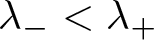 $\lambda_- \lt \lambda_+$ in Λ0 yielding invertible endpoints $D_1G(0,\lambda_-),D_1G(0,\lambda_+)\in GL(Y,X)$ and parity
 \begin{equation*}
\sigma(D_1G(0,\cdot),[\lambda_-,\lambda_+])=-1.
\end{equation*}
\begin{equation*}
\sigma(D_1G(0,\cdot),[\lambda_-,\lambda_+])=-1.
\end{equation*} Now for C 1-mappings  $G:U\to Y$ this allows an immediate application of [Reference López-Gómez and Sampedro28, Theorem 4.1] under the assumption that the generalized algebraic multiplicity of the path $D_1G(\cdot,0)$ is odd. But because of [Reference López-Gómez and Sampedro28, Theorem 3.2] this is equivalent to our assumption of having a parity index −1 in λ 0. Moreover, the continuous differentiability of G can be weakened to our assumption $(M_2)$ using methods due to Pejsachowicz [Reference Pejsachowicz32, Lemma 2.3.1] or [Reference Pejsachowicz and Skiba34, Lemma 6.3] together with [Reference Väth43, Theorem 8.73].


 Open access

