Refine listing
Actions for selected content:
308 results in 47Axx
Almost commuting self-adjoint operators and measurements
- Part of
-
- Journal:
- Canadian Mathematical Communications / Volume 1 / 2026
- Published online by Cambridge University Press:
- 06 April 2026, e3
-
- Article
-
- You have access
- Open access
- HTML
- Export citation
-
We study the problem when an n-tuple of self-adjoint operators in an infinite-dimensional separable Hilbert space H with small commutators is close to an n-tuple of commuting self-adjoint operators on $H.$ We give an affirmative answer to the problem when the synthetic-spectrum and the essential synthetic-spectrum are close. Examples are also exhibited that, in general, the answer to the problem when $n\ge 3$ is negative even the associated Fredholm index vanishes. This is an attempt to solve a problem proposed by David Mumford related to quantum theory and measurements.


Weak cluster points of maximizing sequences on Banach spaces satisfying $\boldsymbol {(M_p)}$
- Part of
-
- Journal:
- Canadian Mathematical Bulletin , First View
- Published online by Cambridge University Press:
- 23 February 2026, pp. 1-8
-
- Article
-
- You have access
- Open access
- HTML
- Export citation
-
Let T be a bounded linear operator on a separable Banach space that satisfies geometric properties similar to those of $\ell ^p,\, p>1$. We prove that the smallest and the largest norm of weak cluster points of all maximizing sequences for T can only take the values $0$ or $1$. The three classes of bounded linear operators emerging from the dichotomy of these extremal norm values coincide with the partition, created by considering the norm-attaining property and if the essential norm equals the norm.


Frequently hypercyclic random vectors for $C_{0}$-semigroups
- Part of
-
- Journal:
- Ergodic Theory and Dynamical Systems , First View
- Published online by Cambridge University Press:
- 18 February 2026, pp. 1-30
-
- Article
- Export citation

FIXED-ROTATION MINKOWSKI AVERAGING: CLASSIFICATION AND SHARP RATES
- Part of
-
- Journal:
- Bulletin of the Australian Mathematical Society , First View
- Published online by Cambridge University Press:
- 29 January 2026, pp. 1-12
-
- Article
- Export citation
-
We study a discrete process on planar convex bodies in which, at each step, a body is replaced by a weighted Minkowski average of itself and its rotation by a fixed angle. Up to translation and uniform scaling, this produces a rigid averaging dynamical system. We give a complete classification of the limit shapes. If the angle is an irrational multiple of $2\pi $, the iterates converge to a disk. If the angle is rational, they converge to the average of finitely many rotated copies of the initial body. We also obtain sharp convergence rates. In the rational case, the decay is uniform and exponential with an explicit constant depending only on the weight and the denominator of the angle. For irrational angles, we prove quantitative rates under a mild number-theoretic condition that holds for almost every angle: low regularity inputs have polynomial decay up to a logarithmic factor, while real analytic inputs have stretched exponential decay. For angles with bounded continued fraction coefficients, we give matching lower bounds along subsequences. These results describe the global attractors of the dynamics and indicate the absence of chaotic behaviour.

Inequalities of the ℓp-operator norm for block matrices
- Part of
-
- Journal:
- Canadian Mathematical Bulletin , First View
- Published online by Cambridge University Press:
- 26 January 2026, pp. 1-12
-
- Article
- Export citation
-
We develop several $\ell ^p$-operator norm inequalities for $k\times k$ block matrices defined on the $\ell ^p$-sum of Banach spaces. Using these inequalities, we obtain p-numerical radius and spectral radius bounds for $k\times k$ block matrices. We deduce a p-numerical radius bound for the Kronecker product $A\otimes B$, where $A\in {M}_k(\mathbb {C})$ is a $k\times k$ complex matrix and $B\in \mathcal {L}(\mathbb {H})$ is a bounded linear operator on a complex Hilbert space $\mathbb {H}$. This improves and extends Holbrook’s bound $w(A\otimes B)\leq w(A)\|B\|.$ If $\|A\|_{\ell ^p}$ and $w_p(A)$ denote the $\ell ^p$-operator norm and p-numerical radius of $A\in {M}_k(\mathbb {C})$, respectively, then it is shown that where
 $$ \begin{align*} \frac{1}{2}\|A\|_p+\mu_p(A) \leq w_p(A), \end{align*} $$ $\mu _p(A)$ is a positive real number that involves the $\ell ^p$-operator norms of the Cartesian decomposition of A. In addition, a complete characterization of the equality case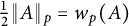 $\frac {1}{2}\|A\|_p= w_p(A)$ is given.


The norms for symmetric and antisymmetric tensor products of the weighted shift operators
- Part of
-
- Journal:
- Canadian Journal of Mathematics , First View
- Published online by Cambridge University Press:
- 26 January 2026, pp. 1-27
-
- Article
- Export citation
-
In the present article, we study the norms for symmetric and antisymmetric tensor products of weighted shift operators. By proving that for $n\geq 2$, if and only if the weight satisfies the regularity condition, we partially solve [see Problems 6 and 7 in Garcia et al. (2025, Canad. J. Math., 77, 324–346)]. It will be seen that most weighted shift operators on function spaces, including weighted Bergman shift, Hardy shift, etc., satisfy the regularity condition. Moreover, at the end of the article, we solve [see Problems 1 and 2 in Garcia et al. (2025)].
 $$ \begin{align*}\|S_{\alpha}^{l_1}\odot\cdots \odot S_{\alpha}^{l_k}\odot S_{\alpha}^{*l_{k+1}}\odot\cdots \odot S_{\alpha}^{*l_{n}}\| =\mathop{\prod}_{i=1}^n\left \| S_{\alpha}^{{l_{i}}}\right\|, \text{ for any} \ (l_1,l_2\ldots l_n)\in\mathbb N^n\end{align*} $$

The index of a pair of pure states and the interacting integer quantum Hall effect
- Part of
-
- Journal:
- Forum of Mathematics, Sigma / Volume 14 / 2026
- Published online by Cambridge University Press:
- 19 January 2026, e10
-
- Article
-
- You have access
- Open access
- HTML
- Export citation
-
We introduce the index ${\mathcal N}(\omega _1,\omega _2)$ of a pair of pure states on a unital C*-algebra, which is a generalization of the notion of the index of a pair of projections on a Hilbert space. We then show that the Hall conductance associated with an invertible state $\omega $ of a two-dimensional interacting electronic system which is symmetric under $U(1)$ charge transformation may be written as the index $\mathcal {N}(\omega ,\omega _D)$, where $\omega _D$ is obtained from $\omega $ by inserting a unit of magnetic flux. This exhibits the integrality and continuity properties of the Hall conductance in the context of general topological features of $\mathcal {N}$.


Spectral inclusions of perturbed normal operators and applications
- Part of
-
- Journal:
- Proceedings of the Edinburgh Mathematical Society , First View
- Published online by Cambridge University Press:
- 02 January 2026, pp. 1-55
-
- Article
-
- You have access
- Open access
- HTML
- Export citation
-
We consider a normal operator $T$ on a Hilbert space $H$. Under various assumptions on the spectrum of $T$, we give bounds for the spectrum of $T+A$ where $A$ is $T$-bounded with relative bound less than 1 but we do not assume that $A$ is symmetric or normal. If the imaginary part of the spectrum of $T$ is bounded, then the spectrum of $T+A$ is contained in the region between two hyperbolas whose asymptotic slope depends on the $T$-bound of $A$. If the spectrum of $T$ is contained in a bisector, then the spectrum of $T+A$ is contained in the area between certain rotated hyperbolas. The case of infinitely many gaps in the spectrum of $T$ is studied. Moreover, we prove a stability result for the essential spectrum of $T+A$. If $A$ is even $p$-subordinate to $T$, then we obtain stronger results for the localisation of the spectrum of $T+A$.


Twenty dry Martinis for the unitary almost-Mathieu operator
- Part of
-
- Journal:
- Ergodic Theory and Dynamical Systems / Volume 46 / Issue 4 / April 2026
- Published online by Cambridge University Press:
- 10 December 2025, pp. 903-920
- Print publication:
- April 2026
-
- Article
-
- You have access
- Open access
- HTML
- Export citation
TRACE FORMULAS IN NONCOMMUTATIVE GEOMETRY
- Part of
-
- Journal:
- Bulletin of the Australian Mathematical Society / Volume 113 / Issue 1 / February 2026
- Published online by Cambridge University Press:
- 28 November 2025, pp. 175-176
- Print publication:
- February 2026
-
- Article
-
- You have access
- HTML
- Export citation
Regular Dilations on Kreĭn Spaces
- Part of
-
- Journal:
- Canadian Journal of Mathematics , First View
- Published online by Cambridge University Press:
- 03 November 2025, pp. 1-24
-
- Article
-
- You have access
- Open access
- HTML
- Export citation
-
For bounded operators on Kreĭn spaces, isometric or unitary dilations always exist. We prove that any minimal isometric or unitary dilation has a precise geometrical structure. Moreover, a bounded operator T has a unique minimal unitary dilation if and only if T and $T^*$ have unique minimal isometric dilation if and only if T is either contractive or expansive and $T^*$ is either contractive or expansive. Passing to the bi-dimensional case, a minimal unitary extension (in short, m.u.e.) $U=(U_1, U_2)$ is obtained for a pair $V=(V_1, V_2)$ of commuting bounded isometries on a Kreĭn space. There is a link with the one-dimensional case: if U is an m.u.e. for $V,$ then $U_1U_2$ is an m.u.e. for $V_1V_2$. Also, if $(V_1V_2)^*$ is either contractive or expansive, then V has a unique minimal unitary extension. A minimal regular isometric dilation is obtained for a commuting pair $T=(T_1, T_2)$ of bounded operators on a Kreĭn space such that $T_1,\ T_2$ are contractions and T is a bidisc contraction or $T_1,\ T_2$ are expansions and T is a bidisc expansion. The existence of a minimal unitary extension is used to provide a minimal regular unitary dilation for T. Discussions about uniqueness and geometric structure conclude the article.


Numerical range of Toeplitz and weighted composition operators on weighted Bergman spaces
- Part of
-
- Journal:
- Canadian Mathematical Bulletin , First View
- Published online by Cambridge University Press:
- 21 October 2025, pp. 1-19
-
- Article
-
- You have access
- Open access
- HTML
- Export citation
Study of weaving frames in Krein spaces
- Part of
-
- Journal:
- Canadian Mathematical Bulletin , First View
- Published online by Cambridge University Press:
- 19 September 2025, pp. 1-16
-
- Article
- Export citation
Optimization of the principal eigenvalue of the Neumann Laplacian with indefinite weight and monotonicity of minimizers in cylinders
- Part of
-
- Journal:
- Proceedings of the Royal Society of Edinburgh. Section A: Mathematics , First View
- Published online by Cambridge University Press:
- 15 September 2025, pp. 1-35
-
- Article
-
- You have access
- Open access
- HTML
- Export citation
-
Let $\Omega\subset\mathbb{R}^N$, $N\geq 1$, be an open bounded connected set. We consider the indefinite weighted eigenvalue problem $-\Delta u =\lambda m u$ in Ω with $\lambda \in \mathbb{R}$, $m\in L^\infty(\Omega)$ and with homogeneous Neumann boundary conditions. We study weak* continuity, convexity and Gâteaux differentiability of the map $m\mapsto1/\lambda_1(m)$, where $\lambda_1(m)$ is the principal eigenvalue. Then, denoting by $\mathcal{G}(m_0)$ the class of rearrangements of a fixed weight m0, under the assumptions that m0 is positive on a set of positive Lebesgue measure and $\int_\Omega m_0\,dx \lt 0$, we prove the existence and a characterization of minimizers of $\lambda_1(m)$ and the non-existence of maximizers. Finally, we show that, if Ω is a cylinder, then every minimizer is monotone with respect to the direction of the generatrix. In the context of the population dynamics, this kind of problems arise from the question of determining the optimal spatial location of favourable and unfavourable habitats for a population to survive.


Quantitative ergodic theorems for actions of groups of polynomial growth
- Part of
-
- Journal:
- Ergodic Theory and Dynamical Systems / Volume 46 / Issue 1 / January 2026
- Published online by Cambridge University Press:
- 04 September 2025, pp. 128-181
- Print publication:
- January 2026
-
- Article
- Export citation
Evans function, parity and nonautonomous bifurcations
- Part of
-
- Journal:
- Proceedings of the Royal Society of Edinburgh. Section A: Mathematics , First View
- Published online by Cambridge University Press:
- 29 August 2025, pp. 1-40
-
- Article
-
- You have access
- Open access
- HTML
- Export citation
On the rate of growth of random analytic functions, with an application to linear dynamics
- Part of
-
- Journal:
- Canadian Journal of Mathematics , First View
- Published online by Cambridge University Press:
- 28 August 2025, pp. 1-21
-
- Article
- Export citation
Higher-order trace formulas for contractive and dissipative operators
- Part of
-
- Journal:
- Canadian Journal of Mathematics , First View
- Published online by Cambridge University Press:
- 15 August 2025, pp. 1-26
-
- Article
- Export citation
-
We establish higher-order trace formulas for pairs of contractions along a multiplicative path generated by a self-adjoint operator in a Schatten-von Neumann ideal, removing earlier stringent restrictions on the kernel and defect operator of the contractions and significantly enlarging the set of admissible functions. We also derive higher-order trace formulas for maximal dissipative operators under relaxed assumptions and new simplified trace formulas for unitary and resolvent comparable self-adjoint operators. The respective spectral shift measures are absolutely continuous and, in the case of contractions, the set of admissible functions for the nth-order trace formula on the unit circle includes the Besov class $B^n_{\infty , 1}(\mathbb {T})$. Both aforementioned properties are new in the mentioned generality.

On Bauschke–Bendit–Moursi modulus of averagedness and classifications of averaged nonexpansive operators
- Part of
-
- Journal:
- Canadian Journal of Mathematics , First View
- Published online by Cambridge University Press:
- 07 August 2025, pp. 1-26
-
- Article
-
- You have access
- Open access
- HTML
- Export citation
-
Averaged operators are important in Convex Analysis and Optimization Algorithms. In this article, we propose classifications of averaged operators, firmly nonexpansive operators, and proximal operators using the Bauschke–Bendit–Moursi modulus of averagedness. We show that if an operator is averaged with a constant less than $1/2$, then it is a bi-Lipschitz homeomorphism. Amazingly the proximal operator of a convex function has its modulus of averagedness less than $1/2$ if and only if the function is Lipschitz smooth. Some results on the averagedness of operator compositions are obtained. Explicit formulae for calculating the modulus of averagedness of resolvents and proximal operators in terms of various values associated with the maximally monotone operator or subdifferential are also given. Examples are provided to illustrate our results.


A Kakutani–Rokhlin decomposition for conditionally ergodic process in the measure-free setting of vector lattices
- Part of
-
- Journal:
- Ergodic Theory and Dynamical Systems / Volume 45 / Issue 12 / December 2025
- Published online by Cambridge University Press:
- 05 August 2025, pp. 3600-3618
- Print publication:
- December 2025
-
- Article
-
- You have access
- Open access
- HTML
- Export citation
