




1 Introduction
The famous ‘ten Martini problem’ was initially posed by Kac who promised ten Martinis for the solution of the following problem [Reference Kac40]. Consider the almost-Mathieu operator (AMO)
 $$ \begin{align} (H_{\unicode{x3bb},\Phi,\theta} \psi)(n)= & \psi(n+1)+\psi(n-1)+2\unicode{x3bb} \cos2\pi(\theta+n\Phi)\psi(n), \end{align} $$
with coupling constant $\unicode{x3bb}>0$
, frequency
$\unicode{x3bb}>0$
, frequency $\Phi \in {\mathbb {R}}\setminus {\mathbb {Q}}$
and phase
$\Phi \in {\mathbb {R}}\setminus {\mathbb {Q}}$
and phase $\theta \in {\mathbb {T}}$
. Kac asked ‘are all the gaps [in the spectrum of the AMO] there?’ or, in other words, ‘is the spectrum of the AMO a Cantor set?’. This problem was made public by Simon [Reference Simon49, Problem 1]. It was completely solved by Avila-Jitomirskaya only decades later [Reference Avila and Jitomirskaya6], building on considerable effort with partial progress along the way, compare [Reference Bellissard and Simon14, Reference Choi, Elliott and Yui22, Reference Puig44]. For an in-depth overview of the development, we refer the reader to the surveys [Reference Damanik and Fillman25, Reference Marx and Jitomirskaya42].
$\theta \in {\mathbb {T}}$
. Kac asked ‘are all the gaps [in the spectrum of the AMO] there?’ or, in other words, ‘is the spectrum of the AMO a Cantor set?’. This problem was made public by Simon [Reference Simon49, Problem 1]. It was completely solved by Avila-Jitomirskaya only decades later [Reference Avila and Jitomirskaya6], building on considerable effort with partial progress along the way, compare [Reference Bellissard and Simon14, Reference Choi, Elliott and Yui22, Reference Puig44]. For an in-depth overview of the development, we refer the reader to the surveys [Reference Damanik and Fillman25, Reference Marx and Jitomirskaya42].
The ‘dry ten Martini problem’ (DTMP) originally asks the natural follow-up question [Reference Simon49, Problem 2]: are all gaps in the spectrum of the AMO open? Over the years, substantial partial progress for various subsets of parameters was made by Choi, Elliott and Yui [Reference Choi, Elliott and Yui22], Puig [Reference Puig44], Avila and Jitomirskaya [Reference Avila and Jitomirskaya7], and Avila, You and Zhou [Reference Avila, You and Zhou8], yet, the critical case $\unicode{x3bb} =1$
with
$\unicode{x3bb} =1$
with $\Phi $
a Diophantine number is believed to still be open, see [Reference Riedel48, Theorem 1.4]. Of course, one can ask the (dry) ten Martini problem for any model of interest. Recent progress has been made for the extended Harper’s model [Reference Han34], Sturmian Hamiltonians [Reference Band, Beckus, Biber, Raymond and Thomas10, Reference Band, Beckus and Loewy11, Reference Raymond47], and
$\Phi $
a Diophantine number is believed to still be open, see [Reference Riedel48, Theorem 1.4]. Of course, one can ask the (dry) ten Martini problem for any model of interest. Recent progress has been made for the extended Harper’s model [Reference Han34], Sturmian Hamiltonians [Reference Band, Beckus, Biber, Raymond and Thomas10, Reference Band, Beckus and Loewy11, Reference Raymond47], and $C^2$
- and
$C^2$
- and $\cos $
-type sampling functions [Reference Forman and VandenBoom30, Reference Wang and Zhang52]. Research along this line turns out to be very fruitful, for example, the discovery of a robust property [Reference Ge, Jitomirskaya and You31] or the construction of explicit examples [Reference He, Hou, Shan and You35, Reference Hou, Shan and You38].
$\cos $
-type sampling functions [Reference Forman and VandenBoom30, Reference Wang and Zhang52]. Research along this line turns out to be very fruitful, for example, the discovery of a robust property [Reference Ge, Jitomirskaya and You31] or the construction of explicit examples [Reference He, Hou, Shan and You35, Reference Hou, Shan and You38].
We mention in passing that one might take another step in the direction of abstraction and ask the question, how, for a family of random operators defined over an ergodic dynamical system, the base dynamics determines the topological structure of the almost-sure spectrum. Clearly, the DTMP is a special case of this ‘all gaps open’ problem. As for operators with quasiperiodic base dynamics such as the AMO, the set of possible gap labels is determined by the so-called gap labelling theorem [Reference Bellissard, Dorlas, Hugenholtz and Winnink12, Reference Bellissard, Waldschmidt, Moussa, Luck and Itzykson13, Reference Damanik, Emilsdóttir and Fillman23, Reference Damanik, Fillman, Brown, Gesztesy, Kurasov, Laptev, Simon, Stolz and Wood24, Reference Geronimo and Johnson32, Reference Johnson and Moser39]. The converse of this is the question whether a label predicted by the gap labelling theorem labels an actual gap, that is, a gap that is not collapsed or degenerate. This converse problem is, in general, very difficult since both the base dynamics and the sampling functions can affect the topological structure of the spectrum, compare [Reference Avila, Bochi and Damanik5].
A crucial ingredient in the classical proof of the DTMP for the AMO is the Aubry–André duality [Reference Avila and Jitomirskaya7, Reference Puig44], that is, a duality between different elements of the family $\{H_\unicode{x3bb} \}$
with respect to a twisted Fourier transform. In the general case, that is, without appealing to this duality, the property that ‘all gaps are open’ is expected to hold only in generic sense [Reference Avila, Bochi and Damanik4, Reference Avila, Bochi and Damanik5, Reference Damanik and Li27, Reference Puig and Simó46]. However, whenever one has this duality available for a concrete operator, one can expect the DTMP to hold.
$\{H_\unicode{x3bb} \}$
with respect to a twisted Fourier transform. In the general case, that is, without appealing to this duality, the property that ‘all gaps are open’ is expected to hold only in generic sense [Reference Avila, Bochi and Damanik4, Reference Avila, Bochi and Damanik5, Reference Damanik and Li27, Reference Puig and Simó46]. However, whenever one has this duality available for a concrete operator, one can expect the DTMP to hold.
We here solve the dry ten Martini problem for a model that goes beyond the class of quasiperiodic Schrödinger operators, but for which one nevertheless can prove an André–Aubry duality: the so-called unitary almost-Mathieu operator (UAMO) is a quantum walk that describes the motion of a single particle with two-dimensional internal degree of freedom on the integers in discrete time steps. The dynamics is described by the alternation of two types of operators: a parametrized shift and a ‘coin’ operator that locally acts via a matrix-valued quasiperiodic function. This model was introduced and studied in [Reference Cedzich, Fillman and Ong21], see also [Reference Cedzich, Fillman, Geib and Werner19, Reference Fillman, Ong and Zhang29]. In [Reference Cedzich, Fillman and Ong21], among other results concerning the spectral types in various parameter regimes, the ten Martini problem was solved in the critical setting for all irrational frequencies. For Diophantine frequencies, we here advance this result in two important directions: on the one hand, we ‘dry’ it, and on the other, we extend it to the non-critical setting.
2 The model and results
In this work, we establish the DTMP for a family of quasiperiodic operators that was introduced in [Reference Cedzich, Fillman and Ong21] and dubbed unitary almost-Mathieu operator (UAMO) due to its striking similarities with the almost-Mathieu operator $H_{\unicode{x3bb} ,\Phi ,\theta }$
defined in (1.1). The UAMO is a split-step quantum walk
$H_{\unicode{x3bb} ,\Phi ,\theta }$
defined in (1.1). The UAMO is a split-step quantum walk $W_{\unicode{x3bb} }=S_\unicode{x3bb} Q$
on
$W_{\unicode{x3bb} }=S_\unicode{x3bb} Q$
on ${\mathcal {H}}=\ell ^2({\mathbb {Z}})\otimes {\mathbb {C}}^2$
that is defined in terms of two operators:
${\mathcal {H}}=\ell ^2({\mathbb {Z}})\otimes {\mathbb {C}}^2$
that is defined in terms of two operators: $S_\unicode{x3bb} $
is the conditional shift operator,
$S_\unicode{x3bb} $
is the conditional shift operator,
 $$ \begin{align*} S_\unicode{x3bb}:\delta^\pm_{n}\mapsto\unicode{x3bb}\delta^\pm_{n\pm1}\pm\unicode{x3bb}'\delta^\mp_n,\quad\unicode{x3bb}\in[0,1],\:\unicode{x3bb}'=\sqrt{1-\unicode{x3bb}^2}, \end{align*} $$
and Q is a ‘coin’ operator that acts coordinate-wise via a $2\times 2$
unitary
$2\times 2$
unitary $Q_n$
. Here,
$Q_n$
. Here, $\delta _n^s=\delta _n\otimes e_s$
,
$\delta _n^s=\delta _n\otimes e_s$
, $n\in {\mathbb {Z}}$
,
$n\in {\mathbb {Z}}$
, $s\in \{+,-\}$
denotes the basis of
$s\in \{+,-\}$
denotes the basis of ${\mathcal {H}}$
where
${\mathcal {H}}$
where $\delta _n$
is the standard basis of
$\delta _n$
is the standard basis of $\ell ^2({\mathbb {Z}})$
and
$\ell ^2({\mathbb {Z}})$
and $e_+=[1,0]^\top ,e_-=[0,1]^\top $
.
$e_+=[1,0]^\top ,e_-=[0,1]^\top $
.
For the UAMO, these local coins are quasiperiodically distributed according to the rule
 $$ \begin{align} Q_{\unicode{x3bb},n} = Q_{\unicode{x3bb},n,\Phi,\theta} = Q_{\unicode{x3bb},2\pi(n\Phi + \theta)}, \quad n \in {\mathbb{Z}}, \end{align} $$
where $Q_{\unicode{x3bb} ,\theta }$
denotes a modified counterclockwise rotation through the angle
$Q_{\unicode{x3bb} ,\theta }$
denotes a modified counterclockwise rotation through the angle $\theta $
, that is,
$\theta $
, that is,
 $$ \begin{align} Q_{\unicode{x3bb},\theta} = \begin{bmatrix} \unicode{x3bb}\cos(\theta)+i\unicode{x3bb}' & -\unicode{x3bb}\sin(\theta) \\ \unicode{x3bb}\sin(\theta) & \unicode{x3bb}\cos(\theta)-i\unicode{x3bb}' \end{bmatrix}, \quad \theta \in {\mathbb{T}}:={\mathbb{R}}/{\mathbb{Z}},\:\unicode{x3bb}\in[0,1], \end{align} $$
and we abbreviated $\unicode{x3bb} '=\sqrt {1-\unicode{x3bb} ^2}$
.
$\unicode{x3bb} '=\sqrt {1-\unicode{x3bb} ^2}$
.
With these two building blocks, the UAMO is defined as
 $$ \begin{align} W_{\unicode{x3bb}_1,\unicode{x3bb}_2,\Phi,\theta}:=S_{\unicode{x3bb}_1}Q_{\unicode{x3bb}_2,\Phi,\theta}, \end{align} $$
and we shall abbreviate as $W_{\unicode{x3bb} _1,\unicode{x3bb} _2}$
for fixed
$W_{\unicode{x3bb} _1,\unicode{x3bb} _2}$
for fixed $\Phi $
and
$\Phi $
and $\theta $
. As discussed in detail in [Reference Cedzich, Fillman and Ong21, §3],
$\theta $
. As discussed in detail in [Reference Cedzich, Fillman and Ong21, §3], $\Phi $
plays the role of a magnetic field in an associated two-dimensional model and
$\Phi $
plays the role of a magnetic field in an associated two-dimensional model and $\theta $
plays the role of a Fourier parameter of the second lattice dimension. We shall nevertheless stick with the standard nomenclature in dynamical systems and call
$\theta $
plays the role of a Fourier parameter of the second lattice dimension. We shall nevertheless stick with the standard nomenclature in dynamical systems and call $\Phi $
the frequency and
$\Phi $
the frequency and $\theta $
the phase, and refer to
$\theta $
the phase, and refer to $\unicode{x3bb} _1$
and
$\unicode{x3bb} _1$
and $\unicode{x3bb} _2$
as coupling constants, as they determine the ‘strength’ of the shift and the coin, respectively.
$\unicode{x3bb} _2$
as coupling constants, as they determine the ‘strength’ of the shift and the coin, respectively.
The UAMO displays a metal–insulator phase transition with respect to the coupling constants for almost all $\Phi $
and
$\Phi $
and $\theta $
: for
$\theta $
: for $\unicode{x3bb} _1>\unicode{x3bb} _2$
, the spectrum of
$\unicode{x3bb} _1>\unicode{x3bb} _2$
, the spectrum of $W_{\unicode{x3bb} _1,\unicode{x3bb} _2}$
is purely absolutely continuous; for
$W_{\unicode{x3bb} _1,\unicode{x3bb} _2}$
is purely absolutely continuous; for $0<\unicode{x3bb} _1=\unicode{x3bb} _2\leq 1$
, it is purely singular continuous while for
$0<\unicode{x3bb} _1=\unicode{x3bb} _2\leq 1$
, it is purely singular continuous while for $\unicode{x3bb} _1<\unicode{x3bb} _2$
, it is a pure point with exponentially decaying eigenfunctions. Note that in certain regimes, the ‘almost all’ can be lifted to ‘all’, for details see [Reference Cedzich, Fillman and Ong21, Theorem 2.2]. This follows from a characterization of the associated eigenfunction cocycle which, in the nomenclature of Avila’s global theory [Reference Avila2], results in the spectral phase diagram [Reference Cedzich, Fillman and Ong21] as shown in Figure 1.
$\unicode{x3bb} _1<\unicode{x3bb} _2$
, it is a pure point with exponentially decaying eigenfunctions. Note that in certain regimes, the ‘almost all’ can be lifted to ‘all’, for details see [Reference Cedzich, Fillman and Ong21, Theorem 2.2]. This follows from a characterization of the associated eigenfunction cocycle which, in the nomenclature of Avila’s global theory [Reference Avila2], results in the spectral phase diagram [Reference Cedzich, Fillman and Ong21] as shown in Figure 1.
The phase diagram of the unitary almost-Mathieu operator (colour online).

We henceforth call the UAMO subcritical, critical and supercritical in the respective parameter ranges. For a precise meaning of these notions in terms of quasiperiodic cocycles, see Definition 3.1.
Another important ingredient in these proofs is a unitary version of André–Aubry duality, which relates $W_{\unicode{x3bb} _1,\unicode{x3bb} _2}$
to its ‘dual’
$W_{\unicode{x3bb} _1,\unicode{x3bb} _2}$
to its ‘dual’
 $$ \begin{align*} W_{\unicode{x3bb}_1,\unicode{x3bb}_2}^{\sharp}:=W_{\unicode{x3bb}_2,\unicode{x3bb}_1}^\top, \end{align*} $$
and which immediately implies that the spectra of $W_{\unicode{x3bb} _1,\unicode{x3bb} _2}$
and
$W_{\unicode{x3bb} _1,\unicode{x3bb} _2}$
and $W_{\unicode{x3bb} _2,\unicode{x3bb} _1}$
are the same.
$W_{\unicode{x3bb} _2,\unicode{x3bb} _1}$
are the same.
The arithmetic properties of $\Phi $
play a crucial role in determining spectral properties of the underlying operator. We call
$\Phi $
play a crucial role in determining spectral properties of the underlying operator. We call $\Phi $
Diophantine if there exist
$\Phi $
Diophantine if there exist $\kappa>0,\tau >1$
such that
$\kappa>0,\tau >1$
such that
 $$ \begin{align} \|n \Phi\|_{{\mathbb{T}}}:= \inf_{p\in{\mathbb{Z}}} |n \Phi-p| \geq\frac\kappa{|n|^{\tau+2}}\quad\text{ for all } n\neq0. \end{align} $$
In this case, we write $\Phi \in {\mathrm {DC}}(\kappa ,\tau )$
. Moreover, we shall denote the set of all Diophantine frequencies by
$\Phi \in {\mathrm {DC}}(\kappa ,\tau )$
. Moreover, we shall denote the set of all Diophantine frequencies by
 $$ \begin{align} {\mathrm{DC}}=\bigcup_{\kappa>0,\tau>1}{\mathrm{DC}}(\kappa,\tau), \end{align} $$
which is known to have full Lebesgue measure as a subset of ${\mathbb {T}}$
. More generally, we say
${\mathbb {T}}$
. More generally, we say $\rho $
is Diophantine with respect to
$\rho $
is Diophantine with respect to $\Phi $
if there exists some positive constants
$\Phi $
if there exists some positive constants $\kappa ',\tau '$
such that
$\kappa ',\tau '$
such that
 $$ \begin{align*} \|\rho - n\Phi\|_{{\mathbb{T}}} \geq \frac{\kappa'}{|n|^{\tau'}} \quad \text{ for all } \; 0 \neq n \in \mathbb{Z}, \end{align*} $$
and $\rho $
is rational with respect to
$\rho $
is rational with respect to $\Phi $
if
$\Phi $
if $\rho - n\Phi \in \mathbb {Q}$
for some
$\rho - n\Phi \in \mathbb {Q}$
for some $n \in \mathbb {Z}$
.
$n \in \mathbb {Z}$
.
It turns out that the spectrum of $W_{\unicode{x3bb} _1,\unicode{x3bb} _2,\Phi ,\theta }$
is independent of
$W_{\unicode{x3bb} _1,\unicode{x3bb} _2,\Phi ,\theta }$
is independent of $\theta $
by the minimality of the rigid translation
$\theta $
by the minimality of the rigid translation $\theta \to \theta +\Phi , \Phi \in {\mathbb {R}}\setminus {\mathbb {Q}}.$
We denote this common spectrum by
$\theta \to \theta +\Phi , \Phi \in {\mathbb {R}}\setminus {\mathbb {Q}}.$
We denote this common spectrum by $\Sigma _{\unicode{x3bb} _1,\unicode{x3bb} _2,\Phi }$
. Our main result is the following theorem.
$\Sigma _{\unicode{x3bb} _1,\unicode{x3bb} _2,\Phi }$
. Our main result is the following theorem.
Theorem 2.1. For $\Phi \in {\mathrm {DC}}$
and
$\Phi \in {\mathrm {DC}}$
and $\unicode{x3bb} _1\neq \unicode{x3bb} _2$
, all gaps in the spectrum of the unitary almost-Mathieu operator
$\unicode{x3bb} _1\neq \unicode{x3bb} _2$
, all gaps in the spectrum of the unitary almost-Mathieu operator $W_{\unicode{x3bb} _1,\unicode{x3bb} _2,\Phi }$
allowed by the gap labelling theorem are open.
$W_{\unicode{x3bb} _1,\unicode{x3bb} _2,\Phi }$
allowed by the gap labelling theorem are open.
Remark 2.2. The reason for the ‘twenty’ instead of the usual ‘ten’ in the title of the paper comes from the observation that we have ‘twice as many’ gaps as for the AMO: phenomenologically, this can be seen in Figure 2, where we see that the spectrum of the UAMO consists of two copies of the butterfly. The reason for this is the prevalence of more symmetries: the spectrum of the AMO is real and symmetric about $0$
due to the involutive symmetry that multiplies locally by
$0$
due to the involutive symmetry that multiplies locally by $(-1)^n$
and shifts
$(-1)^n$
and shifts $\theta \mapsto \theta +1/2$
. The UAMO has spectrum on the unit circle. It has the same symmetry as the AMO, which amounts to a reflection about the origin. In addition, the spectrum possesses an axial symmetry about the real axis due to complex conjugation [Reference Cedzich, Fillman, Geib and Werner19].
$\theta \mapsto \theta +1/2$
. The UAMO has spectrum on the unit circle. It has the same symmetry as the AMO, which amounts to a reflection about the origin. In addition, the spectrum possesses an axial symmetry about the real axis due to complex conjugation [Reference Cedzich, Fillman, Geib and Werner19].
The ‘Hofstadter butterfly’ for the UAMO in the subcritical regime with $(\unicode{x3bb} _1,\unicode{x3bb} _2)=(1/\sqrt {2},1/\sqrt {3})$
and denominators up to 70. Clearly, there are two butterflies: for every denominator q, there are
$(\unicode{x3bb} _1,\unicode{x3bb} _2)=(1/\sqrt {2},1/\sqrt {3})$
and denominators up to 70. Clearly, there are two butterflies: for every denominator q, there are $2q$
bands instead of just q as for the original butterfly [Reference Hofstadter37]. This is rooted in the symmetries of the system: for every
$2q$
bands instead of just q as for the original butterfly [Reference Hofstadter37]. This is rooted in the symmetries of the system: for every $z\in \Sigma _{\unicode{x3bb} _1,\unicode{x3bb} _2,\Phi }$
also
$z\in \Sigma _{\unicode{x3bb} _1,\unicode{x3bb} _2,\Phi }$
also $z^*\in \Sigma _{\unicode{x3bb} _1,\unicode{x3bb} _2,\Phi }$
and
$z^*\in \Sigma _{\unicode{x3bb} _1,\unicode{x3bb} _2,\Phi }$
and $-z\in \Sigma _{\unicode{x3bb} _1,\unicode{x3bb} _2,\Phi }$
, compare Remark 2.2.
$-z\in \Sigma _{\unicode{x3bb} _1,\unicode{x3bb} _2,\Phi }$
, compare Remark 2.2.

Remark 2.3. Let us make some comments about Theorem 2.1.
-
(1) By [Reference Cedzich, Fillman and Ong21, Theorem 2.2(d)], the ten Martini property holds in the critical case for all irrational frequencies, that is, for $0<\unicode{x3bb} _1=\unicode{x3bb} _2\leq 1$
, the spectrum of
$W_{\unicode{x3bb} _1,\unicode{x3bb} _2,\Phi }$
is a Cantor set of zero Lebesgue measure for every irrational
$\Phi $
. The dry version of the problem remains open.
$0<\unicode{x3bb} _1=\unicode{x3bb} _2\leq 1$
, the spectrum of
$W_{\unicode{x3bb} _1,\unicode{x3bb} _2,\Phi }$
is a Cantor set of zero Lebesgue measure for every irrational
$\Phi $
. The dry version of the problem remains open. -
(2) In the non-critical setting, the DTMP for non-Diophantine
$\Phi $
is notoriously hard. For the critical AMO with Liouville frequencies, this was proved in [Reference Choi, Elliott and Yui22] by employing the particular structure and symmetries of the operator. The more involved structure of the UAMO seems to render impossible an adaption of the argument in [Reference Choi, Elliott and Yui22]. We nevertheless expect the DTMP to hold for all frequencies, see [Reference Avila, You and Zhou8] for a possible attack strategy. -
(3) We combine Avila’s almost-reducible theorem with Eliasson’s reducibility for Diophantine frequencies to obtain the global reducibility except for the critical case. Therefore, this treatment does not cover the Liouville frequencies. More specifically, Theorems 3.7 and 3.8 only apply for Diophantine frequencies.
-
(4) This is the first time a DTMP is shown for (GE)CMV matrices. Some results in Baire category for certain classes of almost-periodic extended CMV matrices were previously obtained by [Reference Damanik and Li27, Reference Li, Damanik and Zhou41]. It is an open question whether it holds for other CMV matrices with, for example, subshift or Sturmian Verblunsky coefficients.



We base our proof on the recent understanding of Anderson localization for Diophantine frequencies obtained in [Reference Cedzich, Fillman, Li, Ong and Zhou20] and techniques developed therein: the Anderson localization for the UAMO in the supercritical setting $\unicode{x3bb} _1<\unicode{x3bb} _2$
proved in [Reference Cedzich, Fillman and Ong21] is a full measure result. In [Reference Cedzich, Fillman, Li, Ong and Zhou20], an arithmetic version of Anderson localization is proved, albeit for a mosaic model where every other local coin in (2.1) is trivial. However, the proof of [Reference Cedzich, Fillman, Li, Ong and Zhou20] works in a straightforward way for UAMO as well, compare also [Reference Yang53]. We provide a sketch of the proof in §5.
$\unicode{x3bb} _1<\unicode{x3bb} _2$
proved in [Reference Cedzich, Fillman and Ong21] is a full measure result. In [Reference Cedzich, Fillman, Li, Ong and Zhou20], an arithmetic version of Anderson localization is proved, albeit for a mosaic model where every other local coin in (2.1) is trivial. However, the proof of [Reference Cedzich, Fillman, Li, Ong and Zhou20] works in a straightforward way for UAMO as well, compare also [Reference Yang53]. We provide a sketch of the proof in §5.
Theorem 2.4. Let $\Phi \in {\mathrm {DC}}(\kappa ,\tau )$
and
$\Phi \in {\mathrm {DC}}(\kappa ,\tau )$
and $\unicode{x3bb} _1<\unicode{x3bb} _2$
. Then, for each ‘
$\unicode{x3bb} _1<\unicode{x3bb} _2$
. Then, for each ‘ $\Phi $
-non-resonant’
$\Phi $
-non-resonant’ $\theta $
, that is, each
$\theta $
, that is, each $\theta $
such that
$\theta $
such that
 $$ \begin{align*} |\!\sin2\pi(\theta+n\Phi)|<\exp(-|n|^{{1}/{2\tau}}) \end{align*} $$
does not hold for infinitely many n, $W_{\unicode{x3bb} _1,\unicode{x3bb} _2,\Phi ,\theta }$
admits Anderson localization.
$W_{\unicode{x3bb} _1,\unicode{x3bb} _2,\Phi ,\theta }$
admits Anderson localization.
Remark 2.5. This result is a full measure result in $\theta $
. It is sharp in the sense that it cannot be strengthened to all
$\theta $
. It is sharp in the sense that it cannot be strengthened to all $\theta $
[Reference Cedzich and Fillman18].
$\theta $
[Reference Cedzich and Fillman18].
We shall also need the following dynamical duality formulation of Aubry–André duality for the UAMO, which can be seen as the reverse statement to [Reference Cedzich, Fillman and Ong21, Theorem 2.4]. As such, we expect it to be of interest beyond this paper.
Theorem 2.6. (Aubry–André duality)
Let $\varphi =\varphi ^\xi =[\varphi ^{\xi ,+},\varphi ^{\xi ,-}]^\top $
,
$\varphi =\varphi ^\xi =[\varphi ^{\xi ,+},\varphi ^{\xi ,-}]^\top $
, $\xi \in \mathbb {T}$
, be a solution to the generalized eigenvalue equation
$\xi \in \mathbb {T}$
, be a solution to the generalized eigenvalue equation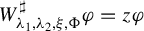 $W^{{\sharp }}_{\unicode{x3bb} _{1},\unicode{x3bb} _{2},\xi ,\Phi }\varphi =z\varphi $
for some
$W^{{\sharp }}_{\unicode{x3bb} _{1},\unicode{x3bb} _{2},\xi ,\Phi }\varphi =z\varphi $
for some $z\in \partial {\mathbb {D}}$
which has the form of a Bloch wave, that is, there exists
$z\in \partial {\mathbb {D}}$
which has the form of a Bloch wave, that is, there exists $\check \phi $
such that
$\check \phi $
such that $\varphi _n=e^{2\pi in\theta }\check \phi (\xi +n\Phi )$
. Define
$\varphi _n=e^{2\pi in\theta }\check \phi (\xi +n\Phi )$
. Define
 $$ \begin{align} \begin{bmatrix}\check{\psi}^{+}\\\check{\psi}^{-}\end{bmatrix}=\frac1{\sqrt2}\begin{bmatrix}1&-i\\-i&1\end{bmatrix}\begin{bmatrix}\check{\phi}^{+}\\\check{\phi}^{-}\end{bmatrix} \end{align} $$
with nth Fourier coefficients $\psi _n^{+}$
and
$\psi _n^{+}$
and $\psi _n^{-}$
, respectively. Then,
$\psi _n^{-}$
, respectively. Then, $W_{\unicode{x3bb} _{1},\unicode{x3bb} _{2},\Phi ,\theta }\psi =z\psi $
.
$W_{\unicode{x3bb} _{1},\unicode{x3bb} _{2},\Phi ,\theta }\psi =z\psi $
.
Note that this theorem is formulated in a formal way without summability or integrability assumptions. The careful reader will realize that in the cases where we will apply it, namely analytic Bloch waves on the one or localized solutions on the other side, this duality is well defined.
3 Preliminaries
Our proof of Theorem 2.1 uses techniques from the theory of one-frequency cocycles of CMV matrices, which we hence review in this section to keep the present treatise as self-contained as possible. We first review the construction of so-called Cantero–Moral–Velázquez matrices (CMV matrices), whose intimate connection with quantum walks on the line was first discussed in [Reference Cantero, Moral, Grünbaum and Velázquez16] and further generalized in [Reference Cedzich, Fillman, Li, Ong and Zhou20, Reference Cedzich, Fillman and Ong21]. We then discuss the dynamics of the transfer matrix cocycle of the UAMO through that of the associated Szegő cocycle. This cocycle is the natural one from a point of view of orthogonal polynomials on the unit circle [Reference Simon50, Reference Simon51] and has the advantage over the transfer matrix cocycle that it automatically lies in ${\mathbb {SU}}(1,1)$
.
${\mathbb {SU}}(1,1)$
.
3.1 The UAMO as a generalized extended CMV matrix
Consider the Hilbert space $\ell ^2({\mathbb {Z}})$
with the standard basis
$\ell ^2({\mathbb {Z}})$
with the standard basis $\{\delta _n : n \in \mathbb {Z}\}$
. On
$\{\delta _n : n \in \mathbb {Z}\}$
. On $\ell ^2({\mathbb {Z}})$
, we define generalized extended CMV (GECMV) matrices
$\ell ^2({\mathbb {Z}})$
, we define generalized extended CMV (GECMV) matrices $\mathcal {E} = \mathcal {E}(\alpha ,\rho )$
by
$\mathcal {E} = \mathcal {E}(\alpha ,\rho )$
by $\mathcal {E}=\mathcal {L}\mathcal {M}$
, where
$\mathcal {E}=\mathcal {L}\mathcal {M}$
, where $\mathcal {L}=\bigoplus _{n\in \mathbb {Z}}\Theta (\alpha _{2n},\rho _{2n})$
and
$\mathcal {L}=\bigoplus _{n\in \mathbb {Z}}\Theta (\alpha _{2n},\rho _{2n})$
and $\mathcal {M}=\bigoplus _{n\in \mathbb {Z}}\Theta (\alpha _{2n+1},\rho _{2n+1})$
are specified by
$\mathcal {M}=\bigoplus _{n\in \mathbb {Z}}\Theta (\alpha _{2n+1},\rho _{2n+1})$
are specified by
 $$ \begin{align} \Theta(\alpha,\rho)=\begin{bmatrix}\overline{\alpha}&\rho\\\overline{\rho}&-\alpha\end{bmatrix} \end{align} $$
with Verblunsky pairs
 $$ \begin{align} (\alpha,\rho)\in\mathbb{S}^3=\{(z_1,z_2)\in\overline{\mathbb{D}}^2:|z_1|^2+|z_2|^2=1\}. \end{align} $$
Each $\Theta (\alpha _j,\rho _j)$
acts unitarily on the subspace
$\Theta (\alpha _j,\rho _j)$
acts unitarily on the subspace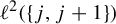 $\ell ^2(\{j,j+1\})$
, and hence, the blocks of
$\ell ^2(\{j,j+1\})$
, and hence, the blocks of $\mathcal {L}$
and
$\mathcal {L}$
and $\mathcal {M}$
are shifted by one basis element with respect to each other. Hence,
$\mathcal {M}$
are shifted by one basis element with respect to each other. Hence, $\mathcal E$
has the matrix representation
$\mathcal E$
has the matrix representation
 $$ \begin{align} \mathcal E = \begin{bmatrix} \ddots & \ddots & \ddots & \ddots &&&& \\ & \overline{\alpha_0\rho_{-1}} & \boxed{-\overline{\alpha_0}\alpha_{-1}} & \overline{\alpha_1}\rho_0 & \rho_1\rho_0 &&& \\ & \overline{\rho_0\rho_{-1}} & -\overline{\rho_0}\alpha_{-1} & {-\overline{\alpha_1}\alpha_0} & -\rho_1 \alpha_0 &&& \\ && & \overline{\alpha_2\rho_1} & -\overline{\alpha_2}\alpha_1 & \overline{\alpha_3} \rho_2 & \rho_3\rho_2 & \\ && & \overline{\rho_2\rho_1} & -\overline{\rho_2}\alpha_1 & -\overline{\alpha_3}\alpha_2 & -\rho_3\alpha_2 & \\ && && \ddots & \ddots & \ddots & \ddots & \end{bmatrix}, \end{align} $$
where all unspecified matrix elements are zero and we boxed the element $\langle \delta _0,\mathcal E\delta _0\rangle $
.
$\langle \delta _0,\mathcal E\delta _0\rangle $
.
‘Generalized’ here means that we admit the $\rho $
terms to be complex, whereas in the definition of ‘standard’ extended CMV matrices given in [Reference Cantero, Moral and Velázquez17, Reference Simon50, Reference Simon51] they are fully determined as
$\rho $
terms to be complex, whereas in the definition of ‘standard’ extended CMV matrices given in [Reference Cantero, Moral and Velázquez17, Reference Simon50, Reference Simon51] they are fully determined as $\rho _n=\sqrt {1-|\alpha _n|^2}$
and hence real. By [Reference Cedzich, Fillman and Ong21, Proposition 2.12], respectively [Reference Cedzich, Fillman, Li, Ong and Zhou20, Theorem 2.1], different choices for the phases of the
$\rho _n=\sqrt {1-|\alpha _n|^2}$
and hence real. By [Reference Cedzich, Fillman and Ong21, Proposition 2.12], respectively [Reference Cedzich, Fillman, Li, Ong and Zhou20, Theorem 2.1], different choices for the phases of the $\rho $
terms are related through a gauge transformation, that is, by conjugating with a diagonal unitary. This freedom in choosing the phases of the
$\rho $
terms are related through a gauge transformation, that is, by conjugating with a diagonal unitary. This freedom in choosing the phases of the $\rho $
terms has been fruitfully exploited already to uncover hidden symmetries of the model [Reference Cedzich and Fillman18, Reference Cedzich, Fillman, Li, Ong and Zhou20]. In particular, every GECMV matrix is gauge-equivalent to a standard extended CMV matrix. We shall assume that this gauge transformation has already been carried out, that is, we assume that
$\rho $
terms has been fruitfully exploited already to uncover hidden symmetries of the model [Reference Cedzich and Fillman18, Reference Cedzich, Fillman, Li, Ong and Zhou20]. In particular, every GECMV matrix is gauge-equivalent to a standard extended CMV matrix. We shall assume that this gauge transformation has already been carried out, that is, we assume that $\rho _n\in [0,1]$
for all
$\rho _n\in [0,1]$
for all $n\in {\mathbb {Z}}$
, and denote the resulting standard extended CMV matrix also by
$n\in {\mathbb {Z}}$
, and denote the resulting standard extended CMV matrix also by $\mathcal {E}$
. This is important, since it implies that the Szegő transfer matrices
$\mathcal {E}$
. This is important, since it implies that the Szegő transfer matrices $S_{n,z}$
defined in (3.7) are in
$S_{n,z}$
defined in (3.7) are in ${\mathbb {SU}}(1,1)$
and the
${\mathbb {SU}}(1,1)$
and the $\Theta $
in (3.1) are symmetric.
$\Theta $
in (3.1) are symmetric.
To study the spectral properties of $\mathcal {E}$
, one naturally considers the generalized eigenvalue equation
$\mathcal {E}$
, one naturally considers the generalized eigenvalue equation
 $$ \begin{align*} \mathcal{E}u=zu, \quad z\in{\mathbb{C}}. \end{align*} $$
Solutions to this equation satisfy the following recurrence (cf. [Reference Cedzich, Fillman and Ong21, §4]):
 $$ \begin{align} \begin{bmatrix}u_{2n+1}\\u_{2n}\end{bmatrix}=A_{n,z}\begin{bmatrix}u_{2n-1}\\u_{2n-2}\end{bmatrix}, \quad n \in {\mathbb{Z}}, \end{align} $$
where the eigenfunction transfer matrices $A_{n,z}$
are given by
$A_{n,z}$
are given by
 $$ \begin{align} &\! A_{n,z} \nonumber \\ &\ =\frac{1}{\rho_{2n}\rho_{2n-1}} \begin{bmatrix} z^{-1}+\alpha_{2n}\overline{\alpha}_{2n-1}+\alpha_{2n-1}\overline{\alpha_{2n-2}}+\alpha_{2n}\overline{\alpha_{2n-2}}z& -\overline{\rho_{2n-2}}\alpha_{2n-1}-\overline{\rho_{2n-2}}\alpha_{2n}z\\ -\rho_{2n}\overline{\alpha_{2n-1}}-\rho_{2n}\overline{\alpha_{2n-2}}z&\rho_{2n}\overline{\rho_{2n-2}}z \end{bmatrix} \end{align} $$
for $n \in {\mathbb {Z}}$
and
$n \in {\mathbb {Z}}$
and $z \in {\mathbb {C}} \setminus \{0\}$
. Since after gauge transforming, the
$z \in {\mathbb {C}} \setminus \{0\}$
. Since after gauge transforming, the $\rho _n$
terms in (3.5) are real, by [Reference Cedzich, Fillman, Li, Ong and Zhou20, Lemma 5.3], we have the following:
$\rho _n$
terms in (3.5) are real, by [Reference Cedzich, Fillman, Li, Ong and Zhou20, Lemma 5.3], we have the following:
 $$ \begin{align} A_{n,z}=R_{2n}^{-1}JS^{+}_{n,z}JR_{2n-2}, \end{align} $$
where $S^{+}_{n,z}=S_{2n,z}S_{2n-1,z}$
is determined by the normalized Szegő transfer matrices
$S^{+}_{n,z}=S_{2n,z}S_{2n-1,z}$
is determined by the normalized Szegő transfer matrices
 $$ \begin{align} S_{n,z}=\frac{z^{-({1}/{2})}}{\rho_{n}}\begin{bmatrix}z&-\overline{\alpha_{n}}\\-\alpha_{n}z&1\end{bmatrix} \in {\mathbb{SU}}(1,1), \end{align} $$
and
 $$ \begin{align} R_{n}=\begin{bmatrix}1&0\\-\overline{\alpha_{n}}& \rho_{n} \end{bmatrix},\quad J=\begin{bmatrix}0&1\\1&0\end{bmatrix}. \end{align} $$
Consider the generalized eigenvalue equation of the transposed extended CMV matrix:
 $$ \begin{align} \mathcal{E}^\top v=zv. \end{align} $$
Since $\mathcal {L}$
and
$\mathcal {L}$
and $\mathcal {M}$
are symmetric when
$\mathcal {M}$
are symmetric when $\rho \in {\mathbb {R}}$
, one has that
$\rho \in {\mathbb {R}}$
, one has that $\mathcal {E}^\top =\mathcal {M}\mathcal {L}$
and (3.9) becomes
$\mathcal {E}^\top =\mathcal {M}\mathcal {L}$
and (3.9) becomes $\mathcal {M}\mathcal {L}v=zv$
. Applying
$\mathcal {M}\mathcal {L}v=zv$
. Applying $\mathcal L$
to both sides, we find that for any generalized eigenfunction v of
$\mathcal L$
to both sides, we find that for any generalized eigenfunction v of $\mathcal E^\top $
,
$\mathcal E^\top $
, $u=\mathcal L v$
is a generalized eigenfunction for
$u=\mathcal L v$
is a generalized eigenfunction for $\mathcal E$
. By definition of
$\mathcal E$
. By definition of $\mathcal L$
, we have that
$\mathcal L$
, we have that
 $$ \begin{align*} \begin{bmatrix}u_{2n+1}\\u_{2n}\end{bmatrix}=J\Theta_{2n}J\begin{bmatrix}v_{2n+1}\\v_{2n}\end{bmatrix}=\begin{bmatrix}-\alpha_{2n}&\rho_{2n}\\\rho_{2n}&\overline{\alpha_{2n}}\end{bmatrix}\begin{bmatrix}v_{2n+1}\\v_{2n}\end{bmatrix}. \end{align*} $$
It thus follows from (3.4) that solutions $v\in \ell ^\infty ({\mathbb {Z}})$
to (3.9) satisfy the following recurrence relation:
$v\in \ell ^\infty ({\mathbb {Z}})$
to (3.9) satisfy the following recurrence relation:
 $$ \begin{align} \begin{bmatrix} v_{2n+1}\\v_{2n} \end{bmatrix}=P_{2n}^{-1}A_{n,z}P_{2n-2}\begin{bmatrix}v_{2n-1}\\v_{2n-2}\end{bmatrix}, \end{align} $$
where $P_{n}=J\Theta (\alpha _n,\rho _n)J$
with J as in (3.8). This again allows us to easily deduce the Szegő transfer matrices for
$P_{n}=J\Theta (\alpha _n,\rho _n)J$
with J as in (3.8). This again allows us to easily deduce the Szegő transfer matrices for $\mathcal E^\top $
via (3.6).
$\mathcal E^\top $
via (3.6).
As detailed in [Reference Cedzich, Fillman and Ong21, §2.3], the UAMO defined in (2.3) is a GECMV with dynamically defined Verblunksy coefficients
 $$ \begin{align} \begin{aligned} \alpha_{2n-1} &= \unicode{x3bb}_2 \sin(2\pi(\theta+n\Phi)), \quad\quad & \alpha_{2n} &= \unicode{x3bb}_1',\\ \rho_{2n-1} &= \unicode{x3bb}_2 \cos(2\pi(\theta+n\Phi)) - i \unicode{x3bb}_2', & \rho_{2n} &= \unicode{x3bb}_1, \end{aligned} \end{align} $$
where, as above, $\unicode{x3bb} _i\in [0,1]$
and
$\unicode{x3bb} _i\in [0,1]$
and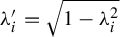 $\unicode{x3bb} _i'=\sqrt {1-\unicode{x3bb} _i^2}$
for
$\unicode{x3bb} _i'=\sqrt {1-\unicode{x3bb} _i^2}$
for $i=1,2$
. Applying the gauge transformation from [Reference Cedzich, Fillman, Li, Ong and Zhou20, Reference Cedzich, Fillman and Ong21] yields an extended CMV matrix
$i=1,2$
. Applying the gauge transformation from [Reference Cedzich, Fillman, Li, Ong and Zhou20, Reference Cedzich, Fillman and Ong21] yields an extended CMV matrix $\mathcal E=\mathcal E_{\unicode{x3bb} _1,\unicode{x3bb} _2,\Phi ,\theta }$
with Verblunsky coefficients as above except
$\mathcal E=\mathcal E_{\unicode{x3bb} _1,\unicode{x3bb} _2,\Phi ,\theta }$
with Verblunsky coefficients as above except
 $$ \begin{align} \rho_{2n-1} = (1-\unicode{x3bb}_2^2 \sin^2(2\pi(\theta+n\Phi)))^{1/2}. \end{align} $$
Plugging in these Verblunsky coefficients, $R_{2n}$
defined in (3.8) is constant. Moreover,
$R_{2n}$
defined in (3.8) is constant. Moreover, $A_{n,z}$
in (3.5) defines a quasiperiodic cocycle
$A_{n,z}$
in (3.5) defines a quasiperiodic cocycle $(\Phi ,A_z(\cdot ))$
which is
$(\Phi ,A_z(\cdot ))$
which is $JR$
-conjugate to the quasiperiodic two-step combined Szegő-cocycle
$JR$
-conjugate to the quasiperiodic two-step combined Szegő-cocycle $(\Phi ,S_z^{+}(\cdot ))$
, with J and R given in (3.8) and
$(\Phi ,S_z^{+}(\cdot ))$
, with J and R given in (3.8) and
 $$ \begin{align} S_z^{+}(\theta)&=\frac{1}{\unicode{x3bb}_1\sqrt{1-\unicode{x3bb}_2^2 \sin^2(2\pi \theta)}}\begin{bmatrix}z+\unicode{x3bb}_1'\unicode{x3bb}_2\sin(2\pi \theta)&-\unicode{x3bb}_1'z^{-1}-\unicode{x3bb}_2\sin(2\pi \theta)\nonumber\\-\unicode{x3bb}_1'z-\unicode{x3bb}_2\sin(2\pi \theta)&z^{-1}+\unicode{x3bb}_1'\unicode{x3bb}_2\sin(2\pi \theta)\end{bmatrix}\\ &\in{\mathbb{SU}}(1,1). \end{align} $$
Similarly, we get the reduced Szegő cocycle for the Aubry-dual operator $W^{{\sharp }}_{\unicode{x3bb} _1,\unicode{x3bb} _2,\Phi ,\theta }$
from (3.10) and (3.6) as
$W^{{\sharp }}_{\unicode{x3bb} _1,\unicode{x3bb} _2,\Phi ,\theta }$
from (3.10) and (3.6) as
 $$ \begin{align} S^{{\sharp}}_{z}(\theta)=\frac{1}{\unicode{x3bb}_2\sqrt{1-\unicode{x3bb}_1^2\sin^2(2\pi \theta)}}\begin{bmatrix}z+\unicode{x3bb}_1\unicode{x3bb}_2'\sin(2\pi\theta)&-\unicode{x3bb}_1\sin(2\pi \theta)-\unicode{x3bb}_2'z^{-1}\\-\unicode{x3bb}_1\sin(2\pi \theta)-\unicode{x3bb}_2'z&z^{-1}+\unicode{x3bb}_1\unicode{x3bb}_2'\sin(2\pi \theta)\end{bmatrix}. \end{align} $$
Note that this is just (3.13) with $\unicode{x3bb} _1$
and
$\unicode{x3bb} _1$
and $\unicode{x3bb} _2$
exchanged. In the rest of the paper, we will use simply
$\unicode{x3bb} _2$
exchanged. In the rest of the paper, we will use simply $(\Phi ,A_z)$
,
$(\Phi ,A_z)$
, $(\Phi ,S^+_z)$
and
$(\Phi ,S^+_z)$
and $(\Phi ,S^{\sharp }_z)$
to denote these cocycles when they do not cause confusion.
$(\Phi ,S^{\sharp }_z)$
to denote these cocycles when they do not cause confusion.
3.2 Cocycle dynamics
A crucial ingredient to our proof is the behaviour of the quasiperiodic cocycles associated with the UAMO. Let $\Phi \in {\mathbb {R}}\setminus {\mathbb {Q}}$
and
$\Phi \in {\mathbb {R}}\setminus {\mathbb {Q}}$
and $A\in C({\mathbb {T}},{\mathbb {SU}}(1,1))$
. This pair
$A\in C({\mathbb {T}},{\mathbb {SU}}(1,1))$
. This pair $(\Phi ,A)$
defines a linear skew-product
$(\Phi ,A)$
defines a linear skew-product $(\theta ,v)\mapsto (\theta +\Phi ,A(\theta )v)$
and is called a (quasiperiodic)
$(\theta ,v)\mapsto (\theta +\Phi ,A(\theta )v)$
and is called a (quasiperiodic) ${\mathbb {SU}}(1,1)$
-valued cocycle. Its iterates are defined as
${\mathbb {SU}}(1,1)$
-valued cocycle. Its iterates are defined as $(n\Phi ,A^n)$
where
$(n\Phi ,A^n)$
where
 $$ \begin{align} A^n(\theta)=\begin{cases} A((n-1)\Phi+\theta)\cdot A((n-2)\Phi+\theta)\cdots A(\theta), & n> 0,\\ A^{-1}(n\Phi+\theta)\cdot A^{-1}((n-1)\Phi+\theta)\cdots A^{-1}(\Phi+\theta), & n<0. \end{cases} \end{align} $$
We denote  the identity matrix by usual convention. The motivation for considering ${\mathbb {SU}}(1,1)$
-cocycles comes from the fact that we are interested in cocycles induced by the Szegő transfer matrices from (3.7). We note that concepts from the theory of
${\mathbb {SU}}(1,1)$
-cocycles comes from the fact that we are interested in cocycles induced by the Szegő transfer matrices from (3.7). We note that concepts from the theory of ${\mathbb {SL}}(2,{\mathbb {R}})$
-cocycles carry over directly due to the isomorphism
${\mathbb {SL}}(2,{\mathbb {R}})$
-cocycles carry over directly due to the isomorphism
 $$ \begin{align} M^{-1}{\mathbb{SU}}(1,1)M={\mathbb{SL}}(2,{\mathbb{R}}), \end{align} $$
where M is the constant unitary matrix
 $$ \begin{align*} M=\frac{1}{1+i}\begin{bmatrix}1&-i\\1&i\end{bmatrix}. \end{align*} $$
We adopt the following notions of Avila [Reference Avila2]: we say that $(\Phi ,A)$
is uniformly hyperbolic if there are
$(\Phi ,A)$
is uniformly hyperbolic if there are $c,C>0$
such that
$c,C>0$
such that $\|A^n(\theta )\|\geq Ce^{c|n|}$
for all
$\|A^n(\theta )\|\geq Ce^{c|n|}$
for all $n\in {\mathbb {Z}}$
. Moreover, if
$n\in {\mathbb {Z}}$
. Moreover, if $A:{\mathbb {T}}\to {\mathbb {SU}}(1,1)$
is analytic with an analytic extension to a strip
$A:{\mathbb {T}}\to {\mathbb {SU}}(1,1)$
is analytic with an analytic extension to a strip $\{\theta +i\epsilon :|\epsilon |<\delta \}$
, we have the following definition.
$\{\theta +i\epsilon :|\epsilon |<\delta \}$
, we have the following definition.
Definition 3.1. If $(\Phi ,A)$
is not uniformly hyperbolic, it is said to be:
$(\Phi ,A)$
is not uniformly hyperbolic, it is said to be:
-
(1) supercritical, if
$\sup _{\theta \in {\mathbb {T}}}\Vert A^n(\theta )\Vert $
grows exponentially; -
(2) subcritical, if there exists a uniform sub-exponential upper bound on the growth of
$\Vert A^n(\xi )\Vert $
through some band
$|\!\operatorname {Im} \xi |<\tilde \epsilon $
; -
(3) critical otherwise.



An equivalent formulation of this characterization can be given in terms of the Lyapunov exponent of the cocycle $(\Phi ,A)$
which is defined through
$(\Phi ,A)$
which is defined through
 $$ \begin{align} L=\lim\limits_{n\to\infty}\frac{1}{n}\int_{{\mathbb{T}}}\log\Vert A^n(\theta)\Vert \,d\theta, \end{align} $$
where $A^n$
is the n-step transfer matrix as above. This limit exists and does not depend on the phase
$A^n$
is the n-step transfer matrix as above. This limit exists and does not depend on the phase $\theta $
by Kingman’s well-known subadditive ergodic theorem.
$\theta $
by Kingman’s well-known subadditive ergodic theorem.
This cocycle characterization can be employed to localize the spectrum of quasiperiodic CMV matrices [Reference Damanik, Fillman, Lukic and Yessen26].
Theorem 3.2. Let $\mathcal E_\theta $
,
$\mathcal E_\theta $
, $\theta \in {\mathbb {T}}$
, be a quasiperiodic CMV matrix. Then,
$\theta \in {\mathbb {T}}$
, be a quasiperiodic CMV matrix. Then, $z\in {\mathbb {C}}$
is in the spectrum of
$z\in {\mathbb {C}}$
is in the spectrum of $\mathcal {E}_\theta $
if and only if the associated Szegő cocycle
$\mathcal {E}_\theta $
if and only if the associated Szegő cocycle $(\Phi ,S_z)$
is not uniformly hyperbolic.
$(\Phi ,S_z)$
is not uniformly hyperbolic.
In fact, this result holds in a more general setting where instead of circle shifts, one merely has a dynamical system $(X,T)$
that is minimal and ergodic. It can be shown in this case that there exists a common set
$(X,T)$
that is minimal and ergodic. It can be shown in this case that there exists a common set $\Sigma \subseteq \partial \mathbb {D}$
such that
$\Sigma \subseteq \partial \mathbb {D}$
such that $\sigma (\mathcal {E}_\theta )=\Sigma $
for every
$\sigma (\mathcal {E}_\theta )=\Sigma $
for every $\theta \in {\mathbb {T}}$
. A spectral gap of
$\theta \in {\mathbb {T}}$
. A spectral gap of $\Sigma $
is a connected component in
$\Sigma $
is a connected component in $\partial \mathbb {D}\setminus \Sigma $
. Similarly, a spectral band is a connected component of
$\partial \mathbb {D}\setminus \Sigma $
. Similarly, a spectral band is a connected component of $\Sigma $
. Such spectral bands may or may not exist. The aim of the current work is to show that there is no spectral band in
$\Sigma $
. Such spectral bands may or may not exist. The aim of the current work is to show that there is no spectral band in $\Sigma =\Sigma _{\unicode{x3bb} _1,\unicode{x3bb} _2,\Phi }$
, the common spectrum of the UAMO
$\Sigma =\Sigma _{\unicode{x3bb} _1,\unicode{x3bb} _2,\Phi }$
, the common spectrum of the UAMO $W_{\unicode{x3bb} _1,\unicode{x3bb} _2}$
.
$W_{\unicode{x3bb} _1,\unicode{x3bb} _2}$
.
We call two cocycles $(\Phi ,A)$
and
$(\Phi ,A)$
and $(\Phi ,B)$
analytically conjugated if there is an analytic mapping
$(\Phi ,B)$
analytically conjugated if there is an analytic mapping $Z:{\mathbb {T}}\to \mathbb {PSU}(1,1)$
such that
$Z:{\mathbb {T}}\to \mathbb {PSU}(1,1)$
such that
 $$ \begin{align*} [Z(\Phi+\theta)]^{-1}A(\theta)Z(\theta)=B(\theta). \end{align*} $$
We say that $(\Phi ,A)$
is (analytically) reducible if it is analytically conjugated to a cocycle
$(\Phi ,A)$
is (analytically) reducible if it is analytically conjugated to a cocycle $(\Phi ,B)$
with B constant.
$(\Phi ,B)$
with B constant.
Definition 3.3. We call $(\Phi ,A)$
almost reducible if the closure of its analytic conjugacy class contains a constant, that is, if there exists
$(\Phi ,A)$
almost reducible if the closure of its analytic conjugacy class contains a constant, that is, if there exists $\epsilon>0$
and analytic
$\epsilon>0$
and analytic $Z_n:{\mathbb {T}}\to \mathbb {PSU}(1,1)$
with holomorphic extensions to
$Z_n:{\mathbb {T}}\to \mathbb {PSU}(1,1)$
with holomorphic extensions to $\{\theta +iy:|y|<\epsilon \}$
such that
$\{\theta +iy:|y|<\epsilon \}$
such that
 $$ \begin{align*} \lim_{n\to\infty}\|Z_n(\cdot+\Phi)A(\cdot)Z_n(\cdot)^{-1}-B\|_\epsilon=0, \end{align*} $$
where $B\in {\mathbb {SU}}(1,1)$
is constant and
$B\in {\mathbb {SU}}(1,1)$
is constant and $\|A\|_\epsilon =\sup _{|\!\operatorname {Im}(z)|<\epsilon }\|A(z)\|$
.
$\|A\|_\epsilon =\sup _{|\!\operatorname {Im}(z)|<\epsilon }\|A(z)\|$
.
The following result of Avila is crucial for our proof.
Theorem 3.4. (Avila [Reference Avila3])
Let $\Phi \in {\mathbb {R}}\setminus {\mathbb {Q}}$
. If
$\Phi \in {\mathbb {R}}\setminus {\mathbb {Q}}$
. If $(\Phi ,A)$
is subcritical, then it is almost reducible.
$(\Phi ,A)$
is subcritical, then it is almost reducible.
Let $(\Phi ,A)$
be an
$(\Phi ,A)$
be an ${\mathbb {SU}}(1,1)$
-valued quasiperiodic cocycle that is homotopic to a constant, and identify
${\mathbb {SU}}(1,1)$
-valued quasiperiodic cocycle that is homotopic to a constant, and identify ${\mathbb {S}}^1\subset {\mathbb {R}}^2\equiv {\mathbb {C}}$
in the usual way. The cocycle
${\mathbb {S}}^1\subset {\mathbb {R}}^2\equiv {\mathbb {C}}$
in the usual way. The cocycle $(\Phi ,A)$
induces a homeomorphism
$(\Phi ,A)$
induces a homeomorphism $F_A:{\mathbb {T}}\times {\mathbb {S}}^1\to {\mathbb {T}}\times {\mathbb {S}}^1$
by
$F_A:{\mathbb {T}}\times {\mathbb {S}}^1\to {\mathbb {T}}\times {\mathbb {S}}^1$
by $F_A(\theta ,v)=(\Phi +\theta ,f_A(\theta ,v))$
, where
$F_A(\theta ,v)=(\Phi +\theta ,f_A(\theta ,v))$
, where
 $$ \begin{align*} f_A(\theta,v):=\frac{A(\theta)v}{\|A(\theta)v\|}. \end{align*} $$
This map admits a continuous lift $\widetilde F_A:{\mathbb {T}}\times {\mathbb {R}}\to {\mathbb {T}}\times {\mathbb {R}}$
,
$\widetilde F_A:{\mathbb {T}}\times {\mathbb {R}}\to {\mathbb {T}}\times {\mathbb {R}}$
, $(\theta ,t)\mapsto (\Phi +\theta ,\widetilde f_A(\theta ,t))$
, where
$(\theta ,t)\mapsto (\Phi +\theta ,\widetilde f_A(\theta ,t))$
, where $\widetilde f_A:{\mathbb {T}}\times {\mathbb {R}}\to {\mathbb {R}}$
is a lift of
$\widetilde f_A:{\mathbb {T}}\times {\mathbb {R}}\to {\mathbb {R}}$
is a lift of $\widetilde f_A$
satisfying
$\widetilde f_A$
satisfying $\widetilde f_A(\theta ,t+1)=f(\theta ,t)+1$
and, if
$\widetilde f_A(\theta ,t+1)=f(\theta ,t)+1$
and, if $\pi _2:{\mathbb {T}}\times {\mathbb {R}}\to {\mathbb {T}}\times {\mathbb {S}}^1$
denotes the projection
$\pi _2:{\mathbb {T}}\times {\mathbb {R}}\to {\mathbb {T}}\times {\mathbb {S}}^1$
denotes the projection $(\theta ,\phi )\mapsto (\theta ,e^{2\pi i\phi })$
,
$(\theta ,\phi )\mapsto (\theta ,e^{2\pi i\phi })$
, $\pi _2\circ \widetilde F_A=F_A\circ \pi _2$
.
$\pi _2\circ \widetilde F_A=F_A\circ \pi _2$
.
Definition 3.5. (Rotation number)
Let $(\Phi ,A)$
be a
$(\Phi ,A)$
be a ${\mathbb {SU}}(1,1)$
-valued cocycle that is homotopic to a constant. If the limit
${\mathbb {SU}}(1,1)$
-valued cocycle that is homotopic to a constant. If the limit
 $$ \begin{align*} \operatorname{\mathrm{rot}}(\Phi,A)=\lim_{n\to\infty}\frac{\widetilde f_A^n(\theta,t)-t}{n} \end{align*} $$
exists, we call it the fibred rotation number of the cocycle $(\Phi ,A)$
.
$(\Phi ,A)$
.
In the current setting, the base dynamics is given by the torus rotation $\theta \mapsto \theta +\Phi $
which is uniquely ergodic on
$\theta \mapsto \theta +\Phi $
which is uniquely ergodic on ${\mathbb {T}}$
, and hence this limit exists uniformly and, moreover, is independent of
${\mathbb {T}}$
, and hence this limit exists uniformly and, moreover, is independent of $(\theta ,t)$
[Reference Herman36]. The regularity of rotation numbers in great generality can be found in [Reference Gorodetski and Kleptsyn33].
$(\theta ,t)$
[Reference Herman36]. The regularity of rotation numbers in great generality can be found in [Reference Gorodetski and Kleptsyn33].
The cocycle corresponding to the generalized eigenvalue equation (3.9) depends on the spectral parameter $z\in {\mathbb {C}}$
, compare (3.5). In this case, we write
$z\in {\mathbb {C}}$
, compare (3.5). In this case, we write $\operatorname {\mathrm {rot}}\equiv \operatorname {\mathrm {rot}}(z)$
to make this dependence explicit. In the context of CMV matrices and (normalized) Szegő cocycles, the following simple relation can be found in [Reference Simon50, Theorem 8.3.3]:
$\operatorname {\mathrm {rot}}\equiv \operatorname {\mathrm {rot}}(z)$
to make this dependence explicit. In the context of CMV matrices and (normalized) Szegő cocycles, the following simple relation can be found in [Reference Simon50, Theorem 8.3.3]:
 $$ \begin{align*} 2\operatorname{\mathrm{rot}}(e^{i\zeta})=\nu((0,\zeta)),\quad \zeta\in[0,2\pi), \end{align*} $$
where $\nu $
is the density of states measure defined by
$\nu $
is the density of states measure defined by
 $$ \begin{align*} \int_{T}g\,d\nu=\int_T\langle \delta_0,g(\mathcal{E})\delta_0\rangle\, d\theta. \end{align*} $$
Since the density of states measure is supported only on the spectrum $\Sigma $
, the following result is standard.
$\Sigma $
, the following result is standard.
Lemma 3.6. The rotation number $\operatorname {\mathrm {rot}}(z)$
is constant in each spectral gap of
$\operatorname {\mathrm {rot}}(z)$
is constant in each spectral gap of $\Sigma .$
We also need the following discrete one-dimensional analogue of a result by Eliasson from [Reference Eliasson28], compare also Hadj-Amor [Reference Amor1, Theorem 1] respectively [Reference Puig45, Theorem 11].
Theorem 3.7. Let $\delta> 0$
,
$\delta> 0$
, $\Phi \in {\mathrm {DC}}(\kappa ,\tau )$
and
$\Phi \in {\mathrm {DC}}(\kappa ,\tau )$
and $A_{*}\in {\mathbb {SU}}(1,1)$
. Then, there is a constant
$A_{*}\in {\mathbb {SU}}(1,1)$
. Then, there is a constant $\epsilon = \epsilon (\gamma ,\tau ,\delta ,\| A_{0}\|)$
such that if
$\epsilon = \epsilon (\gamma ,\tau ,\delta ,\| A_{0}\|)$
such that if $A \in C^{\omega }_{\delta }({\mathbb {T}},{\mathbb {SU}}(1,1))$
is analytic with
$A \in C^{\omega }_{\delta }({\mathbb {T}},{\mathbb {SU}}(1,1))$
is analytic with $\| A - A_{*} \|_{\delta } \leq \epsilon $
and the rotation number
$\| A - A_{*} \|_{\delta } \leq \epsilon $
and the rotation number $\operatorname {\mathrm {rot}}(\Phi , A)$
is either Diophantine or rational with respect to
$\operatorname {\mathrm {rot}}(\Phi , A)$
is either Diophantine or rational with respect to $\Phi /2$
, then
$\Phi /2$
, then $(\Phi ,A)$
is reducible.
$(\Phi ,A)$
is reducible.
Indeed, [Reference Eliasson28, Reference Moser and Pöschel43], or more recently [Reference Puig44], give a detailed characterization of the location of the spectral parameter based on the knowledge of reducibility for Schrödinger cocycles. The following result is the form we need; we shall provide a proof along the lines of [Reference Puig45] for completeness.
Theorem 3.8. Let $\delta>0$
,
$\delta>0$
, $\Phi \in {\mathrm {DC}}(\kappa ,\tau )$
,
$\Phi \in {\mathrm {DC}}(\kappa ,\tau )$
, $z\in {\mathbb {C}}$
, and let
$z\in {\mathbb {C}}$
, and let $A_z\in {\mathbb {SU}}(1,1)$
be a constant matrix and let
$A_z\in {\mathbb {SU}}(1,1)$
be a constant matrix and let $A_z(\theta )$
be given by (3.5) and (3.11). There exists a constant
$A_z(\theta )$
be given by (3.5) and (3.11). There exists a constant $\epsilon =\epsilon (\kappa ,\tau ,\delta ,\Vert A_z\Vert )$
such that if
$\epsilon =\epsilon (\kappa ,\tau ,\delta ,\Vert A_z\Vert )$
such that if $A_z(\theta )\in C^\omega _\delta ({\mathbb {T}},{\mathbb {SU}}(1,1))$
with
$A_z(\theta )\in C^\omega _\delta ({\mathbb {T}},{\mathbb {SU}}(1,1))$
with $\| A_z(\theta )-A_z\|_\delta <\epsilon $
, and
$\| A_z(\theta )-A_z\|_\delta <\epsilon $
, and $z\in {\mathbb {C}}$
locates at an edge of a spectral gap, then there exists
$z\in {\mathbb {C}}$
locates at an edge of a spectral gap, then there exists $Z\in C^\omega _\delta ({\mathbb {T}},\mathbb {PSU}(1,1))$
such that
$Z\in C^\omega _\delta ({\mathbb {T}},\mathbb {PSU}(1,1))$
such that
 $$ \begin{align*}M^{-1}Z(\theta+\Phi)^{-1}A_z(\theta)Z(\theta)M=\begin{bmatrix}1&c\\0&1\end{bmatrix},\end{align*} $$
where M is the matrix in (3.16) that induces the isomorphism between ${\mathbb {SU}}(1,1)$
and
${\mathbb {SU}}(1,1)$
and ${\mathbb {SL}}(2,{\mathbb {R}})$
. In particular,
${\mathbb {SL}}(2,{\mathbb {R}})$
. In particular, $\{z\}\neq \operatorname {\mathrm {rot}}^{-1}(k\Phi /2)$
for some
$\{z\}\neq \operatorname {\mathrm {rot}}^{-1}(k\Phi /2)$
for some $k\in {\mathbb {Z}}$
if and only if
$k\in {\mathbb {Z}}$
if and only if $c\neq 0.$
Proof. It suffices to consider the Szegő cocycles due to (3.6). For the case $c\neq 0$
, we shall assume that
$c\neq 0$
, we shall assume that $c>0$
, the case
$c>0$
, the case $c<0$
is similar. One may refer to [Reference Broer, Puig and Simó15, Theorem 2] for the case
$c<0$
is similar. One may refer to [Reference Broer, Puig and Simó15, Theorem 2] for the case $c=0$
. Therefore, we only need to show that
$c=0$
. Therefore, we only need to show that $c\neq 0$
implies
$c\neq 0$
implies $\{z\}\neq \operatorname {\mathrm {rot}}^{-1}(k\Phi /2)$
. There is a standard fact that for z locating at a spectral gap edge, the constant matrix must be parabolic (cf. [Reference Yoccoz54]). Our goal is to show that if
$\{z\}\neq \operatorname {\mathrm {rot}}^{-1}(k\Phi /2)$
. There is a standard fact that for z locating at a spectral gap edge, the constant matrix must be parabolic (cf. [Reference Yoccoz54]). Our goal is to show that if $c\neq 0$
, then an arbitrarily small perturbation of z along a certain direction of the unit circle pushes the cocycle to the uniformly hyperbolic region. Then, we are in a spectral gap and z is a boundary of an open spectral gap.
$c\neq 0$
, then an arbitrarily small perturbation of z along a certain direction of the unit circle pushes the cocycle to the uniformly hyperbolic region. Then, we are in a spectral gap and z is a boundary of an open spectral gap.
Suppose that $\{z\}\in \operatorname {\mathrm {rot}}^{-1}(k\Phi /2)$
. Then, by Theorems 3.4 and 3.7, since we are not in the uniformly hyperbolic case, there exists
$\{z\}\in \operatorname {\mathrm {rot}}^{-1}(k\Phi /2)$
. Then, by Theorems 3.4 and 3.7, since we are not in the uniformly hyperbolic case, there exists $Z\in C^\omega _\delta ({\mathbb {T}},\mathbb {PSU}(1,1))$
such that
$Z\in C^\omega _\delta ({\mathbb {T}},\mathbb {PSU}(1,1))$
such that
 $$ \begin{align} M^{-1}Z(\theta+\Phi)^{-1}\frac{1}{\rho}\begin{bmatrix}z^{{1}/{2}}&-\overline{\alpha}z^{-({1}/{2})}\\-\alpha z^{{1}/{2}}&z^{-({1}/{2})}\end{bmatrix}Z(\theta)M=\begin{bmatrix}1&c\\0&1\end{bmatrix}. \end{align} $$
Consider the perturbation of the spectral parameter $z\mapsto z\,e^{2i\zeta }$
, where we put a factor
$z\mapsto z\,e^{2i\zeta }$
, where we put a factor $2$
for convenience. Then, computing the right side of (3.18) yields
$2$
for convenience. Then, computing the right side of (3.18) yields
 $$ \begin{align} \begin{bmatrix} 1&c\\0&1 \end{bmatrix}+\zeta\begin{bmatrix} 1&c\\0&1 \end{bmatrix}\begin{bmatrix}-\operatorname{Im}((\overline{z_1}-\overline{z_2})(z_1+z_2)) & |z_1-z_2|^2\\|z_1+z_2|^2&\operatorname{Im}((\overline{z_1}-\overline{z_2})(z_1+z_2))\end{bmatrix}+O(\zeta^2), \end{align} $$
where $Z=\big [\begin {smallmatrix}z_1&z_2\\\overline {z_2}&\overline {z_1}\end {smallmatrix}\big ]$
with
$Z=\big [\begin {smallmatrix}z_1&z_2\\\overline {z_2}&\overline {z_1}\end {smallmatrix}\big ]$
with $|z_1|^2-|z_2|^2=1.$
Taking the trace and averaging yield, to first order,
$|z_1|^2-|z_2|^2=1.$
Taking the trace and averaging yield, to first order,
 $$ \begin{align} 2+c\zeta[|z_1+z_2|^2], \end{align} $$
where $[\cdot ]$
means averaging with respect to the Lebesgue measure on
$[\cdot ]$
means averaging with respect to the Lebesgue measure on ${\mathbb {T}}.$
It follows that if
${\mathbb {T}}.$
It follows that if $c\neq 0$
, we can pick
$c\neq 0$
, we can pick $\zeta $
sufficiently small such that
$\zeta $
sufficiently small such that $c\zeta>0$
and (3.20)
$c\zeta>0$
and (3.20) $>2$
.
$>2$
.
Let us show that the system represented by (3.19) is uniformly hyperbolic for $c\neq 0$
and
$c\neq 0$
and $c\zeta>0$
with
$c\zeta>0$
with $\zeta $
sufficiently small. Let
$\zeta $
sufficiently small. Let
 $$ \begin{align*} B_0=\begin{bmatrix}0&c\\0&0\end{bmatrix} \end{align*} $$
and
 $$ \begin{align*} B_1=\begin{bmatrix}-\operatorname{Im} \overline{(z_1-z_2)}(z_1+z_2)+\frac{c}{2}|z_1+z_2|^2&|z_1-z_2|^2+c \operatorname{Im} \overline{(z_1-z_2)}(z_1+z_2)\\|z_1+z_2|^2& \operatorname{Im} \overline{(z_1-z_2)}(z_1+z_2)- \frac{c}{2}|z_1+z_2|^2\end{bmatrix}. \end{align*} $$
One can verify that
 $$ \begin{align*} (3.19)=\exp(B_0+\zeta B_1+O(\zeta^2)). \end{align*} $$
Denote
 $$ \begin{align*} D(\zeta)=[B_0]+\delta [B_1]=\begin{bmatrix}d_1&d_2\\d_3&-d_1\end{bmatrix} \end{align*} $$
and let
 $$ \begin{align*} d(\zeta)=\det(D(\zeta))=-c\zeta[|z_1+z_2|^2]+O(\zeta^2). \end{align*} $$
Then, for $\zeta $
sufficiently small satisfying
$\zeta $
sufficiently small satisfying $c\zeta>0$
, we have
$c\zeta>0$
, we have $d(\zeta )<0$
. There exists
$d(\zeta )<0$
. There exists $Q\in {\mathbb {SU}}(1,1)$
with
$Q\in {\mathbb {SU}}(1,1)$
with $\Vert Q\Vert ^2=O(\Vert D\Vert /\sqrt {|\zeta |})$
(compare, e.g. [Reference Li, Damanik and Zhou41, Lemma 4.1]) such that
$\Vert Q\Vert ^2=O(\Vert D\Vert /\sqrt {|\zeta |})$
(compare, e.g. [Reference Li, Damanik and Zhou41, Lemma 4.1]) such that
 $$ \begin{align*} Q^{-1}D(\zeta)Q=\begin{bmatrix} \sqrt{-d}&0\\0&-\sqrt{-d} \end{bmatrix}. \end{align*} $$
Moreover,
 $$ \begin{align*}Q^{-1}\exp(B_0+\zeta B_1+O(\zeta^2))Q=\exp(\Delta+O(|\zeta|^{3/2})),\end{align*} $$
which is uniformly hyperbolic for $\zeta $
sufficiently small. This shows that when
$\zeta $
sufficiently small. This shows that when $c\neq 0$
, z is an edge of an open gap, which contradicts the assumption
$c\neq 0$
, z is an edge of an open gap, which contradicts the assumption $\{z\}=\operatorname {\mathrm {rot}}^{-1}(k\Phi /2)$
.
$\{z\}=\operatorname {\mathrm {rot}}^{-1}(k\Phi /2)$
.
4 Proofs
4.1 Proof of Theorem 2.1
In this section, we prove Theorem 2.1. In the non-critical case $\unicode{x3bb} _1\neq \unicode{x3bb} _2$
, either
$\unicode{x3bb} _1\neq \unicode{x3bb} _2$
, either $S^+_{z}$
or
$S^+_{z}$
or $S^{{\sharp }}_{z}$
is subcritical. Since the corresponding operators
$S^{{\sharp }}_{z}$
is subcritical. Since the corresponding operators $W_{\unicode{x3bb} _1,\unicode{x3bb} _2,\Phi ,\theta }$
and
$W_{\unicode{x3bb} _1,\unicode{x3bb} _2,\Phi ,\theta }$
and $W^{{\sharp }}_{\unicode{x3bb} _1,\unicode{x3bb} _2,\Phi ,\theta }$
are isospectral by Aubry–André duality, we can start from either side. Since
$W^{{\sharp }}_{\unicode{x3bb} _1,\unicode{x3bb} _2,\Phi ,\theta }$
are isospectral by Aubry–André duality, we can start from either side. Since $\Phi \in {\mathrm {DC}}$
in Theorem 2.1, subcriticality essentially implies reducibility [Reference Avila3] and we can adopt Puig’s argument [Reference Puig44]. The conservation of the Wronskian for the second-order difference operator indicated by the transfer matrices rules out double point spectrum, that is, point spectrum with geometric multiplicity two. To be more specific, if
$\Phi \in {\mathrm {DC}}$
in Theorem 2.1, subcriticality essentially implies reducibility [Reference Avila3] and we can adopt Puig’s argument [Reference Puig44]. The conservation of the Wronskian for the second-order difference operator indicated by the transfer matrices rules out double point spectrum, that is, point spectrum with geometric multiplicity two. To be more specific, if $W^{{\sharp }}_{\unicode{x3bb} _1,\unicode{x3bb} _2,\Phi ,\theta }$
is localized, then its eigenvectors decay to zero, leading to vanishing Wronskians, which means it cannot have two linearly independent eigenvectors corresponding to a single eigenvalue. The idea of the proof in the following context is that the transfer matrix of
$W^{{\sharp }}_{\unicode{x3bb} _1,\unicode{x3bb} _2,\Phi ,\theta }$
is localized, then its eigenvectors decay to zero, leading to vanishing Wronskians, which means it cannot have two linearly independent eigenvectors corresponding to a single eigenvalue. The idea of the proof in the following context is that the transfer matrix of $W_{\unicode{x3bb} _1,\unicode{x3bb} _2,\Phi ,\theta }$
being reducible to the identity violates the simplicity of the point spectrum of the corresponding Aubry-dual operator, which leads to a contradiction.
$W_{\unicode{x3bb} _1,\unicode{x3bb} _2,\Phi ,\theta }$
being reducible to the identity violates the simplicity of the point spectrum of the corresponding Aubry-dual operator, which leads to a contradiction.
We begin by characterizing the two-step Szegő-cocycle $(\Phi ,S^+_z)$
(cf. (3.13)) related to our operator
$(\Phi ,S^+_z)$
(cf. (3.13)) related to our operator $W_{\unicode{x3bb} _1,\unicode{x3bb} _2,\Phi ,\theta }$
by (3.6) according to the nomenclature of Definition 3.1. By [Reference Cedzich, Fillman and Ong21, Theorem 2.9] and (3.6), we have the following theorem.
$W_{\unicode{x3bb} _1,\unicode{x3bb} _2,\Phi ,\theta }$
by (3.6) according to the nomenclature of Definition 3.1. By [Reference Cedzich, Fillman and Ong21, Theorem 2.9] and (3.6), we have the following theorem.
Theorem 4.1. Let $\Phi \in {\mathbb {R}}\setminus {\mathbb {Q}}$
and
$\Phi \in {\mathbb {R}}\setminus {\mathbb {Q}}$
and $\unicode{x3bb} _1>\unicode{x3bb} _2$
. Then,
$\unicode{x3bb} _1>\unicode{x3bb} _2$
. Then, $(\Phi ,S^+_{z})$
is subcritical for every
$(\Phi ,S^+_{z})$
is subcritical for every $z\in \Sigma _{\unicode{x3bb} _1,\unicode{x3bb} _2,\Phi }$
.
$z\in \Sigma _{\unicode{x3bb} _1,\unicode{x3bb} _2,\Phi }$
.
We have the following as a direct corollary.
Corollary 4.2. Let $\Phi \in {\mathbb {R}}\setminus {\mathbb {Q}}$
and
$\Phi \in {\mathbb {R}}\setminus {\mathbb {Q}}$
and $\unicode{x3bb} _1<\unicode{x3bb} _2$
. Then,
$\unicode{x3bb} _1<\unicode{x3bb} _2$
. Then, $(\Phi ,S^{{\sharp }}_z)$
is subcritical for every
$(\Phi ,S^{{\sharp }}_z)$
is subcritical for every $z\in \Sigma _{\unicode{x3bb} _1,\unicode{x3bb} _2,\Phi }$
.
$z\in \Sigma _{\unicode{x3bb} _1,\unicode{x3bb} _2,\Phi }$
.
The following result is an analogue of Avron and Simon [Reference Avron and Simon9].
Theorem 4.3. For any $|z|=1$
, denote by
$|z|=1$
, denote by $\operatorname {\mathrm {rot}}_{\unicode{x3bb} _1,\unicode{x3bb} _2}(z)$
and
$\operatorname {\mathrm {rot}}_{\unicode{x3bb} _1,\unicode{x3bb} _2}(z)$
and $\operatorname {\mathrm {rot}}^{\sharp }_{\unicode{x3bb} _1,\unicode{x3bb} _2}(z)$
the rotation numbers of
$\operatorname {\mathrm {rot}}^{\sharp }_{\unicode{x3bb} _1,\unicode{x3bb} _2}(z)$
the rotation numbers of $(\Phi ,S^+_z)$
and
$(\Phi ,S^+_z)$
and $(\Phi ,S^{\sharp }_z)$
, respectively. Then,
$(\Phi ,S^{\sharp }_z)$
, respectively. Then,
 $$ \begin{align*} \operatorname{\mathrm{rot}}_{\unicode{x3bb}_1,\unicode{x3bb}_2}(z)=\operatorname{\mathrm{rot}}^{\sharp}_{\unicode{x3bb}_1,\unicode{x3bb}_2}(z). \end{align*} $$
Proof. According to [Reference Cedzich, Fillman and Ong21, Theorem 5.1], there exists a unitary transformation U such that
 $$ \begin{align*} U^*W_{\unicode{x3bb}_1,\unicode{x3bb}_2,\Phi}U=W^\top_{\unicode{x3bb}_2,\unicode{x3bb}_1,\Phi}, \end{align*} $$
where $W_{\unicode{x3bb} _1,\unicode{x3bb} _2,\Phi }$
and
$W_{\unicode{x3bb} _1,\unicode{x3bb} _2,\Phi }$
and $W^\top _{\unicode{x3bb} _2,\unicode{x3bb} _1,\Phi }$
are the direct integrals of
$W^\top _{\unicode{x3bb} _2,\unicode{x3bb} _1,\Phi }$
are the direct integrals of $W_{\unicode{x3bb} _1,\unicode{x3bb} _2,\Phi ,\theta }$
and
$W_{\unicode{x3bb} _1,\unicode{x3bb} _2,\Phi ,\theta }$
and $W^\top _{\unicode{x3bb} _2,\unicode{x3bb} _1,\Phi ,\theta }$
, respectively. Since the base dynamics
$W^\top _{\unicode{x3bb} _2,\unicode{x3bb} _1,\Phi ,\theta }$
, respectively. Since the base dynamics $\theta \to \theta +\Phi $
is minimal and uniquely ergodic, the density of states measures of
$\theta \to \theta +\Phi $
is minimal and uniquely ergodic, the density of states measures of $W_{\unicode{x3bb} _1,\unicode{x3bb} _2,\Phi ,\theta }$
and
$W_{\unicode{x3bb} _1,\unicode{x3bb} _2,\Phi ,\theta }$
and $W^\top _{\unicode{x3bb} _2,\unicode{x3bb} _1,\Phi ,\theta }$
exist, and are denoted by
$W^\top _{\unicode{x3bb} _2,\unicode{x3bb} _1,\Phi ,\theta }$
exist, and are denoted by $k(\cdot )$
and
$k(\cdot )$
and $k^{\sharp }(\cdot )$
, respectively, compare [Reference Simon50, Ch. 8]. Moreover, they are independent of the specific choice of
$k^{\sharp }(\cdot )$
, respectively, compare [Reference Simon50, Ch. 8]. Moreover, they are independent of the specific choice of $\theta $
. It follows that
$\theta $
. It follows that
 $$ \begin{align*}k(\cdot)=k^{\sharp}(\cdot).\end{align*} $$
By the relation of rotation numbers of Szegő cocycles and the density of states measures of its associated CMV matrices, compare [Reference Simon50, Theorem 8.3.3], since our cocycle map is obtained by combining two steps,
 $$ \begin{align*} \operatorname{\mathrm{rot}}_{\unicode{x3bb}_1,\unicode{x3bb}_2}(e^{i\zeta})=k(\zeta)=k^{\sharp}(\zeta)=\operatorname{\mathrm{rot}}^{\sharp}_{\unicode{x3bb}_1,\unicode{x3bb}_2}(e^{i\zeta}),\quad \zeta\in [0,2\pi).\\[-36pt] \end{align*} $$
It is well known that the spectrum equals the subset of $\partial {\mathbb {D}}$
where the rotation number is not locally constant, compare [Reference Geronimo and Johnson32]. Therefore,
$\partial {\mathbb {D}}$
where the rotation number is not locally constant, compare [Reference Geronimo and Johnson32]. Therefore, $W_{\unicode{x3bb} _1,\unicode{x3bb} _2,\Phi ,\theta }$
and
$W_{\unicode{x3bb} _1,\unicode{x3bb} _2,\Phi ,\theta }$
and $W^{\sharp }_{\unicode{x3bb} _1,\unicode{x3bb} _2,\Phi ,\theta }$
are isospectral. Moreover,
$W^{\sharp }_{\unicode{x3bb} _1,\unicode{x3bb} _2,\Phi ,\theta }$
are isospectral. Moreover, $J\subset \partial {\mathbb {D}}$
is a spectral gap of one of them if and only if it is a spectral gap of the other and the labels agree.
$J\subset \partial {\mathbb {D}}$
is a spectral gap of one of them if and only if it is a spectral gap of the other and the labels agree.
Proof of Theorem 2.1
By the discussion above, it is sufficient to consider the case $\unicode{x3bb} _1<\unicode{x3bb} _2$
. Assume that z is a gap boundary, that is,
$\unicode{x3bb} _1<\unicode{x3bb} _2$
. Assume that z is a gap boundary, that is, $2\operatorname {\mathrm {rot}}(\Phi ,S^{{\sharp }}_z)=k\Phi $
for some
$2\operatorname {\mathrm {rot}}(\Phi ,S^{{\sharp }}_z)=k\Phi $
for some $k\in \mathbb {Z}$
. Then, by Theorem 3.4 and Corollary 4.2,
$k\in \mathbb {Z}$
. Then, by Theorem 3.4 and Corollary 4.2, $S^{\sharp }_z$
is almost reducible. Since
$S^{\sharp }_z$
is almost reducible. Since $\Phi $
is Diophantine, by Theorem 3.7, there exists
$\Phi $
is Diophantine, by Theorem 3.7, there exists $B\in C^{\omega }({\mathbb {T}},\mathbb {PSU}(1,1))$
such that
$B\in C^{\omega }({\mathbb {T}},\mathbb {PSU}(1,1))$
such that
 $$ \begin{align} [B(\theta+\Phi)]^{-1}S^{{\sharp}}_{z}(\theta)B(\theta)=A, \end{align} $$
where $A\in {\mathbb {SU}}(1,1)$
is constant. By Theorem 3.8,
$A\in {\mathbb {SU}}(1,1)$
is constant. By Theorem 3.8, $z\in \operatorname {\mathrm {rot}}^{-1}(k\Phi /2)$
is unique if and only if
$z\in \operatorname {\mathrm {rot}}^{-1}(k\Phi /2)$
is unique if and only if  .
.
Fix $\theta \in {\mathbb {T}}$
and assume that z is a collapsed gap of the spectrum of
$\theta \in {\mathbb {T}}$
and assume that z is a collapsed gap of the spectrum of $W^\top _{\unicode{x3bb} _2,\unicode{x3bb} _1,\Phi ,\theta }$
with
$W^\top _{\unicode{x3bb} _2,\unicode{x3bb} _1,\Phi ,\theta }$
with $\unicode{x3bb} _1<\unicode{x3bb} _2.$
Since the cocycle
$\unicode{x3bb} _1<\unicode{x3bb} _2.$
Since the cocycle $(\Phi ,S^{{\sharp }}_{z})$
is subcritical by Corollary 4.2, (4.1) boils down to
$(\Phi ,S^{{\sharp }}_{z})$
is subcritical by Corollary 4.2, (4.1) boils down to

and therefore, by (3.6) and (3.10),

Let $Z(\theta )=JRPB(\theta )$
, then
$Z(\theta )=JRPB(\theta )$
, then

Let $Z(\theta )=[U(\theta ),V(\theta )]$
, where
$Z(\theta )=[U(\theta ),V(\theta )]$
, where $U,V\in C^{\omega }({\mathbb {T}},{\mathbb {C}}^2)$
are the columns of
$U,V\in C^{\omega }({\mathbb {T}},{\mathbb {C}}^2)$
are the columns of $Z(\theta )$
. It follows from (4.2) that
$Z(\theta )$
. It follows from (4.2) that
 $$ \begin{align} [U(\theta+\Phi),V(\theta+\Phi)]=e^{i0}A^{{\sharp}}_z(\theta)[U(\theta),V(\theta)] \end{align} $$
and thus, $\{U(\theta +n\Phi )\}_{n\in \mathbb {{\mathbb {Z}}}}$
and
$\{U(\theta +n\Phi )\}_{n\in \mathbb {{\mathbb {Z}}}}$
and $\{V(\theta +n\Phi )\}_{n\in {\mathbb {Z}}}$
are independent Bloch waves of the generalized eigenvalue equation
$\{V(\theta +n\Phi )\}_{n\in {\mathbb {Z}}}$
are independent Bloch waves of the generalized eigenvalue equation $W_{\unicode{x3bb} _1,\unicode{x3bb} _2,\Phi ,\theta }^{\sharp }\psi =W^\top _{\unicode{x3bb} _2,\unicode{x3bb} _1,\Phi ,\theta }\psi =z\psi $
. By Theorem 2.6, these are independent solutions to
$W_{\unicode{x3bb} _1,\unicode{x3bb} _2,\Phi ,\theta }^{\sharp }\psi =W^\top _{\unicode{x3bb} _2,\unicode{x3bb} _1,\Phi ,\theta }\psi =z\psi $
. By Theorem 2.6, these are independent solutions to $W_{\unicode{x3bb} _1,\unicode{x3bb} _2,\Phi ,0}u=zu$
.
$W_{\unicode{x3bb} _1,\unicode{x3bb} _2,\Phi ,0}u=zu$
.
Moreover, by (3.4), (3.6), and since $P_{2n}$
and
$P_{2n}$
and $R_{2n}$
are constant for the Verblunsky coefficients of the UAMO specified in (3.11) and (3.12) after gauge transforming, we have
$R_{2n}$
are constant for the Verblunsky coefficients of the UAMO specified in (3.11) and (3.12) after gauge transforming, we have $\det A_{n,z}=1$
, which implies the constancy of Wronskian. Note that we smuggled a factor
$\det A_{n,z}=1$
, which implies the constancy of Wronskian. Note that we smuggled a factor $e^{i0}$
into (4.3): since
$e^{i0}$
into (4.3): since $0$
is
$0$
is $\Phi $
-non-resonant, by Theorem 2.4, the spectrum of
$\Phi $
-non-resonant, by Theorem 2.4, the spectrum of $W_{\unicode{x3bb} _1,\unicode{x3bb} _2,\Phi ,0}$
for
$W_{\unicode{x3bb} _1,\unicode{x3bb} _2,\Phi ,0}$
for $\unicode{x3bb} _1<\unicode{x3bb} _2$
and
$\unicode{x3bb} _1<\unicode{x3bb} _2$
and $\Phi \in {\mathrm {DC}}$
is pure point and simple (by constancy of the Wronksian). This contradicts the assumption that z is unique and, hence, the gap cannot be collapsed.
$\Phi \in {\mathrm {DC}}$
is pure point and simple (by constancy of the Wronksian). This contradicts the assumption that z is unique and, hence, the gap cannot be collapsed.
4.2 Proof of Theorem 2.6
In this section, we prove the reverse statement of the generalized Aubry–André duality from [Reference Cedzich, Fillman and Ong21]. It is needed in the proof of Theorem 2.1 to conclude that solutions to the dual eigenequation yield solutions of the original eigenequation.
In the self-adjoint setting, the analogous result holds by simply Fourier transforming the assumed eigenvalue equation, so let us try the same strategy here. From $W^{{\sharp }}_{\unicode{x3bb} _{1},\unicode{x3bb} _{2},\xi ,\Phi }\varphi =W^{\top }_{\unicode{x3bb} _{2},\unicode{x3bb} _{1},\xi ,\Phi }\varphi =z\varphi $
and [Reference Cedzich, Fillman and Ong21, Lemma 4.2], we obtain that
$W^{{\sharp }}_{\unicode{x3bb} _{1},\unicode{x3bb} _{2},\xi ,\Phi }\varphi =W^{\top }_{\unicode{x3bb} _{2},\unicode{x3bb} _{1},\xi ,\Phi }\varphi =z\varphi $
and [Reference Cedzich, Fillman and Ong21, Lemma 4.2], we obtain that
 $$ \begin{align} z\varphi_n^+ & = (\unicode{x3bb}_1\cos(2\pi(n\Phi+\xi))+i\unicode{x3bb}_1')(\unicode{x3bb}_2\varphi_{n+1}^+ +\unicode{x3bb}_2'\varphi_n^-)\nonumber\\ &\quad+\unicode{x3bb}_1\sin(2\pi(n\Phi+\xi))(-\unicode{x3bb}_2'\varphi_n^++\unicode{x3bb}_2\varphi_{n-1}^-), \end{align} $$
 $$ \begin{align} z\varphi_n^- & = -\unicode{x3bb}_1\sin(2\pi(n\Phi+\xi))(\unicode{x3bb}_2\varphi_{n+1}^++\unicode{x3bb}_2'\varphi_n^-)\nonumber\\ &\quad+(\unicode{x3bb}_1\cos(2\pi(n\Phi+\xi))-i\unicode{x3bb}_1')(-\unicode{x3bb}_2'\varphi_n^++\unicode{x3bb}_2\varphi_{n-1}^-). \end{align} $$
Let us write the Fourier transform as
 $$ \begin{align} \psi_n=\int_{\mathbb T}\frac{dx}{2\pi}e^{-2\pi i nx}\check\psi(x). \end{align} $$
Plugging in the concrete form of $\varphi $
from Theorem 2.6, Fourier transforming with respect to
$\varphi $
from Theorem 2.6, Fourier transforming with respect to $x=\xi +n\Phi $
and multiplying by
$x=\xi +n\Phi $
and multiplying by $\exp [-2\pi in\theta ]$
, (4.4) gives
$\exp [-2\pi in\theta ]$
, (4.4) gives
 $$ \begin{align*} \int_{\mathbb T}\frac{dx}{2\pi}e^{-2\pi i mx}z\check\phi^+(x) &= \int_{\mathbb T}\frac{dx}{2\pi}e^{-2\pi i mx}\\ &\quad \times [(\unicode{x3bb}_1\cos(2\pi x)+i\unicode{x3bb}_1')(\unicode{x3bb}_2e^{2\pi i\theta}\check\phi^+(x+\Phi) +\unicode{x3bb}_2'\check\phi^-(x))\\ &\quad+\unicode{x3bb}_1\sin(2\pi x)(-\unicode{x3bb}_2'\check\phi^+(x)+\unicode{x3bb}_2e^{-2\pi i\theta}\check\phi^-(x-\Phi))]. \end{align*} $$
Expanding the trigonometric functions, reorganizing the terms and using (4.6) gives
 $$ \begin{align*} z\phi_m^+ & = \tfrac12\unicode{x3bb}_2\unicode{x3bb}_1[e^{2\pi i((m-1)\Phi+\theta)}\phi_{m-1}^+-ie^{-2\pi i((m-1)\Phi+\theta)}\phi_{m-1}^-]\\ &\quad+\tfrac12\unicode{x3bb}_2\unicode{x3bb}_1[e^{2\pi i((m+1)\Phi+\theta)}\phi_{m+1}^++ie^{-2\pi i((m+1)\Phi+\theta)}\phi_{m+1}^-]\\ &\quad+\unicode{x3bb}_2\unicode{x3bb}_1'ie^{2\pi i(m\Phi+\theta)}\phi_m^++i\unicode{x3bb}_2'\unicode{x3bb}_1'\phi_m^-\\ &\quad+\tfrac12\unicode{x3bb}_2'\unicode{x3bb}_1[\phi_{m-1}^-+i\phi_{m-1}^++\phi_{m+1}^--i\phi_{m+1}^+]. \end{align*} $$
Similarly, from Fourier transforming and expanding the trigonometric functions, we obtain from (4.5)
 $$ \begin{align*} z\phi_m^- & = \tfrac12\unicode{x3bb}_2\unicode{x3bb}_1(-ie^{2\pi i ((m+1)\Phi+\theta)}\phi_{m+1}^++e^{-2\pi i ((m+1)\Phi+\theta)}\phi_{m+1}^-(x))\\ &\quad+ \tfrac12\unicode{x3bb}_2\unicode{x3bb}_1(ie^{2\pi i ((m-1)\Phi+\theta)}\phi_{m-1}^++e^{-2\pi i ((m-1)\Phi+\theta)}\phi_{m-1}^-(x))\\ &\quad+\unicode{x3bb}_2\unicode{x3bb}_1'(-ie^{-2\pi i(m\Phi+\theta)}\phi_m^-)+i\unicode{x3bb}_2'\unicode{x3bb}_1'\phi_m^+\\ &\quad+\tfrac12\unicode{x3bb}_2'\unicode{x3bb}_1[i\phi_{m-1}^--i\phi_{m+1}^--\phi_{m-1}^+-\phi_{m+1}^+]. \end{align*} $$
Linearly combining these expressions as $a\phi ^++b\phi ^-$
for
$a\phi ^++b\phi ^-$
for $(a,b)=(1,-i)$
and
$(a,b)=(1,-i)$
and $(a,b)=(-i,1)$
, we find
$(a,b)=(-i,1)$
, we find
 $$ \begin{align*} z\psi_m^+&=\unicode{x3bb}_1(\unicode{x3bb}_2\cos(2\pi((m-1)\Phi+\theta))+i\unicode{x3bb}_2')\psi_{m-1}^+-\unicode{x3bb}_2\unicode{x3bb}_1\sin(2\pi((m-1)\Phi+\theta))\psi_{m-1}^-\\ &\quad-\unicode{x3bb}_1'(\unicode{x3bb}_2\cos(2\pi(m\Phi+\theta))-i\unicode{x3bb}_2')\psi_m^--\unicode{x3bb}_2\unicode{x3bb}_1'\sin(2\pi(m\Phi+\theta))\psi_m^+,\\ z\psi_m^-&=\unicode{x3bb}_1(\unicode{x3bb}_2\cos(2\pi((m+1)\Phi+\theta))-i\unicode{x3bb}_2')\psi_{m+1}^-+\unicode{x3bb}_2\unicode{x3bb}_1\sin(2\pi((m+1)\Phi+\theta))\psi_{m+1}^+\\ &\quad+\unicode{x3bb}_1'(\unicode{x3bb}_2\cos(2\pi(m\Phi+\theta))+i\unicode{x3bb}_2')\psi_m^+-\unicode{x3bb}_2\unicode{x3bb}_1'\sin(2\pi(m\Phi+\theta))\psi_m^-, \end{align*} $$
where we used the definition of $\psi $
in (2.6). Comparing with [Reference Cedzich, Fillman and Ong21, Lemma 4.1], we see that indeed
$\psi $
in (2.6). Comparing with [Reference Cedzich, Fillman and Ong21, Lemma 4.1], we see that indeed $W_{\unicode{x3bb} _1,\unicode{x3bb} _2,\Phi ,\theta }\psi =z\psi $
.
$W_{\unicode{x3bb} _1,\unicode{x3bb} _2,\Phi ,\theta }\psi =z\psi $
.
5 Proof sketch of Theorem 2.4
In the current setting of the UAMO, the eigenfunction cocycle depends on a set of explicit parameters $\unicode{x3bb} _1,\unicode{x3bb} _2,\Phi $
as well as the spectral parameter z. We will therefore denote its associated Lyapunov exponent, which characterizes the (typical) decay of generalized eigenfunctions, by
$\unicode{x3bb} _1,\unicode{x3bb} _2,\Phi $
as well as the spectral parameter z. We will therefore denote its associated Lyapunov exponent, which characterizes the (typical) decay of generalized eigenfunctions, by $L_{\unicode{x3bb} _1,\unicode{x3bb} _2,\Phi }(z)$
. Here,
$L_{\unicode{x3bb} _1,\unicode{x3bb} _2,\Phi }(z)$
. Here, $L_{\unicode{x3bb} _1,\unicode{x3bb} _2,\Phi }(z)$
can be explicitly computed to be [Reference Cedzich, Fillman and Ong21, Theorem 2.9]
$L_{\unicode{x3bb} _1,\unicode{x3bb} _2,\Phi }(z)$
can be explicitly computed to be [Reference Cedzich, Fillman and Ong21, Theorem 2.9]
 $$ \begin{align} L_{\unicode{x3bb}_1,\unicode{x3bb}_2,\Phi}(z)\geq\max\bigg\{0,\log\bigg[\frac{\unicode{x3bb}_2(1+\unicode{x3bb}_1')}{\unicode{x3bb}_1(1+\unicode{x3bb}_2')}\bigg]\bigg\}, \end{align} $$
with equality if and only if z belongs to the spectrum. In particular, in the case $\Phi \in {\mathbb {R}}\setminus {\mathbb {Q}}$
and
$\Phi \in {\mathbb {R}}\setminus {\mathbb {Q}}$
and $\unicode{x3bb} _1<\unicode{x3bb} _2$
, the Lyapunov exponent is positive.
$\unicode{x3bb} _1<\unicode{x3bb} _2$
, the Lyapunov exponent is positive.
We now sketch rest of the proof that follows the same outline as the proof of [Reference Cedzich, Fillman, Li, Ong and Zhou20, Theorem 6.3]. To this end, denote by $\mathcal E=\mathcal E_{\unicode{x3bb} _1,\unicode{x3bb} _2,\Phi ,\theta }$
the CMV matrix corresponding to the UAMO as described in §3.1. Let
$\mathcal E=\mathcal E_{\unicode{x3bb} _1,\unicode{x3bb} _2,\Phi ,\theta }$
the CMV matrix corresponding to the UAMO as described in §3.1. Let $n_1,n_2\in {\mathbb {Z}}$
and set
$n_1,n_2\in {\mathbb {Z}}$
and set $\Lambda =[n_1,n_2]\cap {\mathbb {Z}}$
. The main goal is to show the exponential decay of the Green function
$\Lambda =[n_1,n_2]\cap {\mathbb {Z}}$
. The main goal is to show the exponential decay of the Green function $G_{z,\Lambda }^{\beta _1,\beta _2}:=(z(\mathcal {L}^{\beta _1,\beta _2}_\Lambda )^*-\mathcal {M}_\Lambda ^{\beta _1,\beta _2})^{-1}$
of the finite cutoff of the (standard) extended CMV matrix
$G_{z,\Lambda }^{\beta _1,\beta _2}:=(z(\mathcal {L}^{\beta _1,\beta _2}_\Lambda )^*-\mathcal {M}_\Lambda ^{\beta _1,\beta _2})^{-1}$
of the finite cutoff of the (standard) extended CMV matrix $\mathcal {E}^{\beta _1,\beta _2}_{[n_1,n_2]}$
. Here,
$\mathcal {E}^{\beta _1,\beta _2}_{[n_1,n_2]}$
. Here, $\beta _1,\beta _2\in \partial {\mathbb {D}}$
are arbitrary boundary conditions at
$\beta _1,\beta _2\in \partial {\mathbb {D}}$
are arbitrary boundary conditions at $n_1$
and
$n_1$
and $n_2$
, respectively, and we project the decoupled CMV matrix
$n_2$
, respectively, and we project the decoupled CMV matrix $\mathcal {E}^{\beta _1,\beta _2}$
to
$\mathcal {E}^{\beta _1,\beta _2}$
to $\Lambda $
. Likewise,
$\Lambda $
. Likewise, $\mathcal {L}^{\beta _1,\beta _2}_\Lambda $
and
$\mathcal {L}^{\beta _1,\beta _2}_\Lambda $
and $\mathcal {M}^{\beta _1,\beta _2}_\Lambda $
are the cutoff block-diagonal unitary matrices
$\mathcal {M}^{\beta _1,\beta _2}_\Lambda $
are the cutoff block-diagonal unitary matrices $\mathcal L$
and
$\mathcal L$
and $\mathcal M$
from §3.1, respectively. Let
$\mathcal M$
from §3.1, respectively. Let $\rho _\Lambda =\prod _{j\in \Lambda }\rho _j$
, which we know that we can control well by [Reference Cedzich, Fillman, Li, Ong and Zhou20, Lemma 6.7], and define
$\rho _\Lambda =\prod _{j\in \Lambda }\rho _j$
, which we know that we can control well by [Reference Cedzich, Fillman, Li, Ong and Zhou20, Lemma 6.7], and define
 $$ \begin{align*} P_{z,\Lambda}^{\beta_1,\beta_2}=|\rho_\Lambda|^{-1}(z-\mathcal{E}_{z,\Lambda}^{\beta_1,\beta_2}). \end{align*} $$
Then, we can represent the matrix elements $G_{z,\Lambda }^{\beta _1,\beta _2}(x,y)=\langle \delta _x,G_{z,\Lambda }^{\beta _1,\beta _2}\delta _y\rangle $
of the Green function for
$G_{z,\Lambda }^{\beta _1,\beta _2}(x,y)=\langle \delta _x,G_{z,\Lambda }^{\beta _1,\beta _2}\delta _y\rangle $
of the Green function for $x,y\in \Lambda $
by
$x,y\in \Lambda $
by
 $$ \begin{align*} |G_{z,\Lambda}^{\beta_1,\beta_2}(x,y)|=\frac{1}{|\rho_y|}\bigg|\frac{P^{\beta_1,\bullet}_{z,[n_1,x-1]}P_{z,[y+1,n_2]}^{\bullet,\beta_2}}{P_{z,\Lambda}^{\beta_1,\beta_2}}\bigg|, \end{align*} $$
where $\bullet $
denotes a free boundary condition. To show that G decays exponentially, it suffices to give nice upper bounds for
$\bullet $
denotes a free boundary condition. To show that G decays exponentially, it suffices to give nice upper bounds for $|P_{z,[n_1,x-1]}^{\beta _1,\bullet }|,|P_{z,[y+1,n_2]}^{\bullet ,\beta _2}|$
and a lower bound for
$|P_{z,[n_1,x-1]}^{\beta _1,\bullet }|,|P_{z,[y+1,n_2]}^{\bullet ,\beta _2}|$
and a lower bound for $P_{z,\Lambda }^{\beta _1,\beta _2}$
. These are provided in [Reference Cedzich, Fillman, Li, Ong and Zhou20, Lemma 6.10] and [Reference Cedzich, Fillman, Li, Ong and Zhou20, Lemma 6.11], respectively. These estimates force
$P_{z,\Lambda }^{\beta _1,\beta _2}$
. These are provided in [Reference Cedzich, Fillman, Li, Ong and Zhou20, Lemma 6.10] and [Reference Cedzich, Fillman, Li, Ong and Zhou20, Lemma 6.11], respectively. These estimates force $G_{z,\Lambda }^{\beta _1,\beta _2}(y,n_i), i=1,2$
to decay exponentially (cf. [Reference Cedzich, Fillman, Li, Ong and Zhou20, Lemma 6.9]) with a rate determined by the Lyapunov exponent
$G_{z,\Lambda }^{\beta _1,\beta _2}(y,n_i), i=1,2$
to decay exponentially (cf. [Reference Cedzich, Fillman, Li, Ong and Zhou20, Lemma 6.9]) with a rate determined by the Lyapunov exponent $L_{\unicode{x3bb} _1,\unicode{x3bb} _2,\Phi }(z)$
. Since the computations are lengthy and mostly explicit, we omit the details.
$L_{\unicode{x3bb} _1,\unicode{x3bb} _2,\Phi }(z)$
. Since the computations are lengthy and mostly explicit, we omit the details.
Acknowledgements
The authors thank David Damanik and Jake Fillman for inspiring discussions. L.L. is supported by AMS-Simons Travel Grant 2024-2026.


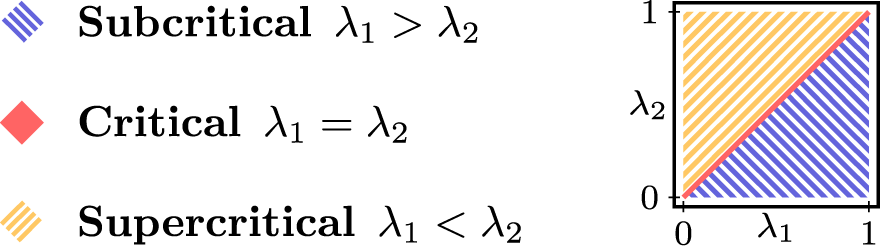


 Open access

