


In today’s digital economy, the fiercest battles are no longer fought on factory floors or in research labs but, according to Beckert (Reference Beckert2016), waged in the realm of imagined futures. ‘Because decisions about innovative activities are themselves creating the future’, Beckert (Reference Beckert2016, p. 170) writes, ‘competition in capitalist economies is in no small measure a struggle over imaginaries of future technologies’. This chapter explores a crucial yet often overlooked aspect of this struggle: industry analyst rankings. As hyped expectations blur with formal assessments, rankings have become strategic battlegrounds where the future is not just predicted but actively shaped. Vendors are no longer just constructing promissory narratives to sell products – they are developing narratives to shape the very criteria, narratives and categories by which their products are judged.
We live in a ‘society of rankings’ (Eposito & Stark, Reference Esposito and Stark2019). Organisations are required to respond to increasing numbers of rankings, ratings, and other reputational indices (Espeland & Sauder, Reference Espeland, Sauder and Espeland2016; Pollock et al., 2019). The organisational response has been widely studied, with strategies of ‘conformance’ (Martins, Reference Martins2005), ‘gaming’ (Espeland & Sauder, 2007), and ‘lobbying’ (Wedlin, Reference Wedlin2006) foregrounded. In recent years, the conversation has shifted from considering the issue of organisational change towards understanding how rankings create rivalry effects. Scholars are providing increasing empirical evidence of how rankings form new ‘competitive battlefields’ (Kornberger & Carter, Reference Kornberger and Carter2010), which include intensifying existing competitive relationships (Brankovic et al., Reference Brankovic, Ringel and Werron2018) and creating new rivalries (Mehrpouya & Samiolo, Reference Mehrpouya and Samiolo2016). It is also conjectured that competitive rivalries may be shifting more generally from those between products and services in the market to those being enacted in rankings (Karpik, Reference Karpik2010; Kornberger, Reference Kornberger2017).
If, as proponents argue, rivalry today is played out as much through rankings as any other means, then this requires the reconsideration of competitive strategies. However, research sheds little light on how the effects of competitive rivalry stemming from rankings unfold at the strategic level (Arora-Jonsson et al., Reference Arora-Jonsson, Brunsson and Hasse2020). Even though studies intimate that rankings engender significant shifts in strategy practice (e.g. Rindova et al., Reference Rindova, Martins, Srinivas and Chandler2018), the literature remains somewhat narrowly focused on identifying ‘gaming strategies’, defined as ‘symbolic responses’ located at the ‘margins of organisational practice’ (Sauder & Espeland, Reference Sauder and Espeland2009, p. 77).
To explore this issue, we provide a rich empirical account of the way a group of digital economy vendors engage with rankings. The rivalry effects surrounding rankings in the digital economy perhaps represent an extreme case (Eisenhardt, Reference Eisenhardt1989) in that this sector has evolved characteristics and mechanisms that propel ranking-based competition, which may not, at least not yet, be as evident in other ranking fields. However, such cases throw significant dynamics and practices into stark relief that might invite comparison and inform theorising. We show that digital vendor organisations respond to rankings not just to improve their own ranked positions but to weaken those of a competitor. These strategic practices include leapfrogging a rival, de-positioning a competitor, owning the market, and encouraging a breakout, which together make up what we theorise as ranking strategy, defined as a set of strategic practices that actors engage in to shape rivalries.
8.1 How Rankings Create Rivalry Effects
The argument that rankings facilitate and promote rivalries between organisations predates current discussions (Karpik, Reference Karpik2010; Kornberger & Carter, Reference Kornberger and Carter2010; Mehrpouya & Samiolo, Reference Mehrpouya and Samiolo2016; Kornberger, Reference Kornberger2017). Early studies laid the foundation for a view of rankings as more than just ‘signals’ that brought attention to organisational actions, accomplishments, and prospects (Fombrun & Shanley, Reference Fombrun and Shanley1990, p. 234). Because rankings provided ‘definitions of success’ (Rindova & Fombrun, Reference Rindova and Fombrun1999, p. 700) and facilitated competitive benchmarking, it became evident that they could go beyond signalling an organisational competitive position to encouraging the organisation to compare itself to others. In particular, studies noted how rankings created ‘exemplars and role models’, which could then inform ‘strategic planning’ (Rindova & Fombrun, Reference Rindova and Fombrun1999, p. 700). Though the potential of rankings to do more than simply represent competitive rivalries was recognised in early work, it is only in more recent studies that the consequences of bringing organisations into the same evaluative space have been foregrounded.
It has been argued that ‘comparability leads to competition’, that is to say, what was supposed to be a ‘descriptive measure’ providing information about quality of a product or service ‘tends to become an assessment that puts it in competition with other items’ (Esposito & Stark, Reference Esposito and Stark2019, p. 7). For example, in one of the first explicit formulations of how rankings create rivalry effects, Wedlin (Reference Wedlin2006) showed how the introduction of MBA rankings augmented existing competition between rival business schools (p. 11; Sauder, Reference Sauder2008). Kornberger and Carter (Reference Kornberger and Carter2010) further developed this idea in their discussion of Anholt’s City Brands Index, arguing that rankings not only enhanced but also created new forms of rivalry (p. 236). They demonstrated, for instance, how the cities of Sydney and London had become rivals, even though they had not previously considered themselves in competition with one another.
Recent empirical work has directly shifted attention from how competition appears as an unintended consequence of rankings to how rankings can be purposefully designed and introduced to create and operationalise competitive rivalries. For example, Mehrpouya and Samiolo (Reference Mehrpouya and Samiolo2016) discuss that ‘inciting competition’ between drug companies was the ‘programmatic ambition’ of the Access to Medicine Index (p. 13). Brankovic et al. (Reference Brankovic, Ringel and Werron2018) theorise university rankings ‘as tools used by third parties to construct competition’, which, through their ‘repeated publication’, can ‘create a continually shifting environment for universities’ that creates and maintains an ‘audience’ hungry for ranking products to understand the changing environment (p. 9).
In short, studies support the idea that rankings are implicated in the rivalising of organisations because they influence the scope and depth of the competitive dynamics between them (Mehrpouya & Samiolo, Reference Mehrpouya and Samiolo2016; Esposito & Stark, Reference Esposito and Stark2019). This has led some to speculate whether rivalries arising as a consequence of rankings might equal, or even outstrip, those enacted in other ways, such as through the launching of new products, entering one another’s markets, and attempting to wrestle away customers (see Kilduff, Reference Kilduff2019, for a review). Scholars argue, for instance, that competition is shifting from confrontation between products and services to confrontation in and through rankings (Karpik, Reference Karpik2010; Kornberger, Reference Kornberger2017). This raises an important question: if rankings engender rivalising effects, does it mean that organisations will deploy specific strategic practices in response (Rindova et al., Reference Rindova, Martins, Srinivas and Chandler2018)?
8.2 How Organisations Respond to Rivalry Effects
Despite growing interest in the rivalry effects created by ranking, how organisations respond to these effects remains poorly understood. Studies have focused on the pressures’ rankings generated within organisations but less on those between organisations (Elsbach & Kramer, Reference Elsbach and Kramer1996). For instance, prior work has shown how rankings are ‘engines of status anxiety’ that ‘incentivise’ ranked organisations to ‘focus their efforts on improving their relative position’ (Sauder & Espeland, Reference Sauder and Espeland2009, p. 74). Although discussions vary on how organisations might progress their position, they commonly coalesce around a few key strategic moves. One common response discussed in the literature is conformance with the criteria imposed by the ranking. As Martins (Reference Martins2005) suggests, conformance is a widespread response because rankings ‘push organisations to change in accordance with the criteria used by the rankings’ (p. 715).
Another common response is that of gaming the ranking to maximize one’s position (Corley & Gioia, Reference Corley and Gioia2000). Gaming responses are often depicted as ‘symbolic’ and include efforts at ‘managing appearances’ (Espeland & Sauder, 2007, p. 29). Where with a conformance response we would typically expect the shifting of the organisation and its practices towards those imposed by the ranking, gaming strategy includes attempts to ‘improve ranking factors without improving the characteristics the factors are designed to measure’ (Espeland & Sauder, 2007, p. 29) and to ‘manipulate appearances in ways that leave internal practices intact’ (Sauder & Espeland, Reference Sauder and Espeland2009, p. 77).
Whilst gaming is a more proactive concept than conformance for understanding how organisations mitigate the pressures brought about by rankings (Sauder & Espeland, Reference Sauder and Espeland2009), less is known about how rankings might provide organisations with a competitive opening and how they might capitalise on that opportunity (Rindova et al., Reference Rindova, Martins, Srinivas and Chandler2018). Moreover, because gaming is a concept that turns attention towards symbolic responses, it also suggests a decoupling between ranking regime and organisational practice. For instance, Sauder and Espeland (Reference Sauder and Espeland2009) indicate a dilemma between internalising (conformance) and externalising (gaming). They discuss decoupling taking place via gaming strategies but also stress ‘tight coupling’ between ranking and those ranked, leading to internalising pressures and (Foucauldian) self-discipline within organisations, and subsequently organisations oscillating between two unreconcilable and extreme responses.
Indeed, recent studies suggest conformance and gaming are only some of the possible strategies adopted (Brandtner, Reference Brandtner2017; Pollock et al., Reference Pollock, D’Adderio, Williams and Leforestier2018). This marks the point of departure for our chapter: if one accepts that rankings are increasingly central for competition, then they are likely to provoke a whole set of nuanced, differentiated strategic responses (Rindova et al., Reference Rindova, Martins, Srinivas and Chandler2018). Indeed, some have begun to differentiate forms of strategic agency, defined as the organisations’ ‘capacity to cope with and influence’ rankings (Kornberger, Reference Kornberger2017, p. 1753). Other studies mention how a ranked organisation might embark upon a process of ‘lobbying’ (Wedlin, Reference Wedlin2011, p. 205) or ‘petitioning’ (Chelli & Gendron, Reference Chelli and Gendron2013, p. 200). Likewise, some have argued that increasing numbers of professionals, such as public relations (PR) experts, have become involved in the process, suggesting that rankings are ‘prone to manipulation’ (Sauder & Fine, Reference Sauder and Fine2008; Rindova et al., Reference Rindova, Martins, Srinivas and Chandler2018, p. 2191). Recent research suggests the need to develop a more fine-grained, systematic, and empirically grounded understanding of the strategic practices that organisations use to engage with rankings. Thus, in this chapter, we ask: what strategic practices are employed by organisations to improve their competitive position vis-à-vis a rival in a given ranking?
8.2.1 A Note on Rankings
The most important ranking in the digital economy is the Magic Quadrant (Pollock & Williams, Reference Pollock and Williams2016). Produced by Gartner, it has become the key ‘battlefield’ between vendors (Gyurko, Reference Gyurko2009). This is because technology buyers foreground this ranking over all other information sources. It is common, for instance, for buyers to draw up their shortlists solely based on those vendors appearing on this ranking (Gyurko, Reference Gyurko2009). Made up of four quadrants, labelled Leaders, Visionaries, Challengers, and Niche Players, those placed further to the right are seen to have more ‘complete visions’, whilst those placed towards the top have an elevated ‘ability to execute’ on that vision (see Figure 8.1). In his popular book Up and to the Right, Stiennon (Reference Stiennon2012) encourages vendors to do everything not just to get into the Magic Quadrant but to be placed in the top quadrant as ‘being one of the three or four vendors in the Leaders Quadrant almost guarantees your inclusion in product selection process’.

Whilst, as we will show, competitive rivalries between vendors are increasingly played out on the Magic Quadrant, inclusion in the ranking is influenced by contradictory impulses. There is, first, a ‘scarcity’ (Brankovic et al., Reference Brankovic, Ringel and Werron2018) of potential ranking positions. Rather than being produced in the common format like ordinal scale tables, it is a practice or convention in the digital economy that rankings are graphical, constructed to be ‘visually appealing’ and never ‘overcrowded’ lest this makes them difficult to read. Magic Quadrants, therefore, normally contain between twenty and twenty-five vendors, as compared with twelve to fifteen vendors respectively for Forrester Waves and Decisionscapes (Pollock & Campagnolo, Reference Pollock, Campagnolo, Kornberger, Justesen, Madsen and Mouritsen2015). One consequence is that they can only ever capture a small fraction of the market, which means that in particularly buoyant technology markets where there might be hundreds of vendors vying for inclusion, competition for entrance can be fierce (Pollock & D’Adderio, Reference Pollock and D’Adderio2012).
Second, rankings in the digital economy lack an ‘ultimate quality’ (Davies, Reference Davies2016). There are now hundreds of different Magic Quadrants, Waves, and Decisionscapes in circulation, each capturing a different technology category or market, but, due to innovation, this number is changing all the time as new ones are added and older ones retired (Gyurko, Reference Gyurko2009). In a study tracking the longevity of Magic Quadrants, for instance, it was shown that many last as little as twenty-four months before they are either withdrawn or reconfigured (Pontikes & Kim, Reference Pontikes and Barnett2017). This means that if a vendor does not make it onto a ranking, it may find further opportunities to enter just a few months later in a new or updated version. Likewise, for those having successfully secured a placement, this might only be temporary as their ranking could well be retired or adapted down the line.
Taken together, these two factors have engendered in digital vendors the understanding that while the ranking environment is high stakes, it is also highly volatile. This has required them to take major steps to help manage their response to rankings, including creating the expertise of analyst relations. Analyst relation (AR) experts have done two things: they (directly) foster the rivalry effects surrounding rankings through directly helping organisations respond to rankings by providing them with information about analysts and strategies to approach them, but they also (more indirectly) nurture and intensify the idea that rankings have become the key competitive battlefield where rivalries are played out.
8.3 Responding to How Rankings Create Rivalising Effects
Existing research suggests that rankings do not merely represent competitive rivalries between organisations but have also become new spaces of rivalry (Karpik, Reference Karpik2010; Kornberger, Reference Kornberger2017). The goal of this chapter is to understand how ranked organisations respond to the fact that rankings create rivalising effects. What we add to the literature is a detailed analysis of how this new space is animated through various strategic practices. During fieldwork, we observed the intensity of competition that can emerge just before and shortly after the launch of a new ranking. Vendors that appeared near or above another ranked organisation were increasingly treated as close competitors. Progress against rivals was measured in terms of movement within the ranking. Before describing the practices organisations take against rivals, we first set out the internal vendor strategies used by ranked organisations to engage with rankers.
8.4 Internal Vendor Strategies to Engage Analysts
In this section, we demonstrate that as rankings have become increasingly important for competitive positioning, vendors have sought to establish closer relationships with analysts. As we saw in Chapter 4, analysts already probe and reshape emerging venture narratives; here, established vendors institutionalise those interactions through dedicated AR teams. The rankers, in turn, appear to require similarly close interactions with vendor AR teams.
8.4.1 Battle That Goes on Internally
In the digital economy, vendors and rankers often cultivate unusually close and ongoing relationships – closer, in fact, than those typically found in other sectors. From the point of view of the ranked organisations, it is the AR expert who is tasked with leading and coordinating the response. The AR expert will attempt to build ‘personal relationships’ with individual analysts, which includes engineering periods of ‘social time’, often ‘over a meal’ or ‘drink’ (Webinar 1). An experienced AR expert describes the need for this relationship building: ‘You need to know what are the characteristics of these analysts: Are they approachable? Are they people who we have a strong relationship? And exactly how am I going to work with these analysts?’ (Webinar 1). Such interactions enable the gathering of information not yet publicly available, including whether the ranker is currently considering introducing a new ranking and which vendors they are considering including within it. An AR expert describes how, when the analyst approaches their organisation for a ‘briefing’ on a new technological topic, they typically respond positively, even though they may lack the necessary information. He hopes to gain further insights about upcoming rankings:
If the analyst asks you something, for instance, [she is] researching on bitcoin currency, ‘Do you cover that?’ ‘Yes’. ‘Could you brief me on that?’ ‘Yes’. You should always ask why and then see where that fits in. ‘Why?’ ‘Because my client’s asking’. ‘Why?’ ‘Because I’m researching about it’. ‘When are you going to publish it?’ ‘Why are you going to publish it?’ and so on.
The analysts, in turn, were not naive about these kinds of interactions. They knew the AR expert would probably subject them to some pressure or even try to change what they were thinking. Analysts told us how such advances could occur in the baldest of ways:
It is in their interests … to influence it basically. In fact, they call it ‘influencer marketing’ …. So that is what they care about. If you ask a vendor AR person, what they ask the analyst …. ‘Is there anything with our name on?’. ‘Yes, that one there in about three months’ time’. ‘Right, OK. That is what I need to plan for’. So, they don’t care about anything else that I am writing about… They care about: ‘Is our name going to be on that document?’. ‘Right, what do we need to do to stop you saying anything bad about us?’ So, it is a PR exercise. So that is the battle that goes on internally.
Surprisingly, perhaps, the rankers were not disdainful but open to these kinds of channels. This was because they, too, benefited. Analysts informed us that they required ‘regular contact with the vendor’ (A2, interview) because the ideas and information exchanged would help them interpret the direction of complex and fast-moving technologies and markets, which was particularly useful in the research they produced for their clients and in emerging or evolving markets. Analyst informants confided to us that the more interactions they carried out with ranked organisations, the better their own client insights. Some even lamented how AR experts would limit access to other ranked organisations by acting as gatekeepers: ‘Obviously an analyst would love to have diary access to [vendor] executives and many things. So, at times, AR can be a positive, be almost an interface conduit into an organisation, but also, can be almost a gatekeeper’ (A3, interview).
What we see here is that fostering interactions was in the interests of all parties concerned. In the sections that follow, we demonstrate that these close relationships enabled ranked organisations to influence the shape of rankings.
8.4.2 Tools to Influence a Ranking
Influencing a ranking requires mustering more than one skillset. Ranked organisations have developed an understanding of the process of creating and building opportunities for changing an analyst’s opinion, and AR experts have created formal methods for achieving this. We listened to many AR experts as they described the various instruments they had at their disposal: ‘How do I use all the tools within my toolbox in order to change that analyst’s opinion? So, that’s what we call “AR 1.01,” that’s what we do day in and day out’ (Webinar 2). These tools were not vendor-specific but similar across the ranked organisations studied.Footnote 1
The first step was to initiate the process of shaping a ranking well in advance of publication. For instance, a document on influencing rankings describes how: ‘Building credibility with a [ranker] is a process that can take years’ (Internal document 1). Seasoned AR experts would gently admonish more junior colleagues who thought improving a ranked position could be done immediately. As the document goes on to say: ‘Many AR managers are tasked with the challenge to move [up the ranking] in the timeframe of a year …. Anyone who’s looking for a quick jump [upwards] clearly is confusing AR and PR’ (Internal document 1).
Another tool was to understand specifically ‘who’, that is to say, which analyst was to be influenced. An AR expert tells an audience: ‘Don’t think of [the ranking organisation] as “a firm” but think of it as the “individual analyst,” and the relationship that you’re trying to build with that analyst’ (Webinar 1). However, many rankings are constructed by teams, with each team led by an analyst, as well as those who play other roles, such as data collection. A document unpacks the key interactions that need to be taken around the lead:
Identify the analyst who leads the creation of [the ranking], (they do change), and engage the analyst to learn more about the criteria used for vendor evaluation in previous [rankings]. Engaging the analyst in a discussion, (e.g. a briefing or phone inquiry), should uncover any possible changes in the planned criteria for a forthcoming report.
A further tool was identifying those aspects that might be influenced. AR experts typically interrogated analysts around a core set of questions: ‘What is their set of assumptions? What [are] their criteria? What’s their scoring mechanism?’ (Webinar 1). A final, and perhaps critical, question was: ‘What [do] they think about you?’ (Webinar 1). These were the aspects AR experts anticipated they might be able to change. Analysts are increasingly open about evaluative criteria and publicise this information on websites.
Another part of the toolbox was to be judicious about which point in the lifecycle of a ranking to apply pressure. It was commonly understood, for instance, that there were more opportunities to influence the ranking at the birth stages of a new technological phenomenon or market. This aligns with our Chapter 3 argument that early-stage hype periods are when vendors must act, treating hype peaks as opportunities for influence. This is when the ranking is being put together. As this analyst describes:
The interesting bit is when a market is in flux, when it is in the first year or two. After a while, after two or three years, it is pretty much understood on both sides. And [the ranking criteria] will nudge around a little bit, and the analyst will weight it slightly differently each year, move things around a bit each year, to try and reflect what they think is going on.
AR experts recognised how, during the initial stages, ‘Very radical shifts can occur in both the underlying assumptions and the [ranking] criteria’ (Webinar 1). But they also expressed uncertainty about whether and how to approach the analyst. It was recognised that, on the one hand, ‘Sometimes [analysts] don’t want to tell you about [the ranking criteria] because they haven’t got it thought out in their head’ (Webinar 1). On the other, informants saw how this offered opportunities: ‘It’s actually not a bad idea [to approach the analyst] because if it’s not thought out in their head, you have a chance to potentially influence it. If it’s really firm and firmly set in their head, those are the ones that are going to be more difficult for you to change’ (Webinar 1).
Certain AR experts had determined that it made sense to approach an analyst at a particular moment or ‘season’. The ‘on’ season is the period just before the launch of a ranking when most if not all of the decisions about ranking criteria have been taken; the ‘off’ season, alternatively, is the period following the ranking launch and before the work for the new, annually updated ranking has begun:
At [AR Agency] we’re constantly trying to figure out methodologically speaking what we do to make the biggest impact and what we found is… You must also run your ‘off-season’ well. So, I just want to introduce this word and this concept and talk a little bit about it …. The reason why we call the off-season is, just this straightforward sports analogy, champions are made in the off-season. By the time the game starts, you’ve already lost a huge opportunity to make a difference.
This informant stressed that: ‘This off-season we believe is the best time to shape criteria. It is the best time to change weighting and it’s the best time to completely inform the analyst about changing their perception about what they think about you’ (Webinar 2). The AR expert goes on: ‘During this off-season, it is the best time to say, “Hey, can I ask you to think about the problem in a different way?”’ (Webinar 2).
We have provided evidence that vendor organisations have developed sophisticated internal expertise and strategies to respond to the new competitive battlefield tendered by rankings. Changing a ranked position was a very real possibility in these circles. Our informants sought to improve their own organisation’s ranked position. In addition, they indicated that they were increasingly in a situation where they could influence the ranking of a competitor. We now turn to describe the various strategies they deployed to do this.
8.5 Strategic Practices Organisations Take against Rivals
Vendors were as focused on each other’s ranked position as they were on their own. A seasoned AR expert described how it had become like a ‘chess game’ (Personal email). The goal was not simply to work out your own response, but it required ‘anticipating competitors’ moves’ (Personal email). According to this informant, there was a ‘widespread and constant chess-game of one vendor trying to de-position a competitor by supplying the analysts with information, insights, and intelligence that puts the competitor in a bad light’ (Personal email).
Analysts also deployed similar kinds of analogies to describe how vendor organisations were attempting to organise the competitive encounter through them: ‘The vendors know exactly how the game is played, and they are “using” the analysts’ (Analyst 1, interview). He tells us what ‘using the analyst’ means:
It is an interesting two-way battle. The firms don’t talk to each other, the vendors – not in a direct fashion, they might off the record – but they are working through the analyst and trying to pull it a little bit in their direction, of course, how we view their products. We are aware of that. We are aware that we are being manipulated to some degree.
The competitive encounter between organisations has today been extended onto the new terrain of rankings. As this analyst informant sums up: ‘That is where the conflict comes, on those documents, and [rankings] are the epitome of those conflicts’ (Analyst 1, interview).
This extension of the competitive encounter onto rankings has also propelled the rise of a new, powerful strategic actor. This AR expert can claim a tactical role (as opposed to a mere technical assistance or professional expertise) because they control, or promise to maintain, these relevant ‘zones of uncertainty’ (Friedberg & Crozier, Reference Friedberg and Crozier1980). Because, in this study, rankings were channelling the encounter between competitors, it was recognised how their practices could become strategically important. Some saw the AR expert role as merely about arranging meetings with rankers, described pejoratively as a ‘diary booking service’, but there was also a growing sense that this actor could, or should, be ‘driving strategy’ (Internal presentation 1). Some advocated for how the AR expert was in a position to leverage, ‘the unique insights of the industry analysts within their value chain to drive superior strategy’ (Internal presentation 1), to work upstream and, ‘support the explanation of a business strategy’, to ‘assist with short- and long- term planning’ (Internal document 2) and, to offer the organisation a significant ‘competitive advantage opportunity’ (Webinar 1).
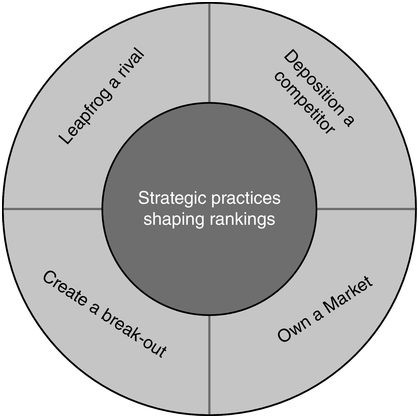
But what are the concrete strategy practices through which organisations engage with rankings? In Figure 8.2, we summarise the different ways an organisation might attempt to counter a competitor through a ranking. First, vendors enacted strategic practices to leapfrog a rival. Second, vendors deployed strategic practices to de-position a competitor. Third, vendors enacted strategic practices to shake up an area by creating a breakout. Finally, there were strategic practices that allowed a vendor to set the rules of the game or own the market. We will now describe these practices in more detail.
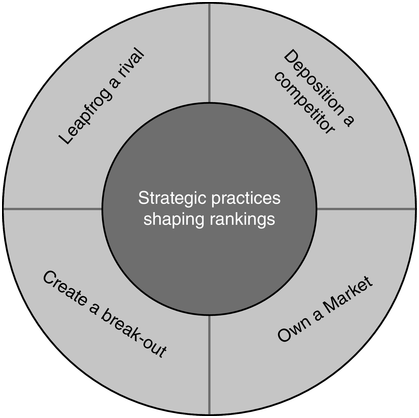
Figure 8.2 Long description
The diagram has two concentric circles. The inner circle is labelled, strategic practices shaping rankings. The outer circle is divided into 4 equal parts, each labelled with a strategic practice. The labels in the clockwise order are as follows: Deposition a competitor, own a market, create a breakout, and leapfrog a rival.
8.5.1 Strategic Practices to Leapfrog a Rival
Vendors embraced strategies to leapfrog a rival – to push, as one informant described, a ‘competitor’s dots either down or to the left or both’ (Webinar 1). This meant practices were not simply conceived of as stratagems for improving one’s own position but were imbued with the sense that you could make a move against a rival organisation. For instance, an AR expert advises others on the different ways they might go about leapfrogging a rival: ‘Now, if you’re on the [ranking] … where do you fit in comparison to your competitors, to all the other people …?’ (Webinar 1). If a vendor finds itself unable to move itself up, the advice given is to consider how it might push its competitors down. The reason being: ‘If I had the ability to push my competitor down, then by inference, I’ve pushed myself up’ (Webinar 1). This particular AR expert goes on: ‘If I happen to have a competitor who’s in the [top spot on the ranking], what can I do to de-position them, move them into the [bottom spot] and perhaps put myself into the [top spot]?’ (Webinar 1).
To push a rival down, a vendor organisation will apparently supply analysts with information ‘that puts the competitor in a bad light’ (Webinar 1). An analyst talked us through such a scenario. Here, the vendor was briefing him on their own products but took the opportunity to criticise a rival:
When we are preparing a [ranking], when we are having interactions with the vendors, we have to have regular contact with the product managers and the product leaders …. Obviously, in those sessions, they’ll be saying, ‘I can’t believe that you’ve got [rival 1] here or you have got [rival 2] here [on the ranking]? You know they are complete rubbish. You know that we have just won this customer from them who had to throw them out because they were completely useless’. So, we get that all the time, you know. They are constantly hectoring us and badgering us and saying: ‘You really don’t know what is going on out there.’
There was the very real possibility that a rival was working to highlight your weaknesses, which ‘could impact your dot’ (Webinar 1). An informant gives an example where a rival successfully argued for a modification to the ranking’s original evaluative criteria, which saw his organisation ‘drop’ to a weaker position:
I was [well placed] in the original [ranking], and actually not too bad a position [in the top spot]. But because the criteria changed in the new release …. Not because I changed, but because the way in which I’m being measured has changed, I’m suddenly dropped to a [lower] position, indicating, for example, that I don’t have the [attributes] anymore that [the ranker] has now put into the criteria for this [ranking].
Informants recounted anecdotes about vendors who had become complacent after moving into the top position. Successfully moving up in a ranking could apparently motivate a rival, especially a close competitor, to double its own efforts to ‘de-position you’:
I did have a client once say, ‘We have moved into the [top] section, on the [ranking]: we’re done!’. And that’s a really important thing to understand, that to say, ‘You’re done’, and not move ahead can be very, very dangerous. Because remember, your competitors are trying to de-position you. So, one of the reasons why we see vendors fail is that they’re not staying on top of these evolving criteria and assumptions and they didn’t continue to improve the communications with the analyst.
The work of analyst relations is both a matter of improving your own position and stopping a rival from leapfrogging you. This comprised the reflexive task of paying close attention to others’ practices, including carrying out research to understand a rival’s knowledge or expertise of rankings. There were several tell-tale signs to indicate a rival’s preparedness and ability to influence a ranking. For instance, an AR expert advises organisations to: ‘Go out and look to see if your competitors have posted any of these [rankings] as reprints’ (Webinar 1). Buying ‘reprints’, which would cost several thousand pounds, not only allowed a ranked organisation to advertise its improved placing to a prospective customer but would also indicate: ‘[Their] understanding of [ranking strategies], and their level of influence, and likewise, how much effort they may be putting into trying to change [rankings] as well’ (Webinar 1). In these settings, such skills and knowledge provided vendors a competitive edge, especially if rivals did not yet possess these skills.
8.5.2 Strategic Practices to De-Position a Competitor
There were many ways to dent the ambition or progress of a close competitor, but none was as damaging as ‘killing-off’ their ranking. An ex-analyst told us, rankings ‘do have a life’ and that over time they ‘become stale’, such that they ‘Eventually become killed off or they morph into something very different’ (A5, interview). Killing-off a ranking was not common as a competitive strategy for vendors and their AR advisors, as it required very high levels of expertise and detailed knowledge of the inner workings of analyst firms. An AR expert described how: ‘[The ranker] does retire old ones and create new ones …. Working with the analyst that has two [rankings], you might be able to alter the characteristics. Working with an analyst that has lots of [rankings], you might be able to kill a [ranking]’ (Webinar 1).
Why might an organisation attempt to kill-off a ranking? A vendor might be incentivised to attempt this when its rival is dominating a ranking in the hope that it would fare better under a new category that would be formed to replace the retired one. One AR expert told us how its main rival was ranked in the top section on one ranking, but his organisation was in the bottom section. When his efforts to reverse the position proved unsuccessful, he set about an alternative strategy:
[The ranker] had two [rankings] for [technology]: One for [product 1] and the other for [product 2]. My employer … was consistently a leader in the [ranking] for [product 1], but [in the bottom section] in the [ranking for product 2]. Not for lack of trying or significant Research and Development investment, but [my organisation] did not have a snowball’s chance in hell of catching the [best placed vendors] on the [product 1 ranking].
Our informant brought together evidence to convince the analyst that the initial market specialisation, which warranted two rankings, had been replaced by more encompassing ‘multi-product’ vendor solutions, which required just one ranking. He goes on to explain:
So, I worked to get [the ranker] to create a new [ranking] focused on [Multi-products]. It worked! For the 2016 [ranking] refresh cycle, [ranker] retired the two legacy [product 1 and 2] rankings, 2015 was the last year of publication, and launched a new [ranking] for [Multi-product Solutions].
This was highly beneficial as he recounts: ‘For all three years, [my organisation] has not just been a leader on this [ranking], but the clear leader’ (Personal email).
Encouraging the retirement of a ranking could have significant disruptive effects. Analysts told us that killing-off a ranking: ‘Does make vendors very angry’ (A1, interview). Often, this is because it means their products are no longer visibly part of the market of offerings. As one ex-analyst describes: ‘Vendors often take the view, “Oh my God! What are we going to do?” There is no [ranking] for us to use as our main mouthpiece’ (A5, interview). The same informant goes on: ‘If the [ranking] goes away, it is going to hurt. We are not pretending it won’t. If you’re a leader in a [ranking], it is definitely going to win you business. And you will have to find new ways to make up for the loss of that [ranking]’ (A5, interview).
We also came across less obvious effects from killing-off a ranking. For instance, it was not just that vendor products lose their visibility in the marketplace, there could be other more ‘in-house’ implications. Apparently, ‘at many vendors, [rankings] have more impact internally than externally’ (Internal document 3). As an AR expert explained, if a particular vendor product was well-positioned in a ranking, the particular internal ‘business unit’ producing it would typically be held in high regard. The reverse also seemed to be true:
Imagine an organisation like [Vendor A] or [Vendor B] for whom it is very important that they are the number one or number two in every market, using the [ranking]. Imagine you are running a line of business inside an organisation and the [ranking] maybe might close. That will be a disaster for you because your work currently is feeding up to some corporate scorecard where the organisation strategically is trying to align its resources to the organisation’s performance in [rankings].
Because rankings are often used as internal performance measurement systems, this means that if killed off, the performance information about the specific product no longer feeds into or makes a difference to more organisation-wide measures. From then on, as our informant points out, ‘Your performance doesn’t matter to your boss in the same way’ (AR2, interview). As a result, that part of the business could be treated differently: ‘And if one [business unit] stops being in the [ranking] … you are going to have nine most important business units rather than ten’ (AR2, interview). Potentially, as this informant makes clear, this could mean that the ones, ‘No longer in [rankings] will be spoken about differently. They will be spoken about as “mature organisations”; they will be treated like “cash cows” rather than “growth markets”’ (AR2, interview). It was not uncommon, we were told, for an organisation to ‘retire’ a product if its ranking was killed off.
8.5.3 Strategic Practices to Own a Market
There were several strategic practices that a ranked organisation could potentially ‘own a market’ (Webinar 1). Owning a market could be enacted through lobbying for a new ranking or market category. An internal document explains how ‘categories are vital to validating a technology’s value to companies’ as they make it ‘possible for buyers to understand where different solutions fit, and help vendors to reduce confusion about whether their solutions complement or replace others’ (Internal document 3). The document goes on: ‘In the same way that technology vendors co-create industry standards, influencing categories is crucial for the success of firms that are leading markets, and thus might not fit pre-existing schemas’ (Internal document 3). Creating a category ‘could be done within [rankings]’ (Webinar 1).Footnote 2
For instance, one AR expert describes how he played a role in how a ranker viewed and created its ‘Web Services’ category and ranking: ‘It was before Web Services was the big area it is now, and it sort of changed in its definition slightly’ (AR3, interview). Creating a new ranking or category was potentially highly advantageous. As an internal document describes: ‘Because few firms attempt it seriously, the benefits accrue massively to those who do’ (Internal document 3). As another AR expert explained: ‘You can own a market if you redefine the category, so you’re the leader’ (Webinar 1). It meant, for instance, that everyone else, that is to say your rivals, must compete according to the criteria in which you have had a hand in shaping: ‘You’re unique in this category; everybody else is an also-ran. And you’re going to be the leader’ (Webinar 1).
Category creation campaigns represent a significant endeavour, however. They take a long time, possibly up to ‘one or two years’ (Internal document 3) and require ‘extensive, prolonged investment’, ‘serious executive commitment’ (Internal document 3), and high levels of knowledge and expertise. In shaping the Web Services category, for instance, the AR expert drew upon his understanding and often direct involvement in the practices of ranking organisations to craft his interventions in a way that resonated most strongly with the ranker. As the AR expert describes:
And with analysts we have to educate them to say, ‘No, we are actually looking at things differently’. And we have managed to get them to change the way they approach the scenario. It is harder, you have to get some metrics to get them to change the way they think. But it can be done, and I have done it.
Our AR informant understood the internal processes for ranking creation. This includes establishing that there is a market with enough players for the ranker’s work of assessment to be pertinent to its own clients: ‘We knew that for it to become a [ranking] in its own right it had to have a certain amount of revenue within it, it had to have a certain number of vendors competing within it, lots of different scenarios’ (AR3, interview). The AR expert supplied this information: ‘And it worked. They actually developed a new way of looking at things’ (AR3, interview).
8.6 Strategic Practices to Encourage or Exploit a Breakout
A final strategic action is to try to encourage or exploit a breakout. Ranking breakouts were highly disruptive and could have complex consequences. They could place an incumbent under pressure and also provide vendors previously excluded from a ranking the opportunity to enter. We encountered two types of breakouts: geographical breakouts and technical breakouts. They resemble the disaggregation of hype fields we described in Chapter 6, where splitting categories (such as geographical or technical breakouts) creates new hotspots of attention.
Geographical breakouts are where a global ranking is divided into multiple regional versions. Large incumbents tend to dominate international rankings since they sell into numerous geographical markets. However, it was also these vendors who could be most negatively impacted by a breakout, as they are not automatically included in all new regional rankings unless they have a physical presence in the region. As an AR expert describes: ‘Imagine you have a global market segment that shows [a French vendor] as the world’s number six IT firm, and shows [a Japanese vendor] as being the world’s number two IT firm, and you segment that into North America, Europe and Asia’ (AR3, interview). What happens then is that these vendors who ‘are in the top 10 of IT firms globally’ might ‘just disappear off the North America [ranking]’ (AR3, interview). If this happens, these vendors will then find it difficult to sell into the North American market and could be forced into quite radical action, such as striking partnerships with vendors in North America.
Technical breakouts are where a product covered in one ranking is divided into several more specialised versions. For instance, we observed the case of a ranking for security software which went from one to eight rankings overnight. Technical breakouts put incumbents in difficulty because their products are now subject to more scrutiny. According to this informant, this offered a rival the potential to highlight weaknesses:
If you have got [IT security] solutions that are able to do the core things, [but] there are eight [rankings] now. Let’s say that there are eight things that these solutions could do, but probably most of them will only be really, really excellent at two or three of these pieces of functionality. They won’t need to be great at all of them. But suddenly you break it out into separate [rankings] and then it becomes visible that you are weak.
Breakouts could be used to identify weaknesses or gaps in a rival’s solutions, which could then be brought to the attention of buyers and others. As this informant describes: ‘Suddenly you break it out into separate [rankings] and then it becomes visible that you are weak and then that becomes a “proof point” for your competitors’ (AR3, interview). Our informant describes how these proof points could be used in sales discussions. A prospect is interested in a rival vendor, but despite being well-positioned in the original IT security ranking, it is not ranked in the new ‘Firewalls’ ranking. The vendor makes the prospect aware of how its rival is absent from the ranking and its imputed deficiencies: ‘You are using a Firewall System, a system that doesn’t have Intrusion Detection. And OK, at the moment, you are not worried about Intrusion Detection. But what if you do become worried about Intrusion Detection?’ (AR3, interview). A technical breakout could also prompt an incumbent to implement large-scale remedial measures similar to those described above.
By contrast, for those initially excluded from a ranking, a breakout could be highly positive. As an analyst described, this is because ‘where you have more [rankings], you have more chance of being on one’ (Analyst 1, interview). Similarly, as another analyst describes, the sudden entrance of new rankings ‘provides a stimulus for the vendors to go after the analyst afresh’ (A4, interview). This informant tells us how ‘I will find myself talking with vendors who maybe feel the [ranking] is very unfair to them or maybe they struggle to even get eligibility to even be in a [ranking]’ (A4, interview). Or, as this informant goes on: ‘If you have got a very dated [ranking] that has been there for many years, it probably doesn’t change much from one year to another, the mind-set of the analyst may be closed and myopic as well’ (A4, interview). So, when rankings are broken up this provides openings: ‘The fact is when the analysts are forced to rethink the way they assess the market, they are more open-minded. They are more open to suggestions and ideas’ (A4, interview).
8.7 Discussion: How Rivalry Effects Unfold at the Level of Organisational Strategy
Whilst there is growing evidence that rankings engender competition between vendor organisations (Wedlin, Reference Wedlin2006; Espeland & Sauder, Reference Espeland, Sauder and Espeland2016; Brankovic et al., Reference Brankovic, Ringel and Werron2018), we know little about how such rivalry effects unfold at the level of organisational strategy (Kornberger, Reference Kornberger2017; Rindova et al., 2019). Based on our ethnographic study of how digital vendors engage with rankings, we have provided insights into the strategic practices developed by ranked organisations, not just to improve their own position but to confront rivals and weaken their position. Our data suggests that organisations are making a high number of strategic moves against one another, identified through the field-inspired labels of leapfrogging a rival, deposing a competitor, owning a market, and encouraging a breakout, which together we theorise as ranking strategy. We have defined ranking strategy as the strategic practices developed by organisations to shape rivalries.
8.8 Ranking Strategy
The first strategic practice, leapfrogging a rival, points to how rankings create a ‘system of stratification’, where ‘one [organisation’s] ascent requires another’s descent’ (Sauder & Espeland, Reference Sauder and Espeland2009, p. 77). The second strategic practice, de-position a rival, foregrounds how competitive relations between vendors have become so intense that they might be motivated to invest (often significant) resources to ‘undermine’ a rival’s position (Rindova et al., 2019, p. 2195). Killing-off a rival’s ranking could be beneficial because losing one’s position on a ranking can be a source ‘status anxiety’ as there will no longer be the same certainty about ‘who is on top of the status order’ (Brandtner, Reference Brandtner2017, p. 214). The third strategic practice, own a market, sheds light on how rankings are created in the first place and the role of powerful stakeholders in that process (Rindova et al., 2019, p. 2191). The fourth strategic practice, encourage or exploit a breakout, offered excluded organisations further opportunity to enter or excel on a ranking because in a more ‘plural’ ranking system, ‘there can be more than one winner’ (Brandtner, Reference Brandtner2017, p. 201). These strategic practices demonstrate the professionalisation of hype management. We return to this point in Chapter 9, which frames these developments as part of the shift to ‘tamed hype’ in the digital economy.
Constructing a ranking strategy allowed organisations to modulate the competitive rivalry effects stemming from rankings, which might include increasing or decreasing competitive rivalries. The concept builds on previous studies of rankings, which have also attempted to characterise organisational attempts to have a say in setting ‘the rules of the game’ (Corley & Gioia, Reference Corley and Gioia2000, p. 322) and have employed notions like ‘lobbying’ (Wedlin, Reference Wedlin2006) and ‘negotiating’ (Chelli & Gendron, Reference Chelli and Gendron2013). In so doing, our chapter shares in a general shift beyond the idea of the ranking as a ‘black box’ (Esposito & Stark, Reference Esposito and Stark2019) towards conceptualisations that recognises how, in specific contexts, organisations can form close ‘interactions’ with rankers (Sauder & Fine, Reference Sauder2008; Rindova et al., 2019), which allows them to shape rankings (Pollock et al., Reference Pollock, D’Adderio, Williams and Leforestier2018). In articulating ranking strategy, we do not wish to convey the impression that organisational actors can drive or control a ranking. Instead, the concept sheds light on how they achieved success in moulding the ‘cycle of influence’ (Analyst 6, interview), as the informant put it. In other words, they could establish channels with rankers and provide ideas and information to inform their evaluation process. Previous work in the sociology of markets has noted similar forms of influence around market categories, which, because there is ‘flexibility in how people construct categories’, ‘opens opportunities for category strategy to influence how people conceive of markets’ (Pontikes, Reference Pontikes2018, p. 628).
8.9 Gaming Process Giving Way to Strategic Responses
Our chapter challenges the narrowly focused gaming analysis in which organisations are seen to embark on ‘symbolic responses’ located at the ‘margins of organisational practice’ (Sauder & Espeland, Reference Sauder and Espeland2009, p. 77). Though the notion of gaming remains a valuable concept that illuminates critical resistance to the internalisation of rankings, in suggesting that there is a ‘decoupling’ (Sauder & Espeland, Reference Sauder and Espeland2009, p. 74) between the ranking regime and organisational practice, it inadvertently implies that ranked organisations are accepting of the evaluation regime. That is to say, they attempt to avoid their adverse effects, but they do not necessarily challenge or reshape rankings. We found, by contrast, that ranked organisations, with the help of the new forms of ranking experts described above, were not accepting but attempted to reconfigure the evaluation scheme they were subject to through encouraging the ranker to create, rework, or retire a ranking.Footnote 3 In this respect, we answer calls to throw light on the ‘strategic actions’ undertaken to influence rankings (Brandtner, Reference Brandtner2017; Rindova et al., 2019, p. 12). We also echo recent discussions of the shift from ‘push’ to ‘pull’ stratagems surrounding evaluation and ranking processes, which were initially not thought ‘a priority’ as they bear ‘little relation’ to existing organisational practices but increasingly organisational actors ‘welcome and desire’ them, especially if they can shape and benefit from them (Power, Reference Power2021).
8.10 Rankings Pattern Competitive Rivalries in New Ways
Our chapter offers new insights into the critical question of why organisations might become rivals in the first place (Porac et al., Reference Porac, Thomas, Wilson, Paton and Kanfer1995) and provides indications of how rankings could shape competitive rivalries in new ways (Durand & Paolella, Reference Durand and Paolella2013; Pontikes, Reference Pontikes2018). In this respect, we answer calls by strategy and organisation theory scholars to build an understanding of ‘when and why organisations compete’ (Arora-Jonsson et al., Reference Arora-Jonsson, Brunsson and Hasse2020). As Samiolo and Mehrpouya (Reference Samiolo, Mehrpouya, Ringel, Espeland, Sauder and Werron2021) similarly note, the consequences of competition are studied more often than the conditions that give rise to it. There is also growing interest in understanding whether and how competitive rivalries might die out. In particular, how a situation that has ‘been constructed as competitive becomes uncompetitive’ (Arora-Jonsson et al., Reference Arora-Jonsson, Brunsson and Hasse2020, p. 18).
In the fields of strategy and organisation theory, the question of rivalry has been framed around a discussion of market categories. Our chapter is relevant here because scholars have identified how rankings are a key trigger in category formation (Durand & Paolella, Reference Durand and Paolella2013). But category scholars often approach the study of rivalries as either resulting from managerial cognition or broader institutional and cultural factors. In terms of the former, for instance, Porac et al. (Reference Porac, Thomas, Wilson, Paton and Kanfer1995) argued that the question as to who might be considered a rival was the ‘product of managerial minds’ (p. 224). As for the latter, in discussing the US News & World Report and other rankings, Durand and Paolella identify how it is ultimately ‘audience interpretations’ that decide rivalry (2013). However, we have demonstrated that rivalry is not solely the result of managerial cognition or audience interpretations but is also mediated by and through rankings. There may thus be benefits in exploring rivalry through the practices of engagement that occur around rankings. Studying such strategy practices may offer alternative entry points and open up new possibilities for research on rivalries.
In particular, our chapter not only invites greater integration between discussions of rankings and market categories but also raises the question of whether ranking strategies realise unique kinds of competition. Are rivalries enacted by rankings likely to be different from those surrounding a category? While our insights align with Pontikes’ (Reference Pontikes2018) discussion of how organisations leverage strategy to influence a market category, for instance, our focus on rankings contrasts with her inference that shaping a market category requires organisations to ‘band together’ and pursue ‘collaboration over competition’ (p. 626). For instance, Pontikes (Reference Pontikes2018) argues, ‘sound category strategy focuses on influencing the category boundary such that the firm is in a favourable position with respect to competitors’, but this does not extend to keeping ‘all competitors out of the category’ (p. 625). We show, by contrast, that the competitive rivalry effects surrounding rankings do appear to encourage struggle and confrontation and that organisations actively attempt to exclude their rivals from particular markets.
Moreover, rankings appear to afford different temporalities with regard to rivalries. We contrast, for instance, the constantly changing ground of rankings with the relatively long-lived nature of market categories (Durand & Paolella, Reference Durand and Paolella2013). Because rankings in the digital space are continuously created and retired (Pontikes & Kim, Reference Pontikes, Kim, Durand, Granqvist and Tyllstrom2017), our data suggest that rankings create ‘episodic’ forms of rivalry (Arora-Jonsson et al., Reference Arora-Jonsson, Brunsson and Hasse2020). Organisations are brought together for intense periods of rivalry but may no longer desire the same level of competition once their ranking has been killed off. Thus, in contrast to the market category literature that assumes rivalries are enduring over years and decades (Durand & Paolella, Reference Durand and Paolella2013), our chapter suggests they can potentially have a much shorter lifespan.
8.11 Illuminating and Theorising a New Set of Strategy Practices
Our final contribution is to the strategy practices literature, where we provide an inventory of the strategy practices through which organisations engage with these new competitive battlefields. This new inventory has the potential to advance the Strategy as Practice (SAP) agenda in two specific ways. We extend the focus of this literature into the increasingly important but not yet identified domain of ‘strategising’ (Vaara & Whittington, Reference Vaara and Whittington2012). As Vaara and Whittington (Reference Vaara and Whittington2012) note, the literature has generally ignored the topic of how strategies emerge. In our chapter, we witness the birth of a new domain or category of strategising in response to changing external environments. Indeed, our data show that while these practices were not always formally or universally expressed as a strategy (Jarzabkowski et al., Reference Jarzabkowski, Balogun and Seidl2007), they can be thought of as strategic because they were consequential in creating a competitive advantage (Vaara & Whittington, Reference Vaara and Whittington2012). Furthermore, this chapter highlights the role of ‘strategies of engagement’ defined as those ‘plans and actions that aim at influencing and changing the calculation of another actor in one own’s favour’ (Kornberger & Vaara, Reference Kornberger and Vaara2022, p. 15). The literature has recognised the importance of strategies of engagement but has not explored them in depth, tending instead to focus on internal strategic practices, which, as Kornberger and Vaara (2020) argue, has meant that it has lost sight of how organisations engage with each other. A ranking strategy goes some way to readdressing this imbalance by shedding light on the moves organisations are making against one another.
8.12 Research Opportunities for Studying Ranking Strategy
Our chapter highlights how rankings should be considered as not simply the enabling mechanism for strategy analysis but the object of strategy itself. We provide insights into how developing and implementing a well-crafted ranking strategy is becoming a requirement for organisations in certain areas like the digital economy, where those not devoting often significant resources to such strategies are being outmanoeuvred by competitors who are. An empirical programme is needed to build a better understanding of what it takes to develop and execute a ranking strategy from one sector to another, while noting that in different contexts, the intensity, modalities, and extent of these strategy practices will differ. Though not exhaustive of all possible practices, our inventory provides a focus for empirical enquiry into ranking strategy and its relation to general competitive strategies. We do not necessarily think that organisations will engage in all the strategy practices described above. Strategies are likely to be more developed in specific contexts than others. We should also be careful to pay attention to the limitations of ranking strategy. As acknowledged by Sauder and Fine (Reference Sauder and Fine2008), influencing a ranking is a time-consuming and challenging process that requires bringing together multiple sets of skills. Accordingly, future work could focus on the kinds of limits that those constructing and deploying ranking strategies encounter.
Overall, these competitive practices around rankings demonstrate the increasing institutionalisation of hype, setting the stage for the final chapters’ broader analysis of how hype has become ‘tamed’ and what that means for markets (Chapter 9) and future research (Chapter 10).


 Open access