


Introduction
The development of mines, infrastructure, buildings and plantations changes landscapes and seascapes profoundly, putting pressure on biodiversity and often reducing the provision of important ecosystem services. The mitigation hierarchy is a decision-making framework developed with the aim of preventing and remediating environmental impacts from such developments. It requires developers to first avoid impacts where possible. Where impact avoidance is not possible, developers should strive to minimize impacts, to restore affected areas and, finally, to offset any remaining residual impacts (McKenney & Kiesecker, Reference McKenney and Kiesecker2010; Clare et al., Reference Clare, Krogman, Foote and Lemphers2011; BBOP, 2012a; Gardner et al., Reference Gardner, Von Hase, Brownlie, Ekstrom, Pilgrim and Savy2013).
The first part of the mitigation hierarchy, impact avoidance, requires developers to ‘anticipate and prevent adverse impacts on biodiversity before actions or decisions are taken that could lead to such impacts’ (Ekstrom et al., Reference Ekstrom, Bennun and Mitchell2015). Impact avoidance is typically identified as the most important stage of the mitigation hierarchy (McKenney & Kiesecker, Reference McKenney and Kiesecker2010; Clare et al., Reference Clare, Krogman, Foote and Lemphers2011; Ekstrom et al., Reference Ekstrom, Bennun and Mitchell2015). In principle, impact avoidance can reduce the need for remediation, thus side-stepping problems such as restoration time lags, limits to what can be offset, and negative social implications of removing people's access to nature locally and attempting to replace it elsewhere (Bendor, Reference Bendor2009; Maron et al., Reference Maron, Dunn, McAlpine and Apan2010; Pilgrim et al., Reference Pilgrim, Brownlie, Ekstrom, Gardner, von Hase and ten Kate2013a; Ives & Bekessy, Reference Ives and Bekessy2015).
In practice, there are concerns that impact avoidance is often ignored, misunderstood and poorly applied by developers, impact assessment practitioners and regulators (Clare et al., Reference Clare, Krogman, Foote and Lemphers2011; Villarroya et al., Reference Villarroya, Barros and Kiesecker2014). At the same time, there are signs of offsetting being situated in policy as a means to legitimize development that would not otherwise have been permitted (Walker et al., Reference Walker, Brower, Stephens and Lee2009; Ferreira et al., Reference Ferreira, Aragão, Barlow, Barreto, Berenguer and Bustamante2014; Sullivan & Hannis, Reference Sullivan and Hannis2015). Situating offsets as a ‘licence to trash’ runs counter to the principle of avoiding negative impacts to the maximum extent practicable, a core tenet of the mitigation hierarchy (U.S. EPA & DA, 1990; McKenney & Kiesecker, Reference McKenney and Kiesecker2010; BBOP, 2012a).
We review the incentives and requirements for impact avoidance, identify challenges for achieving it, and outline some possible solutions, with an emphasis on the ways in which conservation organizations can advocate for better impact avoidance. There are further details about the issues discussed here, and a wider range of case studies, in BirdLife International (2015) and Ekstrom et al. (Reference Ekstrom, Bennun and Mitchell2015).
Current incentives, requirements and criteria for impact avoidance
National laws, voluntary sustainability standards, corporate commitments and pressure from civil society organizations all have roles to play in creating incentives and requirements for impact avoidance. Most countries require impact avoidance to be considered as part of the Environmental and Social Impact Assessment process (Pope et al., Reference Pope, Bond, Morrison-Saunders and Retief2013). Sustainability standards include those set by financial institutions, such as Performance Standard 6 of the International Finance Corporation, as well as sector-specific standards, such as those of the Roundtable on Sustainable Palm Oil. Increasingly, companies are adopting commitments to No Net Loss or Net Positive Impact, which seek to ensure that negative impacts on biodiversity and ecosystem services are balanced (for No Net Loss) or outweighed (for Net Positive Impact) by impact avoidance, minimization, restoration and offsetting (Gardner et al., Reference Gardner, Von Hase, Brownlie, Ekstrom, Pilgrim and Savy2013; Rainey et al., Reference Rainey, Pollard, Dutson, Ekstrom, Livingstone, Temple and Pilgrim2015).
In Table 1 we summarize some of the key components (actions and criteria) of standards and laws requiring avoidance, for a set of illustrative instruments. Commonly required actions include consultation, impact assessment, consideration of cumulative impacts, and monitoring. Consulting with local communities and conservation organizations is an important step in identifying impacts that might be considered serious or unacceptable, and that might otherwise not be assessed. Conducting an Environmental and Social Impact Assessment is now standard practice for large developments in most countries but it is less common to consider the cumulative impacts of multiple developments, including off-site, cryptic and secondary impacts (Pope et al., Reference Pope, Bond, Morrison-Saunders and Retief2013; Raiter et al., Reference Raiter, Possingham, Prober and Hobbs2014). Transparent long-term monitoring and evaluation is essential for demonstrating that commitments to avoid and remediate impacts have been successfully upheld.
Examples of voluntary standards and national legislation that set requirements for impact avoidance by defining actions and criteria. Parentheses indicate cases where a requirement is acknowledged but not clearly defined.
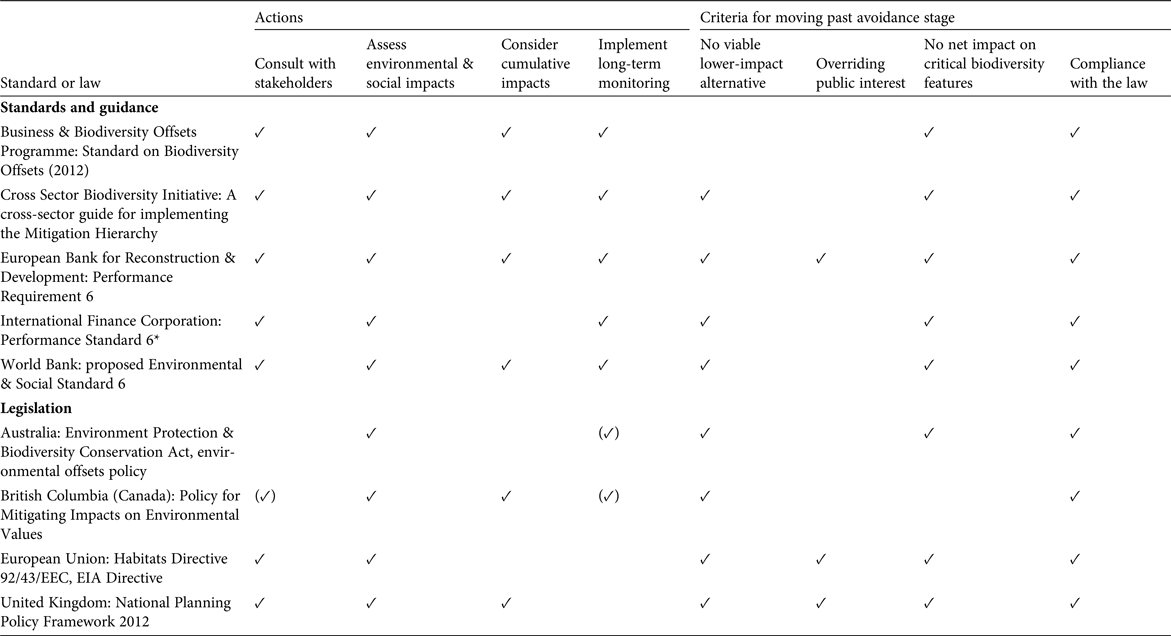
*Requirements for consultation and impact assessment are established in International Finance Corporation Performance Standard 1.
Our examples illustrate four recurrent criteria for moving past the avoidance stage of the mitigation hierarchy. The first is that alternatives are given full consideration by regulators and developers, both before and during the Environmental and Social Impact Assessment (Table 1). These can include project cancellation, alternative site locations (spatial impact avoidance), alternative scheduling of activities (temporal impact avoidance), and use of technology and planning within a site (design-based impact avoidance; Table 2).
Examples of various types of impact avoidance, and where they are appropriate. Inclusion of projects is solely to illustrate the range of actions that can be taken to avoid impacts on biodiversity, and should not be interpreted as endorsement or a suggestion that best practice was necessarily followed.
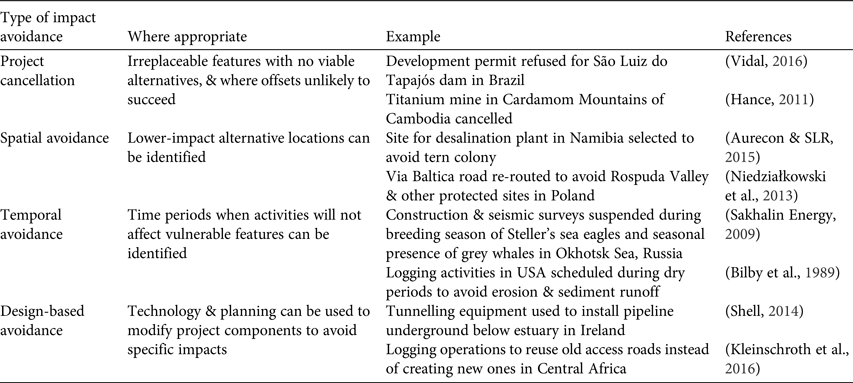
Early consideration of alternatives is advisable, alongside early engagement with a full range of stakeholders to identify appropriate alternatives (Ekstrom et al., Reference Ekstrom, Bennun and Mitchell2015). The cost of altering a project is lower early in the planning process, before decisions about locations and technologies are locked in and the range of feasible alternatives is narrowed. Planning tools can facilitate access to data on existing conservation designations and thus help to screen alternative sites, such as the Integrated Biodiversity Assessment Tool (IBAT, 2015) and national land-use planning and protected area databases (Ekstrom et al., Reference Ekstrom, Bennun and Mitchell2015).
A second common criterion for proceeding past the avoidance stage is that the societal benefits of a project should outweigh its environmental costs. The European Habitats Directive provides some of the clearest guidance here. Impacts on priority habitats and species are permitted only for reasons of human health, public safety or environmental benefit, or if there are ‘imperative reasons of overriding public interest’ for the project to proceed (Council of the European Commission, 1992; European Commission, 2007). Even here, however, defining when societal benefits are sufficient to justify environmental harm is subjective and often highly political.
A third common criterion for moving past avoidance is delivery of No Net Loss or a net gain in biodiversity (BBOP, 2012a; Gardner et al., Reference Gardner, Von Hase, Brownlie, Ekstrom, Pilgrim and Savy2013). No Net Loss is typically assessed only for priority biodiversity features such as threatened species, critical habitat and areas of high conservation value, even though it could potentially be applied most successfully to common species and ecosystems (Pilgrim et al., Reference Pilgrim, Brownlie, Ekstrom, Gardner, von Hase and ten Kate2013b). There are partial exceptions: the UK National Planning Policy Framework, for example, covers wider biodiversity in addition to designated sites (Department for Communities and Local Government, 2012). However, the Framework's reliance on the concept of significant harm means in practice that small, cumulative impacts to common species are likely to be ignored. No Net Loss obligations can often be met through a promise of remediation as well as through impact avoidance and minimization (BBOP, 2012b).
Fourthly, legal requirements can help to define opportunities for impact avoidance, such as through identifying protected sites and species. Laws also set requirements for planning and define how Environmental and Social Impact Assessments should be carried out, and where they are contravened they provide the basis for conservation organizations to challenge failures to avoid impacts in the courts.
Challenges for effective impact avoidance
We reviewed the literature and drew on our experiences to identify challenges for effective impact avoidance in five broad and often overlapping categories: political will, regulation, process, capacity and technical knowledge (Table 3). Political will refers to the perceived importance among decision makers of avoiding impacts on biodiversity, relative to other concerns. In the absence of political will, laws are less likely to be enforced, expensive alternatives are more likely to be ruled infeasible, and legal protection is at risk of being weakened or corrupted to cater for powerful private interests. Mascia et al. (Reference Mascia, Pailler, Krithivasan, Roshchanka, Burns and Mlotha2014) found over 500 cases of downgrading, downsizing or degazettement of protected areas in 57 countries, most commonly to facilitate industrial-scale resource extraction and development. For companies in the public eye, reputational risk is an incentive to develop the political will to ensure that impacts are reported and avoided (Dawkins & Fraas, Reference Dawkins and Fraas2011), but for smaller companies, and those without shareholders for whom environmental issues are important, it may not be.
Reasons for the failure of plans and policies to avoid impacts on biodiversity and ecosystem services, and some possible solutions.

The effectiveness of regulation depends both on the quality of legislation, and its implementation in practice. In Indonesia there is often a mismatch between official maps and the physical reality of land cover, and thus it can be easier for palm oil companies to obtain concessions in primary forest that is classified as non-forest estate on official maps, rather than in the millions of hectares of degraded land that, because it is mapped as forest estate, is legally unavailable for development (Rosenbarger et al., Reference Rosenbarger, Gingold, Prasodjo, Alisjahbana, Putraditama and Tresya2013). This is a failure of the legal system for land classification, arising perhaps from a lack of political will to protect primary forests. A review of 11 European projects affecting sites protected under the Habitats Directive found consistent failures by the European Commission in the interpretation and application of the Directive (Kramer, Reference Kramer2009). In only three of these cases were alternative locations assessed, as required by the Directive, and in few if any cases was a robust argument established for the project being of ‘overriding public interest’ (for further details see Kramer, Reference Kramer2009). In these cases, although the law seems to provide strong protection in principle, it appears to have been undermined by interpretations that privileged economic development and marginalized environmental protection. In the Democratic Republic of Congo, mining rights have been granted within protected areas, even though such areas are legally protected from extractive activities (Javelle & Veit, Reference Javelle and Veit2012). This results from contradictory regulations, inconsistent and outdated government information, a lack of cooperation between the two relevant ministries and, ultimately, opposing interests.
Even while acting within the law, regulators and companies have choices about how to pursue the process of identifying and acting on opportunities to avoid impacts. For example, if impact avoidance is not considered until the Environmental and Social Impact Assessment, opportunities to fundamentally rethink project alternatives may no longer be available. There are incentives, for those who would benefit from a project, to ensure that project cancellation is not considered, and to overlook indirect and cumulative impacts. Because Environmental and Social Impact Assessments and standards are typically applied at a project rather than landscape scale, they are not ideally suited to identifying strategic opportunities for impact avoidance. Within standards, requirements vary, and there is scope for criteria such as those for identifying high conservation values to be interpreted differently by different assessors (Senior et al., Reference Senior, Brown, Villalpando and Hill2015). Responsibility for ensuring permanent protection of avoided areas may be unclear: areas avoided during an early phase may be demanded in later stages of a project, and areas avoided by one company may not be avoided by others. For example, Sakhalin Energy's avoidance plans (Table 2) were undermined by Exxon's plans to conduct seismic surveys in the same area (Western Grey Whale Advisory Panel, 2015).
Government departments, companies and civil society organizations all too often lack sufficient capacity and resources to understand, develop and implement sound environmental policies properly (Quétier et al., Reference Quétier, Regnery and Levrel2014). National and local governments often lack (or do not allocate) sufficient resources to audit compliance with legislation. Small and medium-sized companies may be unable to afford in-house expertise on biodiversity and the mitigation hierarchy. Effective impact avoidance may require upfront investments in assessment and planning at a time when there may be uncertainty about whether a project will proceed. Even large companies may be unwilling to incur these costs. The influence of civil society organizations may be limited if they are poorly resourced and have limited expertise, as is common with local groups.
Although knowledge is increasing, there are still many gaps in technical understanding of the spatial distributions and population status of species, especially for plants and invertebrates (Pimm et al., Reference Pimm, Jenkins, Abell, Brooks, Gittleman and Joppa2014). This makes it difficult to identify and prioritize the sites of most importance in advance of developments. Information on the success and costs of restoration and offsetting efforts is also sparse. Unrealistic assumptions about the capacity and cost of restoration and offsetting could result in promises of remediation being a more attractive option for companies than avoiding impacts early in the project cycle. A further challenge is that there may be trade-offs between impact avoidance and other conservation strategies. For example, one way to avoid expanding into natural habitats is to consolidate timber production, farming and infrastructure in existing zones or corridors of disturbance. There is widespread evidence that sparing land in this way would be beneficial for many wild species, even if it increased the per-hectare impacts of development (Edwards et al., Reference Edwards, Gilroy, Woodcock, Edwards, Larsen and Andrews2014; Balmford et al., Reference Balmford, Green and Phalan2015; Stott et al., Reference Stott, Soga, Inger and Gaston2015). However, some degree of sharing land with multiple uses to reduce the per-hectare impacts of land uses is also desirable, and clear guidance on how to balance these strategies is not available in most places.
Confrontation or compromise?
Conservation organizations have strategic choices to make about when to collaborate with developers and when to oppose them. Campaigning against harmful developments is important, and this strategy of saying no can help to counterbalance the ambit claims (extreme initial demands) of developers (Laurance, Reference Laurance2016). Opposition is thus an important conservation strategy.
Conservation organizations can also play a role in identifying where developments should take place. A key problem with focusing exclusively on impact avoidance is the risk of leakage, or displacement of impacts. Development avoided at one location is likely to take place elsewhere. Even project cancellation is no guarantee that impacts have been avoided, unless regulation also constrains the demand drivers incentivizing development. Insofar as development is driven by market demands for minerals, energy and other resources, those demands will continue to incentivize further development (Meyfroidt et al., Reference Meyfroidt, Lambin, Erb and Hertel2013). Thus, it may be as important for conservationists to get involved in defining where development is acceptable as where it is not (Venter et al., Reference Venter, Possingham, Hovani, Dewi, Griscom and Paoli2013; Dinerstein et al., Reference Dinerstein, Baccini, Anderson, Fiske, Wikramanayake and McLaughlin2015). Mapping priority areas for avoidance also, by implication, often identifies locations that may be more appropriate for development (Bright et al., Reference Bright, Langston, Bullman, Evans, Gardner and Pearce-Higgins2008; Martin et al., Reference Martin, Tolley, Farmer, Mcowen, Geffert and Scharlemann2015).
There are risks involved in both confrontational and collaborative strategies. As conservation interests are typically less powerful than development interests, opposition could leave conservation organizations marginalized and without input into decisions. On the other hand, too much willingness to compromise could result in greenwash, conferring an image of environmental responsibility on companies in exchange for minimal concessions or donations (Robinson, Reference Robinson2012). The best strategy will be context-dependent, and in some situations a combination of principled opposition and pragmatism will be most successful. For example, conservation organizations engaged with local and national authorities to develop standards for new housing developments near the Thames Basin Heaths in the UK. Disturbance-sensitive bird species were protected by avoiding construction within a buffer zone, and developers were required to provide dog-walking areas alongside new housing nearby to minimize additional disturbance (BirdLife International, 2015).
Opportunities for more effective impact avoidance
There are multiple ways in which conservation organizations can work towards, and support, more effective impact avoidance (Table 3). They can harness and broadcast public support for conservation, thus creating political space for decision makers who want to support impact avoidance (Downie, Reference Downie2016) and increasing the reputational cost on those who ignore it (Ivanova, Reference Ivanova2015). When they can establish or promote particular ways of thinking about issues (frames), they influence the extent to which ecological values are considered in policy development (Sullivan & Hannis, Reference Sullivan and Hannis2015). Conservation organizations could also play a greater role in challenging corrupt or undemocratic institutions that give private or political interests excessive influence (Greenwald et al., Reference Greenwald, Suckling and Pimm2012). The success of high-profile campaigns in persuading companies to adopt sustainability standards and zero-deforestation commitments shows how corporate policies can be influenced (Newton et al., Reference Newton, Agrawal and Wollenberg2013; Gibbs et al., Reference Gibbs, Munger, L'Roe, Barreto, Pereira and Christie2016).
Regulation can be improved, both in the letter of the law and, perhaps more often, in its application. Conservation organizations can advocate for more stringent requirements for impact avoidance and clearly defined legal protection for sites and species. They can also campaign against subsidies and other perverse incentives for development in areas of biodiversity importance, such as Brazil's proposal to open up to 10% of its strictly protected areas to mining (Ferreira et al., Reference Ferreira, Aragão, Barlow, Barreto, Berenguer and Bustamante2014). Conservation organizations could also campaign to extend stronger protection to common species and habitats, which are sometimes overlooked in legislation (Gaston, Reference Gaston2010). Working informally with state agencies and developers may be fruitful: Malcom & Li (Reference Malcom and Li2015) suggested that informal dialogue in advance of submitting project proposals may have helped to reduce the number of proposals submitted in the USA that would have put threatened species in jeopardy.
There are opportunities for conservation organizations to hold governments and companies accountable to the processes and plans they have signed up to. They can track compliance with legislation and standards, especially in jurisdictions where there is limited capacity for public authorities to do so. They can also push for voluntary actions that make success more likely, such as inclusion of indirect and other enigmatic impacts in Environmental and Social Impact Assessments and genuine consideration of project cancellation options. Perhaps the most important demand they can make is for decision makers to consider impact avoidance from the earliest stages of the planning process (Ekstrom et al., Reference Ekstrom, Bennun and Mitchell2015). Had this been done in the case of the Via Baltica (Table 2), for example, the case might not have gone to the European Court of Justice, and considerable legal costs and delays could have been avoided.
Building the capacity of individuals and institutions plays a pivotal role in the success of conservation efforts (Brooks et al., Reference Brooks, Waylen and Mulder2012). Conservation organizations can support the development of biodiversity-inclusive landscape and regional-level zoning plans, as well as better policy guidance material to support the implementation and enforcement of legislation on impact avoidance. They can contribute to developing voluntary or regulatory mechanisms to ensure avoided areas receive long-term protection, such as new legal mechanisms for permanently retiring grazing leases on public land (Leshy & McUsic, Reference Leshy and McUsic2008). They have also played an important role in the development of voluntary standards, and will continue to do so. For example, Greenpeace played a key part in developing a methodology for identifying areas with high carbon stocks that should be avoided, to address a key gap in the Roundtable on Sustainable Palm Oil standards (Dinerstein et al., Reference Dinerstein, Baccini, Anderson, Fiske, Wikramanayake and McLaughlin2015).
Conservation organizations can provide tools and technical data to make it easier to conduct cumulative, strategic and environmental impact assessments. Examples include the Biodiversity Risks and Opportunities Assessment tool and the Migratory Soaring Bird Sensitivity Map (BirdLife International, 2015). Conservation organizations can work with other civil society organizations to understand synergies and trade-offs between multiple objectives, and find common ground in advocating for impact avoidance. This may require understanding complex interactions, such as those between conservation and other human interests. It may also involve identifying places where development may be acceptable, as well as those where it should be avoided. A final, crucial role is in better evaluation and communication of the success (or otherwise) of efforts to avoid impacts (Baylis et al., Reference Baylis, Honey-Rosés, Börner, Corbera, Ezzine-de-Blas and Ferraro2016).
Conclusion
We suggest that a renewed focus on the first stage of the mitigation hierarchy could help to limit the impacts of large-scale developments in energy, infrastructure, agriculture and other sectors on biodiversity. Conservation organizations play an important role in cultivating political will, holding decision makers accountable to the law, improving the processes of impact assessment and avoidance, building capacity and providing technical knowledge. Ensuring that impact avoidance is considered as early as possible in the planning process and that it is placed even more firmly at the heart of the mitigation hierarchy in both policy and practice should be key demands on their agenda.
Acknowledgements
This paper is a product of a project on strengthening the mitigation hierarchy for greater conservation gains, funded by the Cambridge Conservation Initiative Collaborative Fund. We thank all of the participants in that project, and we are grateful to two anonymous reviewers whose suggestions greatly improved the article. BP was funded by a Zukerman Fellowship at King's College, Cambridge.
Author contributions
SW, assisted by BP, SB, PH, BC and BV, developed the project idea and wrote the proposal. GH collected and summarized case study data in a report. All authors met to discuss the topic and develop recommendations. BP, assisted by GH, SB, DM, PH, BC, AK and SW, wrote the article.
Biographical sketches
Ben Phalan works on strategies to reconcile human demands for natural resources with the conservation of birds and biodiversity. Genevieve Hayes is working on reducing the deforestation footprint of high-risk commodities such as palm oil, cocoa and rubber. Sharon Brooks works to improve corporate performance regarding the management of biodiversity and ecosystem services, working primarily with the extractive sector. David Marsh works with the extractive sector to improve understanding and mitigation of site-level impacts on biodiversity and ecosystem services. Pippa Howard directs Fauna & Flora International's engagement with the corporate sector. Brendan Costelloe works to influence and improve how biodiversity is incorporated into UK Government planning policy. Bhaskar Vira directs the University of Cambridge Conservation Research Institute. Aida Kowalska focuses on supporting the development and implementation of biodiversity safeguards in renewable energy developments. Samir Whitaker works on cross-sectoral conservation initiatives, and is particularly interested in environmental risk screening and management for the corporate sector.



