




Introduction
Settlements have been described as the ‘missing factor’ in the archaeology of prehistoric mainland Southeast Asia (Higham Reference Higham, Piper, Matsumara and Bulbeck2017: 369). The transition to sedentism and agriculture in this region occurred approximately 5000–3000 years ago. Here, we refer to this ‘neolithic’ period in lower case to disassociate the mainland Southeast Asian neolithic from the terminology and frameworks developed in European and South-west Asian contexts, which are inappropriate for the Southeast Asian region. Most of the archaeological evidence for the mainland Southeast Asian neolithic derives from mortuary contexts, with minimal information available for other aspects of prehistoric communities, including the nature of dwellings, domestic activities and uses of space. Secure evidence for settlement is limited to just three recently excavated sites in southern Vietnam: Loc Giang, Rach Nui and An Son. At each of these sites, excavations have revealed a series of superimposed, hard, laterally continuous surfaces, which are creamy-white in colour, and preliminarily interpreted as lime mortar floors (Piper & Oxenham Reference Piper, Oxenham, Boyle, Rabett and Hunt2014; Oxenham et al. Reference Oxenham2015; Piper et al. Reference Piper2017).
In this article, we use an integrated microarchaeological approach to investigate the formation history of the Loc Giang surfaces. The techniques used are archaeological micromorphology, Fourier Transform Infrared (FTIR) spectroscopy, Automated Quantitative Evaluation of Minerals using Energy Dispersive Spectroscopy (QEM-EDS), X-ray Diffraction (XRD) and biogenic silica concentrations. This study is the first application of such a suite of techniques to the investigation of prehistoric settlements in mainland Southeast Asia. Our results establish the use of lime mortar and plaster technology in Southeast Asia between c. 3510 and 3150 cal BP at Loc Giang. These floors provide the earliest-known evidence for pyrogenic lime production and the first secure evidence of settlement construction in mainland Southeast Asia. The findings at Loc Giang represent a promising start to the investigation of non-mortuary archaeology in the region.
Prehistoric lime production technology
Pyrogenic lime mortars and plasters are sophisticated construction materials that involve the conversion of a source of calcium carbonate (CaCO3), such as shell or limestone, into quicklime (calcium oxide: CaO) by burning at high temperatures (>800°C). Quicklime is then mixed with water to produce slaked (hydrated) lime, or calcium hydroxide (Ca(OH)2), which can be shaped as a thick, plastic paste or ‘putty’ and used as a building material (Friesem et al. Reference Friesem, Abadi, Shaham and Grosman2019). Upon exposure to atmospheric carbon dioxide, this calcium hydroxide paste reverts to calcium carbonate, producing a hard, durable surface. In this article, we differentiate these mortars and plasters, defining the former as a material that consists of a fine lime matrix (binder) with an added coarse fraction (temper) used to construct architectural surfaces, such as floors, and the latter, plaster, as a medium, such as clay or lime, which is applied as a fine coat or finish to lime-mortared surfaces (Stoops et al. Reference Stoops, Canti, Kapur, Nicosia and Stoops2017).
The earliest studies of lime mortars used microarchaeological techniques, such as polarised light microscopy, scanning electron microscopy and X-ray diffraction (Gourdin & Kingery Reference Gourdin and Kingery1975; Goren & Goldberg Reference Goren and Goldberg1991). Polarised light microscopy, utilising cross polarised light (XPL) and plane polarised light (PPL), remains the standard for identification (Karkanas Reference Karkanas2007). Emerging research, however, highlights the strength of FTIR in assessment of the pyrogenic formation history of lime products (Friesem et al. Reference Friesem, Abadi, Shaham and Grosman2019). FTIR can identify burnt clays, pyrogenic aragonite and the high atomic disorder of pyrogenically formed lime (Berna et al. Reference Berna2007; Regev et al. Reference Regev2010; Toffolo & Boaretto Reference Toffolo and Boaretto2014).
Prehistoric pyrogenic lime technology is now well-documented globally, including in South-west Asia by at least 12 000 cal BP (Kingery et al. Reference Kingery, Vandiver and Prickett1988; Friesem et al. Reference Friesem, Abadi, Shaham and Grosman2019), China by 3000 BP, India by c. 5500–4500 BP, and Central and South America by c. 2500 BP (Carran et al. Reference Carran, Hughes, Leslie and Kennedy2012). Although lime technology is an ethnohistorically documented practice in Southeast Asia (Ceron & Eusebio Reference Ceron and Eusebio2007), it has not been previously identified in prehistoric contexts in this region.
Archaeology of Loc Giang
Loc Giang (10°59′43″N, 106°17′25″E) is a mounded site situated on a slightly raised Quaternary alluvial terrace on the east bank of the Vam Co Dong River, in An Ninh Tay Commune, Duc Hoa District, Long An Province, southern Vietnam (Figure 1). The extant portion of a formerly more extensive mound covers approximately 500m2 and rises some 3m above the surrounding alluvial floodplain.
The location of Loc Giang and contemporaneous sites of An Son and Rach Nui in southern Vietnam (maps modified by E .Grono and reproduced with the permission of CartoGIS Services, The Australian National University).

Following excavations by the Long An Provincial Museum and the Vietnam Historical Museum in 1988, 1993 and 2007, renewed excavations at Loc Giang were undertaken in 2014 by a collaborative team from the Australian National University (Canberra), the Southern Institute of Social Sciences (Ho Chi Minh City) and Long An Provincial Museum (Tan An) (Piper et al. Reference Piper2017). The 2014 season focused on a 5 × 4m trench, from which the samples analysed in the current research were recovered.
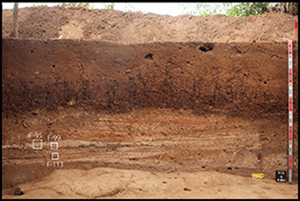
Most of the mound accumulation results from a sequence of more than 30 surfaces, representing four phases of construction (Figures 2 & 3). The surfaces comprise relatively hard, compacted, creamy white sediments with a loam texture, a high calcareous content and an alkaline pH between 8 and 9 (Piper et al. Reference Piper2017: 35). The surfaces extended laterally across several metres of the excavated trench. The excavators’ preliminary interpretation of these surfaces was that they represented lime mortar floors (Piper et al. Reference Piper2017). The site was interpreted as a settlement based on the surfaces and associated features, including middens, pits, postholes and possible hearths; however, microarchaeological characterisation of the surfaces is essential to confirm the identification of domestic floors and the materials and technology of construction.
Section drawing of the west wall of the 2014 excavation trench, illustrating a well-preserved sequence of Phase 2 and Phase 3 surfaces (grey fill). The location of some of the intact micromorphology blocks investigated in the study are shown as black rectangles (modified from Piper et al. Reference Piper2017: fig. 5a).

a) Section of the west wall of the 2014 excavation trench, showing an example of the floor sequence (photograph by Dang N.K. and P.J. Piper); b–d) examples of intact floor fragments (left and centre), showing compacted, creamy-white, finely textured matrices and coarse temper, including ceramic fragments, burnt clay and charred plant remains. Equivalent thin sections scanned in cross polarised (XPL) light (right) exhibit well-reacted calcitic groundmasses and distinctive coarse temper inclusions; b) and d) thin section scans (right) show two superimposed floor surfaces, reflecting replacement and repair of original surfaces (images produced by E. Grono).

The earliest phase of construction (Phase 1) consists of at least five surfaces that are poorly preserved due to levelling activities prior to subsequent construction (Phase 2). Phase 2 consists of 11 surfaces that extend across a wider area, indicating a spatial expansion of construction activities. Phase 3 is the best preserved, consisting of more than 25 sequential surfaces, with evidence of replacement and repair (Figure 2). Surface edges and corners delineate the dimensions of living areas, and several discrete patches of burning suggest the presence of hearths on the surfaces. Finally, Phase 4 surfaces are fragmentary, having been affected by post-neolithic human activity.
Twelve radiocarbon dates indicate occupation between 3980 and 3270 cal BP (Piper et al. Reference Piper2017). The Bayesian chronological model of the Loc Giang dates suggests a rapid accumulation of the Phase 2 and Phase 3 surfaces across a period of 50–360 years between 3510–3370 cal BP and 3320–3150 cal BP (at 95.4% probability) (Piper et al. Reference Piper2017).
Materials and methods
We use an integrated microarchaeological approach to test the preliminary field interpretation that the excavated surfaces represent the intentional use of lime to construct floors in a domestic context. We combine contextual and compositional analyses to assess fragments of the surfaces recovered during excavation, as well as samples retrieved from the trench walls using kubiena tins, including a well-preserved sequence of Phases 2 and 3 surfaces in the west wall (Figures 2 & 3). The surface fragments and the samples from the trench walls were prepared as thin sections for contextual (micromorphology and QEM-EDS) analyses. A micro-sampling strategy was used to extract correlated sediments from the ‘mirror image’ faces of the micromorphology samples for compositional analyses (FTIR, XRD and biogenic silica concentrations). Table 1 lists the archaeological features investigated and the microarchaeological techniques used. Detailed description of the analytical methods is provided in the online supplementary materials (OSM).
Summary of field descriptions and microarchaeological attributes of three sub-types of lime identified at Loc Giang. Refer to the online supplementary materials (OSM) for a full breakdown of microscopic (micromorphological) and compositional (FTIR, XRD and biogenic silica concentrations) data.

Results
Three sub-types of lime were identified at Loc Giang: 1) lime mortar; 2) lime plaster; and 3) residual lime waste (Table 1).
Lime mortar
Lime mortar is the most common type of lime identified at Loc Giang. It is identified based on several micromorphological and compositional (FTIR, XRD and QEM-EDS) attributes. The mortars share a dense, microcrystalline calcium carbonate matrix that displays a well-reacted (crystallitic b-fabric (XPL)) micromass (Figures 3b–d & 4a–b), with occasional local domains that exhibit transitional, mottled semi-isotropic (XPL) textures due to incomplete carbonation of lime (Figure S1c–d in the OSM). FTIR, XRD and QEM-EDS analyses confirm that calcium carbonate (a mixture of calcite and aragonite) dominates the composition of most samples (Table 1; Figures S9 & S11). Based on the position of the ν 3 peak at 1485cm−1 or higher wavenumbers (Figures S8d & S9c), aragonite is likely to have been pyrogenically formed (Toffolo et al. Reference Toffolo2017: fig. 2). Pyrogenic aragonite is an indicator of calcareous materials being heated to temperatures exceeding 600°C and can be used as a proxy for pyrogenic lime (Toffolo & Boaretto Reference Toffolo and Boaretto2014).
Macro and micromorphological attributes of the three lime deposit types from Loc Giang: a–e) lime mortar constructed floor; a) surface showing a sharp upper boundary and a dense, compacted microstructure. Minimal accumulation of detrital mineral grains (dashed red line) indicates that the floors were kept clean through sweeping or use of mats; b) well-reacted microcrystalline calcium carbonate binder and evenly mixed coarse inclusions; c) horizontal fissures cleave apart rather than skirt coarse inclusions and are thus attributed to vertical pressure (trampling). Common additive materials in the lime mortar floors are (d) charred plant remains in shrinkage voids, and (e) fired clay aggregates; f–i) lime plaster coating or wash; f) macro-lens photograph and (g) XPL thin section scan, showing adherence of the coating (red arrow) to the upper surface of a lime mortar floor [F-117] (dashed red line); h) the lime coating comprises microlaminations of different colour and purity of microcrystalline calcium carbonate, forming as a result of several washes, or alternatively from weathering during burial; i) zigzag to reticulate patterning formed during carbonation of the reacted lime; j–l) lime chunk identified as residual waste from lime preparation; j) macro-lens photograph showing the fine, powdery texture; k) XPL thin section scan; and l) XPL photomicrograph showing almost complete recarbonation of lime (images produced by E. Grono).

The FTIR spectra of one sample contained a small amount of dolomite in addition to aragonite and calcite. Due to the regional absence of a geological source of dolomite, it is likely to be diagenetic or possibly linked to the use of shells to prepare lime (Figure S8h: see caption for discussion of the presence of dolomite). Small aggregates of opaque, dark grey (PPL) and isotropic (XPL) quicklime (calcium oxide) are apparent in the binder, representing unreacted lime (Figure S1d). The coarse components occasionally show shrinkage fractures from firing (Figure S1f) and isotropic (XPL) reaction rims of reacted lime at the interface with the binder (Figures S1e & S11k)—both features which indicate pyrogenic formation. Based on mineral alteration, we estimate exposure to different temperatures as follows: clay minerals at approximately 600–700°C (FTIR: Table S2, Figures S8–S9) (Berna et al. Reference Berna2007); calcitic ashes at 600°C or higher; melted phytolith slags at 800°C (micromorphology: Figures S2c & S2f) (Canti Reference Canti2003); and pyrogenic aragonite above 600°C (FTIR: Table S2, Figures S8–S9) (Toffolo & Boaretto Reference Toffolo and Boaretto2014). These temperatures are within the range necessary to produce quicklime, which supports the hypothesis that these surfaces represent the intentional use of pyrogenic lime to construct domestic floors.
The manipulation of lime during floor preparation leaves physical traces in the fabric. This is seen in the massive, dense and compacted microstructure (Figures 3b–d & 4a–b), the evenly mixed groundmass, and the low porosity comprised of vesicles (Figure S1c) and planar shrinkage fractures (Figure S1g) formed during drying and hardening of the lime. In addition to cracks during drying, sub-horizontal fissures that cleave through, rather than skirt, components are attributed to vertical pressure from trampling (Figure S1h). Each discrete floor surface is defined by sharp, smooth upper and lower boundaries (Figure 3). The thicknesses of the individual lime floor surfaces range between approximately 10 and 50mm (Figure 3). The minimal accumulated occupational debris identified on the surfaces and the replacement of eroded areas attest to the systematic cleaning and maintenance of the floors (Figure 3b & d; Figure 4a).
The floor mortars contain a diverse range of added materials (temper) that are evenly distributed in well-mixed fabrics (Figures 3b–d & 4a–b). Dominant temper types comprise variably fired (orange-crimson in reflected light) clay aggregates (Figures 4e & S1h) and plant materials. The latter include: charred plant fragments (Figure 4d); melted phytolith slags (Figure S2f); silicified plant remains, such as phytoliths (Figure S2d) and rice husks (Figure S2b & e); and plant pseudomorphic and shrinkage voids, some of which still contain charred plant remains and calcitic ashes in anatomical position (Figure S2c). FTIR analyses confirm the presence of burnt clay (Figures S8–S9), and biogenic silica extraction reveals moderate to elevated levels of phytoliths (Table 1). Less frequently added materials include quartz grains and fragments of pottery, (burnt and unburnt) bone, shell and coprolites (Figure S2). FTIR, XRD and QEM-EDS analyses confirm the presence of carbonated hydroxyapatite, verifying micromorphological identification of bone fragments (Table 1).
Lime plaster
The second type of microdeposit indicating intentional use of lime takes the form of thin (<5mm thick) lime plaster floor coatings (or washes) [F-117.1] applied to the upper surfaces of lime mortar floors (Figure 4f–g). These plaster coatings lack the addition of temper and, instead, exhibit microlaminations of microcrystalline calcium carbonate (Figure 4h), as well as fissure cracks from the drying and hardening of the lime (Figure 4i). The presence of lime plaster coatings was not identified in the field, and thus the full spatial extent of these lime washes is not recorded; in the past, however, the colour of these bright, white floor surfaces would have been a striking visual feature in the settlement (Clarke Reference Clarke2012).
Residual lime waste
The third type of lime microdeposit identified is a white, powdery lime chunk [F-141] (Figure 4j) that, in thin section, shows almost complete recarbonation, producing a well-reacted calcitic groundmass (Figure 4k–l). FTIR and XRD analyses identify a dominant mineralogical composition of calcite (Table 1). The pyrotechnological formation of the calcite is evidenced by microscopic observations of planar cracks and vesicles formed during the carbonation process and FTIR identification of altered (heated) clay (Table 1). This microdeposit is interpreted as residual lime waste from lime production. Infrequent coarse components that are randomly orientated and distributed reflect incidental or deliberate additives to the lime paste. These include vegetal materials (phytoliths, calcitic plant ash and degraded plant matter) and bone fragments (Figure S4d–e). The presence of carbonated hydroxyapatite is confirmed by FTIR and XRD, and moderate phytolith concentrations of 478 000/g sediment are reported following biogenic silica extraction (Table 1).
Discussion: technology of lime production in Southeast Asia
Based on the results reported here, Loc Giang is currently the earliest known example of the use of lime mortar in Southeast Asia. The microarchaeological analyses confirm well-established lime production technology by at least Phase 2 (c. 3510–3370 cal BP) and continuing through Phase 3 (c. 3320–3150 cal BP) of the settlement. The floor matrices consist of well-reacted lime binders (Figures 3b–d, 4a–b) that reflect high-quality construction and technological skill in the preparation of these surfaces (Karkanas Reference Karkanas2007). The absence of evidence for phases of experimental lime production implies that the inhabitants of Loc Giang were experienced in lime construction from the earliest use of the technique. To date, no kilns have been identified, perhaps indicating that lime was produced using ephemeral combustion features (e.g. open hearths or pit kilns), as suggested for the Neolithic of the Eastern Mediterranean (Kingery et al. Reference Kingery, Vandiver and Prickett1988; Karkanas Reference Karkanas2007; Goren & Goring-Morris Reference Goren and Goring-Morris2008). Lime mortar floors provide a hard, water-repellent and hygienic surface that would have been advantageous in a wet, tropical environment. Common types of temper, such as burnt and unburnt clays and plant remains (Figure 4d–e), improve the hardness and tensile strength of lime mortars (Stoops et al. Reference Stoops, Canti, Kapur, Nicosia and Stoops2017). Occasional inclusions of ceramic, bone, shell and coprolite fragments (Figure S2i–l) in the Loc Giang floors suggest that the inhabitants combined the inclusion of high-quality temper materials with rubbish recycled from everyday activities (Karkanas & Van De Moortel Reference Karkanas and Van De Moortel2014). Therefore, two practices essential to sedentary communities—settlement construction and waste management—seem to have developed in tandem at Loc Giang.
Limestone is not naturally present in this region of Vietnam, and the coastal province of Kien Giang, 200km south-west of Loc Giang, is the only source of this material in southern Vietnam (Nguyen Reference Nguyen1986). While it is possible that limestone was imported, it is completely absent in the thin sections examined here. If limestone had been used to produce lime at Loc Giang, it is expected that some partly burnt limestone residues would be identifiable within poorly reacted parts of the lime mortar (e.g. Karkanas Reference Karkanas2007; Friesem et al. Reference Friesem, Abadi, Shaham and Grosman2019). An alternative source of calcium carbonate is shell, which is used to prepare lime in many ethnographically documented societies (Panda & Misra Reference Panda and Misra2007) and would have been a readily available resource at Loc Giang. While today the site is approximately 85km inland, the coastline would have been much closer during the mid-Holocene, when sea levels were 2.5–4.5m higher than present (Proske et al. Reference Proske2010). As sea levels retreated, the Mekong Delta rapidly prograded, resulting in the brackish and tidal mangrove estuarine environment present during the period when Loc Giang was occupied (Proske et al. Reference Proske2010), as indicated by the mollusc assemblages from the site (Piper et al. Reference Piper2017: 41). Few microscopic shell fragments were identified in the thin sections examined here and only a few hundred shell fragments were recovered from the entire site, although the excavators recorded a number of burnt shell deposits during excavation (Piper & Nguyen Reference Piper and Nguyen2016: 107). The lack of shell remains in lime mortars and plaster is also consistent with traditional ethnographic techniques of lime production, which utilise sieves to separate fine lime powder from burnt shell fragments and other coarse impurities, thus leading to a lime paste without recognisable fragments of shell within its matrix (Panda & Misra Reference Panda and Misra2007: 263–64 & 269; Thakuria Reference Thakuria2012: 96).
Although recorded in several ethnographic contexts around the world (e.g. Ceron & Eusebio Reference Ceron and Eusebio2007; Panda & Misra Reference Panda and Misra2007; Russell & Dahlin Reference Russell and Dahlin2007), the use of shell in lime production still represents a lacuna in geoarchaeological research, which has focused almost exclusively on the use of limestone. The possible use of shells to produce lime mortar has been suggested for coastal regions of ancient China and medieval India, a medieval chapel in Scotland, Bronze Age (c. 5000–3000 cal BP) sites in the Aegean and Eastern Mediterranean, and Early to Late Classic (c. 1800–1200 BP) Maya sites in Belize (MacKinnon & May Reference MacKinnon and May1990; Brysbaert Reference Brysbaert2007; Deshpande-Mukherjee Reference Deshpande-Mukherjee2011; Thacker Reference Thacker and Hughes2013; Macphail & Goldberg Reference Macphail and Goldberg2017: 233; Zhang et al. Reference Zhang2019). In-depth microarchaeological examinations of shell lime production, however, are still lacking.
Consistency and repetition in both floor materials and technology throughout the stratigraphic sequence of Phases 2 and 3 (3510–3150 cal BP) at Loc Giang indicate that floor construction was a communal practice that drew on social memory and tradition (see Boivin Reference Boivin2000). Pyrogenic lime production involves considerable expenditure of time, labour and resources to create durable structures. The investment in dwelling construction, together with evidence of managed pig and dog populations (Piper et al. Reference Piper2017) and regulated waste disposal activities (Grono Reference Grono2020), would have required at least some of the community to reside permanently at the settlement; therefore, Loc Giang represents one of the earliest sedentary communities in mainland Southeast Asia.
Hard, laterally extensive surfaces similar to those at Loc Giang have also been recorded in association with postholes at the contemporaneous neolithic sites of An Son (c. 4300–3400 cal BP) on the Vam Co Dong River, 300m east of Loc Giang (Piper & Oxenham Reference Piper, Oxenham, Boyle, Rabett and Hunt2014), and at Rach Nui (c. 3500–3300 cal BP) approximately 80km to the south-east, on the Dong Nai River (Oxenham et al. Reference Oxenham2015). Additional construction evidence from the neolithic period has been recovered from the site of Khok Phanom Di in Peninsula Thailand (4000–3500 cal BP), including wattle-and-daub wall fragments and a clay floor with wall foundations (C.F.W. Higham pers. comm.); however, these architectural remains are thought to have had a mortuary rather than domestic function.
Piper and Oxenham's (Reference Piper, Oxenham, Boyle, Rabett and Hunt2014) comparative analysis of settlement evidence from Loc Giang, An Son and Rach Nui in southern Vietnam suggests that the use of lime mortar was a regional building tradition, invoking Bellwood et al.'s (Reference Bellwood2011: 160) ‘Greater Mekong’ cultural network of neolithic communities in southern Vietnam. At Rach Nui, 13 phases of floor construction took place across a period of approximately 200 years, representing the renewal of platforms and above-ground structures roughly every decade or two (Oxenham et al. Reference Oxenham2015). Similarly, repeated episodes of demolition, levelling and rebuilding at Loc Giang potentially reflect settlement maintenance and reconfiguration over time, in terms both of household shifts (e.g. Boivin Reference Boivin2000) and the requirements of living in tropical environments that accelerate building decay. In this region today, dwellings are replaced every 10–15 years, or even more frequently, due to insect infestations, damp conditions and the rotting of organic construction materials (Bernot Reference Bernot, Izikowitz and Sorensen1982: 35; Castillo et al. Reference Castillo2017: 75).
The microarchaeological identification of lime mortar at Loc Giang therefore offers the first insights into settlement construction and social dynamics during the mainland Southeast Asian neolithic period (c. 5000–3000 cal BP). It contributes one of the first robust lines of evidence for the emergence of sedentism; moreover, it adds to an emerging picture of the mainland Southeast Asian neolithic as an innovative period that was characterised by variability and regional diversification. Processes of ‘neolithisation’ in this region appear to have involved mosaics of local communities, who developed their own cultural and social identities and traditions (see Grono Reference Grono2020; Piper et al. Reference Piper, Higham and Kim2022), such as the use of lime mortar in southern Vietnam.
Understanding the non-mortuary aspects of neolithic communities in mainland Southeast Asia is only just beginning. Most archaeological research on prehistoric mainland Southeast Asia (between 5000 and 3000 years ago) has involved the excavation of burial sites (Piper & Oxenham Reference Piper, Oxenham, Boyle, Rabett and Hunt2014; for a summary of well-researched burial sites from this period, see Higham Reference Higham2014). In contrast, settlement sites have been less well researched—an imbalance that is probably caused by a combination of factors, including the low archaeological visibility of dwellings (Grono Reference Grono2020), past excavation strategies that have focused on burials, and logistical challenges involved in opening sufficiently large excavation areas to reveal the floor plans of potential dwellings.
Going forward, there is potential for further investigation of possible neolithic settlement sites with extensive in situ deposits in southern Vietnam (Loc Giang has now been almost completely destroyed through quarrying). We argue, however, that the successful identification of lime construction at Loc Giang was achieved through careful field excavation strategies coupled with the innovative use in this region of microarchaeology, rather than large-scale excavation. Microarchaeological techniques enable fine-grained insights into dwellings and floor sequences, including both the technological processes and social practices involved in floor construction. We believe that the detection of dwellings and the study of domestic activities and the use of space is most effectively achieved by integrating microscopic and macroscopic techniques (Karkanas & Goldberg Reference Karkanas and Goldberg2018), and we encourage the wider application of microarchaeology for the investigation of other settlement sites across the region.
Conclusions
The microarchaeological investigation of surfaces from neolithic Loc Giang in southern Vietnam confirms the intentional production of lime and its use for the construction of floors within domestic contexts by c. 3510–3150 cal BP. This currently represents the earliest evidence for the use of such technology in mainland Southeast Asia. The lime mortar floors are of high quality and there is no evidence of experimental phases, indicating that the inhabitants of Loc Giang were experienced from the outset in lime production and its use in construction. A vertical sequence of more than 30 superimposed surfaces highlights the role of memory and tradition in maintaining continuity in social and technological practices throughout the life of the settlement. The expenditure of time, effort and resources involved reflects a commitment to place and a degree of sedentism, opening a new perspective on the prehistoric communities of mainland Southeast Asia as they transitioned to a neolithic way of life.
Acknowledgements
The archaeological excavations and post-excavation analyses were a collaborative research project between Long An Provincial Museum, Tan An, Center for Archaeological Research, Southern Institute for Social Sciences, Ho Chi Minh City, and the School of Archaeology and Anthropology, Australian National University Canberra, co-directed by Nguyen Khanh Trung Kien and Philip Piper. The authors would like to thank the investigative team: Le Hoang Phung, Nguyen Hoang Bach Linh, Nguyen Nhut Phuong, Nguyen Ngoc Hong, Van Ngoc Bich, Do Thi Lan, Tran Thi Kim Quy, Jasminda Ceron and Fredeliza Campos. Thanks are extended to Adelaide Petrographics and John Vickers and Shane Paxton, Australian National University for assistance with thin section preparation. The authors also thank the two anonymous reviewers for their valuable comments.
Funding statement
This research was funded by an Australian Government Research Training Program Scholarship (2015–2018). The 2014 excavation of Loc Giang was funded by the ARC Grant DP140100384.
Supplementary materials
To view supplementary material for this article, please visit https://doi.org/10.15184/aqy.2022.139.


 Open access

