


- GHG
-
greenhouse gas
Feeding nine to ten billion people by 2050 presents an enormous challenge( Reference Godfray, Beddington and Crute 1 ). A number of options have been proposed to help address the issue, including closing the yield gap (i.e. making the difference between the attainable yield and that actually realised smaller), increasing the production potential of crops (largely through the use of new technologies and investment in research), reducing waste, changing diets and expanding aquaculture, all of which need to be coordinated in a multifaceted and linked global strategy to ensure sustainable and equitable food security( Reference Godfray, Beddington and Crute 1 ).
At the same time as increasing food production, we also need to significantly decrease the climate impact of food production( Reference Smith, Martino and Cai 2 ) as well as improving the resilience of food production to future environmental change. Additional, non-climate related needs are to protect our freshwater resources( Reference Frenken and Kiersch 3 ), protect biodiversity( 4 ), move towards healthier diets( 5 ) and reduce the adverse impact of food production on a whole range of ecosystem services( Reference Firbank, Bradbury and Jenkins 6 ).
Historical expansion of agriculture into forests and natural ecosystems( Reference Bruinsma 7 ) has significantly contributed to the loss of ecosystem services. This has given added impetus to the realisation that future increases in food supply need to be met without increasing the agricultural area, i.e. to derive more agricultural product from the same area( Reference Godfray, Beddington and Crute 1 , Reference Smith, Gregory and van Vuuren 8 ). The main means of intensifying crop production will be through increased yields per unit area together with a smaller contribution from an increased number of crops grown in a seasonal cycle. As cereal production (wheat, maize and rice) has increased from 877 million tonnes in 1961 to 2342 million tonnes in 2007, the world average cereal yield has increased from 1·35 t/ha in 1961 to 3·35 t/ha in 2007, and is projected to be about 4·8 t/ha in 2040. Simultaneously, per-capita arable land area has decreased from 0·415 ha in 1961 to 0·214 ha in 2007( Reference Smith, Gregory and van Vuuren 8 ). Put another way, had the increases in yield of the last 60–70 years not been achieved, almost three times more land would have been required to produce crops to sustain the present population; land that does not exist except by using some that is unsuitable for cropping. Hence, some form of sustainable intensification of food production will be required( Reference Garnett and Godfray 9 ); but more fundamental changes in food production (and consumption) will also be needed if we are to meet future challenges. We will return to this theme at the end of our paper.
According to the United Nations definition, ‘food security exists when all people, at all times, have physical and economic access to sufficient, safe and nutritious food to meet their dietary needs and food preferences for an active and healthy life’. At the same time as delivering food security, we must also reduce the environmental impact of food production.
Food security is underpinned by effective food systems, which are a set of dynamic interactions between and within biogeophysical and human environments. They include a number of activities (producing food; processing, packaging and distributing food; and retailing and consuming food), which lead to a number of associated outcomes some of which contribute to food security (i.e. food availability, access to food and food utilisation) and others which relate to environmental and other social welfare concerns( Reference Ericksen 10 ). Since food security is diminished when food systems are disrupted or stressed, food security policy must address the whole food system.
Although food availability increased by 26% between 1970 and 2000( Reference Rosegrant, Paisner and Meijer 11 ), Africa is the only continent that has yet to achieve food surplus, some 800–1200 million people remain undernourished and the numbers experiencing food insecurity increased substantially during the rapid increase in food prices of 2008. Hazell and Wood( Reference Hazell and Wood 12 ) state that the hunger problem is fundamentally one of income distribution rather than of food shortages per se. While the hungry are too poor to buy the food produced and suffer malnourishment, the rich have excessive food intake and suffer from obesity and associated chronic illnesses. Increasing global food production will not solve these problems. The majority of the poor live in rural areas where they depend primarily on agriculture and related activities for both food and their livelihoods, though the needs of the urban poor are now becoming an ever increasing focus. These areas are often characterised by a fragile and naturally poor resource base of soil, land and water meaning that money to invest in improved crop and livestock husbandry is limited or non-existent( Reference von Braun, Rosegrant and Pandya-Lorch 13 ).
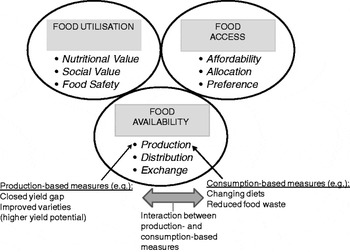
Land use and issues of food security are intimately linked and the interplay has been made explicit in the context of climate change( Reference Gregory, Ingram and Brklacich 14 , Reference Ingram, Gregory and Izac 15 ). Hazell and Wood( Reference Hazell and Wood 12 ) used a combination of per-capita income and agricultural productivity (shown in other studies to correlate most strongly with food security at a country level), for different production zones to develop a typology for assessing options for examining future food security. Such an analysis demonstrates that different responses will be required in different domains if food insecurity is to be diminished and resources conserved. Food security is a multi-faceted challenge, involving much more than just food production. Indeed, food production is only one of the challenges of providing food availability (which also relies on distribution and exchange), and food availability, if only one aspect of food security which also includes food access and food utilisation. Fig. 1 shows how food production (the main focus of this paper), fits into the much larger challenge of food security. In this paper we examine how food production might be increased while at the same time reducing greenhouse gas (GHG) emissions from agriculture (which contribute to climate change), and accounting for future climate threats. We then examine what sustainable food production under a future climate might look like.
The relationship between food production, food availability and food security. The production- and consumption-based measures (and the interactions between them) that make an impact upon food production and that are the focus of this paper are shown in the lower part of the figure, to show the limits to the scope of this review.
The climate footprint of food production
Agriculture releases significant amounts of CO2, CH4 and N2O to the atmosphere. CO2 is released largely from microbial decay or burning of plant litter and soil organic matter. CH4 is produced when organic materials decompose under anoxic conditions, notably from fermentative digestion by ruminant livestock, stored manures and rice grown under flooded conditions. N2O is produced by the microbial transformation of N in soils and manures, and is often enhanced where the available N exceeds plant requirements, especially under wet conditions( Reference Smith, Martino and Cai 2 ).
The total global contribution of agriculture to GHG emissions considering all direct emissions (such as GHG emissions from soil and livestock) and indirect emissions (such as fossil fuel use, agrochemicals production and land conversion to agriculture) is between 8·5 and 16·5 Pg CO2-eq, which represents between 17 and 32% of all global anthropogenic GHG emissions, including land use changes( Reference Bellarby, Foereid and Hastings 16 ). In the last century, there have been substantial changes in agriculture, with the uptake of synthetic fertilisers, development of new crop varieties (‘Green Revolution’) and the adoption of large-scale farming systems.
Direct emissions from agriculture contribute between 5·1 and 6·1 Pg CO2-eq (10–12%) to global GHG emissions. These emissions are mainly in the form of CH4 (3·3 Pg CO2-eq/yr) and N2O (2·8 Pg CO2-eq/yr) whereas the net flux of CO2 is thought to be small (0·04 Pg CO2-eq/yr) ( Reference Smith, Martino and Cai 2 , Reference Smith, Martino, Cai, Metz, Davidson, Bosch, Dave and Meyer 17 , Reference Smith, Martino and Cai 18 ). However, the clearing of native vegetation for agriculture (i.e. land use change rather than agriculture per se) releases large quantities of ecosystem carbon such as CO2 (5·9 (sd 2·9) Pg CO2-eq/yr). N2O emissions from soils and CH4 from enteric fermentation of cattle constitute the largest sources, 38 and 32% of total non-CO2 emissions from agriculture in 2005, respectively. Biomass burning (12%), rice production (11%) and manure management (7%) account for the rest.
The magnitude and relative importance of the different sources and emissions vary widely between regions. Globally, agricultural CH4 and N2O emissions have increased by 17% from 1990 to 2005, and are projected to increase by another 35–60% by 2030 driven by growing N fertiliser use and increased livestock production( 19 ).
In addition to the direct agriculture emissions mentioned earlier, the production of agrochemicals is another important source of GHG emissions. Fertilisers contribute significantly to the overall impact of industrialised agriculture. The production of fertilisers is energy intensive, and adds a significant amount, between 0·3 and 0·6 Pg CO2-eq/yr, representing between 0·6 and 1·2% of the world's total GHG. The greatest source of GHG emissions from fertiliser production is the energy required, which emits CO2, although nitrate production generates more CO2-eq in the form of N2O( Reference Bellarby, Foereid and Hastings 16 ).
Similarly, Mosier and Kroeze( Reference Mosier and Kroeze 20 ) and the US Environmental Protection Agency (EPA)( 21 ) estimated that N2O emissions will increase by about 50% by 2020 (relative to 1990). If demands for food increase, and diets shift as projected, then annual emissions of GHG from agriculture may escalate further. However, improved management practices and emerging technologies may permit a reduction in emissions per unit of food (or protein) produced, and perhaps also a reduction in emissions per capita food consumption.
If CH4 emissions grow in direct proportion to increases in livestock numbers, then global livestock-related CH4 production (from enteric fermentation and manure management) is expected to increase by 60% in the period 1990–2030( 19 ). However, changes in feeding practices and manure management could ameliorate this increase. The US-EPA( 21 ) forecast that combined CH4 emissions from enteric fermentation and manure management will increase by 21% between 2005 and 2020.
The area of rice grown globally is forecast to increase by 4·5% by 2030( 19 ), so CH4 emissions from rice production would not be expected to increase substantially. There may even be reductions if less rice is grown under continuous flooding (causing anaerobic soil conditions) as a result of scarcity of water, or if new rice cultivars that emit less CH4 are developed and adopted( Reference Wang, Neue and Samonte 22 ). However, the US-EPA( 21 ) projects a 16% increase in CH4 emissions from rice crops between 2005 and 2020, mostly due to a sustained increase in the area of irrigated rice.
According to the US-EPA( 21 ), aggregate agricultural emissions are projected to increase by about 13% during the decades 2000–2010 and 2010–2020. Assuming similar rates of increase (10–15%) for 2020–2030, agricultural emissions might be expected to rise to 8–8·4, with a mean of 8·3 Pg CO2-eq by 2030. With projected global median emissions of about 55 Pg CO2-eq, in the same time period, agriculture would contribute about 15% to direct emissions( Reference Smith, Martino, Cai, Metz, Davidson, Bosch, Dave and Meyer 17 ) equating to a 3% increase of its contribution to total human GHG emissions. However, this slight increase has a high uncertainty considering the wide potential range of future emissions.
In addition to being a significant part of the climate problem, agriculture may be part of the solution. Agriculture has significant climate change mitigation potential. There are a wide range of mitigation options in agriculture with an overall potential of up to 6 Pg CO2-eq/yr, but with economic potential of around 4 Pg CO2-eq/yr at carbon prices up to 100 US$/t CO2-eq( Reference Smith, Martino and Cai 2 , Reference Smith, Martino, Cai, Metz, Davidson, Bosch, Dave and Meyer 17 ). This overall potential could mitigate close to 100% of agriculture's direct emissions. By far the greatest mitigation contribution originates from soil carbon sequestration (89%) with some potential for mitigating CH4 (9%) and N2O (2%) emissions( Reference Smith, Martino and Cai 2 ).
The low carbon concentration in croplands means that there is a great potential to increase carbon content through beneficial management practices( Reference Smith 23 ). Where land uses have changed to become predominantly agricultural, restoration of the carbon content in cultivated organic soils has a high per-area potential and represents the area of greatest mitigation potential in agriculture.
The most prominent options for mitigation in agriculture emissions( Reference Smith, Martino and Cai 2 , Reference Smith 24 ) are:
-
1. Cropland management (mitigation potential up to about 1·45 Pg CO2-eq/yr) such as:
-
(a) Avoiding bare fallow: Bare soil is prone to erosion and nutrient leaching and contains less carbon than the same field with vegetation. An important solution is ‘catch’ and ‘cover’ crops, which cover the soil in between the actual crop or in fallow periods, respectively.
-
(b) Using an appropriate amount of N fertiliser by avoiding applications in excess of immediate plant requirements, by applying it at the right time and by placing it more precisely in the soil. Reducing the reliance on fertilisers by adopting cropping systems such as use of rotations with legume crops has a high mitigation potential.
-
(c) No burning of crop residues in the field.
-
(d) Reducing tillage: While the carbon benefits from no-till agriculture in industrial farming settings maybe offset by increasing reliance on herbicides and machinery, there are some preliminary study results which show that reduced tillage without the use of herbicides in organic systems has positive benefits for carbon sequestration in the soil.
-
-
2. Grazing land management (mitigation potential up to about 1·35 Pg CO2-eq/yr) such as reducing grazing intensity or reducing the frequency and intensity of fires (by active fire management). These measures typically lead to increased tree and shrub cover, resulting in a CO2 sink in both soil and biomass.
-
3. Restoration of organic soils that are drained for crop production and restoration of degraded lands to increase carbon sinks (combined mitigation potential about 2·0 Pg CO2-eq/yr): avoid drainage of wetlands and carry out erosion control.
-
4. Improved water and rice management (about 0·3 Pg CO2-eq/yr); in the off-rice season, CH4 emissions can be reduced by improved water management, especially by keeping the soil as dry as possible and avoiding water logging.
-
5. Lower but still significant mitigation is possible with set-asides, land use change (e.g., conversion of cropland to grassland) and agro-forestry (about 0·05 Pg CO2-eq/yr); as well as improved livestock and manure management (about 0·25 Pg CO2-eq/yr).
-
6. Increased efficiency in the manufacturing of fertilisers can contribute significantly with a reduction of up to about 0·2 Pg CO2-eq/yr. Improvements would be related to greater energy efficiency in NH3 production plants (29%), introduction of new N2O reduction technology (32%) and other general energy saving measures in manufacturing (39%).
Many of these mitigation opportunities use the currently available technologies and can in theory be implemented immediately. In practice, there are many obstacles for implementing such mitigation measures in actual farming systems. Such obstacles fall in different categories, including structural, institutional, financial and educational. Removing such obstacles will require dedicated effort at many levels( Reference Smith, Martino and Cai 18 ).
The challenge of reducing agricultural GHG emissions is intricately linked with the other challenges related to sustainable agricultural production. The greatest challenge of agriculture during the twenty-first century is to feed the increasing number of increasingly wealthy people on earth while maintaining soil and water resources( Reference Godfray, Beddington and Crute 1 ). The world population is expected to increase from approximately seven to nine billion people between 2010 and 2050. At the same time, consumption of food per capita is increasing. This is projected to lead to a doubling of global meat consumption and a 60% increase in world cereal consumption from 2000 to 2050( 25 ). While this projected increase in production is certainly feasible, it is likely to come at a high cost for environment and biodiversity unless action is taken to develop and implement farming systems that are considerably more sustainable (in all aspects) than currently seen.
Climate change impacts on food production
Food production from agriculture is extremely dependent on temperature and rainfall and therefore vulnerable to climate change( Reference Nelson, Rosegrant and Koo 26 ). The overall impacts of climate change on agriculture are expected to be negative and will threaten global food security. In a landmark assessment of the potential impacts of climate change on agriculture, Nelson et al. ( Reference Nelson, Rosegrant and Koo 26 ) conclude that despite gains in some crops in some regions, under future climate change, increased temperatures will eventually reduce crop yields but will encourage weed and pest proliferation, while changes in precipitation patterns will increase the likelihood of crop failures in the short term, and decline in production in the long term. Their analysis shows that populations in developing countries, which are already food insecure and vulnerable to climate change, are likely to be the worst affected( Reference Nelson, Rosegrant and Koo 26 ).
The results of the analysis of Nelson et al. ( Reference Nelson, Rosegrant and Koo 26 ) suggest unequivocally that despite gains in productivity in some regions, agriculture and human well-being will be negatively affected by climate change. The impacts of climate change on agriculture and human well-being are complex and include (a) the biological effects on crop yields; (b) the resulting impacts on outcomes including prices, production and consumption; and (c) the impacts on per capita energy consumption and child malnutrition. In summary, Nelson et al. ( Reference Nelson, Rosegrant and Koo 26 ) found that: (i) climate change will cause yield declines for the most important crops in developing countries, with South Asia being affected particularly badly, (ii) climate change will have varying effects on irrigated yields, but yields for all irrigated crops in South Asia will experience large declines, (iii) climate change will result in price increases for rice, wheat, maize and soyabeans (the most important agricultural crops) with higher feed prices resulting in higher meat prices, reducing the growth in meat consumption slightly and causing a more substantial fall in cereal consumption, (iv) food energy availability in 2050 will decline relative to 2000 levels throughout the developing world, which will increase child malnutrition by 20% relative to a world with no climate change; climate change will eliminate much of the improvement in child nourishment that would occur with no climate change.
Nelson et al. ( Reference Nelson, Rosegrant and Koo 26 ) conclude that aggressive agricultural productivity investments of (7·1–7·3 billion US$) are required to raise energy consumption enough to offset the negative impacts of climate change on the health and well-being of children.
Climate extremes associated with future climate change (e.g. droughts, heat waves and storms) are also expected to adversely affect food production, but the impacts to date remain largely un-quantified. Since climate change is expected to adversely affect global food production, sustainable food production in the future will be even more difficult to achieve, making climate mitigation even more important( Reference Smith and Olesen 27 ).
Sustainable food production under a future climate
In the previous sections, we have reviewed the very significant challenge of feeding nine billion people sustainably and the potential to reduce GHG emissions from agriculture under the challenges presented by future climate change. Each challenge is in itself enormous, requiring solutions that co-deliver on all aspects. It is clear that the status quo is not an option, and tinkering with current production systems is unlikely to deliver the food and ecosystem services we need in the future; more radical change in production, consumption and diet are likely to be required over the coming decades. In this section, we examine how production- and consumption-based measures might be used to address these huge challenges.
Production-based measures
Can the projected crop yields required to sustain a population of nine billion be achieved and sustained? Even in countries with technologically advanced agriculture, it is not a fact that yields will increase. While there are some new technologies and innovations emerging to improve yields such as minimum and conservation tillage to improve soils, precision farming to apply inputs taking account of spatial heterogeneity and adoption of improved cultivars (mainly via conventional breeding), these are largely based on ‘old’ knowledge and are hardly novel. The last two decades have seen reductions in investment for crop research in the public sector but a greater role for commercial research especially in the areas of genetic modification and biotechnology. This combination has weakened the public sector and fostered research ‘on problems suitable for industrial appropriation, not necessarily those most urgently in need of understanding or solution’( Reference Evans 28 ). The synergistic solutions that emerged from a range of intellectual inputs in earlier decades are less assured in the immediate future.
A primary requirement for the future is to produce higher yields with inputs that do not lead to environmental problems either on- or off-site. Nutrient additions that are inadequate relative to crop off-take degrade land through nutrient mining while additions that are excessive degrade land, water and air through leaching, eutrophication and gaseous emissions( Reference Vitousek, Naylor and Crews 29 ). Ideally, nutrient additions (whether as mineral fertilisers or manures) and soil biota should be managed to deliver nutrients to crops synchronously with demand( Reference Myers, Palm, Cuevas, Woomer and Swift 30 ) but this has proved difficult to achieve in practice because applications must be made before the demand exists and large canopies do not permit application of solid sources to soils.
In addition to improving the efficiency with which crops use nutrients and water, another key requirement is to increase the amount of solar energy harvested per unit of fossil energy expended. Concerns about the amount of fossil-fuel energy expended in crop production and food processing are not new( Reference Pimental, Jurd and Bellotti 31 , Reference Spedding and Walsingham 32 ), but have recently come to the fore again as energy costs have increased and concerns about CO2 emissions and the need to develop low carbon cropping practices have emerged. Pimental and Pimental( Reference Pimental and Pimental 33 ) provide a variety of examples to illustrate the poor energy returns of many crop production practices ranging from maize production in Mexico using human power and an axe and hoe returning 10·7 times as much energy as consumed in production to a return of 2·2 times for rice production in the US. In the Mexican example, the only fossil fuel used was in the production of the axe and hoe giving a return of 422 for each Joule of fossil fuel used; unfortunately the yield (1·94 t/ha) is well below that required to sustain the future global population. These figures omit the energy required to convert the grains into human food; negligible in the Mexican example but substantial enough in the case of the US to render the overall energy return close to unity. The energy required to produce N fertilisers is substantial (typically about 60 MJ/kg N), so one of the most effective means of improving energy efficiency in cropping systems is to introduce legumes into rotation, although this may also reduce energy output (e.g.Reference Hoeppner, Entz and McConkey 34 ).
Smith( Reference Smith 35 ) recently reviewed some options for sustainable intensification, which are outlined later. Tilman et al. ( Reference Tilman, Balzer and Hill 36 ) conclude that securing high yields on the existing croplands of nations where yields are suboptimal is very important if global crop demand is to be met with minimal environmental impact. At the high-tech end are options such as the genetic modification of living organisms and the use of cloned livestock and nanotechnology ( Reference Godfray, Beddington and Crute 1 , 37 , 38 ) while at the low-tech end are options such as the closure of yield gaps, for example by the redistribution of inputs such as N fertiliser from regions which over-fertilise (such as China), to regions were N supply is limited (such as much of sub-Saharan Africa( Reference Porter, Challinor and Ewert 39 , Reference Foley, Ramankutty and Brauman 40 )).
Godfray et al. ( Reference Godfray, Beddington and Crute 1 ) examined the possibility of increasing crop production limits, since not all crop yields are similar, with some plant species being far more productive. They argue that modern genome sequencing techniques will allow a range of food crops to be developed more quickly than has been possible in the past, without reliance on increased water and fertiliser input that characterised the Green Revolution. While current genetically modified crops rely on single gene manipulations, Godfray et al. ( Reference Godfray, Beddington and Crute 1 ) suggest that by 2050, it will be possible to manipulate traits controlled by many genes and confer desirable traits (such as improved N and water use efficiency). Cloned animals with innate resistance could also reduce losses from disease. Globally then, genetic manipulation could play a role in future sustainable intensification, though public opposition to genetic modification remains in some regions of the world.
Foley et al. ( Reference Foley, Ramankutty and Brauman 40 ) examined the closure of the yield gap as a mechanism of sustainable intensification (in some regions) by rebalancing the distribution of inputs to optimise production. Cassman et al. ( Reference Cassman, Dobermann and Walters 41 ) noted that many regions of the globe are over-fertilised, while others are under-fertilised. Foley et al. ( Reference Foley, Ramankutty and Brauman 40 ) also showed that the benefits and impacts of irrigation are not evenly distributed and that water needed for crop production varies greatly across the globe. They suggest that redistributing these imbalances could largely close the yield gap, and show that bringing yields to within 95% of their potential for sixteen important food and feed crops could add 2·3 billion tonnes (21 × 1015 kJ = 21 EJ) of new production, which represents a 58% increase( Reference Foley, Ramankutty and Brauman 40 ). Closing the yield gap of the same crops to 75% of their potential, would give a global production increase of 1·1 billion tonnes (11·7 × 1015 kJ = 11·7 EJ), which is a 28% increase( Reference Foley, Ramankutty and Brauman 40 ).
Other agronomic mechanisms for increasing crop productivity include better matching of nutrient supply to crop need (e.g. improved fertiliser management, precision farming), better recycling of nutrients, improved soil management (to reduce erosion, maintain fertility and improve nutrient status) and better matching of crops with the bioclimatic regions where they thrive. All these efficiency improvements are possible now, but their impact on closing the yield gap remains largely un-quantified.
Consumption-based measures
While increases in agricultural production through sustainable intensification have received some attention( Reference Garnett and Godfray 9 , Reference Smith 35 , Reference Tilman, Balzer and Hill 36 ), efficiency improvements in the entire food-chain and dietary changes towards less land-demanding food have begun to be explored only recently. Wirsenius et al. ( Reference Wirsenius, Azar and Berndes 42 ) examined scenarios of enhanced food supply that minimise the use of land to 2030, i.e. (i) faster growth in feed-to-food efficiency in animal food production; (ii) decreased food wastage; and (iii) dietary changes with reduced meat demand. They found that, relative to projected changes in demand from the FAO figures, reduced meat demand could significantly reduce the demand for agricultural land( Reference Wirsenius, Azar and Berndes 42 ).
Projections of food demand, which include population changes and also changes in per-capita wealth, suggest that we will need 70–100% more food by 2050( 43 ). Part of this increase in demand is driven by a greatly increased demand for livestock projects (meat and dairy) in developing economies. Given that the conversion efficiency of plant to animal matter conversion is in the region of 10%( Reference Godfray, Beddington and Crute 1 ), and that about a third of the world's cereal production is fed to animals( 44 ), a reduction in livestock product consumption could greatly reduce the need for more food. On average, the production of beef protein requires several times the amount of land and water than the production of vegetable proteins, such as cereals( Reference Stehfest, Bouwmann and van Vuuren 45 ). While meat currently represents only 15% of the total global human diet, approximately 80% of the agricultural land is used for animal grazing or the production of feed and fodder for animals( 44 ). It should be noted that this includes extensive grasslands in areas where other forms of agriculture would be extremely challenging.
Given the strong relationship between wealth and consumption of livestock products, the increased food demand driven by the increasing prosperity of developing countries has been assumed, and has been used in various scenario analyses of the agricultural sector( Reference Smith, Martino and Cai 2 ). However, what would happen if wealth and livestock product consumption could be decoupled? What would happen if the global population ate less meat? Stehfest et al. ( Reference Stehfest, Bouwmann and van Vuuren 45 ) examined these questions. Under the most extreme scenario, where no animal products are consumed at all, adequate food production in 2050 could be achieved on less land than is currently used, allowing considerable forest regeneration, and reducing land-based GHG emissions to one-third of the reference ‘business-as-usual’ case for 2050.
The largest decreases occur in grassland area, but decreases in cropland can also be achieved. Other variants (no ruminant meat, no meat) had slightly smaller impacts, but reduced grassland area significantly (80%) and reduced cropland area as well. Another scenario, examining the hypothetical adoption of a healthy diet (following healthy eating recommendations( Reference Willett 46 )) globally, also saw significant global reduction in ruminant numbers, and reductions in cropland (−135 Mha) and grassland (−1360 Mha) areas. In addition to reducing pressure on agricultural land, a global transition to a low meat, healthy diet would reduce the mitigation costs to achieve a 450 ppm CO2-eq stabilisation target by about 50% in 2050 compared with the reference case( Reference Stehfest, Bouwmann and van Vuuren 45 ). In another study, Popp et al. ( Reference Popp, Lotze-Campen and Bodirsky 47 ) examined non-CO2 GHG emissions under different assumptions of food demand. They too found that reduced demand for livestock products would significantly decrease emissions, and when comparing technical v. demand side mitigation measures, found that demand-side measures were far more effective.
Gill et al. ( Reference Gill, Smith and Wilkinson 48 ) showed that the situation is not quite so straightforward; there are large areas of land that are unsuitable for crop growth, and on these areas ruminant agriculture is the most effective way of converting non-human-edible food (grass) into human-edible food (meat and dairy products). Other studies have shown that on the basis of individual foods, healthier options do not always result in lower GHG emissions, though at the level of the whole diet, fewer livestock products in healthier diets do reduce GHG emissions( Reference Macdiarmid, Kyle and Horgan 49 ).
Despite these caveats, given the size of the climate mitigation potential of a healthier diet with less meat, the recognised health benefits of preventing overconsumption of livestock products, notwithstanding the potential difficulty in effecting changes in diet and consumption patterns( Reference Godfray, Beddington and Crute 1 ), options for addressing the demand side of the food security challenge must be worth further serious consideration.
In addition to dietary changes, waste reduction is often cited as a demand-side option for reducing food security concerns( Reference Godfray, Beddington and Crute 1 , 37 , Reference Foley, Ramankutty and Brauman 40 ). About 30–40% of food in both developed and developing countries is currently wasted; in developing countries this is dominated by pre-consumer losses while in developed countries food waste is dominated by post-consumer losses. Globally, about 1·3 billion tonnes of food is wasted each year( Reference Gustavsson, Cederberg and Sonesson 50 ). Reducing waste, especially from the most resource intensive food products (meat and dairy), could play a role in delivering food security( Reference Foley, Ramankutty and Brauman 40 ) and reduce the need for sustainable intensification, since more of the food produced would be consumed. While waste reduction alone will not allow us to meet our 2050 food security goals, its contribution is of the same magnitude as the redistribution of nutrients and water to close the yield gap examined by Foley et al. ( Reference Foley, Ramankutty and Brauman 40 ). In terms of food security, Gustavsson et al. ( Reference Gustavsson, Cederberg and Sonesson 50 ) note that because many smallholder farmers in developing countries exist on the edge of food insecurity, a reduction in food losses in developing countries could have an immediate and significant impact on their livelihoods.
Conclusions
The scale of the problems of food security, reducing climate impact and providing resilience to future climate change, means that we are not in a position to choose between production- and consumption-based food production systems; we clearly need both. The more we manage demand for land-intensive food products, the less we need to intensify production. As Popp et al. ( Reference Popp, Lotze-Campen and Bodirsky 47 ) note for GHG emission reduction potential in agriculture, the greatest reduction potentials are realised through a combination of technological and food consumption-based measures. The same combined approach is also likely to be most effective for addressing future food security. Many of the suggested solutions for delivering food security will also co-deliver on reducing GHG emissions in agriculture. Measures that increase food production but increase GHG emissions, such as the widespread use of additional N fertiliser that fuelled the Green Revolution in the past, will not be suitable for meeting the challenges of the future. Measures that improve the efficiency of agriculture (i.e. that maximise food outputs relative to agricultural inputs), or that reduce demand for food products (i.e. dietary changes and reduced waste) will be beneficial for both food security and GHG emission reduction – these are the improvements that need to be made if we are to rise to the biggest challenge humanity will face in this century.
Acknowledgements
P. S. is a Royal Society-Wolfson Research Merit Award holder. The work of P. S. in this paper contributes to the University of Aberdeen's Environment and Food Security Theme, and to Scotland's ClimateXChange. The authors declare no conflict of interest. P. S. and P. G. discussed the issues together and P. S. planned and wrote the paper with input from P. G.



