

Introduction
Recent decades have seen flagrant violations of the laws of war across multiple conflicts, committed by state and non-state actors, and by democratic states and authoritarian regimes. Collectively, this conduct threatens to erode the already fragile post-Geneva international consensus regarding war’s moral and legal constraints. This generalised emergency in shared norms and values is made worse by aggressive state actions against the international legal order – such as the United States’ recent sanctioning of the International Criminal CourtFootnote 1 and Russia’s issuance of an arrest warrant against ICC chief prosecutor Karim Khan.Footnote 2
Reasserting and reinforcing the importance of compliance with these laws poses major difficulties by itself; difficulties further compounded by the fact that, regrettably, war crimes are rarely automatically condemned by public audiences. More often, societal reckonings with battlefield atrocity involve hotly contested debates about the precise nature of the acts and whether and to what degree the perpetrators are blameworthy. During these debates, guilty parties and their supporters often try to achieve ‘narrative control’Footnote 3 over established facts to minimise – or completely avoid – consequences (whether social, political or legal) for the offending party.
Amidst this geopolitical backdrop, where commitment to international law is in crisis, this paper presents a taxonomy of war crimes apologiaFootnote 4 that details their use and offers resources for countering their promulgation. Unlike denialist narratives, which attempt to deny or reinterpret evidence of war crimes beyond what could reasonably be considered good faith scepticism,Footnote 5 apologist narratives do not exclusively attempt to deny, dispute, or euphemistically describe war crimes.Footnote 6 Rather, apologist narratives attempt to portray the crime’s circumstances, the perpetrator’s character and motives, and the broader context in which the crime occurred in ways that minimise or negate the perpetrator’s moral, and sometimes legal, blameworthiness. In some cases, apologist narratives portray the perpetrator as morally laudable for their actions – directly challenging the peremptory international norm that war crimes are unjust no matter who they are committed by and against. In this article, we examine a taxonomy of common apologist narratives and show how these narratives contribute to an increasingly blatant toleration for war crimes in the international arena.
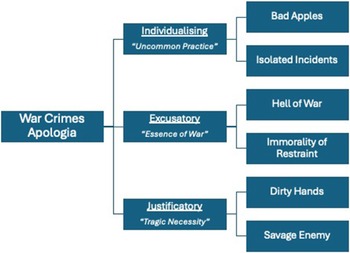
In section one, we identify and critique three broad narrative categories, outlined in Figure 1, that frequently accompany the political, legal, and media coverage of war crimes: 1) individualising narratives (‘uncommon practice’), 2) excusatory narratives (‘essence of war’), and 3) justificatory narratives (‘tragic necessity’). Drawing on a range of real world examples, we outline the features of these narratives and explicate the problematic moral and factual assumptions upon which they implicitly (and sometimes explicitly) depend. In section two, we elucidate the role of these narratives in the perpetuation of socially, politically, and legally harmful attitudes towards war crimes.
Taxonomy of war crimes apologia

Describing and critiquing these narratives is important not only for the purposes of analytical clarity but also because these narratives cultivate a cultural toleration for and, in some cases, celebration of, atrocity. In advancing perpetrator-centric views about responsibility and blame, they also perpetuate a morally and strategically distorted image of war as a space that cannot accommodate moral and legal restraints. This image of war, we argue, weakens the post-Geneva consensus about the reach and limits of battlefield violence and makes the commission of war crimes more likely in the future. In the conclusion, we consider how these narratives could be challenged within military institutions, and in the political and social realm.
Although we examine apologia related to a wide range of conflicts, we focus primarily on the discursive traditions of Western liberal democracies. The reason for this is straightforward. Western states claim to be committed to international humanitarian law, so apologist narratives which excuse, justify, and minimise war crimes are in tension with these countries’ own civilisational assertions. The focus on Western narratives also partially reflects the sample composition. Whereas authoritarian states like Russia favour denialist narratives (and employ propaganda to advance negationist histories), the relative openness of liberal democracies makes this option less available for offending parties. Moreover, unlike their authoritarian counterparts, democracies have at least some accountability mechanisms built into their systems.
A taxonomy of apologist narratives
This section outlines three common war crimes apologist narrative frameworks and unpacks the factual and moral distortions on which they rely.Footnote 7 The first of these, ‘uncommon practice’, are individualising narratives that attribute war crimes to individual perpetrators’ flaws (the ‘bad apple’), sparing the moral reputation of the collective to which they belong. These narratives may acknowledge the wrongness of some conduct but frame these acts as a deviation from the group’s normal pattern of behaviour (‘isolated incidents’). In this way, they deflect broader moral responsibility and minimise or erase institutional or structural factors that contributed to the crime. The second category, ‘essence of war’, downplays perpetrators’ moral responsibility by implying that their actions were understandable given the supposed incompatibility between wartime conditions and the restraint that the laws of armed conflict require. These narratives are typically excusing, rather than justifying,Footnote 8 because while the action is agreed to be criminal, the perpetrator is excused (fully or partially) because their crime is attributed to supposedly extreme circumstances, rather than to their character or motives. The third category of apologist narratives, ‘tragic necessity’, depict war crimes as regrettable but necessary to achieve a moral end (‘dirty hands’) and/or because the enemy’s uniquely evil nature requires a resort to normally unthinkable tactics (‘savage enemy’). In some ‘tragic necessity’ narratives, the perpetrator is regarded as heroic rather than blameworthy.
Narrative category 1: ‘Uncommon practice’
‘Uncommon practice’ are individualising narratives. Unlike ‘tragic necessity’ narratives, described below, these narratives accept the wrongfulness of war crimes but frame them as aberrations – a result of individual character flaws rather than systemic problems within offending institutions. Explicitly or not, these narratives aim to preserve the reputation of a larger group, even when evidence points to institutional involvement in atrocities. At their worst, individualising narratives function as tactical distractions for powerful interests seeking to scapegoat ‘a few’ individuals to preserve the entrenched structure.
Individualising apologia come in two variants. The first focuses on specific people – the so-called ‘bad apples’ narrative. The second aims to condense broader patterns of behaviour into a small number of specific and non-related events (the ‘isolated incidents’ narrative). By viewing criminal phenomena in discrete terms, individualising apologia provide a mechanism through which a ‘villain’ (and the event they preside over) can be depicted as unrepresentative of the collective to which they belong.
A: ‘Bad apples’
‘Bad apple’ narratives assume that combatants who commit war crimes are uniquely weak or wicked individuals whose actions are not representative, statistically or culturally, of their institutions and most of its members. Usually, ‘bad apple’ narratives focus on a singularly reprehensible villain (the ‘lone apple’) or a small number of deviant apples (the ‘rogue squad’).
When the ‘lone apple’ trope is deployed, the chosen villain often seems deserving of their bad reputation. To be sure, some war crimes perpetrators are particularly brutal or verifiably mentally ill, with a history of pathological conduct. The character-driven storytelling aspects in these accounts often makes them effective for audiences in the first place.
One example of a ‘lone apple’ narrative is seen in the anecdote told by a witness in the genocide trial of General Ratko Mladić. Responding to the charge that the Bosnian genocide also included rape, the former Prime Minister of Republika Srpska, Vladimir Lukic, sought to reduce the size of the offender pool to that of a lone perpetrator. As he argued:
It is true that there was a soldier … and I did not want to mention his name, who raped each and every woman he came across. He was transferred to our territory in Romanija and he was killed. His colleagues … [they] told me that it should have been done a long time ago. So they, too, condemned his behaviour.Footnote 9
In America, public responses to the Eddie Gallagher case (a US Navy SEAL Chief who was charged with murdering an adolescent detaineeFootnote 10) show how ‘lone apple’ narratives often try to absolve institutions of responsibility for war crimes. In his analysis of Gallagher’s actions, American special forces officer General Tony Thomas framed the incident as ‘a profoundly good news story’ because some junior SEALs ‘had the guts to step up and identify criminal behaviour’.Footnote 11 Though a small group of SEALs did indeed ‘step up’, this version of events shields the rest of the US Navy Special Warfare Command from wholly deserved blame, including mid-level commanders who turned a blind eye to Gallagher’s conduct.Footnote 12
Australian discourse around the highly publicised murder findings against former Special Air Service Regiment (SASR) soldier, Corporal Ben Roberts-Smith, provides another example of how ‘bad apple’ narratives overlook a perpetrator’s social position in a larger pathological system. A recipient of Australia’s highest military honour, Roberts-Smith was found in civil court to have committed multiple war crimes in Afghanistan between 2009 and 2012.Footnote 13
Defending his decision to overrule the recommendation that the SASR’s Meritorious Unit Citation be revoked, then-Defence Minister Peter Dutton claimed, falsely, that ‘99 percent of our people earned that citation through their brave and courageous actions’.Footnote 14 Former Prime Minister Scott Morrison argued similarly, stating that ‘what’s important is that the many shouldn’t be held accountable for the actions of a few’.Footnote 15 This assumption of institutional non-complicity is a bipartisan position in Australian politics, with center-left politicians from the Australian Labour Party adopting identical arguments.Footnote 16
B: ‘Isolated incidents’
Whereas ‘bad apple’ narratives minimise the number of perpetrators, ‘isolated incidents’ narratives minimise the frequency of and linkages between criminal events. These individualising apologias are prevalent in revisionist histories, especially those which acknowledge some wrongdoing but seek to quarantine its effect on cultural memory. A classic example is the infamous ‘myth of the clean Wehrmacht’ – a figment of the post-Second World War push to rehabilitate the German Army’s reputation by detaching it from the Nazi Party’s legacy. In these narratives, the Wehrmacht’s defenders (with veterans’ organisations at the helm) demanded ‘an end to the defamation of the Wehrmacht at home and abroad’ and a differentiation in historical memory between the Army’s frontline conduct and the Third Reich’s crimes.Footnote 17
Similar apologia appear in more recent cases. For example, responding to Amnesty International’s claims that its soldiers were engaged in corpse desecration and executions of children, the Libyan National Army claimed that the conduct was ‘isolated’ and would be dealt with internally.Footnote 18
Similar event minimisation can be seen in Liz Truss’ defense of the UK government’s arms sales to Saudi Arabia. Although she conceded that the Saudi military’s conduct in Yemen gave rise to ‘incidents of concern’, in her view these ‘incidents’ did not indicate any ‘patterns, trends or systemic weaknesses’ because ‘the incidents which have been assessed to be possible violations of IHL occurred at different times in different circumstances and for different reasons’.Footnote 19 In other words, each event ought to be analyzed separately, and not as a whole.
In Australian SASR apologia, a glaring disparity persists between how investigating authorities quantified the number of offences and how sympathetic observers characterise it. The soldiers’ own apologia minimises the scale of offending through vague allusions to a malign ‘public narrative … dominated by allegations and controversies’.Footnote 20 With this rhetorical device, each crime is rendered an isolated incident – one that must be downplayed to preserve the soldiers’ overall legacy.
C: Critiquing individualizing apologia
‘Bad apple’ and ‘isolated incidents’ narratives are connected by assertions of rarity and aberrance. To an individualising apologist, the observed data may be accurate, but not generalisable and of no relevance to wider sociological analyses of the perpetrating group.Footnote 21 As Jonathan Conricus remarked in response to war crimes allegations levelled at Israel: ‘some of it may have a kernel of truth. Is it common practice? No. Is it something that is sanctioned by the IDF? No’.Footnote 22 But these apologia are rife with factual errors. For example, although the apologia surrounding Eddie Gallagher and Ben Roberts-Smith characterise the perpetrators as sui generis villains, their conduct was part of cascading institutional failures at multiple levels. As journalists Matthew Cole and David Philips observed of the Gallagher affair, far from being a lone villain, Gallagher personified a deeper problem within the Navy SEALs in which a simmering ‘pirate’ subculture had, for decades, bridled against legal restraint.Footnote 23 In Roberts-Smith’s case, he belonged to a special forces community that included literally dozens of direct perpetrators and even more enablers, including commanders who promulgated a lawless ‘warrior culture’. According to statistics compiled by the Inspector General of the Australian Defence Force (IGADF), more than 200 special forces soldiers knew about but failed to report the SASR’s war crimes in Afghanistan.Footnote 24 Yet public narratives frequently misrepresent these figures, using minimising terms like a ‘small number’,Footnote 25 a ‘small clique’,Footnote 26 a ‘handful’,Footnote 27 a ‘few’,Footnote 28 or even a ‘tiny few’Footnote 29 to describe the number of offenders.
These narratives similarly undercount the number of criminal events. In Australia, the IGADF first tabulated 39 murders committed by the SASRFootnote 30 but the Office of the Special Investigator (OSI) later assessed that the crimes were ‘significantly greater’Footnote 31 than this figure, initiating investigations into 53 separate cases.Footnote 32 The Afghan Independent Human Rights Commission (AIHRC) compiled an even larger event count, collecting evidence of 122 separate unlawful killings.Footnote 33 It is hard to see how ‘isolated incidents’ accounts are empirically justifiable in this case.
More fundamentally, individualising narratives do not readily apply to most war crimes because war is a collective activity.Footnote 34 As a result, war crimes almost always possess the forensic signature of a group or policy. Some crimes may be committed by particularly villainous characters, but collective responsibility is still engaged when peers turn a blind eye to the offending. For an individualising narrative to truthfully represent the crime’s circumstances, certain testable criteria should be present. These could include:
(i) Fewer than threeFootnote 35 direct perpetrators within the formation;
(ii) There is no institutional precedent for the crime;
(iii) There is no evidence of attempts to conceal the criminality;
(iv) The group unanimously condemns the crimes;
(v) The institution takes positive steps to recognise the wrongdoing, excoriate the perpetrators, and undertakes appropriate restorative action.
As this proposed ‘Bad Apples Test’ makes clear, the threshold for a credible ‘bad apples’ or ‘isolated incidents’ claim is high, such that it is rarely met. Accordingly, many if not most individualised apologia are gross misrepresentations of the underlying context in which war crimes occur.
Narrative category 2: ‘The essence of war’
The ‘essence of war’ category encompasses all efforts to fully or partially excuse battlefield misconduct through reference to the fundamental and immutable nature of armed conflict. This type of apologia has two forms. The first, the ‘hell of war’ narrative, frames war as intrinsically inhospitable to restraint and humanity. War crimes occur, according to this view, because ‘better’ conduct is unachievable, at least consistently, in the context of battle. The narrative’s second form is the ‘immorality of restraint’. According to this narrative, while legal restraints on battlefield conduct might be technically possible to uphold, such restraints are both an unjust imposition upon combatants and an imprudent roadblock to victory. As we explain in the critique section, both narratives wrongly downplay the achievability of wartime legal standards, misconstrue the moral basis of the laws of war, and devalue combatants’ moral agency.
A: The hell of war
According to ‘hell of war’ narratives, an unbridgeable divide exists between conditions of peace and war. In peacetime, violence can be reduced through social control and socialisation (such as through shame and disgust). But in war, conduct that would earn opprobrium in normal society – the shooting, stabbing, and burning of other human beings – is tolerated, encouraged, or even required. How, some ask, can ‘good’ conduct exist in such conditions? And, given war’s escalatory dynamic, how can any moral and legal limits on combatant conduct endure? Apologist narratives assume that they cannot. This pessimism regarding the possibility of moral restraint in war partly reflects the classic tension between liberal and so-called ‘realist’ schools of thought on the potential for progress in human society.
Historically, the belief that war is fundamentally and irredeemably ‘hell’ has driven arguments for an unconstrained arena of armed conflict. ‘War is cruelty, and you cannot refine it’, argued Union general William Sherman.Footnote 36 For Sherman, war’s conduct could not be restricted, so moral condemnation was warranted only against those who commenced war unjustly.
Central to ‘hell of war’ perspectives is the notion that inhumane conduct is a permanent fixture of armed conflict. This basic ‘fact’ should, therefore, inform judgments of combatants’ moral responsibility. Responding to a criminal investigation into prisoner executions by the UK Parachute Regiment during the Falklands War, Max Hastings argued that: ‘Today, when so few adults have known war at first hand, there is a growing tendency to suppose that the moral absolutes of peacetime civilian life can be transferred to the battlefield’.Footnote 37 For Hastings, war crimes investigations stem from the mistaken belief that war can be remade into something fundamentally less destructive. Such views purport to see war for what it is – ungovernable – and the rules for what they are – utopian fantasy.
Another example of this narrative emerged in Australian debates about Ben Roberts-Smith. Large sections of the Australian public, media, and political elite defended Roberts-Smith’s actions and those of his co-conspirators. Former Prime Minister Tony Abbott warned Australians not to ‘judge soldiers operating in the heat of combat under the fog of war by the same standards that we would judge civilians’.Footnote 38 Political commentator Peta Credlin argued that some ‘excesses … are understandable in the cauldron of war’ because ‘if there was a hell on earth, that hell was Afghanistan’.Footnote 39 She went on to label Roberts-Smith a ‘soldier’s soldier; a hero, even if very possibly a flawed one’.
This ‘hell of war’ narrative transforms the war criminal into a sympathetic figure – a good person made bad by the battlefield’s unendurable pressures but whose wrongful actions are not evidence of bad character. It is not the perpetrator we should condemn, the narrative goes, but war itself. As one high-profile marketing executive wrote in a full-page advertisement in The Weekend Australian titled, ‘An Apology to Ben Roberts-Smith: From a Coward’:
We, the great majority envy your courage, strength, commitment, and the torture you must now endure. We are in your debt … in that awful moment the soldier has to react. Someone has to pull the trigger. Kill or be killed.Footnote 40
It is worth reflecting on what exactly Roberts-Smith did in Afghanistan. An Australian Federal Court found that he kicked a civilian off a cliff then procured a subordinate to shoot him, pressured a ‘rookie’ soldier to execute an elderly Afghan as part of an initiation practice called ‘blooding’, and murdered another prisoner before drinking beer from the dead man’s stolen prosthetic leg back at base.Footnote 41 But Roberts-Smith’s defenders rarely discuss these details, focusing instead on excusing the conduct. For example, Roberts-Smith’s lawyer, in response to photos of the soldiers drinking beer from the pillaged leg, opined that ‘allowances should be made’.Footnote 42
B: The immorality of restraint
This narrative shares many of the assumptions of the ‘hell of war’ narrative but emphasises the immorality, rather than the impracticality, of rules restricting combatant behaviour. Some proponents of this narrative claim that reducing war’s cruelty by imposing legal and moral rules makes war more appealing to belligerent-minded leaders. As Confederate General Robert E. Lee put it: ‘it is well that war is so terrible, or we should grow too fond of it’.Footnote 43
Other variants of this narrative focus not on war’s commencement, but its termination. Battlefield rules are seen as immoral because they delay or make impossible the attainment of victory. Criticising the 1863 Lieber Code (created to regulate hostilities between Union and Confederate forces), Swiss jurist Johann Bluntschli praised efforts to prohibit ‘unnecessary injury, cruelty, or destruction’ but argued that ‘[the] most reckless exactions cannot be denied … because the greater the energy employed in carrying on the war, the sooner will it be brought to an end’.Footnote 44
The view that the fundamental moral question of war is how to bring it to an end quickly endures today. According to Robert O’Neill, the Navy SEAL who claimed responsibility for killing Osama bin Laden: ‘if you wanna lose a war, get lawyers, politicians and four-star generals involved … soldiers in combat make split-second, life-or-death decisions and should not be worried about politicians disagreeing with their moves’.Footnote 45
The most common and compelling version of this narrative centres on what is supposedly owed to the individual combatants sent to fight and die on our behalf. According to the narrative, this sacrifice precludes any post facto negative judgments of the combatant’s behaviour. This view dominated debate around the trial of the Vietnam War’s most famous war criminal, Lieutenant William Calley. Convicted for murdering 22 unarmed civilians during the My Lai Massacre, Calley received substantial public support. One organiser of a petition demanding Calley’s release stated:
I think it is dangerous and a degradation to the United States … to take one of our boys, teach him to kill, put him into that kind of war where they tell you everybody’s an enemy … then prosecute them for doing what they’re taught to do.Footnote 46
Purveyors of these narratives often rely on vague, sterilising descriptions of events, such that cold-blooded murder is conflated with legitimate battlefield killing. In some versions of this narrative, the criminality is minimised or put to one side, such that the approach resembles a ‘soft’ denialism. Instead, the behaviour is framed as ordinary conduct at best, excessive enthusiasm at worst. Former Australian Foreign Minister Alexander Downer exemplified this approach in his commentary on Australia’s crimes in Afghanistan:
You put the army into these situations, not aid workers … Mainly men, young men … I can understand how they can be a little trigger-happy. I cut them a lot of slack. Don’t send the SAS[R] in if you’re worried they’re going to kill someone. Of course they’re going to kill someone. They’re trained to kill someone.Footnote 47
In effect, the argument is that, given their trained proclivities, soldiers will inevitably commit war crimes, so it is unfair to blame them even when their behaviour is ‘excessive’.Footnote 48 By contrast, efforts to curtail war crimes, including through the justice system, are unreasonable overreach. As former Republican congressman Duncan Hunter put it: ‘It’s time to stop prosecuting our warriors who go overseas and do what we ask them to do’.Footnote 49 President Donald Trump held a similar view, justifying his decision to pardon convicted war criminals thusly: ‘people have to be able to fight … They can’t think “Gee whiz, if I make a mistake” … I will always stick up for our fighters’.Footnote 50
‘Hell of war’ and ‘immorality of restraint’ narratives also narrow the field of those who are authorised to criticise perpetrators’ conduct. In these narratives, those who have never fought in a war – civilians, politicians, and the media – lack the experience and right to criticise those who have. As Nelson argued in his defence of the SASR’s conduct: ‘I don’t think any of us on the thrones of sanctimony in our comfortable lives can make judgement’.Footnote 51 Whether in a ‘living room’,Footnote 52 an ‘air-conditioned office’,Footnote 53 an ‘armchair’,Footnote 54 or indeed a luxuriant ‘throne of sanctimony’, the civilian’s supposedly decadent and detached life is a common fixture in all these narratives. Framed in this way, civilian efforts to investigate and punish atrocities become morally condemnable efforts to ‘tear down our heroes’.Footnote 55
C: Critiquing ‘essence of war’ apologia
While claiming to recognise war’s brutal reality, both ‘hell of war’ and ‘immorality of restraint’ narratives use language that distorts and minimises the severity of the crimes that occurred. For example, in its defence of the October 7 massacre, Hamas leaders acknowledged ‘some faults’ in the attack’s execution but argued that any harm to Israeli civilians was caused by ‘confusion’ in the border region following ‘the rapid collapse of the Israeli security and military system’.Footnote 56 Israel’s defenders used similar reasoning to justify Israeli atrocities. As one letter-writer to the Los Angeles Times argued: ‘For many years, Israel has been under rocket attack by Hamas … War is hell. Unfortunately, in order to defeat Hamas, Israel has had to do things that may appear to be inhuman’.Footnote 57 In these examples, the perpetrator is transformed from an agent of wrongdoing into a sympathetic figure deserving leniency due to war’s inherent pathological realities.
The foundational assumption here is that the laws of war are deficient and impossible to abide by, either practically (they are situationally unworkable) and/or ethically (there will inevitably be overriding moral reasons to break them) given war’s harsh realities. Additionally, ‘hell of war’ and ‘immorality of restraint’ narratives often, implicitly or explicitly, depict the laws of war as justified only on military grounds, so that, if following them lacks tactical value in a particular situation, there is no reason to obey them.Footnote 58 But this characterisation fails to provide an accurate account of the origins and purpose of the laws of war and of the possibilities for rule compliance during wartime.
Firstly, the idea that the laws of war are a barrier to attaining military objectives ignores the fact that the laws of war, as codified today in international humanitarian law (IHL), were created primarily by, and almost exclusively for, states. From their genesis, these rules were designed to facilitate, not impede, battlefield victory. This view is reflected within professional discourses in Western militaries, where law of war compliance is often regarded as advantageous, both operationally and strategically.Footnote 59 Far from being constraints on effective fighting, the laws of war sanction a highly permissive mode of warfightingFootnote 60 that aims to mitigate only the worst and purposeless cruelties.Footnote 61
Secondly, it is false to assert that abiding by the laws of war imposes an impossible burden on combatants. While war does contain hellish qualities that do strain the capacities of combatants,Footnote 62 these situational pressures should not be overstated. The vast majority of combatants in professionalised military forces abide by the laws of armed conflict the vast majority of the time, in part because these laws are highly permissive. By couching moral assessments of perpetrators in an overly lenient lexicon, and by framing the rules as unworkable, war crimes apologists marginalise soldiers who do not descend into criminality, despite the stressors of combat.
These narratives also mischaracterise the circumstances in which war crimes occur by portraying war crimes as mostly arising in the ‘heat of battle’. For example, ‘hell of war’ narratives often overlook the fact that most war crimes happen during war’s ‘colder’ moments – in the aftermath of a firefight, in a detention facility behind the frontlines, or in an air operations center far removed from the field of combat. In these cases, a perpetrator cannot cite danger as a justification for executing prisoners, because, by definition, a person who is hors de combat is literally ‘out of combat’. A range of legally and morally superior choices is thus available to perpetrators before they commit the crime. This fact is usually ignored by apologists.
In addition to these distortions, ‘essence of war’ apologia that characterise the laws of war as having purely instrumental value ignore the moral basis of these laws. Recognising that the laws of war have tactical value does not mean that their normative status is reducible to this value alone. While it is true that IHL is intended to serve state interests, it also emerged from, and reflects, a long and complex just war tradition that has its roots in religious and humanitarian traditions that recognised the need to address the prima facie moral wrongness of inflicting death and injury on others.Footnote 63 This tradition also placed heavy emphasis on the moral status of combatants’ characters.Footnote 64
IHL also developed in the context of emerging conceptions of human rights within international law, during which, over the last century, ‘human rights thinking migrated into IHL’.Footnote 65 So, while IHL is aimed at minimising aggregate suffering (rather than protecting individual human rights), central principles in IHL, such as the principle of distinction, rest on the claim that non-combatants have a moral status that makes targeting them prima facie wrong, regardless of military reasons to do so. This point is evident in the language used to describe ‘protected’ status, where non-combatants are presumed to be ‘entitled to respect for their lives … and treated humanely in all circumstances, with no adverse distinction’ (ICRC 2004). This language clearly relies on moral concepts to explain the wrongness of directly targeting or harming non-combatants, not claims about strategic value.
Indeed, as we explain in our discussion of ‘tragic necessity’ narratives below, some of the most pernicious apologia get their persuasive force precisely by acknowledging the moral status of the laws of war while still framing war crimes as moral necessities motivated by duty and sacrifice.
Narrative category 3: ‘Tragic necessity’
Unlike ‘essence of war’ narratives, ‘tragic necessity’ narratives depict perpetrators as fully responsible for, but also justified in, their actions because of the need to save lives and/or to defeat a relentless, savage enemy. These narratives invite audiences to identify and sympathise with perpetrators who, we are told, are forced to make tragic choices and sacrifice their moral principles to achieve a just outcome. With war crimes framed as a moral necessity, these narratives may even elevate perpetrators to moral exemplars.
A: ‘Dirty hands’
In ‘Politics as a vocation’ (1921),Footnote 66 Max Weber articulated an early version of ‘dirty hands’. Writing that the ‘decisive means for politics is violence’, Weber argues that politicians must recognise that ‘the attainment of “good” ends is bound to the fact that one must be willing to pay the price of using morally dubious means … facing the possibility or even the probability of evil ramifications’.Footnote 67 Because of this moral conundrum, the politician with integrity can’t afford to adhere to an idealistic ethics but must recognise that ‘he is responsible for what may become of himself under the impact of these [ethical] paradoxes’.Footnote 68
Later, Michael Walzer expanded on and defended the dirty hands idea in ‘Political action: The problem of dirty hands’.Footnote 69 Walzer’s defence of dirty hands aims to avoid the rigidity of moral absolutism, on the one hand, and the dangers of simplistic ‘ends justifies the means’ reasoning, on the other. The argument for dirty hands posits, first, that genuine moral dilemmas, while rare, do exist. And, in such cases, a person may be justifiedFootnote 70 in violating their deeply held moral principles to bring about a greater good (thus rejecting absolutism). But this decision exacts a personal moral cost (thus rejecting ‘ends justifies the means’ reasoning). To illustrate, Walzer argues that a politician who deeply opposes torture might nonetheless be justified in ordering the torture of a terrorist to find out the location of several bombs that, if they explode, will kill thousands of innocent people.Footnote 71 Because the politician’s opposition to torture is sincere, he recognises that by ordering the use of torture he has committed ‘a moral crime’Footnote 72 even though his only motivation is saving lives. This is what gives him ‘dirty hands’. As a result, he experiences remorse and regret and may even need to ‘repent and do penance’ for his actions.Footnote 73
The dirty hands scenario thereby invites the audience to see the perpetrator’s (reluctant) decision to violate their moral values not as moral weakness, but as moral strength, warranting admiration rather than condemnation. The perpetrator becomes a tragic hero rather than a moral monster, an evocative pathos that makes the dirty hands narrative so appealing to war crimes apologists.
To illustrate, soon after the 9/11 terrorist attacks, the Bush administration began to craft a political and legal narrative to justify torturing terror suspects that involved core elements of the ‘dirty hands’ narrative. First, torture was described as ‘abhorrent to American values’, thereby demonstrating that the Bush administration had the ‘right’ moral values. Then, the resort to torture was depicted as a tragic necessity motivated only by the intention ‘to avoid the greater harm’ (in the words of the infamous ‘Torture Memos’ produced by the Office of Legal CounselFootnote 74). Those involved in the torture program were thus portrayed as motivated only by duty and loyalty, not sadism or cruelty. For example, former CIA Director General Michael Hayden admitted ‘that there had been abuses early on’, but claimed that ‘[t]he CIA detention and interrogation program was launched out of a sense of duty, not enthusiasm’.Footnote 75 Similarly, former CIA lawyer John Rizzo praised the ‘resoluteness of CIA career professionals who were convinced of [the interrogation program’s] value and thus steadfastly, stoically carried it on for years in the face of shifting political winds and increasingly toxic public controversy’.Footnote 76 Even former President Obama, who criticised the use of torture, turned the CIA’s torture program into evidence of noble patriotism:
People did not know whether more attacks were imminent. And there was enormous pressure on our law enforcement and our national security teams to try to deal with this. It’s important for us not to feel too sanctimonious in retrospect about the tough job that those folks had. A lot of those folks were working hard under enormous pressure and are real patriots.Footnote 77
‘Dirty hands’ narratives are also used to justify ‘one-off’ war crimes. US Republican politician Allen West appealed to a ‘dirty hands’ narrative to defend his mistreatment of a captured prisoner while deployed to Iraq. Before the incident, West had received intelligence about a plot to ambush his unit. They detained the suspect, beat him, and West fired his pistol near his head to extract information. When West was eventually charged with assault, he stated during his hearing: ‘I know the method I used was not right, but I wanted to take care of my soldiers’.Footnote 78 West framed his choice as one that he knew was wrong (because he possesses the ‘right’ moral values) but was nonetheless justified because of his overwhelming concern for his soldiers. Far from being condemned for abusing the prisoner, West received thousands of letters of support, including one signed by 95 members of the US Congress.Footnote 79
The most extreme iteration of ‘dirty hands’ invokes a supreme emergency, in which the existential defence of a community is said to justify otherwise unthinkable measures. An extraordinary invocation of this narrative is seen in the claim made by some of Radovan Karadžić’s supporters that Serb atrocities in Bosnia were a ‘preventative genocide’ (preventivnog genocida) that sought only to protect Serb minorities from becoming genocide victims themselves.Footnote 80 In this narrative, the genocidaire is transformed into a protector.
As shown in these examples, the ‘dirty hands’ narrative exculpates perpetrators by turning what would normally be evidence of bad moral character and dishonourable motives – the commission of a war crime – into evidence of the perpetrator’s good moral character and honourable motives. The second version of the ‘tragic necessity’ narrative similarly invites the audience to sympathise with the perpetrator but focuses primarily on the nature of the enemy rather than the perpetrator’s own values.
B: ‘The savage enemy’
In ‘savage enemy’ narratives, the decision to commit war crimes is forced upon a reluctant perpetrator by the enemy’s extraordinary malevolence. In this narrative, the enemy’s refusal to abide by the rules of war requires a ‘necessary evil’ response to avoid catastrophe. Examples of this narrative incorporate elements of the ‘dirty hands’ narrative by framing the resort to a ‘necessary evil’ as the regretful choice made by good people.
One version of the ‘savage enemy’ narrative presumes that reciprocity is the only basis for constraints in war. The laws of war, per this view, lack an underlying moral foundation. So, when the enemy flouts the rules, there is no moral obligation for one’s own side to follow them.
In an arguably more insidious version of this narrative, the rules of war are depicted as having some moral foundation, so the perpetrator feels remorse about being ‘forced’ to violate them to defeat a ruthless enemy, demonstrating their moral goodness and thus their moral superiority over the barbaric enemy they face. And, because the perpetrator is being forced to violate the rules in response to the enemy’s tactics, the ‘savage enemy’ is ultimately responsible for all atrocities that occur throughout the entirety of the war, including one’s own atrocities.
‘Savage enemy’ narratives have a long history in colonial wars and the atrocities that often accompanied them. The Spanish colonisation of the New World and the subjugation of its indigenous peoples led the Spanish Crown to sponsor a series of debates (known as the ‘Affair of the Indies’) in which renowned thinkers discussed ‘the relationship between war and justice in an effort to provide guidelines for Spain’s political relationship with the “barbarians of the New World, commonly called Indians”’.Footnote 81 Of course, the ‘barbarians’ themselves had no voice in these debates. And, while some participants offered limited defences of indigenous peoples’ rights, the debates ultimately legitimised conquest and genocide by providing a theoretical ‘blessing’ to such practices and by creating the illusion of a morally decent colonialism.Footnote 82
The narrative of civilising warfare against a ‘savage enemy’ has been replicated many times since the Affair of the Indies, to justify the mass killing of indigenous peoples. For example, Daniel Brunstetter explains how, after the American Revolutionary War, defenders of the extermination of Native Americans justified their actions by claiming that Native Americans ‘did not abide by (European) rules of war but rather waged merciless warfare that ignored all civilized constraints … different standards were justified when dealing with such peoples’.Footnote 83
A similar narrative was used to justify the US invasion of the Philippines and the use of torture against Filipino soldiers and civilians. When a 1904 Senate report found evidence of the widespread use of torture by US troops, President Roosevelt defended the military, claiming that the war represented ‘the triumph of civilization over forces which stand for the black chaos of savagery and barbarism’.Footnote 84 Members of the Roosevelt Administration also suggested that, if torture had occurred, it ‘might at times be justified by the frequent violations of the rules of “civilized warfare” committed by a “barbaric and treacherous” enemy’.Footnote 85
A modern iteration of this narrative emerged after the terrorist attacks of 11 September 2001, when the Bush administration deployed the language of ‘civilisation versus barbarism’ to justify the torture of Al-Qaeda suspectsFootnote 86 and the illegal invasion of Iraq.Footnote 87 This rhetoric almost exactly mirrored Roosevelt’s rhetoric. As US Attorney General John Ashcroft put it on 24 September 2001:
[T]he attacks of September 11th drew a bright line of demarcation between the civil and the savage … On one side of this line are freedom’s enemies, murderers of innocents in the name of a barbarous cause. On the other side are friends of freedom.Footnote 88
The Bush administration’s use of the ‘savage enemy’ narrative, combined with elements of the ‘dirty hands’ narrative discussed above, simultaneously displaced responsibility for torture onto ‘freedom’s enemies’, while painting perpetrators’ motives as noble. Thus, the resort to torture became compatible with the claim that torture is also ‘abhorrent to American values’.
In more recent contexts, ‘savage enemy’ narratives have featured in the war crimes apologia of both Hamas and the Israeli Defense Forces (IDF). Attempting to justify the October 7 massacres, Hamas issued the following statement:
… given the Zionist crimes against our peaceful people and the destruction of civilians’ homes … the enemy does not understand the language of moral values and humanity so we will address it in the language it understands well.Footnote 89
Within hours of this statement, the IDF used the same ‘savage enemy’ logic to defend its own conduct. Justifying Defense Minister Yoav Gallant’s ‘starvation’ order, which prevented the distribution of food and water to Gaza’s civilian population, IDF spokesman Lt Col Jonathan Conricus stated:
We are at war, we have been assaulted, attacked by a ruthless inhumane enemy that has butchered our civilians. … you cannot expect us to be providing electricity, water and energy to the very same enemy that has come across our border and is trying to kill our civilians.Footnote 90
Gallant himself defended imposing a ‘complete siege’ on Gaza in even starker terms: ‘we are fighting against human animals and we are acting accordingly’.Footnote 91 Leveraging the suffering of Israeli victims of Hamas’ conduct more directly, the Israeli government shared a quote from a freed hostage who stated that, ‘there are no innocent civilians in Gaza’.Footnote 92
C: Critiquing ‘tragic necessity’ narratives
Both ‘dirty hands’ and ‘savage enemy’ narratives portray the commission of war crimes as not only justified, but as evidence of moral superiority. Unlike ‘essence of war’ narratives, ‘tragic necessity’ apologia acknowledge the moral basis of the laws of war, but argue that sometimes rules must give way in the face of competing, overriding, moral imperatives. The seductiveness of these apologia relies on their capacity to supposedly reconcile atrocity perpetration with moral goodness. For example, the ‘dirty hands’ narrative must acknowledge that the laws of war are founded on moral principles, because if they were only militarily valuable, breaking them for military reasons would involve no moral sacrifice – no ‘dirty hands’ – at all. This point alone reveals inconsistent approaches to the moral status of rules across different forms of apologia.
Like ‘dirty hands’, ‘savage enemy’ narratives morally distort the commission of war crimes by, on the one hand, shifting sympathy from the victims of war crimes to the perpetrators (who are depicted as tragic or even morally courageous figures), and, on the other hand, shifting moral responsibility to the victims, whose barbaric nature and tactics have ‘forced’ the resort to criminal violence. This extreme manifestation of tu quoque logic continues today in both Israel’s and Hamas’ framing of the October 7 massacre (and Israel’s response to it), where both sides have blamed the other for their own war crimes. Hamas employed this blame-shifting tactic in its criticism of the International Criminal Court for seeking the arrest of three Hamas leaders,Footnote 93 arguing that prosecuting Palestinians who try to resist Israeli oppression would be ‘to equate the victim with the executioner’.Footnote 94 Similarly, Israel’s defenders have consistently sought to justify IDF criminality by claiming that the supposed existential threat posed by Hamas has forced Israel to bomb children ‘in their homes or out of them’.Footnote 95 And so the American Jewish Committee argued that the mass death in Gaza caused by Israel’s actions is ‘a deeply regrettable consequence of Hamas’ lawless tactics, not evidence of Israel’s criminal intent.’Footnote 96 Distorted as this logic may be, the continuing use of these narratives in conflict illustrates just how appealing they are for states seeking to justify or excuse war crimes by displacing moral blame onto their victims.
The social and political costs of war crimes apologia
The taxonomy we outline in section one offers a powerful analytical tool for assessing and identifying real life instances of war crimes apologia. Identifying these apologia is vitally important because these narratives distort the relationship between the laws of war, morality, and military goals, and exaggerate the difficulties of compliance with battlefield rules. By doing so, these apologia promote dangerous attitudes that undermine the international legal and moral consensus on military conduct, create impunity for war crimes, and prolong grave injustices against victims of war crimes.
War crimes apologia and international order
A review of these war crimes apologia might suggest the pessimistic conclusion that there has never been consensus on battlefield conduct in practice, despite the legal and moral commitments that states claim to uphold. Instead, as we saw with the history of the ‘savage enemy’ narrative, states have long used apologia to justify violating constraints, especially against groups who are dehumanised via racialised tropes. Given this history, one might ask what we gain from pointing out that states continue to use these same apologia.
This cynicism is misplaced. Identifying and critiquing these apologia is important not only because of their factual and moral distortions but because their use by belligerents continues to endure even as offending parties lay claims to legal and moral improvements. These apologia maintain their seductive grip, and become even more influential, in conditions of collective amnesia (when the crimes are conveniently forgotten) and, paradoxically, because of the narratives’ uncritical repetition. In other words, a uniquely noxious social situation arises when the historical details of atrocities are obliterated from memory even as the tropes used to justify them are remembered.
It is therefore crucial to dissect and dispose of these apologia because their continued acceptance has major implications for victims’ status and rights, the stability of international law, and the justice system’s ability to hold perpetrators to account. By numerically minimising war crimes or by refashioning them into an inevitability and/or a necessity, these narratives protect those who massacre, torture, and murder from accountability, while simultaneously dehumanising the victims of those crimes. This creates almost total impunity for continued offending.
For practical evidence of the destructive effect of apologia on accountability, we can look to the aftermath of the 1902 US Senate report that found evidence of systematic torture by US troops in the Philippines.Footnote 97 Despite this finding, no officer or soldier accused of torture was ever punished. In one case, Captain George Brandle was acquitted of torturing two Filipino prisoners because ‘his intentions had been justified and legitimate’.Footnote 98 A similar appeal to ‘good intentions’ (styled as a just response to ‘savage enemies’) contributed to the Obama administration’s failure to seek accountability for the perpetrators of the post-9/11 torture program. As Serwer recounts:
Even a proposal for a South African-style ‘truth and reconciliation’ commission was rejected. All avenues for any form of accountability for torture – criminal, civil, even professional – were blocked by Obama-era officials.Footnote 99
This almost complete impunity for war crimes continues to play out in the case of Israel, where relentless blatant appeals to savage enemies and tragic necessity have contributed to the Israeli government’s refusal to accept or address extensively documented evidence of atrocities.Footnote 100 As a result of these persistent narratives, war crimes findings by human rights organisations,Footnote 101 a United Nations Commission of Inquiry,Footnote 102 and the issuance of arrest warrants for senior Israeli politiciansFootnote 103 have failed to curb Israel’s conduct and deter support from its allies. This case illustrates how these narratives increasingly undermine and threaten the stability of international moral and legal wartime norms.Footnote 104
The licensing effect of war crimes apologia
In addition to impeding accountability for past and ongoing wrongs, war crimes apologia are cultural enablers of escalations in battlefield atrocity, setting conditions for even worse offending. Observing that large-scale atrocities are often preceded by ‘supportive networks’ that neutralise critics, lionise perpetrators, and encourage unfettered violence, Albert Bandura argues that ‘moral justification’ is a baseline prerequisite for society-wide moral disengagement from atrocity.Footnote 105 ‘Savage enemy’ narratives are the most dangerous here because they are often laden with dehumanising tropes that dismiss and ignore victims and even view their suffering as deserved. This allows the wider public to blame the victims of war crimes for the war crimes.Footnote 106
Disregard for victims’ rights is a mainstay in individualising apologia as well, in part because these narratives’ factual distortions often straddle the line between apologia and denialism. In the case of the Australian SASR crimes, for example, the Brereton Report documented how numerous complaints from local Afghans were dismissed by Australian officers, who treated many allegations as ‘Taliban propaganda’Footnote 107 even as those same officers were aware of incidents considered to be ‘isolated’.Footnote 108 This is a form of what philosopher Vanessa Carbonell calls ‘claimant injustice’,Footnote 109 which occurs when socio-political conditions make it impossible for victims to effectively protest the wrongdoing they’ve experienced, often because they lack the power to do so. In these circumstances, legitimate protests are ‘ignored, misinterpreted, underestimated, rejected, or silenced’ by the dominating group, further exacerbating the wrong done to the victims.Footnote 110 All war crimes apologia inflict this moral harm on victims, thus extending the harm beyond the physical violence they have suffered.
In addition to the harm inflicted on victims, apologist narratives damage a society’s ability to confront their own history in ways that could facilitate moral and political improvement. In the US in particular, the repeated use of apologist narratives to excuse atrocities (from the extermination of Native Americans to atrocities committed during the Global War on Terror) has led to a culture of forgetting.Footnote 111 As a result, important opportunities for moral growth have been lost. Similarly, the entrenchment of apologist narratives in Australia during the post-Afghanistan era has stymied genuine acknowledgment of the harm caused to Afghan victims and prevented a domestic reckoning of what Australian ‘values’ are and ought to be. Ultimately, when one society refuses to acknowledge the harm it has visited on another, the resulting ‘epistemic injustice’Footnote 112 can promote a dynamic of competitive victimhood between warring groups.Footnote 113 Apologist narratives thus mute the long-standing consensus that compliance with the laws of war is good for global stability and, more importantly, protects the basic rights of all people.
Conclusion
The rules of war were created, in part, to sanction a wide range of belligerent violence. Critically, these rules also exist to safeguard the innocent from harm, regardless of where they live or which ‘side’ they are on. Torture, rape, and murder in war are wrong not only because they undercut military aims or invite enemy retaliation. They are wrong because they violate victims’ most basic rights. By centering perpetrators’ experiences and rights, war crimes apologia obscure this fact. The gross imbalance between the emphasis on perpetrators’ moral character, suffering, and interests, on the one hand, and the devastating moral and physical injuries suffered by the victims of war crimes, on the other, is typically erased by war crime apologia.
Solving the problems caused by war crimes apologia might seem intractable. But we suggest four broad approaches for acknowledging the extreme harm they cause while also challenging the false and misleading claims on which they are based. Firstly, our taxonomy of war crime apologia can make a potentially important contribution to military education. If military forces are committed to the laws of war, as many (sincerely) claim to be, then military personnel must be educated about war crimes apologia, and taught about when and how apologia have been used by a state’s own forces. Recognising that ‘our side’ can commit war crimes is crucial. Secondly, military and public education should reinforce the fact that IHL protects all persons in the conflict area and that war crimes are not only legal violations but are egregious violations of the human dignity that all persons share. Thirdly, media and political commentary on war crimes should take pains to identify and avoid apologist perspectives in their coverage of war crimes. Finally, and perhaps most importantly, political and military leaders must be willing to recognise the moral wrongness of these crimes and make appropriate amends to victims. Without proper acknowledgement of the past, war crimes apologia will retain their destructive power.
Video Abstract
To view the online video abstract, please visit: https://doi.org/10.1017/S0260210525101472.


 Open access

