


Tackling obesity should be a priority in the public health policies of developed countries(1, 2). One way to assess this is to examine the targets that are set for reducing the prevalence of obesity. The use of targets in health is said to have been inspired by the ‘management by objective’ approach used in the business world(Reference van Herten and Gunning-Schepers3). The USA pioneered the setting of health targets in 1979(4), but targets became a common feature of public health strategies following the launch of the WHO’s Health For All initiative(5). The European Regional Office of WHO set thirty-eight targets in 1984(6). Not everyone immediately welcomed setting targets(Reference Ritsatakis, Barnes, Dekker, Harrington, Kokko and Makara7), and one health minister even described them as political suicide(Reference Gunning-Schepers and van Herten8). The importance of health targets was reasserted in the WHO’s renewed initiative Health For All in the 21st Century(9), for which the European Region set twenty-one targets.
Targets have been described as the first step towards the achievement of health(Reference Nutbeam and Wise10), as a means to give policy focus and recognizability(Reference van Herten and Gunning-Schepers11) and as a way to keep health policy on course(Reference Gunning-Schepers and van Herten8). Targets can be classified into three groups(Reference van de Water and van Herten12, Reference van Herten and van de Water13). Inspirational targets, often called ‘goals’ or ‘objectives’, are intended to stimulate policy development and action at national and state levels. Managerial targets are set to assist the development of detailed plans for the implementation of policy. Finally, technical targets enable the measurement of progress towards achievement of the overall goals. Targets often set the desired amount of improvement and the date by which this should be achieved(6, Reference van de Water and van Herten12, Reference van Herten and van de Water13). The use of targets demonstrates a commitment to achieve improvements within a specified time period and to monitor progress towards goals. Thus, the setting of health targets may be taken as a proxy for governments’ commitment to tackling specific health problems.
The present study reviews goals and targets for overweight and obesity in twelve developed countries. Because they are directly relevant to obesity, targets for nutrition and physical activity are also reviewed.
Methods
Policy documents which address obesity were obtained from twelve developed countries from three continents: Australia, Canada, Denmark, England, Ireland, Japan, New Zealand, Northern Ireland, Scotland, Sweden, USA and Wales. Government websites were searched using key terms: public health policy; overweight; obesity; physical activity; and nutrition. Independent searches were carried out with an Internet search engine using key terms of country name and policy, with each of the following topics: public health; obesity; overweight; nutrition; and physical activity. The reference lists of the documents obtained were then reviewed to identify further documents. These searches were repeated until the policy and background documents were obtained for all countries. Policy documents published up to January 2008(14–42) were reviewed by two independent observers (L.I. and I.K.C.), and details of all relevant goals and targets on overweight, obesity, nutrition and physical activity were extracted.
The terminology used in public health policies varies between countries and over time. The USA uses the term ‘objectives’ to describe its numerical targets(14). Denmark sets overall objectives and intermediate aims and identifies specific target groups within the population(15). Northern Ireland used the term ‘targets’ in its 2002 public health policy(16), then replaced it with ‘health outcomes’ in the 2004 version(17). To ensure that all statements of commitment to tackle obesity were obtained, the present paper uses the term ‘target’ to mean the intended improvement in a specific health outcome, irrespective of the label attached to it in the policy document. The operational definition we have used does not require that the amount of health gain or the date for achievement is specified, again to ensure complete ascertainment. This definition is less strict than has been used elsewhere(Reference van de Water and van Herten12), but it enables us to identify whether or not public health policies express the desire to tackle the burgeoning obesity epidemic.
Targets for nutrition cover a wide range of topics including some which are directly relevant to obesity, such as fat and sugar intake, and others which are less relevant such as Na, Ca and oily fish intake and Fe deficiency in pregnant women. For reasons of relevance and brevity we have focused on targets most relevant to obesity: the consumption of fat, sugar, grain, bread and cereals, and fruit and vegetables.
Results
Targets for obesity
Eight of the countries studied have set targets for obesity, either in general public health policies or in stand-alone obesity policies (Table 1). There are marked differences between these countries in the initial prevalence of obesity, the amount of desired improvement and the date by which this should be achieved. The USA(14) sets the most ambitious targets. These are to increase the proportion of adults who are at normal weight and to reduce the proportion of adults and children who are obese. It first set targets for overweight in 1990(18), but did not set obesity targets until 2000(14). Japan(19) is the only other country to specify the desired reduction in the prevalence of obesity among adults (note that obesity is defined as BMI > 25 kg/m2 in Japan, whereas it is defined as BMI > 30 kg/m2 in all other countries). The current New Zealand target is to reduce the prevalence of obesity without specifying when or by how much(20). The previous target set in 1993, and restated in 1997, was to prevent an increase beyond 10 % in men and 13 % in women(21). However by 2003 the prevalence of obesity had risen to 20 % for men and 22 % for women. Australia intends to reverse the rise in children by 2008(22), but does not specify the amount of reduction to be achieved. A target to halt the rise in obesity among Australian adults by 2007 was set in a 1997 document, but this was rescinded in September 2006(23). No new targets have been set. Northern Ireland(16, 17), Denmark(24, 25) and Sweden(26) wish only to halt the increase in the prevalence of obesity among adults. Northern Ireland(16, 17, 27) wishes to halve the prevalence of childhood obesity by 2025.
Targets for tackling obesity from a review of policy documents published to January 2008 by twelve developed countries
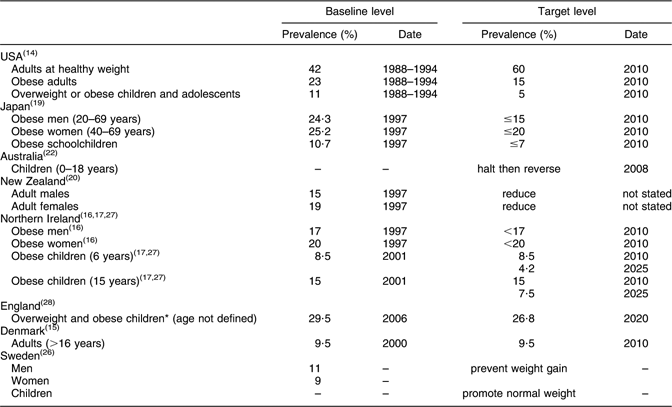
*The 2008 English policy does not specify the prevalence rates, but states the aim of reducing the prevalence to the 2000 level. The prevalence data have been taken from the Health Survey for England published in 2008(31).
England wants to reduce the prevalence in children to the level in 2000 by the year 2020(28). Although the prevalence data are not stated in the policy document, the target corresponds to a modest reduction which will leave the prevalence at 27 %. The previous target set in 2004 was to halt the rise in prevalence by 2010(29). England did not set a target for adults in either the 2008(28) or 2004(29) policies. This is in contrast to the 1992 English public health policy, which aimed to reduce the prevalence of obesity among adults from 8 % to 6 % in men and from 12 % to 8 % in women by 2005(30). The prevalence of obesity in England in 2006 was 25 % among men and 25 % among women(31).
Targets for nutrition and physical activity
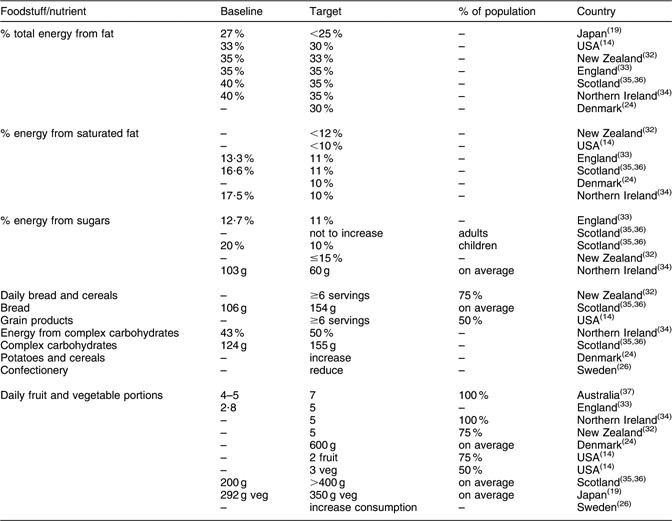
Nutritional targets were identified for nine of the twelve countries studied: Japan(19), New Zealand(32), England(33), Northern Ireland(34), Scotland(35, 36), Australia(37), Denmark(24), the USA(14) and Sweden(26) (Table 2). All nine countries set a target for the consumption of fruit and vegetables and most do so for the proportion of energy from fat. There is some variation in the baseline levels and in the intended improvements, particularly in total energy from fat and sugar. It is notable that there are no targets for reduction of total energy consumption. There is considerable variation in the number of numerical targets set: Scotland(35) and Northern Ireland(34) set targets on all the topics most relevant to obesity, whereas Australia(37) sets only one target, for fruit and vegetable consumption. The targets for fruit and vegetables and for grains and cereals are difficult to compare because they are cast in different ways. Sweden points out that from a public health perspective the most significant changes in diet would include doubling the consumption of fruit and vegetables, halving the consumption of confectionery and doubling the intake of bread(26). In addition to the information in the table, Sweden makes the commitment to decrease consumption of energy-dense food and increase consumption of keyhole-labelled foods (low-fat and/or high-fibre processed foods).
Targets for foodstuffs and nutrients most relevant to obesity from a review of policy documents published to January 2008 by twelve developed countries
The most common target for physical activity is that a greater proportion of adults should take 30 min of moderate activity on most days of the week. For children the period of activity is usually 1 h on most days. There is some variation between countries on how often the activity should be taken and the proportion of the population who should take it. England’s target is that 70 % of adults should engage in moderate activity on five days of the week by 2020(38). New Zealand aims for 75 % of adults to be moderately active for at least 30 min on most, if not all days of the week by 2010(39). Scotland’s target is that 50 % of adults over 16 years will be physically active for 30 min on most days and 80 % of children should accumulate an hour of physical activity on most days by 2022(40). This will require an annual increase of 1 % in the proportion being active. Sweden(26) wishes to increase the proportion of adults who are active for at least 3·5 h/week, whereas for children the aim is for at least 7 h/week. The USA has the greatest number of targets, all of which specify the amount of improvement to be achieved by 2010. For example, it sets a target to increase both regular moderate physical activity for adults (from 15 % to 30 %) and adolescents (from 27 % to 35 %). It also aims to increase the numbers taking part in vigorous activity as well as improving strength and endurance and flexibility. Japan wants to increase regular physical activity in men (from 29 % to 39 %) and women (from 25 % to 35 %) by 2010(19). In 1996 Northern Ireland(16) set a target of increasing the frequency of regular activity among men (from 30 % to 35 %) and women (from 20 % to 25 %) by 2002. No new targets have been set, although a 2001 evaluation found that the target had been met for women but not for men(41). Denmark(24) and Wales(42) wish people to be more physically active but give few details of what is intended.
Targets on knowledge and behaviour
An important finding was the range of ambitious knowledge and behaviour targets on nutrition and physical activity set mainly by Japan, but also by the USA. Japan’s nutritional targets cover knowledge of optimal body weight, appropriate meal size as well as the importance of dietary behaviours such as not skipping breakfast and eating meals slowly and with friends(19). For example, Japan wants to increase the number of people who know their optimal weight to 90 % by 2010 from a baseline of 62 % of men and 80 % of women in 1998. It also aims to reduce the number of people who skip breakfast to 15 % of adults and to zero in children by 2010 and to increase the number of people who read nutritional labels. Japan is currently developing targets for changes in the environment that will facilitate changes in diet. Topics to be covered are the provision of healthy meals in restaurants, increased provision of information and the involvement of voluntary groups in activities related to health and nutrition in the community and workplace.
Japan’s physical activity targets for adults are to increase awareness about the importance of activity, to encourage vigorous exercise and also to increase walking(19). Targets for walking are to increase the number of steps taken by 1000 steps/d for adults, the equivalent of a 10 min walk. It also wants to increase awareness of the benefits of activity and of intentional participation in activity for health reasons. Japan sets separate targets for older people. It wants them to increase walking by 1300 steps/d. It also aims to increase the number of older people who take a positive attitude towards going outside alone and who like going shopping, as well as increasing their participation in social activity.
The USA(14) takes a different approach and specifies targets for nutrition and education at specific settings: schools, worksites and primary care. Thus it wants to increase the percentage of children and adolescents whose meals and snacks at school contribute to good dietary quality. It also wants to increase the number of worksites that offer nutrition or weight management classes or counselling. The USA also aims to increase physical activity within schools, both during and outside school hours. Importantly, it also sets a target to ensure that at least 50 % of time designated to physical activity in class is spent being physically active. The USA is alone in setting a target on television watching by children: to increase the number of children who watch television for less than 2 h on a school day to 75 % by 2010 from a baseline of 57 % in 1999. The targets for increasing access to physical activity include: making school facilities available outside school hours, increasing physical activity and fitness programmes in the workplace, and increasing the proportion of trips made by cycling and walking.
Discussion
The present study has found that only two of the twelve countries studied set targets for a substantial reduction in the prevalence of obesity for adults and children. Two other countries specified decreases for children only: one a substantial decrease and one a modest decrease. Four countries wanted either to halt the rise in prevalence or to reverse the trend (note that the Australian 1997 target to reverse the increase in obesity among adults was rescinded 9 years later and a new target has not yet been set(23)). For four other countries no targets on obesity were stated. Two of the countries studied had set ambitious targets on obesity in the early 1990s, but set much more modest targets in subsequent policy documents.
The role of targets is to provide focus and direction for policy(Reference van Herten and Gunning-Schepers11, Reference van Herten and Gunning-Schepers43), forming an essential step in improving health(Reference Nutbeam and Wise10). Given the current levels and upward trend in the prevalence of obesity, countries might be expected to commit to tackling this problem by setting ambitious targets for obesity. It is clear that many are not doing so, but instead are taking a cautious approach to the setting of obesity targets. These countries are aware of the harms arising from obesity, as many carefully review in their policy documents the morbidity, mortality and medical and financial costs(2). Nor is there a lack of willingness to set challenging targets, as all the countries studied set overarching goals to increase life expectancy or healthy life expectancy and to reduce inequalities in health(44).
One explanation for the reluctance to set ambitious targets could be that many countries are adopting a pragmatic approach to target setting for obesity. They may recognize that the prevalence of obesity is set to continue to rise and that tackling the problem is beset with difficulties. Certainly New Zealand, in a 1997 review of progress on targets(21), used this argument to justify its then target on obesity. If pragmatism is the answer, this suggests that some governments are unwilling at present to take vigorous action to reduce the serious health and economic consequences of obesity.
Many targets are set for nutrition and physical activity. The nutritional targets almost always specify the amount of intended improvement and the date by which this should be achieved. However, the form in which some of the nutritional targets are cast, such as percentage of energy from fat or the number of grams of carbohydrate to be consumed, do not translate easily into changes in diet. In contrast, the recommendation to eat 5 portions of fruit and vegetables daily is easily operationalized.
It is surprising that none of the countries set targets for reductions in energy consumption. Reducing energy consumption is essential for weight loss and it is also a message which is readily understood. This would be most easily achieved by reductions in the consumption of fatty/sugary foods which several countries (e.g. Sweden(26), New Zealand(45) and Denmark(15)) wish to achieve. It is disappointing that only Sweden(26) sets a target for a reduction in the consumption of confectionery. Sweden is also investigating the potential for reducing consumption of confectionery by increasing taxes.
The impact the nutritional targets may have is uncertain. Several countries have had similar nutritional targets for many years(Reference Gifford46–Reference Curran49) during which time obesity rates have been rising(Reference Kettel Khan and Bowman50–52). This suggests that these targets may be more an expression of improvements that governments desire than a formal commitment to ensure that dietary changes occur.
There is considerable variation in the physical activity targets across the countries. Although some countries set specific targets, others express a more general desire for people to be more active. The targets currently set for adults, of 30 min of regular exercise per day, may have been set because this was the level at which substantial health benefits would be gained(Reference Pate, Pratt and Blair53, 54). However, a more recent consensus statement concluded that these levels would be insufficient to prevent the transition from overweight to obesity(Reference Saris, Blair and van Baak55). The activity time would need to be extended to 45 to 60 min/d. Physical activity is an important issue for older people because their activity levels are low(Reference Crombie, Irvine, Williams, McGinnis, Slane, Alder and McMurdo56, Reference Macera, Ham, Yore, Jones, Ainsworth, Kimsey and Kohl57) and the benefits of physical activity for them are well-established(58–Reference Mazzeo and Tanaka60). Only Japan sets targets for activity levels for older people.
Some of the targets, particularly those of Japan but also some from the USA, are of a quite different type to those set by other countries. The Japanese nutrition targets, such as knowledge of portion size or reading of nutritional labels, are attractive because they identify prerequisites to changes in dietary behaviour. Some of the US targets, such as worksites offering counselling on nutrition and weight management, focus on specific mechanisms which could lead to changes in dietary behaviour. The physical activity targets from both countries also provide examples of behavioural change prerequisites and mechanisms for changing behaviour. These targets identify a series of steps that will facilitate the achievement of the longer-term goal of reducing the level of obesity. Figure 1 illustrates how these steps can be organized in a sequence: prerequisites for change, preparatory behaviour change, lifestyle change and finally reduced level of obesity. The prerequisites for change are increased knowledge of healthy eating and physical activity, combined with beliefs about the benefits of a healthy lifestyle. A further requirement is a supportive environment in which healthy food and opportunities for physical activity are readily available. Preparatory behaviour change involves individuals resolving to change their lifestyles and undertaking preparatory behaviours such as reading food labels. This is followed by dietary changes which lead to reduced energy intake and increased physical activity. These will lead, in the longer term, to reduced levels of obesity.
Indicators of progress towards behaviour changes needed to reduce levels of obesity
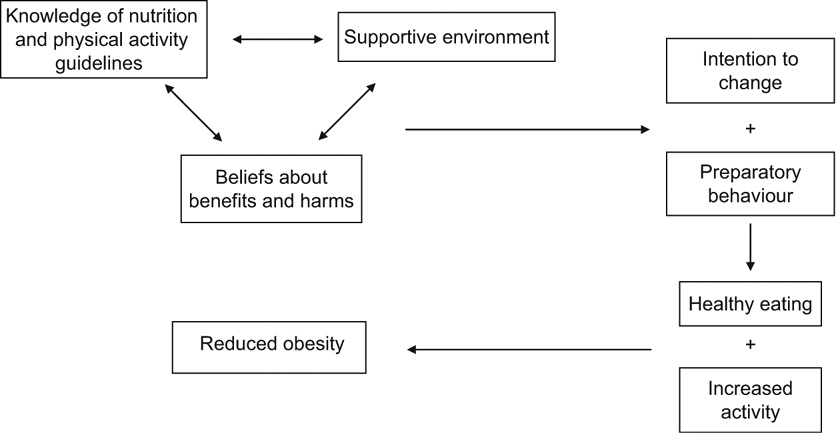
The present study found that most countries set targets which focus on changed dietary behaviour and physical activity or reduced levels of obesity. These are near to the end of the sequence to obesity reduction shown in Fig. 1. In contrast, some of the targets from Japan and the USA cover the intermediate and early stages of the pathway. Such targets are likely to detect desirable changes more rapidly than the traditional targets, allowing early opportunities for modification to policy implementation. All countries could usefully adopt these types of targets. Such targets could be more attractive to governments than headline obesity targets. The desired changes are more readably achievable in the short term and are an important first step towards reducing the prevalence of obesity. An additional benefit of intermediate targets is that governments can assess progress to achieving them within one electoral cycle.
In summary, we have found that if targets are a proxy for government commitment, there is insufficient drive to reduce the prevalence of obesity. It may be that governments are being pragmatic, recognizing the difficulty of making major changes in nutrition and physical activity. Governments may have to balance their concerns for an efficient and productive agricultural sector and their concern for health(Reference Lobstein61, Reference Tillotson62). It is also possible that the food industry has successfully lobbied governments(Reference Nestle63). Whatever the explanation, the consequence of the lack of commitment is an acceptance of the dire health sequelae of the obesity epidemic. A report from England suggests a fall in life expectancy of 9 years(64) and one from Sweden states that the increased health-care costs of morbidity associated with obesity could not be sustained(26). There is an urgent need for governments to reconsider targets on obesity.
Acknowledgements
There are no conflicts of interest. I.K.C., L.I. and L.E. conceived and supervised the study. L.I. and H.W. identified and retrieved the policy documents. I.K.C. and L.I. analysed the policies and led the writing. L.E. and H.W. assisted with the writing. This study was funded by NHS Health Scotland, a branch of the Scottish Executive Health Department. We are grateful to Dr L. Gruer for encouragement and support to undertake this work.



