

I. Introduction
On May 24, 1698, the Bishop of Chiapas and Soconusco in New Spain, Francisco Núñez de la Vega, stepped up to the pulpit and urged his Native parishioners to embrace the holy Sacrament of Confession and Penance lest the grave sins of “nahualism, incest, sodomy, and bestiality” lead their souls to perdition.Footnote 1 In this authoritative sermon entitled the Ninth Pastoral Letter (Carta Novena Pastoral), Bishop Núñez wrote 5,347 words, using many Old World tropes regarding popular magic to rail against New World ritual specialists who engaged in non-orthodox traditions of divination, healing, and shapeshifting – pejoratively referred to as nahualistas. Footnote 2 Consequently, Bishop Núñez opined that these nahualistas embodied the gravest of sins just as warlocks and witches had in medieval Europe.Footnote 3 Nahualistas constituted a threat to the conversion of the Indigenous masses because their seemingly efficacious powers of healing and divination provoked the wrath of the “Lord our God” by perpetuating the sin of idolatry.Footnote 4 Bishop Núñez’s concerns were not entirely unjustified, as Indigenous ritual specialists known as nahual or nahualli (sing.) and nanahualtin or nahualistas (pl.) had operated as intellectuals and leaders in their respective communities long before Spaniards invaded the Yucatán Peninsula in the sixteenth century.Footnote 5
Aware of the important roles nanahualtin fulfilled in local communities, Bishop Núñez lamented in his Ninth Pastoral Letter that for “nearly 200 years” the Indigenous peoples of New Spain had “received the light of the Gospel,” but nonetheless, “preserve[d] in their hearts the roots of their ancient nahualism.”Footnote 6 These nanahualtin remained influential throughout the colonial era because they successfully harnessed the power of nature, evinced by their ability to transform into animals, elements like wind and lightning, prognosticate, and heal or harm individuals at will. The elevated status of nanahualtin led Indigenous commoners to seek their advice, which conflicted with Catholic orthodoxy. Because clergymen like Bishop Núñez championed the sacraments as the preferred way to access the divine realm, non-orthodox rituals performed in mountains, rivers, and caves were derided as idolatrous devil worship.
This article analyzes Bishop Núñez’s Ninth Pastoral Letter of 1698 in conjunction with two witchcraft cases (1685 and 1696) from Chiapas, wherein the bishop personally investigated allegations of divination, shapeshifting, and sorcery. I maintain that Bishop Núñez incorporated firsthand observations from these cases into his Ninth Pastoral Letter (1698), in which non-orthodox Indigenous rituals and beliefs were conflated into the ever-expanding category of idolatry to justify ongoing evangelization in the region.Footnote 7 Although Bishop Núñez gained firsthand knowledge of these rituals when making his formal inspections (visitas), he had been predisposed to view Indigenous ritual specialists negatively through the writings of his predecessors. For instance, Bishop Núñez’s four citations of Fray Juan de Torquemada’s Monarquía Indiana (1615) in the Ninth Pastoral Letter of 1698 show that works by Franciscan friar-chroniclers influenced the mindset of this Dominican clergyman. Moreover, two of Núñez’s citations refer to chapters wherein Torquemada explicitly mentions the writings of his sixteenth-century Franciscan predecessor, Andrés de Olmos. This article shows that Bishop Núñez projected sixteenth-century stereotypes created by Franciscan friars regarding Nahua ritual specialists onto Maya parishioners in Chiapas and Soconusco in the late seventeenth century, even when those accounts centered on beliefs and practices found in central Mexico.
Next, this article examines three additional witchcraft cases (1721, 1778, and 1801) to show the continued influence of Bishop Núñez and his Ninth Pastoral Letter in the region. Together, these cases show that Indigenous elders knew of the bishop’s disdain for the nahualli and that local Dominican clergy continued to read Núñez’s writings when dealing with idolatry and allegations of nahualism long after the bishop’s passing in 1706.
II. The Bishop and His Diocese
Beginning in the seventeenth century, the ethnic composition of the religious orders in the New World became increasingly American-born.Footnote 8 Amos Megged notes that in 1615 there were 146 criollo priests in both Chiapas and Guatemala “who had graduated in Ciudad Real and Santiago de Guatemala, compared with 76 Peninsulars who had replaced their deceased predecessors.”Footnote 9 By 1630, the last group of Dominicans from Spain had established themselves in the province, but the balance between peninsulares and criollos had shifted to favor the latter, and Francisco Núñez de la Vega grew up in this environment.Footnote 10 Born in Cartagena in the New Kingdom of Granada circa 1634, Núñez was an elite criollo. Footnote 11 Núñez’s father was Arias Núñez de la Vega y Vidaurri, and his mother was María López de la Vandera. Both of Núñez’s parents were reputed to be honest, Old Christians with “limpieza de sangre,” a phrase that literally translates to “blood cleanliness” and was used to denote a noble lineage devoid of Jewish and Muslim ties.Footnote 12 His family maintained a close relationship with the Church, and four of Núñez’s sisters entered the Dominican convent Santa Inés de Bogotá. At 16 years of age, Núñez entered the Order of the Preachers (commonly known as the Dominicans) in the convent in Cartagena, where he professed by 1650.Footnote 13
In the following decade, Núñez transferred to the convent in Santa Fe de Bogotá, taking classes in the Dominican school Santo Tomás.Footnote 14 At approximately 26 years of age, Núñez was ordained by the bishop of Popayán, Vasco de Contreras. Two decades later, from the Royal Palace of Aranjuez, King Carlos II authorized a royal license for Fray Francisco Núñez de la Vega to serve as bishop of Chiapas on May 7, 1682. The post was later confirmed by Pope Innocent XI on June 8, 1682.Footnote 15 At approximately 48 years of age, Bishop Núñez officially governed the diocese of Chiapas and Soconusco, but the region was vast. The Indigenous inhabitants spoke a multitude of languages, and the Spanish population was small. This meant Bishop Núñez was surrounded by Native peoples like the Lacandon, Manché, and Chol, who had not yet converted to Christianity.Footnote 16
Worse still for fervent missionaries like Bishop Núñez, Indigenous ritual specialists remained influential in villages throughout the region. Consequently, the exact manner of worship conducted by these ritual specialists became increasingly important for clergy in the New World as they attempted to define, locate, and eradicate alleged idolatry among the Native populace.Footnote 17 The notable Dominican Bartolomé de las Casas previously addressed the subject of idolatry, noting that those who practiced it could not be excused “because the common and ultimate goal of those who adore the idols is not to worship stones but to venerate them, in the form of a religious rite.”Footnote 18 Initially, the religious orders clashed with one another in New Spain as they attempted to translate Catholic doctrine into Indigenous languages. Jesús García Ruiz argues that the publication of the “Quiché, Cachiquel and Tzutuhil dictionary” and the “Catechism” in these three languages inadvertently created an ideological confrontation between Franciscans and Dominicans, which influenced theological thought in southern New Spain for a long while.Footnote 19
At the University of Salamanca, Francisco de Vitoria began his influential curricular reforms in the mid-1530s, which replaced the traditional reading of Peter Lombard’s Sentences with the direct study of Thomas Aquinas’s Summa Theologiae and, in so doing, linked theology to contemporary moral, political, and economic issues.Footnote 20 This curricular shift subsequently influenced perceptions of idolatry and proselytization in the New World as Dominicans, and later Jesuits, trained in the semiotic realism of Thomism, remained more optimistic apropos the reinterpretation and reconfiguration of Indigenous phrases, symbols, and technologies to conform with Church doctrine when proselytizing.Footnote 21
By contrast, Franciscans and Augustinians were more suspicious of Indigenous beliefs and practices as they, having been schooled in nominalism, denied the existence of universals, recognizing only generalizations and particulars derived thereof.Footnote 22 Nominalism asserted that universals were not real entities (ante rem) as Platonism maintained, nor were they the actual thing (in re) as Aristotelianism argued. Instead, nominalism asserted that only individuals or entities had real existence and the so-called universals were simply names, words, and terms (nomina and termini).Footnote 23 Hence, nominalist-influenced missionaries in New Spain remained more inclined to view Indigenous practices as superstitious and idolatrous.
In the sixteenth century, theological differences coupled with logistics in New Spain, as the Franciscans experienced an initial territorial advantage, quickly establishing themselves in the largest towns in the central part of the country. The later-coming Dominicans and Augustinians were pushed into secondary or peripheral areas, which created conflict in places like Chiapas and the central highlands.Footnote 24 Following the Third Mexican Provincial Church Council in 1585, however, a blurring of theological boundaries between the orders can be seen once the Church banned the representations of “animals, demons, and stars together with saints to prevent the faithful from venerating them,” thereby curtailing the sin of idolatry.Footnote 25 By the turn of the seventeenth century, previously contentious theological concepts between Dominican realists and Franciscan nominalists receded into the background for various reasons, including the rise of criollo clergy previously mentioned and the displacement of mendicants with secular clergy, many of whom were also criollo. Footnote 26 Therefore, Núñez’s spiritual education at midcentury included a familiarity with Old World and New World treatises shaped by pastoral experience, which noted the incomplete indoctrination of the majority of the Native population in southern New Spain.
After assuming the bishopric in 1682, Bishop Núñez began making official inspections (visitas) to villages in the area, imploring pious Natives to confess and disclose any signs of witchcraft and non-orthodox beliefs as part of his campaign to exterminate idolatry. In the diocese of Chiapas, bishops’ visitations were usually conducted in the dry season between October and March and lasted between 2 and 5 months. These visitations covered “even the most remote parishes” in Chiapas, thereby bringing to light the lived experiences of Indigenous peoples in the outlying communities.Footnote 27 These inspections enabled clergy to gain firsthand knowledge of non-orthodox rituals practiced by Native ceremonial specialists.
In 1685, in the province of Soconusco, Bishop Núñez visited Tonalá on December 19 and Mapastepec on December 28. In 1686, the bishop continued his inspections in Izquintla on January 11, Tizapa on January 18, Huehuetán on February 19, and Tizapa again on March 4. The bishop inspected the province of Llanos next, surveying Chicomuselo on March 11 and Comitlán on March 19, 1686. On May 13, Bishop Núñez inspected Chapultenango in the province of the Zoques.Footnote 28
Toward the end of 1687, Bishop Núñez conducted a second general inspection of his diocese. The bishop first inspected Pinola on December 5 and 16 of 1687. Next, he visited San Bartolomé on December 20. The following year, Bishop Núñez returned to Comitlán on February 5, 1688. After conducting this second general inspection, Bishop Núñez became increasingly concerned about the influence that Indigenous ritual specialists wielded locally.
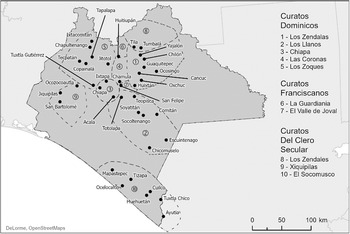
Map of Chiapas.
Villages and parishes (curatos) among the Dominicans (1–5), Franciscans (6–7), and secular clergy (8–10) in Chiapas, New Spain. Map courtesy of J. Glatz, Western Michigan University Libraries Mapping Service.

Figure 1. Long description
A grayscale map of Chiapas, New Spain, divided into ten numbered zones by dashed lines.
At the center of the map is region 3, Chiapa, which contains the town of Chiapa and is surrounded by region 7, El Valle de Joval, containing Chamula and San Felipe.
To the North and Northeast are regions 1, 4, 5, 6, and 8. Region 5, Los Zoques, includes Ixtacomitan, Chapultenango, Tecpatan, and Tapalapa. Region 4, Las Coronas, includes Jitotol and Copainala. Region 6, La Guardiania, includes Huitiupan. Region 1, Los Zendalas, is a large area in the Northeast containing Tila, Tumbala, Yajalon, Chilon, Guaquitepec, Ocosingo, Cancuc, Oxchuc, and Huixtan. Region 8, also labeled Los Zendalas, is at the northernmost tip.
To the East and Southeast is region 2, Los Llanos, which contains Teopisca, Soyatitan, Comitan, Socoltenango, Escuintenago, and Chicomuselo.
To the West is region 9, Xiquipilas, containing Tuxtla Gutierrez, Ocozocoautla, Jiquipilas, San Bartolome, Acala, and Totolapa.
To the South, along the coast, is region 10, El Socomusco, containing Mapastepec, Tizapa, Ocelocalco, Huehuetan, Cuilco, Tuxtla Chico, and Ayutla.
A legend on the right categorizes the regions:
* Curatos Dominicos: 1 Los Zendalas, 2 Los Llanos, 3 Chiapa, 4 Las Coronas, 5 Los Zoques.
* Curatos Franciscanos: 6 La Guardiania, 7 El Valle de Joval.
* Curatos Del Clero Secular: 8 Los Zendalas, 9 Xiquipilas, 10 El Socomusco.
A scale bar at the bottom right indicates 0 to 100 kilometers.
The visitation reports and testimony provided by Indigenous commoners provide a rich trove of information about pervasive beliefs and behaviors in rural areas, making them useful for historians. Nevertheless, statements made before ecclesiastical judges, inquisitors, and criminal magistrates could very well have been made under duress. Clergy seeking to extirpate idolatry were predisposed to view non-orthodox rituals with suspicion, inadvertently willing contentious concepts like idolatry and Satan into existence. Both David Tavárez and Carlo Ginzburg agree that notions like sorcerer and sin were ontological states of invention by Church authorities.Footnote 29 Therefore, the following sections make use of criminal records and commoner testimony to highlight the robustness of Indigenous cosmological traditions while also taking note of the ways in which colonial elites obtained it.
III. Non-orthodox Rituals in Seventeenth-Century Chiapas
One criminal case from 1685 contains informative testimony from Indigenous agriculturalists about nahualism in Chiapas, which piqued the interest of Bishop Núñez.Footnote 30 An Indigenous Nahuatl-speaking woman from Jiquipilas named María Sánchez noted the magical powers of a “mulato” ritual specialist named Nicolás de Santiago, known to shapeshift into “anything he wanted, including a snake, ass…” or even “a ball of air.”Footnote 31 Ritual specialists such as Nicolás de Santiago played an important role in the lives of Indigenous and African-descent commoners in the region, as evidenced by the fact that they were consulted to help name newborn children, divine the future by casting lots and surveying the stars, and cure illnesses caused by hexes.Footnote 32 Bishop Núñez was informed of these non-orthodox rituals taking place on the outskirts of Jiquipilas by July 28, 1685.Footnote 33
On February 20, 1686, María Sánchez made a formal declaration before ecclesiastical authorities, stating that she needed an interpreter of the “Mexican-language,” meaning Nahuatl, as she could not express herself well in “Castilian” and wished to confess things for which she was very “repentant.”Footnote 34 María stated that the “Virgin of Solitude” helped her to see the error of her ways, referring to the non-orthodox rituals she learned as a child from her father Juan Sánchez, a well-known Indigenous ritual specialist.Footnote 35 María told Bishop Núñez that her father took her to a mountainous cave near Jiquipilas many years ago and taught her magic, which the bishop viewed as idolatrous and superstitious. This cavern, called San Lorenzo by locals, was still revered in María’s adult years and, allegedly, by Nicolás de Santiago, who also taught his mixed-race son Andrecillo how to become a “brujo,” meaning sorcerer.Footnote 36 Reportedly, Nicolás de Santiago transported the recently deceased to San Lorenzo to bury them after performing rituals with incense, candles, and flowers inside.Footnote 37
As a child, Juan Sánchez escorted María to San Lorenzo, where he told her to renounce God forever.Footnote 38 Initially, María obeyed her father, so she was introduced to her porcupine animal-spirit companion, that is nahual. Footnote 39 This porcupine nahual lifted María into the air and carried her to the foot of San Lorenzo. Inside the cave, María saw a being who appeared like the figure “painted at the feet of Saint Michael seated on a golden throne with a tail.” This devil-like figure spoke directly to María, stating, “embrace me.”Footnote 40 He also told María to get rid of her fear. Later, María was taken to the cave again by her father, where she encountered a large snake nahual, which coaxed her into giving it affection.Footnote 41 Each time Juan Sánchez took María to the cave, she flew through the air and soon arrived at the foot of San Lorenzo.Footnote 42
As Fernando Cervantes observes, such testimony resonated with theologians steeped in Thomistic philosophy and influenced proselytization in the New World.Footnote 43 While Thomas Aquinas drew from patristic and occasionally canonical authorities such as Augustine, pseudo-Dionysius, John of Damascus, and Origen, he modified Church lore by integrating “the doctrine of spirits into his metaphysic in a way that rooted the absolute evil of demons in basic theory as never before.”Footnote 44 A binary moral division of the spirit world emerged from Aquinas’s metaphysical descriptions of an angel’s essence, which theologians of succeeding centuries continued to employ, notwithstanding the difficulties of applying such ideas in a pastoral context.Footnote 45
The eminent Spanish professor of theology and tutor to Philip II of Spain, Pedro de Ciruelo, employed Aquinas’s good–evil binary when debating the likelihood of astral experiences in the sixteenth century (c. 1560), highlighting that the devil fed the possessed pure “fantasies, telling them that they are traveling to other houses and places, what they see, what they are doing, and what they are saying.”Footnote 46 Ciruelo also commented upon necromancy, stating that any Christian who practiced the dark arts “has a clear and manifest alliance with the devil and is an apostate and traitor against God and the Catholic Church.”Footnote 47 Only by preaching the Christian Gospel could one bring an “end to deceitful idolatry” so that errant believers could return “to the true God.”Footnote 48
Bishop Núñez echoed such ideas more than a century later in his Ninth Pastoral Letter (1698), warning his parishioners not to believe in the powers of Indigenous ritual specialists even if they “perform marvels or auguries” as they are not true “miracles” but rather “lies and nonsense of the Devil [used] to part you from the faith.”Footnote 49 Consequently, María Sánchez’s testimony that her father began to teach Nicolás de Santiago how to be a “sorcerer” and how to care for the cave of San Lorenzo when he realized he was about to die would have preoccupied clergymen as they carried out their inspections.Footnote 50 According to María, she had steadfastly refused her father’s requests to serve as San Lorenzo’s steward (mayordomo), so he later taught Nicolás de Santiago about non-orthodox rituals and ceremonies. Bishop Núñez was moved by María’s detailed account, affirming that there was “no doubt” (no hallarse dudoso) she spoke the truth about what had transpired at San Lorenzo.Footnote 51 Bishop Núñez eventually arrested Nicolas de Santiago for the crimes of superstition and sorcery.Footnote 52
To better understand these ongoing non-orthodox rituals in the diocese, Núñez consulted works by Franciscans such as Fray Juan de Torquemada’s Monarquía Indiana. In the Ninth Pastoral Letter, Núñez cited Monarquía Indiana four times, which suggests a theological shift among some Dominicans as they converged with Franciscans regarding their approach to proselytization and the suppression of idolatry. In the Ninth Pastoral Letter, Núñez lamented the “deceptions” made by the “dogmatizing nahualistas” who make children believe “in their tender youth” that “God gave them nahuals as guardian angels.”Footnote 53 Here, Núñez specifically cited Chapter 47, Book 6, of Monarquía Indiana, which opens with Torquemada’s assertion that before Spaniards came to the New World, “the Indians” understood a “phantom” named “Tlacatecolotl” to be the “Demon” which he terms the devil. In Nahuatl, tlacatecolotl literally translates to “person, owl, or a man like such, or [one who] appears like Owls,” deriving from “Tlacatl, which is [a] Person, and Tecolotl, which means, owl.”Footnote 54 Torquemada stated that because the tlacatecolotl terrorized the Nahua at night, they understood sightings of it to be a bad omen.Footnote 55
Midway through Chapter 47 of Book 6, Torquemada mentioned Andrés de Olmos, stating that when Olmos lived at a convent in Cuernavaca, the devil appeared to another Indigenous man in the form of a cacique or Indigenous leader adorned with gold jewelry. This cacique took the unnamed Indigenous man to a field at the foot of a mountain range and asked, “Why have you forgotten me for so long?”Footnote 56 The cacique then instructed this Indigenous man to organize a communal feast at the foot of the mountain, making sacrifices and offerings to honor him. Accordingly, one pious Indigenous neophyte informed Olmos and the other friars about the festival, so it was discovered and recorded in Monarquía Indiana.
Torquemada had access to a plethora of early colonial sources because he served as the chronicler of the Franciscans in New Spain from 1605 to 1612, during which time he collected the papers of other friar-chroniclers who preceded him, including Andrés de Olmos, Toribio de Benavente (Motolinía), Bernardino de Sahagún, and Gerónimo de Mendieta. For his part, Andrés de Olmos and his Tratado de hechicerías y sortilegios had been inspired “almost entirely by the influential demonological treatise of the Basque Franciscan Fray Martín de Castañega” which focused on idolatry and devil worship among European commoners, illuminating another instance in which Old World ideas were projected onto Indigenous peoples in the New World.Footnote 57 The blending of these Franciscan sources into the subsequent publication of Monarquía Indiana (1615) meant that readers like Núñez learned about a flattened and homogenized account of Nahua rituals and beliefs from central Mexico.
Clergymen like Bernardino de Sahagún and Andrés de Olmos similarly associated tlacatecolotl with Satan and diabolism, even though the original term did not convey such meaning. In Chapter 9 of Book 10 of the sixteenth-century Florentine Codex, Sahagún highlighted multiple types of sorcerers and tricksters, such as the nahualli and the tlacatecolotl. Sahagún noted that a wicked diviner equated to a “tlaueliloc tlacateculotl,” meaning “very evil owl-man.” Here, Sahagún defined tlacatecolotl simply as a “man who has a pact with the devil who is transfigured into animals.”Footnote 58 Similarly, Olmos translated tlacatecolotl as Satan in his sixteenth-century Tratado, noting that “the owl-man is named, so many times named, truly named the bad angel, devil, demon, Satan.”Footnote 59 These early friar-chroniclers began discarding the subtleties embedded in Nahuatl to convey their understanding of good and evil to neophytes in New Spain, which seemingly influenced Bishop Núñez’s understanding of Tzeltal religious ceremonies in the late seventeenth century.
In 1687, Bishop Núñez likewise interpreted nocturnal birds of prey negatively after inspecting the Maya–Tzeltal parish of Oxchuc. In the Ninth Pastoral Letter, Núñez states that inside the local church in Oxchuc hung an image of a “fierce black” deity named Hicalahua (alt. Ik’alajaw), which had the “limbs of a man” and was placed among “five buzzards and [other] owls.”Footnote 60 Earlier Franciscan portrayals of the owl-man tlacatecolotl seemingly predisposed this Dominican bishop to view the veneration of Hicalahua with disdain. The placing of Hicalahua with nocturnal birds of prey in a church suggested idolatry to Núñez and Church authorities. As such, Núñez and his subordinates dismantled the “idolatrous” iconography in Oxchuc and reminded parishioners about the dangers of nahualism while “praying the Credo [Apostle’s Creed] in loud voices.”Footnote 61
In 1696, Bishop Núñez came across another worrisome case of alleged sorcery in the village of Tecpatán.Footnote 62 On May 20, a 20-year-old woman named Catarina Pérez stated that an Indigenous man named Esteban de Mesa cursed her after she refused his advances, declaring, “you will [soon] learn that I am a man” (sabrás que soi [sic] hombre) and that she fell ill with leprous-like symptoms on her hands shortly thereafter.Footnote 63 When Catarina’s mother could no longer stand the sight of her child in agony, she begged Esteban de Mesa to cure her daughter, which he accomplished by washing her hands and touching them with his. Catarina informed the bishop that Esteban de Mesa had previously hexed the town crier, Sebastián Jiménez, giving him aches and pains in his side.Footnote 64
For Bishop Núñez, these ongoing practices indicated that a full conversion to Catholicism remained woefully incomplete. In the Ninth Pastoral Letter, Núñez criticizes any reputed healings by nahualistas, labeling them imposter “doctors,” “medicine men,” and “bloodletters” who in reality are “witches, enchanters, and sorcerers, who seemingly cure [but actually] make others sick and murder anyone they wish by applying an instrument they call herbal medicine, using infernal words and puffs of air, with which they invoke the Devil.”Footnote 65
According to Núñez, these nahualistas or “superstitious teachers” (supersticiosos maestros) passed on their expertise to at least three other willing participants at a time so that the knowledge of non-orthodox practices and beliefs known as nahualism continued to spread throughout the region.Footnote 66 Núñez states that these nahualistas used items and animals like feathers, herbs, sticks, frogs, snakes, turtles, or centipedes that would enter the body of the infirm through the genitals, belly, head, throat, nostrils, arm, or any appendage that the nahual companion wished to use as an “instrument of its malefic designs.”Footnote 67 Case testimony from María Sánchez (c. 1686) seems to have influenced Bishop Núñez’s thinking when he later states in the Ninth Pastoral Letter (1698) that nahualistas teach their “disciples” to first “renounce God and His saints,” including the “Most Holy Mary,” and “to not be afraid” so they can “learn the office of a sorcerer.”Footnote 68
Bishop Núñez highlights the wickedness of nahualistas, claiming they often uttered maledictions to “burn houses, destroy estates or cornfields, which the [other] Indians call ‘getting sick.’”Footnote 69 Núñez explains that when nahualistas attempted to cure, they merely undid the sorcery previously performed, which made it seem as if the afflicted had truly healed. Núñez notes that certain nahualistas performed healing ceremonies by citing orthodox prayers such as the Our Father, the Hail Mary, and the Apostles’ Creed loudly for all to hear. However, after they chanted these words, they silently prayed the infernal words given to them by their teachers in accordance with a demonic pact previously made.Footnote 70 For clergymen like Bishop Núñez, these non-orthodox rituals could invoke the wrath of God. Consequently, Indigenous parishioners were told that the most efficacious way to curry “friendship with God” (la amistad de Dios) was to truly repent by engaging in the “holy sacrament of confession and penitence for all sins… including the grave sins of nahualism, incest, sodomy, or bestiality.”Footnote 71 In doing so, Indigenous neophytes could escape the “slavery of Satan” and achieve a “great victory” against him.Footnote 72
For Bishop Núñez, traditional healing rituals among the Maya could only be interpreted negatively. Clergymen in New Spain expanded upon the concept of idolatry from the Book of Exodus and applied it to Indigenous and African-descent ritual specialists therein.Footnote 73 Proselytizers like Núñez took origin stories from the Bible and applied them to the American context as they made formal investigations in their parishes, thereby incorporating authoritative literature from the Church with local, on-site experiences. For example, the Tzeltal traditions as understood by Bishop Núñez underwent a threefold development beginning with a migration from Eden, settlement in a quasi-redemptive postlapsarian world, followed by redemption through Christianity.Footnote 74 The following section examines Bishop Núñez’s approach to indoctrination and incorporates notions of biblical inerrancy to better contextualize this worldview.
IV. Bishop Núñez’s Theological Innovations
In addition to sources like Torquemada’s Monarquía Indiana, Bishop Núñez incorporated Bible commentaries circulating in Europe at the time, along with personal observations and local oral histories found in Chiapas. When conducting his aforementioned inspections, Núñez came across “many notebooks written in their language,” which used “enigmatic ciphers” and “painted figures” to label and name the “sites, provinces, names of their primitive gentiles, animals, stars, and elements” which they used to “worship the Devil.”Footnote 75 These sources informed Núñez of an Indigenous deity named Votán, whom he attributed to the royal lineage of Cham, meaning Noah’s son Ham.
In ancient times, this Votán had been accompanied by three other heads of lineages to the great river Ucimacintla in Chiapas. Here, Votán established the kingdom of “Na Chan,” meaning “the house of the serpent.”Footnote 76 In a footnote of the Ninth Pastoral Letter, Núñez links the Maya feathered serpent “Cuchulchan” (alt. Ku Chul Chan) to the Nahua deity Mixcoatl, which means “nebulous serpent or [pertaining to] a cloud.”Footnote 77 Núñez ties Ku Chul Chan to the Maya calendar, noting a painted image “of the seventh sign [of the month] in the form of a man and [a] serpent called Cuchulchan, which the elders have explained is a plumed serpent moving in the water.”Footnote 78 In Núñez’s own time, nearly “two hundred families” claimed descent from Votán “in the southern Tzeltal community of Comitlan.”Footnote 79
Bishop Núñez associated the names of heroes found in folk stories about Tzeltal migration with idolatry. In the sacred Tzol kin calendar, which consisted of 20 days, names such as “Votan [sic] Tzequil, Chianx, and Chabim,” continued to be celebrated.Footnote 80 Drawing from the Book of Genesis to explain Indigenous culture in the Americas, Núñez traced the sin of idolatry to Asia, where Ham, a son of Noah, founded and populated “the kingdom of China.”Footnote 81 At the age of 72 after the “universal Flood” had passed, Ham put “magical superstitions” into writing so that these “infinite evils of idolatry were introduced to the world.”Footnote 82 Ham’s descendants then taught this “diabolical doctrine” to the masses, enabling the sin of idolatry to spread throughout the world.Footnote 83 According to Núñez, the “abominable trifles of Satan” disseminated from one inhabitant to another so that the nahualistas, whose understanding of “superstition” was similar to the ancient Chaldeans and Egyptians, “came to be revered and adored by those who understood that… good fortune, favor, succor, or benefit” came to them through their animal spirit companion—the nahual. Footnote 84
One seventeenth-century adaptation of the alleged Curse of Ham favored by Bishop Núñez attributed the sin of idolatry to Noah’s son Ham rather than his brother Japheth and placed Ham in Asia instead of Africa.Footnote 85 Accordingly, the descendants of Ham perpetuated idolatry for centuries so that Native peoples in the Americas chose “as idols and nahuals” everything in nature, such as the “stars, elements, birds, fish … brute animals… ants, mice, owls, and bats.”Footnote 86 David Whitford has shown that Noah’s alleged cursing of Ham to perpetual slavery (Genesis 9: 20–27) became extremely influential in the sixteenth and seventeenth centuries with the rise of the Transatlantic Slave Trade.Footnote 87 During this time, a “wide variety of authors” manipulated the Book of Genesis to create a “Curse Matrix, wherein each new contrivance built on the previous configuration and added to it.”Footnote 88 Bishop Núñez reshaped this Curse Matrix slightly and cited the Curse of Ham as the founding moment of idolatry in the world during his late seventeenth-century investigations of Indigenous communities in Chiapas.
A Dominican predecessor to Bishop Núñez, named Diego Durán, similarly linked the Nahua peoples to the ancient Israelites. In the mid-sixteenth century, Durán compiled The History of the Indies of New Spain, and stated that the “rites, idolatries, and superstitions” conducted “in the mountains, and under trees, in dark and gloomy caves, and in the caverns of the earth,” where Natives allegedly “burned incense, killed their sons and daughters, sacrificed them, and offered them as victims to their gods” convinced Durán that the Indigenous peoples of the Americas were in fact the ancient Israelites as described in the Old Testament.Footnote 89 Durán further states, “what most forces me to believe that these Indians are of Hebrew descent is their strange insistence in clinging to their idolatries and superstitions… just as their ancestors did.”Footnote 90
One Franciscan predecessor of Bishop Núñez, Fray Juan de Torquemada, similarly linked pre-Hispanic rituals in mountainous regions to the sin of idolatry. Recall that Bishop Núñez cites Torquemada four times in his Ninth Pastoral Letter (1698), two of which contain references to Andrés de Olmos and his accounts begun in the 1530s.Footnote 91 Torquemada’s attitude toward Nahua deities appears similar to that of both Durán and Núñez, evinced by the opening sentence in Book VI Chapter 48 of Monarquía Indiana, which states that “the Indians made idols of nearly all the visible creatures” on the planet and were blinded by the devil when they made “a thousand sorceries and superstitions.”Footnote 92 In this good–evil binary, the devil was wholly responsible for leading Native peoples away from the path of virtue.
Bishop Núñez further draws from Torquemada’s accounts of the Nahua when he states that nahualistas “with their reports and superstitious calendars, dictated by the devil, [attempt to] predict fortunes and assign nahuals before they baptize from the day [Indigenous] children are born,” citing Book VIII, Chapter 5 of Monarquía Indiana. Footnote 93 In the footnote of this citation, Bishop Núñez adds additional context, claiming “In [Indigenous] catalogs in the province of Soconusco, predictions are made using nine signs, the fourth sign is Tzenteutl [Cinteotl], which the Mexica believed to be a harvest goddess.”Footnote 94 The ethnonym Mexica refers to the Nahuatl-speaking peoples of Tenochtitlan who, among others, venerated the corn deity Cinteotl.Footnote 95 Bishop Núñez does not mention the Maya corn deity Yum Kaax, believing the Nahua equivalent to suffice.Footnote 96 Thus, Bishop Núñez utilized Torquemada’s study of the Nahua, which incorporated works by other friar-chroniclers like Olmos, and applied it directly to Maya peoples in Chiapas and Soconusco much later in time.
In 1686, Bishop Núñez heard María Sánchez’s confession regarding non-orthodox rituals in the mountainous cavern of San Lorenzo. On February 20, María Sánchez testified to the cave’s ongoing religious significance to the Indigenous community, stating that Nicolás de Santiago, along with her father, transported the recently deceased from the church cemetery by using their magical powers to open locked gates by conjuring a strong wind (viento recio). The Indigenous elder Juan Sánchez and Nicolás de Santiago (mulato) then disinterred the deceased and took them to the cave of San Lorenzo, bringing flowers, candles, and incense with them every Monday, Tuesday, Holy Thursday, Eve of Corpus Christi, New Year’s Eve, and All Saints’ Day.Footnote 97 The impact of such testimony can be seen in the Ninth Pastoral Letter when Bishop Núñez urges his parishioners to “annihilate the places, mountains and boulders where [idols are] placed; cover and close with stone and mud the caves where they were hidden, so that they may be forgotten.”Footnote 98 Rebecca Dufendach maintains that the early Franciscans were keen to document “the sequence of celebrations and other ritual observances” among Native peoples to “better identify idolatry.”Footnote 99 By the seventeenth century, Dominicans like Núñez had stripped Indigenous ritual specialists and their non-orthodox rituals of cosmological significance, placing them within a Catholic framework marked by the Gregorian calendar.
Although the Ninth Pastoral Letter constitutes a single sermon, it remained highly influential after Bishop Núñez’s death in 1706, illuminating the legacy of this bishop and his ideas about Native cosmology.Footnote 100 Asunción Lavrin argues that sermons constituted “literary and intellectual efforts that the best minds of the colonial period appreciated as an aural experience of scholarship and eloquence.”Footnote 101 The repercussions of Núñez’s Ninth Pastoral Letter can be seen throughout the eighteenth century and into the early nineteenth century in the writings of his successors and in the testimony of Indigenous declarants. Resident clergy continued to engage with Núñez’s writings and similarly deemed idolatrous the non-orthodox rituals practiced by the Maya. The following section details three witchcraft cases from the years 1721, 1778, and 1801 as they refer to either Bishop Núñez or the Ninth Pastoral Letter (1698) in some capacity.
V. Living in the Bishop’s Shadow
In 1721, a Native man from the village of Ocelocalco named Nicolás Fabián was accused of witchcraft in a letter from the town council (cabildo) of Soconusco in Chiapas, which was sent to the resident priest, Francisco de Oliver.Footnote 102 Through subsequent denunciations, two Indigenous men named Pedro Gerónimo and Gerónimo Pérez became implicated. The case was reviewed by the local commissary of the Inquisition and dean of the cathedral, Juan de Santander, who acted on behalf of Bishop Jacinto de Olivera y Pardo.
On March 20, 1721, a 70-year-old Indigenous man named Juan Lázaro testified that a young woman named María Gálvez fell ill with stomach and intestinal pains, which culminated in her death around midnight, even though there were no signs of a fever.Footnote 103 Before expiring, María called upon Our Lady of the Rosary and a local Indigenous healer (curandero) named Pedro Gerónimo for help.Footnote 104 After Pedro Gerónimo arrived, María went mute and began to vomit black blood and a ball of corn husks. Pedro Gerónimo confirmed that María had been cursed, but he maintained that he was not responsible for this hex. Locals believed some malevolent person to be culpable, as 10 other adults and children had recently died in a similar manner. Juan Lázaro stated that both Pedro Gerónimo and Gerónimo Pérez were rumored to be nahualistas and sorcerers and that Pedro Gerónimo was especially “feared and respected” for his magical prowess.Footnote 105 Juan Lázaro also testified that he had previously witnessed the arrest and removal of known nahualistas under the administration of a priest named Elorriaga by order of Bishop Francisco Núñez de la Vega.Footnote 106
On July 15, 1721, a 50-year-old upper-class Indigenous man (indio principal) named Juan de los Santos from the village of Acacoyagua testified before Francisco de Oliver. Juan de los Santos confirmed that Pedro Gerónimo and Gerónimo Pérez were known nahualistas and that Pedro Gerónimo, in particular, was blamed for the evils that manifested in the area.Footnote 107 De los Santos further stated that while he had known of two other nahualistas in the past, one had been sent away to “don fray Francisco Núñez de la Vega” and the other died by a severe strike from a hard ball when he had shapeshifted into a “tiger.”Footnote 108 De los Santos’s testimony highlighted that Pedro Gerónimo and Gerónimo Pérez were the only remaining nahualistas in the area, suggesting Bishop Núñez contributed to a decline in the nahualli presence locally.
Bishop Núñez’s influence in the region could still be discerned approximately 57 years later in another witchcraft case from 1778. On May 13, a priest named don Joseph Ordóñez y Aguiar wrote to his superior Bishop Francisco Polanco from the town of Chamula, requesting advice about the best course of action to counteract “superstitious” and “idolatrous” practices reported by the deputy priest in the environs of San Andrés in Chiapas.Footnote 109 Ordóñez initially grew concerned about non-orthodox ceremonies that Native ritual specialists conducted in remote caves and mountainous areas on March 31, 1778, nearly 80 years after the Ninth Pastoral Letter’s composition in 1698. Ordoñez had recently inspected a cave locals called Sacumchen, which was situated atop a hill near the town of San Andrés. Once inside Sacumchen, don Joseph found a “poorly formed cross” made of liquidambar as well as candles, wicks, cinders, and boxes used for incense. At the base of the cross, Ordóñez detected several bones which he feared were human.Footnote 110
To his horror, Ordóñez unearthed one human cadaver after another, including an infant’s skull that had some skin still attached. Having found this poorly formed cross, signs of rituals removed from the Church, and multiple cadavers, Ordóñez concluded that Sacumchen constituted an idolatrous sepulcher wherein errant believers sacrificed themselves to Satan.Footnote 111 Historically, European colonizers like Ordóñez took a dim view of non-orthodox rituals in areas distant from the Church because of their connection to the witches’ sabbath and the devil in the Old World.Footnote 112 For many Catholic colonizers, non-orthodox rituals conducted in remote areas were simply part of the devil’s machinations to lure errant souls to perdition. Local, Indigenous rituals held no intrinsic value of their own.
From the pulpit to the confessional, bishops, friars, and priests sought to extirpate non-orthodox rituals and Indigenous ritual specialists like the nahualli from popular culture, associating this figure with the sin of idolatry. Hence, Ordóñez lamented that the “violent and pestiferous” incense used in places like Sacumchen, which could only be acquired in the mountains, “showed greater veneration for caves than churches as they [Natives] spend money on good incense for those [caves] and not for these [churches].”Footnote 113 The coadjutor, Nicolás de Morales, stated that he believed the cave of Sacumchen housed an idol or its “simulacrum,” which had been venerated by Indigenous locals either in the time of their “gentility” or that the idols inside this cave were those previously mentioned by “the illustrious Lord Núñez in his Ninth Pastoral,” such as “Poxlom, Patlan, Tzihuizin, or Hicalahua” (Ik’alajaw).Footnote 114 He also stated that two other clergy, don Hermenegildo de León and don Raymundo Guillén, had located additional shrines dedicated to the deities Guex and Yochoom in the environs of Chamula.Footnote 115 Such commentary shows an active engagement with the Ninth Pastoral Letter (1698) in the late eighteenth century.
Ordóñez also learned that an Indigenous man named Andrés González Jomoc visited Sacumchen on Tuesdays and that two additional shrines had been discovered—one in a cave to the north of San Andrés and the other in a cave to the west. Evidence of non-orthodox rituals, such as incense and used candles, was also found inside these caves. Three Indigenous men named Pascual Hernández, Cristóbal Hernández, and Felipe Díaz were alleged to have visited the shrines inside these caves “to ask for good weather.”Footnote 116 Excavations in these caves had not taken place, so resident clergy did not know whether these Indigenous ritual specialists buried their dead there, but they suspected as much. The following case reveals that clergy in Chiapas consulted Bishop Núñez’s writings when the nahualli figure appeared yet again in the nineteenth century.
On December 20, 1801, an Indigenous man named Tiburcio Pamplona was accused by another Native named Julián de Castillejo of bewitching his wife, Feliciana Gómez.Footnote 117 This complaint was made before Fray Pascual Aparicio, who eventually ordered the arrest of Pamplona. According to Castillejo, Pamplona hexed his wife after she confronted Pamplona for stealing some of her garments from their house. Shortly after this confrontation, Feliciana began to “pass worms through a sore in her orifice,” leading Castillejo to conclude that Pamplona was responsible for the illness.Footnote 118 Fray Pascual subsequently opened an investigation, questioning other villagers about Pamplona’s reputation. Unfortunately for Pamplona, several locals denounced him as a sorcerer and “nahualista.”Footnote 119
Fray Pascual then informed Ramón de Ordóñez y Aguiar, vicar and governor of the bishopric, as the episcopal see was vacant at that time. When summoned before Fray Pascual, Pamplona confessed to having made a pact with the devil, who was his nahual, meaning his spirit companion.Footnote 120 According to this confession, the devil first came to Pamplona when he was 10 years old. Since that time, the devil helped Pamplona travel during the night and obtain anything he wanted. Pamplona also stated that he had a second nahual, which was a snake.Footnote 121 This nahual, which had four snouts, had been assigned to Pamplona at birth, illuminating the continuation of Indigenous-led baptisms in the late eighteenth century.Footnote 122
For Ramón de Ordóñez y Aguiar, the accusations against Pamplona, along with Pamplona’s own testimony, confirmed the information found in Bishop Núñez’s Ninth Pastoral Letter.Footnote 123 Ordóñez stated in his missive that such investigations were important to the Catholic religion and to the Spanish state in order to investigate the dogmatizers or teachers of the diabolical sect of nahualism, because conducting these investigations helped to discover their calendars, reports, papers, chronological books, and other superstitious monuments of Indigenous “gentility.”Footnote 124 Thus, nearly 103 years after Bishop Núñez composed his Ninth Pastoral Letter, clergymen in southern New Spain continued to project a similar understanding of non-orthodox rituals and beliefs onto the Indigenous population. Significantly, Indigenous ritual specialists and the nahualli figure were transformed into a scapegoat by Bishop Núñez, especially in the Ninth Pastoral Letter, which local Dominicans consulted when investigating rumors of non-orthodox rituals and beliefs in Indigenous villages.
VI. Conclusion
Bishop Francisco Núñez de la Vega proved to be an influential doctrinaire in the seventeenth, eighteenth, and nineteenth centuries. Bishop Núñez took his proselytization duties seriously and attempted to eradicate perceived idolatry to enforce orthodoxy during his lifetime. The Ninth Pastoral Letter of 1698 constituted the discursive culmination of the bishop’s theological innovations in Chiapas and Soconusco with respect to the enigmatic nahualli figure. Overall, this authoritative sermon conflated the sacred beliefs of the Maya with those of the Nahua and expanded the category of idolatry to include the nahualli, which justified ongoing evangelization. Although Bishop Núñez gained firsthand knowledge of non-orthodox rituals by presiding over witchcraft cases in Chiapas when making his inspections, he had been predisposed to view Indigenous ritual specialists negatively through the writings of his Franciscan predecessors. Evinced by the four citations of Fray Juan de Torquemada’s Monarquía Indiana in the Ninth Pastoral Letter of 1698, Dominican clergy incorporated the works of early Franciscan friar chroniclers even though these writings detailed the beliefs and practices of the Nahua in central Mexico instead of the Maya to the south. The last three witchcraft cases analyzed here (1721, 1778, and 1801) show that the bishop cast a long shadow in the region after he died in 1706. For Indigenous ritual specialists living in the bishop’s shadow, an active embrace of nahualism provided an alternative to the good–evil binary espoused by the Church. Much to the chagrin of Bishop Núñez and his successors, the ever-elusive nahualli continued to enchant New Spain throughout the colonial era.
Acknowledgments
The author would like to thank Michelle Honeybun, Mohammed S. Ali, Martin Nesvig, and the journal’s anonymous readers for their insightful suggestions and comments.

 Open access

