





1 Introduction
Schur polynomials are characters of irreducible representations of general linear groups
$\mathrm {GL}_{k}(\mathbb {C})$
 , and are central objects in algebraic combinatorics with various beautiful properties and numerous applications [Reference Weyl38, Reference Fulton and Harris15, Reference Meckes31]. Dual Littlewood identities (of types B, C, D) are important sum-product identities involving the Schur polynomials [Reference Littlewood29] [Reference Macdonald30, P.79]:


where the sums run over all partitions
$\lambda =(\alpha |\alpha )$
 ,
$\lambda =(\alpha +1|\alpha )$
,
$\lambda =(\alpha +1|\alpha )$
 and
$\lambda =(\alpha |\alpha +1)$
and
$\lambda =(\alpha |\alpha +1)$
 in the Frobenius notation corresponding respectively to types B, C, and D. Here
$\alpha $
in the Frobenius notation corresponding respectively to types B, C, and D. Here
$\alpha $
 is a strict partition. These are referred to as partitions of type
$B, C$
is a strict partition. These are referred to as partitions of type
$B, C$
 , and D, respectively. Type B partitions are self-conjugate, type C partitions are usually known as doubled distinct partitions [Reference Garvan, Kim and Stanton16, Section 8] (or
$(-1)$
, and D, respectively. Type B partitions are self-conjugate, type C partitions are usually known as doubled distinct partitions [Reference Garvan, Kim and Stanton16, Section 8] (or
$(-1)$
 -asymmetric partitions), while type D partitions are conjugate of doubled distinct partitions (or
$1$
-asymmetric partitions), while type D partitions are conjugate of doubled distinct partitions (or
$1$
 -asymmetric partitions).
These identities naturally give rise to three measures on partitions,


In [Reference Rains33, Section 7], Rains used an algebraic method to show these measures are determinantal with explicit correlation kernels. Moreover, the Littlewood identities and refined ones have recently been shown to play an important role in integrable probability [Reference Barraquand, Borodin and Corwin4, Reference Barraquand, Borodin, Corwin and Wheeler5, Reference Betea and Wheeler7, Reference Borodin and Rains10, Reference Bisi and Zygouras9] as well.
From the classical Cauchy identity (of type A)

and with the free fermion (vertex operator) realization, Okounkov[Reference Okounkov32] introduced the Schur measure

and proved that the Schur measure is a determinantal one with an explicit correlation kernel. In the past twenty years, the Schur measure has provided rich interplay between combinatorics, probability, statistical mechanics, and enumerative geometry. Using the Cauchy-type identity for the universal symplectic characters, Cuenca and Mucciconi defined the symplectic Schur process [Reference Cuenca and Mucciconi11]. Very recently, Betea, Nazarov, Nikitin and Scrimshaw [Reference Betea, Nazarov, Nikitin and Scrimshaw8] studied the dual version of the Schur measure defined by

based on the dual Cauchy identity

For the Cauchy identities of types
$B, C$
 , and D, Betea [Reference Betea6] defined the symplectic and orthogonal Schur measures and found that each measure is a determinantal point process with an explicit correlation kernel in analogy with Okounkov’s Schur measure by using the vertex operator method. Betea also pointed out that the measure
$\mathfrak {M}_{C}(\lambda )$
, and D, Betea [Reference Betea6] defined the symplectic and orthogonal Schur measures and found that each measure is a determinantal point process with an explicit correlation kernel in analogy with Okounkov’s Schur measure by using the vertex operator method. Betea also pointed out that the measure
$\mathfrak {M}_{C}(\lambda )$
 (resp.
$\mathfrak {M}_{D}(\lambda )$
(resp.
$\mathfrak {M}_{D}(\lambda )$
 ) is a special case of symplectic (resp. orthogonal) Schur measures, and also specializes to the Poissonized Plancherel measure [Reference Betea6]. The first goal of this paper is to study the measures (1.4), (1.5), and (1.6) using a new free fermionic (or vertex operator) construction and show that they are determinantal.
The Frobenius notation for partitions shows that there exists a one-to-one correspondence between the set of partitions for measure
$\mathfrak {M}_{C}(\lambda )$
 and the set of strict partitions, for example,
$(\alpha +1|\alpha )\longrightarrow \alpha $
and the set of strict partitions, for example,
$(\alpha +1|\alpha )\longrightarrow \alpha $
 . Though the latter is a subset of
$\mathcal P$
. Though the latter is a subset of
$\mathcal P$
 , it is well known that many properties of Schur functions can be generalized to Schur’s Q-functions. It is interesting to note that the set of partitions for the measures related to other classical types also display similar phenomena.
The main methodology of this paper is vertex calculus. The classical Boson-Fermion correspondence (vertex operator representation) shows that there exists an isomorphism between two level one representations of the infinite-dimensional Heisenberg algebra
$\mathcal {H}$
 : the space
$\Lambda $
: the space
$\Lambda $
 of symmetric polynomials and the Fock space
$\mathcal {M}$
of symmetric polynomials and the Fock space
$\mathcal {M}$
 . It identifies the Schur polynomial
$s_\lambda (\mathbf {x})$
. It identifies the Schur polynomial
$s_\lambda (\mathbf {x})$
 with the partition element
$|\lambda \rangle $
with the partition element
$|\lambda \rangle $
 in
$\mathcal {M}$
in
$\mathcal {M}$
 [Reference Date, Jimbo, Kashiwara and Miwa12, Reference Frenkel and Kac14, Reference Kac, Raina and Rozhkovskaya19, Reference Jing20, Reference Jing and Rozhkovskaya25]. In parallel, the correspondence between symplectic Schur polynomial
$sp_\lambda (\mathbf {x}^{\pm })$
[Reference Date, Jimbo, Kashiwara and Miwa12, Reference Frenkel and Kac14, Reference Kac, Raina and Rozhkovskaya19, Reference Jing20, Reference Jing and Rozhkovskaya25]. In parallel, the correspondence between symplectic Schur polynomial
$sp_\lambda (\mathbf {x}^{\pm })$
 (resp. orthogonal Schur polynomial
$o_\lambda (\mathbf {x}^{\pm })$
(resp. orthogonal Schur polynomial
$o_\lambda (\mathbf {x}^{\pm })$
 ) and
$|\lambda ^{sp}\rangle $
) and
$|\lambda ^{sp}\rangle $
 (resp.
$|\lambda ^{o}\rangle $
(resp.
$|\lambda ^{o}\rangle $
 ) was found in [Reference Baker3, Reference Jing and Nie24]. Using vertex operator representations, an identity between the odd orthogonal Schur polynomials
$so_\lambda (\mathbf {x}^{\pm })$
) was found in [Reference Baker3, Reference Jing and Nie24]. Using vertex operator representations, an identity between the odd orthogonal Schur polynomials
$so_\lambda (\mathbf {x}^{\pm })$
 and
$|\lambda ^{so}\rangle $
and
$|\lambda ^{so}\rangle $
 was also established[Reference Jing, Li, Pan, Wang and Ye23]. In [Reference Jing, Li and Wang22, Reference Jing, Li, Pan, Wang and Ye23], for generalized partitions
$\lambda =(\lambda _1,\dots ,\lambda _l)$
was also established[Reference Jing, Li, Pan, Wang and Ye23]. In [Reference Jing, Li and Wang22, Reference Jing, Li, Pan, Wang and Ye23], for generalized partitions
$\lambda =(\lambda _1,\dots ,\lambda _l)$
 and
$\mu =(\mu _1,\dots ,\mu _l)$
and
$\mu =(\mu _1,\dots ,\mu _l)$
 , the third and fourth named authors together with collaborators have shown the following three orthonormal relations


where
$\langle \mu ^{so}|$
 ,
$\langle \mu ^{sp}|$
,
$\langle \mu ^{sp}|$
 , and
$\langle \mu ^{o}|$
, and
$\langle \mu ^{o}|$
 are partition elements in the completed dual Fock space
$\widetilde {\mathcal {M}}^*$
are partition elements in the completed dual Fock space
$\widetilde {\mathcal {M}}^*$
 .
.
In [Reference Jing and Li21], these two authors used a single vertex operator to study the dual Cauchy identity. In this paper, we introduce a family of new partition elements
$|\underline {\lambda }^{sp}\rangle $
 (resp.
$|\underline {\lambda }^{o}\rangle $
(resp.
$|\underline {\lambda }^{o}\rangle $
 ,
$|\underline {\lambda }^{so}\rangle $
,
$|\underline {\lambda }^{so}\rangle $
 ) and calculate their inner products with the dual vacuum
$\langle 0|$
) and calculate their inner products with the dual vacuum
$\langle 0|$
 . We show that nonzero inner products
$\langle 0|\underline {\lambda }^{sp}\rangle $
. We show that nonzero inner products
$\langle 0|\underline {\lambda }^{sp}\rangle $
 lead to a new proof of the dual Littlewood identity for type C as given in (1.2). The remaining two dual Littlewood identities can be proved similarly. This gives rise to vertex operator constructions of the measures
$\mathfrak {M}_{B}(\lambda )$
lead to a new proof of the dual Littlewood identity for type C as given in (1.2). The remaining two dual Littlewood identities can be proved similarly. This gives rise to vertex operator constructions of the measures
$\mathfrak {M}_{B}(\lambda )$
 ,
$\mathfrak {M}_{C}(\lambda )$
,
$\mathfrak {M}_{C}(\lambda )$
 , and
$\mathfrak {M}_{D}(\lambda )$
, and
$\mathfrak {M}_{D}(\lambda )$
 . Our first result is an integral representation for the correlation kernels. In the following, we will use
$\mathbf {i}=\sqrt {-1}$
. Our first result is an integral representation for the correlation kernels. In the following, we will use
$\mathbf {i}=\sqrt {-1}$
 and i as an indexing variable.
Theorem 1.1. (i.e., Theorem 4.4 and Theorem 4.5) For
$\lambda =(\alpha +1|\alpha )$
 ,
$\lambda =(\alpha |\alpha +1)$
,
$\lambda =(\alpha |\alpha +1)$
 or
$\lambda =(\alpha |\alpha )$
or
$\lambda =(\alpha |\alpha )$
 , let
$n_i=\lambda _i-i+1$
, let
$n_i=\lambda _i-i+1$
 . The measures
$\mathfrak {M}_{C}(\lambda )$
. The measures
$\mathfrak {M}_{C}(\lambda )$
 ,
$\mathfrak {M}_{D}(\lambda )$
,
$\mathfrak {M}_{D}(\lambda )$
 , and
$\mathfrak {M}_{B}(\lambda )$
, and
$\mathfrak {M}_{B}(\lambda )$
 are determinantal ensembles


where the correlation kernels are given by the following integrals:


with

and the
$z-$
 and
$w-$
and
$w-$
 contours are simple counterclockwise circles around 0 satisfying
$|w|<|z|<|x_i|$
contours are simple counterclockwise circles around 0 satisfying
$|w|<|z|<|x_i|$
 .
.
The generalized family of partitions also offers some nontrivial combinatorial identities. Our second result (Theorem 5.2) derives infinitely many generalized Littlewood identities, where the classical ones have played an important role in studying symmetric functions (cf. [Reference Macdonald30]). We offer the nonzero conditions of the inner products
$\langle \mu ^{sp}|\underline {\lambda }^{sp}\rangle $
 ,
$\langle \mu ^{o}|\underline {\lambda }^{o}\rangle $
,
$\langle \mu ^{o}|\underline {\lambda }^{o}\rangle $
 and
$\langle \mu ^{so}|\underline {\lambda }^{so}\rangle $
and
$\langle \mu ^{so}|\underline {\lambda }^{so}\rangle $
 for one-column partitions
$\mu $
for one-column partitions
$\mu $
 . As a consequence, we obtain three new families of identities generalizing the classical identities (1.1), (1.2), and (1.3). Generalized Littlewood identity (5.21) is closely related to the recently emerged bounded Littlewood identities given by Erickson and Hunziker [Reference Erickson and Hunziker13, Table 4] and Huh, Kim, Krattenthaler, and Okada [Reference Huh, Kim, Krattenthaler and Okada18, (5.3)]. For any fixed partition
$\mu $
. As a consequence, we obtain three new families of identities generalizing the classical identities (1.1), (1.2), and (1.3). Generalized Littlewood identity (5.21) is closely related to the recently emerged bounded Littlewood identities given by Erickson and Hunziker [Reference Erickson and Hunziker13, Table 4] and Huh, Kim, Krattenthaler, and Okada [Reference Huh, Kim, Krattenthaler and Okada18, (5.3)]. For any fixed partition
$\mu $
 , our approach suggests that the nonzero condition of
$\langle \mu ^{sp}|\underline {\lambda }^{sp}\rangle $
, our approach suggests that the nonzero condition of
$\langle \mu ^{sp}|\underline {\lambda }^{sp}\rangle $
 for partitions
$\lambda $
for partitions
$\lambda $
 will produce a new generalized Littlewood identity.
In fact, the generalized Littlewood identities considered by Erickson and Hunziker [Reference Erickson and Hunziker13] for the so-called
$(-n)$
 -asymmetric partitions were obtained in the context of the BGG resolutions. Correspondingly, for any positive integer n, we also obtain the following new generalized Littlewood identities for
$(-n)$
-asymmetric partitions were obtained in the context of the BGG resolutions. Correspondingly, for any positive integer n, we also obtain the following new generalized Littlewood identities for
$(-n)$
 -asymmetric partitions, as the third result of the paper.

where

Combining with [Reference Huh, Kim, Krattenthaler and Okada18, Theorem 1.1] and [Reference Stembridge35, Theorem 7.1], we obtain the following identities


Under the involution
$\omega $
 sending
$s_{\lambda }(\mathbf {x})$
sending
$s_{\lambda }(\mathbf {x})$
 to
$s_{\lambda '}(\mathbf {x})$
to
$s_{\lambda '}(\mathbf {x})$
 , our (1.16) and (1.17) are actually the following identity:

which was conjectured by Lievens, Stoilova, and Van der Jeugt[Reference Lievens, Stoilova and Van der Jeugt28, (5.25)] and proved by King[Reference King and Dobrev27].
The paper is organized as follows. We recall all the definitions and preliminary results in Section 2. In Section 3, we revisit the classical dual Littlewood identities using vertex operators. In Section 4, we study the measures resulting from the dual Littlewood identities. Then we derive the infinitely many generalized Littlewood identities in Section 5. In Section 6, generalized Littlewood identities for
$(-n)$
 -asymmetric partitions are also obtained. We then study the connections between our generalized Littlewood identities and some of the known Littlewood-type identities in Section 7.
2 Preliminaries
In this section, we recall some definitions and results of the Heisenberg algebra, generalized partitions, vertex operators, and symmetric polynomials. We mostly follow the notations in [Reference Jing, Li and Wang22, Reference Jing, Li, Pan, Wang and Ye23, Reference Macdonald30].
2.1 Heisenberg algebra
Let
$\mathcal {H}$
 be the Heisenberg algebra generated by
$\{a_n\}_{n\in \mathbb {Z}\setminus \{0\}}$
be the Heisenberg algebra generated by
$\{a_n\}_{n\in \mathbb {Z}\setminus \{0\}}$
 with central element
$c=1$
with central element
$c=1$
 , subject to the commutation relations [Reference Frenkel and Kac14]:

The Fock space
$\mathcal {M}$
 (resp.
$\mathcal {M}^*$
(resp.
$\mathcal {M}^*$
 ) is generated by the vacuum vector
$|0\rangle $
) is generated by the vacuum vector
$|0\rangle $
 (resp. dual vacuum vector
$\langle 0|$
(resp. dual vacuum vector
$\langle 0|$
 ) and subject to

Let
$\mathcal {M}_n^*$
 be the subspace of degree n spanned by
$\langle 0|a_{-i_1}\cdots a_{-i_n}$
be the subspace of degree n spanned by
$\langle 0|a_{-i_1}\cdots a_{-i_n}$
 , then
$\mathcal {M}^*=\oplus _{n=0}^{\infty }\mathcal {M}_n^*$
, then
$\mathcal {M}^*=\oplus _{n=0}^{\infty }\mathcal {M}_n^*$
 . Let
$\overline {\mathcal {M}}^*_n$
. Let
$\overline {\mathcal {M}}^*_n$
 be the graded space
$\oplus _{i\leq n} {\mathcal {M}}^*_i$
be the graded space
$\oplus _{i\leq n} {\mathcal {M}}^*_i$
 . The completion
$\widetilde {\mathcal {M}}^*$
. The completion
$\widetilde {\mathcal {M}}^*$
 is the inverse limit of
$\overline {\mathcal {M}}^*_n$
is the inverse limit of
$\overline {\mathcal {M}}^*_n$
 .
.
2.2 Generalized partitions
A generalized partition
$\lambda =(\lambda _1,\lambda _2,\cdots ,\lambda _l)$
 of weight
$|\lambda |=\sum _i\lambda _i$
of weight
$|\lambda |=\sum _i\lambda _i$
 is a finite sequence of weakly decreasing nonnegative integers such that the total sum is
$|\lambda |$
is a finite sequence of weakly decreasing nonnegative integers such that the total sum is
$|\lambda |$
 .
$\lambda _i$
.
$\lambda _i$
 are called parts of
$\lambda $
are called parts of
$\lambda $
 , and the length
$l(\lambda )$
, and the length
$l(\lambda )$
 of
$\lambda $
of
$\lambda $
 is the number of nonzero parts. A partition is a sequence of weakly decreasing positive integersFootnote 1. The set of all partitions is denoted by
$\mathcal {P}$
is the number of nonzero parts. A partition is a sequence of weakly decreasing positive integersFootnote 1. The set of all partitions is denoted by
$\mathcal {P}$
 . The conjugate of a partition
$\lambda $
. The conjugate of a partition
$\lambda $
 is the partition
$\lambda ^{\prime }$
is the partition
$\lambda ^{\prime }$
 with
with

The Young diagram of a partition
$\lambda =(\lambda _1,\lambda _2,\dots , \lambda _k)$
 is the set
$(\{ (i,j) \in {\mathbb Z}^2: 1\le i\le k, 1\le j\le \lambda _i\})$
is the set
$(\{ (i,j) \in {\mathbb Z}^2: 1\le i\le k, 1\le j\le \lambda _i\})$
 . Each element
$ (i,j)$
. Each element
$ (i,j)$
 in a Young diagram is called a cell. We often identify a partition with its Young diagram and write
$\operatorname {\mathrm {Par}}(p \times q)$
in a Young diagram is called a cell. We often identify a partition with its Young diagram and write
$\operatorname {\mathrm {Par}}(p \times q)$
 for the set of partitions whose Young diagrams fit inside a rectangle with p rows and q columns. For a partition
$\lambda $
for the set of partitions whose Young diagrams fit inside a rectangle with p rows and q columns. For a partition
$\lambda $
 , let
$\alpha _i=\lambda _i-i$
, let
$\alpha _i=\lambda _i-i$
 and
$\beta _i=\lambda ^{\prime }_i-i$
and
$\beta _i=\lambda ^{\prime }_i-i$
 , both
$\alpha , \beta $
, both
$\alpha , \beta $
 are strict. The (Frobenius) rank of a partition
$\lambda $
are strict. The (Frobenius) rank of a partition
$\lambda $
 , denoted
$\operatorname {\mathrm {rk}}\lambda $
, denoted
$\operatorname {\mathrm {rk}}\lambda $
 , is the largest integer k such that
$\lambda _k\geq k$
, is the largest integer k such that
$\lambda _k\geq k$
 . The Frobenius notation for the partition
$\lambda $
. The Frobenius notation for the partition
$\lambda $
 is given by

where
$r=\operatorname {\mathrm {rk}}\lambda $
 . In particular, we say a partition
$\lambda $
. In particular, we say a partition
$\lambda $
 is
$(-n)$
is
$(-n)$
 -asymmetric if
$\lambda =(\alpha +n|\alpha )$
-asymmetric if
$\lambda =(\alpha +n|\alpha )$
 [Reference Albion1][Reference Ayyer and Kumari2][Reference Jouhet and Wahiche26]. Here
$\alpha +n$
[Reference Albion1][Reference Ayyer and Kumari2][Reference Jouhet and Wahiche26]. Here
$\alpha +n$
 means
$(\alpha _1+n, \alpha _2+n, \ldots , \alpha _r+n)$
means
$(\alpha _1+n, \alpha _2+n, \ldots , \alpha _r+n)$
 . We will sometimes write
$(n^m)$
. We will sometimes write
$(n^m)$
 for the rectangular partition with m parts equal to n.
2.3 Vertex operators
Define the following vertex operators [Reference Baker3, Reference Jing, Li and Wang22, Reference Jing, Li, Pan, Wang and Ye23, Reference Jing and Nie24]

It is easy to check that

The following results follow from vertex algebraic techniques [Reference Jing and Nie24, Theorem 3.4] and the Baker-Campbell-Hausdorff formula

Proposition 2.1 [Reference Jing and Nie24, Reference Jing, Li and Wang22, Reference Jing, Li, Pan, Wang and Ye23]
The operators
$U_i,U^*_i,Y_i,Y^*_i,W_i,W^*_i$
 act linearly on
$\mathcal M$
act linearly on
$\mathcal M$
 and
$U^*_i,Y^*_i, W^*_i$
and
$U^*_i,Y^*_i, W^*_i$
 act linearly on
$\widetilde {\mathcal M}^*$
act linearly on
$\widetilde {\mathcal M}^*$
 , and satisfy the following commutation relations:

For a generalized partition
$\lambda =(\lambda _1,\lambda _2,\dots ,\lambda _l)$
 , we denote the following partition vectors:

where the elements
$\langle \lambda ^{so}|, \langle \lambda ^{sp}|, \langle \lambda ^{o}|\in \widetilde {\mathcal M^*}$
 .
.
Lemma 2.2 [Reference Jing, Li and Wang22, Reference Jing, Li, Pan, Wang and Ye23]
For generalized partitions
$\lambda =(\lambda _1,\dots ,\lambda _l)$
 and
$\mu =(\mu _1,\dots ,\mu _l)$
and
$\mu =(\mu _1,\dots ,\mu _l)$
 , the partition elements are orthonormal vectors in the following sense:


Lemma 2.3 [Reference Jing, Li and Wang22, Reference Jing, Li, Pan, Wang and Ye23]
For any generalized partition
$\mu =(\mu _1,\dots ,\mu _l)$
 , one has that for any
$\sigma \in \mathfrak S_l$
, one has that for any
$\sigma \in \mathfrak S_l$


where
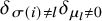
$\delta _i$
 denotes
$\delta _{\sigma (i)\neq l}\delta _{\mu _l\neq 0}$
denotes
$\delta _{\sigma (i)\neq l}\delta _{\mu _l\neq 0}$
 Footnote 2 and the symbol
$ \left ({}^a_{b}\right )$
Footnote 2 and the symbol
$ \left ({}^a_{b}\right )$
 means either a or b.
2.4 Symmetric polynomials
The readers are referred to the basic references [Reference Macdonald30, Chapter 1] and [Reference Stanley34, Chapter 7] for the general background of symmetric polynomials. We denote the algebra of symmetric polynomials by
$\Lambda $
 . For the variable
$\mathbf {x}=(x_1,\dots ,x_k)$
. For the variable
$\mathbf {x}=(x_1,\dots ,x_k)$
 , the elementary symmetric polynomials
$e_n(\mathbf {x})$
, the elementary symmetric polynomials
$e_n(\mathbf {x})$
 and the complete symmetric polynomials
$h_n(\mathbf {x})$
and the complete symmetric polynomials
$h_n(\mathbf {x})$
 are respectively defined by

The Schur polynomials
$s_{\lambda }(\mathbf {x})$
 are defined as the bialternant and determinants:

for
$l(\lambda )\leq k.$
 It is well known that
$s_{\lambda }(\mathbf {x})$
It is well known that
$s_{\lambda }(\mathbf {x})$
 is the character of the irreducible representation of
$\mathrm {GL}_k(\mathbb C)$
is the character of the irreducible representation of
$\mathrm {GL}_k(\mathbb C)$
 indexed by the highest weight
$\lambda $
indexed by the highest weight
$\lambda $
 .
.
3 Dual Littlewood identities
In this section, we revisit dual Littlewood identities using vertex operator methods.
Lemma 3.1. For a partition
$\lambda =(\lambda _1,\dots ,\lambda _k)$
 , we have


Proof. We only prove the relation (3.2), as the other two relations can be treated similarly. The orthogonality relation (2.8) shows that the inner product

is nonzero only for the case

where
$\varepsilon \in \{1,-1\}$
 . It follows from (2.11) and (3.5) that for some
$\sigma \in \mathfrak S_k$
. It follows from (2.11) and (3.5) that for some
$\sigma \in \mathfrak S_k$
 , and any integer
$j\in [1, k]$
, and any integer
$j\in [1, k]$


that is,

for
$\varepsilon _j\in \{1,-1\}$
 . Since
$1\leq \sigma (k+1-j)\leq k$
. Since
$1\leq \sigma (k+1-j)\leq k$
 ,
$\varepsilon _j(\lambda _j-j)$
,
$\varepsilon _j(\lambda _j-j)$
 runs through
$1, 2, \ldots , k$
runs through
$1, 2, \ldots , k$
 as j goes through
$1, 2, \ldots , k$
as j goes through
$1, 2, \ldots , k$
 . Thus there is a one-to-one correspondence between the two sets

It is easily seen that
$\lambda _1\leq k+1$
 , then
$\lambda _i-i\leq k-i+1$
, then
$\lambda _i-i\leq k-i+1$
 . Note that
$\lambda _i\geq 1$
. Note that
$\lambda _i\geq 1$
 , so
$\lambda _1=k+1$
, so
$\lambda _1=k+1$
 in view of (3.8). As a result

Since
$\lambda _i\leq k+1$
 , we have
$\lambda _2-2=k-1$
, we have
$\lambda _2-2=k-1$
 if
$\lambda _2=k+1$
if
$\lambda _2=k+1$
 . Continuing this way, we assume that the subscript
$s_1$
. Continuing this way, we assume that the subscript
$s_1$
 of
$\lambda _{s_1}$
of
$\lambda _{s_1}$
 is the first number such that
$\lambda _{s_1}<k+1$
is the first number such that
$\lambda _{s_1}<k+1$
 (and
$\lambda _{i}=k+1$
(and
$\lambda _{i}=k+1$
 for
$i<s_1$
for
$i<s_1$
 ). Then we have

as
$\lambda _i-i=k+1-i$
 for
$1\leq i\leq s_1-1$
for
$1\leq i\leq s_1-1$
 . Note that
$1-k\leq \lambda _k-k < 0$
. Note that
$1-k\leq \lambda _k-k < 0$
 , we have
$\varepsilon _k=-1$
, we have
$\varepsilon _k=-1$
 and
and

from (3.9). Thus

Note that
$-(\lambda _{k-1}-(k-1))\leq k-s_1$
 , then

Therefore, we have that

Let
$t_1$
 be the minimum subscript of
$\lambda _{k-t_1}$
be the minimum subscript of
$\lambda _{k-t_1}$
 such that
$\lambda _{k-t_1}>s_1-1$
such that
$\lambda _{k-t_1}>s_1-1$
 . Then

Similar to the above procedure, we have
$\lambda _{s_1}-s_1=k+1-s_1-t_1$
 , that is,

Assuming the subscript
$s_2$
 of
$\lambda _{s_1+s_2}$
of
$\lambda _{s_1+s_2}$
 is the first number such that
$\lambda _{s_1+s_2}<k+1-t_1$
is the first number such that
$\lambda _{s_1+s_2}<k+1-t_1$
 , we have

As above,
$\lambda _{k-t_1}=s_1+s_2-1$
 . Thus we have

Continuing the procedure until
$\lambda _s-s=1$
 , that is,
$\lambda _s=s+1$
, that is,
$\lambda _s=s+1$
 , we see that
$\lambda $
, we see that
$\lambda $
 is of the form

with
$\lambda _1\leq k+1$
 .
.
For
$\lambda =(\alpha _1+1,\alpha _2+1,\cdots |\alpha _1,\alpha _2,\cdots )$
 ,
,

where the second and third equations have used (2.3), (2.5) and the fact
$k=\lambda _1-1$
 . Note that
$\nu =(\lambda _2-1,\dots ,\lambda _k-1)$
. Note that
$\nu =(\lambda _2-1,\dots ,\lambda _k-1)$
 is also a generalized partition and
$k=\frac {|\lambda |-|\nu |}{2}$
is also a generalized partition and
$k=\frac {|\lambda |-|\nu |}{2}$
 , thus (3.16) becomes

Continuing the process, we can complete the proof.
Theorem 3.2. For
$\mathbf {x}=(x_1,\dots ,x_k)$
 , one has that


Proof. Following [Reference Jing, Li and Wang22], we introduce the following half vertex operators

Using the Baker-Campbell-Hausdorff formula (2.4), we can rewrite

Noting that
$\Gamma _+(\mathbf {x})|0\rangle =|0\rangle $
 and
$\langle 0|\Gamma ^{-1}_-(\mathbf {x})=\langle 0|$
and
$\langle 0|\Gamma ^{-1}_-(\mathbf {x})=\langle 0|$
 , we immediately have that

From the definition of the vertex operator
$Y^{*}(z)$
 , we have

and thus have

by (3.2). Comparing (3.23) and (3.25), we can prove (3.19).
Similarly, let


By computing
$\langle 0|\Gamma _B(\mathbf {x})|0\rangle $
 and
$\langle 0|\Gamma _D(\mathbf {x})|0\rangle $
and
$\langle 0|\Gamma _D(\mathbf {x})|0\rangle $
 , we can get another two dual Littlewood identities.
4 Measures related to dual Littlewood identities
Using the results in Section 3, we obtain vertex operator representations of measures
$\mathfrak {M}_{B}(\lambda )$
 ,
$\mathfrak {M}_{C}(\lambda )$
,
$\mathfrak {M}_{C}(\lambda )$
 , and
$\mathfrak {M}_{D}(\lambda )$
, and
$\mathfrak {M}_{D}(\lambda )$
 , and prove that they are determinantal measures.
Lemma 4.1. For generalized partitions
$\lambda =(\lambda _1,\dots ,\lambda _k)$
 and
$\mu =(\mu _1,\dots ,\mu _k)$
and
$\mu =(\mu _1,\dots ,\mu _k)$
 , one has that

Proof. From the commutation relations (2.5) it follows that

For the case
$\mu _1\geq \lambda _1$
 , the equation (4.2) tells us that

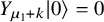
due to the fact
$Y_{\mu _1+k}|0\rangle =0$
 from (2.3). For
$\mu _1<\lambda _1$
from (2.3). For
$\mu _1<\lambda _1$
 , using (4.2) repeatedly we have that

Repeating the process, we have that
$(Y^*_{\mu _k-k+1}Y_{\mu _k-k+1})\cdots (Y^*_{\mu _2-1}Y_{\mu _2-1})(Y^*_{\mu _1}Y_{\mu _1})|\underline {\lambda }^{sp}\rangle $
 is nonzero for

The condition
$\mu _k<\lambda _k$
 forces that

that is, the left side of (4.1) equals 0 for the case
$\mu _1<\lambda _1$
 . Combining the two cases, we complete the proof.
From type-C dual Littlewood identity (3.19), we can consider the following measure

on partitions
$\lambda $
 of the type
$\lambda =(\alpha +1|\alpha )$
of the type
$\lambda =(\alpha +1|\alpha )$
 . Let
. Let

Theorem 4.2. For
$\lambda =(\lambda _1,\dots ,\lambda _i,\dots ,\lambda _k)=(n_1,\dots ,n_i+i-1,\dots ,n_k+k-1)=(\alpha +1|\alpha )$
 , one has that

with the kernel

where the integration is over the
$z-$
 and
$w-$
and
$w-$
 counterclockwise circles around 0 satisfying
$|w|<|z|<|x_i|$
counterclockwise circles around 0 satisfying
$|w|<|z|<|x_i|$
 .
.
Proof. Let

From (2.5) and the definitions of vertex operators
$Y^*(z)$
 and
$Y(z)$
and
$Y(z)$
 , it is easy to check that


Let
$[z^k]f$
 denote the coefficient of
$z^k$
denote the coefficient of
$z^k$
 in f. From (3.24) and (4.1), we have

By the Baker-Campbell-Hausdorff formula (2.4), the one-point correlation is

Similarly, we have the k-point correlation:

where we have used the
$BC$
 -type Cauchy determinant [Reference Betea6, (2.5)]:

From (4.11) and using contour integrals to perform the coefficient extraction, we get


where the contours in the first
$2k$
 -fold integral are simple counterclockwise circles centered around the origin satisfying
$|w_1|<|z_1|<\cdots <|w_k|<|z_k|<|x_i|$
-fold integral are simple counterclockwise circles centered around the origin satisfying
$|w_1|<|z_1|<\cdots <|w_k|<|z_k|<|x_i|$
 .
.
Remark 4.3. Relation (4.8) tells us that the generating function of
$K^{\prime }_C(i,j)$
 is
is

Let
$t_n=\frac {1}{n}\sum ^k_{i=1}x^n_i$
 , then
$J(z)=\exp \left (-\sum _{n\geq 1}t_n(z^n+z^{-n})\right )$
, then
$J(z)=\exp \left (-\sum _{n\geq 1}t_n(z^n+z^{-n})\right )$
 . Direct calculation gives that

We can also define the following two measures


over respective partitions specified above. If we replace
$\mathbf {x}=(x_1,\dots ,x_k)$
 by
$\mathbf {i}\mathbf {x}=(\mathbf {i}x_1,\dots ,\mathbf {i}x_k)$
by
$\mathbf {i}\mathbf {x}=(\mathbf {i}x_1,\dots ,\mathbf {i}x_k)$
 , we can show that measures
$\mathfrak {M}_{C}(\lambda )$
, we can show that measures
$\mathfrak {M}_{C}(\lambda )$
 and
$\mathfrak {M}_{D}(\lambda )$
and
$\mathfrak {M}_{D}(\lambda )$
 are determinantal point processes (see (1.5) and (1.6) for the definitions of
$\mathfrak {M}_{C}(\lambda )$
are determinantal point processes (see (1.5) and (1.6) for the definitions of
$\mathfrak {M}_{C}(\lambda )$
 and
$\mathfrak {M}_{D}(\lambda )$
and
$\mathfrak {M}_{D}(\lambda )$
 ).
).
Theorem 4.4. For
$\lambda =(\alpha +1|\alpha )$
 or
$\lambda =(\alpha |\alpha +1)$
or
$\lambda =(\alpha |\alpha +1)$
 , let
$n_i=\lambda _i-i+1$
, let
$n_i=\lambda _i-i+1$
 . We have


where the correlation kernels are given by


with

and the
$z-$
 and
$w-$
and
$w-$
 contours are simple counterclockwise circles around 0 satisfying
$|w|<|z|<|x_i|$
contours are simple counterclockwise circles around 0 satisfying
$|w|<|z|<|x_i|$
 .
.
Theorem 4.5. Let
$n_i=\lambda _i-i+1$
 for
$\lambda =(\alpha |\alpha )$
for
$\lambda =(\alpha |\alpha )$
 . The measure
$\mathfrak {M}_{B}(\lambda )$
. The measure
$\mathfrak {M}_{B}(\lambda )$
 is a determinantal ensemble

with the correlation kernel

Remark 4.6. In fact, if the vertex operators (2.2) are equipped with certain middle terms, the modes of vertex operators satisfy anti-commutation relations. From the q-series identity
$\sum _{\lambda =(\alpha +1|\alpha )}q^{|\lambda |}=\prod ^\infty _{i=1}(1+q^{2i})$
 , one may consider the correlation function

similar to the case of partitions [Reference Okounkov32], strict partitions [Reference Wang36] or self-conjugate partitions [Reference Wang and Yang37].
Remark 4.7. The third and fourth named authors together with collaborators also showed that
$\mathfrak {M}_{B}(\lambda )$
 ,
$\mathfrak {M}_{C}(\lambda )$
,
$\mathfrak {M}_{C}(\lambda )$
 , and
$\mathfrak {M}_{D}(\lambda )$
, and
$\mathfrak {M}_{D}(\lambda )$
 are determinantal in [Reference Jing, Li, Pan, Wang and Ye23, Theorem 3.12] with different kernels.
5 One-column Littlewood-type identities
In this section, we consider three families of generalized Littlewood identities over partitions shifted by one-columns.
Lemma 5.1. Fix
$m\in \mathbb Z_+$
 . Let partitions
$\eta =(1^m)$
. Let partitions
$\eta =(1^m)$
 and
$\lambda =(\lambda _1,\dots ,\lambda _k)$
and
$\lambda =(\lambda _1,\dots ,\lambda _k)$
 . Then


where we have adopted the shorthand notation:

Proof. From the proof of Lemma 3.1, the inner product

is nonzero only for

where
$\epsilon \in \{1,-1\}$
 . From (2.11) and (5.5), we have


that is,

where
$\varepsilon _j\in \{1,-1\}$
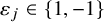 . From (5.7), we know that
$\sigma (k+1-j)\in \{1,2,\dots ,k-1,k+m\}$
. From (5.7), we know that
$\sigma (k+1-j)\in \{1,2,\dots ,k-1,k+m\}$
 , and thus

Along the lines of the proof of Lemma 3.1, we have
$\lambda _1=2m+k+1$
 . Assuming

then

Using similar discussion in Lemma 3.1, we have


It is easy to show that
$\epsilon _{r+1}=-1$
 from
$\lambda _{r+1}\leq r+m+1$
from
$\lambda _{r+1}\leq r+m+1$
 and
$\epsilon _{r+1}(\lambda _{r+1}-{r+1}-m)\geq m+2$
and
$\epsilon _{r+1}(\lambda _{r+1}-{r+1}-m)\geq m+2$
 . We therefore have

in other words,

Combining (5.12), (5.13), and (5.15), we have
$\langle \eta ^{sp}|\underline {\lambda }^{sp}\rangle $
 is nonzero only for

If partition
$\lambda $
 of the type described in (5.16) with
$\operatorname {\mathrm {rk}}\lambda =r$
of the type described in (5.16) with
$\operatorname {\mathrm {rk}}\lambda =r$
 , then
$\lambda $
, then
$\lambda $
 can be written as

with
$\lambda _{r+1}\leq r-1$
 . Using the commutation relation (2.5), we can express
$(Y^{*}_{-1})^mY^{*}_{\lambda _1}Y^{*}_{\lambda _2}\cdots Y^{*}_{\lambda _k}$
. Using the commutation relation (2.5), we can express
$(Y^{*}_{-1})^mY^{*}_{\lambda _1}Y^{*}_{\lambda _2}\cdots Y^{*}_{\lambda _k}$
 as
as

It is easy to check that
$\nu =(\alpha _1+m+2,\dots ,\alpha _{r-1}+m+r,r\pm 1,\underbrace {r-1,\dots ,r-1}_m,\lambda _{r+1},\dots ,\lambda _{k})$
 is a partition and
$|\nu |+m=|\lambda |$
is a partition and
$|\nu |+m=|\lambda |$
 . Comparing with (3.2), we can prove (5.2). Relations (5.1) and (5.3) could be proved similarly.
Theorem 5.2. For
$\mathbf {x}=(x_1,\dots ,x_k)$
 , one has


where

Proof. We first prove (5.20) in detail. From the definitions of vertex operators
$Y^{*}(z)$
 (2.2) and
$\Gamma ^{-1}_-(\mathbf {x})$
(2.2) and
$\Gamma ^{-1}_-(\mathbf {x})$
 (3.21), we have

In terms of components

Similarly,


Using the Baker-Campbell-Hausdorff formula (2.4) and (5.24), we have

where we have used (2.11) and the properties of determinants. From (3.24) and (5.2), we have

Comparing (5.28) and (5.27), we get (5.20).
From the vertex operators
$\Gamma _B(\mathbf {x})$
 (3.26) and
$\Gamma _D(\mathbf {x})$
(3.26) and
$\Gamma _D(\mathbf {x})$
 (3.27), we can similarly obtain (5.19) and (5.21) by evaluating
$\langle 0|(U^{*}_{-1})^m\Gamma _B(\mathbf {x})|0\rangle $
(3.27), we can similarly obtain (5.19) and (5.21) by evaluating
$\langle 0|(U^{*}_{-1})^m\Gamma _B(\mathbf {x})|0\rangle $
 and
$\langle 0|(W^{*}_{-1})^m\Gamma _D(\mathbf {x})|0\rangle $
and
$\langle 0|(W^{*}_{-1})^m\Gamma _D(\mathbf {x})|0\rangle $
 with the help of the inner-product formulas (5.1) and (5.3).
Remark 5.3. The proofs in this section show that we can obtain three generalized Littlewood identities for any fixed generalized partition.
6 Generalized identities for
$\boldsymbol{(-n)}$
 -asymmetric partitions

By computing the Euler characteristic of the BGG resolutions, Erickson and Hunziker obtained some new families of generalized Littlewood identities for
$(-n)$
 -asymmetric partitions[Reference Erickson and Hunziker13]. For any positive integer n, we also provide generalized Littlewood identities for
$(-n)$
-asymmetric partitions[Reference Erickson and Hunziker13]. For any positive integer n, we also provide generalized Littlewood identities for
$(-n)$
 -asymmetric partitions from the vertex algebraic viewpoint.
Lemma 6.1. Fix
$m\in \mathbb Z_+$
 . For the generalized partitions
$\eta =(0^m)$
. For the generalized partitions
$\eta =(0^m)$
 and
$\lambda =(\lambda _1,\dots ,\lambda _k)$
and
$\lambda =(\lambda _1,\dots ,\lambda _k)$
 , one has that


Proof. Similar to the proof of Lemma 5.1.
Theorem 6.2. For
$\mathbf {x}=(x_1,\dots ,x_k)$
 , one has


Proof. By computing
$\langle 0|(U^{*}_{0})^m\Gamma _B(\mathbf {x})|0\rangle $
 ,
$\langle 0|(Y^{*}_{0})^m\Gamma _C(\mathbf {x})|0\rangle $
,
$\langle 0|(Y^{*}_{0})^m\Gamma _C(\mathbf {x})|0\rangle $
 , and
$\langle 0|(W^{*}_{0})^m\Gamma _D(\mathbf {x})|0\rangle $
, and
$\langle 0|(W^{*}_{0})^m\Gamma _D(\mathbf {x})|0\rangle $
 , we can complete the proof by using a similar process to prove Theorem 5.2.
Remark 6.3. Using the involution
$\omega $
 such that
$\omega (s_{\lambda }(\mathbf {x}))=s_{\lambda '}(\mathbf {x})$
such that
$\omega (s_{\lambda }(\mathbf {x}))=s_{\lambda '}(\mathbf {x})$
 and
$\omega \left (\prod _{1 \leq i\leq j \leq k}(1-x_ix_j)\right )=\prod _{1 \leq i< j \leq k}(1-x_ix_j)$
and
$\omega \left (\prod _{1 \leq i\leq j \leq k}(1-x_ix_j)\right )=\prod _{1 \leq i< j \leq k}(1-x_ix_j)$
 , one can get generalized Littlewood identities for n-asymmetric partitions.
7 Connections with some known bounded Littlewood identities
In [Reference Huh, Kim, Krattenthaler and Okada18], Huh, Kim, Krattenthaler, and Okada obtained some bounded Littlewood identities. In the following, we point out some connections with our generalized Littlewood identities (cf. [Reference Erickson and Hunziker13]).
Case 1
In [Reference Huh, Kim, Krattenthaler and Okada18], a special case of (5.3) could be stated as follows.

where
$c(\lambda )$
 denotes the number of odd columns of
$\lambda $
denotes the number of odd columns of
$\lambda $
 . Comparing with (5.21), we have

In fact, (7.2) is the generalized Littlewood identity (6.10) for
$a=b=m$
 in [Reference Erickson and Hunziker13].
Case 2
Theorem 1.1 in [Reference Huh, Kim, Krattenthaler and Okada18] can be rewritten as follows (cf. [Reference Stembridge35, Theorem 7.1], [Reference Huh, Kim, Krattenthaler and Okada17, Theorem 1.1])


Comparing with Theorem 6.2, we have


Remark 7.1. The Littlewood-type identity (7.5) agrees with [Reference Erickson and Hunziker13, Table4(II)].
Remark 7.2. By the classical Littlewood identity

the right sides of (7.5) and (7.6) could be seen as some probability measures, and are in fact the correlation functions
$\langle 0|(Y^{*}_{0})^m\Gamma _C(\mathbf {x})|0\rangle $
 and
$\langle 0|(W^{*}_{0})^m\Gamma _D(\mathbf {x})|0\rangle $
and
$\langle 0|(W^{*}_{0})^m\Gamma _D(\mathbf {x})|0\rangle $
 , respectively.
Remark 7.3. Let
$\lambda =(\alpha +n|\alpha )$
 and
$|\alpha |=\alpha _1+\cdots +\alpha _{\operatorname {\mathrm {rk}} \lambda }$
and
$|\alpha |=\alpha _1+\cdots +\alpha _{\operatorname {\mathrm {rk}} \lambda }$
 . One has that
$(-1)^{\frac {|\lambda |}{2}+m\operatorname {\mathrm {rk}}\lambda }=(-1)^{|\alpha |+\operatorname {\mathrm {rk}} \lambda }$
. One has that
$(-1)^{\frac {|\lambda |}{2}+m\operatorname {\mathrm {rk}}\lambda }=(-1)^{|\alpha |+\operatorname {\mathrm {rk}} \lambda }$
 for
$n=2m+1$
for
$n=2m+1$
 and
$(-1)^{\frac {|\lambda |+\operatorname {\mathrm {rk}}\lambda }{2}+m\operatorname {\mathrm {rk}}\lambda }=(-1)^{|\alpha |+\operatorname {\mathrm {rk}} \lambda }$
and
$(-1)^{\frac {|\lambda |+\operatorname {\mathrm {rk}}\lambda }{2}+m\operatorname {\mathrm {rk}}\lambda }=(-1)^{|\alpha |+\operatorname {\mathrm {rk}} \lambda }$
 for
$n=2m$
for
$n=2m$
 . By the involution
$\omega $
. By the involution
$\omega $
 , (7.5) and (7.6) become

which will reduce to the Littlewood identity (7.7) by setting
$n\geq k$
 , and this identity was conjectured by Lievens, Stoilova, and Van der Jeugt [Reference Lievens, Stoilova and Van der Jeugt28] and proved by King [Reference King and Dobrev27]. Thus our method offers a new proof of this Littlewood identity.
Case 3
By (2.11), we have

where the determinant in the right side appeared in [Reference Huh, Kim, Krattenthaler and Okada18, Theorem 1.2, Theorem1.3]. This suggests there would be an interesting Lie theoretical explanation from the vertex algebraic viewpoint. We will study
$\langle 0|(Y^{*}_{0})^p(Y^{*}_{-1})^q\Gamma _C(\mathbf {x})|0\rangle $
 ,
$\langle 0|(U^{*}_{0})^p(U^{*}_{-1})^q\Gamma _B(\mathbf {x})|0\rangle $
,
$\langle 0|(U^{*}_{0})^p(U^{*}_{-1})^q\Gamma _B(\mathbf {x})|0\rangle $
 , and
$\langle 0|(W^{*}_{0})^p(W^{*}_{-1})^q\Gamma _D(\mathbf {x})|0\rangle $
, and
$\langle 0|(W^{*}_{0})^p(W^{*}_{-1})^q\Gamma _D(\mathbf {x})|0\rangle $
 and explore their connections in a forthcoming paper.
Acknowledgments
We thank the anonymous referees for helpful suggestions, which have enhanced the quality of the paper.
Competing interests
The authors have no competing interests to declare.
Funding statement
This work is supported by NSFC (grant nos. 12301033, 12171303), NSF of Huzhou (grant no. 2022YZ47), the Simons Foundation (grant no. MP-TSM-00002518), and the Open Research Fund of Hubei Key Laboratory of Mathematical Sciences (Central China Normal University), Wuhan 430079, P. R. China (grant MPL2025ORG007).


 Open access

