

Introduction
Across much of the world there has been a remarkable growth in higher education, generating more knowledgeable and productive communities, providing new opportunity structures for individual social advancement and offering employers potential access to a widening pool of skilled recruits. Reference MarginsonMarginson (2016) thus poses the question of the potential of higher education to contribute to the common good, democratising knowledge and widening employment opportunity and social mobility. He points however to strong countervailing trends – the emergence of new hierarchies of value, based on newly emerging processes of competitive stratification. Focusing on Bolivia, this article examines one source of such stratification: the tendency of employers to recruit on the basis of institutional reputation. If this tendency is to be countered in the interests of social justice and equity, its drivers need to be understood.
Bolivia has enjoyed more than a decade of unprecedented economic stability; at a 4.4% rate, it was the fastest growing South American economy in 2018. In this favourable context, the market of higher educational services has grown considerably, and the labour force supply is rapidly expanding. According to the Executive Committee of Bolivian Universities (ECBUFootnote 1) and the Ministry of Education, the number of newly enrolled college students has increased at an annual rate of 2.1% between 2003 and 2016. In the same time span, the number of college graduates has increased at an average 5.5% per year. The supply of higher educational services is also rising steeply. A fast-growing number of private universities are currently meeting a large demand for higher education alongside 14 ECBU-affiliated educational institutions. The number of private universities operating in full compliance of the regulations set by the Ministry of Education has nearly doubled in a 10-year span, going from 21 in 2003 to 41 in 2013. Importantly, Bolivia is not an isolated case in this process of increasingly diversified higher education supply. Latin America, as a whole, has been experiencing a fast expansion of programmes offered by universities and centres for higher education over the last decade (Reference SaltoSalto, 2016).
We argue that this situation has fundamental yet unstudied consequences in the labour market related to greater informational frictions. The key issue is that the growing competition in the higher education market constantly increases the heterogeneous nature of graduates’ educational credentials. In an increasingly diverse and competitive market for higher education, universities tend to be particularly responsive to potential employers’ requirements (Reference Bonilla, Bottan and HamBonilla et al., 2019; Reference Hastings, Neilson and ZimmermanHastings et al., 2015; Reference Rodríguez, Urzúa and ReyesRodríguez et al., 2016). Bolivian universities are offering an increasingly diverse range of programmes, seeking to make them appealing through innovative content, and advertising them widely in an attempt to increase their share of prospective students (Reference Urquidi, Ergueta and ForondaUrquidi et al., 2020 Reference Bagolle, Valencia and UrquidiBagolle et al., 2019).
In this context, recruiters’ interpretations of graduates’ educational credentials play a pivotal role in the transition from college to the workplace (Reference BaillyBailly, 2008; Reference CaiCai, 2013). Recruiters have different perceptions and expectations about the adequacy of these credentials depending on the mechanisms they have at hand to cope with informational asymmetries. Their interpretation of the university identity is tightly linked to the university reputation (Reference Camacho, Messina and UribeCamacho et al., 2017; Reference MacLeod, Riehl and SaavedraMacLeod et al., 2017). In order to cope with informational problems, recruiters make decisions based on their knowledge and experience about the applicants’ expected performance. This set of available information to the recruiter is termed ‘system of beliefs’ in Reference BaillyBailly (2008) and Reference CaiCai (2013), and it is essentially formed of subjective interpretations of the applicant’s educational credentials that are impossible to perfectly gauge.
Thus, in this article we ask, what is the extent to which recruiters’ perceptions about educational credentials determine the employability of college graduates in the formal sector? We argue that in order to better understand the transition process from college to the workplace in the fast-growing Bolivian economic system, it is crucial to establish the role played by perceptions and university reputation. This question is relevant because a strand of literature argues that the increasingly diversified supply of higher education programmes should have positive effects, as it may boost employability by virtue of a more efficient process of skill acquisition, attuned to the needs of recruiters (Reference Carranza and FerreyraCarranza and Ferreyra, 2019; Reference Ferreyra, Avitabile and BoteroFerreyra et al., 2017). However, this does not seem to be the general case in Bolivia. Considerable empirical evidence shows that educational credentials, as measured by observable indicators (e.g. years or levels of schooling), are hardly relevant factors to explain employability in the country (see, for example, Reference Bassi and NansambaBassi and Nansamba, 2018; Reference LizarragaLizarraga, 2015). This may be partly due to the rapid expansion of the supply-side in the labour force market, but of course, the latter is an institution plagued with imperfections including informational frictions that must be taken into account, which is precisely what we investigate in this article. Unobservable factors such as recruiters’ perceptions and university reputation may be fundamental determinants of employability, separating successful from unsuccessful applicants in the job market (Reference Deming, Yuchtman and AbulafiDeming et al., 2016). To the best of our knowledge, there is no empirical assessment in Bolivia about the role played by unobserved recruiters’ behaviour and informational frictions that come along the increasingly heterogeneous labour force. Actually, similar studies are also very scarce in Latin America in general; any notable exceptions are quite recent (see, for example, Reference ArteagaArteaga, 2018; Reference MacLeod, Riehl and SaavedraMacLeod et al., 2017 for the case of Colombia, Reference Hastings, Neilson and ZimmermanHastings et al., 2015, for a study about Chile and Reference Brotherhood, Ferreira and SantosBrotherhood et al., 2019, for the case of Brazil).
This study aims at providing a suitable answer to the question raised earlier, building upon a theoretical framework proposed by Reference MacLeod, Riehl and SaavedraMacLeod et al. (2017) and paying special attention to the role played by recruiters’ interpretations of the applicants’ educational credentials in the transition from college to the workplace. Following Reference Deming, Yuchtman and AbulafiDeming et al. (2016), Reference MacLeod and UrquiolaMacLeod and Urquiola (2015) and Reference MacLeod, Riehl and SaavedraMacLeod et al. (2017), we associate educational credentials in a CV to the identity of the degree-awarding university. Since we focus on recruiters’ interpretation of the university identity based on their system of beliefs, these educational credentials can be associated to university reputation in our analysis. Undertaking this study is challenging for at least two reasons: data unavailability and a persistently high rate of informal labour contracts in the job market.Footnote 2 To tackle both issues, we set up a correspondence experiment that consists of sending out emails applying for unpaid internships in officially registered (i.e. formal) firms, along with a fictitious enclosed CV (Reference PetzoldPetzold, 2017; Reference Petzold and MoogPetzold and Moog, 2018). The reason for choosing to send applications for an unpaid internship as a proxy for employability is twofold. First, there is vast empirical evidence supporting a strong positive relationship between internship experiences and overall future career success (Reference DrydakisDrydakis, 2016; Reference Nunley, Pugh and RomeroNunley et al., 2016). Internships are increasingly shown to be an effective ‘stairway to employment’ (Reference Sarkar, Overton and ThompsonSarkar et al., 2016; Reference Silva, Lopes and CostaSilva et al., 2016). Thus, interpreting employability as the ability to access a job (Reference SulemanSuleman, 2017), we argue that obtaining an early career internship can be interpreted as a first-step towards realistic chances of employability in the formal sector. Second, we reason that as unpaid internships imply lower monetary costs for the firms, they would be more inclined to provide an answer and thus maximise the response rate in our study. Nine fictitious CVs were designed and sent out through email, along with an application for an unpaid internship, to a pool of 1454 formal firms located in the three main Bolivian urban areas: La Paz, Cochabamba and Santa Cruz. These CVs are carefully designed to signal candidates with identical age, skills, work experience, educational level, place of residence and family background. They differ by university identity, thus allowing us to study role of recruiters’ interpretations of this information in their decision-making processes. Importantly, we pay particular attention to account for the potential confounding role of gender in our study, as it is the only individual characteristic that cannot be identical in our fictitious CVs, thus posing serious identification threats. To tackle this issue, we set up a specific gender-control experimental branch to arrive at clean estimates of the effect of university reputation on the response to candidates.
We find that university reputation premium is large. The average positive response rate for applicants signalling a ‘well-valued university’ is 1.4 times that of those signalling a ‘poorly-valued university’ (7.87% compared to 5.62%). The 2.25 percentage point differential is strongly significant, and we show that it is a consistent impact estimation, free of potential confounding effects caused by gender, observed firm characteristics and seasonality.
The document is structured as following: Section ‘A brief literature overview’ presents a thorough literature review of relevant scholarships. Section ‘Theoretical framework’ presents an adaption of the framework proposed by Reference MacLeod, Riehl and SaavedraMacLeod et al. (2017) to assess the role of college reputation and other characteristics embedded in a CV on labour market outcomes. Section ‘Experiment design and procedures’ describes the experimental procedures and strategy for random group formation. Section ‘Results’ presents our main results and findings and finally, Section ‘Summary and concluding remarks’ concludes the document with theoretical and empirical insights.
A brief literature overview
Three strands of academic literature are directly relevant for our study. First is the role of the recruiters’ expectations and interpretations of applicants’ observed characteristics, especially university identity. Second is the analysis of the relationship between the expected validity of educational credentials and labour market outcomes. Third is the discussion about methodological strategies that effectively allow for a credible identification of causal relations between the applicants’ observed characteristics and market outcomes.
Unescapably, recruiters face an informational problem when they assess applications, and thus act upon their beliefs and perceptions about the signals and information that are made available to them. The university identity conveys information to recruiters about applicants’ educational credentials acting as effective signals allowing them to cope with the information asymmetry. As one directly and easily observable trait, university identity often triggers stereotypes and preconceptions about productivity in the recruiters’ mind-sets (Reference Bosak, Eagly and DiekmanBosak et al., 2018). Thus, educational institutions are increasingly paying attention to the labour market success of their graduates as a means to boost their reputation among recruiters (Reference Rhiel, Saavedra, Urquiola, Hoxby and StangeRiehl et al., 2017). On this matter, several studies have stressed recruiters’ inability to make perfectly objective assessments of an applicant’s educational credentials, as they are only partial, imperfect signals of their skills (Reference ArrowArrow, 1973; Reference PhelpsPhelps, 1972; Reference SpenceSpence, 1973). Along these lines, Reference BaillyBailly (2008) proposed a reinterpretation of Spence’s classical theory about education signalling as a dynamic error-and-trial process of learning in which recruiters may have several interpretations of the educational signals conveyed by the applicants. In that sense, Bailly stresses that educational outputs should not be seen as substances that are always similarly interpreted, but rather as non-substantial components of a decision environment that may be differently valuated according to each recruiter’s beliefs.
These ideas strongly suggest avoiding a simplistic viewpoint to assess the role played by a university degree as a signal for recruiters – there is burgeoning literature on this matter. Reference Hastings, Neilson and ZimmermanHastings et al. (2015) found a highly heterogeneous premium schedule in Chile, varying along different types of college degrees. Degrees awarded by highly selective programmes and institutions are found to imply large labour market returns compared to other degrees. Reference Brotherhood, Ferreira and SantosBrotherhood et al. (2019) stress the importance of school quality differential among states in Brazil as drivers of unequal monetary returns in the labour market. While analysing productivity of colleges in Colombia in terms of their contribution to their graduates’ learning and future earnings, Rhiel et al. (2017) find that the most highly selective schools, and thus those providing the highest quality education, add the most to their students’ earnings in the labour market.
The aforementioned studies mainly rely on observed measures of school quality, either through a direct assessment of students’ abilities by means of entrance/exit college exams, or input-related indicators of school quality including expenditure per student or teacher–pupil ratio. Another vein of studies, however, focuses on the role of perceived school quality from the recruiter’s viewpoint. Reference Deming, Yuchtman and AbulafiDeming et al. (2016) conducted a field experiment about the perception of the value of postsecondary degrees in the United States, finding that applicants holding degrees awarded by online for-profit educational institutions are less likely to achieve success in the labour market. Reference MacLeod, Riehl and SaavedraMacLeod et al. (2017) also found evidence of perceived school quality premiums in Colombia, showing that school reputation, unlike years of schooling, is highly correlated with the evolution of graduates’ labour market earnings. Although MacLeod et al. use entry/exit exams as observed proxies of labour market school reputation, they originally propose a framework in which it is precisely the recruiters’ perceived reputation of educational institutions which may be at the origin of labour outcome differences.
One common, crucial issue in the aforementioned empirical studies is the application of adequately designed strategies to successfully identify the intended causal relations. One such methodological approach is a field experiment which is exempt of some core limitations of regression analyses, including over-saturation of the regression equation and the impossibility to effectively deal with unobservable confounders.
Two types of field experiment designs are commonly applied for collecting data in labour market studies such as the one that we undertake here. The first is an audit experiment, in which pairs of identical auditors, except for the characteristic that is tested as a source of differentials (such as race, skin colour, gender or educational credentials), engage in a personal interaction with recruiters to generate data. One handicap in this design that is often brought up in the literature (see, for example, Reference Bertrand, Duflo, Duflo and BanerjeeBertrand and Duflo, 2017) is that it relies on human interactions to generate information. One can hardly assume that people’s behaviour can be controlled to be identical for many obvious reasons. First is the simple fact that the auditors are different individuals and thus they will always have several distinctive personal traits that are unobservable prior to their interaction with recruiters. Second, as auditors know that they are part of an experiment, they may tend to react differently according to the evolution of their interaction with their counterparts.
A second type of design that overcomes the aforementioned limitations are correspondence studies, in which fictitious CVs are sent out to recruiters in order to generate information about their response, thus avoiding human interaction. This type of studies has been extensively applied in developed countries, such as the United States (Bertrand and Mullainathan, 2004), Sweden (Reference Carlsson and RoothCarlsson and Rooth, 2008), Germany (Reference Kaas and MangerKaas and Manger, 2010), Australia (Reference Booth, Leigh and VarganovaBooth et al., 2012), France (Reference Duguet and PetitDuguet and Petit, 2005) and the United Kingdom (Reference DrydakisDrydakis, 2015). There are only a few similar studies carried out in Latin America countries. Following this approach, Reference Bravo, Sanhueza and UrzuaBravo et al. (2008) analysed discrimination in Chile associated with names and places of residence. Reference Galarza and YamadaGalarza and Yamada (2014) studied discrimination in Peru associated with ethnic conditions and domestic standards of physical beauty.
Theoretical framework
We draw inspiration from Reference MacLeod, Riehl and SaavedraMacLeod et al. (2017) to set up the theoretical foundations and causal mechanisms of our study. Originally, MacLeod et al. posit a mechanism relating university reputation to the dynamic evolution of wages, and they operationalised it in a quasi-experimental setting using Colombian data. We limit ourselves to present here the essential aspects of their framework only to highlight that it is also useful to assess the nexus between university reputation and employability (not only wages), and that it allows also to establish clear hypotheses that can be tested in an experimental setting.
Universities build up labour market reputation based on their graduates’ performance. Let
 denote the labour market reputation of university
 , which is hard to perfectly observe. From the recruiter’s viewpoint,
can be considered as a noisy group-measure of the work-relevant skills possessed by any graduate of university
. If one denotes applicant’s
, which is hard to perfectly observe. From the recruiter’s viewpoint,
can be considered as a noisy group-measure of the work-relevant skills possessed by any graduate of university
. If one denotes applicant’s
 stock of work-relevant skills as
 , then

where
 represents the noise embedded in university reputation as a signal of the applicant’s skills. Thus,
can be interpreted as the expected skill-stock of a random university
graduate
represents the noise embedded in university reputation as a signal of the applicant’s skills. Thus,
can be interpreted as the expected skill-stock of a random university
graduate

Assuming that skills are normally distributed among applicants, then the university’s reputation represents the mean of their graduates’ skill schedule

where
 denotes the precision of the university’s labour market reputation as a signal of its graduates’ skills.
This setting implies a crucial role for the applicants’ CVs and the information conveyed therein. Alongside the university’s identity, the CV provides a vital set of information for recruiters to make their hiring decisions. This set includes the applicant’s gender, their family and ethnic background, their work experience, hints of their socioeconomic position and many other personal characteristics that are carefully taken into consideration by the recruiters in their quest to successfully manage asymmetrical information. In this setting, once the CVs are sent out, the applicant’s success is entirely in hands of recruiters and the way in which they interpret the signals they are given in the CVs. This clearly evokes the importance of Reference BaillyBailly’s (2008) systems of beliefs in a setting of informational frictions induced by noisy signalling.
Let us denote the information set conveyed in applicant’s
CV as
 , which has a finite overall precision,
 , as a signal of work-relevant abilities for the recruiter. The information set includes the university’s identity, which must not be confounded with the university’s labour market reputation (Reference MacLeod, Riehl and SaavedraMacLeod et al., 2017). The former is an observed factor, but the latter is an unobserved element resulting from the interpretation of the university’s identity by the recruiter (Reference BaillyBailly, 2008; Reference CaiCai, 2013).
Generally, let us now denote as
 a certain labour outcome for applicant
. In their framework, Reference MacLeod, Riehl and SaavedraMacLeod et al. (2017) consider wages as the labour outcomes of interest, but it may be extended to employability, waiting-time for a positive response or any other material as well as non-material job-related characteristics. In our study, the outcome of interest is receiving a call-back, which, in this framework, is a noisy reflection of the recruiters expected work-relevant skill-stock, given the information included in the CV
a certain labour outcome for applicant
. In their framework, Reference MacLeod, Riehl and SaavedraMacLeod et al. (2017) consider wages as the labour outcomes of interest, but it may be extended to employability, waiting-time for a positive response or any other material as well as non-material job-related characteristics. In our study, the outcome of interest is receiving a call-back, which, in this framework, is a noisy reflection of the recruiters expected work-relevant skill-stock, given the information included in the CV

where
 represents all other non-considered random factors affecting the outcome.
Assuming normality for all variables, it is possible to use Bayes’ rule to express the latter equation of labour outcome formation as

where
 and
and
 . Thus, the outcome is a function of the applicant’s university reputation, the overall information included in their CV and other non-considered factors, which may be largely context-dependent. This means that the unconditionally expected outcome is a function of the applicant’s university reputation and other individually varying signals included in the CV and thus observed by the recruiter

The precision of each element in Equation (6) as a signal of the applicant’s abilities is directly associated with its importance as a determining factor of the labour market outcome. We rule out the possibility of having
 and
and
 simultaneously, as this would mean that the outcome is confounded with a random error term, regardless of the CV’s content, which is unrealistic. It may be the case, however, that
while
simultaneously, as this would mean that the outcome is confounded with a random error term, regardless of the CV’s content, which is unrealistic. It may be the case, however, that
while
 , which would imply the irrelevance of the university’s labour market reputation for recruiters’ decision-making. Similarly, it may be case that
 while
, representing a situation where the university’s labour market reputation completely determines the expected outcome, regardless of any other information embedded in the applicant’s CV.
while
, representing a situation where the university’s labour market reputation completely determines the expected outcome, regardless of any other information embedded in the applicant’s CV.
We argue that this framework allows us to gauge the extent to which university reputation has a causal effect on labour market outcomes based on a correspondence experimental study. To capture the effect of university reputation, let us consider two applicants,
and
 , for which we construct identical corresponding information sets
and
, for which we construct identical corresponding information sets
and
 , except for the university identity. In this framework, this situation triggers different interpretations of the applicants’ CVs by the recruiters that are entirely due to distinct university reputations. Let us say that applicants
and
attended universities
and
, except for the university identity. In this framework, this situation triggers different interpretations of the applicants’ CVs by the recruiters that are entirely due to distinct university reputations. Let us say that applicants
and
attended universities
and
 , respectively. Thus

In a correctly designed experimental setting, statistically significant differences in the expected outcomes can only be attributed to differences in the reputation of the applicants’ respective universities. Any evidence supporting that
 can be interpreted as causal evidence of labour market returns to university reputation, as measured by the considered outcome. We stress that the interpretation of this differential as an average impact of university reputation – or an average treatment effect (ATE) in traditional treatment effects literature – relies on the successful configuration of the complementary information conveyed in the applicant’s CVs. We now go on to explain how we set up the correspondence experiment to effectively estimate this impact.
Experiment design and procedures
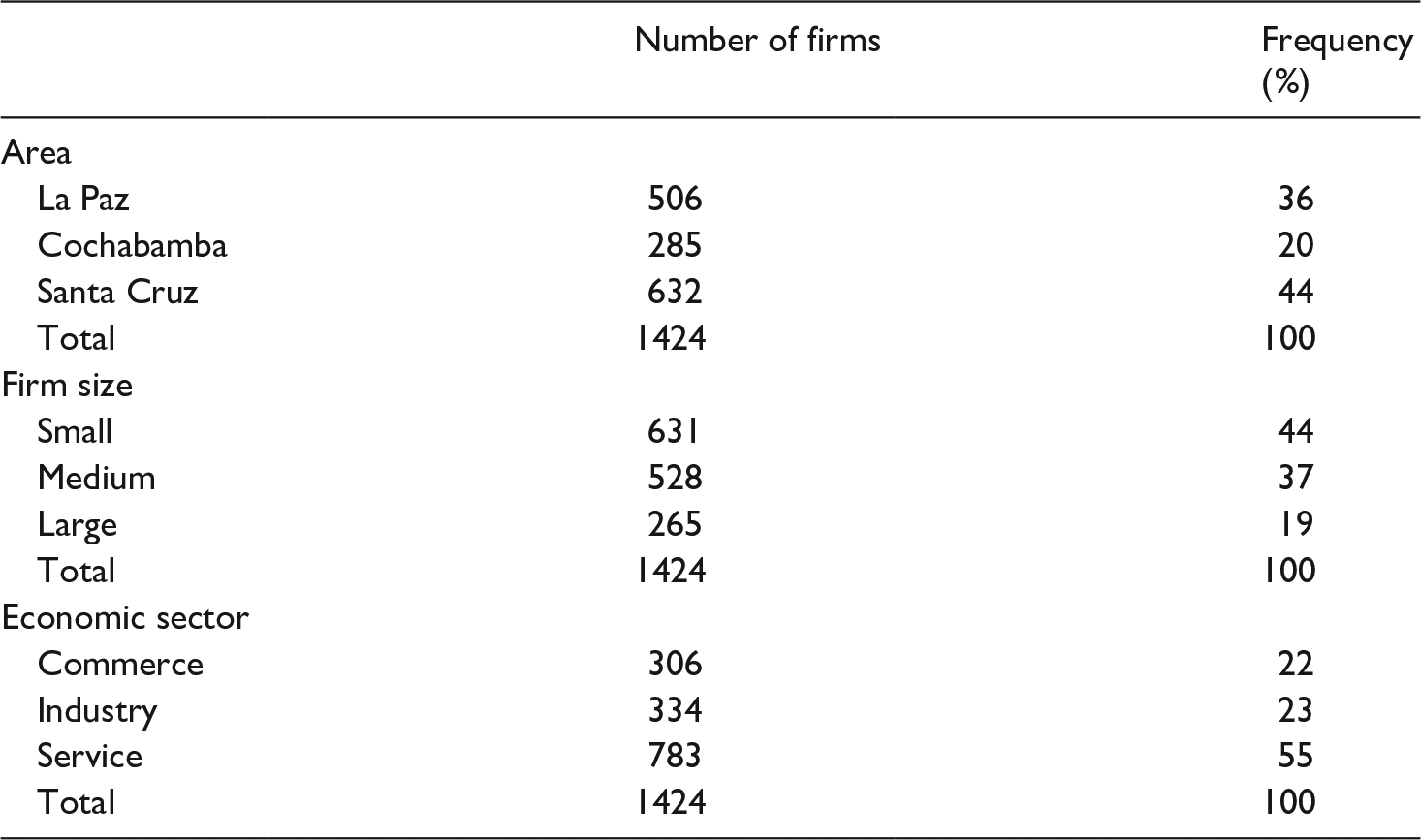
Our experiment covers the urban areas of the three largest Bolivian cities, namely La Paz, Cochabamba and Santa Cruz, which concentrate 76% of the urban population. Our sample frame is composed of all formal firms operating in these cities that have a register as employers in the Ministry of Labour as of January 2017. This criterion excludes a very large number of single-owner firms, which represent 79% of the existing formal enterprises in these cities. As they often lack the status of a formal employer, an internship in this type of firm may hardly result in a subsequent formal job offer for the applicant, justifying their exclusion from our analysis. Thus, our sample frame comprises 46,095 firms with a valid and publicly known email address, of which we have drawn a random sample of 1424 firms, corresponding to a 2.5% sampling error. The firm sample composition is presented in Table 1.
Distribution of the firm sample.
Source: Own.
Two key elements received particular attention prior to the execution of the correspondence study. First is the construction of a set of CVs specifically designed for the purpose of this study, and second is the definition of random groups of firms.
The applicants’ identities were carefully created to convey neutral information except for the university identity. For this, we take into account each of the following points, with particular attention when it comes to gender – which, of course, is the only element in the CV that we cannot set to be neutral:
• The given and last names were carefully chosen to be some of the most common in the country, while also conveying neutral information about key socioeconomic characteristics, including ethnicity and family background.Footnote 3
• We indicated the possession of an undergraduate degree in Business Administration. We justify this choice because it is one of the most highly demanded by employers, it is offered by all the ECUB colleges and we argue that it helps us to avoid preference biases towards more specific or specialised professional training.
• A set of skills and competencies was carefully selected in order to be adequately fitted to usual requirements by firms, while conveying abilities that can be considered common among the entry-level working population. The skill profiles were created using data from the World Bank’s Survey Towards Employability and Productivity collected in 2012, which is, to the best of our knowledge, the only survey that allows to measure the skills and competencies among the working population in the country. These skills and competencies include knowledge of accounting and finance, mathematics and statistics, good communication skills (writing, speaking and comprehensive reading), proficiency in the use of computer and Internet browsing and a basic level of writing and speaking in English as a foreign language.
• We used data from the 2016 Demand Labour Survey collected by IDB to measure the recruiters’ perceptions about the quality of education in universities located in La Paz, Santa Cruz and Cochabamba (Reference Urquidi, Ergueta and ForondaUrquidi et al., 2020). In absence of an official assessment of university quality in the country, we use this information to define a ‘well-valued university’ as an institution that may facilitate the employability of its graduates in the formal sector as opposed to a ‘poorly valued university’. In separate analyses for each one of the three urban areas, the well-valued university is the one having the highest valuation and is reported to be known by more than 50% of the respondents. In turn, the poorly valued university is the one having the lowest valuation and is reported to be known by more than 50% of the respondents. Thus, well-valued universities are the ones enjoying the best reputation among recruiters in their respective locations, and the converse is true for the poorly valued universities.
• Based on the vast existing evidence suggesting discrimination against female applicants (Reference Banerjee, Bertrand and DattaBanerjee et al., 2009; Reference Bertrand and MullainathanBertrand and Mullainathan, 2004), we chose to assign male identities to the main branch of the experiment seeking to maximise response rates. However, we acknowledge that this decision can pose grave identification threats, as we risk confounding the intended university reputation effects with gender-induced effects. In order to be able to show that our results are not capturing such gender-related confounding effects, we consider a third additional control experimental branch operationalised by the creation of a CV corresponding to a female applicant graduated from a well-valued university. We do not consider an identity corresponding to a female applicant graduated from a poorly valued university due to the small sample in our data. We choose to safeguard the power of our main experimental branch, while having enough data to confidently rule out gender-induced confounding effects.
Thus, three broad types of fictitious CVs were created:
• Type A: Male applicant, graduated from a well-valued university.
• Type B: Male applicant, graduated from a poorly valued university.
• Type C: Female applicant, graduated from a well-valued university.
Types A and B are used in the main branch of the experiment as they signal male applicants with distinct university identities. Types A and C are the CVs used in the gender-control branch of the experiment. As we mentioned earlier, the university identity was assigned according to the results obtained by area (La Paz, Cochabamba and Santa Cruz), yielding a total of nine fictitious CVs specifically created for this study. Thus, our experiment also controls for regional variations.
Let us now focus on the strategy followed to create groups of randomly selected firms and thus operationalise the correspondence study, while making the most out of the sample of firms at hand. Following Reference Bertrand, Duflo, Duflo and BanerjeeBertrand and Duflo (2017), we reason that in an adequately designed experimental setting, which generates data that is effectively controlled for unobserved characteristics, decisions made by recruiters need to take place while simultaneously facing two generic types of fictitious CVs. Thus, our strategy consisted of forming random groups of firms in three stages: the first regarding the type of experiment (i.e. whether we are assessing the role of gender or that of university reputation), the second regarding the timeframe for sending out the applications and the third regarding the order in which the firm received the CVs.
At the first stage, we made sure that each firm received a pair of CVs according to the type of experiment in which they were randomly assigned:
• Half of the firms (712) received Type A and Type B CVs, and thus their response allows us to gauge the effects of university reputation on the outcome. Hence, in the remainder of the document we refer to this part of the study as the main experiment branch.
• Half of the firms (712) received Type A and Type C CVs, allowing to gauge any potential distortion on the outcome caused by our decision of assigning a male identity. Thus, we refer to this part of study as the gender-control branch. Since this a complementary experimental branch, we chose to assign well-valued universities to the applicants seeking to maximise the response rates for this additional branch.
At the second stage, each one of the groups formed in the first stage were randomly divided in two groups (each one comprising 356 firms). In each type of experiment, one of these subgroups received the CVs between January and February 2017, and the other subgroup received them between June and July 2017. These timeframes were chosen because they correspond to recess terms in the tertiary educational system, thus depicting periods in which firms usually expect to receive internship applications. By sending out CVs at two different points in time, we explicitly seek to control for potential seasonal confounding effects.
At the third and final stage, each of the subgroups formed at the second stage were randomly divided into two additional groups (each one comprising 178 firms), for which we have inverted the order in which the CVs were received. Through this procedure, we seek to avoid potential biases caused by any unobserved factor operating while the recruiters take a first glance at the fictitious CVs. In all cases, we made sure that each firm received the second CV within the next 48 hours after they received the first one.
Results
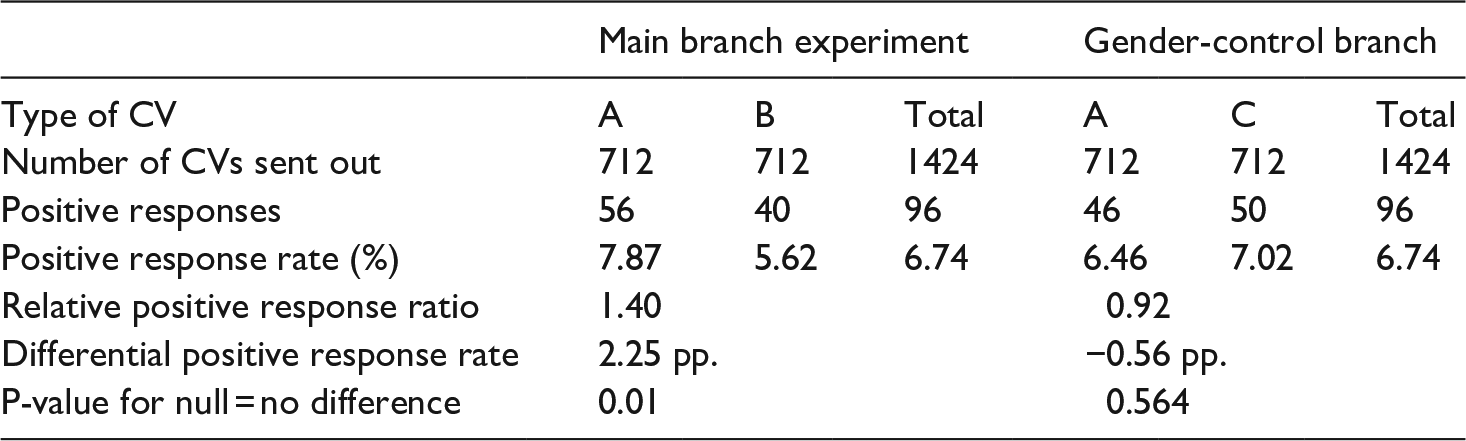
Taking the correspondence study as a whole, a total 2848 CVs were sent out (two to each firm) of which 192 received a positive response. Thus, the overall positive response rate is 6.74%, which is similar to Reference Bertrand and MullainathanBertrand and Mullainathan (2004) and slightly lower compared to Reference Galarza and YamadaGalarza and Yamada (2014). Summary statistics of the response rates for both the main experiment branch and the gender-control branch are presented in Table 2.
Experiment statistics.
Source: Own.
The set of responses was received up to 2 months after the emails were sent. Most of them (90%) came by a mobile phone call and the rest (10%) was received through email. We consider a response as positive if it includes an interview offer or if the interview was immediately conducted during the first contact. In every case, after being contacted by a firm, we politely declined to move forward with the procedure. We are well aware of the fact that a positive response in our setting does not necessarily guarantee a positive result for the application, so our results should be interpreted as an opportunity for a positive outcome. We assume that failure to receive a positive response automatically implies the absence of opportunity for a positive outcome (Reference Bertrand and MullainathanBertrand and Mullainathan, 2004).
Since we are relying on experimental data, a simple comparison of the expected response rates in the main experiment branch as presented in Equation (7) suffices to establish the magnitude of university reputation premium. We will assess this differential and then present additional checks of its validity as an impact estimate. The mean positive response rate for graduates from poorly valued universities is 5.62% and that of graduates from well-valued ones is 7.87%. The 2.25 percentage points differential in favour of the latter graduates is strongly statistically significant in light of a means test. Thus the response rate for applicants from well-valued universities is 40% higher, depicting a quite large market reputation premium. In other words, a graduate from a well-valued university needs to send out around 13 applications and expect one positive response in return. A graduate from a poorly valued university needs to send out nearly 18 applications to expect the same result.
To the best of our knowledge, this is the first empirical proof of the importance of perceived quality of educational credentials as a key determinant of opportunities to enter the formal sector of the Bolivian labour market. In that sense, our results complement a host of studies showing that quantity of education – regularly measured by years of schooling – has very limited explanatory power of labour market outcome differentials (Reference Bagolle, Valencia and UrquidiBagolle et al., 2019; Reference LizarragaLizarraga, 2015; Reference Urquidi, Ergueta and ForondaUrquidi et al., 2020). Our results prove that educational credentials are, indeed, highly heterogeneous from the recruiters’ viewpoint. This triggers information frictions that affect people’s opportunities at the workplace. In this light, an increase of higher education enrolment rates may not necessarily contribute to increase employability in the country over time, nor realistically improve many people’s chances for a quality formal job.
The increasing diversity of degrees in Bolivia does not have the positive effect on employability argued in Reference Ferreyra, Avitabile and BoteroFerreyra et al. (2017), as it does not seem to promote a better alignment between labour supply and the needs from the demand-side. There is evidence of a similar situation in Colombia, where educational credentials became increasingly noisy signals for recruiters due to an important and disordered increase of college programmes to cope with the rapid expansion of the demand for educational services (Reference Camacho, Messina and UribeCamacho et al., 2017).
In light of the gender-control branch outcomes, we are able to affirm that our results are not capturing any gender-related confounding effects (see Table 2). Actually, the female applicant received slightly more positive responses compared to the male applicant (50 compared to 46). However, based on a means test for the differential response rate, this response gap is not statistically significant.
Even though this branch of our experiment is only auxiliary to answer our research question, we argue that it has a useful interpretation in itself: chances of a positive response arrive at a similar rate for both male and female applicants, insofar as they have good educational credentials, according to the recruiters’ beliefs. Recent empirical evidence, coming mostly from developed countries (Reference Bertrand, Duflo, Duflo and BanerjeeBertrand and Duflo, 2017) and a handful of developing countries (Reference Zhou, Zhang and SongZhou et al., 2013) show that discrimination against women at the call-back stage of experiments similar to ours is much less apparent than other types of discrimination. We postulate two plausible explanations for this result. First, from a methodological viewpoint, the similar response rates to men and women may be related to the Business Administration degree included in the CVs, which does not relate to a particularly male-dominated profession. In addition, we believe that this finding may be the reflection of the steady inclusion of women in the national tertiary education system (Reference Urquidi, Ergueta and ForondaUrquidi et al., 2020).
Additional validity checks
In order to provide evidence of the internal validity of our results, we undertake a set of model-based assessments of our data. We show that our results are robust to the inclusion of observed firm characteristics as additional controls. This implies that our results come from an adequately balanced experimental procedure. We show this while also taking into account the non-linearity of our outcome, which is a binary variable. This goes on to prove that our results are robust to different functional form specifications of the latent variable underlying the outcomes of both experimental branches.
We estimated a set of probit models where the dependent variable, denoted as
 , is the response given by firm i to CV
in experiment branch
, is the response given by firm i to CV
in experiment branch
 , which can either be the main branch or the gender-control branch. If the response is positive, then
 ; otherwise,
 . We estimated two variants of this model for each type of CV. The first variant includes an intercept and the observed firm characteristics available in our data, namely area, economic sector and size as right-hand side predictors. The second variant only includes an intercept. Since the probit model is a special case of the generalised linear model with a normal distribution link, the predicted probability of having
 in the latter variant exactly corresponds to the response rates presented in Table 2. The estimation results are presented in Table 3.
Estimation results.

95% CI in square brackets.
* p < 0.1;
** p < 0.05;
*** p < 0.01.
None of the observed firm characteristics is significant to explain the outcomes of the main experiment or the gender-control branches. Thus our results are not driven by this observed potential determining factors of employability. Furthermore, this model-based approach allows us to estimate the variation around the average university reputation effect. The differential positive response rate in favour of applicants from well-valued universities ranges from 1 to 3.5 percentage points with 95% confidence. Taking the average positive response rate of these applicants (7.87%), their likelihood of receiving a positive call-back can be as high as 1.44 times that of applicants from poorly valued universities.
Summary and concluding remarks
This study was motivated by the fact that the well-documented positive relationship between a rapid educational expansion and improvement of employability seems to be very weak, almost inexistent, in Bolivia during the last decade. This situation may have several explanations as it is related to fundamental characteristics of the labour market, such as culture, demographics, long-run productivity and so on. However, drawing inspiration from Reference BaillyBailly (2008) and Reference MacLeod, Riehl and SaavedraMacLeod et al. (2017), we have demonstrated that recruiters’ perceptions and interpretations of applicants’ observable signals play a crucial role in the transition from college to the workplace. Thus we made a case for informational frictions between applicants and recruiters as one plausible explanation of the above-mentioned disconnection, in the context of an increasingly heterogeneous labour force. Following Reference CaiCai (2013), our study is inscribed in scholarship about the role of university reputation on labour market outcomes, as we focus on the role of recruiters’ interpretation of educational credentials.
We generated data for this study by implementing a correspondence experiment in the three main Bolivian cities (La Paz, Cochabamba and Santa Cruz) on a sample of 1424 formal firms that are registered as employers in the Ministry of Labour. We sent pairs of fictitious CVs to each firm along with an application for an unpaid internship, hence capturing decisions made by firms in face of two applicants that are identical expect for two controlled characteristics. In the main branch of our experiment, half of the firms received CVs from a male well-valued and a poorly valued university, according to the 2016 IDB Labour Demand Survey data. We designed the experiment to have an auxiliary gender-control branch, in which CVs corresponding to a male and a female candidate from a well-valued university were sent out.
Our main finding – a quite novel one for the Bolivian case – is that university reputation premiums are quite large. Applicants from a well-valued university are 40% more likely to receive a positive response compared to applicants showing credentials form a poorly valued university – a 2.25 percentage point advantage over a baseline likelihood of 7.87%. This shows the extent to which informational frictions play a defining role in the communication process between applicants and recruiters. Perceived college quality heterogeneity from the recruiters’ viewpoint is thus proven to be an important source of disconnection between educational advancements, as measured by quantity of education and actual improvements in the workplace. University reputation and the perceived value of educational credentials need to be seriously taken into account in order to grasp a fuller picture about the transition from college to the job market in Bolivia.
This result is free of regional differences and seasonal confounding effects. Most notably, they are also free of gender-induced confounding effects. We find that both men and women are equally likely to receive a positive response (around 6.74%). The reason for this result may be manifold. First, it may be due to the fact that an unpaid internship implies nearly nil costs for the firm, but above all, that this situation is likely to arise under identical hiring costs for the firms. Second, our fictitious CVs signalled a degree in Business Administration, purporting to convey generic useful skills for firms in a wide array of economic activities. One may hardly defend that this profession is gender-oriented, providing another plausible explanation for our result. Additional studies are required to assess whether this is the case for other professions. Third, this result may partly be the reflection of the rapid inclusion of women in the tertiary education system for which we made a case earlier.
Of course, we do not wish to imply that gender discrimination is non-existent in the country overall. Rather, we wish to lay out some possible conditions in which discriminating behaviour in the labour market seems less likely to occur, based on an internally valid experimental setting. Indeed, discrimination may persist beyond the intended scope of our study.
We argue that several veins for future research in the country arise in light of this result. First, however, it is important to recognise that studies accounting for quantity of education only do not seem able to grasp the true complexity of the connection between education and labour outcomes in Bolivia. Thus, it may be useful to transcend traditional survey data and administrative registers in the quest to fully understand the matter at hand. We stress that one aspect requiring further attention by researchers is the formation of college reputation and its relation to school choice by students; we intend to pursue this. In this study, we have demonstrated that college reputation overpowers gender as a determining factor for recruiters’ decision-making in the formal sector. This result is valid in the main Bolivian cities when conveying a degree in a gender-neutral profession, namely Business Administration. We argue that this result may hardly be extended to other contexts, for which further data needs to be generated. We intend to focus our future research efforts in these directions, as we are convinced that many processes in the transition from college to the workplace remain uncovered. This certainly hinders public policies’ capabilities of improving people’s livelihoods and bringing about human development in the country.
Funding
The author(s) received no financial support for the research, authorship and/or publication of this article.


 Open access

