


This paper contains supplementary material that can be found online at http://journals.cambridge.org
Introduction
Human–wildlife conflict occurs within the context of a dynamic social–ecological system in both developing and developed countries. In Africa such conflict often arises beyond formally designated and fenced protected areas because habitat is intermingled with communities and farms. For example, Hoare (Reference Hoare1999) and Muruthi (Reference Muruthi2005) estimate that free-roaming elephants live in c. 80% of their potential habitat, most of which is not located within gazetted protected areas. This combination of wildlife and human occupation leads to interactions and conflicts, with negative consequences that are well documented: damage to crops, livestock and structures, injury and death to humans, and loss of individual animals from a population because of relocation, poaching or culling.
Responses to human–wildlife conflict are varied and occur at different social–organizational scales involving actors with sometimes conflicting objectives. Many actions are focused on education (both in terms of reducing some attractants as well as training farmers to use specific techniques), relocation or culling of specific problem animals, use of fencing or other barriers to restrict animal movement or protect livestock, reinforcement of specific infrastructure such as water systems, aversive conditioning of wildlife, and schemes to compensate individuals for losses caused by wildlife (Muruthi, Reference Muruthi2005).
Despite the attention given to human–wildlife conflict, the development and application of technologies, and continuing education and training for conflict reduction, conflicts continue to arise, necessitating the development of national-level policies in some countries to address prevention and mitigation of conflicts and compensation for losses. In Namibia the number of incidents of human–wildlife conflict reported on communal conservancies rose from 325 in 2001 to 7,738 in 2010, with much of the increase related to crop damage and attacks on livestock (NACSO, 2011). In the face of such increases, policies are built upon understanding the nature of the issue, assumptions about the efficacy of alternative solutions, available science, and political perspectives concerning who is responsible for doing what.
Within any given conflict situation the actions and policies considered, developed and implemented result from mental models of conflict employed by various constituencies. Understanding how policy-makers and others frame human–wildlife conflict and its resolution as a result of these mental models is thus fundamental to developing effective responses. Many of the suggested responses involve engagement of stakeholders and constituencies (Messmer, Reference Messmer2000; Redpath et al., Reference Redpath, Arroyo, Leckie, Bacon, Bayfield, Gutiierrez and Thirgood2004; Ogra, Reference Ogra2008; Treves et al., Reference Treves, Wallace and White2009); however, stakeholders are likely to differ in their definitions of the conflict, their acceptance of proposed solutions and their responses, depending on their economic situation or attitude towards wildlife (Manfredo & Dayer, Reference Manfredo and Dayer2004). These differences are often influenced by stakeholders’ mental models of human–wildlife conflict.
The purpose of this paper is to explore the process of mind mapping as a method of uncovering the underlying mental models used in understanding human–wildlife conflict in a social–ecological system. Recognizing that social–ecological systems have multiple dimensions, we brought together people from diverse backgrounds to collectively develop mind maps of the problem, manifesting the meaningful learning that Novak (Reference Novak1990) argues is at the heart of effective learning. We describe how we used small group processes combined with mind mapping software to elicit mental models of human–wildlife conflict. Focusing effort initially on developing such mind maps may enable natural resource and wildlife managers to understand grounds for conflict better and create forums for public engagement.
Social–ecological systems and mental models
The multi-actor nature of human–wildlife conflict exists within a complex social–ecological system (Anderies et al., Reference Anderies, Janssen and Ostrom2004). In such systems the causes of problems as well as attempts to remedy them are influenced by complex and often non-linear dynamic and external processes (Roe, Reference Roe1998), confounding both prediction and effective management. These systems tend to be loosely coupled (there are often multiple causes for the same effects) and frequently display temporal lags between deployment of management and reduction of conflict (Weick, Reference Weick1976).
Anderies et al. (Reference Anderies, Janssen and Ostrom2004) identified four major interacting components in their description of complex social–ecological systems: (1) resource users, (2) resources (in this case a variety of crops, livestock, wildlife and wildlife habitat), (3) public infrastructure (facilities, roads, management policies) and (4) infrastructure providers (governments, communities and NGOs). Because the components of the system are coupled, if only loosely, changes in one affect others but often in ways that are not clearly understood. The system is a nested hierarchy and thus changes occurring in the larger social–ecological system affect processes and conditions at smaller scales, and vice versa. For example, how people exploit resources, such as agricultural land, is influenced by a wide variety of local and larger scale social and political factors such as government policies and financial subsidies, and biophysical processes such as nutrient cycling. In many cases, those who develop the policies and physical infrastructure for farming and wildlife are not the people who actually cultivate crops or manage wildlife, and they may not see the connections between their activities and the consequences in terms of human–wildlife conflict (Leong et al., Reference Leong, Decker, Forester, Curtis and Wild2007). Each of the constituencies (farmers, conservation NGOs, government agencies) involved has unique perspectives and holds different mental models of this system.
Meadows (Reference Meadows1999) argued that to understand the deepest malfunctions of systems one must pay attention to the rules and who has power over them. Underlying the rules, structures and patterns that influence where and when human–wildlife conflict occurs and how society responds are mental models of conflict situations. Senge (Reference Senge1990:163) noted that ‘Mental models are deeply held internal images of how the world works, images that limit us to familiar ways of thinking and acting’. Not only are mental models difficult to observe directly (as we are often not aware of our own mental models) but they also influence how we behave, such as in the development of policy and actions to mitigate human–wildlife conflict. Significantly, they filter what we observe and therefore how we respond. Cumming & Collier (Reference Cumming and Collier2005) argued that ‘given the importance of our mental models, which determine the data that we collect, the questions that we consider “interesting” and the ways in which we change our views of the world to accommodate new results, it is perhaps surprising that we do not have a more clear-cut approach to characterizing the essential components of complex systems and the ways in which they interact with one another’.
Understanding the mental models in use by various stakeholders in a particular social–ecological system provides an opportunity to change policy and management (Meadows, Reference Meadows1999). One can identify areas of agreement and disagreement to effect change, providing a basis for developing community-driven solutions to human–wildlife conflict. Given the growing number of conflicts between humans and wildlife in Namibia (NACSO, 2010, 2011), the vulnerability of subsistence societies to disturbance, and the growth in both wild animal populations (NACSO, 2011) and Namibia's human population (growth rate of 3.1% per year; Office of the President, 2004), understanding what mental models may be in use could be an essential first step in conflict prevention and mitigation.
Study area
In Namibia conservation has a strong local basis through implementation of community conservancies located on communal lands. A conservancy is a formally established community-based natural resources management unit on communal land that gives local residents conditional use rights over wildlife (Jones, Reference Jones1999; NACSO, 2009, 2010). Crop damage and livestock loss in Namibia are primarily caused by elephants and large predators such as lions, cheetahs and hyaenas. Elephants may also cause damage to structures, particularly rural water systems and utility poles. Annual losses as a result of crop and livestock damage in the Caprivi region of Namibia alone amount to hundreds of thousands of Namibian dollars (Mulonga & Suich, Reference Mulonga and Suich2003), a particularly significant sum given the predominant subsistence nature and poverty level of the local population. As Mulonga and Suich note, ‘crop damage is a particular risk to less resourced households, who do not have access to livestock or any cash income.’ As Namibia's human population grows, more conflicts are likely as the number of farms increases and human activity encroaches on wildlife habitat (Mosimane et al., Reference Mosimane, Mfune and Angula2006). Ongoing conflict may lead to negative attitudes towards wildlife restoration and conservation (Parker & Osborn, Reference Parker and Osborn2006).
In 2008 a workshop identified human–wildlife conflict as one of the most significant challenges facing community-based natural resource management in Namibia (Mosimane et al., Reference Mosimane, McCool, Lendelvo, Khumalo and Pittman2008). Although human–wildlife conflict has been recognized as a problem since the early 1990s and several interventions (e.g. fencing, aversive conditioning, changing human behaviour) have been implemented to address the problem (Murphy et al., Reference Murphy, Vaughun, Katjiua, Mulonga and Long2004; Kasaona, Reference Kasaona2006), the workshop highlighted its continuing significance as a barrier to conservancy management. Efforts to reduce human–wildlife conflict have been made in good faith; however, the continuing rise in conflict (NACSO, 2011) suggests these efforts are not necessarily succeeding.
These initiatives support the notion that human–wildlife conflict is a barrier to achieving community-based conservation and economic development. In addition, the continual growth in conservancies, from four in 1998 to 59 in 2010 and covering 16.1% of Namibia (NACSO, 2011), and the resulting rise in wild animal populations (NACSO, 2011) suggest that humans and wildlife will come into more frequent contact in the future. Given the emphasis on community-level conservation in Namibia, the perspectives and mental models that constituencies hold become significant components of strategies to resolve human–wildlife conflict.
Methods
Mental models can be portrayed by a process called mind mapping. A mind map is a visual representation of how an individual or group relates different concepts or variables to a central concept or idea (Buzan, Reference Buzan1993). Mind maps depict branches of ideas radiating outwards from a central concept. Eventually, the mind map demonstrates how an individual or group perceives a particular concept, the important ideas influencing that concept and the relationships between the ideas.
Mind mapping has its origins in concept mapping, a method of graphically organizing and representing knowledge (Novak, Reference Novak1990; Novak & Canas, Reference Novak and Canas2008). Novak's work on how children learn led to the proposition that meaningful learning, rather than rote learning, is more effective for retention and application. In this framework meaningful learning is thought to require (1) a well-organized relevant knowledge structure, (2) an emotional commitment to integrate new knowledge with existing knowledge and (3) possession of relevant prior knowledge. Therefore, mind mapping assumes that study participants have relevant prior knowledge and that this knowledge is well organized into specific structures. Research examining mind maps seeks to provide an empirical mechanism to capture and display an individual's well-organized knowledge structure based on relevant prior knowledge. Mind mapping has been used in a variety of situations, particularly in teaching (Rooda, Reference Rooda1994; Mueller et al., Reference Mueller, Johnston and Bligh2002; Brinkman, Reference Brinkman2003; Budd, Reference Budd2004) and, more recently, in water (Kolkman et al., Reference Kolkman, Kok and van der Veen2005) and ecosystem management (Glaser, Reference Glaser2006). We used mind maps to aid understanding of the mental models of human–wildlife conflict that may be operating in Namibia. We organized and facilitated a workshop in September 2009, the primary purpose of which was to identify and describe the various components contributing to the rise in incidents of human–wildlife conflict and their prevention. We invited various organizations to nominate participants that were knowledgeable about human–wildlife conflict in Namibia, and the diverse group of participants included government officials, conservancy members, NGO members and faculty members from the universities of Namibia and Montana. The 19 participants were asked to reflect upon human–wildlife conflicts and the associated variables prior to the workshop. The aim was to bring together a group of individuals with a variety of experiences in human–wildlife conflict; however, this group was not necessarily representative of a larger population. Therefore, there may be a broader diversity of mind maps than shown here. We acknowledge that because of the small sample size the mind maps developed here cannot be generalized to the broader population.
In the workshop we used the mind mapping software IMindMap (ThinkBuzan, Cardiff, UK). Concepts are shown graphically in hierarchal order of importance as defined by those creating the mind map. The central concept (in this case human–wildlife conflict) is located at the centre of the mind map, and ideas and representations radiate from it. The completed mind map shows how a person or group conceives of a concept and the ideas linked to it.
The workshop followed a three-step process. The first step was to identify the four or five major factors influencing human–wildlife conflict in Namibia. Participants were randomly divided into three groups and given a short orientation to mind mapping. Engagement of small groups in building mental models of a system or issue is particularly useful in so-called ‘messy’ situations, where the problem is poorly defined (Ackoff, Reference Ackoff1974). In such situations, ‘the emphasis is necessarily, but not exclusively, on problem structuring and on creating consensus and commitment’ (Vennix, Reference Vennix1999). In this case, each group consisted of individuals with a variety of experiences and perspectives on human–wildlife conflict, thereby helping to describe human–wildlife conflict more fully. Following discussion and consensus each group developed a mind map with human–wildlife conflict at the centre and with the most significant variables influencing the conflict radiating from that central concept.
Step two involved a plenary discussion of the mind maps and significant factors, to group similar factors and reach consensus on their importance. This was followed by a voting process to prioritize the three most important factors that influence human–wildlife conflict in Namibia. In step three, the participants worked in groups to develop mind maps for each of these factors; participants identified with each major factor according to their interests and background. This step was followed by a further plenary discussion.
Results
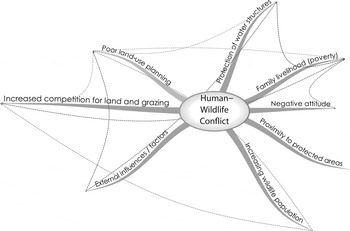
In the first stage of the workshop small groups developed mind maps centred on the concept of human–wildlife conflict. Each group was asked to draw a map of the factors leading to such conflicts as they had experienced them. Group 1 identified poor land-use planning, increased competition for land and grazing, external influences, proximity to protected areas, increasing wildlife populations, negative attitudes, family livelihoods (poverty) and inadequate management policies as factors contributing to human–wildlife conflict (Fig. 1, Supplementary Fig. S1). The group further identified variables that influenced the primary factors; for example, they identified fear of injury, negative impacts on livelihoods, disease, and lack of historical benefits as contributors to negative attitudes towards wildlife. Group 2 identified lack of understanding of systems, unequal costs and benefits, management decision making, land-use planning, culture and tradition, competition for resources, and increasing wildlife populations as factors contributing to human–wildlife conflict (Supplementary Fig. S2).
Simplified mind map of human–wildlife conflict in Namibia (Group 1; see Supplementary Fig. S1 for the full map). The dotted lines between the significant factors show the interconnections between them.
Group 3 identified compensation for losses, devolution of rights to manage wildlife, land-use practices, types of conflict, management to prevent losses, and government policy as the most significant factors contributing to human–wildlife conflict (Supplementary Fig. S3). The group then identified variables that contribute to each of the significant factors and then linked variables that appeared to influence more than one factor. In general, the groups did not identify similar significant factors contributing to human–wildlife conflict and, where the factors were the same, the influencing variables differed.
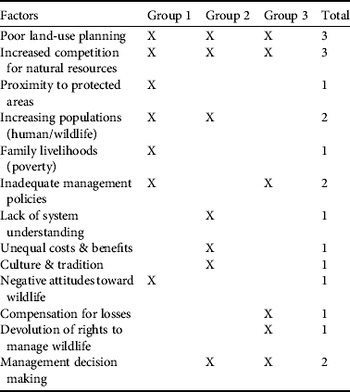
After the groups had presented their mind maps a vote was taken to decide the three most important factors in the prevention of human–wildlife conflict (Table 1). Participants voted that the three most significant factors were improved and participatory land-use planning, improved policies and wildlife management, and resilience and attitudes of community members.
Most significant factors identified as contributing to human–wildlife conflict in Namibia, as identified by three groups of workshop participants.
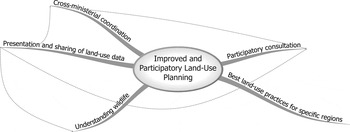
At this stage, these factors were not particularly well defined. Participants were therefore asked to develop mind maps for each of the three significant factors. Again, the mind maps were developed in small groups, and this time the participants organized themselves into groups based on their interests and backgrounds, to provide an expert focus on each factor. Group A focused on participatory land use and connected five main concepts to land-use planning: cross-ministerial coordination, participatory consultation, understanding wildlife, best land-use practices for specific regions, and presentation and sharing of land-use data (Fig. 2, Supplementary Fig. S4). For each factor, the group identified variables that influenced it. This mental model suggests that Group A viewed land-use planning based on the integration of five concepts as a factor in preventing human wildlife conflict. For example, the Ministry of Lands and Resettlement and the Ministry of Agriculture, Water and Forestry must coordinate with the Ministry of Environment and Tourism (which is the wildlife agency for Namibia) in making decisions about agricultural land uses, while incorporating knowledge about wildlife and engaging in participatory processes that are specific to a particular region. Group B created a mental map focused on improved policies and management of wildlife (Supplementary Fig. S5). This factor is influenced by four major concepts: conservancy management, central government management, wildlife policy and policy on compensation for damage caused by problem animals. Again, each of these concepts is associated with other concepts. For example, compensation is influenced by techniques such as self-insurance, trust funds and government compensation. Group C identified six major factors associated with enhancing livelihood resilience and community attitudes: understanding livelihoods, developing choices for alternative livelihoods, matching benefit distribution to livelihood needs, improving understanding of conservation values, preventing and mitigating effects of resource competition, and training and capacity building (Supplementary Fig. S6). The connections identified here reinforce the idea that conservation must be as much people-oriented as wildlife-centred if it is to engender and maintain social and political acceptance.
Simplified mind map of factors affecting land-use planning to reduce human–wildlife conflict (see Supplementary Fig. S4 for the full map). The dotted lines between the significant factors show the interconnections between them.
Discussion
The workshop demonstrated that mind mapping can identify the mental models of various actors and that the models can become a central theme for discussion. Although the mind-mapping process identifies how groups and individuals perceive the world it does not identify the relative importance of various components. The workshop did not include all potential actors involved in mitigation of human–wildlife conflict in Namibia, and the mind maps might have taken a different form, particularly with respect to identifying factors preventing conflicts from occurring, had there been a broader range of participants. This is a limitation of the workshop, not of the mind mapping process itself. Further research is needed to address these limitations. The mind maps show that human–wildlife conflict is a function of many factors and variables. They also suggest that action to reduce, prevent and mitigate human–wildlife conflict takes place on multiple fronts involving many different actors. This is an important finding because it identifies factors, including policy, that if appropriately considered could lead to a reduction in the number of incidents of conflict.
The results show that the participants held different mental models. Although many aspects were shared, others were not, suggesting the potential for tension and conflict in relation to policies and management approaches. This was demonstrated when the Namibian government released its human–wildlife conflict management policy the week following the workshop; controversy surrounded some important components of the policy, such as reductions in compensation for damage caused by wildlife.
The results of our workshop indicate that some participants saw conflict as a function of wildlife policies and management, the policy infrastructure guiding conservation in Namibia. The lack of an approved human–wildlife conflict management policy (at the time of the workshop) placed the costs of conflict on local residents, whereas many of the benefits of wildlife populations accrue to Namibian and even international citizens. This disassociation between costs and benefits serves as a barrier to developing locally determined compensation programmes.
The mind maps also reveal a perception that human–wildlife conflict is influenced by livelihoods because people are dependent on livestock, crops, infrastructure and freedom of mobility, all of which are threatened by human–wildlife conflict. In wildlife-rich regions human populations are often heavily dependent on subsistence agriculture and thus vulnerable to any disturbance factors. Thus, livelihoods may be perceived to be at risk from problem animals and this may result in human–human conflict. The importance of building resilience in the contexts of poverty and large increases in wildlife populations resulting from conservation cannot be underestimated. Several authors (Jackson & Wangchuk, Reference Jackson and Wangchuk2001; Treves et al., Reference Treves, Wallace, Naughton-Treves and Morales2006; Webber et al., Reference Webber, Hill and Reynolds2007; Treves et al., Reference Treves, Wallace and White2009) have noted the importance of community engagement in developing human–wildlife conflict management programmes. Our study reinforces this notion, and identifying mental models of all stakeholders is an important step in developing solutions that have broad acceptability. Human–wildlife conflict is a global issue that is expressed and experienced in local situations. These situations are generally complex, with a variety of actors engaged at different temporal and spatial scales to resolve conflict. In some regions both human and wildlife populations are vulnerable to change: humans living on or below the poverty line may view wildlife as competition, and populations of threatened species cannot afford losses from the culling of problem animals. The various stakeholders involved may have different understandings of conflict, resulting in additional debate and disagreement regarding proposed management techniques and policies. Understanding the mental models used by the different stakeholders seems to be an essential step in complex and poorly understood systems. These mental models could then be useful for constructing sustainable solutions directed more at policy than at specific conflict mitigation actions. Mind mapping is one technique that facilitates the portrayal of such mental models. Our study demonstrated that mind mapping can be done easily and effectively in a workshop, with the mind maps then becoming the focus of discourse rather than stakeholder positions. Mind maps could also reveal leverage points and relationships not otherwise considered in developing responses to human–wildlife conflict. Our results are specific to Namibia but it would be useful to see mind mapping exercises in different contexts and further test their usefulness. We believe that exposing mental models across settings in other countries will provide important information for finding effective solutions to the issues embedded in human–wildlife conflict.
Acknowledgements
We acknowledge the financial support of the University of Namibia and the University of Montana, which made this research collaboration possible. Valuable contributions were made during the workshop by members of the Namibian Association of Community Based Natural Resources Management Organisations, various conservancies and the Ministry of Environment and Tourism.
Biographical sketches
Alfons Mosimane's research focuses on sustaining collective action in the management of common pool resources, social-ecological systems, nature-based tourism and benefit sharing. For the past 10 years he has researched institutional development and governance systems in community-based natural resources management in Namibia. Stephen McCool has investigated people–environment relationships, particularly in national parks and other similar protected areas, for over 30 years. Perry Brown's research has focused on human dimensions of wildlife, protected area management and natural resource policy and planning. Jane Ingrebretson has over 25 years of experience as a wildlife biologist mapping out community plans for reducing human–wildlife conflict. Her research interests focus on mortality of grizzly bears from human causes, such as hunting, poaching and collisions with vehicles.



