




Introduction
In the 1990s, Uganda established a comprehensive system of political representation for disabled people, kick-starting proliferation of disabled people's organisations (DPOs) across the country. Ugandan disabled people consequently have extensive involvement in government, and the Ugandan example is considered a model for other countries (Zewale Reference Zewale2023). In Ugandan legislation, deaf people are treated as a subcategory of disabled people, equivalent to, for example, people with visual impairment.Footnote 1 However, previous research suggests deaf people do not always fit comfortably into Ugandan disability infrastructure (Lwanga-Ntale Reference Lwanga-Ntale2003:22). There are few deaf people among the political representatives of disabled people, and many DPOs have no deaf members. Linguistic exclusion is central to this issue. Beckmann (Reference Beckmann2020:180) argues the Ugandan disability movement fails deaf people because it disregards sign language's role in mediating collective identities. This article explores how visual communicationFootnote 2 practices in one Ugandan DPO relate to the varying forms of solidarity underlying deaf people's belonging, providing insights that are relevant far beyond the immediate setting.
I carried out research with a disabled women's organisation called Tusobora, based in Kicweka market, near Rubuga town, western Uganda.Footnote 3 Tusobora was unusual because, while most members were hearing, several deaf people took prominent roles within the group. In this article, I argue the inclusion of deaf people in Tusobora arose from a collective competence for visual communication developed over time in the market, where the group's core members ran small retail stalls. Despite the unusual visual communication possibilities in this setting, tensions existed about flows of information, with deaf members sometimes accusing hearing members of concealing opportunities from them.
In 2019, I attended a meeting of the Rubuga District Deaf Association (henceforth, ‘the Association’), held in a beer shelter in the market belonging to Lidia, a deaf woman who was a leader in the Association and a core member of Tusobora. Towards the end of the meeting Lidia suggested members should start saving money with the Association weekly, to invest in their businesses and ‘develop’ the deaf community. She signed:

This question perplexed me because many members of the Association already attended a ‘mixed’ weekly savings group run by members of Tusobora, held a few metres away in another beer shelter. Of the sixty members of this savings group, called Tukolengane, thirteen were disabled people, including seven who were deaf. This made deaf people a majority among ‘disabled’ members, in a group that was conceptually centred on a DPO and publicly identified with disability. Lidia herself was Secretary of Tukolengane and regularly encouraged other deaf people to join. Why, then, would she so emphatically claim ‘mixing’ was bad, and why would she want a deaf-only savings group?
In this article, I employ two theoretical approaches to parse deaf marketgoers’ communication, revealing the complex terrain of linguistically mediated experiences of belonging that provided the context for Lidia's comment. The first is Silverstein's distinction between language and speech communities. The term speech communities, coined by Bloomfield (Reference Bloomfield1933) and revised by Gumperz (Reference Gumperz and Duranti1968/2009) and Hymes (Reference Hymes, Gumperz and Hymes1972), evidently originates in an oralist view of human communication (see Nonaka Reference Nonaka2014:54–55). Nevertheless, it has been extensively used, although with criticism, in studies of ‘shared signing communities’, which are places in which deaf and hearing people regularly communicate in signed languages (Senghas & Monaghan Reference Senghas and Monaghan2002:76; Kisch Reference Kisch2008:285, 309; Nonaka Reference Nonaka2014:54–55).Footnote 5 Like earlier authors, I use this terminology to draw attention to how visual communication mediates community belonging for deaf people in Kicweka.
Silverstein (Reference Silverstein1998:407) distinguishes between language communities (‘reflexively self-aware groups of speakers’, normatively oriented to a specific Language; Büscher, D'Hondt, & Meeuwis Reference Büscher, D'Hondt and Meeuwis2013:542) and speech communities (a more general term referring to ‘regularities of discursive interaction in a group or population’, often involving multiple languages). I find this formulation particularly helpful because it emphasises that, while linguistic communities can involve the reflexive construction of a normative orientation to a specific language, those that do not include this feature (speech communities, in his terminology—although I adopt Nonaka's term speech/sign communities in its place to avoid the oralist bias of the original) nevertheless constitute linguistically mediated communities. The distinction also illuminates key features of the difference between the communicative spaces in Kicweka market, and their relationship to each other as overlapping ‘dialectically constituted cultural forms’ (Silverstein Reference Silverstein1998:401).
Deaf marketgoers engaged in a ‘reflexively self-aware’ language community proper in the Deaf Association, oriented specifically to Ugandan Sign Language (UgSL), and in the market's less normatively standardised speech/sign community, which featured the ‘collective competence for visual communication’ I noted earlier as a distinctive pattern within its plurilingual milieu. In other words, a specific language—UgSL—was made conceptually central to the relationships established in the Association, while in the market, relationships were still based on communicative exchange, but participants’ interpretations of them did not centre the linguistic modalities involved. These different modes of ‘community formation… intersect[ed] in intricate and unpredictable ways’ (Büscher et al. Reference Büscher, D'Hondt and Meeuwis2013:542) in the market, producing complex positions including Lidia's vacillation about deaf people's place in disability-focused organisations.
Second, I bring in ‘deaf space’, a term denoting spaces oriented to deaf communicative practices, which enable deaf sociality. Deaf space has been defined in two main ways: as deaf-friendly ‘safe spaces’ where sign language is unremarkable and widely understood (Lee Reference Lee2012), or, more specifically, as spaces of deaf-deaf sociality centring deaf experience and shared embodiment, often facilitating identity-formation on these bases (Gulliver Reference Gulliver2009; Bauman Reference Bauman, Bauman and Murray2014; Kusters Reference Kusters2015). The ‘safe space’ approach to deaf space has been criticised for ignoring the role of privilege and obscuring experiences of unsafeness within apparently ‘safe’ spaces (Player Reference Player2020; Ghani Reference Ghani2022). I therefore do not use it. For clarity, I reserve the term deaf space for spaces meeting the more precise definition, centring deaf-deaf communication and deaf embodiment. For spaces in which sign language is widely used and understood, including by hearing people, I adopt Kusters’ term ‘deaf-hearing visual communication space’ (Kusters Reference Kusters2015:20–21).
Deaf space approaches enable me to expand on Silverstein's speech/sign and language communities by foregrounding the role spatiotemporal characteristics of speech/sign and language communities play in creating different linguistic possibilities. One strand of deaf space literature emphasises temporary co-option of spaces not normally oriented to deaf communicative needs, such as the ‘Deaf city’ created during the 2001 ‘Deaflympics’ (Breivik, Haualand, & Solvang Reference Breivik, Haualand and Solvang2002; see also Kusters Reference Kusters2017a). Similarly, the deaf space created by the Rubuga Deaf Association was spatially and temporally limited: meetings were irregular, never longer than a few hours, and the space reorganised to facilitate deaf communication during them was small.
Understanding this feature requires attention to the mechanisms of solidarity underlying the collective. Deaf space is based on shared deaf embodiment, usually between people who do not live together (most deaf people in Uganda are born into hearing families; Lule & Wallin Reference Lule and Wallin2010:117). The resulting collective therefore emerges at specific times and places when deaf people intentionally gather; it is spatially discrete and temporally discontinuous. By contrast, the ‘deaf-hearing visual communication space’ in Kicweka market, in which both deaf and hearing people had developed visual communicative competence, existed on an everyday basis over a larger (though still demarcated) space. It did not centre deaf embodiment or deaf community, as Deaf Association meetings did. Instead, its ‘everyday’-ness fostered solidarities of a different form, based on long-term co-residence and familiarity between deaf and hearing people, which were understood to create mutual obligation.
Linking spatiotemporal characteristics to solidarities of different kinds is a key innovation facilitating insight into forms of visual communication and their role in deaf people's lives. Additionally, although deaf space approaches are specific to deaf embodiment and communication, I suggest analyses of how differing forms of solidarity underly the spatiotemporal characteristics of language collectives could prove fruitful for understanding how other minoritised language communities articulate linguistic collectives, especially where language ideologies emphasise patterns of embodiment (for example, see Goodwin & Goodwin Reference Goodwin, Goodwin and Duranti2004:238).
I investigate the potentialities of diverging forms of visual communicative competence in the market, and how my deaf interlocutors used them. I find they distinguished deaf spaces based on shared embodiment from ‘deaf-hearing visual communication space’, but nevertheless valued and engaged with both (Kusters Reference Kusters2015:20–22 concludes similarly from research in Ghana). They used the two types of visual communication space for different purposes, and both were essential to their sociality and livelihoods. The unusual presence of both types of visual communication community in Kicweka market distinguished it from the rest of the town, where Beckmann's contention that development of collective identity through sign language has been neglected by the Ugandan disability movement held true, and deaf people were significantly more marginalised (Beckmann Reference Beckmann2020:180; Modern Reference Modern2021:138–141).
In what follows, I first explain the research context, describing the infrastructure of Uganda's ‘disability movement’ and Tusobora's history, including how visual communication competence developed among its members. I then give an account of my methodology. Subsequently, I describe the use of visual communication in three settings within the market: the stalls belonging to deaf and hearing Tusobora members; meetings of Tukolengane, the savings group run by Tusobora members; and a meeting of the Deaf Association. In the discussion, I set out how these different spaces and their associated forms of linguistic community interact with each other. The conclusion reflects on what this analysis tells us about deaf space and the relationship between speech/sign communities and language communities for deaf people in Kicweka.
Background
Disability infrastructure in Uganda
In 1995, President Museveni's NRM government introduced a new constitution, which allocated reserved places in Parliament to women, youth, and disabled people, calling each a ‘special interest group’. Legislation introduced in 1997 extended this to local councils. Representatives of disabled people were to be elected through a complicated electoral college system based on local branches of the National Union of Disabled People of Uganda (NUDIPU) and registered disabled voters. The Persons with Disabilities Act (first introduced in 2006) defines ‘disability’ as ‘a substantial functional limitation of a person's daily life activities caused by physical, mental or sensory impairment and environment barriers, resulting in limited participation in society on equal basis with others’ (Parliament of the Republic of Uganda 2019:Section I.1.(1), Schedule 3), hence including deaf people within the new infrastructure.
The main practical benefit available to disabled people during my fieldwork was the Special Grant, which provided funding to set up or expand individual small businesses. Other programmes also focused on entrepreneurship made up all government and NGO initiatives targeted specifically at disabled people in Rubuga, though some delivered loans instead of grants; almost no other types of assistance were available. To qualify for the programmes, groups of disabled people had to incorporate and register with the government as community-based organisations (CBOs). Because the special grant was small, but an organisation could officially only apply once, a striking duplication of CBOs resulted, as disabled people tried to find new ways to access resources. Disabled and deaf sociality in Uganda have been described as NGO-centric (Mugeere, Atekyereza, Kirumira, & Hojer Reference Mugeere, Atekyereza, Kirumira and Hojer2015:5). In Kicweka, however, deaf and disabled people interacted most with local CBOs like Tusobora, not national or international NGOs.
Tusobora in context
Tusobora coalesced from a number of wheelchair-using women who participated in an adult literacy class in the 1990s. After the end of the course, a local civil servant suggested they register as a CBO to access the Special Grant, and the core members moved into Kicweka market to establish or expand small businesses. There they met Lidia, the deaf woman introduced earlier, who was already running a stall in the section of the market Tusobora members settled in. Lidia and several other members had attended a school for disabled children that included a form of institution-specific Signed English in teaching (see Søgaard Andersen Reference Søgaard Andersen, Englund and Nyamnjoh2004), although she had not been in the same class as any founding members. Both parties therefore knew some signs, although the former students told me they found the sign system hard to follow, so this knowledge was basic. Lidia, who had become deaf after learning to speak, could also communicate effectively using spoken Runyoro and speechreading.Footnote 6 She soon joined Tusobora.
Shortly afterwards, the Uganda National Association of the Deaf (UNAD) organised a three-month UgSL course in Rubuga. Most deaf people in provincial areas of Uganda had not yet encountered UgSL, which developed in deaf schools in the 1960s–1980s but only became codified following its recognition in the 1995 Constitution (Lutalo-Kiingi Reference Lutalo-Kiingi2014:32). UNAD's course in Rubuga therefore sought to train deaf people in UgSL, as well as their hearing relatives and friends (Lutalo-Kiingi, Buyinza, De Clerck, & Turner Reference Lutalo-Kiingi, Buyinza, De Clerck, Turner, Stone, Adam, de Quadros and Rathmann2022:para. 17). The course facilitated deeper connections between Tusobora members and other deaf people. Lidia invited some younger deaf women, who primarily used sign language and did not speak, to assist on her market stall, and some also joined Tusobora. Due to the presence of this core of signers in the market, hearing Tusobora members were continually exposed to signing after the course, and, by the time I carried out fieldwork, several had become highly competent.
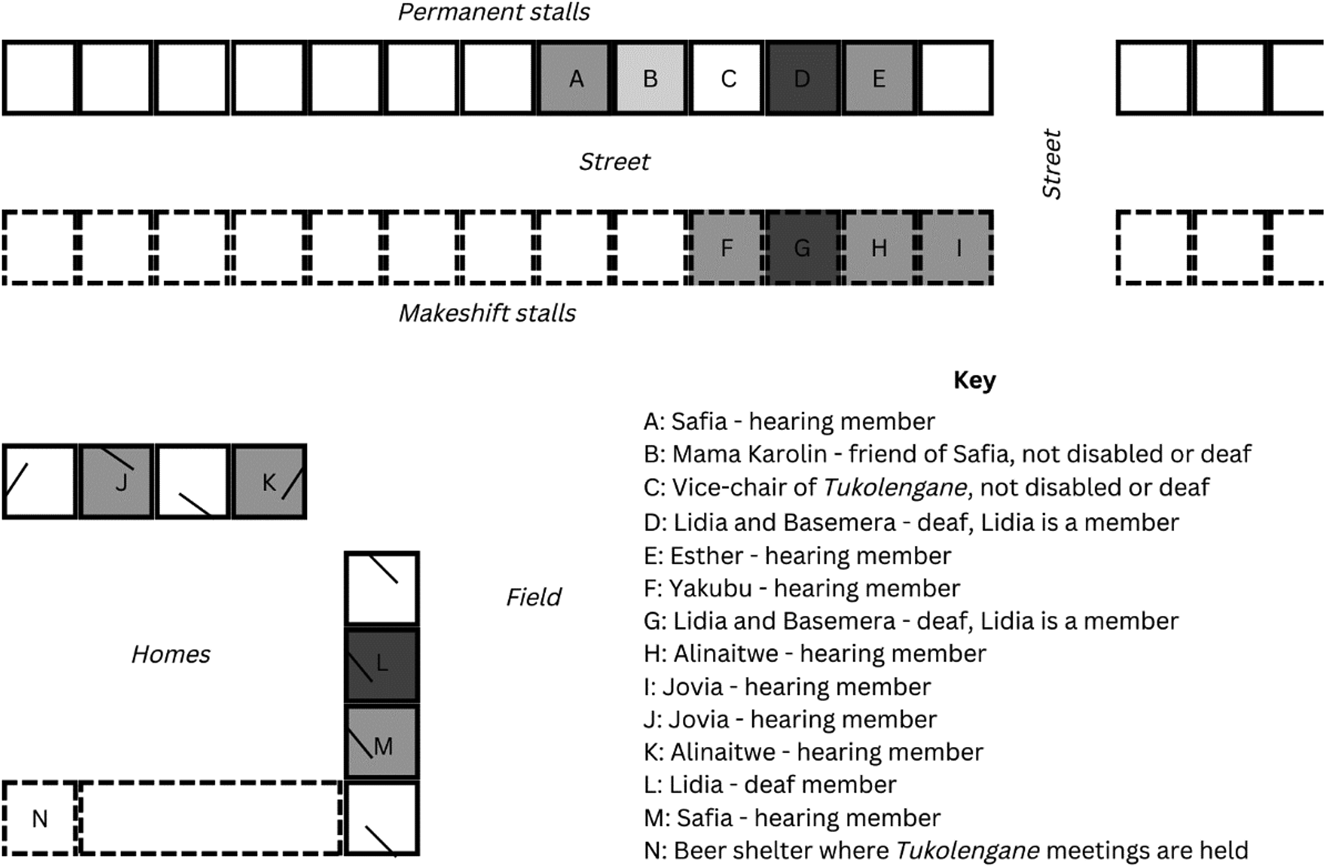
Spatial arrangements in Kicweka market were crucial to this developing capacity. Figure 1 shows the section of the market Tusobora occupied. Homes and stalls rented by Tusobora members are shaded and labelled, showing that they cluster in two areas. Members constantly communicated throughout the day, utilising spoken Runyoro, signed UgSL, and loosely conventionalised multimodal linguistic experimentation. Many participants frequently used words and signs at the same time.
Spatial layout of Tusobora's section of Kicweka market.

The bottom left of the diagram shows an area of low-cost housing comprising eight one-room dwellings arranged in two buildings around a central courtyard. A third side of the courtyard is lined by wooden sheds. Eight families lived here, four of which were headed by Tusobora members. Three of these Tusobora members were hearing wheelchair users; the fourth was Lidia, who was deaf.
The top of the diagram shows one of the main streets of the market. One side of the street was lined with brick lockups. During the day, each lock-up had wooden tables set up outside displaying goods. On the other side of the street was a row of improvised wooden shelters. During the day, stalls were set up within and in front of each shelter. Some were used to serve locally brewed beer (including Lidia's), featuring an oil-drum in the centre surrounded by benches for patrons. Tusobora members’ stalls occupied a short stretch within the two rows with easy sightlines between them, which facilitated visual communication. Many members were neighbours, while a few unrelated people (represented in the diagram by unmarked stalls) were scattered in between.
Sociolinguistic differences in deaf communication
Important sociolinguistic differences derive from variations in deaf people's semiotic resources, which include visual and spoken languages, literacies, gesture, and drawing, and how they relate to the collective ‘semiotic repertoires’ of their interactive social and material environments (Kusters Reference Kusters2021:185–86; Moriarty & Kusters Reference Moriarty and Kusters2021). Pedagogical material from a Uganda National Association of the Deaf (UNAD) course in UgSL I attended in 2017 taught that there are four types of deafness: (i) Congenital—being born deaf; (ii) Pre-lingual—being born hearing but becoming deaf before fully learning spoken language; (iii) Post-lingual—being born hearing but becoming deaf after acquiring spoken language; and (iv) Hard of hearing. UNAD taught that most people in the first two categories cannot use spoken language, but some in the latter two do, sometimes alongside UgSL.
These categories, based on when a person became deaf, are not the only determiners of semiotic resources—unequal education levels and access to deaf communities and signed language also affect them (De Meulder, Kusters, Moriarty, & Murray Reference De Meulder, Kusters, Moriarty and Murray2019:4)—however, they are consequential. Deaf people who spent time in Kicweka market came from all categories. Lidia had become deaf after learning to speak Runyoro; most of her assistants had been born deaf or become deaf before acquiring spoken language. As a result, they had different preferred communication methods, which impacted relationship-building with both deaf and hearing people.
Methodology
The data presented in this article derive from eighteen months of fieldwork with Tusobora from 2017 to 2019, aimed at understanding how Uganda's unique disability infrastructure affected disabled people's lives. I lived next door to a hearing member of Tusobora, spending most days conducting participant observation and interviews in the market and other locations connected with Tusobora members, including nearby villages, local council offices, and NGO-organised events. I conducted 136 semi-structured interviews in English, UgSL, and Runyoro. Primarily, these were (i) life history interviews with deaf and disabled members and non-members of Tusobora, aimed at eliciting memories of connection and disconnection to disability infrastructure, and (ii) interviews with officials to understand disability-related infrastructure.
As a female, White, British-Irish, hearing researcher living with a long-term health condition, my complex positionality affected data collection. Given a context deeply marked by coloniality, my Whiteness loaned me unearned official status in formal settings and created problematic hierarchies with participants (Modern Reference Modern2021:47, 161). My gender enabled access to intimate female spaces, however, it also prevented access to other deaf spaces in Rubuga, particularly those dominated by young deaf men. This article therefore does not give a full account of deaf space in Rubuga; rather, it analyses interactions between different spatially-linked modes of visual communication in the lives of deaf market women in Kicweka.
I was introduced to Tusobora by a disabled Ugandan colleague in 2013. As a member of a DPO in my home country, the UK, I presented myself to them as a disabled person. Among group members, disability status has become the basis for kinship-like bonds. This process draws on a regional history of incorporation of non-related people into kinship groups, through expansion of the kinship term waitu ‘our person’ among those who share social space over long periods (Doyle Reference Doyle2006:467–68; Modern Reference Modern2021:182–86, 193–94). However, while some members concurred with my self-presentation as disabled, many did not think people living with chronic illness fell within the category ‘disability’. This gave me an ambiguous status—incorporated either via disability or through long-term social interaction—which may have helped me navigate between Tusobora's subgroups, including between deaf and hearing people.
Deaf members told me, the ambiguous insider-outsider, more about divisions and suspicions between themselves and hearing members than they did hearing members of the group. Nevertheless, as a hearing person, I had limited sensory access to deaf participants’ experiences and a relatively shallow history using visual communication. I studied UgSL and the local spoken language, Runyoro, for nine months before fieldwork, including attending the three-month UNAD course Tusobora members had completed years earlier. Towards the end of fieldwork, I spent three months of concentrated research with Kicweka's deaf inhabitants and in deaf gathering spaces, including Lidia's market stall and weekly meetings of the savings group Tukolengane. I also attended and video-recorded the only meeting of the Rubuga Deaf Association that took place while I was in Rubuga.
I did not become fully fluent in UgSL but could easily converse and understand everyday conversations. Lidia and I routinely used Runyoro and co-speech signing concurrently. For some difficult sign language interactions, I recruited deaf interpreters from outside the field site. Betty Najjemba helped interview a deaf participant who did not use UgSL (or any formal sign language) or speech. Nasser Ssenyondo translated video of the Deaf Association meeting into English and discussed interpretation of complex utterances with me. All English glosses were written by me, after reviewing video and Ssenyondo's translation.
Deaf communication in Kicweka market
In this section, I introduce the first of my three examples of communicative settings, describing how visual communication operated on stalls in Kicweka market. Deaf stallholders were skilled in multimodal communication, in which different channels of communication (including gesture, pantomime, mouthing, and writing) are ‘chained’ into communicative projects between deaf and hearing people (Green Reference Green2017; Kusters Reference Kusters2017b). They commonly pointed, picked up and moved objects, used conventionalised gestures (particularly for numbers), wrote on their skin or the ground, and, in some cases, spoke or mouthed, as they served customers. Crasborn & Hiddinga (Reference Crasborn, Hiddinga, Friedner and Kusters2015) suggest ability to communicate across modal language barriers is common in deaf people, produced through deaf experience as a linguistic minority in a hearing world. Kusters (Reference Kusters2017b:284) argues multilingual markets are ideal places for multimodal communication because hearing people communicating across language barriers also ‘chain’ different channels including gesture and writing. Given this context, most of the time deaf stallholders and their customers successfully communicated directly using these techniques.
However, not all market interactions occurred this way. While most customers attempted the techniques deaf stallholders demonstrated, sometimes they failed to understand or refused to try. When this happened, deaf stallholders called on other Tusobora members to interpret (always in an unpaid, informal capacity). Three members usually took this role: Safia and Esther, the most fluent hearing signers, and, most frequently of all, Lidia, who was deaf but spoke and speechread Runyoro. Although Lidia usually engaged in market-based interpretation as the interpreter, acting for other deaf people who did not use speech, very intransigent customers caused her to ask Safia or Esther to help. Other Tusobora members and friends with less developed signing also sometimes interpreted.
The following example involves Basemera, a young deaf woman who primarily used sign, who worked as Lidia's assistant. She sold skirts from a section of Lidia's beer shelter, across the lane from the main Tusobora stalls, and assisted on Lidia's main stall (G and D in Figure 1). A customer approached Basemera's stall and tried on two skirts. She asked the price, first by speaking and, when she wasn't understood, by pointing. She easily recognised Basemera's closed-fist gesture to mean ‘5,000 shillings’ (the closed fist, meaning ‘5’, is used by Ugandan hearing people in noisy situations). The customer verbally requested a reduction, and Basemera, understanding from the conventional pattern of the conversation, shook her head. The customer turned to Lidia, who was resting in the beer shelter, and repeated her question. Lidia replied, speaking, that the skirts belonged to Basemera and she had refused, but when the customer realised Lidia was deaf (from the sound of her voice) she stopped listening, looking around for someone else to help. She saw Mama Karolin across the lane and walked over, gesturing that she would return.
Mama Karolin was a close friend to several Tusobora members and operated a stall located between Safia's and Lidia's (marked B in Figure 1), which meant she was continually exposed to visual communication. After a few words, Mama Karolin called Basemera. She repeated the request, pointing to one skirt then the other and gradually moving her right hand downwards to indicate a reduction. Basemera shook her head again and signed ‘profit none’. ‘profit’ is signed by tapping a ‘k’ handshape on the lower right-hand side of the stomach (see Figure 2), and ‘none’ by sweeping two ‘0’ handshapes outwards from the centre of the body.
Ssenyondo Nasser demonstrates the ‘k’ handshape and ‘profit’ sign in UgSL. (Note: When performed upside down, as it is in the ‘profit’ sign, the ‘k’ handshape is very similar to, and often confused with, the letter ‘p’ in the UgSL alphabet; Sam Lutalo-Kiingi, p.c.).

‘profit’ is potentially intelligible to non-signing people despite the unfamiliar handshape, because the area tapped is where women keep money tied in their clothing (the sign therefore makes use of spatial ‘representational techniques’ available to sign languages; Green Reference Green2017:338). Mama Karolin tapped her hand on the same area, then signed ‘money’ (a common gesture among hearing people) with a questioning expression. When Basemera nodded, she told the customer Basemera could not give a discount because she bought the skirts at a high price and there would be no profit.
When I asked them to describe their communication with customers to me, deaf stallholders used the sign phrase ‘try+’ (see Figure 3), made by twice repeating the verb ‘try’. Iteration is a common strategy for verb plurality in UgSL, used to convey ongoing or continuous action or high intensity (Lutalo-Kiingi Reference Lutalo-Kiingi2014:133). ‘try+’ invokes repetition and experimentation, a commitment to repeating communicative attempts until understanding is achieved (see also Kusters Reference Kusters2017b:293–94). Discussing ‘direct communication’ (i.e. without an interpreter) between deaf people who use different signed languages, Green (Reference Green2014:454–55, Reference Green, Friedner and Kusters2015:72) argues ‘difficult sign interactions’ involve ‘heightened relationships’ that constitute a ‘moral orientation’, necessitating ‘turning towards’ the other person. For ‘try+’ to work, the deaf person needed their conversation partner to commit to co-creating meaning. When this orientation is not forthcoming, deaf people are thereby rendered ‘unintelligible’ (Green Reference Green2022:24, 32). In my example, the customer did not accept this task, shifting it onto Mama Karolin. Mama Karolin had learned some basic signs because of the location of her stall and her relationship with Tusobora members, but, more importantly, she understood the expressive capacities of visual language and believed communication with her deaf neighbours was feasible.
Ssenyondo Nasser demonstrates the ‘try+’ sign phrase.

Where direct engagement between deaf stallholder and customer was not possible, friends and neighbours with experience of visual communication—including those not using formal UgSL—were crucial. Between Basemera and Mama Karolin, informal interpretation happened through the modality of ‘try+’, because the customer rejected the (more effective) deaf interpreter, Lidia. However, even when the interpreter did know UgSL, for example when Safia, Esther, or Lidia were interpreting, interpretation events in the market mirrored the back-and-forth ad-hoc experimentation typical of ‘try+’. The style resembled Forestal's (Reference Forestal, Adam, Stone, Collins and Metzger2014:40) ‘community interpreting’, a mode developed by deaf interpreters, which stresses ‘the importance of interactive dialogues and rapport with all parties, especially Deaf consumers’. Interpretation by Tusobora members in the market was conversational, often including questions between interpreter and deaf stallholder, or asides and comments that were not communicated to the customer. It happened as part of a flow of social life, based on shared experience and knowledge.
Tukolengane, Tusobora's Community Savings and Loan Association
By contrast, communication in my second communicative setting, the weekly meetings of the Community Savings and Loan Association (SLA) Tukolengane, occurred within a more formal organisational structure, which placed constraints on interactive modes of communication. While Tukolengane meetings usually felt relaxed from the point of view of general members, for the group's officers things were different. They faced intense pressure to get through high volumes of transactions accurately, while holding the attention of busy participants. The formal meeting format and its requirements therefore set this space aside from the relaxed everyday multimodal communication of the market.
Introducing Tukolengane
Tukolengane meetings were held in a beer shelter belonging to a non-disabled neighbour of several DWG members, labelled N in Figure 1. SLAs were common in Kicweka and vital to the financial affairs of its people. The micro-businesses typical in the market could not run without SLA loans, which facilitated bulk purchasing of stock and major expenditures like school fees. It was therefore crucial for deaf stallholders to access them, and Tukolengane had been set up with safeguards in its processes to ensure deaf people could access it, discussed below. Tukolengane meetings also functioned as deaf gathering spaces and were valued by deaf participants for the opportunity to interact with each other, as well as for engaging with hearing members in a setting where (unpaid informal) interpretation was available through hearing Tusobora signers. Deaf people, especially women, often gathered at Lidia's stall after the end of the meeting, chatting in UgSL.
Tukolengane meetings were nearly identical to the hundreds of other SLA meetings occurring in Kicweka weekly; they used the same technology, including individual savings booklets for each member and large counter books where all transactions were recorded. This paperwork and the money collected were kept in a locked box that could only be opened when three ‘keyholders’, all trusted group members, were present. The group used standard categories of payment prevalent across Kicweka, taking savings in increments of 2,000 shillings up to a maximum of 10,000 per week (approximately 40p to £2 in 2019), and requiring small weekly payments for a ‘welfare’ fund. Loans were either interest bearing business loans drawing on the main savings fund, usually given in hundreds of thousands of shillings, or smaller interest-free ‘welfare loans’ intended as a short-term emergency facility for members facing specific problems, such as a family funeral.
Tukolengane meetings were usually quiet, with members sitting in a rough circle focused on the officials consulting the books and collecting money. Progress was narrated by the person holding the active book, who announced stages of the meeting, amounts of money, and called individual members to contribute. Most members were seated too far from the books to follow by reading, so instead relied on this spoken guide. However, for deaf people it was inaccessible. There was no simultaneous interpretation of the spoken narrative (nor was it ever requested), but most major transition points were indicated in UgSL, with some problematic exceptions, discussed below. Deaf members regularly asked questions and had them answered in UgSL. Fluent signers were, however, few, and only two hearing members could be relied upon to fully understand and be able to answer questions in UgSL.
Deaf members persisted in this group because the informal interpretation system operated through hearing Tusobora members, despite its limitations, was better than anything available in other SLAs, and because deaf inclusion within the expected ‘users’ of the group's services had prompted changes in format which contributed to ‘collective access’ (Hamraie Reference Hamraie2013). The most important format change involved how members requested loans. As Secretary, Lidia maintained two lists: one for members wanting business loans and another for the smaller welfare loans. Each week, at any point during the meeting, members could approach her and add their name, which Lidia wrote at the bottom of the appropriate list, ‘booking’ a future opportunity to borrow.
The ‘booking’ system was common among SLAs as a tool for transparency, because additions to the list could only be made in the public meeting when the key holders had opened the group's lock box. However, it was usually applied to the larger business loans only. Tukolengane extended it to welfare loans because it had additional importance for deaf members: it put the timing of requests for loans in their control, because they could add their name any time, rather than only when the officers had announced the relevant meeting stage. Deaf members therefore did not have to gauge the right moment to engage with a group process governed by verbal announcements and dominated by hearing people. However, deaf inclusion remained relative and variable. At moments when it did not work, explosive interactions revealed ongoing divisions between deaf and hearing members, as well as patterns of relative disadvantage related to differences between individual deaf people's access to the meeting's semiotic repertoire, which led to diverging modes of participating.
Three of the seven deaf members acted as a corporate group-within-a-group, sitting and conversing together throughout the meetings. These people—Tusobora member Hadija, her husband, and a young man named Namutebi—were either deaf from birth or became deaf before acquiring spoken language; they primarily used UgSL. As well as operating as a sub-group in Tukolengane, they were core members of Rubuga's Deaf Association, along with Lidia. Lidia was fluent in UgSL and Runyoro, and comfortable in the sociolinguistic communities associated with both (this was unusual among deaf people in Kicweka who used speech). As an officer, Lidia sat at the central table, while the three deaf members who primarily used UgSL sat in another section of the beer shelter; however, she frequently interacted with them in UgSL. She was critical to the integration of UgSL-using members because she bridged between deaf and hearing groups.
The other three deaf members of Tukolengane did not sit with the group of three UgSL-users either, because the semiotic resources they had access to were again different. They included Basemera, who was new to Kicweka and only learning UgSL, and two older women who had become deaf later in life, who preferentially used speech and speechreading, although with less ease and accuracy than Lidia. By contrast to the thick connections between UgSL-using deaf people, deaf people who relied on speech alone were excluded from deaf sociality within the group. They found it even more difficult than the other deaf members to understand meeting progress.
Debating linguistic inclusion in Tukolengane
During one meeting, the welfare loans stage had almost concluded when Lidia loudly claimed the other officials basorooriire abadeaf ‘have discriminated against deaf people’ by leaving them until last. The vice-chair had started the welfare loans stage by calling oh'akwenda welfare? ‘who wants a welfare loan?’, rather than following the ‘booking list’, as expected. Available credit had been divided among those who responded, without referring to the list. No-one had interpreted the vice-chair's question into UgSL. Two deaf members were at the top of the list and should have been allocated funding first. They did not realise the usual system was not being followed until Lidia intervened.
The deaf members did receive their loans after Lidia's complaint, and she told me she thought the proper systems would be followed in the future because her complaints had made the other officers ‘afraid’. In the following week's meeting, increased effort to ensure deaf members were not excluded was evident. When the welfare loans section started, the chair signed this information, first waving to get the attention of deaf participants, and another hearing Tusobora member repeatedly called aloud the names of the deaf members who indicated that they were at the top of the list until they had received their money. Through these everyday acts of attempted inclusion, hearing disabled members obviously considered deaf people a core part of Tukolengane's membership and purpose.
Nevertheless, deaf inclusion in Tukolengane cycled between intensified improvement and subsequent neglect. Moments when it seemed deaf members might miss out arose in three of the eleven meetings I attended. Lidia was crucial for resolving these problems: as a speaking deaf person she was more able to influence the flow of the meeting than those using signing alone. Her shout cut across hearing members’ attention, mobilising the ‘sonorous, material, and affective qualities’ (Weidman Reference Weidman2014:42–46) of the voice, which tapped into sedimented embodied structures of feeling and elicited affective responses (the ‘fear’ she claimed other officers felt). Most hearing members, meanwhile, had less experience with the aesthetics of anger expressed through signing, so their emotional responses to angry signing—which was also produced at these difficult moments—were less intense.
Consequently, deaf people's relationships to Tukolengane were not homogenous. Lidia, with evident pride in her influence over Tukolengane, encouraged other deaf people to join, seeing it as a place they could co-shape alongside Tusobora members. However, even she became frustrated when accessibility was at its lowest ebb, as could be seen when she proposed a deaf-only savings group during the Deaf Association meeting (which took place just a week after the Tukolengane meeting in which she complained about discrimination against deaf people). Her suggestion of this deaf-only group, while also championing deaf people's participation in the mixed group, exemplified her ambivalent relationship with the category ‘disabled people’. Disability organisations had enabled improvements in her life, but the linguistic specificity of deaf people's access needs was not fully accommodated, even in spaces that prioritised disability inclusion.
In the next section, I introduce the Rubuga Deaf Association meeting, my final example of a deaf communicative setting. I show how this space's reflexive orientation towards using UgSL enabled development of a form of solidarity between UgSL-using deaf people that articulated with, but did not erase, Lidia's unstable belonging within disability infrastructure.
Rubuga Deaf Association
In February 2019, the Rubuga Deaf Association met in Lidia's beer shelter in Kicweka market (labelled G in Figure 1). The meeting was the first for a long while, following an extended period of division among deaf people, which had split the community, largely along gender lines (see also Lee Reference Lee2012:183; Beckmann Reference Beckmann2020:153). Lidia and Namutebi, a leader among Rubuga's young deaf men, had recently reconciled and wanted to bring the association back together to hold elections, which were long overdue. Partly because of this background, participants at the meeting expressed a strongly normative discourse of ‘unity’ (see Figure 4) aimed at achieving ‘deaf development’. ‘unity’ was contrasted to acting ‘one one’ (individualistically) and explicitly associated with men and women working together. These calls for ‘unity’ were partially a calculated response to state and NGO expectations. As Lidia explained, elections were essential because when officials seek recipients for a project, they look for people who can guarantee them access to a defined population: index-loc-distant support want leader+ deaf ‘donors want there to be leaders of the deaf’. To access the opportunities of the disability movement, the ‘deaf community’ had to be united, at least enough to elect a representative to act as broker between ‘community’ and state.
Ssenyondo Nasser demonstrates the UgSL sign ‘unity’.

However, ‘unity’ was not only something Association members felt obliged to create. It was also understood to be positive and natural, a state unfortunately interrupted by the ‘disappointing’ period of conflict. After a particularly heated exchange, Namutebi expressed his frustration:

After this statement, he pointed at himself, then slowly around the group, then at his ear with a questioning expression. Following this, he mimed speaking, exaggeratedly flapping his mouth, and ended by pointing around the group again with a questioning expression. This was a rhetorical device, asking if anyone present was hearing or used speech, and fully expecting the answer he received: a decisive collective ‘no’.
Namutebi's ‘deaf one’ was a normative claim, mobilising the shared embodiment of deaf people (physically geared towards visual communication (see Bahan Reference Bahan and Bauman2008), opposed to the flapping mouth of speakers) in a ‘cultural project of groupness’ (Silverstein Reference Silverstein1998:405) that asserted obligation to act as a group (see also Green Reference Green2014:456, Reference Green, Friedner and Kusters2015:76 and Moriarty & Kusters Reference Moriarty and Kusters2021 on ‘deaf-same’). The statement was rooted in the phenomenology of being deaf in a majority hearing world. Visual language thoroughly shaped the Association. The space was arranged to maximise ease of visual communication, with participants sitting on benches along each side of the shelter, forming a rough square (see also Kusters Reference Kusters2015:88–89; Friedner Reference Friedner2016:191). The central barrel that was usually present had been removed, so everyone had good sightlines to everyone else. Sign language was used exclusively, with most utterances in near-standard UgSL.
Lüpke (Reference Lüpke2016:25–27) argues speakers in multilingual environments mobilise appropriate (ethno)linguistic identifications through producing linguistic details that ‘focalise particular aspects of identity’; Cobbinah, Hantgan, Lüpke, & Watson (Reference Cobbinah, Hantgan, Lüpke, Watson and Auzeanneau2016:90–92) describe these as ‘prototypes’: ‘conceptual cores’ of linguistic identities that otherwise distinctly overlap (see also Büscher et al. Reference Büscher, D'Hondt and Meeuwis2013 on indexicalities). Lidia's linguistic choices during the meeting highlighted the importance of UgSL to the group: whereas in everyday life, Lidia frequently used speech, with co-speech signing when other deaf people were present, during the meeting she only used UgSL. In addition, while her co-speech signing usually prioritised the lexical ordering of Runyoro over that of UgSL (despite utilising some other elements of UgSL grammar), during the meeting her signing employed UgSL lexical ordering, diverging from Runyoro. The concepts she used, especially her negative invocation of ‘mix’ and promotion of deaf ‘unity’, were also distinct from the language she used elsewhere, working as ‘prototypes’ to signal her membership of the deaf group. Nevertheless, she did not change her communication practices or modes of association elsewhere.
The exclusive use of UgSL led to unequal participation in the meeting, with those fluent in the language dominating. This meant those with more education, including Namutebi, who had studied in Kampala (Murangira Reference Murangira2022:470 also notes stratification by education level among Ugandan deaf people). Other attendees were less familiar with UgSL. Basemera, for example, had relied on the Signed English she learned at school, supported by speechreading, before she came to work in Kicweka market a few months earlier. She was visibly embarrassed when asked to sign the meeting's opening prayer, and later told me she would not run in the proposed elections because she only had a little ‘skill’ (referring explicitly to her UgSL). She worked doggedly at improving her ‘skill’, including studying Lidia's UgSL dictionary, but remained nervous when signing deaf people conversed rapidly. Several deaf people who preferentially used speech and had little knowledge of sign language were technically members of the Association, but none attended the meeting. The semiotic repertoire of the meeting was inaccessible to them, given their own semiotic resources.
While focalising UgSL and promoting deaf-specific organisational forms, however, the meeting also included features associated with larger collectives. Members enthusiastically signed attendance registers, an administrative technology closely associated with the ‘NGO-centric’ organisation of Ugandan deaf sociality (Mugeere et al. Reference Mugeere, Atekyereza, Kirumira and Hojer2015:5). Familiarity with NGO-related organisational techniques was important to status within the group: when Namutebi misunderstood the English headings on the attendance form and wrote his address in the wrong column, other participants laughed at him, one calling him ‘a villager’, a stereotypical indicator of low status in contemporary Uganda due to the colonial legacy of pervasive hierarchical urban-rural divides (Mamdani Reference Mamdani1996:26). Through these acts, attendees participated in values shared with majority (hearing) Ugandan society. Bureaucracy was a valued element of the meeting, enabling members to understand themselves as part of a national deaf community imbricated with ‘development’.
The enthusiasm for organisational forms not specifically geared towards deaf people's semiotic resources (like written forms in English) and the continuing differences between linguistic practice during the meeting and elsewhere reveal complex interactions between the language community of the Association and other forms of language and speech/sign community. The next section discusses how this occurred, and what role it played in deaf people's sociality in Rubuga.
Articulating linguistic spaces and communities
Namutebi's rhetorical mime, depicting a uselessly flapping mouth, provided a dramatic image of deaf separation from hearing society, suggesting speaking was irrelevant in deaf lives. However, speaking did play a large role for many deaf people. Lidia was a resource for deaf people in Rubuga because of her speech, as she could interpret for those who had little or no access to spoken language at the police station or hospital and write reports on deaf activities—roles she took on an ad-hoc basis without payment. Deaf people who could communicate using spoken/speechread languages had similar roles in many historical deaf communities (Adam, Carty, & Stone Reference Adam, Carty and Stone2011:383). While Lidia's leadership position among Rubuga's deaf women was sometimes contested, including by non-speaking deaf women, the leadership challenges I witnessed did not reference her speaking status, focusing instead on allegations about financial management. Appreciation of her role as an articulator between deaf and hearing communities (including the Kicweka market community) was widespread.
The previous sections described three settings in which deaf people regularly participated in Kicweka market, explaining visual and spoken communication practices in each. First, I described everyday interactions across the visual-aural modal divide on deaf people's market stalls. These encounters usually employed a loosely conventionalised mixture of resources from different linguistic modalities, which deaf stallholders called ‘try+’. Occasionally, third party hearing people interpreted, sometimes using UgSL and sometimes themselves improvising. The regular patterns of communication identified and the way relationships tracked along them (emerging, for example, between Mama Karolin and her deaf neighbours, but not between deaf stallholders and hearing neighbours who did not attempt visual communication) suggest this qualified as a speech/sign community in Silverstein's terms, but there was no reflection within it on how language should work, or how it relates to ideas about ‘communities’.
Second, I described language practices during the weekly meetings of Tukolengane, a savings and loans association run by Tusobora members. Here, communication between deaf signers and non-signing hearing people through ‘try+’ also occurred. However, direct communication in UgSL and informal interpretation between Runyoro and UgSL played bigger roles. The meeting format had also been partially redesigned so deaf people could access resources without having to understand the spoken narrative guiding the process. Reflection on the role of language and how to manage unequal semiotic access occurred during moments of tension. When this happened, reference to the communities that language mediates was implied through group terms, as when Lidia complained the group had discriminated against abadeaf ‘deaf people’.
Finally, I discussed a Rubuga Deaf Association meeting. This was a deaf space which focalised UgSL and the affordances of visual language. It therefore qualified as a language community, in Silverstein's sense: a reflexive community oriented to a specific language. Participants used linguistic ‘prototypes’ to index their belonging, including a rhetoric of ‘unity’ aimed at ‘deaf development’. Those who regularly used speech outside the meeting excluded it for the duration, including adopting more standard forms of UgSL grammar than were usually seen in co-speech signing (see Kusters, Green, Moriarty, & Snoddon Reference Kusters, Mara Green, Moriarty;, Snoddon, Kusters, Mara Green, Moriarty and Snoddon2020:15). Reflection on language use and its relationship to community was explicit and normative, although participants nevertheless continued to act contrary to the prescribed practice elsewhere.
Deaf people in Kicweka were involved with multiple linguistic communities, and engaged in multiple identities, some specific to being deaf and others not. Most deaf people who primarily used UgSL and had little or no access to spoken language identified strongly with the oppositional deaf ‘unity’ of the Association, but this did not overwrite other forms of belonging, and many enthusiastically engaged with other collectives in different settings. Deaf-hearing and deaf-deaf spaces interacted, and it could be difficult to draw boundaries between them (Friedner Reference Friedner, Burch and Kafer2010:62 makes a similar argument), especially where deaf collectives existed alongside possibilities for interpretation, such as during Tukolengane meetings and at Lidia's market stall.
This section addresses how different forms of ‘visual communication space’ interacted in Kicweka, drawing out implications for analysis of deaf people's communication practices, relationships between languages and collectives, and theories of deaf space. The settings I described differ in three ways: (i) communicative affordances, (ii) spatial and temporal dimensions, and (iii) the bases of solidarity and collectivity which linguistic interaction mediates.
Deaf people and sign language researchers recognise that different forms of visual communication have varying affordances. While most deaf people in Rubuga could, and did, communicate with the majority hearing people using ‘try+’, this took intense effort and required a cooperative disposition from hearing conversation partners, which was not always forthcoming (Green Reference Green2022:21–22; Murangira Reference Murangira2022:474–75). It was also usually restricted to relatively simple topics (see Kusters Reference Kusters2014:145). One deaf man explained he had never been told a story before coming to Kicweka market; although he had always signed with those around him, the quality of communication he accessed in the market was different.
Anthropologists in other settings report deaf people valuing using standardised sign language with other deaf people because it enables ‘deep and full communication’ (Friedner Reference Friedner2015:74, 165; Kusters & Sahasrabudhe Reference Kusters and Sahasrabudhe2018:60). Similarly, deaf interlocutors frequently told me working in a place without other deaf people was ‘boring’ because they missed out on incidental social communication (Kusters Reference Kusters2014:145; and Green Reference Green2022:25 report similar claims from deaf interlocutors, even in settings where hearing people were skilled in creative visual communication). One deaf woman left a rare permanent hotel job for this reason, requesting to work as an assistant to Lidia instead. Communication with hearing people through ‘try+’ was also valued, but the intense work of comprehension involved meant it was impractical to use it for all daily interaction, especially for those proficient in UgSL.
Deaf signers coming to Tusobora's section of Kicweka market could rely on accessing two key semiotic resources: intense deaf sociality based on UgSL, and an instrumentally and emotionally valued opportunity, through the broader group of visual communicators, to extend sociality beyond deaf people. Lidia's market stall always provided at least one fluent deaf signer and received regular visits from other signing deaf people. It was also the focus of Kicweka's ‘deaf-hearing visual communication space’, being central both in physical location (see Figure 1) and in the density of visual communication interactions. In this section of the market, a substantial group of hearing people had developed skill in UgSL, including ‘habits’ essential to visual communication such as following conversational turns with eye-gaze (Green Reference Green2022:30), and/or the disposition to experiment, rephrase, and re-channel central to multimodal communication (see Lee Reference Lee2012:ch. 7; Kusters Reference Kusters2015:65; and Edwards Reference Edwards2018:278 on other places where common visual language use made ‘gesturing persons’ more easily understood). The combination of these different kinds of linguistic modes made Kicweka market a preferred work location, exerting ‘social gravity’ (Lee Reference Lee2012:175; see also Beckmann Reference Beckmann2020:37), especially for young deaf women.
The combination was particularly powerful because the two modes had different spatiotemporal characteristics. The deaf spaces—meetings of the Deaf Association or deaf gatherings at Lidia's stall—were limited in size (to a single beer shelter or stall) and duration (present periodically, not an everyday occurrence). By contrast, the ‘deaf-hearing visual communication space’ was present from dawn to dusk daily, because the Tusobora traders, especially the most fluent signers (Lidia and Safia), worked extremely long hours. Spatially, this form of communication operated throughout the Tusobora section of the market (see Figure 1), with tendrils along routes deaf people took to and from the space, where over time hearing stallholders adopted simple signs and orientations towards visual communication. Informal deaf and hearing interpreters in the market also brought in a potentially unlimited range of non-signing interlocutors, facilitated by the market's role as a regional commercial hub.
Because different linguistic spaces and communities offered varying social opportunities, deaf people could creatively engage them in attempts to build a fulfilling social and economic life. These attempts relied on articulating the different forms of obligation and collective that linguistic communities mobilised. In the Deaf Association, deaf people acting collectively was considered ‘natural’ because of their shared linguistic embodiment. The solidarity developed between deaf people in this space was oppositional to other groups, which were seen as dominated by hearing people (despite the Association sharing institutional forms with other groups). This deaf solidarity carried over into other spaces, where it articulated with other forms of collective and belonging. In Tukolegane meetings, for example, deaf people who primarily used UgSL sat together. They also shared dense financial relationships with each other and Lidia, including forms of short-term borrowing designed to short-circuit restrictions Tukolengane placed on lending (to prevent risky or ‘non-productive’ borrowing), which were conceptualised as only possible between ‘friends’ (for an account of these practices and the patterns in deaf people's use of them, see Modern Reference Modern2021:145–47).
While I only ever saw members of Tukolengane's ‘deaf corporate group’ conduct these ‘friendship’-based transactions with each other or Lidia (i.e. those with whom they shared ‘deaf’ identity and language), Lidia also performed them with hearing members of Tusobora. Like the links between deaf members, her bonds with hearing Tusobora signers were based on belonging and solidarity, but with a different basis. Elsewhere, I have argued that members of Tusobora had, over years of working and living together in the same section of the market, developed ‘moral orientations’ (Green Reference Green2014, Reference Green, Friedner and Kusters2015) towards one another, which motivated acts of physical care and linguistic commensuration (Modern Reference Modern2021, see chapters 4 and 5). These orientations were based on mutual obligation, which they expressed through the phrase ‘we have ever been together’. Rather than shared embodiment, Tusobora members—including deaf members Lidia and Hadija—shared a deep interactional history emerging from long-term co-residence. This motivated them to assist each other across categories of difference including their abilities and impairments.
Bringing different forms of collective into play enabled deaf people to negotiate linguistic access in spaces, like Tukolengane, that experienced cycles of increased and reduced adjustment to deaf members’ communicative needs. Earlier, I described one period of increased attention, spurred by Lidia's complaint about discrimination against Abadeaf. This claim worked because of Lidia's belonging to two sub-groups of Tukolengane. Hearing signers could respond to her challenge because of their capacities for visual communication and were inclined to do so because of their Tusobora-derived ‘moral orientation’ toward Lidia and toward linguistic inclusion for deaf people—in other words, because of solidarity with their deaf peers. However, Lidia's complaint was motivated through the oppositional positioning of hearing and deaf people, fostered in the Deaf Association. Lidia could speak from within a group opposed to the rest of Tukolengane, bolstered by solidarity based on shared embodiment, while still retaining her moral claim on the disabled collective through a different form of membership. In doing so, she drew connections between the UgSL-using Association, which defined itself by internal sameness, opposed to hearing people (Namutebi's ‘deaf one’), and Tusobora, in which shared history was thought to enable members to accommodate each other's differences.
Finally, the connection to Tusobora was also important for members of Tukolengane's ‘deaf corporate group’ as they negotiated the sometimes-fractious politics of the deaf community. For example, Namutebi sometimes asked Safia or Alinaitwe, both hearing members of Tusobora, to help him with Tukolengane transactions when he could not attend the meeting, rather than going to Lidia. He did this even though his (sometimes complex) requests were difficult to communicate through ‘try+’, which he used with Alinaitwe, whose UgSL was weak. This route was particularly important when deaf politics was discordant, enabling him to utilise the ‘deaf-hearing visual communication space’ of the market to avoid an element of deaf community he otherwise must engage.
Conclusion
My analysis brings Silverstein's distinction between speech and language communities into conversation with deaf space. In Silverstein's terms, the Deaf Association is a language community, focalising a distinct language and reflexively theorising the language's role in community. Deaf space theorists, however, tells us deaf language communities are specifically geared to deaf sensory being-in-the-world, pointing to the solidary base of shared embodiment among deaf people and demonstrating that solidarities based on language can relate to experiences of semiotic connection and exclusion. The semiotic asymmetries experienced by deaf people in majority hearing settings (see De Meulder et al. Reference De Meulder, Kusters, Moriarty and Murray2019:4) draw attention to the role of linguistic embodiment, but it is not unique to deaf people. Similar processes may exist in spoken language communities, in cases where normative embodied practices become a focus of language ideologies (for example Goodwin & Goodwin Reference Goodwin, Goodwin and Duranti2004:238).
Spatial analysis is a central part of deaf space approaches. However, my analysis shows that space is important to deaf communication beyond the UgSL-focused deaf spaces that centre deaf embodiment, including in communicative spaces more closely resembling speech/sign communities. Here, Silverstein's approach helps clarify the deaf space literature, showing that, despite not reflexively focusing on deaf community, spaces that foster deaf-hearing visual communication can also provide deaf people with ‘communities’ based on language ideologies, such as Mama Karolin's belief that visual communication is capable of the same level of expressiveness as spoken language (see Kusters & Sahasrabudhe Reference Kusters and Sahasrabudhe2018:48; Kusters et al. Reference Kusters, Mara Green, Moriarty;, Snoddon, Kusters, Mara Green, Moriarty and Snoddon2020:6, 11). Silverstein's concept of (speech/)sign community can help overcome the elision of spaces where deaf-hearing visual communication is common from accounts of deaf communication and its connection to community,Footnote 7 by allowing us to ask how these other kinds of visual communication space can function as communities in ways that modify deaf people's linguistic access, such as when Lidia mobilised her historically mediated connections to Tusobora to increase linguistic access within Tukolengane.
Deaf participation in the Tusobora section of Kicweka market engaged collective communicative competence of several kinds, creating differentiated but interacting forms of communicative space. UgSL was central to the historical development and continuing viability of these forms, both for deaf-deaf community development and for inclusion in the market through ease of communication with hearing people. But less systematised multimodal communication among a wider community also helped foster belonging for deaf people beyond the deaf community. Both communicative spaces were sometimes problematic and attitudes towards them varied contextually. It was important for deaf people to access both.
Some of the most effective ways to negotiate improvements in deaf linguistic access occurred through strategically manoeuvring positionalities in the respective communities associated with both to reflect on each other. ‘try+’-style gestural communication drew strength from the presence of UgSL and its associated language ideologies, and in turn consolidated UgSL-users’ position in the market. Relationships between the forms of sign were therefore reciprocal, not opposing. Nevertheless, spaces that opposed visual and aural communication, and their respective users, were also used to negotiate deaf people's relationships with their fellow market denizens, through providing a space of deaf solidarity from which to object.


 Open access

