Introduction
Herbicide application is a crucial process in weed management to ensure optimum control while minimizing physical drift. Off-target movement not only contributes to environmental pollution but also reduces herbicide efficacy (Knoche Reference Knoche1994). Thus, optimum spray performance is environmentally and economically important. Pimentel (Reference Pimentel2005) stated that the increased use of pesticides in current crop protection practices has resulted in increased awareness of and concern about risks associated with off-target movement of pesticides. These concerns necessitate the need to re-evaluate pesticide application practices.
The process of pesticide application begins with liquid atomization through an orifice present in a spray nozzle. The spray solution exits the nozzle in a thin sheet, consequently broken up by the instability of the liquid into ligamentous forms that develop into droplets upon impact with the atmosphere (Bouse Reference Bouse1994). The efficacy of a pesticide application can be defined as a function of four consecutive stages: deposition (amount that hits the target), retention (amount remaining on the target after impact), uptake (amount taken into the plant), and translocation (amount translocated inside the plant) (De Cock et al. Reference De Cock, Massinon, Salah and Lebeau2017; Zabkiewicz Reference Zabkiewicz2007). Previous research has demonstrated that deposition and off-target movement of spray droplets are highly affected by the droplet spectra produced by agricultural nozzles (Creech et al. Reference Creech, Henry, Fritz and Kruger2015). Additionally, spray droplet size has a considerable influence on spray drift and may be more important for drift mitigation efforts than environmental factors such as wind speed, temperature, and humidity (Bird et al. Reference Bird, Esterly and Perry1996; Combellack Reference Combellack1982; Frost and Ware Reference Frost and Ware1970).
Normally, spray droplet size is characterized by the volume median diameter (D v0.5) of the droplet spectra, which corresponds to the median diameter where half of the spray volume consists of droplets smaller and the other half of spray droplets larger than the median (Meyer et al. Reference Meyer, Norsworthy, Kruger and Barber2015). Chemical companies and nozzle manufacturers generally recommend nozzles that produce finer sprays for application of nonsystemic herbicides. Smaller spray droplets result in greater target coverage, thus increasing weed control (Ennis and Williamson Reference Ennis and Williamson1963; Knoche Reference Knoche1994; Lake Reference Lake1977; McKinlay et al. Reference McKinlay, Brandt, Morse and Ashford1972). Nevertheless, research has demonstrated that spray droplets smaller than 140 μm (Fine) are more likely to move off-target and may lead to reduced product efficacy (Burt and Smith Reference Burt and Smith1974). In addition, Nuyttens et al. (Reference Nuyttens, Baetens, De Schampheleire and Sonck2007) reported that smaller spray droplets remain suspended longer in the atmosphere compared to larger spray droplets and are often displaced more by lateral air movement than by the vertical force of gravity.
The use of larger droplet sizes is often recommended to reduce herbicide particle drift (De Oliveira et al. Reference De Oliveira, Precipito, Gandolfo, de Oliveira and Lucio2019). Coarser sprays carry greater kinetic energy, which maximizes droplet adsorption onto the leaf surface (Reichenberger et al. Reference Reichenberger, Bach, Skitschak and Frede2007). Although adoption of larger spray droplets may reduce particle drift, reduction of herbicide efficacy on target weed species have been documented (Wolf Reference Wolf2002). Etheridge et al. (Reference Etheridge, Hart, Hayes and Mueller2001) reported reduced broadleaf signalgrass [Urochloa platyphylla (Munro ex C. Wright) R.D. Webster] and common cocklebur (Xanthium strumarium L.) control with glufosinate and paraquat applied with increased droplet size. Conversely, Berger et al. (Reference Berger, Dobrow, Ferrell and Webster2014) reported no differences in Palmer amaranth control with lactofen applied with Fine and Coarse sprays. The divergent results found in the literature may be due to differences in weed species and chemistries applied. Morphological factors such as leaf structure, presence, or absence of leaf trichomes, and cuticle thickness can also influence herbicide efficacy (Norsworthy et al. Reference Norsworthy, Burgos and Oliver2001). McKinlay et al. (Reference McKinlay, Ashford and Ford1974) observed better leaf retention of paraquat on the leaf surface following application with smaller spray droplet sizes on upright grass species compared to broadleaf species with horizontal leaf disposition.
Weed management strategies developed using spray droplet sizes for optimal weed control may be used to maximize herbicide efficacy (Butts et al. Reference Butts, Samples, Franca, Dodds, Reynolds, Adams, Zollinger, Howatt, Fritz, Hoffmann and Kruger2018, Reference Butts, Samples, Franca, Dodds, Reynolds, Adams, Zollinger, Howatt, Fritz, Hoffmann, Luck and Kruger2019a). Sprayers equipped with pulse width modulation (PWM) systems can be used to optimize pesticide application, as they allow for constant spray droplet size and pressure across a wide range of driving speeds using a system of variable flow rates (Butts et al. Reference Butts, Samples, Franca, Dodds, Reynolds, Adams, Zollinger, Howatt, Fritz, Hoffmann, Luck and Kruger2019a). The presence of solenoid valves upstream from the nozzle assist with flow rate and pressure adjustment across spray boom sections, minimizing the risk of product rate application errors (Anglund and Ayers Reference Anglund and Ayers2003; Luck et al. Reference Luck, Sharda, Pitla, Fulton and Shearer2011). Research has demonstrated that PWM sprayers provide greater application flexibility to operators, as variations in flow rate can be made without nozzle and pressure modifications, thus maintaining spray droplet size constant (Giles et al. Reference Giles, Henderson and Funk1996; GopalaPillai et al. Reference GopalaPillai, Tian and Zheng1999). Hence, PWM sprayers may be used to efficiently sustain and deliver a specific spray droplet size and spray pattern during pesticide application.
In recent years, the evolution of Palmer amaranth populations resistant to protoporphyrinogen oxidase (PPO)–inhibiting herbicides has raised serious concerns (Bond et al. Reference Bond, Reynolds and Irby2016). The widespread occurrence of Palmer amaranth populations resistant to glyphosate and acetolactate synthase (ALS) inhibitors has led to an increased use of PPO-inhibiting herbicides, especially in soybean [Glycine max (L.) Merr.] and cotton (Gossypium hirsutum L.) production systems (Salas et al. Reference Salas, Burgos, Tranel, Singh, Glasglow, Scott and Nichols2016). Lactofen and acifluorfen are contact herbicides found in the diphenyl ether chemical family of PPO-inhibiting herbicides and are widely used for POST control of broadleaf weed species in soybean, cotton, rice (Oryza sativa L.), and peanut (Arachis hypogaea L.) (Ware and Whitacre Reference Ware and Whitacre2004). Previous research reported Palmer amaranth control of 94% and 99% following lactofen and acifluorfen applications, respectively (Grichar Reference Grichar2008). In addition, these herbicides provide acceptable levels of selectivity, as no soybean and peanut yield reduction has been reported due to visible injury following applications (Harris et al. Reference Harris, Gossett, Murphy and Toler1991; Sperry et al. Reference Sperry, Ferrell, Smith, Fernandez, Leon and Smith2017). The first Palmer amaranth population resistant to PPO-inhibiting herbicides was reported in Arkansas in 2011 (Heap Reference Heap2019). Consequently, biotypes resistant to fomesafen and lactofen have been documented in Tennessee and Illinois, respectively (Heap Reference Heap2019). Preliminary results from greenhouse screenings conducted at the Delta Research Extension Center in Stoneville, MS, demonstrated that Palmer amaranth samples from fields located in the northern Mississippi Alluvial Valley could be infested with biotypes resistant to PPO-inhibiting herbicides (Bond et al. Reference Bond, Reynolds and Irby2016). Therefore, cost-effective application methods that increase application efficiency and mitigate spray drift are needed to maximize lactofen and acifluorfen efficacy on Palmer amaranth, reducing the selection pressure for PPO-resistant biotypes. The objective of this experiment was to evaluate the influence of spray droplet size on efficacy of lactofen and acifluorfen for controlling Palmer amaranth.
Materials and Methods
Experiment Design and Establishment
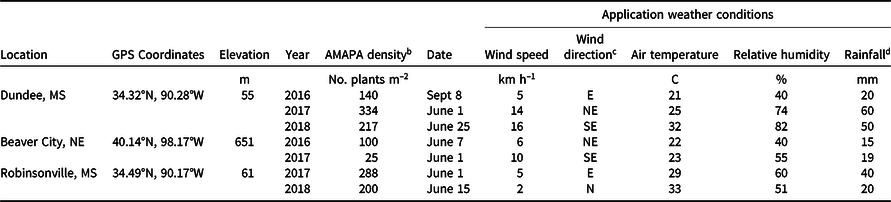
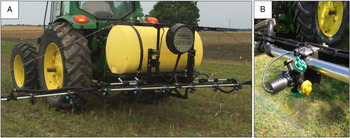
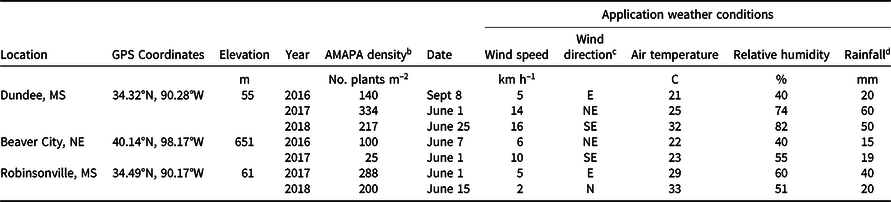
Experiments were conducted in 2016, 2017, and 2018 in a non-crop environment in Dundee, MS (2016 to 2018) on a Sharkey clay soil; Beaver City, NE (2016 and 2017) on a Holdrege silt loam; and Robinsonville, MS (2017 and 2018) on a Commerce silt loam to evaluate the effect of spray droplet size using lactofen and acifluorfen for Palmer amaranth control. Seven site-years of research were conducted, and individual site information including GPS coordinates, elevation, Palmer amaranth population density, application date, and weather conditions at time of application are presented in Table 1. Herbicide resistance to glyphosate and ALS-inhibiting herbicides has been observed across all experimental locations. However, no level of PPO resistance was observed prior to and throughout the years in which experiments were conducted. Lactofen (Cobra®, 0.24 kg ai L–1;Valent U.S.A. Corp., Walnut Creek, CA) at 0.21 kg ai ha–1 and acifluorfen (Ultra Blazer®, 0.24 kg ai L–1; UPL Corporate, King of Prussia, PA) at 0.42 kg ai ha–1 were applied with crop oil concentrate (Agri-Dex®; Helena Chemical Co., Collierville, TN) at 1% v/v to 15-cm tall Palmer amaranth plants. Treatments consisted of six targeted droplet sizes (150, 300, 450, 600, 750, and 900 µm) determined from the volume median diameter (D v0.5) of the measured droplet size distribution. Each herbicide was evaluated as an individual experiment. One nontreated control per site-year in each experiment was used for treatment comparison. Plot dimension was 4 m wide by 12 m long, and treatments were arranged in a randomized complete block design with four replications. Buffer strips measuring 1 m wide were used between plots to minimize the effect of any potential spray drift on nearby plots. Treatments were applied using a tractor-mounted sprayer equipped with a Pin Point® PWM system (Capstan Ag Systems, Inc., Topeka, KS) using non-Venturi WilgerTM precision spray technology nozzles (Wilger Inc., Lexington, TN) operated at 4.8 km h–1 and spray volume of 140 L ha–1 (Figure 1).
Location, GPS coordinates, elevation, year, Palmer amaranth density, application date, and weather conditions at the time of herbicide application.a
a AMAPA, Amaranthus palmeri S. Wats., Palmer amaranth.
b Palmer amaranth population density was collected 1 wk prior to herbicide application.
c Wind direction at time of application.
d Precipitation totals (30 d) starting at 15 d prior to herbicide application date.
Tractor-mounted sprayer equipped with Pin Point® pulse width modulation (PWM) system (A) and non-Venturi WilgerTM precision technology spray nozzles (B) in Dundee, MS.

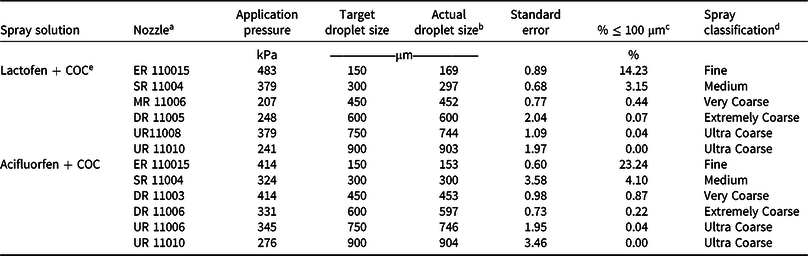
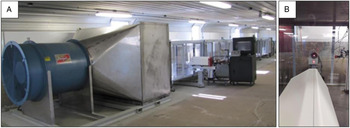
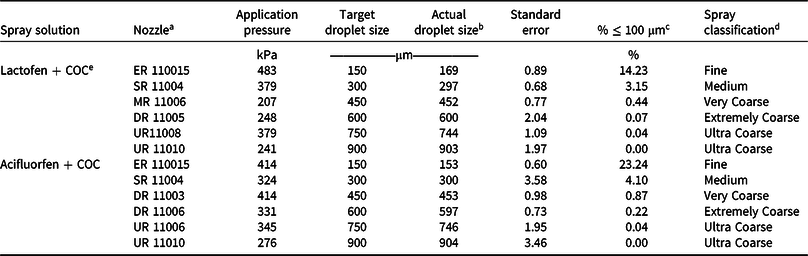
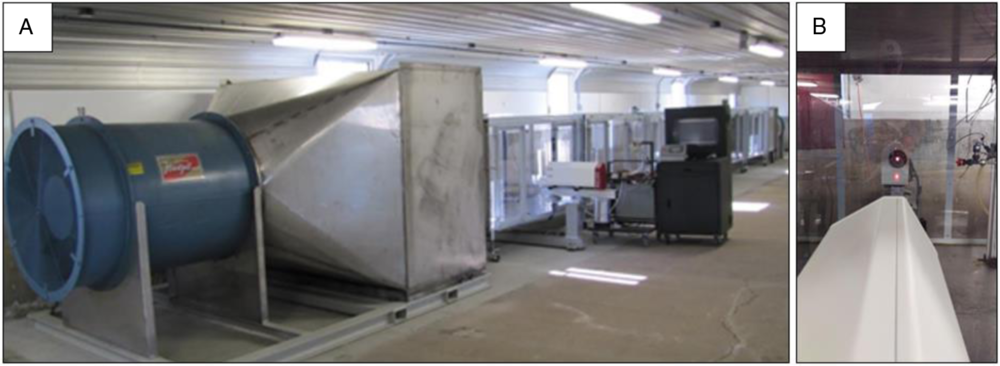
Prior to experiment initiation, the spray droplet spectra for lactofen and acifluorfen was characterized in a low-speed wind tunnel at the Pesticide Application Technology (PAT) Laboratory at the University of Nebraska–Lincoln in North Platte, NE. Nozzle type, orifice size, and application pressure necessary to produce the aforementioned droplet size treatments were determined using a Sympatec HELOS-VARIO/KR laser diffraction system (Sympatec Inc., Clausthal-Zellerfeld, Germany) equipped with an R7 lens capable of detecting particle sizes ranging from 18 to 3,500 µm (Table 2) (Figure 2). The laser diffraction instrument was placed 30 cm downwind from the nozzles. The spray plume was oriented perpendicular to the laser beam and traversed the laser beam by means of a mechanical linear actuator. The actuator moves the nozzles at a constant speed of 0.2 m s–1 such that the entire spray plume will pass through the laser beam. During application, each nozzle–pressure combination was traversed through the laser beam three times, with each pass serving as one repetition for D v0.5 determination. Henry et al. (Reference Henry, Fritz, Hoffmann, Kruger, Poffenberger and Heuser2016) and Creech et al. (Reference Creech, Henry, Fritz and Kruger2015) describe in detail the operation of the low-speed wind tunnel at the PAT Laboratory. Actual droplet size, percent of volume contained in droplets with diameters equal to or less than 100 μm (% ≤ 100 μm), and spray classifications are shown in Table 2. Percent of droplets equal to or smaller than 100 μm was used as a drift risk indicator––also referred to as percent driftable fines (Alves et al. Reference Alves, Kruger, da Cunha, de Santana, Pinto, Guimarães and Zaric2017). Spray droplet size classifications were assigned in accordance with ASABE S572.1 (ASABE 2009).
Herbicide, nozzle type, application pressure, droplet size analysis, and spray classification for lactofen and acifluorfen droplet size treatments.
a Flat-fan, non-Venturi nozzles; WilgerTM precision technology spray tips (Wilger Inc., Lexington, TN).
b Actual droplet size was measured using nozzle and application pressure combinations for each herbicide.
c Percent of spray volume with D v0.5 ≤ 100 μm.
d Spray classification according to ASABE S572.1.
e Abbreviation: COC, crop oil concentrate.
Low-speed wind tunnel (A) equipped with laser diffraction sensor (B) at the Pesticide Application Technology (PAT) Laboratory at the University of Nebraska–Lincoln.
Data Collection
Visual evaluation of Palmer amaranth control was collected at 7, 14, 21, and 28 d after herbicide treatment (DAT). Palmer amaranth control was evaluated on a scale of 0 (no control) to 100% (complete death of all plants) relative to the nontreated check (Frans et al. Reference Frans, Talbert, Marx, Crowley and Camper1986). Prior to herbicide application, 10 plants per plot were tagged at the soil surface for aboveground biomass evaluation (Figure 3). To maximize Palmer amaranth control differences between droplet sizes, plants were allowed to grow up to 15 cm (Butts et al. Reference Butts, Samples, Franca, Dodds, Reynolds, Adams, Zollinger, Howatt, Fritz, Hoffmann and Kruger2018, Reference Butts, Samples, Franca, Dodds, Reynolds, Adams, Zollinger, Howatt, Fritz, Hoffmann, Luck and Kruger2019a, Reference Butts, Samples, Franca, Dodds, Reynolds, Adams, Zollinger, Howatt, Fritz, Hoffmann, Luck and Kruger2019b). Rulers were used to ensure that tagged plants did not exceed 15 cm in height. Plants were selected in the center of each plot, preferably in between tractor wheel tracks to protect plants from being run over. Additionally, tagged plants were also used to assist with visual evaluations in plots where new emergence or regrowth occurred, especially in areas with high Palmer amaranth population density. In case of a new emergence flush, tagged plants were tracked and served as a reference for visible Palmer amaranth control. At 28 DAT, tagged plants were harvested, placed in paper bags, removed from the experimental area, and dried in a forced-air dryer at 55 C for 72 h to constant mass. The dry Palmer amaranth plants were pooled into one dry-biomass measurement per plot and divided by 10 for average dry-shoot biomass per plant. Dry-biomass measurements were converted into percent dry-biomass reduction (Equation 1):
 $$100 - \left( {{{X \times 100}}\over{Y}} \right)$$
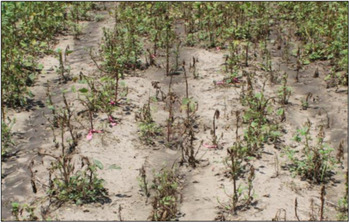
Experimental plot with tagged Palmer amaranth plants from the 2017 Dundee, MS, site-year.

where X is the average dry biomass of an individual experimental unit and Y is the dry biomass of the nontreated control. To minimize any block effect, percent biomass reduction was calculated by comparing dry-weight measurements to the nontreated check within each block.
Statistical Analysis
Visible Palmer amaranth control and percent dry-biomass reduction data were analyzed in SAS v. 9.4 (SAS® Institute, Inc., Cary, NC). Studentized residuals were calculated for all data points, and those exceeding 2.5 were classified as outliers and removed prior to ANOVA. Variance homoscedasticity was also evaluated and confirmed utilizing studentized residuals. Therefore, Palmer amaranth control and percent dry-biomass reduction data met model and distribution assumptions and were each subjected to ANOVA using PROC MIXED procedure; means were then separated using Fisher’s protected LSD at α = 0.05. The nontreated check was not included in Palmer amaranth control analysis to allow greater mean separation between response parameters. In addition, Palmer amaranth control at 7, 14, 21, and 28 DAT was analyzed by rating period to better assess and evaluate visible responses following each herbicide application. Given the differences in the number of years in which experiments were conducted at each location, year and location were combined in one factor (site-year). This approach utilizing multiple-environment trials is useful for estimating treatment effects over a wide variety of environments (Blouin et al. Reference Blouin, Webster and Bond2011; Carmer et al. Reference Carmer, Nyquist and Walker1989). Spray droplet size and site-year were analyzed as fixed effects and replication as a random effect.
Results and Discussion
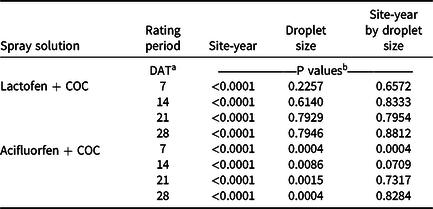
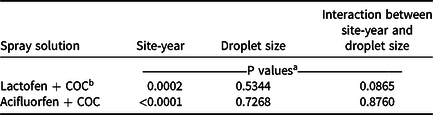
No interaction between spray droplet size and site-year was present for Palmer amaranth control at any rating interval for either herbicide, except acifluorfen at 7 DAT (Table 3). Although Palmer amaranth control at 7 DAT was predominantly greater following acifluorfen application with 150- (Fine) and 300-μm (Medium) droplets, the same trend was not observed across all site-years (data not shown). Nevertheless, Palmer amaranth control following acifluorfen application at 14, 21, and 28 DAT indicated no significant interaction between spray droplet size and site-year, indicating similar result trends across site-years (Table 3). A similar response was observed in percent dry-biomass reduction, where no interaction between droplet size and site-year was present for lactofen and acifluorfen (Table 4). The absence of a significant interaction between spray droplet size, percent dry-biomass reduction, and site-year was used as a parameter for pooling data over site-years.
ANOVA probability values at each rating period for site-year, droplet size, and interaction between site-year and droplet size with respect to visible Palmer amaranth control following lactofen and acifluorfen application.
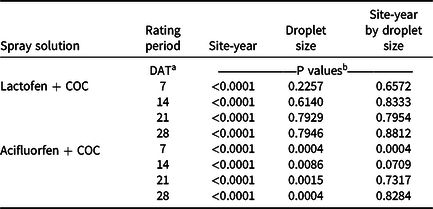
a Abbreviations: COC, crop oil concentrate; DAT, days after treatment.
b Probability values calculated based on data pooled across 7 site-years.
ANOVA probability values for site-year, droplet size, and interaction between site-year and droplet size with respect to dry Palmer amaranth biomass reduction following lactofen and acifluorfen application.
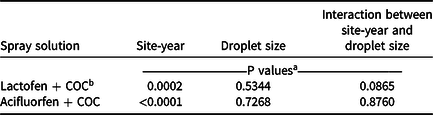
a Probability values calculated based on data pooled across 7 site-years.
b Abbreviation: COC, crop oil concentrate.
Palmer Amaranth Control with Lactofen
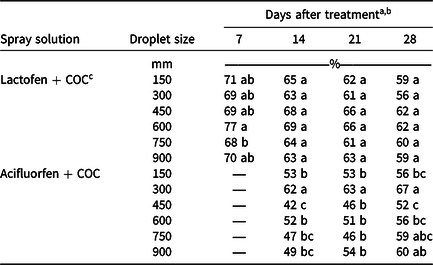
Spray droplet size did not affect lactofen efficacy on Palmer amaranth, regardless of rating period (Table 3). Palmer amaranth control at 7 DAT following lactofen application ranged from 68% to 77% (Table 5). At 14, 21, and 28 DAT, Palmer amaranth control ranged from 63% to 69%, 61% to 66%, and 56% to 62%, respectively (Table 5). These findings are consistent with previous research conducted by Berger et al. (Reference Berger, Dobrow, Ferrell and Webster2014), which reported no differences in Palmer amaranth control with lactofen using XR flat-fan and air induction (AI) nozzles. Similarly, Gizotti de Moraes (Reference Gizotti de Moraes2018) observed consistent control of Palmer amaranth following lactofen application with XR, AIXR, and TTI nozzles. Observations from the same experiment also demonstrated that lactofen applied with XR, GA, AIXR, TDXL, ULD, and TTI nozzles provided similar control of common lambsquarters (Chenopodium album L.), shattercane [Sorghum bicolor (L.) Moench], horseweed (Erigeron canadensis L.) and kochia [Bassia scoparia (L.) A.J. Scott]. Furthermore, the absence of droplet size effect on the efficacy of nonsystemic (contact) herbicides has been previously reported by Brown et al. (Reference Brown, Soltani, Shrosphire, Spieser and Sikkema2007), where glufosinate applied with XR and AI nozzles resulted in similar control of Powell amaranth (Amaranthus powellii S. Wats.), velvetleaf (Abutilon theophrasti Medik.), common ragweed (Ambrosia artemisiifolia L.), and common lambsquarters. For the purpose of this research, herbicide applications were made to 15-cm Palmer amaranth plants. The low level of Palmer amaranth control (< 80%) observed in the experiments can be attributed to plant height at the time of application. This was expected, because previous research demonstrated that lactofen provided 92% control of Palmer amaranth when applied to 5- to 10-cm plants, but only 48% control when applied to 15- to 20-cm tall plants (Grichar Reference Grichar2007). Additionally, reduced Palmer amaranth control with PPO-inhibiting herbicides has been reported as plant height increased (Berger et al. Reference Berger, Dobrow, Ferrell and Webster2014; Chahal et al. Reference Chahal, Aulakh, Jugulam, Jhala, Price, Kelton and Sarunaite2015; Grichar Reference Grichar2007). If lactofen application had been made to smaller plants, greater Palmer amaranth control would be expected; however, estimations of visual control would be difficult to perform.
Visible Palmer amaranth control following lactofen and acifluorfen application with various spray droplet sizes.
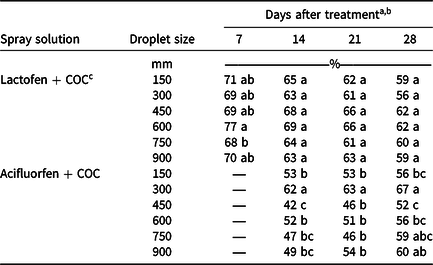
a Visible Palmer amaranth control data were pooled across 7 site-years and analyzed within each rating period.
b Means within a column followed by the same letter are not significantly different according to Fisher’s protected LSD (α = 0.05).
c Abbreviation: COC, crop oil concentrate.
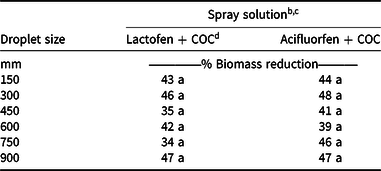
The lack of differences in Palmer amaranth control with lactofen using various droplet sizes was also observed in percent dry-biomass reduction (Table 4). Lactofen application using droplet sizes ranging from 150 (Fine) to 900 μm (Ultra Coarse) resulted in consistent percent dry-biomass reduction (Table 5). These observations agree with those of Creech et al. (Reference Creech, Moraes, Henry, Luck and Kruger2016), which reported no differences in efficacy of saflufenacil, a PPO-inhibiting herbicide, with spray droplets ranging from 224 (Fine) to 622 μm (Extremely Coarse) for common lambsquarters and shattercane control. Likewise, Gizotti de Moraes (Reference Gizotti de Moraes2018) reported similar percent biomass reduction of common lambsquarters, shattercane, horseweed, and kochia 28 d after lactofen and fomesafen application using six nozzle types. The results observed in the lactofen experiment indicate that spray droplet size was not a contributing factor in herbicide efficacy across 7 site-years. Although lactofen droplet spectrum analysis in a wind tunnel demonstrated that percent driftable fines (≤ 100 μm) increased as droplet size decreased, Palmer amaranth control and percent biomass reduction remained consistent across selected droplet sizes (Table 2). Therefore, Ultra Coarse spray classifications (750 and 900 μm) could be used effectively without compromising lactofen performance while minimizing spray drift potential.
Palmer Amaranth Control with Acifluorfen
Acifluorfen applied with 300-μm (Medium) spray droplets provided the greatest Palmer amaranth control at 14, 21, and 28 DAT (Table 5). On average, Palmer amaranth control following acifluorfen application with 300-μm (Medium) spray droplets was 10%, 13%, and 13% greater compared to all other spray droplets at 14, 21, and 28 DAT, respectively (Table 5). Shaw et al. (Reference Shaw, Morris, Webster and Smith2000) observed increased common cocklebur control following acifluorfen application with 250-(Medium) and 350-μm (Coarse) spray droplets. The increased Palmer amaranth control observed with acifluorfen applied using 300-μm (Medium) droplets could be a result of optimal droplet deposition and target coverage, probably allowing the herbicide to be dispersed evenly across the leaf surface (McKinlay et al. Reference McKinlay, Brandt, Morse and Ashford1972; Prasad Reference Prasad1987); however, leaf coverage by acifluorfen was not evaluated in this study. Research conducted by De Cock et al. (Reference De Cock, Massinon, Salah and Lebeau2017) demonstrated that spray droplets ≤ 150 (Fine) and ≥ 350 μm (Medium) are more exposed to the effects of droplet evaporation and bouncing, respectively. In that regard, the increased percent driftable fines (23.24%) produced during application with 150-μm (Fine) droplets could have contributed to less particle deposition (Table 2), thus leading to reduced herbicide efficacy. Additionally, spray droplets ≤ 100 μm (Very Fine) are more likely to be affected by environmental factors such as wind, relative humidity, and temperature (Byass and Lake Reference Byass and Lake1977; Grover et al. Reference Grover, Kerr, Maybank and Yoshidja1978).
The increased Palmer amaranth control resulted from acifluorfen application with 300-μm (Medium) droplets did not translate into greater percent biomass reduction (Table 6). Although 300-μm (Medium) droplets provided greater numerical percent biomass reduction, it was not statistically different from any other spray droplet size. The absence of a clear separation between droplet sizes with respect to percent biomass reduction could be attributed to plant damage followed by regrowth after herbicide application. When visually assessing Palmer amaranth control, it was common to see herbicide damage across a range of droplet sizes. However, upon closer inspection, plants sprayed with 300-μm (Medium) droplets were not producing new biomass, whereas plants sprayed with all other droplet sizes were often injured but were starting to produce new biomass. Alterations in size, biomass, resource allocation, and phenology are means by which Palmer amaranth normally responds to stress conditions such as herbicide application (Korres et al. Reference Korres, Norsworthy, Burgos and Oosterhuis2017).
Influence of spray droplet size on percent dry Palmer amaranth biomass reduction following lactofen and acifluorfen application.a
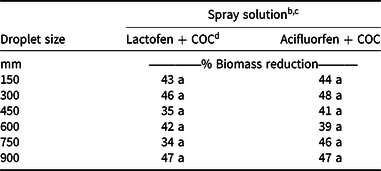
a Dry-biomass reduction calculated as a percentage of the nontreated check.
b Dry Palmer amaranth biomass reduction data were pooled across 7 site-years.
c Means within a column followed by the same letter are not significantly different according to Fisher’s protected LSD (α = 0.05).
d Abbreviation: COC, crop oil concentrate.
Results from these experiments identified that spray droplet size was not a contributing factor in lactofen efficacy for Palmer amaranth control. Spray droplet sizes ranging from 150 (Fine) to 900 μm (Ultra Coarse) provided the same level of Palmer amaranth control across a wide range of environments. Larger droplets can be used effectively without compromising lactofen efficacy at rate and spray volume used in this study to control Palmer amaranth. Therefore, 900-μm (Ultra Coarse) droplets are recommended for lactofen application to reduce the likelihood of herbicide off-target movement. For acifluorfen, 300-μm (Medium) droplets resulted in greater Palmer amaranth control across all site-years. Results from this research suggest that 300-μm (Medium) droplets should be used to maximize acifluorfen efficacy on Palmer amaranth. However, greater effort should be devoted to monitoring environmental factors such as wind speed, air temperature, and relative humidity, as research has demonstrated that these factors have a stronger impact on smaller droplets (Carlsen et al. Reference Carlsen, Spliid and Svensmark2006; Foster et al. Reference Foster, Sperry, Reynolds, Kruger and Claussen2018; Havens et al. Reference Havens, Hilger, Hewitt, Kruger, Marchi-Werle and Czaczyk2018). The differences in optimum droplet size observed for lactofen and acifluorfen could be due to product formulation. Although lactofen and acifluorfen are both PPO-inhibiting herbicides, they are formulated as emulsifiable concentrate (EC) and soluble liquid (S), respectively. Previous research reported that the physical properties of the spray liquid have great influence on herbicide performance (Miller and Ellis Reference Miller and Ellis2000). Butler Ellis et al. (Reference Butler Ellis, Tuck and Miller1997) indicated that droplet velocity is reduced with liquid solutions and increased by emulsions, which have implications for both droplet retention on the target and off-target movement. Hence, greater droplet velocity could be responsible for the consistent lactofen efficacy across all droplet sizes. This research also highlighted the flexibility of PWM sprayers to apply optimal spray droplet size and pressure combinations for different herbicides. With increased environmental protection and public safety concerns, the adoption of technologies that allow for more precise and efficient spray applications is needed to meet current standards and regulations.
Acknowledgments
This research was partially funded by Monsanto Company as part of the Will D. Carpenter Distinguished Field Scientist Graduate Assistantship. The authors would like to thank all the undergraduate and graduate research assistants at Mississippi State University and University of Nebraska who helped with the execution and conduction of this research. The authors would further like to thank Capstan Ag Systems, Inc., for providing assistance with the PWM system, and Wilger Industries Ltd. for supplying the nozzles used in this research. No conflicts of interest have been declared.