


1 Introduction
Psychiatric inpatient treatment is increasingly performed in settings with locked doors [Reference Bowers, Haglund, Muir-Cochrane, Nijman, Simpson and Van Der Merwe1, Reference Haglund, von Knorring and von Essen2]. Legal status does not seem to be the crucial factor for admission to a locked ward Reference Hoyer, Kjellin, Engberg, Kaltiala-Heino, Nilstun and Sigurjonsdottir[3] and locking policies are mainly determined by local tradition and highly variable between countries, hospitals and wards Reference Rittmannsberger, Sartorius, Brad, Burtea, Capraru and Cernak[4]. The decision to admit a patient to a locked ward is primarily driven by safety concerns, as locked doors are regarded as an effective measure for protection against the outside, control over patients, secure and efficient care and relief for relatives Reference Haglund, von Knorring and von Essen[2]. Following the medical-ethical guidelines of the Swiss Academy of Medical Sciences, the application of a coercive measure is indicated in cases where a risk of harm to the patient or others cannot otherwise be averted [5]. The constraints to personal freedom these treatment settings impose is ethically problematic and is acceptable from an ethical point of view only under certain conditions: the least restrictive alternative is used and its duration is kept to a minimum, the patient's rights are granted, patient's relatives or guardians are informed and the procedure follows established national and local protocols [Reference Lutzen6–Reference Huber, Sowislo, Schneeberger, Flury Bodenmann and Lang8]. Locked door settings could also be justified if they would prevent the necessity of safety measures interfering further with personal freedom such as seclusion, restraint and forced medication.
However, locked wards have well-known disadvantages [Reference Lang, Walter, Borgwardt and Heinz9, Reference Schneeberger, Huber and Lang10]. Among others, patients’ satisfaction with treatment and care may be lower than on open wards Reference Muller, Schlosser, Kapp-Steen, Schanz and Benkert[11], the therapeutic atmosphere may be worse Reference Blaesi, Gairing, Walter, Lang and Huber[12] and patients may feel confined and dependent Reference Haglund and von Essen[13]. In addition, recent data challenges the hypothesis that locked wards provide improved safety over open-door settings regarding suicide, absconding and aggression [Reference Huber, Schneeberger, Kowalinski, Frohlich, von Felten and Walter14, Reference Schneeberger, Kowalinski, Fröhlich, Schroeder, Von Felten and Zinkler15]. Furthermore, locked door settings might even increase the incidence of seclusion, restraint and forced medication, as increased rates of aggressive incidents have been connected to a punitive or threatening atmosphere on locked inpatient units Reference Bowers, Jarrett and Clark[16]. In addition, closed doors are often used to replace the staff-patient contact, which again might lead to increased safety measures and involuntary treatment. On the contrary, the change to an open-door policy has shown the potential to reduce the incidence of these safety measures. This effect has been found in studies examining individual wards [Reference Lang, Hartmann, Schulz-Hartmann, Gudlowski, Ricken and Munk17–Reference Jungfer, Schneeberger, Borgwardt, Walter, Vogel and Gairing21] and in a large observational data set from 21 German hospitals Reference Schneeberger, Kowalinski, Fröhlich, von Felten, Borgwardt and Lang[22]. In addition, there is evidence that these effects cannot be fully attributed to shifts from recently opened to still closed wards Reference Jungfer, Schneeberger, Borgwardt, Walter, Vogel and Gairing[21]. Following this line of thought, the official statement of the ethics committee of the German Medical Association recommended the reduction of compulsory treatment and the reduction of closed wards in psychiatric settings Reference Wiesing[23].
However, several open questions that cannot be answered from the current literature remain: it is unsure whether the hospital-wide introduction of an open-door policy is associated with an enduring positive effect on seclusion and forced medication, or if there is a limited effect with return to previous levels. Furthermore, it is unclear what amount of reduction regarding safety measures is possible and how large the effect size of the complex intervention “introduction of an open-door policy” might be.
1.1 Aims and hypotheses of study
The aim of the present study was to examine if the introduction of an open-door policy in a hospital providing mental healthcare services is associated with the frequency of seclusion and forced medication and if yes, how enduring these associations might be. This led us to the following hypotheses:
• the introduction of an open-door policy is associated with a long-term reduction of the frequency of seclusion;
• the introduction of an open-door policy is associated with a long-term reduction of the frequency of forced medication.
2 Methods
2.1 General framework
The Department of Adult Psychiatry, Universitäre Psychiatrische Kliniken (UPK) Basel, University of Basel, Switzerland, provides psychiatric in and outpatient services for a population of about 190,000 people living in the city of Basel and the surrounding area. It has a health care mandate for psychiatric patients in the canton of Basel-City and basic healthcare insurance does not cover inpatient treatment in other cantons. During the 6-year study period (2010–2015), between 250 and 260 beds on 15 wards were available for inpatient treatment. In a clinic-wide approach to enable a less restrictive policy [Reference Blaesi, Gairing, Walter, Lang and Huber12, Reference Jungfer, Schneeberger, Borgwardt, Walter, Vogel and Gairing21], six previously closed psychiatric wards were permanently opened beginning from August 2011. During this process, a systematic change towards a more patient-centered and recovery-oriented treatment standard including active family and caregivers involvement, the implementation of a new concept in cognitive behavioral therapy (individual and group therapy), the implementation of a primary nursing care delivery model, improved availability of pharmaco- and psychotherapy, teambuilding measures and de-escalation training for the personnel, was implemented (compare [Reference Sollberger and Lang24, Reference Sollberger and Lang25]).
Processes for the prevention of critical incidents, seclusion and forced medication were continuously monitored to ensure maximum safety for patients and personnel while reducing involuntary treatment Reference Sharfstein[26]. The primary interdisciplinary team consisted of psychiatrists, psychologists and nurses. Table S1 summarizes the number of full-time employees per profession and per examined year and is available as an online-only supplement to provide an overview on staff-to-case ratio and team composition. Team members were aware of clinical monitoring but were not informed that a scientific evaluation of the data would be performed.
2.2 Study population
Inclusion criteria for the current study were inpatient status at the Department of Adult Psychiatry, UPK Basel, at least 18 years of age, and admission to one of the 15 wards between 01/2010 and 12/2015. Patients whose inpatient treatment had not been completed within the analysis period were excluded from the current study. Of the 17,615 inpatient cases available from 01/2010 to 12/2015, 17,359 (98.6%) were entered in the current analyses. No further in or exclusion criteria were defined to ensure a naturalistic sample.
2.3 Documentation and management of clinical data
Clinical and treatment data were continuously documented using the Medfolio software (current version: 2.2.0.2085; NEXUS AG, Villingen-Schwenningen, Germany) and extracted using HCe® Analytics software (Business Intelligence Connector 3 (BIC 3) for patient controlling; TIP Management AG, Dübendorf, Switzerland). Data on age, gender, marital status, nationality, housing situation, occupational situation, diagnoses according to the International Classification of Diseases, 10th revision (ICD-10 Reference WHO[27]), legal status, type of admission, psychopharmacological treatment and type of discharge were documented by the psychiatrists responsible for the respective patient.
Due to legal requirements, a detailed documentation of coercive measures was available. A definition of coercive measures can be found in the medical-ethical guidelines of the Swiss Academy of medical Sciences [5] and two types of coercive measures were recorded as main outcome parameters:
• first, forced isolation with or without psychopharmacological treatment was documented as “seclusion” and defined as the involuntary placement of an individual locked in a room alone, which may be set up especially for this purpose;
• secondly, forced intake of oral or application of intramuscular medication without forced isolation was documented as “forced medication” and defined as administering medication against the patient's will using restraint or strong psychological pressure (involving at least three staff members) Reference Raboch, Kališová, Nawka, Kitzlerová, Onchev and Karastergiou[28].
Data on physical restraint, defined as mechanical restraint using belts or straps, were not available for the current analyses as this coercive measure is not used at the UPK Basel. Involuntary hospitalization constitutes an additional coercive measure. However, only public health officers and local authorities are allowed to initiate an involuntary hospitalization in the canton of Basel-City–although longer-term changes in their decisions and guidelines might follow the introduction of an open-door policy in the hospital where they admit their patients, involuntary hospitalization therefore cannot be directly influenced by changes in hospital policies and was thus not chosen as an outcome parameter. It has, however, been included in the sample description and as a potential confounder in the multivariate analyses.
As data was documented during routine treatment and anonymized during data extraction, the current study was exempt from local ethics committee approval. Nevertheless, the study protocol has been peer-reviewed by an internal research committee at the Department of Adult Psychiatry, Universitäre Psychiatrische Kliniken (UPK) Basel, University of Basel, Switzerland. The current study was performed in accordance with all national and international legal regulations and with the Declaration of Helsinki in its current version.
2.4 Statistical analysis
Descriptive statistics are given in total numbers and percentages for nominal scaled variables as well as mean and standard deviation (SD) for ordinal and interval scaled variables. Group comparisons were performed via chi-square tests (nominal scale, parametric) and one-way ANOVAs (ordinal and interval scale, parametric). Due to the descriptive nature of the exploratory comparisons accompanying and enhancing the sample description (Tables 1–3), no correction for multiple testing was employed.

Values are given as number (percentage) for nominal variables and in mean ± standard deviation for continuous variables. To enhance the interpretability of the sample description, P-values from exploratory analyses are presented.
a One-way ANOVA.
b χ 2-test.
To investigate the association of seclusion and forced medication with the implementation of a least restrictive policy (main analysis), we performed a panel data analysis using generalized estimating equations (GEE) with the binary response variable “seclusion” and “forced medication” and the year of admission as independent variable (main analyses). Due to the dependency of our observations within subjects, we chose compound symmetry as our covariance structure in the model. Regarding other clinical and sociodemographic characteristics prior to and at admission as described in the descriptive statistics, there were significant differences for most variables, with fluctuations over time and no clear trend for an increase or decrease, indicating the need to control for these variables as potential confounders. Namely, we controlled for the following confounders:
• age;
• sex;
• marital status;
• nationality;
• housing situation;
• occupational situation;
• main diagnosis;
• type of entry;
• type of admission;
• triage to an open or closed ward at admission.
Multiple imputations were used to estimate missing values for GEE analyses. To assess if this may have an impact on our findings, we performed GEE analyses without multiple imputation as sensitivity analyses. This yielded comparable results that are therefore not reported in the current manuscript.
All tests of significance were 2-tailed and P-values <.05 were considered significant. Effect size ηp2 was calculated according to Levine et al. Reference Levine and Hullett[29] and defined as small (d = 0.2–.49), medium (d = 0.5–.79), and large (d ≥ 0.8). Statistical analyses were conducted using PASW Statistics 18.0 (Chicago, Illinois, USA).
3 Results
Overall, 17,359 cases were admitted and had completed treatment during the observation period. The percentage of closed beds available for inpatient admissions persistently decreased from 45.6% in 2010 to 8.5% in 2015. This organizational change is reflected in the growing percentage of cases admitted to open wards (from 41.0 to 87.8%) at relatively stable rates of involuntary admissions fluctuating from 7.7 until 11% of the cases. Table 1 shows the clinical and sociodemographic characteristics of the patients prior to and at admission.
From 2010 to 2015, the mean age of our sample ranged from 45.4 to 46.9 years and there was a slightly higher percentage of female than male subjects (50.3 to 54.1%). Percentages of widowed subjects decreased over time. The percentage of admitted patients with private residences also showed a decrease over time, whereas the percentage of employed patients was stable. While the percentage of cases with a main diagnosis of schizophrenia spectrum disorder and with “other psychiatric diagnosis” was stable over time, percentages of the remaining diagnostic categories and the group of cases with no main diagnosis of a psychiatric illness differed regarding the year of admission. There were significant differences regarding type of entry and the type of admission and the triage to an open ward showed an increase over time in our sample.
Table 2 shows the clinical characteristics of the included cases during hospitalization. There were significant differences in psychopharmacological treatment with an overall decrease of medication with sedatives and mean treatment duration ranged from 24.2 to 28.3 days with the lowest duration in 2015. Type of discharge showed significant fluctuations with no clear tendency for an in or decrease over the observation period.
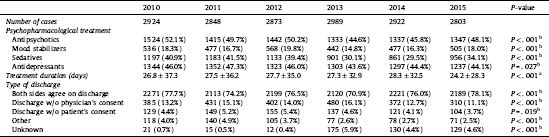
Values are given as number (percentage) for nominal variables and in mean ± standard deviation for continuous variables. To enhance the interpretability of the sample description, P-values from exploratory analyses are presented.
a One-way ANOVA.
b χ 2-test.
Table 3 shows the descriptive statistics regarding the outcome variables seclusion and forced medication. The percentage of cases with at least one seclusion, the mean number of seclusions per case, the mean duration of a seclusion, the percentage of cases with at least one forced medication and the mean number of forced medications per case all showed a significant decrease from 2010 to 2015 in these exploratory analyses. Over the observation period, the percentage of cases affected by at least one seclusion dropped from 8.2 to 3.5% with a decrease in frequency from a mean of 5.1 to 2.9 seclusions per affected case and in the duration of seclusion from 27.1 to 18.2 hours. For forced medication, the percentage of affected cases decreased from 2.4 to 1.2% and the mean number of events per affected case was lowered from 2.3 to 1.2.

Values are given as number (percentage) for nominal variables and in mean ± standard deviation for continuous variables. To enhance the interpretability of the sample description, P-values from exploratory analyses are presented.
a One-way ANOVA.
b χ 2-test.
Table 4 shows the test statistic for year of admission as a predictor of seclusion controlled for sex, age, marital status, nationality, housing situation, occupational situation, main diagnosis, type of entry, type of admission, triage to an open or closed ward and adjusted for multiple hospitalizations of the same patient. As hypothesized, the application of seclusion showed a significant decrease over time with large effect size (η p2 = 0.82; odds ratio: 0.88). Hence, the probability for an admitted case to experience seclusion was reduced by 12% per year. Also, younger age, being separated, divorced or widowed, unemployment and Swiss nationality were associated with a higher probability of seclusion. On the other hand, voluntary admission, admission on patient's initiative and the admission to an open ward went along with a lowered probability of seclusion.

CI: confidence interval; df: degrees of freedom; SE: standard error; n/a: not applicable.
Table 5 shows the test statistic for the year of admission as a predictor of forced medication controlled for the same variables as mentioned for Table 4. Again, as hypothesized, the application of forced medication decreased significantly over time with a medium effect size (η p2 = 0.70; odds ratio: 0.90). Hence, the probability for an admitted case to experience forced medication was reduced by 10% per year. In addition, age, marital status, type of entry, type of admission and triage to an open or closed ward showed significant connections with the occurrence of forced medication. Younger age and being separated, divorced or widowed were associated with a higher probability of forced medication and voluntary admission, admission on patient's initiative and the admission to an open ward with a lowered probability of forced medication.
4 Discussion
This 6-year, hospital-wide, longitudinal, observational study examined potential associations of the introduction of an open-door policy with the frequency of seclusion and forced medication. To the authors’ knowledge, this is the first study covering the introduction of an open-door policy with an observation period allowing assessment of the time course and stability of the accompanying changes.
Furthermore, the analysis of data on a hospital-wide level allowed controlling for shifts in patient distribution. As basic healthcare insurance in Basel-City does not cover inpatient treatment in other cantons and as the UPK Basel has a health care mandate for psychiatric patients in the canton of Basel-City without the possibility to decline admissions of specific patient groups, possible effects of shifts inpatient distribution on a canton-wide scale can be assumed to be negligible. Further strengths of this study include the high data quality due to prospective electronic documentation, the good generalizability of the results due to the inclusion of a general psychiatric patient collective covering all psychiatric diagnoses and the large number of patient cases examined.

CI: confidence interval; df: degrees of freedom; SE: standard error; n/a: not applicable.
The hospital-wide introduction of an open-door policy constitutes a complex intervention [Reference Sollberger and Lang24, Reference Sollberger and Lang25]. Most of the applied changes cannot easily be monitored using clinical data. However, our data show a prominent and continuous reduction in the availability of closed beds for inpatient treatment.
One of the often-named caveats against the introduction of an open-door policy is the fear that it might lead to premature treatment discontinuation with discharge of patients that are still endangered or dangerous, leading to safety problems and a revolving-door phenomenon with rising involuntary admissions. However, based on first evidence from the current literature [Reference Huber, Schneeberger, Kowalinski, Frohlich, von Felten and Walter14, Reference Schneeberger, Kowalinski, Fröhlich, von Felten, Borgwardt and Lang22], this may not be the case. Furthermore, the absence of clear longitudinal trends for involuntary admissions, treatment duration and type of discharge in our sample supports the notion that the introduction of an open-door policy did not have this effect in our sample.
Our main findings are in line with previous literature showing a decrease in involuntary measures following the introduction of an open-door policy on individual wards [Reference Lang, Hartmann, Schulz-Hartmann, Gudlowski, Ricken and Munk17–Reference Steinert, Eisele, Goeser, Tschoeke, Uhlmann and Schmid20]. In addition, they are compatible with a recent study comparing hospitals without locked wards and hospitals with locked wards and showing that restraint or seclusion during treatment were less likely in hospitals with an open-door policy Reference Schneeberger, Kowalinski, Fröhlich, von Felten, Borgwardt and Lang[22]. In addition, our results further support the findings from a previous study comparing two permanently open, two permanently closed and two newly opened wards in our hospital from 08/2010 to 07/2011 and from 08/2011 to 07/2012 Reference Jungfer, Schneeberger, Borgwardt, Walter, Vogel and Gairing[21]. These analyses showed a significant decrease in frequency of seclusion and forced medication for the newly opened wards, with a significant overall decrease of seclusion and no significant overall differences for forced medication. The current results expand on these findings, showing that the association of an open-door policy with reduced involuntary measures remains stable over an observation period of six years and that there is no return to previous levels.
As a patient shift to other hospitals is highly unlikely due to the local healthcare system conditions and as all 15 hospital wards were included in the current analyses, it is improbable that this positive development is counterbalanced by an increase in security measures or involuntary admissions in other hospitals. Personal communication maintained with the police, the public health officers and the local authorities during the introduction of an open-door policy revealed no signs of an increase of adverse events during the observation period, indicating that the decrease in involuntary measures did not come at the cost of an increased risk for the patients or the general population.
The overall frequency of seclusion and forced medication as reported in the literature varies considerably. In the EUNOMIA project, the percentage of patients receiving coercive measures in each country varied between 21 and 59% Reference Raboch, Kališová, Nawka, Kitzlerová, Onchev and Karastergiou[28]. In a study conducted in 36,690 cases treated in several psychiatric hospitals in Germany, 9.5% of the cases were exposed to coercive measures Reference Steinert, Martin, Baur, Bohnet, Goebel and Hermelink[30]. In summary, the rates of seclusion (up to 8.2%) and forced medication (up to 2.4%) in our sample are compatible with the rates found in other studies. Nevertheless, further efforts could result in a still higher reduction of seclusion and forced medication, as, e.g., the mean duration of seclusion remained high (at a mean of 18 hours) compared to a mean duration of seclusion of about 20 minutes in the UK Reference Steinert, Lepping, Bernhardsgrutter, Conca, Hatling and Janssen[31].
4.1 Limitations
The current study has a number of methodological limitations. Due to the observational character of the data without comparison group, it remains unclear what amount of the decrease in seclusion and forced medication can be attributed to the introduction of an open-door policy. However, the National Association for Quality Development in Hospitals (ANQ), which monitors the incidence of seclusion and forced medication for all hospitals in Switzerland starting from 2012, found no general trend for an increase or decrease [32]. Still, further research employing study designs with control groups, preferably in a randomized controlled trial design, is encouraged to verify our findings. On the other hand, this kind of trial is difficult to realize due to ethical constraints and comes with its own limitations (e.g., concerning the validity of the comparison groups, which may be influenced by effects of the personnel and the treatment approach and concerning selection effects imposed by informed consent and in and exclusion criteria, limiting transferability of the findings to clinical routine) Reference Schneeberger, Huber and Lang[33].
Whereas the minimal in and exclusion criteria, the inclusion of all wards in a general psychiatric hospital and of patients with the whole spectrum of psychiatric diagnoses improves the generalizability of our findings, treatment on locked wards and involuntary measures inherently depend on the local and national situation regarding healthcare system and legal framework. It is, therefore, unclear to which degree our findings may be transferable to other systems with differing conditions.
Furthermore, clinical routine data were used for the current analyses. Although they were prospectively entered in an electronic documentation system and it is known that data quality and completeness is sufficient for scientific analyses, only basic clinical data were available. It would have been of additional use for the current study to have more detailed information regarding, e.g., history of aggression, aggressive incidents during inpatient treatment, psychopathology and adherence to treatment. In addition, reporting on adverse events pertaining to the general population was only available via personal communication and sources of quantitative data were often unavailable, incomplete, or heterogeneous. However, this is a common problem and similar limitations exist for other research on our topic [Reference Huber, Schneeberger, Kowalinski, Frohlich, von Felten and Walter14, Reference Schneeberger, Kowalinski, Fröhlich, von Felten, Borgwardt and Lang22].
5 Conclusion
In this 6-year, hospital-wide, longitudinal study, the implementation of a least restrictive policy was associated with an ongoing, clinically relevant, statistically significant, high effect strength reduction in seclusions and a medium effect strength decrease in forced medication. This underlines the potential of the introduction of an open-door policy to attain a long-term reduction in coercive measures.
Ethics committee approval
According to current legal regulation, no approval from the local ethics committee was required for the current study.
Role of funding source
This work was supported by the Swiss Academy of Medical Sciences and the Gottfried and Julia Bangerter-Rhyner foundation (CGH) and the research fund of the UPK Basel (LH and CGH). The funding body had no role in the design, collection, analysis, or interpretation of data; in the writing of the manuscript; or in the decision to submit the manuscript for publication.
Authors’ contributions
UEL and CGH designed the study and LH and CGH wrote the initial draft of the paper. DF and CGH collected the data. LH, DF, AS and CGH analyzed and interpreted the data. All authors have contributed to, read and approved the final version of the manuscript. LH and CGH had full access to all the data in the study and take responsibility for the integrity of the data and the accuracy of the data analysis.
Disclosure of interest
The authors declare that they have no competing interest.
Appendix A. Supplementary data
Supplementary data associated with this article can be found, in the online version, at https://doi.org/10.1016/j.eurpsy.2017.09.008.




Comments
No Comments have been published for this article.