


Introduction
Industrial and agricultural expansion, rising energy consumption and growing human populations exert severe pressure on freshwater resources (Nilsson, Reference Nilsson2005; Grill et al., Reference Grill, Lehner, Thieme, Geenen, Tickner and Antonelli2019). Globally, rivers are amongst the most altered ecosystems, affected by > 125,000 large and small dams (Zarfl et al., Reference Zarfl, Lumsdon, Berlekamp, Tydecks and Tockner2015; Couto & Olden, Reference Couto and Olden2018), pollution, destruction of riparian habitats, sand mining and destructive fishing practices (Dudgeon, Reference Dudgeon2002). Freshwater diversity is thus amongst the most threatened in the world, with freshwater fish being particularly vulnerable (Dudgeon, Reference Dudgeon2002; Dudgeon et al., Reference Dudgeon, Arthington, Gessner, Kawabata, Knowler and Naiman2006).
Threats are most pronounced in tropical countries with emerging economies, where dam building overlaps with high freshwater biodiversity (Pandit & Grumbine, Reference Pandit and Grumbine2012; Tockner et al., Reference Tockner, Bernhardt, Koska, Zarfl, Hüttl, Bens, Bismuth and Hoechstetter2016). In such regions, subsistence communities are directly dependent on the services that aquatic ecosystems provide (Beck et al., Reference Beck, Claassen and Hundt2012). For example, in India, > 10.8 million people depend on inland fisheries for their livelihoods (Planning Commission, Reference Planning Commission2012). India also ranks third in the world in terms of the numbers of large dams (ICOLD, 2019), with > 6,000 large and small dams, in addition to severe pollution, degradation of riparian vegetation, unsustainable sand mining and harmful fish harvesting practices (Grant et al., Reference Grant, Lynch, Muneepeerakul, Arunachalam, Rodríguez-Iturbe and Fagan2012; Grumbine & Pandit, Reference Grumbine and Pandit2013; Jumani et al., Reference Jumani, Rao, Machado and Prakash2017; Krishnaswamy et al., Reference Krishnaswamy, Kumar, Kelkar, Nair, Atkore, Hiremath, Rai and Siddhartha2017).
The Western Ghats mountain range, extending along the west coast of peninsular India, is especially vulnerable. As the most densely populated global biodiversity hotspot (Myers et al., Reference Myers, Mittermeier, Mittermeier, da Fonseca and Kent2000), its catchment provides water for > 400 million people (Molur et al., Reference Molur, Smith and Daniel2011). This freshwater ecoregion also has high fish species richness and endemism (Abell et al., Reference Abell, Thieme, Revenga, Bryer, Kottelat and Bogutskaya2008). Of the 320 fish species recorded in the Western Ghats, 66% are endemic, of which approximately half are threatened or near threatened (Dahanukar & Raghavan, Reference Dahanukar and Raghavan2013). Millions of people rely on these rivers for their livelihoods and sustenance, with c. 56% of fish species in the region being harvested for consumption (Molur et al., Reference Molur, Smith and Daniel2011). River-dependent communities use traditional fishing practices and artisanal fishing gear, often made using locally sourced materials (Ramesan, Reference Ramesan2006; Kharat et al., Reference Kharat, Kumkar and Sonawane2013; Shaji & Laladhas, Reference Shaji and Laladhas2013). Some communities also associate fishing with important festivals and life events such as marriage or death (Prajith et al., Reference Prajith, Remesan and Edwin2016).
Despite their ecological, cultural and socio-economic significance, these rivers continue to be heavily dammed and diverted (Krishnaswamy et al., Reference Krishnaswamy, Kumar, Kelkar, Nair, Atkore, Hiremath, Rai and Siddhartha2017). Such projects, coupled with pollution, unsustainable fishing and sand-harvesting practices, have severely damaged several river reaches and imperilled the biodiversity that they support (Grant et al., Reference Grant, Lynch, Muneepeerakul, Arunachalam, Rodríguez-Iturbe and Fagan2012; Atkore et al., Reference Atkore, Kelkar and Krishnaswamy2017; Jumani et al., Reference Jumani, Rao, Kelkar, Machado, Krishnaswamy and Vaidyanathan2018). Although > 150 species are threatened in the Western Ghats, existing laws do not protect freshwater fish species under the Schedules of the Wild Life (Protection) Act, 1972 (Molur et al., Reference Molur, Smith and Daniel2011). Although fish are included in the definition of ‘wildlife’ under the Act, they are excluded from the definition of ‘wild animals’ (Pinder & Raghavan, Reference Pinder and Raghavan2013). Although the Indian Fisheries Act of 1879 prohibits unsustainable fishing methods, these rules are rarely enforced (Molur et al., Reference Molur, Smith and Daniel2011). No-fish zones declared under various State Acts are also not well recognized (Vyas et al., Reference Vyas, Damde and Parashar2012), and Forest Department management plans rarely focus on freshwater biodiversity. Almost all of the 981 protected areas in India are set up and managed to conserve terrestrial habitats and offer only incidental protection to rivers and riverine biodiversity within their boundaries (Vasudevan et al., Reference Vasudevan, Kumar and Chellam2006; Abraham & Kelkar, Reference Abraham and Kelkar2012).
One of the few existing models of in situ freshwater fish conservation in India involves community-based fish sanctuaries (Dandekar, Reference Dandekar2013). Here we define a community-based fish sanctuary (henceforth fish sanctuary) as a specific waterbody, its associated fish resources and other biotic and abiotic habitat elements that are managed by one or more local communities through formal or informal governance mechanisms. These sanctuaries have existed across India for centuries and usually comprise a river reach (ranging from 50 m to 20 km) or pond protected by local communities from destructive activities such as fishing, sand mining, water abstraction and removal of riparian vegetation.
Although sacred groves (terrestrial community-based protected areas) and sacred waters (rivers of religious significance) have been well studied (Gokhale et al., Reference Gokhale, Velankar, Chandran, Gadgil, Ramakrishnan, Saxena and Chandrashekara1998; Bhagwat & Rutte, Reference Bhagwat and Rutte2006), there is little mention of fish sanctuaries in the scientific literature (except Gupta et al., Reference Gupta, Kanagavel, Dandekar, Dahanukar, Sivakumar, Mathur and Raghavan2016). Large gaps remain in our understanding of the implementation of fish sanctuaries, particularly in terms of critically examining them from a systems perspective.
We conducted a review of the published, peer-reviewed literature compiled from thematic searches on Google Scholar using the keywords ‘fish sanctuary’, ‘community-based conservation’, ‘fish reserves’ and ‘fish god’. We excluded papers pertaining to marine and terrestrial protected areas and those that did not involve community participation. This resulted in a final selection of 19 publications, of which only four pertained to fish sanctuaries in India. Additionally, we also reviewed the grey literature, comprising reports, governmental websites, blogs and news articles. Based on this literature review and primary information gathered over 35 years of combined field experience, we propose a classification of fish sanctuaries and put forth a novel conceptualization of fish sanctuaries as dynamic social–ecological systems. We also synthesize the threats to these systems across scales, their potential role in freshwater fish conservation and future research directions.
Types of fish sanctuaries
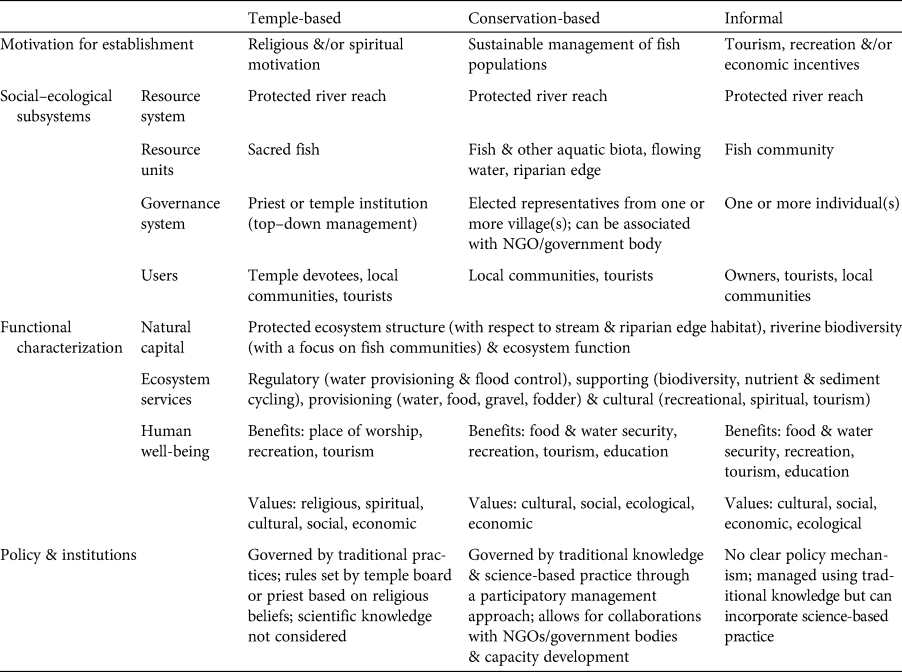
Based on the motivation behind their establishment and management, we identify three types of fish sanctuaries in India (Fig. 1, Table 1).
Framework to characterize community-based fish sanctuaries in India as a functional social–ecological system (Table 2).

Representative examples of community-based fish sanctuaries in India, including sanctuary type, priority fish species protected and key management strategies employed.

1NA: information not available.
Components of the social–ecological framework (Fig. 1) across three types of community-based fish sanctuaries in India.
(1) Temple-based fish sanctuaries
(Plate 1) These are protected river reaches or pools situated adjacent to temples or shrines. Although their numbers are not well established, we have observed > 30 temple-based sanctuaries across six states (Kerala, Karnataka, Maharashtra, Madhya Pradesh, Uttarakhand and Himachal Pradesh), and older records document up to 27 sacred fish ponds in a single district (Simoons, Reference Simoons1974). Temple-based sanctuaries are usually established to worship one or more fish god(s). Fish are considered sacred by various Hindu sects, particularly the Vaishnavite (worshippers of Lord Vishnu) and Saivite (worshippers of Lord Shiva) groups (Simoons, Reference Simoons1974). The first incarnation of Vishnu is believed to have been a fish who saved humanity from a destructive flood and is worshipped as the Matsya or Fish God. The Vedas, an ancient Hindu epic, mentions the mahseer fish being used by devotees to appease the souls of their deceased ancestors (Nautiyal, Reference Nautiyal1989). The Indus script also used the fish as a symbol to represent five important deities (Simoons, Reference Simoons1974). Some of the earliest records of fish sanctuaries date back to c. 295 BCE, whereas more recent records are from British naturalists of colonial India (Simoons, Reference Simoons1974). The iconic mahseer group (species belonging to the genera Tor, Neolissochilus and Naziritor; Eschmeyer & Fricke, Reference Eschmeyer and Fricke2010; Froese & Pauly, Reference Froese and Pauly2010) is revered in particular. These fish have high socio-cultural and religious significance throughout South and Southeast Asia, with references to them existing in various scriptures and sculptures (Nautiyal, Reference Nautiyal2014; Pinder et al., Reference Pinder, Britton, Harrison, Nautiyal, Bower and Cooke2019). In these sanctuaries, fish are protected from hunting and fed by priests and devotees (Table 1), and thus tend to grow large in body size and high in abundance.
The Shishileshwara temple fish sanctuary on the Netravathi River in Karnataka, India. Photo: Wikimedia Commons (2007).

(2) Conservation-based fish reserves
(Plate 2) These reserves are created and managed by local communities to protect freshwater resources and the services that they provide. They may receive governmental or NGO support and are similar to the Freshwater Conservation Reserves found across Southeast Asia (Koning et al., Reference Koning, Perales, Fluet-Chouinard and McIntyre2020). These fish reserves are gaining popularity in parts of north-east India, where fish diversity is particularly high and local communities heavily rely on fish for sustenance (Dash et al., Reference Dash, Tandel, Baruah and Sarma2020). For example, during 2012–2018, 54 fish sanctuaries were established in the state of Meghalaya alone (Dash et al., Reference Dash, Tandel, Baruah and Sarma2020). Fish are not explicitly revered in these reserves, and there may or may not be consistent food provisioning. Some communities offer tourism or catch-and-release angling in these reserves to generate revenue (Baruah & Sarma, Reference Baruah and Sarma2018; Dash et al., Reference Dash, Tandel, Baruah and Sarma2020).
Protector of the Wachi Wari fish sanctuary, a community-based conservation reserve in West Garo hills, Meghalaya, India. Photo: P. Dandekar.

(3) Informal fish sanctuaries
(Plate 3) These are uncommon and documented poorly. They are established through varying levels of protection afforded by one or more individual(s) or landowner(s), usually from a small household, river resort or tourism homestay located near a river. Such protected river reaches are created informally, without a clear intent to form a fish sanctuary. However, the protection they offer against exploitation and habitat destruction, along with food provisioning, leads to congregations of large-sized fish. Hence, they function as protected spaces. Often these are close to homestays or small-scale resorts, where fish congregations serve as tourist attractions.
The informal Sitanadi fish sanctuary in Karnataka, India. Photo: S. Machado.

Fish sanctuaries as social–ecological systems
We conceptualize fish sanctuaries using the social–ecological systems framework, which allows for the integration of social and ecological factors (Fig. 1; Ostrom, Reference Ostrom2009). This framework classifies the social–ecological system into four subsystems (resource systems, resource units, governance system and users) that interact with each other and are set within a larger ecological, social and political setting (Ostrom, Reference Ostrom2009; McGinnis & Ostrom, Reference McGinnis and Ostrom2014). For fish sanctuaries, we define the resource system as the extent of the sanctuary. The resource units, governance system and user subsystem vary across sanctuary types (Table 2). Additionally, we incorporate a functional characterization of the social–ecological system based on natural capital, ecosystem services and human well-being, which further influence the policy and governance of these systems (adapted from Resilience Alliance, Reference Resilience Alliance2010; Kalaba, Reference Kalaba2014).
For temple-based fish sanctuaries, the resource units are the revered fish, often belonging to the mahseer group (Nautiyal, Reference Nautiyal2014). Users include devotees, local communities and tourists; the governance system usually comprises a priest or a committee representing the temple institution. These fish sanctuaries are governed by traditional practices rooted in religious or spiritual beliefs and are further safeguarded by social customs. Devotees are encouraged to feed temple fish with puffed rice or biscuits. These practices have become ritualized as important religious activities, yet potentially they are contentious with conservation goals as these items are not considered by scientists as suitable food sources for wild fish. Scientific knowledge is usually not considered in the governance of fish sanctuaries, and religious beliefs can contradict scientific facts. For example, priests in the Shishileshwara fish sanctuary assign religious attributes to the fish and believe that mahseer are vegetarian despite their role as top predators in river systems.
Conservation-based fish reserves are examples of local communities self-organizing to manage a common natural resource for sustainable use. Here, the resource units comprise the protected river reach, including the protected fish, water, aquatic biota and adjoining riparian forests. Users include members of the local community, tourists and sometimes anglers (Dash et al., Reference Dash, Tandel, Baruah and Sarma2020). A locally elected committee comprising representatives from one or more village(s) usually forms the governance system, which may or may not include members from NGOs or local government bodies (Dash et al., Reference Dash, Tandel, Baruah and Sarma2020). These sanctuaries are primarily managed using the traditional knowledge of local communities, although scientific practices can be incorporated in the management of these sanctuaries when partnering with scientists, NGOs or governmental bodies, as in the case of the Lapalang fish conservation zone in Meghalaya (Pinto et al., Reference Pinto, Vaidyanathan, Varughese, Krishnaswamy, Massar and Haokip2021). As the fish are not revered, social compliance is achieved through participatory decision-making, penalties for the violation of rules and regular monitoring (Dash et al., Reference Dash, Tandel, Baruah and Sarma2020).
Informal sanctuaries are variable and their resource units comprise the protected fish populations. Users often include sanctuary owners/guardians and tourists or communities that visit the site. Although they lack a structured governance system, protection is offered through the presence of one or more vigilant individual(s) who reside(s) by the river. For example, the staff of the Sitanadi Jungle Camp began feeding the fish in the river near their campsite whilst simultaneously warding off illegal fishing activities. The consequent occurrence of high fish densities became a tourist attraction, which further encouraged protection efforts. Such sanctuaries are managed informally, including via food provisioning and the prevention of illegal activities such as destructive fishing practices and sand mining.
Based on the policies and institutions governing fish sanctuaries, their establishment creates natural capital assets, primarily in the form of protected riverine habitats and associated biotic components (Fig. 1, Table 2). Consequently, some level of ecosystem function is preserved, with the extent of this preservation depending on on sanctuary characteristics such as size, location and condition. Natural assets and preserved ecosystem function yield various ecosystem services to users within and beyond the boundary of the social–ecological system. Potential ecosystem services generated include regulatory (water purification, flood control), provisioning (water, food and/or fodder supply), supporting (biodiversity, nutrient cycling) and cultural (spirituality, tourism, recreation) services (Costanza et al., Reference Costanza, D'Arge, de Groot, Farber, Grasso and Hannon1997; Millennium Ecosystem Assessment, Reference Millennium Ecosystem Assessment2005). These services in turn provide direct benefits and intangible value to local communities, thereby contributing to human well-being (Fig. 1). The extent of ecosystem services realized is driven further by the policies and institutions governing these sanctuaries (Kalaba, Reference Kalaba2014), which vary across sanctuary types.
Threats to fish sanctuaries
As community-based fish sanctuaries are documented poorly and not recognized officially, they are subject to threats (Ramachandra et al., Reference Ramachandra, Chandran, Shenoy, Rao, Shivamurthy and Mukri2013; Gupta et al., Reference Gupta, Kanagavel, Dandekar, Dahanukar, Sivakumar, Mathur and Raghavan2016), which originate from factors within the boundary of the social–ecological system, within the broader river system and beyond the river system (Fig. 2).
Threats to community-based fish sanctuaries in India across spatial scales.

Threats originating within the social–ecological system are linked to the various subsystems and the interactions between them (Jupiter et al., Reference Jupiter, Epstein, Ban, Mangubhai, Fox and Cox2017). Often the efficacy of a social–ecological system centred on common-pool resource management relies on the ability of participatory mechanisms to align individual interests with those of the group (Ostrom, Reference Ostrom2009). The literature on common-pool governance (Ostrom, Reference Ostrom2009) suggests that the conservation outcomes of fish sanctuaries are influenced by interactions between subsystems. For example, sanctuaries can be threatened by the collapse of the governance subsystem (e.g. lack of participatory approaches, lack of trust, conflict amongst users, erosion of governance mechanisms), reduced social compliance (because of weakening religious beliefs, improper monitoring, dissatisfaction, changes in local demographics) or the loss of clarity of system boundaries (if boundaries are not well delineated). Such breakdowns in governance have occurred in fish sanctuaries in India. For example, a feud between two villages managing a fish sanctuary led to the collapse of the governance system and social compliance, resulting in the dynamiting and destruction of the Bansamgre fish sanctuary in Meghalaya (Dandekar, Reference Dandekar2018). Temple-based sanctuaries are also at risk because of declining religious beliefs, especially in younger generations who are influenced by increased urbanization and modernization (Gupta et al., Reference Gupta, Kanagavel, Dandekar, Dahanukar, Sivakumar, Mathur and Raghavan2016), or caste-based conflicts. For instance, in 1996 miscreants destroyed the protected fish population at the Shishileshwara fish sanctuary in Karnataka by pouring chemical poisons into the river as an act of sabotage (Akshatha, Reference Akshatha2011).
Threats at an intermediate scale, from outside the boundary of the social–ecological system but within the river system, are also prevalent. As most fish sanctuaries are not well documented and receive little to no formal protection, they are often ignored in environmental impact assessments and development planning. Consequently, many have been lost or are under threat from hydropower dams, water diversion projects, development of inland waterways and pollution (Dandekar, Reference Dandekar2013; Raghu, Reference Raghu2013; Pinder et al., Reference Pinder, Britton, Harrison, Nautiyal, Bower and Cooke2019). Dams can affect sanctuaries through submergence, loss of connectivity, flow regulation, altered riverine habitats and disturbances during their construction and operation (Bhatt & Pandit, Reference Bhatt and Pandit2016; Jumani et al., Reference Jumani, Deitch, Kaplan, Anderson, Krishnaswamy, Lecours and Whiles2020). For example, the proposed Kukke Stage I small hydropower project threatens the Yenekal and Nakur Gaya temple fish sanctuaries on the Kumaradhara River in Karnataka (Ramachandra et al., Reference Ramachandra, Chandran, Shenoy, Rao, Shivamurthy and Mukri2013). The Ganol and Daribokgre hydropower dams threaten numerous sanctuaries on the Simsang River (Gupta et al., Reference Gupta, Kanagavel, Dandekar, Dahanukar, Sivakumar, Mathur and Raghavan2016). Similarly, pollution events caused mass fish mortality in two temple sanctuaries on the Indrayani River and one on the Bhima River in Maharashtra (Pinder et al., Reference Pinder, Britton, Harrison, Nautiyal, Bower and Cooke2019). The destruction of resource systems and resource units adversely affects natural capital, thereby compromising the entire functional loop of the social–ecological system (Fig. 1). As many fish species in sanctuaries are potamodromous (i.e. those that undertake seasonal migrations to access upstream spawning habitats), fish populations are affected by dams that fragment the river and impede successful migration and reproduction (Nautiyal et al., Reference Nautiyal, Rizvi and Dhasmanaa2008; Gupta et al., Reference Gupta, Kanagavel, Dandekar, Dahanukar, Sivakumar, Mathur and Raghavan2016).
At broader scales beyond the river system, threats from global climate change also affect fish sanctuaries. Global warming has caused an increase in extreme climatic events, including more frequent and severe droughts and changes in rainfall patterns and intensity (Perkins et al., Reference Perkins, Alexander and Nairn2012; Trenberth et al., Reference Trenberth, Dai, van der Schrier, Jones, Barichivich, Briffa and Sheffield2014). These changes are expected to alter stream flows, increase stream drying, reduce hydrological connectivity and increase maximum water temperatures, which in turn affect endemic fish communities, especially in intermittent streams (Vorosmarty et al., Reference Vorosmarty, Green, Salisbury and Lammers2000; Meenu et al., Reference Meenu, Rehana and Mujumdar2013). The Himalayas are amongst the hotspots that are most sensitive to global warming (Immerzeel et al., Reference Immerzeel, van Beek and Bierkens2010; Hock et al., Reference Hock, Rasul, Adler, Cáceres, Gruber and Hirabayashi2019), with their rivers and fish populations being especially vulnerable (Grumbine & Pandit, Reference Grumbine and Pandit2013; Nautiyal, Reference Nautiyal2014). Increasing water temperatures have affected the reproduction of fish such as the Indian major carps in the river Ganga (Vass et al., Reference Vass, Das, Srivastava and Dey2009) and the copper mahseer Neolissochilus hexagonolepis (a flagship species in many fish reserves) in Meghalaya (Majhi et al., Reference Majhi, Das and Rajkhowa2013). Additionally, geographical shifts of warm-water species towards colder stretches have also occurred in various streams (Vass et al., Reference Vass, Das, Srivastava and Dey2009; Adve, Reference Adve2014).
Conservation potential of fish sanctuaries
Well-managed fish sanctuaries have the potential to contribute to the in situ conservation of freshwater fish, other aquatic biota and riparian habitats whilst also providing socio-cultural benefits. Sanctuaries can function as riverine protected areas, protecting not only fish and biotic communities but also entire reaches of riparian habitats, akin to the freshwater conservation zones that have been documented across Southeast Asia (Baird et al., Reference Baird, Flaherty and Baird2005; Koning et al., Reference Koning, Perales, Fluet-Chouinard and McIntyre2020). By safeguarding against harmful activities, fish sanctuaries have the potential to form refuge habitats for species of high conservation importance such as the black mahseer Tor khudree (Least Concern), Malabar mahseer Tor malabaricus (Endangered), hump-backed mahseer Tor remadevii (Critically Endangered), copper mahseer N. hexagonolepis (Near Threatened) and kooral or Curmuca barb Hypselobarbus curmuca (Endangered). For example, surveys along the Savitri basin in the Western Ghats recorded the migratory T. khudree only in and around the Walan Kond temple-based fish sanctuary (Katwate & Katwate, Reference Katwate and Katwate2015). As illustrated by studies of similar freshwater conservation zones in Laos (Baird et al., Reference Baird, Flaherty and Baird2005) and Thailand (Koning et al., Reference Koning, Perales, Fluet-Chouinard and McIntyre2020), fish communities in such sanctuaries can attain higher species richness, density and biomass, and can potentially serve as source populations for adjacent river reaches.
Given that community-based initiatives can achieve in situ conservation whilst circumventing excessive spending and bureaucratic processes (Dandekar, Reference Dandekar2018), there is an urgent need to tap into their conservation potential. Temple priests can be powerful allies in efforts to curb prevalent destructive practices such as illegal sand mining, dynamiting and poison fishing. As temple institutions and leaders are respected by local communities, they can garner local conservation support through communication and education (Sheikh, Reference Sheikh2006; Bhatia et al., Reference Bhatia, Redpath, Suryawanshi and Mishra2017). Similarly, capacity building with key actors in community-based reserves could help promote best practices. Targeted engagement with landowners near streams that support high freshwater biodiversity can also help to popularize and improve informal fish sanctuaries.
Efforts made by NGOs, scientists and governmental bodies to engage with local communities can also aid in the creation of new fish sanctuaries. For example, the Meghalaya State Aquaculture Mission has been working with local communities to revitalize their traditional fish protection and management practices. Since 2012 they have helped local communities establish > 54 fish sanctuaries in Meghalaya (Meghalaya State Aquaculture Mission, 2014). Although governmental agencies offer infrastructure and logistical support, the local community manages, protects and monitors the sanctuaries (Dandekar, Reference Dandekar2018). Such sanctuaries have benefitted local communities through increased capture of food fish, local tourism, generation of employment and improved livelihoods (Meghalaya State Aquaculture Mission, 2014).
Given their socio-ecological importance, sanctuaries should be integrated into broader conservation efforts and recognized in official decision-making processes, impact assessments and development planning, similarly to how protected areas and sacred groves are considered. Consideration should also be given to increasing the recognition of fish sanctuaries by pursuing their official designation, for example as IUCN Category VI protected areas. However, given that sanctuaries are typically small, scattered and vulnerable to threats from within and beyond their boundaries, additional strategies are needed for fish conservation. Multi-pronged approaches that include catchment-scale management and conservation, legislation, education programmes and enforcement will be essential to conserving these systems.
Directions for future research
Community-based fish sanctuaries are complex social–ecological systems that have been documented to some extent in popular articles and historical records, but have been mostly overlooked in the scientific literature (except Gupta et al., Reference Gupta, Kanagavel, Dandekar, Dahanukar, Sivakumar, Mathur and Raghavan2016). Given their potential for conservation, there is an urgent need to address this lack of scientific knowledge. All of the available information on known sanctuaries needs to be compiled into a publicly available data source, particularly as many such sanctuaries are being destroyed without having been documented.
We highlight the following areas as priorities for further research: (1) Determine the impacts of sanctuaries on fish behaviour and population dynamics, other aquatic biota and riverine habitats. (2) Examine the potential of protected fish communities to serve as source populations within a river system. (3) Determine how factors such as sanctuary size, location, level of protection and local compliance with protective regulations influence the effectiveness of sanctuaries in protecting threatened species. (4) Ascertain the social, ecological and institutional factors that contribute to the various conservation outcomes of these sanctuaries (Gokhale et al., Reference Gokhale, Velankar, Chandran, Gadgil, Ramakrishnan, Saxena and Chandrashekara1998; Ostrom, Reference Ostrom2009; Jupiter et al., Reference Jupiter, Epstein, Ban, Mangubhai, Fox and Cox2017). (5) Determine the users and governance subsystems across fish sanctuary types, communities and geographical regions and their influence on the efficacy of management techniques, levels of compliance and local attitudes towards these systems. (6) Examine the responses and adaptive capacities of sanctuaries to growing anthropogenic threats. (7) Determine the varied ecosystem services derived from sanctuaries.
Acknowledgements
We thank Mahi Puri, Chad Palmer and Woi Sok for comments on manuscript drafts, and the Editor and two anonymous reviewers for their critiques. This research received no specific grant from any funding agency or commercial or not-for-profit sectors.
Author contributions
Conceptual development: SJ, with contributions from VH; writing: SJ, with contributions from VH, PD, NM.
Conflicts of interest
None.
Ethical standards
This research abided by the Oryx guidelines on ethical standards.


 Open access


