

Introduction
Mediterranean ecoregions, characterized by a mild climate of cool, wet winters and warm, dry summers, are recognized as global priorities for conservation due to their high levels of endemism and increasing habitat loss (Cowling et al. Reference Cowling, Rundel, Lamont, Arroyo and Arianoutsou1996, Myers et al. Reference Myers, Mittermeier, Mittermeier, da Fonseca and Kent2000). Yet, only 4.3% of the Mediterranean biome is within formally protected reserves, one of the lowest percentages of any biome (Underwood et al. Reference Underwood, Viers, Klausmeyer, Cox and Shaw2009). Private land conservation efforts are needed, especially partnerships with the agricultural industry, which is a major economic driver in these regions (Cox & Underwood Reference Cox and Underwood2011). Decisions concerning privately protected areas (PPAs), agricultural production and which management approaches to use in human-dominated landscapes will largely determine the fate of biodiversity and ecosystem services in Mediterranean regions (Viers et al. Reference Viers, Williams, Nicholas, Barbosa, Kotzé, Spence and Webb2013).
The burgeoning wine industry is cause for ecological concern as native habitats are converted (Cox & Underwood Reference Cox and Underwood2011). However, wine grapes are a high-value specialty crop that can both benefit from and contribute to biodiversity conservation. Winegrowing depends on several ecosystem services, such as natural pest control, climatic regulation, soil formation and tourism, all which can be enhanced not only by setting aside adjacent land, but also by the adoption of on-farm management practices, such as maintaining biological corridors (Hilty & Merenlender Reference Hilty and Merenlender2004), inter-row ground cover (Petremand et al. Reference Petremand, Fleury, Castella and Delabays2016) and islands of remnant habitat (Steel et al. Reference Steel, Steel, Williams, Viers, Marquet and Barbosa2017). Moreover, wine is largely defined by the term terroir, a concept that links the geographic origin and identity of the wine. This refers to the specific characteristics of the soil, topography, climate, landscape and biodiversity in the vineyard (OIV 2010) and recognizes the importance of natural assets that contribute to wine identity and uniqueness (Miura et al. Reference Miura, Sánchez, Castañeda, Godoy and Barbosa2017), a highly appreciated value for consumers (Viers et al. Reference Viers, Williams, Nicholas, Barbosa, Kotzé, Spence and Webb2013).
Some wine-producing regions are introducing sustainability programmes to promote practices that reduce a vineyard’s negative environmental impact by conserving energy or reducing carbon emissions, yet few make explicit connections to biodiversity conservation outcomes (Webb et al. Reference Webb, Barbosa, Granillo, Kotzé, Nicholas, Spence and Viers2011). One exception is the Biodiversity and Wine Initiative of the World Wide Fund for Nature (WWF), a partnership between the South African wine industry and non-governmental conservation organisations. This programme has contributed to conserving the endangered vegetation in the Cape Floristic Region by encouraging the adoption of conservation practices as part of sustainable winegrowing (von Hase et al. Reference von Hase, Rouget and Cowling2010). Similarly, the Wine, Climate Change and Biodiversity Programme (WCB), a voluntary environmental programme of the Institute of Ecology and Biodiversity in Chile, encourages wineries to protect natural adjacent land and to adopt management practices that maintain biodiversity and ecosystem services within vineyards (hereafter called conservation practices). The programme develops applied research and offers technical assistance for participants, mainly through conservation education workshops (see Supplementary Material S1, available online, for more information). The number of wineries partnering with the WCB programme has increased, from one in 2008 to 14 during the first five years of the programme (Barbosa & Villagra Reference Barbosa and Villagra2015). These wineries have set aside nearly 20 600 ha for conservation of native forest and shrubland in a region where only 1.7% or 256 901 ha are protected by the National System of Protected Areas (Schutz Reference Schutz2017). Despite these important contributions, the underlying motivations of landowner participation and the programmes’ impacts on attitudinal and behavioural components of conservation action on private agricultural land remain largely unknown. This information is critical to shape and adapt local conservation programmes, especially in Chile, where to date there is no legal framework to support PPAs.
Assessing the effectiveness of conservation interventions is essential to ensure that scarce funds are efficiently used to achieve conservation outcomes (Ferraro & Pattanayak Reference Ferraro and Pattanayak2006, Jacobson Reference Jacobson2009) and to contribute to understanding policies that promote conservation action (e.g., Pannell Reference Pannell2008). Most assessments measure success based on land area protected, but not the underlying drivers of programme effectiveness, which rest upon decisions made by participating individuals (Knight et al. Reference Knight, Cowling, Difford and Campbell2010, Stolton et al. Reference Stolton, Redford and Dudley2014). Of the studies analysing landholder participation in PPA conservation programmes, results have identified multiple factors in order to develop effective strategies to enhance participation and meet programme objectives within time and budget constraints (Kabii & Horwitz Reference Kabii and Horwitz2006). For instance, in South Africa, the success of private conservation programmes depends on the attitudes of landowners towards the particular habitat or species to be conserved, demographic characteristics (Winter et al. Reference Winter, Prozesky and Esler2007), conservation values and emotional relationships with the land (Selinske et al. Reference Selinske, Coetzee, Purnell and Knight2015). In California, adoption of sustainable practices in vineyards, such as pest monitoring and irrigation management, resulted from participation in a sustainable winegrowing programme (Shaw et al. Reference Shaw, Lubell and Ohmart2011). Proactive environmentalism in the US wine industry was linked to managers’ attitudes and social pressures (Marshall et al. Reference Marshall, Cordano and Silverman2005). In the New Zealand wine industry, the most important drivers for sustainable practices were managers’ personal values, product quality and customer demand (Gabzdylova et al. Reference Gabzdylova, Raffensperger and Castka2009). In fact, manager attitudes and export dependence are stronger determinants of environmental practice adoption in New Zealand compared to the USA (Marshall et al. Reference Marshall, Akoorie, Hamann and Sinha2010). Thus, understanding the relationship between attitudes, social pressures and motivations is necessary for successful participation and retention in any conservation programme, especially on private lands where success depends on landowner commitment (Potoski & Prakash Reference Potoski and Prakash2013, Selinske et al. Reference Selinske, Coetzee, Purnell and Knight2015).
Social science frameworks can improve the effectiveness of sustainability programmes by enhancing understanding of what drives conservation behaviours and informing the development of effective strategies to enhance participation (Bennett et al. Reference Bennett, Roth, Klain, Chan, Clark, Cullman and Epstein2016). Understanding motivations to adopt voluntary conservation practices is a key to better policy (Potoski & Prakash Reference Potoski and Prakash2013). The well-used theory of planned behaviour (TPB) (Ajzen Reference Ajzen1985) establishes that personal behaviour depends on behavioural intention that is predicted by three constructs: (1) attitude towards the behaviour, which refers to the sum of a person’s positive or negative evaluations of performing the behaviour; (2) subjective norm, which reflects the sum of the perceived desire of significant others to approve or disapprove of a particular behaviour; and (3) perceived behavioural control, which is related to the sum of perceptions of internal and external constraints on performing a behaviour. This framework has been widely applied when exploring individual environmental behaviours (Aguilar-Luzón et al. Reference Aguilar-Luzón, García-Martínez, Calvo-Salguero and Salinas2012, López-Mosquera & Sánchez Reference López-Mosquera and Sánchez2012), as well as farmer and rancher conservation behaviours (Dolisca et al. Reference Dolisca, McDaniel, Shannon and Jolly2009, Willcox et al. Reference Willcox, Giuliano and Monroe2012, Mastrangelo et al. Reference Mastrangelo, Gavin, Laterra, Linklater and Milfont2013, Brain et al. Reference Brain, Hostetler and Irani2014). It also has been used to explore managers’ attitudes towards environmental management within organizations (Cordano & Frieze Reference Cordano and Frieze2000, Flannery & May Reference Flannery and May2000, Papagiannakis & Lioukas Reference Papagiannakis and Lioukas2012).
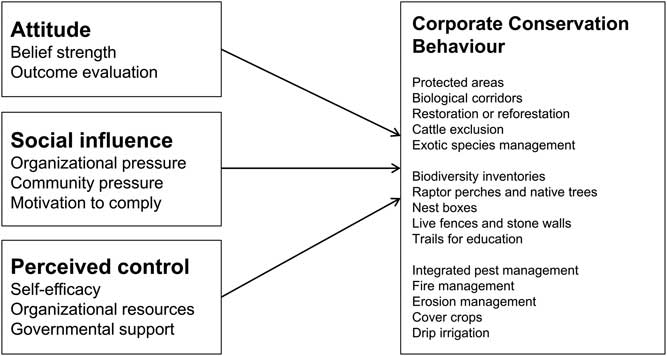
To fit the organizational context of the Chilean wine industry, we substituted the TPB construct of subjective norm with perceived social influence (SI) (Kaufmann et al. Reference Kaufmann, Stagl and Franks2009, Chou et al. Reference Chou, Chen and Wang2012). SI emphasizes internal social pressures and external community pressures that vineyard managers perceive when making conservation decisions. We also conceptualize corporate conservation behaviour as a multidimensional construct, not attached to a specific behaviour, following the concept of corporate environmental responsiveness (Papagiannakis & Lioukas Reference Papagiannakis and Lioukas2012) (Fig. 1).
Our model of corporate conservation behaviour for Chilean wineries, modified from the theory of planned behaviour, delineates three predictive factors: (1) attitude towards corporate conservation behaviour; (2) social influence; and (3) perceived behavioural control (adapted from Papagiannakis & Lioukas Reference Papagiannakis and Lioukas2012).
This study is the first to assess participation in a sustainability winegrowing programme in Latin America and to use the TPB to understand the attitudinal and behavioural decision factors determining winegrowers’ conservation behaviours in the critically endangered Mediterranean ecosystems. The study goals are: (1) to understand the factors that influence winegrowers’ decisions related to conservation; and (2) to examine whether those factors differ between vineyards participating in the WCB programme and unexposed vineyards. Based on this theoretical framework, we predicted that vineyards involved in the WCB programme would: (1) exhibit higher levels of corporate conservation behaviour and related positive attitudes; (2) perceive more SI; and (3) perceive fewer constraints to performing conservation behaviours than comparison vineyards.
Methods
Data Collection
All 14 vineyards currently enrolled in the WCB, which represent 8% of the total number of Chilean wineries, were contacted for interviews. To select the comparison group, we used a Wines of Chile Association database of 90 wineries to classify the WCB vineyards into strata based on the volume of wine exported and randomly selected comparison vineyards from the same strata (n=14). The prospective respondents, the agricultural managers or managers directing farm management practices were sent an introductory letter and two emails, then telephoned to encourage participation (Dillman et al. Reference Dillman, Smyth and Christian2009).
Semi-structured interviews were conducted in 13 vineyards of the WCB programme and 10 of the comparison group (93% and 71% response rates, respectively). In total, 25 managers were interviewed (two managers worked in two of the vineyards). Interviews were typically conducted on the farm or in the headquarter offices. All interviews were conducted face to face, audio recorded upon respondent’s permission and conducted by the primary author during June–July 2013. The mean interview duration was 53.8 minutes (SD=3.3, range=30–103), and this was similar for the WCB and comparison groups (Mann–Whitney U=64, p=0.57).
Most of the respondents were men (96%), with a mean age of 43 years. The majority of WCB and comparison managers (65%) reported their vineyards exported more than 80% of their production to the USA, Europe, Asia and Brazil, and about half owned more than 1000 ha, including cultivated and non-cultivated land divided into one or more farms in the Mediterranean region. A description of the respondents and companies is presented in Supplementary Material S2.
Survey Instrument
The semi-structured interviews comprised open-ended and closed questions including vineyard and demographic characteristics, current use of 15 conservation practices highlighted by the WCB programme (grouped into three categories: sustainable agriculture, private land conservation and wildlife friendly practices), evaluation of conservation practices, perceived SI, barriers and motivations for conservation practices and programme participation. To explore differences in goals for the vineyards, the participants were asked to rank the importance of ten farm goals that fell into three broad categories of environmental sustainability, productivity and social standards. Three pilot tests allowed us to shorten the original list of 17 items.
Data Analysis
The adoption of conservation practices and the mean rank of farm goals were analysed with non-parametric statistics (e.g., Mann–Whitney U and Fisher’s exact tests) due to the small sample size. Interview recordings were transcribed, coded, checked for consistency over time (Richards Reference Richards2014) and analysed according to Thomas (Reference Thomas2006) by the primary author. Codes were interpreted into broad themes based on the theoretical constructs of TPB and differences between WCB and the comparison group were examined. The cross-sectional research design used in this study did not allow us to establish a causal relationship between WCB programme interventions and observed differences between WCB and comparison vineyards. We lacked baseline data from managers before their enrolment in the WCB program; however, the comparison of the two groups allowed us to identify factors underlying conservation behaviours in the region studied, as well as to test a theoretical framework in the context of the study.
Results
Corporate Conservation Behaviour
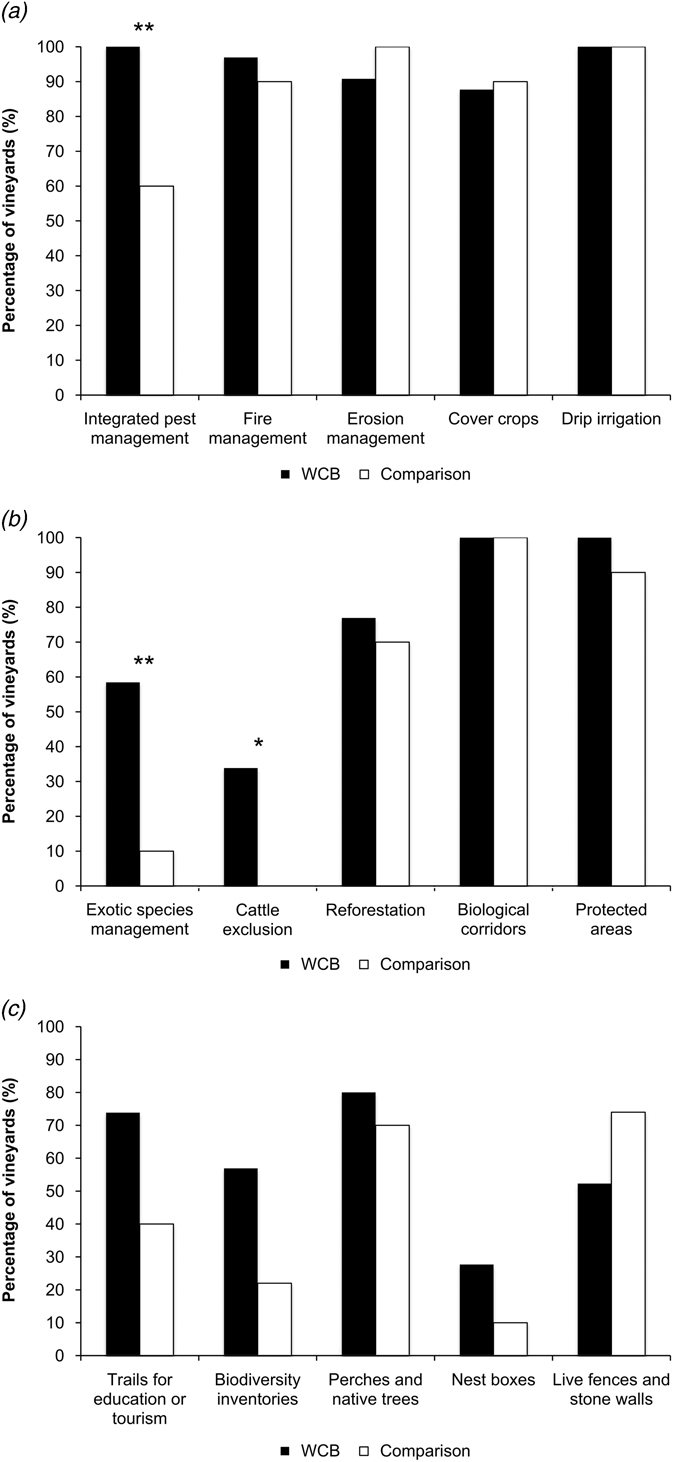
Most vineyards (70% in each group) adopted 8 of 15 practices. Sustainable agriculture practices were common across both groups except for integrated pest management, which was more often adopted by WCB vineyards (Fisher’s exact test, p=0.024) (Fig. 2). Common private-land conservation practices included reforestation, biological corridors and protected areas, while WCB vineyards removed exotic species, such as California poppy (Eschscholzia californica) or Eucalyptus spp., more often than the comparison group (Fisher’s exact test, p=0.038). This group reported learning from the WCB programme about which species were invasive and how to control them. The WCB vineyards also tended to exclude cattle from protected areas to allow native species to grow, while comparison vineyards allowed cattle to graze in their protected areas (Fisher’s exact test, p=0.081), believing that grazing reduced the fire risk by keeping grass short. Overall, the WCB group adopted more conservation practices (mean=11.4, SD=1.8) than the comparison group (mean=9.3, SD=1.8) (Mann–Whitney U=104, p=0.015).
Percentages of Wine, Climate Change and Biodiversity Programme (WCB) and comparison vineyards implementing: (a) sustainable agricultural practices; (b) private land conservation practices; and (c) wildlife friendly practices.*p < 0.1, **p < 0.05.
The mean rank of ten farm goals did not differ between groups. The goal of ‘biodiversity conservation’ was negatively correlated with ‘improve wine quality’ (r=–0.650, p=0.000) and positively correlated with ‘preserve vineyard’s tradition’ (r=0.423, p=0.035) (Supplementary Material S3).
Attitudes towards Conservation Behaviour
The respondents identified many positive outcomes associated with the adoption of conservation practices (Table 1). These ranged from financial and strategic drivers to the benefits of ecosystem services. Positive corporate image was the most frequent strategic driver. Some WCB respondents linked conservation with positive corporate image and product quality (protecting nature maintains a terroir, which gives identity to the wine and an image to sell). Both groups mentioned the financial driver of cost savings related to the ecosystem service of pest and disease control. Increasing profit was not mentioned as a direct motivation for engaging in conservation practices.
Positive outcomes associated with the adoption of conservation practices as reported by managers. WCB=Wine, Climate Change and Biodiversity Programme
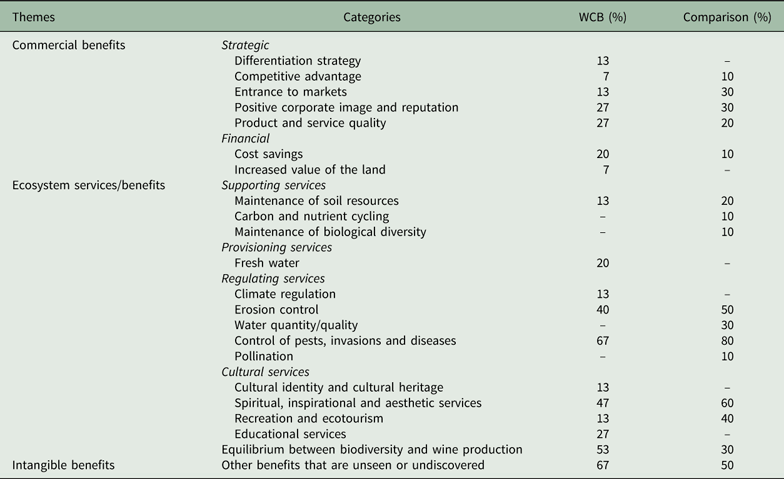
Among ecosystem services, the managers were more aware of regulating and cultural services rather than supporting or provisioning services. The WCB managers recognised more cultural services than the comparison group (Table 1). Both groups identified positive connections between biodiversity and winegrowing, particularly for pest and disease control. However, many managers did not see evidence of direct impacts on wine production, such as improved quality or higher yields, even from WCB vineyards.
Few negative outcomes of biodiversity conservation were reported (Table 2). Both groups reported some management practices becoming more complex or inefficient with conservation, such as maintaining native trees within crop rows that may impede machinery, and the economic and opportunity costs of conservation land rather than productive land.
Negative outcomes and other motivations associated with the adoption of conservation practices as reported by managers. WCB=Wine, Climate Change and Biodiversity Programme
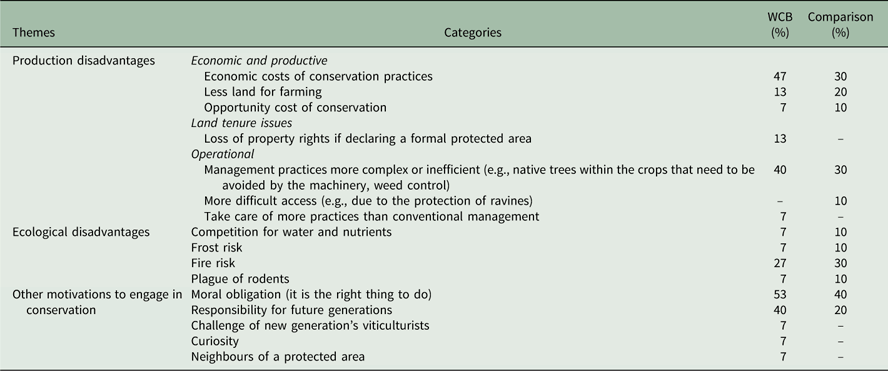
Other motivations for engaging in conservation behaviour were not related to specific outcomes of conservation, but derived from relationships with nature and with other people (Table 2). Several managers discussed their responsibility to future generations and saw conservation practices as doing ‘what is right’.
Social Influence
Managers from the WCB group reported positive social pressures to perform conservation behaviour from 20 stakeholder groups, almost twice as many as comparison group managers reported from 11 stakeholder groups (Table 3). The highest percentage of wineries reported the influence of the customers and the owner of the vineyard. Managers said that customers, especially from Europe and North America, are increasingly requesting environmentally friendly products. However, some managers, especially from the WCB group, perceived market pressures mainly to avoid the use of chemical products and stated that the market does not require nor monetarily reward biodiversity conservation efforts. For example, a WCB manager reported that wine quality is what matters when it comes to the customers: “No customer buys a bad wine twice. The customer bought it once because of the seal, because it takes care of the birds, whatever, but if the wine is bad the guy won’t buy it again.”
Positive social pressures for implementing sustainability and conservation practices from different stakeholder groups related to the organization and from the community. WCB=Wine, Climate Change and Biodiversity Programme
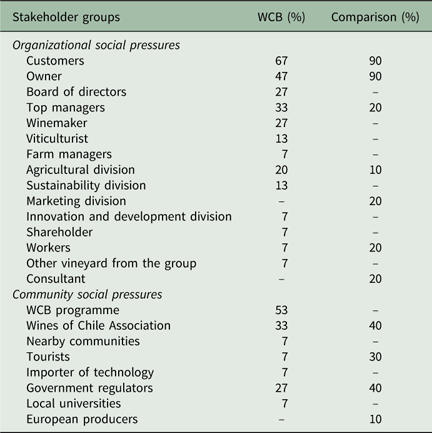
Managers in both groups reported a major influence of the owner, who either agreed with or led environmental stewardship actions within the company. The vineyard that scored lowest in conservation behaviour reported no interest from the company’s owner. Other influential stakeholders were the top managers, and specific individuals in the case of some WCB vineyards, such as the winemaker and viticulturist.
Perceived social pressures from external stakeholders came mainly from government regulators and the Wines of Chile Association, a trade association of wine producers that created a Sustainability Code in 2011, a voluntary resource to guide the national industry towards sustainable winegrowing. Perceptions about the conservation influence of the Wines of Chile Association varied from strong (24% of managers) to insignificant (24% of managers) for conservation decision-making. Managers perceived pressures to comply with national environmental regulations as mainly focusing on chemical products and industrial waste management, environmental impact assessments and compensation projects for land-use change.
Most managers reported that their company would approve of conservation practices, but ultimately financial considerations would dictate decisions. The WCB managers reported that they made decisions about conservation as a team, which included some influential stakeholders (e.g., viticulturist, winemaker, sustainability manager). The WCB group reported a broader spectrum of organizational and community stakeholder influence in contrast to more centralized conservation decision-making by comparison vineyard owners and managers.
Perceived Behavioural Control
The WCB managers reported almost twice the number of constraints to conservation practices (mean=2.6, SD=1.28) than the comparison group (mean=1.4, SD=1.17) (Mann–Whitney U=107.5, p=0.026). Most constraints were external, related to organizational resources or technical support for conservation, rather than internal or related to managers’ self-efficacy in handling environmental issues (Table 4). The organizational resources needed for conservation were common constraints for both groups and encompassed economic and human resources.
Perceptions of constraints and facilitating factors for conservation. WCB=Wine, Climate Change and Biodiversity Programme
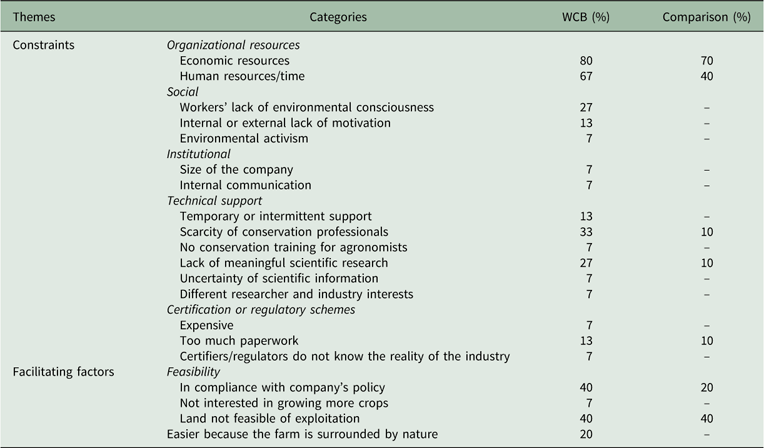
Managers reported a lack of scientific and technical support for conservation practices as a constraint. Although the technical assistance of the WCB programme was valued for providing conservation information, a WCB manager said he still lacked the scientific information to make economic decisions about conservation: “I need to see evidence that conservation will lead to more or less grape production, or if the wine quality will change and how much more or less the consumers will pay for that quality… because at the end of the day vineyards are business.”
Managers from both groups reported having set aside conservation land, often because it was too expensive or complicated to exploit (e.g., cultivation on steep hillsides) or because the soil was poor for wine grapes (Table 4). Perceptions of governmental support and legislation for conservation are shown in Supplementary Material S4.
Discussion
Based on the TPB, this study identified factors underlying conservation behaviour between vineyards affiliated with the WCB sustainability initiative and a comparison group. Participation in the WCB programme was positively associated with the adoption of conservation practices. Positive and negative attitudes towards conservation were similar between WCB and comparison wineries, yet stakeholder SI and perceptions of constraints differed.
Similar Attitudes towards Conservation Behaviour
Previous research has shown the importance of managers’ attitudes on corporate environmental responsiveness for different manufacturing industries (Cordano & Frieze Reference Cordano and Frieze2000, Flannery & May Reference Flannery and May2000, Papagiannakis & Lioukas Reference Papagiannakis and Lioukas2012), and more specifically in the wine industries of the USA and New Zealand (Marshall et al. Reference Marshall, Cordano and Silverman2005, Reference Marshall, Akoorie, Hamann and Sinha2010). In the case of Chilean winegrowers, positive attitudes were mainly related to the evaluation of strategic outcomes of conservation practices rather than financial reasons (i.e., helping to achieve a commercial plan), as well as regulatory and cultural services provided by nature. Contrary to our prediction that WCB managers would exhibit more positive attitudes than the comparison group, we found that positive attitudes were held by both groups of managers. For example, our analysis showed that the comparison managers were also aware of the ecosystem service of pest control, but did not implement integrated pest management as the WCB group did. Thus, attitudes did not help to explain differences in conservation practices between groups of vineyards, suggesting that attitudes may not be an important driver of conservation behaviour in Chile, as previous studies have shown in other countries.
Intangible Relationship between Terroir and Conservation
Several authors have emphasized strategic drivers for corporate environmentalism (Bhattacharya & Sen Reference Bhattacharya and Sen2004, Marshall et al. Reference Marshall, Cordano and Silverman2005, Bhaskaran et al. Reference Bhaskaran, Polonsky, Cary and Fernandez2006, Pannell Reference Pannell2008), but few have explored the ecological benefits of conservation. This is highly relevant for the wine industry because wine is largely defined by its geographic origin and the local climatic and edaphic conditions where the grapes are grown, captured in the term gout de terroir or ‘taste of the earth’ (Viers et al. Reference Viers, Williams, Nicholas, Barbosa, Kotzé, Spence and Webb2013). Yet, few wine managers identified the supporting services of ecosystems directly related to the concept of terroir (e.g., maintenance of soil resources, carbon and nutrient cycling). These services are controlled by variables that change relatively slowly and their benefits are intangible for society (Chapin et al. Reference Chapin, Kofinas and Folke2009). For that reason, they are often taken for granted or overlooked by managers and the public. In fact, vineyard managers did not perceive any direct impacts of conservation on wine production or quality, which was reflected in the negative correlation between conservation and wine quality in the ranked responses for farm goals. The need to strengthen the linkage between conservation practices and the potential for improved product quality was also suggested for the US wine industry, yet research is still needed (Marshall et al. Reference Marshall, Cordano and Silverman2005).
Prominent Role of Stakeholders
Managers from WCB programme vineyards perceived broader organizational and community stakeholder influence than comparison group managers, who mainly focused on the owner and customers as the main drivers of adoption, as predicted by the TPB. Specific individuals within the WCB vineyards may have served as environmental leaders, influencing the decision-making process and motivating the companies to embrace conservation efforts. In other studies, SI alone had little effect on organic farmers’ decisions to adopt sustainable actions (Kaufmann et al. Reference Kaufmann, Stagl and Franks2009). Likewise, SI did not sway restaurant managers’ intentions to adopt sustainable practices (Chou et al. Reference Chou, Chen and Wang2012). In contrast, internal stakeholder pressures are common drivers of environmental practice adoption in the US and New Zealand wine industries (Marshall et al. Reference Marshall, Cordano and Silverman2005, Reference Marshall, Akoorie, Hamann and Sinha2010). Our results support these findings and highlight the importance of the owner, top managers and specific individuals in the conservation decision-making process. The internal or organizational social pressures, as well as the company’s decision-making structure, play an important role in the adoption of conservation behaviours in the Chilean wine industry.
Consumer demand emerged as an important driver of sustainability for the Chilean wine industry, as has been reported in New Zealand and the USA (Gabzdylova et al. Reference Gabzdylova, Raffensperger and Castka2009, Marshall et al. Reference Marshall, Akoorie, Hamann and Sinha2010). However, managers perceived these pressures as targeting a wide range of sustainability practices of the companies as a whole, rather than specific biodiversity conservation outcomes in the field. Conservation practice adoption may not command price premiums simply because customers ignore the environmental public goods produced by these companies (Potoski & Prakash Reference Potoski and Prakash2013). Compared to customers and vineyard owners, the role of external or community stakeholders, such as Wines of Chile Association and government regulators, played a minor role in influencing the adoption of sustainability and conservation practices. The role of both customers and community stakeholders should be expanded in order to establish standards to protect biodiversity and the wine’s terroir. Progress has been made recently with a joint effort between the WCB programme and affiliated vineyards to encourage the Wines of Chile Association to incorporate biodiversity conservation guidelines in their Sustainability Code (Wines of Chile 2015).
More Barriers Do Not Mean Less Control
Our third prediction that WCB managers would perceive fewer constraints on performing conservation behaviours than the comparison group was unsupported. WCB vineyards reported more constraints on performing conservation behaviours than the comparison group. This does not necessarily imply that WCB managers’ perceived control over the conservation behaviour was low. We were not able to assess managers’ beliefs about their ability to deal with specific inhibiting or facilitating factors. Thus, WCB vineyards may have identified more constraints just because they were adopting more conservation practices or receiving more information about dealing with constraints than the comparison group, but not because managers did not feel capable of dealing with them. Future studies should incorporate additional indirect measures (Ajzen Reference Ajzen2002) on the basis of beliefs about managers’ perceived ability to deal with constraints.
Managers weighed conservation within the context of economic pressures that often force farmers to use the land most productively in the short term. Our results support previous studies that have found that economic pressures often prevent landowners from protecting wildlife habitats on their properties (Plieninger et al. Reference Plieninger, Modolell and Konold2004, Winter et al. Reference Winter, Prozesky and Esler2007). Likewise, financial incentives, primarily estate tax reductions, had a major influence on US ranchers’ decisions to enter into conservation easement agreements (Brain et al. Reference Brain, Hostetler and Irani2014). Providing economic incentives to influence winegrowers’ behaviours is an option, but could erode both personal and social norms by turning behaviours motivated by norms into financially motivated behaviours (Rode et al. Reference Rode, Gómez-Baggethun and Krause2015). The WCB and other conservation programmes need to address external drivers more directly to be more effective in fostering lasting conservation behaviour changes among Chilean winegrowers. Developing economic incentives based on market mechanisms or government contracts should be undertaken cautiously because of their temporary and volatile nature. These may be easily eroded if costs and benefits shift (Pannell Reference Pannell2008).
Our results suggest that elucidating the link between conservation, terroir and wine production and quality would be more helpful in persuading Chilean wineries to overcome financial constraints and invest in conservation. This relationship was perceived by managers as ambiguous and more strategic than ecological (i.e., related to positive corporate image), and therefore more intangible than tangible. Research is needed to elucidate this relationship and generate reliable and persuasive data for decision-making.
The conservation of endangered Chilean Mediterranean ecosystems, which are extremely underrepresented in the National System of Protected Areas, currently depends on farmers and private landholders. This study provides new information about conservation decision-making in the Chilean wine industry, unravelling the multidimensional nature of winegrowers’ motivations for and barriers to conservation behaviour adoption in vineyards. The success of adopting conservation practices depends not only on the manager’s positive evaluation of practices, but also on the internal and external social pressures managers perceive, the organizational structure and how decisions are made in the company and the manager’s control over factors such as available information, technical support and economic resources. These results provide a comprehensive explanation of the dynamics of influences on corporate conservation behaviour, which is critical to addressing the significant challenges facing biodiversity conservation and the promotion of sustainable agricultural systems. As other agricultural sectors begin to adopt sustainability and biodiversity guidelines, this type of analysis aids understanding not only of effective practices, but also of how and why managers adopt them.
Supplementary Material
For supplementary material accompanying this paper, visit http://www.journals.cambridge.org/ENC
Supplementary material can be found online at http://dx.doi.org/10.1017/S0376892918000206
Acknowledgements
We thank all the managers who gave their valuable time to participate in the study. Thanks to Karina Godoy, Fabiola Canepa, Matías Tobar, Daniela Araya and Camila Agurto for their essential research assistance. We also thank Martha Monroe, Mickie Swisher, Glenn Israel and three anonymous reviewers for their helpful reviews and suggestions.
Financial Support
Funding was provided by the Comisión Nacional de Investigación Científica y Tecnológica (CONICYT) (OB, CONICYT PIA APOYO CCTE AFB170008) (MM-G, doctoral fellowship), the Tropical Conservation and Development Programme Research Grant and the Tinker Foundation at the University of Florida.
Conflict of Interest
None.
Ethical Standards
The authors assert that all procedures contributing to this work comply with applicable national and institutional ethical guidelines for human subjects (University of Florida-IRB approval #2013-U-0629).



