




1. Introduction
The Tocharian A hapax ṣtākkrukkeśśi has been analysed as a genitive plural and translated as “to the slanderers” (Pinault Reference Pinault1991, DTTA). Its etymology and external connections, however, remain unclear. In this article, I propose that it was borrowed from an earlier form of Old Khotanese ṣṭakulcā-, a derivative of Old Khotanese ṣṭakulā- “abuse”. A close investigation of the textual occurrences of the Tocharian A and Khotanese lexemes reveals that the two words were used in the same sociolinguistic settings in both languages.
Section 2 introduces the Tocharian A lexeme and discusses its occurrences in the Maitreyasamiti-Nāṭaka, considering also its Old Uyghur translation. Section 3 is devoted to the Khotanese lexeme and aims at uncovering its semantics through an investigation of the attestations in the Book of Zambasta. Several Buddhist Sanskrit texts are also examined for this purpose, and a brief excursus bears on some Late Khotanese occurrences of the term. In this section, I also consider the possibility that Old Khotanese ṣṭakulā- may have been borrowed from Gāndhārī. The technical details of the borrowing trajectory Khotanese → Tocharian A are discussed in Section 4, and Section 5 contains a summary of the results of the study.
2. Tocharian A ṣtākkrukkeśśi
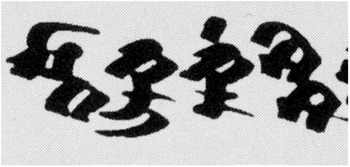
The Tocharian A hapax ṣtākkrukkeśśi occurs in the third act of the Maitreyasamiti-Nāṭaka, an extensive drama on the future Buddha Maitreya written in Tocharian A. The occurrence of the word in YQ III.3 b4 is clear (Figure 1). No alternative reading is possible.
Occurrence of ṣtākkrukkeśśi in YQ III.3h b4 (Ji Reference Xianlin1998: 359).

The fragment YQ III.3 contains a lively account of the foundation of the nuns’ order during the Buddha’s lifetime. The restitution of the fragmentary Tocharian text has greatly benefited from the more complete Hami version of the Old Uyghur Maitrisimit (Laut Reference Laut, Baldauf, Kreiser and Teycan1991; Geng and Klimkeit Reference Shimin and Klimkeit1988: 179–83). Pinault (Reference Pinault1991) summarizes the results of the comparison with the Old Uyghur version and offers the first edition and translation of the fragment, later re-edited in Ji (Reference Xianlin1998: 156–8).
The section of the story contained in YQ III.3 opens with words of reproach against women uttered by the Śākya noblemen, outraged by the possibility that they may get to hear the Law by the Buddha himself in the Nyagrodhārāma shrine. To these words the women reply that the Buddha himself had been carried in a womb and brought up by women: they have the right to go and meet him. Thus, led by Queen Mahāprajāpatī Gautamī, the Buddha’s stepmother, they reach the shrine. Supporting their cause, the Buddha preaches the five virtues of women, as opposed to the five sins of which the Śākyas were accusing them. The reply of the women (b4–5) runs as follows:Footnote 1
/// (kaklyuṣu)räṣ kātkmāṃ nāṃtsunt kulewāñ träṅkiñc hiśt tākiṣ ṣtākkrukkeśśi ku(sne) /// (ā)rkiśoṣṣaṃ kāswoneṣi wākäm ṣeṣ ◆ säm pkāk ptāñkät käṣṣi wasäṃ trä(ṅkäṣ) /// (märkampa)l klyosäṃsamäs ||
Having heard that, and having become glad, the women say: Shame on the denouncers, who … (who) was the paragon of virtue in the world, he the Buddha-god teacher speaks to us in every way … we will hear the Law!
In the following, I quote Pinault’s (Reference Pinault1991: 179) translation of the reconstruction of the original text, based on the Old Uyghur translation:
Fi soit des calomniateurs qui (dirent que Siddhārtha nous blâmait! Lui qui) dans le monde a montré à plusieurs reprises une vertu exceptionnelle, lui, le maître Buddha, il nous attribue totalement cette vertu-là. (Avec un cœur sans crainte, maintenant), nous allons assurément écouter (la Loi).
The Old Uyghur version in Geng and Klimkeit’s (Reference Shimin and Klimkeit1988: 183) translation runs as follows:
Getadelt werden mögen jene (noch) der Leidenschaft (verhafteten) Śākya-(Jünglinge) wegen ihrer Worte, die sie zu uns sagten: >Euch tadelt Siddhārtha sehr!< Jetzt geruhte der Göttergott Buddha mit so viel gutem Lob, wie es auf der Erde gibt, uns allen zu loben. Mit einem furchtlosen Herzen wollen wir jetzt die Lehre hören.
The translation of the hapax ṣtākkrukkeśśi as “denouncer” is partly based on the Old Uyghur version. More recently, this was examined anew by Peyrot (Reference Peyrot2013: 239), who revised the translation of the passage as follows:
yeritmiš bolzun ol bagragu šakilar sözlämiš savlar .. kim biziŋä inčä tep tedilär
“May the aggressive Śākyas be reproached because of the words that they said to us.”
There is no doubt that ṣtākkrukkeśśi refers to the Śākya noblemen. As it is the women who are speaking, the word should have a negative connotation. It might also refer to the fact that the men are lying about the sins they are attributing to women, that is, they are “slandering” them.
The first semantic feature is supported by the Old Uyghur version, which has the adjective bagragu. This is derived from bag(ı)r “liver, belly” (HWA: 137) by means of the suffix -agu, which “forms nominals denoting individuals whose characteristic quality ‘inhabits’ the body part denoted by the base noun” (Erdal Reference Erdal1991: 162). Thus, bagragu would literally describe the Śākyas as “livered” or “moved by the belly”, i.e. “violent, aggressive” (so Peyrot Reference Peyrot2013; cf. also Pinault Reference Pinault1991: 166 “effronté”). In Buddhist texts, however, bagragu is often used in hendiadys with nizvani “kleśa” (← Sogdian, cf. Buddhist Sogdian nyzβʾnʾk “passion”, e.g. SCE 305, Manichaean Sogdian nyzβʾny “id.” (DMSB: 156)). For this reason, Geng and Klimkeit (Reference Shimin and Klimkeit1988: 183) opt for the translation “bound by passion (der Leidenschaft verhaftet)”, with a more explicit Buddhist reference. Both translations are considered in the Handwörterbuch des Altuigurischen (HWA: 137), which provides the translations “aggressiv, leidenschaftlich, den Leidenschaften verhaftet”.
The semantic feature of “lying, slandering” implicit in Pinault’s (Reference Pinault1991) translation “calomniateurs”, on the other hand, cannot be directly extracted from the Old Uyghur translation. It is based on his hypothesis that the morphological structure of the hapax may have been parallel to the family of Sanskrit words meaning “slanderer” or the like. As verbs with this semantic connotation in Sanskrit are all formed with a preverb apa- or upa- added to a root for “to speak” (apa-vādaka- “slanderer”, upa-kroṣṭr̥- “id.” < apa-vad- and upa-kruś-), he analyses ṣtākkrukkeśśi as formed by ṣtāk “down” and krukke, a derivative of a root kruk- meaning “to cry out” (cf. Skt. kruś- “id.). ṣtāk is analysed as an enlarged form of ṣät “downwards” (DTTA: 488), possibly reinforced by an element -k. Thus, ṣtākkrukkeśśi is explained as the gen. pl. of ṣtāk-krukke* (see also DTTA: 499).Footnote 2
As ultimately recognized by Pinault (Reference Pinault1991: 190) himself, however, the analysis is tentative because it implies the reconstruction of two otherwise unattested Tocharian lexemes (a verbal root *kruk- and an adverb *ṣtāk). I would like to point out that an alternative segmentation of the word as ṣtākkru-kke*, i.e. ṣtākkru* with the addition of a suffix -kke, is possible. This option implies that the word is a loanword from Tocharian B into Tocharian A, as the suffix is only known from Tocharian B. With the suffix -kke itself possibly being borrowed from Pre-Khotanese (Dragoni Reference Dragoni2023: 107–9), the reconstructed Tocharian B word may be a loanword from another language. As no suitable source form is available in Sanskrit or Middle Indo-Aryan, a look into the Khotanese lexicon is justified. As shown by Dragoni (Reference Dragoni2023: 253–4), the number of loanwords from Khotanese into Tocharian is significant and second only to those from Indo-Aryan.
3. Old Khotanese ṣṭakulā- “abuse”
Old Khotanese ṣṭakulā- “abuse” shows much similarity with the Tocharian A hapax, from both a semantic and a phonological point of view. This justifies a more detailed analysis of its textual occurrences and its etymology.
The word is well-attested in Old Khotanese: it occurs six times in the Book of Zambasta and once in the Suvarṇabhāsottamasūtra. Its frequent use is confirmed by the occurrence of several derivatives of the word, the substantive ṣṭakulcā- “abuse” (Z 12.112), the adjective a-ṣṭakulca- “free from abuse” (Suv 6.2.56 = Suv 1.108–9) and the compound ṣṭakula-jsera- “worthy of reproach” (Z 12.11). The meaning of ṣṭakulā- can be determined thanks to bilingual evidence from Suv 6.2.56. The passage shows the adjective a-ṣṭakulca- (Degener Reference Degener1987: 52) used as an adverbial accusative (aṣṭakulcu) in hendiadys with a-niyaśśu “without contempt”, a ya-derivative of the verb nyas- “to despise” (SGS: 60, KS: 299), to translate Buddhist Sanskrit a-bhaṇḍana- “without abuse, quarrel” (BHSD: 405, < bhaṇḍ- “to abuse, quarrel with”).
In the following, I quote the six occurrences of the lexeme and its compounds and derivatives in the Book of Zambasta.Footnote 3 The context of each passage is given between square brackets before every quotation.


The five passages from the Book of Zambasta allow us to gain a better comprehension of the semantic range and usage of ṣṭakulā- in Old Khotanese. The compound ṣṭakula-jsera- “worthy of reproach” [(a), (c)] can be formally analysed as an “inverted bahuvrīhi”Footnote 4 formed with the participium necessitatis of yan- “to do”, tcera- “to be done”, as second member (see Degener Reference Degener1987: 36 “tadelns-wert”). Someone may “end up” [(a)] (niṣa’s-, SGS: 57) or “become” [(c)] (häm-) worthy of reproach. [(b)] and [(e)] show the original substantive in the nom. sg. Its ending -a clearly points to a feminine ā-stem.
The phrase ṣṭakulce yan- or ṣṭakule yan- (mid.) [(d)] deserves a more detailed investigation. Morphologically, ṣṭakulce is derived from ṣṭakulā- through the addition of the suffix -kyā-/-cā- (KS: 207). Because ṣṭakule and ṣṭakulce are both plurals, the phrase literally means “to do acts of abuse”. For the use of the plural in collocations with yan-, one might compare the frequent kīre yan- (act.) “to do (good) acts” and käḍägāne yan‑ (mid.) “to do (bad) acts” (e.g. HK: 58).
Semantically, it is possible to further determine the meaning of the two phrases contained in (d) by consulting the chapter on morality (Śīla-patala) in Asaṅga’s Bodhisattvabhūmi,Footnote 5 the main source of the twelfth chapter of the Khotanese Book of Zambasta, as first recognized by Leumann (Reference Leumann1933–Reference Leumann1936: 146). In the following, I quote the section of the Sanskrit text corresponding to Z 12.112 from Wogihara’s (Reference Wogihara1932: 175) edition, followed by Tatz’s (Reference Tatz1986) translation. Tatz’s version considers also Dutt’s (Reference Dutt1966: 120) edition of the Sanskrit text and several Tibetan witnesses (see Tatz Reference Tatz1986: 39). No significant variations are recorded for this passage.
bodhisattvaḥ dharma-bhāṇakaṃ pudgalaṃ saṃciṃtyâvamānayati a-sat-karoti avahasati avaspaṇḍayati
vyaṃjana-pratisaraṇaś ca bhavati nârtha-pratisaraṇaḥ.
s’āpattiko bhavati. sâtisāraḥ. kliṣṭām āpattim āpadyate.
If the bodhisattva deliberately discounts the person speaking doctrine and pays no respect to him, ridiculing him, making sarcastic remarks, and making his reference the letter rather than the meaning, then he is possessed of fault, possessed of contradiction; there is defiled fault (Tatz Reference Tatz1986: 78).
Table 1 records the correspondences between the Old Khotanese lexicon of Z 12.112 and Asaṅga’s Buddhist Sanskrit. I will not comment here on the condition of illness of a bodhisattva in Z 12.113, which was possibly incorporated into the same verse from the next section of the Sanskrit text.Footnote 6
Lexical correspondences between Z 12.112 and Asaṅga’s chapter on morality from the Bodhisattvabhūmi

Table 1 Long description
The table pairs Old Khotanese words with their Sanskrit counterparts to show lexical correspondences in a morality-related passage. It matches bodhisatvä with Sanskrit bodhisattvaḥ and haysānandai with saṃciṃtya. The Old Khotanese phrase dāta-hvāñandu corresponds to the Sanskrit expression dharma-bhāṇakaṃ. The Old Khotanese entry, ṣṭakulce yande, is linked to several Sanskrit verbs, including avamānayati, a-sat-karoti, avahasati, and avaspaṇḍayati. The final pair connects ārrī mästä with the Sanskrit phrase kliṣṭām āpattim āpadyate.
ṣṭakulce yande corresponds to four Sanskrit verbs of allied meaning: ava-man- “to despise”, a-sat-kr̥- “to treat with disrespect”, ava-has- “to laugh at” and ava-sphaṇḍ- “to treat with contempt, deride” (BHSD: 77). These lexical correspondences introduce a slightly different nuance of meaning to Emmerick’s (Reference Emmerick1968) English rendition “to insult”. I would like to point out that a translation “to laugh at, deride” would fit passage (d) better. I see the same component of derision in Z 2.28–29 [(a)]. It is not difficult to imagine how the lively description of a buddha falling into a grass-covered hole might have provoked the hilarity of the heretics and, ultimately, of the public listening to the poem.
The same semantic connotation of derision can also be found in a Late Khotanese occurrence of ṣṭakulā- from the Dunhuang Late Khotanese Aśokāvadāna, an original Khotanese composition recounting several episodes of the legend of King Aśoka. One of the sections of the text (section 5) contains a version of the famous tale of Aśoka’s minister Yaśa and the man’s head, known, among other sources, from the Buddhist Sanskrit Aśokāvadāna as contained in the Divyāvadāna (Strong Reference Strong1983). Yaśas, an “exceedingly unbelieving” minister of King Aśoka, dares to reproach the king: how could he bow down to every Buddhist monk he encounters on his path? Does this not show serious disrespect to the institution of kingship? So, he addresses the king in Late Khotanese:
P 2958.49–52Footnote 7
(5.8.2) tvā rrųśtä ṣṭikulavīyi ni parya pidiṃde . (5.8.3) cu āṃ saṃ rrųsti-vrrihāṃ sątti vijsyā harbiśī āṃ aurgi tsai . (5.8.4) rre ṣi’ cąṇḍä śtāka u śūrä ūvāryāṃ pųñāṃ jsa byaudi .
(5.8.2) Deign not to make sovereignty contemptible. (5.8.3) Whatever red-robed individual you may just see, you go completely with homage to him. (5.8.4) A king, he must be fierce and bold, possessed with noble merits! (Dragoni Reference Dragoniin preparation).
The Sanskrit version contained in the Divyāvadāna does not yield any exact lexical comparandum for Late Khotanese ṣṭikula-vīya-, a vīya-adjective formed from the substantive ṣṭikulā- (< OKh. ṣṭakulā- with fronting of the vowel of the first syllable due to the preceding coronal consonant cluster), on which see KS: 311. However, it is clear how Yaśas stigmatizes a behaviour that he finds socially inappropriate by using a derivative of ṣṭakulā-. Is it not the same sociolinguistic setting one sees at play in the women’s reaction to the aggression of the young Śākya noblemen?
4. Is Tocharian A ṣtākkrukke* borrowed from Khotanese?
These considerations lead us to the core of the problem, namely whether the Khotanese lexeme is the source of the borrowing into Tocharian. In Section 3, I have shown that the semantics support the hypothesis of a borrowing: the two words have the same meaning, and they are also used in the same sociolinguistic settings. In this section, I intend to discuss the problem from a phonological and a morphological point of view. In Section 4.1, I discuss and reject the current etymology of Old Khotanese ṣṭakulā-. I also reconstruct a possible Gāndhārī source for the Old Khotanese lexeme. Section 4.2 deals with the borrowing path Khotanese → Tocharian.
4.1. Old Khotanese ṣṭakulā- is not an Iranian formation and may have been borrowed from Gāndhārī
In the following, I am going to verify whether ṣṭakulā- can be etymologized within Khotanese. Bailey (KT 6.349, DKS: 415) suggested a connection with the Iranian root *stak- “to resist, oppose”, often reconstructed on the basis of Avestan staxra- “strong, firm” and staxta- “id.” and Zoroastrian Middle Persian stahm (EDIV: 362).Footnote 8 Its reconstruction for Proto-Indo-Iranian is uncertain (KEWA 3.509 s.v. stákati, EWA 3.522 s.v. STAK “widerstreben, abwehren”).
Bailey’s connection might be semantically justified (“to oppose” > “to abuse”), but it cannot account for the unvoiced -k-, unexpected word-internally. Furthermore, his suggestion implies a derivation with a suffix -ula- unknown to Khotanese. In sum, Bailey’s suggestion does not stand up to closer scrutiny.
No other suitable roots can be found in Khotanese or Iranian in general. A similar suffix (-ula-/-ura-), however, is well-known from Indo-Aryan and forms adjectives from a verbal root, cf. bhaṅgura- “fragile” < bhañj- “to break” (Wackernagel and Debrunner Reference Wackernagel and Debrunner1954: 486–9). If ṣṭakulā- were an Indic loanword, the reconstruction of an adjective *ṣṭak-ula- (or ṣṭak-ura-, considering the frequent variation in the shape of the suffix) as a possible source could proceed without morphological difficulties. The root ṣṭak-, however, remains unclear.
I would like to suggest that the root reconstructed by Turner as *ṭhagg-, *ṭhakk-, *ṭhaṅg- (CDIAL n. 5489) is in fact the source of Old Khotanese ṣṭak-. This root is assigned by Turner the basic meaning of “to cheat”, but, being the source of the English substantive thug through Hindī ṭhag “thug”,Footnote 9 its semantic history of violence is well known to students of British India.Footnote 10 The root might have entered Khotanese via one of the Middle Indo-Aryan vernaculars spoken in Central Asia in the first centuries of the Common Era.
It is not directly attested in Gāndhārī, but it occurs in Prakrit, cf. e.g. ṭhagiya- “cheated” and ṭhaga- “thief” (CDIAL n. 5489). In several Middle Indo-Aryan languages, including Gāndhārī and Pāli, the phoneme represented by <ṭh> can be traced back to Old Indo-Aryan ṣṭ(h) (Pischel Reference Pischel1900: 207–9; Burrow Reference Burrow1937: 20; Baums Reference Baums2009: 158).Footnote 11 As far as Gāndhārī is concerned, it is still a matter of debate whether the initial sibilant of the cluster was actually pronounced or not, as recently argued by Halfmann (Reference Halfmann2024). In our case, however, the virtual absence of Gāndhārī instances of word-initial <ṭh> going back to Old Indo-Aryan ṣṭ(h)- invites one to proceed with caution: the word may have been borrowed into Gāndhārī from a third language and may exhibit irregular sound correspondences. In fact, as pointed out to me by one reviewer, the root may have entered Indo-Aryan from Dravidian.Footnote 12 Besides, one should not rule out the possibility of a hypercorrect form with prosthetic ṣ- in Khotanese. A comparable case is Late Khotanese ṣṭīka “commentaries” in the preface to the Late Khotanese Rāmayaṇa (P 2801.5 = KT 3.65)Footnote 13 beside ṭīka elsewhere, a loanword from Skt. ṭīkā- “commentary”. A general tendency to avoid ṭ- word-initially in Khotanese through prosthesis of ṣ- was suggested by Bailey (Reference Bailey1940a: 572).Footnote 14
Based on these considerations, the Gāndhāri source form may be reconstructed as *ṭhakula- or, slightly less probably, *ṣṭakula-. The velar geminate (-gg- or -kk-) reconstructed by Turner for Indo-Aryan accounts for the preservation of the unlenited intervocalic -k- in the Gāndhārī source as well as in the Khotanese loanword. As the Indo-Aryan suffix -ula/-ura forms adjectives from verbal roots, the original meaning of Gāndhārī *ṭhakula- may have been “abusive”. The semantic shift “abusive” > “abusive (act)” > “abuse” may have taken place during the process of borrowing into Old Khotanese (see in detail below and Section 4.2), but it could also be reconstructed for the Gāndhārī source. I have no specific explanation for the fact that the Old Khotanese substantive is a feminine ā-stem. One may tentatively assume that the word entered Old Khotanese in a fixed collocation with yan- and was assigned the plural ending -e by analogy with kīre yan- (act.) “to do (good) acts” and käḍägāne yan‑ (mid.) “to do (bad) acts”, as witnessed by the attested ṣṭakule yan- (see occurrence (d) in Section 3). The feminine ṣṭakulā- may be a back formation from this plural in -e. This may also explain the shift from adjective to substantive that, in this case, should have happened within Old Khotanese: ṣṭakule (kīre) yan- “to do abusive (acts)” > ṣṭakule yan- “to abuse (lit. ‘do abuses’)” ≫ ṣṭakule “abuses” ≫ ṣṭakulā- “abuse”.
Geographically, the hypothesis of a borrowing from Gāndhārī into Khotanese is further supported by the attestation of the word in languages of the Indo-Iranian borderlands, both Indo-Aryan (Lahndā ṭhag “thief”, Pašaī ṭhak “id.”) and Iranian (Parachi ṭag “mad” is recorded by Morgenstierne [Reference Morgenstierne1929: 296] and compared to the same root).Footnote 15
4.2. On the borrowing path Khotanese → Tocharian
The question of the source of Tocharian A ṣtākkrukke* is now complicated by the possible foreign source of Old Khotanese ṣṭakulā-. Besides, the possibility that the word was borrowed directly from Old Khotanese into Tocharian A should also be considered, notwithstanding our preliminary hypothesis of a Tocharian B intermediary (see Section 2). In the following, I will discuss four alternative borrowing trajectories:Footnote 16
1. *Gāndhārī → Old Khotanese → Tocharian A
2. *Gāndhārī → Old Khotanese → *Tocharian B → Tocharian A
3. *Gāndhārī → Old Khotanese and Tocharian A independently
4. *Gāndhārī → Old Khotanese and *Tocharian B (→ Tocharian A) independently
The first problem concerns whether Tocharian borrowed the word directly from Gāndhārī (3, 4) or through Old Khotanese (1, 2). Pending a more detailed investigation of Gāndhārī historical phonology, the data gathered in Section 4.1 speak in favour of an Old Khotanese source for the Tocharian word. The initial sibilant, difficult to reconstruct for Gāndhārī, can be easily accounted for by assuming prosthesis of ṣ- in Khotanese during the borrowing process (see Section 4.1). As the Tocharian form also shows initial ṣ-, the first two borrowing trajectories (1, 2) appear more likely.
The second problem bears on the correct description of the borrowing path Khotanese → Tocharian. Did Tocharian A borrow directly from Old Khotanese, or should one reconstruct a Tocharian B intermediary between Old Khotanese and Tocharian A?
If Tocharian B borrowed from Khotanese, from a source form ṣṭakulā- ∼ ṣṭakurā- “abuse”,Footnote 17 one may expect several different adaptations depending on the chronology. From pre- or Old Khotanese, one would expect Tocharian B *ṣtākäro > *ṣtākro > *ṣtākkro, if from the pre- or Old Khotanese acc. sg. ṣṭakulo ∼ ṣṭakuro. The gemination -k- > -kk- is due to the following -r- (Klingenschmitt Reference Klingenschmitt and Schlerath1994: 347; Peyrot Reference Peyrot, Kloekhorst and Pronkforthcoming), both in Tocharian A and B. Should we reckon with a more recent borrowing, from the Old Khotanese stage onwards,Footnote 18 one may reconstruct Tocharian B *ṣtākär or even *ṣtākur (cf. Tocharian AB mahur “diadem” ← Gāndhārī, cf. Skt. makuṭa- DTTA 335). If Tocharian A borrowed directly from Khotanese, one may reconstruct Tocharian A *ṣtākär or *ṣtākur (cf. Tocharian A mukär* “mirror” ← Skt. mukura- “id.”), without much difference from a borrowing from a later stage of Khotanese into Tocharian B (cf. supra). Among these reconstructed forms, the closest source for the attested ṣtākkru° before the addition of the suffix -kke appears to be *ṣtākur. At this stage, it is impossible to distinguish between Tocharian A or B because the form suits a later borrowing from the Old Khotanese stage onwards into both languages.
Additional clues may be gathered from the analysis of the element -kke. I assume that the metathesis -ur- > -ru- happened after the addition of this element and was triggered by the unusual cluster -urk(k)-, only occurring in loanwords like TB kurk(k)amäṣṣe “pertaining to saffron” (see Dragoni Reference Dragoni2021: 304): *ṣtākurkke > *ṣtākrukke > ṣtākkrukke*. In Dragoni (Reference Dragoni2023: 107−8), I examined the three Tocharian B suffixes with geminate -kk- (-kko, -kka, -kke) in Tocharian B, so far unattested in Tocharian A. I argued that the suffix -kko was borrowed from (the acc. sg. of) pre-Khotanese *-kka- > Old Khotanese -ka-, that -kka was later created as the feminine counterpart of -kko, and that -kke was a morphological adaptation of -kko used for adjectives and proper names. The evidence for the three suffixes outside proper names is limited (Table 2).Footnote 19
Occurrences of the suffixes -kko, -kka and -kke in Tocharian outside proper names

Table 2 Long description
The table lists Tocharian words, outside proper names, grouped by three suffixes: -kko, -kka, and -kke. Under -kko there is one example, tanākko, glossed as “grain seed,” with an etymological link to tāno meaning “corn of grain.” The -kka column has four items: yirmakka, glossed as “(female) treasurer, measurer,” linked to yarm “measure” plus malyakka “young (feminine).” The -kke column has four items: larekke “dear” linked to lare “dear,” malyakke “youthful” (?) and naumikke “jewel” linked to naumiye “jewel” and appakke “daddy” linked to āppo “father.” Overall, -kka and -kke are represented by more examples than -kko in this small set.
In Dragoni (Reference Dragoni2023: 107), I identified these suffixes as formatives for diminutive nouns and adjectives (e.g. tanākko, larekke) and agent nouns (yirmakka*). If Tocharian B *ṣtākur was borrowed as a noun and meant “abuse”, ṣtākkrukke* may have been an agent noun meaning “abuser”, as yirmakka* “(female) treasurer” was derived from yarm “treasure”. A closer examination of the occurrences of Tocharian B yirmakka*, however, reveals that the translation “(female) treasurer” is not supported by bilingual evidence. yirmakka* is only attested before proper names at the end of documents, where the signatures of the witnesses are usually found.Footnote 20 Nothing would prevent one from interpreting yirmakkai in these attestations as another proper name or a title of still undetermined meaning.Footnote 21 The evidence for -kko, -kka, -kke as a formative for agent nouns in Tocharian B is very weak.
In Section 4.1, I proposed that the semantic shift “abusive” > “abuse” happened within Old Khotanese. As the shift may have happened in connection with the collocation with the verb yan- “to do”, it is not far-fetched to assume that, when the borrowing into Tocharian B took place, the Gāndhārī loanword into Khotanese ṣṭakula- still had the adjectival meaning “abusive”, outside of the collocation. Thus, Tocharian B *ṣtākur was an adjective and the suffix -kke had a diminutive function. Tocharian A ṣtākkrukke* was a substantivized adjective meaning “the abusive one”. Morphologically, the closest parallel would be Tocharian B larekke “dear” from the adjective lare “id.”. Unlike larekke, however, the context of ṣtākkrukke* allows one to posit an additional pejorative meaning for the diminutive suffix -kke. Cross-linguistically, it is very common for diminutives to take this function, too (Sánchez Fajardo Reference Sánchez Fajardo2022: 135−264). Besides, the ka-suffix is attested with a pejorative connotation throughout the whole history of Iranian (see Ciancaglini Reference Ciancaglini, Basello and Rossi2012: 95 for Avestan, and Nourzaei Reference Nourzaei2023: 124 and elsewhere for Classical and Contemporary Persian).
As far as Tocharian is concerned, I could find a suitable parallel for a seemingly pejorative suffix -kke in malyakke attested in the Vinaya passage preserved in IOL Toch 127 a4−6:
walo cew eṅkormeṃ ◆ pyāśine (śan)mäṣṣi(n)e wat ypoymeṃ wat lyucīne ◆ mäntrākka wat cew weñi ◆ lyak nestä ◆ malyakke ne(s)tä ◆ trikau nestä ◆ wārṣṣe nestä
The king, after arresting him, would beat him, or would bind him, or would banish him from the country, or would tell him just thus: “You are a thief, you are a foolish, you are mistaken, you are a robber”.Footnote 22
A study of the source text in Pāli (Oldenberg Reference Oldenberg1881: 46) allows us to establish the following lexical correspondences: lyak = coro, malyakke = bālo, trikau = muḷho, wārṣṣe = theno. Pāli (and Sanskrit) bāla- means “child, youth”, but can also denote an inexperienced person or a fool already in Vedic (EWA 2.223). The feminine malyakka, on the other hand, occurs in the medical fragment W 27 b3:
kātso malyakka mäsketär mā ylārya ||
(…) the stomach becomes young, not decrepitFootnote 23
In this medical fragment, -kka in malyakka cannot have a specific pejorative connotation, which may have been limited to -kke, but a more general diminutive would fit very well. The occurrences of malyakke and malyakka show a remarkable correspondence with the semantics of Skt. bāla- “child, young, fool”. As their etymology is still unclear, the probative value of malyakke and malyakka remains limited.Footnote 24 At any rate, they seem to support the analysis of -kke in ṣtākkrukke* as having a pejorative connotation. If -kke in ṣtākkrukke* is taken as the diminutive suffix -kke with a pejorative connotation, Tocharian A ṣtakkrukke* was borrowed from Tocharian B because no suffix -kke is attested in Tocharian A.Footnote 25
This analysis favours option two over option one. It is attractive both from a semantic and a morphological perspective, but it implies the reconstruction of an otherwise unattested Tocharian B lexeme. The possibility that Tocharian A borrowed directly from Old Khotanese should be investigated as well. As recently surveyed by Peyrot (Reference Peyrot, Kloekhorst and Pronkforthcoming), a Tocharian A geminate can have multiple sources. In a word-internal position, it can most likely arise after assimilation of a cluster containing y or n, after syncope (e.g. *kVkV > kkV) or before r. The first geminate in ṣtākkrukke* may be due to the following r also in Tocharian A (see above). If it arose from assimilation of a consonant cluster, the source of the second kk in Tocharian A may have been *ky. The only exact parallel for this development, Tocharian A śākki ∼ śākke “Śākya”, was most likely borrowed from Middle Indo-Aryan (cf. Gāndhārī śaka° in śakamuṇi, Pāli sakka-) and not directly from Buddhist Sanskrit śākya-, but late assimilation of y resulting in a geminate is well-attested elsewhere in Tocharian A (cf. loc. sg. arkiśoṣṣaṃ < arkiśoṣyaṃ “in the world”). For the long ā in the first syllable, cf. Tocharian A ākāl “wish”, borrowed from Bactrian αγαλγο “id.”. These observations allow the reconstruction of a pre-stage *ṣtākurkye, for which a fitting source can be identified in the immediate antecedent of the attested Old Khotanese ṣṭakulce, possibly *ṣṭakulkye. As pointed out above, the alternation l ∼ r can be reconstructed for the early Old Khotanese source, which may have been *ṣṭakurgye, from a nom. sg. *ṣṭakurgyā-. In Old Khotanese, the suffix -kyā-/-cā- has at least two concurrent spellings, one with <ky> and another with <c>. The suffix has also a voiced counterpart -gyā-/-jā- arising after assimilation with certain preceding consonants, among which r, spelled both with the digraph <gy> and with <j>.Footnote 26 For this suffix, the archaic orthography shows a marked preference for -gyā-, but -cā- is also found. <ky> and <c> as well as <gy> and <j> seem to be interchangeable in all the other attested orthographic stages of Khotanese. As in the case of the relative and interrogative pronoun kye, regularly written <kye> in the archaic orthography but alternating with <ce> in later stages, I take <ky> and <gy> also in the occurrences of the suffix -kyā-/-cā- as the more conservative spellings, possibly reflecting an inner-Khotanese development /ky/ > /č/. As kye is derived from the gen. sg. *kahya (SVK 3.59, Suv 2.265), the spellings <ky>, <gy> may reflect an earlier stage of the suffix -kyā-/-cā-, and the Tocharian A evidence may reflect early Old Khotanese /ky/. Clearly it cannot be taken as reflecting (classical) Old Khotanese /č/, so the borrowing cannot have taken place after the earliest attestations of Old Khotanese, yielding as a terminus ante quem the fifth century ce.
As for the morphology, I assume that the borrowing took place from the collocation ṣṭakulce yan- (e.g. Z 12.112). This source justifies final -e in Tocharian A. The semantic shift “abuse” > “abuser” is only apparent, as it could easily have been realized through a substantivized adjective “abusive (one)” (see above). One should also bear in mind that the suffix -kyā-/-cā- can form adjectives from ta-participles, a potential source of uncertainty on the meaning of ṣṭakulce that may have triggered slight semantic changes during the borrowing process.
In conclusion, it is not easy to decide between the first and second scenarios. On purely mechanical grounds, one might want to opt for the first scenario as it does not require the reconstruction of an unattested intermediary. Indeed, with the caveat that the lack of attestation of ṣtākkrukke* in Tocharian B may only be due to chance, I opt for a direct borrowing from early Old Khotanese into Tocharian A. An additional argument in support of this scenario is the presence of a limited but significant corpus of Old Khotanese loanwords in Tocharian A without a Tocharian B correspondence.Footnote 27 In Dragoni (Reference Dragoni2023: 233−5), I argue that this corpus may reflect language contact between Khotanese and Tocharian A speakers in the Qarašahr area, where a leaf containing one of the earliest witnesses of the Book of Zambasta was found (Maggi Reference Maggi and Meisterernst2016). While these words are mostly religious terms, it cannot be excluded that words from other semantic areas could be borrowed as well.
The discovery of yet another instance of exchange between Tocharian and Khotanese within the Maitreya-tradition is relevant to the study of its transmission in Central Asia before it was translated into Old Uyghur. It further highlights the special connection of the Tocharian A version with Khotan.Footnote 28
5. Conclusions
In this article I have studied the history of Tocharian A ṣtākkrukke* “slanderer (?)”, a hapax of uncertain interpretation occurring in the Maitreyasamiti-Nāṭaka. A fresh examination of the text passage where it occurs reveals that it was used in the same sociolinguistic settings as Old Khotanese ṣṭakulā- “abuse” and derivatives (Sections 2, 3), a word of uncertain etymology. To verify whether the Tocharian A word could have been borrowed from Old Khotanese ṣṭakulā-, I investigate its etymology and conclude that ṣṭakulā- is not an Iranian formation, as previously claimed, but was borrowed from Gāndhārī. I reconstruct the Gāndhārī source of ṣṭakulā- as *ṭhakula- (∼ *ṭhakura-) and analyse it as an ula-/ura-suffixed derivative of the root *ṭhakk- “to cheat” (Section 4.1). In Section 4.2, I study the borrowing path from Khotanese into Tocharian A and reach the following conclusion concerning the history of the word:
Gāndhārī *ṭhakula- ∼ *ṭhakura- → early Old Khotanese ṣṭakulā-/*ṣṭakurā-, + suffix -kyā-/-cā- ṣṭakulcā-/*ṣṭakurgyā-, nom. pl. ṣṭakulce, *ṣṭakurgye → Tocharian A *ṣtākurkye > *ṣtākrukye > *ṣtākkrukye > ṣtākkrukke*
Based on Tocharian A -kke < *-kye possibly reflecting early Old Khotanese -gye, and not -je, I argue that the word cannot have been borrowed after the fifth century ce, i.e. after the earliest written attestations of Old Khotanese.
Technical abbreviations
- CEToM
A Comprehensive Edition of Tocharian Manuscripts, https://cetom.univie.ac.at/
- SCE
Sūtra of the causes and effects of actions (see MacKenzie Reference MacKenzie1970)
- Suv
Suvarṇabhāsottamasūtra (see Skjærvø Reference Skjærvø2004)
- Z
Book of Zambasta (see Emmerick Reference Emmerick1968)
Bibliographic abbreviations
- BHSD
Edgerton (Reference Edgerton1953)
- CDIAL
Turner (Reference Turner1962–1985)
- DKS
Bailey (Reference Bailey1979)
- DMMPP
Durkin-Meisterernst (Reference Durkin-Meisterernst2004)
- DMSB
Sims-Williams and Durkin-Meisterernst (Reference Sims-Williams and Durkin-Meisterernst2022)
- DoT
Adams (Reference Adams2013)
- DTTA
Carling and Pinault (Reference Carling and Pinault2023)
- EDIV
Cheung (Reference Cheung2007)
- EWA
Mayrhofer (Reference Mayrhofer1992−2001)
- HK
Emmerick (Reference Emmerick2024)
- HWA
Wilkens (Reference Wilkens2021)
- KEWA
Mayrhofer (Reference Mayrhofer1956−1980)
- KS
Degener (Reference Degener1989)
- KT 1–7
Bailey (Reference Bailey1945−1985)
- SGS
Emmerick (Reference Emmerick1968a)
- Suv 1, 2
Skjærvø (Reference Skjærvø2004)
- SVK 3
Emmerick and Skjærvø (Reference Emmerick and Skjærvø1997)
Acknowledgements
This research was supported by the European Research Council (ERC) Consolidator Grant project “The Silk Road Language Web” (Grant agreement ID: 101088902). I am grateful to Michaël Peyrot and Niels Schoubben, as well as to the two anonymous reviewers of this journal, for comments on an earlier version of this article.
OA funding statement
Open access funding provided by Leiden University.


 Open access

