





1. Introduction
1.1. Kinship terminology in language and culture
Kinship terminology plays a crucial role in human cultures, reflecting the diverse ways in which societies conceptualize family relationships and social roles (Sahlins, Reference Sahlins2011; Schneider, Reference Schneider2014). As a culturally structured system, kinship is not merely a matter of genealogy or biological reproduction; rather, it is shaped by how relationships are socially specified and linguistically encoded (Read, Reference Read, Feinberg and Ottenheimer2001). For example, in English, the term ‘brother’ can refer to any male sibling regardless of age, whereas Chinese uses distinct terms such as ‘哥哥’ (older brother) and ‘弟弟’ (younger brother), thereby encoding relative age and hierarchy more explicitly (Waltner, Reference Waltner2019). Such differences suggest that kinship terms do more than denote family relations: they also reflect broader cultural models of interpersonal organization and social cognition (e.g., Brekhus, Reference Brekhus2015; Brown, Reference Brown2020; Milicic, Reference Milicic2013). This phenomenon has garnered substantial academic attention, as examining the differences in kinship terminology across languages offers valuable insights into how linguistic systems influence human cognition (Chen & Ren, Reference Chen and Ren2020; Yokotani, Reference Yokotani2012).
However, current studies are not concerned with kinship terminology as a complete lexical system in the abstract. Instead, this study focuses on a more specific communicative phenomenon: how speakers introduce a brother in everyday interaction, and whether they rely on a kinship term alone or supplement it with a personal name. By narrowing the focus in this way, the study examines kinship terminology usage in a particular introductory context rather than kinship terminology as a whole.
1.2. Prior research on kinship terminology
Current research has examined kinship terminology from lexical, semantic and cultural perspectives, but comparatively less attention has been paid to how kinship terms are used in actual introductory contexts and to the cognitive motivations underlying such usage patterns. For example, Tazik and Aliakbari (Reference Tazik and Aliakbari2023) demonstrated that age, gender and educational level can influence variations in Bahmaie kinship terms. Vakhitova et al. (Reference Vakhitova, Kuzembayeva, Yergazina, Zhumakhanova and Khayrullina2022) compared 300 kinship terms in Russian and Kazakh and found both similarities and differences in gender- and age-related distinctions. Rácz et al. (Reference Rácz, Passmore, Sheard and Jordan2019) examined the evolution of kinship terms across 47 Indo-European languages and showed that replacement rates correlate with usage frequency and genealogical distance. These studies highlight the importance of cultural and linguistic context in shaping kinship systems.
At the same time, English and Chinese have often been described as reflecting different cultural emphases (Li, Reference Li2021). Chinese kinship terminology places greater weight on seniority and hierarchical distinctions, whereas English-speaking societies are often associated with a comparatively simpler kinship system that aligns with values such as equality and individualism (Hao, Reference Hao2016; Wang, Reference Wang2018). Nevertheless, most previous English–Chinese studies have concentrated on address forms in a broader sense rather than on the more specific issue of kinship terminology usage in introductory sequences. For instance, prior studies have examined cross-cultural differences in address term choice between Americans and Chinese (Hao et al., Reference Hao, Zhang and Zhu2008), conducted broader contrastive analyses of English and Chinese address forms (Gao, Reference Gao2013) and discussed address behavior in Chinese society (He & Ren, Reference He and Ren2016). While informative, these studies do not directly explain how speakers organize information when introducing a family member, nor do they specifically address the contrast between ‘kinship term only’ and ‘kinship term + personal name’ patterns.
Therefore, previous studies have treated kinship primarily as a lexical or cultural classification system. Less attention has been given to the discourse-level question of how kinship terms are packaged in interaction. This is particularly important in the present study, because the empirical phenomenon under investigation is not simply which kinship term a language possesses, but how that term is used when a speaker introduces a brother to another interlocutor.
1.3. Theoretical framework
This study is broadly informed by the usage-based approach, but its immediate explanatory framework consists of three more directly relevant mechanisms: the Focus-Shift Principle, the Principle of Least Effort and Typological Markedness. In the present study, the usage-based approach is treated as a broader background orientation rather than as the sole analytical model, because the analysis does not directly test usage-based constructs such as input frequency or entrenchment. Its relevance lies mainly in the general assumption that recurrent discourse practices shape speakers’ expectations about what information is salient, sufficient and contextually appropriate in interaction (Bybee, Reference Bybee2010; Ibbotson, Reference Ibbotson2013; Tomasello, Reference Tomasello2003).
More specifically, the Focus-Shift Principle, rooted in functional and cognitive linguistics, is relevant because the present study examines how speakers organize information when introducing a brother (Erteschik-Shir, Reference Erteschik-Shir2007; Lambrecht, Reference Lambrecht1994). In this context, the contrast between kinship-term-only expressions and kinship-term-plus-name expressions can be understood as a difference in information packaging: focal weight may be assigned either to the relational role or to the individuated referent. This principle is particularly useful because the cross-linguistic contrast observed in the study concerns not grammatical possibility, but the distribution of informational prominence in introductory discourse. English-speaking interaction is often described as relatively individual-centered and lower-context, whereas Chinese and some East Asian interactional traditions are often described as more role-oriented and higher-context. These broader tendencies may help explain, though not determine, differences in focal organization.
The Principle of Least Effort, also associated with functional and cognitive approaches to language use, is understood here not simply as a preference for shorter expressions, but as a tendency toward communicative efficiency (Waters, Reference Waters1937; Zipf, Reference Zipf2016). In the present context, omission of a personal name may be efficient when the kinship term already provides sufficient relational information, whereas addition of a personal name may be efficient when the kinship term alone does not sufficiently individuate the referent. This principle is, therefore, relevant because it helps explain why different languages may favor different introductory patterns without assuming that one pattern is inherently simpler than another (Fedorenko et al., Reference Fedorenko, Plantadosi and Gibson2024; Jones, Reference Jones2010).
Typological Markedness derives from linguistic typology and the broader functional-cognitive tradition (Andersen, Reference Andersen2001; Croft, Reference Croft2003; Sinnemäki, Reference Sinnemäki2011). It is relevant here because kinship systems differ in the degree of semantic specificity encoded in sibling terms. In some languages, kinship terms themselves encode distinctions such as relative age or hierarchical status, whereas in others the kinship term is comparatively general. These typological differences may affect which part of an introductory expression carries greater informational weight and whether an additional personal name is more or less likely to be used. In this sense, markedness is invoked here not as a rigid East–West dichotomy, but as a way of accounting for cross-linguistic differences in the informational load carried by kinship terms (Passmore et al., Reference Passmore, Barth, Quinn, Greenhill, Evans and Jordan2021; Wilkinson, Reference Wilkinson2009).
Previous usage-based studies are relevant to the present study in a limited but more specific sense. For example, Ahn and Kim (Reference Ahn and Kim2021) show how recurrent patterns of use and differential discourse salience shape the cultural conceptualization of the Korean kinship-related terms ‘Ajeossi’ and ‘Samchon’. In other words, their study is relevant here because it illustrates how repeated usage and socially entrenched contrasts can influence the interpretation of kin-related expressions. Wang and Gao (Reference Wang and Gao2022), similarly, are relevant not simply because they discuss the Chinese kinship term ‘jiejie’, but because they examine how this term can be generalized through analogy from its prototypical kinship meaning to extended, non-literal uses in address. This analogy-based extension is important for the present study because it shows how kinship terms may expand beyond literal family reference under the influence of repeated communicative practice. Taken together, these studies support the broader usage-based claim that kinship terms are shaped by recurrent usage, analogy and discourse experience. At the same time, the present study relies more directly on the Focus-Shift Principle, the Principle of Least Effort and Typological Markedness to explain cross-linguistic variations in brother-introduction expressions.
1.4. Research gap and the present study
Although previous research has shown that kinship terminology reflects cultural perceptions of family relations (Sahlins, Reference Sahlins2013), much of that work has focused either on kinship systems within a single language or on broad lexical comparisons across languages. What remains underexplored is a narrower but analytically important question: how speakers package kinship information when introducing a brother in interaction. More specifically, previous studies have not adequately explained why some languages tend to use a kinship term alone, whereas others frequently combine the kinship term with an appositive personal name. This gap is particularly important in the comparison between English and Chinese. In Chinese, kinship terms such as ‘哥哥’ and ‘弟弟’ are already relatively specific because they encode both kinship relation and relative age. In English, by contrast, ‘brother’ is comparatively general and may more readily invite additional individuating information, such as a personal name. A systematic comparison of these patterns, therefore, offers a useful entry point for understanding how kinship terminology usage varies across languages in a specific communicative context.
To address this gap, the present study adopts a mixed-method design combining corpus comparison and open-ended survey data. The corpus data are used to compare brother-introduction expressions in English and Chinese, while the survey data extend the analysis to a broader multilingual sample. In this way, the study seeks to move beyond broad generalizations about kinship systems and instead provide a focused account of kinship terminology usage in introductory contexts. On the basis of the above literature review and theoretical discussion, the present study addresses the following research questions:
-
(1) What differences characterize brother-introduction expressions in English and Chinese, particularly regarding whether speakers use a kinship term alone or add an appositive personal name?
-
(2) How do speakers of different Asian and European languages introduce a brother, and to what extent do their introductory expressions pattern with the English and Chinese data?
-
(3) What cognitive mechanisms and motivations underlie cross-linguistic differences in brother-introduction expressions, especially the choice between a kinship term alone and a kinship term plus an appositive personal name?
2. Methodology
2.1. Research design
This study employs a combined approach of corpus comparative analysis and an open-ended questionnaire survey to investigate kinship terminology across different languages. To address the first research question – how native speakers of Chinese and English introduce their brothers to friends – the study employs two corpora: the Corpus of Contemporary American English (COCA, https://www.english-corpora.org/coca/) and the Beijing Language and Culture University Corpus Center (BCC, https://bcc.blcu.edu.cn/). These corpora were selected to facilitate a comparative analysis of kinship terminology across the two languages, enabling the study to examine the linguistic structures used by speakers of Chinese and English in this context. Although genre variables may influence the use of kinship terms, this study primarily focuses on examining the general linguistic and cognitive mechanisms underlying kinship term usage in English and Chinese. Therefore, genre was not specifically controlled for, as the study aims to explore the broad patterns of kinship term usage across these languages, rather than the nuances introduced by specific genres. This analysis aims to reveal the linguistic structural differences between Chinese and English, and to explore how these differences may arise in relation to cognitive mechanisms underlying language.
Specifically, a search was conducted in COCA using the phrases ‘this/here is my brother’ and ‘这是我(俺)哥/弟’ as queries to examine the frequency of kinship term introductions in each corpus. For the BCC corpus, the search was conducted in the platform’s default display mode, which presents 30 words to the left and 30 words to the right of the node. For COCA, the search was conducted in the platform’s default Context/KWIC-style display, which does not provide an explicitly fixed left/right word span in the same way. In both corpora, the analysis focused particularly on the material following the kinship term, since the presence or absence of an appositive personal name constituted the main analytical contrast. Retrieved instances were manually examined to determine whether the introductory kinship term was followed by a personal name.
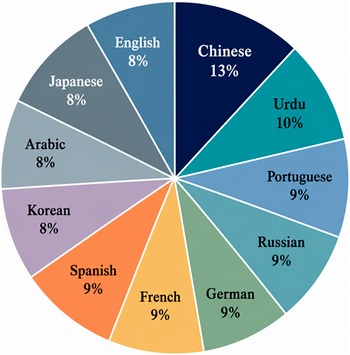
Secondly, this study employs a questionnaire survey with open-ended questions to further explore the similarities and differences in introductory expression patterns/information-structural preferences across languages from a cognitive perspective. A total of 119 participants representing 10 language backgrounds/L1 groups, including 71 males and 48 females, completed the questionnaire, with ages ranging from 17 to 50 years. The multilingual sample was assembled on an exploratory and convenience basis rather than through systematic country-based sampling. Accordingly, the study does not claim that these 10 language backgrounds constitute a fully representative typological sample of European and Asian languages. Instead, they were included to provide a preliminary multilingual extension of the English–Chinese comparison. Since the questionnaire was designed in English, all participants had an intermediate or higher level of English proficiency. The participant demographics in this study are shown in Figure 1.
Participant demographics in this study.

2.2. Data analysis
Firstly, this study utilized the COCA and BCC corpora, both of which are widely recognized for their comprehensive and representative language resources, to examine linguistic patterns in Chinese and English. To facilitate the analysis, the study employed AntConc software, a powerful corpus analysis tool renowned for its compatibility with multiple languages and its effectiveness in handling both Chinese and English texts – an essential feature for cross-linguistic studies (Authony, Reference Anthony2022). AntConc offers a range of analytical tools, such as keyword-in-context (KWIC), word frequency lists and concordance generation, enabling researchers to explore phrase structures, lexical patterns and linguistic trends in depth. These features are particularly useful for identifying linguistic patterns across diverse corpora, providing valuable insights into the structural and cultural differences between the two languages. From the COCA corpus, 309 instances were found containing the pattern ‘this/here is my brother’ sourced from materials such as movies, TV shows, web content and blogs. Similarly, the BCC corpus yielded 57 relevant instances. After the initial retrieval, the concordance lines were manually screened so that only relevant brother-introduction expressions were retained for analysis. Particular attention was paid to the post-node material following the kinship term in order to determine whether the expression was followed by an appositive personal name or occurred without one. To compare the linguistic pattern differences between Chinese and English, a log-likelihood ratio test was conducted.
Additionally, the study employed open-ended questionnaires to gather detailed responses from participants on how they introduce their brothers in various everyday contexts across different linguistic backgrounds. After the survey, the responses were transcribed into textual data for further analysis. The first stage of analysis involved coding, where researchers identified key themes, patterns and recurring ideas in the participants’ answers. The coding was carried out by a single researcher. To improve internal consistency, the coding procedure was conducted in three rounds at 3-month intervals. In the first round, preliminary recurrent response patterns were identified and initial coding categories were established. In the second round, the responses were re-examined and the coding categories were refined to improve consistency. In the third round, the full dataset was reviewed again as an audit stage to check the stability of the coding decisions across time. Because the coding was not originally designed as a formal multi-coder reliability study, inter-rater reliability statistics are not reported here; accordingly, this part of the study is best understood as an exploratory qualitative coding procedure. We performed a thematic analysis to identify and categorize themes and to uncover significant patterns of kinship terminology usage across the languages studied. Furthermore, content analysis was applied to quantify specific terms or concepts, which facilitated comparisons between participants and highlighted differences in how kinship terms are expressed across linguistic groups. This multi-method approach provided a comprehensive understanding of the interplay between linguistic structure and kinship terminology.
3. Results
3.1. Information-structural variations in kinship terminology usage between English and Chinese speakers
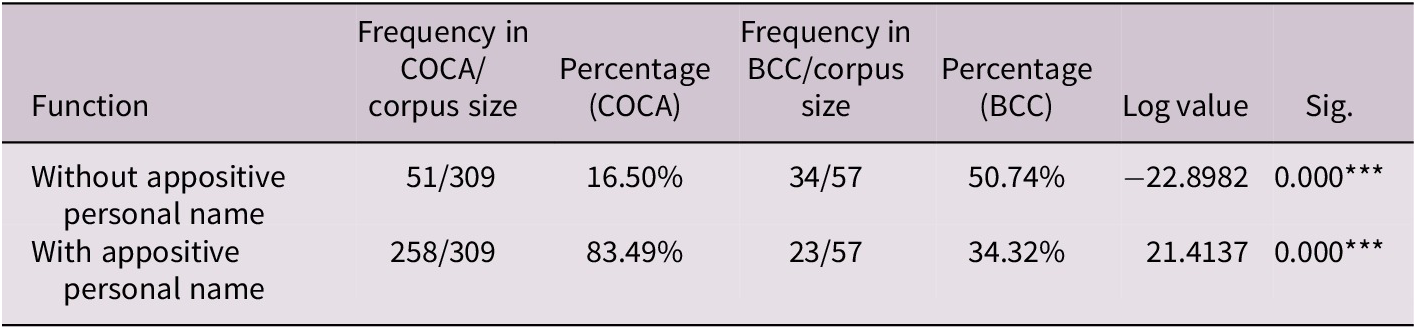
This study aims to explore information-structural variations in kinship terminology usage, specifically focusing on whether speakers introduce a brother by using a kinship term alone or by supplementing it with an appositive personal name. Through the analysis of the frequency of the phrase ‘this/here is my brother’ in both COCA and BCC, this study found that English native speakers tend to include names when introducing kinship terminology, whereas Chinese native speakers generally omit names in such contexts. Table 1 presents the results of a log-likelihood ratio test comparing information-structural preferences in English and Chinese brother-introduction expressions. The analysis shows a significant disparity in how brothers are introduced in both languages. In English (as represented in the COCA corpus), 83.49% of the instances involved introducing brothers by mentioning their names, while only 16.50% introduced brothers without naming them. In contrast, Chinese (represented in the BCC corpus) demonstrated a reverse trend, with 50.74% of instances introducing brothers without mentioning their names, and only 34.32% including the brother’s name. The results are statistically significant, with p-values less than 0.001 for both introductory expression types, indicating a statistically significant cross-linguistic difference in how brother-introduction information is packaged in the two languages.
Log-likelihood ratio test results for information-structural differences in English and Chinese brother-introduction expressions

Table 1. Long description
The header row lists Function, Frequency in C O C A forward slash corpus size, Percentage C O C A, Frequency in B C C forward slash corpus size, Percentage B C C, Log value, and Sig. The first data row, Without appositive personal name, shows 51 forward slash 309 for C O C A, 16.50 percent, 34 forward slash 57 for B C C, 50.74 percent, log value negative 22.8982, and significance 0.000 triple asterisk. The second row, With appositive personal name, shows 258 forward slash 309 for C O C A, 83.49 percent, 23 forward slash 57 for B C C, 34.32 percent, log value 21.4137, and significance 0.000 triple asterisk. The note below clarifies that triple asterisk means p less than 0.001, double asterisk means p less than 0.01, and single asterisk means p less than 0.05.
Note: *** p < 0.001, ** p < 0.01 and *p < 0.05.
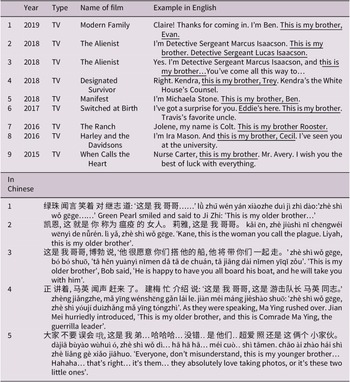
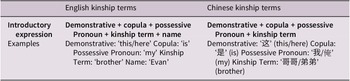
Additionally, Table 2 presents representative examples of introductory kinship terms in COCA and BCC. In these two sentences, ‘This/here is my brother, Evan’ and ‘ 这是我哥哥 ’, the study identifies distinct information-structural patterns between English and Chinese, as shown in Table 3. The examples in Table 2 were selected to showcase the differences in kinship term usage between English and Chinese. The selection criteria include the use of common linguistic patterns found in the BCC and COCA corpora, which are widely applicable across cultures. Additionally, sentences were selected based on their frequency in the corpora, ensuring that the examples are representative of typical usage patterns in both languages. In English, the sentence ‘This is my brother, Evan’ follows an introductory expression pattern in which a kinship term is followed by an appositive personal name: ‘Demonstrative + Copula + Possessive Pronoun + Kinship Term + Name’. This structure starts with the demonstrative ‘this’, followed by the copula ‘is’, the possessive pronoun ‘my’, the kinship term ‘brother’ and, finally, the name ‘Evan’. The presence of the name at the end of the construction emphasizes the individual’s identity, which is a key feature of English sentence structure, where personal identity is often highlighted. In contrast, the Chinese sentence ‘这是我哥哥/弟弟’ follows an introductory expression pattern in which the kinship term appears without an appositive personal name: ‘Demonstrative + Copula + Possessive Pronoun + Kinship Term’. The sentence begins with the demonstrative ‘这’ (this/here), followed by the copula ‘是’(is), the possessive pronoun ‘我’ (my) and the kinship term ‘哥哥’ (older brother). This construction does not include the brother’s name, focusing instead on the relational context provided by the kinship term. The absence of a name in the Chinese introductory expression pattern reflects a stronger focus on the relational role and social position encoded in the kinship term itself. These contrasting information-structural patterns illustrate how English and Chinese differ in the way they package information in brother-introduction contexts, with English prioritizing individual identity through the inclusion of names, while Chinese emphasizes relational context through kinship terms (see Table 3). This distinction highlights how introductory expression patterns can shape the meaning and focus of kinship terms in different languages.
Examples of kinship terminology expressions in COCA and BCC

Table 2. Long description
Starting at the top row, the table contains five columns: index, year, type, name of film, and example in English. Row 1: 2019, TV, Modern Family, Claire says ‘Thanks for coming in. I’m Ben. This is my brother, Evan.’ with ‘This is my brother, Evan.’ underlined. Row 2: 2018, TV, The Alienist, ‘I’m Detective Sergeant Marcus Isaacson. This is my brother. Detective Sergeant Lucas Isaacson.’ with ‘This is my brother. Detective Sergeant Lucas Isaacson.’ underlined. Row 3: 2018, TV, The Alienist, ‘Yes. I’m Detective Sergeant Marcus Isaacson, and this is my brother… You’ve come all this way to…’ with ‘this is my brother…’ underlined. Row 4: 2018, TV, Designated Survivor, ‘Right. Kendra, this is my brother, Trey. Kendra’s the White House’s Counsel.’ with ‘this is my brother, Trey’ underlined. Row 5: 2018, TV, Manifest, ‘I’m Michaela Stone. This is my brother, Ben.’ with ‘This is my brother, Ben.’ underlined. Row 6: 2017, TV, Switched at Birth, ‘I’ve got a surprise for you. Eddie’s here. This is my brother. Travis’s favorite uncle.’ with ‘Eddie’s here. This is my brother.’ underlined. Row 7: 2016, TV, The Ranch, ‘Jolene, my name is Colt. This is my brother Rooster.’ with ‘This is my brother Rooster.’ underlined. Row 8: 2016, TV, Harley and the Davidsons, ‘I’m Ira Mason. And this is my brother, Cecil. I’ve seen you at the university.’ with ‘this is my brother, Cecil’ underlined. Row 9: 2015, TV, When Calls the Heart, ‘Nurse Carter, this is my brother. Mr. Avery. I wish you the best of luck with everything.’ with ‘this is my brother’ underlined. Each example highlights the phrase introducing a brother, demonstrating kinship terminology in contemporary English media.
Information-structural patterns of kinship terminology expressions in English and Chinese

Table 3. Long description
The table consists of two main rows and three columns. The first row presents the introductory expression structure for kinship terms. The English column lists: Demonstrative plus copula plus possessive pronoun plus kinship term plus name. The Chinese column lists: Demonstrative plus copula plus possessive pronoun plus kinship term. The second row provides examples. The English example is: Demonstrative ‘this/here’, copula ‘is’, possessive pronoun ‘my’, kinship term ‘brother’, name ‘Evan’. The Chinese example is: Demonstrative ‘zhe’ (this/here), copula ‘shi’ (is), possessive pronoun ‘wo/wa’ (my), kinship term ‘gege/didi’ (brother). The spatial order follows left to right for columns and top to bottom for rows.
Bolded text indicates the information-structural patterns of kinship terminology expressions, while the non-bolded text provides corresponding examples.
3.2. The similarities and differences of information structure among different languages around the world
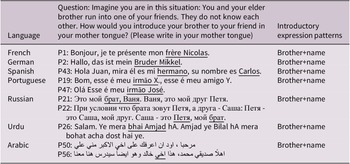
This study also employed open-ended questionnaires to survey 119 native speakers from 10 different countries, aiming to explore the linguistic differences and similarities in kinship terminology expressions globally, using the example ‘this/here is my brother’. Based on the results in Table 4, the languages represented in this table can be grouped according to a shared introductory expression pattern in which a kinship term is accompanied by an appositive personal name. One type mirrors the information-structural pattern of native English speakers, where they introduce their brothers to friends using a general kinship term combined with the brother’s name (e.g., ‘Brother + Name’). The findings show that 90% of native speakers of French, German, Arabic and Portuguese use the ‘Brother + Name’ structure when introducing their brothers. For instance, in French, ‘mon frère Nicolas’ (my brother Nicolas), in German, ‘mein Bruder Mikkel’ (my brother Mikkel) and in Arabic, ‘أخي خالد’ (my brother Khaled) are commonly used. Similarly, native Portuguese speakers say ‘meu irmão José’ (my brother José). In Russian, the structure ‘мой брат Ваня’ (my brother Vanya) is frequently employed, and in Urdu, speakers often use ‘mera bhai Amjad’ (my brother Amjad). Furthermore, 80% of native Russian speakers and 63% of native speakers of Spanish and Urdu adopt this pattern. For example, in Spanish, ‘mi hermano Carlos’ (my brother Carlos), and in Urdu, ‘mera bhai Amjad’ (my brother Amjad) reflect this structure. In summary, native speakers of French, German, Spanish, Portuguese, Russian, Urdu and Arabic predominantly use the ‘Brother + Name’ format when introducing their brothers, with the brother’s generational title specified in more particular contexts. This pattern highlights the linguistic preference for emphasizing individual identity using a name alongside the kinship term.
Kinship terminology expressions with appositive personal names in selected languages

Table 4. Long description
From the top row downward, the leftmost column lists languages: French, German, Spanish, Portuguese, Russian, Urdu, and Arabic. The central column provides sample introductory expressions in each language, with the underlined segment highlighting the kinship term plus the brother’s name. For French, the phrase is ‘Bonjour, je te présente mon frère Nicolas.’ For German, ‘Hallo, das ist mein Bruder Mikkel.’ For Spanish, ‘Hola Juan, mira él es mi hermano, su nombre es Carlos.’ Portuguese includes two examples: ‘Bom, esse é meu irmão X.’ and ‘Olá Esse é meu irmão José.’ Russian presents ‘Это мой брат, Ваня.’ and ‘При условии что брата зовут Петя, а друга - Саша: Петя - это Саша, мой друг. Саша - это Петя, мой брат.’ Urdu shows ‘Salam. Ye mera bhai Amjad hA. Amjad ye Bilal hA mera bohat acha dost hai ye.’ Arabic provides ‘مرحبا، اود ان اعرفك على اخي الاكبر مني علي’ and ‘اهلاً صديقي محمد، هذا اخي خالد وهو ايضاً سيدرس هنا معنا.’ The rightmost column consistently displays the pattern ‘Brother plus name.’ The underlined portion in each expression is the focus of the study, as noted in the table footnote.
Note: The serial numbers in the table (e.g., P34) refer to the codes in the data. The underlined portion is the focus of the study.
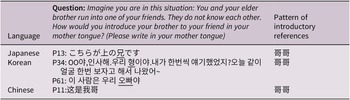
The second type involves using specific kinship terms to introduce their brothers without mentioning the brother’s name, as illustrated in Table 5 for selected East Asian languages. In this structure, the focus is placed on the relationship rather than the individual’s name. For example, in Japanese, speakers would say ‘こちらが上の兄です’ (This is my elder brother), while in Korean, a typical introduction might be ‘이 사람은 우리 오빠야’ (This is my elder brother). Similarly, native Chinese speakers would introduce their older brother simply as ‘这是我哥’ (This is my older brother). Interestingly, one native Korean speaker mentioned that they would never mention their brother’s name when introducing him to friends for the first time unless the friend specifically asked for it, highlighting the importance of the relational title over individual identity. These results indicate that speakers from East Asian languages, including Japanese, Korean and Chinese, predominantly use specific kinship titles like ‘elder brother’ or ‘older brother’ without specifying the individual’s name. This contrasts with the approach observed in many Indo-European languages, where names are typically included in kinship introductions. This difference underscores how languages emphasize either relational context or personal identity in the introduction of kinship terms.
Kinship terminology expressions without appositive personal names in selected East Asian languages

Table 5. Long description
The table has three columns: Language, a sample introductory phrase in the native script, and the pattern of introductory references. From top to bottom: The first row is Japanese, with the phrase ‘P13: kochira ga ue no ani desu’ and the kinship pattern ‘哥哥’. The second row is Korean, with two sample phrases: ‘P34: OO-ya, insa hae. Uri hyung-iya. Naega hanbeonssik yaegihaessji? Oneul gachi eolgul hanbeon bojago haeseo nawasseo~‘ and ‘P61: I saram-eun uri obba-ya’, both using the kinship pattern ‘哥哥’. The third row is Chinese, with the phrase ‘P11: zhe shi wo ge’ and the kinship pattern ‘哥哥’. The table highlights that all three languages use a specific kinship term for elder brother in introductions, with the exact phrase and script varying by language.
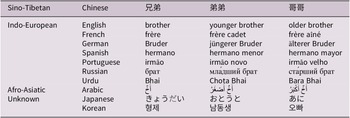
After comparing kinship terms in different languages, it is evident that languages using similar methods for introducing relatives share certain commonalities. Firstly, English, French, German, Spanish, Portuguese, Russian and Urdu have largely consistent ways of introducing relatives. A notable characteristic of languages within the same family is the existence of cognates, words that share a common etymological origin, providing crucial evidence for historical linguistic relationships (Hock, Reference Hock1991). A prominent feature of this language family is cognates, such as ‘brother’ in English, ‘frère’ in French, ‘Bruder’ in German and ‘брат’ in Russian, which are all derived from the Proto-Indo-European word ‘bʰréh2tēr’. The Spanish word ‘hermano’ and the Portuguese word ‘irmão’ have the same origin and come from the Latin word ‘germānus’. Indo-European languages display a high degree of similarity in kinship terms, lacking specific terms for ‘older brother’ or ‘younger brother’. When distinguishing the age hierarchy among siblings, they use the same method as English, adding adjectives like ‘older’ or ‘younger’ to the word ‘brother’ (see Table 4). Arabic, a member of the Afro-Asiatic language family, uses a similar structure to Indo-European languages when forming sibling terms. In contrast to the relatively ambiguous kinship terms, introducing names in Indo-European languages and Arabic is much simpler.
However, unlike Indo-European languages and Arabic, Chinese, Korean and Japanese each have distinct terms for ‘older brother’ and ‘younger brother’. The way native speakers of Chinese, Korean and Japanese introduce their siblings is markedly different from that of speakers of Indo-European and Arabic languages. The classification of the Korean and Japanese languages has been a topic of scholarly debate for many years. Early linguistic research suggested that Korean and Japanese were part of the Altaic language family, but they share only a limited number of cognates with other Altaic languages and have been heavily influenced by Classical Chinese, a representative language of the Sino-Tibetan family. Like Chinese, both Korean and Japanese have specific terms for ‘older brother’ or ‘younger brother’ (see Table 6). Additionally, names in these three languages tend to be more complex and less phonetically simple compared to their kinship terms. For example, in Korean, the name ‘Jeong-hwan’ contains a more intricate structure than the simple kinship term ‘형’ (hyung) for ‘older brother’, reflecting a greater phonetic complexity in personal names. Similarly, Japanese names like ‘Takahiro’ or ‘Yuki’ often have more syllables than the relatively simpler kinship term ‘兄’ (ani) for ‘older brother’. This complexity in naming conventions can be contrasted with the relatively straightforward phonetic structure of kinship terms in Indo-European and Arabic languages, where terms like ‘brother’ or ‘أَخٌ’ (akh) tend to be shorter and less complex.
Kinship terminology in different languages

Table 6. Long description
Beginning at the top row, the table is organized by language family in the first column, followed by language in the second column. The next three columns display kinship terms for brother, younger brother, and older brother. The Indo-European section includes English (brother, younger brother, older brother), French (frère, frère cadet, frère aîné), German (Bruder, jüngerer Bruder, älterer Bruder), Spanish (hermano, hermano menor, hermano mayor), Portuguese (irmão, irmão novo, irmão velho), Russian (брат, младший брат, старший брат), and Urdu (Bhai, Chota Bhai, Bara Bhai). The Afro-Asiatic section lists Arabic (أَخُ, أَخُ أَصْغَرُ, أَخُ أَكْبَرُ). The Unknown section includes Japanese (きょうだい, おとうと, あに) and Korean (형제, 남동생, 오빠). The column headers are Sino-Tibetan, Chinese, and three Chinese kinship terms: 兄弟, 弟弟, 哥哥. Each row aligns kinship terms for brother, younger brother, and older brother in the respective languages.
Therefore, the findings show the variations in the linguistic structure of kinship terminology expressions across different countries. For example, most native speakers of Indo-European languages (e.g., English, French, German, Spanish, etc.) tend to specify the general kinship relationship and the name, such as ‘brother Jim’ or ‘Bruder Mikkel’. In these languages, kinship terms are relatively simple and do not distinguish between older and younger siblings, which results in a less specific reference to familial relationships. Consequently, names tend to be straightforward and unambiguous. As a result, there is no need to elaborate on the specific kinship relationship, while names are relatively simple and clear. However, in Sino-Tibetan, Afro-Asiatic languages and other languages, that is, Japanese and Korean, native speakers of these languages typically introduce the exact relationship with their relatives and omit the more complex names.
4. Discussion
By analyzing cross-linguistic differences in brother-introduction expressions, this study identifies how the Focus-Shift Principle, the Principle of Least Effort and Typological Markedness interact as complementary explanatory mechanisms. In the revised discussion, these mechanisms are interpreted not only at the level of linguistic form and information structure, but also in relation to broader functional and sociocultural tendencies. More specifically, the discussion proceeds at three interconnected levels: the linguistic level, where English and Chinese differ in the semantic specificity encoded in sibling terms; the information-structural level, where speakers distribute focal weight differently between the individuated referent and the relational role; and the sociocultural level, where these recurrent patterns may be related, cautiously, to broader tendencies in self-construal, cognition and communicative orientation documented in recent cross-cultural research. Importantly, this broader interpretive scope does not imply that language use is mechanically determined by culture; rather, it suggests that linguistic structure, discourse preference and sociocultural orientation may converge in shaping recurrent introductory choices.
4.1. Information-structural variations in kinship terminology usage across English and other European and Asian languages
The results of the study revealed a significant difference in the information-structural organization of kinship terminology expressions, particularly in how speakers introduce a brother. Specifically, Chinese speakers tend to introduce their brothers without mentioning their names, whereas English speakers typically include the name when introducing a family member. At the linguistic level, one plausible explanation is that Chinese kinship terms such as ‘哥哥’ and ‘弟弟’ are semantically richer than the English term ‘brother’, because they encode relative age as well as kinship relation. This greater specificity allows the kinship term itself to carry a larger share of the identificational burden. By contrast, the English term ‘brother’ is comparatively more general and therefore more compatible with supplementation by a personal name.
At the information-structural level, the contrast can be interpreted as a difference in how salient information is packaged in discourse. In the sentence ‘This is my brother, Evan’, the inclusion of the name ‘Evan’ shifts focal weight toward the individuated referent. In contrast, the Chinese sentence ‘这是我哥哥’ foregrounds the relational role encoded in the kinship term itself, without requiring an additional personal name. The contrast is, therefore, better understood as a difference in information packaging rather than a difference in grammatical possibility.
At the sociocultural level, these findings may also be related, cautiously, to broader differences in models of selfhood and social attention. Recent large-scale work has shown that cultural variations in self-construal are more complex than a simple East–West dichotomy, but it remains the case that some social settings place relatively greater emphasis on autonomy and individuality, whereas others give greater weight to relational embeddedness and role-based positioning (Vignoles et al., Reference Vignoles, Owe, Becker, Smith, Easterbrook, Brown, González, Didier, Carrasco, Cadena, Lay, Schwartz, Des Rosiers, Villamar, Gavreliuc, Zinkeng, Kreuzbauer, Baguma, Martin and Bond2016). Related research in cultural psychology has also suggested that cross-cultural differences in cognition often involve different balances between focal-object attention and context-sensitive or relational processing. From this perspective, the greater tendency to include a personal name in English introductions may help foreground the individuated actor, while the greater tendency to rely on the kinship term alone in Chinese may help foreground the speaker’s relational framing of that actor. These broader tendencies may help account for the discourse patterns observed here, but they should not be treated as deterministic explanations for all speakers or all contexts.
4.2. Focus-shift and information packaging in kinship terminology usage
From the perspective of the Focus-Shift Principle, the contrast observed in the present study can be interpreted as a difference in how speakers package salient information when introducing a brother (Erteschik-Shir, Reference Erteschik-Shir2007; Lambrecht, Reference Lambrecht1994; Yang & He, Reference Yang and He2022). In the English data, the kinship term ‘brother’ is relatively general and is frequently followed by a personal name. This pattern suggests that focal weight is often shifted toward the individuated referent, that is, toward the identity of the brother as a particular person. In the Chinese data, by contrast, expressions such as ‘哥哥’ and ‘弟弟’ already encode both kinship relation and relative age. As a result, the relational role itself may serve as the primary focal unit, reducing the need for an additional personal name in introductory contexts.
This interpretation also strengthens the argument that the contrast between English and Chinese is better understood as one of information structure rather than one of syntax. Chinese is fully capable of appositive constructions, but the data suggest that Chinese speakers often choose not to use them in this context because the kinship term already carries substantial informational weight. English speakers, on the other hand, may be more likely to add a personal name because the term ‘brother’ alone provides less specific information. The focal contrast, then, lies between highlighting a relational role and highlighting an individuated person. In functional terms, this can be understood as a discourse-organizational preference shaped by communicative needs rather than by grammatical constraint (Kemp et al., Reference Kemp, Xu and Regier2018).
The multilingual questionnaire data show a similar tendency. Many European-language responses favor a ‘kinship term + name’ pattern, whereas East Asian-language responses more often rely on the kinship term alone. This does not mean that all languages in one region follow a single uniform rule. Rather, it suggests a recurrent cross-linguistic tendency in how focal information is distributed in introductory discourse. In this respect, the Focus-Shift Principle provides a more precise account of the findings than a purely lexical comparison of kinship systems.
The findings may also be related, cautiously, to broader sociocultural tendencies documented in recent cross-cultural work on communication and cognition. More individual-centered contexts often privilege explicit identification of the focal actor, whereas more role- or relation-centered contexts may tolerate greater reliance on socially shared or relationally inferable information. Recent research has emphasized that such differences should not be essentialized, but may still shape recurrent discourse preferences in systematic ways (Santos et al., Reference Santos, Varnum and Grossmann2017). Within this perspective, it is plausible that English introductions more readily foreground the individual actor, whereas Chinese introductions more readily foreground the speaker’s relation to that actor. Again, these are best treated as interpretive tendencies rather than categorical cultural rules (Liu & Li, Reference Liu and Li2024).
4.3. Least effort and typological markedness in cross-linguistic brother introductions
The findings can also be interpreted in terms of the Principle of Least Effort. In the present study, least effort should not be understood simply as formal brevity, but as the efficient coordination of speaker effort and hearer interpretation (Waters, Reference Waters1937; Zipf, Reference Zipf2016). In Chinese, kinship terms such as ‘哥哥’ and ‘弟弟’ already provide relatively rich relational information. Under such conditions, omitting a personal name may reduce production effort without significantly increasing interpretive difficulty. In English, however, the more general term ‘brother’ may leave the referent less fully specified. In that case, adding a personal name can reduce the hearer’s inferential burden and thereby increase overall communicative efficiency (Fedorenko et al., Reference Fedorenko, Plantadosi and Gibson2024; Jones, Reference Jones2010). In this sense, least effort is better understood functionally as a principle of communicative economy, not merely as a preference for shorter forms.
This interpretation is important because it avoids the misleading assumption that the least effort always favors shorter expressions. In some contexts, a slightly longer expression may in fact be more efficient if it facilitates identification of the intended referent. The English pattern, therefore, should not be treated as redundant in any simple sense. Rather, it can be understood as an efficient strategy in a system where the kinship term itself carries less specific relational information than its Chinese counterpart. Conversely, the Chinese pattern can be understood as efficient because the kinship term already performs more of the identificational work. This functional interpretation aligns well with broader communicative-efficiency accounts that treat linguistic form as shaped by the balancing of cognitive cost and interpretive payoff (Piantadosi et al., Reference Piantadosi, Tily and Gibson2012; Fedorenko et al., Reference Fedorenko, Plantadosi and Gibson2024).
Typological Markedness provides a further layer of explanation. Kinship terms differ across languages in how much semantic specificity they encode (Andersen, Reference Andersen2001; Croft, Reference Croft2003; Sinnemäki, Reference Sinnemäki2011). In Chinese, sibling terms such as ‘哥哥’ and ‘弟弟’ are more highly specified because they encode relative age as well as kinship relation. In English, by contrast, ‘brother’ is less specified in this respect. These differences in markedness may affect which part of the introductory expression becomes more informative or focal. Where the kinship term itself is already relatively marked and informative, the pressure to add an appositive name may be weaker. Where the kinship term is less marked, an additional personal name may be more likely to carry the burden of specification (Passmore et al., Reference Passmore, Barth, Quinn, Greenhill, Evans and Jordan2021; Wilkinson, Reference Wilkinson2009).
The multilingual data suggest that this explanation may extend beyond the English–Chinese comparison, although the present study does not claim a rigid typological split between ‘European’ and ‘Asian’ languages. Rather, the results point to a more limited tendency: languages that encode richer relational distinctions in kinship terms may be more likely to rely on the kinship term itself in introductory contexts, whereas languages with more general sibling terms may more readily combine the kinship term with a personal name. In this way, typological markedness complements Focus-Shift and Least Effort by explaining why different languages distribute informational load differently in brother-introduction expressions. At the same time, these tendencies may also be reinforced by sociocultural preferences for either role-centered or individual-centered discourse, but the present data support only a cautious interpretive connection rather than a strong deterministic claim.
5. Conclusion
This study provides a focused account of cross-linguistic variations in kinship terminology usage in introductory contexts, using the expression ‘this/here is my brother’ as a point of departure. By combining corpus comparison with an open-ended survey, the study reveals significant differences in how brother-introduction expressions are organized across languages. The corpus analysis of COCA and BCC shows that English speakers more often include their brothers’ personal names alongside kinship terms, whereas Chinese speakers more often rely on the kinship term itself. The multilingual survey further supports this tendency: many speakers from the European-language groups represented in the sample preferred a ‘kinship term + name’ pattern, whereas speakers from the East Asian-language groups more often relied on the kinship term alone. Taken together, these findings suggest that cross-linguistic differences in brother-introduction expressions are closely related to differences in semantic specificity, information packaging and communicative preference.
The study is broadly informed by the usage-based approach, while drawing more directly on the Focus-Shift Principle, the Principle of Least Effort and Typological Markedness to account for the observed patterns. From this perspective, the contrast between English and Chinese is better understood not as a matter of grammatical possibility, but as a difference in how speakers distribute focal weight and manage communicative efficiency in introductory discourse. More specifically, English brother is comparatively general and therefore more likely to be supplemented by a personal name, whereas Chinese 哥哥 and 弟弟 already encode kinship relation and relative age, allowing the kinship term itself to function as a more informative focal unit. In this sense, the present study contributes to research on kinship terminology by showing how information structure, communicative economy and markedness may jointly shape introductory expression patterns across languages.
At the same time, the findings should be interpreted within the empirical limits of the study. The corpus analysis is restricted to English and Chinese, and the multilingual survey sample is exploratory and organized by language backgrounds/L1 groups rather than by a systematically selected set of countries or language families. In addition, the questionnaire data are based on self-reported responses, and the study focuses on one specific kin relation in one specific interactional context. For these reasons, the present article does not propose a full typology of kinship systems; rather, it offers preliminary evidence for a recurrent cross-linguistic tendency in brother-introduction expressions. Future research could extend this line of inquiry by examining a broader range of kinship relations, discourse settings and language backgrounds, and by combining corpus, experimental and interactional data to test whether the tendencies identified here generalize beyond the present case.
Funding statement
This work was supported by the Key Project of the 2025 Jiangsu Education Science Planning Program (B/2025/01/215) and the Jiangsu Provincial Degree and Graduate Education Reform Project (JGKT25_B005).
Data availability statement
The data that support the findings of this study are openly available in two corpora: the Corpus of Contemporary American English (COCA) at https://www.english-corpora.org/coca/, and the Beijing Language and Culture University Corpus Center (BCC) at https://bcc.blcu.edu.cn/. Additionally, the data for the open-ended questionnaires that support the findings of this study are available on request from the corresponding author, Dr. Wang. The data are not publicly available due to restrictions, as they contain information that could compromise the privacy of research participants.

 Open access

