





Introduction
The early stage of sugar beet growth coincides with the emergence of many annual, biennial, and perennial weeds (ASBGA 2024; May and Wilson Reference May, Wilson and Draycott2006). Palmer amaranth, a prominent weed in western states where sugar beet is grown, is an annual broadleaf weed species native to the southwestern United States and northern Mexico (Sauer Reference Sauer1957). Palmer amaranth is one of the most highly prolific weeds in modern agricultural systems. Its small seeds facilitate dispersion by farm machinery, and because the weed is a dioecious obligate out-crosser, adaptive traits are readily spread among populations (Jhala et al. Reference Jhala, Norsworthy, Ganie, Sosnoskie, Beckie, Mallory-Smith, Liu, Wei, Wang and Stoltenberg2021; Oliveira et al. Reference Oliveira, Gaines, Patterson, Jhala, Irmak, Amundsen and Knezevic2018; Reference Oliveira, Jhala, Bernards, Proctor, Stepanovic and Werle2022; Sauer Reference Sauer1957).
Palmer amaranth interference varies among crops, but it can be severe, even at low densities. Miranda et al. (Reference Miranda, Bradshaw and Lawrence2021) reported 77% yield loss of dry bean (Phaseolus vulgaris L.) with as few as two Palmer amaranth plants per meter row. Similar or greater yield losses have been estimated, with 60% losses of peanut (Arachis hypogea L.) by 5 plants m−1 row; and 22% yield reduction of soybean [Glycine max (L.) Merr.] with just 0.33 plant m−1 row (Burke et al. Reference Burke, Schroeder, Thomas and Wilcut2007; Chandi et al. Reference Chandi, Jordan, York, Milla-Lewis, Burton, Culpepper and Whitaker2012). By comparison, Schultz and Lawrence (Reference Schultz and Lawrence2020) estimated 90% sugar beet yield loss for every 2 Palmer amaranth plants m−1 row.
Herbicide-resistant (HR) Palmer amaranth is prevalent throughout the United States (Ward et al. Reference Ward, Webster and Steckel2013), and resistance to multiple herbicide sites of action have been documented in many states (Heap Reference Heap2024). In western states where sugar beet is grown, dicamba-resistant and glyphosate-resistant (GR) biotypes exist in Colorado and Nebraska (Araujo et al. Reference Araujo, Westra, Shergill and Gaines2024). In Nebraska, resistance to inhibitors of acetolactate synthase, hydroxyphenylpyruvate dioxygenase, protoporphyrinogen oxidase, and photosystem II have been reported (Knezevic et al. Reference Knezevic, Creech, Jhala, Klein, Proctor, Folck, Weisbrod, Lawrence and Zaric2025). GR biotypes have also been reported in the pacific northwest (Idaho and Oregon), and resistance to acetolactate synthase inhibitors is suspected (Adjesiwor et al. Reference Adjesiwor, Felix, Adler, Landau, Araujo, Gaines and Lawrence2026).
The very-long-chain fatty acid (VLCFA) inhibitors acetochlor, S-metolachlor, and dimenthenamid-P were the only herbicides available to western-state sugar beet producers for controlling HR Palmer amaranth before metamitron was granted an emergency exemption for use under Section 18 of the Federal Insecticide, Fungicide, and Rodenticide Act (Adjesiwor et al. Reference Adjesiwor, Adler and Felix2025). However, many VLCFA inhibitors can be applied only after the 2 true-leaf (TL) stage of sugar beet growth due to crop injury concerns (Adjesiwor et al. Reference Adjesiwor, Adler and Felix2025; BASF 2025; Bayer CropScience 2021; Beiermann et al. Reference Beiermann, Creech, Knezevic, Jhala, Harveson and Lawrence2021; Syngenta 2004) and will not control emerged HR Palmer amaranth. Ethofumesate applied preemergence has been reported to control redroot pigweed (Amaranthus retroflexus L.) (Miller et al. Reference Miller, Thomas, Adam and Mettler2025); however, its activity on HR Palmer amaranth is poor (Akuoko et al. Reference Akuoko, Kniss, Felix, Alder and Lawrence2026; Lawrence and Kniss Reference Lawrence and Kniss2021; Peters and Aberle Reference Peters and Aberle2024). Akuoko et al. (Reference Akuoko, Kniss, Felix, Alder and Lawrence2026) reported <52% HR Palmer amaranth control with preemergence applications of cycloate (4.03 kg ai ha−1) and ethofumesate (1.58 kg ai ha−1).
Metamitron, a photosystem II inhibitor, is the only effective preemergence herbicide for controlling HR Palmer amaranth in sugar beet fields (Akuoko et al. Reference Akuoko, Kniss, Felix, Alder and Lawrence2026). In trials located near Scottsbluff, Nebraska, metamitron (5.63 kg ai ha− 1) applied both alone and in a tank mixture with ethofumesate provided 98% control of HR Palmer amaranth throughout the season (Akuoko et al. Reference Akuoko, Kniss, Felix, Alder and Lawrence2026). However, it is possible that rates less than previously evaluated could be combined with other herbicides to provide effective sequential HR Palmer amaranth control, rather than relying on metamitron alone for season-long control.
An alternative to applying metamitron at 5.63 kg ai ha−1 for season-long control may be to use a lower rate at preemergence in combination with VLCFA inhibitors applied at the 2 TL stage, to extend the period that soil-active herbicides are active in the soil by layering different residual herbicides in sequence. The objective of this field study was to determine which metamitron use rate (<5.63 kg ai ha−1) would allow weed control through the 2 to 6 TL growth stage of sugar beet and therefore allow applications of VLCFA inhibitors to be used in sequence for season-long suppression of HR Palmer amaranth.
Materials and Methods
Site Description
A preliminary field trial was conducted in 2020 at the University of Nebraska-Lincoln Panhandle Research and Extension Center in Scottsbluff (41.89°N, 103.68°W). Field trials were repeated in 2023 on fields owned by farmers near Mitchell, Nebraska (41.57°N, 103.42°W); Eaton, Colorado (40.58°N, 104.68°W); and Eckley, Colorado (40.10°N, 102.47°W). Soil descriptions of the trial locations are listed in Table 1. Overhead irrigation was applied at all trial locations. All locations had a natural infestation of GR Palmer amaranth, with common lambsquarters (Chenopodium album L.) also present at the Nebraska locations, and GR kochia [Bassia scoparia (L.) A. J. Scott] at the Eaton site.
Herbicide application dates and site description of trial locations in 2020 and 2023.

Experimental Design and Treatments
All plots were conventionally tilled to control any existing weeds that had emerged before sugar beets were planted. Sugar beet variety Crystal W611NT (Betaseed Inc., Shakopee, MN) was planted on May 11, 2020, and between April 17 and April 28, 2023 (Table 1). Sugar beets were seeded at approximately 138,000 and 128,000 seeds ha−1, in 56-cm or 76-cm rows at the Nebraska and Colorado locations, respectively (Table 1). Planting dates, seeding rates, and plant spacing were within the typical ranges used by sugar beet growers in both Nebraska and Colorado (Demingi Reference Demingi1942; Yonts et al. Reference Yonts, Wilson, Smith, Wilson, Smith and Jasa2013). Each plot measured 9.1 m long and 2.2 m wide at the Nebraska locations, and 7.6 m long and 3 m wide at the Colorado locations. Fertilizers were applied according to University of Nebraska-Lincoln and Colorado State University Extension recommendations for sugar beet production based on soil nutrient status at each location.
Field trials were arranged in a randomized complete block design with four replications at each location. The trials were designed as a dose-response treatment with varying rates of metamitron applied with or without a single rate of ethofumesate. Herbicide rates varied by trial year. Treatments during the preliminary trial in Scottsbluff in 2020 consisted of preemergence applications of metamitron (Goltix 700 SC; ADAMA, Raleigh, NC) at 0, 1.28, 2.56, 3.84, 5.40, and 6.40 kg ai ha−1 with and without ethofumesate (1.68 kg ai ha−1) (Ethofumesate 4SC; Willowood LLC, Henderson, NV). At the Eaton, Eckley, and Mitchell locations in 2023, treatments consisted of preemergence applications of metamitron at 0, 0.87, 1.74, 2.61, 3.48, and 4.35 kg ai ha−1, with and without ethofumesate (1.86 kg ai ha−1). All herbicides were applied with a CO2-pressurized backpack sprayer equipped with TeeJet 11003 AIXR nozzles (TeeJet Technologies, Glendale Heights, IL) calibrated to deliver 140 or 187 L ha−1 of spray solution at the Nebraska and Colorado locations, respectively. Herbicides were applied at a constant speed of 5 km h−1 with the spray boom maintained 51 cm above the ground at all locations. Trial plots were irrigated with 12.6 mm of water within 24 h of herbicide application to ensure incorporation.
Data Collection
GR Palmer amaranth density and visual control estimates were assessed at each location. GR Palmer amaranth density and control were recorded at the Mitchell and Eckley locations to the 6 to 8 TL stage, and to the 8 to 10 TL stage at the Scottsbluff and Eaton locations. Weed density was assessed by hand-counting the number of GR Palmer amaranth within two 0.5-m2 quadrats per plot. Sugar beet growth stage was determined by hand-counting true leaves on four randomly selected plants in the nontreated control plots. Control was evaluated on a scale of 0% to 100%, where 0% represents no control and 100% represents complete control of GR Palmer amaranth.
Statistical Analysis
All data were analyzed using R statistical software (v. 4.4.1) (R Core Team 2024). Nonlinear regression analysis was used to determine the response of GR Palmer amaranth to the evaluated herbicide dose. Data from each location were analyzed separately using the drc package (v. 3.0-1) (Ritz and Strebig Reference Ritz and Strebig2016). Following fitted model comparison using the Akaike information criterion, log-likelihood using the logLik function, and lack-of-fit test using the modelFit function (Ritz et al. Reference Ritz, Baty, Streibig and Gerhard2015), a best-fit model was chosen for a given response variable, considering the biological perspective (Onofri et al. Reference Onofri, Carbonell, Piepho, Mortimer and Cousens2010).
A three-parameter log-logistic model as suggested by Ritz et al. (Reference Ritz, Baty, Streibig and Gerhard2015) was used to evaluate the effect of metamitron dose (the predictor variable) on GR Palmer amaranth density (the response variable) at the Scottsbluff, Eaton, and Eckley locations using the drm function in the drc package (v. 3.0-1) (Ritz and Strebig Reference Ritz and Strebig2016) as follows (Equation 1): $y={{d} \over {1+\exp\left\{b\left[\log\left(x\right)-\log\left(e\right)\right]\right\}}}$
where y is the response variable (GR Palmer amaranth density), d is the mean GR Palmer amaranth density (measured per square meter) response under a zero metamitron dose (the upper limit), x is metamitron dose expressed in kg ai ha−1, e is the effective metamitron dose required to result in a 50% reduction in GR Palmer amaranth density (ED50), and b is the slope parameter describing the steepness of the dose-response curve at the ED50.
The three- or four-parameter model was inadequate for describing a dose-response relationship due to high variability in GR Palmer amaranth density data from the Mitchell location and considering the biological perspective and visual inspection of parameter estimates. Consequently, a generalized log-logistic model (a five-parameter model) as suggested by Ritz (Reference Ritz2010) was used (Equation 2): $y=c+{{d-c}\over {\left\{1+\exp\left[b\left(\log\left(x\right)-\log\left(e\right)\right)\right]\right\}^{f}}}$
where y is the response variable, d is the mean GR Palmer amaranth density (measured per square meter) response under zero metamitron dose (upper limit), x is metamitron dose expressed in kg ai ha−1, c is the mean GR Palmer amaranth density response at high metamitron dose (lower limit), e is the effective metamitron dose where GR Palmer amaranth density is at the inflection point between the upper and lower limits, b is the slope near e, and f is the asymmetry factor. As explained by Keshtkar et al. (Reference Keshtkar, Kudsk and Mesgaran2021) and Ritz (Reference Ritz2010), the e parameter in the generalized log-logistic model is not always equivalent to the ED50. In this situation, the asymmetrical factor (f) was >1 (Table 2), pushing the dose-response curve to the left, relative to the symmetrical situation (where f = 1). Therefore, to allow meaningful comparison of dose-response rates across locations, the ED50 value for the Mitchell location was obtained using the ED function rather than relying directly on the e parameter.
Parameter estimates (b, c, d, e, and f) for nonlinear regression models used in a sugar beet weed control trials.a,b

a Abbreviation: SE, standard error.
b Parameter estimates: b is the slope near the inflection point e; c is the lower limit; d is the upper limit; e is the metamitron rate (kg ha−1) where Palmer amaranth response is between the lower and upper limits.
c The e parameter at the Mitchell location was generated using the ED function rather than relying directly on the e parameter.
A four-parameter log-logistic model was used to evaluate the effect of metamitron dose on the percent of GR Palmer amaranth control among all locations using the drm function in the drc package, v. 3.0-1 (Ritz and Strebig Reference Ritz and Strebig2016). To improve the biological interpretation of parameter estimates, the c and d parameters used in the model for analyzing percent control data from the Scottsbluff, Eaton, and Eckley locations were fixed at zero and 100, respectively, as suggested by Keshtkar et al. (Reference Keshtkar, Kudsk and Mesgaran2021) and used by Nunes et al. (Reference Nunes, Werle, Freitas and Cunha2022) and Sperry et al. (Reference Sperry, Scholtes, Golus, Viera, Reynolds, Kruger, Irby, Eubank, Barber and Dodds2022). The resulting function becomes (Equation 3): $y={{100} \over {1+\exp\left\{b\left[\log\left(x\right)-\log\left(e\right)\right]\right\}}}$
where y is the response variable (percent of mean GR Palmer amaranth control), x is the metamitron dose expressed in kg ai ha−1, e is the ED50 value, and b is the slope near the e.
At the Mitchell location, only the c parameter used in the model for analyzing percent control data was fixed at zero, as suggested by Keshtkar et al. (Reference Keshtkar, Kudsk and Mesgaran2021). The resulting function becomes (Equation 4): $y={{d} \over {1+\exp\left\{b\left[\log\left(x\right)-\log\left(e\right)\right]\right\}}}$
where y is the response variable (percent of mean GR Palmer amaranth control), d is the mean GR Palmer amaranth percentage control response under high metamitron dose, x is the metamitron dose expressed in kg ai ha−1, e is the ED50 value, and b is the slope near the e.
The estimated ED90 values were extracted from fitted dose-response models using the ED function in the drc package (Ritz and Strebig Reference Ritz and Strebig2016). In Eckley, estimated GR Palmer amaranth control was lower than 90%. Consequently, ED75 and ED85 values were added to allow comparison of dose-response rates across all locations. To construct plots using the ggplot function from the ggplot2 package, v. 4.0.2 (Wickham et al. Reference Wickham, Chang, Henry, Pedersen, Takahashi, Wilke, Woo, Yutani, Dunnington and Brand2026); the predict function in the drc package was used to obtain parameter estimates and standard error from each dose-response model (Ritz et al. Reference Ritz, Baty, Streibig and Gerhard2015). To compare the relative potency of metamitron and metamitron + ethofumesate on GR Palmer amaranth suppression, the EDcomp function in the drc package was used to estimate the ratio of metamitron dose that produces the same 50% GR Palmer amaranth response to both herbicide programs.
Results and Discussion
Regression analysis was appropriate for both GR Palmer amaranth density and visual control, based on a lack-of-fit test at all locations. Response data were analyzed by location because GR Palmer amaranth densities varied among study locations and metamitron rates differed between study years.
The parameter error estimates for both GR Palmer amaranth visual control and density were high due to high variations in weed count data at the Nebraska locations. In contrast, the Colorado locations, which had higher weed densities (Table 2), provided lower parameter error estimates due to low variations in weed count.
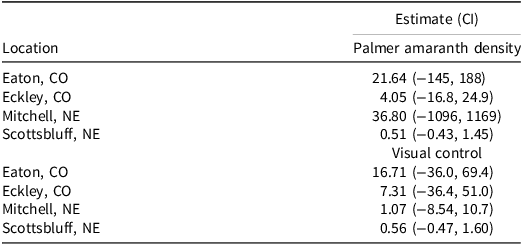
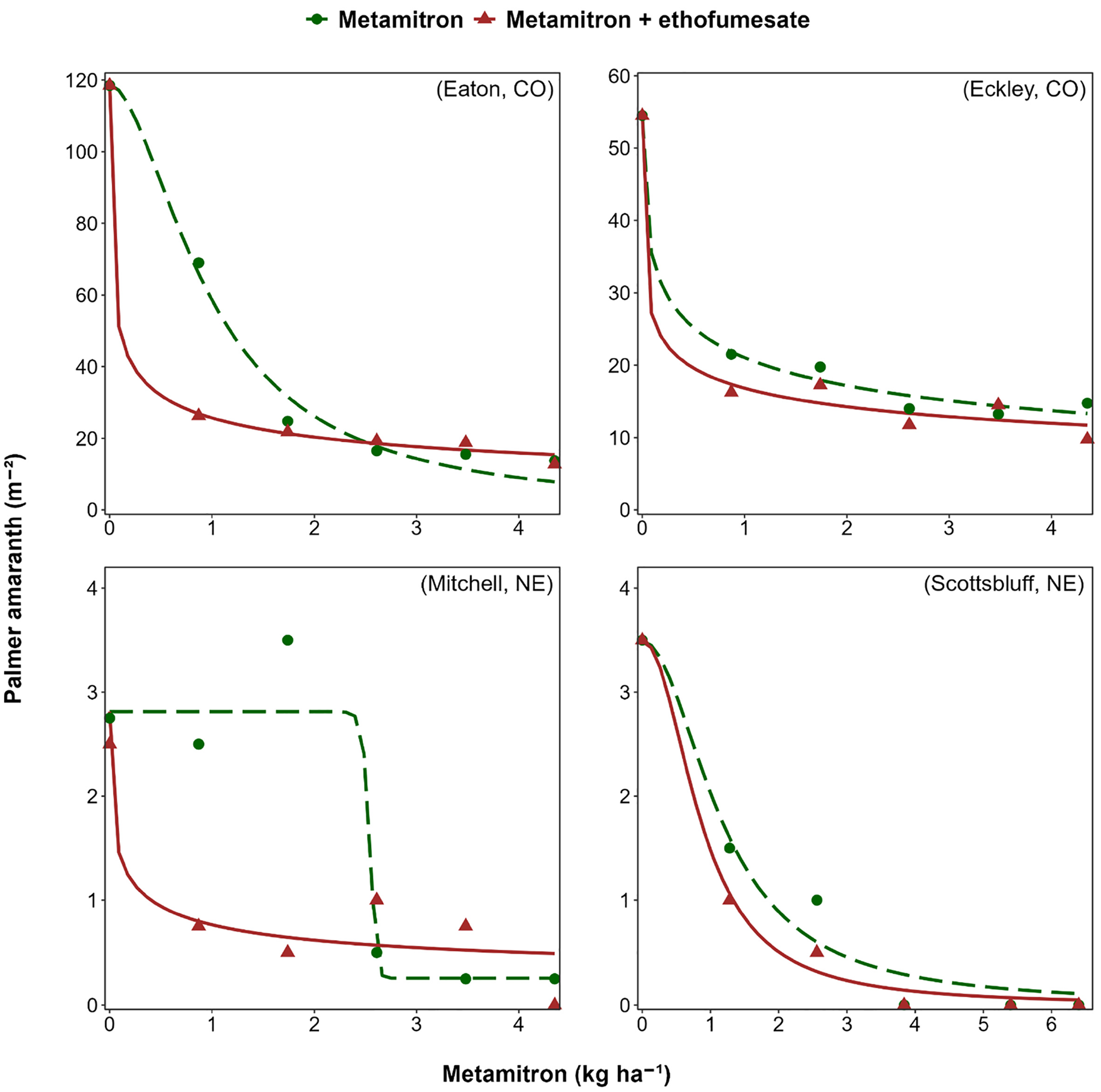
In the trials at Eaton, Eckley, and Mitchell, adding ethofumesate as a tank-mixture partner generally reduced the metamitron rate needed for both visual control estimates and ED50 values (Table 2), although overlapping parameter error estimates precluded statistical differences in relative potency among treatments (Table 3). This trend was most pronounced and consistent at the Colorado locations where higher GR Palmer amaranth densities (>50 Palmer amaranth plants m–2) were observed relative to the Nebraska locations (<5 Palmer amaranth plants m–2; Figure 1). GR Palmer amaranth densities were reduced by 50% at the Eaton and Eckley locations when metamitron was applied alone at ≥0.4 kg ai ha–1, compared with ˂0.1 kg ai ha–1 when ethofumesate was added as a tank-mixture partner. The metamitron rate estimated to obtain a 50% reduction in density at Scottsbluff decreased from 1.18 to 0.87 kg ai ha–1 when ethofumesate was added, but this trend did not hold for visual control, an inconsistency we attribute to lower GR Palmer amaranth density and greater pressure from the presence of common lambsquarters at Scottsbluff (data not shown), which likely reduced the consistency of visual estimates.
Relative herbicide potency ratio (ED50) for metamitron applied alone versus metamitron + ethofumesate applied in a tank mix on Palmer amaranth density and percentage visual control response across sugar beet weed control trials.a,b

a Abbreviation: CI, confidence interval. CIs were calculated at a level of α = 5%. If a CI includes include zero, difference in potency between herbicide programs are not statistically different.
b Estimated relative potency describes how Palmer amaranth suppression activity of an application of metamitron + ethofumesate compares with metamitron applied alone. It is expressed as the ratio of metamitron dose that produces the same 50% Palmer amaranth response for both herbicide programs. If the ratio is >1, metamitron applied alone is more potent than metamitron + ethofumesate, and if the ratio is <1, the reverse is true. If the ratio = 1, the two herbicide programs are equally potent.
Palmer amaranth density (per square meter) in response to different metamitron and metamitron + ethofumesate rates applied preemergence to sugar beet weed in four trials (2020 near Scottsbluff, NE; and Mitchell, NE; Eaton, CO; and Eckley, CO in 2023).

Figure 1. Long description
Panel A: A line graph shows Palmer amaranth density in Eaton, CO. The x-axis represents metamitron rates in kg per hectare, ranging from 0 to 4. The y-axis represents Palmer amaranth density in meters squared, ranging from 0 to 120. Two data series are plotted: one for metamitron alone (green dashed line with circles) and one for metamitron plus ethofumesate (red solid line with triangles). The density decreases as the metamitron rate increases, with the combination treatment showing a more pronounced reduction. Panel B: A line graph shows Palmer amaranth density in Eckley, CO. The x-axis represents metamitron rates in kg per hectare, ranging from 0 to 4. The y-axis represents Palmer amaranth density in meters squared, ranging from 0 to 60. Two data series are plotted: one for metamitron alone (green dashed line with circles) and one for metamitron plus ethofumesate (red solid line with triangles). The density decreases as the metamitron rate increases, with the combination treatment showing a more pronounced reduction. Panel C: A line graph shows Palmer amaranth density in Mitchell, NE. The x-axis represents metamitron rates in kg per hectare, ranging from 0 to 4. The y-axis represents Palmer amaranth density in meters squared, ranging from 0 to 4. Two data series are plotted: one for metamitron alone (green dashed line with circles) and one for metamitron plus ethofumesate (red solid line with triangles). The density decreases as the metamitron rate increases, with the combination treatment showing a more pronounced reduction. Panel D: A line graph shows Palmer amaranth density in Scottsbluff, NE. The x-axis represents metamitron rates in kg per hectare, ranging from 0 to 6. The y-axis represents Palmer amaranth density in meters squared, ranging from 0 to 4. Two data series are plotted: one for metamitron alone (green dashed line with circles) and one for metamitron plus ethofumesate (red solid line with triangles). The density decreases as the metamitron rate increases, with the combination treatment showing a more pronounced reduction.
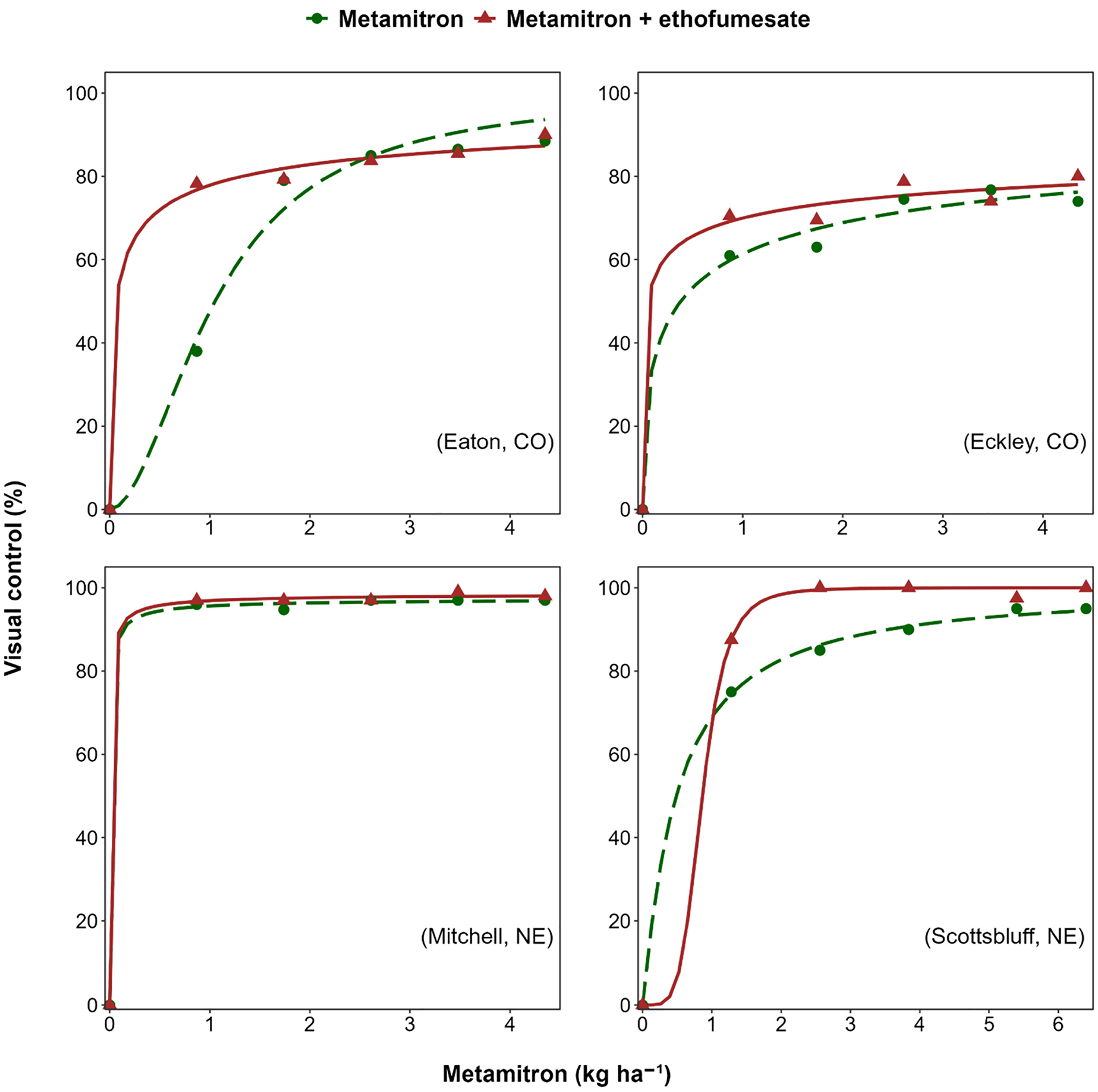
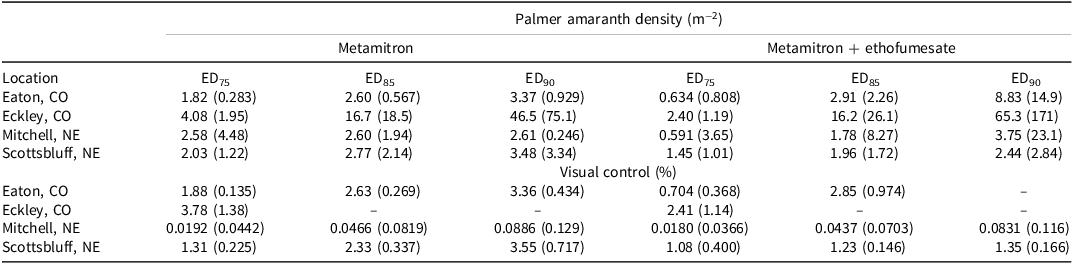
Neither treatment consistently achieved the 90% GR Palmer amaranth response threshold at the Colorado locations, likely due to high weed densities (Figures 1 and 2). Consequently, to allow for comparison of dose-response rates, we focus on 75% or 85% GR Palmer amaranth response thresholds for cross-location comparison. At Eaton, the ED85 metamitron rate for visual control of GR Palmer amaranth was estimated at 2.63 kg ai ha–1 when applied alone, compared with 2.85 kg ai ha–1 when ethofumesate was applied as a tank-mixture partner. This was a reversal of what we observed at the Nebraska locations (Table 4; Figure 2) and attributed this to high kochia density at Eaton (data not shown). Previous research has reported that metamitron (5.63 kg ai ha–1) + ethofumesate has no effect on kochia (Akuoko et al. Reference Akuoko, Kniss, Felix, Alder and Lawrence2026). In contrast, at the Nebraska locations (Scottsbluff and Mitchell), the ED85 metamitron rate for visual control of GR Palmer amaranth was either 0.003 less at Mitchell (0.047 vs. 0.044 kg ai ha–1) or 1.25 kg ai ha–1 less at Scottsbluff (2.33 vs. 1.23 kg ai ha–1) when ethofumesate was added as a tank-mix partner. Similarly, at Eckley, the ED75 metamitron use rate decreased from 3.78 kg ai ha–1 when applied alone to 2.41 kg ai ha–1 when ethofumesate was added. A similar trend of lower metamitron use rates when applied together with ethofumesate associated with the ED75 was observed the other three locations.
Percent of mean visual control (%) in response to metamitron and metamitron + ethofumesate rates applied preemergence to sugar beet in four weed control trials (2020 near Scottsbluff, NE; and Mitchell, NE; Eaton, CO; and Eckley, CO in 2023).

Estimated effective dose of metamitron and metamitron + ethofumesate applied preemergence to achieve a Palmer amaranth response in sugar beet weed control trials.a,b

a Abbreviations: ED, expected dose; SE, standard error.
b ED75, ED85, and ED90 are the estimated doses of metamitron required to reach, respectively, 75%, 85%, and 90% reductions in Palmer amaranth density.
Scottsbluff and Mitchell were the only locations where 90% visual control thresholds were achievable with both treatments (Table 4; Figure 2). At the Scottsbluff location, an estimated 3.55 kg ai ha–1 of metamitron applied alone was needed to achieve the 90% threshold compared with just 1.35 kg ai ha–1 when it was applied with ethofumesate in a tank mixture, but at Mitchell, <0.1 kg ai ha–1 of metamitron was needed when either applied alone or as a tank-mixture partner. At all four study locations, the highest percentage control threshold was ≤3.78 kg ai ha–1 when metamitron was applied alone. Our findings support those reported by other researchers that effective sugar beet weed management with metamitron applied alone at 3.50 kg ai ha−1 or lower (Deveikyte et al. Reference Deveikyte, Sarunaite, Seibutis, Price, Kelton and Sarunaite2015; Rathika Reference Rathika2014). For example, Trajdos et al. (Reference Trajdos, Kucharski and Sadowski2014) reported 80% control of redroot pigweed and common lambsquarters with metamitron (2.80 kg ai ha−1) in a trial conducted in Poland.
As previously elaborated, we observed no statistical differences in relative potency between metamitron and metamitron + ethofumesate at any of the four locations. Even so, adding ethofumesate as a tank-mix partner may reduce selection pressure. Metamitron resistance by common lambsquarters and redroot pigweed has emerged where the herbicide has been relied upon as a solo treatment (Aper et al. Reference Aper, Mechant, Rubin, Heyerick, Callebaut, Mangelinckx, Deforce, De Kimpe, Bulcke and Reheul2012; Mechant et al. Reference Mechant, Bulcke and Maeghe2005; Mikulka et al. Reference Mikulka, Sen, Kosnarova, Hamouz, Hamouzova, Sur, Suk, Bhattacharya and Soukup2024). Metamitron is often used in a tank mixture with other herbicides and adjuvants to improve control of susceptible broadleaf weed biotypes (Aper et al. Reference Aper, Mechant, Rubin, Heyerick, Callebaut, Mangelinckx, Deforce, De Kimpe, Bulcke and Reheul2012; Giannopolitis and Strouthopoulos Reference Giannopolitis and Strouthopoulos1979; Mizniak Reference Miziniak2022).
Practical Implications
Previous research into GR Palmer amaranth control using metamitron indicated season-long weed control with rate of 5.63 kg ai ha−1 (Akuoko et al. Reference Akuoko, Kniss, Felix, Alder and Lawrence2026). At all four study locations, metamitron at rates of 0.02 to 4.08 kg ai ha−1 provided at least 75% control of GR Palmer when applied alone and 0.02 to 2.41 kg ai ha−1 when ethofumesate was added as a tank-mix partner, showing a meaningful reduction in use rate relative to what has previously been reported in the United States (Akuoko et al. Reference Akuoko, Kniss, Felix, Alder and Lawrence2026). This rate reduction has practical value for sugar beet growers seeking to lower per-acre herbicide costs without sacrificing early season GR Palmer amaranth suppression. GR Palmer amaranth control was maintained through the 8- to 10-TL growth stage of sugar beet, providing ample time for VLCFA-inhibiting herbicides to be applied as a layby, to provide overlapping GR Palmer amaranth suppression. Furthermore, tank mixing ethofumesate with metamitron may reduce selection pressure on Palmer amaranth populations, considering the documented resistance in countries where the herbicide has been used as a solo treatment. Results from this trial formed part of the original supporting documents that led to the issuance of an emergency exemption in 2024 under the Federal Insecticide, Fungicide, and Rodenticide Act to use metamitron (3.27 kg ai ha−1) in Colorado and Nebraska, which was subsequently extended to include Wyoming, Idaho, and Oregon in 2025 (ADAMA 2026; NDA 2024).
Acknowledgments
Sugar beet seed was provided by KWS Seeds LLC, Bloomington Minnesota (USA).
Funding
We thank Western Sugar Cooperative for funding this research.
Competing Interests
The authors declare they have no competing interests.



 Open access

