


Introduction
Faced with dwindling catch rates and increasingly complex regulations (Urquhart et al., Reference Urquhart, Acott and Zhao2013) the challenges confronting small-scale fishing communities cannot be ignored (Chuenpagdee, Reference Chuenpagdee2012). The Voluntary Guidelines upheld by the FAO Committee of Fisheries and supported by 4,000 individuals from state, civil society and NGOs herald a new era of participatory, ecosystem-friendly small-scale fishing policies, strategies and frameworks (FAO, 2014a). Defining rights to fish is a contentious issue and, with political developments still in their infancy, many problems in the implementation process are yet to be resolved (Jentoft, Reference Jentoft2014).
Although > 90% of all fishers are involved in small-scale fishing (FAO, 2014b) the sector is largely managed using conventional approaches, which support effort-control through privatization and allocation of fishing rights (Capistrano & Charles, Reference Capistrano and Charles2012). Rights-based fishing, as supported, for example, by the World Bank Global Partnership for Oceans initiative, aims to improve unsustainable practices by restricting licence allocation and access to fishing areas. Advocates insist that limiting rights will provide economic incentives for collective self-regulation (Berkes, Reference Berkes2006), ensuring fisheries are managed for the future (Capistrano & Charles, Reference Capistrano and Charles2012). However, small-scale fishing activities predominate in developing countries, where both the state of fish stocks and sea tenure arrangements are poorly understood (Branch et al., Reference Branch, Austin, Acevedo-Whitehouse, Gordon, Gompper, Katzner and Pettorelli2012; Stevens et al., Reference Stevens, Irwin, Kramer and Urquhart2014). This complicates the rights-based fishing approach, as understanding who should be allowed to catch which fish from where is not a clear-cut issue. Fisheries are commonly viewed as fundamental to livelihoods, particularly of the poor. Access to small-scale fishing is often critical to welfare (Béné, Reference Béné2011) and well-being (Coulthard et al., Reference Coulthard, Johnson and McGregor2011; Weeratunge et al., Reference Weeratunge, Béné, Siriwardane, Charles, Johnson and Allison2014), particularly in remote communities with inadequate health-care services, low levels of education, lack of access to land, poor infrastructure, minimal access to micro credit, little political free will, and increased susceptibility to HIV and AIDS-related illnesses (Allison & Seeley, Reference Allison and Seeley2004). Critics of rights-based fishing therefore argue that economic incentives for resource stewardship are insufficient when there are other sources of insecurity in people's lives unrelated to fisheries (Allison et al., Reference Allison, Ratner, Asgard, Willmann, Pomeroy and Kurien2012). Moving beyond property rights to a human rights approach to fishing is viewed as a way of improving both human development and resource sustainability (Ratner et al., Reference Ratner, Asgard and Allison2014).
Marine protected areas (MPAs) serve various purposes but commonly are designed to restrict access, control fishing effort or prevent biodiversity loss (Mascia & Pailler, Reference Mascia and Pailler2011; Angulo-Valdés & Hatcher, Reference Angulo-Valdés and Hatcher2010; Jentoft et al., Reference Jentoft, Chuenpagdee and Pascual-Fernandez2011; Jennings et al., Reference Jennings, Smith, Fulton and Smith2014). Benefits to fisheries are particularly evident in no-take zones (Lester & Halpern, Reference Lester and Halpern2008; Halpern et al., Reference Halpern, Lester and Kellner2009). There have been numerous calls to increase global MPA coverage (Caveen et al., Reference Caveen, Gray, Stead and Polunin2013); for example, the strategic plan agreed in 2010 at the 10th Conference of the Parties of the Convention on Biological Diversity, in Nagoya, Japan, outlines 20 goals. Aichi Target 11 in particular aims to achieve conservation through limiting use within 10% of coastal and marine areas by 2020 (Woodley et al., Reference Woodley, Bertzky, Crawhall, Dudley, Londoño and MacKinnon2012; Bennett & Dearden, Reference Bennett and Dearden2014). Marine protected areas can facilitate an increase in species diversity (Gell & Roberts, Reference Gell and Roberts2003) and replenishment of fish stocks (Hilborn et al., Reference Hilborn, Stokes, Maguire, Smith, Botsford and Mangel2004), and they can protect ecosystem structure and enhance resilience, increasing adaptive capacity and reducing risks during extreme climatic events (MacKinnon et al., Reference MacKinnon, Dudley and Sandwith2011). They may lead to improved governance and alternative livelihoods; encourage economic growth through tourism (Rodwell & Roberts, Reference Rodwell and Roberts2004); provide social, educational and cultural benefits; and provide control sites for scientific research (Agardy et al., Reference Agardy, Notarbartolo di Sciara and Christie2011). However, MPAs may also be subject to inappropriate planning and mismatching of international or national objectives with local interests (Angulo-Valdés & Hatcher, Reference Angulo-Valdés and Hatcher2010; Benson, Reference Benson2012; Cohen & Foale, Reference Cohen and Foale2013). In countries with low human development scores, government structures are inherently weak (Gutiérrez et al., Reference Gutiérrez, Hilborn and Defeo2011). Here, both small and poorly designed MPAs are particularly susceptible (Mora & Sale, Reference Mora and Sale2011; Song et al., Reference Song, Chuenpagdee and Jentoft2013) to social failings (Christie, Reference Christie2011) and oversights, such as marginalization (Agrawal & Redford, Reference Agrawal and Redford2009) or omission (Crona & Rosendo, Reference Crona and Rosendo2011) of key resource user-groups. In these circumstances it is not self-evident that MPAs are more favourable than traditional fisheries management tools (Warner & Pomeroy, Reference Warner and Pomeroy2012; Caveen et al., Reference Caveen, Gray, Stead and Polunin2013). In reality, MPAs are subject to non-compliance, encroachment, opportunistic behaviour and resource-related conflict (Fabricius et al., Reference Fabricius, Folke, Cundill and Schultz2007), particularly where societal, economic, cultural and institutional characteristics are overlooked (Charles & Wilson, Reference Charles and Wilson2009). I investigate complexities at the interface between protected areas, fisheries management and commercial small-scale fishing operations in the Bijagós region of Guinea-Bissau, and attempt to inform the design of fishing regulation.
Study area
Development in Guinea-Bissau (Fig. 1) has been hindered by political rivalry. Assassinations, periodic coups d’état and civil war have left an estimated 88% of the country's largely rural population surviving on disposable income of < USD 1 per day (Gacitua-Mario et al., Reference Gacitua-Mario, Nordang, Wodon, Boubacar-Sid, Creppy, Gacitua-Mario and Wodon2007), and national unemployment remains high (Cockayne & Williams, Reference Cockayne and Williams2009). Territorial waters, coinciding with the meeting of the Canary and Guinea currents, serve offshore industrial fishing, including illegal, unregulated and unreported activities, driven by increasing export demands and high prices for seafood (Kaczynski & Looney, Reference Kaczynski and Looney2000; Kaczynski & Fluharty, Reference Kaczynski and Fluharty2002; Agnew et al., Reference Agnew, Pearce, Pramod, Peatman, Watson, Beddington and Pitcher2009). In the near-shore, thousands of workers are employed directly or supported by small-scale fishing economies (González, Reference González2010). The intensity of small-scale fishing is such that monitoring and management are considered outside government control (Agnew et al., Reference Agnew, Walmsley, Leotte, Barnes, White and Good2010; González, Reference González2010). For a fish-dependent nation experiencing high rates of child mortality and malnutrition, protein security is a key challenge (Kawarazuka & Béné, Reference Kawarazuka and Béné2011).
(a) The Bijagós Archipelago, Guinea-Bissau, with the boundaries of the UNESCO Biosphere Reserve including Orango National Park (PNO) and the National Marine Park of João Viéira Poilão (PNM–JVP). (b) Key fishing camps (past and present) in the Bijagós Archipelago, as described by residents of Cabuno camp, Uno Island, in 2010.

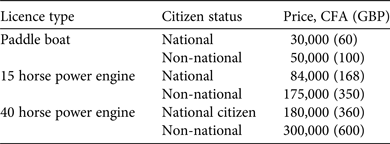
The Bijagós ethnic group occupies some 20 islands in the Bijagós Archipelago (West Africa's only coastal island system), setting others aside as sacred, or for seasonal agriculture or grazing. Many Bijagós follow an animistic religion, led by traditional priests. They believe in ‘another world’ guarded by sacred spirits (imbued into the physical bodies of animals and trees) who control both individual and collective destinies. Ceremonial masks celebrating animist spirits (and inadvertently biodiversity itself) are routinely paraded in Bijagós rituals, and the active promotion of sound relations between the present and spirit world is considered fundamental to Bijagó well-being (Maretti, Reference Maretti2003). As a conservation measure, the islands were designated a UNESCO Biosphere Reserve in 1996, and 4 years later both the National Marine Park of João Vieira Poilão (NMP-JVP) and Orango National Park (PNO) were established as IUCN Management Category II protected areas, for ecosystem protection and for recreation (Campredon & Cuq, Reference Campredon and Cuq2001; Catry et al., Reference Catry, Barbosa, Paris, Indjai, Almeida and Limoges2009). The protection agenda coincided with a move to reign in small-scale fishing efforts, identified as a threat to marine megafauna (Broderick et al., Reference Broderick, Catry and Araujo1998). Small-scale fishing activities have proliferated in the Bijagós Archipelago for decades, involving multinational migrants whose aspirations and realities differ from those of indigenous islanders (Tvedten, Reference Tvedten1990; Haakonsen, Reference Haakonsen, Durand, Lemoalle & and Weber)1991; Baekgaard & Overballe, Reference Baekgaard, Overballe, Tvedten and Hersoug1992; Campredon & Cuq, Reference Campredon and Cuq2001; Randall, Reference Randall2005; Diop & Dossa, Reference Diop and Dossa2011; Binet et al., Reference Binet, Failler and Thorpe2012). Fishers, traders, fish-smokers and transporters originating from across West Africa settle within or pass through fishing camps (economic enclaves) dispersed across the islands and along the mainland coast. These camps provide a backbone to the wider regional small-scale fishing economy. Guinea-Bissau, however, unlike neighbouring states, charges higher tariffs for non-national fishing licences (Diaw & Haakonsen, Reference Diaw and Haakonsen1992; Table 1) and this creates a specific dilemma: small-scale commercial fishing activity may threaten biodiversity but it is also valuable (given the expensive licenses required).
The prices (in CFA and GBP) of fishing licences for national and non-national small-scale fishers in Guinea-Bissau in 2010.
Uno Island (c. 100 km2) hosts an indigenous population of c. 3,000, in 27 villages (known in Portuguese Kriole as tabancas). Conditions on the island are basic, with no electricity, running water or roads. Uno was selected for this study because of the presence of an in-migrant small-scale fishing camp, in Cabuno, and hence the potential for cross-cultural comparison. For the Bijagós of Uno, subsistence rice production is a central occupation, complemented by subsistence fishing, cashew (cash crop) harvesting and livestock herding. Agricultural practice is closely tied to customary land law and an age-based initiation society structure. In contrast, residents of the small-scale fishing camp originate from several West African countries and diverse occupational backgrounds (Cross, Reference Cross2015a). Sun-drying, smoking and salting techniques are all adopted, depending on the type of fish caught (Cross, Reference Cross2015b) and the market destination, of which multiple examples between Dakar and Lagos were cited.
Methods
Data are derived from 24 months of fieldwork on Uno Island. A pilot visit (April–June 2008) and follow-up trip (January 2009–September 2010) were temporarily disrupted by the assassination of President Joao-Bernardo de Vieira, in Bissau city, in March 2009. During fieldwork a variety of methods (household, economic, spot-check time allocation and catch landing surveys; participant observation; semi-structured interviews; focus groups; and key informant discussions) were trialled and developed on Uno, to undertake a cross-cultural investigation of the livelihoods of migrant small-scale fishers and Bijagós islanders (Cross, Reference Cross2014).
Semi-structured life-history interviews were conducted with 142 individuals: 83 Bijagós residents of the Cabuno area and 59 residents of the small-scale fishing camp. Research assistants were employed to undertake documentation, and during separate methodological trials key events were identified as benchmarks or prompts to frame each individual history. These included political milestones and episodes of conflict, but also crop-raiding events and initiation ceremonies identified by the Bijagós villagers. Bijagós assistants conducted interviews in the villages (in either Bijagó or Portuguese Kriole); a migrant assistant conducted interviews in the camp in various languages (including Mandinga, Soussou and Temne). Follow-up meetings were held regularly with each assistant, providing an opportunity to read through, discuss, transcribe and translate each interview into English. All respondents were invited to participate through a purposive snowball sampling technique (Bunce et al., Reference Bunce, Townsley, Pomeroy and Pollnac2000). Life history interviews comprised three sections, the first detailing the participant's core characteristics (year of birth/age, name, gender, birthplace, ethnicity, religion, nationality, household membership, education status and current occupation), the second focusing on occupational experience within and outside the fishing industry (and reasons for occupational change), and the third discussing occupational experiences in fisheries more specifically (detailing locational information, catch types and conditions of payment).
The life history interviews are used here to contextualize historical, social, economic and cultural knowledge (Davis, Reference Davis2006) surrounding small-scale fishing in the Bijagós. Face-to-face interviews grant freedom to respondents, encouraging confidence and minimizing the gap between interviewee and researcher (Zappes et al., Reference Zappes, da Silva, Pontalti, Danielski and Beneditto2013). Data derived from these interviews provide a biographical means (Ritchie et al., Reference Ritchie, Lewis, Nicholls and Ormston2014) of exploring the wider context of fishing to participants. Narratives, thoughts, comments and opinions of interview participants were pooled in a thematic analysis (Braun & Clarke, Reference Braun and Clarke2006), and I present here a chronology of events as recalled by interviewees. These dialogues provide a platform from which to investigate circumstances surrounding the formation of small-scale fishing camps, and relations with non-camp communities.
Results
Formation of the Cabuno camp (1990–2000)
Many migrant small-scale fishers working on Uno first settled in the archipelago during the late 1990s, before the UNESCO accreditation. One camp, known in Kriole as Jeu di Porcos (Pig Island), was then flourishing, providing numerous opportunities for trade (Fig. 1b). This island was set aside by the Bijagós of Caravella for pig grazing. Migrant workers, many lacking fishing experience, arrived from the mainland; Senegalese fishers also arrived from Jeu di Peixe (Fish Island). Many Senegalese were established in the fishing business, progressing from crew members to net owners or captains on motorized vessels, sponsored by wealthy investors from Ziguinchor. With motorized vessels they could work further afield, and the archipelago presented bounteous opportunities for fishing. Jeu di Porcos had a population of several hundred people, and conditions were basic. During the November–May dry season, drinking water was extracted from neighbouring Caravella and sold in the camp. With a constant influx of new arrivals from both the north (Senegal) and south (Guinea-Conakry, Sierra Leone and Liberia), competition for fishing and living space intensified. Motorized boats began to work further south and gradually Orango Island became a popular area. Moving daily between Jeu di Porcos and Orango was costly, however, in terms of both time and petrol. By the year 2000, many groups had relocated permanently to Imbone, in southern Orango, where two small-scale fishing camps were established (Ancopado and Vietnam).
According to the small-scale migrant fishers on Uno Island, as legislation was finalized for Orango National Park, fishers from Jeu di Porcos who had resettled on Orango met with forceful resistance. Armed members of the Commission for Fisheries Surveillance, a subsection of the Fisheries Ministry, forcibly dismantled Ancopado and Vietnam, burning houses, stores and fishing materials. As one angry respondent described it, ‘That place is a zoo! There the politicians like to keep everything perfect and not have no fishing man touch nothing.’ Following eviction from Orango, the migrant fishers returned to Jeu di Porcos, where they were joined by new arrivals from the mainland. Over the following months conditions in the camp became more crowded. Already depleted mangroves were cut back even further, providing fuel for cooking and smoking fish. Eventually the camp was destroyed by a storm. With their homes in ruins, many occupants relocated to nearby Caravella Island, others went south and many arrived on the beach of Cabuno.
Relations with non-camp communities (2000–2008)
Bijagós in Cabuno still recall the 1980s, before any small-scale fishers arrived. Several described the use of a sacred grove for animistic marriage rituals. A friendly rapport was then established with passing fishers; exchanges of news and knowledge were welcomed, and trading opportunities realized. Following the violence at Vietnam, the Orango eviction and the collapse of Jeu di Porcos, several hundred fishers arrived and relations with the Bijagós deteriorated. With the migrant fishing population increasing, catching extensively and showing little sign of moving on, the people of Cabuno walked out to the beach. ‘We begged them to leave here,’ explained one islander, ‘because of what was happening to our sea.’ The Bijagós maintain that any year-round fishing effort is undesirable and an ‘improper cultivation’ of the sea. ‘In the time of working the rice paddies,’ one respondent explained, ‘we come onto the land and we work. But those people, they are at sea every day. For us, we have different types of work. We don't only fish.’ Many indicated their frustration at this extensive effort, ‘because of tomorrow’. Extensive clearance of forest and mangrove habitat on Uno (for cooking and fish-smoking purposes) has generated anger and fear among the islanders for the existence of their sacred ritual spaces, most notably those used during the secret initiation ceremony. ‘If they (the migrants) start to destroy our initiation sites with their tree-cutting,’ one villager explained, ‘then they will destroy the heritage of our villages. In the beginning, they respected the terrain of the village. But now, this is their terrain. This camp is more permanent. The people have begun staying longer. They don't listen to the voice of the village.’
The Bijagós and migrant small-scale fishers in Cabuno now share a history of violent conflict. During the dry season of 2003 a cohort of Bijagós male pre-initiates from Cabuno stormed and burned the fishing camp. The attack took place in broad daylight and the perpetrators stood their ground as the fire spread. Unsure what to do the fishers fled, some by boat, many on foot. ‘We sailed north around Uno,’ one Sierra Leonean explained, ‘and we begged one village to let us camp on their beach but they refused.’ The fishers regrouped at the police office near An-Onho, where they were advised to return to Cabuno beach. Angered by the forceful intervention by the Bijagós, the Island Administration quickly seized control of the situation. This authority (composed of mainland ethnicities) perceived the Bijagós as having no right to destroy or evict fishers from national land. Various regulatory and organizational mechanisms were then used to facilitate the return of migrant fishers to Cabuno. The Ministry of Transport and Communications assumed control of the landing area in Cabuno, and the Maritime Police took responsibility for monitoring access to and through the fishing camp, assisted by the island police unit. Rights to land catch within the camp area fell under the control of the Fishing Ministry, and wood cutting licences under the Department of Forestry (Ministry of Agriculture).
With this shift in power, a split emerged among the Bijagós. Elders in Cabuno who accepted State intervention were criticized as being weak. Bijagó youth in particular were critical. ‘It's because all the elders were sitting with all the power. They turned to us youngsters, saying “leave those people in the beach alone”, and that is how the problem has come back again. In the older times, responsibility was always given to the elders but their ways of understanding are not complete; youngsters now also have to take part.’ Some elders also regretted the administrative control. ‘The State is the only one to benefit,’ one individual explained. ‘According to the administration, the migrants must stay. But then they (the State) are the ones going there every month to collect money.’ Given the substantial financial opportunities presented by non-national small-scale fishing, the camp is subject to frequent and impromptu visits by the Uno Island administration, fisheries officers on Uracane and Bubaque, inspectors from Bolama and Bissau, the national maritime police, immigration officers and the Commission for Fisheries Surveillance. If migrant residents are found without identity papers, boat certification, fishing licences or wood cutting permits, irregular on-the-spot fines are issued.
In response, small-scale fishers have adopted various strategies to manage individual circumstances. Any occupants possessing a Guinea-Bissau national identity card (purchased in the capital) may offer services such as signing for boat licences or fishing documents, to avoid the higher non-national rates. Alternatively migrants may simply hide in the bush during inspections. Fishing boats are often hidden in the surrounding mangroves, and stocks of smoked or salted fish and valuable household possessions are concealed to avoid theft or confiscation by fisheries inspectorates. If inspectors are present, camp residents stand on the beach front and warn any approaching boats not to land. News of imminent inspections is communicated by means of a network that includes passing fishing boats and traders. Independent visits from the Bijagós are also common, with local residents asking for compensation against wood cutting activities. However, these requests are largely ignored.
Discussion
Ethnographic case studies facilitate an in-depth understanding of phenomena occurring within a relatively natural setting (Bhattacharya, Reference Bhattacharya2012) and knowledge may be accumulated from verbal statements and daily observations of events as they occur naturally (Bernard, Reference Bernard2006). Knowledge of small-scale fishers in the Bijagós, as captured here through life-history interviews, is insufficient to fully evaluate the social and ecological implications of fishing area restrictions around Uno. However, attempts are now being made to assess the challenges, based on anecdotal and comparative evidence (Igoe & Brockington, Reference Igoe and Brockington2007).
Instances of forceful (Agrawal & Redford, Reference Agrawal and Redford2009) and socially unjust (De Santo, Reference De Santo2013) conservation-induced displacement episodes have been described (Igoe & Brockington, Reference Igoe and Brockington2007; Schmidt-Soltau & Brockington, Reference Schmidt-Soltau and Brockington2007; Miller et al., Reference Miller, Caplow and Leslie2012), associated with ill-treatment (Almudi & Berkes, Reference Almudi and Berkes2010) and violence (Peluso, Reference Peluso1993). Migrant small-scale fishers on Uno discussed a militaristic eviction from southern Orango that coincided with the designation of Orango National Park. This resulted in a loss of control and displacement of fishing, from a restricted-use to unrestricted area. Ill-considered marine management is known to merely displace fishing, causing widespread change or damage in formerly undisturbed habitats (Kaiser, Reference Kaiser2005; Ewers & Rodrigues, Reference Ewers and Rodrigues2008; Crona & Rosendo, Reference Crona and Rosendo2011), and effective management requires efforts to be made beyond spatial boundaries (Allison et al., Reference Allison, Lubchenco and Carr1998). The finding that protected area status alone cannot ensure protection is not new (Teh & Sumaila, Reference Teh and Sumaila2013); Fernandes (Reference Fernandes2012) observed that conservation rules in the Bijagós Archipelago were poorly understood by small-scale fishers. Evidence from Uno reveals that fishing in the Bijagós is poorly regulated. Restrictions and closures are required for biodiversity conservation but fishing can prevail within protected areas and leak into unprotected environments. Small-scale fishing is generally viewed as problematic on the islands, ultimately increasing both the vulnerability of the camps and the potential for conflict with adjacent Bijagós communities. As small-scale fishing economies in the archipelago remain isolated, the need to reform rights to fish remains and the welfare functions of small-scale fishing remain underestimated.
Alienation of resource users (Hind et al., Reference Hind, Hiponia and Gray2010), prioritization of NGO donor goals above local needs (Benson, Reference Benson2012), tendencies to undermine local access to development (Bennett & Dearden, Reference Bennett and Dearden2014), and inattention to alternative livelihood pathways (Bown et al., Reference Bown, Gray and Stead2013) limit support for marine protected areas. Increased conflict is common where protected areas are viewed as problematic (Bavinck, Reference Bavinck2005). Considering those gaining and losing rights on Uno (an approach advocated by Mascia & Claus, Reference Mascia and Claus2009), both small-scale fishers and indigenous islanders have felt disempowered since the designation of Orango National Park. Conversely, the Uno island administration, fisheries officers, maritime police units, immigration officers, the Commission for Fisheries Surveillance and Department of Forestry representatives from Uracane, Bubaque and Bissau all appear to be vying for a stake in the control of small-scale fishing, while implementing a relatively ad hoc management initiative.
Industrial fishing licence payments are a critical source of revenue in Guinea-Bissau (Kaczynski & Fluharty, Reference Kaczynski and Fluharty2002; Agnew et al., Reference Agnew, Walmsley, Leotte, Barnes, White and Good2010); the potential profits generated from non-national small-scale fishers is reflected on Uno Island. In both large and small-scale fishing arenas substantial losses may result from mismanagement. By 2010 residents of the Uno fishing camp had realized their greatest vulnerability: foreignness. The migrants openly discussed the significance of payments demanded by officials legitimately charged with controlling fishing. Migrant fishers are aware of the opportunity their presence offers these officials to supplement inadequate, diverted, lost or unpaid salaries. Numerous examples of corruption, involving both officials and fishers, were described in the Uno interviews, including false identity papers, boat licence fraud, acceptance of unregistered fines, and confiscation of personal goods by State authorities. This study presents a crisis in which rent-seeking and resource-rent appropriation, weak institutional performance and political short-termism (Kaiser, Reference Kaiser2005; Béné, Reference Béné2008; Baggio & Papyrakis, Reference Baggio and Papyrakis2010; Béné et al., Reference Béné, Hersoug and Allison2010; Sumaila et al., Reference Sumaila, Khan, Dyck, Watson, Munro, Tydemers and Pauly2010) obstruct the interface between fisheries, protected area management and conservation in the Bijagós. From a government perspective, control of small-scale fishing seems an insurmountable challenge given the inherent corruption. Non-compliance, conflict and non-cooperation are likely to present persistent problems, with negative consequences for the livelihoods of those dependent upon fish. The political systems involved are complex and founded upon multiple conflicting objectives, which fundamentally jeopardizes any reform process (Cross, Reference Cross2014).
In considering options for improving small-scale fisheries, movement towards a collaborative co-management agenda could foster support. If co-management is not seen as a silver bullet (Nielson & Lund, Reference Nielson and Lund2012) or blueprint (Defeo et al., Reference Defeo, Castrejón, Pérez-Castañeda, Castilla, Gutiérrez, Essington and Folke2014) it can engage with a desire for reform, through participatory democracy, decentralization, social engagement and community empowerment (Charles & Wilson, Reference Charles and Wilson2009; Christie, Reference Christie2011; Nunan, Reference Nunan2014). Collaboration does, however, increase the risk of marginalization (Jentoft, Reference Jentoft2005) and modification of an existing status quo among resource users (Béné, Reference Béné2011; Njaya et al., Reference Njaya, Donda and Béné2012). Integrating local ecological with conventional scientific knowledge can encourage shared responsibility (Berkes, Reference Berkes2010), and compiling location-specific objectives may foster institutional diversity and political will (Jones et al., Reference Jones, Qiu and De Santo2013; Carbonetti et al., Reference Carbonetti, Pomeroy and Richards2014). Although inclusion of migrants in collaborative plans is generally low (Cinner et al., Reference Cinner, Fuentes and Randriamahazo2009; Fulanda et al., Reference Fulanda, Munga, Ohtomi, Osore, Mugo and Hossain2009), co-management seeks to increase resilience and develop incentives for collaboration, by nurturing marine stewardship (Levin & Lubchenco, Reference Levin and Lubchenco2008) and encouraging compliance (Mwaipopo, Reference Mwaipopo2008; Slater et al., Reference Slater, Mgaya and Stead2014). Arguably, new collaborative institutions can only succeed if they absorb the tacit knowledge accumulated from historically deep-rooted local institutions, building upon existing cultural norms and meanings associated with various types of local leadership, social networks, reciprocal obligations, and the routines of everyday life (Cleaver, Reference Cleaver2002; Jentoft, Reference Jentoft2005; Gutiérrez et al., Reference Gutiérrez, Hilborn and Defeo2011; Russell & Dobson, Reference Russell and Dobson2011). In Kenya the involvement of fishers in community organization and decision making has challenged notions that small-scale fishers are poorly organized (Cinner et al., Reference Cinner, McClanahan and Wamukota2010). Likewise in Australia the Girringun Aboriginal Corporation, which represents the land and sea interests of traditional owner groups, has achieved recognition in decision making for the Great Barrier Reef World Heritage Centre through a persistent positive commitment to collaborative management (Nursey-Bray & Rist, Reference Nursey-Bray and Rist2009).
A Biodiversity Conservation Trust Fund (the Bioguinea Foundation) currently controls financial operations within Guinea-Bissau's National Parks (GEF, 2012) and supports an increase in protected area coverage (CFA, 2010). Marine megafauna (particularly elasmobranchs, cetaceans, sea turtles and swordfishes) continue to attract attention in the Bijagós Archipelago as conservation research assimilates the knowledge of local fishers (Tous et al., Reference Tous, Ducrocq, Bucal and Feron1998; Béziers, Reference Béziers2009; Leeney & Poncelet, Reference Leeney and Poncelet2015; Leeney et al., Reference Leeney, Weir, Campredon, Regalla and Foster2015). The small-scale marine fishing sector in Guinea-Bissau persists in providing employment for more than 120,000 people (Belhabib & Pauly, Reference Belhabib and Pauly2015) while securing a basic but critical staple food for the wider population. The right to fish, however, remains a contentious issue (Borrini-Feyerabend & Hill, Reference Borrini-Feyerabend, Hill, Worboys, Lockwood, Kothari, Feary and Pulsford2015) and migrant fishers do not yet appear to be represented.
Acknowledgements
This study was funded by a joint ESRC–NERC interdisciplinary studentship (ES/F009984/1), the Parkes Foundation, the University College London (UCL) Graduate School and UCL Fellowship Fund. I extend sincere thanks to Katherine Homewood and Caroline Garaway (UCL Anthropology) and Marcus Rowcliffe (Institute of Zoology, London) for supervisory guidance, and to Eddy Allison, JoAnn McGregor and the anonymous reviewers of this article. Finally, I thank all field assistants and residents of Uno Island for their hospitality and generosity of time in sharing these experiences.
Biographical sketch
Helen Cross's interests developed from sea-turtle nesting ecology to wider turtle population dynamics, before focusing on human–ecological interactions. She has contributed to sea-turtle conservation efforts in Costa Rica and Panama (Endangered Wildlife Trust UK), Greece (Sea Turtle Protection Society) and Lebanon (Mediterranean Association to Save the Sea Turtles). Helen now works with the Bioclimate research and development group, based in Edinburgh, UK.



