





The Faroe–Shetland and Rockall basins (Fig. 1) contain a comprehensively studied sequence of marine and terrestrial Palaeogene sedimentary rocks, which have a well-defined stratigraphical framework (Ebdon et al. Reference Ebdon, Granger, Johnson, Evans, Scrutton, Stoker, Shimmield and Tudhope1995; Ritchie et al. Reference Ritchie, Ziska, Johnson and Evans2011; Stoker & Varming Reference Stoker, Varming, Ritchie, Ziska, Johnson and Evans2011) and depositional palaeogeography. This stratigraphical framework has been derived from analysis of sedimentary rock successions to the E of the Faroe–Shetland escarpment, a feature which has been taken to mark the edge of the North Atlantic Igneous Province (NAIP) flood basalt lava field. To the W of the Faroe–Shetland escarpment, thick sequences of extrusive basaltic lavas, hyaloclastites and volcaniclastic sedimentary rocks dominate the early Palaeogene basin fill (Schofield & Jolley Reference Schofield and Jolley2013). At the eastern margin of the Faroe–Shetland Escarpment, volcanic and volcaniclastic rocks interdigitate with siliciclastic sedimentary rock successions in the Flett and Judd sub-basins (Fig. 1). Associated with these volcanic rocks is an extensive intrusive complex – the Faroe–Shetland Sill Complex (FSSC) – which extends into the central and eastern parts of the Faroe–Shetland Basin (FSB; Rateau et al. Reference Rateau, Schofield and Smith2013; Schofield et al. Reference Schofield, Holford, Millet, Brown, Jolley, Passey, Muirhead, Grove, Magee, Murray, Hole, Jackson and Stevenson2015).
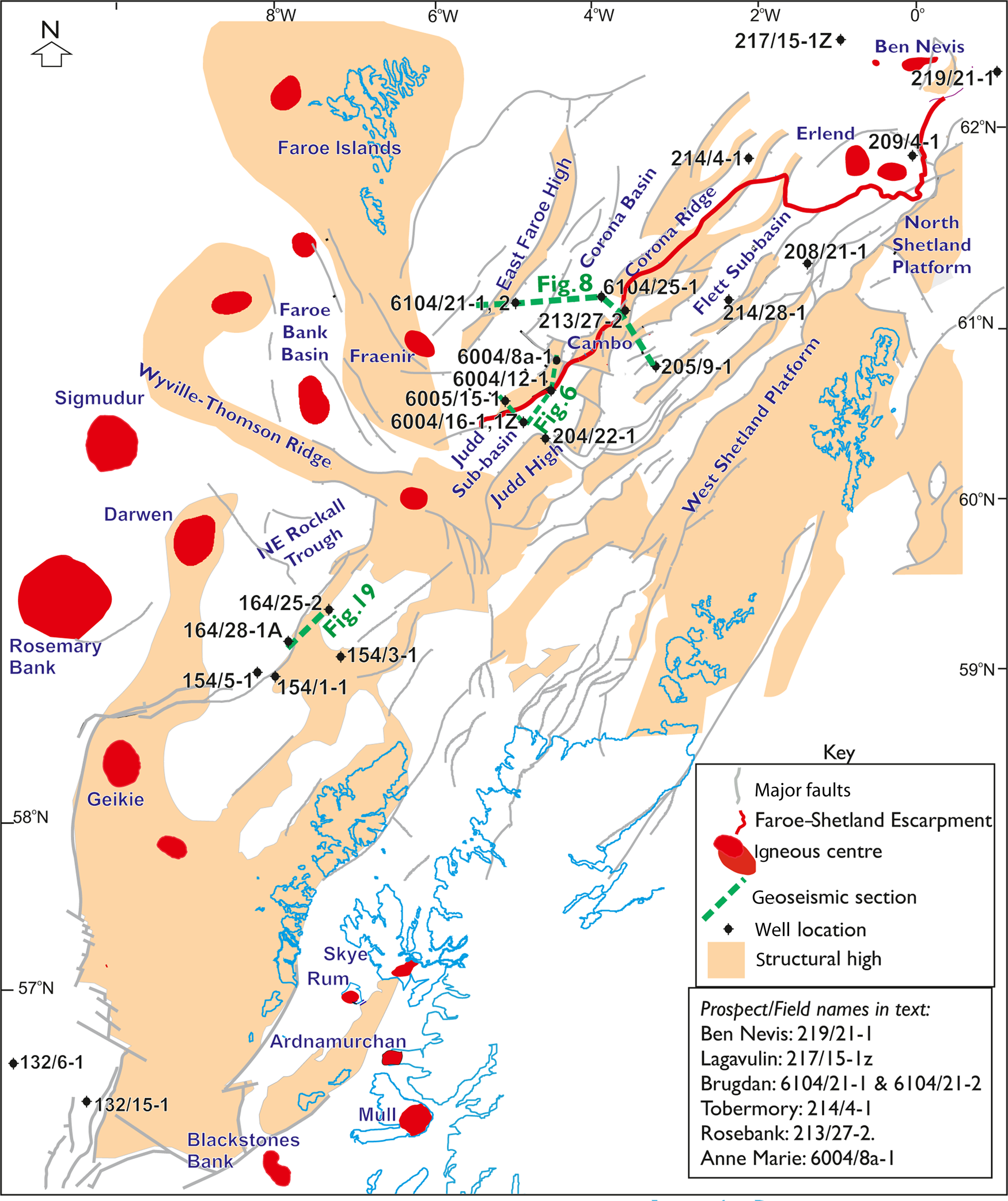
Location map for Rockall and Faroe–Shetland basins. Structural elements adapted from Ellis et al. (Reference Ellis, Jolley, Passey, Bell and Varming2009). Location of wells discussed in the text are shown with structural and other significant geological features.
Occurrences of tephras or ‘tuff’ layers, interpreted to originate as volcanic ash airfall deposits (Knox & Morton Reference Knox, Morton, Morton and Parson1988), are more widespread than the associated lava fields. These tephra are recognised within the FSB and are correlative with ashes recorded in the Rockall, North Sea and Anglo-Paris basins (Knox & Morton Reference Knox, Morton, Morton and Parson1988; Ellison et al. Reference Ellison, Knox, Jolley and King1994). The tephra record of the North Sea Basin was divided into two periods, termed by Knox & Morton (Reference Knox, Morton, Morton and Parson1988) as Phase 1 and Phase 2 (the latter with four subdivisions). A recent review of tuffs within the FSB (Watson et al. Reference Watson, Schofield, Jolley, Archer, Finlay, Mark, Hardman and Watton2017) confirmed the occurrence of these two well-developed tephra phases and extended the onset of the oldest tephra deposits from the Thanetian to the upper Danian.
Constraining the stratigraphical distribution of volcanic and volcaniclastic rocks in the Faroe–Shetland and Rockall basins is fundamental to the understanding of this part of the NE Atlantic margin. Despite this, interpretations of the stratigraphy and distribution of these volcanic rocks have remained ambiguous, both within the basins and within marginal onshore exposed successions such as on the Faroe Islands, East Greenland and the British Palaeogene Igneous Province (BPIP). The stratigraphical relationship of the Faroe Islands Basalt Group (FIBG; Passey & Jolley 2009) to the sedimentary and volcanic rocks of the FSB has been subject to diverging interpretations. These are rooted in the differing stratigraphies, which propose eruptions over a short period between 57.2 Ma and 54.4 Ma (Thanetian–Ypresian; Passey & Jolley 2009; Schofield & Jolley Reference Schofield and Jolley2013; Ellis & Stoker Reference Ellis, Stoker, Cannon and Ellis2014), or a longer duration from ~61.5 Ma to 54.4 Ma (Selandian–Ypresian; Waagstein et al. Reference Waagstein, Guise, Rex, Jolley and Bell2002; Mudge Reference Mudge, McKie, Rose, Hartley, Jones and Armstrong2015; Stoker et al. Reference Stoker, Hollford and Hillis2017; Olavsdottir et al. Reference Olavsdottir, Stoker, Boldreel, Andersen and Eidesgaard2019).
Peak extrusive volcanism during the eruption of the FIBG has been linked to uplift and erosion of the southern part of the FSB, leading to the formation of an unconformity. Subsurface mapping has revealed a dendritic drainage system incised into older shelf marine rocks within the Judd Sub-basin (Fig. 1; e.g., Hartley et al. Reference Hartley, Roberts, White and Richardson2011), with the surface being marked by a shift from marine to terrestrial sedimentation (Mudge Reference Mudge, McKie, Rose, Hartley, Jones and Armstrong2015). Termed the Flett Unconformity, this feature has been related to maximum thermal support from the Iceland mantle plume prior to the onset of sea floor spreading (Smallwood & Gill Reference Smallwood and Gill2002; Shaw Champion et al. Reference Shaw Champion, White, Jones and Lovell2008; Hartley et al. Reference Hartley, Roberts, White and Richardson2011; Mudge Reference Mudge, McKie, Rose, Hartley, Jones and Armstrong2015). However, other authors suggest that this uplift and subsidence can be explained by plate tectonic forces alone (e.g., Stoker et al. Reference Stoker, Hollford and Hillis2017).
Improvements in sub-basalt geophysical data acquisition and interpretation, allied to an increase in well penetrations, has given new insight into the subsurface stratigraphy within and below the area of thick flood basalts W of the Faroe–Shetland escarpment (Gallagher & Drumgoole Reference Gallagher and Drumgoole2007; Jerram et al. Reference Jerram, Single, Hobbs and Nelson2009; Wright et al. Reference Wright, Davies, Jerram, Morris and Fletcher2012; Schofield & Jolley Reference Schofield and Jolley2013; McLean et al. Reference McLean, Schofield, Brown, Jolley and Reid2017). In particular, these data and interpretations, such as that of Watson et al. (Reference Watson, Schofield, Jolley, Archer, Finlay, Mark, Hardman and Watton2017), have provided the basis for a revised understanding of the relationship between the volcaniclastic sedimentary rock units and the extensive flood basalt successions (e.g., Naylor et al 1999; Archer et al. Reference Archer, Bergman, Iliffe, Murphy and Thornton2005; Millett et al. Reference Millett, Hole, Jolley, Schofield and Campbell2016) within the FSB and Rockall Basin. In particular, the subsurface well and seismic data archive has yielded a record of NAIP volcanism in the context of a > 6 Myr marine basin sedimentary rock record. As this subsurface record is considerably thicker than that preserved in the onshore margins of the NAIP, understanding the stratigraphy and variations in depositional environments of basinal volcano-sedimentary successions has enabled stratigraphical insights into the rifting of the NE Atlantic.
1. FSB pyroclastic and extrusive volcanic record
The main phase of extrusive activity in the NAIP is recorded in the FSB by the extrusion of 40,000 km2 of flood basalt lavas (Passey & Jolley Reference Passey and Jolley2009), which thin from the >6 km thickness of the FIBG eastwards to a few metres at the edge of the Faroe–Shetland Escarpment. These thick flood basalts have represented a significant challenge to the seismic imaging of intra and sub-basalt strata (e.g., Gallagher & Drumgoole Reference Gallagher and Drumgoole2007). Despite improvements in sub-basalt geophysical imaging, the difficulties of deepwater exploration including drilling challenges (Millett et al. Reference Millett, Hole, Jolley, Schofield and Campbell2016; Watson et al. Reference Watson, Schofield, Jolley, Archer, Finlay, Mark, Hardman and Watton2017) and the presence of basaltic sill complexes in the sub-basalt sedimentary rock sequences (Schofield et al. Reference Schofield, Holford, Millet, Brown, Jolley, Passey, Muirhead, Grove, Magee, Murray, Hole, Jackson and Stevenson2015) have held back exploration to date. In consequence, wells drilled to the E of the Faroe–Shetland Escarpment significantly outnumber those drilled through the thicker flood basalt cover.
The most extensive and youngest of the lava flow fields in the FSB are made up of the FIBG in the W (Passey & Jolley Reference Passey and Jolley2009), the exposed part of which is broadly correlative with largely unnamed flow fields on the Corona Ridge and to the NE (Jerram et al. Reference Jerram, Single, Hobbs and Nelson2009; Wright et al. Reference Wright, Davies, Jerram, Morris and Fletcher2012; Schofield & Jolley Reference Schofield and Jolley2013; Millett et al. Reference Millett, Hole, Jolley and Passey2017; Hardman et al. Reference Hardman, Schofield, Jolley, Holford, Hartley, Morse, Underhill, Watson and Zimmer2018). Separate monogenetic volcanic centres and associated lava fields in the FSB have been recognised to predate the extensive flood basalt eruptions (Jolley 2009; McLean et al. Reference McLean, Schofield, Brown, Jolley and Reid2017). The extent, stratigraphy, eruption history and depositional environments of volcanic rocks in the FSB have been interpreted from integrated seismic-borehole studies based on industry seismic and well data in the offshore regions (Jolley & Bell Reference Jolley, Bell, Jolley and Bell2002; Jolley 2009; Passey & Jolley Reference Passey and Jolley2009; Ellis & Stoker Reference Ellis, Stoker, Cannon and Ellis2014). Recently, pre-breakup, syn-breakup and post-breakup tectonic phases have been proposed for the FSB (Stoker et al. Reference Stoker, Hollford and Hillis2017), and are used here. However, the stratigraphical relationship of the volcanic successions to the sedimentary rock succession in the FSB remains unclear.
1.1. Methods
Understanding of the geology of the volcanic rocks in the Faroe–Shetland and Rockall basins has been aided by data from hydrocarbon exploration within the basin, the stratigraphy having been interpreted from geophysical data and well penetrations. Within wells, stratigraphy has been derived from proprietary microfossil, nannofossil and palynological zonations, which are held to be confidential and, as such, are not used in this analysis. To constrain the strata examined here, we have conducted extensive palynological analysis of well sections and derived a stratigraphical model (Fig. 2) based on the Geomagnetic Polarity Time Scale (GPTS) 2012 and later update (Gradstein et al. Reference Gradstein, Ogg, Schmitz and Ogg2012; Ogg et al. Reference Ogg, Ogg and Gradstein2016). In addition to the palynostratigraphy utilised in Ogg et al. (Reference Ogg, Ogg and Gradstein2016), which is derived from Powell (Reference Powell and Powell1992), additional datums derived from Ebdon et al. (Reference Ebdon, Granger, Johnson, Evans, Scrutton, Stoker, Shimmield and Tudhope1995), Jolley et al. (Reference Jolley, Morton, Prince, Dore and Vining2005), Jolley & Morton (Reference Jolley and Morton2007) and Schofield & Jolley (Reference Schofield and Jolley2013) have been included. The palynostratigraphy utilised here is closely similar to published records from the North Sea Basin, where data are more widely available (e.g., Knox & Holloway Reference Knox, Holloway, Knox and Cordey1992; Schroder Reference Schroder1992; Jolley Reference Jolley1998; Kender et al. Reference Kender, Stephenson, Riding, Leng, Knox, Peck, Kendrick, Ellis, Vane and Jamieson2012), although there are differences in detail. Selected stratigraphically significant species of microplankton and pollen/spores are presented in data plots for the studied well sections. Where appropriate, sum pollen/spore and sum microplankton data are plotted as raw data from standardised preparations. These data are of value in identifying flooding events and constraints on the stratigraphical analysis. Species data are presented as percentages of either microplankton or pollen/spores, as appropriate. In sections where the total counts are highly variable, the data are plotted as square roots to eliminate misleading frequency plots.
Stratigraphical model based on GPTS 2012 and 2016 (Gradstein et al. Reference Gradstein, Ogg, Schmitz and Ogg2012; Ogg et al. Reference Ogg, Ogg and Gradstein2016). Dinocyst datums in bold red are derived from the GPTS 2016; other dinocyst and pollen/spore records are derived from Ebdon et al. (Reference Ebdon, Granger, Johnson, Evans, Scrutton, Stoker, Shimmield and Tudhope1995) or from regional studies of microplankton distribution (e.g., Mudge & Bujak Reference Mudge and Bujak2001; Jolley et al. Reference Jolley, Morton, Prince, Dore and Vining2005). Because of the absence of magnetostratigraphical data for the subsurface FSB, the magnetochrons are positioned with reference to correlative palynological events in the wider North Sea Basin (Ali & Jolley Reference Ali, Jolley, Knox, Corfield and Dunay1996; Jolley Reference Jolley1998). Phase 1 and Phase 2 North Sea Basin pyroclastic events (Knox & Morton Reference Knox, Morton, Morton and Parson1988) are shown relative to the stratigraphy of the FSB. Sequences are those of Ebdon et al. (Reference Ebdon, Granger, Johnson, Evans, Scrutton, Stoker, Shimmield and Tudhope1995). Abbreviations: LAZ = local assemblage zone (defined by Schofield & Jolley Reference Schofield and Jolley2013); MFS = maximum flooding surfaces (defined by Jolley & Morton Reference Jolley and Morton2007). Sequences T10 to T60 are those defined by Ebdon et al. (Reference Ebdon, Granger, Johnson, Evans, Scrutton, Stoker, Shimmield and Tudhope1995) for the FSB.

The sequence stratigraphical framework erected for the FSB by Ebdon et al. (Reference Ebdon, Granger, Johnson, Evans, Scrutton, Stoker, Shimmield and Tudhope1995) is relatable to the palynostratigraphy used here. Biostratigraphical datums derived from palynomorphs and foraminifera were used by Ebdon et al. (Reference Ebdon, Granger, Johnson, Evans, Scrutton, Stoker, Shimmield and Tudhope1995) to constrain the ages of their unconformity bounded sequences, following the original sequence stratigraphical concept of Posamentier & Vail (1988). This approach has the advantage of emphasising the succession of strata in chronostratigraphically-related sequences. In contrast, a lithostratigraphical approach to basin stratigraphy has inherent pitfalls from diachronous facies.
Wireline data from wells were used in order to appraise the volcanic lithologies encountered within the study wells. A simplified facies scheme is used based on the principles of volcanic wireline analyses (e.g., Planke Reference Planke1994; Nelson et al. Reference Nelson, Jerram, Single and Hobbs2009; Millett et al. Reference Millett, Hole, Jolley, Schofield and Campbell2016). The main interpreted volcanic facies include simple lava, compound lava, hyaloclastite, intrusions, volcaniclastic lithologies and tuffs. No volcanic cuttings analyses (e.g., Millett et al. Reference Millett, Hole, Jolley, Cannon and Ellis2014) were undertaken during the current study and so the volcanic lithologies are assigned based on an appraisal of the originally reported wellsite lithologies coupled to an appraisal of the log character.
The stratigraphy used in this study is, where appropriate, compared to radiometric dating of igneous lithologies from the BPIP, published by other authors. It is fortunate that Wilkinson et al. (Reference Wilkinson, Ganerød, Hendricks, Eide, Peron-Pinvidic, Hopper, Stoker, Gaina, Doornanbal, Funck and Arting2017) has undertaken an assessment of published NAIP radiometric data. The assessment considered the statistical validity of published radiometric dates, recalculating them based on the new standards of Gradstein et al. (Reference Gradstein, Ogg, Schmitz and Ogg2012). These valid ages are considered below and those rejected by Wilkinson et al. (Reference Wilkinson, Ganerød, Hendricks, Eide, Peron-Pinvidic, Hopper, Stoker, Gaina, Doornanbal, Funck and Arting2017) are not used. Valid ages with experimental errors of >0.5 Myr are generally not included here, because of the short duration of stratigraphical events. Exceptions are made where no alternative is available. Ages that have no published analytical details are not included – for instance, the radiometric dates for the Skye Western Red Hills Complex and the Ardnamurchan Central Complex (see Emeleus & Bell Reference Emeleus and Bell2005). Following this approach has meant that some BPIP igneous complexes currently lack valid, published radiometric dates.
The stratigraphy used can be applied to lava flow fields where they include volcaniclastic and siliciclastic sedimentary rock interbeds. While dinocysts and other algae are of stratigraphical value in marine facies, lava field and transitional depositional environments require a combination of this approach with the analysis of pollen and spores derived from higher plants. Pollen and spores dominate terrestrial successions, but are transported in abundance into coeval brackish to fully marine environments. Transportation into the transitional coastal zone was dominated by fluvial taphonomic processes (e.g., Peck Reference Peck, Birks and West1973). Further transportation of palynofloras into the marine basin was by turbidity currents amplified by the rafting of palynomorphs offshore on density layers during periods of marine water stratification (e.g., Jolley & Morton Reference Jolley and Morton2007). Integration of marine and terrestrial records has consequently allowed correlation across depositional facies.
The samples used in this study were derived from subsurface wells, from which ditch cuttings are the dominant sample type, with some sidewall and conventional core pieces included where available. Because of the potential for downhole cavings in ditch cuttings, the stratigraphy used is primarily based on first downhole occurrences, which mark regional or wider disappearances of species from the stratigraphical record.
Samples for palynological analysis were processed following standard techniques, including hydrofluoric acid digestion, boiling in 20 % hydrochloric acid to remove precipitates and oxidation for 5 min in dilute 40 % nitric acid where necessary. The resultant residues were mounted in a permanent petropoxy mounting medium and examined under a transmitted light Olympus BX53 microscope. For each sample, counts of 250 specimens were targeted and the data normalised as percentages of the marine or terrestrial palynoflora. Where full counts were not attained, data were expressed as square roots.
Samples collected for palynology were also analysed for major element geochemistry. In analysing the geochemistry of the sedimentary rocks studied here, two principle techniques were used. Standard X-ray fluorescence (XRF) techniques have been used to analyse the full range of major oxides. Because of the time taken in preparing samples for XRF analysis, and the number of samples for analysis, other samples were subjected to Flame Atomic Absorption Spectrometry (FAAS). These techniques were used and cross-correlated on Columbia River Basalt Province intra-lava field samples by Jolley et al. (2008; and see supplementary material S1 available at https://doi.org/10.1017/S1755691021000037).
The primary purpose of collecting XRF and FAAS data was to allow identification of ashfall events and consequent elevated marine macronutrient levels (eutrophication events) in drill cuttings. To allow comparison between major element distribution and the dinocyst record, XRF and FAAS were conducted on the palynological sample set. The stratigraphical distribution of ashfall events in the FSB was recorded by Watson et al. (Reference Watson, Schofield, Jolley, Archer, Finlay, Mark, Hardman and Watton2017), which included some of the same wells analysed here. Plotting of phosphorous pentoxide (P2O5):aluminium oxide (Al2O3) ratios for key wells was done to identify intervals of elevated nutrient input, moderated against variations in clay input from clastic sources. Gonyaulacoid, autotrophic dinoflagellates can bloom in response to water mass eutrophication, where levels of iron, phosphorus and nitrogen are elevated. Other algae (e.g., diatoms) bloom in response to water mass eutrophication in a similar way, the increase in these prey organisms leading to small-scale blooms of predatory autotrophic dinoflagellates. The palynological data presented here include influxes of taxa, which can be interpreted as eutrophication-driven bloom events. Comparison of these records to major element data allows the identification of increases in macronutrient availability, which is potentially linked to volcanic events.
2. Pre-breakup volcanic activity
Isolated ash deposits have been reported from the periphery of the NAIP (e.g., Svalbard; Jones et al. Reference Jones, Augland, Shephard, Burgess, Eliassen, Jochmann, Friis, Jerram, Planke and Svensen2017) and the W of Britain (e.g., Ganerød et al. Reference Ganerød, Smethurst, Torsvik, Prestvik, Rousse, McKenna, van Hinsbergen and Hendriks2010), and are attributable to the earliest phase of volcanism beginning in the latest Danian around ca.62 Ma (e.g., Saunders et al. Reference Saunders, Fitton, Kerr, Norry, Kent, Maoney and Coffin1997; Wilkinson et al. Reference Wilkinson, Ganerød, Hendricks, Eide, Peron-Pinvidic, Hopper, Stoker, Gaina, Doornanbal, Funck and Arting2017). Early ashes are felsic in character (rhyolitic) and their distribution is limited in the offshore basins (e.g., Watson et al. Reference Watson, Schofield, Jolley, Archer, Finlay, Mark, Hardman and Watton2017). Unlike basaltic ashes, the formation of felsic ashes does not necessarily require major flooding events to promote fragmentation, which contributes to the more limited distribution of the felsic ashes offshore.
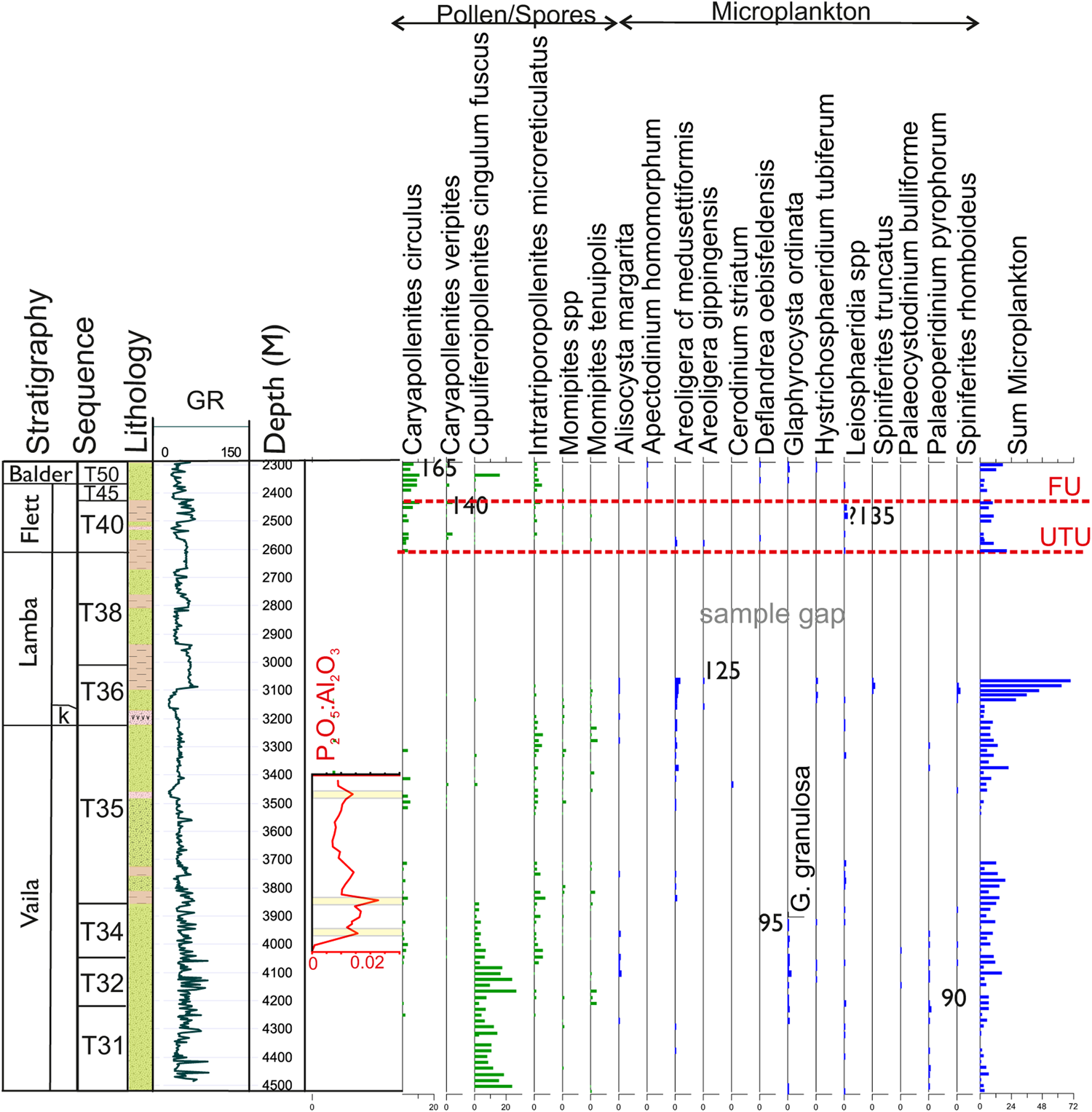
In a recent review of pyroclastic deposits of the FSB, Watson et al. (Reference Watson, Schofield, Jolley, Archer, Finlay, Mark, Hardman and Watton2017) noted the occurrence of volcanic ash in marine sedimentary rocks through the Selandian. In particular, tuffaceous units were noted in the upper Selandian, while older Selandian and upper Danian (sequences T10 to T28) records were dismissed as misinterpretations on the basis of a review of petrophysical data (Fig. 2). Wells 6005/15–1, 6004/12–1 and 6004/16–1 were drilled the Danian to Ypresian succession of the Judd Sub-basin, Selandian to Thanetian tephras being noted in 6005/15–1 by Watson et al. (Reference Watson, Schofield, Jolley, Archer, Finlay, Mark, Hardman and Watton2017). P2O5:Al2O3 in shale-dominated ditch cutting samples from well 6005/15–1 (Fig. 3) show a series of high-value peaks in the Selandian to Ypresian. One of the most prominent of these P2O5:Al2O3 peaks is recorded at the Sequence T36 volcaniclastic Kettla Tuff Mb (Fig. 3; and see Watson et al. Reference Watson, Schofield, Jolley, Archer, Finlay, Mark, Hardman and Watton2017). Importantly, the correlation of the P2O5:Al2O3 peak to the Kettla Tuff Mb indicates that similar peaks in the Selandian to Thanetian interval of all three wells mark basin ashfall events within Selandian sequences T22–T36 (Figs 3–5; supplementary data S1).
Well 6005/15–1: this well penetrated two thin syn-breakup basalt flows with an interbedded sedimentary unit, which yielded a palynoflora diagnostic of Sequence T45 (see Jolley 2009). The top of Sequence T40 is truncated by the Flett Unconformity, and Flett Formation strata below MFS 135 are missing, resting unconformably on the Lamba Formation (see Fig. 1 for lithostratigraphy used). Sequences T38 to T36 marine sedimentary rocks are marked by occurrences of Alisocysta margarita and Areoligera gippingensis in the Lamba Formation. At the base of Sequence T36, the Kettla Tuff Mb is recognised from its log signature and from the P2O5:Al2O3 plot, derived from FAAS of ditch cutting samples. This ratio highlights tephra-rich intervals in older Selandian sedimentary rocks, although these do not correspond directly to the cored interval of tuffaceous sediment (3508–3514 m; see Watson et al. Reference Watson, Schofield, Jolley, Archer, Finlay, Mark, Hardman and Watton2017) because of ditch cuttings sample spacing. The δ13Corg record was derived from kerogen preparations. The upper part of the PETM record is missing at the Flett Unconformity. An older carbon isotope excursion is potentially a record of the STTE. All taxon palynomorph data displayed as percentages of total terrestrial or marine groups; only stratigraphically significant taxa are displayed. The standardised count of microplankton is plotted in this and subsequent figures to illustrate intervals of maximum marine influence. The key is common to all well stratigraphy figures and all wells are displayed in measured depths in metres (i.e., the depth in the well bore below a rig datum, usually the rotary table).

6004/16–1 Marjun: although the Flett Unconformity is identified by the absence of oldest Sequence T45 strata, cavings and potential confusion over drilling returns affect sample quality downhole to within Sequence T38. Below this, this deep well has a record of pre-breakup volcanism extending down into Sequence T22 and potentially Sequence T10. P2O5:Al2 O3 identify tephra in sequence T22, T32–T36. All palynomorph data displayed as square roots; only stratigraphically significant taxa are displayed.

6004/12–1 Svinoy: no extrusive volcanics were present in this well other than the dispersed ash of the Kettla Tuff Mb and those identified from major element ratios. These data were derived from XRF analysis of ditch cutting samples (supplementary data S1), the P2O5:Al2O3 highlighting the presence of tephra in sequences T35 and T34, which are correlative with those recorded in 6005/15–1. Both the Flett Unconformity and the Upper Thanetian Unconformity are present in the well, with oldest Sequence T40 and oldest Sequence T45 strata being absent. All palynomorph data displayed as square roots; only stratigraphically significant taxa are displayed.
Evidence for ashfall events in the latest Danian of the FSB were not supported by Watson et al. (Reference Watson, Schofield, Jolley, Archer, Finlay, Mark, Hardman and Watton2017), who focussed on interpretations made in Naylor et al. (Reference Naylor, Bell, Jolley, Durnall and Fredstead1999), linked to wells nearby the Judd and Westray igneous centres. These centres were subsequently identified as being Palaeozoic and Precambrian intrusive rocks. Occurrences of volcaniclastic material in Sequence T22 was noted by Watson et al. (Reference Watson, Schofield, Jolley, Archer, Finlay, Mark, Hardman and Watton2017), an observation supported here from major element analysis, also from well 6004/16–1z (Fig. 4). A comparable record of tephra was recorded at 22.7 m below surface by Morton et al. (Reference Morton, Evans, Harland, King, Ritchie, Morton and Parson1988) from a shallow British Geological Survey borehole (82/12) drilled in the Papa Basin. The original palynological analysis attributed a Danian age to the single tephra horizon recorded; re-examination here of the palynofloras from core samples recovered abundant Palaeoperidinium pyrophorum, common specimens of Palaeocystodinium bulliforme and Isalbelladinium? viborgense from 22.70 m. These occurrences indicate an age equivalent to Sequence T22 (Fig. 2). In contrast to the Sequence T22 tephra recovered from well 6004/16–1z, which is of andesitic composition (Watson et al. Reference Watson, Schofield, Jolley, Archer, Finlay, Mark, Hardman and Watton2017), Morton et al. (Reference Morton, Evans, Harland, King, Ritchie, Morton and Parson1988) reported that the 82/12 tephra was tholeiitic, supporting multiple small-scale sources for these lower Selandian volcanics.
Geochemical analysis of cuttings from the Danian was not undertaken. However, examination of fresh ditch cuttings from well 6004/16–1z indicated that traces of tephra were visible within the Sequence T10 sediments, although this is not detectable petrophysically (Watson et al. Reference Watson, Schofield, Jolley, Archer, Finlay, Mark, Hardman and Watton2017). The older Danian record of volcanism in the FSB remains equivocal. This is due to the low frequency of well penetrations of the deeper Palaeocene, and to the difficulties in identifying isolated tephras in ditch cuttings without supporting geochemical analyses.
Major element analysis of Judd Sub-basin wells has identified occurrences of tephra in Selandian sequences T32, T34 and T35 (Figs 2–5). These tephra predate the prominent Kettla Tuff Mb, which occurs in Sequence T36. Interpretation of geophysical data illustrates that these tephra horizons are correlative (Figs 3–7), with the greatest concentration in sequences T34–T35. A notable aspect of the Selandian tephra record is the absence of any tephra events in the interval within Sequence T25 to Sequence T31. Previous records of tephra from sequences T25 and T28 (Sørensen Reference Sørensen2003; Stoker & Varming Reference Stoker, Varming, Ritchie, Ziska, Johnson and Evans2011) have already been disputed by Watson et al. (Reference Watson, Schofield, Jolley, Archer, Finlay, Mark, Hardman and Watton2017) on petrophysical grounds. The major element analysis here does not support the occurrence of tephra in this interval, or in overlying Sequence T31.
Geoseismic interpretation W to E across the FSB through 6005/15–1 Longan (see Fig. 3), 6004/16–1 Marjun (see Fig. 4), 6004/12–1 Svinoy (Fig. 5) and 6004/8a-1 Anne Marie (Fig. 6). Note the small Sequence T36 lava field on the upfaulted block (Anne Marie). Evidence for the Mid Palaeocene Unconformity (Stoker et al. Reference Stoker, Hollford and Hillis2017) is given by the Anne Marie Sequence T36 lava field overlying Sequence T34 marine sedimentary rocks. This indicates t uplift prior to or during Sequence T35 on this eastern flank of the basin. The deeply incised surface of the Lamba Formation at the Upper Thanetian Unconformity has the lows filled by ‘mini-basins’ of Sequence T40 sedimentary strata. These are later eroded by the lower magnitude Flett Unconformity, whose irregular surface is overlain by strata from the upper part of Sequence T45. TWT: two way time.

The source of these Selandian tephras has been subject to some debate, rooted in difficulties in correlating their thin, discontinuous record. They are considered unlikely to have been sourced from the BPIP onshore volcanic centres (Morton et al. Reference Morton, Evans, Harland, King, Ritchie, Morton and Parson1988; Watson et al. Reference Watson, Schofield, Jolley, Archer, Finlay, Mark, Hardman and Watton2017), because the high-titanium tholeiitic geochemistry of the tephras has few comparable sources in the onshore record. Taken together with the timing of the FIBG eruption (Morton et al. Reference Morton, Evans, Harland, King, Ritchie, Morton and Parson1988; Jolley & Bell Reference Jolley, Bell, Jolley and Bell2002; Passey & Jolley Reference Passey and Jolley2009; Ellis & Stoker Reference Ellis, Stoker, Cannon and Ellis2014), this has been used to suggest an undetermined NE Atlantic source. On the East Faroe High (Fig. 1), well 6104/21–2 penetrated around 30 m of heavily sill-intruded, quartz-free volcaniclastic sandstone within Sequence T35 (Fig. 8). These sedimentary rocks were reported by Watson et al. (Reference Watson, Schofield, Jolley, Archer, Finlay, Mark, Hardman and Watton2017) to contain a terrestrial palynoflora of the ‘westerly sourced’ type of Jolley & Morton (Reference Jolley and Morton2007), leading them to suggest a derivation from the WSW originating in the Munkegrunnar Volcanic Province, in particular the Fraenir Volcanic Centre (Fig. 1). While this is a possible source, interpretation of seismic data for this study (Fig. 9) has indicated the presence of a thick package of currently undrilled volcanic or volcaniclastic rocks to the NW of the East Faroe High, which appears to be within the interval sequence T31–T36. The presence of this unit points to an unrecognised pre-breakup extrusive volcanic succession underlying the exposed FIBG.
Brugdan 6104/21–2. Both the Lamba and Vaila formations are extensively intruded with sills. Palynomorphs recovered from intervals of these sills are cavings from the overlying sedimentary rocks and reflect the difficulties in drilling such variably resistant strata. Identified from its log signal and from examination of the ditch cuttings, the volcaniclastic Kettla Tuff Mb (Ket.) occurs near the base of the Lamba Fm (Sequence T36). Within the FSB, this lower Lamba Formation interval is marked by frequent to common Momipites and Cupuliferoipollenites species, the base of which is used to determine the oldest Sequence T36 sediments in this well. Stratigraphically significant species palynomorph data are displayed as square root values. In samples with highly variable individual counts, presented data as percentages would be misleading. Sum pollen/spores and sum microplankton are plotted as standardised counts and demonstrate variable recovery in this succession.

Geoseismic section from the East Faroe High to the Corona Ridge through wells 6104/21–1 Brugdan 2 (Fig. 8), 6104/25–1 Sula Stelkur (Fig. 14), 213/27–2 Rosebank (Fig. 15), 205/9–1 (Fig. 10) and 214/28–1 (Fig. 16). Of particular note is the occurrence of Lamba and Vaila formations (Selandian–lower Thanetian) sedimentary rocks underneath the thick Sequence T40 volcanic rocks (upper Thanetian to lower Ypresian) in the W. A potential Sequence T36 to Sequence T35 or older volcanic or volcaniclastic deposit is interpreted on this line. The occurrence of Selandian volcaniclastic sediment in well 6104/21–2 provides evidence of active volcanism NW of the East Faroe High and potentially under the Faroe Islands. TWT: two way time.

2.1. Kettla Tuff Mb, Sequence T36
In contrast to the limited extent of the tephra units of sequences T10–T35, the Kettla Tuff Mb is widespread and readily identified from wireline log and lithological data, being composed of mixed siliciclastic and volcaniclastic sediment (Eidesgaard & Ziska Reference Eidesgaard, Ziska, Eidesgaard and Ziska2015). In contrast to the majority of the tephras reported from younger sequences T40 to T50, Watson et al. (Reference Watson, Schofield, Jolley, Archer, Finlay, Mark, Hardman and Watton2017) reported that the Kettla Tuff Mb and older tephras were of andesitic composition. Because the Kettla Tuff Mb is generally identified from its double-peak gamma-log response (Knox & Holloway Reference Knox, Holloway, Knox and Cordey1992; Watson et al. Reference Watson, Schofield, Jolley, Archer, Finlay, Mark, Hardman and Watton2017) and the constraints enforced by the lack of cored examples, the Kettla Tuff Mb thickness is probably underestimated. For example, within well 6005/15–1 a thick sequence of shelf marine Lamba Formation sedimentary rocks (Fig. 3) includes a prominent volcaniclastic sandstone assigned to the Kettla Tuff Mb (Jolley 2009; Watson et al. Reference Watson, Schofield, Jolley, Archer, Finlay, Mark, Hardman and Watton2017). Major element ratios from ditch cutting samples in this well indicate that eutrophication continued after the uppermost gamma-log evidence (Fig. 3). As with the older sequence T32–T35 tephras, ashfall-driven eutrophication led to autotrophic dinoflagellate blooms, in this case yielding abundant Areoligera gippingensis dinocysts (Fig. 3).
Kettla Tuff Mb successions in the majority of Flett Sub-basin wells (e.g., 214/27a–3 and 214/28–1) are comparable to those of the Judd Sub-basin, being composed of volcaniclastic sandstone within otherwise marine sedimentary rocks. However, the Kettla Tuff Mb in Flett Sub-basin well 205/09-1 (Fig. 10) is interpreted by Watson et al. (Reference Watson, Schofield, Jolley, Archer, Finlay, Mark, Hardman and Watton2017) as a debrite. Cores from this well recovered Kettla Tuff Mb volcanic lithoclasts, indicating a local source.
Well 205/9–1. This well contains an extensive sequence from the K/Pg boundary to the Early Eocene. It penetrated two notable volcanic intervals, the Kettla Tuff Mb in Sequence T36 and a small lava flow field in the upper part of Sequence T40. The occurrence of common Momipites tenuipolus within Sequence T36 and upper Sequence T35 is widespread in the FSB and is recorded in equivalent Thanet Sands Formation strata in southeastern England (Jolley Reference Jolley1998) sedimentary rocks that contain disseminated degraded volcanic ash. All palynomorph data displayed as square roots because of variable sample counts and to limit the physical width of the plot. Only stratigraphically significant taxa are displayed.

The East Faroe High Brugdan prospect wells 6104/21–1 and 6104/21–2 drilled through the base of the eastern FIBG basalt sequence, before being abandoned in heavily sill-intruded shelf marine sediments of the Lamba and Vaila formations (Figs 8, 9). The shallowest sub-FIBG strata is attributable to the Lamba Formation and yielded the marine dinocysts Alisocysta margarita and Ar. gippingensis, whose youngest stratigraphical occurrence marks the top of the Lamba Formation/Sequence T38 across the FSB and its correlative equivalent in the North Sea Basin (Ebdon et al. Reference Ebdon, Granger, Johnson, Evans, Scrutton, Stoker, Shimmield and Tudhope1995; Mudge & Bujak Reference Mudge and Bujak2001). Subsequent influxes of Areoligera cf. coronata, Spiniferites ramosus ramosus and Momipites tenuipolus confirm the extent of the Lamba Formation.
Brugdan 6104/21–1. The sub FIBG Lamba Formation marine sediments are heavily intruded. The occurrence of diverse dinocyst palynofloras, including Areoligera gippingensis and Hystrichosphaeridium tubiferum, indicate deposition in an open marine mid-shelf environment. Influxes of Momipites species are characteristic of lower Sequence T36. Overlying the Lamba Formation are two hyaloclastite–flow field cycles, the upper part of Cycle 1 containing specimens of Apectodinium species (focussed at MFS 135) and frequent Alnipollenites verus and Caryapollenites veripites. This palynoflora indicates that the lava field penetrated in this well is within the upper part of Sequence T40. Because of the record of this flora derived from Cycle 1 interbeds, it is possible that the hyaloclastite interval of lower Cycle 1, with a low organic matter preservation potential, is also attributable to upper Sequence T40, forming part of the same depositional cycle. Relative sea level change within the Cycle 1 hyaloclastites is highlighted by influxes of pollen/spores and some algae (green and blue bars in the Eruption cycles column, respectively). These influxes are linked to eruption slow down and suggest a water depth of >100 m. The upper limit of the Sequence T40, Beinisvørð Formation equivalent lava succession is marked by the first downhole occurrence of common C. veripites, co-occurring with MFS140, which introduced common H. tubiferum and Deflandrea oebisfeldensis. All species palynomorph data displayed as square roots because of variable total counts; only stratigraphically significant taxa are displayed. Sum pollen/spores and sum microplankton are standardised raw totals to illustrate variable recovery.

As with many other sub-lava field sedimentary rock sequences (Schofield et al. Reference Schofield, Holford, Millet, Brown, Jolley, Passey, Muirhead, Grove, Magee, Murray, Hole, Jackson and Stevenson2015; Angkasa et al. Reference Angkasa, Jerram, Millett, Svensen, Planke, Taylor, Schofield and Howell2017), those of the Brugdan prospect area are intruded by numerous basaltic sills, identifiable from wireline log data by their high velocity, low gamma and sharp upper and lower margins, often resulting in box-like log profiles (e.g., Planke et al. Reference Planke, Alvestad and Eldholm1999; Figs 8, 11). These intrusions were emplaced into marine claystones, which include the volcaniclastic sandstones of the Kettla Tuff Mb (Fig. 8), which reaches >10 m thickness based on wireline log response. The palynoflora associated with the lower Sequence T36 interval containing the Kettla Tuff Mb in well 6104/21–2 is of shallow marine shelf composition, which, taken together with the well location being outside the depocentres proposed for the Kettla Tuff Mb by Watson et al. (Reference Watson, Schofield, Jolley, Archer, Finlay, Mark, Hardman and Watton2017), again supports a more localised source.
Further sources on the Corona Ridge were proposed as the origin of the volcaniclastic and tuffaceous elements of the local Kettla Tuff Mb (Eidesgaard & Ziska Reference Eidesgaard, Ziska, Eidesgaard and Ziska2015), although this was questioned by Watson et al. (Reference Watson, Schofield, Jolley, Archer, Finlay, Mark, Hardman and Watton2017) on the basis of the lack of volcanic rock penetrations of Thanetian age on the Corona Ridge and failure to identify a source on seismic data. However, multiple sources were favoured by Watson et al. (Reference Watson, Schofield, Jolley, Archer, Finlay, Mark, Hardman and Watton2017) to explain variable thickness of the Kettla Tuff Mb in each of the three depocentres they proposed for the FSB. These depocentres do not in themselves provide evidence for multiple eruptive centres for the Kettla Tuff Mb. Their location correlates with three of the four main sedimentary provenance zones (Fig. 12) of Jolley & Morton (Reference Jolley and Morton2007), representing sedimentary basins into which both direct and remobilised ash would have been accumulated.
Map showing the location of pre-breakup volcanism in the Faroe–Shetland and Rockall basins. Only wells penetrating volcanics are shown, alongside seamounts of known age and correlative onshore exposures in the BPIP. The extent of the pre-breakup volcanic succession under the Faroe Islands is conjectural. The tephra depocentres are those of Watson et al. (Reference Watson, Schofield, Jolley, Archer, Finlay, Mark, Hardman and Watton2017) and the heavy mineral and phytogeographic provenance pathways are after Jolley & Morton (Reference Jolley and Morton2007). Note that the tephra depocentres are basins with input from differing catchments.

2.2. Extrusive volcanism of Sequence T36
Alongside the Kettla Tuff Mb record of pyroclastic volcanic eruptions in the earliest Thanetian sedimentary rocks of the FSB, are relatively small subsurface lava fields of the same age. In the N of the FSB, well analysis and seismic interpretation of the Lagavulin prospect area (Fig. 1) recorded an extensive, syn-breakup lava field (Millett et al. Reference Millett, Hole, Jolley, Schofield and Campbell2016). Penetrated by well 217/15–1Z, subsequent analysis of geophysical and biostratigraphical data (Jolley 2009; McLean et al. Reference McLean, Schofield, Brown, Jolley and Reid2017) demonstrated that this lava field onlapped onto an uplifted and eroded upper Selandian to lower Thanetian (Sequence T36) lava field, previously drilled by Ben Nevis prospect well 219/21–1 (Fig 1). Although the size of the lava field has not been fully assessed to date (McLean et al. Reference McLean, Schofield, Brown, Jolley and Reid2017), increased sub-volcanic temperatures (based on vitrinite reflectance; Rohrman Reference Rohrman2007) have been inferred to relate to the intrusion of a deep-seated laccolith of the order of 10's km in width. This intrusion is suggested to have influenced the apparent asymmetry of the Ben Nevis edifice, which was a potential source of the Kettla Tuff Mb in the N of the FSB (northern depocentre of Watson et al. Reference Watson, Schofield, Jolley, Archer, Finlay, Mark, Hardman and Watton2017; Fig. 12).
Further evidence of a small, localised source for some of the lower Thanetian Kettla Tuff Mb volcaniclastic rocks was presented by Schofield et al. (Reference Schofield, Holford, Millet, Brown, Jolley, Passey, Muirhead, Grove, Magee, Murray, Hole, Jackson and Stevenson2015), following the identification of a small subaerial lava field penetrated in Flett Sub-basin well 208/21–1 (Fig. 1). Sourced from fissures along the crest of a tilted fault block, the lava field extends for <10 km downdip. As with the coeval Ben Nevis lava field, an extensive FSSC magma plumbing system occurred beneath the extruded volcanics. A third example of a Sequence T36 extrusive lava field has been recorded in Corona Ridge well 6004/8a–1 (Figs 1, 6). Resting on Selandian marine siliciclastic sediments, lava flows are succeeded and interbedded with volcaniclastic sediment deposited in a shallow marine environment. The ditch cuttings recovered from this well were of poor quality, with pervasive cavings, limiting further stratigraphical interpretation and inhibiting a robust environmental interpretation.
6004/8a–1 Anne Marie: because of drilling problems, samples from this well are dominated by cavings making presentation of the quantitative palynological data irrelevant. The qualitative data presented here help identify the presence of lava fields of both Sequence T36 and sequences T40–T45. Sequence T40 may extend further uphole, but is tied to the first downhole occurrence of frequent Platycaryapollenites platycaryoides and Caryapollenites veripites. Note that Sequence T34 is represented by Vaila Formation siliciclastic sedimentary rocks with minor intrusions.

There are currently no convincing records of extrusive volcanic rocks or tephra in Thanetian upper Sequence T36 and Sequence T38. A report of a Sequence T38 tuff in well 204/22–1 by Watson et al. (Reference Watson, Schofield, Jolley, Archer, Finlay, Mark, Hardman and Watton2017) identified a potentially thick volcaniclastic sandstone unit stratigraphically younger than other Lamba Formation records. The age of this unit was defined by biostratigraphy available at the time, which gave a range equal to sequences T36–T40. This was supported by the interpretation of the Sequence T36 upper surface from seismic data. New palynological data from wells 204/22–1 and 204/22–2 allied to wireline responses and seismic interpretation shows that the volcaniclastic sandstone forms part of an expanded Sequence T36 succession, composed of seaward dipping clinoforms. Palynofloras from this interval are characterised by a dominance of transported shallow marine and terrestrial taxa. The Kettla Tuff Mb and overlying prograding marine sediments that comprise Sequence T36 thin downslope from >150 m thickness to a ~40-m-thick sequence of shelf claystones (see supplementary data S2). This prograding post-Kettla Tuff Mb volcaniclastic unit remains equivocal. It either demonstrates that lower Thanetian volcanism in the FSB did not cease with the eruption of the Kettla Tuff Mb, or it marks erosion of the Kettla Tuff Mb on the updip shelf during upper Sequence T36 progradation.
3. Syn-breakup volcanic activity
Extensive, dominantly basaltic ash deposits across the NE Atlantic margin have been associated with the flooding of the NE Atlantic rift and the onset of ocean crust emplacement (Saunders et al. Reference Saunders, Fitton, Kerr, Norry, Kent, Maoney and Coffin1997; Jolley & Widdowson Reference Jolley and Widdowson2005; Watson et al. Reference Watson, Schofield, Jolley, Archer, Finlay, Mark, Hardman and Watton2017). Reaching a maximum abundance within the transgressive marine sediments of the Balder Formation (Fig. 2), Knox & Morton (Reference Knox, Morton, Morton and Parson1988) attributed concentrations of pyroclastic ashes within the earliest Eocene of the North Sea Basin to their Phase 2 event. Within the FSB, Phase 2 pyroclastic activity has been recorded from within the oldest part of the Flett Formation, the overlying Balder Formation to within the Horda Formation (sequences T40–T60 of Ebdon et al. Reference Ebdon, Granger, Johnson, Evans, Scrutton, Stoker, Shimmield and Tudhope1995; see Fig. 2) by Ritchie et al. (Reference Ritchie, Ziska, Johnson and Evans2011). The Phase 2 pyroclastic record of the North Sea extends east down the prevailing NW wind direction (Knox & Morton Reference Knox, Morton, Morton and Parson1988) into Denmark and southeastern England (e.g., Heilmann-Clausen Reference Heilmann-Clausen1985; Jolley Reference Jolley, Knox, Corfield and Dunay1996), indicating phreatomagmatic eruptions during the period ~57–54.5 Ma. A comparable distribution pattern for the older Flett Formation (sequences T40 and T45) pyroclastic deposits within the Faroe–Shetland, Rockall and North Sea basins and in Denmark (e.g., Heilmann-Clausen Reference Heilmann-Clausen1985) indicates that phreatomagmatic activity associated with the nascent NE Atlantic Rift began as early as 56.5 Ma.
3.1. Onset of syn-breakup volcanism
Subsurface drilling within the FSB has encountered widespread extrusive volcanism, which is bracketed by, or interdigitated with, marine sediments of upper Thanetian to lower Ypresian age. Many of the wells in the region record penetrations of lava fields erupted during Sequence T40 (Ebdon et al. Reference Ebdon, Granger, Johnson, Evans, Scrutton, Stoker, Shimmield and Tudhope1995; Fig. 2). These include multiple shield and fissure lava fields of the exposed Beinisvørð Formation of the FIBG (Passey & Jolley Reference Passey and Jolley2009), localised, largely fissure fed lava fields on the Corona Ridge (Schofield & Jolley Reference Schofield and Jolley2013; Hardman et al. Reference Hardman, Schofield, Jolley, Hartley, Holford and Watson2017) and the thick lava packages of the NE FSB encountered at the 217/15–1Z Lagavulin well (Millett et al. Reference Millett, Hole, Jolley, Schofield and Campbell2016; Fig. 13). The extensive lava fields in the W of the FSB initiated within Sequence T40 (Ebdon et al. Reference Ebdon, Granger, Johnson, Evans, Scrutton, Stoker, Shimmield and Tudhope1995) and are broadly coeval, with the oldest evidence for pyroclastic Phase 2 (Knox & Morton Reference Knox, Morton, Morton and Parson1988; Jolley 2009; Passey & Jolley Reference Passey and Jolley2009; Schofield & Jolley Reference Schofield and Jolley2013).
219/21–1 Lagavulin well. The well log is derived from Millett et al. (Reference Millett, Hole, Jolley, Schofield and Campbell2016), showing the magmatic cycling recorded by those authors. In the hyaloclastite succession at the base of the well, evidence from influxes of terrestrial palynomorphs and low salinity/freshwater algae define a period of slower eruption. These suggest water depths of ~100 m, the hyaloclastite delta potentially becoming emergent updip of the wellsite. Because this well is close to the source of high-volume eruption, age determination is difficult. However, the influx of common Alnipollenites verus and occurrences of Triatriopollenites subtriangulus in the upper part of Cycle 2 suggest an age no older than Sequence T40. All pollen and spore data are displayed as square roots, the chlorophycean algae Botryococcus braunii is displayed as raw data to emphasise the high-volume intra-lava occurrences. Only stratigraphically significant taxa are displayed.

3.1.1. East Faroe High
The thickest subsurface succession of Sequence T40 lavas was drilled by two wells on the Brugdan prospect at the edge of the East Faroe High (Figs 1, 8, 11). The two wells are immediately adjacent to each other following technical difficulties with the first drilled, 6104/21–1. Penetrating the 2.5 km of FIBG volcanic rocks adjacent to the East Faroe High, well 6104/21–1 (Fig. 11) reached terminal depth (TD) at 4225 m. Underlying the FIBG lava field were mid-shelf marine shales and sandstones. These are attributed to the Selandian to Thanetian uppermost Vaila and Lamba formations and have been extensively intruded by dolerite sills (Ellis & Stoker Reference Ellis, Stoker, Cannon and Ellis2014; Figs 8, 11). Samples from these shales yielded the dinocysts Al. margarita and Areoligera gippingensis, taxa characteristic of Thanetian shelf open-circulation marine sediments of sequences T35–T38 (Figs 2, 8, 11).
In these wells, the overlying FIBG volcanic succession is composed of hyaloclastite breccias and basaltic lavas with interbedded sedimentary rock units. In 6104/21–1, between 2200 m and 3050 m the volcanic succession contains occurrences of the dinocysts Apectodinium parvum, Apectodinium homomorphum, Apectodinium summissum, Deflandrea oebisfeldensis and frequent occurrences of the angiosperm pollen Caryapollenites veripites and Alnipollenites verus, indicating attribution to the upper part of Sequence T40 (Schofield & Jolley Reference Schofield and Jolley2013; Fig. 2). Closely similar terrestrially derived palynofloras have been recorded from the upper Forties Mb, Sele Formation of the North Sea (Schroder Reference Schroder1992; Kender et al. Reference Kender, Stephenson, Riding, Leng, Knox, Peck, Kendrick, Ellis, Vane and Jamieson2012), a deposit of equivalent age. Here the event has a first-order correlation with the recovery phase of the Paleocene-Eocene-Thermal-Maximum (PETM) Carbon-13 (δ13C) excursion (Kender et al. Reference Kender, Stephenson, Riding, Leng, Knox, Peck, Kendrick, Ellis, Vane and Jamieson2012; Eldrett et al. Reference Eldrett, Efthymios, Davis, McKie, Vieira, Osterloff, Sanderson, McKie, Rose, Hartley, Jones and Armstrong2015).
Within the Sequence T40 interval of well 6104/21-1 (Fig. 11), there is evidence for progradation of hyaloclastite deltas passing up into emergent lava fields in two major cycles. The emergent lava field stage of each cycle was locally submerged by a rise in relative sea level, marked by an influx of dinocysts and other algae during a maximum flooding event. Interaction between the changes in relative sea level and lava field progradation have been recorded in the FIBG (Passey & Jolley Reference Passey and Jolley2009; Jolley et al. Reference Jolley, Passey, Hole and Millet2012; Wright et al. Reference Wright, Davies, Jerram, Morris and Fletcher2012). Their occurrence in the East Faroe High area indicates that overall subsidence caused the lava field to remain at near sea level throughout eruption.
Repeated cycles of eruption are also recorded in hyaloclastite delta and lava field prograding successions within Sequence T40 in well 217/15–1z (Millett et al. Reference Millett, Hole, Jolley, Schofield and Campbell2016; Fig. 13). The dominantly volcanic and volcaniclastic succession penetrated in the 217/15–1z well yielded limited palynofloras because of the proximal volcanic depositional system. However, the co-occurrence of common A. verus and Cupuliferoidaepollenites liblarensis above 2620 m indicates attribution to Sequence T40 (Fig. 2; McLean et al. Reference McLean, Schofield, Brown, Jolley and Reid2017).
3.1.2. Corona Ridge
The thick FIBG flood basalt lava fields attributed to Sequence T40 extend eastwards towards the Corona Ridge. There are few well penetrations in this area, but 6104/25–1 (Sula Stelkur; Fig. 14) W of the Corona Ridge recorded hyaloclastite breccias overlain by volcaniclastic sediments above TD. These strata contain occurrences of Apectodinium species, abundant Platycaryapollenites platycaryoides and common C. veripites, indicating attribution to the earliest Ypresian interval of Sequence T40 (Fig. 2). The lack of deeper well penetrations in this area and the difficulties of seismic interpretation in thick basalt successions leave a question over the facies of the undrilled thick volcanic succession below TD. However, geoseismic interpretation (Fig. 7) and evidence from the thickness of Sequence T40 volcanic successions on the adjacent Corona Ridge (Schofield & Jolley Reference Schofield and Jolley2013) indicate that the Sequence T40 volcaniclastic rocks in 6104/25–1 were probably the southeastern prograding volcaniclastic margin of the FIBG.
6104/25–1 Sula Stelkur. The upper limit of Sequence T40 is defined by the first downhole occurrence of common Caryapollenites veripites, coinciding with an influx of the dinocyst Hystrichosphaeridium tubiferum. The overlying lava succession contains interbeds with occurrences of Caryapollenites circulus, although all interbeds yield dinocysts indicating marine influence through eruption of the lava field. Reworking of dominantly Jurassic spores and pollen reflect interaction of the Flett Delta system with the lava field. All species palynomorph data displayed as square roots because of variable sample totals; only stratigraphically significant taxa are displayed. Sum pollen/spores, sum microplankton and sum reworking are plotted as raw data to illustrate intervals of variable recovery.

On the Corona Ridge, multiple well penetrations around the Rosebank, Cambo and Tobermory fields (Fig. 1) have yielded stratigraphical and depositional facies data that have been integrated with seismic interpretation (Schofield & Jolley Reference Schofield and Jolley2013; Hardman et al. Reference Hardman, Schofield, Jolley, Hartley, Holford and Watson2017, Reference Hardman, Schofield, Jolley, Holford, Hartley, Morse, Underhill, Watson and Zimmer2018; Watson et al. Reference Watson, Schofield, Jolley, Archer, Finlay, Mark, Hardman and Watton2017). Lava flow fields and associated volcaniclastic sediments of Sequence T40 (Schofield & Jolley Reference Schofield and Jolley2013) are interbedded with siliciclastic sedimentary rocks deposited by the Flett Delta system, termed the Colsay Mb (Hardman et al. Reference Hardman, Schofield, Jolley, Hartley, Holford and Watson2017). These rocks were deposited in fluvial floodplain, estuarine and shelf marine facies yielding diverse pollen/spore and microplankton palynofloras (Fig. 15). The oldest Sequence T40 rocks drilled in Rosebank Field well 213/27–2, the volcaniclastic sedimentary rocks of Colsay 4 (Helland-Hansen Reference Helland-Hansen, Varming and Ziska2009; Poppitt et al. Reference Poppitt, Duncan, Preu, Fazzari, Archer, Bowman and Lyell2018), rest unconformably on argillaceous marine sedimentary rocks of the Thanetian Lamba Formation. These are characterised by abundant occurrences of the dinocyst Alisocysta margarita (Figs 2, 15). The abundant occurrences of the PETM proxy (Crouch et al. Reference Crouch, Dickens, Brinkhuis, Aubry, Hollis, Rogers and Visscher2003) dinocyst Apectodinium augustum within Colsay 3 and in interbeds within the Rosebank Lower Volcanics (Schofield & Jolley Reference Schofield and Jolley2013; Fig. 14), confirm the stratigraphical relationship of these strata to the PETM carbon isotope excursion (CIE). The subsequent post-CIE recovery is recorded in Sequence T40, upper Colsay 3 sedimentary rocks, but is truncated by the Flett regional unconformity (e.g., Shaw Champion et al. Reference Shaw Champion, White, Jones and Lovell2008). This interval from uppermost Colsay 3 to the Sequence T40–Sequence T45 boundary within Colsay 1 is characterised by common C. veripites and P. platycaryoides pollen. The upper part of this interval also contains common occurrences of Azolla massulae and Sparganiaceaepollenites magnoides, both derived from aquatic/aquatic marginal plant taxa, reflecting high moisture availability during deposition of upper Flett Formation Unit F1b. This assemblage has been recorded within the post-PETM recovery stage and is correlative with the uppermost units of the Forties Mb, North Sea Basin (e.g., Kender et al. Reference Kender, Stephenson, Riding, Leng, Knox, Peck, Kendrick, Ellis, Vane and Jamieson2012).
Well 213/27–2. Underlying the Rosebank Lower Volcanic (RLV) and Colsay 4 (Col. 4) volcaniclastic sedimentary succession are shallow-shelf marine shales of the Lamba Formation resting on the Cretaceous Shetland Group. An influx of common to abundant Alisocysta margarita indicates an age equivalent to Sequence T38 or older. An influx of Apectodinium species including common Apectodinium augustum in Colsay 3 (Col. 3) indicates MFS135, equivalent to the base of the PETM excursion event. The overlying Rosebank Middle Volcanics (RMV) and lower part of Colsay 1 (Col. 1) are dominated by pollen and shoreface dinocysts (Areoligera cf. coronata). Common occurrences of Caryapollenites veripites and Platycaryapollenites platycaryoides define the top of Sequence T40. Note that this falls within the Colsay 1 unit, a significant intra Colsay 1 unconformity is supported by the absence of MFS140 reflecting erosion/non-deposition at the Flett Unconformity. All species palynomorph data displayed as percentages; only stratigraphically significant taxa are displayed.

Regionally, the unconformity between the Lamba Formation marine shales and the overlying volcaniclastic and siliciclastic sediments of the Flett Formation is marked by a pronounced lithological and palynofacies change. In the offshore record, structured organic (pollen/spores and algae), vitrinite and abundant amorphous organic kerogen characterise the lower Flett Formation. These assemblages contrast with those of the Lamba Formation, which has low diversity/high dominance pollen and spore floras, rich dinocyst-dominated microplankton floras and inertinite-rich kerogen. This abrupt change is a consequence of uplift and erosion across the basin at the Sequence T38/Sequence T40 boundary. It is coincidental with, or rapidly followed by, initiation of flood basalt eruption (Fig. 7). The correlative unconformity, also marked by a basin-ward shift in facies, is seen on the western margin of the North Atlantic rift in E Greenland (Jolley & Whitham Reference Jolley and Whitham2004; Parsons et al. Reference Parsons, Whitham, Kelly, Vautravers, Dalton, Andrews, Pickles, Strogen, Braham, Jolley and Gregory2017).
3.1.3. Flett Sub-basin
Within this dominantly marine sedimentary basin, the sea floor vent system drilled in well 214/28–1 is of particular interest (Fig. 16). Originating as from a deeper intrusive sill complex, the vent formed on the sea floor at the unconformity between Sequence T38 and Sequence T40 (Schofield et al. Reference Schofield, Holford, Millet, Brown, Jolley, Passey, Muirhead, Grove, Magee, Murray, Hole, Jackson and Stevenson2015). Vent formation was immediately predated by the intrusion of a sill complex. The sill complex induced a forced fold in the overlying strata, demonstrated by the asymmetric onlap of the vent cone onto the anticline. The vent cone is composed of redeposited Lamba Formation sediment (Fig. 16), including a reworked dinocyst flora containing Areoligera gippingensis and Alisocysta margarita. Overlying the vent deposits are marine turbidites of the Flett Formation (Grove Reference Grove2013; Schofield et al. Reference Schofield, Holford, Millet, Brown, Jolley, Passey, Muirhead, Grove, Magee, Murray, Hole, Jackson and Stevenson2015), the lowermost beds of which contain common occurrences of Areoligera cf. coronata, Deflandrea oebisfeldensis, Alnipollenites verus and Caryapollenites circulus. These taxa are characteristic of the oldest, pre-PETM sediments of Sequence T40 – the influx of common Apectodinium augustum at 2934.64 m provides a confirmation of the assigned age and a proxy for the PETM hyperthermal (Crouch et al. Reference Crouch, Dickens, Brinkhuis, Aubry, Hollis, Rogers and Visscher2003; Kender et al. Reference Kender, Stephenson, Riding, Leng, Knox, Peck, Kendrick, Ellis, Vane and Jamieson2012; Fig. 16). This species occurs in association with Apectodinium parvum, Apectodinium paniculatum and Apectodinium homomorphum, taxa which occur in both deeper and transitional marine facies of Sequence T40 following the PETM inception. Common occurrences of Caryapollenites veripites from 2529.84 m to 2807.21 m are characteristic of the recovery phase of the PETM in both the FSB and North Sea Basin. The association of these taxa with common Platycaryapollenites platycaryoides and A. verus is typical of earliest Ypresian palynofloras (Schroder Reference Schroder1992; Beerling & Jolley Reference Beerling and Jolley1998; Kender et al. Reference Kender, Stephenson, Riding, Leng, Knox, Peck, Kendrick, Ellis, Vane and Jamieson2012) and help to define the upper boundary of Sequence T40. The vent in well 214/28-1 occurs at the base of Flett Formation unit F1a (Fig. 2), some 60 m beneath the proxy for the PETM inception. Intrusion of this part of the FSSC was, therefore, not coincidental with the onset of the PETM CIE.
Well 214/28–1. This well penetrated a significant hydrothermal vent. Samples from beneath the hydrothermal vent system contain degraded palynofloras and thermally mature amorphous organic matter as a result of alteration by hydrothermal fluid flow. The Kettla Tuff Mb is defined from its wireline log signature. The hydrothermal vent was developed on the Upper Thanetian Unconformity, redepositing Lamba and Vaila formation sedimentary rocks, which have a uniform gamma-ray log signature. Overlying the vent ejecta are a succession of restricted circulation turbiditic marine shales and sandstones of Sequence T40. The interval between oldest common Apectodinium species, including A. augustum (MFS135) and the base of the turbidite succession is characterised by common Alnipollenites verus and Cupuliferoipollenites cingulum subsp., occurring with Areoligera cf. coronata, an assemblage typical of Flett Formation unit F1a. Flett Formation unit F1b is relatively thick in this well and includes an influx of common/abundant Caryapollenites veripites in the uppermost interval. This event if characteristic of the post-PETM excursion recovery stage in the North Sea Basin (e.g., Kender et al. Reference Kender, Stephenson, Riding, Leng, Knox, Peck, Kendrick, Ellis, Vane and Jamieson2012). Although Sequence T40 appears to be complete, the overlying Sequence T45 is strongly attenuated with no evidence for Flett Formation unit F2a being recorded. All species palynomorph data displayed as square roots because of variable sample totals; only stratigraphically significant taxa are displayed. Sum microplankton are plotted as raw data to illustrate intervals of variable recovery.

In volcanic successions (e.g., 217/15–1z; Fig. 13), the interval between the base of the Flett Formation/Sequence T40 and the first stratigraphical occurrence of the dinocyst proxy for the PETM is difficult to identify. In several wells, hyaloclastite deltas which contain transitional facies algae with long stratigraphical ranges rest directly on older Thanetian sedimentary rocks, or the contact is undrilled. This interval is also absent on basin highs, both in sedimentary and volcanic successions (Fig. 15). However, on the western flank of a tilted fault block, well 205/9-1 (Jolley 2009; Schofield & Jolley Reference Schofield and Jolley2013; Fig. 9) preserves this interval in clastic sedimentary rock facies. The Thanetian to Ypresian transition is marked by sandstones and shales deposited in a shallowing upwards succession capped by two basalt lava flows, separated by a sedimentary interbed. The oldest, Thanetian part of this succession (Flett unit F1a in Fig. 9) is characterised by marine palynofloras with common A. cf. coronata. Above this, palynofloras were deposited in a shallow marine environment, which introduced abundant higher plant material. Because of the transitional fluvial to shallow marine facies, dinocysts belonging to the genus Apectodinium do not occur commonly in this well. However, common specimens of C. veripites, P. platycaryoides and, from 2831 m to 2722 m, common Azolla massulae associated with Sparganiaceaepollenites magnoides are characteristic of the upper part of Flett Formation Unit F1b and the post-PETM recovery phase. A. massulae and S. magnoides are aquatic/aquatic marginal taxa, which occur in the Sequence T40, Colsay 1 interval interbeds on the Corona Ridge (e.g., Rosebank field well 213/27–2; Fig. 15).
The position of the PETM hyperthermal event within the Flett Formation was constrained using bulk palyδ13C for well 6005/15-1 (Fig. 3; supplementary data S3). The CIE excursion is recorded in the uppermost part of Sequence T40 preserved in this well. However, the characteristic CIE profile is truncated by the Flett unconformity (Shaw Champion et al. Reference Shaw Champion, White, Jones and Lovell2008; Hartley et al. Reference Hartley, Roberts, White and Richardson2011) at the Sequence T40–Sequence T45 boundary. Influxes of A. verus, C. veripites and P. platycaryoides define the upper limit of Sequence T40 in this well.
3.2. Later syn-breakup volcanism
Later syn-breakup volcanism attributed to Sequence T45 included lava flow fields which were geographically limited in comparison to those of Sequence T40. These flow fields are thickest towards the Faroe Islands (Malinstindur and Enni formations; Passey & Jolley Reference Passey and Jolley2009), and were drilled in the Brugdan prospect on the margin of the East Faroe High. In well 6104/21–1 on the East Faroe High (Figs 1, 11), a succession dominated by compound flows passes up-section into mixed compound and tabular sheet flows, similar to the onshore upper Malinstindur and Enni formations (Passey & Jolley Reference Passey and Jolley2009; Millett et al. Reference Millett, Hole, Jolley and Passey2017). The interbedded sedimentary rocks in this sequence yielded terrestrial palynomorphs, which become more abundant up-section. These increasingly diverse floras also exhibit later seral successional status, indicating decreasing vegetation community disturbance in response to the slowing eruption rate (e.g., Jolley et al. Reference Jolley, Passey, Hole and Millet2012).
On the western flank of the Corona Ridge, Sequence T40 volcaniclastic rocks in well 6104/25-1 (Fig. 14) are overlain by ca.300 m of flood basalt with subordinate volcaniclastic sedimentary rock units attributed to Sequence T45. Although the current seismic interpretations (Fig. 9) do not allow identification of the source of these flows, local fissures on the Corona Ridge are recognised as being the source of Sequence T45 lava fields (Schofield & Jolley Reference Schofield and Jolley2013). These locally erupted compound flow fields were recorded in the Cambo and Rosebank fields area (Fig. 1; Schofield & Jolley Reference Schofield and Jolley2013), thinning towards a zone of inter-digitation with estuarine and marine sedimentary rocks to the N. Additionally, these locally sourced lava fields are also recorded to the W and S of the Corona Ridge in well 6005/15–1 (Fig. 3). Here, a succession of upper Flett Formation inner shelf marine to fluvial sedimentary strata includes two thin basalt lava flows (Jolley 2009; Schofield & Jolley Reference Schofield and Jolley2013). This succession is overlain by marine sediments deposited during the uppermost Flett Formation transgression. This transgression is recorded basin-wide – for example, overlying the Enni Formation flow field in well 6104/21–1 (Fig. 11). Here, shelf marine volcaniclastic rocks are characterised by a dinocyst flora including common Deflandrea oebisfeldensis, Hystrichosphaeridium tubiferum and Apectodinium species (but excluding Apectodinium augustum). Comparable microplankton records have been made from uppermost Flett Formation siliciclastic sedimentary rocks on the Corona Ridge (Figs 14–16), indicating that volcanism ceased on the Corona Ridge prior to that on the East Faroe High.
Although Sequence T45 flows are overlain by siliciclastic fluvial to shelf marine Hildasay Mb strata on the Corona Ridge, intra-Sequence T45 marine incursions are also recorded here (e.g., 6104/25–1 and 213/27–2; Figs 14, 15). Lava-bounded sedimentary rock successions of both marine and fluvial origin contain reworked, mainly Lower–Middle Jurassic palynomorphs. These reworked palynomorphs were probably eroded from structural highs or other Jurassic sediment sources and transported by the Flett Delta system. This delta system interdigitated with the Corona Ridge lava fields (Hardman et al. Reference Hardman, Schofield, Jolley, Hartley, Holford and Watson2017), competing with them for depositional accommodation space.
The resumption of marine sedimentation across the FSB after the cessation of eruptions was promoted by a lack of basin structuration. This is attributable to the topography-annealing influence of the recently erupted lava fields forming extensive basalt plains, in combination with continued reduction of thermal support within the region (Hardman et al. Reference Hardman, Schofield, Jolley, Hartley, Holford and Watson2017). Lava field eruption in the FSB ceased in the earliest Eocene, but the basin continued to receive extensive ashfall during deposition of the Balder Formation. This reflects the shift of eruption activity towards the developing North Atlantic Rift, aligned on a NE–SW lineament away from the eastern peripheral zone (Fig. 17). This culminated in the flooding of the rift zone and the phreatomagmatic eruptions that sourced the geographically extensive ash deposits of the Balder Formation and correlative units.
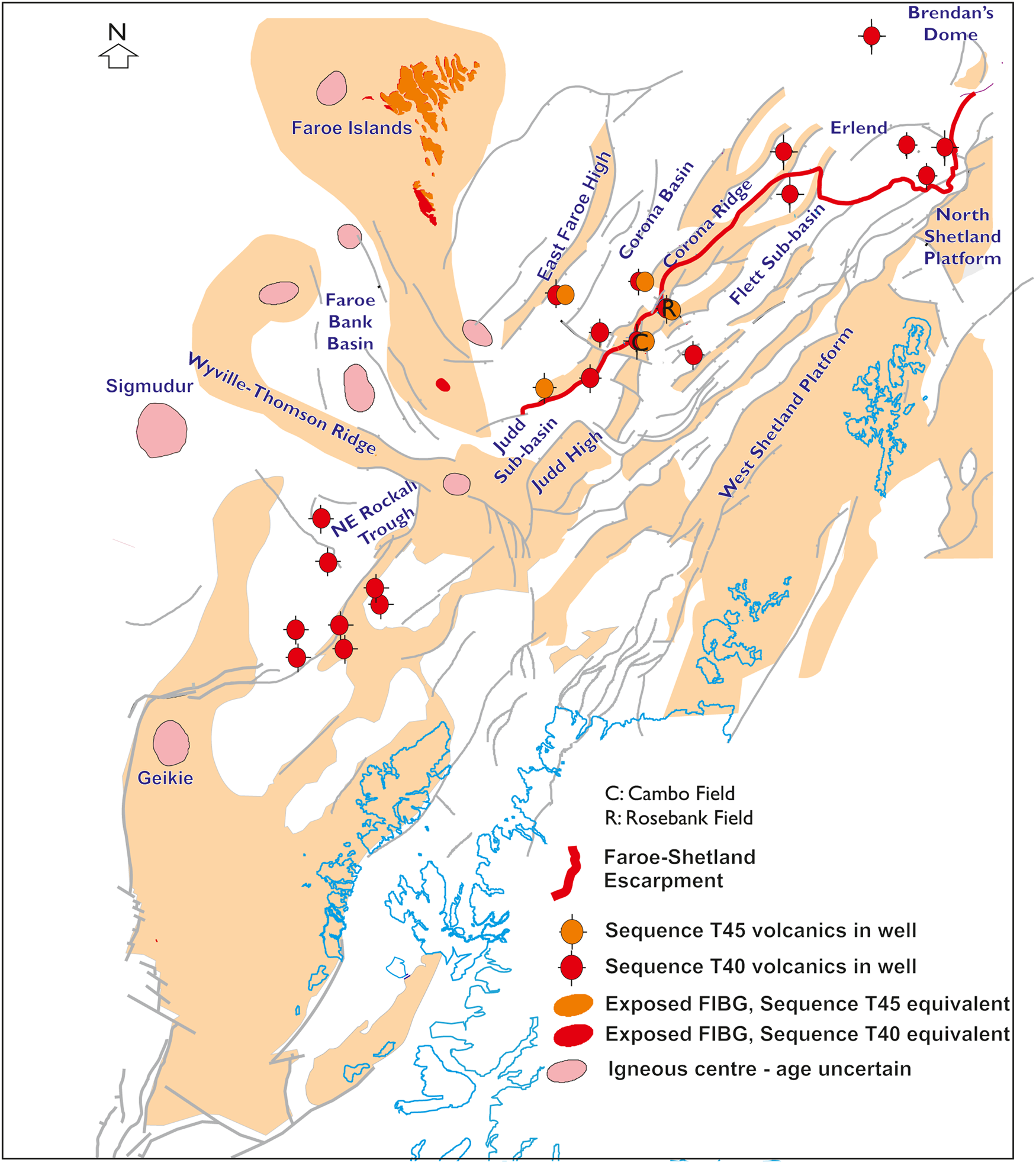
Map of syn-breakup volcanic rocks drilled in Faroe–Shetland and Rockall basin wells, exposed in the BPIP and on the exposed FIBG. The limit of the Faroe–Shetland Escarpment is also shown for reference. Volcanism is focused NE–SW across FSB and the Northeast Rockall Trough. Late syn-breakup, Sequence T45 extrusive volcanism is concentrated in the NW of the area, towards the location of the nascent North Atlantic Rift.
4. Volcanic successions in the Rockall Basin
The Rockall Basin has fewer well penetrations and a lower density of seismic data coverage than the FSB. Recent re-appraisal of hydrocarbon prospectivity in the Rockall Basin to the S of the FSB (Schofield et al. Reference Schofield, Jolley, Holford, Archer, Watson, Hartley, Howell, Muirhead, Underhill and Green2018; Broadley et al. Reference Broadley, Schofield, Jolley, Howell and Underhill2020) has identified basin flank lava fields within both Sequence T40 and Sequence T36 along the eastern Rockall margin (Fig. 1). In this basin, the low density and quality of much of the subsurface samples or data has prevented recognition of any tephra deposits older than Thanetian.
Pre-breakup lower Thanetian (Sequence T36) lava fields identified by well penetrations in the Rockall Basin, to date, are small in overall spatial extent and are associated with shelf margin faulting (Fig. 1). These lava fields initiated as hyaloclastite deltas prograding westwards into the Rockall Trough. Successions of this character are recorded in wells 132/6–1, 132/15–1, 154/1–1, 154/1–2, 153/5–1 and 164/28–1A (Figs 1, 11; and see Schofield et al. Reference Schofield, Jolley, Holford, Archer, Watson, Hartley, Howell, Muirhead, Underhill and Green2018). For example, well 164/28–1A penetrated a ~300-m-thick hyaloclastite sequence (Figs 18, 19) overlain by ~100 m of a dominantly compound flow lava field. Overlain by Thanetian marine sedimentary rocks, this older lava field is, in turn, unconformably overlain by the prograding volcaniclastic and volcanic rocks of a syn-breakup, Sequence T40 lava field. Syn-breakup lava fields are extensive on the eastern Rockall Basin margin, but have fewer well penetrations (Fig. 17). Wells 164/7–1 (Archer et al. Reference Archer, Bergman, Iliffe, Murphy and Thornton2005) and 164/25–2 to the NE (Figs 18, 19) both drilled this succession. The most stratigraphically extensive, well 164/25–2 drilled a thick hyaloclastite delta succession, which had prograded from the E (Schofield et al. Reference Schofield, Jolley, Holford, Archer, Watson, Hartley, Howell, Muirhead, Underhill and Green2018) and overlying basaltic lavas in a succession comparable to those in the FSB. Further, Sequence T40 volcanic delta facies were drilled by well 154/3–1, which penetrated approximately 500 m of hyaloclastites (Schofield et al. Reference Schofield, Jolley, Holford, Archer, Watson, Hartley, Howell, Muirhead, Underhill and Green2018) overlain by approximately 400 m of dominantly compound basalt lava flows. Although the Rockall Basin contains locally sourced lava fields attributable to Sequence T40, to date, no volcanic strata of Sequence T45 have been drilled.
Well 164/28–1a. Positioned to the W of the West Lewis Ridge, this well recorded volcaniclastic and volcanic strata in Sequence T36. Occurrences of Alisocysta margarita and common Areoligera cf. medusettiformis in the marine shales overlying the volcanic succession indicate a lower Thanetian age. Above these, the Sequence T40 volcanic succession palynoflora contains Caryapollenites circulus and Apectodinium spp., with the overlying Sequence T45–Sequence T50 interval containing Deflandrea oebisfeldensis. All species palynomorph data displayed as square roots because of variable sample totals; only stratigraphically significant taxa are displayed. Sum pollen/spores, sum microplankton are plotted as raw data to illustrate intervals of variable recovery.

Rockall geoseismic correlation tied to well 164/28–1a (Fig. 18) and to well 164/25–2, the latter drilled through the eastern margin of the West Lewis Ridge (see Schofield et al. Reference Schofield, Jolley, Holford, Archer, Watson, Hartley, Howell, Muirhead, Underhill and Green2018). The Sequence T36 volcanics are apparently restricted to the western margin of the West Lewis Ridge and were probably sourced from a magmatic system related to the western bounding faults. The Sequence T40 volcaniclastic and volcanic strata, although thinner, are more extensive.

Within the Rockall Basin, a number of large seamounts are present, which have been identified as being composed of Early Palaeogene intrusive igneous bodies. Three of these, Rosemary Bank, Hebrides Terrace and Anton Dohrn (Fig. 1), have been analysed from grab samples (O'Connor et al. Reference O'Connor, Stoffers, Wijbrans, Shannon and Morrissey2000). These authors proposed that argon isotope (Ar)/Ar dates obtained from basalts collected by grab samples supported a pulsing mantle plume model. Volcanism was considered to begin at 70 ± 1 Ma, with pulses of activity recorded at 62 Ma, 52 Ma, 47 Ma, 42 Ma, which correspond with the Sullom and Horda formations of the equivalent Rockall Basin record. The dating of weathered basalts from grab samples with little geological context is problematical. Although these dates are statistically significant and included in the review of NAIP dating by Wilkinson et al. (Reference Wilkinson, Ganerød, Hendricks, Eide, Peron-Pinvidic, Hopper, Stoker, Gaina, Doornanbal, Funck and Arting2017), the nature of the material analysed introduces significant uncertainty with respect to the geological accuracy of the chronostratigraphical results. Currently, of these five dates, only ~62 Ma is supported by other geological evidence from the Rockall and Faroe–Shetland basins.
The Rosemary Bank, Hebrides Terrace and Anton Dohrn seamounts are included in seismic data surveys tied to well data (Schofield et al. Reference Schofield, Jolley, Holford, Archer, Watson, Hartley, Howell, Muirhead, Underhill and Green2018). The Anton Dohrn seamount currently rises above the sea floor, and is surrounded by Late Palaeogene and Neogene marine sedimentary rocks. Within the rock succession around the centre, bright, high-amplitude reflectors dipping away from the centre are correlative with a prograding volcaniclastic delta and lava field system penetrated by wells 132/6–1 and 132/16–1 (Schofield et al. Reference Schofield, Jolley, Holford, Archer, Watson, Hartley, Howell, Muirhead, Underhill and Green2018, fig. 8). These are overlain by Eocene Balder Formation and Horda Formation sedimentary rocks, which onlap onto the Anton Dohrn structure, overstepping the potentially Sequence T36 volcanics/volcaniclastics. The Anton Dohrn centre was a topographic high during the deposition of these Sequence T40–Sequence T50 sedimentary rocks, much as it is today. Syn-breakup volcanic activity on Anton Dohrn appears unlikely based on the available age dating and the evidence from seismic interpretaion. There is greater uncertainty over the initiation of this and other complexes given the lack of deep-well penetrations.
5. Discussion
Analysis of FSB and Rockall Basin strata has confirmed two main periods of volcanic activity (Fig. 20). Upper Danian to lower Thanetian pre-breakup volcanic activity corresponds to pyroclastic Phase 1 (Knox & Morton Reference Knox, Morton, Morton and Parson1988; Watson et al. Reference Watson, Schofield, Jolley, Archer, Finlay, Mark, Hardman and Watton2017) and is composed of dominantly acidic ashes. In contrast, upper Thanetian to Ypresian syn-breakup activity includes the dominantly basaltic pyroclastic Phase 2 of Knox & Morton (Reference Knox, Morton, Morton and Parson1988). The onset of pre-breakup volcanism was correlated with calcareous nannofossil zone NP4 (62.2 Ma, latest Danian; Ogg et al. Reference Ogg, Ogg and Gradstein2016) by Nielsen et al. (Reference Nielsen, Stephenson and Thomsen2007). This date is comparable to geochronological ages for the oldest volcanics of the onshore BPIP (see Fig. 20), the Eigg Lava Formation and Muck Tuff (Eigg Lava 62.55 ± 1 Ma Ar–Ar sanidine tephra (Storey et al. Reference Storey, Duncan and Tegner2007); Muck Tuff 61.74 ± 1.76 Ma sanidine tephra (Chambers et al. Reference Chambers, Pringle and Parrish2005)). The onset of volcanism was linked by Nielsen et al. (2007) to a change in tectonic regime from compressional to relaxational at ~62.2 Ma following cessation of N–S convergence between Europe and Africa. Consequential rifting in the FSB gave rise to pre-breakup volcanic activity (62.5–58.7 Ma), including the Sequence T36 lava fields (59.6–58.95 Ma). Within the Faroe–Shetland and Rockall basins, pre-breakup volcanism can be divided into four intervals (Fig. 20).
Synthesis panel showing the stratigraphical distribution volcanic and volcaniclastic rocks in the study area. Stratigraphical columns for locations are labelled as follows: FAR = Faroe Islands; EFH = East Faroe High; CR = Corona Ridge; SFSB = southern FSB; FSb = Flett Sub-basin; RB = Rockall Basin. Lithostratigraphical formations are coloured differently for clarity, and labelled as follows: B = Beinisvørð Formation; M = Malinstindur Formation; E = Enni Formation; RM-LV = Rosebank Lower to Middle Volcanics; RUV = Rosebank Upper Volcanics; v = occurrences of volcanic ash in FSB and Rockall Basin sedimentary rocks. Radiometric dates for igneous centres and volcanic rocks which were determined to be statistically valid (Wilkinson et al. Reference Wilkinson, Ganerød, Hendricks, Eide, Peron-Pinvidic, Hopper, Stoker, Gaina, Doornanbal, Funck and Arting2017) are shown in the Events column. Experimental errors on these dates are shown in black. Red bars indicate the restriction to these errors from age control imparted by the polarity of the host rock. The date for Mull Centre 1 pillow lavas is derived from a contact metamorphosed rock and included to highlight the potential age of intrusions in the Mull Central Complex. The red uplift curve is derived from Shaw Champion et al. (Reference Shaw Champion, White, Jones and Lovell2008) and Hartley et al. (Reference Hartley, Roberts, White and Richardson2011), as modified by Hardman et al. (Reference Hardman, Schofield, Jolley, Holford, Hartley, Morse, Underhill, Watson and Zimmer2018). The maximum uplift post-dates the extrusion of the most voluminous flood basalt sequences and corresponds to a widespread unconformity and incision surface across the basin. The uplift curve of Hardman et al. (Reference Hardman, Schofield, Jolley, Holford, Hartley, Morse, Underhill, Watson and Zimmer2018) is shown as a solid line, with the dashed line inferring the uplift at the Upper Thanetian Unconformity event demonstrated here. BFU = basin flank uplift episodes discussed in the text. Blue horizontal bars mark major basin unconformities. USE = upper Selandian Event marked by an expanded succession in the FSB and a correlative unconformity in the North Sea Basin. The right hand track ‘N’ in the diagram shows the correlation to tectonic events proposed by Nielsen et al. (Reference Nielsen, Stephenson and Thomsen2007) and those in track ‘S’ by Stoker et al. (Reference Stoker, Hollford and Hillis2017).

The oldest volcanic activity recorded in the Faroe–Shetland and Rockall basins is of upper Danian to lower Selandian age. Tephra records in Sequence T10 to Sequence T22 strata are coeval with the earliest volcanism recorded in the BPIP (Fig. 20), currently recorded from small exposures in Antrim and the Small Isles. Pillow lavas from the Mull Central Complex have also yielded a statistically valid date of 62.87 ± 0.48 Ma (Chambers et al. Reference Chambers, Pringle and Parrish2005; Wilkinson et al. Reference Wilkinson, Ganerød, Hendricks, Eide, Peron-Pinvidic, Hopper, Stoker, Gaina, Doornanbal, Funck and Arting2017), indicating that they were erupted early in the evolution of the BPIP. This analysis was derived from a sample (SO17) included in a palaeomagnetic investigation of igneous rocks from Mull by Dagley et al. (Reference Dagley, Mussett and Skelhorn1987). Sample SO17 was collected from pillow lavas within Mull Central Complex Centre 1 and described by these authors as ‘texturally granoblastic, indicating recrystallization’. They highlight that the ‘amygdales which once contained zeolites and chlorite have recrystallize to form plagioclase and pyroxene’. At best, the radiometric age derived from sample SO17 records a magmatic intrusion event, which caused contact metamorphism of these lavas.
The Mid Selandian interval during which sequences T25 to T31 Vaila Formation deposition took place, is characterised by an apparent absence of tephra in the Faroe–Shetland and Rockall basins. Isotope dating of the Rum early rhyodacite (Troll et al. Reference Troll, Nicoll, Donaldson and Emeleus2008) and the Central Complex (Hamilton et al. Reference Hamilton, Pearson, Thompson, Kelley and Emeleus1998) indicate that activity did continue in the BPIP at the uplifted margin of the nascent North Atlantic Rift (Fig. 20). The absence of any tephra sourced from Rum in the Rockall Basin may be a consequence of it being adjacent to an area of few well penetrations. It may also be a result of prevailing westerly winds (Knox & Morton Reference Knox, Morton, Morton and Parson1988) transporting the ash to the SE. This apparent volcanic hiatus in the Faroe–Shetland and Rockall basins is followed by a period of increased tephra input into the basin, preserved in sequences T32–T35. This activity overlaps with the radiometric age errors of a felsic dyke in Mull Centre 3 (Loch Ba Dyke; Fig. 20), although the sampled dyke is a normally magnetised rock, which is most likely attributable to C26N.
The extrusive lava fields and extensively distributed tephras attributed to Sequence T36 mark the peak of Selandian volcanism in the Rockall Basin and FSB. The upper Selandian Kettla Tuff Mb and age-equivalent small lava flow fields are correlative with extrusive activity in the BPIP. The Skye Main Lava Series (SMLS) and apparently coeval Canna Lava Formation were erupted into eroded valleys in the Rum Western Granite (Emeleus Reference Emeleus1997). The granite forms part of the Rum Central Complex, which has been dated as Selandian (Fig. 20; Hamilton et al. Reference Hamilton, Pearson, Thompson, Kelley and Emeleus1998). The SMLS lava field was subsequently intruded by the Thanetian, Cuillins Gabbro (Gabbro pegmatite 58.91 ± 0.06 Ma; Hamilton et al. 1988). All of the SMLS lavas are of reversed magnetic polarity (Wilson et al. Reference Wilson, Dagley and Ade-Hall1972), indicating lava field eruption prior to Chron 26N. In the ~1 Myr between intrusion of the Rum Central Complex and C26N, significant uplift and erosion of the area was experienced followed by the eruption of the SMLS. Between 0.25 and 2.0 km of strata were thought to have been removed from above the Rum granodiorite (Troll et al. Reference Troll, Nicoll, Donaldson and Emeleus2008), prior to eruption of the SMLS, indicating significant, rapid uplift and subsequent denudation of the basin's eastern flank.
Sequence T36 lava fields were located along the easterly margin of the active depocentres in the FSB and Rockall Basins with, currently, only a single example on the East Faroe High. Others appear as within-basin seamounts in the Rockall Basin. This spatial distribution and pattern of extrusive and pyroclastic volcanism was related to NNE–SSW-orientated early-stage rifting through the Faroe–Shetland and Rockall basins (Fig. 12). This rifting is comparable in style to that seen along the Mid Ethiopian Rift (e.g., Keir et al. Reference Keir, Bastow and Corti2015; Siegberg et al. Reference Siegberg, Gernon, Bull, Keir, Barfod, Taylor, Abebe and Ayele2017).
Following cessation of Selandian to lower Thanetian extrusive volcanism in both the Faroe–Shetland and Rockall basins (Schofield et al. Reference Schofield, Jolley, Holford, Archer, Watson, Hartley, Howell, Muirhead, Underhill and Green2018), siliciclastic sedimentation continued, with deposition of the marine Lamba Formation (Sequence T38, Thanetian). Cessation of volcanic activity during the Thanetian (58.6–57 Ma) is considered to have occurred towards the close of a phase of relaxation related inversion in NW Europe (Nielsen et al. Reference Nielsen, Stephenson and Thomsen2007). This inversion was inferred to relate to the ending of Africa–Europe convergence and was associated with a southerly migration of depocentres in the Sorgenfrei–Tornquist Zone of the eastern North Sea during this time (Nielsen et al. Reference Nielsen, Stephenson and Thomsen2007). Resumption of sedimentation in the Faroe–Shetland and Rockall basins after ~57 Ma was reflected by a basin-wards shift in gross depositional environment from open-circulation shelf marine to variable salinity, restricted-circulation shallow-shelf marine and terrestrial facies at the base of the Flett Formation (Ellis & Stoker Reference Ellis, Stoker, Cannon and Ellis2014). In both basins, flood basalts, terrestrial or restricted-circulation shallow marine deposits are recorded resting unconformably on open-circulation marine shelf sediments of the Lamba or Vaila formations. This uplift is inferred to have resulted either from a resumption of thermal support from the magmatic system (e.g., Hartley et al. Reference Hartley, Roberts, White and Richardson2011), from intra-plate rift-related stresses (Stoker et al. Reference Stoker, Hollford and Hillis2017), or the intrusion of several hundreds of meters in gross thickness of FSSC sills into Mesozoic sedimentary rocks (Schofield et al. Reference Schofield, Holford, Millet, Brown, Jolley, Passey, Muirhead, Grove, Magee, Murray, Hole, Jackson and Stevenson2015). Within the FSB, widespread hyaloclastite delta progradation and subsequent flood basalt eruptions were sourced from the FIBG in the NW, from N of the Ben Nevis structure (Millett et al. Reference Millett, Hole, Jolley, Schofield and Campbell2016; McLean et al. Reference McLean, Schofield, Brown, Jolley and Reid2017), from near the Erlend Volcanic Centre (Jolley & Bell Reference Jolley, Bell, Jolley and Bell2002) and from localised fissures along the Corona Ridge and adjacent fault blocks (Schofield & Jolley Reference Schofield and Jolley2013; Hardman et al. Reference Hardman, Schofield, Jolley, Holford, Hartley, Morse, Underhill, Watson and Zimmer2018). Eruptive cyclicity was recorded within the Beinisvørð Formation of the FIBG (Jolley et al. Reference Jolley, Passey, Hole and Millet2012), with a total cessation of Beinisvørð Formation eruption at ~55.85 Ma. This cessation of volcanic activity is recorded basin-wide from Kangerlussuaq (Ellis & Stoker Reference Ellis, Stoker, Cannon and Ellis2014) in the W, the Faroe Islands (Passey & Jolley Reference Passey and Jolley2009), around the Erlend Volcanic complex in the N (Jolley & Bell Reference Jolley, Bell, Jolley and Bell2002) to the eastern margin of the Rockall Basin in the S (Schofield et al. Reference Schofield, Jolley, Holford, Archer, Watson, Hartley, Howell, Muirhead, Underhill and Green2018; Broadley et al. Reference Broadley, Schofield, Jolley, Howell and Underhill2020).
Debate continues surrounding the age of the Beinisvørð Formation lavas of the FIBG, with Waagstein et al. (Reference Waagstein, Guise, Rex, Jolley and Bell2002) reporting whole-rock potassium (K)–Ar and Ar–Ar ages from altered basalt samples suggesting an onset of volcanism at ca.58.8 ± 0.5 Ma, whilst Storey et al. (Reference Storey, Duncan and Tegner2007) reported ages as old as 60.8 ± 1.2 Ma for Ar–Ar determinations on plagioclase separates from lavas penetrated by the Lopra 1/1A borehole (Storey et al. Reference Storey, Duncan and Tegner2007; Fig. 20). For both the K–Ar and Ar–Ar isotopic dating methods, it has been widely reported that even small degrees of alteration (often petrographically invisible) can significantly affect age determinations (e.g., Hofmann et al. Reference Hofmann, Féraud and Courtillot2000; Kelley Reference Kelley2002; Baksi Reference Baksi, Foulger and Jurdy2007; Baksi & Reidel Reference Baksi and Reidel2013; Cramer et al. Reference Cramer, Sherlock, Halton, Blake, Barry, Kelley and Jolley2013); therefore, challenges remain in terms of appraising the validity of low-K basaltic rocks that have undergone low-temperature metamorphism with clear evidence for the passage of heated hydrothermal fluids. In this regard, Waagstein et al. (Reference Waagstein, Guise, Rex, Jolley and Bell2002) clearly acknowledge increasing evidence for alteration of plagioclase phenocrysts with depth in the Lopra well: ‘[t]he plagioclase is generally clear and fresh-looking in the basalts from the upper part of the formation, but becomes increasingly clouded with microscopic inclusions and tiny fracture fillings downwards in the Lopra well’ (p. 225).
A recent re-evaluation of the isotopic age dates for the North Atlantic discounted the Waagstein et al. (Reference Waagstein, Guise, Rex, Jolley and Bell2002) ages, but appraised the Storey et al. (Reference Storey, Duncan and Tegner2007) ages as experimentally robust based on screening criteria, and recalculated them based on the updated timescale of Gradstein et al. (Reference Gradstein, Ogg, Schmitz and Ogg2012) to give an oldest age of 60.83 ± 0.6 Ma (Wilkinson et al. Reference Wilkinson, Ganerød, Hendricks, Eide, Peron-Pinvidic, Hopper, Stoker, Gaina, Doornanbal, Funck and Arting2017; Fig. 20). These data imply continuous volcanism over a period of >5 Myr. Biostratigraphic approaches outlined in Passey & Jolley (Reference Passey and Jolley2009) and Schofield & Jolley (Reference Schofield and Jolley2013) attributed the Beinisvørð Formation to Sequence T40, indicating a younger age and shorter period of eruption (<1.5 Myr). With new data provided by the analysis of the Brugdan wells on the East Faroe High and the associated seismic data interpretations presented here, a reappraisal of the discrepancy is timely.
The principal challenge for palynology in the Beinisvørð Formation lava field sections is that the sedimentary interbeds contain a poor marine dinocyst record due to deposition in dominantly sub-aerial to shallow-water environments. Pollen and spores from higher plants occur commonly, but stratigraphically significant assemblages are restricted to interbeds formed over longer time periods (Jolley et al. Reference Jolley, Passey, Hole and Millet2012). Constrained by the lower Ypresian, post-PETM terrestrial palynoflora of the overlying Prestfjall Formation (Passey & Jolley Reference Passey and Jolley2009), the exposed Beinisvørð Formation contains palynofloras, including frequent Caryapollenites veripites, which indicate upper Sequence T40 equivalent strata. On the Faroe Islands, the subsurface Beinisvørð Formation is only penetrated by the Lopra 1/1A borehole. Drilled in two stages, samples recovered from drilling are limited to five cores of igneous lithologies and a suite of ditch cuttings. Samples taken from these ditch cuttings yielded palynofloras that lack age-diagnostic assemblages below 700 m (below sea level). However, because these assemblages are derived from ditch cuttings, cavings in the open hole may have extended this record down-section. Below 700 m, the majority of the subsurface Beinisvørð Formation and the Lopra Formation has yielded palaeoenvironmental data, but no direct biostratigraphical age constraint. While the biostratigraphical and radiometric age determinations arrived at different conclusions, they both shared one aspect of interpretation – that the Beinisvørð and Lopra formations of the Faroe Islands area represented a single continuous period of volcanic activity, the difference between the approaches being the duration of that activity.
New information which helps to constrain the age of the southeastern margin of the FIBG is provided by the penetration of the succession in wells 6104/21–1 and 6104/21–2 (Figs 8, 11). These wells demonstrate the presence of the Thanetian to Selandian Lamba Formation and Vaila Formation marine shelf sedimentary rocks, including the Kettla Tuff Mb, underneath the FIBG basalts. Absence of biostratigraphical constraint on the seismic and well log data has previously led to these sub-FIBG sediments and their hosted intrusions being regarded as part of the overlying lava pile (Olavsdottir et al. Reference Olavsdottir, Stoker, Boldreel, Andersen and Eidesgaard2019). However, the occurrence of the Kettla Tuff Mb and underlying volcaniclastic, shallow marine sandstones of Sequence T35 in well 6104/21–2 (Figs 8, 11) is significant. The observed thickening north-eastwards of this unit under the Sequence T40–Sequence T45 FIBG lava field (Fig. 9) indicates the presence of a Selandian volcanic succession on the East Faroe Platform, which potentially continues underneath the Faroe Islands. From seismic data (Fig. 9), Lamba Formation marine sedimentary rocks are observed to pinch out to the NW between the Selandian volcanic succession and the overlying Ypresian, Sequence T40 FIBG lava field. FIBG upper Thanetian to lower Ypresian volcanic rocks, therefore, rest unconformably on Selandian volcanic strata NE of the East Faroe High and potentially in the area of the Faroe Islands. Superposition of Palaeogene lava fields of different ages has been recognised within the Faroe–Shetland and Rockall basins (Lagavulin–Ben Nevis, McLean et al. Reference McLean, Schofield, Brown, Jolley and Reid2017; Rockall Basin, Schofield et al. Reference Schofield, Holford, Millet, Brown, Jolley, Passey, Muirhead, Grove, Magee, Murray, Hole, Jackson and Stevenson2015; Figs 18, 19) and is probably more widespread (see also Anne Marie prospect on the Corona Ridge; Fig. 6). The presence of a Selandian volcanic succession unconformably overlain by an upper Thanetian to lower Ypresian lava field is concordant with the radiometric dates of Storey et al. (Reference Storey, Duncan and Tegner2007). Selandian radiometric ages from the Lopra 1/1A borehole (60.63 ± 0.70 Ma; 60.83 ± 0.60 Ma) contrast with a radiometric age (57.49 ± 0.60 Ma) indicating upper Thanetian eruption of the exposed Beinisvørð Formation.
In the FSB, activity resumed in lower Sequence T45 (Ypresian, ~55.8 Ma) on the Corona Ridge, with the eruption of dominantly fissure-fed flow fields (Schofield & Jolley Reference Schofield and Jolley2013). Thicker Sequence T45 lavas were extruded, dominantly from low-angle shield volcanoes to the W in two large-scale cycles forming the Malinstindur and Enni formations of the FIBG (Passey & Jolley Reference Passey and Jolley2009; Millett et al. Reference Millett, Hole, Jolley and Passey2017). Equivalent Ypresian flow fields prograded towards the E, although those drilled on the Corona Ridge were locally erupted (Schofield & Jolley Reference Schofield and Jolley2013; Hardman et al. Reference Hardman, Schofield, Jolley, Hartley, Holford and Watson2017; Poppitt et al. Reference Poppitt, Duncan, Preu, Fazzari, Archer, Bowman and Lyell2018). These local-sourced flow fields of both Sequence T40 and Sequence T45, in particular those of the Corona Ridge, have been included within the mapped extent of the Faroe–Shetland Escarpment (Fig. 1). Interpreted as a hyaloclastite delta front (Passey & Hitchen Reference Passey, Hitchen, Ritchie, Ziska, Johnson and Evans2011), previously published and new evidence presented here indicates that this feature is composed of flow fields of different source areas and ages, including some intrusive sheets.
6. Unconformities
The Selandian to lower Ypresian interval of the Faroe–Shetland and Rockall basins is recognised as including three major unconformities (e.g., Stoker et al. Reference Stoker, Hollford and Hillis2017). The oldest Danian–Selandian Unconformity is apparently unrelated to volcanism in the NAIP (Stoker et al. Reference Stoker, Hollford and Hillis2017). However, the Mid Palaeogene Unconformity and Flett Unconformity have been recorded to be coincidental with syn-breakup and post-breakup volcanism.
Coeval with the uplift and erosion of the Inner Hebrides, a Mid Palaeocene unconformity (Stoker et al. Reference Stoker, Hollford and Hillis2017; Olavsdottir et al. Reference Olavsdottir, Stoker, Boldreel, Andersen and Eidesgaard2019) has been recorded in the FSB and tied to the upper boundary of Sequence T35. Well and seismic data do not provide evidence of a significant unconformity within the basin at this point (Figs 7, 9), but do indicate the presence of an expanded section between Sequence T34 and the top of Sequence T36. Within the North Sea Basin, the Kettla Tuff Mb equivalent Glamis Tuff Mb occurs below the acme of Areoligera gippingensis and above the first downhole influx of Palaeoperidinium pyrophrum (Jolley Reference Jolley1998; Vieira et al. Reference Vieira, Mahdi and Alderson2020). In the FSB, the Kettla Tuff Mb (at the base of Sequence T36) is significantly higher up the succession than the first downhole occurrence of common P. pyrophorum. This occurs at the upper limit of Sequence T31. The interval equivalent to sequences T32, T34 and T35 is, therefore, highly condensed or missing in the North Sea Basin. This is potentially a result of extensional pre-breakup subsidence in the FSB and a lack of accommodation space on the uplifted flank in the North Sea Basin. The presence of an expanded succession in the FSB is supported by the tentative identification of a negative carbon isotope excursion (Fig. 3) in Sequence T34, a potential record of the Selandian–Thanetian Transitional Event (STTE; Barnet et al. Reference Barnet, Littler, Westerhold, Kroon, Leng, Bailey, Rohl and Zachos2019). This event is recorded as occurring immediately below Chron 26N in Tethys (Gubbio section; Coccioni et al. Reference Coccioni, Bancalà, Catanzarit, Fornaciari, Frontalini, Giusberti, Jovane, Luciani, Savian and Sprovieri2012) and in the lower latitude North Atlantic (Zumia section; Storme Reference Storme, Devleeschouwer, Schnyder, Cambier, Baceta, Pujalte, Di Matteo, Lacumin and Yans2012).
Confusion has been centred around the stratigraphical position and extent of the well-documented Flett Unconformity (Shaw Champion et al. Reference Shaw Champion, White, Jones and Lovell2008; Hartley et al. Reference Hartley, Roberts, White and Richardson2011; Stoker et al. Reference Stoker, Hollford and Hillis2017). In the Judd Sub-basin, a NW-trending, incised dendritic drainage system was deeply eroded during Flett Formation times into the underlying Lamba Formation. This drainage system has been attributed to transient uplift associated with the impact of the Iceland Plume in the region (Shaw Champion et al. Reference Shaw Champion, White, Jones and Lovell2008), tied to pulsing of the mantle plume around the PETM. These authors linked the erosion surface to the onset of Flett Formation deposition (e.g., Stoker et al. Reference Stoker, Hollford and Hillis2017), or to the PETM (Hartley et al. Reference Hartley, Roberts, White and Richardson2011). However, these interpretations have been significantly hampered by a lack of biostratigraphical control in an interval where low-salinity marine and terrestrial palynofloras are dominant.
Wells penetrating the most complete successions in inter-channel zones of the Judd Sub-basin dendritic system (e.g., 204/22–2 and 204/25a-3; see supplementary data S2) include sedimentary rock units deposited in fluvially dominated facies during uppermost Sequence T40 (equivalent to LAZ Rc6–Rc7; Schofield & Jolley 2013; Fig. 2). These inter-dendritic channel strata are unconformably overlain by terrestrial to shallow marine, Sequence T45 (Flett Formation Unit F2b-F3) strata. Where the dendritic channels are most deeply incised (into Sequence T38, Lamba Formation), the oldest post-erosion channel fill is attributable to Flett Formation Unit F2a (e.g., 204/19–1; see supplementary data S2). While these data support uplift and incision of the Judd Sub-basin area, it is clear that the erosive phase identified by previous authors occurred after the deposition of uppermost Sequence T40 sediments – that is, within the Flett Formation, not at the onset of its deposition.
Within the Judd Sub-basin, uppermost Flett Formation Unit F1b strata rest unconformably on Sequence T38 marine Lamba Formation sediments (supplementary data S2). These strata are, in turn, locally eroded and overlain by Sequence T45 Flett Formation sedimentary rocks. This succession highlights the presence of a second, older unconformity. Lack of effective biostratigraphical control has resulted in these two erosion surfaces being amalgamated.
Further evidence of the sub Flett Formation (sub Sequence T40) unconformity, here termed the Upper Thanetian Unconformity, is recorded in the geoseismic interpretation of the southern FSB presented here (Fig. 7) and is also present in interpreted seismic lines presented by Hardman et al. (2018; Fig. 2). Here, the Upper Thanetian Unconformity is evident as an uplifted and deeply eroded surface, dissecting the uppermost Lamba Formation Sequence T38. The most deeply eroded areas provided accommodation space for the deposition of shallow marine to terrestrial Sequence T40 sedimentation (e.g., 6005/15–1; Fig. 3). In this well, the uppermost Flett Formation Unit 1b, which includes the youngest PETM excursion and recovery phase, is eroded by the subsequent Flett Unconformity. In this case, shallow marine sediments of Flett Formation Unit F2b–F3 were deposited on the Flett Unconformity surface (Fig. 3).
Within the Judd Sub-basin, the Flett Unconformity dendritic drainage system was initiated at the boundary between Flett Formation units F1b and F2a. How much of this system was inherited from the more extensive Upper Thanetian Unconformity surface is currently undetermined, as is the impact of the amalgamation of these surfaces on estimations of uplift. The development of the dendritic Flett Unconformity in the Judd Sub-basin has been attributed to a greater degree of uplift in the S of the FSB (Stoker et al. Reference Stoker, Hollford and Hillis2017). This appears to be a perception driven by the absence of three-dimensional seismic data in the centre and N of the FSB. However, two-dimensional seismic data and associated well penetrations clearly identify the presence of a significant correlative erosion surface in the Flett Sub-basin to the N and in the S of the Corona Basin (Fig. 7). The change from open-circulation marine sedimentation to organic rich, restricted-circulation shallow marine to terrestrial sedimentation was noted at this boundary by Ellis & Stoker (Reference Ellis, Stoker, Cannon and Ellis2014). This change is mirrored at the correlative unconformity surface in the North Sea, where the Lista Formation is overlain by the Forties Mb of the Sele Formation. Similarly, shift to transitional zone facies is recorded as far S as southeastern England, where the Thanet Sands/Ormesby Clay formations are overlain by Lambeth Group (Ellison et al. Reference Ellison, Knox, Jolley and King1994).
The timing of uplift associated with the Flett Unconformity has been discussed by Hardman et al. (Reference Hardman, Schofield, Jolley, Holford, Hartley, Morse, Underhill, Watson and Zimmer2018), who reported evidence for a slow decline in thermal support following maximum uplift (Fig. 20) during deposition of the Flett Formation. Maximum incision on the palaeo-shelf and, thus, maximum uplift has been proposed to have occurred at the Sequence T40–Sequence T45 boundary (Fig. 20). This was coincident with the slow down and cessation of eruption of the widespread Sequence T40 lava fields, including the exposed Beinisvorð Formation of the FIBG. Thermal support from magmatism is demonstrated to have continued after the maximum effusion of flood basalts in the Beinisvorð Formation, and to occur within the Colsay 1 sedimentary rock succession of the Corona Ridge (Figs 3, 15). The cessation of high-volume flood basalt eruption and switch to lower-volume intrusion and eruptions at this time is attributed to a switch to higher-level melts and intrusions.
Identification of the Upper Thanetian and Flett unconformities sheds light on the timing of uplift in the Faroe–Shetland and Rockall basins. The most prolonged gap in the stratigraphical record coincides with the incision of the most prominent erosion surface at the upper Thanetian Sequence T38–Sequence T40 boundary. Calculations of uplift at the younger Flett Unconformity by Shaw Champion et al. (Reference Shaw Champion, White, Jones and Lovell2008) are, therefore, based on an inherited drainage system modified by later Ypresian erosion at the Sequence T40–Sequence T45 boundary. Maximum uplift of the FSB occurred at the Upper Thanetian Unconformity, immediately preceding the onset of widespread flood basalt eruption in Sequence T40 (Fig. 20) and coincidental with at least one phase of FSSC intrusion in the Flett Sub-basin (Fig. 16).
7. Conclusions
Integration of biostratigraphical, wireline log and geophysical data has identified two periods of eruption in the Faroe–Shetland and Rockall Basins. These periods have different orientations and foci, resulting from them being responses to different processes.
The first period is pre-breakup. Volcanism occurred as a consequence of a rifting episode driven by a relaxation of intra-plate deformation in Europe following the cessation of convergence of Africa and Europe at 62 Ma. This early rift was orientated SSW–NNE on a Cretaceous trend and parallel to the continental margin in the Rockall Basin and FSB. Volcanic activity was initially concentrated at basin flank structures, under the present Faroe Islands and within the Rockall Basin at seamounts. Structural lineaments linked the basin volcanism to rift-flank volcanism of the BPIP, focussed at large igneous centres. Some of these central complexes (e.g., Rum, Mull) were uplifted and rapidly eroded later during the pre-breakup period, at a time when additional accommodation space was developed in the offshore sedimentary basins. This is interpreted as a ~61 Ma phase of basin flank uplift, amplified by a shallowing of melt depth and associated granitic intrusions (Hole et al. Reference Hole, Millett, Rogers and Jolley2015). At the non-volcanic margins of the FSB, this late uplift phase is potentially associated with the Mid Palaeocene Unconformity of some authors (e.g., Stoker et al. Reference Stoker, Hollford and Hillis2017). Only one rift-flank flow field has been identified to date on the western side of the pre-breakup basin, against many on the eastern flank and within the basin. These stretch from the Rockall Basin to the Ben Nevis structure. This could suggest that this rift was asymmetrical, but much of the potential evidence lies beneath the extrusive volcanic rocks of the syn-breakup eruptions. Cessation of pre-breakup eruption is correlated to the cessation of intra-European plate relaxation inversion (Nielsen et al. Reference Nielsen, Stephenson and Thomsen2007).
The second period of eruption is syn-breakup. The most geographically widespread phase of flood basalt eruptions initiated following a major eastern margin North Atlantic uplift event, which resulted in the Upper Thanetian Unconformity in the Rockall Basin and FSB. Initial high-volume extrusive igneous successions were focussed to the W of the FSB. In the centre and E of the basin, separate eruption loci developed along pre-existing lineaments either as fissure or point-sourced lava fields. With shallowing of melting at the end of the first stage, a granitic centre developed on Skye (Eastern Red Hills Granites) and thermal support was maintained in the basin beyond the end of high-volume flood basalt eruption.
Reactivation and further erosion of the Upper Thanetian Unconformity surface at ~55.85 Ma was linked to formation of the Flett Unconformity. Subsequent slow basin subsidence (Hardman et al. Reference Hardman, Schofield, Jolley, Holford, Hartley, Morse, Underhill, Watson and Zimmer2018) resulted in deposition of shallow marine to terrestrial sedimentary successions, infilling the eroded surface. These interdigitated with the syn-breakup lava fields developed at the basin centre and western margin. The north-westerly shift of eruption focus and the eruption of mid ocean ridge basalt (MORB)-type lavas in the younger stages of the syn-breakup reflects the emplacement of oceanic crust in the nascent North Atlantic Rift prior to flooding of the rift and eruption of the widespread Balder Formation ashes.
Over the Palaeogene, Stoker et al. (Reference Stoker, Hollford and Hillis2017) present evidence that the opening of the NE Atlantic is not simple rift to post-rift subsidence, but a long-term record of tectonic instability and vertical crustal motions into the Eocene. The evidence presented here confirms that a Danian–Thanetian nascent rift developed on a Cretaceous lineament along the Rockall Basin and FSB as a result of changes in intra-plate stress regimes in Europe. Clarification of the relationship of syn-breakup to the record of regional uplift highlights that the oldest, highest amplitude uplift (which formed the Upper Thanetian Unconformity) occurred prior to, or at the onset of, syn-breakup magmatism. Changes in gross depositional environment across the unconformity, noted earlier by Ellis & Stoker (Reference Ellis, Stoker, Cannon and Ellis2014), are seen over the 1000 km from the Faroe–Shetland to the London Basin, all signifying uplift, erosion and subsequent dominance by terrestrial and restricted marine depositional systems. Regional uplift of this magnitude is likely to be a reflection of changes in tectonic regime, exceeding the magnitude of the expected effects of a mantle plume.
8. Supplementary material
Supplementary material is available online at https://doi.org/10.1017/S1755691021000037.
9. Acknowledgements
The authors would like to thank Simon Kelley for comments on an earlier draft of the manuscript and for discussions on radiometric age dating. Dougal Jerram and John Faithfull are thanked for their constructive and helpful comments on the manuscript. PGS are thanked for permission to publish FSB MegaSurvey Plus data shown in Figures 6 and 8. PGS and TGS are thanked for permission to publish seismic data from the FSB2012 GeoStreamer survey also shown in Figure 6. Data used in Figure 19 are courtesy of GeoPartners and TGS, processing by DUG. IHS Kingdom Suite and Schlumberger Petrel Software are thanked for their donation of academic licenses to the University of Aberdeen.


 Open access

