





Introduction
Palmer amaranth has evolved resistance to seven sites of action (SOAs) in the United States (Heap Reference Heap2020). The perpetuating evolution of herbicide resistance in Palmer amaranth has increased pressure on the few remaining preemergence and postemergence herbicide options that are commonly used by U.S. soybean and cotton producers. The innovation of genetically modified (GM) herbicide-tolerant soybean and cotton has enabled producers to apply over-the-top postemergence herbicides to combat evolving Palmer amaranth populations. However, a new herbicide site of action (SOA) has not been developed in almost 30 yr. Therefore, proper management of the few remaining effective SOA is imperative (Duke Reference Duke2012; Norsworthy et al. Reference Norsworthy, Ward, Shaw, Llewellyn, Nichols, Webster, Bradley, Frisvold, Powles, Burgos, Witt and Barrett2012).
Monsanto (which merged with Bayer Crop Science in 2019) commercially launched glyphosate/dicamba/glufosinate–resistant cotton (XtendFlex ® ) in 2015, with a subsequent commercialization for use in soybean, in 2021. Specific to this work, the incorporation of multiple GM traits allows the use of postemergence applications of dicamba, glufosinate, and glyphosate. Applying two effective SOAs in mixture mitigates the likelihood of target-site herbicide resistance more than applying the herbicides sequentially (Bagavathiannan et al. Reference Bagavathiannan, Norsworthy, Smith and Neve2013, Reference Bagavathiannan, Norsworthy, Smith and Neve2014; Diggle et al. Reference Diggle, Neve and Smith2003); however, dicamba-containing products such as XtendiMax® plus Vaporgrip® (Monsanto Corporation, St. Louis, MO) and Engenia® (BASF Corporation, Research Triangle Park, NC) cannot be mixed with glufosinate due to limitations on the Environmental Protection Agency–approved product labels (Anonymous 2020a, 2020b). Therefore, using the XtendFlex® technology, dicamba and glufosinate, have to be applied sequentially.
Many factors within sequential herbicide programs can affect their weed control efficacy, including but not limited to the interval between sequential applications (Meyer et al. Reference Meyer and Norsworthy2019), sequence of herbicides applied (Burke et al. Reference Burke, Askew, Corbett and Wilcut2005), weed size (Lee and Oliver Reference Lee and Oliver1982; Steckel et al. Reference Steckel, Wax, Simmons and Phillips1997; Wilson Reference Wilson2005), environmental conditions (Ahrens Reference Ahrens1994; Anderson et al. Reference Anderson, Swanton, Hall and Mersey1993; Coetzer et al. Reference Coetzer, Al-Khatib and Loughin2001), application technique or nozzle selection (Etheridge et al. Reference Etheridge, Hart, Hayes and Mueller2001; McKinlay et al. Reference McKinlay, Ashford and Ford1974; Meyer et al. Reference Meyer, Norsworthy, Kruger and Barber2015), and cost. To optimize herbicides when using the XtendFlex ® technology, a clear understanding is needed of how the aforementioned factors can influence the overall weed control efficacy of sequential applications of dicamba and glufosinate. Additionally, identifying which weed control program provides the greatest relative net benefit to the producer from both cost and weed control efficacy perspectives would be beneficial.
It has been previously shown that the order in which sequential postemergence herbicides are applied can influence weed control (Burke et al. Reference Burke, Askew, Corbett and Wilcut2005). For example, when a contact herbicide such as glufosinate is applied, a decrease in sequential herbicide absorption and translocation has been observed. Reductions in sequential herbicide absorption and translocation were attributed to the rapid necrosis of plant tissue following the glufosinate application (Burke et al. Reference Burke, Askew, Corbett and Wilcut2005). The reduction in absorption and translocation observed following a glufosinate application may suggest that an application of glufosinate preceding an application of dicamba will not optimize postemergence weed control in the XtendFlex ® technology.
Applications of synthetic auxin herbicides such as dicamba can have adverse effects on sequentially applied herbicides (Priess et al. Reference Priess, Norsworthy, Barber and Castner2019). Following an auxin herbicide application, sensitive plants have been observed to display abnormalities such as epinasty, leaf abscission, and abnormal elongation of aerial structures (Grossman Reference Grossmann2000). The plant symptomology that occurs after an auxin herbicide application may reduce the overall leaf surface area of subsequently treated sensitive broadleaf weeds. However, impacts from the reduction of leaf surface area on the efficacy of sequentially applied herbicides have not been quantified. In addition, application of an auxin herbicide causes an upregulation of detoxifying enzymes (glutathione transferase, cytochrome P450s), which can affect the metabolism of the applied herbicide as well as subsequently applied pesticides (Cummins et al. Reference Cummins, Cole and Edwards1999; Raghavan et al. Reference Raghavan, Ong and Dalling2005). Even though auxin herbicides have the potential to impact efficacy of sequentially applied contact herbicides, an increase in Palmer amaranth efficacy was observed when 2,4-DB was applied 7 d prior to lactofen or acifluorfen, when compared to sequential applications of 2,4-DB (Chahal et al. Reference Chahal, Jordan, York and EP2011).
To mitigate the probability of Palmer amaranth evolving resistance to either dicamba or glufosinate when the XtendFlex® technology is used, timing and order of sequential herbicide applications of the two SOAs need to be optimized to maximize weed control. Therefore, the objectives of this research were to 1) assess weed control of single applications of stand-alone dicamba and glufosinate; 2) determine whether the unlabeled mixture of dicamba plus glufosinate was synergistic, additive, or antagonistic; 3) evaluate the improvement in weed control over and above single applications with sequential applications of dicamba followed by (fb) dicamba, glufosinate fb glufosinate, dicamba fb glufosinate, and glufosinate fb dicamba, and identify the sequence of herbicide order that optimized control; 4) investigate whether time intervals of 0.2, 3, 7, 14, and 21 d between herbicide applications optimized control of sequential applications of dicamba fb glufosinate and glufosinate fb dicamba (Table 1); and finally, 5) quantify economic and production risk by simultaneously comparing not only weed control effectiveness but also herbicide cost (including application charges) across weed control options using Monte Carlo simulation to quantify the relative net benefit to producers in dollar terms. To accomplish this, we estimated cumulative probability density functions (CDFs) to visually present the extent to which the range of outcomes with a particular weed control option compares with the range of outcomes of alternative weed management options.
Experimental treatments. a

a Abbreviation: fb, followed by.
b Cost of herbicide treatment includes a custom application fee of US$21.98 ha−1 application−1.
Material and Methods
Field Trials
Field experiments were conducted in 2019 and 2020. In 2019, experiments were conducted in Keiser, AR (35.675128°N, 90.07844°W), near Crawfordsville, AR (35.228428°N, 90.336762°W), and near Marianna, AR (34.725784°N, 90.735788°W). In 2020, the experiment was conducted in Fayetteville, AR (36.092002°N, 94.187002°W), and at the same locations near Keiser and Marianna. The experiment was designed as a single-factor randomized complete block with four replications (Table 1). Field location, Palmer amaranth size at the initial application, and soil information at each site are displayed in Table 2.
Experiment data.

Treatments were initiated without an attempt to grow cotton or soybean on ground with native Palmer amaranth populations at all locations besides Fayetteville, AR, in 2020, where Palmer amaranth from Crittenden County, AR, was overseeded. Crop and weed interactions can influence the ability of herbicide-injured weeds to recover and produce seed (Evans et al. Reference Evans, Knezevic, Lindquist and Shapiro2003; Jha and Norsworthy Reference Jha, Norsworthy, Riley, Bielenberg and Bridges2008). As crop density increases, weed biomass and the ability of weed interference to effect crop yield decreases (Tollenaar et al. Reference Tollenaar, Dibo, Aguilera, Weise and Swanton1994). Because these experiments were conducted without a crop present, Palmer amaranth had an improved opportunity to regrow. The presence of a crop would likely affect the ability of herbicide treatments to control weeds as evaluated elsewhere (Tollenaar et al. Reference Tollenaar, Dibo, Aguilera, Weise and Swanton1994). However, Palmer amaranth has been observed to partially acclimate to crop shading by increasing leaf area and total leaf chlorophyll concentrations (Jha et al. Reference Jha, Norsworthy, Riley, Bielenberg and Bridges2008). To evaluate the effectiveness of the herbicide treatments without crop competition the experiments were conducted without a crop present.
Plot size at all locations was 1.93 m wide and 6 m long. Prior to the first herbicide application, two 0.25- to 0.5-m2 quadrants where the size of the quadrants depended on Palmer amaranth density, were established in each plot and plants were counted for a density assessment. After initial density assessments were recorded, either S-metolachlor or dimethenamid-P was applied over the entire test area at a rate of 1,606 g ai ha−1 or 736 g ai ha−1, respectively, to limit further Palmer amaranth emergence. Average Palmer amaranth height was also recorded prior to the initial herbicide application.
Herbicides were applied with hand-held CO2-pressurized sprayers calibrated to deliver 140 L ha−1 of spray solution at 6.4 kph. Dicamba was applied using TTI 110015-VP (TeeJet, Springfield, IL) nozzles to ensure an ultra-course droplet using small-plot spraying equipment (Anonymous 2020a, 2020b). Glufosinate was applied with AIXR 110015-VP (TeeJet) nozzles. The mixture of dicamba + glufosinate was applied with TTI 110015-VP nozzles.
Following herbicide applications, Palmer amaranth control was visually rated and plants with live tissue were counted in the established 0.25- to 0.5-m2 quadrants 28 d after final application (DAFA) in each treatment. Estimates of Palmer amaranth control were rated on a scale of 0 to 100, with 0 being no control and 100 being complete Palmer amaranth death 14 and 28 DAFA. Initial and final counts were used to calculate a quantitative mortality percentage for each treatment.
Economic Analysis
Pricing for dicamba, the required volatility reducing agents (VRAs), and glufosinate products labeled for use over-the-top of XtendFlex ® crops were obtained from Helena Agri-Enterprises, Nutrien Ag Solutions, and Simplot locations in the mid-southern United States. Cost per liter, as averaged across the different retailers in spring 2021, were converted to cost per hectare using labeled use rates of each product. Several VRAs were priced including Sentris (BASF, Lundwigshafen, Germany), VaporGrip Xtra Agent (Bayer CropScience, St. Louis, MO), and Delta Lock (Loveland Products, Loveland, CO), and similarly converted to cost per hectare. Use rates of VRAs were calculated using a spray volume of 140 L ha−1, which is the minimum amount required by label (Anonymous 2020a, 2020b). Rebates affecting the cost of the herbicide were not included due to intricacies in the various programs and difficulty standardizing rebates across products and locations. Given changing bio-tech trait availability no attempt was made to calculate longer-term average cost differences across herbicide, VRAs, and deposition aid and drift management adjuvants (DRAs).
In addition to pesticide and adjuvant input costs, the cost of application also contributes to the overall expense of herbicide applications. To standardize treatments a custom application fee of US$21.98 ha−1 was added to each herbicide application, based on the average statewide cost of custom ground herbicide applications in Texas (Klose et al. Reference Klose, Smith, Thompson, Waller, Zapata and Keeling2019). A total cost of herbicide expense was calculated for each treatment in Table 1. Other factors that could affect the cost of these postemergence herbicide applications are the ability to mix residual herbicides to embed these applications in timely full-season herbicide programs to limit Palmer amaranth emergence; however, the use of residual herbicides is outside of the scope of this research. The over-the-top applications of dimethenamid-P and S-metolachlor used to prevent new flushes of weeds in this research were not included in the cost calculations.
To quantify both weed control effectiveness and treatment cost implications we calculated relative net monetary benefits across all treatments and further simulate ranges of likely outcomes associated with different weed control options using Monte Carlo simulation with @Risk v7.5 (Palisade Corporation, Raleigh, NC). Triangular truncated probability density functions (distributions) were fitted to Palmer amaranth mortality rates from experimental data for each of the treatments and to the initial Palmer amaranth density in the field. Because experimental trials were conducted under high initial Palmer amaranth densities, the latter distribution was scaled and truncated at 10,764 plants ha−1 based on the very high density found in the Palmer amaranth management software (Lindsay et al. Reference Lindsay, Popp, Norsworthy, Bagavathiannan, Powles and Lacoste2017). Using Monte Carlo simulation with 10,000 iterations, Table 1 in the Supplemental Material lists the parameters describing the distributions as sampled from the fitted distributions for treatments where herbicide applications were made to <10-cm-tall plants and to plants that were 13 to 25 cm tall. Triangular distributions, truncated between software-selected minima greater than or equal to 0%, and maxima of software-selected maxima less than or equal to 100%, exhibited superior fit characteristics in comparison to beta, normal, exponential, gamma, Weibull, Pareto, Pearson, Inverse Gauss, Laplace, Levy, logistic, loglogistic, and log normal distributions using the Kolmogorov-Smirnov statistic reported by @RISK for a majority of the fit distribution comparisons for each treatment alternative.
For each of the 10,000 simulation runs, the initial Palmer amaranth density (PD) was drawn randomly from its fitted distribution and then also a mortality rate (MRi) for each treatment alternative, i, from respective fitted distributions. This was done to calculate the estimated number of Palmer amaranth plants remaining (PRi) after spraying individual herbicide treatments on the two weed sizes tested. Because trial data were collected in the absence of a crop grown, we estimate yield loss (YLi) on the basis of PR in percentage terms for soybean as follows (Bensch et al. Reference Bensch, Horak and Dallas2003):
 $$Y{L_i} = \left( {104.6 \cdot {{P{R_i}} \over {10000}}} \right)\bigg/\left(1 + \left( {104.6 \cdot {{{{P{R_i}} \over {10000}}} \over {86.9}}} \right)/100\right)$$
The yield loss percentages for each treatment alternative were then multiplied by a yield-based revenue expectation per hectare using a soybean price of US$0.37 kg−1 and an irrigated soybean yield of 4,370 kg ha−1 to reflect long-term average dollar loss expectations from Palmer amaranth for a soybean producer in the study region.
Estimated dollar losses (DLi = YLi multiplied by the revenue potential of soybean at US$1,606 ha−1) as a result of varying levels of control of Palmer amaranth across the k treatment alternatives were compared to obtain an estimate of the relative benefit (RBi) a producer would obtain by choosing a particular herbicide treatment alternative i over the herbicide treatment with the largest dollar loss across the k alternatives: $R{B_i} =\mathop{\max}\limits_k D{L_i} - D{L_i}$
The weed control option with the least dollar loss is expected to be preferred by the producer and would lead to the largest RB. However, the producer spends different dollar amounts on weed control (WCi) across alternatives. As such, relative cost (RCi) is the difference between the least-expensive weed control option across the k alternatives and the chosen alternative i and reflects added cost for more expensive treatment alternatives in terms of herbicide cost itself as well as charges for application: $R{C_i} = W{C_i} - \mathop{\min \limits_k} W{C_i}$
Finally, the relative net benefit of a particular weed control method is a function of both RB and RC and summarizes the dollar impact from a revenue and cost side. It is calculated as follows: $RN{B_i} = R{B_i} - R{C_i}$
Importantly, no cost is assessed to Palmer amaranth evolving herbicide resistance to alternatives that use the same SOA as would be the case for treatments using the same herbicide twice in the same growing season, nor is a value assigned for weed seed addition to the soil seedbank across treatment alternatives as a function of PR. Hence, relative net benefit (RNB) values are likely conservative in the sense that treatments with poor weed control have further costs.
To summarize, a particular iteration run in the Monte Carlo simulation would depend on that particular iteration run’s initial PD, which is the same across all treatment alternatives, and the randomly chosen mortality rate independently chosen form each treatment’s fitted mortality rate distribution. Calculating both a positive or negative RNB is possible as some treatments may be low cost but also lead to high yield and thereby revenue or dollar losses given poor control, or they could be effective weed control options that could be either relatively cheap or expensive. Hence, the treatment alternative with the highest RNB is superior to the other treatment alternatives. Such RNBi were iteratively calculated 10,000 times to report both an average RNB and also to estimate CDFs across 10,000 iterations to reflect differences in riskiness as well as relative profitability. Treatment alternatives with steeper curves (e.g., less risk) and those with greater mean values (e.g., more RNB) would be preferred by the producer.
Because treatment effectiveness in terms of mortality rates is likely related across treatments, partial correlation coefficients were used (Supplemental Material, Tables 2 and 3), to develop CDFs with those correlations imposed. Treatment comparisons both with and without those correlations employed were performed to assess whether correlations across treatments made a difference in terms of ranking weed control management alternatives.
Percent control and mortality when <10-cm-tall Palmer amaranth was treated with single and sequential applications of dicamba and glufosinate, averaged over two site-years. a,b,c

a Palmer amaranth control and mortality is expressed as a percent of the nontreated.
b Abbreviations: DAFA, days after final application; fb, followed by; NA, not applicable.
c Means followed by the same letter within a column are not statistically different according to Tukey’s honestly significant difference test (α = 0.05).
Data Analysis
Data were analyzed by Palmer amaranth size (<10 cm and 13 to 25 cm). A single factor ANOVA was used to assess herbicide treatments in SAS software (version 9.4; SAS Institute Inc., Cary, NC) using the GLIMMIX procedure. A beta error distribution was assumed for Palmer amaranth control 14 and 28 DAFA (McDonald and Xu Reference McDonald and Xu1995). Site-years were analyzed by weed size at the initial application and site locations, and runs were added as random variables. Experiments conducted at the Crawfordsville, AR, location in 2019 and Keiser, AR, location in 2020 were considered labeled applications based on the average Palmer amaranth size at the initial application (Table 2). The other four experimental runs were pooled because Palmer amaranth averaged over 10 cm in height at the time of the initial application (Table 2). Means were separated using Tukey’s highly significant difference test (α = 0.05). Least significant mean contrasts were conducted for comparison of single applications versus sequential applications, dicamba fb dicamba versus glufosinate fb glufosinate, dicamba fb glufosinate versus glufosinate fb dicamba, dicamba fb dicamba versus dicamba fb glufosinate, and glufosinate fb glufosinate versus dicamba fb glufosinate (α = 0.05).
To evaluate the interaction of the unlabeled mixtures of dicamba and glufosinate (Anonymous 2020a, 2020b), Colby’s method (Colby Reference Colby1967) was used to assess the type of interaction occurring when two herbicides are applied in mixture. Colby’s method requires the calculation of an expected value as follows: ${\rm E = (X + Y) - (XY)/100}$
where E is the expected value of the herbicide mixture, and X and Y are values of herbicides when applied alone. A two-sided t-test was performed comparing the expected value calculated from Colby’s equation and the observed values of the mixture (α = 0.05). If the expected value of the herbicide mixture was statistically greater than the observed value the mixture was considered antagonistic. If no difference was found between the observed and expected value the mixture was considered additive, and if the observed value was greater than the expected value the mixture was considered synergistic. The expected value calculated in this experiment may be considered inflated because glufosinate alone treatments were applied with an Air Induction Extended Range (AIXR) nozzle and the mixture of the two herbicides was applied with a Turbo Teejet Induction (TTI) nozzle to abide by nozzle regulations of dicamba labels, even though the mixture of dicamba plus glufosinate is not federally labeled (Anonymous 2020a, 2020b).
Results and Discussion
Site-years included in the analysis for labeled Palmer amaranth size at the time of the initial application were Crawfordsville, AR, 2019 and Keiser, AR, 2020. For Palmer amaranth control 14 and 28 DAFA and percent mortality the main effect of herbicide treatment was significant (Table 3). Site-years included in the larger-than-labeled Palmer amaranth size at the time of the initial application were Keiser 2019, Marianna 2019, Fayetteville 2020, and Marianna 2020. For Palmer amaranth control 14 DAFA, 28 DAFA, and percent mortality the main effect of herbicide treatment was significant (Table 4). As mentioned previously, all experiments were over-sprayed with either S-metolachlor or dimethenamid-P prior to first application of treatments; therefore, control ratings and mortality percentages reflect emerged plants at the time of initial application.
Percent control and mortality when 13- to 25-cm-tall Palmer amaranth was treated with single and sequential applications of dicamba and glufosinate, averaged over four site-years. a,b,c

a Palmer amaranth control and mortality are expressed as a percent of the nontreated.
b Abbreviations: DAFA, days after final application; fb, followed by; NA, not applicable.
c Means followed by the same letter within a column are not statistically different according to Tukey’s honestly significant difference test (α = 0.05).
To justify the interpretation of the data collected an explanation of why percent control and mortality data taken at 28 DAFA is used preferentially over the 14 DAFA evaluation is needed. The percentage of Palmer amaranth weed control at 14 DAFA for sequential dicamba applications at 7-, 14-, and 21-d intervals ranged from 4 to 19 and 4 to 11 percentage points lower than the 28 DAFA evaluation on labeled and larger-than-labeled weed sizes, respectively (Tables 3 and 4). At 14 DAFA, the systemic nature of sequential applications of dicamba had not reached maximum Palmer amaranth control; therefore, comparisons of sequential applications of dicamba to other sequential applications at 14 DAFA should not be made. The lack of rapid removal of Palmer amaranth from crops like cotton or soybean, unlike glufosinate, especially at high densities following application, may have a negative effect on the crop if competition for resources is still occurring. Furthermore, the presence of weedy vegetation such as injured Palmer amaranth and its reflected far-red light perceived by nearby plants are known to alter crop growth (Afifi and Swantton Reference Afifi and Swanton2012; Markham and Stolenberg Reference Markham and Stolenberg2009). However, evaluations at 28 DAFA allowed time for the maximized herbicide efficacy to be reached, and captured any regrowth that occurred from either dicamba or glufosinate (GLP, personal observation). In the presence of a crop, some of these sequential treatments may perform slightly different than observed here such as extent of Palmer amaranth regrowth from a dicamba or glufosinate application if the crop is approaching canopy formation as noted in previous research (Meyer and Norsworthy Reference Meyer and Norsworthy2020).
Single Applications
Single applications of dicamba or glufosinate applied to <10-cm-tall Palmer amaranth provided 76% and 65% control and caused 92% and 85% mortality, respectively, at 28 DAFA (Table 3). Larger-than-labeled Palmer amaranth plants were not controlled >90% by a single herbicide application. A single application of glufosinate or dicamba applied to larger-than-labeled weeds controlled Palmer amaranth 59% and 65% and led to 47% and 59% mortality, respectively (Table 4). Similarly, Merchant et al. (Reference Merchant, Sosnoskie, Culpepper, Steckle, York, Braxton and Ford2013) and Coetzer et al. (Reference Coetzer, Al-Khatib and Peterson2002) observed that a single application of glufosinate or dicamba did not provide greater than 76% control of Palmer amaranth at labeled or above-labeled weed sizes.
Mixtures of Dicamba Plus Glufosinate
Norsworthy et al. (Reference Norsworthy, Ward, Shaw, Llewellyn, Nichols, Webster, Bradley, Frisvold, Powles, Burgos, Witt and Barrett2012) noted that the use of multiple SOAs in mixture will lessen the risk of herbicide resistance due to an increase in efficacy and a reduction of selection pressure on a single herbicide. The mixture of dicamba plus glufosinate applied to Palmer amaranth <10 cm in height provided 76% control and did not differ from a single application of dicamba but did provide an increase of 11 percentage points in control when compared to a single application of glufosinate 28 DAFA. The mixture of dicamba plus glufosinate to larger-than-labeled Palmer amaranth did not result in increased control or mortality when compared to dicamba or glufosinate alone (Table 4). The mixture of dicamba plus glufosinate was antagonistic when compared to the expected value reducing Palmer amaranth control by 15 and 28 percentage points and mortality by 5 and 12 percentage points at the labeled and above-labeled weed sizes 28 DAFA, respectively (Table 5). These results are similar to those previously observed (Meyer and Norsworthy, Reference Meyer and Norsworthy2019).
Effect of mixtures of dicamba and glufosinate on Palmer amaranth control and mortality at 14 and 28 d after final application, separated by labeled and larger-than-labeled weed sizes. a

a Abbreviation: DAFA, days after final application.
b Palmer amaranth mortality is expressed as a percent of the nontreated.
c Labeled Palmer amaranth is <10 cm in height, larger-than-labeled Palmer amaranth is 13- to 25-cm in height.
d An asterisk (*) denotes significant antagonism based on a two-sided t-test between observed and expected values. Expected values are based on Colby’s equation [E = (X + Y) – (XY)/100].
e Significant P-values (≤0.05) are indicated by *.
Meyer and Norsworthy (Reference Meyer and Norsworthy2019) deemed the mixture of dicamba plus glufosinate to be antagonistic on 30-cm-tall weeds, with reductions in the Palmer amaranth control of 18 percentage points when compared with the expected value calculated by Colby’s equation. When compared to the expected value, the poor efficacy of the mixture of two SOAs is likely attributed to the use of a TTI (ultra-coarse droplet) nozzle and the inverse nature of the systemic and contact activity of the two herbicides. Glufosinate efficacy is optimized at a droplet size of 605 µm (extremely coarse; Butts et al. Reference Butts, Samples, Franca, Dodds, Reynolds, Adams, Zollinger, Howatt, Fritz, Hoffmann and Kruger2018). The TTI nozzle used in this experiment for postemergence applications of dicamba produces an ultra-coarse droplet, thus droplet size is not optimized for glufosinate efficacy (Anonymous 2020a, 2020b; Butts et al. Reference Butts, Samples, Franca, Dodds, Reynolds, Adams, Zollinger, Howatt, Fritz, Hoffmann and Kruger2018). Contrarily, Merchant et al. (Reference Merchant, Sosnoskie, Culpepper, Steckle, York, Braxton and Ford2013) observed an increase in efficacy when dicamba plus glufosinate was applied to Palmer amaranth that was 13 to 25 cm in height with a fine to coarse droplet nozzle. Meyer et al. (Reference Meyer, Peter, Norsworthy and Beffa2020) also observed a 46 percentage point reduction in dicamba translocation when dicamba was mixed with glufosinate compared to dicamba alone, using radio-labeled herbicides. As mentioned previously, dicamba applications can cause an upregulation of cytochrome P450 and glutathione S-transferase enzymes, which can enhance herbicide metabolism (Cummins et al. Reference Cummins, Cole and Edwards1999; Raghavan et al. Reference Raghavan, Ong and Dalling2005). All aforementioned factors including nozzle selection, reductions in systemic translocation of dicamba caused by rapid necrosis from glufosinate, and/or upregulation of detoxifying enzymes caused by dicamba could be possible reasons improved control was not observed when the two herbicides were mixed (Burke et al. Reference Burke, Askew, Corbett and Wilcut2005; Cummins et al. Reference Cummins, Cole and Edwards1999; Meyer et al. Reference Meyer, Peter, Norsworthy and Beffa2020; Raghavan et al. Reference Raghavan, Ong and Dalling2005).
Palmer amaranth control or mortality percentages did not reach 100% when a single application of dicamba, glufosinate, or a mixture of the two herbicides was applied, regardless of weed size (Tables 3 and 4). To mitigate the selection for resistant biotypes and addition of weed seed to the soil seedbank, a zero-tolerance policy should be implemented (Norsworthy et al. Reference Norsworthy, Ward, Shaw, Llewellyn, Nichols, Webster, Bradley, Frisvold, Powles, Burgos, Witt and Barrett2012, Reference Norsworthy, Korres, Walsh and Powles2016). Therefore, additional measures will be needed to control Palmer amaranth plants that survive a single application of either herbicide or mixture, regardless of weed size at the initial application.
Sequential Applications
Across all time intervals, an increase of 5 to 11 and 16 to 17 percentage points in control occurred when sequential herbicide applications were made compared with single herbicide applications at 14 and 28 DAFA, respectively, regardless of weed size (Table 6). Sequential applications of glufosinate were optimized at a 7-d interval between applications when initially applied at a labeled weed size. When applied to labeled-sized Palmer amaranth (<10 cm), glufosinate fb glufosinate at the 7-, 14-, and 21-d intervals provided 94%, 78%, and 72% control and 98%, 92%, and 88% mortality 28 DAFA, respectively (Table 3). Similarly, Meyer and Norsworthy (Reference Meyer and Norsworthy2020) observed that sequential applications of glufosinate at 7- to 10-d intervals optimized annual weed control. On larger-than-labeled Palmer amaranth sizes (13 to 25 cm), weed control and mortality among timing intervals of sequential glufosinate applications did not differ. Control and mortality of larger-than-labeled Palmer amaranth plants following sequential glufosinate applications ranged from 75% to 76% and 66% to 77% at 28 DAFA, respectively (Table 4). Likewise, Meyer and Norsworthy (Reference Meyer and Norsworthy2020) observed 84% and 80% Palmer amaranth control when glufosinate at 451 g ai ha−1 was applied sequentially at 7- and 14-d intervals 3 wk after application.
Least significant means contrast conducted on single applications vs sequential applications and differing sequential applications vs differing sequential applications analyzed by Palmer amaranth size, evaluation timing, and averaged over site-year. a,b

a Sequential applications were averaged over time intervals between sequential applications.
b Abbreviations: DAFA, d after final application; fb, followed by; vs, versus.
c Average Palmer amaranth height at the time of the initial application.
d Significant P-values (≤0.05) are indicated by *.
In terms of visual control ratings of <10-cm-tall Palmer amaranth, sequential applications of dicamba were optimized at the 14- and 21-d interval, 28 DAFA (Table 3). A distinctly superior interval between sequential applications of dicamba applied to 13- to 25-cm-tall Palmer amaranth was not observed. Control and mortality of larger-than-labeled Palmer amaranth ranged from 82% to 85% and 88% to 90%, respectively. No differences in Palmer amaranth mortality were observed among sequential applications of dicamba at 7-, 14-, and 21-d intervals, regardless of weed size (Table 3 and 4). No sequential application of dicamba or glufosinate resulted in 100% control or 100% mortality of Palmer amaranth (Tables 3 and 4). The risk for selection of resistant biotypes in the aforementioned single SOA postemergence systems is high and multiple SOAs should be used to mitigate target-site based herbicide resistance (Norsworthy et al. Reference Norsworthy, Ward, Shaw, Llewellyn, Nichols, Webster, Bradley, Frisvold, Powles, Burgos, Witt and Barrett2012). The use of a single SOA for postemergence control reflects a glufosinate (LibertyLink™) or Roundup Ready™ Xtend™ system used in an area where Palmer amaranth has resistance to acetolactate synthase, 5-enolpyruvyl-shikimate-3-phosphate synthase, and protoporphyrinogen oxidase inhibitors. Additional control measures will have to be taken to mitigate Palmer amaranth seed replenishing the soil seedbank and furthering the selection for resistant biotypes.
The sequence of sequential herbicide applications influenced the control level observed in the postemergence two-SOA XtendFlex ® system. Averaged over intervals, dicamba fb glufosinate provided a 4 percentage point increase in control when compared with glufosinate fb dicamba sequentially applied to labeled and larger-than-labeled Palmer amaranth sizes based on a contrast (Table 6). The increase in control observed when dicamba is applied prior to glufosinate is likely attributed to adequate absorption and translocation of both herbicides. When a contact herbicide such as glufosinate is applied before a systemic herbicide such as dicamba a reduction in absorption and translocation of the systemic herbicide is observed (Sung-Eun et al. Reference Sung-Eun, Yoon-Sung, Sul-Hwa and Jae-Chul2005). Future studies should assess the extent to which dicamba absorption and translocation is affected by a prior glufosinate application at differing time intervals.
When weed sizes were less than 10 cm, >90% Palmer amaranth control was observed in all sequential herbicide treatments 28 DAFA that included two SOAs, except dicamba fb glufosinate at the 0.2-d interval, and glufosinate fb dicamba at the 7- and 21-d intervals (Table 3). Dicamba fb glufosinate at the 0.2-d (6 h) interval was consistently the lowest level of control observed when dicamba was applied prior to glufosinate 28 DAFA, regardless of weed size. This observation can likely be attributed to the rapid reduction in Palmer amaranth groundcover following an auxin herbicide application (Priess et al. Reference Priess, Norsworthy, Barber and Castner2019). Following an application of dicamba with TTI nozzles, a 31 to 36 percentage point reduction in Palmer amaranth groundcover was observed (Priess et al. Reference Priess, Norsworthy, Barber and Castner2019). A dicamba application subsequently reduces Palmer amaranth groundcover and the surface area of the weed available for intercepting glufosinate. Even though the prior sequence and interval of the sequential herbicide treatment follows label requirements, an increase in herbicide cost, application cost, and reductions in Palmer amaranth weed control does not make dicamba fb glufosinate at a 0.2-d (6 h) interval a sequence likely for adoption by growers and applicators.
To optimize the use of the two SOAs on labeled weed sizes dicamba fb glufosinate at the 14-d interval was the only treatment that provided 100% control and 100% mortality of Palmer amaranth 28 DAFA (Table 3). On larger-than-labeled Palmer amaranth, dicamba fb glufosinate at the 14-d interval provided higher control than any other herbicide treatment besides dicamba fb glufosinate at the 21-d interval at 28 DAFA (Table 6). Findings from this research lead to the conclusion that dicamba fb glufosinate 14 d later optimizes Palmer amaranth control (Tables 3 and 4). The only time there was zero addition to the Palmer amaranth soil seedbank was with dicamba fb glufosinate at the 14-d interval at <10 cm weed size. Importantly, this mitigates further selection of herbicide resistance by eliminating escapes (Neve et al. Reference Neve, Norsworthy, Smith and Zelaya2011).
The optimized use of dicamba fb glufosinate at the 14-d interval may be explained by a reduction in the interaction between the two herbicides. Priess et al. (Reference Priess, Norsworthy, Barber and Castner2019) observed that Palmer amaranth regrowth and an increase in Palmer amaranth groundcover occurred 14 d after a dicamba application. Therefore, when a sequential application of dicamba fb glufosinate at a 14-d interval is made, glufosinate would be applied to actively growing weeds with increased leaf surface area for herbicide contact when compared with closer time intervals between sequential applications. In addition, by delaying a subsequent herbicide application by 14 d and targeting actively growing weeds, interactions of herbicide absorption and translocation may be negligible. Reductions in herbicide absorption and translocation are often attributed to rapid necrosis of contact herbicides (Meyer et al. Reference Meyer, Peter, Norsworthy and Beffa2020). Scarponi et al. (Reference Scarponi, Buono and Vischetti2005) found that upregulation of herbicide detoxifying enzymes was maximized 3 d after a metabolic enzyme-inducing seed treatment was applied, and an upregulation of herbicide detoxifying enzymes was not observed past 7 d. Because auxin herbicides are known to cause an upregulation of herbicide detoxifying enzymes, delaying the subsequent herbicide application by 14 d may alleviate this interaction.
Economic Implications
Dicamba products labeled for use in Xtend ® or XtendFlex ® crops averaged US$34.05 ha−1 (including the addition of a necessary volatility reducing agent) and glufosinate products averaged US$29.33 ha−1. Excluding technology fees, seed cost, residual herbicides, and herbicide rebate programs, the cost of dicamba and glufosinate are similar but increase with sequential applications given added application charges regardless of weed size (Tables 7 and 8).
Relative comparisons across treatment alternatives using Monte Carlo simulation and hypothetical soybean revenue loss estimates for simulations of for Palmer amaranth ≤10 cm height. a

a Abbreviations: fb, followed by; HC, herbicide cost and application charges; MR, Palmer amaranth mortality rate; NA, not applicable; RB, estimated relative benefit; RC, added relative cost; RNB, relative net benefit; RP, expected number of remaining plants after spray; YL, estimated yield loss.
b Evaluation was performed with average initial Palmer amaranth plant density and average mortality rates under varying assumptions of correlation among mortality rate probability distributions.
c See Supplemental Material Table 2 for partial correlation coefficients among weed control options.
d Bold lettering indicates the top choice (highest RNB = RB – RC) among either single herbicide weed control treatments using different herbicides or their mixture, and again, the most profitable time interval among weed control systems involving two sequential passes with different combinations of herbicides.
Relative comparisons across treatment alternatives using Monte Carlo simulation and hypothetical soybean revenue loss estimates for Palmer amaranth 13 to 25 cm height. a

a Abbreviations: fb, followed by; HC, herbicide cost and application charges; MR, expected Palmer amaranth mortality rate; NA, not applicable; RB, estimated relative benefit; RC, added cost; RNB, relative net benefit; RP, expected number of remaining plants after spray; YL, estimated yield loss.
b Evaluation was performed with average initial Palmer amaranth plant density and average mortality rates under varying assumptions of correlation among mortality rate probability distributions.
c See Supplemental Material Table 3 for partial correlation coefficients among weed control options.
d Bold lettering indicates the top choice (highest RNB = RB – RC) among either single herbicide weed control treatments using different herbicides or their mixture and again the most profitable time interval among weed control systems involving two sequential passes with different combinations of herbicides.
Average mortality rates, as drawn from the fitted distributions (Supplemental Material Table 1), along with estimated yield loss and associated relative revenue loss of a hypothetical soybean crop were calculated using Eq. 1. Average mortality rates (MRs) closely resemble those reported in Tables 3 and 4 but are slightly different because they are averages of 10,000 random draws from fitted mortality rate distributions as discussed above. The relative benefit of a treatment is reported in relation to the most revenue robbing alternative (Eq. 2) using the average Palmer amaranth plant density (PD) before herbicide application of 5,194 plants ha−1 across all treatments (Supplemental Material Table 1). Added cost relative to the most inexpensive treatment reflects RC (Eq. 3) and showcases the single pass with glufosinate to be the cheapest alternative, whereas sequential applications of dicamba are most expensive (Tables 7 and 8).
The average relative net benefit (RNB), taking both relative cost of herbicide treatment and relative benefit from weed control, calculated at average PD and average MR represents a point estimate on the distribution functions of RNB. Treatment differences across RNB showcase dicamba fb glufosinate with a 14-d interval between applications to have the highest RNB of US$54.86 ha−1. The second-best alternative is a single pass of dicamba at RNB of US$48.75 ha−1 or US$6.11 ha−1 less than the best treatment option for Palmer amaranth plants <10 cm in height (Table 7). Because MR differed not only in average but also in range, the simulated average RNB numbers both with and without correlation across treatments were calculated using the 10,000 randomly drawn observations from treatments with different MR distributions. Averages reported are larger than the point estimate at average PD and average MR as randomly selected observations from different distributions lead to greater RNB values. Importantly, however, the ranking of treatment alternatives continues to highlight dicamba fb glufosinate with 14-d gap between application to showcase the highest average RNB but now at a lesser average difference of US$3.16 ha−1 or the difference in RNB of US$106.43 ha−1 for dicamba fb glufosinate at 14 d versus the RNB of US$103.27 ha−1 for dicamba alone (Table 7). Imposing correlation across treatments did not alter the rankings nor the difference among the top RNB treatments because RNB differences point to the same optimal choice of using dicamba fb glufosinate with a 14-d interval and remain on average about US$3 ha−1 apart from the second-best weed control treatment.
Economic implications when spraying is delayed to a larger-than-labeled Palmer amaranth size led to a change in the optimal control program, larger yield losses, and larger RNB differences across weed control options compared with results shown for small weed sizes (Tables 7 and 8). The best option following best management practices (BMPs) to differentiate SOAs remains with dicamba fb glufosinate; however, treatment interval should be shorter (7 d) than for smaller sized weeds (14 d). The treatment option, not following BMPs to manage herbicide resistance by switching SOA, but of highest RNB, is the dicamba fb dicamba treatment with an interval of 21 d between herbicide application. The simulated mean difference between dicamba fb dicamba after 21 d and dicamba fb glufosinate after 7 d is US$27.41 ha−1. A similar option of glufosinate fb glufosinate, in terms of not following herbicide-resistance BMPs, is much less successful in avoiding soil weed seedbank accumulation given higher PR or lesser mortality rate. Assuming the producer chooses the dicamba fb dicamba with a 21-d interval, 1) expected yield loss is nearly five times greater; 2) does not follow herbicide-resistance BMPs; and 3) leaves on average 9% more Palmer amaranth plants in the field along with attendant negative soil weed seedbank implications, than if spraying were to occur in a timelier manner.
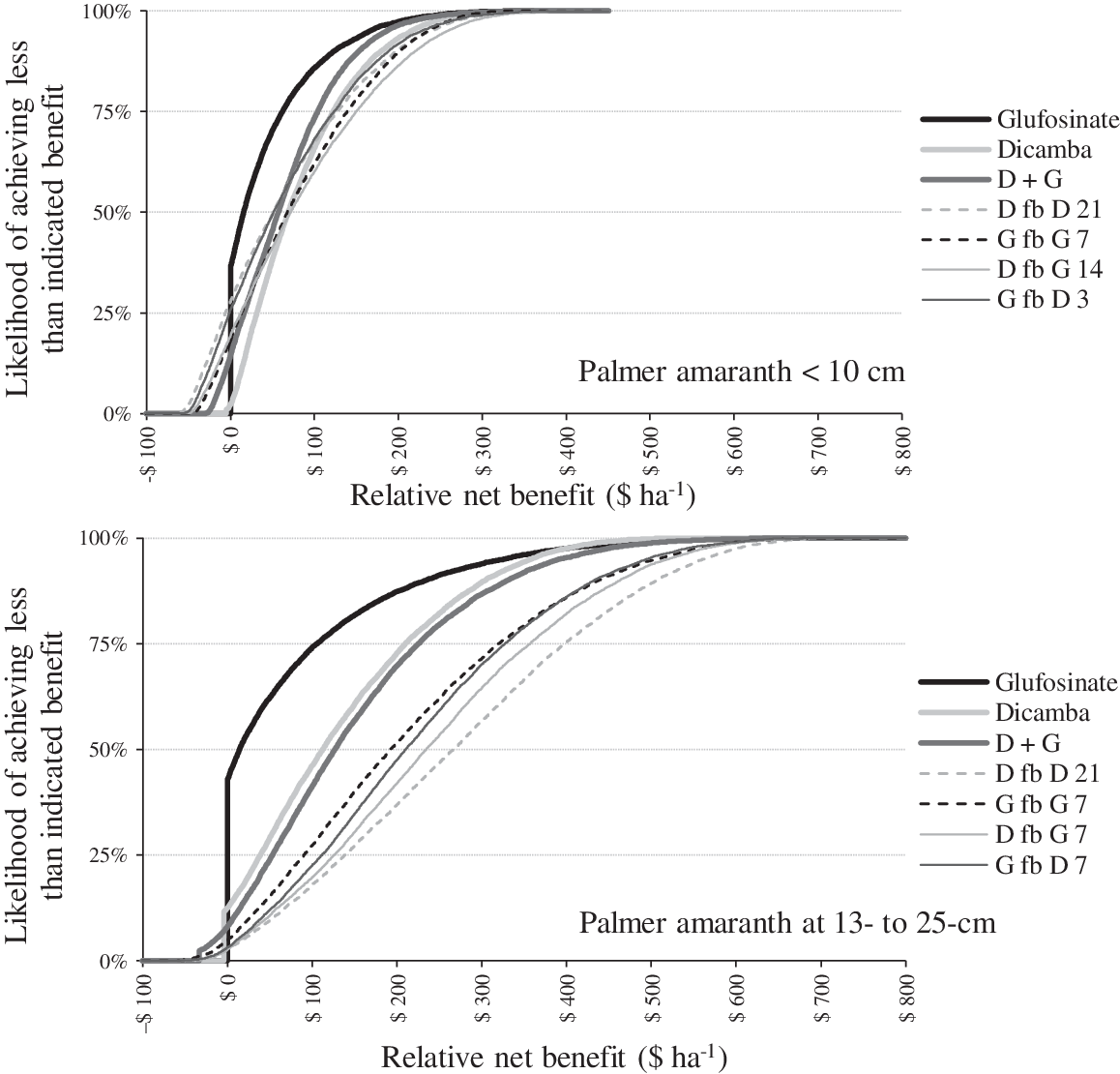
To portray differences at the mean (50% percentile) and across the range of observations in RNB by size of Palmer amaranth plant at time of herbicide application, we plotted estimated CDFs of RNB across single and sequential pass treatments (Figure 1). To lessen the number of CDFs to compare, only the best treatments among single and sequential pass control options are shown and represent RNB iterations with the correlation among treatments imposed (Tables 7 and 8 footnote d). Comparing weed control treatment options by Palmer amaranth size, timely application at smaller weed size is less risky. The range in weed control efficacy is smaller leading to steeper CDFs with smaller weed size in comparison to the larger weed size. Also, the economic implications of choosing a less-than-optimal weed control option is smaller with the smaller weed size (RNB CDFs are horizontally closer in proximity). A second observation is that the cheapest control option, involving a single pass of glufosinate alone, has the least downside risk, given its low cost, but lags behind in terms of upside potential associated with superior Palmer amaranth control. Over the 10,000 simulations, there is a 43% and 37% chance of glufosinate alone controlling weeds as effectively as the other treatment options while at the same time being least expensive, when Palmer amaranth plants are large and <10 cm, respectively (the likelihoods of glufosinate CDF RNB values remain at US$0). However, the best weed control options also indicate superior RNB approximately 98% of the time in comparison to the cheapest option (CDFs cross at 2% cumulative likelihood), using glufosinate once only, in comparison to dicamba once only (<10 cm) or dicamba fb dicamba after 21 d when Palmer amaranth plants are 13 to 25 cm in size. Hence, the cheapest option is inferior 98% of the time in comparison to better weed control strategies. Finally, while the CDFs are clearly differentiable in terms of producer preference when weed size is large, the distinction at smaller weed size between dicamba alone versus dicamba fb glufosinate after 14 d, for example is less clear. At the mean (50% cumulative likelihood), the costlier option is preferred as indicated (Figure 1 and Table 7); however, there is more downside risk with dicamba fb glufosinate after 14 d in comparison to dicamba alone because that treatment option is costlier. At the same time, the upside potential is larger with the costlier option. A risk-averse producer may thus opt for dicamba alone because the range in relative profitability is smaller. At the same time, however, reduction in profit risk increases the soil seedbank given the 7 percentage point lower mortality rate with dicamba alone versus dicamba fb glufosinate after 14 d (Table 7).
Comparison of simulated cumulative distribution functions of relative net benefit accounting for relative sales losses and relative weed control cost for single pass vs. sequential passes of herbicides when applied to large and small weeds using average soybean price and yield expectations as an example. In the legend, abbreviations are D, dicamba; G, glufosinate; and fb, followed by. The number following the herbicide abbreviation is the interval in days between sequential applications.
Conclusions and Practical Implications
A single application of dicamba, glufosinate, or dicamba plus glufosinate alone did not control Palmer amaranth greater than 80%, regardless of weed size. Sequential applications of dicamba fb dicamba and glufosinate fb glufosinate did not result in 100% control of Palmer amaranth at any time interval or regardless of weed size. In order to mitigate the selection of biotypes with reduced sensitivity to the few remaining effective postemergence herbicides in XtendFlex ® soybean or cotton, producers should adopt sequential herbicide application regimes and other integrated weed management strategies to completely control Palmer amaranth. Both dicamba and glufosinate have already experienced a tremendous amount of selection. The risk for further selection of biotypes with reduced sensitivity to either herbicide in single SOA sequential herbicide systems is high. To increase the sustainability of herbicides, an optimized sequence and time interval between applications of dicamba and glufosinate should be used in the XtendFlex ® technology. Dicamba fb glufosinate 14 d later was the only sequential postemergence system that provided 100% control and 100% mortality of Palmer amaranth when herbicides were applied to weeds <10 cm in height. On larger-than-labeled Palmer amaranth sizes, complete control and mortality was not achieved; therefore, weed size at the time of the initial application is still of the utmost importance. When weed size increases to 13 to 25 cm in height, incomplete control of Palmer amaranth leads to greater variability in producer returns not only for individual treatment options but also across treatment options. Economic returns were highest for dicamba fb dicamba after 21 d, which can create economic pressure to choose a weed control option that does not follow herbicide-resistance BMPs in comparison to using dicamba fb glufosinate after 7 d, or the next best option in Table 8.
Finally, the competitive impact of weeds that survive contact and systemic herbicides like glufosinate and dicamba should be investigated in the future because Palmer amaranth plants appeared to rapidly regrow 14 d after a glufosinate application and slower death and limited regrowth was observed from plants treated with dicamba, in the absence of a crop (GLP, personal observation). The inability to quickly remove Palmer amaranth from crops following a dicamba application may result in competition for limited resources for an extended period following application of the herbicide. Conversely, the regrowth of glufosinate-treated Palmer amaranth 14 d after application may also influence the crop and weed interaction. Changes in the competitiveness of Palmer amaranth following a herbicide application in the presence of a crop would likely affect weed seed production.
Supplementary material
To view supplementary material for this article, please visit https://doi.org/10.1017/wet.2022.44
Acknowledgments
Funding for this research was provided by Bayer CropScience. The authors declare no conflicts of interest.


 Open access

