


In political science, much attention has been paid to the problem of partisan polarization. Early work on polarization largely focused on the ideological and issue differences between partisans in the political elite (McCarty, Poole, and Rosenthal Reference McCarty, Poole and Rosenthal2006; Poole and Rosenthal Reference Poole and Rosenthal1984) and the mass public (Abramowitz Reference Abramowitz2010; Fiorina and Abrams Reference Fiorina and Abrams2008; Hetherington Reference Hetherington2001). More recently though, scholars have explored the social divide between partisans (Iyengar, Sood, and Lelkes Reference Iyengar, Sood and Lelkes2012; Iyengar and Westwood Reference Iyengar and Westwood2015; Mason Reference Mason2015; Reference Mason2018). Most notably, in a foundational paper, Iyengar, Sood, and Lelkes (Reference Iyengar, Sood and Lelkes2012) introduced the concept of affective polarization, defined as the tendency to evaluate in-party members positively and out-party members negatively (Iyengar and Westwood Reference Iyengar and Westwood2015). Since its inception, attention to affective polarization has increasingly overshadowed interest in other polarization-related phenomena (Krupnikov and Ryan Reference Krupnikov and Ryan2022, 26).
Researchers have become particularly interested in the consequences of affective polarization for the health of American democracy (Druckman et al. Reference Druckman, Klar, Krupnikov, Levendusky and Ryan2021; Kingzette et al. Reference Kingzette, Druckman, Klar, Krupnikov, Levendusky and Ryan2021). Among other things, scholars have suggested that affective polarization may lead to a breakdown of democratic norms, insofar as it makes it more difficult for citizens to accept democratic outcomes that favor an increasingly-hated out-party (Iyengar et al. Reference Iyengar, Lelkes, Levendusky, Malhotra and Westwood2019). However, empirical evidence has not provided clear evidence that affective polarization encourages citizens to abandon democratic norms (Broockman, Kalla, and Westwood Reference Broockman, Kalla and Westwood2023; Voelkel et al. Reference Voelkel, Chu, Stagnaro, Mernyk, Redekopp, Pink and Druckman2023; although see Kingzette et al. Reference Kingzette, Druckman, Klar, Krupnikov, Levendusky and Ryan2021). Moreover, researchers have suggested that the most commonly used index of affective polarization warmth bias Footnote 1 may not in fact measure feelings toward opposing partisans, but instead party leaders (Druckman and Levendusky Reference Druckman and Levendusky2019). Furthermore, recent work has argued that our current conceptualization may miss the diversity and complexity of the psychological processes that feed into affective polarization (Finkel et al. Reference Finkel, Bail, Cikara, Ditto, Iyengar, Klar and Mason2020).
Given concerns over the relevancy of affective polarization in explaining partisan animus (Druckman, Green, and Iyengar Reference Druckman, Green and Iyengar2023), we believe that both the conceptualization and measurement of affective polarization require an update. We argue that affective polarization consists of an interrelated set of attitudes a given partisan holds about their own partisan group, their rival partisan group, and the relationship between these groups. Drawing on conceptual work by Finkel et al. (Reference Finkel, Bail, Cikara, Ditto, Iyengar, Klar and Mason2020), we offer a tripartite conceptualization of affective polarization characterized by three related but distinct dimensions: othering, believing that partisan identity marks fundamental differences between people; aversion, disliking and avoiding out-party members; and moralization, a perception that one’s own partisan identity reflects fundamental values.
After laying out our theoretical model of affective polarization, we present three sets of empirical analyses. In the first, we use factor-analytic methods and item response theory (IRT) to construct a new nine-item scale measure of our tripartite model of affective polarization, the Affective Polarization Scale (APS), which consists of a trio of compact three-item subscales assessing othering, aversion, and moralization. In the second, we validate these subscales and the full composite APS by examining their relationship with partisan and ideological identity strength, political knowledge, and existing measures of affective polarization. In the third section we take our validated scale and examine its relationship with measures of anti-democratic attitudes.
We find that our multi-component scale is associated with stronger political identifications, established measures of affective polarization, support for elite anti-democratic action, and support for political violence. Interestingly, we also find that the three APS subdimensions do not always relate in the same way across outcomes, suggesting that they are not interchangeable as facets of affective polarization. Finally, our results suggest that the relationship between anti-democratic attitudes and the APS subscales and full APS is largely symmetric across party identification, though when asymmetry does occur the effects of the APS and its subdimensions are stronger among Republicans. We conclude by discussing the implications of our findings for our understanding of affective polarization and for American democracy, as well as directions for future research.
AFFECTIVE POLARIZATION: CURRENT THEORY AND MEASUREMENT
Affective polarization is the tendency to evaluate in-party members positively and out-party members negatively (Iyengar and Westwood Reference Iyengar and Westwood2015). This conceptualization is rooted in social identity theory, which argues that identification with a social group (such as a political party) is sufficient to generate favoritism for that group (Huddy, Bankert, and Davies Reference Huddy, Bankert and Davies2018; Tajfel et al. Reference Tajfel, Billig, Bundy and Flament1971). According to social identity theory, people want to feel positively about the groups they belong to, which leads them to want the ingroup to do better than or compare favorably to outgroups (Tajfel and Turner Reference Tajfel, Turner, Hatch and Schultz1979). To measure affective polarization, various indices have been used, including trait ratings of the two parties (Iyengar, Sood, and Lelkes Reference Iyengar, Sood and Lelkes2012; Levendusky Reference Levendusky2018; Levendusky and Malhotra Reference Levendusky and Malhotra2016a), measures of social distance (Iyengar, Sood, and Lelkes Reference Iyengar, Sood and Lelkes2012; Klar, Krupnikov, and Ryan Reference Klar, Krupnikov and Ryan2018), the number of positive and negative things an individual says about the two parties (Levendusky and Malhotra Reference Levendusky and Malhotra2016a), and even implicit association tests (Iyengar and Westwood Reference Iyengar and Westwood2015).
Most common in the literature, however, is warmth bias. Warmth bias is assessed by taking the difference between ratings of the in-party and the out-party (assessed using thermometer ratings of the Democratic and Republican parties). One of the major advantages of using this measure is that it can be constructed using only two items, with these two items frequently present in long-running, archived surveys such as the American National Election Studies. With data spanning decades, scholars have shown that the electorate has become increasingly polarized compared to previous eras (Iyengar and Krupenkin Reference Iyengar and Krupenkin2018: Iyengar et al. Reference Iyengar, Lelkes, Levendusky, Malhotra and Westwood2019: Iyengar, Sood, and Lelkes Reference Iyengar, Sood and Lelkes2012).
Though two-party U.S. politics has been a dominant focus of the literature on affective polarization, it has also been studied in nations with multiparty systems. These studies suggest that affective polarization is not exclusive to the U.S. two-party system (Boxell, Gentzkow, and Shapiro Reference Boxell, Gentzkow and Shapiro2024; Gidron, Adams, and Horne Reference Gidron, Adams and Horne2020). Studies in this comparative literature have also relied largely on warmth-bias measures (Röllicke Reference Röllicke2023), albeit with more complex operationalizations. Warmth bias is typically measured in terms of in-party affect minus mean affect toward all out-parties (Boxell, Gentzkow, and Shapiro Reference Boxell, Gentzkow and Shapiro2024; Reiljan Reference Reiljan2020), in-party affect minus mean affect toward all parties outside the in-party’s electoral bloc (Reiljan and Ryan Reference Reiljan and Ryan2021; Wagner Reference Wagner2021), or differences in affect between parties in different ideological blocs (Bantel Reference Bantel2023).Footnote 2
Despite these advantages, there are methodological concerns with warmth bias measures that present challenges to the inferences we can make about polarization. One major methodological concern with warmth bias is identifying exactly which group of partisans respondents are thinking of when rating the political parties. Druckman and Levendusky (Reference Druckman and Levendusky2019) find that when experimentally manipulating the partisan feeling thermometer targets to be either the party itself, candidates and elected officials from the party, or voters from the party, respondents indicate greater warmth toward opposing party voters than the party itself or its politicians. Their work suggests that standard party feeling thermometers may actually be measuring feelings toward elites, not partisans in the mass public.
In addition, much of the theory surrounding affective polarization has been ad hoc. As mentioned before, the concept of affective polarization and its most common measure were first put forward in Iyengar, Sood, and Lelkes (Reference Iyengar, Sood and Lelkes2012), yet the concept was not formally defined until Iyengar and Westwood (Reference Iyengar and Westwood2015). This has led to inconsistent measurement, as a strong theory did not precede the emergence of various measurement strategies. Furthermore, theory on the political consequences of affective polarization has rarely been accompanied by empirical analyses. What empirical work has been done, however, has found little evidence for a link between warmth bias and deference for democratic norms (Broockman, Kalla, and Westwood Reference Broockman, Kalla and Westwood2023; Voelkel et al. Reference Voelkel, Chu, Stagnaro, Mernyk, Redekopp, Pink and Druckman2023, although see Kingzette et al. Reference Kingzette, Druckman, Klar, Krupnikov, Levendusky and Ryan2021).
That said, we do not think that these findings warrant an abandonment of the concept of affective polarization, efforts to measure it, or a robust interest in its correlates. Nor do we believe that existing research on the topic has been in vain. However, we do believe that the literature on affective polarization is ripe for a new approach, specifically one that more exhaustively accounts for the diversity of psychological processes that create partisan animus.
AN UPDATED AND EXPANDED MODEL OF AFFECTIVE POLARIZATION
To provide a new theoretical model of affective polarization, we must first determine what psychological processes are likely to account for inter-partisan conflict. One of the biggest limitations of most conceptualizations of affective polarization is a lack of explicit attention to the fact that it might have multiple components. Although most of the literature focuses on partisan antipathy (Abramowitz and Webster Reference Abramowitz and Webster2016; Reference Abramowitz and Webster2018; Lelkes and Westwood Reference Lelkes and Westwood2017; Westwood, Peterson, and Lelkes Reference Westwood, Peterson and Lelkes2019), strong attachment to the in-party also plays a role in partisan behavior (Huddy, Mason, and Aarøe Reference Huddy, Mason and Aarøe2015). Consequently, we argue that affective polarization is multidimensional. A multidimensional theory of affective polarization allows us to account for the possibility that different dimensions of affective polarization while correlated may predict somewhat different sets of political consequences.
But what dimensions should we attend to? In an insightful review, Finkel et al. (Reference Finkel, Bail, Cikara, Ditto, Iyengar, Klar and Mason2020) analogize polarization to religious sectarianism, and argue that three processes undergird interpartisan conflict: othering, aversion, and moralization. They define othering as the tendency to view opposing partisans as essentially different or alien to oneself, aversion as the tendency to dislike and distrust opposing partisans, and moralization as the tendency to view opposing partisans as iniquitous. Though affective polarization could conceivably consist of a wide range of perceptions, this tripartite distinction narrows things down by focusing on core psychological aspects of intergroup differentiation frequently identified by political psychologists: the tendency to exaggerate ingroup/outgroup differences (Tajfel and Turner Reference Tajfel, Turner, Hatch and Schultz1979), the tendency to like outgroups less (Iyengar et al. Reference Iyengar, Lelkes, Levendusky, Malhotra and Westwood2019; Tajfel and Turner Reference Tajfel, Turner, Jost and Sidanius2004), and the tendency to see one’s own orientations as being rooted in moral conviction (Skitka and Bauman Reference Skitka and Bauman2008; Skitka et al. Reference Skitka, Hanson, Scott Morgan and Wisneski2021). Finkel and colleagues posit that the confluence of these three ingredients which they label political sectarianism is what poses a threat to democracy.
We believe that this tripartite reconceptualization of affective polarization provides a richer depiction of the ensemble of processes that account for inter-partisan animosity, and we build on key aspects of it in the development of our own model. Following Finkel et al. (Reference Finkel, Bail, Cikara, Ditto, Iyengar, Klar and Mason2020), we believe that it is essential to understand affective polarization as consisting more than an undifferentiated tendency to feel more negatively about out-partisans than in-partisans, and we believe that the broad concepts of othering, aversion, and moralization provide a good starting point for identifying the multiple components of affective polarization. Like Finkel and colleagues, we also regard these three components as constitutive parts of a composite construct reflecting animosity rooted in partisan identity.
Nevertheless, in several respects, we depart from their understanding of othering, aversion, and moralization, how they relate to one another, and how they relate to affective polarization in general. First, whereas Finkel et al. (Reference Finkel, Bail, Cikara, Ditto, Iyengar, Klar and Mason2020) primarily conceptualize othering, aversion, and moralization as three kinds of negative attitudes toward partisan outgroups, our model defines each more broadly as a general interrelated set of beliefs about the out-party, the in-party, and the relation between the two. While out-party disdain is undoubtedly a growing concern (Abramowitz and Webster Reference Abramowitz and Webster2016; Iyengar and Krupenkin Reference Iyengar and Krupenkin2018), it is only one piece of the puzzle. In characterizing affective polarization as such, it is important to note that neither concept nor our measure of it focus on the specific content of othering, aversion, and moralization, or differences between in-partisans and out-partisans more generally. Rather, othering focuses on the subjective perception of difference, allowing partisans to “fill in the blanks.” This follows from the notion that affective polarization is rooted in perceived differences in social identity rather than substantive disagreement in terms of ideology and issues (Finkel et al. Reference Finkel, Bail, Cikara, Ditto, Iyengar, Klar and Mason2020; Iyengar, Sood, and Lelkes Reference Iyengar, Sood and Lelkes2012; Mason Reference Mason2018).
Second, whereas Finkel and colleagues assert that othering, aversion, and moralization generally co-occur and have their strongest relationship with partisan hostility in conjunction with one another, our model relaxes these assumptions. We argue that the dimensions will be positively correlated, but not redundant. In other words, we conceptualize othering, aversion, and moralization as distinguishable elements of affective polarization that should have a moderately correlated three-factor structure.Footnote 3
More importantly, we also argue that each dimension may elicit conflict on its own, even holding the others constant. That is, the confluence of othering, aversion, and moralization may not be necessary for the formation and expression of attitudes and beliefs deleterious to democracy. Rather, any one of these components may independently predict these outcomes—and not all three components may be relevant to all outcomes associated with polarization. For this reason, we believe it is important to consider the three facets independently and not just as part of a single composite. Below, we describe our own conceptualization of othering, aversion, and moralization.
Othering
We define othering as a belief that partisans are fundamentally different from one another. Unlike Finkel et al. (Reference Finkel, Bail, Cikara, Ditto, Iyengar, Klar and Mason2020), we focus on the extent to which one sees the out-party as different from their in-party, rather than different from oneself as an individual. This distinction is small, but important, as individuals make different evaluations about group proximity than individual proximity (Tajfel and Turner Reference Tajfel, Turner, Jost and Sidanius2004). The literature on inter-partisan evaluations has found that partisans increasingly see the other side as more extreme (Druckman et al. Reference Druckman, Klar, Krupnikov, Levendusky and Ryan2022; Lee Reference Lee2022; Levendusky and Malhotra Reference Levendusky and Malhotra2016b; Mernyk et al. Reference Mernyk, Pink, Druckman and Willer2022; Moore-Berg et al. Reference Moore-Berg, Ankori-Karlinsky, Hameiri and Bruneau2020, though see Dias, Lelkes, and Pearl Reference Dias, Lelkes and Pearl2024), and assign positive traits to their in-party but negative traits to the out-party (Iyengar, Sood, and Lelkes Reference Iyengar, Sood and Lelkes2012; Levendusky Reference Levendusky2018; Levendusky and Malhotra Reference Levendusky and Malhotra2016a).
When partisans see the other side as intrinsically alien and different from one’s own group, politics is no longer a difference in issue preferences or negotiable interests, but a confrontation between implacable enemies separated by deep-seeded differences. To the extent that partisans adopt this almost-ethnocentric orientation toward relations between the parties, out-partisans may seem increasingly impossible to work with. Othering may also make it easier for partisans to abandon democratic norms in the face of loss, insofar as anti-democratic attitudes become easier to rationalize when partisans come to believe that “they” are not like “us.”
Aversion
We define aversion as a tendency to dislike and avoid out-party members. Like Finkel et al. (Reference Finkel, Bail, Cikara, Ditto, Iyengar, Klar and Mason2020), we argue that out-party dislike is a key element of aversion, but we also add a further emphasis on the propensity to avoid out-partisans. Previous work suggests that partisans feel increasingly negative about the other side (Iyengar and Krupenkin Reference Iyengar and Krupenkin2018), a tendency which may drive political action more than attachment to one’s own party (Abramowitz and Webster Reference Abramowitz and Webster2016; Reference Abramowitz and Webster2018; Lee, Choi, and Ahn Reference Lee, Choi and Ahn2025, but see Lee et al. Reference Lee, Lelkes, Hawkins and Theodoridis2022). In tandem with general feelings of disdain, partisans often avoid political discussion and social interactions with out-partisans (Carlson and Settle Reference Carlson and Settle2022; Lelkes and Westwood Reference Lelkes and Westwood2017; Westwood, Peterson, and Lelkes Reference Westwood, Peterson and Lelkes2019). We add this emphasis on avoidance for multiple reasons. First, social distance, how comfortable someone is with a personal relationship with a member of a disparate group (Bogardus Reference Bogardus1947), has long been thought of as an element of prejudice against out-groups (Allport Reference Allport1954). Second, and perhaps more importantly, a preference for social distance from out-partisans is a key component of affective polarization measures in the recent literature (Druckman and Levendusky Reference Druckman and Levendusky2019; Iyengar et al. Reference Iyengar, Lelkes, Levendusky, Malhotra and Westwood2019; Iyengar, Sood, and Lelkes Reference Iyengar, Sood and Lelkes2012). These points suggest the importance of incorporating an active, behaviorally-focused component in any conceptualization of aversion.
When partisans avoid and hold disdain for out-partisans, the other side becomes a dangerous enemy. A lack of meaningful social ties between partisans may lead to dehumanization, and with it the ability to justify acts such as violence or limitation of civil liberties. Additionally, those high in aversion may see governmental control by the other side as an existential threat, and therefore abandon democracy in order to keep power out of the hands of an abhorrent adversary.
Moralization
Departing from the Finkel et al. (Reference Finkel, Bail, Cikara, Ditto, Iyengar, Klar and Mason2020) conceptualization, we define moralization not simply as a tendency to see out-partisans as evil, but as an inclination to hold a strongly moralized view of one’s own partisan identity. In this respect, our understanding of moralization differs from our understanding of othering and aversion in that it focuses on perceptions of in-party identity in and of itself rather than comparative partisan perceptions. We adopt this focus based on extensive psychological research suggesting that a subjective belief that one’s own convictions are rooted in morality is a critical and essential basis for several polarization-related inclinations: intolerance of and a desire to be apart from those with opposed views, heightened political engagement, refusal to compromise, and an unwillingness to defer to or accord legitimacy to institutions that produce outcomes inconsistent with one’s convictions (Skitka and Bauman Reference Skitka and Bauman2008; Skitka, Bauman, and Sargis Reference Skitka, Bauman and Sargis2005). Moral conviction imparts a sense of universality and obligation to one’s preferences, thereby inherently motivating a denial of the morality of opponents’ positions.
In this vein, past work has explored how moralized attitudes toward specific issues or policies have unique consequences for political behavior (Hanson, Wisneski, and Morgan Reference Hanson, Wisneski, Scott Morgan, Osborne and Sibley2022; Ryan Reference Ryan2014; Reference Ryan2017; Skitka et al. Reference Skitka, Hanson, Scott Morgan and Wisneski2021), but partisan identification itself may be heavily moralized in the sense that individuals believe that their partisan identity reflects fundamental ideas about the difference between right and wrong. Following social-psychological research on moral conviction, it is important to note that the conceptual and operational focus is not on a perception that preferences are rooted in specific moral principles but on the perception that they reflect a general sense of what is right and wrong. As noted below, moral conviction in this sense can be reliably assessed via self-report and it is strongly predictive of intolerance of differing viewpoints even without reference to specific principles (Skitka et al. Reference Skitka, Hanson, Scott Morgan and Wisneski2021).
Focusing on moralization with respect to one’s own partisan identity also allows our conceptualization to emphasize how polarization is in part rooted in how an individual construes their own partisan identity. Moreover, by focusing less on the simple perception of out-partisans as evil, we are able to provide a clear distinction between moralization and the othering and aversion dimensions. In this respect, a sole emphasis on the evil of out-partisans may introduce overlap with othering (i.e., the out-party is different in that it is evil, unlike the in-party) and aversion (i.e., expressing a dislike of the out-party by labeling it as “evil”).
When partisans believe their party identity is inextricably linked to their deepest moral convictions, negotiation and compromise become equivalent to dereliction of moral duty (Delton, DeScioli, and Ryan Reference Delton, DeScioli and Ryan2020; Skitka and Bauman Reference Skitka and Bauman2008), and partisan intolerance and abandonment of democratic processes may be seen as more justifiable (Skitka, Bauman, and Sargis Reference Skitka, Bauman and Sargis2005; Zaal et al. Reference Zaal, Saab, O’Brien, Jeffries, Barreto and van Laar2017). Furthermore, because those high in moralization seek to maintain a positive evaluation of their partisan group, in-party leaders may be followed uncritically, even if those leaders espouse anti-democratic sentiments.
OVERVIEW OF STUDIES
We empirically develop our model of affective polarization in three sets of analyses. The first focuses on the construction of a new scale measure of the three subdimensions of affective polarization, the second focuses on validation of that measure, and the third focuses on the measure’s relationship with theorized outcomes of affective polarization. These three analyses were carried out using four original surveys conducted during 2022 and 2023. The sample characteristics of all surveys as well as all survey items are available in Section B of the Supplementary Material and replication materials are available at Campos and Federico (Reference Campos and Federico2025). For initial scale-building purposes, Study 1 ( $ N=500 $
) and Study 2 (
$ N=500 $
) and Study 2 ( $ N=501 $
) were collected through the online survey website Prolific. Prolific uses convenience samples of U.S. adults. For both Studies 1 and 2, we applied a quota limiting how many Democrats and Republicans could enroll, with the aim of having an equal number of Democrats and Republicans. Study 1 was conducted in February and March of 2022 and Study 2 was collected in March of 2022.
$ N=501 $
) were collected through the online survey website Prolific. Prolific uses convenience samples of U.S. adults. For both Studies 1 and 2, we applied a quota limiting how many Democrats and Republicans could enroll, with the aim of having an equal number of Democrats and Republicans. Study 1 was conducted in February and March of 2022 and Study 2 was collected in March of 2022.
Study 3 ( $ N=1,346 $
) was preregisteredFootnote
4 and collected via online survey website Lucid, which approximates a nationally representative sample of U.S. adults. Respondents who did not pass an initial attention check were not permitted to take the survey. Those who identified as pure Independents were also excluded from the analyses. Study 3 was conducted in September and October of 2022.
$ N=1,346 $
) was preregisteredFootnote
4 and collected via online survey website Lucid, which approximates a nationally representative sample of U.S. adults. Respondents who did not pass an initial attention check were not permitted to take the survey. Those who identified as pure Independents were also excluded from the analyses. Study 3 was conducted in September and October of 2022.
Study 4 was a three-wave panel survey ( $ {N}_{W1}=2004,{N}_{W2}=1404,{N}_{W3}=1054 $
) conducted as part of the University of Minnesota Center for the Study of Political Psychology’s 2022–2023 Multi-Investigator Panel Study. The panel survey was collected via Bovitz/Forthright, which approximates a nationally representative sample of U.S. adults. Respondents who did not pass an initial attention check were not permitted to take the survey, and a second attention check was administered halfway through the survey, with respondents who failed the second check excluded from the analyses. Respondents who identified as pure Independents in the survey were also excluded. Wave 1 was conducted in December of 2022, Wave 2 was conducted in March of 2023, and Wave 3 was conducted in May and June of 2023.
$ {N}_{W1}=2004,{N}_{W2}=1404,{N}_{W3}=1054 $
) conducted as part of the University of Minnesota Center for the Study of Political Psychology’s 2022–2023 Multi-Investigator Panel Study. The panel survey was collected via Bovitz/Forthright, which approximates a nationally representative sample of U.S. adults. Respondents who did not pass an initial attention check were not permitted to take the survey, and a second attention check was administered halfway through the survey, with respondents who failed the second check excluded from the analyses. Respondents who identified as pure Independents in the survey were also excluded. Wave 1 was conducted in December of 2022, Wave 2 was conducted in March of 2023, and Wave 3 was conducted in May and June of 2023.
PART I: SCALE CONSTRUCTION
The goal of Part I is to construct a scale measure of the three subdimensions of affective polarization, and test whether our tripartite conceptualization actually exists in the minds of partisans. We began this process using data from Study 1.
Study 1: Method
In Study 1, 45 total items—15 for each subdimension—were generated. Some items were adapted from scales theoretically related to the various subdimensions (Iyengar, Sood, and Lelkes Reference Iyengar, Sood and Lelkes2012; Neuliep and McCroskey Reference Neuliep and McCroskey1997; Skitka et al. Reference Skitka, Hanson, Scott Morgan and Wisneski2021). Specifically, items such as “How much are your feelings about [X] based on your core moral beliefs and convictions?” (moralization; Skitka, Hanson, and Wisneski Reference Skitka, Hanson and Wisneski2017) and “People from other cultures act strange when they come to my culture” (othering; Neuliep and McCroskey Reference Neuliep and McCroskey1997) were used and adapted for the present study. Other items were created by the researchers, with some items being reverse-coded to avoid acquiescence bias. All items were statements about the participants’ own party, people from the opposing party, or the relations between members of both parties.
The othering subscale consisted of items such as, “As a [in-party], it is important to differentiate ourselves from [out-party]” and “It is often difficult for us as [in-party] to relate to people who are [out-party].” The aversion subscale consisted of items such as “I would be happy to attend a social gathering where most people were [out-party]” and “Although I do not agree with their political views, there are people I like who are [out-party]” (both reverse coded). The moralization subscale contained items such as “My identity as a [in-party] is connected to my core moral beliefs” and “As a [in-party], my feelings about politics are based on moral principles.” Footnote 5 For all APS items, response options ranged from strongly disagree (1) to strongly agree (7).
We administered two forms of the scale. Those who identified with the Democratic party were assigned the Democratic form, where the items framed Republicans as the outgroup. Those who identified with the Republican party were assigned the Republican form, where the items framed Democrats as the outgroup. In each form, the APS items were given to participants in random order.
Study 1: Initial Item Reduction
The first step in generating a reduced set of items was to examine metrics of normality for all items. No items were eliminated during this stage (see Section C.2 of the Supplementary Material). Parallel analysis (with principal-components extraction; see Lim and Jahng Reference Lim and Jahng2019) was then conducted on the full set of 45 items, which suggested a three factor solution. Actual factoring was then done using the principal-axis method, with the specification that three factors be extracted and with oblimin rotation. After this initial exploratory factor analysis (EFA), items which had a highest loading of less than 0.40 were eliminated (see Section C.2 of the Supplementary Material for full EFA results). This resulted in the elimination of one othering item (“Whatever differences there are between us [in-party] and [out-party] are not important compared to what we have in common”), and one aversion item (“As a [in-party], I would not want my child to marry a [out-party]”).
The parallel analysis was then conducted again, still suggesting a three-factor solution. Principal-axis factoring with three factors was then carried out, and items that cross-loaded (where the second highest factor loading was $ >75\% $
of the highest factor loading) were eliminated. Five aversion items that cross-loaded onto othering were eliminated at this stage (e.g., “There is no way for us [in-party] to get along with [out-party]”). Additionally, two moralization items were eliminated, one that cross-loaded onto othering (e.g., “As a [in-party], I feel that my positions on politics are morally correct in ways that [out-party] positions are not”) and another that cross-loaded onto aversion (e.g., “[out-party] views on politics make them bad people”).
$ >75\% $
of the highest factor loading) were eliminated. Five aversion items that cross-loaded onto othering were eliminated at this stage (e.g., “There is no way for us [in-party] to get along with [out-party]”). Additionally, two moralization items were eliminated, one that cross-loaded onto othering (e.g., “As a [in-party], I feel that my positions on politics are morally correct in ways that [out-party] positions are not”) and another that cross-loaded onto aversion (e.g., “[out-party] views on politics make them bad people”).
With this reduced scale, we conducted another parallel analysis, which again suggested three factors. A three-factor solution was then extracted using the principal-axis method, again with oblimin rotation. Based on this EFA, the eight top-loading othering items were kept. For aversion, the four top loading items were kept, with the addition of one item each from both the original othering scale and the moralization scale. These two additional items loaded most heavily onto aversion and had some face validity for aversion (“Identifying as a [out-party] rather than a [in-party] makes someone a bad person” and “Some people like to say that us [in-party] are fundamentally different from [out-party], but deep down we are all Americans”). Therefore, they were appended to the aversion scale. This produced a six-item aversion scale. For moralization, the six top loading items were kept. These six items most closely corresponded to our modified conceptualization of moralization, focusing on the extent to which one’s partisan identity is believed to reflect fundamental values. This twenty-item scale was then administered in Studies 2–4.
Studies 2, 3, and 4: Confirming the Three-Factor Structure for the Initial Twenty-Item Scale
In Studies 2, 3, and 4 (Wave 1), the twenty-item APS derived in Study 1 was administered. Confirmatory factor analysis (CFA) was then used to confirm the three-factor structure of the scale in each of these datasets. A three-factor structure with items from each of the subdimensions loading on three correlated factors was fit to the data in each sample. Full results of these analyses are reported in Section C.3 of the Supplementary Material. These analyses indicated that the three-factor model fit well (Study 2, $ {\chi}^2(167)=373.790,p<0.001, $
Robust Comparative Fit Index
$ {\chi}^2(167)=373.790,p<0.001, $
Robust Comparative Fit Index $ (CFI)=0.964 $
, Robust Root Mean Square Error of Approximation
$ (CFI)=0.964 $
, Robust Root Mean Square Error of Approximation $ (RMSEA)=0.056 $
; Study 3,
$ (RMSEA)=0.056 $
; Study 3, $ {\chi}^2(167)=704.425,p<0.001,CFI=0.940,RMSEA=0.063 $
; and Study 4 Wave 1,
$ {\chi}^2(167)=704.425,p<0.001,CFI=0.940,RMSEA=0.063 $
; and Study 4 Wave 1, $ {\chi}^2(167)=814.212,p<0.001,CFI=0.952,RMSEA=0.056 $
).
$ {\chi}^2(167)=814.212,p<0.001,CFI=0.952,RMSEA=0.056 $
).
In all samples, this model fit better than an alternative one-factor model with a single dimension ( $ ps<0.001 $
). Correlations between the factors in the three-factor model were similar in all samples, ranging between 0.62 and 0.67 for othering and aversion, 0.54–0.57 for othering and moralization, and 0.22–0.29 for aversion and moralization (all
$ ps<0.001 $
). Correlations between the factors in the three-factor model were similar in all samples, ranging between 0.62 and 0.67 for othering and aversion, 0.54–0.57 for othering and moralization, and 0.22–0.29 for aversion and moralization (all $ ps<0.001 $
). Though significant, these correlations are not large enough to imply redundancy among the dimensions (Rönkkö and Cho Reference Rönkkö and Cho2022). In particular, aversion and moralization were only modestly correlated (
$ ps<0.001 $
). Though significant, these correlations are not large enough to imply redundancy among the dimensions (Rönkkö and Cho Reference Rönkkö and Cho2022). In particular, aversion and moralization were only modestly correlated ( $ <0.30 $
), suggesting that these two forms of polarization do not always co-occur across individuals. This provides initial evidence that the components of affective polarization we define are not interchangeable with one another.
$ <0.30 $
), suggesting that these two forms of polarization do not always co-occur across individuals. This provides initial evidence that the components of affective polarization we define are not interchangeable with one another.
Further Item Reduction: Deriving the Final Nine-Item APS Scale
Although our twenty-item APS performed well, a scale of this length is not practical for most surveys. We reduced the subdimension scales for the initial twenty-item measure to three-item subscales using a combination of IRT methods and subjective item-selection criteria, including face validity and item non-overlap. To carry out the item reduction, we turned to data from Study 4 Wave 1, which had the largest sample size and the most approximately representative sample.Footnote 6 Scale reduction was carried out separately within each dimension to satisfy the unidimensionality assumption of IRT (Embretson and Reise Reference Embretson and Reise2000). Details of the item-reduction process are described further in Section C.4 of the Supplementary Material.
For othering, we began by fitting an IRT model for polytomous items—the graded response model (GRM; Samejima Reference Samejima1969)—to the full set of eight items. Items were then retained or discarded on the basis of the area under that item’s information curve (which plots how precisely scores on the latent trait dimension are estimated against latent trait scores; Embretson and Reise Reference Embretson and Reise2000). Using this criterion, the two lowest-information items were discarded and the two highest-information items were retained. The remaining items were similar in information. Because of this, the third item was chosen after an examination of its information curve. The information curve indicated that it provided information about differences among individuals across a wider range of the latent othering dimension than the other items, without appreciably reducing the amount of information provided by the entire three-item scale.
For aversion, a similar procedure was followed with the six items from the initial scale. On the basis of the areas under the items’ information curves, the two items with the lowest information were dropped, and the two items with the highest information were retained. The two remaining items were similarly high in information. Of these, we ultimately chose the one with lower information as the third item, as its information curve indicated greater coverage of a wider range of latent aversion scores. This item was also more face-valid than the higher-information alternative, given that the latter contained content that touched on moralizing themes (“Identifying as a [out-party] rather than a [in-party] makes someone a bad person”); the chosen third item also had the strength of being reverse-coded.
For moralization, the six items from the initial twenty-item scale were three pairs, with the only difference within each pair being whether they asked about the respondents’ “feelings about politics” or the respondents’ “identity as a [in-party],” Footnote 7 with the loadings being almost indistinguishable. We chose to keep the three items that prompted partisan identity on face-validity grounds, as affective polarization is more conceptually linked to partisan identity. As an additional check, a GRM like the one used above was fit to the full set of six items. Examination of the area under the items’ information curves confirmed (1) that the partisan-identity version of each item provided more information than its paired counterpart and (2) that the total information provided by a scale based on the three partisan identity items was greater than that provided a scale based on the other three. The final nine items are in Table 1.
Final Nine-Item Affective Polarization Scale

Note: * denotes reverse coded items.
As an initial check, we estimated a three-factor CFA model in the Study 4 Wave 1 data. This model fit very well, $ {\chi}^2(24)=87.989,p<0.001,CFI=0.988,RMSEA=0.045 $
. It also fit better than an alternative single-factor model,
$ {\chi}^2(24)=87.989,p<0.001,CFI=0.988,RMSEA=0.045 $
. It also fit better than an alternative single-factor model, $ p<0.001 $
. For additional confirmation, we examined the fit of the three-factor factor model in the two other datasets that were not used to generate the original scale items (Studies 2 and 3). The three-factor model fit very well in Study 2,
$ p<0.001 $
. For additional confirmation, we examined the fit of the three-factor factor model in the two other datasets that were not used to generate the original scale items (Studies 2 and 3). The three-factor model fit very well in Study 2, $ {\chi}^2(24)=51.290,p<0.001,CFI=0.989,RMSEA=0.051 $
; and in Study 3,
$ {\chi}^2(24)=51.290,p<0.001,CFI=0.989,RMSEA=0.051 $
; and in Study 3, $ {\chi}^2(24)=72.599,p<0.001,CFI=0.987,RMSEA=0.048 $
. In Studies 2 and 3, this model also fit better than the one-factor alternative (
$ {\chi}^2(24)=72.599,p<0.001,CFI=0.987,RMSEA=0.048 $
. In Studies 2 and 3, this model also fit better than the one-factor alternative ( $ ps<0.001 $
).
$ ps<0.001 $
).
In the three-factor models, the correlations between the subdimension factors were similar across Studies 2–4. Othering and aversion (Study 2: 0.55; Study 3: 0.52; Study 4W1: 0.50) and othering and moralization (Study 2: 0.53; Study 3: 0.60; Study 4W1: 0.56) were moderately correlated in all samples, whereas aversion and moralization had smaller correlations (Study 2: 0.26; Study 3: 0.25; Study 4W1: 0.24). This pattern of correlations among the latent subdimensions of the APS suggests that the facets of the construct covary, but not so highly as to make the subdimensions redundant: all correlations fall well below the cutoff of 0.80 recommended by Rönkkö and Cho (Reference Rönkkö and Cho2022) for factor discriminability in CFA.
Given its panel structure, Study 4 allowed us to examine the test-retest reliability of the APS and its subdimensions. To provide information on test-retest reliability for the three subdimensions and the full scale, we present simple between-wave test-retest correlations and more formal estimates using the intra-class correlation in Section C.5 of the Supplementary Material (Shrout and Fleiss Reference Shrout and Fleiss1979). These results suggest that the full scale and aversion show good reliability, whereas othering and moralization show moderate reliability. As one would expect, the full APS shows higher test-retest reliability, given the larger number of items. Interestingly, test–retest reliability is slightly lower for moralization (though still within acceptable range), despite the fact that the moralization scale shows similar internal consistency to the other subscales (see below). This suggests that moralization scores, while internally consistent, may vary more over time.
Using multigroup CFA, we also conducted a series of sequential measurement invariance tests comparing the properties of our three-factor solution for the final nine-item scale among Democrats and Republicans (see Section C.6 of the Supplementary Material; Brown Reference Brown2006). In both Studies 3 and 4 W1, we found that the final nine-item APS showed configural, metric, and scalar invariance when comparing factor structures for Democrats and Republicans. Given these results, cross-partisan comparisons of regression coefficients for the APS and its subdimensions in models predicting various outcome variables and cross-partisan comparison of mean scores on the APS and its subdimensions can be validly conducted (Vandenberg and Lance Reference Vandenberg and Lance2000).
Given this evidence, the nine-item reduced scale was selected as the final APS, with three items per subdimension. We examined the internal consistency of the subscales and the full scale using a variant of the $ \omega $
coefficient for multidimensional scales, which estimates reliability based on the final three-dimensional factor models above (Savalei and Reise Reference Savalei and Reise2019; see also Cho Reference Cho2016; Forbes et al. Reference Forbes, Greene, Levin-Aspenson, Watts, Hallquist, Lahey and Markon2021).Footnote
8 The subdimension scales were internally consistent in all studies: othering
$ \omega $
coefficient for multidimensional scales, which estimates reliability based on the final three-dimensional factor models above (Savalei and Reise Reference Savalei and Reise2019; see also Cho Reference Cho2016; Forbes et al. Reference Forbes, Greene, Levin-Aspenson, Watts, Hallquist, Lahey and Markon2021).Footnote
8 The subdimension scales were internally consistent in all studies: othering $ ({\omega}_{S1}\hskip-0.2em =0.79,{\omega}_{S2}\hskip-0.2em =\hskip-0.2em 0.78,{\omega}_{S3}=0.80,{\omega}_{S4W1}=0.80), $
aversion (
$ ({\omega}_{S1}\hskip-0.2em =0.79,{\omega}_{S2}\hskip-0.2em =\hskip-0.2em 0.78,{\omega}_{S3}=0.80,{\omega}_{S4W1}=0.80), $
aversion ( $ {\omega}_{S1}=0.90,{\omega}_{S2}=0.90,{\omega}_{S3}=0.82,{\omega}_{S4W1}=0.86), $
moralization (
$ {\omega}_{S1}=0.90,{\omega}_{S2}=0.90,{\omega}_{S3}=0.82,{\omega}_{S4W1}=0.86), $
moralization ( $ {\omega}_{S1}=0.89,{\omega}_{S2}=0.91,{\omega}_{S3}=0.88,{\omega}_{S4W1}=0.86 $
). To assess the adequacy of the full scale, we also examined the total
$ {\omega}_{S1}=0.89,{\omega}_{S2}=0.91,{\omega}_{S3}=0.88,{\omega}_{S4W1}=0.86 $
). To assess the adequacy of the full scale, we also examined the total $ \omega $
coefficients in each sample, which indicates the portion of variance in the full nine-item scale that is accounted for by all three APS factors (Revelle and Zinbarg Reference Revelle and Zinbarg2009). These statistics also indicated a highly-reliable full scale in each sample (
$ \omega $
coefficients in each sample, which indicates the portion of variance in the full nine-item scale that is accounted for by all three APS factors (Revelle and Zinbarg Reference Revelle and Zinbarg2009). These statistics also indicated a highly-reliable full scale in each sample ( $ {\omega}_{S1}=0.92,{\omega}_{S2}=0.92,{\omega}_{S3}=0.91,{\omega}_{S4W1}=0.91 $
). These estimates suggest that both the APS subdimension scales and full scale are sufficiently reliable for analytic use.Footnote
9
$ {\omega}_{S1}=0.92,{\omega}_{S2}=0.92,{\omega}_{S3}=0.91,{\omega}_{S4W1}=0.91 $
). These estimates suggest that both the APS subdimension scales and full scale are sufficiently reliable for analytic use.Footnote
9
PART II: SCALE VALIDATION
Having constructed a new measure of affective polarization, we seek to validate the APS in Part II through testing its association with theoretically related measures. To do this, we examine the relationship between the APS and measures of partisan and ideological identity, political knowledge, and previous measures of affective polarization.
The seven-point party identification scale is possibly the most used measure in work on American political behavior, and although we are not interested in predicting which party someone identifies with, we can use this scale to test whether the APS is associated with stronger identification with a party in general.Footnote
10 We also employ a different measure of partisan identity strength that conceptualizes partisan identification as a social identity (Huddy, Mason, and Aarøe Reference Huddy, Mason and Aarøe2015; $ {\alpha}_{S1}=0.85,{\alpha}_{S2}=0.85,{\alpha}_{S3}=0.84,{\alpha}_{S4W1}=0.85 $
).
$ {\alpha}_{S1}=0.85,{\alpha}_{S2}=0.85,{\alpha}_{S3}=0.84,{\alpha}_{S4W1}=0.85 $
).
To measure how strongly someone identifies with the liberal or conservative label, we use a seven-point symbolic ideology scale. Again, we are not interested in predicting whether someone is liberal or conservative, but rather how strongly they identify with one of these ideological labels. Another common measure is political knowledge. Knowledge represents how much a respondent knows about national politics, with those who are more knowledgeable having stronger ideological attachments as well as holding more durable and constrained issue positions (Converse Reference Converse1964; Kalmoe Reference Kalmoe2020; Kinder and Kalmoe Reference Kinder and Kalmoe2017). We used this measure to examine how much those high in affective polarization are aware of national politics ( $ {\alpha}_{S3}=0.67,{\alpha}_{S4W1}=0.48 $
).Footnote
11
$ {\alpha}_{S3}=0.67,{\alpha}_{S4W1}=0.48 $
).Footnote
11
Warmth bias, as noted previously, is the most common measure of affective polarization. Although we see this measure as conceptually different from our measure, we do expect the APS and warmth bias to be related.Footnote
12 We also examine the relationship between the APS and trait ratings of partisans ( $ {\alpha}_{S2}=0.91,{\alpha}_{S3}=0.89 $
). In Study 2, we administered an eight-item scale of trait ratings, and in Study 3, a four-item measure. These scales measured trait ratings for both Republicans and Democrats with seven response options ranging from a negative trait attribution to a positive trait attribution (e.g., lazy-hardworking). The difference between a participant’s in-party and out-party ratings was used to create a trait-rating bias measure. Again, we see this measure as conceptually different, but we still do expect it to be related to our measure.
$ {\alpha}_{S2}=0.91,{\alpha}_{S3}=0.89 $
). In Study 2, we administered an eight-item scale of trait ratings, and in Study 3, a four-item measure. These scales measured trait ratings for both Republicans and Democrats with seven response options ranging from a negative trait attribution to a positive trait attribution (e.g., lazy-hardworking). The difference between a participant’s in-party and out-party ratings was used to create a trait-rating bias measure. Again, we see this measure as conceptually different, but we still do expect it to be related to our measure.
Ordinary least squares (OLS) regressionFootnote 13 was used to examine the relationship between the APS and our slate of outcome variables. Because of our focus on the uniqueness of each subdimension, we estimated separate models where the subdimensions serve as separate predictors. This provides an additional test of our hypothesis that the subscales are not interchangeable, as they may predict the various outcomes in different ways. All variables were recoded to run from 0 to 1 so that coefficients represent the expected percentage change in the dependent variable associated with going from the minimum to the maximum of the respective independent variable.
The full results of our validation analyses are presented in Figure 1. We found that the full APS was positively associated with partisan identitfication (PID) extremity in all samples, with the effect of going from the minimum to the maximum value of the APS on PID extremity ranging from 73% in Study 4 W1 to 99.6% in Study 3. Looking at the subdimension models, othering was only weakly positively associated with PID extremity in Study 3 ( $ b=0.16,95\%\hskip2.22198pt CI\hskip2.22198pt [0.03,0.29] $
), aversion was positively associated with PID extremity in all but Study 4 W1 (
$ b=0.16,95\%\hskip2.22198pt CI\hskip2.22198pt [0.03,0.29] $
), aversion was positively associated with PID extremity in all but Study 4 W1 ( $ b=0.04,95\%\hskip2.22198pt CI\hskip2.22198pt [-0.04,0.13] $
), and moralization was strongly associated with PID extremity in all samples. The models predicting partisan social identity provide additional evidence that the APS is related to stronger partisan attachments. The full APS was positively associated with partisan social identity in all four samples, with the effect of the APS on partisan social identity ranging from 65% in Study 2 to 75% in Study 3. Looking at the subdimension models, othering was positively associated with partisan social identity across all samples (although more weakly than moralization), aversion was weakly positively associated with partisan social identity in Studies 3 and 4 W1, and moralization was associated with partisan social identity extremity across all samples.
$ b=0.04,95\%\hskip2.22198pt CI\hskip2.22198pt [-0.04,0.13] $
), and moralization was strongly associated with PID extremity in all samples. The models predicting partisan social identity provide additional evidence that the APS is related to stronger partisan attachments. The full APS was positively associated with partisan social identity in all four samples, with the effect of the APS on partisan social identity ranging from 65% in Study 2 to 75% in Study 3. Looking at the subdimension models, othering was positively associated with partisan social identity across all samples (although more weakly than moralization), aversion was weakly positively associated with partisan social identity in Studies 3 and 4 W1, and moralization was associated with partisan social identity extremity across all samples.
APS and Subdimensions Predicting Political Identity, Knowledge, and Bias
Note: Points represent unstandardized coefficients and lines represent 95% confidence intervals. Models also included demographic controls such as age, bachelor’s degree, white, Hispanic/Latino, gender, and income. Regression tables can be found in Section D of the Supplementary Material.

Moving to the models predicting the strength of ideological identity, we found that the full APS was positively associated with ideological identity extremity in all samples, with the effect of the APS on ideological identity extremity ranging from 66% in Study 4 W1 to 75% in Study 2. Looking at the subdimension models, othering was only weakly positively associated with ideological identity extremity in Study 4 W1 ( $ b=0.10,95\%\hskip2.22198pt CI\hskip2.22198pt [0.01,0.19] $
), aversion was positively associated with ideological identity extremity in all samples (although weaker than moralization), and moralization was associated with ideological identity extremity across all samples.
$ b=0.10,95\%\hskip2.22198pt CI\hskip2.22198pt [0.01,0.19] $
), aversion was positively associated with ideological identity extremity in all samples (although weaker than moralization), and moralization was associated with ideological identity extremity across all samples.
Contrary to our expectations, we found that the full APS was negatively associated with knowledge in Study 3 ( $ b=-0.15,95\%\hskip2.22198pt CI\hskip2.22198pt [-0.23,-0.07] $
) yet positively associated with knowledge in Study 4 W1 (
$ b=-0.15,95\%\hskip2.22198pt CI\hskip2.22198pt [-0.23,-0.07] $
) yet positively associated with knowledge in Study 4 W1 ( $ b=0.12,95\%\hskip2.22198pt CI\hskip2.22198pt [0.05,0.20] $
). Looking at the subdimension models, however, relationships were more consistent across samples. Othering was unrelated to knowledge in either sample, aversion was negatively associated with knowledge in both samples, and moralization was positively associated with knowledge in both samples. Though we expand more on our findings for political knowledge in the discussion, we note here that the inconsistent results for the full scale seem to be a result of cross-sample differences in the magnitude (as opposed to direction) of the subdimension relationships. Aversion and moralization have opposed relationships with political knowledge in both samples, but because the strength of these independent relationships differs across the studies, the composite effect reflected by the full scale appears inconsistent. This gives some additional credence to our argument that the subscales be treated as related but unique forms of affective polarization, as the composite measure may hide important differences between the subdimensions.
$ b=0.12,95\%\hskip2.22198pt CI\hskip2.22198pt [0.05,0.20] $
). Looking at the subdimension models, however, relationships were more consistent across samples. Othering was unrelated to knowledge in either sample, aversion was negatively associated with knowledge in both samples, and moralization was positively associated with knowledge in both samples. Though we expand more on our findings for political knowledge in the discussion, we note here that the inconsistent results for the full scale seem to be a result of cross-sample differences in the magnitude (as opposed to direction) of the subdimension relationships. Aversion and moralization have opposed relationships with political knowledge in both samples, but because the strength of these independent relationships differs across the studies, the composite effect reflected by the full scale appears inconsistent. This gives some additional credence to our argument that the subscales be treated as related but unique forms of affective polarization, as the composite measure may hide important differences between the subdimensions.
We now turn to our scale’s relationship with past measures of affective polarization. Our results suggest that the full APS was positively associated with warmth bias in all three samples, with the effect of the APS on warmth bias ranging from 44% in Study 3 to 69% in Study 2. Looking at the subdimension models, all three dimensions were positively associated with warmth bias in all samples, except for aversion in Study 3 ( $ b=0.00,95\%\hskip2.22198pt CI\hskip2.22198pt [-0.05,0.05] $
). Models predicting trait rating bias suggest that the full APS was positively associated with trait rating bias in both samples. Looking at the subdimension models, all three subdimensions were positively associated with trait rating bias in both samples, except for aversion in Study 3 (
$ b=0.00,95\%\hskip2.22198pt CI\hskip2.22198pt [-0.05,0.05] $
). Models predicting trait rating bias suggest that the full APS was positively associated with trait rating bias in both samples. Looking at the subdimension models, all three subdimensions were positively associated with trait rating bias in both samples, except for aversion in Study 3 ( $ b=0.02,95\%\hskip2.22198pt CI\hskip2.22198pt [-0.03,0.07] $
).
$ b=0.02,95\%\hskip2.22198pt CI\hskip2.22198pt [-0.03,0.07] $
).
Taken together, these results suggest that our scale is a valid measure of affective polarization. Additionally, the differing pattern of results at the subscale level further supports our focus on the uniqueness of the subdimensions. Moralization was the most consistent predictor of political identification variables, and was the only subdimension related to political knowledge. Though less consistently related to the identity measures, othering was the most reliable predictor of previous affective polarization measures. Aversion, despite being consistently related to ideological extremity, was a less steady predictor of partisan attachment and previous forms of affective polarization, yet was negatively related to political knowledge. With our measure validated we can now examine how our theory of affective polarization relates to possible downstream consequences.
PART III: AFFECTIVE POLARIZATION AND ANTI-DEMOCRATIC ATTITUDES
Much of the recent work on outcomes of affective polarization has been interested in how increasing levels of affective polarization might lead to democratic backsliding. Counter to much of the theorizing on affective polarization, few empirical studies have found evidence for this link, leading many scholars to conclude that there is no direct relationship between affective polarization and democratic backsliding (Druckman, Green, and Iyengar Reference Druckman, Green and Iyengar2023). As stated at the outset of this paper, we argue that this conclusion is a result of current theory and measurement missing out on the complexities of affective polarization. Having constructed and validated a new multidimensional measure of affective polarization, we test this claim empirically here in Part III.
While the process of democratic backsliding involves various actors and institutions (Druckman Reference Druckman2024), we focus here on two sets of citizen attitudes that can contribute to backsliding. The first includes individual citizen’s support for anti-democratic elite action. Elites seeking to consolidate power often attack democratic institutions through the violation of norms or laws (Ahmed Reference Ahmed2023), and popular support for these actions legitimize those who seek to dismantle democracy for their own gains. The kinds of elite actions that can lead to democratic backsliding are numerous, and therefore we employ various measures of support for elite attacks on democracy.
Our first measure of support for anti-democratic action is a “rules of the game” scale (Clarke Reference Clarke2022; $ {\alpha}_{S2}=0.85,{\alpha}_{S3}=0.89 $
). This scale measures support for breaking or circumnavigating democratic norms and laws by politicians or the ingroup. We also administered a democratic norms scale made up of various items from the ANES (
$ {\alpha}_{S2}=0.85,{\alpha}_{S3}=0.89 $
). This scale measures support for breaking or circumnavigating democratic norms and laws by politicians or the ingroup. We also administered a democratic norms scale made up of various items from the ANES ( $ {\alpha}_{S3}=0.62 $
). This scale measures individuals’ support for various norms such as freedom of the press, checks and balances, and elite accountability, therefore we would expect a negative relationship between this measure and the APS. Gidengil, Stolle, and Bergeron-Boutin (Reference Gidengil, Stolle and Bergeron-Boutin2022) find that highly partisan or ideological Americans are willing to support in-party candidates that espouse anti-democratic positions in order to make partisan or ideological gains. We measured support for an anti-democratic in-party candidate with a scale asking respondents how likely they are to vote for an in-party candidate over an out-party candidate after learning various anti-democratic positions espoused by the hypothetical in-party politician (Voelkel et al. Reference Voelkel, Chu, Stagnaro, Mernyk, Redekopp, Pink and Druckman2023;
$ {\alpha}_{S3}=0.62 $
). This scale measures individuals’ support for various norms such as freedom of the press, checks and balances, and elite accountability, therefore we would expect a negative relationship between this measure and the APS. Gidengil, Stolle, and Bergeron-Boutin (Reference Gidengil, Stolle and Bergeron-Boutin2022) find that highly partisan or ideological Americans are willing to support in-party candidates that espouse anti-democratic positions in order to make partisan or ideological gains. We measured support for an anti-democratic in-party candidate with a scale asking respondents how likely they are to vote for an in-party candidate over an out-party candidate after learning various anti-democratic positions espoused by the hypothetical in-party politician (Voelkel et al. Reference Voelkel, Chu, Stagnaro, Mernyk, Redekopp, Pink and Druckman2023; $ {\alpha}_{S3}=0.93 $
). Anti-democratic views included suppression of the press and free speech, ignoring unfavorable court rulings, voter suppression, and ignoring unfavorable election results.
$ {\alpha}_{S3}=0.93 $
). Anti-democratic views included suppression of the press and free speech, ignoring unfavorable court rulings, voter suppression, and ignoring unfavorable election results.
We also administered a “partisan spite” scale that measures respondents’ support of spiteful in-party elite action against the out-party (Moore-Berg et al. Reference Moore-Berg, Ankori-Karlinsky, Hameiri and Bruneau2020; $ {\alpha}_{S3}=0.87 $
). These actions include hurting the out-party at expense of the country or economy, voter suppression, and suppression of out-party news organizations. Finally, we measured a more direct form of endorsement of anti-democratic action, support for authoritarian rule (
$ {\alpha}_{S3}=0.87 $
). These actions include hurting the out-party at expense of the country or economy, voter suppression, and suppression of out-party news organizations. Finally, we measured a more direct form of endorsement of anti-democratic action, support for authoritarian rule ( $ {\alpha}_{S3}=0.76 $
). Two items measuring support for an authoritarian executive and army rule were taken from the World Values Survey.
$ {\alpha}_{S3}=0.76 $
). Two items measuring support for an authoritarian executive and army rule were taken from the World Values Survey.
Our second set of attitudes that contribute to democratic backsliding is support for political violence. Recently, the U.S. has seen many instances of political violence, such as an attempt to kidnap Governor Gretchen Whitmer, the January 6th insurrection at the Capitol, and even an assassination attempt against President Donald Trump (Hanna et al. Reference Hanna, Thompson, Mulvihill and Collins2024). Though support for political violence among the general population remains low (Holliday et al. Reference Holliday, Iyengar, Lelkes and Westwood2024), it is essential to identify what psychological mechanisms lead individuals to support political violence (Kalmoe and Mason Reference Kalmoe and Mason2022b). We sought to measure respondents’ support for political violence through both a scale referencing violence toward the out-party specifically (Kalmoe and Mason Reference Kalmoe and Mason2022b; $ {\alpha}_{S2}=0.81 $
), and support for violence generally (
$ {\alpha}_{S2}=0.81 $
), and support for violence generally ( $ {\alpha}_{S4W1}=0.81 $
).
$ {\alpha}_{S4W1}=0.81 $
).
Considering recent debates over how best to measure support for political violence (Kalmoe and Mason Reference Kalmoe and Mason2022a; Westwood et al. Reference Westwood, Grimmer, Tyler and Nall2022a; Reference Westwood, Grimmer, Tyler and Nall2022b), in Study 3 an experiment measuring support for specific acts of political violence was replicated from Westwood et al. (Reference Westwood, Grimmer, Tyler and Nall2022a). Respondents were randomly assigned to one of six conditions where they were told someone was recently arrested for committing a political crime. In all conditions, it is clear that this crime was against the respondents’ out-party, with the severity of the crime ranging from protesting without a permit to murder. To gauge attitudes toward the perpetrator, respondents were asked how severe of a sentence they should receive, with responses ranging continuously from community service to more than twenty years in prison. Additionally, respondents where asked whether they supported a pardon for the perpetrator. Per the recommendations of Westwood et al. (Reference Westwood, Grimmer, Tyler and Nall2022a), an attention check item was administered, with respondents who failed this additional check being excluded from the analyses. Our goal here is not to come up with an estimate of general support for political violence, but rather to examine heterogeneous treatment effects among those higher or lower in affective polarization.
We also explore different perspectives on the relationship between affective polarization and anti-democratic attitudes. Kingzette et al. (Reference Kingzette, Druckman, Klar, Krupnikov, Levendusky and Ryan2021) find that the relationship between affective polarization and anti-democratic attitudes is moderated by which party is institutionally dominant, meaning partisans support democratic norms when their party is in the minority but abandon these norms when their party is in the majority. Following this perspective, we would expect the APS and its subdimensions to have a stronger relationship with anti-democratic attitudes among Democrats than Republicans, as the surveys presented in this section were administered when the Democratic party held either a “trifecta” or both the Presidency and the Senate.
Another line of work argues that Republican elites are unique in that they are antagonistic toward the tenets of democracy, whereas Democratic elites are not (Grumbach Reference Grumbach2022; Sides, Tausanovitch, and Vavreck Reference Sides, Tausanovitch and Vavreck2022). If so, affectively polarized Republicans in the electorate should follow cues from Republican elites and hold stronger anti-democratic attitudes than Democrats. Following this perspective, we would expect the APS and its subdimensions to have a stronger relationship with anti-democratic attitudes among Republicans than Democrats. We also hypothesize that there could be no partisan differences.
To test our hypotheses, we used OLS regressionFootnote 14 to examine the relationships between the full APS and our outcome variables. Just as in Part II, we run models with the subscales as independent predictors and expect there to be different patterns of relationships between the three subdimensions and the outcome variables. We also specify separate models with and without warmth bias as an added covariate to ensure that the APS and its subscales non-redundantly predict the outcomes of interest net of the most widely used index of affective polarization in the extant literature.Footnote 15 All variables were recoded to run from 0 to 1.
Figure 2 presents the main results for anti-democratic attitudes. We found that the composite APS scale was positively related to all anti-democratic attitudes scales fielded with the exception of the “rules of the game” scale in Study 2. As expected, there was a negative relationship between the full scale and support for democratic norms, though this relationship was quite small ( $ b=-0.07,95\%\hskip2.22198pt CI\hskip2.22198pt [-0.14,-0.004] $
). Looking at the subdimension models, othering was positively associated with all measures of anti-democratic attitudes except for democratic norms, support for authoritarian rule, and partisan violence where we found no evidence for a relationship. Aversion was positively associated with all measures of anti-democratic attitudes except for Study 2 “rules of the game,” and was negatively associated with democratic norms. In all models where both othering and aversion were related to the outcome variable in the expected direction, aversion was a substantially larger predictor than othering. Moralization was positively associated with supporting an anti-democratic candidate and partisan spite, but negatively associated with Study 2 rules of the game and positively associated with support for democratic norms. We also found no evidence for a relationship between moralization and authoritarian rule or either measure of political violence.
$ b=-0.07,95\%\hskip2.22198pt CI\hskip2.22198pt [-0.14,-0.004] $
). Looking at the subdimension models, othering was positively associated with all measures of anti-democratic attitudes except for democratic norms, support for authoritarian rule, and partisan violence where we found no evidence for a relationship. Aversion was positively associated with all measures of anti-democratic attitudes except for Study 2 “rules of the game,” and was negatively associated with democratic norms. In all models where both othering and aversion were related to the outcome variable in the expected direction, aversion was a substantially larger predictor than othering. Moralization was positively associated with supporting an anti-democratic candidate and partisan spite, but negatively associated with Study 2 rules of the game and positively associated with support for democratic norms. We also found no evidence for a relationship between moralization and authoritarian rule or either measure of political violence.
APS, Subdimensions, and Warmth Bias Predicting Anti-Democratic Attitudes
Note: Points represent unstandardized coefficients and lines represent 95% confidence intervals. Models also included demographic controls such as age, bachelor’s degree, white, Hispanic/Latino, gender, and income. Regression tables can be found in Section E of the Supplementary Material.

Again the subdimension models show that the three subscales relate to outcome variables differently. Like with political knowledge in Part II, the effect of moralization counteracts that of aversion and othering for rules of the game (Study 2) and democratic norms. Only looking at the full scale models hides the more complex relationship between the subdimensions and anti-democratic attitudes. When looking at the relationship between warmth bias itself and anti-democratic attitudes conditional on the APS, we actually found evidence for multiple negative relationships with measures of anti-democratic attitudes and a positive relationship with endorsing democratic norms. Warmth bias was also negatively associated with support for general political violence, conditional on the APS. However, warmth bias was positively associated with support for an anti-democratic candidate, conditional on the APS.
Figure 3 presents our main results but with separate models for Democrats and Republicans. There were partisan difference in the relationship between the full scale and the outcome measures for Study 2 rules of the game, support for democratic norms, and partisan violence. For these three outcome measures there was an effect in the expected direction only for Republicans, though in all other models the effect among Democrats and Republicans was substantively the same. For othering, the effects among Democrats and Republicans were similar in all models. Looking at aversion, the effects again were similar across partisanship, except for Study 2 rules of the game where there was only a positive relationship for Republicans and general political violence where the effect for Republicans was larger ( $ {b}_{Dem}=0.19,95\%\hskip2.22198pt CI\hskip2.22198pt [0.14,0.24],{b}_{Rep}=0.32,95\%\hskip2.22198pt CI\hskip2.22198pt [0.25,0.39] $
). The relationships between moralization and anti-democratic attitudes were similar across party, except for democratic norms, where there was only a positive relationship for Democrats; and support for an anti-democratic candidate, where there was only a positive relationship for Republicans.
$ {b}_{Dem}=0.19,95\%\hskip2.22198pt CI\hskip2.22198pt [0.14,0.24],{b}_{Rep}=0.32,95\%\hskip2.22198pt CI\hskip2.22198pt [0.25,0.39] $
). The relationships between moralization and anti-democratic attitudes were similar across party, except for democratic norms, where there was only a positive relationship for Democrats; and support for an anti-democratic candidate, where there was only a positive relationship for Republicans.
APS, Subdimensions, and Warmth Bias Predicting Anti-Democratic Attitudes, by Party
Note: Points represent unstandardized coefficients and lines represent 95% confidence intervals. Models also included demographic controls such as age, bachelor’s degree, white, Hispanic/Latino, gender, and income. Regression tables can be found in Section E of the Supplementary Material.

Given these results, we find no evidence for the institutional hypothesis and some support for the Republican hypothesis. In most cases, the effects of the full APS and the subscales were similar among Republicans and Democrats. When there were differences, Republicans high in affective polarization tended to be more inclined to endorse anti-democratic attitudes. Interestingly, there were major partisan asymmetries for the relationship between warmth bias and anti-democratic attitudes, conditional on the APS. Except for support for an anti-democratic candidate, the negative effects of warmth bias were driven by Democrats, with there being no relationship between warmth bias and these outcome measures among Republicans.
For our partisan violence experiment, the main effects followed those of Westwood et al. (Reference Westwood, Grimmer, Tyler and Nall2022a). Conviction of a more severe crime caused respondents to support harsher sentences and be less supportive of pardons compared to a non-violent crime (see Table E.15 in the Supplementary Material). Because we are interested in heterogeneous treatment effects of the APS, the marginal effects from our partisan violence experiment for the full APS and its subdimensions are shown in Figure 4. The results suggest that higher APS scores were associated with smaller treatment effects for the crimes of arson, assault with a deadly weapon, and murder on sentencing length for the convict. In no condition were different levels of the full APS related to different treatment effects on supporting a pardon for the convict. We also found no heterogenous treatment effects for othering in any condition. Aversion, however, was associated with lower treatment effects of arson, assault, and murder on sentencing length. Additionally, vandalism and assault had higher treatment effects on supporting a pardon among those higher in aversion. We found no evidence for heterogenous treatment effects at different levels of moralization on sentencing length. However, we found that the effect of arson and murder on supporting a pardon was lower for those high in moralization.
Marginal Effects of APS and Subdimensions
Note: Points represent unstandardized coefficients and lines represent 95% confidence intervals. Regression tables can be found in Section E of the Supplementary Material. The reference group for the condition variable is “protesting without a permit.”

In sum, our analyses suggest that affective polarization, operationalized as the APS, is associated with greater support for elite actions that dismantle democracy, less support for democratic norms, and more support for political violence. Furthermore, we found that the subscales related to anti-democratic attitudes in different ways, again supporting our notion that the subscales represent distinct, though related, forms of affective polarization. Aversion was by far the most consistent predictor of our various measures of anti-democratic attitudes, and those high in aversion were even more likely to support softer sentences for those convicted of the most violent of crimes. Othering on the other hand was less robustly associated with attitudes that support democratic backsliding. Though we found some positive relationships between othering and a few of our outcome variables, these effects were often quite small. Moralization was an even less robust predictor of anti-democratic attitudes. Though moralization was positively related to voting for an anti-democratic inparty candidates and partisan spite, we found that those high in moralization were less supportive of certain anti-democratic actions and more supportive of democratic norms. However, this relationship was limited to only a few outcome variables.
CONCLUSION
Affective polarization is an important construct in the study of political behavior, but the concept and measures of it have increasingly revealed their limits in recent research. In this paper, we offer a theoretical and methodological reboot. Building on a conceptual framework laid out by Finkel et al. (Reference Finkel, Bail, Cikara, Ditto, Iyengar, Klar and Mason2020), we developed and validated a multidimensional measure of affective polarization in Part I. In addition to providing an overarching, psychologically grounded framework for understanding affective polarization, the scale contructed here suggests that affective polarization is made up of three interrelated but unique forms of polarization.
Part II provided considerable evidence that the full APS is associated with standard measures of strength of political identity and affective polarization, but, more interestingly, the subscales showed differing patterns of correlations. Those high in moralization hold stronger political identifications and more knowledge about national politics, whereas individuals high in aversion mainly hold stronger ideological identifications yet less political knowledge. Othering, though somewhat associated with strong partisan identification in the form of a social identity (Huddy, Mason, and Aarøe Reference Huddy, Mason and Aarøe2015), does not seem to be related to strong political identifications, despite being the strongest and most consistently related to previous operationalizations of affective polarization.
The uniqueness of the subdimensions also appeared in Part III, where we found substantial evidence for a link between various forms of anti-democratic attitudes and the APS. While aversion was a strong predictor of anti-democratic attitudes in all but one of our models, othering was only weakly related to just a few of our outcome measures. On the other hand, those high in moralization were sometimes more likely to endorse democratic norms and disagree with elite anti-democratic action. We should note, however, that anti-democratic attitudes where party was explicitly mentioned (partisan spite and support for anti-democratic inparty candidates) were weakly related to moralization.
Why do the subscales least related to political identifications and knowledge show the highest relationships with attitudes predicting democratic backsliding? As Druckman, Green, and Iyengar (Reference Druckman, Green and Iyengar2023) note, past work has found that behaviors and attitudes that threaten democracy are driven more by “anti-establishment” orientations than stronger identifications with specific political groups on the left or right (Uscinski et al. Reference Uscinski, Enders, Seelig, Klofstad, Funchion, Everett and Wuchty2021). This means that individuals who have endorsed the current political establishment through strong identifications with or positive evaluations of established parties are less likely to hold anti-democratic sentiments. Even though related constructs have often been identified as impediments to compromise and democratic forbearance (Hanson, Wisneski, and Morgan Reference Hanson, Wisneski, Scott Morgan, Osborne and Sibley2022), those high in moralization may be resistant to anti-democratic sentiments not framed specifically in terms of the achievement of partisan advantage because viewing partisan identification through a strongly moralized lens is an inherent affirmation of the current political establishment. Aversion, however, involves a more totalizing rejection of the partisan other, potentially inclining citizens to a rejection of basic pluralistic respect for democratic opponents. This, in turn, may potentiate a stronger link between aversion and anti-democratic attitudes in particular in all contexts. Nevertheless, we believe that this unique finding speaks to the value of our theoretical preference for conceptualizing moralization not simply as a perception of out-partisans as evil, but as a positive belief that in-party identification is rooted in moral concerns.
We believe that the differences in the subscales leads to one of the most important contributions of this paper: only certain forms of affective polarization are universally associated with attitudes and behaviors that are bad for democratic functioning. Looking only at the relationship between the composite APS and anti-democratic attitudes, one might incorrectly conclude that affective polarization is always bad for democracy. A subscale approach allows for future work to explore how certain political or social outcomes relate to specific forms of affective polarization. As the measures covered here are only a portion of what previous work has theorized as dangerous outcomes of affective polarization (Broockman, Kalla, and Westwood Reference Broockman, Kalla and Westwood2023), future work should use the measure presented here to further understand for whom and under what conditions affective polarization poses a threat to democracy.
Future work should also further explore partisan differences in how the APS is linked to political outcomes. On this score, our own analyses were exploratory and aimed at gauging the extent to which the correlates of our measure and its subdimensions differ across partisanship. Although we did find some partisan differences for political violence and certain measures of support for elite anti-democratic action, our results do not suggest broad systematic differences in how Democrats and Republicans express affective polarization: relationships between the full APS and its subscales and the majority of our measures of anti-democratic attitudes were relatively similar in direction and magnitude. Replication of this general pattern of symmetry is essential before drawing firmer conclusions, though.
Although we believe that our approach offers great insights into the nature and consequences of affective polarization, our work here is not without its limitations. First and foremost, we cannot establish a causal relationship between our measure and any of the criterion measures tested. Because our goal was to construct and validate a new measure of affective polarization, we did not seek ways to experimentally manipulate levels of the APS or its subscales. Future research should explore how current techniques used to manipulate warmth bias might be used to manipulate affective polarization as our model defines it (such as those used in Broockman, Kalla, and Westwood Reference Broockman, Kalla and Westwood2023; Levendusky Reference Levendusky2023; Voelkel et al. Reference Voelkel, Chu, Stagnaro, Mernyk, Redekopp, Pink and Druckman2023). As previously noted, manipulations targeting specific subdimensions may be most useful, as this would also allow researchers to understand each subdimension’s casual relationship with social and political outcomes.
Additionally, we mainly focused on possible consequences of affective polarization, but a large amount of the previous work on affective polarization has centered on understanding where it comes from. Alignment of social identities (Mason Reference Mason2015; Reference Mason2018), party identity and policy considerations (Dias and Lelkes Reference Dias and Lelkes2022; Orr and Huber Reference Orr and Huber2020), and psychological predispositions (Federico Reference Federico and van Prooijen2021; Luttig Reference Luttig2017; Reference Luttig2018) have been suggested as antecedents of affective polarization. By design, our conceptualization and measure do not focus on the exact content of partisan differentiation. That said, insofar as the APS is an effective index of affective polarization, future research should examine what kinds of polarized issue, ideological, or identity commitments lead to high scores on the APS (Orr, Fowler, and Huber Reference Orr, Fowler and Huber2023).
Though much of the past work on affective polarization focuses on partisans (Druckman et al. Reference Druckman, Klar, Krupnikov, Levendusky and Ryan2024; Druckman, Green, and Iyengar Reference Druckman, Green and Iyengar2023; Iyengar et al. Reference Iyengar, Lelkes, Levendusky, Malhotra and Westwood2019), scholars have also been interested in the divide between partisans and non-partisans (Klar and Krupnikov Reference Klar and Krupnikov2016; Krupnikov and Ryan Reference Krupnikov and Ryan2022). Though our interest here is in partisan affective polarization, we also conducted an exploratory test of the APS with pure independents where both Democrats and Republicans are framed as the outgroup (see Section G of the Supplementary Material). Researchers interested in affective polarization among independents are welcome to further develop the APS for use with non-partisans.
Finally, our research has focused primarily on the measurement and study of affective polarization in the U.S. two-party context. However, evidence of affective polarization in multiparty systems abounds as well (Gidron, Adams, and Horne Reference Gidron, Adams and Horne2020; Röllicke Reference Röllicke2023). Though the version of the APS we present here is oriented toward the Democratic/Republican divide in the U.S., the instrument can be easily adapted for use in multiparty systems in ways that mirror strategies focused on differences in in-party versus mean out-party affect (Reiljan Reference Reiljan2020), with “out-party” being defined in varying ways (e.g., Reiljan and Ryan Reference Reiljan and Ryan2021). In Section F of the Supplementary Material, we present modified versions of the scale based on these strategies, and we hope they will prove useful in comparative work.
Overall, our data suggest that affective polarization is not a unitary superordinate construct. Rather its subdimensions represent three distinct but related forms of affective polarization that vary in their relationship with political outcomes. This leads us to a final recommendation for users of our new measure: researchers are advised to consider the three subdimensions and not simply the full composite measure in their own analyses. Though the full composite is highly reliable, predicts numerous outcomes, and can thus serve as an omnibus measure of affective polarization, our confirmatory factor analyses consistently indicated a moderately-correlated three-factor structure across datasets, while our regression analyses frequently found different patterns of correlation between the subdimensions and various outcomes. Thus, a key advantage of our measure is that it will allow researchers to better explore the differences—as well as the similarities—between othering, aversion, and moralization.
SUPPLEMENTARY MATERIAL
To view supplementary material for this article, please visit https://doi.org/10.1017/S0003055425000255.
DATA AVAILABILITY STATEMENT
Research documentation and data that support the findings of this study are openly available at the American Political Science Review Dataverse: https://doi.org/10.7910/DVN/YMKFPZ.
Acknowledgements
We would like to thank Sarah Beck, Paul Goren, Lauren Hopkins, Taylor Hvidsten, Aaron Kaufman, Minyoung Kim, Howie Lavine, Dan Myers, Penny Nichol, Mackenzie Nickle, and the APSR editors and anonymous referees for their helpful feedback. Earlier versions of this project were presented at the 2023 Midwest Political Science Association Conference, and far too many times to count at the University of Minnesota Center for the Study of Political Psychology.
FUNDING STATEMENT
This research was funded through the Psi Chi International Honor Society in Psychology Undergraduate Research Grant and the University of Minnesota Center for the Study of Political Psychology.
CONFLICT OF INTEREST
The authors declare no ethical issues or conflicts of interest in this research.
ETHICAL STANDARDS
The authors declare the human subjects research in this article was reviewed and approved by the University of Minnesota and certificate numbers are provided in the appendix. The authors affirm this article adheres to the principles concerning research with human participants laid out in APSA’s Principles and Guidance on Human Subject Research (2020).
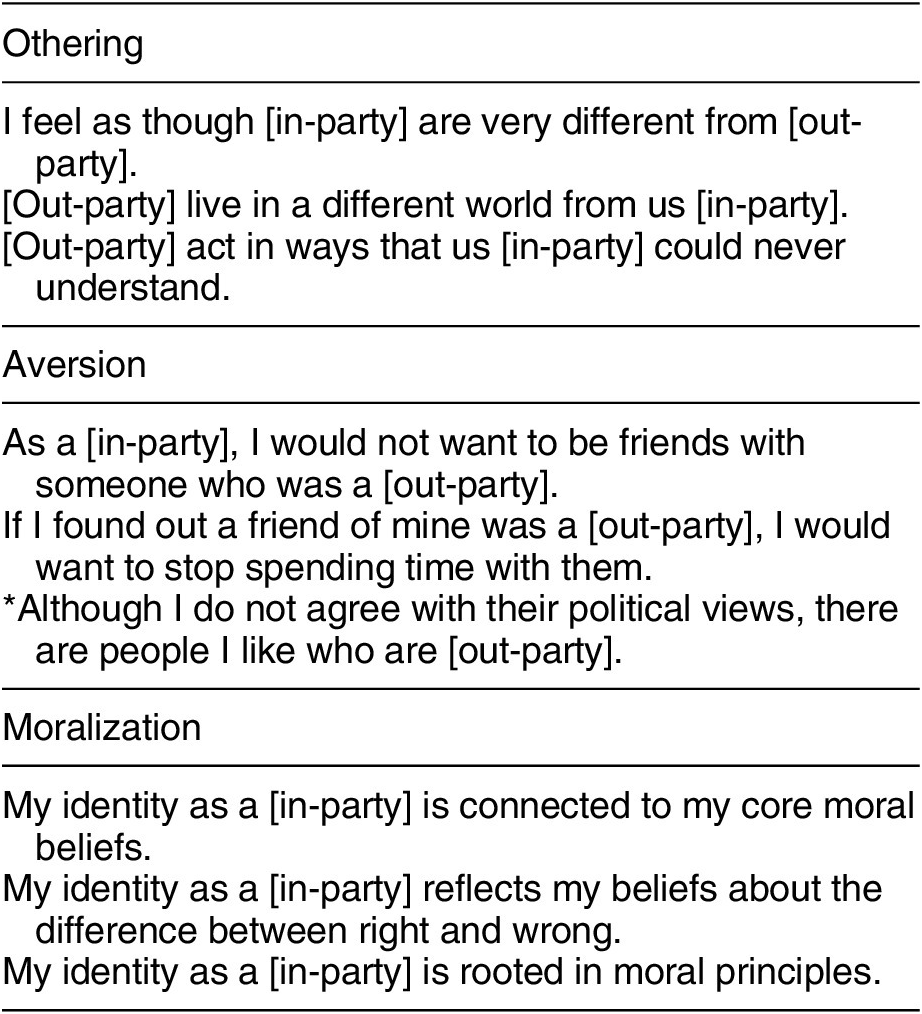
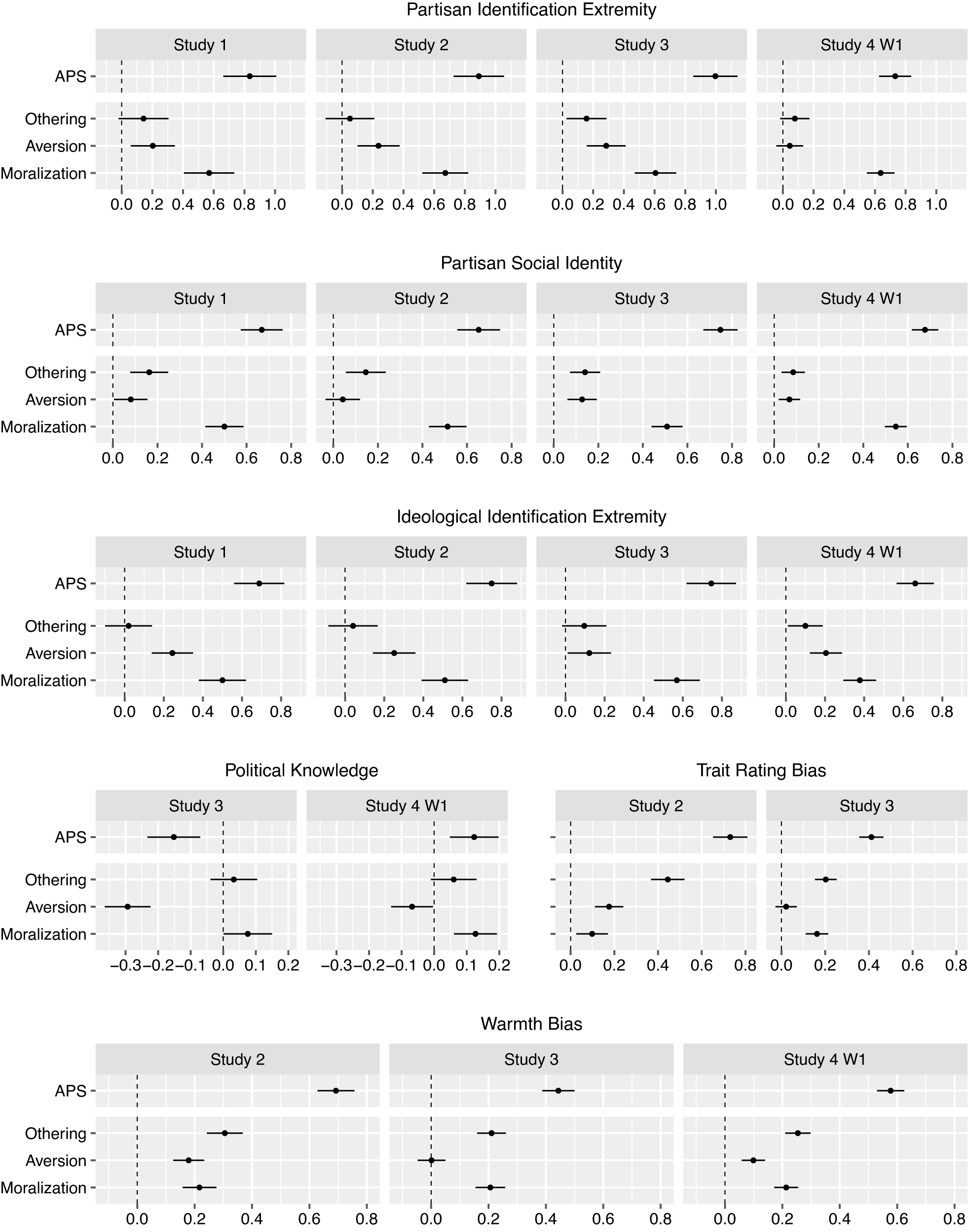
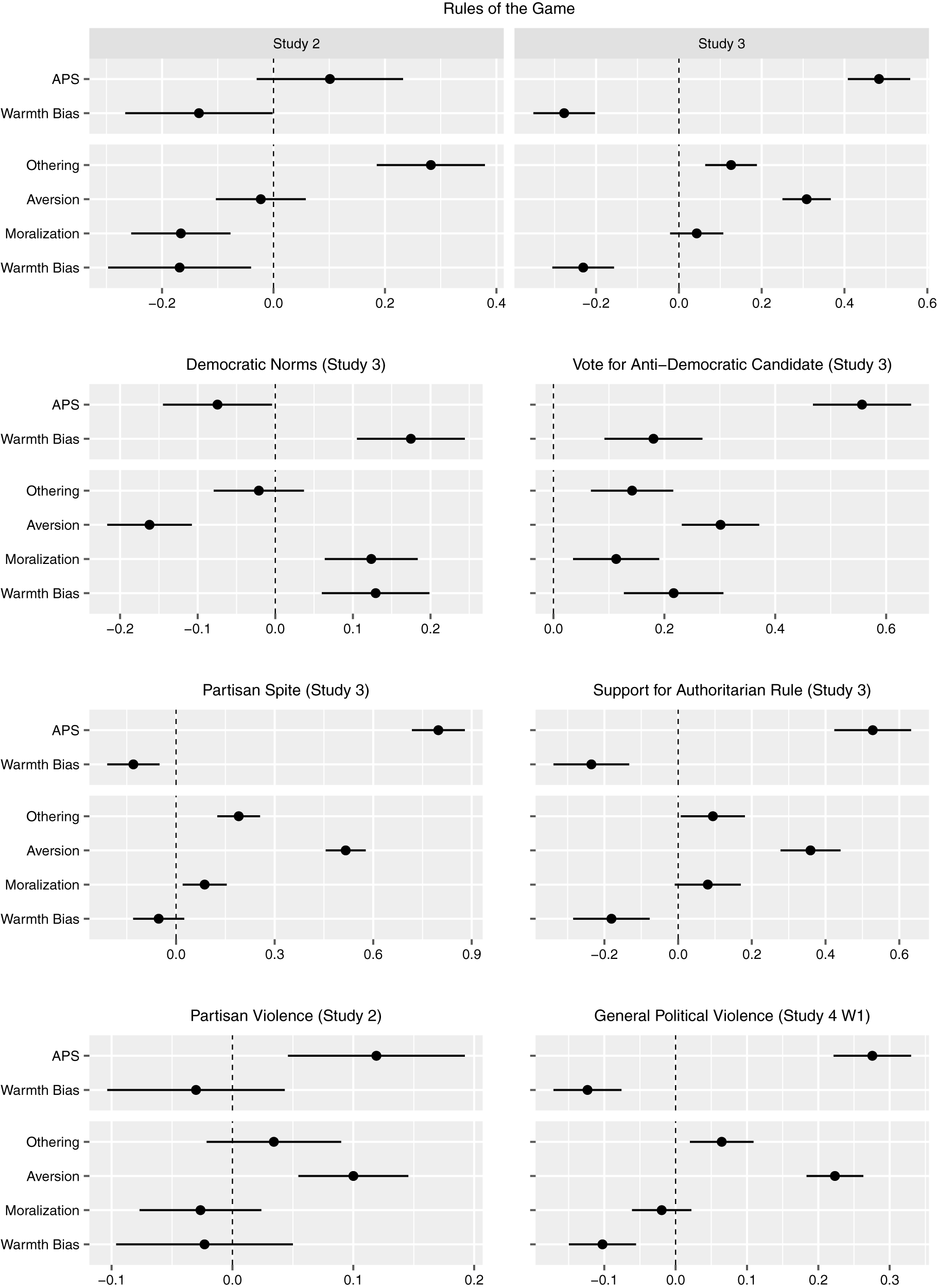
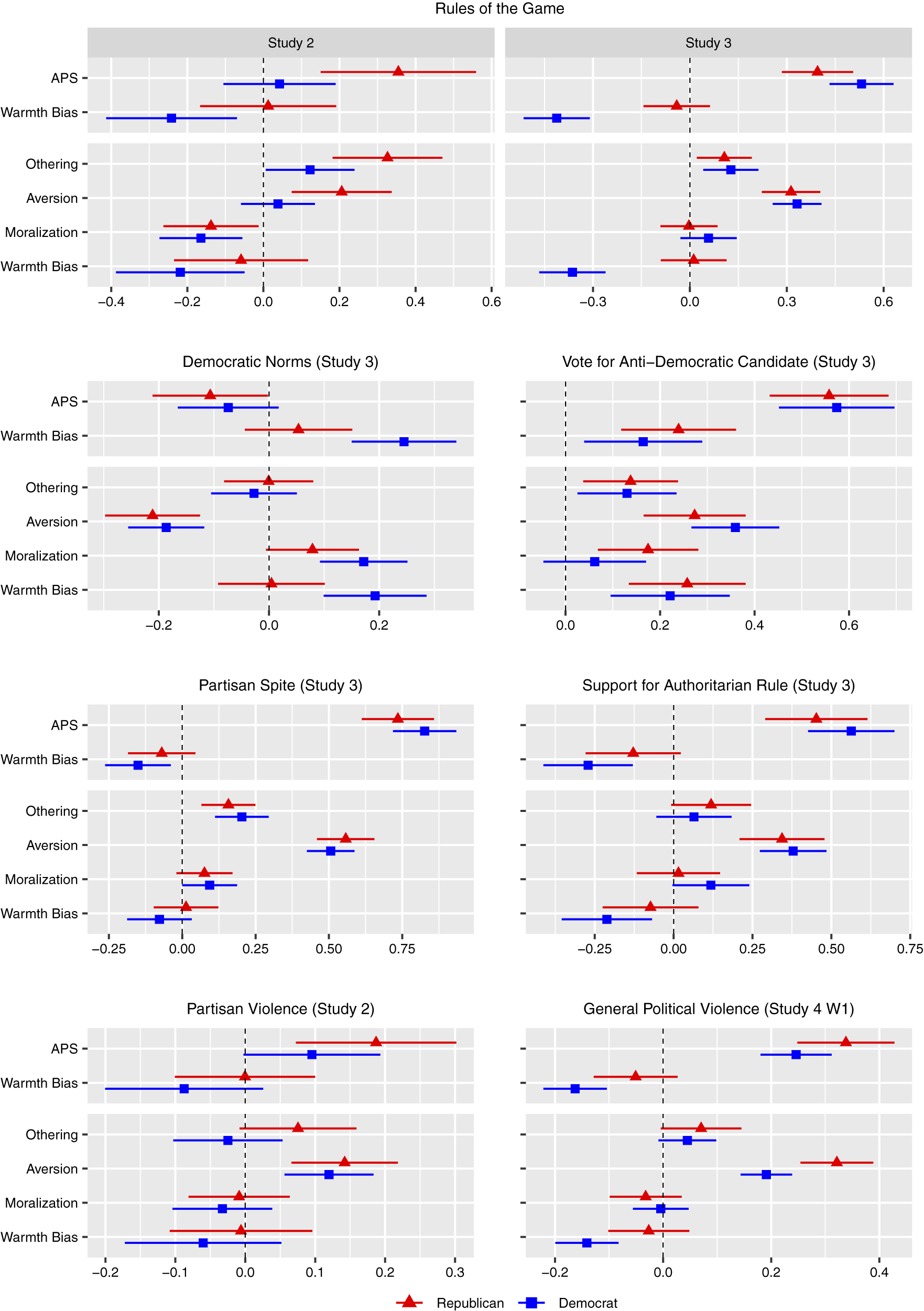
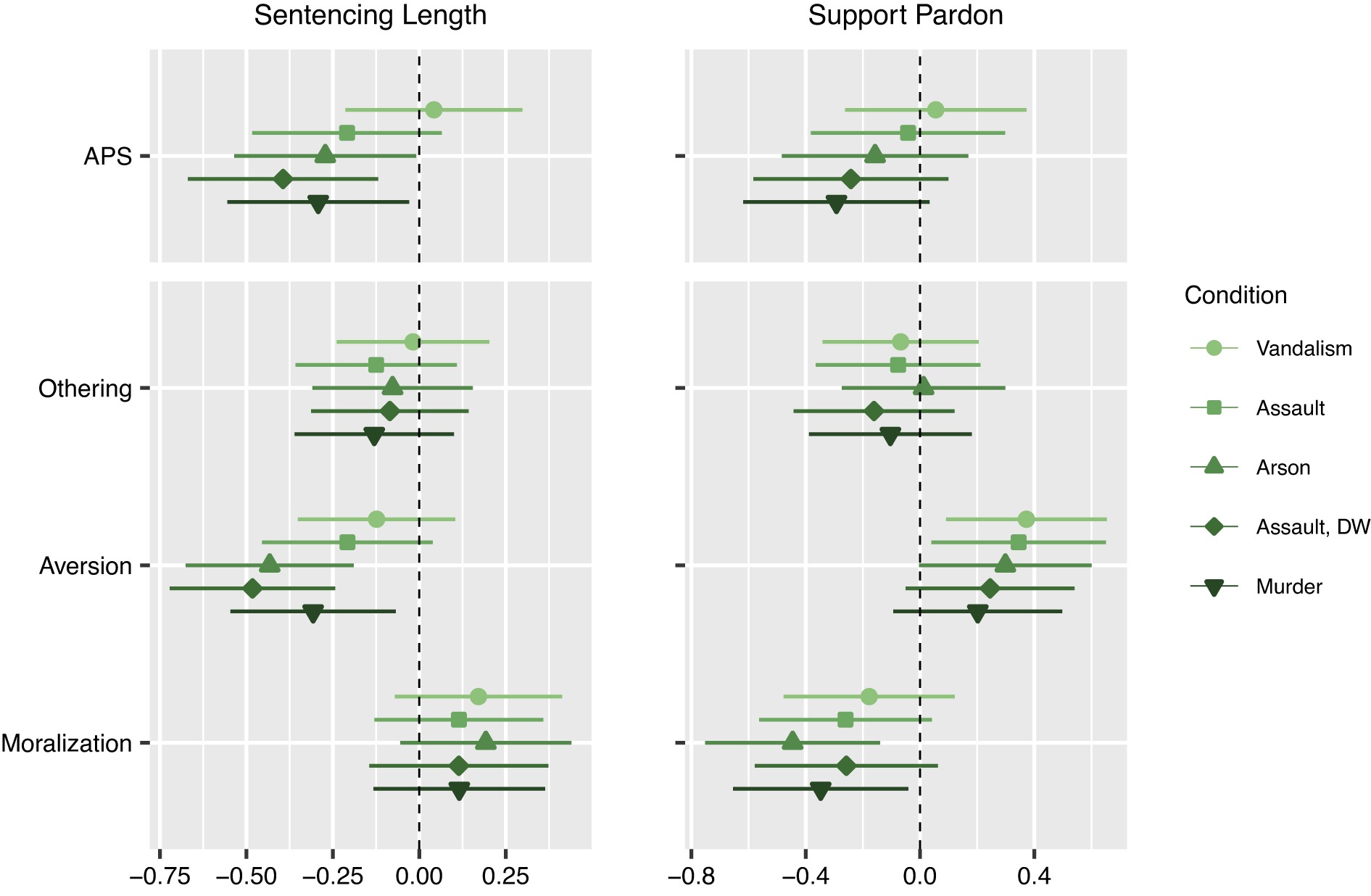


 Open access


Comments
No Comments have been published for this article.