





Introduction
Everyone is exposed to stressors in their lives, which may range from daily hassles, such as a conflict with a neighbor, a poor test result, an angry bus driver, to major stressful life events, such as an earthquake, a divorce, or being bullied. How individuals respond to these stressors depends on both the person and context. If individuals are able to recover from or adapt to the stressor relatively quickly, they show resilience (Ioannidis et al., Reference Ioannidis, Askelund, Kievit and Van Harmelen2020; Rutter, Reference Rutter2012). Resilience can either be defined as the dynamic process of adaptation or recovery that unfolds after stressful or negative experiences or the positive outcome of functioning well after stress (Kalisch et al., Reference Kalisch, Baker, Basten, Boks, Bonanno, Brummelman, Chmitorz, Fernàndez, Fiebach, Galatzer-Levy, Geuze, Groppa, Helmreich, Hendler, Hermans, Jovanovic, Kubiak, Lieb, Lutz and Kleim2017, Reference Kalisch, Cramer, Binder, Fritz, Leertouwer, Lunansky, Meyer, Timmer, Veer and Van Harmelen2019; Masten et al., Reference Masten, Best and Garmezy1990, Reference Masten, Lucke, Nelson and Stallworthy2021). If individuals are unable to recover or adapt to a stressor, they are at risk for later mental health problems.
From a developmental perspective, resilience early in life, during childhood and adolescence, is particularly important. That is, mental health problems during adolescence have a substantial impact on daily life and later development (Thapar et al., Reference Thapar, Collishaw, Pine and Thapar2012) and can lead to increased risks of psychopathology later in life (Clayborne et al., Reference Clayborne, Varin and Colman2019; Kim-Cohen et al., Reference Kim-Cohen, Caspi, Moffitt, Harrington, Milne and Poulton2003; Patel et al., Reference Patel, Flisher, Hetrick and McGorry2007). Currently, around 13%–25% of adolescents experience depression or anxiety (WHO, 2021). This percentage is expected to increase due to heightened stress levels caused by a rapidly changing world, societal challenges, and major crises such as the COVID-19 pandemic and climate change (Daly, Reference Daly2022; Lass-Hennemann et al., Reference Lass-Hennemann, Sopp, Ruf, Equit, Schäfer, Wirth and Michael2023; Poletti et al., Reference Poletti, Preti and Raballo2023; Racine et al., Reference Racine, McArthur, Cooke, Eirich, Zhu and Madigan2021; Wiederhold, Reference Wiederhold2022). To prevent this increase, a proactive approach and focus on resilience across the lifespan is needed, rather than focusing only on risk factors of mental health problems (Pluess, Reference Pluess2024; Uhlhaas et al., Reference Uhlhaas, Davey, Mehta, Shah, Torous, Allen, Avenevoli, Bella-Awusah, Chanen, Chen, Correll, Do, Fisher, Frangou, Hickie, Keshavan, Konrad, Lee, Liu and Wood2023).
Most of the knowledge about resilience stems from research on the long-term responses to major life events (e.g., the loss of a loved one, an earthquake or natural disaster) or adversity in childhood (e.g., parental divorce or emotional or physical abuse) (Fritz et al., Reference Fritz, de Graaff, Caisley, van Harmelen and Wilkinson2018; Ioannidis et al., Reference Ioannidis, Askelund, Kievit and Van Harmelen2020; Werner, Reference Werner1995). Everyone experiences one or more of these major events in their life, and this generally causes high levels of stress (Kendler et al., Reference Kendler, Karkowski and Prescott1999; Kessler, Reference Kessler1997; McLaughlin et al., Reference McLaughlin, Colich, Rodman and Weissman2020). However, besides major stressors, all of us encounter smaller stressors in their everyday lives, e.g., a fight with a friend or being late for school/work, which can lead to increased negative affect and lower positive affect. Here, we define the process in which individuals recover from these daily hassles (Almeida, Reference Almeida2005; Montpetit et al., Reference Montpetit, Bergeman, Deboeck, Tiberio and Boker2010; Seery & Quinton, Reference Seery and Quinton2016) in the short-term as “daily resilience.” In this structured review, we describe the importance of daily resilience, synthesize the existing body of research on daily resilience and describe the measures used and associations of daily resilience with psychosocial variables, mental health and well-being.
Definitions and measurement of resilience to major life events or adversity
While our study focusses on daily resilience to smaller daily stressors, we first provide context by discussing the definitions and measurement of resilience to major life events or adversity for two reasons. First, the majority of existing resilience research has investigated recovery from major stressful life events or adversity. Second, these definitions influences how daily resilience can be defined and measured in the context of daily stressors. There is a broad variety of operationalizations and measurements of resilience to major life events or adversity (Anderson & Priebe, Reference Anderson and Priebe2021; Bonanno, Reference Bonanno2012; Schultze-Lutter et al., Reference Schultze-Lutter, Schimmelmann and Schmidt2016; Southwick et al., Reference Southwick, Bonanno, Masten, Panter-Brick and Yehuda2014; Walsh et al., Reference Walsh, Dawson and Mattingly2010). At the moment, research into both adult and youth resilience mostly includes measures of trait resilience using static questionnaires (Mesman et al., Reference Mesman, Vreeker and Hillegers2021). These measures are suitable to assess the self-reported trait aspects of resilience, but cannot capture the dynamic process of recovery from stress. There is thus a growing theoretical consensus that instead of a trait, resilience is either a process or outcome (Kalisch et al., Reference Kalisch, Baker, Basten, Boks, Bonanno, Brummelman, Chmitorz, Fernàndez, Fiebach, Galatzer-Levy, Geuze, Groppa, Helmreich, Hendler, Hermans, Jovanovic, Kubiak, Lieb, Lutz and Kleim2017, Reference Kalisch, Cramer, Binder, Fritz, Leertouwer, Lunansky, Meyer, Timmer, Veer and Van Harmelen2019; van Harmelen, Reference van Harmelen2022). Resilience can be defined as the process of affective recovery from stressors or as the outcome of this process: individuals that recover quickly from the stress show good well-being and mental health, i.e., resilient functioning.
Importantly, within individuals, resilience is not stable over time. Individuals can experience resilience at certain times or in certain contexts, whereas they might be less able to adapt to or recover from stressors at other times or in other contexts (Cahill et al., Reference Cahill, Hager and Shryane2023; Kalisch et al., Reference Kalisch, Baker, Basten, Boks, Bonanno, Brummelman, Chmitorz, Fernàndez, Fiebach, Galatzer-Levy, Geuze, Groppa, Helmreich, Hendler, Hermans, Jovanovic, Kubiak, Lieb, Lutz and Kleim2017, Reference Kalisch, Cramer, Binder, Fritz, Leertouwer, Lunansky, Meyer, Timmer, Veer and Van Harmelen2019; van Harmelen, Reference van Harmelen2022). Different resilience factors can help individuals to be able to recover from major stressful experiences of adversity. According to Ann Masten, resilience after major stressful or traumatic life events is “ordinary magic,” such that ‘resilience comes not from rare qualities, but from the everyday magic of the ordinary, normative human resources’ (Masten, Reference Masten2015). Resilience factors include personal and social skills, parental resilience, and social support from friends and family (Fritz et al., Reference Fritz, de Graaff, Caisley, van Harmelen and Wilkinson2018; King et al., Reference King, Jolicoeur-Martineau, Laplante, Szekely, Levitan and Wazana2021; Mesman et al., Reference Mesman, Vreeker and Hillegers2021; van Harmelen et al., Reference van Harmelen, Kievit, Ioannidis, Neufeld, Jones, Bullmore, Dolan, Fonagy and Goodyer2017).
Measuring daily resilience
Major life events are relatively rare on a daily basis, making it difficult to capture and study the experience of such events and subsequent recovery in real time. Alternatively, smaller stressors and daily hassles occur every day and can be tracked in real-time daily life. We refer to the short-term recovery from these daily stressors as “daily resilience.” Since the 1980s, researchers have emphasized the importance of recovery from daily stressors for overall mental health. In fact, it has been argued that the impact of daily stressors on well-being and mental health could be as great or greater than that of major life events (Delongis et al., Reference Delongis, Coyne, Dakof, Folkman and Lazarus1982; Kanner et al., Reference Kanner, Coyne, Schaefer and Lazarus1981; Monroe, Reference Monroe1983). Recent research seems to confirm the relation between recovery from (multiple) daily stress and mental health, although the number of studies is limited (Charles et al., Reference Charles, Piazza, Mogle, Sliwinski and Almeida2013; Parrish et al., Reference Parrish, Cohen and Laijrenceaij2011; Vaessen et al., Reference Vaessen, van Nierop, Decoster, Delespaul, Derom, de Hert, Jacobs, Menne-Lothmann, Rutten, Thiery, van Os, van Winkel, Wichers and Myin-Germeys2017; Wright et al., Reference Wright, Aslinger, Bellamy, William and Woods2019). For example, slower recovery from daily stressors puts adolescents at risk for persistence or worsening of psychopathology (Vaessen et al., Reference Vaessen, van Nierop, Decoster, Delespaul, Derom, de Hert, Jacobs, Menne-Lothmann, Rutten, Thiery, van Os, van Winkel, Wichers and Myin-Germeys2017). Moreover, daily stressors have been suggested to be the mechanism by which major life events influence mental health. Major life events can disrupt daily routines and the (perceived) ability to deal with daily challenges (Wright et al., Reference Wright, Aslinger, Bellamy, William and Woods2019). In line with this idea, the response to and recovery from daily stressors have been found to mediate the association between major life events and mental health outcomes, while also having independent predictive effects (Eckenrode, Reference Eckenrode1984; Kanner et al., Reference Kanner, Coyne, Schaefer and Lazarus1981; Schneiders et al., Reference Schneiders, Nicolson, Berkhof, Feron, Van Os and Devries2006; Wagner et al., Reference Wagner, Compas and Howell1988). Therefore, even though small daily stressors do not cause immediate mental health problems, recovery from such stressors are potentially related to future mental health. This may be due to the accumulation of poor short-term recovery and the resulting pile-up of stress. To fully understand this recovery from daily stressors, i.e., daily resilience, and to be able to support individuals in strengthening resilience, we need to identify resilience factors and mechanisms that protect against the development of mental health problems following daily stressors.
To be able to investigate daily resilience, we need valid measurements. The recovery from everyday stressors in real-time requires multiple measurements within or across days. In recent years, major progress has been made in the study of daily life, which has opened up new opportunities to trace the dynamic processes of daily resilience. Daily stressful events and responses to these events can be assessed using the experience sampling method (ESM) or daily diaries via the smartphones of participants (Hamaker & Wichers, Reference Hamaker and Wichers2017; van Roekel et al., Reference van Roekel, Keijsers and Chung2019). ESM refers to structured self-report diary techniques assessing mood, symptoms, behavior, and context as they occur in daily life and real-time (Csikszentmihalyi & Larson, Reference Csikszentmihalyi and Larson1987; Myin-Germeys & Kuppens, Reference Myin-Germeys, Kuppens, Myin-Germeys and Kuppens2022; de Vries et al., Reference de Vries, Baselmans and Bartels2021). Participants receive multiple very short questionnaires on their phone per day, in which they answer, for instance, how they are feeling, where they are, and what they are doing. In daily diary studies, participants receive one questionnaire at the end of the day about their daily mood, behaviors, and events.
The current study
Despite the increasing recognition of the importance of daily resilience for mental health and the increasing technical feasibility of measuring feelings, behavior, and context in real-time, a structured overview of existing empirical studies, the approaches to measuring daily resilience, and their associations with other variables is lacking. We aim to advance the understanding of daily resilience by systematically reviewing the increasingly popular approach of ESM and daily diary studies on daily resilience. We address two research questions:
-
1. What are existing approaches to measure daily resilience and what is the quality of these operationalizations? We include studies that measure perceived daily resilience directly via self-report items and studies that measure daily resilience as the recovery of positive or negative affect after experiencing daily stressors, in line with more dynamic accounts in the resilience literature.
-
2. How does daily resilience relate to psychosocial variables, mental health and well-being in youth and adult samples? Daily resilience during childhood and adolescence might be especially important for well-being and mental health, therefore we discuss the results separately for youth ( <25 years) and adult samples (25+ years).
Methods
This preregistered systematic review (PROSPERO: https://www.crd.york.ac.uk/prospero/display_record.php?RecordID=475693) is conducted in accordance with the Preferred Reporting Items for Systematic Review and Meta-Analysis (PRISMA) guidelines (Moher et al., Reference Moher, Liberati, Tetzlaff and Altman2009). In October 2023, the medical library of the Erasmus MC Rotterdam conducted the search for relevant articles in the bibliographic databases Embase, Medline ALL, PsycINFO, Web of Science, Cochrane, and Google Scholar. Additional articles that were missed during this search were identified via reference lists of the selected articles. The search strategy included combinations of search terms related to (1) resilience (resilience, stress or affect recovery, adaptation or adjustment) and (2) experience sampling and daily diaries (Ecological Momentary Assessment, Experience Sampling, daily diary, momentary assessment or longitudinal sampling; see Supplementary Material for the full search strategy). A total of 3060 articles were identified across the records, which led to 2183 articles after duplicates removed (see Figure 1).
PRISMA 2020 flow diagram for new systematic reviews which included searches of databases and registers only. from: Page MJ, McKenzie JE, Bossuyt PM, Boutron I, Hoffmann TC, Mulrow CD, et al., The PRISMA 2020 statement: an updated guideline for reporting systematic reviews. BMJ 2021;372:n71. doi: 10.1136/bmj.n71.

Two independent reviewers (LdV, JZ) screened the titles and abstracts of collected articles for eligibility. Articles were included if daily resilience was assessed in daily life in daily diary or ESM studies. There was a strong level of agreement between the reviewers (89.1% interrater reliability, McHugh, Reference McHugh2012) Discrepancies between the reviewers were resolved by discussions.
The full-text papers of the 141 remaining articles were independently assessed by the two reviewers. Exclusion criteria were: (1) no measure of daily resilience to daily stressors, (2) only a static baseline measure of resilience, (3) only a measure of stress reactivity, i.e., assessing the affective response only at the same time point of the stressor instead of recovery, i.e., hours or days later, (4) review papers, or (5) descriptive planned studies or methodological papers not including a resilience measure. The full-text screening resulted in a strong mean interrater reliability of 89.5% and the inclusion of 36 studies.
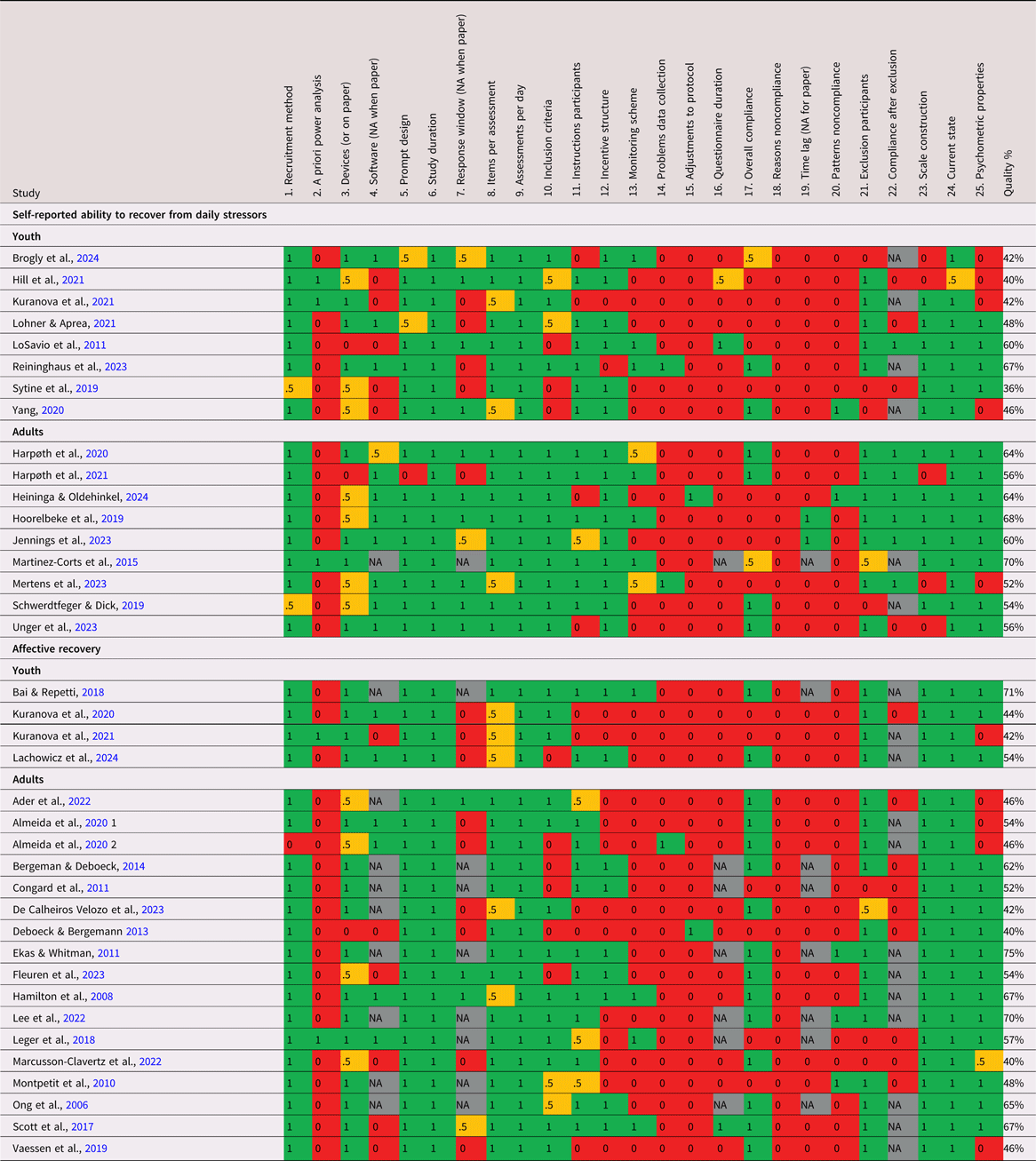
Data on characteristics, design, and results of the 36 studies were extracted. To assess the quality of included articles, we used a checklist for the design and reporting for ESM studies (van Roekel et al., Reference van Roekel, Keijsers and Chung2019). This checklist includes 25 items on recruitment, procedure, and materials (see Supplementary Material). Each item was rated as 1, 0.5 or 0, or cannot determine/not applicable, and scores were converted to percentages. Studies rated >80% were considered good quality, 60%–80% was considered fair quality and <60% was considered poor quality. The two reviewers had 94.0% consensus and discrepancies were resolved by discussions.
Results
We examined the existing approaches to measure daily resilience and the associations with well-being and mental health. The 36 included studies assessed the micro-dynamics of daily resilience via two operationalizations. Seventeen studies used daily or momentary self-report items to assess the perceived ability of participants to recover from daily stressors, hereafter referred to as self-reported ability to recover from daily stressors. Twenty studies assessed daily resilience indirectly, in terms of short-term recovery of positive or negative affect after the experience of daily stressors, i.e., affective recovery. One study included both a daily self-report item and a measure of affective recovery in 68 adolescents and reported no relation between the measures (r = −.01 [95%CI: −0.21, 0.19], Kuranova et al., Reference Kuranova, Booij, Oldehinkel, Wichers, Jeronimus and Wigman2021).
Table 1 provides an overview of the samples and characteristics of the 36 included studies, split by daily resilience operationalization (self-report vs affective recovery) and age group (youth, defined as the mean age of the sample below 25 years, and adults). Table 2, 3, and 4 provide the results of the studies. We discuss the findings of the studies separately for youth and adults to take the development of daily resilience into account. Table 3 includes the quality assessment.
Descriptives of the 36 included studies, split by operationalization of daily resilience (self-report vs affective recovery) and age (youth vs adults)

Note. NL = the Netherlands, USA = United States of America, ESM = experience sampling method.
Items used for self-reported ability to recover from daily stressors

Note. N.A. = not applicable. Cronbach’’s alpha is reported for between-person measures. If the Cronbach’’s alpha is based on within-person measures, this is defined: B = between-person Cronbach’’s alpha, W = within-person Cronbach’’s alpha.
Quality assessment of 36 included studies

Note. N.A. = not applicable. Quality ratings are percentages of all non-N.A. ratings. <60% is poor quality, 60%–80% is fair quality, and >80% is good quality.
Self-reported ability to recover from daily stressors
Study characteristics and quality
Eight and nine studies respectively assessed self-reported ability to recover from daily stressors in youth samples and adults. Note that Harpøth et al., (Reference Harpøth, Kongerslev, Trull, Hepp, Bateman and Simonsen2020, Reference Harpøth, Yeung, Trull, Simonsen and Kongerslev2021) used data from the same participants. Sample sizes ranged from 43 to 248 participants, with an average of 96.4 (SD = 45.5) participants. The mean age in the youth samples ranged from 18.1 to 24.7 years, with a mean age of 21.3 (SD = 2.5) and in the adult samples from 29 to 46 years (M age = 35.5, SD = 6.3). The proportion of males was on average 39.3% (SD = 22.7%, range 0%–100%). Specific populations were included, such as patients with depression (Heininga & Oldehinkel, Reference Heininga and Oldehinkel2024; Hoorelbeke et al., Reference Hoorelbeke, Van den Bergh, Wichers and Koster2019) or firefighters (Schwerdtfeger & Dick, Reference Schwerdtfeger and Dick2019) (see Table 1).
Of the 17 studies, seven were of fair quality ( >60% (Harpøth et al., Reference Harpøth, Kongerslev, Trull, Hepp, Bateman and Simonsen2020; Heininga & Oldehinkel, Reference Heininga and Oldehinkel2024; Hoorelbeke et al., Reference Hoorelbeke, Van den Bergh, Wichers and Koster2019; Jennings et al., Reference Jennings, Lanaj and Kim2023; LoSavio et al., Reference LoSavio, Cohen, Laurenceau, Dasch, Parrish and Park2011; Martinez-Corts et al., Reference Martinez-Corts, Demerouti, Bakker and Boz2015; Reininghaus et al., Reference Reininghaus, Paetzold, Rauschenberg, Hirjak, Banaschewski, Meyer-Lindenberg, Boehnke, Boecking and Schick2023)). The other 10 studies showed poor quality (36%–56%), resulting in an average rating of 54.4% (SD = 10.6%). Only three studies did a power analysis to determine the needed sample size and showed sufficient power to detect effects (Hill et al., Reference Hill, Meijer, Van Yperen, Michelakis, Barisch and Den Hartigh2021; Kuranova et al., Reference Kuranova, Booij, Oldehinkel, Wichers, Jeronimus and Wigman2021; Martinez-Corts et al., Reference Martinez-Corts, Demerouti, Bakker and Boz2015). Most studies did not provide full details of the methods used. For example, few studies reported the software used to collect ESM data or response window for the surveys (see Table 3).
Ten studies used daily diaries with one survey per day and lasted on average 19.5 days (SD = 25.7, range = 5–90 days). The compliance of daily diary or ESM studies gives important information about the study and data quality. The average compliance was reported for six daily diary studies and was on average 88.3% (SD = 7.9%). The seven ESM studies included between 5 to 16 prompts per day or students could choose how often to complete surveys for a maximum of 280 days (Brogly et al., Reference Brogly, Lizotte, Mitchell, Speechley, MacDougall, Huner, Anderson and Bauer2024). The average compliance, based on five studies, was 66.0% (SD = 19.3%).
Instruments
Different items or scales were used to assess daily or momentary self-reported ability to recover from daily stressors (see Table 2). The number of items used ranged from 1 to 21 (M = 4.9, SD = 5.5). The items were mostly adaptations of trait resilience questionnaire items (11 of the 17 studies, 64.7%), e.g., adding “today” or “in this moment” to the items. The other studies either used a self-developed scale, the Monitoring of Actual Resilience State (MARS) scale (Lohner & Aprea, Reference Lohner and Aprea2021) or items with no source definition. The instruments varied in timescale. Ten studies used items to assess daily self-reported ability to recover (e.g., “Today I could handle what came my way” (Kuranova et al., Reference Kuranova, Booij, Oldehinkel, Wichers, Jeronimus and Wigman2021). Four studies focused on momentary ability to recover (e.g., “Right now, I feel like I can deal with whatever comes”; Mertens et al., Reference Mertens, Kraiss and Vaessen2023). Finally, three studies assessed self-reported ability to recover in response to a stressful or negative event (e.g., “I had difficulties to recover” (Reininghaus et al., Reference Reininghaus, Paetzold, Rauschenberg, Hirjak, Banaschewski, Meyer-Lindenberg, Boehnke, Boecking and Schick2023). Most studies investigated the self-reported ability to recover from daily stressors in relation to general daily stressors, whereas Jennings et al. (Reference Jennings, Lanaj and Kim2023) and Martinez-Corts et al. (Reference Martinez-Corts, Demerouti, Bakker and Boz2015) examined resilience in the context of work conflicts.
Ten of the twelve studies with multiple items reported the internal consistency of the items. The average Cronbach’s alpha of 0.81 (SD = .11) indicated good consistency. Moreover, to assess if self-reported ability to recover from daily stressors changes within a person over time, an intraclass correlation coefficient (ICC) was reported in nine studies. The average ICC was 0.52 (SD = .15, range = .29–.80). This indicates that, on average, 52% of the variance in self-reported ability to recover from daily stressors was due to stable between-person differences and the remaining 48% of the variance in self-reported ability to recover from daily stressors was due to within-participant variability (and/or measurement error).
Results and associations of self-reported ability to recover from daily stressors in youth
First, we assessed mean levels of self-reported ability to recover from daily stressors. Due to the use of different measurement scales, the means could not be directly compared. Therefore, scores were standardized to a range of 1–10 using the R rescale function. Mean levels then ranged from 2.5 (LoSavio et al., Reference LoSavio, Cohen, Laurenceau, Dasch, Parrish and Park2011) to 7.2 (Lohner & Aprea, Reference Lohner and Aprea2021), with a mean of 5.7 (SD = 1.7; see Table 4).
Results of the studies assessing self-reported ability to recover from daily stressors and associations with other measures

Self-reported ability to recover from daily stressors showed significant associations with different psychological and environmental measures in youth (see Table 4). Some studies investigated under which circumstances youth report more ability to recovery from daily stressors. At this within-person level, LoSavio et al. (Reference LoSavio, Cohen, Laurenceau, Dasch, Parrish and Park2011) found that in 82 students from the USA self-reported ability to recover from daily stressors, defined as stress-related growth, was higher in moments with more positive affect or more negative affect. Similarly, USA students reported higher daily resilience on days with more hope, optimism, or stress (Sytine et al., Reference Sytine, Britt, Sawhney, Wilson and Keith2019; Yang, Reference Yang2020) and days with less somatic symptoms and neuroticism (Yang, Reference Yang2020).
The other studies provided insight into which adolescents report higher daily ability to recover from daily stressors compared to others. At this between-person level, self-reported ability to recover from daily stressors was positively related to overall trait resilience in both young adults with different levels of risk for psychosis (Kuranova et al., Reference Kuranova, Booij, Oldehinkel, Wichers, Jeronimus and Wigman2021) and German students (Lohner & Aprea, Reference Lohner and Aprea2021). Furthermore, self-reported ability to recover from daily stressors was positively related to overall conscientiousness and agreeableness (Lohner & Aprea, Reference Lohner and Aprea2021) and predicted mental health outcomes one year later (Kuranova et al., Reference Kuranova, Booij, Oldehinkel, Wichers, Jeronimus and Wigman2021). Overall, self-reported ability to recover from daily stressors in youth is related to both within-person factors such as positive affect and optimism, and between-person factors such as trait resilience and personality traits.
Results and associations of self-reported ability to recover from daily stressors in adults
Similar to the findings in youth samples, the rescaled mean score for self-reported ability to recover from daily stressors varied from 4.3 (Harpøth et al., Reference Harpøth, Kongerslev, Trull, Hepp, Bateman and Simonsen2020, Reference Harpøth, Yeung, Trull, Simonsen and Kongerslev2021) to 8.0 (Jennings et al., Reference Jennings, Lanaj and Kim2023), with a mean of 6.3 (SD = 1.4; see Table 4). Self-reported ability to recover from daily stressors in adults (aged 25 or older) was related to several psychological measures (see Table 4). At a within-person level, self-reported ability to recover from daily stressors was higher on days/moments with more positive affect or less negative affect in both women with borderline personality disorder (Harpøth et al., Reference Harpøth, Yeung, Trull, Simonsen and Kongerslev2021) and full-time employees in the US (Jennings et al., Reference Jennings, Lanaj and Kim2023). Furthermore, self-reported ability to recover from daily stressors was related to an increase in positive affect and decrease in negative affect the next day in outpatients with depression (Heininga & Oldehinkel, Reference Heininga and Oldehinkel2024), more optimism and less work conflicts in Spanish employees (Martinez-Corts et al., Reference Martinez-Corts, Demerouti, Bakker and Boz2015), more daily meaning in life and less depletion in US employees (Jennings et al., Reference Jennings, Lanaj and Kim2023), and lower heart rate variability in firefighters (Schwerdtfeger & Dick, Reference Schwerdtfeger and Dick2019).
At a between person level, self-reported ability to recover from daily stressors was positively related to overall trait resilience in both firefighters and adults from the general population (Schwerdtfeger & Dick, Reference Schwerdtfeger and Dick2019; Unger et al., Reference Unger, Kraiss and Vaessen2023). Furthermore, self-reported ability to recover from daily stressors was consistently positively related higher levels of positive affect or lower levels of negative affect in various samples (Harpøth et al., Reference Harpøth, Kongerslev, Trull, Hepp, Bateman and Simonsen2020; Heininga & Oldehinkel, Reference Heininga and Oldehinkel2024; Hoorelbeke et al., Reference Hoorelbeke, Van den Bergh, Wichers and Koster2019; Jennings et al., Reference Jennings, Lanaj and Kim2023). Similarly, self-reported ability to recover from daily stressors was consistently linked to the severity of mental health problems in (sub)clinical samples (Harpøth et al., Reference Harpøth, Kongerslev, Trull, Hepp, Bateman and Simonsen2020, Reference Harpøth, Yeung, Trull, Simonsen and Kongerslev2021; Heininga & Oldehinkel, Reference Heininga and Oldehinkel2024; Hoorelbeke et al., Reference Hoorelbeke, Van den Bergh, Wichers and Koster2019). For instance, in outpatients with depression, participants with higher self-reported ability to recover from daily stressors showed a better daily mood and fewer depressive symptoms at baseline and three and six months later (Heininga & Oldehinkel, Reference Heininga and Oldehinkel2024).
Overall, when ability to recover from daily stressors was assessed with self-reported questionnaires, the findings among adolescents and adults provided quite similar patterns. Self-reported ability to recover from daily stressors in adults is associated with various psychological measures across diverse samples, including within-person factors of positive and negative affect, and between-person factors such as trait resilience and severity of mental health problems.
Affective recovery after daily stressors
Study characteristics and quality
Whereas 17 studies operationalized daily resilience with self-reported instruments to assess perceived ability to recover from daily stressors, 20 studies operationalized the underlying dynamics, in terms of the recovery of positive or negative affect after daily stressors. The average sample size was 289 participants (SD = 334, range = 27–1155). The mean age of the four youth samples was 16.7 (SD = 6.0), ranging from 10.9 (Bai & Repetti, Reference Bai and Repetti2018) to 24.7 (Kuranova et al., Reference Kuranova, Booij, Oldehinkel, Wichers, Jeronimus and Wigman2021). The mean age of the adult samples was 52.4 years (SD =16.5), ranging from 32.1 to 79.0. The proportion of males included ranged from 0% to 100%, with a mean of 36% (SD = 21%). Different populations were included, from healthy participants to patients with mental health problems (see Table 1).
Seven studies were of fair quality ( >60% (Bai & Repetti, Reference Bai and Repetti2018; Bergeman & Deboeck, Reference Bergeman and Deboeck2014; Bergh & Silverman, Reference Bergh and Silverman2018; Ekas & Whitman, Reference Ekas and Whitman2011; Hamilton et al., Reference Hamilton, Affleck, Tennen, Karlson, Luxton, Preacher and Templin2008; Lee et al., Reference Lee, Grodstein, Trudel-Fitzgerald, James, Okuzono, Koga, Schwartz, Spiro, Mroczek and Kubzansky2022; Ong et al., Reference Ong, Bergeman, Bisconti and Wallace2006; Scott et al., Reference Scott, Ram, Smyth, Almeida and Sliwinski2017). The other studies showed poor quality regarding design and reporting (40%–57%), resulting in an average rating of 54.4% (SD = 11.2%, see Table 3). Only Leger et al. (Reference Leger, Charles and Almeida2018) performed a power analysis and showed sufficient power to detect effects. Most studies did not include all details on the methods to be able to replicate the study (see Table 3). Nine studies (including 11 samples) were daily diary studies where participants completed one survey a day for 8-168 days (M = 55.6 days, SD = 46.2 days). The average compliance of these daily diaries, based on 10 samples, was 82.4% (SD = 14.9%). The 11 ESM studies included on average 7 surveys per day (SD = 2.7, range = 3-20) for 2–40 days (M = 10.9 days, SD = 10.9 days). The compliance was on average 79.4% (SD = 15.1%).
Operationalization of affective recovery
In this second type of studies, daily resilience was operationalized as the recovery of positive or negative affect after the experience of a stressor, i.e., affective recovery. Different operationalizations of affective recovery were used and the nature of the stressors from which individuals recovered differed (see Table 5). In the youth samples, Bai and Repetti (Reference Bai and Repetti2018) defined affective recovery as the degree of recovery from school problems at bed time. Children whose positive or negative affect at bedtime was no longer significantly affected by the problems were considered showing resilience. In the other youth studies, recovery time was defined as the time until negative/positive affect after a stressful events on was no longer significantly different from baseline negative/positive affect. Specifically, Kuranova et al. (Reference Kuranova, Booij, Oldehinkel, Wichers, Jeronimus and Wigman2021) investigated the speed of affect recovery from unpleasant events across multiple days, whereas Kuranova et al. (Reference Kuranova, Booij, Menne-Lothmann, Decoster, van Winkel, Delespaul, De Hert, Derom, Thiery, Rutten, Jacobs, van Os, Wigman and Wichers2020) and Lachowicz et al. (2024) estimated the recovery time after an unpleasant event or activity within a day (see Table 5).
Results of the studies that operationalized daily resilience as affective recovery after daily stressors and associations with other measures

Note. r = correlation, * indicates significant correlations. Prox= proximal effects, Dis=distal effects. Unless indicated by within-person, between person correlations and associations are reported.
In the adult studies, similar approaches to estimate affective recovery after the stressor were taken. In six ESM studies, the recovery of positive or negative affect after the experience of a stressor was investigated within a day, assessing recovery over minutes or hours. These studies either estimated the recovery speed, i.e., amount of time until the effect of stress on negative/positive affect is no longer significantly different from the baseline negative/positive affect, or the degree of recovery by investigating the remaining effect of stress on affect later in the day. Five other studies used a multilevel model was used to estimate the effect of a stressor on next day’s negative or positive affect, reflecting recovery over one day (Ekas & Whitman, Reference Ekas and Whitman2011; Hamilton et al., Reference Hamilton, Affleck, Tennen, Karlson, Luxton, Preacher and Templin2008; Lee et al., Reference Lee, Grodstein, Trudel-Fitzgerald, James, Okuzono, Koga, Schwartz, Spiro, Mroczek and Kubzansky2022; Leger et al., Reference Leger, Charles and Almeida2018; Ong et al., Reference Ong, Bergeman, Bisconti and Wallace2006). Finally, the remaining five studies assessed recovery across multiple days using different complex statistical models, e.g., to assess the dampening or dissipation of negative affect after experiencing stress (Bergeman & Deboeck, Reference Bergeman and Deboeck2014; Congard et al., Reference Congard, Dauvier, Antoine and Gilles2011; Deboeck & Bergeman, Reference Deboeck and Bergeman2013; Fleuren et al., Reference Fleuren, Nübold, Uitdewilligen, Verduyn and Hülsheger2023; Montpetit et al., Reference Montpetit, Bergeman, Deboeck, Tiberio and Boker2010).
Results and associations of affective recovery in youth
Examining how these dynamic operationalizations of daily resilience as affective recovery were related to different psychosocial variables and mental health or well-being, we again start with a discussion of findings in youth ( < 25 years). These associations were only investigated at the between-person level, i.e., providing insight into which child or adolescent shows more affective recovery in daily life compared to others. Bai and Repetti (Reference Bai and Repetti2018) reported that children who recovered more from their school problems had fewer self-reported depressive symptoms and fewer internalizing problems as reported by their parents. Relatedly, adolescents who recovered more quickly from stress experienced due to a difficult activity reported less severe anxiety symptoms (Lachowicz et al., 2024). However, affective recovery time was not related to anxiety symptoms three year later, indicating the instability of resilience. Furthermore, this operationalization of affective recovery was not related to depressive symptoms. In contrast, Kuranova et al. (Reference Kuranova, Booij, Menne-Lothmann, Decoster, van Winkel, Delespaul, De Hert, Derom, Thiery, Rutten, Jacobs, van Os, Wigman and Wichers2020) compared the recovery time in two groups of adolescents based on the 1-year change in depressive symptoms, i.e., stable and increasing symptoms. At baseline, the group of adolescents with increasing symptom levels recovered slower from increased negative affect after a stressful event (recovery time: ∼180 min) compared to individuals with no increase in symptoms (∼90 min, Kuranova et al., Reference Kuranova, Booij, Menne-Lothmann, Decoster, van Winkel, Delespaul, De Hert, Derom, Thiery, Rutten, Jacobs, van Os, Wigman and Wichers2020). Finally, Kuranova et al. (Reference Kuranova, Booij, Oldehinkel, Wichers, Jeronimus and Wigman2021) found recovery speed after an unpleasant event across multiple days to be unrelated to trait resilience (r = −.16), self-reported daily resilience (r = −.01), and psychopathological symptoms a year later (β = −.01).
Overall, based on a limited number of studies in youth and acknowledging the limitation that within-person studies were entirely lacking, daily resilience as the speed or degree of affective recovery seems to be related to the mental health of the child or adolescents, although the predictive value for later psychopathology remains inconclusive.
Results and associations of affective recovery in adults
Compared to the studies and findings in youth, more associations between daily resilience as the affective recovery after daily stressors and other measures have been reported in adults (see Table 5). Some studies investigated under which circumstances adults showed more affective recovery. At this within-person level, affective recovery within a day was positively associated with less daily negative affect and perceived stress, but not with physical activity (Almeida et al., Reference Almeida, Marcusson-Clavertz, Conroy, Kim, Zawadzki, Sliwinski and Smyth2020). Additionally, a small association with sleep latency was found, i.e., on days with more recovery, adults had less difficulty falling asleep (Marcusson-Clavertz et al., Reference Marcusson-Clavertz, Sliwinski, Buxton, Kim, Almeida and Smyth2022). Similarly, affective recovery over one day was positively related to sleep quality in women with fibromyalgia. After a poor night of sleep, the yesterday’s stressful event still influences today’s positive affect, whereas this association disappears after a good night of sleep, indicating recovery (Hamilton et al., Reference Hamilton, Affleck, Tennen, Karlson, Luxton, Preacher and Templin2008). Finally, adults showed more negative affect recovery on days with more positive affect (Ekas & Whitman, Reference Ekas and Whitman2011; Ong et al., Reference Ong, Bergeman, Bisconti and Wallace2006).
The other studies provided insight into which adults show greater affective recovery in daily life compared to others. At this between-person level, multiple studies compared affective recovery times after a stressful or unpleasant event within a day in different groups based on mental health status. Longer affect recovery times were found for early-stage psychosis patients compared to chronic psychosis patients and healthy controls (recovery time: ∼270 min vs ∼ 90 min, Vaessen et al., Reference Vaessen, Viechtbauer, van der Steen, Gayer-Anderson, Kempton, Valmaggia, McGuire, Murray, Garety, Wykes, Morgan, Lataster, Lataster, Collip, Hernaus, Kasanova, Delespaul, Oorschot, Claes and Myin-Germeys2019), adults with depression compared to healthy controls (∼78–89 vs ∼ 56 min, De Calheiros Velozo et al., Reference De Calheiros Velozo, Lafit, Viechtbauer, van Amelsvoort, Schruers, Marcelis, Goossens, Simons, Delespaul, Claes, Myin-Germeys and Vaessen2023), and mental health patients and at-risk individuals compared to healthy controls (∼180 vs ∼ 90 min, Ader et al., Reference Ader, Schick, Simons, Delespaul, Myin-Germeys, Vaessen and Reininghaus2022). Furthermore, older adults showed greater affective recovery 30–60 minutes after the stressor compared to younger adults, whereas no age differences in negative affect recovery during the 2.5–5 hour period were found, suggesting catching up by younger adults (Scott et al., Reference Scott, Ram, Smyth, Almeida and Sliwinski2017).
In addition, affective recovery over one day or multiple days was positively related to trait resilience in older adults (Bergeman & Deboeck, Reference Bergeman and Deboeck2014; Montpetit et al., Reference Montpetit, Bergeman, Deboeck, Tiberio and Boker2010; Ong et al., Reference Ong, Bergeman, Bisconti and Wallace2006). Adults showing more affective recovery reported fewer physical health problems 10 years later (Leger et al., Reference Leger, Charles and Almeida2018), and a higher number of daily stressors, but not higher optimism (Lee et al., Reference Lee, Grodstein, Trudel-Fitzgerald, James, Okuzono, Koga, Schwartz, Spiro, Mroczek and Kubzansky2022). Furthermore, adults with a faster affect recovery reported more positive affect, but were not different on trait anxiety (Congard et al., Reference Congard, Dauvier, Antoine and Gilles2011). Faster recovery from high perceived stress was also positively related to social coping, support from family and friends, environmental mastery, self-reported health and self-esteem, and negatively to depression (Bergeman & Deboeck, Reference Bergeman and Deboeck2014), and neuroticism (Deboeck & Bergeman, Reference Deboeck and Bergeman2013). Finally, individuals with high burnout levels showed steeper affective recovery after a COVID-19 event compared to individuals with lower burnout levels, suggesting more resilience (Fleuren et al., Reference Fleuren, Nübold, Uitdewilligen, Verduyn and Hülsheger2023). However, employees with lower burnout scores were also less affected by the COVID-19 event, i.e., they needed less recovery.
Answering the research question how daily resilience is related to broader measures of well-being, the findings demonstrate that daily resilience, when operationalized as affective recovery from daily stressors, is related to various psychosocial variables in adults. The within-person results show that days on which adults show faster affective recovery, are characterized by more positive affect, better sleep and less negative affect and stress. The between-person results show that individuals with mental health problems show slower affective recovery. Faster recovery was associated with higher trait resilience, and psychosocial variables such as social coping, support from family and friends, neuroticism and self-esteem.
Discussion
Resilience refers to the dynamic process of adaptation to or recovery from stressors and results in positive well-being and mental health outcomes (Ioannidis et al., Reference Ioannidis, Askelund, Kievit and Van Harmelen2020; Rutter, Reference Rutter2012). This adaptation or recovery does take place after major life events, as is mostly researched in the field of resilience. In addition, recovery also takes place in the flow of everyday life, after experiencing the little hassles and small stressors that every person encounters. Despite increasing technological opportunities to measure the daily lives of individuals with Experience Sampling methods, little is known about the underlying dynamic nature of daily resilience to these daily stressors, and how this is linked to various outcomes, related to well-being and mental health. We aimed to advance our understanding of daily resilience through systematically reviewing studies measuring daily resilience in real-time, using Experience Sampling and daily diary methods.
In this preregistered systematic review, we summarized the available literature on daily resilience across the lifespan. We included 36 studies of which 11 investigated daily resilience in youth, i.e., children, adolescents, or young adults, and 25 in adult samples. Daily resilience was operationalized in two ways: self-reported ability to recover from daily stressors and, indirectly, as the recovery of positive or negative affect after experiencing daily stressors, i.e., affective recovery. The results of the included studies indicate that an individual’s ability to recover from daily stressors depends on the context and their available mental resources. At the same time, there was consensus that daily resilience, in youth and adults, was related to mental health and several psychosocial variables, including positive affect, optimism, personality, support from friends/family, and coping.
Operationalization of daily resilience
The review of the literature highlighted that there are broadly two operationalizations of daily resilience: direct self-report items of perceived ability to recover from daily stressors, as well as a more indirect measure of the degree or speed of positive or negative affect recovery after experiencing daily stressors, i.e., how quickly is positive or negative affect back to baseline after the experience of stress.
The studies examining self-reported ability to recover from daily stressors mostly used items adapted from existing trait resilience questionnaires. The low to moderate ICCs (range = .39–.80) indicate that a substantial part of the variance in daily self-reported ability to recover from daily stressors was due to within-person fluctuations, justifying the use of ESM to assess self-reported resilience multiple times per week or day. However, self-reported daily resilience measures have limitations. When translating trait questionnaires to ESM items, only adding an indication of momentary status (i.e., “Right now” or “Today”) does not necessarily translate the item to momentary states (Myin-Germeys et al., Reference Myin-Germeys, Kasanova, Vaessen, Vachon, Kirtley, Viechtbauer and Reininghaus2018). For example, the item “I tend to bounce back quickly after hard times” from the Brief Resilience Scale can be interpreted to reflect a more general self-appraised resilience or coping process, which is not expected to vary a lot over the day or week.
Furthermore, an important aspect for ESM self-report items is assessing behavior or processes that people are not necessarily aware of. The dynamic process of daily resilience may occur without individuals, and particularly children and adolescents, being fully aware. Questions like “Today, I could rely on myself to overcome challenges” are often too reflective or abstract, whereas questions about the present state, e.g. “Right now, I feel like I can deal with whatever comes” are more direct inquiries and easier for participants to reflect upon. Although easier to answer, the self-report items for daily resilience capture the subjective experience, but cannot adequately capture the dynamic concept of resilience. Items regarding handling or dealing with stress (e.g., Today, I felt I could handle many things at a time (Martinez-Corts et al., Reference Martinez-Corts, Demerouti, Bakker and Boz2015) reflect concepts related to resilience, including coping and emotion regulation (Trudel-Fitzgerald et al., Reference Trudel-Fitzgerald, Boucher, Morin, Mondragon, Guimond, Nishimi, Choi and Denckla2023). Such reflections on coping are not related to daily resilience as a process of recovery from stress. Furthermore, statements such as “My daily life is full of things that keep me interested” (Harpøth et al., Reference Harpøth, Kongerslev, Trull, Hepp, Bateman and Simonsen2020) or “I am cheerful” (Schwerdtfeger & Dick, Reference Schwerdtfeger and Dick2019) lean more towards reflecting positive emotions rather than specifically assessing the capacity to recover from stressors in everyday life. Therefore, although self-reported measures of perceived ability to recover from daily stressors can add valuable information about the subjective coping with daily stressors and resilience factors, more research into the content and psychometric qualities of ESM items of such daily measures are needed.
The other approach of measuring daily resilience as the degree or speed of affective recovery after experiencing daily stressors can capture the process of daily resilience. Requiring data from multiple time points, these measures are computed by combining responses to ESM items on the experience of stressors and positive or negative affect multiple times per day or week. The exact definition and operationalization of daily resilience as recovery from daily stressors varied. Some studies operationalized daily resilience as the absence of negative affect the day after experiencing daily stressors, whereas other studies used survival analyses to determine the time of returning to baseline affect after stress. The first operationalization uses a crude estimation of recovery time (i.e., recovery over one night), whereas the survival analyses studies can be more precise, down to hours or minutes. Additionally, stressors were defined in different ways, including experienced stressfulness of a negative event or perceived momentary stress. For example, some studies focused on stressors with specific contexts, such as school-related challenges, while others used broader measures of overall feelings of stress without tying them to a specific event or context. This heterogeneity in stressors limits the opportunity to investigate how daily resilience differs depending on the type or source of stress. Overall, these differences in operationalizations of affective recovery should be considered when interpreting and comparing the results of the studies.
Moreover, only four studies assessed daily resilience as affective recovery in children or adolescents. From a developmental perspective, daily resilience early in life might be especially important, because of the impact of mental health problems during childhood and adolescence on later development and risk of psychopathology in adulthood (Clayborne et al., Reference Clayborne, Varin and Colman2019; Kim-Cohen et al., Reference Kim-Cohen, Caspi, Moffitt, Harrington, Milne and Poulton2003; Patel et al., Reference Patel, Flisher, Hetrick and McGorry2007; Thapar et al., Reference Thapar, Collishaw, Pine and Thapar2012). Therefore, although the approach of measuring the speed of affective recovery as a proxy for daily resilience is promising, more research is needed. Future research should investigate the within-person and contextual factors, and between-person factors that influence the ability of youth to show daily resilience. Furthermore, the optimal method for measuring daily resilience in children and adolescents needs to be determined, taking into account the burden on young people.
Whether these two broader categories of operationalizations of daily resilience tap into similar phenomena is an open question. Only one study among 68 adolescents included a direct investigation between daily self-reported ability to recover from daily stressors and speed of affect recovery across days. Interestingly, the two were not related (r =–.01, Kuranova et al., Reference Kuranova, Booij, Oldehinkel, Wichers, Jeronimus and Wigman2021). Although this finding should be replicated, this indicates that approaches to measure daily resilience capture different aspects related to daily resilience. Self-reported ability to recover from daily stressors reflects subjective experiences of coping with stress or resilience-related factors, whereas daily resilience as the speed of affective recovery after daily stressors captures the dynamic process of recovery over time.
Associations of daily resilience
Well-known from research to resilience after major life events or adversity, different resilience factors help individuals to be able to recover from stressors, e.g., optimism or social support from friends of family (van Harmelen et al., Reference van Harmelen, Kievit, Ioannidis, Neufeld, Jones, Bullmore, Dolan, Fonagy and Goodyer2017). The second research question in this review was to test whether these and other factors are also associated with daily resilience. Across the included studies, associations with several psychosocial factors and well-being and mental health outcomes were included. Although self-reported ability to recover from daily stressors does not adequately capture the process of recovery after stress, the associations between daily self-reported ability to recover from daily stressors and other psychosocial measures could give insights and starting points for future research on factors influencing daily resilience. It is important to note, however, that the reliance on self-report for both daily resilience and related psychosocial or affective measures introduces a potential common method bias (Podsakoff et al., Reference Podsakoff, MacKenzie, Lee and Podsakoff2003, Reference Podsakoff, Podsakoff, Williams, Huang and Yang2024). For instance, the reporter’s affective or mental health status may alter perceptions, and therefore drive the associations between daily resilience and other measures.
The findings for youth and adults for self-reported ability to recover from daily stressors were similar. At a within-person level, the studies showed that higher self-appraised daily resilience was reported when individuals also reported more positive affect and/or less negative affect. Similarly, positive within-person relations with daily hope, optimism, and meaning in life were found, and negative relations with daily somatic symptoms, depletion, and heart rate variability. At the between-person level, individuals who reported higher ability to recover from daily stressors also reported less depressive symptoms, less loneliness, more trait resilience, or scored higher on conscientiousness and agreeableness compared to others.
Focusing on daily resilience as the affective recovery after daily stressors, only a few studies in adults, and none in youth, investigated differences in daily resilience at the within-person level. Faster or more affective recovery was found in moments or days with less negative affect (Almeida et al., Reference Almeida, Marcusson-Clavertz, Conroy, Kim, Zawadzki, Sliwinski and Smyth2020) and after nights with above-average sleep (Hamilton et al., Reference Hamilton, Affleck, Tennen, Karlson, Luxton, Preacher and Templin2008). The remaining studies in youth and adults investigated who is more likely to show faster affective recovery after daily stressors. In youth, faster affective recovery was related to better mental health, i.e., fewer depressive or anxiety symptoms. Similarly, in adults, slower affective recovery on a day to day basis was consistently reported in individuals at risk for mental health problems or disorders compared with healthy controls.
These results suggest that daily resilience as affective recovery is influenced by factors related to the availability of mental or physical resources for recovery. For example, the findings of Hamilton et al. (Reference Hamilton, Affleck, Tennen, Karlson, Luxton, Preacher and Templin2008) suggest that sleep good improves affective recovery. Similarly, faster recovery has been associated with more social support from family and friends and higher self-esteem (Bergeman & Deboeck, Reference Bergeman and Deboeck2014). These factors can be seen as resources that help individuals recover from daily stressors. Unfortunately, the lacking within-person studies in youth samples limit the ability to determine under which circumstances youth recover faster.
Combined with the potential predictive value of daily resilience for psychopathology symptoms in the following year (Kuranova et al., Reference Kuranova, Booij, Menne-Lothmann, Decoster, van Winkel, Delespaul, De Hert, Derom, Thiery, Rutten, Jacobs, van Os, Wigman and Wichers2020), these findings suggest that speed of recovery can be used as a signal of lower mental health stability or deterioration. Assessing daily resilience has thus the potential to identify individuals at risk of mental health problems and allow for timely intervention. However, replication and further research is needed to support these preliminary findings, particularly in children and adolescents.
Implications and future directions
Our review shows that ESM and diary studies can provide detailed information about fluctuations in daily resilience and insights into the momentary and daily influences on daily resilience, from day to day or even hour to hour. However, both self-report studies of daily resilience and studies of affective recovery included heterogeneous items/conceptualisations, limiting the comparability of results and overall conclusions. Future research to the optimal method to measure daily resilience is needed, as well as research to the factors influencing daily resilience.
Research on daily resilience in real time using ESM is relatively new. The majority of the included studies were from the last five years, i.e., 67% were published in 2019–2024. The samples were not diverse with respect to age, ethnicity, and gender. All studies were performed in Western countries in Europe and the US, limiting the cultural diversity of the samples and the generalizability of the findings on daily resilience to other cultures. Furthermore, most of the studies included more women than men. As is know from research to resilience after major life events or adversity, resilience may differ in men compared to women (Hodes & Epperson, Reference Hodes and Epperson2019; Kalisch et al., Reference Kalisch, Baker, Basten, Boks, Bonanno, Brummelman, Chmitorz, Fernàndez, Fiebach, Galatzer-Levy, Geuze, Groppa, Helmreich, Hendler, Hermans, Jovanovic, Kubiak, Lieb, Lutz and Kleim2017; van Harmelen et al., Reference van Harmelen, Kievit, Ioannidis, Neufeld, Jones, Bullmore, Dolan, Fonagy and Goodyer2017), indicating the need for comparisons. Similarly, resilience, but also mental health and well-being, differs across the lifespan (Infurna, Reference Infurna2021; Ioannidis et al., Reference Ioannidis, Askelund, Kievit and Van Harmelen2020; Masten & Wright, Reference Masten, Wright, Reich, Zautra and Hall2009; Orben et al., Reference Orben, Lucas, Fuhrmann and Kievit2022; Southwick et al., Reference Southwick, Litz, Charney and Friedman2011; Werner & Smith, Reference Werner and Smith2001; Werner, Reference Werner1995; de Vries et al., Reference de Vries, Pelt and Bartels2024; van Harmelen et al., Reference van Harmelen, Kievit, Ioannidis, Neufeld, Jones, Bullmore, Dolan, Fonagy and Goodyer2017). From a developmental perspective, both resilience to major life events and smaller daily stressors is particularly important in youth because of increased stress and the impact of mental health problems during influences on further development and risks of psychopathology later in life (Clayborne et al., Reference Clayborne, Varin and Colman2019). Although we compared the results of studies to daily resilience in youth and adults, no study directly compared the findings in different age groups across the life span. Therefore, as the field grows and more studies on daily resilience are designed, more diverse samples need to be included and results compared in different subgroups.
Measures of the degree or speed of affective recovery can capture the resilience process in daily life. However, intensive data from individuals is required to compute this degree or speed of recovery. Therefore, promising correlates of affective recovery that are easier to measure should also be investigated as well. In a recent review, Ong and Leger (Reference Ong and Leger2022) discussed several of such daily resilience correlates, including dampened reactivity to stress (i.e., immediate affective response at the time or closely after the occurrence of a stressor), toughness/inoculation (i.e., influence of stressor exposure on responses to subsequent stressors), and richness of stressors (i.e., variety of stressors in daily life). Although not capturing the dynamic process of recovery, these daily resilience correlates have been linked to mental health and well-being as well, although research is limited, particularly in adolescents. To fully understand the dynamics of daily resilience and the potential of these measures for early detection of deterioration in mental health, future research is needed that combines these different measures and correlates of daily resilience.
Furthermore, in addition to self-reported data on affective recovery from daily stressors, there is a need to assess recovery from daily stressors integrating the affective, cognitive, physiological, and (objective) behavioral measurements, to capture the full recovery from stress in daily life. For example, measures such as heart rate variability, cortisol reactivity, or sleep patterns can capture other aspects of daily resilience (O’Donohue et al., Reference O’Donohue, Mesagno and O’Brien2019; Weber et al., Reference Weber, Angerer and Apolinário-Hagen2022). This review focuses on the affective recovery from daily stressors. However, reviews and research on the other aspects, as well as the integration of the different aspects of recovery from daily stressors are the focus of the Stress-in-Action consortium (https://stress-in-action.nl/). We aim to provide a more complete understanding of the daily processes around stress.
In addition, the relationship between daily resilience and resilience as a long-term outcome after major life events or chronic stress remains an important question for future research. Results from this review suggest that daily resilience is associated with fewer mental health issues and potentially also resilience to major stressors. Daily resilience could thus be a mechanism for building and maintaining long-term resilience over time. However, more research is needed to establish the direction of effects of these processes. With new opportunities to collect data in daily life, we could investigate in more detail the mechanisms and factors underlying daily resilience and resilience to major events or chronic stress. For example, studies are needed that combine ESM bursts with long-term follow-ups. This could lead to a more nuanced understanding of how resilience functions across time scales and contexts.
Ultimately, the insights from ESM studies to the influences on daily resilience and what enables individuals to recover quickly from stress can help to develop interventions to help individuals show daily resilience to stressors on a day to day basis. For example, interventions that target resilience in the moment, i.e. Ecological Momentary Interventions (EMI) or Just-in-Time Adaptive Interventions, can be developed. These intervention types are designed to deliver personalized interventions based on what the participant needs in a certain moment and context. For example, Reininghaus et al.’s (2023) intervention is an EMI where help-seeking youth learned new compassion-focused exercises and were prompted to complete these exercises when they scored high on stress or negative affect. Initial evaluations showed small increases in momentary self-reported daily resilience after this intervention. Future research should also evaluate the effects of interventions on the process of daily resilience, i.e., affective recovery. With a focus on the young, but taking a life course perspective, interventions aimed at supporting adolescents in building daily resilience to stress reflect a proactive approach to preventing mental health problems before they emerge or worsen. Such interventions are needed in today’s changing world, characterized by increasing levels of experienced stress and rising numbers of young people with mental health problems.
Conclusion
In our fast-paced world, stress has become an inevitable part of our daily lives. Insights into the dynamic process of daily resilience can help to earlier detect individuals at risk of mental health problems after stress and inform targeted interventions and societal initiatives to support individuals through strengthening their resilience to smaller daily stressors and potentially resilience to major events or adversity as well. In this systematic review, we showed that daily resilience can be effectively measured in daily life using daily diaries and ESM studies. Self-reported measures of perceived ability to recover from daily stressors can add valuable information of the subjective coping with stress and related resilience factors. Daily resilience as affective recovery from stress can capture the dynamic process of daily resilience and can be effectively measured in everyday life with novel data-collection techniques such as smartphone-based Experience Sampling. Daily resilience was related to better mental health in both youth and adults. In adult samples, moreover, the ability to recover in daily life from stressors was influenced by factors related to the availability of resources in that moment or day, such as a good night of sleep, more social support, or feelings of optimism. Even though adolescents in particular are facing high levels of pressure and stress, no studies, thus far, have examined how youth manage to recover in daily life. Given that daily stressors may pile up to mental health problems there is an urgent need for similar studies in adolescents to assess in which circumstances, and with which resources, they can show daily resilience.
Supplementary material
The supplementary material for this article can be found at http://doi.org/10.1017/S0954579425000197.
Acknowledgements
The authors wish to thank Christa Niehot from the Erasmus MC Medical Library for developing and updating the search strategies.
Author contribution
LdV conceptualized the study. JZ and LdV performed the literature search and extracted the data. JZ and LdV wrote the first draft of the manuscript. All authors reviewed and edited the manuscript.
Funding statement
This research is funded by a grant from the Stichting Erasmus Trustfonds awarded to L.P. de Vries [97,030.2023.102.114/189/RB] and is part of the PROTECt ME project funded by Convergence, the alliance between Erasmus Medical Centre Rotterdam, Erasmus University Rotterdam and Delft University of Technology. In addition, the work is part of Stress in Action, which is financially supported by the Dutch Research Council and the Dutch Ministry of Education, Culture and Science (NWO gravitation grant number 024.005.010). A-L van Harmelen is funded by the Social Resilience and Security programme at Leiden University and a VIDI award from the Netherlands Council for Scientific research. L. Keijsers is funded by the European Union (ERC, PARADOx, 101043536).
Competing interests
ALVH receives consultancy fees from the Augeo foundation.




 Open access

