

“Holocaust.” A term loaded with meaning, yet instantly recognizable. To the public, it evokes a clear historical catastrophe: the genocide of six million Jews and five million others, the Final Solution, and the atrocities of the Nazi regime. Yet, as Deborah Lipstadt observes in Holocaust: An American Understanding, this recognition emerged gradually rather than immediately:
In 1945, at the Nuremberg trials, the word Holocaust was not used. In 1960, NBC aired Peter Pan, in which Captain Hook proclaimed, “A holocaust of children, there is something grand in the idea.” No one objected. In 1968, the Library of Congress added Holocaust and Jewish as classification categories for works on the genocide. In 1978, NBC aired its blockbuster miniseries Holocaust, with no subtitle—just the word itself.Footnote 1
Over the course of several decades, “Holocaust,” with capital letters, became synonymous with the genocide itself to the point where any other usage—such as “Black Holocaust” or “nuclear Holocaust”—requires a modifier for clarification. As the preeminent Holocaust scholar Raul Hilberg famously put it, “In the beginning, there was no Holocaust.”Footnote 2
This evolution of terminology accompanied a larger codification of Holocaust memory, one shaped by trial coverage, survivor testimony, popular media, and institutional frameworks. A recognizable iconography emerged: the infamous Arbeit Macht Frei slogan, striped uniforms, Anne Frank’s diary (and even the image of Anne herself), and the rail car. Holocaust scholar Oren Baruch Stier refers to these as “the cultural lexicons that the Holocaust bequeathed us,” symbols that cultivate an illusion of historical familiarity.Footnote 3 Yet, while these visual markers may appear stable, their meanings are not. They are continually reinterpreted and recontextualized, especially in Holocaust cinema, where sound, particularly music, plays a powerful yet often overlooked role in structuring the affective and interpretive frames through which cultural memory takes shape. Among sonic elements, the violin has emerged as one of the most persistent auditory symbols through which Holocaust cinema has been made emotionally and culturally legible. But what does the violin signify in these films, and how has that meaning changed?
This article argues that the violin’s recurring use in Holocaust cinema reflects broader transformations in how sound participates in the mediation of Holocaust memory. Far from being a fixed or sentimental motif, the violin shifts over time: from sentimental universalism (The Diary of Anne Frank, 1959) to moral certitude (Schindler’s List, 1993) to speculative absence (The Song of Names, 2019). Tracing this trajectory not only reveals the violin’s symbolic plasticity but also illuminates how music participates in the mediation, commodification, and abstraction of trauma across different historical and aesthetic moments. In examining these shifts, the article contributes to ongoing conversations about the politics of representation, the sonic shaping of memory, and the evolving cultural legibility of the Holocaust. Importantly, I approach the violin’s “agency” as relational: the instrument does not act outside history, but within historically specific aesthetic and institutional frameworks that both constrain what the violin can mean and enable music to organize both affect and ethical orientation for its consumers.
To analyze these transformations, I draw on Michael A. Figueroa’s concept of musical genealogy, which builds on Michel Foucault’s genealogical method.Footnote 4 Rather than searching for a single origin or stable meaning, genealogy interrogates how cultural symbols accrue discursive authority across time through ruptures, institutions, and aesthetic labor. In City of Song: Music and the Making of Modern Jerusalem, Figueroa traces how musical practices mediate sacred and national imaginaries. Similarly, this article traces how the violin accrues memorial significance in Holocaust cinema not inherently, but through its evolving representational function. The violin thus becomes a site of sonic memory work—not because it carries fixed memorial meaning, but because cinema and memory culture repeatedly recruit it, allowing its role to shift across historical and aesthetic frameworks while still mediating audience affect.
This methodological approach complements musicologist Amy Lynn Wlodarski’s concept of musical witness, which theorizes witnessing as both the product (witness as noun) and the process (witness as verb) of Holocaust memory, focusing on mediation rather than transparent access to testimony.Footnote 5 Wlodarski’s model emphasizes music’s capacity to mediate ethical engagement with the past, foregrounding its dialogical potential. While some films align closely with her notion of musical witnessing, others stretch it, asking whether music can substitute for absent testimony or whether it risks aestheticizing loss when direct memory is no longer accessible. Taken together, genealogy and musical witnessing allow the violin to be read not as a neutral sonic marker but as a historically contingent mode of Holocaust mediation.
To situate this transformation historically, the article turns to the broader evolution of Holocaust memory. English and literary scholar Aleida Assmann offers a useful framework, identifying three stages: (1) the postwar era of silence (1945–1985); (2) the emergence of institutional memory culture (1985–2015); and (3) the post-witness era (2015–present).Footnote 6 As she writes:
The first stage relates to the memory of the victims that emerged after 1945 in a culture of forgetting; the second stage started in 1985 when a new “memory culture” was developed as a public and institutional context that established different frames of transmission; and a third stage concerns the current transformation of Holocaust memory confronting us with new challenges as we move across the shadow line of an embodied memory of survivors to an exclusively mediated memory.Footnote 7
Building on Assman’s model, I develop a more specifically cinematic genealogy that traces how these broader shifts are mediated through sound, image, and narrative convention. Film does not merely reflect changes in Holocaust remembrance; it actively participates in shaping collective memory by reinforcing, challenging, and redefining the terms through which the Holocaust becomes culturally legible.
From this perspective, I identify three key stages in Holocaust cinema: 1) the Normative Period (pre-1978); 2) the Era of the Witness (1978–1990s); and 3) the Post-Witness Period (2010s-present). Before the Holocaust was widely recognized in the United States as a distinct historical and cultural category, film often framed Jewish suffering within broader wartime narratives, relying on Hollywood conventions of sentiment, survival, and humanism. By the late 1970s survivor testimony and institutional memory culture repositioned witnessing at the center of Holocaust representation, producing a stronger emphasis on personal narrative and historical reconstruction. In the post-witness era, as living testimony recedes, cinematic representation increasingly turns to abstraction, mediation, and aesthetic experimentation, raising new questions about authenticity, legibility, and loss. Each of these periods is exemplified through one of this article’s central case studies: The Diary of Anne Frank situates the violin within Hollywood’s emotional grammar as a symbol of innocence and coming-of-age; Schindler’s List recasts it as a moral emblem of historical witnessing, canonized through institutional circulation and popular uptake; and The Song of Names renders it as a speculative echo, standing in for voices lost to history. Tracing this evolution genealogically reveals not only what the violin signifies in each film but also how it comes to mean what it does—and at what cost.
In what follows, I first outline the broader evolution of Holocaust memory and its entanglement with cinematic representation before turning to the persistent lacuna in Holocaust and film scholarship: despite the richness of both fields, the role of sound in Holocaust cinema has received little sustained attention. I then examine The Diary of Anne Frank, Schindler’s List, and The Song of Names to show how the violin accrues discursive meaning across time, reflecting broader shifts in Holocaust memory. I conclude by considering the implications of this study for both Holocaust and sound studies, arguing for the urgent need for more deeply interdisciplinary approaches to listening, witnessing, and memory production.
The Evolution of Holocaust Memory and its Cinematic Representation
Understanding the violin’s shifting function in Holocaust cinema requires a broader view of how Holocaust memory itself has changed across historical and aesthetic registers. Cultural memory is not static; it is shaped by institutional practices, representational codes, and popular expectations. Cinema has served as one of the most visible and affectively charged areas where these dynamics unfold.
Hollywood’s postwar Holocaust films—including The Stranger (1946), The Search (1948), The Juggler (1953), The Diary of Anne Frank (1959), and Exodus (1960)—largely avoided explicit acknowledgment of Jewish victimhood.Footnote 8 Antisemitism was often reframed as a generalized threat to democratic ideals, while Jewish specificity was rendered invisible through sentimental and humanist narratives. In this Normative Period, film scores relied on lush orchestration and romantic violin motifs, channeling trauma through a sonic idiom more attuned to love stories than genocide. Even films that confronted trauma directly, such as The Pawnbroker (1964), filtered it through experimental aesthetics that emphasized psychological rupture over historical specificity.
By the late 1970s, the landscape shifted with the rise of survivor testimony and institutional memory culture. NBC’s Holocaust miniseries (1978), the founding of the Fortunoff Archive (1979), and the growing authority of testimonial discourse reframed Holocaust memory around witnessing.Footnote 9 Films such as Sophie’s Choice (1982) and Schindler’s List (1993) positioned testimony at the center, with music taking on a more moral, even sanctified role. John Williams’s violin theme in Schindler’s List, for instance, became not just an emotional cue but a cultural artifact, circulated in commemorations, concerts, and social media, detached from its cinematic origin yet still coded as “Holocaust sound.”Footnote 10 At the same time, films like Harold and Maude (1971) complicate this arc: its juxtaposition of Maude’s implied Holocaust past with a gently optimistic folk soundtrack (via Cat Stevens) mediates memory through irony rather than solemnity.Footnote 11 The film never directly addresses Maude’s Holocaust past beyond a fleeting glimpse of her Auschwitz tattoo.
More recently, Holocaust cinema’s entrance into the post-witness era is shaped by the absence of living testimony. Films increasingly turn towards satire (Inglourious Basterds, 2009, and Jojo Rabbit, 2019), abstraction (The Zone of Interest, 2023), fictional ritual (The Song of Names, 2019), and heritage-inflected pilgrimage narratives such as A Real Pain (2024).Footnote 12 In A Real Pain, memory is mediated almost entirely through a non-diegetic score by Frédéric Chopin—music that is at once nationalistic, canonical, and historically overdetermined. Such nationalism reflects what Abby Anderton describes as asserting one’s “own cultural or military dominance through their musical choices.”Footnote 13 Detached from explicit scenes of atrocity, Chopin’s piano works function as ambient memorial sound, mapping Poland as both cultural homeland and site of loss. This strategy, in turn, echoes the use of Chopin in The Pianist (2002), but without anchoring music to lived testimony. Instead, Chopin circulates as an inherited effect, carrying the weight of prior cinematic memory as much as historical reference.
Tracking the evolution of the violin genealogically allows us to move beyond questions of historical accuracy or emotional authenticity and instead ask how symbols like the violin acquire—and lose—discursive authority. In The Diary of Anne Frank, the violin is a sentimental leitmotif, embedded within Hollywood’s emotional grammar. In Schindler’s List, it becomes a moral emblem, tethered to testimonial gravitas. In The Song of Names, the violin is no longer stable—it becomes absence, speculation, and substitution. It does not confirm memory but invokes what cannot be remembered.
There has been a substantial amount of work dedicated to Holocaust film over the past several decades spanning historical analysis, visual culture, narrative ethics, and trauma aesthetics. Foundational texts such as Annette Insdorf’s Indelible Shadows: Film and the Holocaust and Joshua Hirsch’s Afterimage: Film, Trauma, and the Holocaust helped establish cinema as a central medium through which Holocaust memory is constructed and consumed.Footnote 14 Scholars such as Omer Bartov and Barbie Zelizer have explored how film mediates the unspeakable through visual narrative strategies.Footnote 15 Brad Prager’s work, particularly on Claude Lanzmann’s Shoah (1985), has expanded this field by analyzing the boundaries between reverent and transgressive representation. Rich Brownstein’s Holocaust Cinema Complete further provides a sweeping pedagogical and archival survey, illustrating the breadth of Holocaust film as both a historical and cultural category.Footnote 16
Despite this vibrant body of literature, the sonic dimensions of Holocaust film remain underexplored. Sound is often treated as ancillary—an emotional cue or atmospheric layer that supports visual storytelling. Yet music, like image, participates in the construction of memory. In musicology, Wlodarski’s scholarship has been foundational in arguing for music’s capacity to function as a form of witnessing, particularly in her work on Holocaust music and its ethical implications.Footnote 17 Building on this foundation, scholars such as Anderton and Elias Berner have more recently contributed to the conversation: Anderton explores how Allied propaganda and sonic imagery shaped cultural memory of concentration camps, while Berner examines the role of music in films about the Shoah, foregrounding sound as a cultural and historiographic agent in its own right.Footnote 18
This article builds on these interdisciplinary efforts by foregrounding sound not as an accessory to Holocaust film but as a central discursive and memorial force. Through a genealogical reading of the violin’s evolving role in Holocaust cinema—from sentimental universalism to moral certitude to speculative absence—sound serves as a dynamic and historically contingent medium of Holocaust memory. Rather than acting as a stable or singular symbol, the violin accrues meaning across time through its entanglement with popular aesthetics, institutional frameworks, and shifting modes of witnessing. By attending to what is sounded, not just what is seen, this study offers a new way of listening to Holocaust film and of understanding how memory is mediated through both presence and absence, resonance, and silence.
The Diary of Anne Frank
In The Diary of Anne Frank (1959), the solo violin does not bear witness in the robust, dialogical sense that Wlodarski outlines in her theory of musical witness. While the instrument carries expressive weight and deep emotional resonance, its function aligns more closely with Hollywood’s sentimental conventions than with historical testimony. Here, the violin’s role is shaped less by dialogical engagement with Holocaust history than by a romanticized aesthetic framework that foregrounds Anne’s personal development over the genocide that ultimately claims her life. The violin offers an emotional throughline but not a testimony; it moves the viewer but leaves the historical specificities of Jewish persecution largely unarticulated.
Directed by George Stevens and based on the Pulitzer Prize-winning Broadway play by Frances Goodrich and Albert Hackett, the film adapts Anne’s diary into a narrative shaped by American ideals of innocence, moral clarity, and courage under pressure. It earned eight Academy Award nominations, including Best Picture and Best Original Score, and won three. While embraced by contemporary audiences, the film has since been critiqued for its universalizing lens, framing Anne’s story as emblematic of human resilience rather than Jewish suffering. This interpretive mode is characteristic of what I identify as the “Normative Period” of Holocaust cinema: a time when the Holocaust had not yet been firmly established as a distinct historical category in American public discourse and when its representation was shaped by preexisting cinematic codes of sentiment, romance, and uplift.
Hollywood’s “Golden Age” orchestral style—spanning roughly the 1930s through the early 1950s—established a musical vocabulary defined by lush string writing, lyrical solo violin passages, and sweeping harmonic progressions that signaled emotion and inner transformation. Composers such as Erich Wolfgang Korngold, Max Steiner, and Miklós Rózsa codified this idiom with leitmotifs, symphonic orchestration, and tight synchronization between music and narrative, creating a system in which sound reinforced character psychology and dramatic arcs.Footnote 19 Within this tradition, the violin came to signify nobility, innocence, romantic longing, and redemptive suffering—an expressive shorthand that shaped how audiences were taught to feel.
Composer Alfred Newman’s score for The Diary of Anne Frank inherits and repurposes this established sonic lexicon. Drawing on the conventions of Golden Age scoring, Newman employs string arrangements, prominent solo violin lines, and harmonically expansive cues to guide the viewer through Anne’s emotional arc. Within this framework, the violin functions less as a historical witness than as a sentimental narrator, softening the historical gravity of Anne’s context in favor of interior transformation. From a genealogical perspective, this use of the violin reflects not a neutral or spontaneous expressive choice, but the inheritance of a specific discursive tradition. Returning to Figueroa, genealogy functions as a “history of the present,” illuminating the historical conditions that make musical meanings possible while resisting teleological narratives that render them inevitable.Footnote 20 Read in this way, the violin’s affective power in Newman’s score emerges not as an intrinsic response to Anne’s story but as the product of historically conditioned listening practices shaped by Hollywood’s scoring conventions. The violin’s associations with innocence, spiritual longing, and redemptive beauty thus derive not from Anne’s historical reality, but from Hollywood’s well-established emotional lexicon. The sonic inheritance shapes how viewers are taught to feel: not toward atrocity, but toward interior transformation. The violin, in this case, operates not as a witness to rupture but as an aesthetic residue of prior sentimental codes. As Daniel Goldmark, Lawrence Kramer, and Richard Leppert argue, film music does not simply accompany narrative but actively participates in cultural representation—shaping how audiences interpret memory, identity, and emotion through sound; thus, music should be understood “not as a scarcely noticed background…but as an agent, force, and an object engaged in ongoing negotiations with image, narrative, and context.”Footnote 21 Newman’s score draws on this cinematic grammar, in which the violin reliably evokes interiority, nostalgia, and moral uplift—even in the context of mass atrocity.
The first appearance of Anne’s theme occurs in the film’s opening sequence, after the war, as Otto Frank returns to the annex to retrieve his daughter’s diary. As Miep Gies hands him the diary, a solo violin line emerges—delicate, lyrical, and unmoored from historical specificity. At this point, the violin is not yet connected to Anne as a character but rather to the object of her voice, her written words. It functions as a kind of sonic prologue, framing the diary not as testimony to atrocity but as a symbol of memory and loss rendered in familiar Hollywood emotional language.
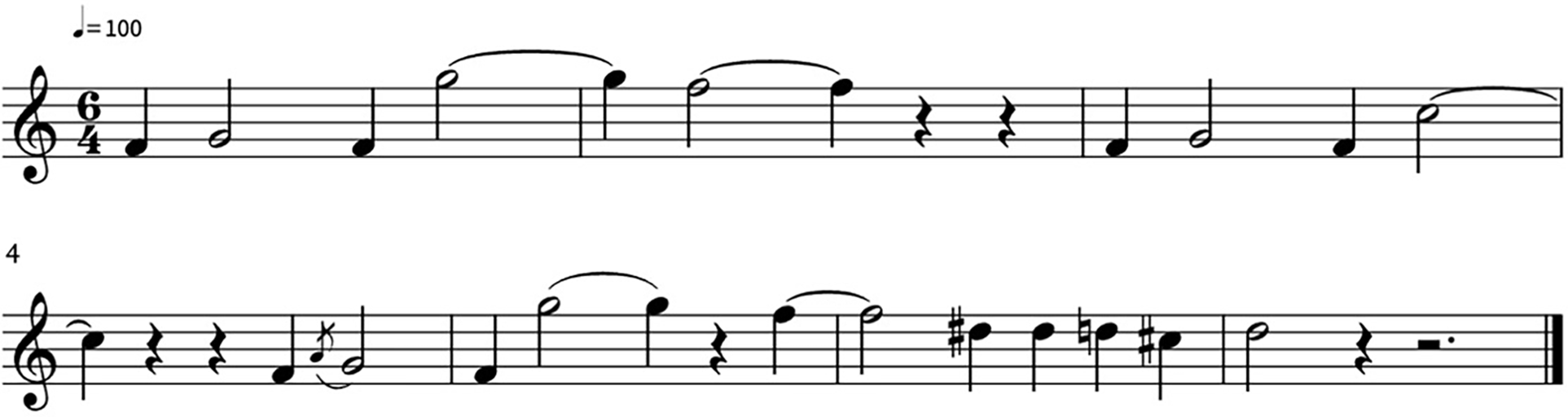
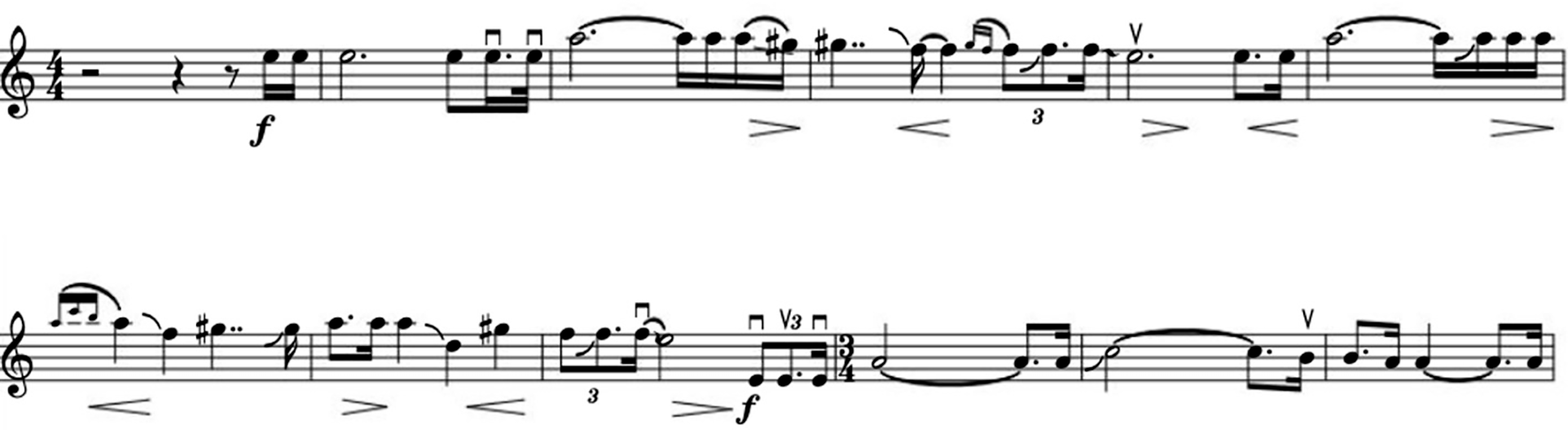
The theme’s association with Anne’s personality begins shortly thereafter, in one of the first scenes inside the annex. Upon learning that Peter van Daan owns a cat, Anne gleefully exclaims, “I love cats!” At the precise moment she says the word “love,” her violin theme returns (see Example 1), highlighting the instrument’s alignment with childlike wonder and non-romantic affection.Footnote 22 Here, the violin communicates exuberance, curiosity, and youthful joy—qualities that foreground Anne’s character as vibrant and emotionally open. This moment also marks the violin’s shift from diary-object to character-theme, but its function remains sentimental, not testimonial.
Alfred Newman, Anne’s Theme, from The Diary of Anne Frank.

As the film progresses, the theme adapts to mirror Anne’s maturation. It appears during episodes of familial tension, holiday reflection, and especially her evolving relationship with Peter. Halfway through the film, in a scene marked by introspection, Anne’s voice appears acousmatically—that is, as a sound we hear without seeing its source, a phenomenon that Michel Chion identifies as central to cinema’s ability to evoke memory, presence, and absence simultaneously.Footnote 23 For Chion, the acousmatic voice holds particular power because it is disembodied and yet intimate, hovering between the real and the imagined. In this moment, Anne’s voice emerges in voiceover: “There is one great change, however—a change in myself.” The violin reenters at this moment with a newly extended, upward-moving variation, coinciding with her admission that she has gotten her period. The development in the theme corresponds not to external trauma but to personal transformation, underscoring the score’s focus on interiority and adolescence. The violin serves here as a musical metaphor for growth, rather than a vehicle for reckoning with the war unfolding outside the annex walls.
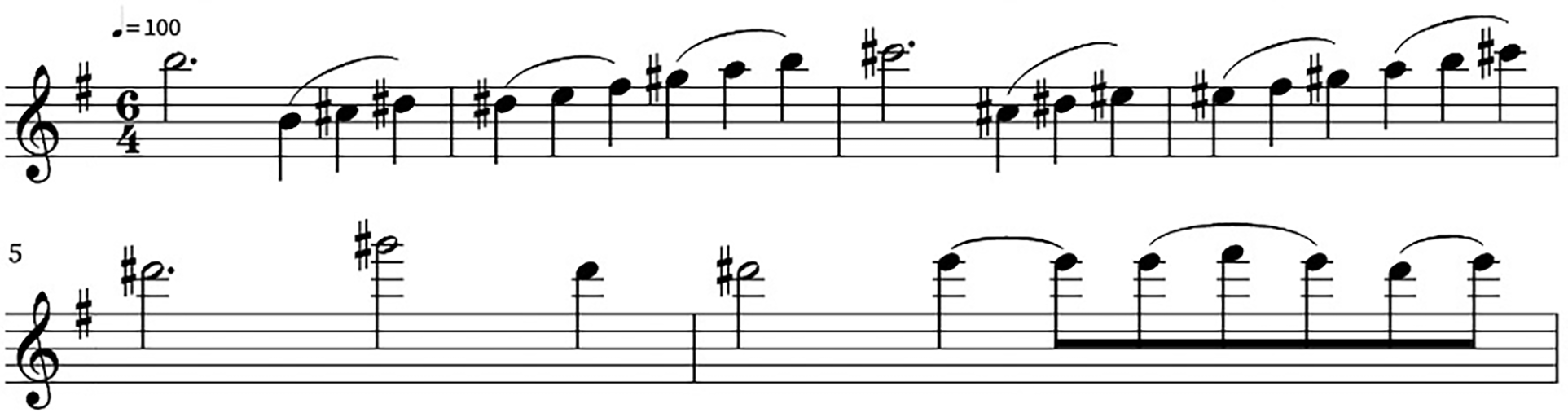
Here, the expansion of Anne’s theme underscores her transition from childhood naivete to a more reflective self-awareness (see Example 2). The lush orchestration and lyrical development of the theme exemplify Hollywood sentimentalism, guiding the audience’s emotional response to Anne’s experience. Rather than engaging with the historical weight of the Holocaust, the film’s score, coupled with Anne’s voiceover, frames this moment within a romanticized coming-of-age narrative, reinforcing a tone of nostalgia and wonder rather than tragedy. As a result, the audience becomes more invested in Anne’s personal journey—her emotions, aspirations, and budding love story—than in the inevitability of her fate.
Alfed Newman, Culmination of Anne’s Theme, from The Diary of Anne Frank.

As the film moves toward its conclusion, the violin reaches its emotional and thematic apex. The final example I want to discuss marks the culmination of Anne’s theme—a moment that encapsulates the film’s full realization of her character arc. By this point, the naïve child from the beginning has been replaced by a young woman who, through Hollywood’s sentimental lens, appears wise beyond her years. The scene presents Anne as a figure of moral clarity, reflecting on the ethical challenges of the world, the depth of her personal growth, and her evolving relationship with Peter. Here, the score reinforces the film’s universalizing tendencies, framing Anne’s development not through the historical specificity of her fate but as part of a broader, almost timeless coming-of-age journey.
The final words the audience hears are Anne’s: “In spite of everything, I still believe that people are really good at heart.” Otto Frank, holding her diary in the annex, replies: “She puts me to shame.” The solo violin returns once more, now surrounded by full strings, lifting Anne’s words into a space of emotional transcendence. And yet, this sonic culmination leaves her fate untouched. The film ends without depicting the arrest, the camps, or her death; instead, it closes on a note of affirmation, shaping Holocaust memory into a narrative of idealism and emotional resilience. The violin, here, serves as a sonic container for this uplift—eloquent, moving, and profoundly American in its sentiment.
In interviews, Newman described his approach as one of spiritual and emotional elevation. “All the music,” he explained, “would be motivated by high ideals, the tenderness and the spiritual qualities inherent in their family life… For Anne, I tried to achieve in her music her youth, her simple candor, her warmth, and her abiding and inspiring faith.”Footnote 24 These are not the materials of testimony, but of American sentimentality. The violin, in this context, is not a witness to atrocity but an emotional register of coming-of-age, rendered in a sonic idiom familiar to midcentury audiences.
To return to Wlodarski, The Diary of Anne Frank offers a case in which music participates in Holocaust representation, but not as a full musical witness. It does not emerge from the imaginative engagement with genocide that characterizes witness as a noun, nor does it invite audiences into an interpretive dialogue with historical trauma as witness as a verb. Instead, the violin theme functions as a stabilizing emotional guide, channeling feeling toward Anne’s personal growth and philosophical idealism rather than toward specificities of Jewish persecution. Its power lies in its beauty, not its testimony.
As Deborah Lipstadt notes, the Broadway adaptation—and by extension, the film—deliberately softened the horror of Anne’s fate, opting instead for an “optimistic upbeat note” that reassured audiences through hope rather than historical reckoning.Footnote 25 Similarly, Lawrence Epstein observes how Anne’s explicitly Jewish reflections were recast in the film as a universal meditation on human suffering—an approach that, while emotionally resonant, flattens the specificity of Jewish persecution and reshapes Holocaust memory into a more palatable, Americanized form.Footnote 26 Seen through the lens of musical genealogy and witness, the violin in The Diary of Anne Frank exemplifies the Normative Period’s reliance on inherited sonic tropes. Its emotive power is undeniable, but its role in mediating Holocaust memory remains tethered to the aesthetics of uplift and emotional coherence. Crucially, this affective strategy does not disappear with the close of the Normative Period. Rather, it establishes a sonic logic—one in which the violin confers moral or emotional resolution at moments when historical representation comes under strain—that will later be reconfigured within new ethical and institutional frameworks.
Schindler’s List
Steven Spielberg’s Schindler’s List debuted in 1993, the same year the United States Holocaust Memorial Museum opened in Washington, DC, a convergence that cemented the Holocaust’s place in American public memory.Footnote 27 By this time, Holocaust remembrance had entered what Assmann calls the Era of the Witness, a period defined by the institutionalization of testimony, the proliferation of educational and memorial practices, and the growing authority of visual and narrative representation in shaping cultural memory. Schindler’s List was both a product and a catalyst for this moment. Widely praised for its humanitarian message and pedagogical potential, the film won seven Academy Awards and drew over 25 million American viewers in its first year. Yet, like the museum, the film also contributed to the crystallization of a particular moral framework—one in which the Holocaust was to be remembered through reverence, realism, and redemptive narrative arcs.
Schindler’s List draws on the visual grammar of classical Hollywood not through sound, but through its carefully composed images and narrative structure. At the heart of this is pastiche—a deliberate blending of visual and narrative techniques from multiple cinematic traditions to produce a layered and multifaceted representation of the Holocaust. Spielberg borrows from earlier styles associated with both Hollywood realism and historical spectacle, but without the critical distance of parody. He blends documentary aesthetics with dramatic visual techniques, producing an ambiguous realism that heightens the film’s emotional impact while making it susceptible to mass reproduction and reinterpretation. This visual pastiche references both Holocaust documentaries, such as Night and Fog (1955/56) and Shoah (1985), and canonical films like Citizen Kane (1941) and The Godfather (1972). Night and Fog, one of the earliest cinematic treatments of the Holocaust, juxtaposes archival footage with present-day images of abandoned camps, cultivating a reflective, unsettling tone. Citizen Kane, by contrast, exemplifies Hollywood’s narrative and visual sophistication, with its deep-focus cinematography, nonlinear storytelling, and psychologically complex protagonist, techniques echoed in Spielberg’s portrayal of Schindler.
In Schindler’s List, Spielberg employs long takes and deliberate camera movements to construct a visual language that draws on both documentary and classical cinematic traditions. He explicitly references Night and Fog through the interweaving of color and black-and-white sequences, reinforcing a connection to earlier documentary forms. Spielberg has also acknowledged that his portrayal of Schindler was influenced by Charles Foster Kane, the central figure of Citizen Kane, describing both as “larger-than-life figures who become rich, who contain both good and evil, and whose motivation is ambiguous.”Footnote 28 These formal and intertextual choices situate Schindler within a lineage of morally complex protagonists while grounding the film’s aesthetic in recognizable cinematic conventions.
While Newman’s score for The Diary of Anne Frank employed the violin as a romanticized leitmotif, John Williams’s score uses it sparingly, reserving it for moments of moral and emotional reckoning. The solo theme, performed by Itzhak Perlman, is not background music—it functions as a sonic claim to witnessing—it is a musical gesture that renders judgment rather than fact and that derives its authority not from testimony itself but from the cinema’s capacity to position music as an ethical surrogate. It does not recount the events of the Holocaust, but it asserts their moral weight. The violin’s restrained, mournful voice occupies a symbolic space, calling the audience not to historical accuracy but to ethical recognition. And yet, the violin’s authority in this context is precarious. While the film uses it sparingly, the cultural afterlife of the theme has made it one of the most recognizable musical motifs of Holocaust representation. Its very success as a sonic icon raises questions about the tension between witnessing and commodification, between ethical sound and marketable sentiment. Read genealogically, the violin’s authority in Schindler’s List does not emerge ex nihilo with the Era of the Witness, nor does it represent a clean break from earlier modes of Holocaust representation. Rather, it reconfigures an affective strategy inherited from the Normative Period—one in which music stabilizes meaning at moments when historical representation strains. What distinguishes Spielberg’s film from The Diary of Anne Frank is not the violin’s structural function but the moral framework within which that function operates. In both films, the solo violin ultimately confers emotional coherence at a point of narrative closure; yet where Newman’s score lifts Anne’s idealism into sentimental transcendence, William’s violin anchors ethical judgment and collective reckoning. Attending to this overlap complicates a strictly linear periodization of Holocaust memory and reveals how Hollywood’s sentimental grammar continues to shape—even under conditions of heightened ethical seriousness—the sonic architecture of cinematic Holocaust representation.
This ambiguity begins with the film’s opening. After a brief candle-lighting ceremony, the image shifts from color to black and white, and the screen is filled with the elegant figure of Oskar Schindler preparing for an evening out. Over this sequence, we hear “Por una Cabeza,” a tango by Carlos Gardel arranged by Angela Morley for the film, performed by solo violin and accordion.Footnote 29 Initially ambiguous in origin, the music is revealed to be diegetic, emanating from a radio in Schindler’s hotel suite. In this moment, music is aligned not with memory or mourning, but with style, seduction, and moral ambiguity. Schindler, adorned with a swastika pin, is not yet positioned as a moral agent but as a man absorbed in the performance of his own charisma, aimed both at those around him and at us as viewers. The tango’s violin strains do not complicate this portrayal; they elevate it, wrapping his self-styling in sensuality and spectacle. The music flatters his image, inviting aesthetic admiration rather than ethical judgment. That the violin first appears as an instrument of Schindler’s self-stylization—and later reemerges as a marker of victimhood—is not incidental; it reveals the instability of musical meaning in a film that repeatedly displaces ethical authority onto sound.
It is not until much later in the film that the solo violin returns, now as non-diegetic score. In a pivotal scene, the women from Schindler’s factory are mistakenly rerouted to Auschwitz. The camera follows them as they are unloaded, their heads shaved and led into a shower room. This sequence, which sparked critical debate for its depiction of the gas chambers, with some scholars like Yosefa Loshitzky accusing Spielberg of violating a visual taboo, is underscored by the mournful return of the violin. The music’s entry is carefully timed: it begins as the women confront the unknown.Footnote 30 Their silence is met not by dialogue, but by the violin’s voice, a substitution that invites the viewers to hear where speech is structurally foreclosed, rather than a recovery of testimony itself. Here, the instrument functions as both an emotional cue and an ethical frame. Its wordless lament locates the audience’s sympathies and guides affective response. The violin does not just heighten the scene’s intensity—it frames its moral stakes, guiding ethical interpretation without claiming to speak from within the historical event.
I have described this elsewhere as a “moral diegesis,” or a sonic structure in which non-diegetic music is deliberately reserved for the victims, constructing a moral distinction between the perpetrators who are surrounded only by the diegetic sounds of their own violence and those they harm.Footnote 31 However, this moral function is not achieved through clear-cut separation alone. The violin often occupies what Robynn Stilwell has termed the “fantastical gap,” a liminal space between the diegetic and non-diegetic realms, where music hovers as if it could belong to both the audience and the characters.Footnote 32 In Schindler’s List, the gap is crucial to the violin’s power. Though the music is formally non-diegetic, it registers affectively as if it emanates from the internal world of the victims, a ghostly lament, a voice assigned to those who cannot speak within the film’s representational limits. In this way, moral diegesis and the fantastical gap work in tandem: the former sets the ethical parameters of sonic alignment, while the latter enables emotional slippage across narrative boundaries. The result is a form of musical witnessing that is both authoritative and intimate, external and yet deeply embedded in the felt world of the film.
The final and most iconic use of the violin comes near the film’s end (see Example 3). Schindler, now a fugitive, is given a ring by his Jewish workers, engraved with the Talmudic phrase, “Whoever saves one life, saves the world entire.” As he breaks down, lamenting that he could have saved more lives, the solo violin enters. It plays the full statement of Williams’s theme and crystallizes the film’s moral architecture. Schindler is not only forgiven; he is mourned in advance. The violin here is elegiac, not just for the dead but for the possibility of redemption. It is now a musical witness as a product, a crafted musical object that carries the emotional charge of memory, even if it cannot offer documentary precision. The very clarity with which the violin is positioned as an ethical voice within the film is what enables its later detachment, making it both legible and transferable across contexts that no longer require historical specificity.
John Williams, Theme from Schindler’s List.

But it is precisely this powerful legibility that renders the theme vulnerable. In the years following the film’s release, the Schindler’s List violin theme became one of the most circulated pieces of film music in history. Skater Katarina Witt performed to it at the 1994 Olympics. It has been arranged for solo piano, cello duet, and electronic remixes and appeared in countless memorial events and popular playlists.Footnote 33 On Spotify alone, it has been recorded and redistributed in over 250 different versions. Its original context, carefully tethered to a specific moral diegesis, is no longer required.
The violin now functions as a sort of “severed sonic icon”: a sonic artifact so thoroughly abstracted from its historical origins that it no longer bears witness to a specific past but instead operates as emotional shorthand for generalized sorrow, loss, and moral gravitas. It cues audiences to feel, but not necessarily to remember, to respond affectively without the burden of context or historical specificity.
Applied here, a genealogical perspective helps illuminate how the Holocaust violin came to carry its specific constellation of emotional and ethical meanings. Rather than asking where this sonic figure “came from,” the question becomes: how did the Schindler’s List violin theme come to signify grief, moral clarity, and Jewish memory at a specific historical moment—and how did that signification mutate over time into something more symbolic than situated and more consumable than commemorative?
In the case of Schindler’s List, the violin’s authority emerges from a convergence of 1990s memory politics, Holocaust institutionalization, and the stylistic legibility of classical Hollywood scoring. Williams’s theme, anchored by Perlman’s performance, is placed carefully within the film’s moral diegesis, used sparingly and only for the victims, establishing it as a sonic vessel for ethical weight.Footnote 34 However, the theme’s post-film afterlife on skating rinks, playlists, and TikTok reels reveals how easily its affective resonance could be detached from that moral structure. What once marked ethical seriousness now risks flattening historical complexity.
Schindler’s List thus marks a turning point in the sonic representation of the Holocaust. The violin becomes not just a musical instrument but also a carrier of memory, judgment, and mourning. Yet, in its very success, it also illustrates the risk at the heart of Holocaust representation: that in striving to witness through beauty, we may unwittingly aestheticize trauma into a gesture of feeling that no longer asks anything of us.
The Song of Names
The Song of Names (2019), directed by François Girard (also the director of The Red Violin, 1998) and scored by Howard Shore, is based on Norman Lebrecht’s historical novel of the same name. Though a Canadian production, the film resonates broadly with contemporary global trends in Holocaust cinema, especially the increasing turn toward aestheticized, post-testimonial forms of remembrance. Winner of Canadian Screen Awards for both Best Original Score and Best Original Song, the film departs from the testimonial realism of earlier Holocaust films and instead offers a speculative, affective meditation on absence, identity, and the limits of memory.
Spanning fifty years, The Song of Names traces the story of Dovidl Rapoport, a gifted Jewish violin prodigy from Warsaw who is taken in by the non-Jewish Simmonds family in London in 1939. As Dovidl’s family is deported to Treblinka and contact with them ceases, the violin becomes both his expressive outlet and the symbolic site of a growing rupture. When Dovidl mysteriously vanishes just before his concert debut in 1951, the act fractures both his surrogate family and his own sense of belonging. It is only decades later, in 1991, that Martin Simmonds—Dovidl’s foster brother—follows a musical clue to a hidden community in New York, where Dovidl has become a Talmudic scholar. Across this journey, the violin emerges not only as a narrative thread but also as a speculative sonic archive, its meaning accruing genealogically, layered through historical fracture, invented ritual, and cinematic memory work.
The violin in The Song of Names tests the boundaries of musical witness. Rather than offering a clear act of testimony, it gestures toward what cannot be remembered firsthand, positioning music as an imaginative stand-in for historical absence. If earlier films relied on music to underscore lived experience or to universalize emotional resonance, this film asks, what happens when music must carry the burden of what was never known, never recorded, never named? In this context, the violin operates at the speculative edge of Wlodarski’s model; it becomes a surrogate for a voice that does not exist. Its authority does not stem from origin but from its accumulated resonance across cinematic and ritual forms. This shift raises urgent ethical questions: Can invented music bear witness to historical trauma? What are the risks of transforming unrecorded suffering into a beautiful, mournful sound? And how might such a gesture honor the dead without aestheticizing their erasure?
Read through Assmann’s model, The Song of Names exemplifies the post-witness condition not simply because it turns to imaginative or invented forms, but because it stages those inventions under the lingering authority of witness-era memory culture. The film’s temporal structure—moving between 1939, 1951, and 1991—folds multiple memory regimes into a single narrative, placing the remnants of testimonial realism, institutional commemoration, and postmemorial speculation into uneasy proximity. In this sense, the post-witness does not replace the Era of the Witness; it metabolizes it. The violin’s “speculative archive” is therefore not free-floating aestheticization but a historically conditioned response to an epistemic limit: the desire to sound what cannot be recorded in a cultural landscape still shaped by expectations that remembrance be publicly performable.
From its opening scenes, the film positions the violin as inseparable from Dovidl’s identity. In his early youth, he is depicted as brash and self-assured—a virtuoso who tells his instructor, “Kreisler is not Rapoport.”Footnote 35 While his brilliance marks him as singular, it also isolates him from others, underscoring the tension between individual artistic expression and communal belonging. The violin here represents both potential and precarity: a sonic embodiment of Dovidl’s ability to survive through art, but also a harbinger of the dislocation to come. At this point in the film, the violin remains tied to ego, to performance, and to exceptionalism—its symbolic meaning still closed off from the genealogical work of memory.
That shift begins when Dovidl encounters a recitation known as the Song of Names in London’s Jewish district. After falling asleep on a bus, he wakes in an unfamiliar neighborhood and stumbles into a gathering of Polish Holocaust survivors. There, he hears the Song for the first time—a chant in which the names of murdered Jews are spoken aloud in a melodic cadence that recalls both Yizkor (memorial) services and the lamentations of Tisha B’Av, the annual day of mourning for the destruction of the Temples and other Jewish tragedies.Footnote 36 Shore’s composition, though fictional, draws deeply from Jewish liturgical structures, anchoring the film in sonic traditions of grief and spiritual continuity. Yet, this moment does not reclaim a lost tradition so much as construct one. The invented ritual performs a kind of genealogical recomposition, borrowing liturgical texture and affective cadence to manufacture continuity in the wake of rupture. The violin, too, begins to shift in meaning: no longer just an instrument of virtuosity, it becomes a vessel for memory, a possible bridge to the dead.
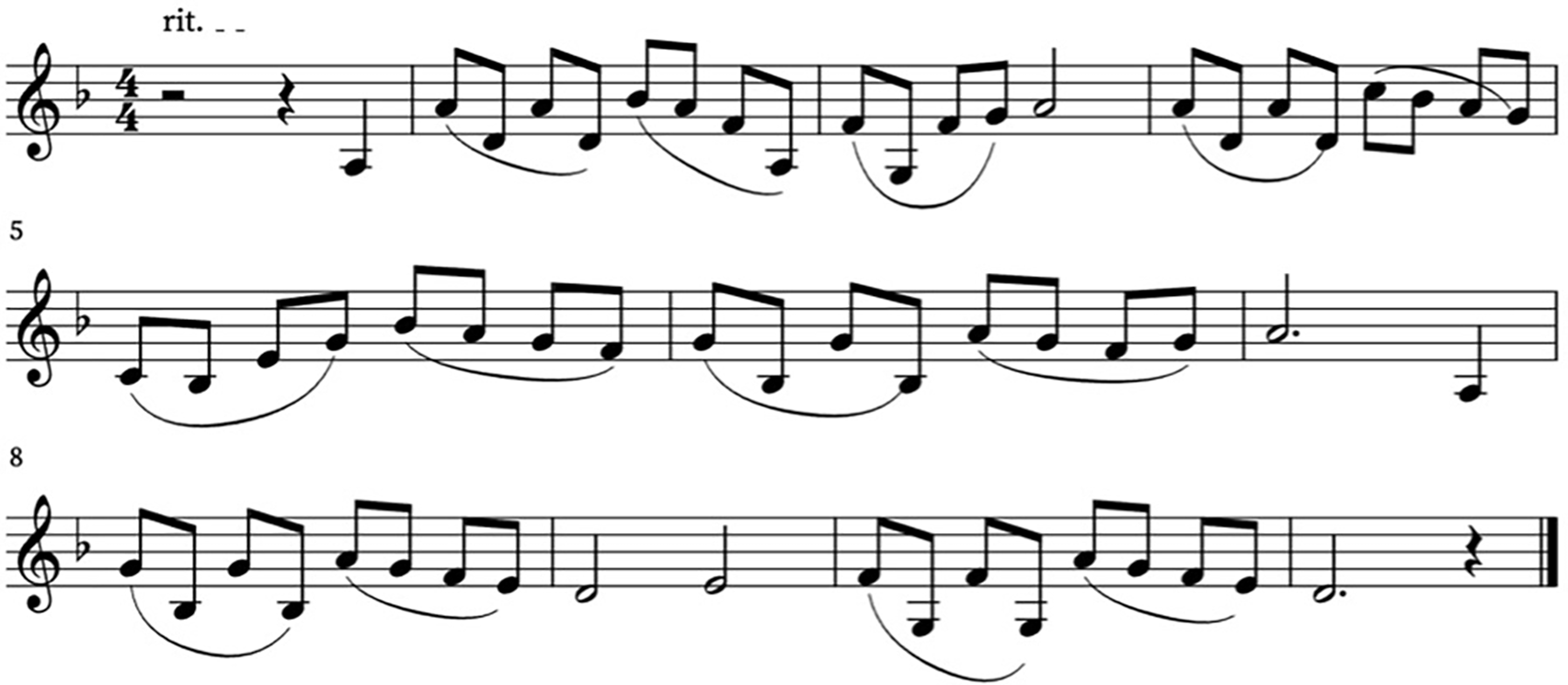
Although there is no historical precedent for a literal Song of Names ritual, the film treats it as an act of musical witnessing—and in doing so, foregrounds the ethical volatility of invented memorial forms in the post-witness era. It neither reconstructs historical experience as in Schindler’s List nor sentimentalizes childhood as in The Diary of Anne Frank. Instead, it fabricates a sonic rite—part prayer, part performance—through which Dovidl can finally confront the ungrievable. This culminates when he travels to the fields of Treblinka, violin in hand. There, he performs his own version of the Song (see Example 4), not a spoken naming of the dead, but a wordless instrumental elegy.Footnote 37
Howard Shore, Song of Names, Violin Theme.

The absence of actual names becomes the point: the violin voices what cannot be said, what was never recorded. As the melody dissipates into silence, the act of playing becomes dialogical—not with a known past, but with a historical void. The violin here performs genealogical labor, standing in for a ritual that never existed, sounding the rupture left by lives that cannot be named. In Wlodarski’s terms, this is a moment of speculative witnessing: music standing in for a historical record that never existed, an elegy for the 800,000 unnamed victims among the approximately 925,000 murdered at Treblinka.Footnote 38
When Martin confronts Dovidl about his vanished concert decades earlier, Dovidl agrees to return to the stage—but with a redefined purpose. In the film’s closing scene, he performs not as a prodigy but as a mourner, converting the concert hall into a ritual space where personal catharsis and collective remembrance briefly merge. The music here does not testify to what was seen or survived but to what was irretrievably lost. It is not archival. It is not a documentary. Instead, it is a postmemorial act of sonic speculation, shaped by the aesthetic and ethical pressures of a world without witnesses.
The ethical stakes are significant. The film risks aestheticizing trauma through invention, but it also resists the narrative closure or redemptive arc that often characterizes such gestures. Rather than presenting the violin as a transcendent solution, it acknowledges its limitations: the performance does not resurrect the dead, nor does it fully repair Dovidl’s ruptured identity. Instead, it offers an attempt, a sonic gesture toward what Wlodarski describes as a living, evolving dialogue between past and present, one that resists finality.
In this final phase of the violin’s cinematic genealogy, its meaning is no longer anchored in sentiment or testimony but in the speculative labor of post-witness sound. The violin becomes a discursive site where cultural memory is not recovered but assembled layer by layer, through rupture, ritual, and cinematic aesthetics. The film thus confronts the central dilemma of twenty-first-century Holocaust remembrance: Can imaginative forms of witnessing honor the dead without distorting them? Can art mourn what history cannot name? Song of Names offers no definitive answer, but in its refusal of resolution lies its power. The violin is not a fixed symbol; it is, once again, an ever-changing, mediated process.
Sonic Afterlives and the Circulation of Memory
Listening genealogically to Holocaust cinema reveals something that visual historiographies often obscure: memory regimes do not replace one another cleanly but overlap, layer, and recur—often audibly. Across seventy years of film, the solo violin has returned not as a fixed symbol of suffering or remembrance, but as a historically contingent sonic mechanism whose authority is repeatedly reconfigured. Its persistence marks neither linear progress nor simple rupture, but the accumulation of affective, ethical, and institutional expectations about how the Holocaust should sound. Tracing the violin’s cinematic genealogy from The Diary of Anne Frank to Schindler’s List to The Song of Names, this study has shown how the instrument shifts from sentimental universalism to moral certitude to speculative absence. Yet these modes fail one another neatly. Elements of Hollywood uplift and persist within witness-era solemnity; witness-era authority continues to shape post-witness invention. Sound makes this porosity audible. The violin stabilizes meaning at moments when historical representation strains, even as the ethical frameworks governing that stabilization change.
Taken together, these case studies suggest that Holocaust memory does not advance by shedding earlier representational forms but by reworking them. In the Normative Period, the violin channels memory toward emotional reassurance, shaping atrocity into interior development and moral affirmation. In the Era of the Witness, it acquires institutional gravity, positioned as an ethical voice capable of conferring seriousness, judgment, and legitimacy. In the Post-Witness Period, that authority does not disappear; it is reactivated under conditions of absence, where music is asked to sound what was never recorded and to mourn what cannot be named. What changes across these films is not simply what the violin signifies but what cultural and ethical labor it is asked to perform.
This sonic genealogy complicates a strictly linear reading of Holocaust memory and modifies existing periodizations by revealing their permeability. While Assmann’s model remains indispensable, attending to sound exposes how earlier listening regimes persist within later ones, shaping affective response long after their original historical contexts have passed. Musical meaning accrues historically, but it also travels—detaching, recombining, and acquiring new force as it circulates across films, institutions, and media environments.
The afterlife of the violin theme in Schindler’s List makes these dynamics especially visible. Once abstracted from its carefully constructed moral diegesis, the theme circulates as an emblem of generalized sorrow and ethical seriousness, often without reference to its original narrative or historical specificity. Its portability raises pressing questions about how sonic recognition can substitute for contextual knowledge, how inherited musical gravity shapes contemporary commemorative practices, and how sound participates in the normalization of Holocaust memory within late-capitalist media ecologies.
Approaching Holocaust cinema through sonic genealogy thus opens new avenues for inquiry. It invites scholars to examine not only how memory is represented but also how it is heard—how sounds accrue authority, how they migrate across platforms and institutions, and how their ethical meanings shift in the process. It also asks us to reckon with the risks of sonic mediation: that music may offer affect without obligation, feeling without friction, or mourning without historical demand. To listen to the violin in Holocaust cinema, then, is not to encounter testimony itself, but to confront the conditions under which memory continues to be made audible. In a post-witness world, where the past no longer speaks for itself, how we listen—and what we allow sound to stand in for—becomes an ethical question. Attending to sound and its genealogies is therefore not simply an aesthetic concern but a critical necessity for understanding how Holocaust memory endures, transforms, and sometimes drifts beyond its historical moorings.
Acknowledgements
This article is the product of sustained scholarly collaboration, and I am deeply grateful to the UCLA community—especially the Herb Alpert School of Music—and to Joy Calico, Ray Knapp, Holley Replogle-Wong, and Mark Kligman for the invitation to present the final stages of this project. I owe particular thanks to Mark Kligman for his invaluable guidance on Jewish prayer modes, which significantly enriched my thinking. I am also grateful to Aaron Fruchtman for his contributions through both his research and our conversations. My sincere appreciation extends to Amy Wlodarski and Rachel Schaff, whose insights, friendship, and support were instrumental in refining the arguments presented here; engaging with their scholarship and generosity has been essential to this work. I am especially indebted to Martin Kavka, whose course, “Meaning after the Holocaust,” first sparked the line of inquiry that underpins this project. This article is dedicated to Professor David Shneer, who once quipped, “Every film about the Holocaust must have a violin.” Said in passing, the remark contained a kernel of truth that ignited this work. May his memory be a blessing.
Kathryn Agnes Huether is a postdoctoral research associate in antisemitism studies at UCLA’s Initiative to Study Hate and the Alan D. Leve Center for Jewish Studies. She holds a PhD in musicology from the University of Minnesota and an MA in religious studies from the University of Colorado Boulder. Her research examines how sound mediates Holocaust memory, antisemitism, and contemporary politics.

 Open access

