


Introduction
Most international conservation continues to be devised and directed by a small but influential group comprised of conservation organizations, donors and advisers. Despite widespread rhetoric concerning participation, local consultation and democratic approaches remain largely absent. What has been widely overlooked is that local people are not necessarily opposed to conservation. Although specific priorities may differ, there is often much more common ground between externally defined conservation priorities and local predilections than commonly assumed. Such shared interests provide opportunities for building tactical partnerships to achieve conservation with other agendas, such as industrial and agricultural development.
Partnerships are today seen as a primary route to sustainable and equitable development (Commission on Sustainable Development, 2004). National and international policy holds hope for many forms of partnership, from public-private partnerships between business and governments, through strategic partnerships between business and civil society, to tri-sector partnerships among all three. Most far-reaching to date is Millennium Development Goal 8, which calls us to 'develop a global partnership for development', through multilateral cooperation among governments and the private sector (United Nations, 2000). Partnerships have also become central to the strategies of international conservation agencies such as Conservation International, WWF, and Fauna & Flora International, which advocate a full spectrum of partnerships from multi-national corporations through to local communities. Partnerships between conservation agencies and multinational businesses have strong foundations and tend to entail mutual planning, joint equity, and accountability of both partners (Earthwatch, 2002; Tennyson, Reference Tennyson2002).
Here, we argue that applying similarly high standards of partnership to relationships between conservation agencies and local community-based groups will increase potential for more effective and sustainable conservation outcomes. We define a partnership as a lasting agreement actively entered into on the expectation of net benefit by two or more parties. High standards of partnership mean commitments to sharing decisions, rights, responsibilities and risks equitably among partners; examples are given below. Partnerships are strengthened when both sides perceive an improved return on their investment in the relationship, in turn stimulating further investment and cooperation. Such cooperative relationships, founded on existing shared conservation values, may provide one of the best mechanisms for sustainable conservation.
Challenges for conservation
Unavoidability of trade-offs Modern conservation priority-setting can give the impression that the making of choices concerning what to conserve is a sophisticated objective science (Margules & Pressey, Reference Margules and Pressey2000; Myers et al., Reference Myers, Mittermeier, Mittermeier, da Fonseca and Kent2000). However, although ecologists have proposed various technical measures, such as metrics of rarity, vulnerability or distinctiveness (Magurran, Reference Magurran2003), conservation agencies usually emphasize charismatic species, environmental services, or future utility values for pharmaceuticals or agriculture (Brooks et al., Reference Brooks, Mittermeier, da Fonseca, Gerlach, Hoffmann, Lamoreux, Mittermeier, Pilgrim and Rodrigues2006). All conservation priority-setting, however scientific it appears, is based ultimately on subjective human preferences, be they widely shared or held by a small influential group (Vermeulen & Koziell, Reference Vermeulen and Koziell2002). Consensus across stakeholder groups is possible, however, and formal conservation assessments can be a useful tool within partnerships (Gelderblom et al., Reference Gelderblom, van Wilgen, Nel, Sandwith, Botha and Hauck2003).
Motives The oft-voiced concern (Sanderson & Redford, Reference Sanderson and Redford2003) that short-term development options take precedence over local conservation is no different at a global scale: tropical forests are still 'worth more dead than alive' (Terborgh, Reference Terborgh1999). Thus, pro-conservation motives are unlikely to be based solely on economic arguments. Conservation is, rather, an ethical desire or preference that society will support if enough people agree (Jenkins, Reference Jenkins1998; Bulte & van Kooten, Reference Bulte and van Kooten2000). Surveys of various human societies reveal widespread ‘biophilia’ and belief that nature has a right to exist even if not useful to humans (van den Born et al., Reference Van den Born, Lenders, de Groot and Huijsman2001). Tapping into these social norms and other non-economic motives can provide powerful incentives for conservation that are distinct from law and profit (Uphoff & Langholz, Reference Uphoff and Langholz1998).
Costs Fences and other forms of imposed protection can work (Bruner et al., Reference Bruner, Gullison, Rice and da Foncesca2001) but the human costs of such interventions, including heavy-handed policing, forced migration, and even deaths, can be hard to justify (Rajpurhit, Reference Rajpurhit1999; Geisler & de Souza, Reference Geisler and de Souza2001). Protected areas often override long-term land and resource rights (Ghimire & Pimbert, Reference Ghimire and Pimbert1997). While benefits accrue globally, tropical conservation often entails major local costs that are seldom adequately compensated or mitigated (Balmford & Whitten, Reference Balmford and Whitten2003). Emerging environmental service payment schemes aim to share costs more equitably among beneficiaries (Ferraro & Kiss, Reference Ferraro and Kiss2002) but are not suited to all circumstances (Wunder, Reference Wunder2005).
Implementation difficulties Although conservation priority-setting occurs in a global setting, conservation outcomes represent the result of numerous local processes. While protected areas have expanded in recent years (IUCN, 2003), coverage will always be incomplete. Much biodiversity will remain, at least initially, in inhabited landscapes where imposing complete protection is difficult and usually impractical.
Conflicts Projects are often designed without local input or consultation and efforts to gain local acceptance are sought later (SharpeReference Sharpe, 1998; Campbell & Vainio-Mattilia, Reference Campbell and Vainio-Mattilia2003). In contrast, we argue that local cooperation should be central, not peripheral, as local objections can override the best conservation intentions. Joint objective-setting, planning and implementation can decrease conflict and thus reduce costs (Buckles, Reference Buckles1999).
Local people: part of the solution, not part of the problem
Rather than viewing local people as part of the conservation challenge, to be educated, compensated or given economic alternatives, we propose that local priorities for conservation should be placed at the centre of joint conservation strategies. While similar calls have been made before (often focusing on large existing protected areas, e.g. Brownrigg, Reference Brownrigg1982; Clad, Reference Clad1984; Infield, Reference Infield2001), we believe partnerships offer a much broader scope and greater opportunities than commonly recognized. Furthermore, even where global and local priorities for conservation and/or development diverge, there are opportunities for tactical partnerships between global and local interest groups to negotiate with other agencies such as governments, businesses and corporations.
Shared conservation values Destructive impacts on nature are unexceptional in both modern and traditional societies (Ellen, Reference Ellen1986; Johnson, Reference Johnson1989; Attwell & Cotterill, Reference Attwell and Cotterill2000). Indigenous conservation may not be motivated by recognizable western style conservation motives (Berkes et al., Reference Berkes, Colding and Folke2000). The concept of the noble savage has largely been laid to rest (Ellen, Reference Ellen1986) and we are not suggesting its resuscitation. However, the commonplace pessimism about the inevitable decline of nature in the face of human selfishness must not blind us to the common opportunities offered in the fact that delight in nature, and conservationist sympathies, do appear to be near universal human characteristics (Lockwood, Reference Lockwood1999; van den Born et al., Reference Van den Born, Lenders, de Groot and Huijsman2001) and that concerns about the natural world are remarkably consistent across cultures (Schultz & Zelezny, Reference Schultz and Zelezny1999; Bandaral & Tisdell, Reference Bandaral and Tisdell2003). Ultimately, conservation is something that most people are willing to support to some degree. Even those penalized by conservation projects accept the need for conservation interventions more generally (McLean & Stræde, Reference McLean and Stræde2003). A study in East Kalimantan, Indonesia, showed that virtually everyone, from remote villagers to town-based civil servants, agreed on the need for forest conservation and controls on logging and conversion (Padmanaba & Sheil, Reference Padmanaba and Sheil2007). Hostility towards specific conservation initiatives is frequently encountered among local communities but this usually results from the neglect of their own concerns, or from perceived abuses by executing agencies, rather than any genuinely anti-nature sentiments (Sharpe, Reference Sharpe1998). Similarly, those who rely on wild products do not wish to see them decline. People will often welcome regulation of their own use of species and ecosystems if administration is seen to be necessary, just and fair (Borrini-Feyerabend et al., Reference Borrini-Feyerabend, Pimbert, Farvar, Kothari and Renard2004).
Strong basis for practice There is evidence of societies maintaining regulatory systems that aid living within ecological limits. Darwin, for example, noted that Inca hunters liberated the “most beautiful and strong” deer to improve future stock (Darwin, Reference Darwin1868). Such rules and norms still survive, although often in modified form (Table 1), and are not necessarily declining in relevance. Positive conservation outcomes, or at least the wish to achieve such outcomes, continue and evolve in spite of threats and constraints (Brechin et al., Reference Brechin, Wilshusen, Fortwangler and West2002). Capitalizing on these opportunities is not a matter of relying on traditional or intrinsic conservation values but rather of investing in dynamic social institutions. In Ecuador, for example, people have agreements to control hunting in local territories, designed mainly to reduce social conflict, but also valuable to conservation (Holt, Reference Holt2005).
Examples of important aspects of local conservation agendas.
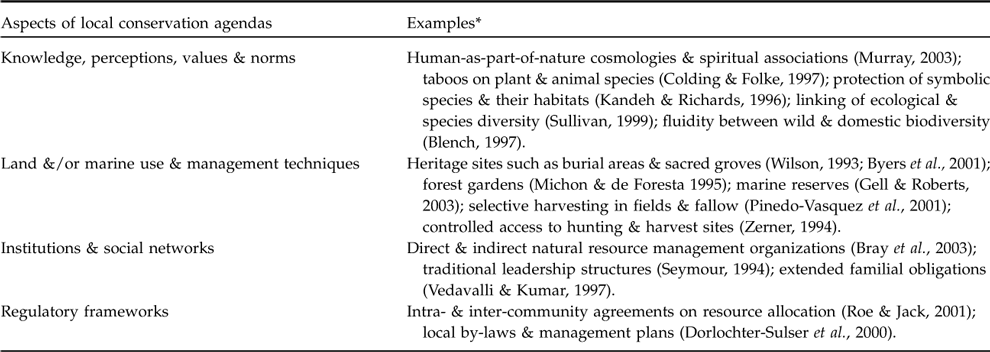
* Johannes (Reference Johannes1978) reviews many oceanic marine examples that are not repeated here.
Tactical alliances International conservation agencies have a legacy as both an ally and a foe of local conservation-friendly groups (Guha, Reference Guha1997; Chapin, Reference Chapin2004). Such agencies are under increasing scrutiny, questioned on democratic issues of representation and accountability (Christensen, Reference Christensen2003; Romero & Andrade, Reference Romero and Andrade2004). Working with local people makes the most of both insider and outsider knowledge (Sheil et al., Reference Sheil, Puri, Wan, Basuki, van Heist, Liswanti, Rukmiyati, Rachmatika and Samsoedin2006) and can provide conservation agencies with greater legitimacy and greater ability to influence policy (Apte, Reference Apte2005). Partnerships can nurture better informed and sympathetic partners more receptive to the insights and benefits of conservation science (Lee, Reference Lee1993; Shanley & Gaia, Reference Shanley and Gaia2002).
Gathering experiences Successful community scale conservation projects may be more widespread than commonly recognized. Such projects can operate on low budgets, with little external support or opportunities for publicity. Nonetheless, a small but significant literature shows that local conservation partnerships can and do work (Shanley & Gaia, Reference Shanley and Gaia2002; Horwich & Lyon, Reference Horwich and Lyon2007). Greater efforts should be invested in identifying such examples, evaluating their achievements and sharing the many lessons these projects can provide (Horwich & Lyon, Reference Horwich and Lyon2007).
Why are there not more partnerships with local interest groups?
Mindset reasons Many influential organizations in global conservation continue with the apparently deep-rooted assumptions that in tropical countries local people seldom hold significant conservation values, that conservation must be imposed, and that strict protection works best. Success stories to contradict such claims are poorly recognized and are typically viewed as exceptions (Sheil & Lawrence, Reference Sheil and Lawrence2004). Yet, elsewhere, engagement is seen as the key to effective practice. For example, successful conservation of striped sea bass along the east coast of the USA is attributed to cooperation among several state and local governments, commercial and local fishermen, restaurateurs, and biologists (Pierce & Kennedy, Reference Pierce and Kennedy2002). Such negotiated solutions are seldom sought in poorer countries where weak governance is more common and pro-conservation lobbying comes more from foreign than from local voices.
Practical reasons Partnership agreements can be understood as business relationships. Doing business is more difficult where there are fewer formal local institutions and weaker support from government services, insurance and credit agencies, and the legal system. There are few precedents. Poor people in poor countries tend not to have the set of state-recognized rights and assets familiar to conservationists from western countries (de Soto, Reference De Soto2003; Cousins et al., Reference Cousins, Cousins, Hornby, Kingwill, Royston and Smit2005). Meanwhile, conservation professionals are now expected to incorporate community participation into their projects but they are often academic biologists who may not be well versed in relevant methods and approaches and ill-placed to develop and oversee them (Sheil & Lawrence, Reference Sheil and Lawrence2004; Adams, Reference Adams2007). Low numbers of rural extension staff in poorer tropical countries compound these problems (Anderson, Reference Anderson2004).
How could partnerships be effective?
Apply high standards Partnership implies equity and freedom of choice between two parties. Most contemporary conservation projects include community participation but to varying degrees (Campbell & Vainio-Mattila, Reference Campbell and Vainio-Mattilia2003). Higher standards of partnership involve more explicit and equitable sharing of decision-making powers, rights of access and use, investments of land, labour and money, the risks and costs associated with these investments, and financial and other returns. In formal terms, partnerships can be understood as a means to share the portfolio of risks associated with an undertaking (e.g. climatic, ecological, regulatory, safety, labour and financial risks). Equitable sharing of risks involves partners working out a shared strategy for risk management: in a hypothetical example of a community-based ecotourism project, a conservation agency may agree to shoulder and mitigate regulatory risks (e.g. any complaints brought against the project) whilst local partners work to reduce safety risks (e.g. damage to fields and livestock by wild animals). Both investments and returns to conservation are not necessarily monetary. Conservation agencies may seek stronger partnerships particularly to increase environmental returns, while local partners may emphasize social returns, such as strengthened land and resource rights (Borrini-Feyerabend et al., Reference Borrini-Feyerabend, Pimbert, Farvar, Kothari and Renard2004). Importantly, partnerships do not have to be about full participation in every aspect of planning and management.
Be pragmatic Conservation must be pragmatic. Notions of community or tradition are harmful if they encourage naivety, reduce vigilance and ignore contemporary pressures (Redford & Stearman, Reference Redford and Stearman1993; Agrawal & Gibson, Reference Agrawal and Gibson1999). Two requirements are critical for functional institutions in natural resource management and conservation. The first is a set of clear, agreed and enforceable rules. These should address resource access, use and management, and include checks and balances on how decisions are made and by whom (Brown, Reference Brown2003). The second is clear channels of accountability, both of partners to each other, for example via regular reporting and contingent activities, and of each partner to their own constituency, for example via locally public information on the spending and outcomes of conservation projects (Chapin, Reference Chapin2004). But there are also trade-offs between democratic ideals and local possibilities. Many conservation development agencies have tried to set up de novo elected committees, with equal representation of gender and ethnic groups. These tend not to be taken seriously by local people and wither away once funding dries up (Seymour, Reference Seymour, Western, Wright and Strum1994). In a suite of non-perfect options, extant local institutions offer better opportunities than external alternatives (Bigg & Satterthwaite, Reference Bigg and Satterthwaite2005). Other sectors have many lessons to offer on partnerships with local people. Experience in timber production, for example, highlights the necessity of provisions for regularly renegotiating agreements and the importance of third party supporters, such as brokers, insurers and development agencies (Vermeulen & Mayers, Reference Vermeulen, Mayers and Ros-Tonen2006).
Allow enough time Building effective cross-cultural partnerships poses various challenges. Local language and cultural barriers can be obstacles to communication (Sheil & Lawrence, Reference Sheil and Lawrence2004). Some communities have been effective in local conservation in large measure because they are suspicious of outsiders and their motives. It takes time to build understanding and trust (Sheil & Boissière, Reference Sheil and Boissière2006). Some lessons are learned only by making mistakes: many institutions and their donors that want quick results can find such a learning process hard to accept (Redford & Taber, Reference Redford and Taber2000).
Recognize costs and trade-offs Joint institutions will work well only if the costs of partnership are less than the perceived benefits for each stakeholder, local and otherwise. Benefits may not be readily perceived from the outset. Even with widely shared goals, incentives to engage will vary widely among local people depending on factors such as their gender, education and livelihood, posing a challenge to community-based approaches (Spiteri & Nepal, Reference Spiteri and Nepal2006). Tried and tested tools for negotiating trade-offs and building consensus among competing local interest groups are becoming more accessible. A good example is the multi-stakeholder trade-off negotiation tool developed for marine resources in the Caribbean (Brown et al., Reference Brown, Tompkins and Adger2002).
Use the unique opportunities of conservation Conservation deals with complex ecosystems and one way that conservation partnerships can offset risk is through ‘no-regrets options’: where there is uncertainty over ecological outcomes, a policy package that includes social and economic interventions is preferred to one seeking ecological outcomes only (Dovers et al., Reference Dovers, Norton and Handmeer1996). Multi-stakeholder management can strengthen conservation planning by bringing together different experiences, which translate into a broader range of knowledge and skills with which to address the problems that arise (Gelderblom et al., Reference Gelderblom, van Wilgen, Nel, Sandwith, Botha and Hauck2003). Many of the principles of co-management and other partnership models for natural resources have arisen from lessons gained in conservation. Examples include devolving authority to institutions matched in scale with managed ecosystems, and applying principles of adaptive management (Brown, Reference Brown2003). Such developments have additional benefits. For example, partnering in conservation activities has proved a means of developing local people's sense of their own worth and the worth of their environment (Sheil & Lawrence, Reference Sheil and Lawrence2004; Van Rijsoort & Zhang, Reference Van Rijsoort and Zhang2005).
Recognize and build on examples Without rigorous analysis we cannot know whether partnerships really work (Ferraro & Pattanayak, Reference Ferraro and Pattanayak2006). However, some mainstream agencies have experimented with building stronger community partnerships. Some long-running examples are successfully improving conservation outcomes and gaining local support (Arambiza & Painter, Reference Arambiza and Painter2006; Horwich & Lyon, Reference Horwich and Lyon2007). Alliances between indigenous peoples and conservation organizations in Brazil, for example, have already supported official recognition of approximately one million km2 of indigenous Amazonian territories, and ensuring effective long-term partnerships is crucial for achieving conservation outcomes in these biologically rich territories (Schwartzman & Zimmerman, Reference Schwartzman and Zimmerman2005).
Conclusions
Authoritarian approaches to imposing conservation may claim some success in the tropics but are becoming increasingly indefensible. Partnerships provide a more democratic approach to decision making in conservation and have both ethical and pragmatic justifications. The ethical rationale is that natural resource governance should be legitimate and subject to democratic control; conservation's costs and benefits should be distributed equitably. The pragmatic rationale is that partnership could lead to more effective and economical conservation by avoiding costs associated with conflict and leading to more intrinsically sustainable conservation programmes.
Conservation agencies recognize that broad-based public support is needed for effective conservation. Most people are willing to support some form of local conservation. Such inclinations take various guises in different cultures, contexts and societies but many offer some basis for developing partnerships with external conservation interests. Such partnerships can help nurture a popular and democratic form of conservation that is distinct from the top-down interventions that continue to dominate in many tropical regions. Partnerships are by no means a panacea for global conservation, nor for the friction between conservation and economic development at local levels. But commitment to stronger forms of partnership, in which serious attention is given to equity in decision making, risk taking and investment, would be a great improvement on the highly inequitable models for conservation that continue to dominate international conservation efforts in the tropics.
Acknowledgements
We thank David Kaimowitz, Sven Wunder, Jeff Sayer, Sandeep Sengupta, Dilys Roe, Jack Putz, Miriam van Heist, Meilinda Wan, Claire Miller and Indah Susilanasari for comments and/or help in preparing this article. DS is funded by grants to CIFOR from the European Commission and the Swiss Development Corporation.
Biographical sketches
Sonja Vermeulen's main interests are the political and institutional mechanisms to tackle inequality in forest and land management, tools and tactics for disadvantaged managers of natural resources to make greater impact on policy, refinement of perceptions of biodiversity and other ecological services into negotiable concepts, and changing roles of the private sector in forestry, especially contracts and collaborations between companies and local people. Douglas Sheil's interests are in the assessment, ecology and conservation of tropical forests. One aspect of his work has been to develop and implement biodiversity assessment methods that consider local preferences and to use these to inform better forest management and policy (see http://www.cifor.cgiar.org).



