


Physical activity is defined as any bodily movement produced by skeletal muscles that results in energy expenditure above basal level and regular engagement in physical activity is widely acknowledged as having important health benefits( Reference Caspersen, Powell and Christenson 1 , 2 ). For example, physical activity has been described as essential for the normal growth and development of children and adolescents, in addition to its beneficial effects in reducing the risk of obesity and associated health problems such as type 2 diabetes mellitus, CVD and bone health problems( Reference Hills 3 – Reference Hills, Street and Soan 9 ). Encouraging all children and adolescents, irrespective of their level of overweight, to increase participation in physical activity and exercise, and reduce sedentary or inactive behaviours, will help to avoid excess weight gain over time( Reference Hamilton, Hamilton and Zderic 10 ). Physical activity contributes to the improvement of body composition and assists in maintenance of weight loss( Reference Jakicic 11 ). A recent study showed that physical activity plays an important role in the prevention of overweight and obesity in childhood and adolescence, and reduces the risk of obesity in adulthood( Reference Hills, Andersen and Byrne 7 ). Without appropriate involvement in physical activity, there is an increased likelihood that children will live less healthy lives than their parents( Reference Olshansky, Passaro and Hershow 12 ). However, particular emphasis must be placed on educating children and families affected by obesity about the range of health benefits associated with physical activity( Reference Daley, Copeland and Wright 13 ) rather than simply focusing on the need for weight loss per se ( Reference Hills, Okely and Baur 14 ).
In addition, there is increasing evidence that health behaviours cluster. For example, regular physical activity and healthy dietary habits in combination help to maintain and improve physical and mental health and well-being( 15 ). During the growing years, optimal nutrition in combination with regular physical activity increases the likelihood of a healthy pattern of physical maturation consistent with the genetic potential of an individual child( Reference Hills, King and Armstrong 6 , Reference Sallis and Glanz 16 ). Physical activity and diet are the cornerstones of obesity prevention and management( Reference Hills and Byrne 17 ). Moreover, obesity is further complicated by the complex interaction between diet, physical activity and metabolic and genetic factors( Reference Pietrobelli, Malavolti and Battistini 18 ) in an environment that encourages consumption of high-energy foods and discourages expenditure of energy( Reference Bouchard 19 ).
Poor lifestyle practices, including the consumption of high-fat diets and low levels of physical activity, have contributed to an increase in the prevalence of overweight and obesity in adolescents( Reference Aronne 20 , Reference Lobstein, Baur and Uauy 21 ). However, the shift in disease burden in low- and middle-income countries has largely been attributed to the ongoing nutrition transition and lifestyle changes characterized by changes in food supply and intake and reduced leisure-time and occupational physical activity( Reference Popkin 22 ). Physical inactivity or sedentary behaviours and unhealthy diets are considered among the leading causes of major non-communicable diseases, thus contributing substantially to the global burden of disease, death and disability( Reference Khatib 23 ).
Owing to the high risk of overweight adolescents becoming obese adults, the engagement of children and adolescents in physical activity and sport is a fundamental goal of obesity prevention( Reference Hills, Andersen and Byrne 7 ). Thus, the aim of the present study was to describe the lifestyle (physical activity and dietary habits) of Moroccan adolescents as a forerunner to the development of a national strategy to promote physical activity and healthy eating practices, aimed to reduce obesity and related diseases.
Participants and methods
Participants
The current study was conducted in the framework of the ATLS regional project (Arab Teens Lifestyle Study), which is a school-based, cross-sectional, multi-centre collaborative study( Reference Al-Hazzaa, Musaiger and Group 24 ). The ATLS project was coordinated by the Arab Center of Nutrition, and included Saudi Arabia, the United Arab Emirates, Bahrain, Kuwait, Iraq, Jordan, Oman, Tunisia and Morocco. The total sample comprised 669 Moroccan adolescents (325 males; 344 females) aged 15·0–19·9 years who were randomly recruited from public secondary schools of Kenitra, a city in the northern part of Morocco. The minimum required sample size was determined so that the sample proportion would be within ±0·05 of the population proportion with a 95 % confidence interval( Reference Al-Hazzaa and Musaiger 25 ). Based on ATLS orientation for sampling, five secondary schools were randomly selected: one to the north, one to the south, one to the east and two in the centre of Kenitra. Subsequently, four classes were chosen at each secondary school: one class by level (grade 1, 2 and 3) plus another class from the largest level to reach the desired number of participants. All classes were mixed (males and females) and all participants were apparently healthy with no physical disabilities. Measurements were completed in the morning and in a private site of examination at each secondary school. The consent of each participant, the authorization and the required ethical approval of the National Ministry of Education were obtained.
Anthropometry
Body weight, height, waist circumference, BMI and body surface area were determined( Reference Lohman, Roche and Martorell 26 ). Body weight was measured to the nearest 100 g using a calibrated portable scale (Seca 750, Germany; 150±0·1 kg). Participants were wearing minimal clothing and barefoot. Height was measured to the nearest 1 mm using a stadiometer (Seca, Germany; 200±0·1 cm). Waist circumference was horizontally measured to the nearest 0·1 cm using a non-stretchable measuring tape at the level of the umbilicus, with the tape snug but without the skin being compressed. BMI was calculated as a ratio of weight (kg) to height squared (m2). Body surface area was calculated using the DuBois formula( Reference DuBois and DuBois 27 ): Body surface area=0·007184×body weight (kg)0·425×height (cm)0·725. BMI-for-age was used to determine obesity (Z-score >+2), overweight (Z-score >+1) and normal weight (Z-score=−2 to +1) according to the growth standards published by the WHO in 2007 for children and adolescents.
Physical activity
The ATLS lifestyle questionnaire consists of forty-seven items, including items for the assessment of physical activity and inactivity. The physical activity questionnaire was modified from an earlier instrument previously shown to have acceptable reliability and fair validity against a pedometer in 15–25-year-old males( Reference Al-Hazzaa and Al-Ahmadi 28 , Reference Al-Ahmadi and Al-Hazzaa 29 ). Recently, the ATLS questionnaire was also validated against an electronic pedometer in males and females (mean age 16·1 (sd 1·1) years) with mean step counts of 6866 (sd 3854) steps/d with no significant gender difference( Reference Al-Hazzaa, Al-Sobayel and Musaiger 30 ). Participants completed the questionnaire in a classroom setting and supervised by school and research project staff in March 2011.
The physical activity questionnaire collects complete information on frequency, duration and intensity of light-, moderate- and vigorous-intensity physical activities during a typical week and includes domains such as transport, household, fitness and sports activities.
Moderate-intensity activities include normal-pace walking, brisk walking, recreational swimming, household activities and sports such as volleyball, badminton and table tennis. Moderate-intensity activities were assigned MET (metabolic equivalent of task) values based on the compendium of physical activities( Reference Ainsworth, Haskell and Whitt 31 ) and the compendium of physical activities for youth( Reference Ridley, Ainsworth and Olds 32 ). Moderate-intensity recreational sports were assigned an average MET value equivalent to 4 MET. Slow walking, normal-pace walking and brisk walking were assigned MET values of 2·8, 3·5 and 4·5 MET, respectively, based on modified MET values from the compendium for youth( Reference Ridley, Ainsworth and Olds 32 ).
Vigorous-intensity physical activity and sports included stair climbing, jogging, running, bicycling, self-defence, weight training and soccer, basketball, handball and singles tennis. Such sports were assigned an average value of 8 MET.
Energy expenditure in MET-min/week was computed from intensity, duration and frequency of activity; participants were subsequently categorized into physically active or inactive based on total physical activity cut-off scores of 1680 MET-min/week (60 min/d×7 d/week×4 MET), corresponding to 1 h of daily moderate-intensity physical activity( Reference Al-Hazzaa and Musaiger 25 ).
Sedentary activity
The ATLS questionnaire also included some items regarding daily time spent watching television and using a computer. The maximal time spent on sedentary activities (television viewing and computer use) was used to classify the study population into two categories: ≤2 and >2 h/d. Two hours per day is the recommended duration defined by the American Academy of Pediatrics( 33 ).
Assessment of dietary habits
Dietary habits were categorized into two groups: (i) healthy habits such as taking breakfast, consumption of vegetables (cooked and uncooked), fruits, milk and dairy products; and (ii) unhealthy habits such as consumption of sugary drinks, doughnuts/cakes, sweets (candy and chocolate), plus energy drinks and fast foods.
Statistical analysis
All analyses were undertaken using the statistical software package IBM SPSS Statistics version 17·0 and Microsoft® Office Excel version 2007. Data were presented as medians and interquartile ranges (25th–75th percentile), percentages and 95 % confidence intervals. The normality of the distribution was tested by the Kolmogorov–Smirnov test. The 95 % confidence interval values were determined using the bootstrap technique based on 1000 bootstrap samples. The χ 2 test or Fisher’s test was used to test associations between nominal variables; the Mann–Whitney U test to compare medians between two independent samples. Logistic regression analysis was used to determine odds ratios and test crude associations of lifestyle habits with overweight and obesity in male and female adolescents. The normal weight group was considered as a reference category. P values <0·05 were considered significant. Concerning data cleaning and to avoid over-reporting, physical activity scores were cleaned and truncated at reasonable and realistic levels. For example, reported time for each vigorous-intensity physical activity was truncated at 120 min/d, while time spent on household activity was truncated at 180 min/d. In addition, the maximum number of stair levels taken by a participant per day was capped at thirty floors (i.e. ten floors, three times daily). Finally, the maximal time spent on physical activity per week was truncated at 1680 min (28 h), or 4 h of physical activity per day. Syntax statements were written to compute activity energy expenditure.
Results
The age and anthropometric characteristics of the participants are presented in Table 1. We noted a significantly higher body weight, height and body surface area among male adolescents while BMI was higher among female adolescents.
Descriptive characteristics of the participants: Moroccan adolescents aged 15·0–19·9 years, ATLS (Arab Teens Lifestyle Study), March 2011
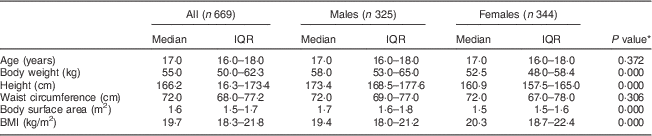
IQR, interquartile range (25th–75th percentile).
* The Mann–Whitney U test was used to compare medians between males and females.
The physical activity profile of the participants is shown in Table 2, and the time and energy expenditure data are presented in Table 3.
Physical activity profiles of the participants: Moroccan adolescents aged 15·0–19·9 years, ATLS (Arab Teens Lifestyle Study), March 2011

Results are presented as proportions (%).
* Bootstrap results for the total proportions were based on 1000 bootstrap samples.
† The χ 2 test was used to determine P values between nominal variables.
Time spent on physical and sedentary activities and energy expenditure among Moroccan adolescents aged 15·0–19·9 years, ATLS (Arab Teens Lifestyle Study), March 2011

IQR, interquartile range (25th–75th percentile); MET, metabolic equivalent of task.
* The Mann–Whitney U test was used to compare medians between males and females.
Physical activity patterns and intensity differed between genders. As anticipated, male adolescents were more active than female adolescents across a typical week and engaged in more vigorous-intensity physical activity than female adolescents, who spent more time in moderate-intensity physical activity. Male adolescents engaged in sport activities in a range of settings – at school, in sports clubs and in the street – whereas female adolescents preferred to practise sport at school. Of particular concern was that one in five of the adolescents surveyed was inactive, with almost 45 % of the sample reporting television viewing for more than 2 h/d and 38 % engaged in computer use for a similar period (see Figs 1 and 2).
Levels of physical inactivity (defined as energy expenditure value <1680 MET-min/week, where MET is metabolic equivalent of task) among Moroccan adolescents (n 669; 325 males and 344 females) aged 15·0–19·9 years, ATLS (Arab Teens Lifestyle Study), March 2011. A greater percentage of females were physically inactive compared with males (P=0·000)

Levels of sedentary activities (defined as duration >2 h/d;  , television viewing;
  , computer use) among Moroccan adolescents (n 669; 325 males and 344 females) aged 15·0–19·9 years, ATLS (Arab Teens Lifestyle Study), March 2011. Television viewing for >2 h/d did not vary between males and females (P=0·140); computer use for >2 h/d did not vary between males and females (P=0·081)

The profile of dietary habits is shown in Table 4. Most adolescents reported eating no breakfast and failing to consume milk and dairy products, fruits and vegetables on a daily basis. In contrast, most reported consumption of doughnuts, cakes, candy and chocolate more than three times per week and approximately 50 % consumed sugary drinks more than three times per week.
Dietary habit profiles of the participants: Moroccan adolescents aged 15·0–19·9 years, ATLS (Arab Teens Lifestyle Study), March 2011

Results are presented as proportions (%).
* Bootstrap results for the total proportions were based on 1000 bootstrap samples.
† The χ 2 test or Fisher’s test was used to determine P values between nominal variables.
‡ Energy drinks: Red Bull, Power Horse or others.
Supplemental Table 1 (see online supplementary material) illustrates crude associations of lifestyle habits with overweight and obesity in adolescents. The table shows that inactive females had over four times the risk (OR=4·23; 95 % CI 1·04, 17·28) to be obese than active females. Male adolescents who used a computer for more than 2 h/d had almost four times (OR=3·78; 95 % CI 1·43, 10·02) the risk to be overweight than their counterparts who used a computer for 2 h/d or less. Adolescents who did not consume breakfast at home on a daily basis were at increased risk to be overweight compared with those who had daily breakfast consumption: risk increased about threefold for males (OR=2·76; 95 % CI 1·04, 7·32) and about fourfold for females (OR=3·70; 95 % CI 1·28, 10·73). Moreover, female adolescents who consumed sugary drinks more than three times weekly had more than twice at risk to be overweight (OR=2·48; 95 % CI 1·24, 4·96) compared with their counterparts who consumed sugary drinks less often.
Discussion
The present study is the first of its kind to describe the lifestyle (physical activity and dietary habits) of Moroccan adolescents. Major findings included a large proportion of adolescents who reported unhealthy dietary practices including skipping breakfast and making less healthy food choices in a typical week. This was coupled with inadequate levels of physical activity in many adolescents and high levels of inactivity or sedentary behaviours.
Interventions that promote a healthy and active lifestyle play an important role in the prevention and management of overweight and obesity in this population, particularly school-based interventions( Reference Gortmaker, Peterson and Wiecha 34 , Reference Muller, Danielzik and Pust 35 ). The present study showed that most female adolescents (67 %) engaged in physical activity at school with classmates, while 27 % of male adolescents practised physical activity with friends at school, in the street and at sports clubs. Based on the time spent at school, this setting seems to be the most practical as well as the most common place to participate in physical activity. Respondents also confirmed that the preferred time of day for physical activity was during the morning.
Results of the present study indicated some differences between genders in size and shape measures, including higher height, weight and body surface area values in male adolescents and higher BMI among female adolescents. The higher BMI among female adolescents is consistent with the high proportion of physical inactivity reported (more evident findings in Supplemental Table 1), the lower time and energy expenditure associated with vigorous-intensity physical activity, and also physiological factors. Low levels of habitual physical activity and insufficient vigorous-intensity activity have been reported as risk factors for higher BMI in this population( Reference Patrick, Norman and Calfas 36 ). Moroccan female adolescents do not spend enough time engaged in vigorous-intensity physical activity and also only expended approximately half the energy of male adolescents in physical activity. A combination of optimal nutrition and regular physical activity during a child’s formative years increases the likelihood of a healthy pattern of physical maturation consistent with genetic potential( Reference Hills, King and Armstrong 6 , Reference Malina and Little 37 ).
Similarly, previous studies have shown that children and adolescents who participate in higher levels of physical activity are less likely to display risk factors for CVD( Reference Strong, Malina and Blimkie 4 , Reference Boreham and Riddoch 38 ) and are more likely to have positive outcomes in weight regulation( Reference Gutin, Barbeau and Owens 39 , Reference Lemura and Maziekas 40 ). As a group, one in five Moroccan adolescents was categorized as inactive; or 33 % of female adolescents v. 9 % of male adolescents. The prevalence of physical inactivity among Moroccan female adolescents is higher than reported in other countries( Reference Caspersen, Merritt and Stephens 41 ) such as Finland (16 %), Australia (27 %) and the USA (31 %). Worldwide, physical inactivity contributes to nearly two million deaths( 15 ).
Our results showed that nearly 45 % of adolescents spend more than 2 h/d in television viewing, and 38 % engaged in computer use for a similar period. Such adolescents may be at greater risk of developing obesity and related diseases, particularly if physical activity levels are also low. A previous study showed that children who watch television for 1 h/d or less have a lower prevalence of obesity( Reference Crespo, Smit and Troiano 42 ). However, the television viewing time among Moroccan adolescents is lower than reported in a national survey in the USA, which revealed that 65 % to 67 % of adolescents watched television for more than 2 h/d( Reference Andersen, Crespo and Bartlett 43 ), and higher than reported in Chinese adolescents (24 %)( Reference Li, Dibley and Sibbritt 44 ). In summary, today’s young people spend more time than previous generations did in sedentary pursuits, including television viewing and computer use( Reference Hills, Okely and Baur 14 ).
Breakfast consumption is associated with a variety of positive outcomes, including improved daily nutrient intake profiles( Reference Affenito, Thompson and Barton 45 , Reference Nicklas, Myers and Berenson 46 ), a healthy body weight( Reference Keski-Rahkonen, Kaprio and Rissanen 47 , Reference Siega-Riz, Popkin and Carson 48 ), and better cognitive functioning and school performance( Reference Rampersaud, Pereira and Girard 49 ). However, 60 % of the adolescents in the present study reported not taking breakfast on a daily basis.
Similarly, dairy products (milk, yoghurt and cheese) are a very important source of Ca during childhood, adolescence and the third age( 50 ), yet most of the present cohort did not consume milk and dairy products on a daily basis, nor consume fruits and vegetables on a daily basis( 15 ). Adult studies have shown that prudent dietary patterns high in fruits and vegetables are associated with low prevalence of the metabolic syndrome( Reference Williams, Prevost and Whichelow 51 , Reference Pereira, Jacobs and Van Horn 52 ). Unfortunately, only 28 % and 49 % of our study population consumed fruits and vegetables respectively on a daily basis rather than the recommendation of at least five times per day( 50 ) as a protective factor against obesity, diabetes, CVD and cancers.
In summary, most adolescents in the present study reported unhealthy dietary habits, including the consumption of foods such as doughnuts, cakes, biscuits, sweets and chocolate and sugary drinks more than three times weekly. These practices are consistent with many parts of the world where the ‘normal’ diet is becoming increasingly energy-dense and sweeter, with high-fibre foods being replaced by more highly processed versions( Reference Popkin 22 ). A continuation of such poor dietary practices increases the risk of adolescents to develop non-communicable diseases as unhealthy eating is considered one of the main causes( Reference Khatib 23 ).
More interventions promoting sound nutritional practices and increased physical activity are needed in Morocco to reduce physical inactivity and sedentary behaviours and limit the intake of unhealthy foods contributing to overweight and obesity and related complications. There is very strong evidence of the effectiveness of such approaches. For example, a project in Finland reported a reduction in the burden of CVD by 70 % through the promotion of good nutrition and physical activity, as well as the implementation of food policies( Reference Puska, Pirjo and Ulla 53 ).
A recognized limitation of the present study was the inability to sample from the private education sector, mainly due to the small number of private institutions in Kenitra. However, available statistical information verified that only 6·89 % of secondary-school students in the city are enrolled in private schools.
Conclusion
In conclusion, the present study described, for the first time, the lifestyle habits of a sample of Moroccan adolescents. From both a dietary and physical activity perspective, the habits of the adolescents surveyed were not consistent with a healthy lifestyle and the prevention of non-communicable diseases in adulthood. A concerted effort on the part of all relevant government agencies will be needed to develop school- and community-based interventions, and to promote physical activity and healthy eating practices among Moroccan children and adolescents. Future large-scale studies involving nationally representative samples of adolescents are recommended. Further work is also recommended to validate the self-report physical activity instrument against a gold standard reference approach such as the doubly labelled water technique.
Acknowledgements
Acknowledgements: The authors wish to thank the volunteers who participated in the study and all persons who aided to make it successful. Their sincere acknowledgement is extended to the Arab Center of Nutrition. Financial support: This research received a specific grant from the Arab Center of Nutrition. The funder has contributed in design, collaboration and data centralization of all Arab cross-sectional studies. Conflict of interest: None. Authorship: A.H. and S.M. participated in the collection, analysis and interpretation of the data, laboratory analysis and drafting the article. K.E.K., A.E.H., I.E.M., H.B. and M.E.M. participated in the collection of data, laboratory analysis, revising the article and final approval of the version to be submitted. A.O.M. and H.M.A.-H. were the principal coordinators in the Arab Center of Nutrition, they contributed to all the Arab studies undertaken in the framework of the ATLS project. A.P.H. revised the content on physical activity and sedentary behaviours, and made language corrections on the final version of the manuscript. N.M. and H.A. were the principal investigators of the project from which these data were derived. Ethics of human subject participation: The required ethical approval of the National Ministry of Education was obtained.
Supplementary material
To view supplementary material for this article, please visit http://dx.doi.org/10.1017/S1368980014002274



