





Introduction
Bilingual language production – a field combining the two previously perhaps most neglected topics of psycholinguistic research (Costa & Santesteban, Reference Costa and Santesteban2006) – has experienced a substantial increase in the number of studies devoted to it in the last two decades. Code-switching, understood as the act of switching between languages within an utterance, has long provided an argument supporting the idea that other languages are not generally off when one is in use (e.g., Sridhar & Sridhar, Reference Sridhar and Sridhar1980). Accordingly, much of the available research on language production in bilinguals has focused on the problem of how bilingual speakers manage to produce speech in one language while preventing interference from other languages, revolving around questions of accessing the relevant mental lexicon (for reviews, see Costa, Reference Costa, Kroll and De Groot2005; Hartsuiker & Pickering, Reference Hartsuiker and Pickering2008), and controlling the language systems (e.g., Abutalebi & Green, Reference Abutalebi and Green2007; Green & Abutalebi, Reference Green and Abutalebi2013). Less is known about the mechanisms involved in the naturalistic production of code-switched utterances themselves (cf. Green & Wei, Reference Green and Wei2014).
A linguistic structure that gives rise to questions about the role of grammatical category in bilingual language production is the compound verb code-switch, i.e., the bilingual compound verb (BCV). Bilingual compound verbs are complex predicates that consist of a ‘light verb’ from the matrix language and a ‘lexical verb’ (non-finite) from the donor language. The light verb is a semantically reduced verb with a meaning such as “do”, “make”, “be”, “become”, “give”, “take”, etc., which serves as a ‘support’ or ‘helping verb’ in the construction, while the lexical content verb carries the semantic weight, denoting an action, event or state. Bilingual [verb+verb] compound verbs have been observed to occur in all bilingual varieties “from Colombo to Athens” (Muysken, Reference Muysken2016), involving matrix languages such as Tamil, Greek, and Hindi; they are also found in Bilingual Navajo (Schaengold, Reference Schaengold2004) and Spanish–English code-switching communities in Belize (Balam, Reference Balam2015) and New Mexico (Wilson & Dumont, Reference Wilson and Dumont2015).
However, the linguistic construction of [verb+verb] compound verbs only occurs in bilingual contexts. In the monolingual native varieties involved, the support verb can only be combined with a nominal lexical element, typically a nounFootnote 1. For example, in monolingual contexts the Spanish hacer (‘to make/do/prepare’) can be used with a noun (e.g., hacer una página web ‘to make a web page’; hacer una pause ‘take a break’) or an adjective (e.g., hacer feliz ‘to make happy’); in contrast in Spanish–English bilingual speech, BCVs of the type [hacer+verbEng] have been observed (e.g., hacer cook ‘to cook’; Wilson & Dumont, Reference Wilson and Dumont2015). As discussed by Muysken (Reference Muysken2016), the Turkic and the Indo-Iranian language families generally have monolingual [noun+verb] compound verbs (formed by a support verb and a nominal – either noun or adjective), which easily develop into [verb+verb] compound verbs in bilingual varieties. For Indo-Aryan languages, it has been suggested that “English verbs are typically borrowed by incorporating them into the ‘nominal’ slot of such complexes: e.g., H. [Hindi] arenj karnā ‘to arrange’” (Masica, Reference Masica1991, p. 75).
If in bilingual compound verbs (BCVs) of the type [v+v] indeed a verb ‘replaces’ the native nominal element, i.e., a verb is placed in the nominal slot of a [noun+verb] construction, this would challenge the assumption of a word class constraint in lexical selection during language production. Language production models have proposed a role of word class in constraining lexical selection via phrasal restrictions, such that only a lexical item of a particular category will be accepted (e.g., Dell, Oppenheim & Kittredge, Reference Dell, Oppenheim and Kittredge2008; Levelt, Reference Levelt1989; Roelofs, Reference Roelofs1992).
In this paper, we study the production of BCVs in Persian–English bilinguals, in order to examine whether the English verb competes with and ‘replaces’ the Persian nominal in those bilingual constructions. Persian is a language that has many support verb constructions, most frequently designated as ‘compound verbs’ (cf. Dabir-Moghaddam, Reference Dabir-Moghaddam1997; Goldberg, Reference Goldberg, Francis and Michaelis2003). Using a combination of naturalistic corpus and experimental data, we seek to explore (1) in what form English verbs are embedded (whether they form BCVs with Persian support verbs), (2) how many of those BCVs (if any) have equivalent Persian compound verbs, (3) whether there is a statistical relationship (in terms of types) between support verbs used in [v+v] BCVs and in their Persian [n+v] equivalents, and (4) whether English verbs compete with Persian nouns for lexical selection, as measured by interference in a word-picture interference paradigm.
Grammatical category in Persian compound verbs
Persian, along with Kurdish, Mazandarani, Gilaki and Baluchi, belongs to the West Iranian language group, which is a branch of the Indo-Iranian subfamily of the Indo-European languages (Windfuhr, Reference Windfuhr and Windfuhr2009). It has three major varieties: Dari Persian (spoken mainly in Afghanistan), Farsi Persian (in Iran), and Tajik Persian (in Tajikistan), each with dialectal subgroups.
In order to convey conceptual content in verb form, the Persian language has two options: a simple verb (1), or a compound verb (2) (Tabātabāi, Reference Tabātabāi2005).
(1) xord
eat.3sg.pret
“ate”
(2) tamāša kard
something.worth.seeing do.3sg.pret
“watched”
A compound verb consists of a non-verbal constituent, e.g., a noun or an adjective, and a verbal constituent. Two types of word formation may be distinguished (Dabir-Moghaddam, Reference Dabir-Moghaddam1997): in compound verb formation via ‘incorporation’, a direct object or sometimes an adverbial complement is incorporated by losing its grammatical morphemes. This is a very productive lexical process, in which the verb remains lexically transparent, with the noun being understood generically (e.g., qazā xordan – lit. food-eat “to eat”). The semantic difference between verb+complement and incorporated counterpart can be exemplified by ali māhi-rā gereft (“Ali caught the fish”) vs. ali māhi gereft (lit. Ali fish-took “Ali fished”).
In compound verb formation via ‘combination’, however, the nominal element carries the main part of the semantic weight, while the verbal element supports it in forming a predicate and may semantically only contribute in marking a perspective (e.g., pas dādan lit. back-give “to return” vs. pas gereftan lit. back-take “to regain”; farib dādan lit. cheating-give ‘to cheat” vs. lit. farib xordan cheating-eat “to be cheated”). This lexical process is relatively limited in productivity, and the meaning of the compound may be opaque (e.g., nafas kešidan – lit. breath-draw “to breathe”, mehmāni dādan – lit. party-give “to throw a party”, dust dāštan – lit. friend-have “to like”, bād xordan – lit. wind-eat “to be interrupted”).
Both incorporation- and combination-type compound verbs are constructions in the lexicon, as evidenced, among other things, by stress patterns, the ability to form nominalizations, and conceptual wholeness (Dabir-Moghaddam, Reference Dabir-Moghaddam1997; Goldberg, Reference Goldberg, Francis and Michaelis2003). However, only one of those types corresponds to the support-verb constructions discussed above, which seem to underlie BCVs, and that is combination. Thus, this is the type of Persian compound verb of interest with respect to the question of BCV production targeted in the present study.
In compounds formed through combination, the non-verbal constituent can be a noun, adjective, adverb, past participle or prepositional phrase. Most relevant in our context is the noun-verb combination. As argued by Dabir-Moghaddam (Reference Dabir-Moghaddam1997), the verb is lexicalized and serves as an aktionsart marker. That is, even though the main semantic burden lies with the noun, the verb is not semantically vacuous. Rather, the semantics of the compound verb is to be attributed to the combination (Goldberg, Reference Goldberg, Francis and Michaelis2003), with the noun contributing the activity and the verb contributing the mode or perspective (Dabir-Moghaddam, Reference Dabir-Moghaddam1997). Complex verbs including the same noun but different verbs usually have different meanings (e.g., tul dādan – lit. duration-give “to protract” vs. tul kešidan – lit. duration-draw “to take time”, gul zadan – lit. deceit-strike “deceive” vs. gul xordan – lit. deceit-eat “to be deceived”), and there is a large number of support verbs in Persian. However, the one most frequently used is kardan “make/do” (Tabātabāi, Reference Tabātabāi2005), which also is most general in perspective (e.g., rezerv kardan – lit. reservation-do “to book”, hammām kardan – lit. bath-do “to take a bath”, salām kardan – lit. hello-do “to say hello”). The verb kardan is also frequently used with adjectives, usually as a causative (e.g., delxor kardan – lit. annoyed-make “to annoy”).
Even though Persian compound verbs formed via combination with a nominal act in some way as single words, they behave in another way like more than one word, as argued by Goldberg (Reference Goldberg, Francis and Michaelis2003). They have both lexical and phrasal properties. They are constructions represented in the mental lexicon, which can also be treated as separate words, depending on higher ranked constraints, according to Goldberg.
Grammatical category in bilingual compound verbs
In BCVs of the type [verb+verb], as evidenced in a number of bilingual communities, a lexical verb from one language is integrated in the context of another language by combining it with a semantically light support verb from the matrix language, which supplies the grammatical information (such as person or tense), while the lexical verb is used in an uninflected form (e.g., Lakshmanan, Balam & Bhatia, Reference Lakshmanan, Balam and Bhatia2016; Muysken, Reference Muysken2016). Examples are the Spanish–English clause te hace explain todo (hacer “to make”: “She explains everything to you”; Balam, Reference Balam2015), and the Persian–English construction create kard-am (kardan “to make/do”: “I created”) from our corpus.
Bilingual compound constructions have been observed with a variety of matrix languages, including Hindustani, Bhojpuri, Panjabi, Malay, Bengali, Pashto, Turkish, Greek, Japanese, Popoloca, and Navajo (for reviews, see Edwards & Gardner-Chloros, Reference Edwards and Gardner-Chloros2007; Lakshmanan et al., Reference Lakshmanan, Balam and Bhatia2016; Muysken, Reference Muysken2000, Reference Muysken2016). The predominance of the [verb+verb] pattern in bilingual event denotations is most remarkable, because the corresponding monolingual compound constructions always include a nominal element, mostly a noun (Muysken, Reference Muysken2000). Even though complex [verb+verb] predicates do occur in South Asian languages, those seem to be different constructions. A thorough analysis for Urdu (Butt, Reference Butt, Amberber, Baker and Harvey2010) suggests that the light verbs are always optional in those monolingual [verb+verb] complexes, that they may add an extra argument (such as the permitter in a permissive), and that their formation clearly takes place in the syntax. This sets them apart from the complex constructions considered here.
In the monolingual [n+v] and also the bilingual [v+v] compound verbs addressed here, the light verb supports the main predicative element, which – being either a nominal (monolingually) or a lexical verb (bilingually) – denotes the activity (event, action, or state). The light verb contributes the syntactic information (such as tense, person, or aspect). One might argue that in linguistic contexts in which the same support verbs are always used, the light verb cannot contribute much meaning. Just one support verb (translatable into “make/do”) has been observed for Spanish–English (e.g., Wilson & Dumont, Reference Wilson and Dumont2015; see also Edwards & Gardner-Chloros, Reference Edwards and Gardner-Chloros2007). In his summary on BCVs, Muysken (Reference Muysken2016) lists only verbs meaning “do” or “be”– and for Persian only “do”. This contrasts with the monolingual Persian compound verbs, for which we find a number of support verbs, as discussed above. Even though they are semantically reduced, they are not “empty”. First, not every lexical element can be combined with every light verb, and second, the light verb may semantically contribute the mode, such as the strike-ing, the give-ing, the take-ing, the general do-ing perspective (Dabir-Moghaddam, Reference Dabir-Moghaddam1997). If Persian constructions represented in the lexicon are the basis for Persian–English BCVs with the nominal constituent being replaced by an English verb, we would expect to predominantly find BCVs with a corresponding monolingual compound verb, and we would expect a tendency to use the mono-lingual compound's support verb (as measured by a statistically significant relationship between mono- and bilingual support verbs). This would be evidence in favor of an interpretation in terms of lexical selection of an English verb instead of the usual native nominal.
Grammatical category and compound words in the mental lexicon
Grammatical category (e.g., noun, verb, adjective) is assumed to be a fundamental, universal feature of human languages (e.g., Baker, Reference Baker2003). Nevertheless, there is great variation between languages in terms of grammatical word classes, and even for the noun-verb distinction there is a gradation, with languages exhibiting sharp distinctions between these two classes at one extreme and languages showing practically no distinction at the other end (Bhat, Reference Bhat, Vogel and Comrie2000).
In noun-verb languages, such as the Indo-European languages, grammatical class may be assumed to be differentiated in the lexicon (cf. Vogel, Reference Vogel, Vogel and Comrie2000). However, even those languages may have words of differing degrees of ‘nouniness’ or ‘verbiness’ (Sasse, Reference Sasse, Haspelmath, Ekkehard, Wulf and Wolfgan2001), and also ambiguous stems, such as walk and love in English, which have been characterized as flexibles (Luuk, Reference Luuk2010). In English, due to its reduction of inflections and the multitude of noun-verb and verb-noun conversions (e.g., a bike – to bike), a high number of flexibles has evolved, which supplement the old inflectional/derivational V-N-A system (Vogel, Reference Vogel, Vogel and Comrie2000). An alternative view, put forward within the framework of a theory assuming only roots, idioms, irregulars and some regulars to be stored in the mental lexicon, is that category information (such as N or V) is included in each lexical entry (e.g., verb root or noun root), even though conversions (e.g., noun based on verb root) are possible (Pinker & Ullman, Reference Pinker and Ullman2002).
Even though there are different views on how and where, there is general agreement that the word class distinction does become available during language processing (cf. Vigliocco, Vinson, Druks, Barber & Cappa, Reference Vigliocco, Vinson, Druks, Barber and Cappa2011). Influential models of lexical access in production, such as the Interactive Two-Step model (Schwartz, Dell, Martin, Gahl & Sobel, Reference Schwartz, Dell, Martin, Gahl and Sobel2006), the WEAVER++ model (Levelt, Roelofs & Meyer, Reference Levelt, Roelofs and Meyer1999), the Dark Side model (Oppenheim, Reference Oppenheim2011; Oppenheim, Dell & Schwartz, Reference Oppenheim, Dell and Schwartz2010), and the WEAVER++-extending Verb Representation model (Pickering & Branigan, Reference Pickering and Branigan1998), assume a close link between syntactic knowledge and lexical items. According to these models, knowledge on grammatical class is stored in the mental lexicon (see Van de Vijver & Baer-Henney, Reference Van de Vijver and Baer-Henney2019, for a proposal of word class representations in form of frames).
Evidence for the representation of word category in the mental lexicon comes from speech error analyses, which have shown that word class features play a role therein, e.g., word substitution errors (e.g., sun → world, come → gone, low → high) as well as word exchange errors (salami ↔ knife, worst → both) tend to involve words from the same grammatical class (Fromkin, Reference Fromkin1971; Appendix in Fromkin, Reference Fromkin1973). Other studies suggest a representational distinction between nouns and verbs, in terms of nouns being learned earlier in children's language acquisition (De Bleser & Kauschke, Reference De Bleser and Kauschke2003) and processed faster (for a review, see Kauschke & Stenneken, Reference Kauschke and Stenneken2008; for further arguments see also Laudanna & Voghera, Reference Laudanna and Voghera2002). Furthermore, marked word class dissociations have been shown – sometimes in the form of a verb disadvantage, sometimes in the form of double dissociations – for acquired and developmental language disorders (for reviews, see Marshall, Reference Marshall2003; Mätzig, Druksa, Masterson & Vigliocco, Reference Mätzig, Druksa, Masterson and Vigliocco2009).
The idea that at least a part of the differences between nouns and verbs stems from syntactical-category knowledge at the lexical level (as opposed to the linked concepts, concreteness, imageability, etc.) is supported by several findings, including processing differences not reducible to morphological complexity (Kauschke & Stenneken, Reference Kauschke and Stenneken2008), patients’ selective difficulties in processing nouns or verbs only in the written or the oral modality, which can therefore not be due to a semantic deficit (e.g., Caño, Hernández, Ivanova, Juncadella, Gascón-Bayarri, Reñé & Costa, Reference Caño, Hernández, Ivanova, Juncadella, Gascón-Bayarri, Reñé and Costa2010), and case studies with homonymous nouns and verbs (he judges vs. the judges; e.g., Shapiro & Caramazza, Reference Shapiro and Caramazza2003). Further evidence that grammatical category information is represented in the mental lexicon comes from picture-naming, word-naming and homograph priming experiments (for a review, see Crepaldi, Morone, Arguino & Luzzatti, Reference Crepaldi, Morone, Arguino and Luzzatti2014).
For compound words, the question arises as to what role their constituents’ grammatical categories play. Linguistic analyses of the Persian compound verbs (Goldberg, Reference Goldberg, Francis and Michaelis2003; Müller, Reference Müller2010) suggest that they linguistically behave as whole words. The compound verb as a whole must be stored in the mental lexicon, as evidenced by the different modes chosen by different languages (e.g., a lecture can be “given” in English, “made” in Persian (soxanrāni kardan [lit. lecture-make], or “held” in German (einen Vortrag halten [lit. hold a lecture]). The view on what it means to “take” or “give” an exam can be just the opposite in two different languages (cf. emtehān gereftan [lit. exam-take] ‘to give an exam’ and emtehān dādan [lit. exam-give] ‘to take an exam’). In addition to being stored as wholes, compound words are also linked to their constituents in representation. A bulk of research suggests that there is generally parallel constituent and whole-word processing (e.g., Libben, Reference Libben, Libben and Jarema2006). We therefore assume that the constituents need to be accessed in speech production, which is also consistent with the idea that the noun is realized in a syntactic slot of the verb and with a description of support-verb constructions as semi-compositional (cf. Langer, Reference Langer, Langer and Schnorbusch2005).
Grammatical word category and lexical access in production
Interactive (e.g., Gordon & Dell, Reference Gordon and Dell2003; Oppenheim, Reference Oppenheim2011) as well as modular (e.g., Kempen & Hoenkamp, Reference Kempen and Hoenkamp1987; Levelt et al., Reference Levelt, Roelofs and Meyer1999) word production models usually assume that grammatical category constrains lexical selection. This word-category constraint is interpreted in terms of the lexical items being inserted into slots provided by the developing syntactic structure, with this insertion requiring a fitting grammatical category (such as a noun as input for the head slot in the building of a noun phrase (e.g., Levelt, Reference Levelt1989).
Evidence for a grammatical category constraint in lexical access comes from everyday speech errors, aphasic word errors, and experimental data. Relevant slips of the tongue include the word substitution word exchange errors discussed before as well as blends (e.g., swinged [switched/changed] or clarinola [clarinet/viola]; Fromkin, Reference Fromkin1971). All of these obey, to a large degree, the word class constraint; and so do aphasic semantic and formal paraphasias (e.g., carrot → parsley, squirrel → school; Cuetos, Aguado & Caramazza, Reference Cuetos, Aguado and Caramazza2000).
Experimental naming studies performed with the picture-word interference paradigm have found that noun distractors interfered more strongly with object naming than adverb distractors in the absence of semantic relatedness, both in German and in English, but only if the production of the object name was embedded in a syntactic frame, a sentence context (Pechmann & Zerbst, Reference Pechmann and Zerbst2002) or a noun phrase (Pechmann, Garrett & Zerbst, Reference Pechmann, Garrett and Zerbst2004). A similar effect was obtained for verb production in Italian, with verb distractors interfering more than noun distractors when naming the picture of an action only when produced in inflected form, not in citation form (Vigliocco, Vinson & Siri, Reference Vigliocco, Vinson and Siri2005). These results are consistent with the idea that grammatical class is only activated if words have to be integrated into a syntactic frame.
Another study, however, has provided evidence in favour of an account in terms of an automatic activation of grammatical word class, even when just a bare noun or verb is produced (Janssen, Melinger, Mahon, Finkbeiner & Caramazza, Reference Janssen, Melinger, Mahon, Finkbeiner and Caramazza2010). Even though the authors argued – based on imageability effects – against an interpretation in terms of word category being involved in lexical access, further evidence in favour of a syntactic constraint in lexical selection was obtained with different paradigms: a blocking paradigm comparing naming in homogeneous- vs. heterogeneous-category lists in French (Duràn & Pillon, Reference Duràn and Pillon2011), a new version of the picture-word interference paradigm, which controlled for imageability and morphology in objects and action naming in Italian, including deverbal action-naming nouns (e.g., risata “laughter”), verbs in citation form (e.g., ridere “to laugh”), and nouns without suffixation (De Simone & Collina, Reference De Simone and Collina2016), and a novel sentence-picture interference paradigm (Momma, Buffinton, Slevc, & Phillips, Reference Momma, Buffinton, Slevc and Phillips2020).
The locus of the word class constraint in lexical access is posited to be the stage of lexical selection (e.g., Levelt, Reference Levelt1989; Dell et al., Reference Dell, Oppenheim and Kittredge2008). A core assumption of current models of lexical access in production is that several lexical candidates are activated in parallel, one of which is to be selected for further processing. The selection criterion assumed for spontaneous speech is to select the most strongly activated lexical item of the appropriate grammatical category (Roelofs, Reference Roelofs1992). Words of other word classes will be “filtered out” and not considered for further processing (Levelt, Reference Levelt1989). That is, words are selected based on their semantic and their syntactical properties. A possible mechanism for the word class constraint, which has been developed in the context of a connectionist model of word production, is the syntactic traffic cop (Dell et al., Reference Dell, Oppenheim and Kittredge2008). It consists of excitatory and inhibitory connections between word class units and lexical items. When, e.g., the noun unit is active in the course of utterance production, it activates all nouns and inhibits all non-nouns, such as verbs.
Many accounts of lexical selection assume that its core mechanism is competition, even though there are also alternative views and debates on this issue (for a review, and evidence supporting the competition account, see, e.g., Vieth, McMahon & de Zubicaray, Reference Vieth, McMahon and de Zubicaray2014a, Reference Vieth, McMahon and de Zubicaray2014b). According to the competition account of lexical selection, the target word competes with other activated words (such as semantically related words, or words about to be produced), and the time taken to produce a word depends on the number of lexical competitors and their activation level. Competition is based on activation, but filtered by grammatical category (Dell et al., Reference Dell, Oppenheim and Kittredge2008).
Evidence in favour of the competition account of lexical selection is the picture-word interference (PWI) effect. In the PWI paradigm, participants name a picture while ignoring superimposed printed distractors. Slower naming latencies with semantically related distractors, in particular with category coordinates (such as table–bench), are assumed to reflect a delay in lexical selection due to enhanced competition among lexical items resulting from an additional activation of a competitor.
In bilingual speakers, the semantic PWI effects are very similar to the ones observed in monolingual speakers – both with distractors in the target language and for distractors in the non-target language (for a meta-analysis, see Hall, Reference Hall2011; see also Smith, Reference Smith, de Groot and Kroll1997, for a review of previous findings). These results suggest that the lexical entries of both languages compete for selection in bilinguals. Evidence presented as challenging this conclusion is the finding that the presentation of a target's translation as a distractor leads to faster, not slower responses (Costa, Miozzo & Caramazza, Reference Costa, Miozzo and Caramazza1999). However, this finding can be reconciled with competition accounts if one assumes that the facilitation through shared concepts exceeds lexical interference (Hall, Reference Hall2011).
The present study investigated whether in a PWI experiment English verb distractors interfere with the production of Persian nominals in English-Persian speakers, suggesting that there is lexical competition between English verbs and Persian nominals in the production of BCVs.
The present study
In this paper, we explore the processes involved in the production of Persian–English compound verbs, using a combination of naturalistic and experimental data. The main question addressed is whether English single verbs compete with Persian nominals denoting activity (action, event, or state) in the bilingual production of compound verbs, paving the way to an insertion of an English base verb in the nominal slot of a native Persian complex verb.
If this is the case, we should expect that (1) Persian–English BCVs produced in bilingual conversation have corresponding translation-equivalent native compound verbs, (2) that the English base verbs denote the same activity as the Persian nominal constituents, and (3) that the support verbs used in the BCVs tend to correspond to their native counterparts. We used naturalistic data from a corpus analysis to test these predictions (Substudy 1).
Furthermore, the picture-word interference effect, assumed to reflect competition while selecting words for production, was used to address the question of lexical competition between English verbs and Persian nominal constituents at the processing level. An interference of English-verb distractors with the naming of the nominal constituents of Persian compound verbs would be indicative of lexical selection between English verbs and Persian nominals in the production of complex predicates in proficient bilinguals. However, it would also be conceivable that the English verbs actually compete with the whole Persian compound verbs for lexical selection, resulting in bilingual verb blends (similar to this type of lexical selection errors). If this is the case, we would expect the English-verb distractors to interfere with the naming of the whole Persian compound verbs but not the nominal constituents alone. In a PWI experiment, we tested whether English-verb distractors interfere with Persian compound verbs and with Persian nominals (Substudy 2).
Through this study, we aim to shed light on the processing of grammatical category in bilingual language production. The idea is to relate naturalistic and experimental results to each other, such that they feed into a model of the production of Persian–English BCVs.
Substudy 1: BCVs in naturalistic data (corpus analysis)
In order to examine the occurrence and structure of BCVs in proficient bilingual speakers of Persian and English in a natural dialogue, we analysed a corpus of naturalistic data from a popular Persian television program produced by a TV channel based in London, which is available on YouTube. We predicted BCVs (a) to occur, (b) to have translation-equivalent native compound-verb counterparts, (3) to tend to incorporate the same support verbs as those monolingual counterparts, and (d) to include English verbs denoting the same activity as the corresponding Persian nominals.
Method
The corpus used in this present analysis is a bilingual corpus of spontaneous conversational speech and consists of 101 YouTube videos comprising 2298 minutes of TV program. Altogether, there were 132 Persian–English participants. They were talking mainly in informal Persian, with switches to English in-between. From the information given during the show, it can be gathered that most speakers were residing in the UK, especially in London. The mean length of residence of those who talked about it (n = 33) was 11.5 years. Their code-switching patterns are indicative of a high level of language proficiency.
We scrutinised the conversational speech data with respect to switching from Persian to English. Following Muysken (Reference Muysken2000), insertions of English words or constructions (multiple-word phrases or clauses) in the Persian conversation were considered as instantiations of code-switching, unless they were lexicalized loan words or word-translating clarifications. We analysed each switch into English with respect to linguistic structure, in order to determine the frequency of BCVs relative to other forms of code-switching to English. Furthermore, we determined the relationship of support verbs in BCVs with support verbs of their translation equivalents in Persian, in order to provide first evidence on the processes involved in the production of BCVs.
Results
Frequency of BCVs relative to other code-switching types
A total of 956 cases of code-switching was observed, 48 of which occurred between clauses (inter-clausal code-switching), and 908 of which occurred within clauses (intra-clausal code-switching). In addition, there were six cases of word-translating clarifications. Intra-clausal code-switching involved the insertion of single words or word combinations, such as new development. Verbs occurred in the form of single verbs, formed by a single word (e.g., insist, enjoy, invite), or complex verbs, formed by two words, such as phrasal verbs (back off, take over, pick up) or expressions such as make fun, double-check, slow cook.
89 English verbs (tokens: 82 single verbs, 7 complex verbs) were produced (9.3% of all code-switching cases). The remaining code-switching instances were divided as follows: 499 nouns (52.2%), 208 adjectives (21.8%), 29 adverbs (3.0%), 2 conjunctions (0.2%), 1 pronoun (0.1%), 68 word groups with nouns (7.1%), 12 other word combinations (1.3%), and 48 clauses (inter-clausal code-switching, 5.0%). Ambiguous cases of flexibles that could be interpreted as either noun or verb (such as cut) were counted as nouns, in order to avoid an overestimation of verb structures. No English noun occurred in the context of a BCV.
Persian was used as the matrix languageFootnote 2, with inserted single English words being structurally adapted to it. Examples are given in (1) and (2). In example (1), the English item fruit is suffixed with both the Persian plural suffix -hā and the Persian possessive clitic pronoun -š. In example 2, the Persian plural marker and the Persian linker are attached to the English noun friend.
(3) Fruit-hā=š xeyli tāzeh bud-and.
Fruit-pl=3sg.poss very fresh be(pret)-3pl
“His/her fruit was very fresh.”
(4) Bā friend-hā-ye jadid-e=š honest bā=š-e.
With friend-pl-lk new-lk=3sg.poss honest be(prs)=obj-lk
“[One] must be honest with one's new friends.”
All 89 English verbs embedded were used in the place of a nominal constituent of a Persian complex verb, forming a BCV with a Persian support verb (see Table S1). Hence, [v+v] BCVs accounted for 9.3% of all code-switches. The inserted English verbs were always in infinitive form (see Examples 3 to 5).
Structure of BCVs
The most important characteristic of the BCVs in our corpus is that a lexical English verb is combined with a Persian support verb (see examples 3 to 5).
(5) Bāyad xodam-ro protect kon-am.
Should myself-obj protect do(prs)-1sg
“I should protect myself.”
(6) Man aslan insist na-kard-am.
I not at all insist neg-do(pret)-1sg
“I did not insist at all.”
(7) Alān man starter=am-ro prepare mi-kon-am.
Now I starter=1sg.poss-obj prepare prs-do(prs)-1sg
“Now I am preparing my starter.”
The Persian equivalents of the BCVs formed would be (5) hefāzat/hemāyat (n., “protection”) konam, (6) esrār (n., “insistence”) nakardam, and (7) āmādeh (adj., “ready”) mikonam.
All BCVs produced have a translation-equivalent [nominal+verb] compound verb in Persian, as determined by the first author as a native speaker (see Table S1). In all of them, the embedded English verb refers to basically the same activity (event, action, or state) as the corresponding Persian nominal constituent (e.g., meet–“meeting”, repeat–“repetition”, imagine–“imagination”).
As Table 1 shows, in most BCVs the same support verb as in the corresponding monolingual compound verb was used. The verb kardan (“to make/do”), being the most frequent light verb in Persian compound verbs, was produced whenever there are two possible equivalent monolingual constructions with one of them involving kardan. In the few cases in which a different support verb than in the equivalent monolingual compound verb was used, it was also kardan. One English verb (to melt) was combined with two different Persian support verbs – corresponding to the active perspective (with kardan: to melt) or the passive perspective (with šodan: “to get melted”).
Relationship (n) between support verbs used in Persian-English [v+v] BCVs (tokens) and support verbs in their translation-equivalent Persian [n+v] compound verbs.

In order to test whether there was a statistically significant relationship between the support verb used in a BCV and the support verb that would be used in its translation-equivalent Persian compound verb, we analysed compound-verb types. There were 63 BCV types. We categorized them according to their support verb: kardan “to make/do” (n=56), šodan “to become/get” (n = 5), dādan “to give” (n = 2). Then we determined for each of the BCVs what support verb(s) would be used in their monolingual counterparts, with the following results: kardan “to make/do” (n = 46), šodan “to become/get” (n = 5), dādan “to give” (n = 4), gereftan “draw” (n = 1), dâshtan (“have/own”, n = 1), kardan or another one (n = 6). We combined the data in a contingency table. The chi square analysis revealed that there was a significant relationship between support verb used in the BCV and support verb expected from the translation-equivalent Persian compound verb (χ2(10) = 93.38, p < .001).
Discussion
The corpus analysis has revealed that a substantial proportion of code-switches in conversations between Persian–English bilinguals are BCVs. All of the BCVs produced have a [verb+verb] constituent structure, which stands in striking contrast to the [nominal+verb] structure of the equivalent monolingual compound verbs. Further analyses yielded three main results that support our hypothesis that English base verbs are inserted in the nominal slots of native Persian complex verbs in Persian–English BCVs. First, all BCVs produced have corresponding translation-equivalent native compound verbs. Second, in all BCVs observed the English base verb denotes the same activity (action, event, or state) as the corresponding Persian nominal constituent. Third, the support verbs used in the BCVs tend to correspond to their native counterparts.
In addition, there is a tendency to use kardan “to make/do”. It is chosen in all 10 BCVs (tokens) in which two options seem possible from the monolingual equivalents. In some cases (n = 4), it is used where another light verb would be expected monolingually. However, this is the most frequent and most general support verb in monolingual contexts, too. It provides a default when no specific viewpoint (aktionsart) is to be emphasized.
Altogether, the results suggest that in English-Persian BCVs the light verb has the same support role as in monolingual Persian compound verbs and that an English lexical verb is placed in the nominal syntactic slot provided by the Persian support verb, supporting the idea that English single verbs compete for selection with Persian nominals. To gain further evidence on this issue, we conducted a psycholinguistic experiment using the PWI paradigm.
Substudy 2: Experiment
The experiment tested whether English verbs interfere with the production of Persian compound verbs and their nominal constituents, using a PWI paradigm. Persian–English speakers were asked to name a set of activity pictures in Persian, producing either the compound verb in its inflected form or just its nominal constituent. Pictures were presented with a superimposed English verb, which could either refer to the activity depicted (same meaning condition) or be unrelated (control condition).
Method
Participants
Twenty-two Persian–English bilinguals with Persian as L1 and English as L2 (12 males, 10 females, mean age: 30.6 years, age range: 21 to 45 years, mean length of formal education: 17.3 years [SD = 4.0]) took part. As the experiment was conducted in Bern, Switzerland, by the first author as part of his PhD project, participants residing in Switzerland were recruited, via personal networks and referral chains. They were paid a compensation of 10 CHF. All reported having normal vision. Participants filled out the Language Experience and Proficiency Questionnaire (LEPQ) developed by Marian, Blumenfeld and Kaushanskaya (Reference Marian, Blumenfeld and Kaushanskaya2007) in an adapted version (‘English for Switzerland’Footnote 3), and estimated their amount of BCV usage/exposure on a scale from zero to ten. The LEPQ data were used to assess entry criteria for inclusion in the experimental analysis: English Proficiency of 5=‘adequate’ or higher, and proportion of English Usage (percentage of time exposed to English) of 20% or higher. An overall estimate of English proficiency was obtained by averaging the scores of the three LEPQ subscales on English (a) Speaking (M = 6.8, SD = 1.3), (b) Speech Comprehension (M = 7.4, SD = 1.4), and (c) Reading (M = 7.5, SD = 1.5), each ranging from zero to ten.
The mean rating of English proficiency was 7.2 (SD = 1.3), the mean rating of English Usage was 33.2% (SD = 17.3), the mean rating of amount of BCV usage/exposure was 4.4 (SD = 2.0). All three variables were significantly correlated with each other: (a) English proficiency – English usage: r = .62 (p < .01), (b) English proficiency – BCV exposure: r = .63 (p < .01), (c) English usage – BCV exposure: r = .61 (p < .01).
Nineteen of the participants fulfilled both criteria (English Proficiency and Usage) for inclusion in the experimental study.
Materials and design
The target stimuli were 20 pictures of actions with Persian compound verb names that have simple verb equivalents in English. All Persian compound verbs included consisted of a light verb and an activity-denoting noun. The item selection followed the criteria of compound-verb picturability, high naming agreement (pre-test with eight Persian native speakers), high translation acceptability (on a scale from one to seven, rating above 5 by Persian–English bilinguals), exclusion of Persian borrowings from English (such as telephone kard lit. telephone-did “telephoned”), avoidance of English verbs that can also be used as action nouns (such to call and a call), and minimal phonological overlap between distractor and target words. Adhering to these criteria, 10 of the monolingual equivalents to BCVs from Substudy 1 could be included; the other 10 compound verbs were similar constructions. Each target picture was paired with two English verb distractors. One was the translation equivalent of the Persian compound verb (same-meaning condition), the other an unrelated verb (control condition). The verbal materials (Persian targets with literal translations and English distractors) are listed in Table S2.
In half of the trials, participants named the action with the compound verb, using an inflected verb form (pret-3sg). In half of them, they named just the noun, with the support verb (also in inflected form) presented below the picture, along with a dotted line. Distractor words were presented in citation form and superimposed on the target pictures (see Figure 1 for an example), with varying positions to prevent subjects from anticipating their position (lowercase letters, Arial font, bold, 32 point). For a given picture, distractors appeared in the same position. Pictures appeared in the centre of the screen.
An example stimulus from the picture-word interference experiment.

Stimuli were presented in four blocks of 40 trials each (20 critical and 20 filler trials). Each target picture appeared once per block. Half of the participants started with the compound verb condition, and named the noun later. For the other half, the order was reversed. Distractor types (same meaning or unrelated) were mixed in each of the trial blocks. The order of items within blocks was randomized.
Procedure
Participants were tested individually. Instructions were given in Persian. Participants were instructed to name the pictures as quickly and accurately as possible in Persian, producing either the full compound verb or just the nominal constituent, with the support verb presented below. Participants were asked to ignore the words superimposed on the pictures. Prior to the experiment proper, participants were presented with all of the target pictures along with their expected names in Persian, in order to familiarize them with the appropriate names (cf. Gauvin, Jonen, Choi, McMahon & de Zubicaray, Reference Gauvin, Jonen, Choi, McMahon and de Zubicaray2018). Next, a practice block of 10 trials, including all four conditions, was administered, with pictures and distractors being different from the experimental trials.
Each trial was structured as follows. First, a centred row of 6 Xs was shown as a fixation mark for 400ms. Then, the picture was presented along with the distractor on the screen until the participant responded or for a maximum of 4000ms, whichever came first. After each trial, a blank page appeared for 500ms. Response latencies were measured from the onset of the stimulus to the beginning of the response. The session lasted approximately thirty minutes.
Results
Erroneous name productions (4.7%) and disfluent or missing responses (3.4%) were discarded. Naming latencies exceeding 1.5 interquartile ranges above the 75th or below the 25th percentile per condition were replaced by estimates (5.1% of all cases). Latency data were entered into a repeated-measures marginal-model analysis, implemented using the MIXED procedure in SPSS 25 (estimation with restricted maximum likelihood), with Linguistic Unit (compound vs. noun) and Distractor Relation (same meaning vs. unrelated) as fixed factors, participants as subjects, fixed factors and picture as repeated variables, and a compound-symmetry covariance structure. Table 2 lists the mean response latencies (estimated marginal means) as a function of fixed-factor combinations.
Estimates for mean response latencies in ms (with Standard Errors) [and 95% Confidence Intervals] as a function of Linguistic Unit produced (compound verb vs. nominal constituent) and English Distractor Relation (unrelated vs. semantically close*).

*Semantically close = English distractor is translation-equivalent to Persian compound verb
The analysis revealed a significant main effect of Linguistic Unit (compound verb < nominal constituent, F (1,1378.5)=96.05, p < .001), and a significant interaction of Linguistic Unit X Distractor Relation (F (1,1378.2)=5.73, p = .017). Pairwise comparisons (Sidak-adjusted) revealed a statistically reliable interference effect of the same meaning distractors for nominal constituents [-51ms, F(1, 378.3)=−6.63, p = .010], whereas there was no statistically significant effect for compound verbs [+16ms, F(1,1378.2) = 0.66, p = .416]. No significant main effect of Distractor Relation was found (F (1,1378.3)=1.54, p = .215). The results for the fixed effects regression model are presented in Table 3.
Marginal model output for response latency (in ms) as a function of Linguistic Unit produced (CV vs. nominal) and English Distractor Relation (unrelated vs. semantically close).

Discussion
The interference of English distractor verbs with the production of Persian nouns is consistent with the hypothesis that the lexical nodes denoting an event from the two languages compete for selection, even though they belong to different grammatical classes. This result lends support for a ‘selection by competition’ account of lexical access, according to which the ease with which a lexical item is selected depends on its activation relative to the degree of activation of competing lexical nodes (e.g., Roelofs & Piai, Reference Roelofs and Piai2014), and the assumption that there is competition between lexical items from both languages in at least moderately proficient bilinguals who use both languages for a considerable amount of time. It therefore supports the idea that lexical selection is (or can be) language-nonspecific (e.g., Lee & Williams, 2001).
More specifically, the interference effect suggests that words from different grammatical categories can compete across two languages in bilinguals. This finding is at odds with the assumption of a rigid grammatical constraint in lexical access. This is even true if the grammatical-class constraint should be constricted to word production in at least minimal syntactic contexts, as suggested by some studies (e.g., Pechmann & Zerbst, Reference Pechmann and Zerbst2002), as the noun production in our experiment occurred in a minimal syntactic context, provided by the support verb itself and its presentation in inflected form.
In contrast, there is no interference in the compound-verb condition. If anything, the production of compound verbs is facilitated by same-meaning English verb distractors – however, the effect was not statistically significant. Instead, the highly activated English verb enters into a competition with the nominal constituent. We propose that this may lead to an occasional production of BCVs of the [verb+verb] type. It is conceivable that the production of BCVs is related to the ‘double’ representation of events at both levels of representation: the compound verb and the event-denoting nominal constituent. We will come back to this in the general discussion.
The finding may be limited to bilinguals with sufficient L2 proficiency and exposure, as determined in the entry criteria to this experiment. It should be noted that according to their self-reports Persian–English bilinguals are well aware of the use of BCVs in daily bilingual conversation and that participants’ self-reported BCV use/exposure correlated with both English proficiency and usage.
General discussion
From different angles, using both corpus-analysis and experimental methodologies, we have studied the mechanism underlying the production of Persian–English compound verbs of the type [verb+verb], in which an English lexical verb is combined with a Persian light verb. We studied bilingual compound verbs (BCVs) produced in natural conversation and conducted a bilingual picture-word interference experiment in which Persian–English speakers named action pictures in Persian while ignoring English verb distractors. The results from both substudies support the idea that lexical competition between English verbs and Persian nominals in compound verbs underlies code-switches in the form of BCVs in Persian–English bilinguals, leading to an insertion of the embedded English verb in the nominal slot provided by the Persian construction, more specifically its support verb.
Persian–English BCVs (naturalistic data)
The corpus data from Substudy 1 show that [verb+verb] BCVs are a common pattern in Persian–English code-switching, amounting to 9.3% of all code-switches in the corpus. All BCVs produced have a monolingual compound verb counterpart, and they are all of the combination type (in contrast to the incorporation type). In all cases observed, the English verbs inserted are translation equivalent to Persian compound verbs, with 59 out of 63 BCVs types (and 85 out 89 tokens) containing the same support verb that a monolingual equivalent may employ. If a different verb is used, it is the more general kardan (“to make/do”), which is already monolingually the most frequent support verb.
The code-switched English verbs always denote the same event or action as the Persian nominal constituent of the corresponding monolingual verb. In all instances observed, the translation-equivalent monolingual verb is semantically transparent (as opposed to opaque constructions such as bād xordan – lit. wind-eat “to be interrupted”) and contains a nominal element denoting the same action or state. Taken together, the results of the corpus analysis support the view that the code-switching in the form of [v+v] BCVs involves the placement of an action/change-of-state-denoting verb in the syntactic slot of an action/state-denoting noun. In these constructions, the support verb is more than a tense/agreement carrier. It contributes to meaning, albeit to a small degree, by providing the perspective (aktionsart). For example, the English verb melt is ambiguous with respect to the mutative (“to become liquid”) or the causative (“to liquefy”) perspective, which is added by the Persian support verb.
It remains to be studied whether the formation of [verb+verb] BCVs is constrained by the existence of support-verb constructions in the matrix language. These are pervasive in a number of BCV matrix languages, such as Greek (e.g., kano/kamno ipoxorisi ‘I make a retreat’; see Fotiou, Reference Fotiou2018), or Spanish (e.g., hacer daño ‘to harm’; see Buckingham, Reference Buckingham2008).
Picture-word interference (Persian naming with English distractors)
The PWI experiment with English verb distractors performed in Substudy 2 served to explore the bilingual activation patterns involved in Persian compound verb production. More specifically, we investigated whether English simple-verb translation equivalents of Persian compound verbs interfere with lexical access to the nominal constituent or the whole compound verb. Pictures of actions were paired with unrelated or action-denoting English verbs, while participants named the action in Persian by producing either only the nominal constituent or the whole compound verb. An interference effect from the same-meaning English verb to the whole-compound production without an effect onto nominal production would have been indicative of lexical competition between the English single verb and the Persian compound verb, with the BCV resulting as an amalgamation of both verbs. If, on the contrary, there is interference to the nominal-constituent production, this suggests that the English verb competes with the nominal constituent, and that the BCV involves a substitution of the Persian noun with an English verb, and that is what we have found. We observed different effects for the compound-verb and the nominal constituent condition, which is compatible with the idea that an English verb denoting an action or a change of state, which gets activated along with the Persian compound verb, competes for selection with the Persian noun, whose syntactic slot is provided by the Persian support verb.
Contrary to the grammatical category constraint proposed for monolingual language production, words of different categories appear to be able to compete for selection across the languages of bilinguals in the case of BCVs, leading to [v+v] BCVs. This finding begs two questions. Why is an English verb selected in the place of Persian nominal (noun or adjective)? How may the production of [v+v] BCVs be captured in a model of bilingual lexical access?
Why is a verb selected from the other language?
Given that the organization of grammatical word categories (noun and verb) is similar across the two (structurally similar) languages of a bilingual (Hernández, Costa, Sebastián-Gallés, Juncadella, & Reñé, Reference Hernández, Costa, Sebastián-Gallés, Juncadella and Reñé2007; Hernández et al., Reference Hernández, Caño, Costa, Sebastián-Gallés, Juncadella and Gascón-Bayarri2008), and that more switches occur on nouns than on verbs (for a review, see Marian, Reference Marian, Isurin, Winford and de Bot2009), the question arises why a verb from the non-target language is selected rather than a noun, i.e., why [verb+verb] BCVs occur in the first place.
One conceivable explanation is that the verb placements in the nominal slot are occasional selection errors, similar to monolingual slips of the tongue. However, they are far too frequent to be explained over an unsuccessful retrieval of an appropriate lemma. This type of BCVs occurs in various language contact situations and seems to be highly productive, and even becoming more complex across generations in contexts characterized by prolonged bilingualism (Balam, Reference Balam2015). Moreover, they would still violate the grammatical category constraints observed in monolingual slips of the tongue. Hence, explaining the selection of an alien verb instead of a native noun in terms of selection errors is not convincing.
We suggest an alternative explanation in terms of activation and inhibition processes, i.e., in terms of the regular language production mechanisms. According to our account, a lexical node corresponding to a verb is chosen in the production of BCVs if its level of activation is higher than those of competing lemma nodes – even of the noun category, assuming that its associated grammatical category node gets inhibited. For instance, in the production of insist kard (lit. insist-did “insisted”), the lemma insist (V) receives more activation than either esrār (N) or insistence (N) from the concept ESRĀR KARDAN. Its selection via placement in the noun slot provided by kardan involves an inhibition of its link to the Verb node. The mechanisms involved will be discussed below.
As argued already by Sebba (Reference Sebba1998) for Greek as matrix language with BCVs, the lack of inflectional morphology in English may be helpful in the selection of non-finite English verbs, as these forms are verbal, but less so than finite forms. It should be noted, however, that non-finite verbs with inflectional morphemes (such as in Spanish, German, or Dutch) have also been observed (for reviews, see Fotiou, Reference Fotiou2018; Muysken, Reference Muysken2000.
The fact that code-switched verbs are generally embedded in a non-finite form (with a number of means to integrate them into the morphosyntactic frame of the matrix language) has been accounted for with the assumption that this requires only checking for congruence at the lexical-conceptual level, not with the grammatical frame (Myers-Scotton & Jake, Reference Myers-Scotton and Jake2013). On the one hand, activity-denoting nouns might have a very similar conceptual representation as the verbs they are derived from; on the other hand, they differ with respect to the grammatical-category information represented in the mental lexicon. It remains to be explained why a verb is selected in the first place.
A main reason for a high activation of the English verb's node may be its frequent activation in the past, which can be assumed to change its probability to get activated, in terms of either lower activation thresholds (e.g., Paradis, Reference Paradis2004, Reference Paradis2009), or a higher resting activation level (e.g., Dijkstra & Rekké, Reference Dijkstra and Rekké2010). Another probable factor is recency of activation. An additional possible factor might be that some English verbs, in terms of their word form, fit better into the Persian compound verbs’ constituent structure than the corresponding denominal nouns do. Most of the inserted verbs in our corpus in Substudy 1 have fewer syllables than the corresponding activity nouns, such as enjoy vs. enjoyment, insist vs. insistence, or add vs. addition. If this is true, it would imply feedback from the word-form level to the lemma level, other than assumed in top-down models with minimal input from one processing stage to the next and an unidirectional flow of information, such as Levelt et al.'s (1999) model (see Vigliocco & Hartsuiker, Reference Vigliocco and Hartsuiker2002). In contrast, it would be consistent with theoretical proposals that assume an influence of lower levels of processing onto lexical competition, modelled in terms of feedback of activity (e.g., Dell, Reference Dell1986), or a processing of grammatical and phonological word information in the same stage of processing, with information of different types becoming available in a cascaded manner (e.g., Janssen & Caramazza, Reference Janssen and Caramazza2010).
If the production of [v+v] BCVs is a function of the degree of activation of the English simple verb due to factors such as frequency or recency of activation – possibly combined with word-form fitting – the question is how the selection of verb from L2 in the slot of an L1 noun is achieved in production.
How is a verb selected from the other language?
In this section, we attempt to show how the production of BCVs might be captured in a model of bilingual access, integrated in an incremental network model of speech production. In those models (e.g., Dell, Reference Dell1986; Dell et al., Reference Dell, Oppenheim and Kittredge2008; Levelt, Reference Levelt1989; Levelt et al., Reference Levelt, Roelofs and Meyer1999; Pickering & Branigan, Reference Pickering and Branigan1998), activation spreads from the intended concepts to the corresponding abstract lexical representations frequently called lemmas. At this level, lexical selection takes place. From there, activation spreads further to phonological units and other aspects of phonological word form.
In localist network models, concepts and lexical representations are conceptualized as nodes, with concepts being interrelated with each other in a conceptual network. Concepts spread activation via links to related concepts, which spread part of their activation to “their” lemmas, which act as competitors. The spreading of activation is not constrained by grammatical class; for example, activating the concept DOG might lead to an activation spreading to its associated lexical node dog as well as to the nodes for the noun cat and the verb bark, via the related concepts (Roelofs, Reference Roelofs1992). Lexical selection, however, is constrained by grammatical class via phrasal restrictions, i.e., only highly activated lexical items of the grammatical category accepted for insertion into the syntactic slot will be considered by the encoding mechanism (e.g., Levelt, Reference Levelt1989).
In the bilingual speaker, lexical representations from both languages are activated in parallel, as evidenced amply by research findings (for reviews see, Costa, Reference Costa, Kroll and De Groot2005; Costa, Albareda & Santesteban, Reference Costa, Albareda and Santesteban2008). Based on this and other research (e.g., Potter, So, Von Eckardt & Feldman, Reference Potter, So, Von Eckardt and Feldman1984), it is usually assumed that each lexical concept is connected to the corresponding lexical nodes of both languages, given that the concept is lexicalized in both languages in a speaker. In beginning L2 learners, the conceptual links may be weaker for L2 than for L1, with L2 production relying in part on direct lexical links to L1 (Kroll, van Hell, Tokowicz & Green, Reference Kroll, van Hell, Tokowicz and Green2010). However, in highly proficient bilinguals, the conceptual links are similarly strong in both languages, with language-independent access to meaning – such that at moments we are even unaware of the language we are using or in which we have received a message (cf. Ng & Wicha, Reference Ng and Wicha2013).
For the Persian compound verbs, we assume – in accordance with studies of compound processing (cf. Libben, Reference Libben, Libben and Jarema2006) – that both the morphologically structured compound and its constituents are represented in the lexical system (see Libben, Reference Libben, Libben and Jarema2006). According to our account, the compound verbs are listed in the mental lexicon and, accordingly, addressed as a whole, but at the lemma level they are represented by two lemma nodes, constituting a ‘single-concept-multiple-lemma case’ (Levelt et al., Reference Levelt, Roelofs and Meyer1999). Morphologically and in word form representation, they are decomposed. Many Persian compound verbs have English simple-verb equivalents, whose lemma nodes are linked to the same conceptual node. For example, the concept ESRĀR KARDAN (“to insist”) is linked with the single lemma node insist and the pair of lemma nodes esrār kardan (lit. insistence-do) (see Figure 2). In addition, each lemma is linked to a language node (Persian or English), to a grammatical category node (e.g., noun or verb), and to featural nodes (e.g., nodes for tense or number categories: cf. Roelofs, Reference Roelofs1992). In addition, there are combinatorial nodes, which are activated when a lexical item is used in a particular construction (cf. Pickering & Branigan, Reference Pickering and Branigan1998).
A partial model of the lexical representations and activation patterns in an integrated bilingual (Persian–English) lexicon underlying the production of bilingual compound verbs (BCVs), such as insist kardan. A monolingual compound verb, such as esrār kardan, is represented by two lemma nodes. It is a verb projection linked to its nominal constituent, but listed as a whole in mental lexicon. Each lemma node (e.g., insist) is linked to a conceptual node (e.g., INSIST), a category node (e.g., Noun), a language node (e.g., Persian), a morpheme node (e.g., <kardan>), combinatorial nodes providing syntactic slots depending on subcategorizations frames (e.g., _NP, Comp_S), and featural nodes (e.g., Singular, Past). Thick lines indicate strong activations of nodes or links. The link of an English verb (e.g., insist) to its category node (Verb) undergoes an inhibition (indicated by the thunderbolt arrow) during the production of BCVs.
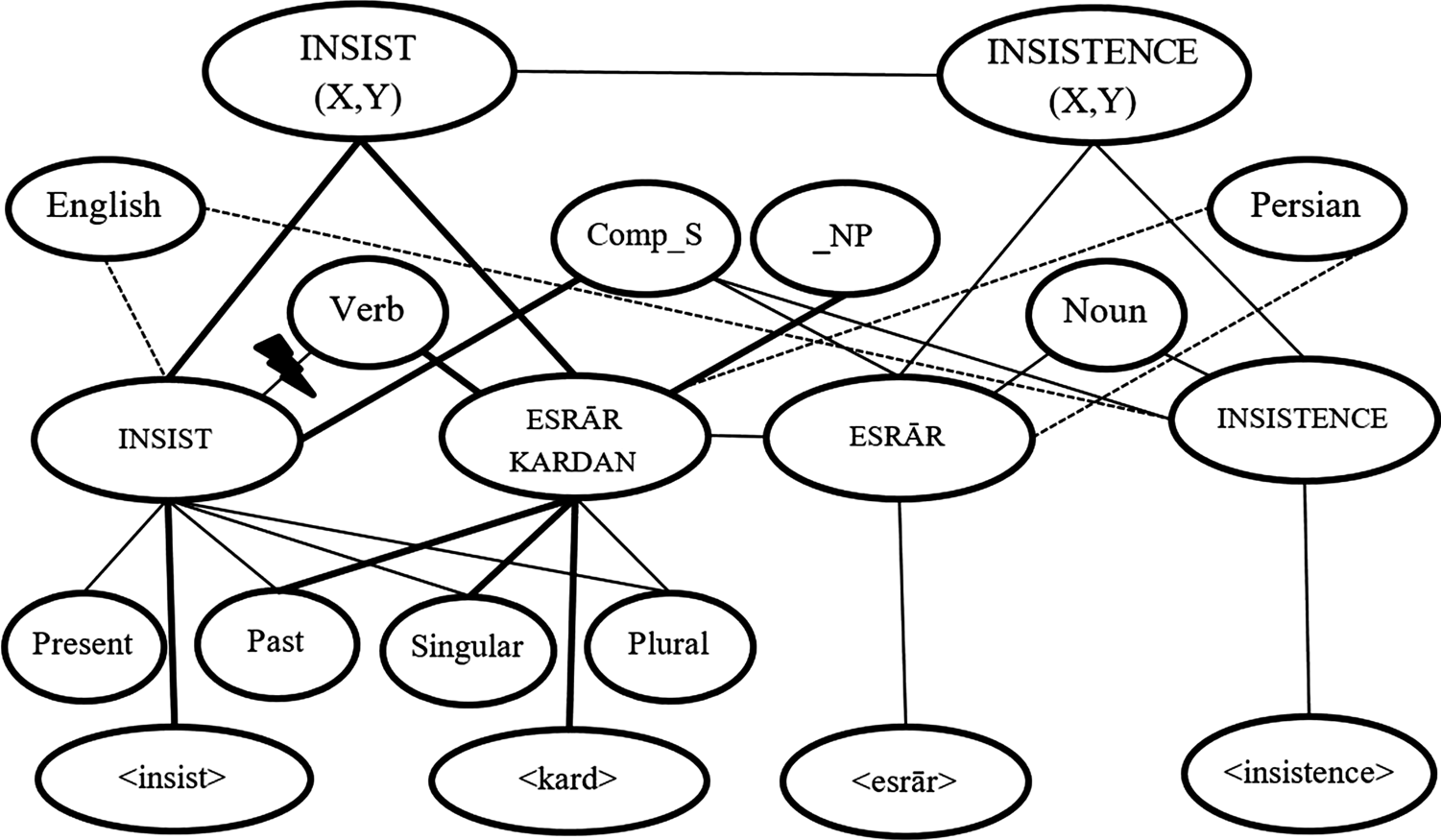
Figure 2 is a model characterizing the production of BCVs. We propose that the production of the first constituent of a BCV, the English verb in the place of a Persian nominal, involves the following sequence of events: The intended concept spreads activation to the corresponding lemma nodes in both languages. Thus, in the production of the BCV insist kard (lit. insist-did-3sg “he/she insisted”), the activated concept ESRĀR KARDAN (“to insist”) spreads activation to the connected lemmas esrār (“insistence” and kardan (“do”) in the Persian subsystem, and insist in the English subsystem. At the same time, activation spreads within the conceptual networks, among other nodes also to the two conceptual nodes representing the semantic aspects involved: the activity itself (ESRĀR “insistence”) and the perspective taken (KARDAN “do/make”). Accordingly, the lemmas connected to them, such as insistence, insist and esrār or do, make and kardan receive activation as well or again. In this process, the lemma node corresponding to the English verb – insist in our example – has a higher activation level than its competing nouns in both languages, probably due to a more frequent activation in the recent past, possibly supported by its fulfilling a double function in representing the activity itself (semantic core of the compound) and the complex concept (activity+perspective taken).
The also highly activated support verb kardan fits the syntactic structure of the Persian sentence and calls a VP procedure in which kardan can fulfil the function of head and which provides a syntactic slot for a noun. Furthermore, activation also spreads to the linked language nodes and syntactic-category nodes. Language and category need to be changed in order to produce insist (V, English) instead of esrār (N, Persian). As for the language, the code-switching speakers in our corpus are clearly in a bilingual mode, in which both languages are relatively active, even though the base language is more strongly activated (Grosjean, Reference Grosjean, De Groot and Kroll1997). English words are therefore not generally inhibited in production; they just need a particularly high individual level of activation to be selected – in order to compensate for the comparatively lower activation of the language as a whole. According to the Inhibitory Control model (Green, Reference Green1998), this would involve co-operatively operating word production schemas instead of competition. As for the syntactic category, we propose that inhibition is applied to the link of the verb to the syntactic category node, enabling the selection of the lemma as acceptable input for the noun-phrase slot subcategorized by the support verb. Thus, a lemma node of a different syntactic category may come to compete for selection, in case it has a particularly high level of activation. Such a mechanism allows words from different categories across the languages of a bilingual to compete for selection.
Recent approaches to code-switching processing (e.g., Green & Wei, Reference Green and Wei2014, Green Reference Green2018) propose that inhibition may be differentially involved in bilingual speech depending on the type and context of production (e.g., during dense code-switching with another bilingual versus during interaction with a monolingual speaker of one of the languages). The results based on processing during a single-language naming task, as in Substudy 2, may therefore not be directly informative of the processing mechanisms involved during code-switched production; however, they are informative on the underlying activation and inhibition processes, given that the need to ignore the English distractors presented induced a bilingual language mode.
High activation of the English verb may also relate to community-specific code-switching patterns and bilingual language experience, as evidenced by work on cross-generational development in BCV use in Belize (Balam, Reference Balam2015) and a comparative study of three Spanish–English bilingual communities revealing that acceptability judgments reflect exposure (Balam, Parafita Couto & Stadthagen-González, Reference Balam, Parafita Couto and Stadthagen-González2020). Both exposure to and frequency of use of BCVs in the community likely play crucial roles in determining speakers’ threshold of activation for these forms. In speakers from code-switching communities, the category links of verbs that are frequently used in BCVs may undergo a permanent weakening. Such a mechanism might contribute to the more automatic processes, without much need of executive control, involved in dense code-switching communities or situations (cf. Green, Reference Green2011a, Reference Green, Cook and Bassetti2011b; Green & Abutalebi, Reference Green and Abutalebi2013). A similar mechanism might also contribute to the not-so-rare changes of syntactic category – for example, from noun to verb, e.g., to google, or to zeta-jones.
The last 30 years saw much research on the structure of BCVs. The focus of this study is, however, on the processing mechanisms involved in the production of BCVs, in particular on the role of the word category. The production of [verb+verb] Persian–English compound verbs shows that the syntactic category of a word does not provide a rigid constraint on lexical access in the case of BCVs. We propose that competition of a verb from the donor language with a noun from the base language allows the formation of BCVs of this type.
Further research is invited to test this model in other bilingual contexts. One question to be asked is whether the proposal depends on the occurrence of verb-derived nouns in the matrix language. Other aspects to be addressed might include the role of the degrees of ‘nouniness’ or ‘verbiness’, or the de-grammaticalization of the grammatical class system in the embedded language, as well as the existence of support-verb constructions in the matrix language. More generally, the production of [v+v] BCVs shows that verbal behaviour has a higher degree of flexibility than afforded by current speech production models.
Supplementary Material
For supplementary material accompanying this paper, visit https://doi.org/10.1017/S1366728921001103
Table S1 (PDF): Complete list of BCVs produced in the conversation corpus (Substudy 1). Each BCV is given with the following information: structural gloss, English lexical verb, Persian support verb, and Persian translation equivalent(s) of the bilingual construction.
Table S2 (PDF): Verbal stimulus materials used in the experiment (Substudy 2).
Acknowledgements
This article is based on a doctoral dissertation submitted by the first author, under the supervision of the second and third authors, to the University of Bern. The first author was in part funded by a post-graduate scholarship from the Joséphine Karman Fellowship Trust. We thank Marie-Anne Morand for her assistance with the programming of the experiments and the speech-onset latency analysis.
Data availability
The data that support the findings of this study are available from the authors.
Competing interests
The authors declare none.


 Open access

