


Away-from-home food (AFHF) intake has received attention recently due to the increasing consumption of food outside the home, which may be a factor in the increasing prevalence of overweight and obesity( Reference Bezerra, Curioni and Sichieri 1 ). Although excessive weight gain is a result of multiple factors, including genetic, metabolic, socio-economic, behavioural and environmental causes, the consumption of foods away from home has been implicated as a selected behaviour related to overweight and obesity( Reference Popkin, Adair and Ng 2 – Reference Marin-Guerrero, Gutierrez-Fisac and Guallar-Castillon 7 ). Possible mechanisms to explain this relationship include the substantial contribution of AFHF to daily energy intake and the high content of total fat and saturated fat in foods prepared away from home( Reference Lachat, Nago and Verstraeten 8 ).
In Brazil, 50 % of the adult population has a BMI over 25 kg/m2 and 15 % are obese, representing an increase of 8 % in the prevalence of overweight in 5 years( Reference Bezerra, Curioni and Sichieri 1 ). During the same period, expenditures on foods consumed away from home increased by 7 %( Reference Popkin, Adair and Ng 2 ).
One study conducted in a representative sample of Brazilian urban households, using expenditures on foods consumed away from home as a proxy for AFHF consumption, found a positive association between eating out and overweight and obesity among men but not among women( Reference Bezerra and Sichieri 9 ). Data from the first National Dietary Survey showed that eating away from home positively increased total energy intake in urban areas of Brazil( Reference Bezerra, de Moura Souza and Pereira 10 ).
One important issue that may affect the relationship between eating out and obesity is unhealthy dietary practices within the home food environment. A study in the city of São Paulo, in the south-east of Brazil, investigated the quality of meals consumed at home and away from home and found that only lunch consumed away from home presented lower nutritional quality than lunch consumed at home. The authors concluded that a diet of low nutritional quality is independent of the place of consumption, showing that meals consumed at home also need improvement( Reference Gorgulho, Fisberg and Marchioni 11 ).
The aim of the present study is to evaluate the association between eating away from home and body weight. In addition, the study aimed to examine whether dietary intake differs based on the consumption of food away from home among AFHF consumers and to compare consumers and non-consumers of AFHF.
Materials and methods
Study design and study population
Data were obtained from the first Brazilian National Dietary Survey conducted along with the 2008–2009 Household Budget Survey by the Brazilian Institute of Geography and Statistics. The primary sampling units were selected by systematic sampling with probabilities proportional to size and were stratified by geographic location (urban/rural and five Brazilian geographic areas) and economic level. In the second stage, households were selected by simple random sampling. Thirty per cent of these households were randomly selected to participate in the first Brazilian National Dietary Survey, with a non-response rate of 19 %. A total of 34 003 individuals participated in the dietary survey. Details on the sampling plan and study design are available in a previous publication( 12 ).
Previous analyses have shown that most AFHF intake occurs in urban areas( Reference Bezerra, Souza Ade and Pereira 13 ). Therefore, for the current paper, only individuals living in urban areas of Brazil were included. Individuals less than 25 years old were excluded because people usually become completely responsible for their own food acquisition after this age. Additionally, individuals aged 65 years or older were excluded because BMI has been found to be less informative of health risks and mortality at this age( Reference Douketis, Paradis and Keller 14 ). Pregnant and lactating women (n 533) were also excluded.
Individuals with missing values for weight and/or height totalled 1084; analyses were conducted either without these values (n 13 736) or with imputed values obtained using the hot deck technique (n 14 820). The methodology used for data imputation can be found in other publications( 15 , Reference Andridge and Little 16 ). Briefly, data were subjected to a system of review and automatic imputation known as Critique and Imputation for Quantitative Data (CIDAQ). This system incorporates multivariate data processing, in which data are evaluated by taking into account the following variables: age, sex, weight, height and household income.
Assessment of away-from-home food intake
The definition of AFHF included all foods obtained and consumed away from home. Foods that became a part of the household food supply were not considered AFHF, regardless of the place of purchase or consumption. For example, AFHF did not include foods that were prepared at home but consumed outside the home or ready-to-eat foods that were purchased outside the home but consumed at home. This definition is consistent with its use in other studies( Reference Bezerra and Sichieri 9 , Reference Bezerra, de Moura Souza and Pereira 10 ).
Food consumption was assessed by a food record collected on two non-consecutive days; only the first day of intake was included in the present analysis. Individuals recorded their food and beverage intake, excluding water, with as much detail as possible; individuals recorded the time when each food was eaten, the amount eaten and the place where each food was obtained and consumed. Interviewers reviewed all food records, probing for food details and typically forgotten items, and recorded them in a computer database. Food quantities reported using household measures and common portions were transformed into grams or millilitres to estimate the total amount of food consumed. Then, the nutritional composition of the total amount of food consumed was estimated using a Brazilian food composition table specially developed for the survey( 17 ).
Anthropometric measures
Weight and height were measured by trained interviewers at respondents’ households using an electronic portable scale and a wall-mounted stadiometer. Weight was measured to the nearest 100 g using an electronic portable scale, and height was measured to the nearest 0·1 cm using a vertical wall-mounted stadiometer. Details of the procedures used can be found in a previous publication( 15 ). BMI was computed as weight (kg) divided by the square of height (m2), and the WHO cut-offs were used to classify the respondents: 25 kg/m2≤BMI<30 kg/m2 for overweight and BMI≥30 kg/m2 for obesity( 18 ).
Sociodemographic variables
Sociodemographic characteristics included age, sex, household income and years of schooling. Household income included all monetary and non-monetary incomes. Years of schooling were divided into four categories: up to 4 years, between 5 and 9 years, between 10 and 12 years, and 13 years or more.
Statistical analyses
Descriptive statistics were used to evaluate the differences between AFHF consumers and non-consumers. The χ 2 statistic was used for categorical variables, and linear regression models with the consumption of food away from home as the independent variable were used for continuous variables.
The association between the percentage of energy provided by foods consumed away from home and overweight or obese BMI status was tested using logistic regression models. The generalized logit function was used to compare the overweight and obese categories with the reference category (normal weight). The models were further adjusted for per capita household income and years of schooling.
The mean percentages of energy provided by protein, fat, saturated fat and free sugars were calculated based on the consumption of foods away from home. Among AFHF consumers, we also compared the percentage of energy from these nutrients provided by at-home and away-from-home food consumption.
Food categories, representing similar food items in nutritional content or in the way foods are customarily consumed, were created to compare the consumption of specific food groups by place of consumption. Food categories included rice, beans, milk, pizza, deep-fried and baked snacks, sandwiches, sweets and sugar, soft drinks and alcoholic beverages. Rice and beans were included because they represent traditional foods consumed in Brazil( Reference Marchioni, Claro and Levy 19 ) and are promoted by the Brazilian Food Guidelines, as well as milk, which was analysed as a contrast to the consumption of soft drinks( 20 ). Alcoholic beverages were also included in the analyses because they are frequently consumed away from home( Reference Orfanos, Naska and Trichopoulos 21 , Reference Vandevijvere, Lachat and Kolsteren 22 ). The other groups were chosen because of their high energy content and low nutrient density, which are generally considered to contribute to overweight status( Reference Malik, Popkin and Bray 23 – Reference Taveras, Berkey and Rifas-Shiman 26 ). The association between eating away from home (yes/no) and energy consumption from these food categories was tested through linear regression models. These models were adjusted for sex, age and per capita household income (model 1), as well as for total energy intake (model 2).
Statistical analyses were performed using the statistical software package SAS release 9·1·3 (2003). Sample weights were applied to obtain nationally representative estimates, and the stratification and clustering of the design were incorporated into the analyses. This research protocol was approved by the Institute of Social Medicine of the University of the State of Rio de Janeiro (CAAE 0011·0·259·000-11).
Results
A total of 13 736 adults (6179 men and 7557 women) were included in the main analysis. The mean age of the population was 41·7 (se 0·2) years, 38 % were considered overweight and 17 % were classified as obese. The prevalence of AFHF reporting on the first day of intake was 42·7 % (48·8 % among men and 37·1 % among women).
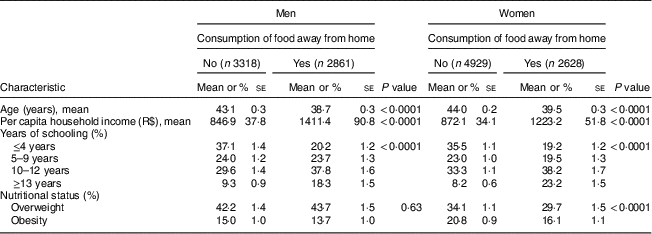
Table 1 presents the characteristics of the sample based on the consumption of AFHF. Individuals who consumed foods away from home were younger and had higher income and a higher schooling level. There was no significant difference between non-consumers and consumers of AFHF in prevalence of overweight and obesity among men, whereas among women, the prevalence of overweight and obesity was lower in consumers compared with non-consumers of food away from home.
Characteristics of the study population (means or percentages, with their standard errors) according to the consumption of food away from home; urban adults (n 13 736) aged 25–65 years, Brazilian National Dietary Survey 2008–2009
We excluded 1084 individuals from the sample because they had missing values for weight and/or height. Although these individuals were more likely to be men and had a higher prevalence of AFHF consumption (45·9 v. 42·7 %, P<0·0001), there were no significant differences in age, income, total energy intake and away-from-home energy intake between them and those with weight and height data. When the values for weight and/or height imputed using the hot deck technique were included, the prevalences of overweight (38 %) and obesity (17 %) remained the same and the association with the consumption of AFHF did not change.
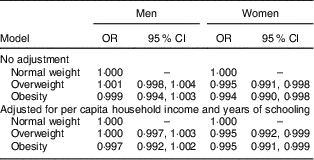
The consumption of foods away from home was not associated with being overweight or obese among men. Among women, a marginal association was found between eating away from home and not being overweight or obese (Table 2).
Association (odds ratios and 95 % confidence intervals) of being overweight or obese with percentage of energy from foods consumed away from home; urban adults (n 13 736) aged 25–65 years, Brazilian National Dietary Survey 2008–2009
Individuals who consumed food away from home had lower intakes of protein and higher intakes of total fat, saturated fat and free sugars than non-consumers. Considering only individuals who consumed foods away from home, the percentage of energy from protein, as well from as fat and saturated fat, was lower away from home than at home, but the contribution of free sugars to energy intake was higher away from home (Table 3).
Percentage of energy from protein, fat, saturated fat and free sugars (means and their standard errors) according to the consumption of foods away from home; urban adults (n 13 736) aged 25–65 years, Brazilian National Dietary Survey 2008–2009
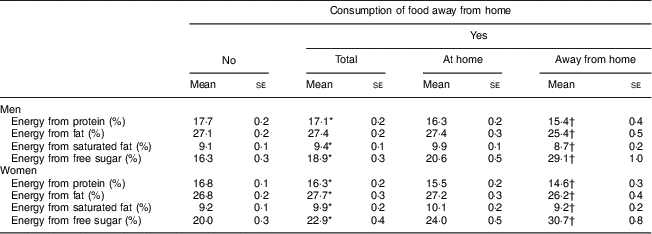
* P≤0·01 for comparison between non-consumers and away-from-home food consumers.
† P≤0·01 for the comparison between at-home and away-from-home nutrient consumption among away-from-home food consumers.
The mean energy intake from specific food groups based on the consumption of foods away from home is shown in Table 4. On average, individuals who consumed AFHF had lower total intakes of rice, beans and milk and higher total intakes of energy-dense foods such as deep-fried and baked snacks, sweets and sugar, and soft drinks than non-consumers. The total consumption of alcoholic beverages was also higher among AFHF consumers than non-consumers. After controlling for sex, age, per capita household income and total energy intake, these differences remained.
Consumption of energy from specific food groups (kJ; means and their standard errors) according to the consumption of foods away from home and regression coefficients (β coefficients and P values) comparing consumers with non-consumers of food away from home; urban adults (n 13 736) aged 25–65 years, Brazilian National Dietary Survey 2008–2009
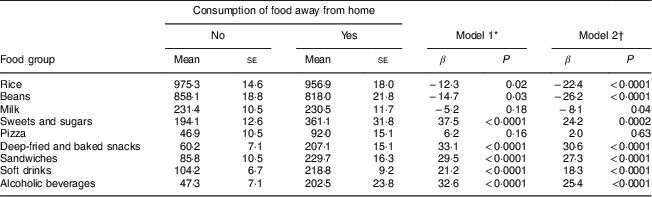
* Adjusted for sex, age and per capita household income.
† Adjusted for sex, age, per capita household income and total energy intake.
Discussion
In a large sample of 13 736 adults living in urban areas of Brazil, no association between eating away from home and being overweight or obese was observed among men, and a marginal negative association was observed among women.
In a previous study also conducted among Brazilian adults living in urban areas of Brazil, a positive association was found between eating out of the home and overweight and obesity among men( Reference Bezerra and Sichieri 9 ). This difference could be explained by the way food away from home was assessed. Reference Bezerra, de Moura Souza and PereiraBezerra Reference Bezerra, de Moura Souza and Pereiraand Sichieri( Reference Bezerra and Sichieri 9 ) used expenditures on foods consumed away from home in a 7 d period, which could have increased the probability of identifying substantial AFHF consumers.
On the other hand, our finding of no association between eating away from home and BMI among men is consistent with the findings of a large study conducted with 34 974 Spanish adults, in which no association was found between having any of the main meals away from home and obesity( Reference Marin-Guerrero, Gutierrez-Fisac and Guallar-Castillon 7 ). Additionally, in a representative national sample of Australian adults (1277 men and 1585 women), no association was found between consuming takeaway food twice weekly or more and overweight or obesity among men( Reference Smith, McNaughton and Gall 27 ).
Our finding of a negative association between AFHF and obesity among women is consistent with a study conducted with 1070 Korean housewives, in which women who ate outside the home at moderate levels had lower obesity rates( Reference Choi, Kim and Yoon 28 ).
The positive association between eating out of the home and obesity is more frequent when fast-food restaurants are analysed separately from full-service restaurants. Among young US adults, greater fast food (but not restaurant food) consumption was associated with higher BMI( Reference Duffey, Gordon-Larsen and Jacobs 29 – Reference Anderson, Rafferty and Lyon-Callo 32 ). However, the association between eating out and body weight is controversial; other studies have suggested that the consumption of food away from home is positively related to body weight, BMI or the prevalence of overweight and/or obesity( Reference Naska, Orfanos and Trichopoulou 5 , Reference Ko, Chan and Tong 33 ), while different ones have described no association( Reference Marin-Guerrero, Gutierrez-Fisac and Guallar-Castillon 7 , Reference French, Harnack and Toomey 34 , Reference Burns, Jackson and Gibbons 35 ).
A more conservative definition, in which individuals were considered substantial away-from-home eaters if they reported more than 25 % of their total energy intake from away-from-home occasions, was previously used by other researchers( Reference Vandevijvere, Lachat and Kolsteren 22 , Reference Malik, Popkin and Bray 23 ). When applying this definition, no association was detected between eating out and BMI among European adults( 18 ), and no significant association with BMI was found in the present study (data not shown).
Although no association was found between eating away from home and BMI, the impact of AFHF on nutrient intake and daily consumption of specific food groups was substantial. Individuals who consumed food away from home presented lower intakes of energy as protein and higher intakes of energy as total fat, saturated fat and free sugars than non-consumers.
These findings corroborate the results of other studies in which high consumers of AFHF presented higher percentage of energy from fat( Reference Burns, Jackson and Gibbons 35 – Reference van’t Riet, den Hartog and van Staveren 37 ). The consumption of food away from home also contributed to more fat and sugar intake among a large sample of European adults (35–70 years old); however, there was no difference between macronutrient contributions to energy intake when at-home eating was compared with out-of-home eating, particularly in northern European countries( Reference Orfanos, Naska and Trichopoulou 38 ). One study conducted among Irish adults reported a lower energy contribution from fat consumed out of the home compared with fat consumed at home( Reference O’Dwyer, Gibney and Burke 39 ).
When evaluating specific food groups, individuals who consumed AFHF had lower total intakes of rice, beans and milk and higher total intakes of energy-dense foods such as deep-fried and baked snacks, sweets and sugar, and soft drinks than non-consumers. The total consumption of alcoholic beverages was also higher among away-from-home consumers than non-consumers.
The consumption of sweets, soft drinks and alcoholic beverages was previously identified as more likely to occur away from home( Reference Vandevijvere, Lachat and Kolsteren 22 , Reference Malik, Popkin and Bray 23 , Reference Kearney, Hulshof and Gibney 36 , Reference Bezerra and Sichieri 40 ). In a recent systematic review, Lachat and colleagues concluded that foods consumed away from home are positively associated with higher fat intake and lower nutrient quality( Reference Lachat, Nago and Verstraeten 8 ). It is worth noting that previous analyses of the present data showed that eating out of the home is positively associated with total energy intake, but the magnitude of this association was very low( Reference Bezerra, de Moura Souza and Pereira 10 ). In the case of possible bias in our results, it would probably be due to underestimation since those individuals who eat away from home less frequently may be classified as out-of-home non-eaters.
The absence of an association between AFHF intake and overweight or obesity can also be explained by the cross-sectional design of the study, which is prone to reverse causality. Obese individuals might eat less away from home to better control their energy intake and prevent weight gain. Additionally, weight gain is an ongoing process that is not properly captured under cross-sectional analysis. Also, food records were used to assess AFHF intake, which is prone to alter dietary behaviour by decreasing the amount or quality of intake, resulting in dietary misreporting of food intake( Reference Willett 41 ).
We defined AFHF based on the place of purchase and consumption of food; foods that went into the household food supply, such as delivery meals or takeaway foods that were consumed at home, were not considered to be AFHF. With this definition, AFHF better represent an individual decision to eat that food as opposed to at-home foods, which are usually available for all members of the household. However, this definition does not allow the differentiation of food between fast-food restaurants, full-service restaurants or work cafeterias. Naska et al. found that eating at work, but not at restaurants, may not contribute to overweight among men( Reference Naska, Orfanos and Trichopoulou 5 ). Larson and colleagues described a higher intake of vegetables among frequent full-service restaurant users but not among fast-food restaurant users( Reference Larson, Neumark-Sztainer and Laska 31 ).
Conclusion
In conclusion, our findings indicate that eating away from home is not associated with obesity among men and is negatively associated with overweight and obesity among women from urban areas of Brazil. However, AFHF consumers had lower intakes of protein and higher intakes of total fat, saturated fat and free sugars than non-consumers and higher intakes of deep-fried and baked snacks, sweets and sugar, and soft drinks. Therefore, public health policies should be implemented to help people make healthier food choices away from home.
Acknowledgements
Financial support: The Brazilian National Dietary Survey was funded by the Brazilian Ministry of Health. I.N.B. received a fellowship from the Brazilian Federal Agency for the Improvement of Higher Education (CAPES; Process no. 6748-10-4). The Brazilian Ministry of Health and CAPES had no role in the design, analysis or writing of this article. Conflict of interest: None. Authorship: R.S. and R.A.P. served as principal investigators, conceptualized the study and drafted the article. E.V. Jr assisted with study design and analyses as well as article writing and review. I.N.B. participated in the quality control of the data, data analysis and article writing and review. Ethics of human subject participation: This research protocol was approved by the University of the State of Rio de Janeiro (CAAE 0011·0·259·000-11).



