Introduction
When studying portable material culture, archaeologists typically start with depositional context as the only physical location associated with objects that can be determined with a high degree of certainty. One fundamental issue that arises from this situation concerns the relationship between the place of discard and the locations where objects were used and manufactured, with archaeologists effectively working backwards through this sequence. In biographical terms, objects are ‘born’, go through various stages of ‘life’ and then ‘die’ (Kopytoff Reference Kopytoff1986), which has led to the archaeological concept of the ‘object biography’ (see Hahn & Weiss Reference Hahn and Weiss2013; Joy Reference Joy2015; Joyce & Gillespie Reference Joyce and Gillespie2015). Of these three main biographical stages, it is often the ‘life’ of archaeological objects—arguably the most important stage—about which there is the greatest uncertainty, as archaeologists rarely know where items were used.
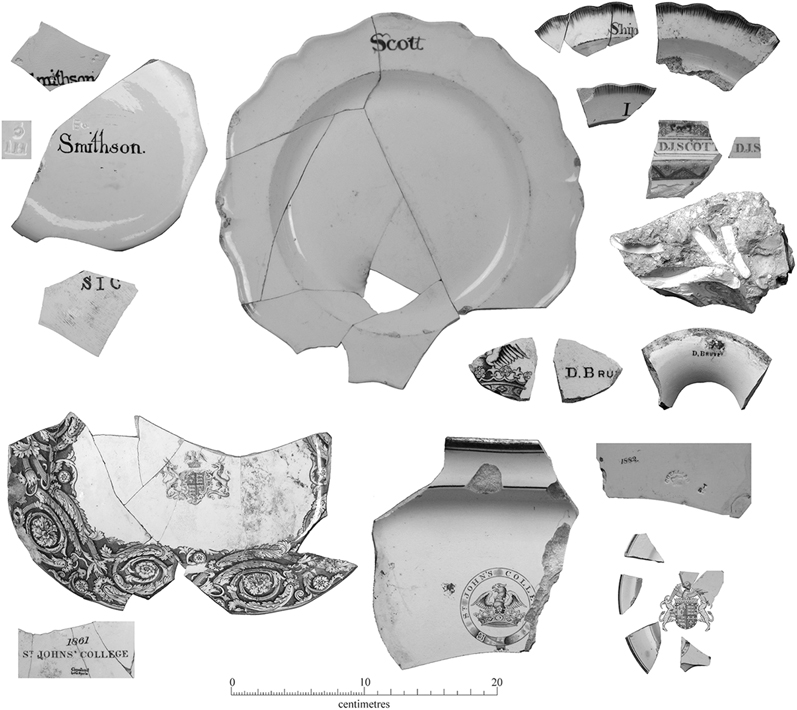
One exception to this are the eighteenth- to twentieth-century collegiate tablewares used at the University of Cambridge, England, which were manufactured and initially purchased for use in the dining halls of specific colleges, such as St John’s (Figures 1–2). That locations of use are known with such certainty obviates the need inherent in most archaeological investigations to start with the depositional context as the prime biographical location associated with an object. This makes such ceramics particularly suitable for a fine-grained interpretation using a biographical approach, particularly when extended to assemblages of material rather than individual items (e.g. Blanco-González Reference Blanco-González2014; Cessford Reference Cessford2014a; Joy Reference Joy2016).
Selection of sherds from late eighteen- to early twentieth-century ceramics produced for use at St John’s College, Cambridge recovered from a variety of archaeological investigations (photograph by Craig Cessford).

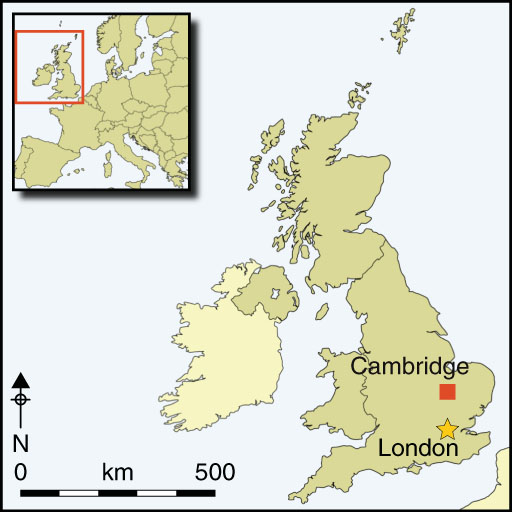
Map of Cambridge showing locations where late eighteenth- to early twentieth-century ceramics produced for use at St John’s College were recovered during archaeological investigations (drawing by Craig Cessford, contains Ordnance Survey data © Crown copyright and database right 2018).

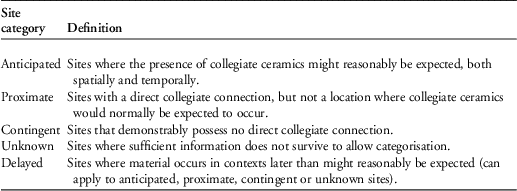
The locales from which collegiate ceramics have been recovered can be broadly categorised into five types in terms of their functional, spatial and temporal domains, linked to an ideal or expected life course: ‘Anticipated’, ‘Contingent’, ‘Proximate’, ‘Unknown’ and ‘Delayed’ (Table 1). A significant proportion of Cambridge collegiate ceramics recovered archaeologically come from sites that can be classified as contingent, that is, locales with no direct collegiate connection. As will be illustrated through two case studies, such sites serve to demonstrate how complex the relationship between the locales of ‘life’ and ‘death’ may be for objects in urban contexts. This challenges the common assumption that the quantity of material deposited in primary use contexts was substantially greater than that disposed of elsewhere (e.g. Peña Reference Peña2007: 39). In turn, this raises significant questions about the interpretation of distribution patterns (e.g. Gerrard Reference Gerrard2011) and the combination of structural, artefactual and environmental evidence to produce integrated narratives of urban centres (e.g. Hall & Hunter-Mann Reference Hall and Hunter-Mann2002; Bowsher et al. Reference Bowsher, Dyson, Holder and Howell2007).
Definitions of site categories.
The University of Cambridge
The University of Cambridge, founded c. 1209, is a federation of autonomous colleges, where governing authority and functions are divided between the university’s central administration and the constituent colleges, although for most of its history, power and wealth has rested firmly with the latter (Leedham-Green Reference Leedham-Green1996). By the late eighteenth century, there were 16 colleges, varying markedly in size and wealth, rising to 23 by the end of the nineteenth century. Broadly speaking, the colleges may be conceived of as grand households, comprising a master, fellows (academics), scholars (students) and servants. Until 1860 fellows had to resign if they married, so collegiate households were almost exclusively homosocial and adult. They were also relatively inward-looking institutions, a quality expressed architecturally through their quasi-monastic layouts, arranged around courts—although a significant proportion of students and almost all servants lived outside the college. Physically, the colleges dominated the core of the historic town, centred upon a ‘university quarter’ between the main street and the river. Breakfast, lunch and supper were simple meals, eaten privately or in small groups in the rooms of students or fellows, and usually ordered from the college kitchen or buttery. Dinner was a communal affair eaten in the college hall. There was a strict hierarchy of fellows and different groups of students seated separately, and those of higher status received better quality food. For the majority of students, dining was not a refined affair; the hall at Trinity College was “ugly, smoky, and smelling so strong of bread and meat, that it would be impossible for me to eat a morsel in it” (Mayor Reference Mayor1911: 124–25), with dining a “primitive” and “savage piece of business” where one “gobbled his fill” (Smith & Stray Reference Smith and Stray2003: 57). In contrast, at the top of the hierarchy, the fellows and some students could enjoy “one of the very best dinners ever put on a table” (Everett Reference Everett1865: 134–35).
Collegiate ceramics
From c. 1760–1770 onwards, many collegiate ceramic dining sets were marked during manufacture by moulding, scratching, hand-painting or transfer-printing coats of arms, heraldic achievements, badges, names, college views or the name of the cook who supplied the crockery (Cessford Reference Cessford2016a, Reference Cessfordin press). Knowing with absolute certainty where these ceramics were used, combined with substantial bodies of documentary and cartographic evidence about where they were deposited, offers the opportunity for richly contextualised analysis and the reconstruction of plausible explanations for how ceramics moved between contexts of use and deposition. This has significant implications for the study of urban archaeology because it permits fine-grained analysis, allowing direct connections to be made between manufacture, acquisition, use and deposition.
One crucial assumption often made about these collegiate ceramics is that they would have remained within their respective colleges for the entirety of their use-lives: moving between the hall, the private rooms of fellows and students, the kitchen, the scullery and storage rooms. While this assumption is largely true, collegiate ceramics might also occasionally and legitimately leave a college. From 1860, fellows were allowed to marry and live outside college, and from then until the Second World War, college cooks sometimes supplied evening meals to these fellows, collecting the crockery the next morning. Groups of college cooks were occasionally involved in preparing food for major civic and university events outside their colleges, which may also have involved supplying ceramics, although such instances were the exception rather than the rule.
Beyond Cambridge colleges, a wide range of eighteenth- to twentieth-century institutions and other groups made use of marked ceramics, such as those associated with the military (Demers Reference Demers2009), eating houses (Gooch Reference Gooch2007), university fraternities (Wilkie Reference Wilkie2010: 184–92) and hospitals (Jeffries & Braybrooke Reference Jeffries and Braybrooke2015: 254). These ceramics are, however, generally found in relatively small quantities and at anticipated sites linked almost exclusively to their prime locale of usage. Marked ceramics linked to hotels (Myers Reference Myers2016) and shipping lines (Laister Reference Laister2006) have been found in greater quantities, but again largely at anticipated sites. In contrast, Cambridge collegiate ceramics have been found in abundance at a variety of sites, many of which can be classified as proximate, contingent or delayed—that is, locales beyond the colleges and often without any direct link to them (Table 1). This is partly because the university constituted a significant proportion (7.8–11.4 per cent) of Cambridge’s population between the eighteenth and twentieth centuries, whereas most of the other institutions noted above from this period formed a much smaller proportion of the urban centres where they were located. Second, the majority of college servants—including the cooks, who often supplied and owned college ceramics—and many undergraduates, resided outside the colleges, leading to a great deal of daily movement by people and ceramics, in and out of the colleges.
Many discoveries of collegiate ceramics have been made at anticipated sites that formed part of the commodity chain linking manufacturers and primary consumers (the colleges). During the period in question, the colleges stored refuse in above-ground enclosed containers or structures. Individuals known as ‘scavengers’ were employed to remove this waste on a regular basis. This material then joined the official civic refuse system and was transported to a number of ‘common dunghills’ around the town, where it was dumped before being used to backfill quarry pits in the surrounding fields about the town. The common dunghills and fields outside Cambridge can therefore be classified as anticipated sites. Collegiate ceramics have also been found on proximate sites with close links to colleges, or sites where such connections may have existed but are poorly documented (categorised here as unknown sites).
There are, however, a number of well-documented contingent sites where collegiate ceramics have been found without any direct college connections. Two of these locales, where large assemblages have allowed for a nuanced reading of the linkages between the contexts of use and deposition as a form of assemblage biography, are discussed below.
Grand Arcade
The 1.5ha Grand Arcade site, excavated in 2005–2006 by the Cambridge Archaeological Unit (CAU), investigated significant portions of 14 properties within a single street block. Even though none of these properties were parts of colleges or occupied by college members, sherds relating to 34 identifiably collegiate vessels were recovered from 15 assemblages. The presence of many of these vessels, however, is readily explicable. Some were recovered from the property of a firm of ceramic retailers that supplied the colleges, while others were found at a property occupied by a college cook. Both of these are therefore anticipated sites.
The largest assemblage, comprising 20 vessels linked to five colleges, was deposited c. 1843–1845 in a cellar at the Cock Inn public house. Although the Cock Inn had no direct collegiate associations, it is possible to construct a convincing explanation of how this assemblage formed; as such, it can be considered a delayed contingent site (Figures 3–4; Cessford Reference Cessford2014a).
Map of colleges and cooks represented in the Cock Inn cellar assemblage (left) and date range of collegiate material in the Cock Inn cellar (right) illustrating the spatial and temporal elements of the assemblage biography (drawing by Vicki Herring).
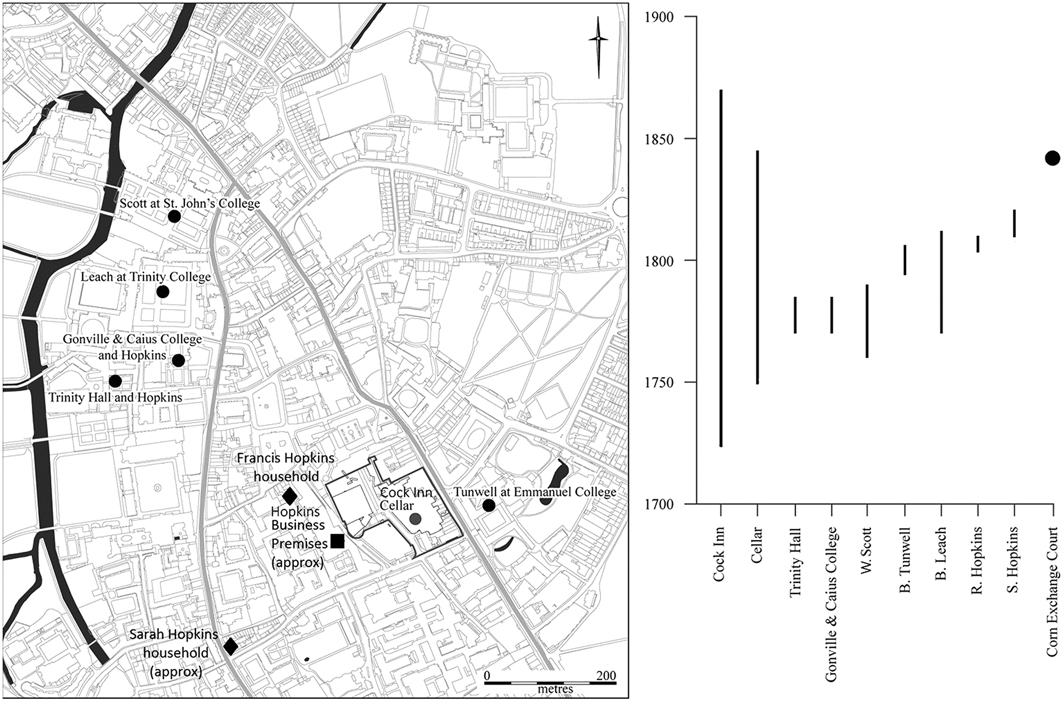
Diagram reconstructing the probable biography of the ‘life’ of the collegiate material in the assemblage recovered from the Cock Inn cellar. Section of the cellar excavation (top) and portrait of the cook Barnett Leach III on a box lid surrounded by quill work (right) (photographs by Craig Cessford, Dave Webb and Ric Leach; drawing by Craig Cessford).
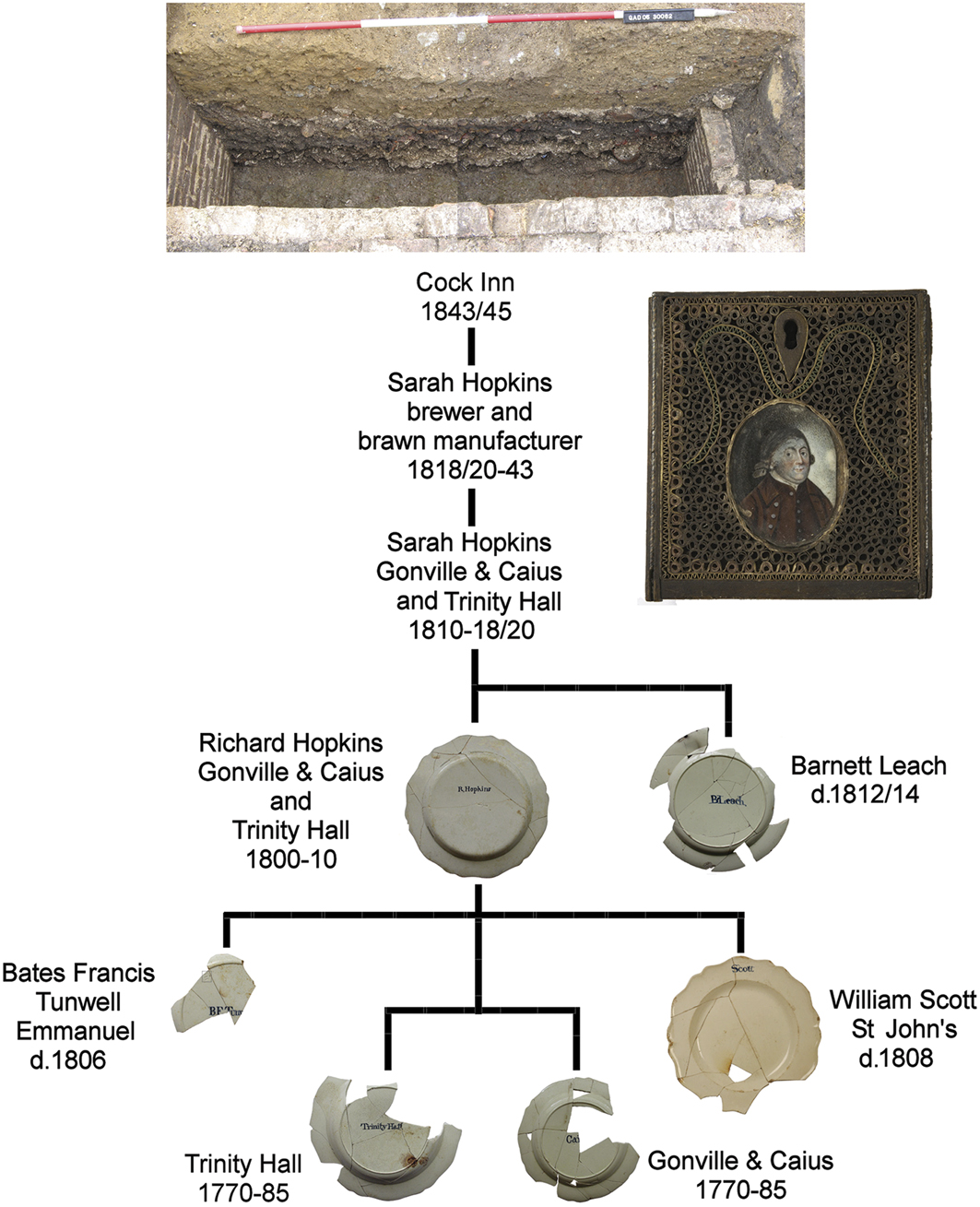
The earliest ceramics from this cellar are four plates from the colleges of Trinity Hall and Gonville & Caius (c. 1770–1785). These plates were presumably ‘inherited’ by Richard Hopkins, the cook at Trinity Hall and Gonville & Caius (c. 1800–1810), whose own name occurs on 11 vessels. There were also single plates of Bates Francis Tunwell (Emmanuel College, 1794–1806) and William Scott (St John’s College, c. 1779–1808). Scott was a witness at the marriage of Hopkins in 1787, so Richard probably acquired these vessels upon the retirement or death of the other cooks. These plates were then used by Richard’s widow Sarah, who was the cook at the same colleges until 1818. Sarah appears not to have commissioned any plates marked with her own name, but she probably acquired two vessels linked to the Leach family, cooks at Trinity College. The latter had been linked to the Hopkins family by marriage since 1787, and when the last cook retired or died in 1812–1814, the vessels were presumably given to Sarah.
After ceasing to work as a cook, Sarah Hopkins, her son Richard and her brother Thomas Broadbent worked as brewers and brawn manufacturers on Slaughter House Lane. Sarah died in 1843, and in c. 1843–1845 part of the Cock Inn, located 100–150m from her premises on Slaughter House Lane (now Corn Exchange Street) was redeveloped. As brewers, Sarah and her son Richard may have had business connections with the Cock Inn. Alternatively, there may simply have been a serendipitous coincidence, with Richard disposing of his mother’s possessions when the Cock Inn redevelopment required backfilling material.
Over 200 ceramic items were deposited in the cellar, so the 20 collegiate ceramics represent 9.8 per cent of the vessels from the assemblage. Other items, including what are probably personal effects, as well as vessels that probably derive from the Cock Inn, form very different elements of the assemblage biography. While the backfilled cellar represents a delayed contingent site for the collegiate ceramics, for other elements, it appears to be variously an anticipated, proximate or contingent site.
Barnwell
In the eighteenth century, Barnwell was a village, located 1.5km from the centre of Cambridge and the colleges. After the enclosure of the surrounding town fields in 1807, it was developed rapidly with working-class housing, becoming a suburb of the town by the 1820s. Since 2012, the CAU and Oxford Archaeology East have conducted several excavations, covering 0.5ha and investigating portions of around a dozen properties along the southern side of Newmarket Road. As at the Grand Arcade, none of these properties were parts of colleges, or occupied by students or fellows, but 189 collegiate vessels were recovered from 12 assemblages. None of these locations can be categorised as anticipated sites—they are, instead, a mixture of contingent and unknown sites.
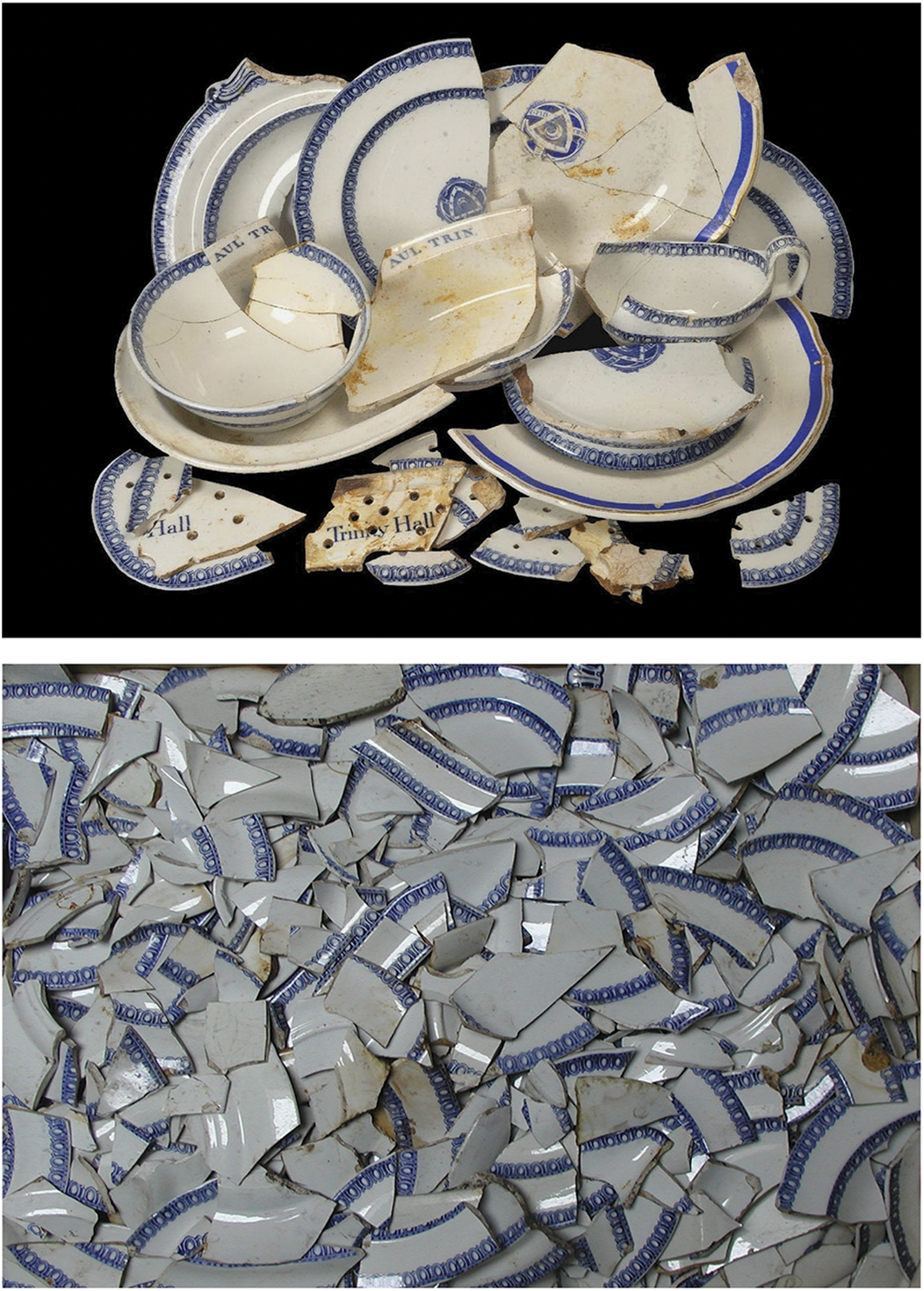
Most of the vessels (170 in total) were used either to backfill a pit and other features, or to create a layer of hardcore during a substantial phase of property redevelopment c. 1877–1885, at what can be considered a contingent site (Figures 5–7; Cessford Reference Cessford2014b). The premises were occupied by the Fletcher family who ran an urban dairy on the outskirts of Cambridge. The redevelopment was probably linked to the ‘Dairies, Cow-Sheds and Milk-Shops Order’ of 1879, which established minimum building standards. The assemblage was only partially recovered, although at least 158 vessels from three separate Trinity Hall dining services—plus some food-storage and -preparation vessels—were identified. It was initially believed that this might relate to the wholesale replacement of some college dining services, but subsequent discoveries demonstrate that vessels for one of these services were still being manufactured as late as 1890. This suggests that there may be a different explanation, for example, a shelf collapse, for the deposit of this large quantity of damaged crockery.
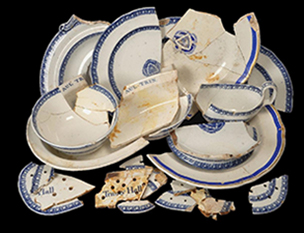
Part of a large assemblage of Trinity Hall ceramics associated with the redevelopment of the Fletcher family property c. 1877–1885 (photographs by Craig Cessford and Dave Webb).
Map of Cambridge showing the location of colleges and the cooks’ residences represented in the assemblage associated with the redevelopment of the Fletcher family property (drawing by Craig Cessford, contains Ordnance Survey data © Crown copyright and database right 2018).
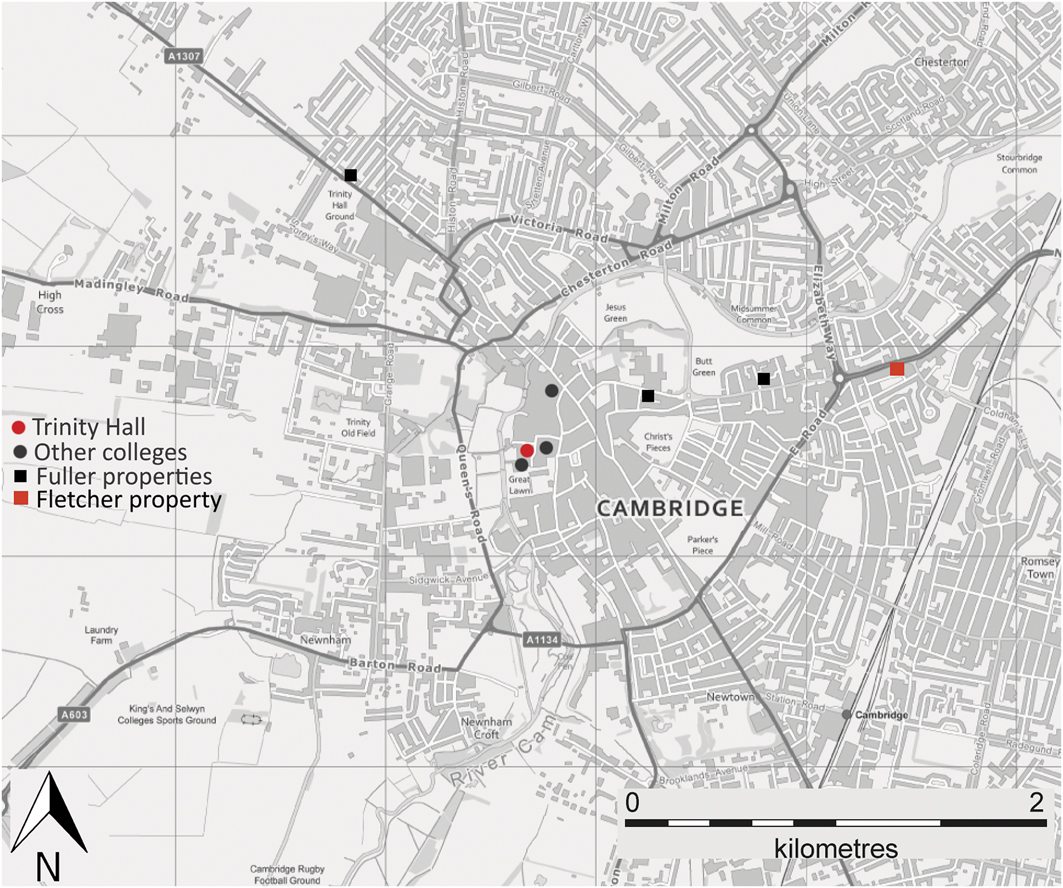
Diagram reconstructing the probable biography of the ‘life’ of the collegiate material in the assemblage associated with the redevelopment of the Fletcher family property (photographs by Craig Cessford).
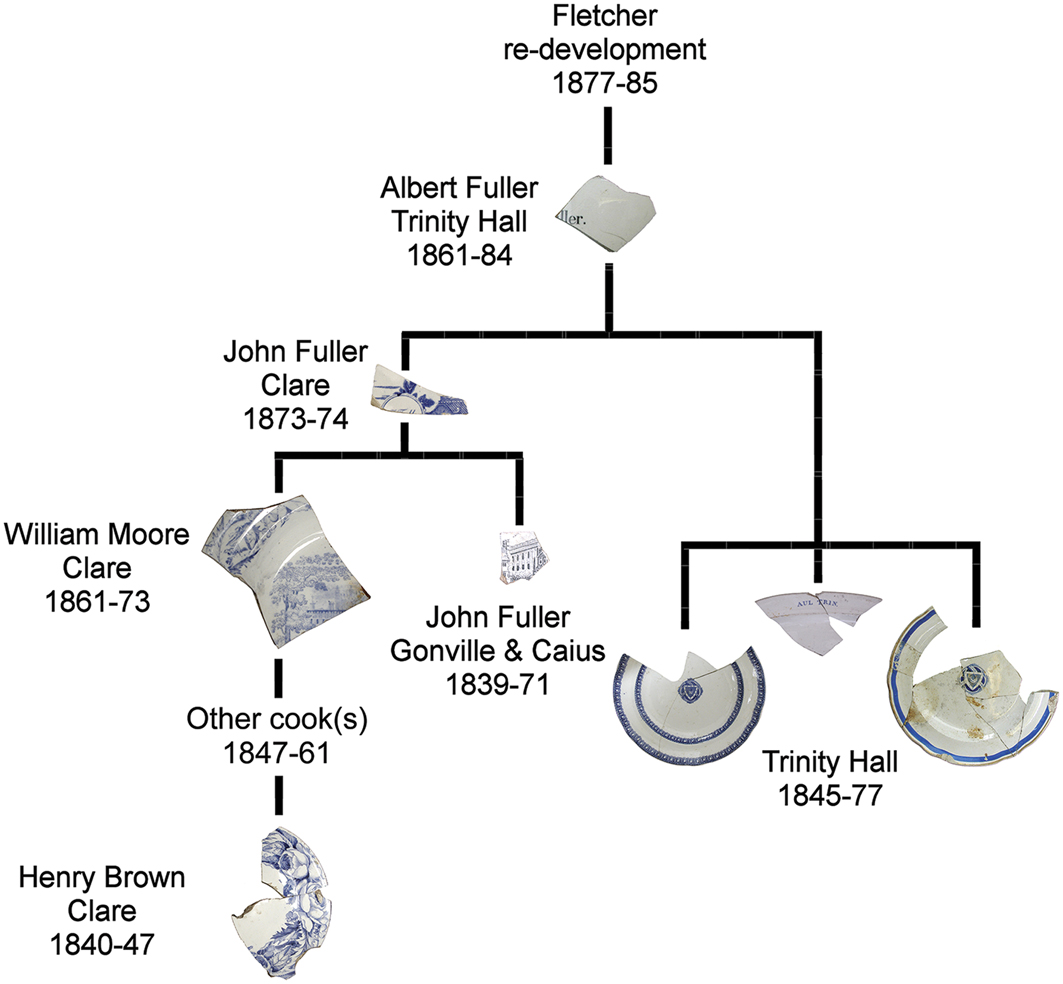
Along with the Trinity Hall material, there are 12 other vessels that can be connected with other cooks and colleges. One is probably linked to Henry Brown, of Clare College (1840–47), while six are linked to one of his successors, William Moore (c. 1861–1873). There are also three vessels linked to John Fuller of Gonville & Caius College (1839–1871) and later Clare College (1873–1874), one of which related specifically to Gonville & Caius. When he died in 1874, John Fuller presumably had some Gonville & Caius and Clare ceramics in his possession, including vessels ‘inherited’ from his predecessors, Brown and Moore, at Clare. On his death, John Fuller’s ceramics may have come into the possession of his brother Alfred, the cook at Trinity Hall (1861–1884), who then took advantage of the disposal of a large group of Trinity Hall ceramics to get rid of this other unwanted material. Although there is no documented connection between Alfred Fuller and the Fletcher family (above), as a cook, Fuller would have been responsible for sourcing milk for the college and may have purchased from their dairy. Alternatively, the connection may have been more tenuous, for example, Alfred Fuller may have employed a haulier with a cart, already involved in the redevelopment of the Fletcher’s premises, to dispose of the ceramics.
Physically distant but proximate sites
Discoveries of nineteenth-century collegiate material from outside Cambridge clearly demonstrate that physical distance and degree of connection need not be directly related. Fragments of four mid nineteenth-century Queens’ College plates from two different services were recovered at Brook Farm in Haslingfield, a village 7km south-west of Cambridge (Figure 8). This is the farthest from Cambridge that collegiate ceramics have been recovered archaeologically, too far for refuse disposal to be considered a reasonable explanation. Queens’ College acquired substantial landholdings in Haslingfield in the late fifteenth century, which it leased to tenants until the mid twentieth century. It is probable that the presence of the plates relates to this link, probably as some form of gift, meaning that this site is perhaps best thought of as a proximate locale.
Map showing the location of sites mentioned in the text (drawing by Craig Cessford).
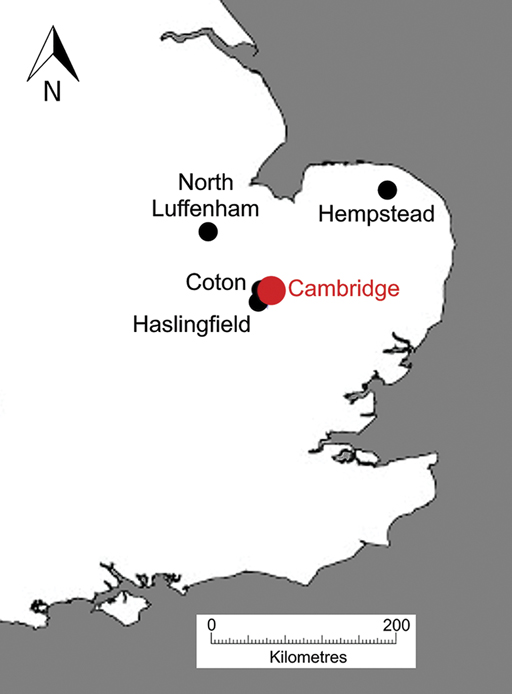
Meanwhile, sherds from two mid nineteenth-century Trinity College plates, from two different services, were found in a field near Coton, 5km east of the college. This suggests that the Haslingfield example is not unique, although in the case of the Coton plates, the link is less clear, as the colleges with closely documented connections to the village are King’s, Queens’, St Catharine’s and St John’s, rather than Trinity; consequently, this locale should be categorised as an unknown site.
In the 1960s, approximately 230 complete late eighteenth- to mid nineteenth-century wine bottles with Emmanuel College seals were found 80km north-west of Cambridge in a cellar at the Old Rectory in North Luffenham, Rutland (Figure 8). Emmanuel gained the advowson—the right to nominate individuals to a vacant church position—of this parish in 1591. This right was still being exercised in the mid nineteenth century, when the college ceased using sealed bottles. It seems unlikely that empty bottles would have been transported this far, suggesting that they may have contained wine.
The date of the bottles suggests that the fellow John Weller (1794–1862) was probably responsible for their relocation. Weller was described as “a most eccentric man […] of great obstinacy of character” who fell out with the other examiners of the Classical Tripos in 1827, left Emmanuel “under a bad omen” for North Luffenham in 1837 and found it “truly a hard and thankless office” (Anonymous Reference Anonymous1908: 7–8). This prompts the question of whether the bottles and their putative contents were given to Weller by the college or if he illicitly appropriated them. Whatever the case, this represents a proximate site. In a similar instance, the advowson for Hempstead, Norfolk, 120km north-east of Cambridge, was held by King’s College; a cesspit at the rectory, backfilled in the 1890s, contained a tile decorated with the college crest (Licence Reference Licence2015: 78) (Figure 8).
Classifying deposition
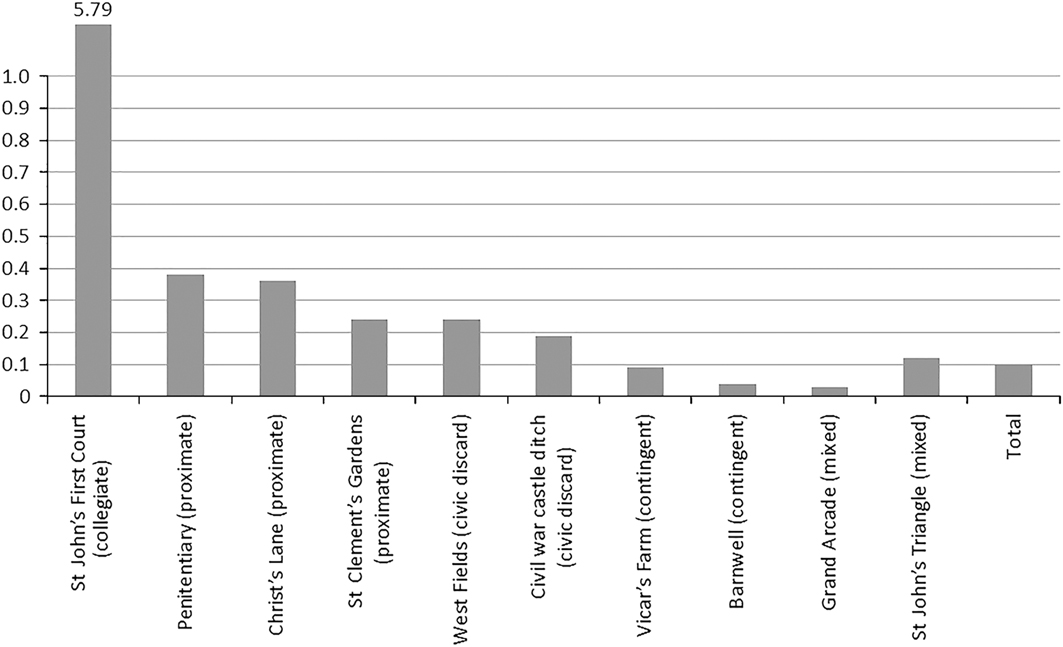
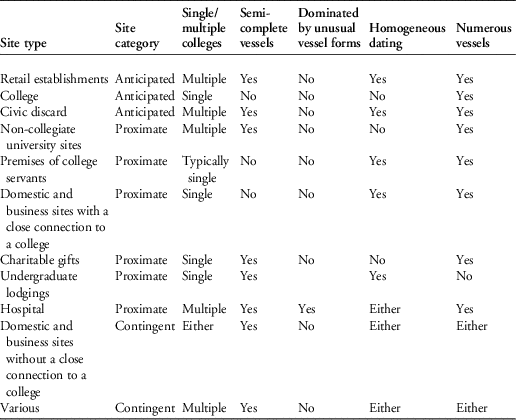
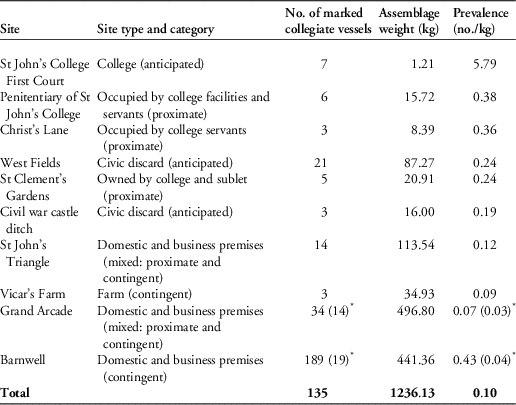
Although specific depositional circumstances are often highly idiosyncratic, it is nonetheless possible to categorise depositional sites according to distinct characteristics related to assemblages of marked collegiate vessels (Table 2). In general, sherd size, weight and damage do not vary significantly between the different categories of sites, meaning that the relative prevalence of collegiate ceramics within overall eighteenth- to twentieth-century ceramic assemblages becomes a useful metric. A relatively crude but effective measure of this is to divide the number of marked collegiate vessels by the weight of the total eighteenth- to twentieth-century ceramic assemblage (Table 3 & Figure 9). The highest values relate to colleges (anticipated sites), followed by locales closely linked to colleges (proximate sites), while the lowest are areas of town with no particular collegiate associations (contingent sites). Sites of civic refuse disposal, with material from both colleges and the rest of the town, can be classified as anticipated sites and have intermediate values. Physical proximity to the colleges does not appear to affect the values; Barnwell, which has no particular collegiate associations and is located several kilometres away, has higher values than the much closer Grand Arcade. One site known as Christ’s Lane, located close to the Grand Arcade, provided accommodation for college servants. It constitutes a proximate site and had a higher value, despite being indistinguishable in terms of other architectural and material culture remains.
Prevalence of marked collegiate ceramic vessels according to number and weight per kilogram (Craig Cessford).
Attributes of college-related material from different types of sites; the attributes are based upon excavated assemblages from Cambridge and Oxford where collegiate ceramics have been recovered.
Prevalence of collegiate ceramics by weight of overall assemblage. ‘*’ indicates values for sites with particular assemblages with large numbers of collegiate vessels excluded.
Other instances of contingent deposition
The deposition of material at contingent locales is not limited to ceramics associated with Cambridge colleges, but also recognised in other periods and places. It is unsurprising that there are assemblages associated with the University of Oxford involving similar processes to those identified for Cambridge colleges (Cessford Reference Cessford2016b). A non-collegiate example from Cambridge is that of an assemblage dating to c. 1775–1780 linked to a coffeehouse run by William Clapham c. 1750–1779, which has nine vessels marked with the proprietor’s initials, but also four vessels with other initials or names (Cessford et al. Reference Cessford, Hall, Herring and Newman2017). Two are from the Sun’s Coffee Room and the Rose Inn, and appear to be linked to coffee-house patrons ‘ordering out’ for meals or drinks from other establishments. The markings were presumably to facilitate the return of the vessels, and such ordering out at least partially explains the regularity with which material is recovered at other establishments and domestic premises (e.g. Hassall et al. Reference Hassall, Halpin and Mellor1985: 216; Owens et al. Reference Owens, Jeffries, Wehner and Featherby2010: 219; Owens & Jeffries Reference Owens and Jeffries2016: 821–23).
John Murray, 4th Earl of Dunmore (1730–1809) and last crown governor of Virginia (1771–1775), took with him to Williamsburg in 1771 a set of Chinese porcelain armorial ceramics manufactured c. 1750–1760. In 1775, early in the American Revolutionary War, Dunmore was forced to evacuate the Governor’s Palace in Williamsburg, abandoning his possessions. Some of his armorial porcelain has been recovered at the palace, but examples have also been found at six other Williamsburg sites (Noël Hume Reference Noël Hume1969: 42). These vessels may either have been carried off when the palace was ransacked in 1775, or sold at auction in 1776. In either scenario, some of Williamsburg’s inhabitants dined off the armorial porcelain of their vanquished adversaries at contingent sites. In another case, an early twentieth-century soup bowl from the Atlantic Lunch restaurant in Washington, D.C. was recovered from a contingent site in St Mary’s City, Maryland, located 90km away where a long-lived community connection between these two locations has been demonstrated (Miller Reference Miller1984).
Comparisons with pre-modern parallels are often problematic, not least because the meaning of ceramic markings is debatable. Even when their significance can be determined, it can still be difficult to identify where vessels were actually used (e.g. Spence Reference Spence2015). One possible parallel is fifth-century BC Athens where some vessels were marked with the names of individuals or as public property (Lang Reference Lang1976: 51–52; Rotroff & Oakley Reference Rotroff and Oakley1992). Those marked as public property include significant numbers from distinctive large assemblages in the agora linked predominantly to the consumption of alcohol. These were probably used in nearby public dining facilities serving the city magistrates, and may be categorised as either anticipated or proximate sites. Three such vessels have also been found nearly 80km away in Corinth; this should probably be categorised as a contingent site with one possible explanation being that the vessels accompanied Athenian envoys (Donati Reference Donati2010: 7–8).
All of these examples of marked ceramics clearly demonstrate that deposition at contingent sites, often distant from the sites of primary usage, is neither exceptional nor confined to collegiate ceramics, but rather a much more widespread phenomenon.
Discussion
The distribution of archaeologically recovered ceramics that can be definitively associated with Cambridge colleges indicates that while some come from locales where their presence might reasonably be anticipated, a significant proportion appear at unexpected sites. Many are found on proximate sites with a direct connection to the colleges, but in some instances, there is greater spatial and temporal distance between the locales of usage and deposition and the connections are less direct and more contingent. Similarly complex artefact biographies can be recognised in relation to the use and deposition of marked ceramics in other eighteenth- to twentieth-century and earlier historical contexts, indicating that this situation is far from unique and raises wider questions for urban archaeologists.
The classification of those locales where collegiate ceramics have been found as anticipated, proximate, contingent, unknown and delayed sites, along with the recognition that these objects have complex biographies, permits a nuanced consideration of the linkages between the contexts of use and deposition, and the relationships between various human actors and objects. In many respects, it is the more counter-intuitive discoveries that are the most informative. Anticipated sites can provide some insights, but effectively just confirm that colleges used collegiate ceramics. Proximate sites are more informative, archaeologically documenting and illuminating connections that were in some instances already known. Contingent sites that possess no direct collegiate connections, but instead probably relate to a series of serendipitous coincidences, are the most challenging to understand. It is here that the relationship between the objects and human actors—particularly those that might traditionally be accorded relatively little significance in considerations of collegiate ceramics such as college-cooks and hauliers—come most clearly into focus. While locales categorised as unknown sites are less informative, it is worth reflecting that the findspots of most archaeological material culture fall into this class, with no sense of whether they are anticipated, proximate or contingent. It is apparent that during their lifespans some collegiate ceramics were moved from anticipated to proximate contexts, before the material was deposited at delayed contingent sites.
Cambridge collegiate ceramics provide a useful case study, and suggest that current archaeological approaches to urban sites inadequately address the relationship between locales of use and deposition. Social connections between individuals and groups, be they proximate or contingent, are more significant than spatial proximity. This suggests that a fundamental re-conceptualisation of urban archaeological sites is required, one that deals with the locales that people and objects move through on various timescales and then leave, via conduits of divestment (Gregson et al. Reference Gregson, Metclafe and Crewe2007) or dispersal (Lucas Reference Lucas2014). Rough and necessarily approximate calculations suggest that it is unlikely that more than five per cent of collegiate ceramics were deposited on college sites. Most collegiate ceramics, therefore, moved in decidedly mysterious ways between contexts of use and deposition. Without the benefit of marking, the overall distribution patterns of depositional contexts from which ceramics associated with particular colleges have been recovered would be insufficient to allow those colleges to be pinpointed specifically (Figure 2). Instead, the ceramics are evidence of numerous extended assemblage biographies, spanning both the commodity chains linking manufacturers and primary consumers and the multiple contingent conduits of divestment or dispersal.
Acknowledgements
I am indebted to many colleagues at the Cambridge Archaeological Unit, particularly Richard Newman, as well as to Rob Atkins, Michael Coles, Kasia Gdaniec and Nigel Jeffries for providing information on various discoveries. Marcus Brittain and Charles Orser provided helpful comments on a draft of the text, and it has been improved by the comments of two anonymous reviewers. This paper was written during my time as the field archaeologist in residence at the McDonald Institute for Archaeological Research, and has benefited from stimulating discussions with members of the Department of Archaeology, University of Cambridge.