




Non-technical Summary
During the middle Permian, Mexico was located to the west of the supercontinent Pangea. Near the south of the North American craton, there was the Coahuila block, a submerged fragment of the continental crust where the Las Delicias Formation was deposited. This formation is characterized by its high diversity of Permian marine organisms, both foraminiferans and larger invertebrates. Of these, the ammonoids are one of the best-represented groups. Eighteen different species of these cephalopods are described in this work, including a new species. The specimens were collected from two different localities: Las Difuntas-18 and Las Manuelas I. Given that ammonoids are important index fossils, we established accurate relative ages to the rocks of both localities, determining that Las Difuntas-18 belongs to the Wordian (middle Guadalupian) whereas Las Manuelas I has a Wordian–Capitanian age (middle–upper Guadalupian). Ammonoids like these have also been recorded in other countries around the world, including the USA, Japan, and China, indicating that some species had a broad global distribution.
Introduction
Ammonoids have been recognized as an important proxy for dating the strata of different late Paleozoic marine successions of Mexico, with the Las Delicias Formation being one of the most significant in the country due to its diverse and exceptionally well-preserved fossil marine invertebrates. Despite detailed stratigraphic studies of this region, little attention has been paid to the fossil fauna, especially the ammonoid diversity. Haarmann conducted the first paleontological report on the Las Delicias Valley in Coahuila in 1913; the fossils were subsequently described by Haack (Reference Haack1914). Later, Böse (Reference Böse1921, Reference Böse1923) reported abundant microfossils and invertebrates deposited in rocks from Permian ages. In 1926, King studied the Las Delicias Valley, carrying out the most complete and detailed geological studies of the area. King also collected several groups of fusulinids and marine invertebrates, including brachiopods, corals, sponges, gastropods, crinoids, and ammonoids, which were the most abundant and diverse group (King, Reference King1934, Reference King, Part, in King, Dunbar, Cloud and and Miller1944). Thus, the work by King et al. (Reference King, Part, in King, Dunbar, Cloud and and Miller1944) was published, in which four different experts made the geological and paleontological studies: King (Reference King, Part, in King, Dunbar, Cloud and and Miller1944) made the first geological map of the region, Dunbar and Cloud (Reference Dunbar, Cloud, King, Dunbar, Cloud and Miller1944) studied the fusulinids and brachiopods, respectively, and Miller (Reference Miller, King, Dunbar, Cloud and Miller1944) identified the ammonoids, describing 34 species belonging to 21 genera. According to King (Reference King, Part, in King, Dunbar, Cloud and and Miller1944), Las Delicias lithology and strata thickness were very variable, making it challenging to distinguish its stratigraphy. Therefore, ammonoid biostratigraphy played a crucial role in identifying relative ages within the region, leading to the establishment of four faunal zones based on distinctive genera.
Miller (Reference Miller, King, Dunbar, Cloud and Miller1944) established the Perrinites Biozone as the oldest ammonoid assemblage zone present; it also included other genera e.g., Medlicottia Waagen, Reference Waagen1880 (= Eumedlicottia Spath, Reference Spath1934) and Adrianites Gemmellaro, Reference Gemmellaro1887. The next was the Waagenoceras Biozone, which also included Medlicottia (= Eumedlicottia), Pseudogastrioceras Spath, Reference Spath1930 (= Roadoceras Zhou, Reference Zhou1985), Epithalassoceras Miller and Furnish, Reference Miller and Furnish1940, Adrianites, Pseudagathiceras Schindewolf, Reference Schindewolf1931, Stacheoceras Gemmellaro, Reference Gemmellaro1887, and Paraceltites Gemmellaro, Reference Gemmellaro1887. Above this was the Timorites Biozone, characterized by the genera Timorites Haniel, Reference Haniel1915, Propinacoceras Gemmellaro, Reference Gemmellaro1887, Pseudogastrioceras (= Roadoceras), Strigogoniatites Spath, Reference Spath1934, Adrianites, Stacheoceras, Paraceltites, Cibolites Plummer and Scott, Reference Plummer, Scott and Sellards1937, Xenodiscites Miller and Furnish, Reference Miller and Furnish1940, and Waagenoceras Gemmellaro, Reference Gemmellaro1887. Miller (Reference Miller, King, Dunbar, Cloud and Miller1944) established accurate correlations between the aforementioned ammonoid zones (Perrinites, Waagenoceras, and Timorites zones) of the Las Delicias Formation and the lithostratigraphic units of the Glass Mountains and Guadalupe Mountains of West Texas, USA, as well as with the Cache Creek Series of the British Columbia, Canada. It is worth noting that Miller (Reference Miller, King, Dunbar, Cloud and Miller1944) highlighted the existence of a younger zone, characterized by the new genus Kingoceras Miller, Reference Miller, King, Dunbar, Cloud and Miller1944, which could represent the uppermost Permian fauna of North America, even potentially younger than the biota described in Texas and New Mexico. This proposal was later supported by Spinosa et al. (Reference Spinosa, Furnish and Glenister1970), who described a new species of the genus Eoaraxoceras Spinosa, Furnish, and Glenister, Reference Spinosa, Furnish and Glenister1970 from a post-Guadalupian age (Amarassian) (= Wuchiapingian). This taxon was associated with other ammonoids from the genera Neocrimites Ruzhentsev, Reference Ruzhentsev1940, Stacheoceras, Timorites, Propinacoceras Gemmellaro, Reference Gemmellaro1887, and Kingoceras. Later, Wardlaw et al. (Reference Wardlaw, Furnish and Nestell1979) working in the Las Delicias area, divided the formation into five informal units based on ammonoid biostratigraphy. The units established ranged from the early Permian (Cisuralian) to the Amarassian (Lopingian). However, McKee et al. (Reference McKee, Jones and Anderson1988, Reference McKee, Jones and Anderson1999) re-evaluated the formation’s general stratigraphy, including the shallow-marine rocks from the basin margin. Based on the four ammonoid zones proposed by Miller (Reference Miller, King, Dunbar, Cloud and Miller1944) along with isotopic data, McKee et al. (Reference McKee, Jones and Anderson1999) proposed 11 informal units (lithosomes), with ages from the Pennsylvanian to middle Permian, which are used in the present study.
Although these works have contributed to the understanding of the stratigraphy and geological history of the Las Delicias Formation, there are still challenges due to the poor succession of facies through strata, lateral facies changes, and variable strata thicknesses, which considerably complicate the establishment of reliable stratigraphic relationships. Therefore, a detailed analysis of each fossiliferous locality within the formation is essential not only for refining age assessments of ammonoid-bearing strata but also for improving reconstructions of the region’s geological history. Given the controversies concerning the geological features and ages of the Permian rocks composing the Las Delicias Formation, this study contributes significantly by describing and updating the taxonomy of Permian ammonoids from two newly documented localities in the region. These new records help to obtain a refined biostratigraphic framework, allowing for a proposal of a more precise determination of the fossiliferous rocks’ ages. Furthermore, this study explores the paleobiogeographic significance of the Guadalupian fauna, offering new insights about faunal exchanges between North America and Paleotethys during the middle Permian.
Geological setting
Study area
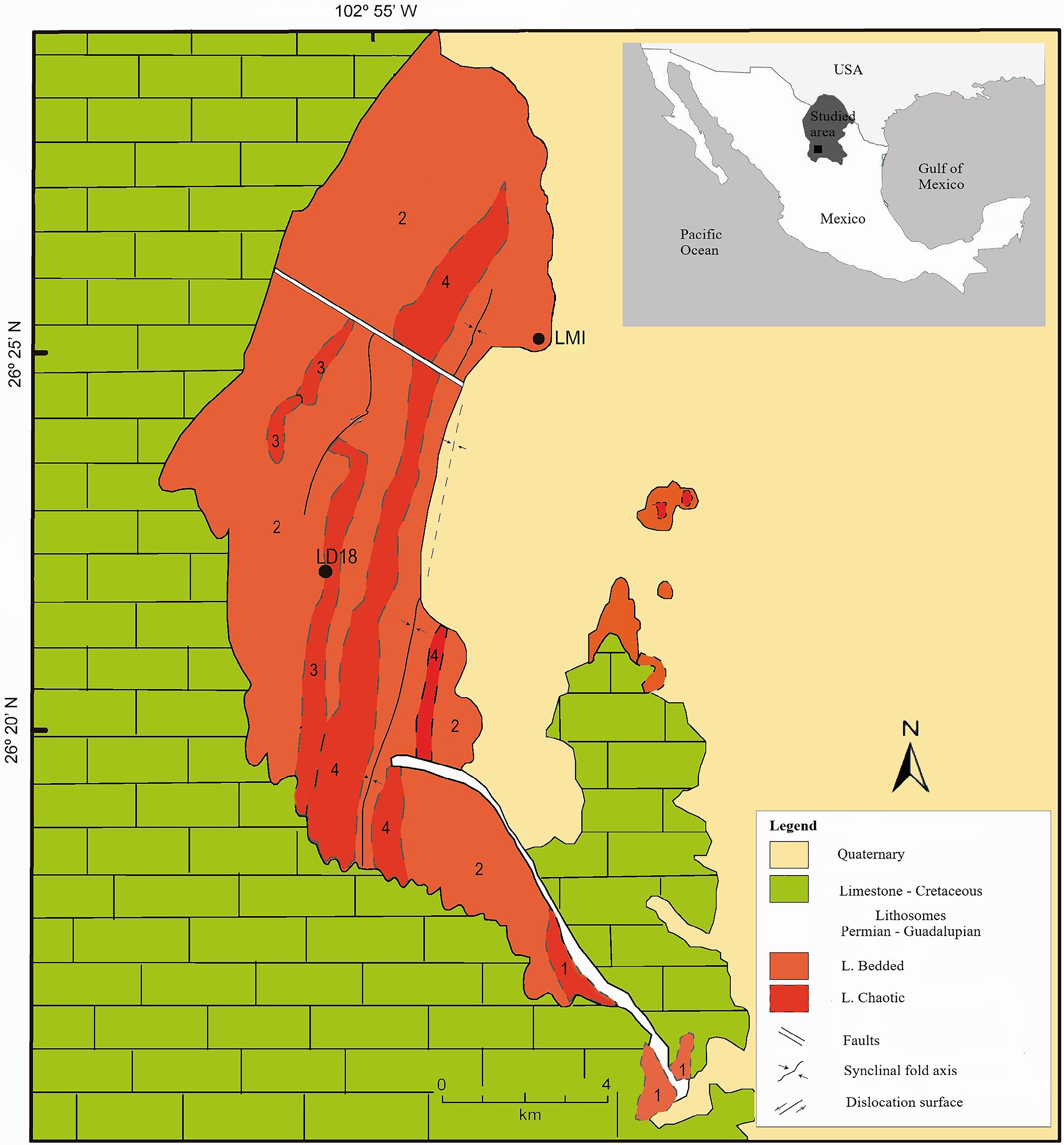
In this work, two localities from the Las Delicias Formation were studied. The rocks outcrop 106 km north-northeast from the municipality of San Pedro de Las Colonias, in the southwestern Coahuila state, Mexico. The first locality, called Las Manuelas I (LMI), is located at 26°25′15″N and 102°52′9″W, whereas the Las Difuntas-18 locality (LD18) is located at 26°22′44″N and 102°55′54″W, facing La Difunta hill (Fig. 1).
Geographic location of the Las Manuelas I (LMI) and Las Difuntas-18 (LD18) sections of Las Delicias Formation. Chaotic lithosomes: 1, Cañon Rosillo; 3, Cerro Prieto; 4, San Pedro. Bedded lithosomes: 2, La Cria (modified from McKee et al., Reference McKee, Jones and Anderson1999).
Geology of the Las Delicias Formation
The name of the Las Delicias Formation was proposed by McKee et al. (Reference McKee, Jones and Anderson1999), referring to the territory of Las Delicias Valley. As mentioned above, the Permian rocks of this formation were initially reported by Haarmann (Reference Haarmann1913), Haack (Reference Haack1914), Böse (Reference Böse1921, Reference Böse1923), and Kelly (Reference Kelly1936). However, King (Reference King1934, Reference King, Part, in King, Dunbar, Cloud and and Miller1944) was the first to work with it in a geological context, reporting a syncline divided into two main flanks: Malascachas to the east and La Difunta to the west; both were composed of diverse facies difficult to correlate. Thus, King et al. (Reference King, Part, in King, Dunbar, Cloud and and Miller1944) measured a type section on the La Difunta flank, with the base at the Arroyo la Difunta and the top at Puerto Sardinas, in contact with the underlying Cretaceous rocks. In this section, King measured a variable lithology with uneven thicknesses, whereas Miller (Reference Miller, King, Dunbar, Cloud and Miller1944) recorded the occurrence of ammonoids, which were used to assign the relative ages of the strata. Subsequently, Wardlaw et al. (Reference Wardlaw, Furnish and Nestell1979) measured a new section that began at Puerto Sardinas and finished at La Difunta and La Colorada creeks. This new succession was divided into five informal units. Based on identifying fusulinids and ammonoids, this proposal suggested that the informal units displayed a clear stratigraphic continuity despite the authors also noticing an evident lateral variability of the units. The arrangement of the rocks and strata observed in our fieldwork made it impossible to follow a continuous sequence between units, and so we discarded the use of this stratigraphic proposal.
Our fieldwork observations showed a considerable stratigraphic complexity that nicely matched the proposal by McKee et al. (Reference McKee, Jones and Anderson1988, Reference McKee, Jones and Anderson1999). These authors divided the lithostratigraphic unit into seven lithosomes (informal term) based on physical relationships and relative ages given by fossils, concluding that the formation was deposited by mass gravity processes, in addition to an early postdepositional slip.
Material and methods
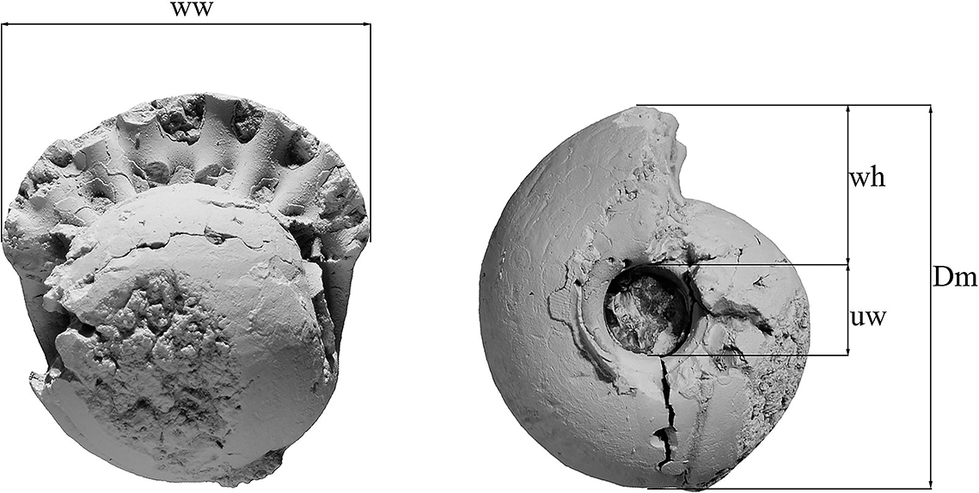
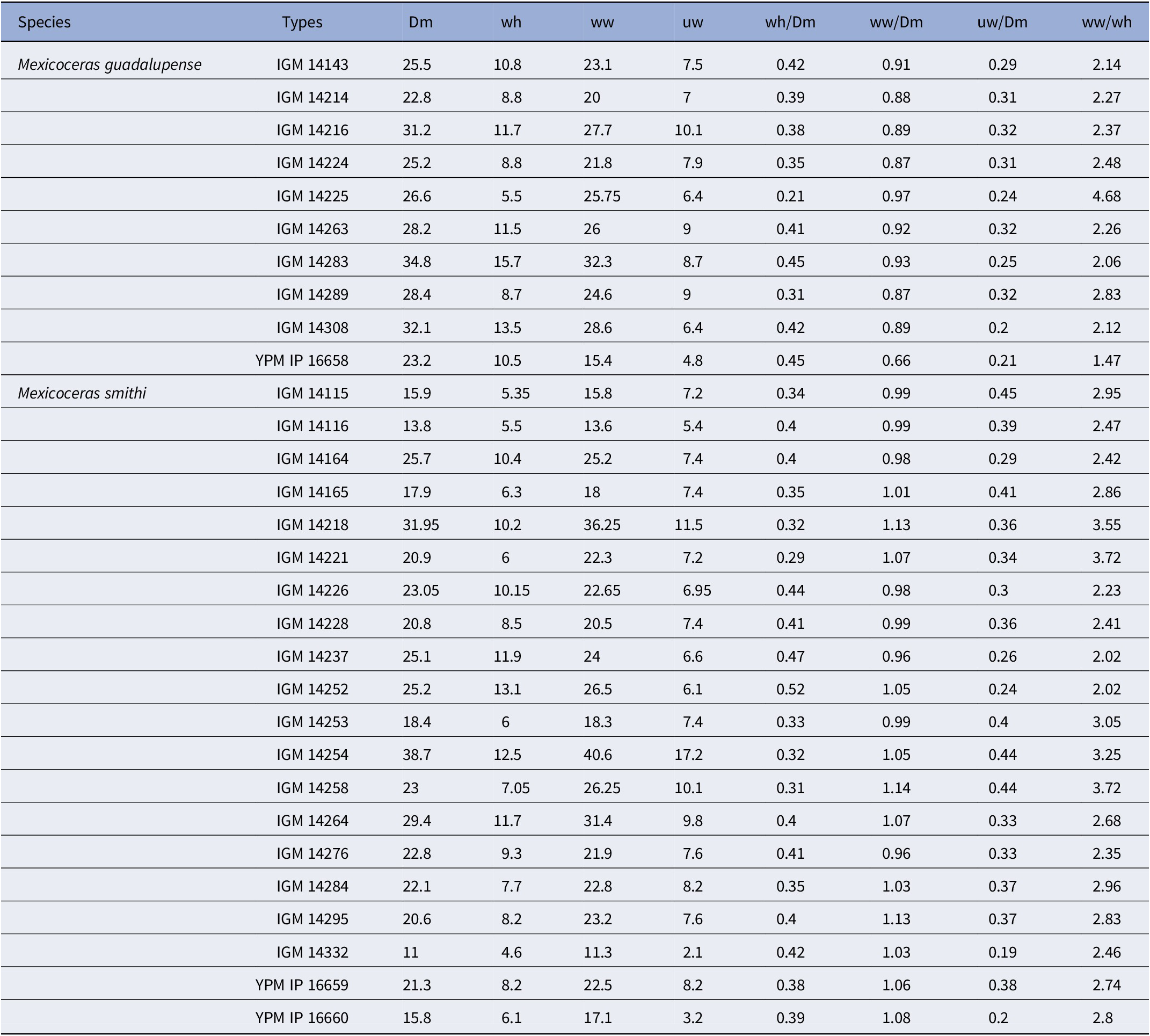
The studied ammonoids were collected during two fieldwork campaigns conducted in 2018−2019. Fossils were collected bed by bed from the Las Manuelas I and Las Difuntas-18 localities of Guadalupian age. Some ammonoids were preserved within rock nodules, where shell preservation was notably better. To improve the taxonomic characterization, we photographed the specimens after whitening with ammonium chloride. The taxonomy at the generic and supra-generic levels followed that of Leonova (Reference Leonova2002) and Furnish et al. (Reference Furnish, Glenister, Kullmann, Zhou and Selden2009); Kullmann et al. (Reference Kullmann, Korn and Petersen2000) was also consulted. The taxonomic descriptions follow classical ammonoid terminology. Conventional shell parameters were used, and all measurements were taken in millimeters: Dm, shell diameter; uw, umbilical width; uw/Dm, umbilical width index; WER, whorl expansion; wh, whorl height; wh/Dm, whorl height index; ww, whorl width; ww/Dm, shell width index; ww/wh, whorl width index (Korn, Reference Korn2010; Klug et al., Reference Klug, Korn, Landman, Tanabe, De Baets, Naglik, Klug, Korn, De Baets, Kruta and Mapes2015) (Fig. 2, Tables 1–3). Quantitative data were analyzed through the statistical freeware PAST version 4.07b (https://past.en.lo4d.com/windows). The list of collected ammonoids with their identifications and their IGM numbers is provided in Supplementary Information 2. Additionally, we constructed 26 3D models with the EinScan-SP 3D scanner; these models can be found in Supplementary Appendices 1−5. If the reader wishes to access the high-resolution three-dimensional (3D) models, these are available upon request by email to the corresponding author.
The morphological terminology and standard measurements applied in this study for describing the ammonoid conch. Dm = shell diameter; uw = umbilical width; wh = whorl height; ww = whorl width.
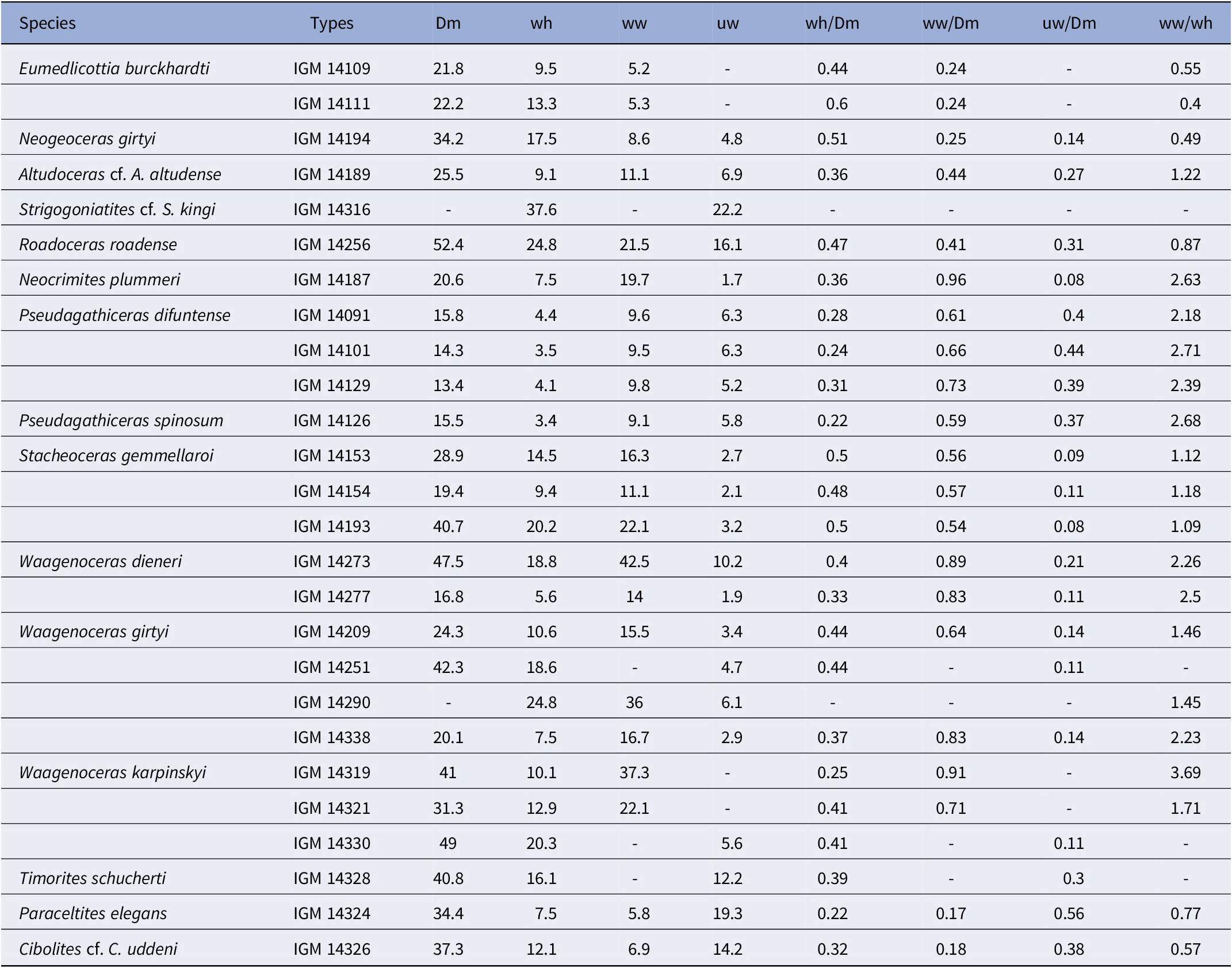
Dimensions (mm) and conch proportions of the most complete specimens. Dm, shell diameter; uw, umbilical width; uw/Dm, umbilical width index; wh, whorl height; ww, whorl width; ww/Dm, shell width index; ww/wh, whorl width index.
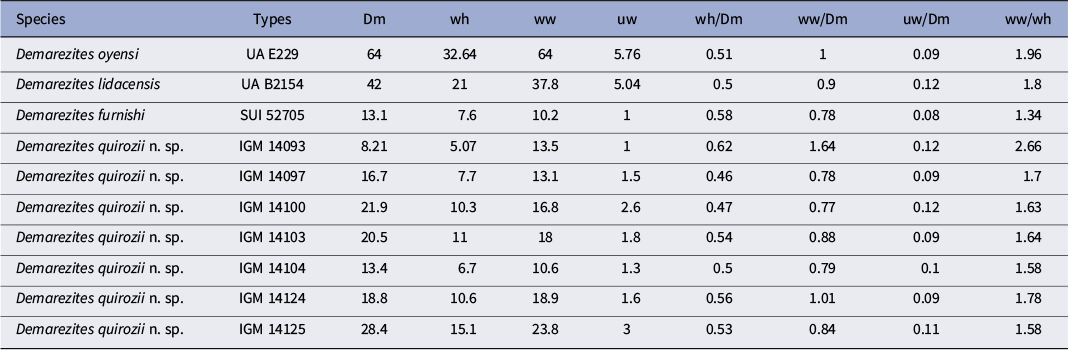
Dimensions (mm) and conch proportions of the most complete specimens of Demarezites spp. Abbreviations as for Table 1. Data taken from Glenister and Furnish (Reference Glenister and Furnish1987), together with own measurements of D. quirozii n. sp.
Dimensions (mm) and conch proportions of the most complete specimens of Mexicoceras guadalupense (Girty, Reference Girty1908) and Mexicoceras smithi (Miller and Furnish, Reference Miller and Furnish1940). Abbreviations as for Table 1.
In addition, we revised and rephotographed the collection of ammonoids collected by Robert King (King et al., Reference King, Part, in King, Dunbar, Cloud and and Miller1944) and described by Miller (Reference Miller, King, Dunbar, Cloud and Miller1944). The study of both new localities was possible due to the information shared by Dr. Jesus Quiroz-Barragán, who also provided some of the Permian ammonoids studied herein.
Repositories and institutional abbreviations
Types, figured, and other specimens examined in this study are deposited in the following institutions: Colección Nacional de Paleontología María del Carmen Perrilliat, Instituto de Geología, Universidad Nacional Autónoma de México (UNAM), with the prefix IGM (Instituto Geológico Mexicano), Mexico City, Mexico; the Invertebrate Paleontology Collection at Yale Peabody Museum, Yale University (YPM IP), New Haven, Connecticut, USA; University of Amsterdam (UA), Amsterdam, Netherlands; Paleontology Repository at the University of Iowa (SUI, State University of Iowa), Iowa City, Iowa, USA; and paleontological collections of the United States Geological Survey (USGS), Reston, Virginia, USA.
Systematic paleontology
Order Prolecanitida Miller and Furnish, Reference Miller and Furnish1954
Suborder Medlicottiina Zakharov, Reference Zakharov1983
Superfamily Medlicottioidea Karpinsky, Reference Karpinsky1889
Family Medlicottidae Karpisnky, Reference Karpinsky1889
Subfamily Medlicottinae Karpinsky, Reference Karpinsky1889
Genus Eumedlicottia Spath, Reference Spath1934
Type species
Medlicottia bifrons Gemmellaro, Reference Gemmellaro1887, from the Wordian, Sosio Limestone, of Sicily, Italy.
Eumedlicottia burckhardti (Böse, Reference Böse1919)
Figures 3, 4.1, 5.1; Table 1; Supplementary Appendix 1, Figure 1A–B
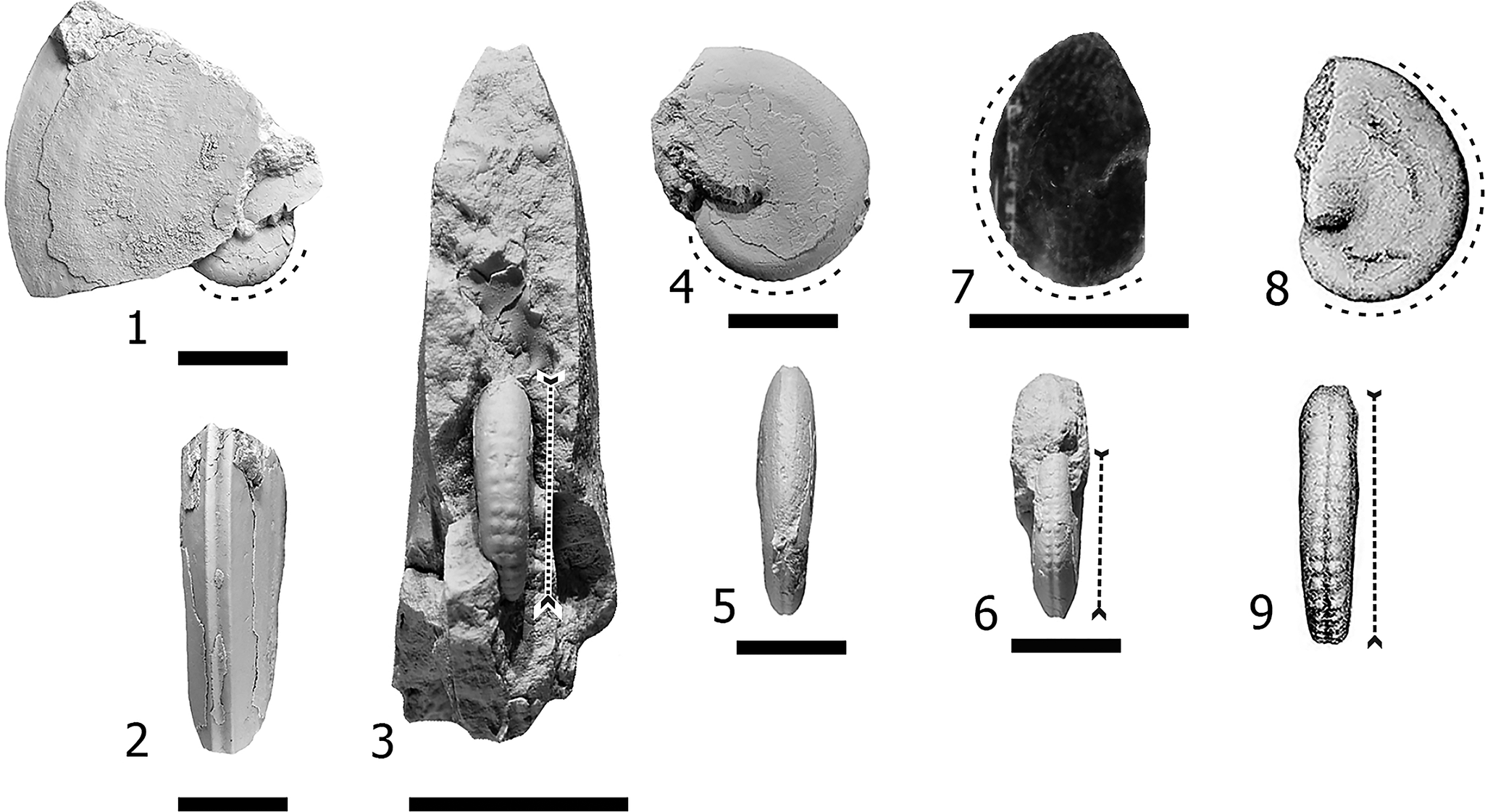
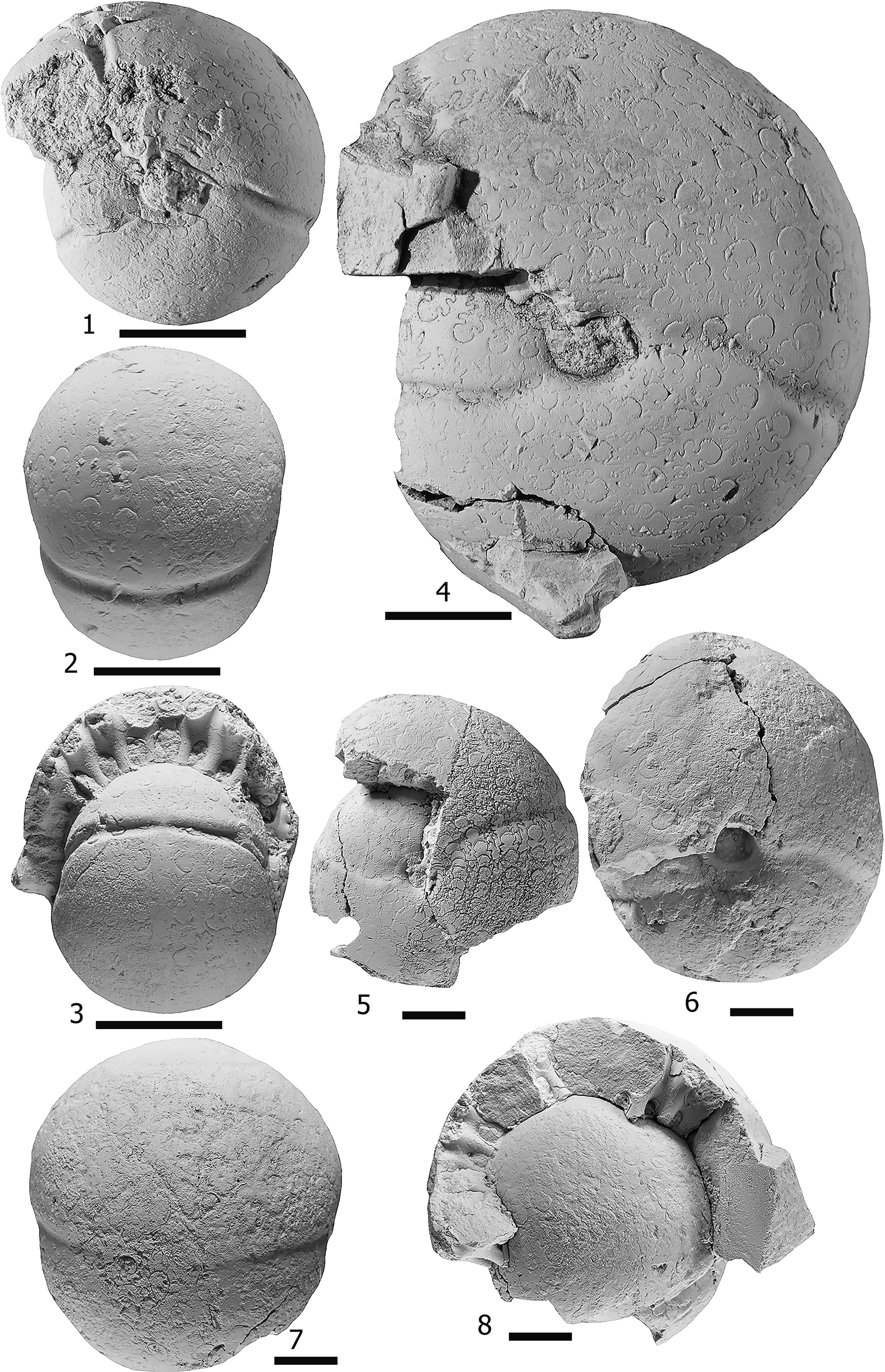
Eumedlicottia burckhardti (Böse, Reference Böse1919): (1–3) IGM 14096, lateral (1), ventral (2), and apertural (3) views; (4–6) IGM 14111, lateral (4), ventral (5), and apertural (6) views; (7–9) YPM IP 16699, lateral (7, 8) and ventral (9) views (this specimen was assigned to Medlicottia sp. indet. by Miller, Reference Miller, King, Dunbar, Cloud and Miller1944). Figures 3.8 and 3.9 from King et al. (Reference King, Part, in King, Dunbar, Cloud and and Miller1944, pl. 23, figs. 1, 2), shown without scale. Dashed lines emphasize two rows of aligned nodes in the ventral zone. Scale bars = 1 cm.
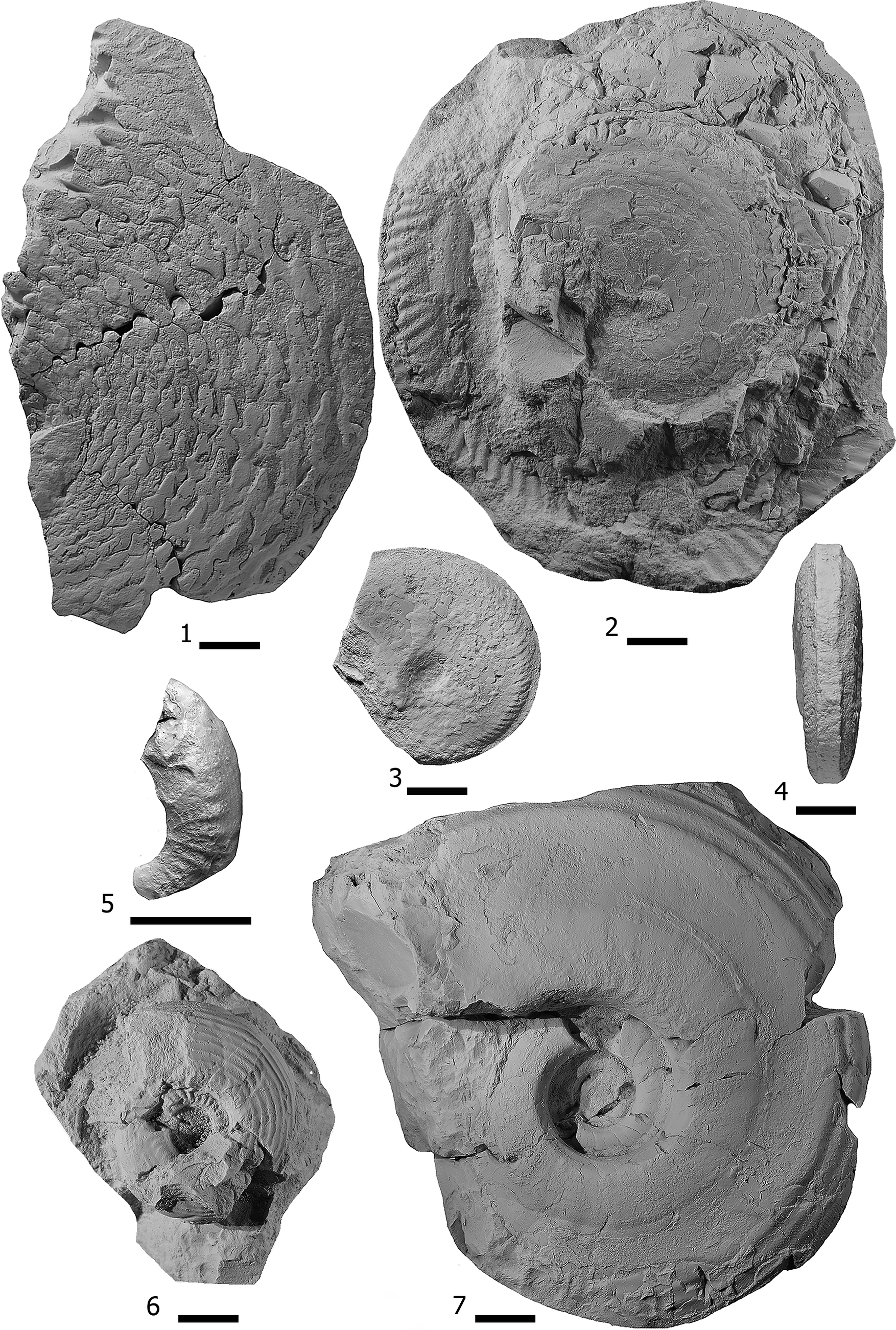
(1) Eumedlicottia burckhardti (Böse, Reference Böse1919), IGM 14197, lateral view. (2–4) Neogeoceras girtyi (Miller and Furnish, Reference Miller and Furnish1940): (2) IGM 14136, lateral view; (3, 4) IGM 14194, lateral (3) and ventral (4) views. (5, 6) Altudoceras cf. A. altudense (Böse, Reference Böse1919): (5) IGM 14188, ventrolateral view; (6) IGM 14189, lateral view. (7) Strigogoniatites cf. S. kingi Miller, Reference Miller, King, Dunbar, Cloud and Miller1944, IGM 14316, lateral view. Scale bars = 1 cm.
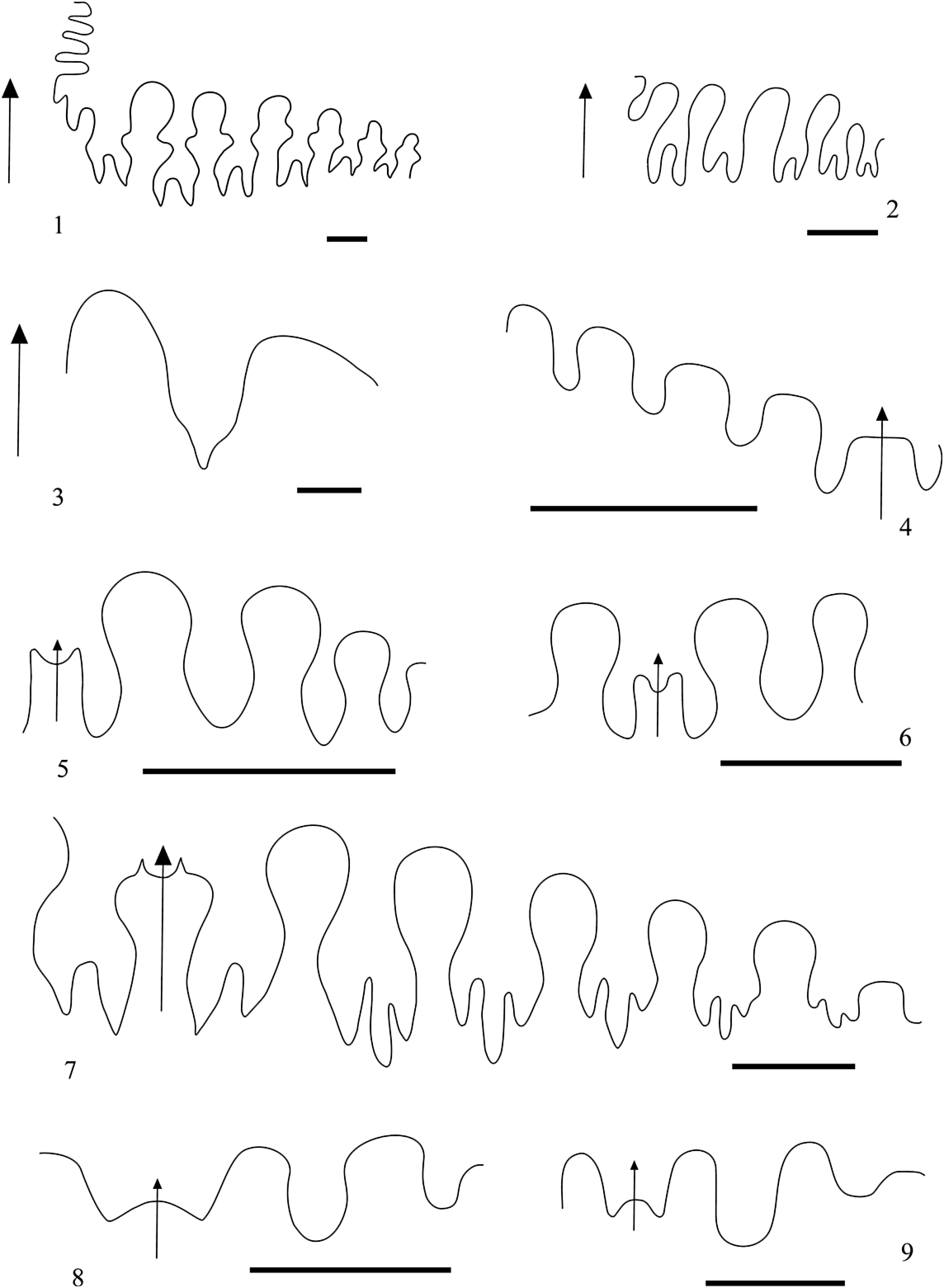
External sutures: (1) Eumedlicottia burckhardti (Böse, Reference Böse1919) from Las Difuntas-18 section, level LD1, Las Delicias Formation; based on sample IGM 14197. (2) Neogeoceras girtyi (Miller and Furnish, Reference Miller and Furnish1940) from Las Difuntas-18 section, level LD1, Las Delicias Formation; based on sample IGM 14136. (3) Roadoceras roadense (Böse, Reference Böse1919) from Las Manuelas I section, level LM1, Las Delicias Formation; based on sample IGM 14256. (4) Neocrimites plummeri (Miller, Reference Miller, King, Dunbar, Cloud and Miller1944) from Las Manuelas I section, level LM1, Las Delicias Formation; based on sample IGM 14198. (5) Pseudagathiceras difuntense Miller, Reference Miller, King, Dunbar, Cloud and Miller1944 and (6) Pseudagathiceras spinosum Miller, Reference Miller, King, Dunbar, Cloud and Miller1944 from Las Difuntas-18 section, level LD1, Las Delicias Formation; based on samples IGM 14129 and 14126, respectively. (7) Stacheoceras gemmellaroi Miller, Reference Miller, King, Dunbar, Cloud and Miller1944 from Las Manuelas I section, level LM1, Las Delicias Formation; based on sample IGM 14193. (8) Paraceltites elegans Girty, Reference Girty1908 and (9) Cibolites cf. C. uddeni Plummer and Scott, Reference Plummer, Scott and Sellards1937 from level LM2, from Las Manuelas I section, Las Delicias Formation; based on samples IGM 14324 and 14326, respectively. Arrows indicate the shell aperture. Scale bars = 5 mm.
See synonymy in Supplementary Information 1.
Syntype
YPM IP 16808, figured by Böse (Reference Böse1919, pl. 1, figs. 51–52) from the Glass Mountains.
Occurrence
Levels LD1 and LD2, Las Difuntas-18 section; levels LM1 and LM3, Las Manuelas I section, Las Delicias Formation, Waagenoceras Zone.
Description
IGM 14109 and 14111 are the best preserved among the material studied. The shell of IGM 14109 is discoidal (ww/Dm = 0.24), involute (uw/Dm = 0.00), with a very small and narrow umbilicus (uw = 0.1), flanks flat to slightly convex, strongly compressed (ww/wh = 0.39). The venter exhibits two keels, divided by a central furrow; keels and furrow are commonly smooth. In two specimens (IGM 14096 and 14111), two rows of aligned nodes in the venter are visible (Fig. 3.3, 3.6). In the suture, the ventrolateral saddle is not observed in any material, but the other part of the saddle shows four adventitious lobules laterally, and next five lateral lobules (Fig. 5.1). The first lateral lobes are larger and bifid at the base, narrowed in the middle part of the lobe; the subsequent lobes decrease in size laterally. Measurements in Table 1.
Materials
IGM 14096, 14106, 14108, 14109, 14111, 14138−14140, 14142, 14144−14146, 14148, 14149, 14152, 14197, 14333−14335, and 14337; 20 specimens preserved as internal molds; only two specimens preserve the living chamber.
Remarks
Miller and Furnish (Reference Miller and Furnish1940) and Miller (Reference Miller, King, Dunbar, Cloud and Miller1944) described specimens of Eumedlicottia burckhardti from Texas and Coahuila, emphasizing the absence of nodes on the venter in the initial stages (juvenile). However, in the Mexican specimen IGM 14096 (Fig. 3.1–3.3), a juvenile stage with two rows of nodes in the venter is observable; in addition, the keels are smooth in the last whorl. The specimen IGM 14111 (Fig. 3.4–3.6) could represent another stage of Eumedlicottia burckhardti because it displays two rows of nodes in the venter. Miller (Reference Miller, King, Dunbar, Cloud and Miller1944) assigned specimen YPM IP 16699 (Fig. 3.7–3.9) to Medlicottia sp. indet., because the sutures do not differ from those of other immature representatives of Medlicottia (= Eumedlicottia) (Leonova, Reference Leonova2019, fig. 4a−f, p. 360). According to Miller, this specimen has a diameter of 13 mm (Fig. 3.7), a similar size to the specimens described and illustrated by us (Fig. 3.4). Both are also nodose on the venter and were found in the Waagenoceras Zone. Additionally, Miller and Furnish (Reference Miller and Furnish1940) described specimens from the Las Delicias Formation, assigned to Medlicottia burckhardti (= Eumedlicottia burckhardti), with variable diameters (e.g., YPM IP 16703 = 80 mm, fig. 12A, p. 54; University of Texas P6420 = 75 mm, fig. 13B, p. 56). However, these measurements might be approximate, because the specimens are fragments. Although our material displays the features described by Miller (Reference Miller, King, Dunbar, Cloud and Miller1944) and Miller and Furnish (Reference Miller and Furnish1940) for the species, e.g., the arrangement of the sutures, the faint morphological differences suggest that we might have the same species but in different ontogenetic stages (juvenile and adult). More specimens with better-preserved shells are needed to establish differences related to ontogeny or sexual dimorphism. Eumedlicottia burckhardti resembles Eumedlicottia kabiensis Zhou, Reference Zhou2017 from South China, but apparently, Eumedlicottia kabiensis has one more adventitious lobule on lateral saddle. It appears that both are coeval species, as Zhou (Reference Zhou2017) proposed a Waagenoceras sp.-Propinacoceras beyrichi Biozone of Wordian age, which included Eumedlicottia kabiensis, whereas Miller and Furnish (Reference Miller and Furnish1940) and Miller (Reference Miller, King, Dunbar, Cloud and Miller1944) assigned Eumedlicottia burckhardti to the Waagenoceras Zone of Permian outcrops from North America. This species has been reported in localities of British Columbia (Canada), Texas (USA), and Coahuila (Mexico).
Genus Neogeoceras Ruzhentsev, Reference Ruzhentsev1947
Type species
Waagenoceras girtyi Miller and Furnish, Reference Miller and Furnish1940, of the Wordian–Capitanian of Texas, USA and Coahuila, Mexico.
Neogeoceras girtyi (Miller and Furnish, Reference Miller and Furnish1940)
Figures 4.2–4.4, 5.2; Table 1; Supplementary Appendix 1, Figure 1C–D
See synonymy in Supplementary Information 1.
Holotype
YPM IP 16700, designated and illustrated by Miller (Reference Miller, King, Dunbar, Cloud and Miller1944, pl. 21, figs. 1, 2) from Las Delicias Formation, Coahuila state, Mexico.
Occurrence
Level LD1, Las Difuntas-18 section; level LM1, Las Manuelas I section, Las Delicias Formation, Waagenoceras Zone.
Description
IGM 14194 is preserved as an external mold. The shell is discoidal (ww/Dm = 0.25), involute (uw/Dm = 0.10), with a small and narrow umbilicus. The whorl cross section is strongly compressed (ww/wh = 0.49). Specimen IGM 14194 has a flattened venter that ends in a poorly developed keel. It is flat along the ventrolateral margins but slightly rounded on the lateral parts of the flanks (Fig. 4.3). Transverse and inclined ribs are visible near the ventrolateral margin; these ribs are short and widely spaced. The adventitious lobes are not visible; however, the lateral lobes are asymmetrically bifid. At least six lobes can be distinguished, and all lateral saddles are spatulate. Measurements in Table 1.
Materials
IGM 14135, 14136, 14147, 14151, 14194, 14331, and 14336; seven specimens preserved as internal molds; only IGM 14194 is preserved in three dimensions.
Remarks
The specimens described herein exhibit the typical traits related to the species Neogeoceras girtyi. The best-preserved specimen (IGM 14136) displays a portion of sutures (Fig. 4.2), whereas another (IGM 14194) exhibits well-developed ornamentation on the surface of the shell (Fig. 4.3, 4.4). These features correspond with those of the holotype of the species (YPM IP 16700), which occurs in the Waagenoceras Zone. The species has been recorded in Texas (USA), and Coahuila (Mexico).
Order Goniatitida Hyatt, Reference Hyatt1884
Suborder Goniatitina Hyatt, Reference Hyatt1884
Superfamily Neoicoceratoidea Hyatt, Reference Hyatt, von Zittel and Eastman1900
Family Pseudogastrioceratidae Ruzhentsev, Reference Ruzhentsev1951
Genus Altudoceras Ruzhentsev, Reference Ruzhentsev1940
Type species
Gastrioceras altudense Böse, Reference Böse1919, from the Wordian–Capitanian, Altuda Member, Texas, USA.
Altudoceras cf. Altudoceras altudense (Böse, Reference Böse1919)
Figure 4.5, 4.6; Table 1; Supplementary Appendix 2, Figure 2A
See synonymy in Supplementary Information 1.
Holotype
University of Texas B381, designated by Miller and Furnish (Reference Miller and Furnish1940, p. 87, pl. 14, fig. 4) from Altuda member, Capitan Formation, Texas, USA.
Occurrence
Level LM1, Las Manuelas I section, Las Delicias Formation, Waagenoceras Zone.
Description
IGM 14189 preserved in black calcite. Shell thinly discoidal (ww/Dm = 0.57), subevolute (uw/Dm = 0.30); with a wide umbilicus. The whorl cross section is weakly depressed (ww/wh = 1.21). The venter is rounded; only a slightly rounded and compressed flank is visible toward the umbilical zone. Longitudinal lirae are preserved on the venter, which are dense and fine. These lirae become stronger and are spaced farther apart on the lateral flank. Starting with weak relief on the umbilical shoulder, the lirae become more prominent on the siphonal area. The flank ribs, each originating from a node, cross the flank toward the venter, making an orthogonal pattern where the ribs intersect with the lirae. These almost straight ribs attenuate toward the upper part of the flank, the nodes disappearing as the shell grows. On the venter, there are widely spaced constrictions, which gradually attenuate toward the lateral flanks. The suture is not observable. Measurements in Table 1.
Materials
IGM 14188 and 14189; two internal calcareous molds: one fragmented specimen and one phragmocone, respectively.
Remarks
Böse (Reference Böse1919) and Miller and Furnish (Reference Miller and Furnish1940) initially described this taxon as Gastrioceras altudense and Pseudogastrioceras altudense (Böse, Reference Böse1919), respectively. Both emphasized ornamentation composed of longitudinal lirae and umbilical nodes. According to their data, this species reaches a maximum diameter of 80 mm; for example, one specimen with Dm = 50, ww = 19, and wh = 24 (illustrated by Miller and Furnish, Reference Miller and Furnish1940, p. 206, pl. 14, figs. 5, 6), and another specimen with Dm = 42, ww = 14, and wh = 19 (illustrated by Miller and Furnish, Reference Miller and Furnish1940, p. 211, pl. 19, figs. 4, 5) from Texas. According to Miller and Furnish (Reference Miller and Furnish1940), this species exhibits two ontogenetic stages: during the juvenile stage, the ribs or longitudinal lirae grow to the ventral and lateral zones of the shell and are absent on the umbilical walls. The umbilical nodes are much more prominent in this stage, with sinuous transverse constrictions, forming a deep, rounded U-shaped ventral sinus. In the adult stage, the longitudinal lirae, umbilical nodes, and constrictions become less visible or faint, and in typical specimens, they become obsolete before the shell has attained a diameter of 60 mm, resulting in a clear ornamentation difference in both stages. The occurrence of strong longitudinal lirae, nodes, and constrictions in the Mexican specimens (Fig. 4.5, 4.6) enabled us to relate the material to the juvenile ontogenetic stage of the species. Of note is a specimen (YPM IP 16255) from the Timorites Zone that Miller (Reference Miller, King, Dunbar, Cloud and Miller1944, pl. 25, figs. 1, 2) identified as Pseudogastrioceras roadense (Miller and Furnish, Reference Miller and Furnish1940). This identification seems inaccurate, because the presence of umbilical nodes, longitudinal lirae visible on the shell surface, and U-shaped constrictions indicate that it is, in fact, a juvenile stage of Altudoceras altudense. The differences with the species Pseudogastrioceras roadense are discussed below. This species occurs in British Columbia (Canada), Texas (USA), and Coahuila and Guerrero (Mexico).
Genus Strigogoniatites Spath, Reference Spath1934
Type species
Glyphioceras angulatum Haniel, Reference Haniel1915, subsequent designation of Miller and Furnish (Reference Miller and Furnish1940), Guadalupe Mountain, Texas, USA.
Strigogoniatites cf. Strigogoniatites kingi Miller, Reference Miller, King, Dunbar, Cloud and Miller1944
Figure 4.7; Table 1; Supplementary Appendix 2, Figure 2B
See synonymy in Supplementary Information 1.
Syntype
YPM IP 16252, figured by Miller (Reference Miller, King, Dunbar, Cloud and Miller1944, pl. 27, figs. 1–3), from Las Delicias Formation, Coahuila state, Mexico.
Occurrence
Level LM2, Las Manuelas I section, Las Delicias Formation, Timorites Zone.
Description
Shell evolute, with a wide umbilicus (uw = 22.2). The umbilical shoulders are rounded, and the umbilical walls are slightly vertical. The venter is somewhat subangular; the shell displays prominent longitudinal lirae. Lirae are not distributed homogeneously on the flank; they are almost absent on much of it, being present only in the middle and upper third of the flank. The greatest liral development is found on the venter. The suture forms septa that consist of a high rounded U-shaped first lateral saddle. Subsequently, there is a deep V-shaped first lateral lobe and a low, relatively broad, rounded asymmetrical second lateral saddle. A small V-shaped lobe is observed, formed on the umbilical wall. Measurements in Table 1.
Materials
IGM 14316, one specimen preserved as an internal calcareous mold from phragmocone. The 3D condition of this specimen is related to a nodular preservation.
Remarks
According to Miller and Furnish (Reference Miller and Furnish1940), there are two species of the genus Strigogoniatites in North America: Strigogoniatites kingi and Strigogoniatites fountaini Miller and Furnish, Reference Miller and Furnish1940, from the Capitanian strata of Coahuila and Texas, respectively. Strigogoniatites kingi is dissimilar to Strigogoniatites fountaini in the sutural arrangement with a highly rounded U-shaped first lateral saddle, a deep V-shaped first lateral lobe, and a low-rounded asymmetrical second lateral saddle. Strigogoniatites kingi differs from Roadoceras roadense (Böse, Reference Böse1919) and R. haacki (Girty, Reference Girty1908) in the shell. Strigogoniatites kingi is ventrally subangular, whereas the genus Roadoceras has a rounded shape. Another noticeable difference from R. roadense is the distribution of the lirae on the flank. Lirae in R. roadense are distributed homogeneously on the flank, but in Strigogoniatites kingi, they quickly vanish progressively during ontogenetic development until they disappear. This ontogenetic trend can be observed in the figured syntype of the species, which clearly shows the vanishing lirae on the flank. The specimen studied herein, larger than the figured syntype, exhibits total disappearance of the majority of the lirae on the flank.
Strigogoniatites kingi occurs in the Timorites Zone within the Las Manuelas I section of the Las Delicias Formation. This species has been reported in Coahuila (Mexico).
Genus Roadoceras Zhou, Reference Zhou1985
Type species
Gastrioceras roadense Böse, Reference Böse1919, subsequent designation of Zhou (Reference Zhou1985) from the Wordian–Capitanian of Hunan, South China.
Roadoceras roadense (Böse, Reference Böse1919)
Figures 5.3, 6.1–6.4; Table 1; Supplementary Appendix 2, Figure 2C
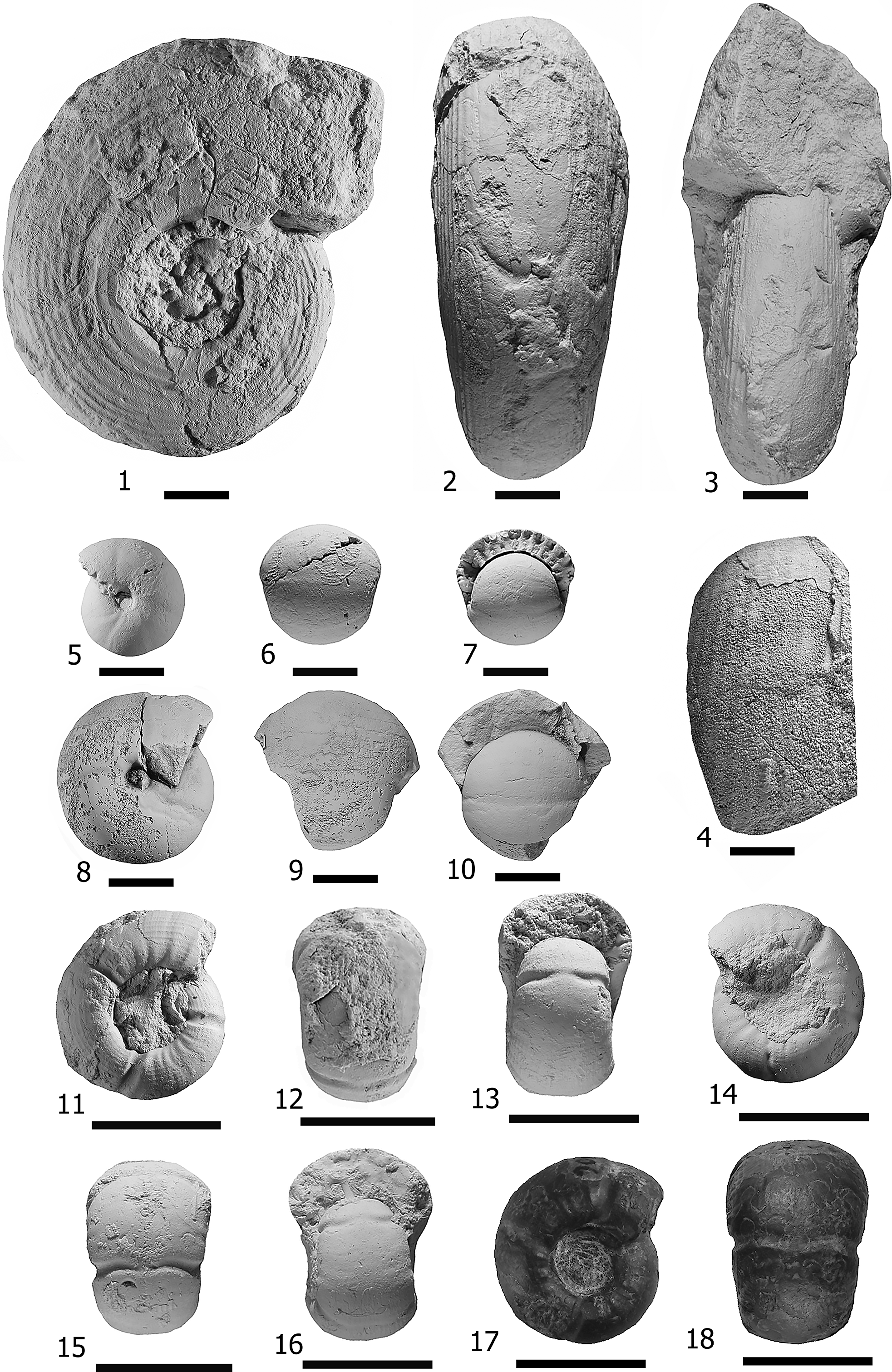
(1–4) Roadoceras roadense (Böse, Reference Böse1919): IGM 14256, lateral (1), ventral (2), and apertural (3) views; (4) IGM 14119, ventral view. (5–10) Neocrimites plummeri (Miller, Reference Miller, King, Dunbar, Cloud and Miller1944) (= Metacrimites plummeri): (5–7) IGM 14198, lateral (5), ventral (6), and apertural (7) views; (8–10) IGM 14187, lateral (8), ventral (9), and apertural (10) views. (11–18) Pseudagathiceras difuntense Miller, Reference Miller, King, Dunbar, Cloud and Miller1944: (11–13) IGM 14101, lateral (11), ventral (12), and apertural (13) views; (14–16) IGM 14129, lateral (14), ventral (15), and apertural (16) views; (17, 18) YPM IP 16306, lateral (17) and ventral (18) views. Scale bars = 1 cm.
See synonymy in Supplementary Information 1.
Syntype
YPM IP 16253, figured by Miller (Reference Miller, King, Dunbar, Cloud and Miller1944, pl. 25, figs. 3, 4), from Las Delicias Formation, Coahuila state, Mexico.
Occurrence
Level LM1, Las Manuelas I section, Las Delicias Formation, Waagenoceras Zone.
Description
IGM 14256 is the best-preserved specimen. The shell is discoidal (ww/Dm = 0.41), subevolute (uw/Dm = 0.36), with a wide umbilicus (uw =16.1). The whorl cross section is moderately compressed (ww/wh = 0.86). The venter and flanks are rounded, and the whorl exhibits an expansion in width toward the living chamber (WER = 2.98; usually > 2.50, extremely high). Its ornamentation consists of prominent longitudinal lirae homogenously distributed on the shell and constrictions marked by a rounded ventral sinus (Fig. 6.2). The suture comprises a high rounded U-shaped first lateral saddle, a deep symmetrical first lateral lobe shaped like a V, and a low broad asymmetrical rounded second lateral saddle. Measurements in Table 1.
Materials
Two specimens, IGM 14119 and 14256, one fragment and one phragmocone, preserved as internal calcareous molds in three dimensions.
Remarks
In the works by Böse (Reference Böse1919) and Miller and Furnish (Reference Miller and Furnish1940), numerous specimens of Roadoceras roadense from the Glass Mountains of Texas, USA, were described. Miller and Furnish (Reference Miller and Furnish1940) showed the ontogenetic development of this species in which the juvenile has a significantly more complex ornamentation pattern that resembles Altudoceras altudense. Roadoceras roadense differs from Altudoceras altudense in shell shape. The shell of Altudoceras altudense is slightly more globose-subdiscoidal compared to that of R. roadense (Fig. 6.3). The difference in ornamentation is also notable; in R. roadense, the umbilical nodes are not observable, and the longitudinal lirae are denser on the lateral flanks of this species. The two studied specimens are subadult-adult. This species is very common in Guadalupian aged strata of North America and has also been recorded by Miller (Reference Miller, King, Dunbar, Cloud and Miller1944) in the Waagenoceras and Timorites zones (Wordian–Capitanian) of the Las Delicias Formation. Roadoceras roadense has been found frequently with different Waagenoceras species from the Wordian, as well as with other taxa, e.g., Timorites and Roadoceras haacki from the Capitanian. Given that the biostratigraphic range of R. roadense remains under discussion, both Zhou (Reference Zhou1987); Zhou et al. (Reference Zhou, Glenister, Furnish, Spinosa, Rozanov and Shevyrev1999) and Shen et al. (Reference Shen, Mu and Zakharov2004) have suggested that this taxon is known from the Wordian–Wuchiapingian?. Roadoceras haacki (Girty, Reference Girty1908) differs from R. roadense in the shape of its whorls, which are compressed and broadly rounded rather than narrowly rounded ventrally. The species occurs in Texas (USA), Coahuila and Guerrero (Mexico), northwestern and southern China, and Tunisia.
Suborder Adrianitina Schindewolf, Reference Schindewolf1931
Superfamily Adrianitoidea Schindewolf, Reference Schindewolf1931
Family Adrianitidae Schindewolf, Reference Schindewolf1931
Subfamily Adrianitinae Schindewolf, Reference Schindewolf1931
Genus Neocrimites Ruzhentsev, Reference Ruzhentsev1940
Type species
Adrianites fredericksi Emel’iancev, Reference Emel’iancev1929; original designation; Baigendzhinian, Artinskian Stage, South Urals.
Neocrimites plummeri (Miller, Reference Miller, King, Dunbar, Cloud and Miller1944)
(= Metacrimites plummeri)
Figures 5.4, 6.5–6.10; Table 1; Supplementary Appendix 3, Figure 3A
See synonymy in Supplementary Information 1.
Holotype
YPM IP 16320, designated by Miller (Reference Miller, King, Dunbar, Cloud and Miller1944, pl. 35, figs. 1, 2) from Las Delicias Formation, Coahuila state, Mexico.
Occurrence
Level LM1, Las Manuelas I section, Las Delicias Formation, Waagenoceras Zone.
Description
Shell is pachyconic (ww/Dm = 0.74), involute (uw/Dm = 0.12), with a small yet open umbilicus, and slightly rounded umbilical shoulders. The whorl cross section is strongly depressed (ww/wh = 2.62). The venter is rounded but slightly depressed ventrolaterally. Internal molds seem completely smooth except for poorly developed constrictions. The suture has an arched shape, displaying a bifid and curved ventral lobe. The lateral lobes are tongue-shaped and have at least six lobes that decrease in size toward the umbilicus. All saddles are rounded and wider than the lobes. Measurements in Table 1.
Materials
IGM 14187 and 14198, two phragmocones preserved as 3D internal calcareous molds.
Remarks
The specific identification of our material was based on the general form of the shell and suture line, which are very similar to those of Miller’s (Reference Miller, King, Dunbar, Cloud and Miller1944) samples. Both internal molds display an apparently smooth shell, except for poorly developed constrictions. This is also similar to Miller’s material because, despite the holotype’ shell being recrystallized in black calcite, it shows some lirae and constrictions. Regarding the genus, the holotype (YPM IP 16320) was described from the Las Delicias Formation of Coahuila, which belonged to the Waagenoceras Zone (Miller, Reference Miller, King, Dunbar, Cloud and Miller1944). Miller (Reference Miller, King, Dunbar, Cloud and Miller1944) described this taxon as Adrianites plummeri and included it in the subfamily Adrianitinae. Later, Ruzhentsev (Reference Ruzhentsev1950), based on different morphological features, especially the suture ontogeny, proposed the genus Neocrimites, which comprised three subgenera: Neocrimites (Neocrimites), Neocrimites (Metacrimites Ruzhentsev, Reference Ruzhentsev1950), and Neocrimites (Sosiocrimites Ruzhentsev, Reference Ruzhentsev1950).The morphological traits of Neocrimites (Neocrimites) and Neocrimites (Sosiocrimites) have allowed them to be retained as independent genus-level taxa, something that does not happen with Neocrimites (Metacrimites), mainly due to the ontogenetic variation in the number of lateral lobes (Zhou, Reference Zhou2017). For this reason, it has been proposed to combine Neocrimites and Metacrimites, and abandon the Metacrimites name (Glenister et al., Reference Glenister, Furnish, Zhou, Furnish, Glenister, Kullmann, Zhou, Carboniferous, Ammonoidea and Selden2009), because any systematic subdivision of these genera could be artificial (Zhou, Reference Zhou2017). The species has been recorded in Coahuila (Mexico).
Subfamily Adrianitinae Schindewolf, Reference Schindewolf1931
Genus Pseudagathiceras Schindewolf, Reference Schindewolf1931
Type species
Agathiceras (Doryceras?) wichmanni Haniel, Reference Haniel1915, from the Wordian of the Maubisse Formation, Timor, Indonesia.
Pseudagathiceras difuntense Miller, Reference Miller, King, Dunbar, Cloud and Miller1944
Figures 5.5, 6.11–6.18; Table 1; Supplementary Appendix 3, Figure 3B
See synonymy in Supplementary Information 1.
Syntype
YPM IP 16306, figured by Miller (Reference Miller, King, Dunbar, Cloud and Miller1944, pl. 29, figs. 10–12) from Las Delicias Formation, Coahuila state, Mexico.
Occurrence
Levels LD1 and LD2, Las Difuntas-18 section, Las Delicias Formation, Waagenoceras Zone.
Description
The shell is pachyconic (ww/Dm = 0.66), subevolute (uw/Dm = 0.44), with a wide umbilicus (uw = 6.3). On the umbilical zone, there are small perpendicular grooves of the whorl section. The whorl cross section is strongly depressed (ww/wh = 2.71). The ventral shape is rounded, the flanks are slightly rounded, and ornamentation is marked by thin longitudinal lirae and transverse prominent constrictions, with three to four constrictions in most specimens. Constrictions crossing the venter (Fig. 6.11, 6.14) form a rounded and strongly developed M-shape (Fig. 6.15, 6.18). On the siphonal area, the constrictions become noticeably shallower (Fig. 6.13, 6.15, 6.16, 6.18). Between the constrictions, poorly developed, slightly sigmoidal to straight ribs appear, essentially only visible in the lower to the middle part of the flank (Fig. 6.11, 6.14). The suture of the ventral lobe is bifid, divided by a small bulge of medium width; each of the pair of ventral lobes is tongue-like, narrow, elongated, and pointed. The lateral lobes, of which there are at least three, are wider than the ventral lobes; saddles are rounded. Saddles and lateral lobes decrease in size toward the umbilicus. Measurements in Table 1.
Materials
IGM 14091, 14092, 14094, 14099, 14101, 14107, 14118, 14120, 14122, 14123, 14127, 14129, 14130, 14131, and 14137; 15 specimens preserved as internal molds. All specimens have a 3D preservation and most are nicely preserved as recrystallized in black calcite.
Remarks
According to Miller (Reference Miller, King, Dunbar, Cloud and Miller1944), Pseudagathiceras difuntense had two ontogenetic stages: the first is the ‘juvenile’ stage, with a very simple suture (Miller, Reference Miller, King, Dunbar, Cloud and Miller1944, p. 102, fig. 15A), whereas the other is the mature stage (Miller, Reference Miller, King, Dunbar, Cloud and Miller1944, p. 102, fig. 15C), characterized by more noticeable traits, e.g., a suture line with three external lateral lobes, similar to the specimens illustrated herein (Fig. 5.5) or the presence of a row of prominent spines on each side of the ventrolateral zones of the living chamber (Miller, Reference Miller, King, Dunbar, Cloud and Miller1944, pl. 29, figs. 6–12; fig. 15C). Our material not only displays the morphological features of the species but also the arrangement of the suture corresponds to the shape mentioned by Miller (Reference Miller, King, Dunbar, Cloud and Miller1944) for a mature specimen. It is worth noting that we did not see the spines described by Miller (Reference Miller, King, Dunbar, Cloud and Miller1944, p. 101) in the type samples YPM IP 16304, 16305, or 16306. These only occur in YPM IP 16309, but neither Miller nor we could obtain clear pictures of such spines. The spines are not visible in our specimens. Our descriptions and photographs complement those detailed by Miller (Reference Miller, King, Dunbar, Cloud and Miller1944). This species has also been reported in Guerrero state, Mexico.
Pseudagathiceras spinosum Miller, Reference Miller, King, Dunbar, Cloud and Miller1944
Figures 5.6, 7; Table 1; Supplementary Appendix 3, Figure 3C
Pseudagathiceras spinosum Miller, Reference Miller, King, Dunbar, Cloud and Miller1944: (1–3) IGM 14126, lateral (1) and ventral (2, 3) views; (4–7) YPM IP 16310, lateral (4, 6) and ventral (5, 7) views. Dashed lines emphasizing two lines of tubercles at the beginning of the body chamber. Figures 7.6 and 7.7 from King et al. (Reference King, Part, in King, Dunbar, Cloud and and Miller1944, pl. 29, figs. 1, 2), shown without scale. Scale bars = 1 cm.

See synonymy in Supplementary Information 1.
Holotype
YPM IP 16310, designated by Miller (Reference Miller, King, Dunbar, Cloud and Miller1944, pl. 29, fig. 1, 2) from Las Delicias Formation, Coahuila state, Mexico.
Occurrence
Level LD1, Las Difuntas-18 section, Las Delicias Formation, Waagenoceras Zone.
Description
The shell is thinly discoidal (ww/Dm = 0.58), subevolute (uw/Dm = 0.40), and widely umbilicated. The venter is rounded, and the flanks are slightly rounded and compressed toward the umbilicus. The whorl cross section is strongly depressed (ww/wh = 2.67). In the first quarter of the visible whorl in the lower third of the flank, it is possible to identify ribbing, with the ribs likely being flexuous (Fig. 7.1). Ribs quickly disappear in early ontogeny. Constrictions are deep, crossing sinuously through the flank (Fig. 7.1), but in the ventral region, they form a rounded and flattened M-shape (Fig. 7.2, 7.3). In the siphonal area, the constrictions become noticeably shallower (Fig. 7.2, 7.3). On the venter, associated with the two arches of the M-shaped constrictions, two lines of tubercles appear (Fig. 7.2, 7.3) These tubercles start at the beginning of the body chamber. The suture on the venter is bifid, with the pair of ventral lobes curved and pointed resembling a tongue. The subsequent lateral lobes and saddles are pointed and rounded, respectively. Measurements in Table 1.
Materials
IGM 14126, preserved as a 3D recrystallized internal mold.
Remarks
Pseudagathiceras spinosum (Fig. 7.4–7.7) resembles Pseudagathiceras difuntense in the shape of the shell and suture (Miller, Reference Miller, King, Dunbar, Cloud and Miller1944, p. 101, pl. 29, figs. 6–12). Pseudagathiceras difuntense can be distinguished from Pseudagathiceras spinosum by its ornamentation. On the flank, the constrictions are straight in Pseudagathiceras difuntense and flexuous in Pseudagathiceras spinosum. On the venter, the constrictions exhibit a similarly rounded M-shape, but in Pseudagathiceras spinosum, the M is less flattened due to the more developed arches of the M-shape. The most conspicuous difference, perhaps, is the presence of two lines of tubercles at the beginning of the body chamber. Pseudagathiceras ornatum Ehiro and Araki, Reference Ehiro and Araki1997 from the Wordian of the Ochiai Formation, northeastern Japan (Ehiro and Araki, Reference Ehiro and Araki1997) is also similar to Pseudagathiceras spinosum, with radial ribs and two rows of ventrolateral spines, but its diameter is larger, and it is more widely umbilicate than Pseudagathiceras spinosum. The species has been recorded in Guerrero and Coahuila (Mexico).
Superfamily Cycloloboidea Zittel, Reference Zittel1895
Family Vidrioceratidae Plummer and Scott, Reference Plummer, Scott and Sellards1937
Genus Stacheoceras Gemmellaro, Reference Gemmellaro1887
Type species
Stacheoceras mediterraneum Gemmellaro, Reference Gemmellaro1887 from the Wordian, Sosio Beds of Sicily, Italy.
Stacheoceras gemmellaroi Miller, Reference Miller, King, Dunbar, Cloud and Miller1944
Figures 5.7, 8.1–8.7; Table 1; Supplementary Appendix 4, Figure 4A
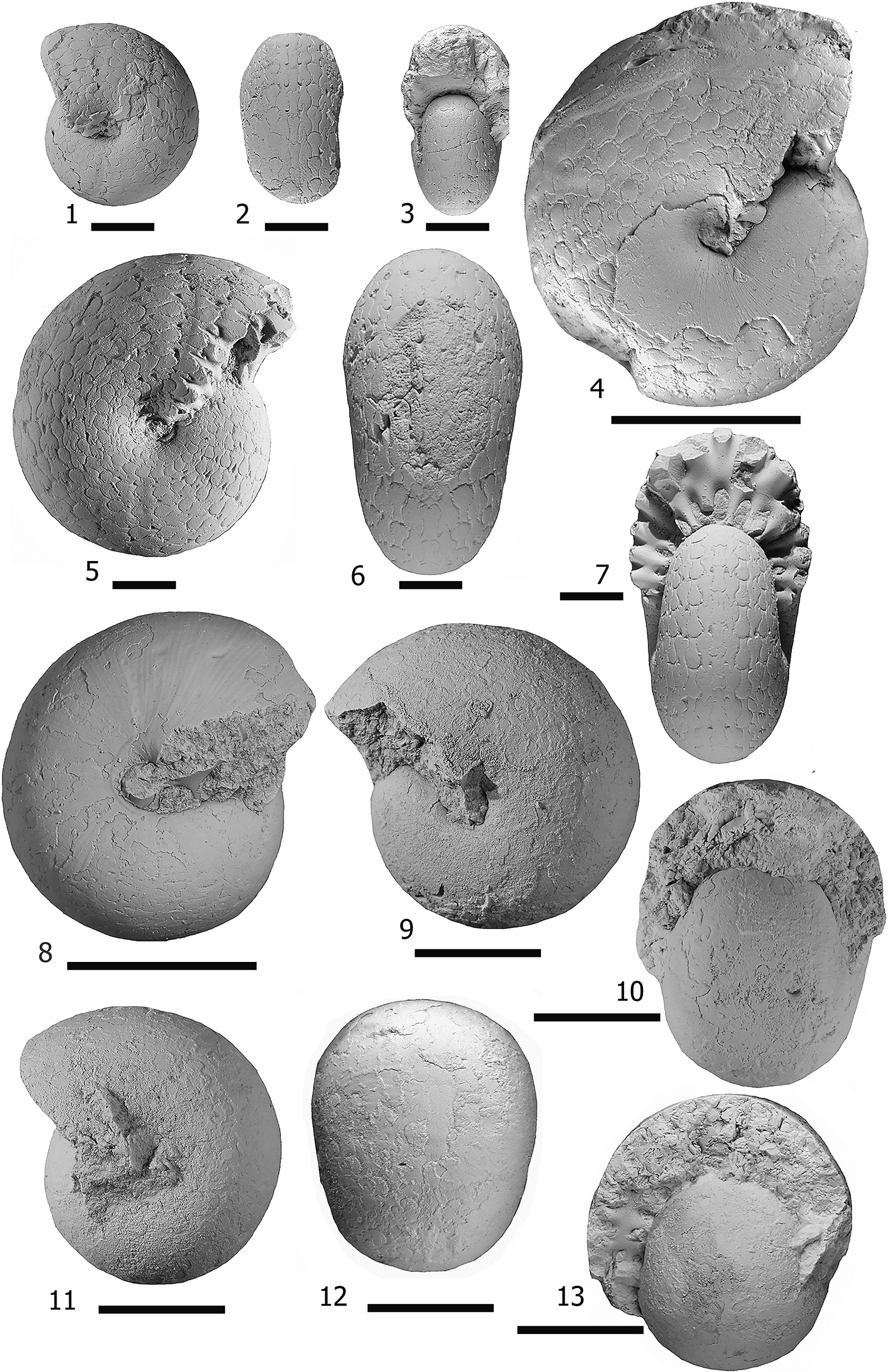
(1–7) Stacheoceras gemmellaroi Miller, Reference Miller, King, Dunbar, Cloud and Miller1944: (1–3) IGM 14153, lateral (1), ventral (2), and apertural (3) views; (4) IGM 14157, ventral view; (5–7) IGM 14193, lateral (5), ventral (6), and apertural (7) views. (8–13) Demarezites quirozii n. sp.: (8) IGM 14097, lateral view; (9, 10) IGM 14100, lateral (9) and ventral (10) views; (11–13) IGM 14093, lateral (11), ventral (12), and apertural (13) views. Scale bars = 1 cm.
See synonymy in Supplementary Information 1.
Lectotype
YPM IP 16653, lectotype designated by Nassichuk (Reference Nassichuk1977) and figured as a syntype by Miller (Reference Miller, King, Dunbar, Cloud and Miller1944, pl. 37, fig. 9), from Las Delicias Formation, Coahuila state, Mexico. YPM IP includes other specimens from the original syntypic series.
Occurrence
Level LD1, Las Difuntas-18 section; level LM1, Las Manuelas I section, Las Delicias Formation, Waagenoceras Zone.
Description
The shell is thinly discoidal (ww/Dm = 0.56) and moderately large, involute (uw/Dm = 0.09), and the umbilicus is small with rounded shoulders. The whorl cross section is weakly compressed (ww/wh = 1.12). The whorls are rounded ventrally, and the flanks are broadly rounded. The ornamentation consists of dense fine transverse lines, which are preserved in a fragment of the external mold of the lateral (Fig. 8.4), and faint constrictions (Fig. 8.5). The ventral lobe of the suture is asymmetrically bifid, separated by a narrow and high ventral saddle, lateral lobes tend to be asymmetrically trifid, with at least six pairs of lateral lobes, those nearest the umbilicus are moderately rounded, and all saddles are rounded. Measurements in Table 1.
Material
IGM 14117, 14153–14163, 14173, 14175, and 14193; 14 specimens preserved as internal molds in black calcite and allow good observation of the suture line. Specimens IGM 14153, 14154, 14155, 14157, 14159, 14173, and 14193 are preserved as 3D molds, the remaining specimens are fragments of phragmocone.
Remarks
Stacheoceras gemmellaroi resembles Stacheoceras toumanskyae Miller and Furnish, Reference Miller and Furnish1940 from the Timorites Zone of the Las Delicias Formation, but Stacheoceras toumanskyae exhibits a larger size and a greater number of elements in the suture (Miller, Reference Miller, King, Dunbar, Cloud and Miller1944). Miller (Reference Miller, King, Dunbar, Cloud and Miller1944) reported Stacheoceras gemmellaroi from the Waagenoceras Zone of the Malascachas section, possibly of Wordian age (middle Guadalupian). In that study, Miller (Reference Miller, King, Dunbar, Cloud and Miller1944) emphasized that the sutures varied slightly during ontogenetic development, making the differentiation of taxa within the genus difficult. Nonetheless, we could observe that the suture of our sample is strongly similar to that described for the syntype of Stacheoceras gemmellaroi (see Miller, Reference Miller, King, Dunbar, Cloud and Miller1944, p. 108, fig. 18). This species occurs in British Columbia (Canada), and Coahuila and Guerrero (Mexico).
Family Cyclolobidae Zittel, Reference Zittel1895
Subfamily Cyclolobinae Zittel, Reference Zittel1895
Genus Demarezites Ruzhentsev, Reference Ruzhentsev1955
Type species
Waagenocerass oyensi Gerth, Reference Gerth1950 from the Roadian of Tae-Vei Beds from Timor, Indonesia.
Demarezites quirozii new species
Figures 8.8–8.13, 9.1–9.3, 10.1, 10.2; Table 2; Supplementary Appendix 4, Figure 4B
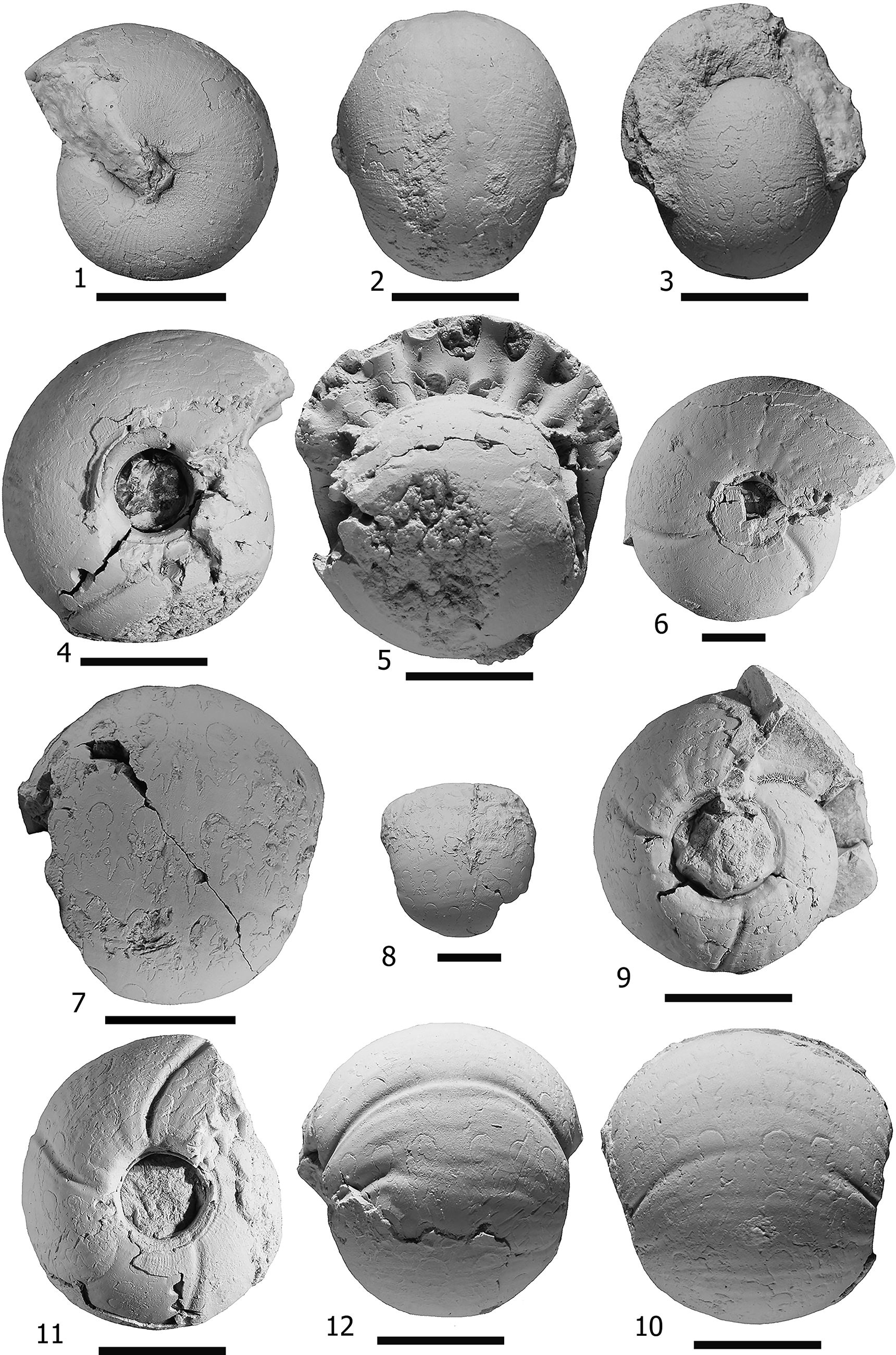
(1–3) Demarezites quirozii n. sp., holotype IGM 14104, lateral (1), ventral (2), and apertural (3) views. (4–7) Mexicoceras guadalupense (Girty, Reference Girty1908): (4, 5) IGM 14225, lateral (4) and apertural (5) views; (6) IGM 14235, lateral view; (7) IGM 14224, ventral view. (8–12) Mexicoceras smithi (Miller and Furnish, Reference Miller and Furnish1940): (8) IGM 14164, ventral view; (9, 10) IGM 14284, lateral (9) and ventral (10) views; (11, 12) IGM 14226, lateral (11) and ventral (12) views. Scale bars = 1 cm.
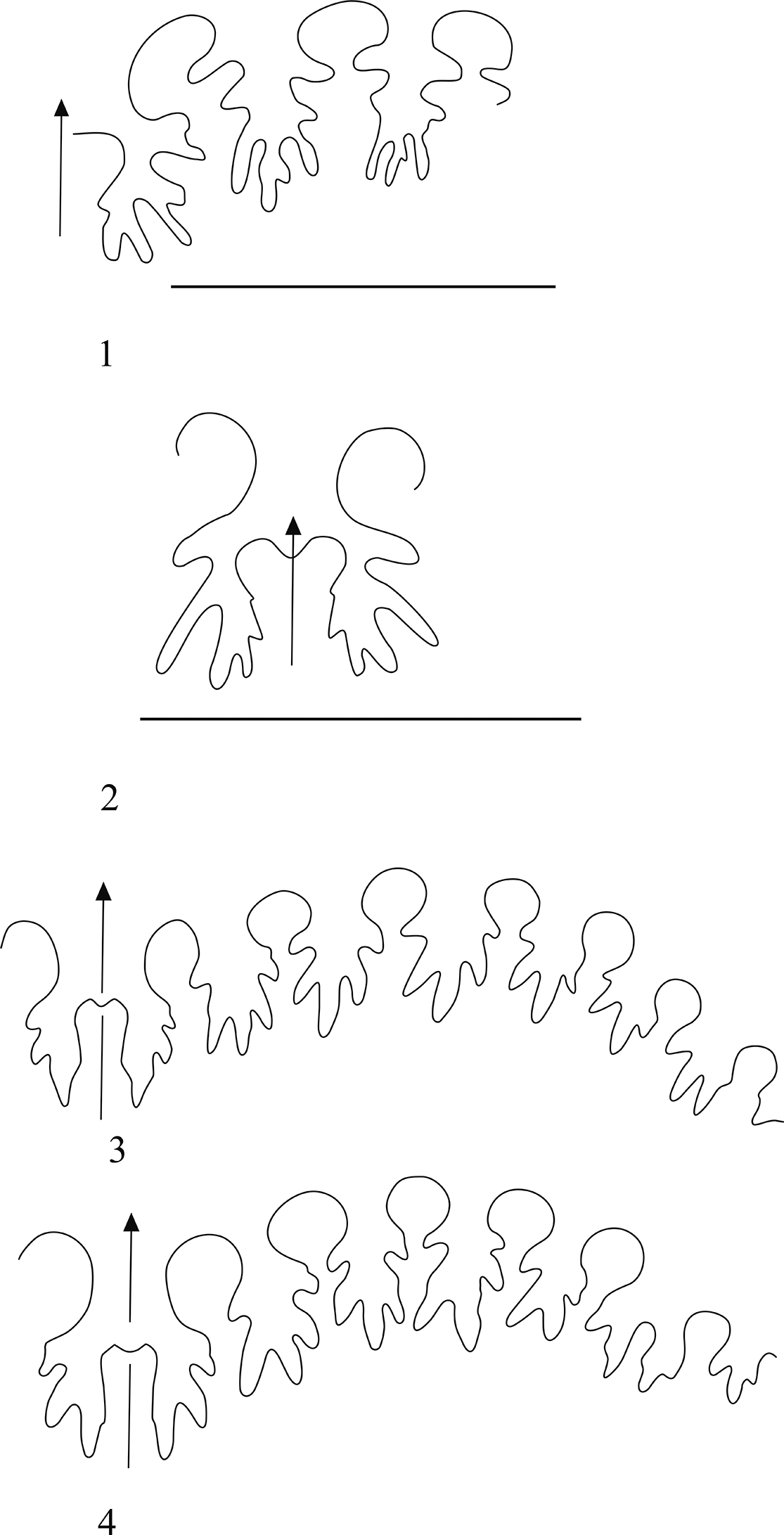
External sutures: (1, 2) Demarezites quirozii n. sp. from Las Difuntas-18 section, level LD1, Las Delicias Formation; based on samples IGM 14097 and 14104, respectively; (3) Demarezites oyensi (Gerth, Reference Gerth1950), UA E229; (4) Demarezites lidacensis (de Roever, 1940), UA B2154. Figures 10.3 and 10.4 modified from Glenister and Furnish (Reference Glenister and Furnish1987, fig. 5), shown without scale. Arrows indicate the shell aperture. Scale bar = 5 mm (1, 2).
See synonymy in Supplementary Information 1.
Type specimens
Holotype, IGM 14104 (Fig. 9.1–9.3), and paratypes, IGM 14093 and 14097 (Fig. 8.8, 8.11–8.13), from level LD-1 from Las Difuntas-18 section, Las Delicias Formation, Coahuila state, Mexico.
Diagnosis
Shell small, globular and involute; the umbilicus is small and narrow. The venter and lateral walls are rounded. Fine transverse lirae, originating from the umbilical wall to the venter and forming faint sinuses, ornament the shell. The advanced suture is well-developed, typical of a mature cyclolobin but on a small-diameter shell.
Occurrence
Level LD1, Las Difuntas-18 section, Las Delicias Formation, Waagenoceras Zone.
Description
The shell is pachyconic (ww/Dm = 0.77) and subinvolute to subevolute (uw/Dm = 0.32), with a small and narrow umbilicus (measurements in Table 2). The whorl cross section is weakly compressed to weakly depressed (ww/wh = 1.51). The venter and lateral walls are rounded. Ornamentation on the shell consists of fine transverse lirae, developed from the umbilical wall to the venter (Figs. 8.8, 9.1–9.3); ornamentation is only visible in the areas with recrystallized shell. The suture line is slightly arched, composed of a pair of broad ventral lobes with three digits; the first two pairs of lateral lobes have seven well-developed digitations. The third lateral lobe, which has five digitations, is less developed, and the digitation of the fourth lobe is smaller and more complex. The ventral saddle is broad and small in height; all lateral saddles are rounded and strangulate (Fig. 10.1, 10.2).
Etymology
Named in honor of Dr. Jesús Quiroz Barragán, founder of the Museo Paleontólogico de la Laguna in Torreón City, Coahuila state, Mexico.
Other material
IGM 14093, 14095, 14097, 14100, 14103, and 14104; six specimens preserved as internal molds in limestone, all showing three dimensions. Only two specimens show partial parts of shell ornamentation.
Remarks
This new species has been classified within the family Cyclolobidae based on two main features: the shape of the shell, which is completely involute with a narrow umbilicus, and the suture with a very complex lobe subdivision (Leonova, Reference Leonova2002, Reference Leonova2010). According to Leonova (Reference Leonova2002), the family Cyclolobidae comprises nine genera, including Demarezites with a stratigraphic range of the middle-upper Permian (Roadian–Changhsingian). The genus has four recorded species. The type species, Demarezites oyensi, is reported from the Roadian strata of Timor (Fig. 10.3). Also from Timor is the species D. lidacensis (de Roever, Reference Roever1939) ranging from the Roadian through the Wordian (Fig. 10.4). Two species have been reported in America; the first is Demarezites furnishi Spinosa and Nassichuk, Reference Spinosa and Nassichuk1994 from Idaho, USA, limited to a Roadian age and possibly extending into the early Wordian (Spinosa and Nassichuk, Reference Spinosa and Nassichuk1994). The second was described as Demarezites sp. indet. from the Wordian of Coahuila, Mexico (Spinosa and Nassichuk, Reference Spinosa and Nassichuk1994). This form was first identified as Waagenoceras dieneri Böse, Reference Böse1919 by Miller (Reference Miller, King, Dunbar, Cloud and Miller1944), but Glenister and Furnish (Reference Glenister and Furnish1987) reviewed part of this material from the lower Palo Quemado beds to the north of Cerro Prieto and suggested that it belonged to the genus Demarezites (Wardlaw et al., Reference Wardlaw, Furnish and Nestell1979). Often specimens of this taxon from Coahuila have only been described to the genus level, although they are common. Demarezites quirozii n. sp. differs from D. furnishi in having seven digitations in its first lateral lobe rather than five (illustrated by Spinosa and Nassichuk, Reference Spinosa and Nassichuk1994, figs. 1.1–1.3, 2.1); in addition, the mushroom-like saddle is more distinctive in the new species (Fig. 10.1). Another difference between D. quirozii n. sp. and D. sp. indet. of Spinosa and Nassichuk (Reference Spinosa and Nassichuk1994) is the ornamentation of the shell. Demarezites sp. indet. has numerous constrictions (Spinosa and Nassichuk, Reference Spinosa and Nassichuk1994, fig. 1.4–1.7), which are absent in the new species described here. This is the first species of Demarezites described from the Permian of Mexico. This species occurs in Coahuila (Mexico).
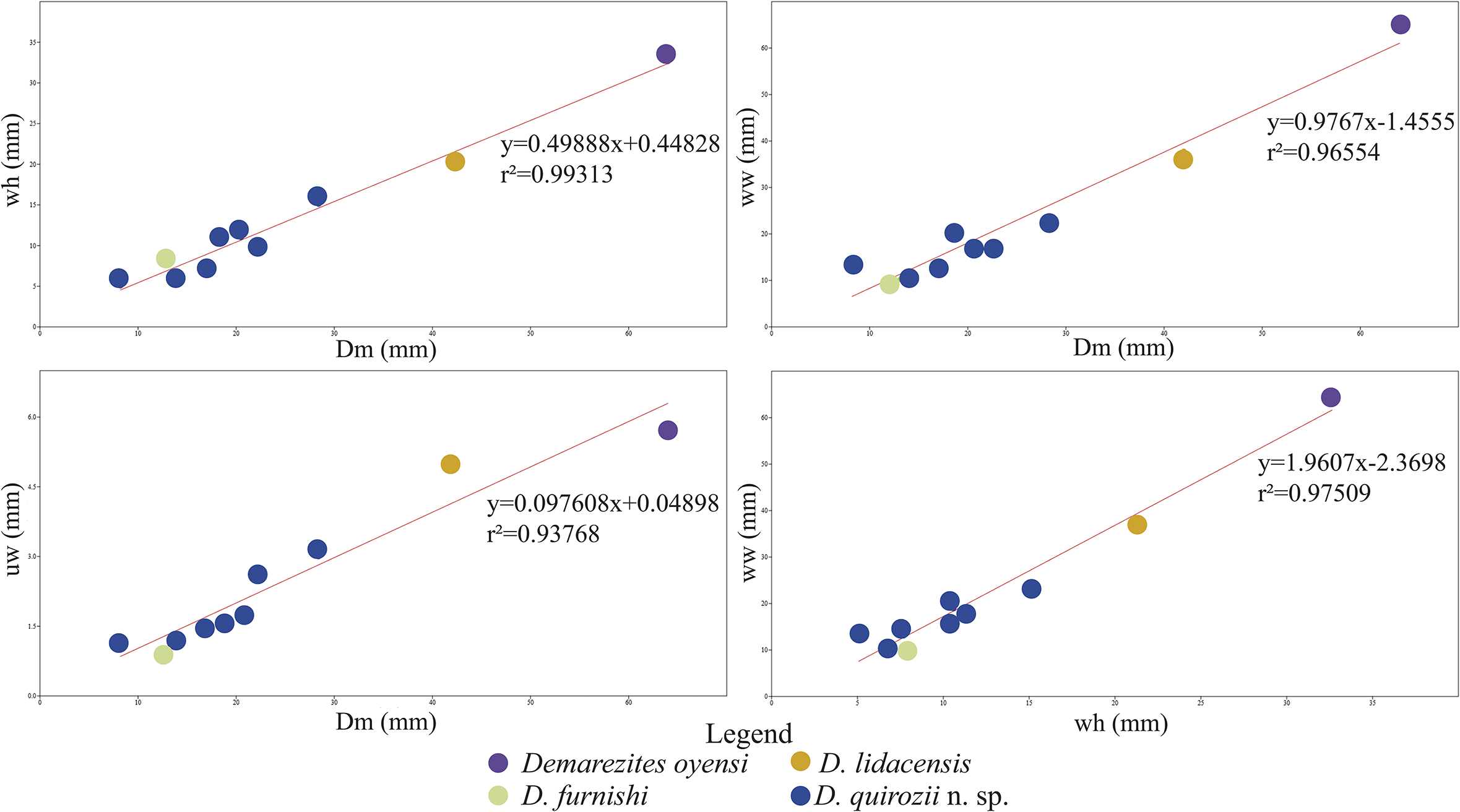
To support the previous remark, we reviewed literature on various Demarezites spp. and their morphometric parameters (Table 2). We quantitatively analyzed the ordinary least squares regression (OLS) using these data. The bivariant correlations were made based on the shell diameter (Dm) and variables like whorl height (wh), whorl width (ww), and umbilical width (uw) (Fig. 11). The plots show high coefficients of determination: Dm-wh (r = 0.99656; r² = 0.99313), Dm-ww (r = 0.98262; r² = 0.96554), and Dm-uw (r = 0.96834; r² = 0.93768). These results indicate consistent allometry during specimen development. The evidence suggests that ontogeny could be the main source of morphological variation within the dataset. The regression lines between D. furnishi and D. quirozii n. sp. are parallel or nearly parallel (Fig. 11), which suggests that they could be ontogenetically related. Based on our analysis, it is reasonable to propose that D. furnishi and D. quirozii n. sp. are distinct species with similar ontogenetic patterns. The partial overlap of data in the plots suggests that D. furnishi and D. quirozii n. sp. exhibit morphologically comparable ontogenetic stages. This interpretation supports the validity of both species within the genus Demarezites, while also suggesting a close ontogenetic affinity between them.
Bivariate diagrams of the conch parameters wh, ww, and uw in function of Dm and ww in function of wh for the 10 specimens of Demarezites used for this study. The blue triangle indicates the holotype specimen of D. quirozii n. sp.
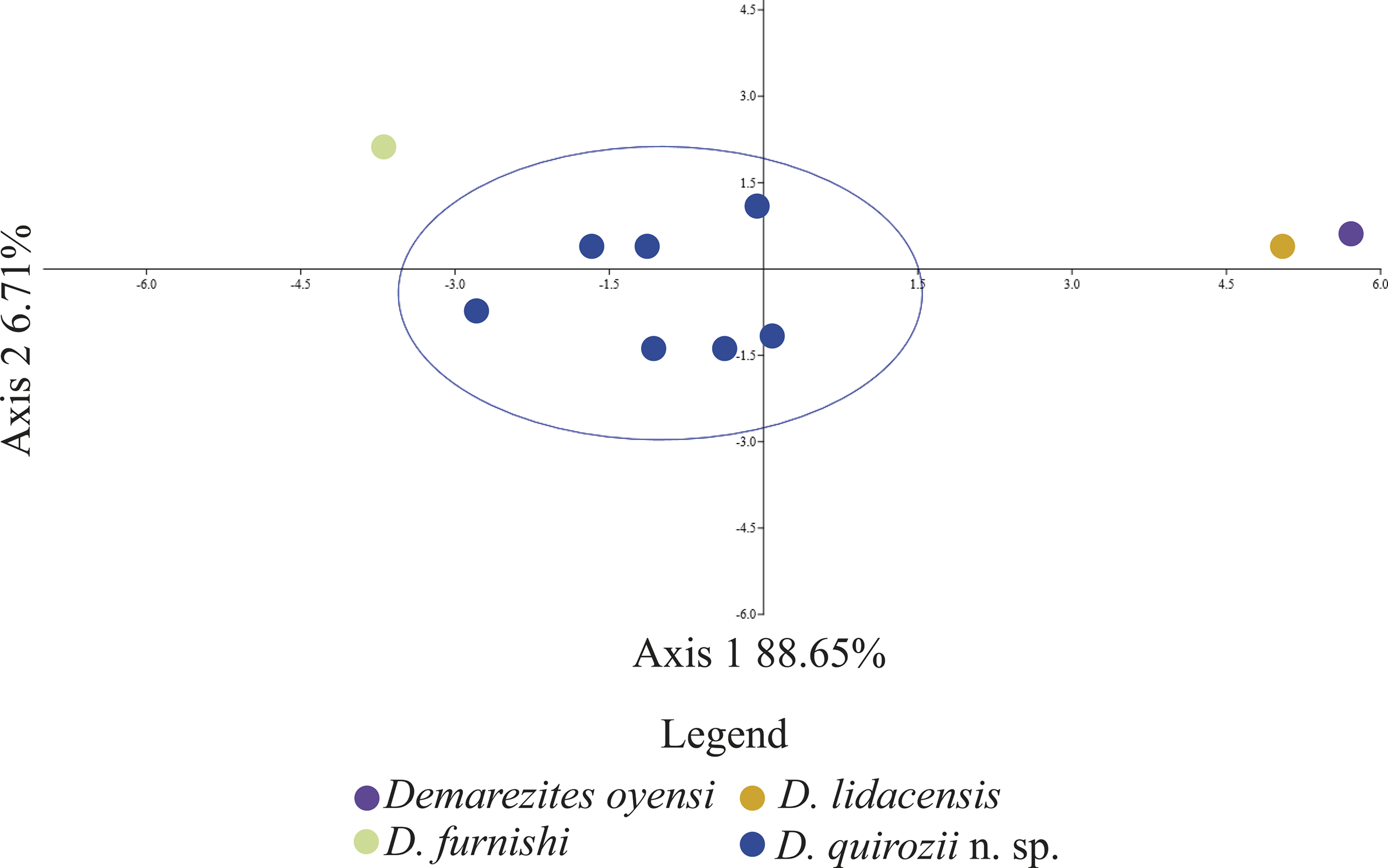
To evaluate whether Demarezites quirozii n. sp. represents a taxonomically distinct species from D. furnishi, a linear discriminant analysis (LDA) was performed using a set of morphometric variables. The analysis was based on morphometric ratios found to be significant: wh/Dm, ww/Dm, uw/Dm, and ww/wh (Table 2). The first canonical axis accounted for 88.65% of the total variance, with the second and third axes contributing 6.71% and 4.65%, respectively (Fig. 12). This strong variance concentration along the first axis indicates that most group morphological differences are captured in a single dimension. The resulting plot shows a clear separation between the specimens assigned to D. furnishi and D. quirozii n. sp. These clusters are well-defined, with minimal overlap, suggesting discrete morphospaces for each species. The observed morphological differences are consistent and statistically supported, justifying the recognition of D. quirozii n. sp. as a separate species. These findings align with qualitative observations of suture complexity (e.g., number of digitations in the first lateral lobe and the shape of saddles), as well as stratigraphic separation. Both quantitative and qualitative data support the taxonomic distinction of D. quirozii n. sp. from previously described species within the genus Demarezites.
Dispersion of the plots along the first two axes (axis 1 and 2) of the Linear Discriminant Analysis (LDA) for the 10 specimens of the genus Demarezites used in this study. The ratios ww/Dm and ww/wh are the most diagnostic parameters for taxonomic differentiation.
Genus Mexicoceras Ruzhentsev, Reference Ruzhentsev1955
Type species
Waagenoceras cumminsi var. guadalupense Girty, Reference Girty1908, subsequent designation of Davis (Reference Davis1968) from the Wordian, middle part of the Delaware Mountain Formation of Texas, USA.
Mexicoceras guadalupense (Girty, Reference Girty1908)
Figures 9.4–9.7, 13.1; Table 3; Supplementary Appendix 4, Figure 4C–D
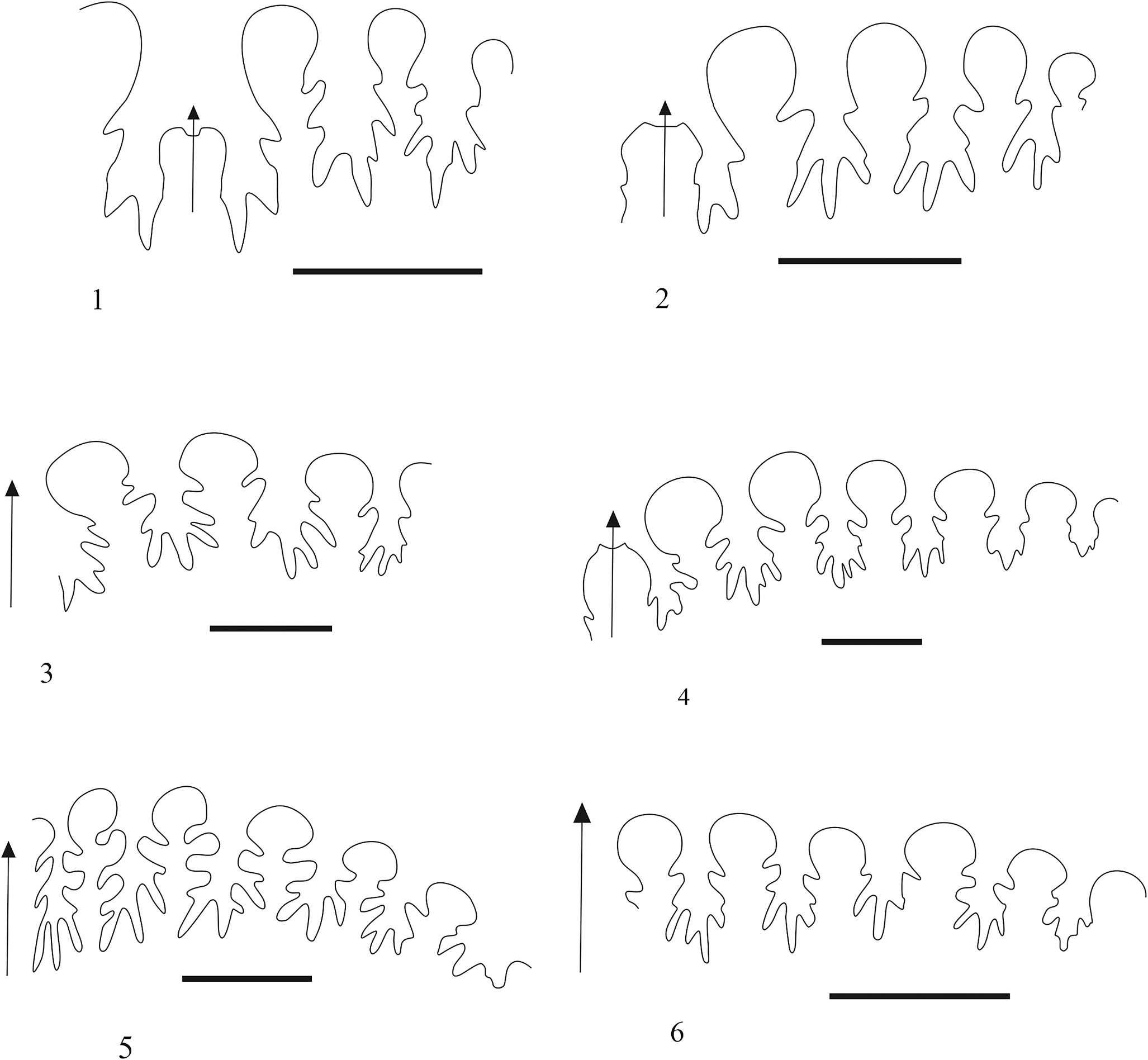
External sutures: (1) Mexicoceras guadalupense (Girty, Reference Girty1908) and (2, 3) Mexicoceras smithi (Miller and Furnish, Reference Miller and Furnish1940) from Las Manuelas I section, level LM1, Las Delicias Formation; based on samples IGM 14224, 14218, and 14221, respectively. (4) Waagenoceras dieneri Böse, Reference Böse1919, (5) Waagenoceras girtyi Miller and Furnish, Reference Miller and Furnish1940, level LM1, and (6) Waagenoceras karpinskyi Miller, Reference Miller, King, Dunbar, Cloud and Miller1944, level LM2, from Las Manuelas I section, Las Delicias Formation; based on samples IGM 14303, 14251, and 14320, respectively. Arrows indicate the shell aperture. Scale bars = 5 mm.
See synonymy in Supplementary Information 1.
Holotype
USGS 1187, figured by Miller and Furnish (Reference Miller and Furnish1940, pl. 40, fig. 7).
Occurrence
Level LM1, Las Manuelas I section, Las Delicias Formation, Waagenoceras Zone.
Description
The shell is thickly pachyconic (ww/Dm = 0.82) and subinvolute (uw/Dm = 0.27); the umbilicus is wide, and the walls of the umbilical zone are deep and form right angles. The whorl cross section is strongly depressed (ww/wh = 2.19). The venter and flanks are rounded. Ornamentation consists of fine lirae parallel to the opening of the shell (Fig. 9.4). Some specimens have constrictions, at least three before the living chamber. The constrictions have an arched form on the flank (Fig. 9.6). Around the siphonal region, constriction becomes shallower. The suture displays a bifid ventral lobe. All lateral lobes are digitate, with at least five lobes. Measurements in Table 3.
Materials
IGM 14143, 14206, 14207, 14214, 14216, 14224, 14225, 14235, 14244, 14257, 14263, 14278, 14283, 14289, 14302, 14306, and 14308, preserved as internal and external molds. Seventeen specimens are preserved as black calcite in three dimensions.
Remarks
The holotype was illustrated by Girty (Reference Girty1908) from the Permian of Delaware Mountains, Texas, USA. Although our specimens display the traits mentioned by Girty (Reference Girty1908) for the species, the Coahuila’s material more closely resembles those samples described by Miller and Furnish (Reference Miller and Furnish1940) and Davis et al. (Reference Davis, Landman, Dommergues, Marchand, Bucher, Landman, Tanabe and Davis1996) from Texas and by Miller (Reference Miller, King, Dunbar, Cloud and Miller1944) from Coahuila, in which a wide umbilicus is evident. Miller and Furnish (Reference Miller and Furnish1940) also stated that specimens of this species rarely, if ever, exhibit constrictions on the fully mature portion of the shell, except at the aperture. Our measurements of the specimens with the maximum diameters (Table 3) show that IGM 14216 and 14283 have constrictions, whereas IGM 14308 does not display them. Waagenoceras dieneri from the Las Delicias Formation of Coahuila (Miller, Reference Miller, King, Dunbar, Cloud and Miller1944) is dissimilar to Mexicoceras guadalupense in its smaller and narrower umbilicus, as well as the suture, which has more lateral lobes (six or seven pairs). The species has been reported in Texas (USA) and Coahuila (Mexico).
Mexicoceras smithi (Miller and Furnish, Reference Miller and Furnish1940)
Figures 9.8–9.12, 13.2, 13.3, 14, 15; Table 3; Supplementary Appendix 4, Figure 4E-G
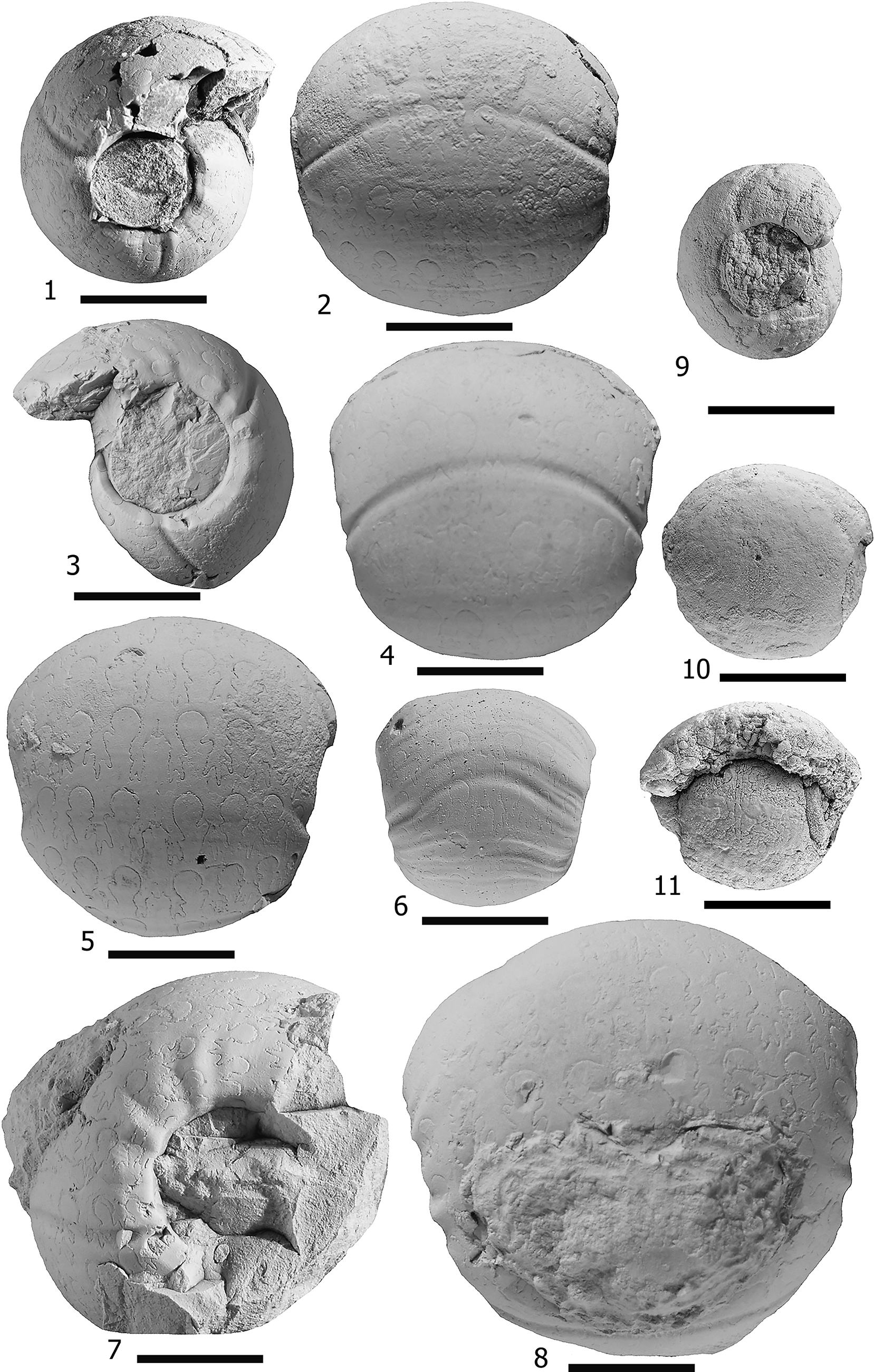
Mexicoceras smithi (Miller and Furnish, Reference Miller and Furnish1940): (1, 2) IGM 14228, lateral (1) and ventral (2) views; (3, 4) IGM 14258, lateral (3) and ventral (4) views; (5) IGM 14221, ventral view; (6) IGM 14259, ventral view; (7, 8) IGM 14218, lateral (7) and ventral (8) views; (9–11) IGM 14115, lateral (9), ventral (10), and apertural (11) views. Scale bars = 1 cm.
See synonymy in Supplementary Information 1.
Syntype
YPM IP 16659, figured by Miller (Reference Miller, King, Dunbar, Cloud and Miller1944, pl. 32, figs. 11, 12) from Las Delicias Formation, Coahuila state, Mexico.
Diagnosis
The shell is evolute with a spindle-shaped broad whorl section. The venter is rounded and very depressed. Whorls maintain this shape throughout ontogeny. Ornamentation consists of nodes or tubercles on the umbilical shoulders (Figs. 9.9, 14.3.3, 14.7). Constrictions are sinuous to the opening on the venter (Fig. 14.2, 14.4, 14.6). Around the siphonal region, the constrictions become shallower.
Occurrence
Level LD1, Las Difuntas-18 section and level LM1-A, Las Manuelas I-A section, Las Delicias Formation, Waagenoceras Zone.
Description
The shell is globular (ww/Dm = 0.98) and evolute (uw/Dm = 0.47) with a spindle-shaped broad whorl section; the umbilicus is large. The whorl cross section is extremely depressed (ww/wh = 5.70). The venter is rounded but slightly depressed. Narrow transverse lirae are evident on the shell; ornamentation consists of fine nodes or tubercles on the umbilical shoulders. The constriction is sinuous, broad, and deep, and is more evident on the umbilical shoulders. Irregular folding can be observed between the constrictions in the internal molds (Fig. 9.10–9.12). The constriction is gentle on the venter. The suture displays a broad bifid ventral lobe, followed by four or five digitate lateral lobes. Specimen IGM 14259 (Fig. 14.6) exhibits very distinctive features including several irregular thickenings on the shell that follow the general pattern of the constrictions. Measurements in Table 3.
Materials
IGM 14115, 14116, 14164−14166, 14172, 14199, 14205, 14217, 14218, 14220, 14221, 14226, 14228, 14237, 14241, 14252−14254, 14258−14261, 14264, 14266, 14276, 14284, 14295, 14301, 14304, and 14332; 31 specimens in LM1 strata preserved as internal molds of black calcite in three dimensions.
Remarks
This species resembles Mexicoceras guadalupense from Mexico and Texas. Both Mexicoceras guadalupense and Mexicoceras smithi display an evolute shell with a very wide umbilicus, evident narrow transverse lirae, and sinuous, broad, and deep constrictions, showing an arched shape transverse to the living chamber, with at least three constrictions before the living chamber. Nonetheless, Mexicoceras smithi differs from Mexicoceras guadalupense in the shape of the shell, which is clearly more robust and spindle-shaped; the whorl is slightly depressed ventrally, the height of the whorl is lower, and there are nodes or tubercles on the umbilical shoulders. It is worth noting that specimens of this species were referred to in previous works (e.g., Miller and Furnish, Reference Miller and Furnish1940, p. 160; Miller, Reference Miller, King, Dunbar, Cloud and Miller1944, p. 109) as Waagenoceras guadalupense smithi (= Mexicoceras guadalupense smithi). In these studies, the description of Waagenoceras guadalupense smithi was based on specimens from Coahuila, and the authors made note that the features mentioned above were not taxonomically significant, simply anatomical variations within the species. However, such morphological differences are evident in several well-preserved specimens, allowing us to differentiate Mexicoceras smithi from Mexicoceras guadalupense. Moreover, Davis (Reference Davis1968) described the adult stages of this species and identified changes in conch proportions (Dm = 48), with the whorl height decreasing in the last third of the living chamber, while the width continues to increase. Another characteristic is that no individual with a diameter > 25 mm has been observed to bear nodes on the umbilicus (Davis, Reference Davis1968). We examined six specimens with diameters > 25 mm (Table 3); among them, IGM 14218 (Fig. 14.7, 14.8) and IGM 14264 exhibit nodes despite their larger size, whereas specimens IGM 14237, 14252, and 14254 lack nodes. This variation suggests possible intraspecific variability in nodal development during later ontogenetic stages. Both species occur in the Waagenoceras Zone of Wordian age (Miller and Furnish, Reference Miller and Furnish1940; Miller, Reference Miller, King, Dunbar, Cloud and Miller1944; Wardlaw et al., Reference Wardlaw, Furnish and Nestell1979). It seems that the species’ geographic distribution is restricted to Coahuila state, Mexico.
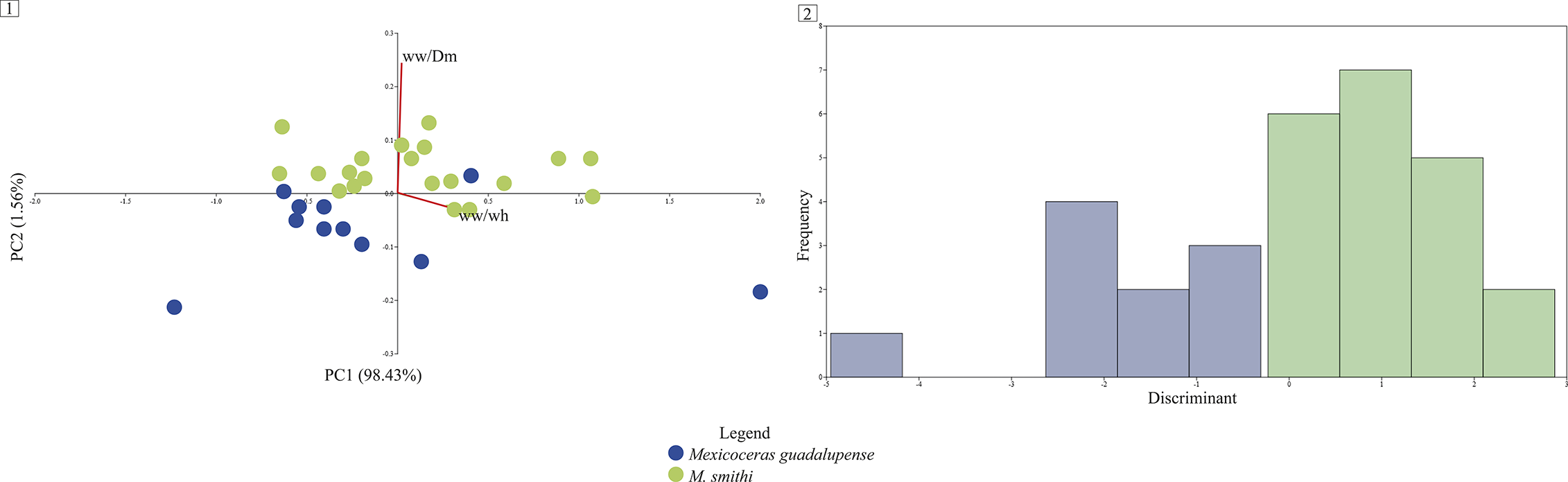
These main qualitative differences in shell shape allow us to recognize that parametric measurements help clarify the distinction between Mexicoceras guadalupense and Mexicoceras smithi. We used morphometric ratios as the main variables: wh/Dm, ww/Dm, uw/Dm, and ww/wh (Table 3). We conducted a principal component analysis (PCA) using ww/Dm vs. ww/wh, in which PC1 explains the majority of the variance (98.43%), and PC2 accounts for a small additional fraction (1.56%) (Fig. 15.1). Therefore, the dispersion in the plot is interpreted almost entirely along the PC1 axis. The plot shows that specimens of Mexicoceras guadalupense are tightly clustered, whereas specimens of Mexicoceras smithi also form a cluster, but in a region that is partially separated from Mexicoceras guadalupense along the PC1 axis. We suggest a clear morphological differentiation between the two taxa based on the variables used. We conducted an LDA to support the previous analysis. The eigenvalue of axis 1 is 1.9696, representing 100% of the explained variance, which indicates that a single axis is sufficient to totally separate the groups (Fig. 15.2). Specimens of Mexicoceras guadalupense are clustered on the left side of the discriminant axis, whereas Mexicoceras smithi specimens are grouped on the right. Therefore, there is no visible overlap between the distributions of the two taxa along this axis. This separation fully distinguishes the individuals according to their prior taxonomic assignment, reinforcing the differentiation observed in the PCA. The unimodal and nonoverlapping distribution of each taxon within the morphospace supports the existence of significant morphometric differences. The results of both analyses (PCA and LDA) validate our proposal that Mexicoceras smithi is taxonomically distinct from Mexicoceras guadalupense.
(1) Dispersion of the plots for the two first Principal Components (PC1 and PC2) of the Principal Components Analysis (PCA). The ratios ww/Dm and ww/wh are the most significant for taxonomic differentiation. (2) Dispersion of the plots along the first axes of the Linear Discriminant Analysis (LDA) for the specimens of the Mexicoceras guadalupense (Girty, Reference Girty1908) and M. smithi (Miller and Furnish, Reference Miller and Furnish1940) used in this study.
Genus Waagenoceras Gemmellaro, Reference Gemmellaro1887
Type species
Waagenoceras mojsisovicsi Gemmellaro, Reference Gemmellaro1887 from the Wordian, Sosio Beds of Sicily, Italy.
Waagenoceras dieneri Böse, Reference Böse1919
Figures 13.4, 16, 17.1, 17.2; Table 1; Supplementary Appendix 4, Figure 4H
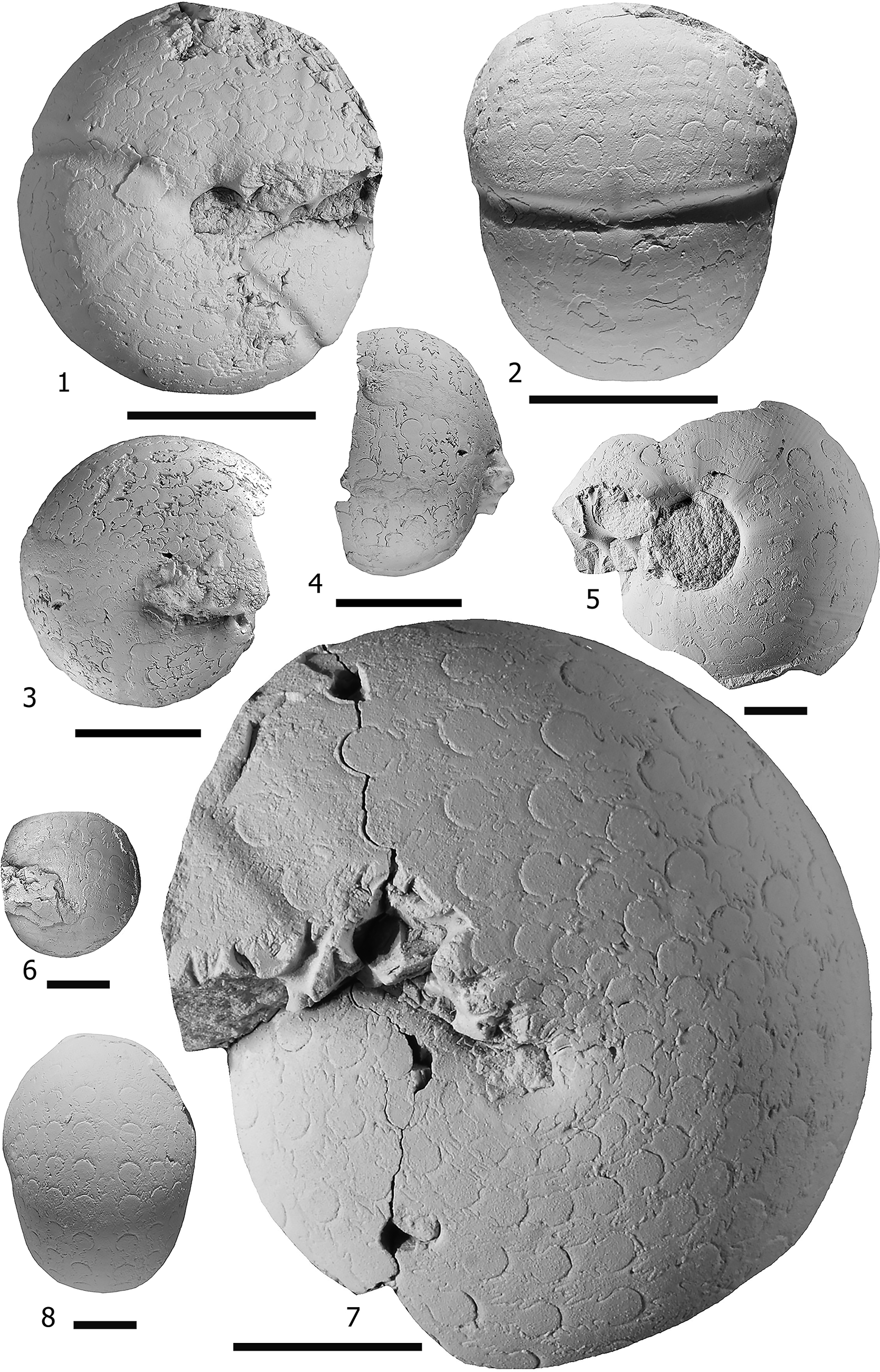
Waagenoceras dieneri Böse, Reference Böse1919: (1, 2) IGM 14277, lateral (1) and ventral (2) views; (3, 4) IGM 14167, lateral (3) and ventral (4) views; (5) IGM 14215, lateral view; (6) IGM 14168, ventral view; (7, 8) IGM 14303, lateral (7) and ventral (8) views. Scale bars = 1 cm.
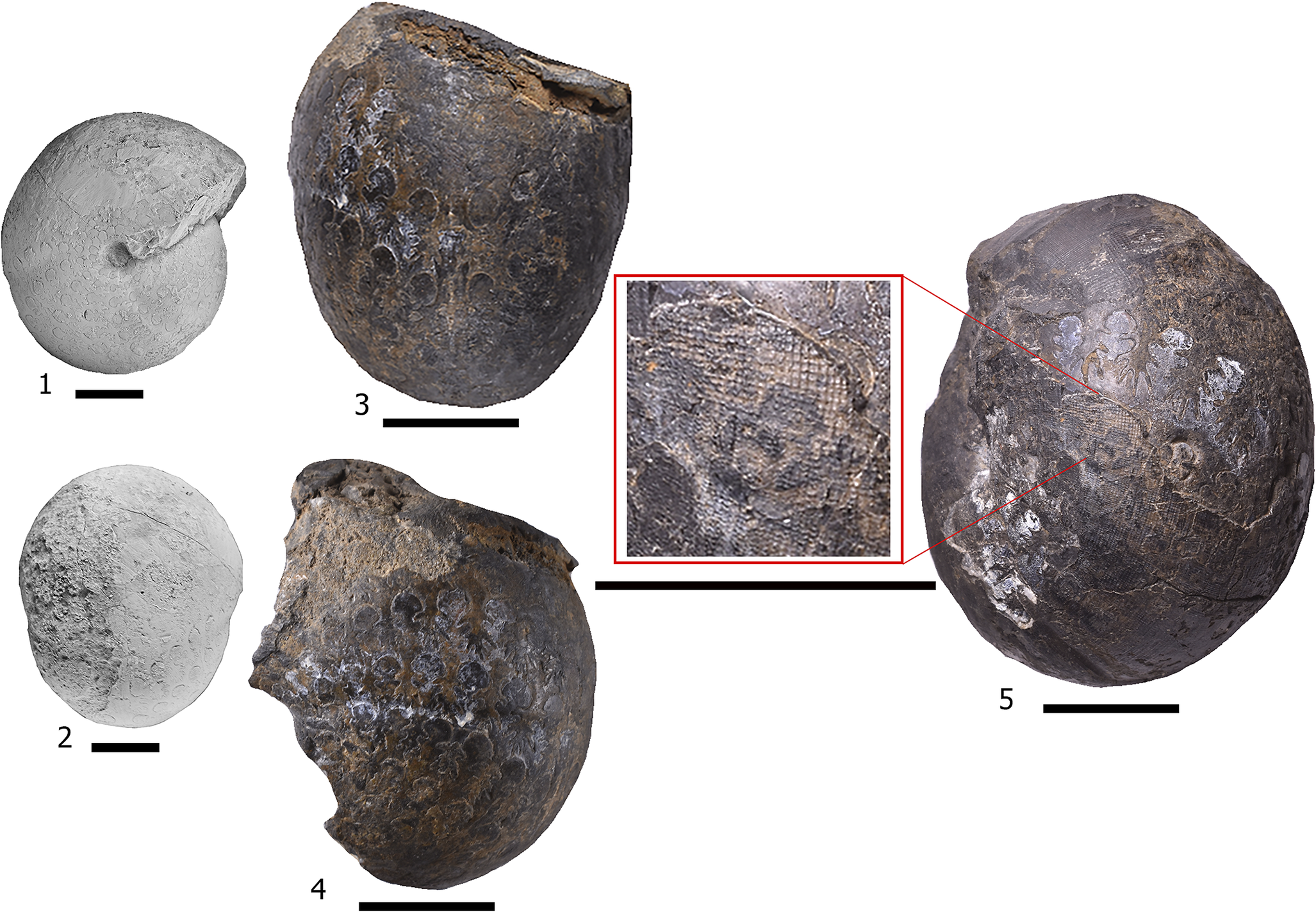
(1, 2) Waagenoceras dieneri Böse, Reference Böse1919, YPM IP 16666, lateral (1) and ventral (2) views. (3, 4) Waagenoceras girtyi Miller and Furnish, Reference Miller and Furnish1940, YPM IP 16672, lateral (3) and ventral (4) views. (5) Waagenoceras karpinskyi Miller, Reference Miller, King, Dunbar, Cloud and Miller1944, YPM IP 16676, lateral view, with partial enlargement (x2.5, red square). Scale bars = 1 cm.
See synonymy in Supplementary Information 1.
Holotype
YPM IP 16666, designated by Miller (Reference Miller, King, Dunbar, Cloud and Miller1944, pl. 33, figs. 1, 2) from Las Delicias Formation, Coahuila state, Mexico.
Occurrence
Levels LD1 and LD2, Las Difuntas-18 section; levels LM1 and LM3, Las Manuelas I section, Las Delicias Formation, Waagenoceras Zone.
Description
The shell is pachyconic (ww/Dm = 0.68) depending on ontogenetic stage, and involute (uw/Dm = 0.15); the umbilicus in some specimens is narrow, although in some cases it is slightly wider, generally deep, with an umbilical shoulder rounded to subangular; the umbilical wall is broad. The whorl cross section is weakly depressed (ww/wh = 1.44). The venter is rounded, with ornamentation consisting of some visible transverse lirae (Fig. 16.5), occasionally with three deep constrictions, which display a shallow ventral sinus (Fig. 16.2). The suture is arcuate and the ventral lobe is bifid, with six pairs of lateral lobes, and all elements are digitated. The penultimate lobe is simply bifid. All saddles are rounded, but those near the umbilical region are wider. Measurements in Table 1.
Materials
IGM 14112–14114, 14121, 14133, 14134, 14167–14171, 14178, 14186, 14200–14202, 14208, 14210, 14213, 14215, 14219, 14222, 14223, 14227, 14229, 14231, 14232, 14234, 14236, 14239, 14240, 14242, 14247, 14249, 14250, 14255, 14262, 14265, 14267–14271, 14273, 14275, 14277, 14279, 14280, 14282, 14285, 14287, 14288, 14293, 14294, 14300, 14303, 14307, 14309, and 14317; 59 specimens preserved as black calcite in three dimensions.
Remarks
The genus Waagenoceras is represented by two Wordian species from the Las Delicias Formation: W. dieneri and W. girtyi Miller and Furnish, Reference Miller and Furnish1940 (Fig. 17.1–17.4), the forms of which can be distinguished by distinctive sutural differences. Waagenoceras dieneri was described by Miller and Furnish (Reference Miller and Furnish1940) from the Word Formation of the Glass Mountains, West Texas. Miller (Reference Miller, King, Dunbar, Cloud and Miller1944) also reported the species in Coahuila, Mexico (Fig. 17.1, 17.2), and Nassichuk (Reference Nassichuk1977) reported it in British Columbia, Canada. These authors recognized at least two ontogenetic stages in the sutural development of W. dieneri. The juvenile is characterized by a suture with a ventral bifid lobe, simply digitate, with lateral lobes subdivided but symmetrical, and all saddles rounded. In the adult stage, the ventral bifid lobe displays more subdivisions, with subsequent lateral lobes also subdivided but retaining symmetry, and saddles are rounded but are mushroom-shaped (Miller, Reference Miller, King, Dunbar, Cloud and Miller1944, p. 113, fig. 22; Nassichuk, Reference Nassichuk1977, p. 580, text-figs. 15, 16). This species has been recorded in Texas (USA), British Columbia (Canada), Coahuila, Guerrero, and Sonora? (Mexico).
Waagenoceras girtyi Miller and Furnish, Reference Miller and Furnish1940
Figures 13.5, 17.3, 17.4, 18.1–18.4; Table 1; Supplementary Appendix 4, Figure 1
(1–4) Waagenoceras girtyi Miller and Furnish, Reference Miller and Furnish1940: (1–3) IGM 14298, lateral (1), ventral (2), and apertural (3) views; (4) IGM 14251, lateral view. (5–8) Waagenoceras karpinskyi Miller, Reference Miller, King, Dunbar, Cloud and Miller1944: (5) IGM 14320, lateral view; (6–8) IGM 14319, lateral (6), ventral (7), and apertural (8) views. Scale bars = 1 cm.
See synonymy in Supplementary Information 1.
Syntype
YPM IP 16663, figured by Miller (Reference Miller, King, Dunbar, Cloud and Miller1944, pl. 32, figs. 7, 8) from Las Delicias Formation, Coahuila state, Mexico.
Occurrence
Levels LD1 and LD2, Las Difuntas-18 section; levels LM1 Las Manuelas I section, Las Delicias Formation, Waagenoceras Zone.
Description
The shell is pachyconic (ww/Dm = 0.63) and involute (uw/Dm = 0.13), with a small and narrow umbilicus; umbilical shoulders are narrowly rounded and the venter is rounded. The whorl cross section is weakly depressed (ww/wh = 1.46). In larger specimens (IGM 14251, Fig. 18.4), the constrictions in the flank are slightly flexuous. The suture is highly arcuate from the venter to the umbilicus. The ventral lobe is bifid, with six or seven pairs of lateral lobes, with the seventh lobe totally bifid. All lateral lobes are multiply digitated and large in mature stages. Measurements in Table 1.
Materials
IGM 14098, 14102, 14105, 14110, 14128, 14141, 14150, 14181, 14204, 14209, 14211, 14212, 14230, 14238, 14245, 14246, 14248, 14251, 14272, 14274, 14281, 14286, 14290, 14296–14299, 14305, and 14338; 29 specimens preserved as molds in three dimensions in black calcite.
Remarks
According to Miller (Reference Miller, King, Dunbar, Cloud and Miller1944) and Nassichuk (Reference Nassichuk1977), Waagenoceras girtyi is dissimilar from W. dieneri in the narrower shell and smaller umbilicus. Nonetheless, we consider the arrangement of the sutures as the main difference because the pattern in W. girtyi is more arcuate (Figs. 13.5, 17.4) than in W. dieneri. In addition, the sutural pattern of W. girtyi displays one more pair of lobes and the lobes are more subdivided. Interestingly, W. girtyi has only been found in North America: Texas (USA), British Columbia (Canada), Coahuila, and Guerrero, (Mexico).
Waagenoceras karpinskyi Miller, Reference Miller, King, Dunbar, Cloud and Miller1944
Figures 13.6, 17.5, 18.5–18.8; Table 1; Supplementary Appendix 4, Figure 4J−L
See synonymy in Supplementary Information 1.
Syntype
YPM IP 16676, figured by Miller (Reference Miller, King, Dunbar, Cloud and Miller1944, pl. 31, figs. 1, 2) from Las Delicias Formation, Coahuila state, Mexico.
Occurrence
Level LM2, Las Manuelas I section, Las Delicias Formation, Timorites Zone.
Description
The shell is pachyconic (ww/Dm = 0.68) and involute (uw/Dm = 0.11), with the umbilicus small but open. The umbilical shoulder is rounded to subangular. The whorl cross section is weakly depressed (ww/wh = 1.23). The ornamentation consists of constrictions that form a low ventral sinus and a shallow lateral sinus. Three or four constrictions occur parallel to the growth lines on the surface of the final whorl. The suture line is slightly arched, with the ventral lobe bifid and multidigitate. Also, the suture displays six lateral lobes, of which four are subdivided and the fifth is trifid. All lateral saddles are rounded. Measurements in Table 1.
Materials
IGM 14319, 14320−14322, 14329, and 14330; six specimens preserved in black calcite.
Remarks
The morphology of Waagenoceras karpinskyi is similar to W. dieneri and W. girtyi, but the traits of the suture are dissimilar. The suture of W. karpinskyi is easily differentiated in its arched form on the venter of the umbilicus (Fig. 13.6). Moreover, the ventral lobes are broader and the next lobes are subdivided. Also, it can have more prominent constrictions and these are more flexuous than the other mentioned species (Fig. 18.5). According to King et al. (Reference King, Part, in King, Dunbar, Cloud and and Miller1944), this species is biostratigraphically associated with the Timorites Zone of Capitanian age (Fig. 17.5). This association has only been reported in the Las Delicias Formation, with W. karpinskyi occurring only in Mexico. Timorites can be distinguished from W. karpinskyi by its more complex suture arrangement, displaying approximately nine lobes. This species occurs in Coahuila state, Mexico.
Genus Timorites Haniel, Reference Haniel1915
(= Hanieloceras Miller, Reference Miller1933)
Type species
Timorites curvicostatus Haniel, Reference Haniel1915 from the lower part of the Djulfian (Capitanian, probably equal to the lower Lopingian) of Timor, Indonesia.
Timorites schucherti Miller and Furnish, Reference Miller and Furnish1940
Figure 19.1–19.3; Table 1; Supplementary Appendix 4, Figure 4M
(1–3) Timorites schucherti Miller and Furnish, Reference Miller and Furnish1940: (1) IGM 14328, lateral view; (2, 3) IGM 14327, lateral (2) and ventral (3) views. (4–6) Paraceltites elegans Girty, Reference Girty1908, IGM 14324, lateral (4), ventral (5), and apertural (6) views. (7–9) Cibolites cf. C. uddeni Plummer and Scott, Reference Plummer, Scott and Sellards1937, IGM 14326, lateral (7), ventral (8), and apertural (9) views. Scale bars = 1 cm.
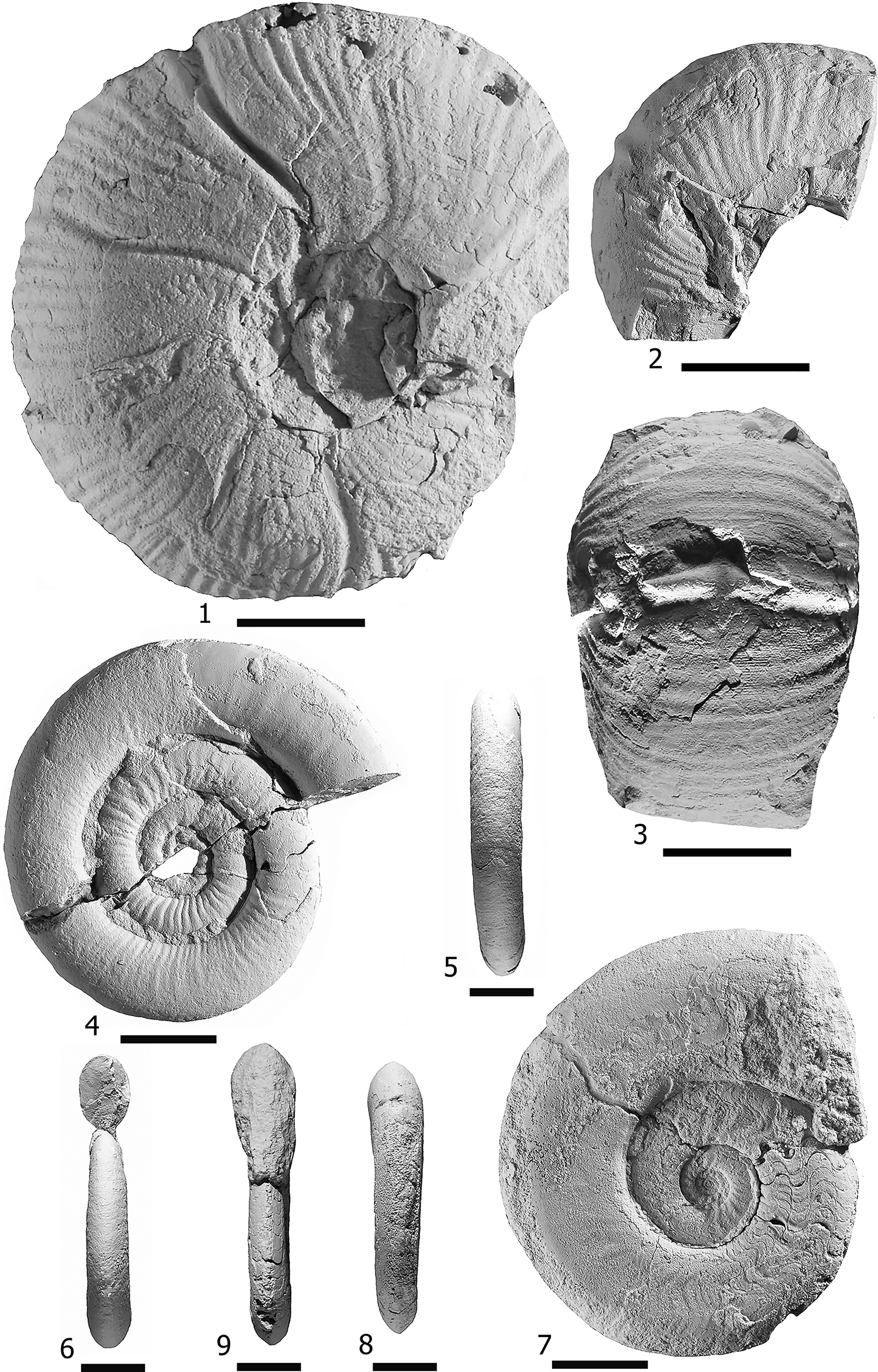
See synonymy in Supplementary Information 1.
Syntype
YPM IP 16694, figured by Miller (Reference Miller, King, Dunbar, Cloud and Miller1944, pl. 36, figs. 1, 2) from Las Delicias Formation, Coahuila state, Mexico.
Occurrence
Level LM2, Las Manuelas I section, Las Delicias Formation, Timorites Zone.
Description
The shell is subinvolute (uw/Dm = 0.29). The umbilicus is wide and the umbilical shoulder rounded. The ornamentation consists of prominent, sinuous transverse ribs that bifurcate from the lateral region to the venter. These ribs are paired and occur around the lower and middle part of the flank (Fig. 19.1, 19.2). The ribbing becomes more robust in the upper third of the flank, crossing straight over the venter. In one specimen (IGM 14327), part of the shell was recrystallized in the venter showing crenulate growing lines parallel to the ribbing (Fig. 19.3). Two or three deep constrictions occur parallel to the ribbing. The suture is not clearly visible, but some lateral lobes are subdivided and large. Measurements in Table 1.
Materials
Two fragments, IGM 14327 and 14328, preserved as internal and external molds in recrystallized black calcite.
Remarks
The examined specimen exhibits the typical ornamentation and diagnostic features of Timorites schucherti (see Miller and Furnish, Reference Miller and Furnish1940; Miller, Reference Miller, King, Dunbar, Cloud and Miller1944; Leonova, Reference Leonova2016). Although the specimen is only laterally visible, the umbilicus is wide and the ribs bifurcate, displaying more than two sinuous transverse constrictions, similar to the specimens illustrated by Miller (Reference Miller, King, Dunbar, Cloud and Miller1944, pl. 35, figs. 10, 11, pl. 36, figs. 1, 2) and Leonova (Reference Leonova2018, fig. 8). Moreover, the suture line on the shell is more developed and elongated than in other Cyclolobidae (Waterhouse, Reference Waterhouse1972), e.g., Waagenoceras karpinskyi. Timorites schucherti is known from the Capitanian (upper Guadalupian) of North America, and has been recorded in Texas (USA) and Coahuila (Mexico).
Order Ceratitida Hyatt, Reference Hyatt1884
Suborder Paraceltitina Shevyrev, Reference Shevyrev1968
Superfamily Xenodiscoidea Frech, Reference Frech1902
Family Paraceltitidae Spath, Reference Spath1930
Genus Paraceltites Gemmellaro, Reference Gemmellaro1887
(= Paralecanites Gemmellaro, Reference Gemmellaro1887; Paracibolites Hayasaka, Reference Hayasaka1947)
Type species
Paraceltites elegans Girty, Reference Girty1908 of the Roadian, Bone Spring Formation of Texas, USA.
Paraceltites elegans Girty, Reference Girty1908
Figures 5.8, 19.4–19.6; Table 1; Supplementary Appendix 5, Figure 5A
See synonymy in Supplementary Information 1.
Holotype
USGS 1184, figured by Miller and Furnish (Reference Miller and Furnish1940, pl. 22, figs. 7, 8) from the Bone Spring Formation of Texas, USA.
Occurrence
Level LM2, Las Manuelas I section, Las Delicias Formation, Timorites Zone.
Description
The shell is extremely discoidal (ww/Dm = 0.16), evolute (uw/Dm = 0.56), with flanks slightly flat to rounded (Fig. 19.4). Whorl section elliptical (Fig. 19.6). Umbilicus wide with umbilical shoulder rounded. The whorl cross section is weakly compressed (ww/wh = 0.77). Venter rounded. The shell ornamentation is ribbed. On the inner whorls, the ribbing is robust, simple, and slightly sigmoidal (Fig. 19.4). There the rib interspaces are approximately three times thinner than the ribs. On the final whorl, the ribbing density substantially increases. Interspaces become slightly thinner than the ribs. The ribbing becomes very delicate and sigmoidal, and it is only visible on the lower to middle part of the flank (Fig. 19.4). Strong attenuation, starting in the middle of the flank, makes the ribbing virtually impossible to appreciate in the upper part of the flank and the venter (Fig. 19.4, 19.5, 19.6). The suture displays a bifid ventral lobe, rounded and variable in depth, followed by two lateral lobes, rounded and variable in depth and width. Saddles are rounded. Measurements in Table 1.
Materials
Two phragmocone molds, IGM 14324 and 14325. IGM 14324 is preserved as a 3D mold recrystallized in black calcite and retains part of the living chamber. IGM 14325 is a fragment of recrystallized phragmocone.
Remarks
Miller (Reference Miller, King, Dunbar, Cloud and Miller1944) described four Paraceltites species from the Permian of Mexico: Paraceltites elegans, Paraceltites ornatus Miller and Furnish, Reference Miller and Furnish1940, Paraceltites rectangularis (Miller, Reference Miller, King, Dunbar, Cloud and Miller1944), and Paraceltites altudensis (Böse, Reference Böse1919). Spinosa et al. (Reference Spinosa, Furnish and Glenister1975) re-examined the original descriptions with more specimens, concluding that Paraceltites ornatus and Paraceltites altudensis are synonyms of Paraceltites elegans. This confusion is based on all Paraceltites spp. having strong variations in ornamentation and the suture, displaying narrow and thin shells. Given this, we reviewed the ornamentation and shape of the shell from the material of the Las Delicias Formation housed at YPM IP. After reviewing the specimens, we agree with Spinosa et al.’s (Reference Spinosa, Furnish and Glenister1975) conclusion, noting that the genus Paraceltites of Coahuila is only represented by two species: Paraceltites elegans and Paraceltites rectangularis. The main difference observed in both is in the venter, because Paraceltites rectangularis has an almost flat belly, whereas in Paraceltites elegans, it is rounded, as seen in our material. Spinosa et al. (Reference Spinosa, Furnish and Glenister1975) nicely illustrated the wide ornamental variability of this species, as well as changes in ornamentation during ontogenetic development, which demonstrate a significant increase in ribbing density in the adult stage. This ontogenetic change can also be clearly appreciated in our specimens. This species has been reported in Texas and Idaho (USA), Coahuila and Guerrero (Mexico), southern China, and Japan.
Genus Cibolites Plummer and Scott, Reference Plummer, Scott and Sellards1937
(= Xenodiscites Miller and Furnish, Reference Miller and Furnish1940)
Type species
Cibolites uddeni Plummer and Scott, Reference Plummer, Scott and Sellards1937 of Wordian–Capitanian, Delaware Mountain and Word formations, Texas, USA.
Cibolites cf. C. uddeni Plummer and Scott, Reference Plummer, Scott and Sellards1937
Figure 5.9, 19.7–19.9; Table 1; Supplementary Appendix 5, Figure 5B
Synonyms in Supplementary Information I
Holotype
University of Texas B3356, figured by Miller and Furnish (Reference Miller and Furnish1940, p. 73, 198, pl. 6, fig. 1) from Delaware Mountains, Texas, USA.
Occurrence
Level LM2, Las Manuelas I section, Las Delicias Formation, Timorites Zone.
Description
The shell is extremely discoidal (ww/Dm = 0.18) and subevolute (uw/Dm = 0.38). Both flanks are slightly flat. The umbilicus is wide and moderately deep, and the umbilical shoulder is rounded. The whorl cross section is weakly compressed (ww/wh = 0.57). The venter has an angular form. Ornamentation is difficult to identify. Sigmoidal ribbing is present on the inner whorls and appreciable until the start of the body chamber. The ventral lobe is bifid, displaying two prongs, rounded and deep. The first lateral lobe is deep, rounded, and narrow, but the second lateral lobe is rounded and wide. The first saddle is lower than the second, but both are asymmetrical, whereas the third lateral saddle near the umbilical zone is low, relatively broad, flattened, and asymmetrical. Measurements in Table 1.
Materials
One specimen, IGM 14326, preserved as an internal mold. It seems to be an adult due to the septal approximation observable at the start of the body chamber. The half last whorl corresponds to the body chamber.
Remarks
The genera Paraceltites and Cibolites are reported for the same level (LM2) of the Las Manuelas I section, in Las Delicias, Coahuila. Even though the two taxa are similar, significant morphological differences can be observed between them. Although both shells are entirely evolute, the flanks in Cibolites are flat (Fig. 19.8, 19.9), whereas in Paraceltites, they are slightly rounded; furthermore, in Cibolites, the venter is angular (Fig. 19.7), whereas in Paraceltites, it is rounded. Moreover, the umbilicus is smaller in Cibolites than in Paraceltites, and the whorl in Cibolites is high, whereas in Paraceltites, it is lower. Even the suture line exhibits differences because the lateral lobe is deep and rounded in Cibolites (Fig. 5.9) and wide and shallow in Paraceltites. The species occurs in Texas (USA), Coahuila (Mexico), and Japan.
Discussion
Biostratigraphy
The Las Delicias Formation comprises one of North America’s most complete Permian rock successions, which includes rocks with ages from the Kungurian (upper Cisuralian) to the Wuchiapingian? (lower Lopingian). These ages have been established using fusulinid, brachiopod, and ammonoid biostratigraphy. Despite these groups being regarded as reliable paleontological proxies, the poor lateral continuity, along with existing biostratigraphic constraints, prevent the assignment of the region’s rocks to specific ages. As a result, lithostratigraphy is not a reliable basis for correlation between sites, and biostratigraphic controls must be chosen for each site in the Las Delicias Formation (e.g., Heredia-Jimenez et al., Reference Heredia-Jiménez, Alanis-Pavón, Quiroz-Barragán, Becerra-Rodríguez and Torres-Martínez2019, Reference Heredia-Jiménez, Alanis-Pavón, Torres-Martínez and Quiroz-Barragán2024; Torres-Martínez et al., Reference Torres-Martínez, Heredia-Jimenez, Quiroz-Barroso, Navas-Parejo, Sour-Tovar and Quiroz-Barragán2019).
As mentioned above, Miller and Furnish (Reference Miller and Furnish1940) and Miller (Reference Miller, King, Dunbar, Cloud and Miller1944) modified Emile Böse’s (Reference Böse1919) zonal scheme to a general North American zonation, which allowed correlation between specific middle Permian marine deposits in Texas (USA), Coahuila (Mexico), and British Columbia (Canada). The significance of this correlation is based on type sections for the Guadalupian Series located in western Texas that make up the global chronostratigraphic reference for the middle Permian (Glenister et al., Reference Glenister, Wardlaw, Lambert, Spinosa, Bowring and Erwin1999; Bell et al., Reference Bell, Hearst, Nestell, Nestell and Lambert2015). The area of West Texas was divided into three chronostratigraphic stages: Roadian, characterized by the ancestral cyclolobin genus Demarezites; Wordian, mainly represented by the genus Waagenoceras; and Capitanian, with Timorites being the best-known ammonoid of this stage (Glenister et al., Reference Glenister, Boyd, Furnish, Grant and Harris1992). Given the worldwide distribution of several cephalopod taxa, Leonova (Reference Leonova2011, Reference Leonova2018) proposed using multiple species as indices for each zone, enabling the making of global correlations despite the uneven global distributions of index taxa. This proposal included the Guadalupian species Daubichites goochi Teichert, Reference Teichert1942-Demarezites oyensi (Gerth, Reference Gerth1950) (Roadian); Adrianites elegans Gemmelardo, 1887-Waagenoceras dieneri (Wordian); and Eoaraxoceras ruzhencevi Spinosa et al., Reference Spinosa, Furnish and Glenister1975-Kingoceras kingi Miller, Reference Miller, King, Dunbar, Cloud and Miller1944, and Timorites schucherti-Cibolites uddeni (Capitanian).
We recognize 18 ammonoid species from the Las Difuntas-18 and Las Manuelas I sections of the Las Delicias Formation. The Las Difuntas-18 section is characterized by Eumedlicottia burckhardti, Neogeoceras girtyi, Roadoceras roadense, Pseudagathiceras difuntense, Pseudagathiceras spinosum, Stacheoceras gemmellaroi, Mexicoceras smithi, Waagenoceras dieneri, and W. girtyi, as well as the new species Demarezites quirozii n. sp. The Las Manuelas I section is characterized by Eumedlicottia burckhardti, Neogeoceras girtyi, Altudoceras cf. Altudoceras altudense, Strigogoniatites cf. Strigogoniatites kingi, Roadoceras roadense, Neocrimites plummeri, Stacheoceras gemmellaroi, Mexicoceras guadalupense, M. smithi, Waagenoceras dieneri, W. girtyi, W. karpinskyi, Timorites schucherti, Paraceltites elegans, and Cibolites cf. C. uddeni.
The species identified in the Las Difuntas-18, and Las Manuelas I sections allowed the authors to relate the strata to specific ammonoid zones (Fig. 20) (Miller and Furnish, Reference Miller and Furnish1940; King et al., Reference King, Part, in King, Dunbar, Cloud and and Miller1944; Glenister et al., Reference Glenister, Boyd, Furnish, Grant and Harris1992; Leonova, Reference Leonova2018). The Las Difuntas-18 and Las Manuelas I ammonoid faunas allowed for biostratigraphic correlation using Leonova’s (Reference Leonova2018) global ammonoid zones (middle Guadalupian). The presence of Waagenoceras dieneri in the Las Difuntas-18 section suggests a Wordian age. The occurrence of W. dieneri in the lower interval (LMI-B) of Las Manuelas I also suggests a Wordian age. But the presence of Timorites schucherti and Cibolites cf. C. uddeni suggests a Capitanian age for the upper section (LMI-A) of the Las Manuelas I section.
Stratigraphy and lithology of the sections studied, displaying the location of the taxa and the corresponding ammonoid biozonation.
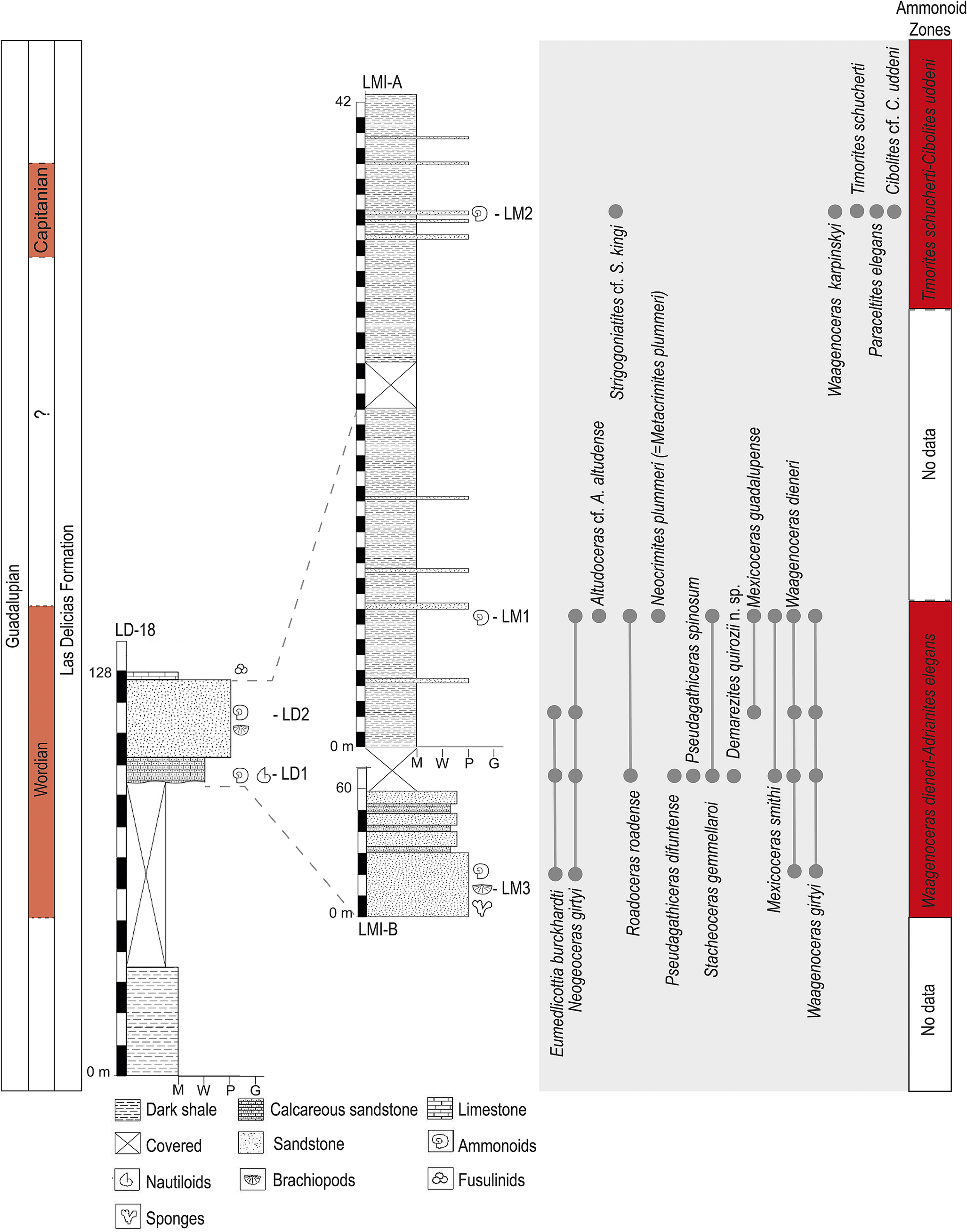
In the Las Difuntas-18 and Las Manuelas I sections, we recognize the Waagenoceras dieneri-Adrianites elegans Zone. Although Adrianites elegans is another index species of this stratigraphic zone (Leonova, Reference Leonova2018), we did not find it in our studied sections. Other species associated with the Wordian, e.g., Pseudagathiceras difuntense, P. spinosum, Neocrimites plummeri, and Stacheoceras gemmellaroi, were previously reported by Wardlaw et al. (Reference Wardlaw, Furnish and Nestell1979) in the Las Delicias Formation. In the Las Difuntas-18 section, we found Demarezites quirozii n. sp. in association with W. dieneri, suggesting that the unit belongs to the lower-middle Wordian. This agrees with Glenister and Furnish (Reference Glenister and Furnish1987), who reported the occurrence of Demarezites sp. indet. in the northern face of Cerro Prieto of the Las Delicias Formation, suggesting an upper Roadian or lower Wordian age for these rocks.
The presence of Waagenoceras dieneri, W. girtyi, Timorites schucherti, and Cibolites cf. C. uddeni in the Las Manuelas I section allowed us to relate the unit to both the Waagenoceras dieneri-Adrianites elegans Zone and Timorites schucherti-Cibolites uddeni Zone (Leonova, Reference Leonova2018). The occurrence of W. dieneri and W. girtyi suggests a Wordian age for the lower strata of the section. In contrast, the presence of Timorites schucherti indicates an upper Guadalupian age for the fossiliferous upper strata (Wardlaw et al., Reference Wardlaw, Furnish and Nestell1979). In this case, the species is associated with W. karpinskyi and Strigogoniatites cf. Strigogoniatites kingi, which are related to the Capitanian (middle Permian) of Coahuila (Miller, Reference Miller, King, Dunbar, Cloud and Miller1944; Leonova, Reference Leonova2002; Zhou, Reference Zhou2017). This information allowed us to establish a Wordian–Capitanian age (middle–upper Guadalupian) for the Las Manuelas I section.
It is worth noting that, previously, the entire Las Manuelas I section had been assigned to the Capitanian (upper Guadalupian), mainly from the occurrence of middle Permian brachiopods and a possible ammonoid in the genus Timorites. However, even though most brachiopods suggested a Wordian age (middle Guadalupian) for the lower strata of the section, more importance was given to the presence of the cephalopod, which is a biostratigraphical proxy for the Capitanian (upper Guadalupian) (Torres-Martínez et al., Reference Torres-Martínez, Heredia-Jimenez, Quiroz-Barroso, Navas-Parejo, Sour-Tovar and Quiroz-Barragán2019). The present study of ammonoids confirms the Wordian age of the lower strata of the unit, as previously suggested based on brachiopod evidence. The occurrence of the Timorites specimen in the middle Guadalupian of the Las Manuelas I section could have been the result of: (1) the specimen actually being a misidentified Waagenoceras because both taxa present a similar suture line during the adult stage (in terms of the ventral lobe and lobes with different digitate), or (2) the specimen had fallen from the upper section, maybe LMI-A of Capitanian age.
Geological considerations
Las Difuntas-18
In this stratigraphic section, Sour-Tovar et al. (Reference Sour-Tovar, Quiroz-Barroso, Quiroz-Barragán, Torres-Martínez and González-Mora2016) reported the presence of fusulinids, sponges, corals, brachiopods, mollusks, and trilobites. Sour-Tovar et al. (Reference Sour-Tovar, Quiroz-Barroso, Quiroz-Barragán, Torres-Martínez and González-Mora2016) measured 128 m of section and recognized a variety of marine facies. According to the geographic coordinates provided by Sour-Tovar et al. (Reference Sour-Tovar, Quiroz-Barroso, Quiroz-Barragán, Torres-Martínez and González-Mora2016), we identified the base of the section measured by the authors during our fieldwork. However, due to the abundant wild vegetation (e.g., agave, lechuguilla, and cactus) and the evident lateral variability, we were unable to recognize all of the lithologies reported by Sour-Tovar et al. (Reference Sour-Tovar, Quiroz-Barroso, Quiroz-Barragán, Torres-Martínez and González-Mora2016) and Galeana-Morán et al. (Reference Galeana-Morán, Quiroz-Barragán and Sour-Tovar2022). Based on our observations, we propose a modification of their stratigraphic section, identifying three facies changes in the upper levels: calcareous sandstone (LD1), sandstone (LD2), and limestone blocks. In the LD1 strata, we observed only the presence of well-preserved nektonic organisms, represented by ammonoids and nautiloids. Conversely, in LD2 strata, we observed ammonoid fragments, disarticulated brachiopods, crinoid fragments, trilobite pygidia, and calcareous sponges, in addition to cross-stratification. The poor preservational state of the fossils from this interval suggested postdepositional transport. Finally, limestone blocks with diverse fusulinid taxa occur at the top of the section. This benthic fauna suggests a shallow-water environment for the limestone stratum.
Las Manuelas I
There are two outcrops with abundant ammonoids from the middle Permian that are well exposed at this locality. Previously, Torres-Martínez et al. (Reference Torres-Martínez, Heredia-Jimenez, Quiroz-Barroso, Navas-Parejo, Sour-Tovar and Quiroz-Barragán2019) and Galeana-Morán et al. (Reference Galeana-Morán, Quiroz-Barragán and Sour-Tovar2022) suggested the Las Manuelas I section comprised a siliciclastic and carbonate succession with a thickness of 330 m. In this work, we remeasured the unit in detail, detecting important lithological and fossiliferous differences between two parts of the section, whereby we propose that the locality be divided into two different stratigraphic successions: LMI-B (lower) and LMI-A (upper). The former has a thickness of 60 m, made up of sandstone at the base and intercalations of sandstone and shale toward the upper levels. In LMI-B, different brachiopod orders (Productida, Orthotetida, Orthida, Rhynchonellida, Athyridida, Spiriferida, Spiriferinida, and Terebratulida) have been recorded, which are typical of the Wordian age (Torres-Martínez et al., Reference Torres-Martínez, Heredia-Jimenez, Quiroz-Barroso, Navas-Parejo, Sour-Tovar and Quiroz-Barragán2019). In contrast, in the LMI-A, only ammonoids have been reported, indicating a Capitanian age.
Paleobiogeography
According to Leonova (Reference Leonova1999, Reference Leonova2005, Reference Leonova2009, Reference Leonova2011), Guadalupian ammonoids are best represented in the western part of the ancient Tethys Ocean, because 78−96% of all known middle Permian genera are associated with the Paleotethys Kingdom, encompassing the current territories of Sicily, Tunisia, Oman, Kurdistan, Crimea, Croatia, Greece, and Timor. During the Guadalupian, these regions were connected by a marine corridor located along the northern coast of Gondwana, which enabled the exchange of invertebrate faunas through the corridor (Blendinger et al., Reference Blendinger, Furnish and Glenister1992). However, it has been reported that different ammonoid taxa could have migrated to other faraway regions, potentially even reaching both sides of Pangea (Glenister and Furnish, Reference Glenister and Furnish1961; Nassichuk et al. Reference Nassichuk, Furnish and Glenister1965). As a result, several North American ammonoid taxa have been identified in the middle Permian basins of western Pangea, e.g., southern China, where genera like Mexicoceras and Eoaraxoceras are found (Zhou, Reference Zhou1985, Reference Zhou2007, Reference Zhou2017), as well as northeastern Japan, characterized by the presence of Mexicoceras, Pseudogastrioceras, Demarezites, Paraceltites, Cibolites, and Timorites (Ehiro and Araki, Reference Ehiro and Araki1997; Ehiro and Misaki, Reference Ehiro and Misaki2005; Ehiro et al., Reference Ehiro, Hasegawa and Misaki2005; Tazawa et al., Reference Tazawa, Fujikawa, Zakharov and Hasegawa2005). The occurrence of ammonoid associations in the Las Delicias Formation, similar to those reported from North America (Texas, British Columbia, and Guerrero) and western Pangea (e.g., China and Japan), supports the proposal that, during the middle Permian, different sea routes were developed across Pangea, facilitating faunal exchange between North America and Paleotethys through the Panthalassa Ocean (Clifton, Reference Clifton1946; González-Arreola et al. Reference González-Arreola, Villaseñor-Martínez and Corona-Esquivel1994; Cantú-Chapa, Reference Cantú-Chapa1997; Lambert et al. Reference Lambert, Lehrmann, Harris, Wardlaw, Grant and Rohr2000; Alanis-Pavón et al. Reference Alanis-Pavón, Moreno-Bedmar and Torres-Martínez2024) (Fig. 21.1, 21.2). These exchanges of marine biota between the two regions could explain the high diversity and limited endemism observed in ammonoids from the middle Permian. Similar paleobiogeographical hypotheses have been proposed for other invertebrates, including sessile organisms (e.g., brachiopods) (Shen et al., Reference Shen, Mu and Zakharov2004, Reference Shen, Xie, Zhang and Shi2009, Reference Shen, Tazawa and Miyake2011; Tazawa et al., Reference Tazawa, Okumura, Miyake and Mizuhara2016; Torres-Martínez et al., Reference Torres-Martínez, Heredia-Jimenez, Quiroz-Barroso, Navas-Parejo, Sour-Tovar and Quiroz-Barragán2019).
(1) Paleogeographical map of the middle Permian, showing the kingdoms of ammonoid previously proposed (I, Paleotethyan; II, Uralian; III, American; IV, Arctic; and V, Australian), as well as their respective distribution (modified from Leonova, Reference Leonova2018). (2) Detail of North American basin during the Guadalupian (middle Permian). Ac, Acatlan Complex; CA, Colombian Andes; ChM, Chiapas Massif; Cho, Chortis block; F, Florida; LD, Las Delicias; M, Maya; NM, New Mexico; Oax, Oaxaquia; OL, Olinalá; Tx, Texas; WT, West Texas; Y, Yucatan (modified from Weber et al., Reference Weber, Iriondo, Premo, Hecht and Schaaf2007; Smith et al., Reference Smith, Platt, Ludvigson, Sawin, Marshall and Olcott-Marshall2015; Guerrero-Moreno et al., Reference Guerrero-Moreno, Solari, Castillo-Reynoso and Torres-Martinez2023).
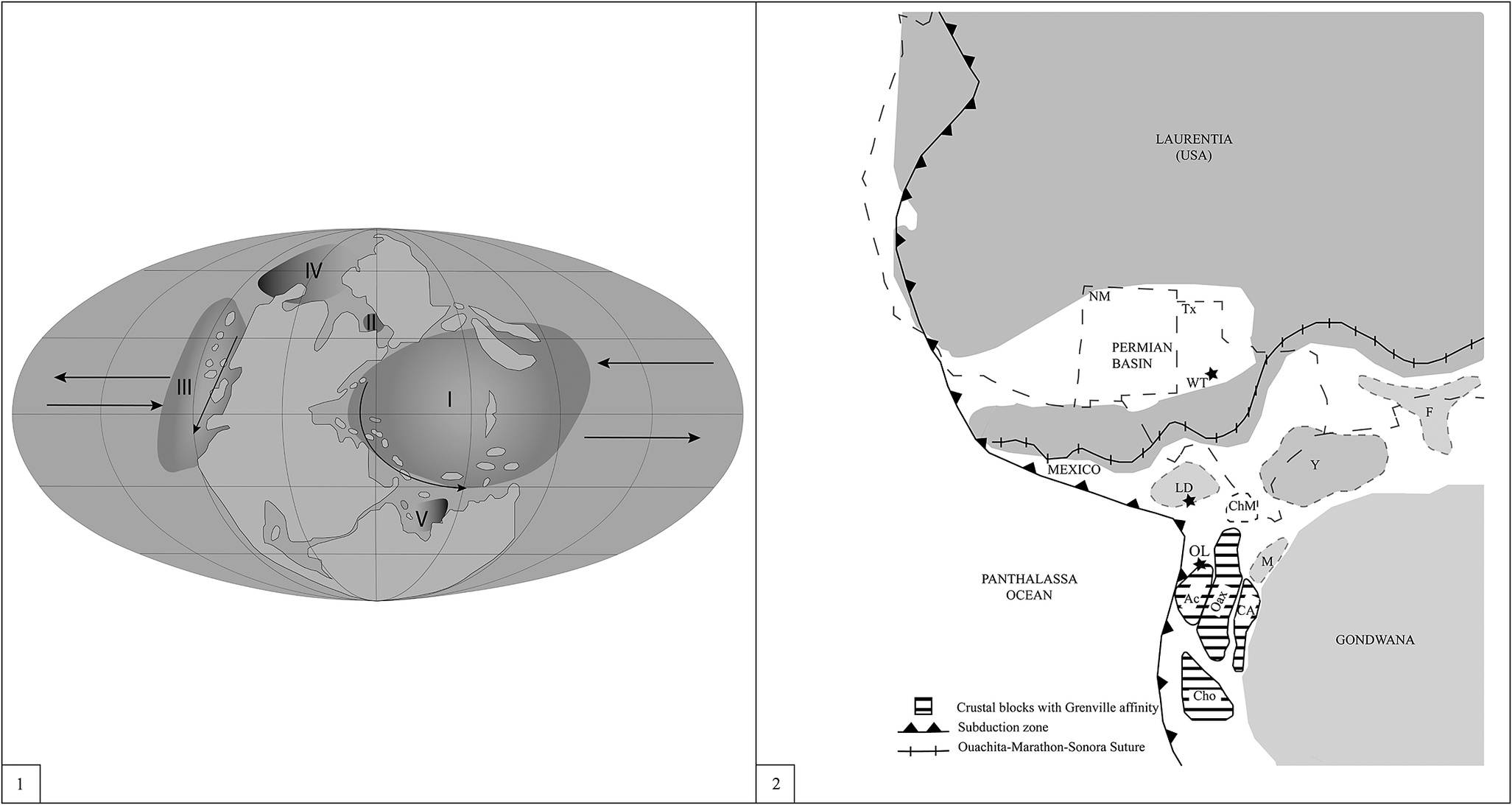
Conclusions
The study of ammonoids from Las Difuntas-18 and Las Manuelas I sections of the Las Delicias Formation allowed us to recognize 18 species. The Las Difuntas-18 section is characterized by Eumedlicottia burckhardti, Neogeoceras girtyi, Roadoceras roadense, Pseudagathiceras difuntense, P. spinosum, Stacheoceras gemmellaroi, Mexicoceras smithi, Waagenoceras dieneri, and W. girtyi, as well as the new species Demarezites quirozii n. sp. The Las Manuelas I section is characterized by Eumedlicottia burckhardti, Neogeoceras girtyi, Altudoceras cf. Altudoceras altudense, Strigogoniatites cf. Strigogoniatites kingi, Roadoceras roadense, Neocrimites plummeri, Stacheoceras gemmellaroi, Mexicoceras guadalupense, M. smithi, Waagenoceras dieneri, W. girtyi, W. karpinskyi, Timorites schucherti, Paraceltites elegans, and Cibolites cf. C. uddeni.
The ammonoid association of the Las Difuntas-18 section supports its assignment to the Waagenoceras dieneri-Adrianites elegans Zone from the Wordian (middle Guadalupian). The ammonoids from the Las Manuelas I section establish that the stratigraphic section is divided into two zones. The lower interval (LMI-B) is associated with the Waagenoceras dieneri-Adrianites elegans Zone of Wordian age (middle Guadalupian). In contrast, the upper interval (LMI-A) is related to the Timorites schucherti-Cibolites uddeni Zone, which belongs to the Capitanian (upper Guadalupian).
The occurrence of different ammonoids in the Las Delicias Formation, also reported in the middle Permian basins of North America and western Pangea (e.g., China and Japan), supports the proposal that during the middle Permian, different sea routes were developed from one side to the other of Pangea, enabling faunal exchange between North America and Paleotethys through the Panthalassa Ocean.
Acknowledgments
Alanis-Pavón thanks the support provided by Posgrado de Ciencias del Mar y Limnología, UNAM with CONAHCYT scholarship no. 931193, and gratefully acknowledges the members of their Ph.D. committee—Torres-Martínez, M.A., Moreno-Bedmar, J.A., Alcántara-Hernández, R.J., Navas-Parejo, P., and Sánchez-Beristain, J.F.—for their guidance and support. This article fulfills a requirement for the Doctorado en Ciencias del Mar y Limnología, UNAM with a specialisation in Geología Marina, pursued by Alanis-Pavón. Torres-Martínez thanks the financial sponsorship provided by Dirección General de Asuntos del Personal Académico through the PAPIIT Project IN114623 (headed by Torres-Martínez). We appreciate J. Quiroz Barragán for the support during fieldwork, in addition to the specimens provided to complete this paper. We also extend our gratitude to the Division of Invertebrate Paleontology, Yale Peabody Museum because Alanis-Pavón received support from the Dunbar Grants in Aid Program for Invertebrate Paleontological Research. We also thank to M.A. Argaez Martínez and D.A. Beltrán López for their help in the preparation, photographing, and building the 3D models of ammonoid fossils. We sincerely thank the anonymous reviewers for their valuable suggestions and comments, which significantly improved the original manuscript.
Competing interests
The authors declare no competing interests.
Data availability statement
Data available from the Zenodo Digital Repository:
Supplementary Information 1: https://doi.org/10.5281/zenodo.15742148
Supplementary Information 2: https://doi.org/10.5281/zenodo.15742240
Supplementary Appendices 1 through 5: https://doi.org/10.5281/zenodo.15742252

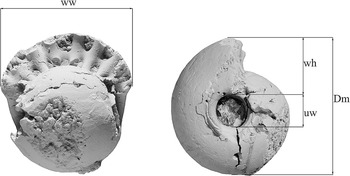

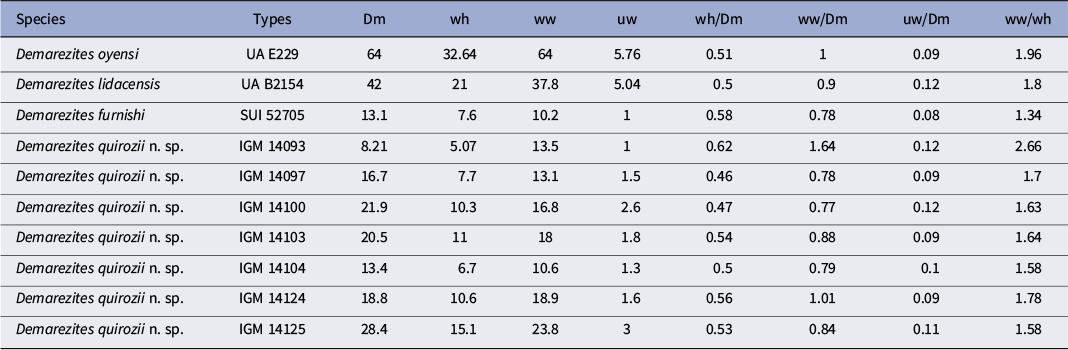
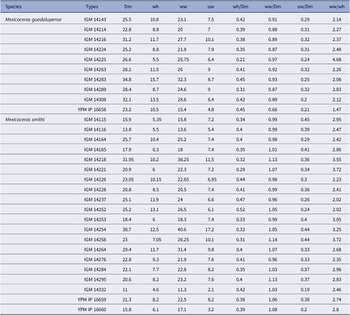
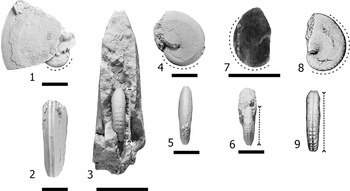
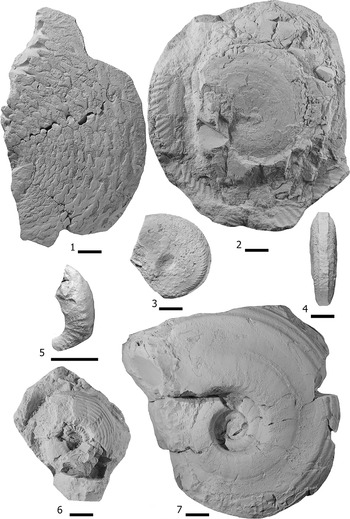
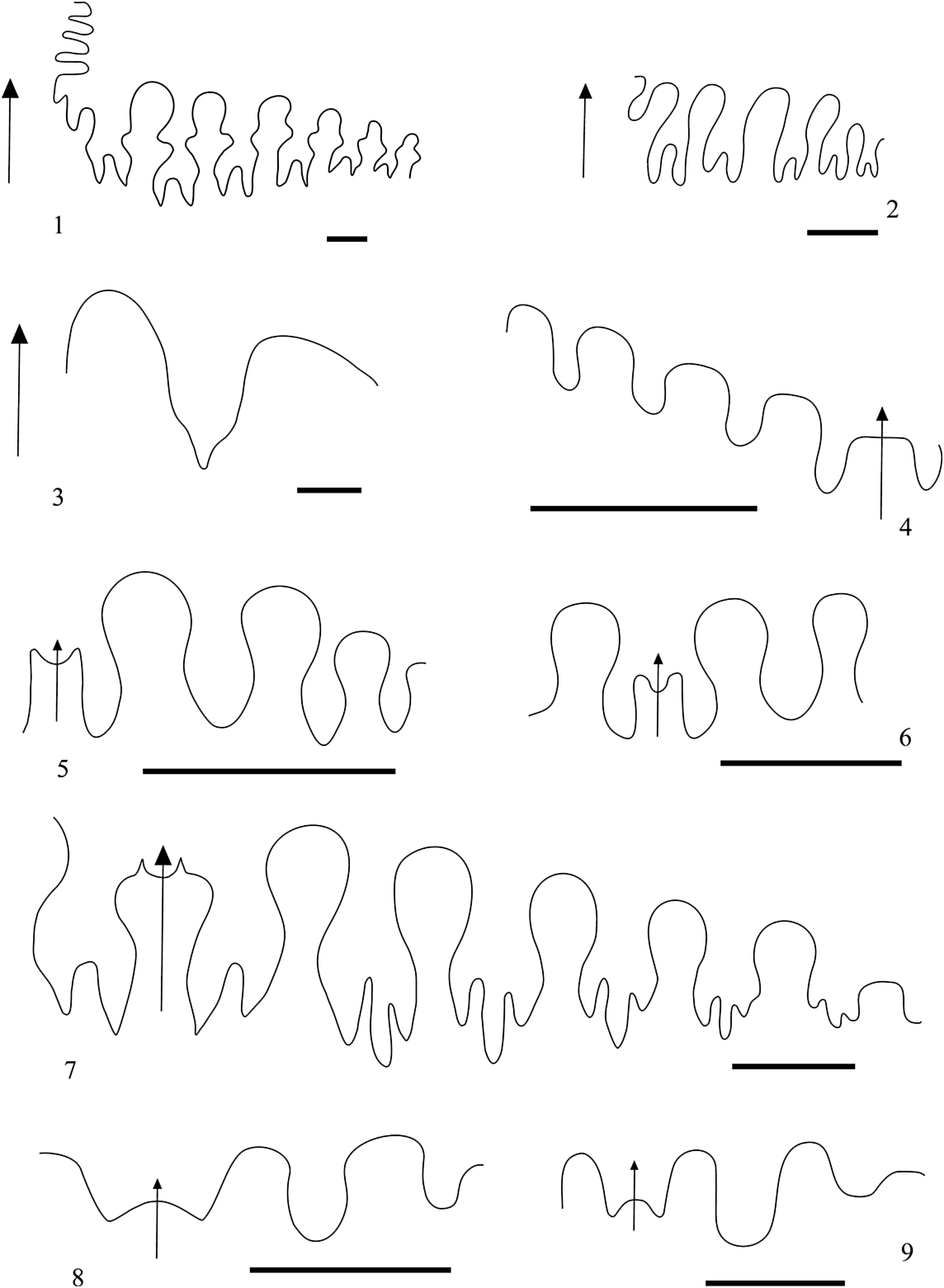
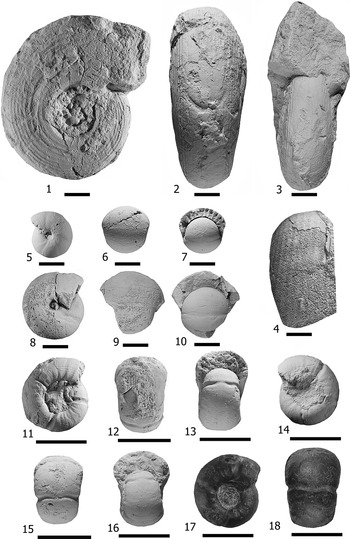
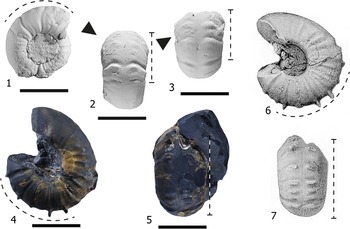

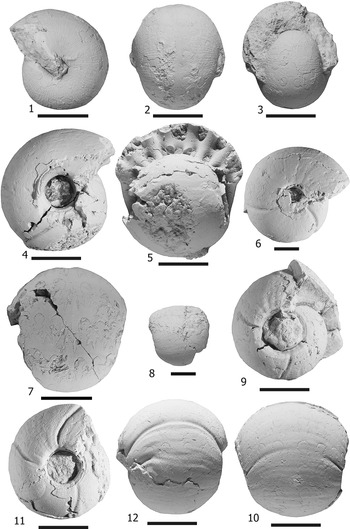
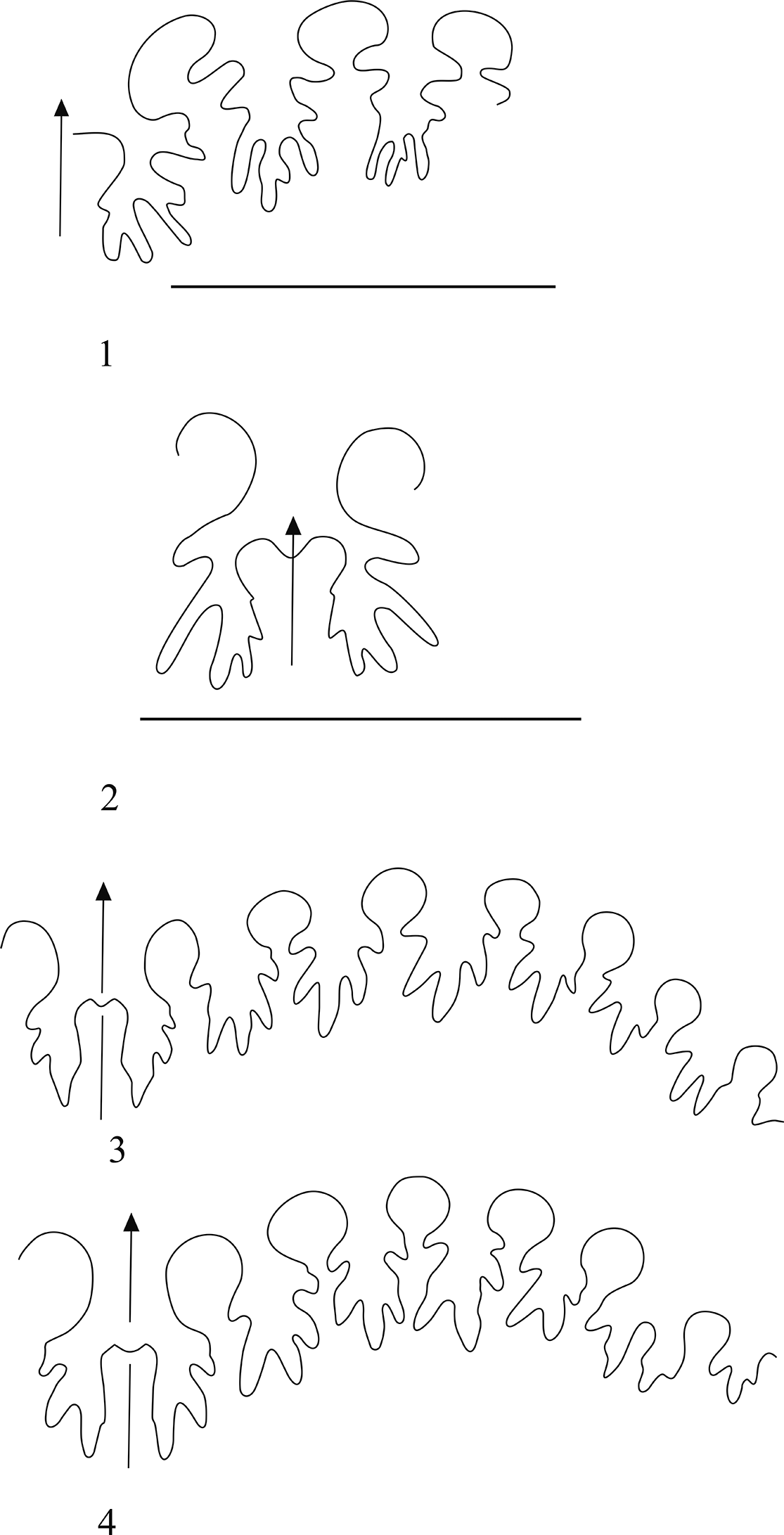

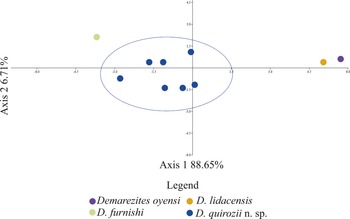


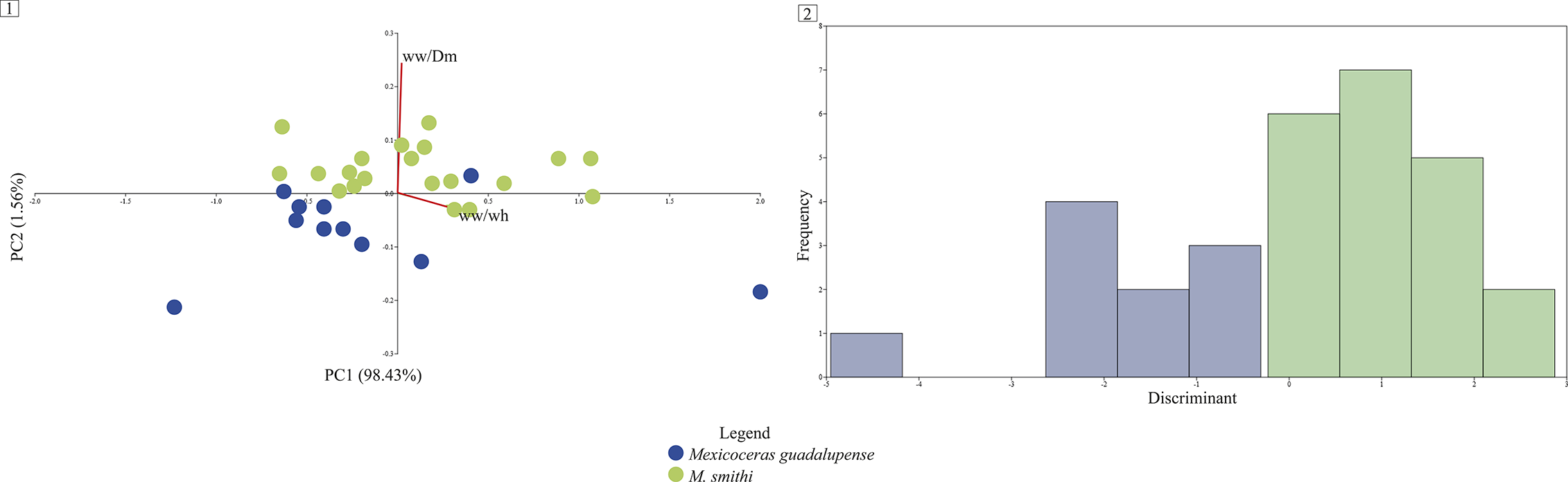


 Open access

