

INTRODUCTION
The so-called Arab Spring, which began in 2011, and the breakdown of the democratic regime in Mali in 2012 have revived the interest of scholars of democratization studies in religious issues. Already during the first and third waves of democratization, European and Latin American transitions to democracy were marked by struggles between religion and the state (Philpott Reference Philpott2004; Stepan and Linz Reference Linz and Stepan2013). For instance, the Catholic Church proactively supported the transition from authoritarian rule in Brazil, Poland, and Portugal during the third wave. Religious actors also influenced the fourth wave of democratization. For instance, Muslim organizations promoted democratic change in Indonesia and Senegal in the 2000s. Notwithstanding these empirical realities, scholars of democratization have been primarily focusing on theoretical reasoning with regard to the relationship between religion and democracy (Huntington Reference Huntington1993), or on specific aspects such as the moderation of religious parties through democratization (Brocker and Künkler Reference Brocker and Künkler2013; Karakaya and Kadir Reference Karakaya and Kadir2013; Mecham and Chernov Hwang Reference Mecham and Hwang2014). However, democratization studies are still missing the “big picture” about the empirical relationship between religion and democratization.
More recently, researchers have adopted an actors-centered approach because of the centrality of human action in transition processes. They have focused on the roles that religious movements, parties, and individuals have played in, for instance, the Egyptian, Libyan, Moroccan, and Tunisian transition processes (e.g., Bayat Reference Bayat2007; Volpi and Stein Reference Volpi and Stein2015). Scholars are interested in learning whether these actors were pro-democratic, what model of relations between the state and religion they advocated (in particular during the phase of constitution-building), and whether they succeeded or not in their endeavors (e.g., Landolt and Kubicek Reference Landolt and Kubicek2013). Although these studies focus on the impact of religious agency on democratization, we still know very little about the factors that conditioned the influence and preferences of particular religious actors in the fourth wave of democratization.
This article seeks to identify the determining factors of religious actors’ influence on democratization in West African Mali. It broadens the actors-centered perspective by integrating institutional factors. In so doing, it builds on recent research that has underlined the great importance of institutional factors. The Harvard Research Project on Religion and Global Affairs (Toft, Philoptt, and Shah Reference Toft, Philpott and Shah2011) as well as Künkler and Leininger (Reference Künkler and Leininger2009b) have confirmed that organizational and institutional factors outweighed other factors such as political theology when explaining religious actors’ influence on the process of establishing democratic rule. On a more general scale, research on the regulation of religion confirms the relevance of institutions for determining the role and influence of religious actors in state affairs and politics (Sezgin and Künkler Reference Sezgin and Künkler2014; Elischer Reference Elischer2015). Against this backdrop, this analysis of the Malian case aims at (a) understanding the organizational and institutional factors that regulated relations between the state and religion under authoritarian rule in Mali before 1987, and (b) explaining religious actors’ (non-)influence in shaping the democratic transition process between 1991 and 1992.
This case study on Mali forms part of a comparative project that provides empirical evidence of the influence of religious actors on democratization in five Muslim-majoritarian democracies that — throughout the 2000s — were classified in the major regime type indices such as those of Freedom House and Polity as being “free” and “consolidating.”Footnote 1 Mali had undergone a successful transition to democratic rule between 1987 and 1992 and remained democratic for the better part of the following 20 years. This was particularly remarkable given Mali's low level of socio-economic development and its status as one of the world's poorest countries (Pringle Reference Pringle2006). However, Mali's democratic transition attracted little attention in empirical research on democratization before 2012. Mali's democratic breakdown in 2012 came as a consequence of increasing discontent with the incumbent government of Amadou Toumani Touré, an extremely weak army, and an influx of former soldiers who fled Libya after the fall of Gaddafi's regime and contributed to the re-escalation of the conflict in the north of the country. Although a democratic order was formally re-established in national elections in 2013, the security situation in the “north” of the country and the socio-economic performance of the state remain very fragile.
We can learn from the Malian case more about why and how religious actors influence the erosion of authoritarian rule and about the establishment of rules to regulate relations between the state and religion after authoritarian rule. Regime change is a “critical juncture” that determines the interactions between state and non-state actors in the future political game (Capoccia and Kelemen Reference Capoccia and Kelemen2007). As I show elsewhere, a high level of path dependency during democratic transition leads to an informalization of Muslim politics and has given Muslim actors extra-parliamentarian veto powers since the 2000s (Leininger Reference Leininger and Leininger2014). It is therefore important to know whether Muslim interests and demands that were formulated during the democratic transition could have prevented tensions between the Malian state and traditional Muslim elites and organizations who have been successfully challenging the liberal model of democracy.
Finally, a note on data. Religion was at the margins — if included at all — of the empirical study of democratization in Mali before 2012. This article therefore draws on primary data collected over a total of seven months of field research in 2005, 2006, 2009, and 2013 in Mali.Footnote 2 It includes the collection of primary documents, such as documentation of the National Conference during the transition, and 123 semi-structured interviews with domestic and international stakeholders on democratization in Mali; 22 of the interviewees were contemporary witnesses of the opening of the authoritarian regime and democratic transition.Footnote 3
In the following, I first introduce the theoretical and conceptual foundations of the empirical analysis. The subsequent empirical analysis starts with a contextualization of Muslim actors by describing the landscape of individual and collective Muslim actors in Mali as well as the institutions that regulated relations between the state and religion before democratization. It continues with the systematic, “thick description” of the role of Muslim actors during the autocratic opening (~1987–1990) and democratic transition (1991–1992), which is the basis for the subsequent systematic analysis of the explanatory factors of Muslim influence on democratization. In line with the theoretical framework, the analytical section focuses on institutional factors and their relevance in explaining Muslim actors’ role during the autocratic opening and transition phases. In the final section, I draw some more general conclusions for the future study of democratization and religion.
THE APPROACH: DEMOCRATIZATION, CRITICAL JUNCTURES, AND RELIGIOUS ACTORS
Democratization
Democratization alters the rules of the game of a political regime. In order to succeed, regime change requires — at different points in time — both incremental and abrupt change. I conceive democratization as a three-stage process:Footnote 4 first, the opening phase, which implies an incremental erosion of authoritarian rule; second, the transition phase, which abruptly leads to the establishment of democratic rule within a time frame of between a few months and several years; and, third, the consolidation phase, which incrementally solidifies the new rules of the game — constitutionally, behaviorally, and attitudinally (Linz and Stepan Reference Linz and Stepan1996). In line with more recent understandings of democratization, I do not conceive of democratization as a linear process that necessarily leads to democratic consolidation (Carothers Reference Carothers2002). Instead, democratization is an open-ended process in which the setback to authoritarian rule is one possible path the regime might take during so-called democratization. For the purpose of the analysis of the Malian case, I concentrate on the opening and transition phases.
Historical Institutionalism and Critical Junctures
In line with historical institutionalism, I argue that actors’ choices and behaviors are confined by formal and informal institutions, which are path-dependent and self-reproducing (Mahoney Reference Mahoney2001; Capoccia and Kelemen Reference Capoccia and Kelemen2007). “Institutions are the humanly devised constraints that structure political, economic, and social interactions. They consist of both, informal constraints […] and formal rules […]” (North Reference North1991, 97). A period of contingency might intermit institutional stability and put forward agency. During critical junctures, such as democratic transition, actors shape outcomes and determine future institutional configurations (Mahoney Reference Mahoney2001, 4–8). As a consequence, human agency is more decisive for the political outcome than institutions. Studying religious actors’ attitudes, behavior, and political theology before and during critical junctures sheds light on their preferences for political institutions. It is important to note that actors do not operate in a vacuum. While they are creating new institutions during the transition, they are still influenced by the rules that had shaped actors’ constellations and behavior under autocratic rule. This is particularly the case for those actors who are on the fringes of the reform processes.
Pre-democratic institutions, which used to shape the political influence of non-state actors such as labor unions, religious organizations, and service providers, can become part of the democratic order because of high path dependency from the autocratic regime. Such institutions, often established under colonial rule in Africa, reinforce themselves and might undermine the quality and deepening of democracy (Bratton and van de Walle Reference Bratton and Walle1994). During democratization, it is likely that actors opt for institutional continuity or gradual change in reform areas that are not at the core of democratic rule. For instance, actors of democratic transition will certainly introduce fundamental democratic institutions such as elections, political pluralism, and multi-party competition, but they are less likely to intervene in the regulation of relations between the state and religion, which might not be conceived to be at the core of democratic reform. However, they are likely to influence democratization. As a consequence, a lack of reform of institutional settings during a democratic transition influences the prospects for democratic consolidation.
From a methodological point of view, the study of critical junctures serves as an analytical tool to approximate impact and draw causal inferences within a political process (Mross Reference Mross2015). First, this is due to the strong counter-factual logic inherent in the concept, which per definition includes the fact that a different outcome was plausible at the time. Second, a longitudinal comparison between the point in time before a critical juncture (here: before democratic transition) and the point in time after such an event allows for identifying explanatory factors.
Religious Actors
In general, I conceive “religious actors” as actors that define themselves at least in part by religious beliefs or a religious identity. Religious actors with Muslim beliefs and identity are at the center of the empirical analysis of the Malian case in hand. These include, on the individual level, believers, religious authorities, as well as “lay” intellectuals; on the societal level, movements, institutions, and associations (religion in civil society); and on the political level, religious political parties (religion in political society).Footnote 5 I focus on individual and collective Muslim actors who deliberately and actively engage, make efforts to participate in, and influence the autocratic opening and democratic transition.
By definition, “religious actors” are not necessarily the opposite pole of “secular actors.” A Muslim actor — as any other religious actor — is secular when accepting and behaving in accordance with the secular order of a political regime (Stepan Reference Stepan2001). An actor cannot be considered to be “secular” when it disrespects or violates secular principles or promotes a non-secular order during the establishment of a new order in democratic transition. I refer to these cases as “Islamist actors” (Mandaville Reference Mandaville2013).
Finally, a word on the institutional attributes of non-state — including religious — actors is needed to later assess the relevance of institutional factors for religious actors’ influence on democratization. Religious institutions and associations, as with any other non-state organizations, vary with regard to their organizational form (centralized versus fragmented) and their degree of societal permeation (anchored versus superficial). Religious institutions’ relationship to state institutions also differs (highly “integrated” versus highly “independent” in the terminology of Philpott (Reference Philpott2007)). Based on previous research, I assume that the influence of religious actors on democratization increases the more centralized the state is, the more that societal permeation is anchored, and the more autonomy the state offers.
ISLAM AND MUSLIM ACTORS IN MALI
In Malian society, at least 90% of the people self-identify as Muslims (Coulibaly and Diarra Reference Coulibaly and Diarra2004; Basedau Reference Basedau, Matthias, Erdmann and Mehler2007a; Afrobarometer since 2008).Footnote 6 However, compared to traditional beliefs, Islam is a very young religion in Mali. Although it used to be a religion of the elites for almost one millennium (9th to 19th century), it only started to spread across the population under French colonial rule in the late 19th century. Malian Islam manifests itself in manifold cultural and historical particularities.Footnote 7 Sufism and reformist movements characterize Malian Islam in the early 21st century. At the same time, traditional beliefs continue to be important. As is the case in other Muslim-majority countries such as Indonesia and Senegal, Muslim and non-Muslim practices often overlap.
Islam in Mali has been housed traditionally in Sufi beliefs and practices. This form of Islam is the most widespread in the country. As a neighboring country of Senegal, the landscape of Mali's Muslim actors is frequently equated with the politically very influential, highly organized, and mass-based Senegalese Sufi orders.Footnote 8 But Mali's Sufi community has been fragmented and localized. The two main Sufi “brotherhoods”Footnote 9 (or tariqas) — the Quadiriyya and Tijaniyya Footnote 10 — have been decentrally organized. Individual Sufi authorities established their local spiritual centers throughout the urban and rural areas of the country.Footnote 11 Although they spiritually belong to a Sufi brotherhood, they are often not interlinked in organizational terms (Schulz Reference Schulz2003; Soares Reference Soares2005b). The fragmentation and limited societal permeation of religious leaders and brotherhoods becomes visible in the most recent survey of the Afrobarometer (2014/2015). Whereas 68.5% indicate in very general terms that they are “Muslim only,” only 19% specify their adherence to specific brotherhoods and religious leaders. For instance, only 3.6% and 1.5%, respectively, indicate that they belong to the Tijaniyya and Quadiriyya brotherhoods.
Reformist movements have been attracting a small number of Malians. In the 1940s, a reformist movement against Sufism emerged and called for a purist interpretation of the Qur'an and Sunna (Amselle Reference Amselle1985). Members of the movement have been condemning Sufi practices as “un-Islamic,” especially the veneration of saints. Many of the reformist leaders studied in Saudi Arabia and were, therefore, referred to as “Wahabists” (Wahabiyya) in the Malian public. However, Salafist teachings also influence their theology (Thurston Reference Thurston2013). Given this mixture of sources and beliefs, I refer to these orthodox Muslim groups as “reformists.” Overall, only 3.5% of interviewees in the most recent Afrobarometer survey identified with reformist movements. Despite reformists being a minor Muslim group in nominal terms, they have been influential in Malian society because their members belong to the Arabic-speaking economic elite of the country (Soares Reference Soares2005a). Their political influence has grown; in particular, since Mahmoud Dicko became the head of the High Islamic Council in 2007, their visibility has increased in public life (Interviews 85 and 101).Footnote 12 Overall, reformists are organized around individual Muslim authorities and mosques.
Peaceful cohabitation and cooperation marked the relationship between the Malian state and Sufi as well as Reformist groups after independence from France in 1960 and the end of the 20th century. Only in the new millennium have violent — and often non-Malian — Salafists emerged in the Sahelian border zone between Algeria, Mali, and Niger. They lack broad popular support and are condemned by the population and Muslim leaders — Sufi and Reformists — for their violent actions (Lecocq et al. Reference Lecocq, Mann, Whitehouse, Badi, Belalimat, Hall and Lacher.2013). However, they are not central to this analysis because they emerged after the period under review.
In sum, the Malian Muslim organizations have been fragmented and had low levels of social permeation. They had not been able to organize and mobilize a large number of Malians until the new millennium. Although Sufi centers have a low level of formal organization, mosques have administrative committees that comprise at least two people and have been aiming at fostering permanent relations between Muslim authorities and believers (Magassa Reference Magassa, Bröning and Weiss2006, 125). Mosques have not only been serving as places to testify to a Muslim's belief but also as centers for social conflict resolution.
UNDER AUTHORITARIAN RULE (1960–1987): AN ALLIANCE OF STATE, REGIME, AND ISLAM
The relationship between religious actors and politics in Mali has been shaped most significantly by authoritarian rule. It is essential to pay attention to the structures of this regime type because they were the points of departure for Muslim actors’ behavior and political influence during democratic transition. As summarized in the first and second column of Table 1, there is a high path dependency of the institutions that regulate relations between the state and religion in the pre-democratic phase before 1991 and the outcomes of democratic transition after 1992.
Path dependency of relations between the state and religion
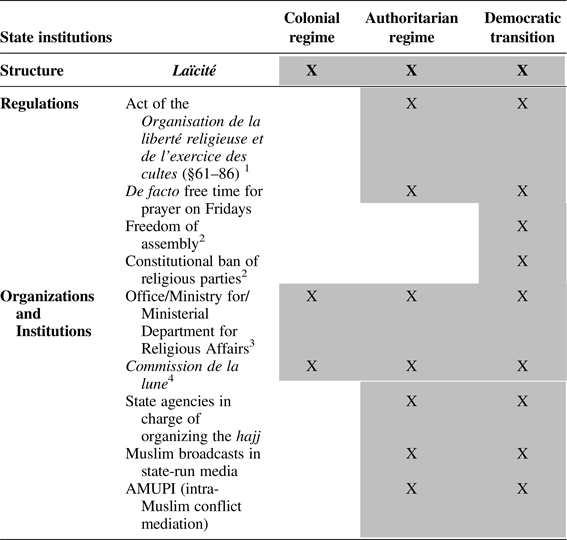
1 French for “Act of the Organization of Religion and Cultic Exercise.” This law has an extensive scope of regulation; for instance it prescribes the internal organization of religious organizations such as the obligation to found Administrative Committees in any religious organization.
2 Article 5 of the Malian Constitution of 1992.
3 The Office for Religious Affairs, an organization created during French colonial rule, was transformed into the Ministry for Religious Affairs after independence in 1960. It was maintained during the First (1960–1969) and Second (1960–1991) Republics of Mali. The ministry was dissolved and partly integrated into the Ministry of the Interior (MATCL) under democratic rule.
4 French for “Committee of the Moon.”
In the early 20th century, France established a colonial administration in the then so-called French Sudan, part of which is today known as Mali. In doing so, it introduced the French model of the institutional separation of state and religion of 1905 (laïcité) and re-organized the relations between official authorities and Muslim actors.Footnote 13 Malian elites were integrated into the colonial administration in order to better control the emergence of anti-French sentiments in society (Fay Reference Fay1995). By establishing the Service des affaires musulmanes in 1906, France pursued a successful strategy of cooptation toward Muslim authorities. Many spiritual leaders of Sufi brotherhoods worked for the French administration at the cost of their credibility in the Malian population (Arnaud Reference Arnaud1912; Le Vine Reference Le Vine and Miles2007). During colonial rule, France aimed at exerting as much control over Muslim leaders as possible. In order to do so, the colonial administration established various institutional innovations such as the Commission de la lune, which declares the beginning of Ramadan every year, or the state-run travel agency that organizes the hajj to Mecca.
After 1960 — the year of Mali's independence from French colonial rule — the authoritarian regimes of Modibo Keïta (1960–1968) and Moussa Traoré (1968–1991) continued and further strengthened the state's control over the religious sphere.
Under Modibo Keïta, a socialist regime with Marxist-Leninist leanings was established: the state bureaucracy was reorganized, a planned economy was introduced, and a single-party system set up under the US-RDA (Union Soudanaise du Rassemblement Démocratique Africain). Although this political regime had typical socialist characteristics, the propagated ideology was not purely socialist (Horeya Reference Horeya1970, 6). Keïta was convinced that the Malian population would not have supported an atheist state ideology. He therefore integrated Islam into the party's program and promoted an “Islamic Socialism.” He proclaimed, “There is no religion that is more socialist than Islam. A good Muslim is socialist.”Footnote 14
Overall, Islam became a permanent part of Malian political discourse during the first post-independence republic. Although he rhetorically integrated Islam, Keïta distanced his regime from Muslim elites in order to prevent them from exerting influence in political affairs (Amselle Reference Amselle1985).
Second and Third Republics (1968–1991): Institutionalizing Muslim Authorities’ Cooptation
In 1968, Modibo Keïta was overthrown by a military coup that was led by General Moussa Traoré. From then on, the political regime turned away from socialism and established a neo-patrimonial order (Amselle Reference Amselle1992; Bratton and van de Walle Reference Bratton and Walle1994). It was based on a clientelistic network that pervaded the whole state apparatus and converged in the dictatorial head of state Moussa Traoré.Footnote 15 Repressive politics that were supported by the secret service and military guaranteed political stability. Political and economic power continued to be concentrated in a single ruling party, now the UDPM (Union Démocratique du Peuple).
The state's control over religious activities was meant to be achieved through organizational infrastructure. For instance, a Ministry for Religious Affairs was established in the early years of military rule; Muslim programs on state-run radio were introduced in 1974 to control the influence of individual Muslim authorities, in particular Reformists; in the public sphere, state officials were pledged to participate in Friday prayers; and working hours were reduced in 1975 (Hock Reference Hock1999).Footnote 16 Internationally, Traoré aimed at signaling Mali's Muslim identity and affiliation to the Muslim world. For example, Mali became a member of the International Organization of the Islamic Conference (Hock Reference Hock1999, 91).
Traoré pursued a general strategy of controlling social forces, thereby strengthening his power base through the establishment of state-financed civilian associations such as the National Union of Women, and the Labour Union (Sears Reference Sears2007, 122). This strategy was also applied to religious actors when, in 1981, Traoré founded the only official organization set up to cater specifically to “Muslim interests,” AMUPI (Association Malienne pour ĺUnité et le Progrès de ĺIslam). AMUPI was established as an official part of the section religieuse of the Ministry of the InteriorFootnote 17 and had a domestic and international function. Domestically, AMUPI functioned as a conflict-regulating institution in cases of disputes within the Muslim community. Internationally, AMUPI was in charge of fundraising and channeling development aid from Arabic organizations, especially from Saudi Arabia (Hock Reference Hock1999). Although AMUPI failed to achieve the latter, it developed a strong role in domestic moral politics. The organization maintained various Islamic programs in the state-run media and represented Muslim interests in public. For instance, AMUPI negotiated the start of the official news program after sunset during Ramadan in 1983. When bars and discotheques opened during Ramadan of the same year, the organization achieved their closure (Soares Reference Soares2005a, 237).Footnote 18 Although it was an efficient organization for representing Muslim interests, AMUPI failed to entirely fulfill its conflict-regulating function due to internal organizational structures (Hock Reference Hock1999, 113).Footnote 19 Overall, AMUPI was tightly intertwined with politics and effectively coopted by Traoré’s regime.
Traoré’s relations with Muslim authorities were part of the general “Islamization” of Malian politics (Hock Reference Hock1999, 98), but his approach to these groups developed further when the regime evolved in 1979 from military to civilian rule. After 1979, Traoré pursued the cooptation of individual religious leaders. He aimed at stabilizing his regime through their political support. Moreover, he relied on their political and personal advice. For instance, the spiritual leader of the brotherhood Hamaliyya of Nioro was known as the personal Marabout of Traoré (Soares Reference Soares2005a, 172). Religious services and advice-giving were richly rewarded with expensive gifts. Benjamin Soares calls this common practice “prayer economy,” which traces back to precolonial times. The prayer economy has not only created a symbiotic relationship between Islam and Malian politics over the centuries, but it is also a source for legitimate political activities and policies.Footnote 20 The legitimizing role of Islam in Malian politics can also be observed in the practice of griots (bards). These traditional singers are invited to public events, where they praise the virtues of respectable families and clans (Pageard Reference Pageard1961; Schulz Reference Schulz2001). In doing so, they revert to Islam as a positive characteristic of power holders. Overall, the informal practices of the “prayer economy” and griots indirectly contributed to the creation of a political culture that makes the affiliation to Islam an important attribute for a politician.
Traoré’s economic policies also consisted of tight relations with Reformist elites because of their involvement in the economic sphere. Many of them were educated in the Arab world and maintained economic relations with it. Consequently, improving relations between the state and Reformist elites was one of the main pillars of Traoré’s economic development strategy. He expected to enhance Mali's socio-economic relations with the Arab world. Traoré’s strategy involved concessions to Reformists, such as the authorization to construct a mosque, which had been forbidden since 1947 (Amselle Reference Amselle1985), or the construction of médersas (private religious schools) (Brenner Reference Brenner2001).
In sum the relations between Muslim elites and Traoré’s military (1968–1979) and civilian (1979–1991) regimes shared two characteristics (see Table 1). First, they comprised informal interactions on the level of Muslim and political elites. Second, formal relations between religion and state were more and more institutionalized throughout Traoré’s reign. The political regime increasingly emphasized its identification with Islam. At the same time, the ruling elite highlighted laïcité in order to maintain and strengthen the state's control over religious activities (Soares Reference Soares2005a, 237; Le Vine Reference Le Vine and Miles2007, 73; Interview 35).Footnote 21
EROSION OF AUTHORITARIAN RULE (1987–1991): POPULAR UPRISING WITH LITTLE SUPPORT FROM MUSLIM LEADERS
In Mali, where a Huntingtonian replacement of power took place (Huntington Reference Huntington1991), Muslim actors had only a small role to play during the opening of President Traoré’s authoritarian regime in the late 1980s (cf. Table 2). The opening was caused by the populations’ steadily growing dissatisfaction with the economic performance of Traoré’s regime and with the extremely low level of welfare in Mali (Vengroff and Moctar Reference Vengroff, Moctar and Wiseman1995, 46; Schulz Reference Schulz2001).Footnote 22 An intellectual elite grew in the urban areas and created an underground opposition movement (Hanke Reference Hanke2001, 101; Interviews 22 and 56).Footnote 23 The democratic movement in neighboring Benin further contributed to calls for Moussa Traoré’s resignation and the establishment of a multi-party system and democracy (Bratton and van de Walle Reference Bratton and Walle1994).Footnote 24 Traoré also faced growing opposition from inside the political establishment, particularly from the (only legal) party UDPM and the official associations and labor unions.Footnote 25 In the beginning of 1991, a coalition of social forces demonstrated repeatedly against the regime of Moussa Traoré. The regime answered most demonstrations with massive suppression, which led to the deaths of at least 200 people (Hanke Reference Hanke2001, 103–104). When Traoré once more called on the military to suppress demonstrations on March 26, the latter refused. Led by General Amadou Toumani Touré, the military overthrew Moussa Traoré and started the process of democratic transformation.
Overview: The role of Muslim actors in Malian democratization (1987–1991)

* Although the Hizboulla al-Islamiya contributed to the erosion of the authoritarian regime, they did not favor a democratic alternative. However, by contributing to Traoré’s fall, they helped to pave the way for democratization.
The social forces that had actively contributed to the fall of Traoré’s dictatorship were members of official associations and organizations (Bingen Reference Bingen and Bingen2000, 247; Postma Reference Postma1994, 451),Footnote 26 namely teachers, students, labor unions, and the national women's organization (Centre Djoliba and Memorial Modibo Keita Reference Djoliba and Modibo Keita2002). The role of Muslim leaders, who had closer ties to political elites than social, mass-based associations, is hardly mentioned in the literature on Malian democratization but was emphasized by the majority of interviewees.Footnote 27 Instead, scholars only refer to the ideological goals of the popular movements: “The democratic movement in Mali was very little concerned with religion; it was profoundly secular, but found little need to present itself as such publicly” (Brenner Reference Brenner and Brenner1993, 73).
The only legal Muslim organization, AMUPI, remained mostly apolitical because, as we have seen in the above section on religious groups under authoritarianism, it was coopted by the state. Furthermore, it was financially dependent upon the regime, which funded 100% of the budget. Bala Kallé, a Reformist Imam of the Grand Mosque in the capital, Bamako, and the head of AMUPI at that time, called on members to support the regime rather than join the emerging democracy movement (Leininger Reference Leininger and Leininger2014). Having been part of the economic elite of the country, some Reformist leaders would have been able to use their economic leverage to influence politics in theory. But according to one critical observer of Malian politics, the costs of opposing the political elite of the authoritarian regime would have been too high because their economic activities were intertwined with those of the political elite (Interview 19).Footnote 28
Only individual Reformists in the rural areas openly criticized the Traoré regime and called for a multi-party system and a secular order that would guarantee an independent space for religious actors. Although the Reformists were able to contribute to the opposition's democratic debate through discursive means (sermons and radio programs) and by gathering support, particularly in rural areas (Brenner Reference Brenner2001, 293), they lacked — unlike religious movements in Indonesia, for instance — the mass support and mobilizational capacity that would have enabled them to play a significant role in the ousting of President Traoré (Soares Reference Soares2005b).
Only one small anti-democratic group, the Hizboulla al-Islamiya, is known to have participated in the anti-regime mass demonstrations in late March 1991 (Brenner Reference Brenner2001, 295–298). They presented themselves as the “Islamic bloc” and chanted against the regime while holding the Qur'an in their hands (ibid.). According to an interviewee who had participated in the protests, the Islamic bloc was neither accepted by the majority of the secular protesters, nor legitimized in civil and political society (Interview 33).Footnote 29 Moreover, some Sufi intellectuals chose indirect forms of protest by founding Muslim newspapers that could serve as platforms for discussions about alternative political regimes and the advantages of a multi-party system. The most prominent Sunni-based newspapers were the moderate Saniya and the more radical Témoignage afro-musulman (Otayek Reference Otayek1993). However, in a society that was more than 60% illiterate, the impact of newspapers was very limited.
With the success of the broad societal opposition against Traoré, Mali became the third Muslim-majority country to democratize (after Turkey and Senegal). Yet, the contribution of Muslim actors to the democratic opening was limited, indeed hardly discernible. Confirming the results of Toft, Philoptt, and Shah (Reference Toft, Philpott and Shah2011), the reasons for this are the institutional and financial relations between the state and religious actors. Traoré had been able to coopt Muslim authorities through their high institutional and organizational integration into state structures and economic policies (see Table 2).
Only some small, less-integrated, and poorly organized Sufi groups — and at least one Islamist group, the Hizboulla al-Islamiya — felt free to oppose Traoré’s regime and favored a new political order, because they lacked societal permeation. As a consequence, they could not play a more prominent role in the autocratic opening. In addition, Hizboulla's political theology was marginalized and not supported by most of the population and political elite. Hizboulla's contribution to the autocratic opening must be seen, however, as an act of defiance against Traoré’s policies, not as support for a democratic alternative.
In sum, Traoré had effectively minimized the potential within Muslim society to rebel against the authoritarian regime through institutional regulation and cooptation (Diarrah Reference Diarrah1991). As a consequence, the institutional positions of religious actors vis-à-vis the regime, not their theological convictions, were the driving factor for their support of its demise and the ensuing democratic opening (see Table 2).
DEMOCRATIC TRANSITION (1991–1992): INSTITUTIONAL PATH DEPENDENCY LIMITS POLITICAL INFLUENCE
The Malian democratic transition has been evaluated as exemplary throughout the democratization literature (e.g., Diarrah Reference Diarrah and Bingen2000; Pringle Reference Pringle2006). It stands out because the actors accomplished the formal democratic reorganization of the state and regime in the relatively short time period of 15 months (March 1991–June 1992). The successful establishment of a democratic order and promulgation of a new constitution was possible because the former authoritarian rulers stepped back from the process and the transition was very inclusive and also incorporated religious actors (Vengroff and Moctar Reference Vengroff, Moctar and Wiseman1995, 45; Interviews 115 and 118).Footnote 30 However, these actors’ groups were poorly organized at the time of democratic transition and could not take advantage of their new right to associate due to a lack of time to get themselves registered.
Only four days after the ousting of president Traoré on March 30, 1991, the democratic opposition movement and those military leaders who had overthrown the president created a transitional government, the Comité de Transition pour la Salut du Peuple (CTSP), which organized the transition and stepped down after the first democratic elections had taken place in April 1992 (see Hanke Reference Hanke2001, 115). The core of the transition phase was the National Conference, which reflected all relevant political and social discussions in a condensed form (Moestrup Reference Moestrup1999; Nzouankeu Reference Nzouankeu1993).
National Conferences were a common phenomenon of the fourth wave of democratizations in francophone West Africa between 1990 and 1992.Footnote 31 Influenced by the political developments in neighboring Benin, the transitional government in Mali called for a National Conference. Three commissions negotiated the Constitution, the electoral law, and the law for political parties (Diarra Reference Diarra1998, 284). In particular, three institutional provisions were at the center of interest of Muslim organizations: first, relations between the state and religion; second, the guarantee of religious freedom; third, the participation in political society through religious political parties. Matters of education were raised but postponed to the post-transition period. The debates around two legal provisions are of major interest for the purpose of this analysis, namely the new Constitution of February 25, 1992, and the law on political parties (La Charte des Partis Politiques).Footnote 32
|About 1,800 delegates from all sectors of society participated in the Malian National Conference from July 29 until August 12, 1991. Information about the number of participating Muslim organizations and individuals varies between 10 (Rapport 1991; Le Vine Reference Le Vine and Miles2007, 87) and 20 (Otayek Reference Otayek1993).Footnote 33 Although the participation of AMUPI — the largest and oldest organization — can be taken for granted, little is known about the (at least) nine other organizations and individuals representing Muslim interests. Alliances were either built ad hoc for the purpose of participating in the National Conference and dissolved shortly after in September 1991, or Muslim actors could not participate at all because they were not registered as an organization, and therefore not allowed to participate (Interviews 13; Interview 115).Footnote 34 Although the right to associate and register non-state organizations was granted shortly after the autocratic opening, many organizations were not able to register before the National Conference because of organizational inexperience of the Transitory Government and the low levels of capacity of the Malian bureaucracy.
Muslim organizations and leaders pursued divergent interests with regard to the three reform areas because of their differing theological backgrounds and their historical (non-)relations to the pre-democratic regime. They can be grouped into three different types of actors (see Table 3).
Overview: Reform agendas of Muslim groups in national conference (1991)

Source: Own compilation.
First, one major pro-authoritarian group participated that favored authoritarian rule but did not proactively oppose democratization during the opening and transition phases. Accordingly, AMUPI, which had enjoyed a preferential position during the autocratic regime, favored the old laïc model of organizing relations between the state and religion during the deliberations. It furthermore emphasized religious freedom and the liberty to practice Muslim beliefs in Mali. In accordance with their belief that a strong Muslim organization should and must cooperate with the state, they opposed the introduction of religious political parties. However, being viewed as part of the old political establishment, AMUPI's legitimacy to influence the future democratic institutional set-up was very limited. At the same time, its representatives were accepted as spiritual leaders who delivered — after the speech of a Protestant priest — the closing remarks at the National Conference that emphasized Islam as being the foundation of Malian society and politics (Centre Djoliba and Memorial Modibo Keita Reference Djoliba and Modibo Keita2002, 456–457).
Second, organizations such as the Association Islamique pour le Salut au Mali (AISLAM) proactively supported the establishment of democratic rule and emphasized the advantages of democracy for religious agency in society and politics. Although in favor of a secular order that separates state and religion and guarantees religious freedom, these organizations favored the introduction of religious political parties in line with Alfred Stepan's concept of the “twin tolerations” (Stepan Reference Stepan2001). They viewed religious parties to be just like any type of party and conceived them as being part of liberal democracy. However, they questioned the liberal model of democracy because of its “Western values.” They assumed that it would not fit Malian realities and should be substituted with a more adequate model of democracy (Brenner Reference Brenner2001, 297). Although they argued for more Muslim values, they did not describe what an alternative model of democracy could look like.
Third, the so-called intégristes, to which the Hizboulla and dissenters of AMUPI belonged, advocated their own interpretation of Islamic law as providing a blueprint for a just social order and opposed the secular and laïc model of separating the state and Islam (Interview 115).Footnote 35 Religious freedom is not foreseen in their agenda because they prefer Islam as a state religion in an Islamic state. As a consequence of the model of an Islamic state, a religious political party would be the natural vehicle for a Muslim agenda (Hock Reference Hock1999, 141), not necessarily as part of a multi-party but a one-party system. Intégristes represented very marginal interests of Malian society and the political elite during the Conference. Their proposals were not tolerated because of the mainstream political culture that fostered secular attitudes.
As a result of the National Conference, the post-transition Constitution of February 25, 1992, maintained a strong institutional separation of religion and the state.Footnote 36 The new Constitution reaffirmed the laïc character of the state and banished religious matters to the private sphere.Footnote 37 The strong commitment to the principle of laïcité is also reflected in its immutability (Article 118). At the same time, it is the most liberal of all Malian constitutions with regard to religious freedoms. It guarantees a positive right to religious freedom (Articles 4 and 12).Footnote 38 This was one of the major demands of Muslim actors that was not questioned during the National Conference. Citizenship is not tied to any religious affiliation.
From this strict, formal separation between state and religion emerged the prohibition of religious political parties (Article 50, Charte des Partis Politiques), which is based on Article 128 of the Constitution: “Ils [les partis politiques] doivent respecter les principes de la souveraineté nationale, de la démocratie, de l'intégrité du territoire, de l'unité nationale et la laïcité de l'Etat.”Footnote 39 During the National Conference and the drafting of the Charter of political parties, the political parties’ necessary “respect for the laïc organization of the state” was equated to the formal exclusion of religious actors from political society and political decision-making in the new democratic order. Against this background, Article 50 of the Charte des Partis Politiques of July 7, 2002,Footnote 40 prohibits any political party that is based on religious values.
Although the Constitution guarantees religious pluralism, it eventually refers to the symbiosis between religion and the Malian state and nation. Article 25 of the Constitution defines the symbol of the Malian state, which carries the writing “Un Peuple, Un But, Une Foi” (“One Folk, One Goal, One Faith”). In doing so, political rule and religion merge into a symbiotic relationship,Footnote 41 which reflects the de facto relations between the state and Islam in Mali and was directly or indirectly supported by all religious actors in the process. Interpreting this symbol of the state from a democratic theoretical perspective, a religious characteristic is attributed to the sovereign. This is problematic from a pluralistic point of view because the symbolic unity of the nation is based on one specific faith.
Legal provisions that regulate common religious practices — such as free time for prayers on Fridays, a ministerial department for religious affairs, state agencies to organize the hajj, or Muslim broadcasts in state-run media — remained untouched during the deliberations in the National Conference.Footnote 42 Instead, legal provisions from colonial rule and Modibo Keïta's regime of the 1960s were retained under democratic rule (see Table 1).Footnote 43
When the National Conference agreed on the new Constitution, most proposals from small Muslim organizations were not considered. However, Muslim organizations accepted their defeat and ultimately gave their consent for the document. They decisively legitimized the new institutional set-up. Attempts of a newly founded umbrella organization (Comité de Coordination des Associations Islamiques du Mali), which promoted an Islamic — as opposed to laïc — model of society, failed shortly after the National Conference. They again lacked popular support and were not able to influence politics (Hock Reference Hock1999, 141).
In sum, Muslim organizations and individuals had very limited influence on democratic reforms, independent of their theological foundations and beliefs (see Table 2). Low levels of credibility of the largest Muslim player, AMUPI, which was perceived as a partner of the previous authoritarian regimes, and high fragmentation of small and inexperienced groups and associations created these limitations of political influence. As a consequence, a high level of institutional continuity marked relations between the state and religion (see Table 1). Although a formal inclusion of religion in state institutions is prohibited, Soares’ analysis is confirmed that “[…] the postcolonial Malian state has not restricted the interactions between religious leaders and their followers, nor the exchange, accumulation and redistribution of resources around them” (Soares Reference Soares2005a, 177). Only the right to assemble, which was favored by all Muslim organizations participating in the National Conference, is a fundamental change. This has led to a mushrooming of Muslim associations since the democratic transition.
Although the positions of some Muslim organizations during the National Conference could be interpreted as obstructive to democratic reform, one must note that they behaviorally abided by democratic rules during the transition and accepted the democratic outcome of the National Conference. Moreover, due to their small size and ad hoc character, they were by far outweighed by more experienced actors such as labor unions and women's organizations. Anti-democratic thought did not emerge as a significant element in the public discourse on the new democratic order.
CONCLUSIONS
This article has analyzed the role of Muslim actors in the opening and transition phases of Mali's democratization (1987–1992) and argued that it was the continuity of institutional factors rather than theological foundation that determined Muslim actors’ roles. Overall, Muslim authorities and organizations were neither driving forces in the opening phase, nor did they have a decisive influence on the institutional outcome of the democratic order post-1992, in particular the regulation of relations between the state and religion. Although Muslim associations and leaders proposed their respective political theologies during democratization (see Table 2), they did not have the organizational and institutional means to convince others of their preferences for a post-authoritarian institutional set-up. A lack of autonomy from the state and limited societal permeation outweighed AMUPI's high level of centralized organization as an enabling factor for influencing democratization.
On a more general note, several lessons can be drawn from the Malian case for the study of democratization. First, political theology is a necessary but not sufficient condition for contributing to the opening of an autocratic regime and promoting pluralism. The Malian case study illustrated that some Muslim organizations that did not pursue pro-democratic goals nevertheless joined calls for a more pluralistic society, the possibility of political engagement, and religious freedom. They did so chiefly because they were driven by the motivation to increase their own chances of influencing society and politics. Some of them demanded a multi-party system and did so to guarantee the legalization of Muslim parties and the inclusion of Muslim interests in Malian politics.
Second, transition studies emphasize the importance of the type of regime change for the successful establishment of democratic institutions (pacted transitions versus revolutions, for example). This argument should not be limited to the constellations between political actors. It should be extended to non-state actors such as religious individuals and organizations. Non-state actors are path-dependent on their former relations with the political establishment. For example, Muslim authorities were coopted by the Malian state because their voices were limited to one official organization (AMUPI). This resulted in a constellation that impeded deliberations about institutions to regulate relations between the state and religion.
Third, institutional factors are crucial in determining religious actors’ behavior during autocratic openings and democratic transitions. The analysis of the opening of Traoré’s autocratic regime and constitution-building showed that a de facto integration into the state apparatus and the financial dependence of Muslim organizations on the state not only impedes pro-liberalizing actions but also leads to support for authoritarian rule. Although this sounds quite evident, it is a factor that has been overlooked due to a focus on political theology.
Fourth, organizational weakness and fragmentation of religious actors, such as any other social and non-state actor, degrades the likelihood that these actors play an important role during the opening or transition to democratic rule. As the Malian case shows, suppressed groups that were organized on an ad hoc basis during the transition lacked the capacity and broad support needed to influence the political elites and the complex processes of deliberation necessary for the establishment of institutions that effectively regulate relations between the state and religion, in particular the introduction of religious parties. As I discussed elsewhere, opting for high levels of institutional path-dependency and relying on a laïc political culture led to an informalization of Muslim politics in Mali, which had become difficult to control during democratic consolidation in the 2000s (Leininger Reference Leininger and Leininger2014).
Finally, informal practices and institutions have been overlooked in the study of early phases of democratization in political regimes. Although scholars of neopatrimonialism have emphasized the importance of informal institutions for democracy and political rule in Africa and elsewhere (Booth and Cammack Reference Booth and Cammack2013), this issue has not been raised as an important factor in constitution-building processes. For example, the Malian “prayer economy,” which has been legitimizing various political leaders, has endured in the post-colonial state, independent of regime type. Tight, informal relations between political and Muslim elites are an important channel for religious interests, which can undermine formal political processes in the democratic future. In the Malian case, Muslim actors have become extra-parliamentarian veto-players in the Malian system. Religious political parties, which remain banned in Mali to date, could be one alternative intermediary institution that could allow for an official and more transparent representation of important interests of Muslim actors (see in general, Stepan Reference Stepan2001; Randall and Svasand Reference Randall and Svasand2002, 4; Basedau Reference Basedau2007b). As some of the Muslim participants in the National Conference had argued, it is not the ethos of a party that is decisive, but its compliance with the democratic order, democratic principles, norms, and behavior.Footnote 44


 Open access

