


Typical of other Western countries, Denmark has seen significant increases in the prevalence of obesity and overweight over the past decades(Reference Heitmann1–Reference Matthiessen, Velsing Groth and Fagt4), posing increased risk of a number of chronic diseases such as CHD and diabetes(Reference Wing, Goldstein and Acton5–Reference Gittelsohn and Kumar9). Two major lifestyle factors contributing to obesity, inadequate physical activity and energy-dense diets, have been investigated extensively(Reference Popkin10–Reference Wilson14) and in developed countries these behaviours are found to be inversely related to socio-economic status(Reference Winkleby, Kraemer and Ahn15–Reference Vlismas, Stavrinos and Panagiotakos21). There is some evidence suggesting similar socio-economic patterning of low exercise and dietary behaviours in the Danish context(Reference Varo, Martinez-Gonzalez and De Irala-Estevez17, Reference Vlismas, Stavrinos and Panagiotakos21–Reference Toftegaard-Stockel, Nielsen and Ibsen23). Within Copenhagen, the tendency to consume fast food is high for residents living in areas of low social class and the propensity for overweight is significant among women living in poorer neighbourhoods(Reference Glümer, Hilding-Nørkjær and Nordahl Jensen22). Because these major contributors are spatially patterned, there is increasing scientific interest in investigating how access to exercise space or to food outlets contributes to obesity(Reference Sallis and Glanz12, Reference Popkin, Duffey and Gordon-Larsen24–Reference Zenk, Schulz and Odoms-Young26).
Of concern is whether disparities across neighbourhoods are predictive of access to food, which potentially impacts the ability of residents to eat healthily. A review conducted by Larson et al.(Reference Larson, Story and Nelson27) of studies performed in the USA showed those living in either low-income(Reference Morland, Wing and Diez Roux28–Reference Powell, Slater and Mirtcheva32) or minority(Reference Moore and Diez Roux29, Reference Zenk, Schulz and Israel30, Reference Powell, Slater and Mirtcheva32–Reference Galvez, Morland and Raines36) areas to have poor access to supermarkets, and that these patterns tend to be nationwide(Reference Powell, Slater and Mirtcheva32). On the other hand, Larson et al.(Reference Larson, Story and Nelson27) as well as Fraser et al.(Reference Fraser, Edwards and Cade37) showed that fast-food outlets, characterized as places where energy-dense foods are sold, tend to be found in greater proportion in predominantly low-income neighbourhoods(Reference Morland, Wing and Diez Roux28, Reference Block, Scribner and DeSalvo38, Reference Lewis, Sloane and Nascimento39) and these patterns are also reflected at a national level(Reference Powell, Chaloupka and Bao40).
In other parts of the world, results of studies investigating disparities in the food environment are mixed(Reference Fraser, Edwards and Cade37, Reference Beaulac, Kristjansson and Cummins41). While some studies conducted in Australia(Reference Burns and Inglis42) and New Zealand(Reference Pearce, Blakely and Witten43) support US findings that low-income areas have poor access to supermarkets but greater access to fast-food outlets, other studies in major cities in the UK(Reference Clarke, Eyre and Guy44), Canada(Reference Apparicio, Cloutier and Shearmur45–Reference Smoyer-Tomic, Spence and Raine47) and Australia(Reference Winkler, Turrell and Patterson48) found low-income neighbourhoods to have equal if not better access to supermarkets than more affluent ones. Additionally, investigations conducted in the UK have been inconsistent, finding no social patterning of out-of-home outlets in general(Reference Macintyre, McKay and Cummins49) compared with the disproportional distribution of multinational food chains(Reference Cummins, McKay and Macintyre50).
Aside from studies conducted in the UK, there are no other area-level explorations of the food environment in other European countries, despite the growth in the number of fast-food outlets(51) and displacement of small grocers by large chain supermarkets(Reference Myers52, 53) over the past decade. This change in the food shopping landscape may also have an impact on who has access to healthy food, resulting in alterations in eating behaviour.
We are particularly interested in investigating the distribution of food outlets in a Scandinavian context, as here there tends to be relatively less income inequality(Reference Kangas54) than in the USA, Canada and Australia, where a large part of the research regarding the impact of food environments on health occurs. Explorations of neighbourhood food environments have not been readily conducted in Denmark. Thus the purpose of the present study was to evaluate whether neighbourhood-level socio-economic indicators such as income, education and immigration status are predictive of supermarket and fast-food outlet exposure in the capital city of Copenhagen.
Methods
Location
Copenhagen is the capital of Denmark (88·25 km2), containing 518 574 residents within the city boundary(55). Population density of the city area alone is 5876·2/km2. Approximately 1·16 million people live in the greater urban area(56), which encompasses almost one-fifth of Denmark's 5·5 million people. Thus Copenhagen is not only the largest city, but also the most densely populated and ethnically diverse area in the country(55, Reference Hussain57).
Neighbourhood boundaries
Administrative map boundaries for all neighbourhoods in the city of Copenhagen (n 400) were supplied by the Danish Map and Cadastre (Danish Map and Cadastre, 2006; www.kms.dk). Neighbourhoods for the present analysis are based on the ‘rode’, which is the smallest administrative unit in Copenhagen proper. Rodes are municipally defined enumeration districts originally used for taxation purposes and serve as the basis for school and tax allocation(Reference Møller-Jensen58). The average area of one rode is small, approximately 0·2 km2; rodes are readily supplied with statistical information by the City and are unique to Copenhagen. In order to prevent potential identification of individuals, we excluded neighbourhoods with sample populations equal to one (n 10). We also eliminated two rodes due to missing outcome measures. Thus, the total number of rodes included in the analysis was 388 out of a total possible 400 neighbourhoods. Recognizing that residents may shop in other neighbouring areas for food due to the small size of each rode, we conducted an analysis using larger units (school districts), which would possibly take care of the lack of access within smaller units. However, a reduction from 400 to sixty-seven analytical units resulted in too few samples per cell.
Socio-economic data
We used 2006 neighbourhood-level socio-economic population information from Statistics Denmark, the provider of national statistics data (Statistics Denmark, 2006; www.dst.dk). Information from Statistics Denmark is based on full population registry data, which are consistently monitored.
We selected socio-economic variables according to population characteristics demonstrated in the literature to be especially vulnerable to having poor access to healthy food(Reference Larson, Story and Nelson27–Reference Powell, Slater and Mirtcheva32, Reference Block and Kouba34–Reference Galvez, Morland and Raines36, Reference Powell, Chaloupka and Bao40). Low education was defined by the percentage of 16- to 85-year-olds in each neighbourhood lacking a high-school diploma. The recent immigration variable was defined by immigration status, as the percentage of first generation non-Danish nationals (excluding descendents) living in the neighbourhood. Although age is not classically defined as a risk factor for poor access to food, we included an age group variable for several reasons. First, age groups under 35 years have been specifically identified by the fast-food industry as the most frequent visitors to fast-food outlets in Denmark(Reference Messmer and Rosenbrink59). Second, the population under age 20 years of age has been identified as containing the fastest-growing number of frequent consumers of fast food(Reference Fagt60). As it is likely that these two groups are related in terms of eating behaviour, we defined the youth variable by the percentage of residents per neighbourhood under 35 years of age. Income was defined by the average taxable income for an individual and any co-habiting partner. We calculated the average neighbourhood income in Euros based on the population aged 16–85 years and categorized it according to quartiles: low (<€23 000), mid-low (€23 000–25 750), mid-high (€25 750–28 500) and high (>€28 500). Statistics Denmark considers taxable income to contain individual's gross income minus labour market contributions, special pension contributions and income deductions(56). For all variables except income, we used mean percentages as comparative cut-off points for analysis.
Food outlets
The addresses of food outlets were obtained from the Danish Central Business Registry (CVR), which is the national tax database for all registered businesses in Denmark(61). The CVR contains categorization capabilities such that we obtained food business information using standardized classification for economic activities in the European Union (Table 1). We defined our search by NACE (Nomenclature statistique des activités économiques dans la Communauté européenne; Statistical Classification of Economic Activities in the European Community) codes(62), with postal code restriction to include only relevant postal codes within the city of Copenhagen and date of business establishment in 2006 or earlier. Based on this initial search, we retrieved 889 addresses. In order to investigate data consistency between various commercial sources of business data, we also supplemented the initial database with addresses purchased from a commercial business locater(63) and used a keyword search based on the NACE code definitions (see Table 1) using the telephone company (Teledanmark, 2006; www.nnmarkedsdata.dk) and compared them against the CVR. There was 68·5 % and 87·0 % overlap, respectively, between the tax registry and the other two data sources. A one-in-five sub-sample of addresses were additionally checked using two map search engines, Google Maps (http://www.googlemaps.dk) and Krak (http://www.krak.dk), to ensure physical presence (70 % and 89 % overlap, respectively). Based on these database comparisons, we eliminated any double addresses or those based on keyword search that did not meet initial search criteria. A total of 869 addresses remained. We excluded another sixty-seven addresses that were categorized as ‘not found’ or listed as a personal address in at least three of the five data sources, one of which included one of the map search engines. Based on the resulting 802 addresses, we then created two business categories based on the NACE code numbers supplied by CVR and as shown in Table 1: (i) retail supermarkets (which include the entire NACE code range of retail, discount, large chain and small independent supermarkets); and (ii) fast-food outlets and grill bars (supplied by one NACE code to include all chain and privately owned non-table service venues selling burgers, pizza, shawarma, hotdogs and combined ice cream/grill bars). We also conducted a food outlet street inventory on a sub-sample of neighbourhoods in two boroughs to check for physical presence. Despite high correspondence between the secondary sources of food outlet information and validation by street inventory (positive predictive values >0·80), we did not include cafés or businesses described as food kiosks in the final analysis. Our street validation revealed that a café could be a true coffee house, a bar or a pub. Additionally, kiosks could also consist of Western Union money exchange sites, tobacco and alcohol retail outlets, Internet cafés or gambling sites, in addition to the conventional convenience store.
NACE codes and examples of fast-food outlets and supermarkets

NACE, Nomenclature statistique des activités économiques dans la Communauté européenne (Statistical Classification of Economic Activities in the European Community).
Food outlet outcome measurements
Food outlet addresses were geocoded and visualized using ArcGIS software version 9·1 (ESRI, Redlands, CA, USA), applying road and highway map data (Krak DK, 2005) as well as administrative neighbourhood boundaries (Danish Map Cadastre, 2006). As we included 388 of the total 400 neighbourhood rodes, not all of the food outlets were used in the analysis. Thus, in total, 802 fast-food outlets and supermarkets were geocoded, and 97 % (n 790) of the food outlets were used in the analysis. Counts of each outcome measure were developed based on total number of geocoded addresses in each category per neighbourhood boundary.
Statistical analyses
We examined how neighbourhood-level socio-economic indicators were associated with the number of fast-food outlets and supermarkets. As initial analyses by Poisson regression indicated overdispersion by a deviance measure greater than one(Reference Gardner, Mulvey and Shaw64), we employed negative binomial analysis in two separate models to analyse neighbourhood exposure to (i) supermarkets and (ii) fast-food outlets, universally controlling for differences in neighbourhood population size. All analyses were conducted with the SAS statistical software package version 9·1 (SAS Institute, Cary, NC, USA).
We report results from both crude and fully adjusted models as rate ratios transformed from beta estimates in a negative binomial analysis(Reference Powell, Slater and Mirtcheva32). In the crude model, we tested each variable singularly to determine the relationship with either supermarket or fast-food outlet exposure in each neighbourhood. In order to retain the most meaningful variables associated with food outlet exposure, we employed backwise deletion from the fully adjusted model in stepwise fashion. For each step of deletion, we manually removed the covariate with the least statistical significance until the model only included variables significantly associated with food outlet exposure. All models were controlled for differences in population size.
Results
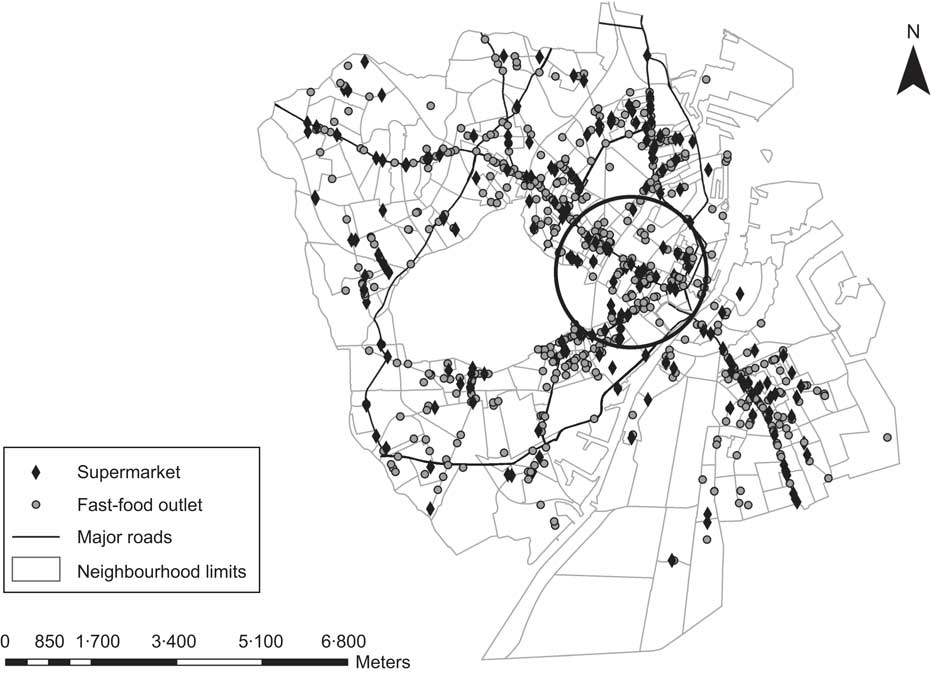
Figure 1 shows the distribution of supermarkets and fast-food outlets in the city of Copenhagen represented by the 400 rodes (in grey outline). While fast-food outlets and supermarkets tend to be more densely located in the city centre (represented by the circle), the greatest number of both supermarkets and fast-food outlets are placed along the major road arteries of the city (selected roads in heavy outline).
Distribution of supermarkets and fast-food outlets in Copenhagen, Denmark, 2006
Among 388 neighbourhoods used for analysis to examine the association between either supermarket or fast-food outlet exposure and socio-economic indicators in the city of Copenhagen, a total of 199 supermarkets and 591 fast-food outlets were located within the study boundaries (Table 2). Almost twice as many neighbourhoods in Copenhagen lacked a supermarket (65 %) as lacked a fast-food outlet (35 %). Overall, there was a fairly wide distribution of residents, with average population density of 14 796/km2 per rode (range: 671–64 383/km2). The Copenhagen neighbourhoods tended to be primarily composed of residents who rent their home (75 %), with low proportions of recent immigrants (13 %). On average, 28 % of the residents did not have a high-school diploma and the average taxable income in 2006 for Copenhagen was approximately €26 000 (range: 0 to €46 000).
Frequency of supermarkets and fast-food outlets, and socio-economic and demographic characteristics of neighbourhoods, Copenhagen, Denmark, 2006
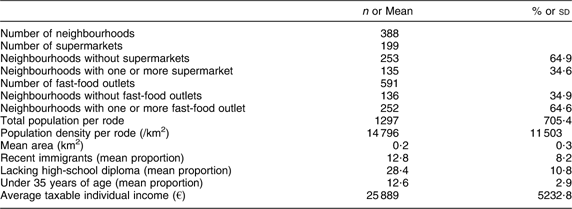
Data are expressed as total number and percentage or mean and standard deviation.
Table 3 shows the results for supermarket exposure expressed as rate ratios based on negative binomial analysis. The results show that supermarkets are not spatially patterned according to neighbourhood income levels. In fact, none of the other socio-economic variables alone or in the fully adjusted models was significantly associated with supermarket exposure. There was also no evidence of a relationship between supermarket exposure and indicators of socio-economic deprivation even after having conducted backwise elimination from the fully adjusted supermarket exposure models in order to extract the most meaningful and significant variables.
Rate ratio (RR) and 95 % confidence interval for supermarket exposure according to sociodemographic indicator, Copenhagen, Denmark, 2006Footnote †

† All models have been adjusted for population size/rode area.
The results for unadjusted, mutually adjusted and backwise elimination models for fast-food outlet exposure are illustrated in Table 4. We noted an income gradient in fast-food outlet exposure, such that neighbourhoods with low and mid-low income had less exposure than wealthier counterparts. These findings were significant in the mutually adjusted model. Neighbourhoods with a greater proportion of youth had marginally statistically significant greater exposure to fast-food outlets (rate ratio = 1·30) than comparison areas. In the final backwise deletion model, youth and income variables were retained, with the low and mid-low income quartiles significantly having 44 % less exposure to fast-food outlets than the highest income referent.
Rate ratio (RR) and 95 % confidence interval for fast-food outlet exposure according to sociodemographic indicator, Copenhagen, Denmark, 2006Footnote †

*Model was statistically significant at the 0·01 level.
† All models have been adjusted for population size/rode area.
Discussion
The present study is the first to explore the socio-economic patterning of supermarkets and fast-food outlets in a major city in a Scandinavian country. In contrast to findings in the USA, which tend to show low-income areas have less access to supermarkets and greater access to fast-food outlets(Reference Larson, Story and Nelson27), we found no evidence of socio-economic patterning of supermarkets in Copenhagen and found that fast-food restaurants were less available in low-income neighbourhoods.
Supermarket exposure
The findings of no association with socio-economic characteristics for supermarket exposure support previous research conducted in other cities such as Cardiff, Leeds and Bradford in the UK(Reference Clarke, Eyre and Guy44), Montreal and Edmonton in Canada(Reference Apparicio, Cloutier and Shearmur45–Reference Smoyer-Tomic, Spence and Raine47) and Brisbane in Australia(Reference Winkler, Turrell and Patterson48), which found low-income areas having equal if not better access to supermarkets than more affluent ones.
Fast-food exposure
In general, neighbourhoods with a high proportion of recent immigrants or a high proportion of residents without a high-school diploma were not significantly associated with fast-food outlet exposure. In the unadjusted model, while no single variable was significantly associated with fast-food outlet exposure, we observed low-income neighbourhoods had less exposure to fast-food outlets than the high-income comparison. This association became significant in the mutually adjusted model. Additionally, exposure was higher for neighbourhoods with greater proportions of youth, although this association was marginally significant. When the recent immigrant and low education variables were removed from the model, retaining only the youth variable, the income patterning of fast-food outlet exposure remained such that low and mid-low neighbourhoods had only 46 % of fast-food outlet exposure compared with high-income areas. Contrary to findings from the USA(Reference Larson, Story and Nelson27), Australia(Reference Burns and Inglis42), New Zealand(Reference Pearce, Blakely and Witten43) and the UK(Reference Cummins, McKay and Macintyre50), these findings suggest that low-income areas in Copenhagen have less exposure to fast-food outlets than wealthier ones. While there seems to be a greater body of literature that supports greater exposure to fast-food outlets in low-income neighbourhoods, Macintyre et al. found no social patterning of out-of-home outlets in Glasgow(Reference Macintyre, McKay and Cummins49).
There may be several reasons for the variability in study results. First, we suspect that there are methodological differences in defining measures of spatial access and scale. One limitation of the present study is that we used the number of outlets as an indication of exposure. We acknowledge that there are other approaches to express measures of spatial access, such as density or proximity(Reference Charreire, Casey and Salze65), which may produce different study results. Another limitation is represented in definitions of neighbourhood scale. While the rode unit of geographical measure was appropriate for an administrative characterization of neighbourhood, it is unique to Copenhagen and cannot be used as a defining scale for the rest of the country. Despite its relatively small size for the measurement of statistical reporting(Reference Møller-Jensen58), it is still much larger than an average census block in the USA, the smallest geographical unit for census data(66). Second, there also may be country differences in transport access to fast-food outlets. There have been several studies conducted elsewhere showing that those living in poor areas are greatly impacted by the food environment, especially if they are lacking adequate transportation(Reference Burns and Inglis42, Reference Inagami, Cohen and Finch67, Reference Inagami, Cohen and Brown68). Given that public transportation is highly accessible in Copenhagen, with relatively low levels of car ownership(55), transportation access to food outlets may not be of the same concern as in other places lacking adequate transport. A third reason for variability in study results could be due to differences in how fast-food outlets were defined in our study. Fraser et al.(Reference Fraser, Edwards and Cade37) suggest that all types of fast-food source should be included in analyses so that associations are based on true representations of the food environment. While we liberally included private and chain-owned fast-food outlets within a specific NACE code in the current study, our analysis did not include other non-traditional sources of fast food (cafés or kiosks) in order to safeguard against misclassification error. Nevertheless, we recognize that study findings may underestimate associations between fast-food outlet exposure and socio-economic patterning. In the same vein, the overall quality of our data was high and consisted of multiple sources of secondary data in addition to street validation; however, we recognize validation of secondary sources of data information is a constant challenge and continued efforts to improve data quality are warranted(Reference Matthews, Moudon and Daniel69). Perhaps the greatest factor influencing the results may be the relatively low income disparity in Denmark, as indicated by its Gini index of 0·25(Reference Holstein, Currie and Boyce70). Denmark is a welfare state and income is significantly redistributed through taxation so that higher income earners pay higher taxes, resulting in smaller differences between wealthy and non-wealthy residents(Reference Kangas54). In comparison, the USA has a Gini index of 0·41(Reference Fukuda-Parr, De Gregorio and Fu71), indicating greater differences between low and high incomes, and may offer one explanation for why income-based disparities in access to supermarkets, for instance, are more visible in the USA. In contrast, the UK (0·36) and Australia (0·35)(Reference Fukuda-Parr, De Gregorio and Fu71) have Gini indices lower than that of the USA, which may also contribute to the mixed findings associated with income patterning of the distribution of food outlets. In the future, in may be interesting to conduct cross-national comparisons to examine whether the distribution of food outlets may be differentiated according to Gini index.
In their recent review of measures of the food environment, Charreire et al.(Reference Charreire, Casey and Salze65) highlighted that future research needs to address the challenge of characterizing multiple dimensions of access that incorporate social and well as economic aspects of access.
Strengths and limitations
The study presents new emerging results relevant for environmental influences on eating behaviour and health in a Scandinavian context, which have very different socio-economic structures and urban form to the USA. Merits of the study include the use of representative register-based information and various sources of address information to validate the physical presence of food outlet location.
In further addressing study limitations, we did not conduct a comprehensive analysis of the food environment to include other types of food outlet such as greengrocers, food kiosks and convenience stores, specialty food shops (bakeries or deli shops), cafés, service restaurants or other places where ready-prepared food is purchased. Although these categories of food outlet are relatively fewer in number compared with the combined total of supermarkets and fast-food outlets in Denmark(61), it may be worthwhile to investigate the impact of cafés and service restaurants on the local food environment, given the increasing trend towards frequenting cafés(Reference Messmer and Rosenbrink59). We also were limited to socio-economic information made available by national statistical databases, and we acknowledge that other socio-economic characteristics associated with food access, such as car ownership or public transportation, which may impact travel to food outlets, or potential indicators of neighbourhood need in a Scandinavian context(Reference Sundquist, Bajekal and Johansson72) may impact the results and should be considered in future studies. As our study is ecological in approach and not linked to individual information, the results are limited in terms of explanatory capacity and do not allow for the inference of associations with behavioural outcomes. Additionally, the study focuses only on one city in Denmark, albeit the capital city, which allows us to explore a much more ethnically and socio-economically diverse population than the rest of the country. Study results may be different if the food environment of the entire country were considered, as populations in rural areas of Denmark tend to be more homogeneous socio-economically(Reference Kangas54). Finally, initial tests (data not shown) indicated no differences in supermarket or fast-food outlet exposures at each level of income, nor were there notable differences in characteristics between areas containing or absent of food outlets. We did not conduct an income-stratified analysis because of lack of sample size required for an analysis of count data. Perhaps results would be more pronounced with a whole-country sample, or a stratified analysis using a continuous exposure measure.
Implications
The facts that our analysis does not reveal disparities in food access and that these findings are different from previous studies in the USA suggest the need for evidence in other European countries regarding food outlet exposure. With regard to policy implementation, results of the study also confirm the need for country- or culturally appropriate measures of access and socio-economic disparity. Finally, more detailed analyses linking the built environment with individual dietary behaviour will provide evidence on the importance of these factors for policy makers.
Conclusions
On the basis of the present analysis, we conclude that there is no association between supermarket exposure and socio-economic indicators in Copenhagen. However, we did detect a patterning of fast-food outlets, such that neighbourhoods in the lowest income quartile had less exposure to fast-food outlets than higher income ones. These findings are supportive of evidence found in the UK(Reference Macintyre, McKay and Cummins49, Reference Cummins and Macintyre73) but do not agree with study trends found in the USA. Therefore the results suggest there may be other socio-economic patterns of neighbourhood food exposure within a European context.
Acknowledgements
This work was made possible through grants funded by the Danish Graduate School in Public Health Science (GRASPH) at the University of Copenhagen, The Oticon Foundation, the Danish Health Fund, the Danish Heart Foundation and the Nordea Fund. None of the authors has a conflict of interest. C.M.S., H.N., C.G., B.E.H. and P.D. were responsible for conception of the study, study design and set-up. H.N. and C.G. were responsible for data collection and processing. C.M.S. drafted the manuscript. H.N., C.G., B.E.H., L.M.P. and P.D. assisted with drafting the manuscript. All authors were involved with data interpretation and critical revisions of the paper, and provided approval for publication.



