




1. Introduction
Much work has been done on the syntax and semantics of the perfect construction in English, with many competing theories concerning the nature and source of its special semantic contribution and distributional properties. If one focuses on the perfect itself, there is also important and relevant research related to its emergence in the history of English, and comparative study relating its behaviour to that of historically kin constructions in other European languages (see, specifically, De Swart Reference De Swart1998). In this article, however, we return to a central puzzle internal to English itself – that of the basic comparison between the simple past and the perfect. This comparison is usually approached via corpus work, or felicity judgements. In our study we present a new, complementary, source of evidence for the contrast between the two constructions. We make novel use of visual world methodology to compare the online processing of the simple past and (past and) present perfect. The results show clear differences that we believe have relevance for the formal analysis of these two forms. Strikingly, we argue that the assumed formal similarity in truth conditions between the past and present perfect in English is due to an erroneous classification of the simple past as ‘perfective’, in a way we will make precise.
The organization of the article is as follows. In the next section, we present the formal semantics background to the analysis of the English perfect and English simple past respectively, setting up the premises and research questions underlying our study. In section 3, we present the background to work on eye tracking and the Visual World Paradigm, motivating why this methodology is interesting and appropriate to addressing those research questions. Section 4 presents our study and the results. Section 5 presents some follow-up extensions to the original experiment. Section 6 concludes and discusses the potential consequences of our study for theoretical analysis
2. Semantic background to the English perfect and English past
In this section, we summarize the formal semantic accounts of the simple past and present perfect in the literature, highlighting the status of the telos, or result state in those proposals. The reason we focus on the result state is to allow us to be as explicit as possible about the predictions of our own empirical contribution to the issue – a psycholinguistic test of result state salience – which will be described in detail in section 3.
2.1. The English past as a perfective past
The past tense marking, as found on many of the world’s languages, is generally interpreted as providing the information that the verbal event in question is situated in time at an interval that precedes the current speech time. A simple neo-Davidsonian representation of this idea is shown in (1).

However, even within the category of past tense, many different versions can be distinguished in natural languages, with different presuppositions and nuances of meaning attached to them. One important distinction is that between a past tense that asserts that the event in question culminated before the speech time (‘perfective’) and one that asserts merely that a relevant activity of the right type was occurring at some past moment (‘imperfective’).
The English simple past tense has been most recently considered to be a subtype of the perfective past or preterite found in many Indo-European languages (Smith Reference Smith1991), contrasting as it does with the past progressive which introduces a clearly ‘imperfective’ or ongoing version of a past event (2).

The perfective–imperfective distinction is found in many of the world’s inflectional paradigms, and has been the topic of much work in language description and semantic analysis. The general consensus has been that the distinction corresponds to different ways of viewing an eventuality and linking it to the anchoring point/interval. For example, given an eventuality, E, a situational perspective taken on it, R, and an anchoring interval, S, a perfective viewpoint corresponds to R holistically including E, while an imperfective one corresponds to R being contained in E (Reichenbach Reference Reichenbach1947; Smith Reference Smith1991; Klein Reference Klein1994; Demirdache & Uribe-Etxebarria Reference Demirdache, Uribe-Etxebarria, Martin, Michaels and Uriagereka2000; Borik Reference Borik2002).

Importantly, viewpoint aspect in the above sense is distinguished from lexical aspect or Aktionsart, where the latter is traditionally cashed out in terms of different event-internal topologies of dynamicity, duration, transition, and sometimes result or telos (Vendler Reference Vendler1967; Dowty Reference Dowty1979; Smith Reference Smith1991; Pustejovsky Reference Pustejovsky1995), although the two obviously feed into the ultimate truth conditions of the whole finite clause.
Central to the question whether a particular tense form is perfective in the above sense has been the question whether the asserted event in the world culminates or not (Parsons Reference Parsons1995). In general, we can talk about culmination as the relationship between an event property, P, and an event, e, in the world. The classical assumption is that uninflected predicates denote properties of complete events (Landman Reference Landman1992; Zucchi Reference Zucchi1999). Under that assumption, the definition of a perfective tense is simply as shown in (4), where it asserts the existence of an event that holds the property P.

The entailment of completion, in the sense of attainment of a goal or telos, only follows from this temporal/aspectual framing if the predicate in question has a lexically specified telos in the first place. The literature on Aktionsart (Vendler Reference Vendler1967; Dowty Reference Dowty1979 building on Aristotelian categories) distinguishes verbs which come with a lexically specified telos from those that do not. Achievements and accomplishments are ‘telic’ in this sense, while states and activities are ‘atelic’.Footnote 1 States and activities are simply said to ‘cease’ at some point, but only achievements and accomplishments are said to ‘culminate’. A complication for English is that many verbs actually seem to be ambiguous between activity (atelic) and accomplishment (telic) interpretations (as discussed in Martin (Reference Martin2019), following Pancheva (Reference Pancheva, Rathert, Alexiadou and von Stechow2003)). This is illustrated in (5) below, where for an hour is a diagnostic that is compatible with atelic interpretations and in an hour with telic interpretations.

It turns out that there are a number of different classes of so-called accomplishment predicates in English which have a default inference of completion in the simple past, but where the entailment of completion can ‘disappear’ under certain conditions (Bar-el et al. Reference Bar-el, Davis, Matthewson, Bateman and Ussery2005). For example, it has been argued that there is a class of predicates that have been analysed with an internal modal operator, as a way of accounting for non-culmination in constructions like (6) below (Martin & Schäffer Reference Martin, Schäffer, Arregui, Rivero and Salanova2017).

To give yet another example, the subclass of gradable accomplishments can assert a maximal stage of an event that is nevertheless not ‘complete’, especially when modified by measure adverbials, as (7) and (8) show (Piñon Reference Piñon, McNally and Kennedy2008; Rappaport Hovav Reference Rappaport Hovav and Rothstein2008; Deo & Piñango Reference Deo, Piñango, Ashton, Chereches and Lutz2011; Kennedy Reference Kennedy, Demonte and McNally2012).


A distinct subcase of non-culminating accomplishments in English has been argued by Martin (Reference Martin2019) to rely on indeterminacies/vagueness in the interpretation of the definite article. In (9) and (10), we see that depending on the level of granularity assumed, the objects in question can be thought of as being completely consumed, or not. The idea is that in some cases, completion in a looser or sloppier sense is sufficient for the use of the ‘perfective’ past tense.


We can think of all these cases as simple cases of coercion (Moens & Steedman Reference Moens and Steedman1988; De Swart Reference De Swart1998), or even codify them using devices such as covert degree operators that are either simple existential, or maximal, as in analyses for English by Piñon (Reference Piñon, McNally and Kennedy2008) and Kennedy (Reference Kennedy, Demonte and McNally2012). These strategies would allow us to maintain the analysis of the English simple past as perfective, while still accounting for the gradability of the judgements.
In the case of activities and states, as mentioned before, it is not even expected that the past tense will produce completion entailments, but that it will give rise to an inference of cessation. In the following two sentences, it seems that this is true, since a natural inference is that John no longer owns that house, and that Mary is no longer running.

However, even cessation entailments are not so straightforward to assess, since there are quite natural contexts where they clearly do not hold. Consider the situation where we are all wondering about whether Janet is pregnant or not because of some hints she has been dropping on social media. So far nobody has seen her in person, but I bump into my friend Sally who was at a dinner party with Janet the day before. I ask my friend Sally,

Clearly no cessation entailment is implied in this case.
We will not be explicitly testing activities and states in our study, but it is worth bearing in mind that the English past tense, especially as it appears on states, does not behave like a classical perfective past tense – it does not create narrative sequenced events, or force inchoative interpretations. The perfectivity account of the English past would have to countenance a disjunctive analysis to handle the situation with respect to states. An aspectually neutral analysis for the English past tense on the other hand would fare better in unifying the interpretation of this tense form across all Aktionsart classes.
On non-states, however, the English past is generally considered to be a perfective past, in contrast to the past progressive with which it appears to be in paradigmatic opposition. In other words, if we choose accomplishment predicates, the simple past tense seems to at least strongly imply completion in (13a), while the past progressive clearly does not (13b).

In our experiment, we test accomplishment verbs for whether they meet the expectations of the perfectivity analysis for the English past tense. Only in this class will failure of those expectations be truly telling.
2.2. The English perfect
The present perfect in English is a periphrastic construction using the auxiliary have and the past participle, which asserts the existence of a past event (as represented by the verbal concept in the participle form), while still expressing some sort of present ‘relevance’.Footnote 2 In this sense, it overlaps with the simple past in truth conditions and the two forms can often be used in the same contexts.

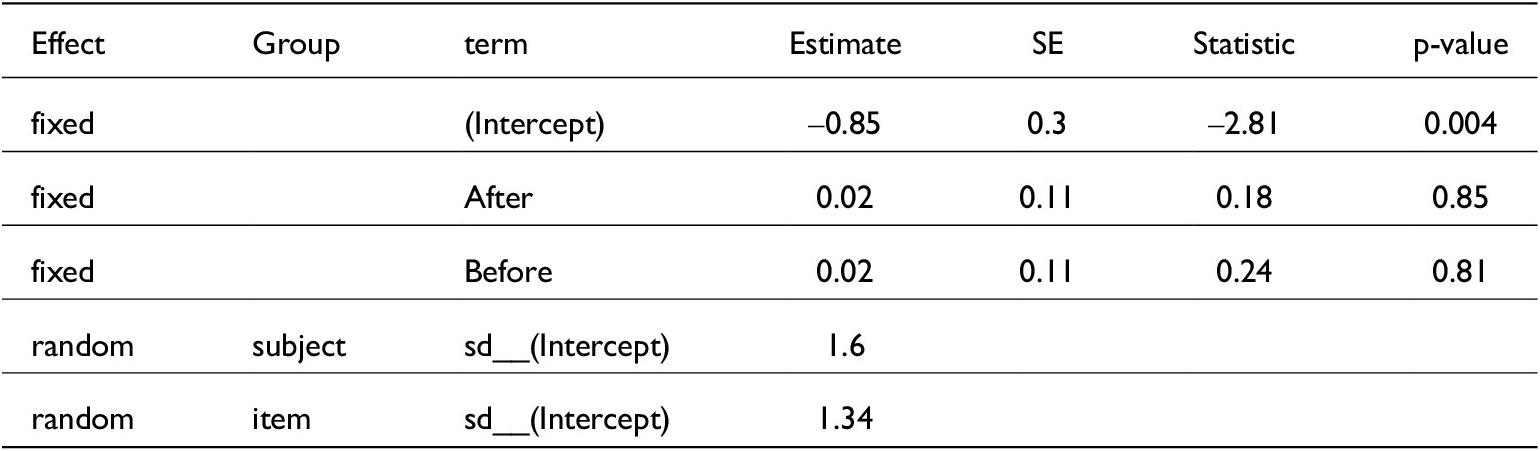
The central problem of the present perfect is that it seems to say two things at once:Footnote 3 on the one hand, the evidence from the tense morphology indicates that a present state is being asserted (the English present tense being confined to statives); on the other, there is an undeniable entailment that a certain event occurred prior to that. The twofold nature of the perfect is what Reichenbach (Reference Reichenbach1947) intended to capture with his notion of Reference time and Event time, although we agree with Schaden (Reference Schaden2009), Bohnemeyer (Reference Bohnemeyer2014) and Michaelis (Reference Michaelis, De Wit, Brisard, Madden-Lombardi, Meeuwis and Patard2024) that his proposal does not itself deliver a complete solution. In the well-known schematic adapted from Reichenbach shown in figure 1, the perfect is characterized by the fact that the reference time is the same as the utterance time, while the event time precedes it.
The Reichenbachian view (Reference Reichenbach1947)

While there is something intuitively correct about the picture above, there are open questions about how exactly to implement this intuition within a formal theory expressing truth conditions. In particular, how are the two eventualities related to each other in the semantics?
Different positions have been taken in the literature with respect to this relationship between the topic situation and the event-related situation. In the resultant state analysis, the present ‘topic’ situation, S, is the asserted eventuality, while the E is specified as entailed by S.

In the indefinite past analysis, the E is the eventuality that is directly asserted, while S, or rather present relevance, is presupposed.

Finally, in the extended now analysis, the interval over which the present perfect construction predicates includes both E and S.

Each of these accounts has its proponents (as indicated in the citations here), with different strengths and weaknesses, and it is not the purpose of this section to critique any individual account. This has been done thoroughly and insightfully elsewhere (Portner Reference Portner2003; Michaelis Reference Michaelis, De Wit, Brisard, Madden-Lombardi, Meeuwis and Patard2024). We point out for descriptive purposes that the Resultant State analysis is best designed to account for the target state readings of accomplishment verbs in the perfect, the Indefinite Past gives the neatest results for activities without telos, while the Extended Now analysis is perfectly adapted to account for the reading the perfect morphology gets on states (see Portner Reference Portner2003 for discussion). As Portner (Reference Portner2003) points out, none of the standard accounts in and of itself gives a satisfying story for the interaction between the different readings that have been described empirically and the Aktionsart of the verb the perfect is built from (but see Michaelis Reference Michaelis, De Wit, Brisard, Madden-Lombardi, Meeuwis and Patard2024 for an account in terms of the constraints on the perfect interpretation imposed by discourse). In our own study, we are concerned with the contrast between the present perfect and the simple past as they occur on accomplishment predicates. For this reason, we abstract away from the problems described above in characterizing the perfect, and concentrate on the verb types which lexically involve a telos in the first place. This means that (i) the present perfect of these verbs will allow the target state reading with a well-defined result and (ii) the simple past of these verbs will entail the achievement of that result by virtue of culmination (under the hypothesis of a ‘perfective’ setting). Within this context, the question will be whether there is any difference in salience of that result state due only to the distinction between simple past and present perfect morphology.
2.3. Accomplishments and their result states
In our experimental study, we test the cognitive salience of depictions of the result state. In this subsection, therefore, we review the expectations flowing from the theoretical literature with respect to the representation of the result state in simple past versus perfect constructions.
The result state is something that is assumed to be part of the lexical representation of certain classes of verbs, classically accomplishments. Theories differ with respect to whether the result state is explicitly represented in semantic (or even syntactic) representations of verb meaning, or whether it is part of the presuppositional lexical content of the verb in question, and invoked by means of meaning postulates (Dowty Reference Dowty1979).
Lexical representations of accomplishments can include explicit representations of this decomposed part of verbal meaning (Dowty Reference Dowty1979; Levin & Rappaport Hovav Reference Levin and Hovav1995), which one can conceive of as the content of a meaning postulate invoked by the linguistic symbol.
Some theories of the syntax semantics interface even include explicit representation of those ‘results’ in the linguistic syntactic representation (e.g. Ramchand Reference Ramchand2008), precisely because they can sometimes be seen to be independently modifiable, and tied to different levels of the syntactic structure (von Stechow Reference Stechow1996; Beck & Johnson Reference Beck and Johnson2002). We do not take a stand on these architectural decisions in this article since they do not make a difference to the entailment predictions themselves.
2.3.1. The English past and result states
In the modern standard representation of perfectivity as schematized in (3), as we have seen, the primary character of the perfective is its inclusive or holistic nature, not in any specific reference to result states. It is assumed, however, that an accomplishment under a perfective setting will create entailments of culmination in a default context.
2.3.2. The perfect and result states
The perfect gives rise to a number of different kinds of readings, with the range of possibilities conditioned by the Aktionsart of the verb being participialized. When it comes to accomplishments, we find two possible readings: one is the target state perfect as defined by Parsons (Reference Parsons1990), where there is a target state for the verb that still holds at the utterance time; the other is the resultant state perfect, where there is a state that holds for ever afterwards simply by virtue of the fact that a particular event came to pass (Parsons Reference Parsons1990). The semantics of this state are so weak that the only thing we can conclude from it is that the event occurred previously (making it truth conditionally equivalent to an indefinite past tense analysis).

However, in the case of accomplishments, the target state reading is more salient in out-of- the-blue contexts. More context is required for the resultant state reading to support the inference that it is relevant to the present that the event occurred in the past, for instance, because of the experience thus gained by the subject. Although the present perfect on accomplishments is in principle ambiguous, we judge that our experimental set-up favoured the target state interpretation, the very same state that would be entailed by a perfective past.
2.3.3. Summary
To summarize, in the case of the simple past on a straightforward accomplishment, perfective style analyses of the simple past predict that the attainment of the result will be entailed. For the perfect on accomplishments, an indefinite past analysis across the board would predict no difference in the strength of entailment for the existence of a result state between the simple past and the present perfect. However, in accounts of the perfect that analyse it as directly asserting the existence of a result state, the perfect differs from the simple past in that it directly asserts the existence of the result state, as opposed to merely entailing its existence. For indefinite past accounts, the extra pragmatics of ‘relevance’ of the present resultant state is an important component of the analysis. This is the sense in which it is said to differ from the simple past.
The main research question for our study will be in whether classic cognitive measures of result salience distinguish between these truth-conditionally equivalent constructions with accomplishments.
3. Background to the present study
In this section we introduce the background to, and motivation for, employing Visual World eye tracking to probe the behaviour of tense/aspect forms in general, and the English past and perfect in particular. As we have seen from the previous section, many competing analyses of these forms do not differ in truth conditions, but have consequences for the division of labour in composing truth-conditional content, and for detailed questions of compositionality and lexical representation. Intuitions about truth conditions are one way to get at the meanings of different linguistic utterances, but they do not always adjudicate between cognitively distinct alternatives. Distributional facts, as evidenced in large corpora, are another source of evidence, and psycholinguistic experimentation is yet another. In our study, we explored the latter technique as a source of evidence, looking at the processing of aspectual forms in real time, in order to complement our theoretical understanding of verbal aspect.
First some background to the Visual World Paradigm is in order.
3.1. The Visual World Paradigm
Human eye movements, or saccades, are rapid movements which track visual attention. Over the years, since the seminal research of Tanenhaus et al. (Reference Tanenhaus, Soivey-Knowlton, Eberhard and Sedivy1995), psycholinguists have discovered that eye movements are actually a robust indicator of attention, below conscious control. While the details of the relationship between saccades and specific processing mechanisms in the brain are still controversial,Footnote 4 the fact that they are correlated with attention is not, and tracking eye movements has become a richly productive methodology within linguistic processing. The Visual World Paradigm (VWP) involves tracking eye movements of subjects over a controlled visual display while they are being presented with linguistic stimuli. The experience of researchers over the past twenty-five years of using this paradigm is that it is highly sensitive to aspects of linguistic input, beyond the conscious control of the language user, with eye movements tracking attention in a temporally fine-grained way.
In this study, we apply the VWP to experimentally probe the cognitive representations triggered by the processing of different types of tense/aspect construction in English, focusing on the difference between the simple past and the perfect.
The classic use of VWP involves static images, and this is very well suited to linking nominal expressions with their potential pictured referents. However, dynamic events have a temporal dimension which makes them different from static objects. The event of ‘eating’, for example, contains many temporal phases, each of which can look quite different qualitatively from the other. Similarly, the start of building a snowman looks quite different from when one is nearly finished. This property of event unfolding makes it very suitable for testing how the cognitive associations of events are affected by aspectual grammatical categories. In fact, grammatical aspect has been analysed precisely as a category that controls which perspective is being taken on the event described by the verb in combination with its arguments (Smith Reference Smith1991), or which portion of the temporal unfolding it makes salient.
The present study thus deliberately uses two different types of static visual representation which focus on different temporal portions of the depicted event – a snapshot of the ongoing event, or a snapshot of the immediate aftermath of the event (the result state). If aspectual marking makes salient a particular dimension of an event, we expect eye tracking in a picture-matching paradigm to track the nature of that focus. Previous behavioural work in the psycholinguistic tradition has already successfully made use of static picture matching to probe aspectual distinctions in judgement tasks; we take this one step further and use a static picture-matching task while tracking the eyes of participants.
In the next section, we summarize the results of these previous picture-matching studies as a way of setting up our own expectations/predictions with respect to the contrast between the English simple past and the English perfect.
3.2. Previous studies on the processing of grammatical aspect
The perfective versus imperfective contrast has been the subject of a considerable number of studies because of its clear semantic associations: imperfective aspect is said to focus on the in-progress, activity stage of an event, while perfective aspect triggers a representation of the event as a completed whole, thus highlighting the final stage and/or the result (goal) state of the event. Previous behavioural studies on the processing of this contrast have confirmed this intuition.
Instruments, locations and participants associated with the activity stage of an event are more salient when an event is presented via imperfective aspectual morphology (Carreiras et al. Reference Carreiras, Carriedo, Alonso and Fernández1997; Ferretti et al. Reference Ferretti, Kutas and McRae2007). In addition, Bergen & Wheeler (Reference Bergen and Wheeler2010) found that verbs in the imperfective aspect exhibit a congruency effect with the direction of motor movement, suggesting that they trigger a motor simulation of the described activity. On the other hand, perfective verbs make salient the completed objects and result states of the relevant events (Madden & Zwaan Reference Madden and Zwaan2003; Ferretti et al. Reference Ferretti, Kutas and McRae2007; Madden & Therriault Reference Madden and Therriault2009; Zhou et al. Reference Zhou, Crain and Zhan2014).
Turning to eye tracking specifically, Zhou et al. (Reference Zhou, Crain and Zhan2014) investigated the time course of grammatical aspect processing by Mandarin-speaking children and adults. Zhou and colleagues found that all groups of participants (including children) launched significantly more looks to the result state picture than the ongoing activity picture in the perfective condition, and conversely significantly more looks to the ongoing activity picture in the durative condition.
Our own previous work using a similar paradigm to Zhou et al. (Reference Zhou, Crain and Zhan2014) demonstrated an analogous effect in the processing of grammatical aspect by Russian-speaking adults and children (Minor et al. Reference Minor, Mitrofanova, Vos and Ramchand2020; Minor et al. Reference Minor, Mitrofanova and Ramchand2022b). This previous work was even able to distinguish fine-grained temporal differences in the unfolding of aspectual marking information in Russian, with eye gaze being sensitive to the different points of disambiguation within the verb (corresponding to prefixal versus suffixal encoding of the aspectual contrast).
3.3. Previous experiment: Minor et al. (Reference Minor, Mitrofanova, Guajardo, Vos and Ramchand2023)
We have seen that languages described as classical aspectually sensitive languages perform in a consistent and reliable way on the image-matching task – perfective marked verbs trigger early looks to the result state picture, while imperfective marked verbs attract looks to the ongoing picture.
We report here in some detail on our recent previous experiments where we directly compared Russian, Spanish and English, since our new set of studies in the present article extends and replicates this paradigm. While we report on parallel experiments for all three languages in Minor et al. (Reference Minor, Mitrofanova, Guajardo, Vos and Ramchand2023), we summarize only the findings for English versus Russian here, since this will be enough to set up the basic English facts we are interested in in this article. The interested reader is referred to Minor et al. (Reference Minor, Mitrofanova, Guajardo, Vos and Ramchand2023) for detailed discussion and for the results for Spanish.
In what follows, the technical description of the experimental set-up and results closely follows the exposition in Minor et al. (Reference Minor, Mitrofanova, Guajardo, Vos and Ramchand2023), with minor cosmetic changes.
Our task was identical for our English speakers and Russian speakers. For English, we tested the contrast between the simple past and the past progressive as an analogue to the Russian perfective versus imperfective forms respectively. Recall from our discussion in section 2, the English past has been most often analysed in the formal semantics literature as having a ‘perfective’ setting. In both languages the verbs in question were designed to be accomplishments (i.e. to contain a specification of a lexical telos or result state), and we used the same experimental procedure and equipment across languages.
While looking at a blank screen,Footnote 5 the participants heard a short context sentence that located the narrative in the past:
It was a bright and sunny day…
It was the first period at school…
It was early in the morning…
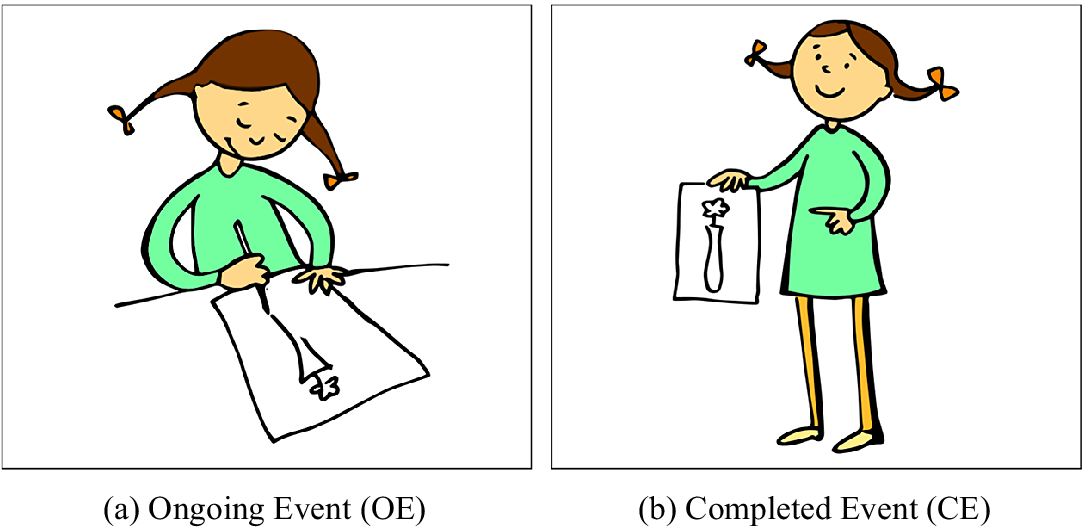
Participants had been instructed to choose which picture best matched the sentence they heard, which they did by a simple gesture, at the end of each trial (see figure 2). We manipulated the aspect of the verb in the target sentence. In Russian, this was the classic perfective/imperfective contrast (19).

Example of a visual display

While in English, we contrasted the simple past with the past progressive (20).

In each experiment there were 24 test items involving accomplishment predicates. There were also 24 filler items, where the two pictures represented different event kinds. We recorded the participants’ eye movements (SMI RED500/EyeLink Duo) as well as their choices for which picture matched the sentence that they heard (offline responses).
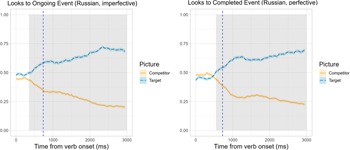
In their offline responses, the Russian participants exhibited an almost universal preference for the Ongoing Event picture when they heard target sentences containing an imperfective verb (98 per cent of the imperfective trials). Conversely, they exhibited an at-ceiling preference for the Completed Event picture when presented with sentences containing a perfective verb (95 per cent of the perfective trials). In figure 3, we show the proportion of looks to the Target picture separately for the two aspectual conditions: perfective and imperfective. For the imperfective trials, looks to the Ongoing Event picture were coded as Target, while looks to the Completed event picture were coded as Competitor. The opposite coding was employed for the perfective trials. All looks outside the pictures (i.e. looks to White Space) were removed (7.77 per cent of the data). We calculated the proportion of looks to the target picture in 60 consecutive 50 ms time bins starting from the verb onset (see figure 3). A cluster-based permutation analysis (Maris & Oostenveld Reference Maris and Oostenveld2007; see the Appendix for our motivation for, and explanation of, this analysis method) revealed that in the imperfective condition, the probability of looks to the Target picture was significantly above chance in the time window from 350 to 3,000 ms after the verb onset (sum $ z=463.09,\hskip0.5em p<0.001 $
, represented by shading in figure 3). In the perfective condition, the probability of looks to the Target picture was significantly above chance in the time window from 550 to 3,000 ms after the verb onset (sum
$ z=463.09,\hskip0.5em p<0.001 $
, represented by shading in figure 3). In the perfective condition, the probability of looks to the Target picture was significantly above chance in the time window from 550 to 3,000 ms after the verb onset (sum $ z=418.95,\hskip0.5em p<0.001 $
).
$ z=418.95,\hskip0.5em p<0.001 $
).
Russian experiment: proportion of looks to the Target and Competitor pictures in the Imperfective and Perfective conditions. Shading represents the time windows where the probability of looks to the Target picture was significantly above chance. The dashed vertical blue lines mark the average verb offsets in the two conditions
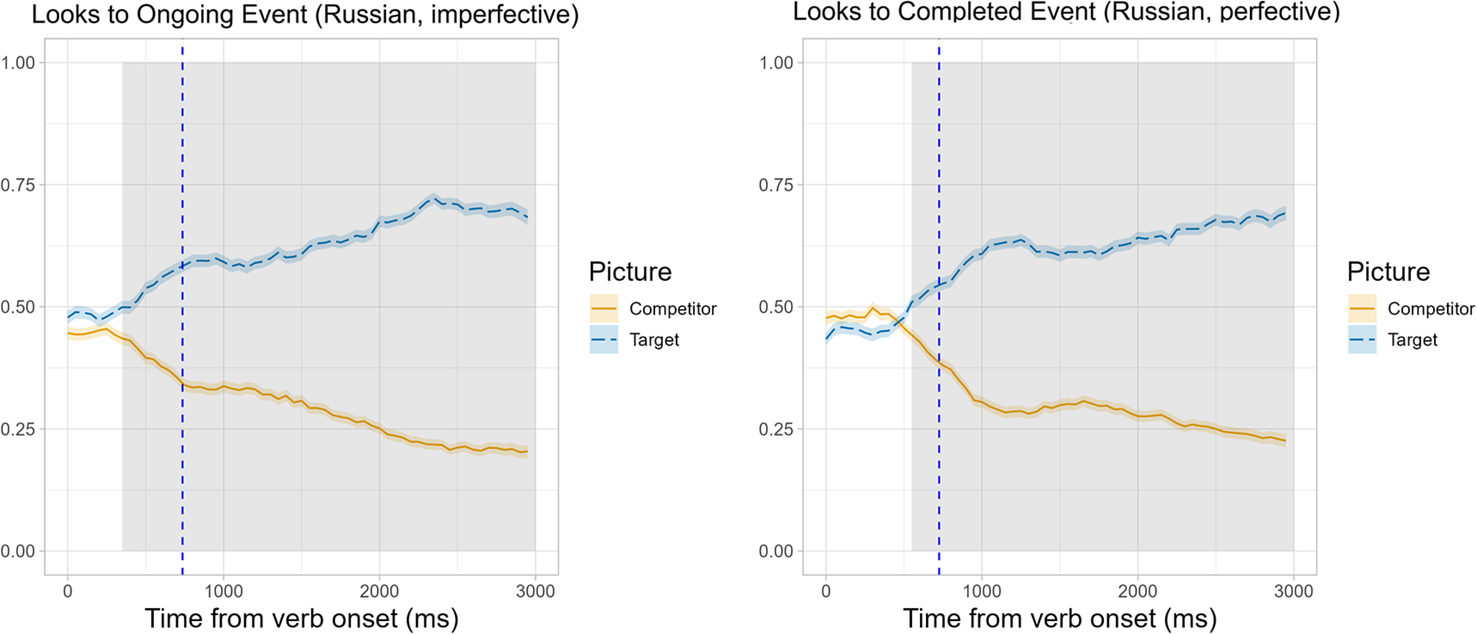
Our Russian data showed no surprises from the point of view of the previous literature and behavioural studies. It was less clear from the experimental record what we would find for English, since the simple past had been classified previously as a perfective past, but many behavioural studies had found rather ambivalent behaviour when it came to entailments of culmination (Arunachalam & Kothari Reference Arunachalam and Kothari2011).
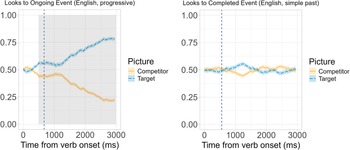
Turning now to the English participants, we found that, as expected, they exhibited an at-ceiling preference for the Ongoing Event picture in the past progressive condition (95 per cent of the progressive trials). However, in the simple past condition the participants did not show a strong preference for either picture, choosing the Completed Event picture in only 54 per cent of the trials. Recall that the English verbs (like the Russian verbs in the companion experiment) were all chosen to be accomplishments with well-defined depictable result states.
Figure 4 shows the proportion of looks to the Target and Competitor pictures separately for the two aspectual conditions: simple past and past progressive. All looks outside the pictures were removed (6.5 per cent of the data). A cluster-based permutation analysis revealed that in the progressive condition the probability of looks to the Target picture was significantly above chance in the time window from 500 to 2,000 ms after the verb onset (sum $ z=103.57 $
,
$ z=103.57 $
, $ p<0.001 $
, represented by shading in figure 4). The analysis of the simple past condition did not reveal any significant clusters of above-chance looks to the Target picture.
$ p<0.001 $
, represented by shading in figure 4). The analysis of the simple past condition did not reveal any significant clusters of above-chance looks to the Target picture.
English experiment: proportion of looks to the Target and Competitor pictures in the past progressive and simple past conditions. Shading represents the time window where the probability of looks to the Target picture was significantly above chance. The dashed vertical blue lines mark the average lexical verb offsets in the two conditions
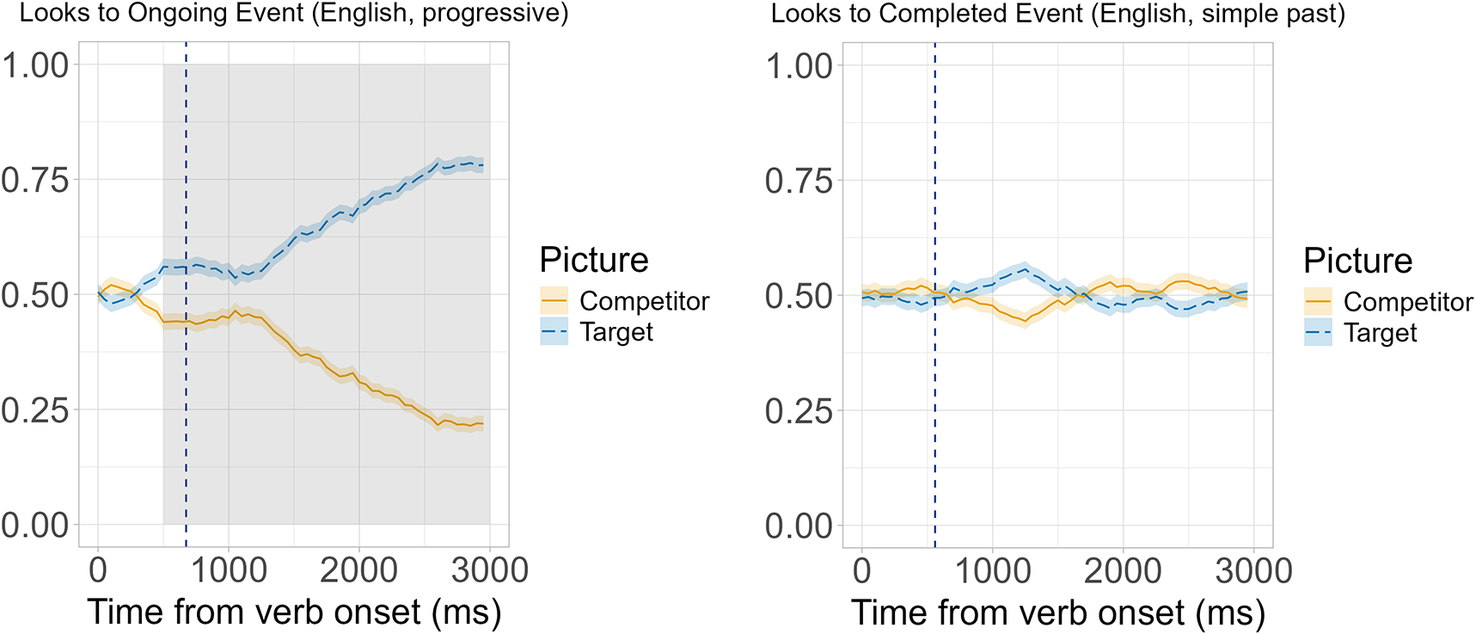
The results of this study for the English past tense were rather striking. Our results suggested that perfective accomplishment verbs in Russian strongly highlight the result state of the event.Footnote 6 However, for the English, we found that that even on telic predicates, the simple past form does not encode a preferential cognitive salience for either the activity portion of an event or its result state.
This study shows us that in Russian, which has grammaticalized perfectivity marking, perfective on accomplishment verbs triggers looks to the static picture of result with near ceiling accuracy. However, the results for English are a little bit more difficult to interpret. One interpretation could be that the English past is ambiguous, and simply does not trigger completion entailments uniformly in this context. Another possibility is that entailments of completion per se are simply not enough to direct the speaker’s gaze to the result picture. One alternative view would be that the grammaticalized status of aspect marking is criterial here, and that languages with a grammaticalized system of contrasts make the entailment of result more salient. Yet another alternative would be to say that the Kleinian perfective operator is too general, and that there is something else in the representation of these past tenses that makes the result state more or less cognitively salient even in the context of the same entailment of completion.
In order to further probe these possibilities for the interpretation of the past tense result for English, we decided to run two follow-up studies. It seemed natural to test the English perfect with this very paradigm, to see whether we could find result state salience with any tense/aspect construction at all in English (which after all does not grammaticalize perfectivity in the same way that Russian does). In addition, we ran a version of the past tense task with the contextual preamble modified, to test whether changing the context would increase the salience of the result state for the simple past on accomplishments.
We describe these new experiments in the sections below and report on their results.
4. Testing the English perfect
To test the English perfect we had to conduct two studies. In the first one, we substituted the perfect for the simple past tense in the previous experiment. Because the original experiment was set up with past-tense context sentences, this necessitated the use of the pluperfect (or past perfect) instead of the present perfect. Thus, Experiment 1 contrasted the past progressive with the past perfect. One difference between this experiment and the original one described in section 3 is that this experiment was conducted online using webcam technology to perform the eye tracking of the participants. To ensure that webcam eye tracking gives equivalent results to the experiment using an infrared camera, a first study was completed simply replicating the results for English from Minor et al. (Reference Minor, Mitrofanova, Guajardo, Vos and Ramchand2023). This study is reported in Vos et al. (Reference Vos, Minor and Ramchand2022). Besides fully replicating the strong preference (98 per cent of trials) for the Ongoing Event picture in the past progressive condition – including the time course at which that preference became significant – we also found that the lack of preference for the Completed Event picture in the simple past condition was, if anything, more pronounced. Though still not significantly different from chance, the Completed Event picture was only chosen in 44 per cent of simple past trials.
Just in case there was something special about the present perfect as opposed to the pluperfect with respect to result state saliency, we also set up a parallel experiment contrasting the present perfect with the present progressive, changing the context sentences to reflect a present-tense narrative orientation (Experiment 2).
These two studies and the results are described below.
4.1. General procedure
We had previously established both that our original finding for the simple past was no accident, and that the webcam eye tracking methodology can produce reliable data in the VWP. In the current study, we closely followed the materials, design, procedure, data preparation and analysis methodology of the replication study described in detail in Vos et al. (Reference Vos, Minor and Ramchand2022), which in turn was a webcam version of the experiment described in detail in section 3. All code, data and materials related to the experiments included in this article are made available via the Open Science Framework. A full description of the procedure, data preparation, analysis and offline response results is given in the Appendix. In this section, we lay out each experiment more informally and then report on the results.
The participants were instructed that they were to choose the picture on the screen that best matched the sentences they were going to hear. Before any visuals were presented, the participants heard a short context sentence that located the narrative in the past:
It was a bright and sunny day…
It was the first period at school…
It was early in the morning…
The visual display appeared at the onset of the target sentence, showing pictures side by side representing an ongoing event (OE) and the corresponding completed event (= the result state that obtained once the action was complete) (CE) respectively. This time, however, we manipulated the aspectual contrast in English to compare the past progressive with the past perfect (21).

In Experiment 1 there were 24 test items involving accomplishment predicates. There were also 24 filler items, where the two pictures represented different event kinds (but shared the same agent, e.g. Grandpa). We recorded the participants’ eye movements and offline responses.
In Experiment 2, the context sentences were adjusted to the present tense:
It is a bright and sunny day…
It is the first period at school…
It is early in the morning…
The target contrast was:

The methodology for Experiment 2 was nearly identical to that of Experiment 1, with the exception of the number of test items: 12 instead of 24. The reason for this was that Experiment 2 was part of a larger set of experiments, for which it was necessary to narrow down the number of items (see Appendix A.1 for more details).
4.2. Experiment 1 results: past progressive versus past perfect
There were 76 participants; none were removed during data preparation for low accuracy on the filler items. In the offline judgement task, participants chose the ongoing picture 97 per cent of the time in the past progressive condition, and chose the completed picture 95 per cent of the time in the past perfect condition.
These judgements were also reflected in the eye gaze data. Figure 5 shows the proportion of looks to target over time for the past progressive and past perfect respectively. Recall that for the progressive, the ongoing picture is coded as Target, while for the perfect the completed picture was coded as the Target.
Proportion of looks to the target picture in the past progressive condition (a) and in the past perfect condition (b)
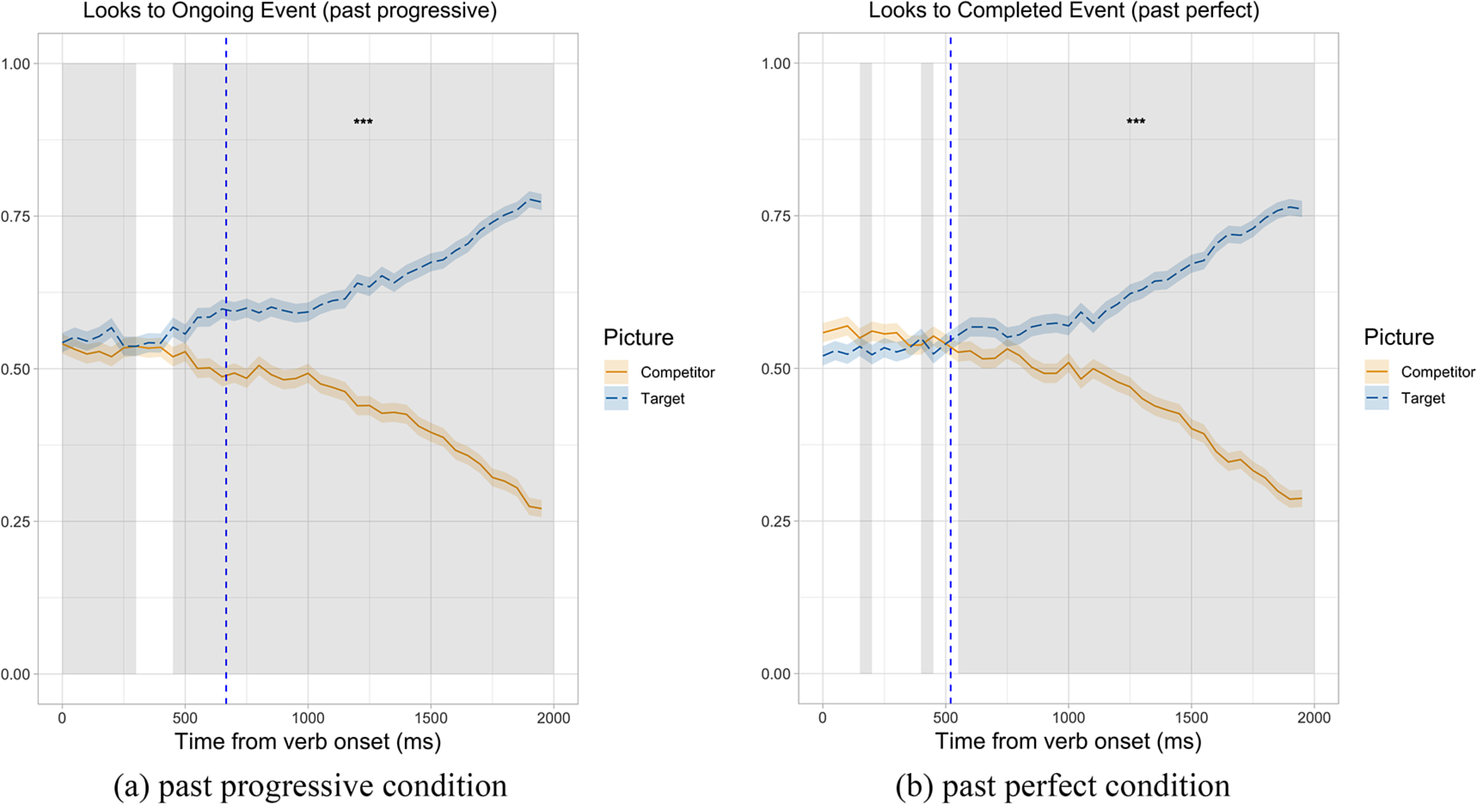
In figures 5a and 5b, the dotted blue line represents the offset of the main verb. Using a cluster-based permutation analysis, we found a statistically higher proportion of looks to the ongoing picture in the progressive starting at 450 ms after main verb onset and continuing until 2,000 ms (sum $ z=195.37 $
,
$ z=195.37 $
, $ p<0.0001 $
). For the past perfect condition, preferential looks to the completed picture started to form a statistically significant cluster at 550 ms continuing on through 2,000 ms (sum
$ p<0.0001 $
). For the past perfect condition, preferential looks to the completed picture started to form a statistically significant cluster at 550 ms continuing on through 2,000 ms (sum $ z=170.83 $
,
$ z=170.83 $
, $ p<0.0001 $
). The significant time windows are shown shaded in grey in figures 5a and 5b.
$ p<0.0001 $
). The significant time windows are shown shaded in grey in figures 5a and 5b.
While the perfect condition appears slightly delayed compared to the progressive, the gaze patterns show conclusively that participants prefer the completed picture for the past perfect, unlike what we found for the simple past in this context.
4.3. Experiment 2: present progressive versus present perfect
Experiment 2 formed part of a larger study in which three different imperfective verb types were tested against the present perfect: the future tense, the auxiliary modal might and the present progressive. Here, we report only the last one, since this is the only contrast relevant to the present article.Footnote 7
There were 108 participants; again, none were removed during data preparation. In the offline judgement task, participants chose the ongoing picture for the present progressive 95 per cent of the time, and chose the completed picture for the present perfect 87 per cent of the time.
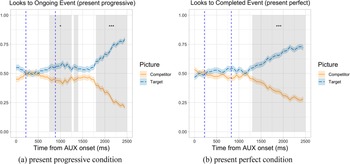
These judgements are also reflected in eye gaze patterns. Figure 6 shows the proportion of looks to target over time for the present progressive and present perfect respectively. Once again, for the progressive, the ongoing picture is coded as Target, while for the present perfect the completed picture was coded as Target.
Proportion of looks to the target picture in the present progressive condition (a) and in the present perfect condition (b)

In figures 6a and 6b, time is measured from auxiliary verb onset; the dotted blue lines represent the offset of the auxiliary verb (first and leftmost line) and the offset of the main verb (second line), respectively. Again, we used cluster-based permutation analysis to find statistically significant preferential looking behaviour. In the present progressive condition, we found a small effect for looks to the ongoing picture between 750 ms and 1,250 ms after the auxiliary verb onset (sum $ z=24.67 $
,
$ z=24.67 $
, $ p=0.019 $
), followed by a highly significant preference from 1,800 ms to 2,500 ms (sum
$ p=0.019 $
), followed by a highly significant preference from 1,800 ms to 2,500 ms (sum $ z=109.25 $
,
$ z=109.25 $
, $ p<0.0001 $
). In the present perfect condition, preferential looks to the completed picture started at 1,300 ms after the auxiliary verb onset. These significant time windows are shown shaded in grey.
$ p<0.0001 $
). In the present perfect condition, preferential looks to the completed picture started at 1,300 ms after the auxiliary verb onset. These significant time windows are shown shaded in grey.
4.4 Discussion
Unlike the simple past when tested under the same conditions, the pluperfect (perfect in the past) reliably triggered looks to the completed action picture. Testing in a present-tense context gave the same result for the present perfect, although in general the present-tense context seems to have given rise to slightly longer reaction times across the board. In other words, both the past and the present perfect in both offline judgements and eye gaze were unambiguously associated with the result state of the action.
In general, the progressive versus perfect graphs in English looked rather similar but with opposite target preferences – the progressive drawing looks to the ongoing picture and the perfect drawing looks to the completed picture.
While the perfect eye gaze trajectory did not match the shape that we found in our Russian experiment, there are many differences between the two constructions, including the fact that the perfect construction in English involves an auxiliary and a participle, while the Russian is a single inflected form. What the two experiments above show is that English does have a construction that matches the Russian perfective in offline choice and saliency of the result state.
However, we still do not know whether the failure of the English past tense to give the same kind of result state saliency with accomplishments is due to its not being sufficiently perfective (i.e. no completion entailments), or if it arises from a more general issue that something more than just entailed existence is necessary for cognitive saliency of the result state. We performed one more variation on the Visual World Paradigm we have used throughout, seeking to construct a context where the completion entailment of the English simple past would be simply unavoidable on accomplishments.
5. Testing the effects of discourse on result saliency
Here we take as our starting point the fact that the aspect literature has also traditionally relied on the test/criterion of narrative sequencing in order to single out perfective versus imperfective meanings. The fact that the English simple past does in fact advance narrative time, and indeed establishes discrete (non-overlapping) sequencing for all non-statives, has reinforced the assumption that it is ‘perfective’. See, for example, the sequences of sentences in (23), where the events are interpreted as occurring one after the other.

On the other hand, a progressive sentence in the past produces an interpretation of overlap with the immediately previous eventuality (24).

The simple past on statives in English, however, does not advance the narrative time (25).

At least in English, the rules of narrative progression are tied to the sortal distinction between stative and non-stative eventualities – states in English require overlap while non-states favour sequencing. Connected to this we would therefore analyse the English progressive in -ing as a stativizer (Vlach Reference Vlach, Tedeschi and Zaenen1981; Hallman Reference Hallman2009; Ramchand Reference Ramchand2018).
In fact, for English, the diagnostic of narrative completion does not reliably coincide with salience of result state. Activities, which are dynamic but have no telos, do advance the narrative time when placed in the simple past (26).

The present perfect on the other hand is famous for not advancing the narrative time (giving rise to infelicity in (27)) even though, as we have shown above, it does make the result state salient.

In Minor et al. (Reference Minor, Mitrofanova, Guajardo, Vos, Ramchand, Starr, Kim and Öney2022a) we see that the rules of narrative progression are in principle dissociable from grammatical aspect, and that we need an independent representation of completion, or saliency of the result state.
The fact that we had to run two separate experiments and could not directly compare the simple past and present perfect points to an important fact about these two tense/aspect forms which their similarity in truth conditions can tend to obscure. In fact, the distribution of the past and present perfect is radically different in terms of discourse context and consequences, even though the past existence of the same eventuality is presumably entailed.
Recent comparative corpus work has shown that while the present perfect form and the simple past forms in European languages are generally in competition across a variety of contexts, the two forms in the different European languages differ strikingly in their division of labour. According to the extensive study in Van der Klis et al. (Reference Klis, Le Bruyn and de Swart2022), the English present perfect stands out from its European counterparts in being the ‘least’ past tense-like in its discourse properties. For example, unlike the passé composé in French, the English perfect:
-
(i) does not support narrative progression.
-
(ii) does not support past tense adverbial modification
-
(iii) prefers newly introduced events rather than presupposed ones.
(Van der Klis et al. Reference Klis, Le Bruyn and de Swart2022)
It seems like the English past tense is the tense that is specialized for temporal relationships in discourse and for establishing narrative progression.
Given this, and the above discussion, we are led to the possibility that perhaps the interpretation of the simple past is dependent on discourse context in a systematic way, and it is in the very context of narrative sequencing that it delivers completion entailments. In our previous experiments, the context sentences were framing static eventualities, where all the target sentences would naturally be interpreted as overlapping temporally with that background context. What would happen to the interpretation of the simple past in a more dynamic narrative sequencing discourse context? Would the saliency of the result state in accomplishments resurface in these different kinds of mini narratives?
Because the context sentences were stative in Experiments 1 and 2, we were interested to see whether dynamic discourse context would make a difference to the result state judgements for the English past. To do this, we ran a third version of our basic paradigm, once again contrasting the simple past with the past progressive, but varying the context sentences so that the target sentence would be interpreted in a narratively discrete way.
5.1. Experiment 3: Narrative progression and the simple past
This experiment was run according to the model of the previous webcam experiments discussed in the Appendix. But here, instead of substituting for the simple past, we keep the comparison between simple past and past progressive but change the nature of the contextual preambles.
Before the onset of the target sentence, the participants once again heard a short context sentence that located the narrative in the past. This time, however, context sentences came in three varieties (i) a before adverbial clause, (ii) an after adverbial clause and (iii) a neutral stative clause:
-
(i) Before the boy went to school…
-
(ii) After the boy came home…
-
(iii) It was early in the morning…
Once again, they were presented with two pictures side by side that they had to choose between: the ongoing event picture (OE), or the result state picture (CE).
The aspectual contrast in Experiment 3 was the original contrast between past progressive and simple (28), with the manipulation now being in the nature of the contextual preamble:

The hypothesis to be tested was that the dynamic narrative context in (i) and (ii) above would be enough to trigger a perfective setting for the English past tense and produce a different behaviour with respect to the picture-matching task. If the discourse context was truly criterial, then the behaviour of the simple past would be statistically different for context (iii) when compared to (i) and (ii).
In Experiment 3 there were 24 test items involving accomplishment predicates. There were also 24 filler items, where the two pictures represented different event kinds. We recorded the participants’ eye movements and their offline responses. Each set of test items was tested with each of the three context sentence types. There were 271 subjects for the experiment.
In the offline judgement task, we once again replicated the result that participants chose the ongoing picture for the progressive, and they did so at ceiling for all three context sentence conditions (see table 1).
Offline accuracy (progressive)

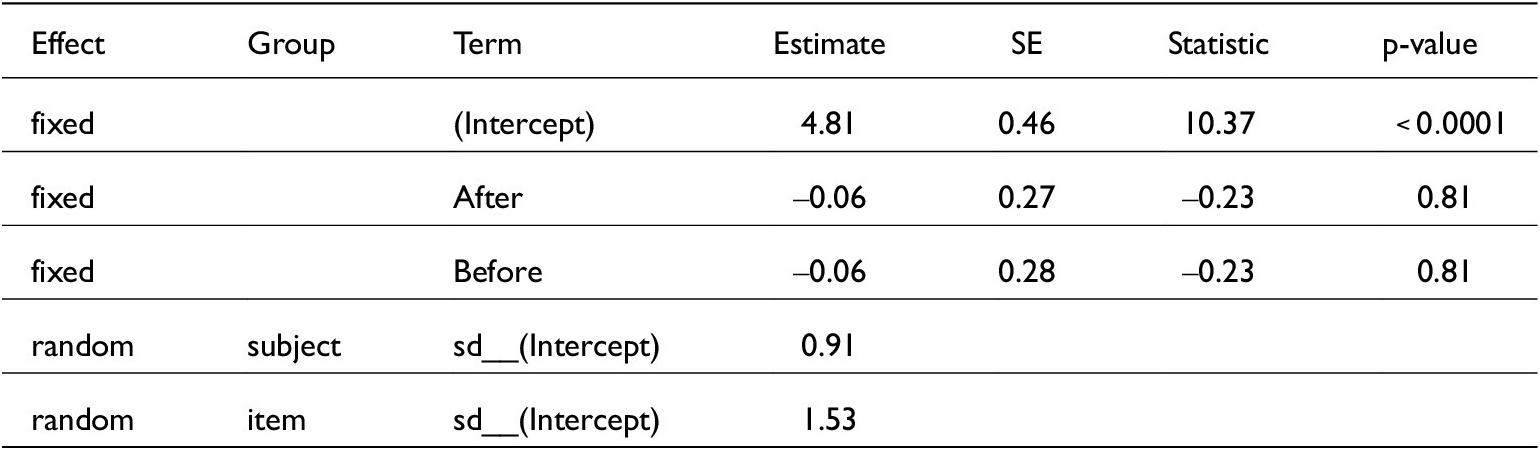
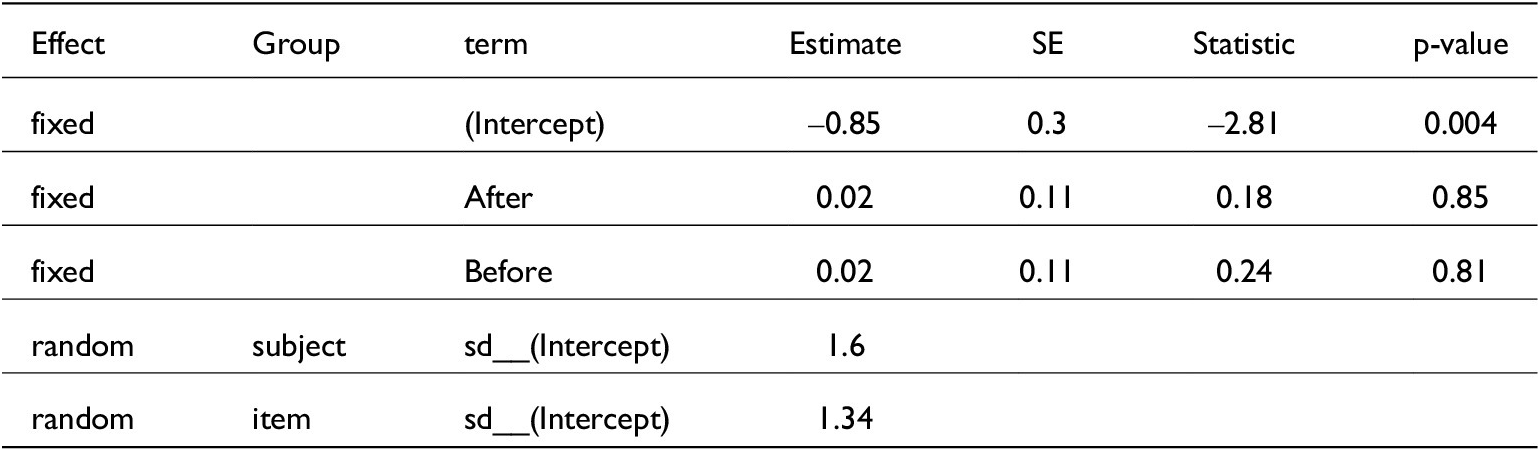
In the simple past conditions, we found that participants chose the completed picture less than 40 per cent of the time. When tested to determine whether the log-odds of selecting the completed picture in these conditions were significantly lower than chance, they were (p = 0.004). Statistically there were no significant differences between the three conditions (see table 2).
Offline accuracy (simple past)

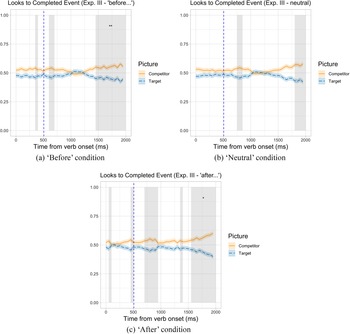
These judgements were also reflected in the eye gaze data. Figure 7 shows the proportion of looks to target over time for the simple past in the before, neutral and after conditions respectively. The completed picture is coded as the Target.Footnote 8
Proportion of looks to the target picture in the simple past condition: (a) ‘Before’-type preamble, (b) ‘Neutral’-type preamble and (c) ‘After’-type preamble
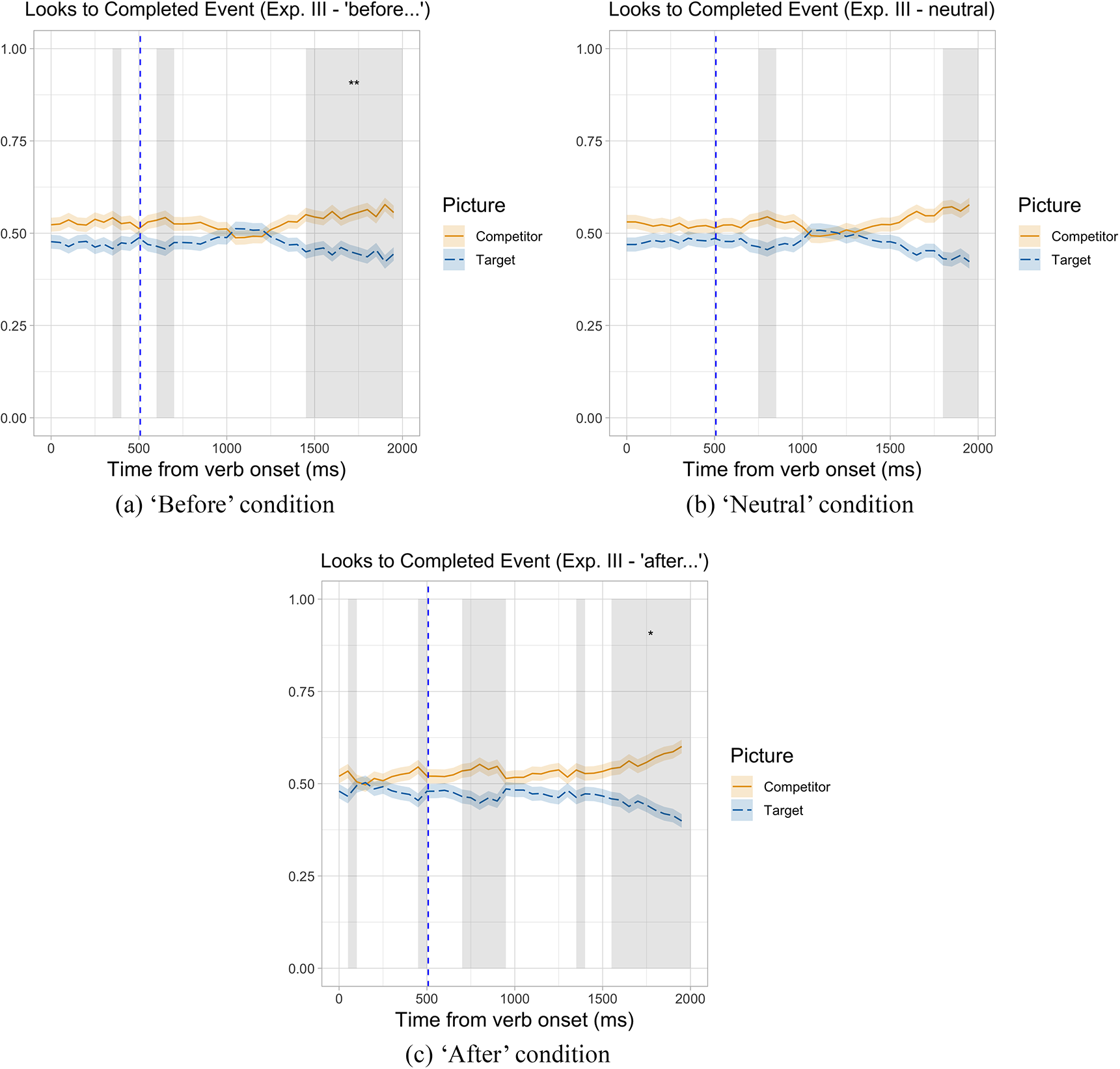
In figures 7a, 7b and 7c, the dotted blue line represents the offset of the main verb. In all three cases, the proportion of looks hovers at chance level (around 0.5) during and immediately after processing the past-tense verb, regardless of preamble. One to two seconds after the verb, there is in all cases, if anything, a preference for the ongoing picture, not the completed one. This preference becomes (comparatively mildly, considering our earlier results for the perfect) statistically significant in the before and after conditions. In the before condition, the cluster-based permutation analysis found one significant cluster (sum $ z=-26.43 $
,
$ z=-26.43 $
, $ p=0.006 $
) late from 1,450 ms to 2,000 ms after verb onset for preferential looks to the ongoing picture. In the after condition, a similar cluster appears at 1,550 ms after verb onset (sum
$ p=0.006 $
) late from 1,450 ms to 2,000 ms after verb onset for preferential looks to the ongoing picture. In the after condition, a similar cluster appears at 1,550 ms after verb onset (sum $ z=-21.98 $
,
$ z=-21.98 $
, $ p=0.025 $
). No significant clusters were found in the neutral condition. The significant time bands are shown shaded in grey (figures 7a–c).
$ p=0.025 $
). No significant clusters were found in the neutral condition. The significant time bands are shown shaded in grey (figures 7a–c).
In sum, the picture choice data aligned with the gaze preference data, and although the gaze data looks slightly different for each simple past subcondition, that variation is not reflected in participants’ final picture choice.
5.2. Discussion
The discourse manipulation turned out not to improve the result saliency of the simple past in English. If anything, the increased complexity of the discourse led to more looks to the ongoing picture. We therefore conclude that our hypothesis was falsified, and the English simple past does not become more ‘perfective’ in narrative contexts. Rather, it seems as though the role of narrative progression in discourse which the simple past in English has for all dynamic verbs must be logically separated from the semantics of telos, or ‘result’ attainment.
6. Conclusion: implications for theories of the English tense/aspect system
The focus of our article has been the differences between the English simple past and the English perfect tenses. In many European languages, the equivalent historically analogous tenses are in competition. In formal semantic accounts, it is often the case that present perfect and the simple past do not differ in their truth conditions, but just in their pragmatics. Recent corpus work suggests, however, that the past tense in English and the present perfect are rather different in their distribution in a text in quite systematic ways (Van der Klis et al. Reference Klis, Le Bruyn and de Swart2022; Michaelis Reference Michaelis, De Wit, Brisard, Madden-Lombardi, Meeuwis and Patard2024). The present perfect does not advance narrative time, the past eventuality it entails does not link up anaphorically to previous events in the discourse, and cannot be directly modified. Our own test, using quite a different methodology – a psycholinguistic Visual World Paradigm – also supports a difference between the two, this time in terms of a cognitive difference. Specifically, we found that the perfect tenses make salient the result state in a way that the past tense does not, even when we control for specific verb and Aktionsart type.
There are two related issues we would like to raise here. The first is the question as to what our measure of result state salience is sensitive to. Is it driven by context, inference and/or pragmatic effects or should it be built into the assertive content of the construction in question? In other words, how should the salience of the result state be captured in formal theories of the perfect, where there is an interplay of assertive and presuppositional content, and with different levels of pragmatic contribution? In answering this question, we need to make sure that whatever we claim the looking preference test is sensitive to should not erroneously predict that the simple past behave in a similar way. In fact, we believe that the contrast with the simple past, even when put into different discourse contexts, is a clue to how the Visual World Paradigm results should be interpreted.
Basically, we suspect that the Visual World test we have now run on a number of different languages and construction pairs is most sensitive to the assertive content of the grammatical form in question and is much less affected by downstream inferential processes. Our main effects here have been of construction type, not of individual participant or item. And our discourse manipulation, though quite drastic, did not significantly change the profile of the simple past behaviour.
It is also important to acknowledge that the test in question is not perfectly symmetrical. The picture corresponding to the ongoing event is clearly the most direct representation of the lexical content of our verbs. The result state quite often depicts the cessation of the action, and is potentially consistent with other kinds of description (although perhaps not in the context of this task). The result state picture always involves some visual inference, while the ongoing picture depicts the action in a more directly recognisable way. If a simple holistic Kleinian interpretation of the perfective past were the full story here, it should entail the past manifestation of both the action and the result of a telic action. The Kleinian analysis of the perfective here is repeated in for convenience.

Under the hypothesis that an entailed subevent should be salient to the comprehender, we would predict that a perfective past would draw looks to both pictures, while for the imperfective it would just be the ongoing picture. Under this story, the English past tense behaviour is entirely expected ‘perfective’ behaviour. Nevertheless, the Russian perfective sentences are clearly preferentially associated with the result-state picture, and this no longer gets an explanation under a Kleinian analysis. So either the Kleinian analysis is not the correct way to represent the phenomenon of perfectivity, or Slavic perfectivity is not in fact a case of it.
What seems missing in the Kleinian analysis, if it is to capture true perfectivity, is an explicit reference to telos or temporal boundedness, and its relationship to result states in the case of accomplishments. There are other accounts of perfectivity that attempt to do just that. We suspect that these accounts are to be preferred to the classical view.
Turning now to the perfect in English, we find that the result state of an accomplishment verb is indeed cognitively salient – it passes the preferential looking test with flying colours.Footnote 9 We know from the discussion of the simple past that an analysis that simply says the result state’s existence is entailed is not enough to derive this result, for this is true of the simple past as well. Instead, if we still wanted an indefinite past analysis, we would have to derive the salience of the result state from some presupposition of present relevance, the standard add-in for such accounts. Our suspicion is that it is going to be difficult to get the notion of relevance, independently defined, to make a principled distinction between the simple past and the present perfect here. Consider a context sentence A, where the state of the new coffee machine is explicitly at issue and made salient. In such a context, both the perfect in B and the simple past in B′ are equally felicitous.

It seems hard to operationalize a pragmatic or information structure notion of present relevance in the highly specific way it is found in the present perfect that is different from general Gricean conditions on conversational expectations and well-formedness.
We think in fact that the proposals in the literature that analyse the perfect in terms of the direct assertion of the result(ant) state thus entailing the past eventuality (Parsons Reference Parsons1990; Smith Reference Smith1991; Kamp et al. Reference Kamp, Reyle and Rossdeutscher2016) are much more promising for accounting for the data patterns found here. Since the resultant state would be exclusively directly asserted in the case of the perfect, we predict that this subevent would be cognitively represented directly. In the case of the simple past which asserts the past existence of a complex accomplishment, both parts of the accomplishment are asserted and no direct preference between ongoing and completed depictions would be predicted. Moreover, this analysis also has the advantage of making sense of the fact that the past tense entailed event is not directly represented in the discourse structure and hence unavailable for temporal relationships.
While we do not claim to have conclusively settled the issue, we think that the results from the Visual World Paradigm experiments we have conducted, keeping task and verb type constant across constructions and languages, constitute an important contribution to the debate about perfectivity on the one hand, and the proper interpretation of the perfect on the other.
Data availability statement
All experiment materials, data and analysis code for this study are made available on Open Science Framework (https://osf.io/82hwv/).
Author contribution
Conceptualization, S.M., M.V. and G.R.; methodology, S.M., M.V. and G.R.; software, M.V.; data analysis, M.V.; visualization, M.V.; investigation, M.V.; data curation, M.V.; project administration, M.V.; validation, M.V.; writing – original draft, G.R., S.M. and M.V.; writing – review and editing, M.V. and G.R.; supervision and funding acquisition, G.R.
Funding information
The authors were funded by the Research Council of Norway FRIPRO project 275490 Modal Concepts and Compositionality: New Directions in Experimental Semantics.
Ethics and consent
This study has been designed and conducted in accordance with the 1964 Helsinki Declaration and its later amendments or comparable ethical standards. The study was registered with and reviewed by the Norwegian Centre for Research Data, to ensure its compliance with the General Data Protection Regulations; the legal ground for processing personal data was informed consent, and data subjects’ rights have been provided for accordingly.
Appendix
A.1. Methods (Experiments 1–3)
The experiment code and materials on which the experiments reported in this article are based are available via the Open Science Framework repository for Vos et al. (Reference Vos, Minor and Ramchand2022). Small adjustments have been made to create the different experiments; the complete code-base for each has not been uploaded to this article’s OSF repository, but readers hoping to scrutinize or replicate a particular experiment are encouraged to contact the first author (myrte.v@gmail.com).
A.1.1. Materials and design
All experiments included 24 filler trials and either 24 (Experiments 1 and 3) or 12 (Experiment 2, see section A.1.2) test trials, consisting of a visual display and an audio stimulus. The visual display consisted of two pictures presented side by side: in the filler trials, the pictures were of two different events (but with a common agent). In the test trials, the pictures represented two stages of the same event: one where the event is ongoing (see figure 2a), and one in which it is completed (see figure 2b). Multiple lists were created such that each test item appeared once in each list, in alternating conditions; and such that the left/right placement of the ongoing/completed event picture, as well as the target/competitor picture, was balanced across lists. Participants were randomly assigned to a list. Subsequently, the trials were pseudo-randomized such that they formed fixed blocks of four items: alternating filler and target items, balanced for picture-type placement. The order between these blocks was randomized by participant. There were no practice items.
A.1.2. Materials and design for Experiment 2
In preparation for this series of experiments, we ran a norming study in which participants rated our English sentence stimuli on how well they described the accompanying target Event picture, on a five-point Likert scale. Sentences in the present progressive, the future tense, and with the modal verb might were normed against their corresponding Ongoing Event picture; only the sentences in the present perfect were normed against their Completed Event picture. Each sentence was presented in written form, underneath its corresponding picture. The points on the Likert scale were labelled, from 1 to 5 respectively: ‘Not at all’, ‘Not well’, ‘Unsure’, ‘Quite well’ and ‘Very well’. The norming study was built using OpenSesame (Mathôt et al. Reference Mathôt, Schreij and Theeuwes2012) and run on our institution’s JATOS server, with monolingual English speakers recruited via Prolific ( $ n=170 $
, paid £1.25 for a median 7 minutes of work). Four lists were created such that each participant would see each Event, paired with a sentence in one of four possible verb types, only once. We then selected only the 12 test items that were normed at an average of at least 3.8 across all sentence variations.
$ n=170 $
, paid £1.25 for a median 7 minutes of work). Four lists were created such that each participant would see each Event, paired with a sentence in one of four possible verb types, only once. We then selected only the 12 test items that were normed at an average of at least 3.8 across all sentence variations.
As in our earlier studies, four lists were created such that each test item appeared in the present progressive condition in one list, and in the present perfect condition in the other; and such that the side of the screen on which the target picture was presented was balanced between lists.
A.1.3. Procedure
All experiments were programmed using jsPsych, version 6.3 (De Leeuw Reference De Leeuw2015), and hosted on a JATOSFootnote 10 server (Lange et al. Reference Lange, Kühn and Filevich2015) hosted by the authors’ institution. For a detailed description of the browser implementation of the procedure of these studies, including the gaze-to-screen location calibration, see Vos et al. (Reference Vos, Minor and Ramchand2022).
Following calibration, the experiment proceeded as described in section 3.3: the narrative preamble phase of each trial began with a fixation point at centre screen, which had to be clicked to play the preamble audio. Once the preamble finished playing, the trial advanced automatically to the visual world display and the target sentence audio. After the sentence ended, the participant had to select one of the pictures by clicking on it, which triggered the start of the next trial. Participants’ eye movements were recorded from the onset of the visual world display, up to the moment they clicked on a picture.
A.1.4. Participants
Participants were recruited via Prolific.ac. In each experiment, we based our sample size on the heuristic we developed over the course of piloting and running Vos et al. (Reference Vos, Minor and Ramchand2022): having established that ~40 participants per experimental condition (given 12 trials per condition) was a sufficient sample size for our webcam VWP study design, we increased the number of participants per condition with every decrease in trials per condition, in a manner roughly resembling an exponential growth formula.
We applied several demographic filters on Prolific, to ensure as much uniformity in language background and computer equipment as we could manage remotely: participants had to be English speaking monolinguals who had spent most of their time before turning 18 in the United Kingdom; and they could only participate with a desktop computer (as opposed to a tablet or phone) and a webcam.
Informed consent was obtained electronically by clicking a button labelled ‘I agree and Start’ at the bottom of a reloadable information and consent page. Participants were paid £4 (in the case of Experiments 1 and 3) for an estimated study duration of 20 minutes, and £3.50 (in the case of Experiment 2) for an estimated study duration of 15 minutes, if they successfully completed the entire study; participants in all three experiments were paid £2 if they completed part of the study after a successful initial calibration, but were barred from finishing it after a failed recalibration. If they were unable to calibrate and start the study, they received no compensation. Participants were informed of this conditional payment structure in the information and consent letter.
A.1.5. Data preparation and analysis
Participant exclusion was determined by picture choice accuracy rate in the filler trials. All participants were $ >85\ \mathrm{per}\ \mathrm{cent} $
accurate, and so none were excluded. We excluded individual trials with
$ >85\ \mathrm{per}\ \mathrm{cent} $
accurate, and so none were excluded. We excluded individual trials with $ >50\ \mathrm{per}\ \mathrm{cent} $
track loss, i.e. trials with
$ >50\ \mathrm{per}\ \mathrm{cent} $
track loss, i.e. trials with $ >50\ \mathrm{per}\ \mathrm{cent} $
gaze predictions located outside the participant’s screen dimensions: an average
$ >50\ \mathrm{per}\ \mathrm{cent} $
gaze predictions located outside the participant’s screen dimensions: an average $ 0.52\ \mathrm{per}\ \mathrm{cent} $
of trials were excluded.
$ 0.52\ \mathrm{per}\ \mathrm{cent} $
of trials were excluded.
In each experiment, we coded the Ongoing Event picture in the ‘imperfect’ condition and the Completed Event picture in the ‘perfect’ condition as Target. The opposing picture was coded as Competitor. To test whether the proportion of Target picture selections was significantly above chance in either condition, we fit two separate mixed effects logistic regressions (using the R package lme4; Bates et al. Reference Bates, Mächler, Bolker and Walker2015; R Core Team 2019) estimating the log-odds of a target response in the ‘imperfective’ and ‘perfective’ trials, with random intercepts for participants and items.

For Experiment 3, we again fit two separate mixed effects logistic regressions – one for the progressive condition, and one for the simple past condition – with discourse type as a fixed effect:

To identify the time windows in which the probability of fixating on the target picture was significantly above chance, we performed a cluster-based permutation analysis (CPA) for each condition (see e.g. Maris & Oostenveld Reference Maris and Oostenveld2007; Huang & Snedeker Reference Huang and Snedeker2020; Yang et al. Reference Yang, Chan, Chang and Kidd2020; Ito & Knoeferle Reference Ito and Knoeferle2023). We chose the CPA because it is a non-parametric test for whether a condition effect is significant at any point during a specific time window, while controlling for autocorrelation of data points in a time series (such as the distribution of gaze fixations over time, or event-related potentials in the brain). It is considered a reliable, if somewhat statistically conservative method of analysis for VWP eye-tracking data: a caveat is that while CPA detects groups of consecutive time bins (the titular ‘clusters’) in which an effect is significant, the left boundary of that cluster does not mark the onset of that significance.
We made a subset of the data from verb onset to 2,000 ms after verb onset; binned that data into 50 ms time bins; calculated the proportion of fixations on the target picture in each time bin; and then binarized these proportions by rounding up to 1 or down to 0. Next, we fit a mixed effects logistic regression for each time bin, to estimate the log-odds of fixations on the target picture. Items and participants were included as random intercepts.
Next, we clustered together consecutive time bins where the probability of fixating on the target picture was significant at $ \alpha =0.08 $
, on the assumption that these all exhibit the same effect;Footnote
11 and summed up their z-values to create a sum statistic for each cluster. Finally, we estimated how likely these clusters would be to occur by chance, under the null hypothesis that the probability of fixating on the target versus the competitor picture was at chance. We did this by creating a permutation distribution, whereby we randomly shuffled the picture labels (target vs competitor) by participant and then repeated the regression and the clustering steps. This procedure was repeated 1,000 times, yielding a distribution of sum statistics against which the statistics of the original clusters were compared. Clusters with
$ \alpha =0.08 $
, on the assumption that these all exhibit the same effect;Footnote
11 and summed up their z-values to create a sum statistic for each cluster. Finally, we estimated how likely these clusters would be to occur by chance, under the null hypothesis that the probability of fixating on the target versus the competitor picture was at chance. We did this by creating a permutation distribution, whereby we randomly shuffled the picture labels (target vs competitor) by participant and then repeated the regression and the clustering steps. This procedure was repeated 1,000 times, yielding a distribution of sum statistics against which the statistics of the original clusters were compared. Clusters with $ p<0.05 $
were considered significant.
$ p<0.05 $
were considered significant.
A.2. Offline response statistical model results (Experiments 1–3)
A.2.1. Experiment 1
Offline accuracy model results (Experiment 1: progressive)

Offline accuracy model results (Experiment 1: past perfect)

A.2.2. Experiment 2
Offline accuracy model results (Experiment 2: progressive)

Offline accuracy model results (Experiment 2: present perfect)

A.2.3. Experiment 3
Offline accuracy model results (Experiment 3: progressive)
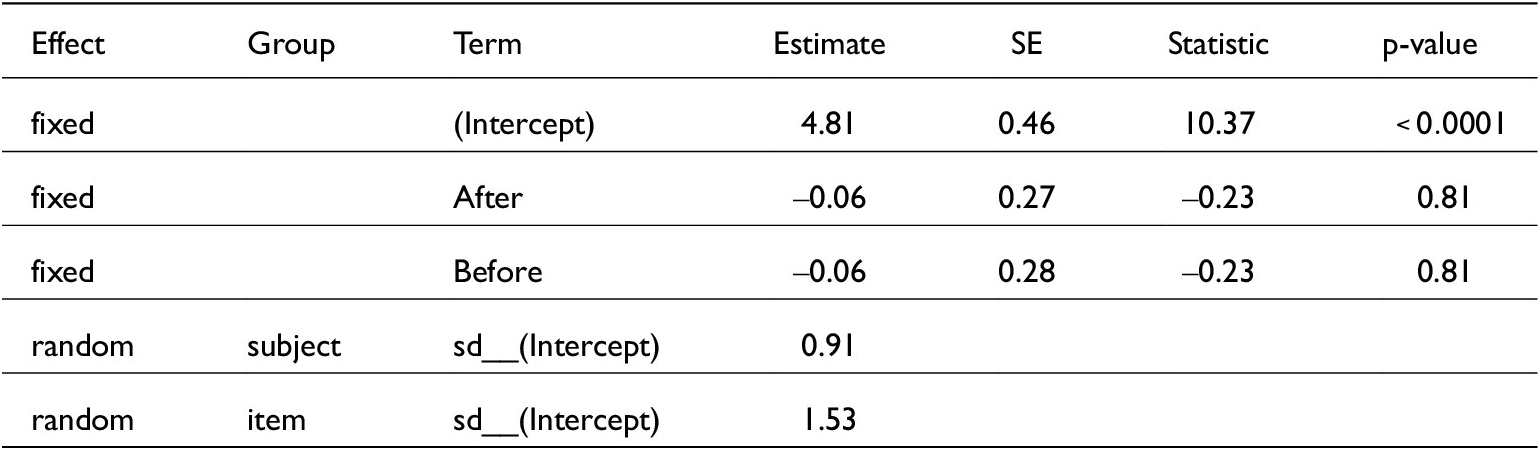
Offline accuracy model results (Experiment 3: simple past)
A.2.4. Online results from the progressive condition (Experiment 3)
Proportion of looks to the target picture in the past progressive condition (aggregated from all three sub-experiments in Experiment 3)











 Open access

