





1. Introduction
Metaphor is a fundamental part of our imagination and language. Via metaphor one “speak[s] of something as though it were another” (Richards, Reference Richards1936, p. 116). In poetry, as in other literary forms of art, the author can establish a similarity relation between two entities, as in John Keats’s (1819) famous saying “Beauty is truth, truth beauty – that is all” or in Shakespeare’s (1597) “Juliet is the sun”. When scholars theorize about the nature of metaphor in literature, they often focus on the artistic nature of figurative language. At the same time, research in psycholinguistics and related fields has shown that literary metaphors are rooted in the same unconscious thought patterns and bodily experiences as conventional metaphors (Gibbs, Reference Gibbs1990, Reference Gibbs1999, Reference Gibbs, Burke and Troscianko2017b). Thus, they neither violate standard communicative norms nor require a special talent to be produced or understood, as proposed earlier (cf., e.g., Grice, Reference Grice, Cole and Morgan1975; Searle, Reference Searle, Searle, Kiefer and Bierwisch1980).
The currently most dominant approach within the large, diverse multi-disciplinary area of metaphor research is Conceptual Metaphor Theory (CMT), which proposes that metaphor is omnipresent also in non-literary language and that it shapes the ways people think, act, and communicate (Lakoff & Johnson, Reference Lakoff and Johnson1980). To take just one example, in Western cultures our concept of time is partly structured by the knowledge that we have about money. This is reflected in common English expressions, such as “Time is money”, “She spends her time unwisely”, and “The diversion should buy him some time”. According to CMT, people think and talk about time by mapping the knowledge that they have about the concrete source domain “money” onto the abstract target domain of “time”. The underlying conceptual metaphor is TIME IS MONEY. Some other common conceptual metaphors are LOVE IS A JOURNEY (e.g., “We’ve hit a crossroads in this relationship”), PEOPLE ARE PLANTS (“She’s in her flower of youth”), and GOOD IS UP (“That’s a high-quality paper”). The main claim of this cognitive-linguistic approach is that we all automatically and unconsciously use such conceptual cross-domain mappings to get a better understanding of abstract concepts that we encounter in our everyday lives.
Apart from studying conceptual metaphors in language use, recent investigations in the cognitive sciences have gathered empirical evidence for the existence of conceptual metaphors in non-verbal realms, such as images, sound, and body language (e.g., Gibbs, Reference Gibbs2006, Reference Gibbs2017a; Bergen, Reference Bergen2012; Forceville, Reference Forceville and Jones2012; Kövecses, Reference Kövecses2015; also see Casasanto & Gijssels, Reference Casasanto and Gijssels2015, or Hampe, Reference Hampe2017, for critical discussions). For instance, people were shown to use upward beat gestures, motivated by the GOOD IS UP conceptual metaphor, when talking about the weather getting better, and employ downward gestures when speaking about buying a car for a cheap price (LESS IS DOWN). Furthermore, extensive research has stressed the importance of embodied simulation processes in people’s engagements with figurative language (e.g., Soriano & Valenzuela, Reference Soriano, Valenzuela, Valenzuela, Rojo and Soriano2009; Colston, Reference Colston2019). For instance, Boroditsky and Ramscar (Reference Boroditsky and Ramscar2002) explored how people’s very recent embodied actions affected their understanding of time metaphors. People waiting in line at a cafe were given the statement “Next Wednesday’s meeting has been moved forward two days” and then asked “What day is the meeting that has been rescheduled?” People who have been advancing further in the queue were more likely to say that the meeting was moved to Friday instead of Monday, thus associating their forward motion in space with their perception of time.
The notion that conceptual knowledge and embodied experiences are also central to people’s understanding of literary metaphors has been explored thoroughly in Turner’s The Literary Mind (Reference Turner1996) and Lakoff and Turner’s More than Cool Reasons (1989). One of the authors’ main arguments is that metaphorical creativity in poetry is the result of common devices that poets use in manipulating conceptual metaphors that they share with everyday people. This also explains why readers, as suggested by Lakoff and Turner, draw on pre-existing conceptual mappings rather than creating novel metaphorical mappings to understand novel poetic language (1989, pp. xi–xii). This view has been taken up and further elaborated in numerous other works (e.g., Kövecses, Reference Kövecses1994; Steen & Gibbs, Reference Steen and Gibbs2004; Camp, Reference Camp2008; Semino & Steen, Reference Semino, Steen and Gibbs2008; Yang, Reference Yang2015). Most of these studies are based on close readings of literary narratives and/or on systematic identifications of conceptual metaphors in (poetic) discourse (e.g., Deignan, Reference Deignan2005; Pragglejaz Group, Reference Group2007; Steen, Reference Steen2007; Steen et al., Reference Steen, Dorst, Herrmann, Kaal, Krennmayr and Pasma2010) rather than on empirical investigations into how readers process poetic metaphors.
Our current study aims to address this lacuna and explores empirically whether readers access conceptual metaphors during poetry interpretation or not. A psycholinguistic experiment consisting of two tasks was designed to shed some light on this issue. In Task 1, participants rated lexical items that were related or unrelated to the underlying conceptual metaphors present in stanzas of poetic texts. Task 2 involved the selection of conceptual metaphors from a set after reading longer excerpts from the same poems. Before introducing the design of the study and discussing the results, the next section will provide an overview of previous research on metaphor processing in poetry.
2. Previous research on metaphor processing in poetry
Research on metaphor processing in literary narratives so far has been characterized by little collaboration between the cognitive sciences and the humanities when it comes to the study of how literary narratives are processed by readers. Furthermore, empirical approaches to the study of literature reception, such as Cognitive Poetics or Neurocognitive Poetics, have given very little attention to the role of conceptual metaphors in the production and processing of poetic language. At the same time, only a handful of studies in psycholinguistics have focused on the role of conceptual metaphors in poetry interpretation.
2.1. COGNITIVE POETICS
An empirical approach to the study of literature reception that combines methods from the cognitive sciences and the humanities is known as Cognitive Poetics. It has its roots in the 1970s and is defined as “a theoretical methodology that explains how poetic language and literary form are shaped and constrained by human cognitive processes” (Tsur, Reference Tsur2017, p. vii). Cognitive Poetics expanded in the late 1990s, driven by increasing interest from literary scholars in conceptual metaphor, figure and ground, and schema- and world-theories (e.g., Freeman, Reference Freeman and Barcelona2000; Stockwell, Reference Stockwell2006; Giovanelli, Reference Giovanelli2013; also see Freeman, Reference Freeman, Geeraerts and Cuyckens2007, or Csabi, Reference Csabi2018, for further discussions). Regarding the study of metaphor, a cognitive poetic approach explores “how the general mapping skills that constitute the cognitive ability to create and interpret metaphor can provide a more coherent theory than the intuitive and ad hoc approaches of traditional criticism” (Freeman, Reference Freeman and Barcelona2000, p. 253). For instance, Popova (Reference Popova2002) explored how metaphorical mappings of smell in Patrick Süskind’s novel Perfume contribute to the emergence of the text’s theme. Furthermore, Bertuol (Reference Bertuol2001) studied the writings of the poet Margaret Cavendish to show how the conceptual metaphor UNIVERSE IS MATHEMATICS shaped how people viewed reality back in the seventeenth century. In general, it can be said that Cognitive Poetics broadens the classical theories in literary studies by taking into account how poetic language and form is constrained by human cognitive processes. Yet, scholars in that field mainly draw on already existing studies in cognitive science instead of conducting empirical research themselves.
2.2. NEUROCOGNITIVE POETICS
A recently developed approach that builds on theories of Cognitive Poetics but also studies the neuronal and cognitive-affective bases of literary reading is called Neurocognitive Poetics. Its focus lies on empirical investigations into how the brain processes poetic language and creates meaning and pleasure out of the various bits and pieces that construct a poem, such as sounds and images, figures of thought (e.g., polysemy, irony, meiosis, oxymoron) or figures of speech (e.g., euphemism, simile, metaphor) (Jacobs, Reference Jacobs2015). One extensive study was conducted by Jacobs and Kinder (Reference Jacobs and Kinder2017) on metaphor processing that aimed, among other issues, at identifying the strongest predictors of ‘metaphor goodness’, i.e., how apt or pleasing the metaphors were.Footnote 1 Some key findings of the study indicate that sentences are more likely to be judged as metaphorically meaningful if the vehicle is concrete, and that ambiguous metaphors produce higher aesthetic liking (e.g., Byron’s “a broken heart is a shattered mirror, reflecting life in pieces”; Shakespeare’s “the sun is the eye of heaven”). However, as the examples show, the corpus was limited to metaphors of the type ‘A is B’, that are relatively rare in discourse. Furthermore, the study did not explicitly test for the role of conceptual metaphor in the processing of poetic metaphors.
Another study that focused on metaphor appreciation was conducted by Littlemore, Sobrino, Houghton, Shi, and Winter (Reference Littlemore, Sobrino, Houghton, Shi and Winter2018). It differs from Jacobs and Kinder’s (Reference Jacobs and Kinder2017) investigation as it paid significantly more attention to conceptual metaphors. Yet, it explored people’s reactions to non-literary, computer-generated metaphors (e.g., ‘love is a beautiful painting’; ‘business is relaxing music’). One of their findings is still highly relevant to the present project: the researchers found that people were more likely to detect meaning in conventional and moderately innovative metaphors than in highly innovative ones. This, as the authors explain, suggests that “people have an awareness of or preference for conceptual metaphor, even if it is at a subconscious level: If there is a conceptual metaphor that can be identified then the metaphor is preferred” (2018, p. 117). More generally, this finding implies that, when readers encounter conventional or moderately innovative metaphors, the underlying conceptual metaphors are accessed. But does the same apply to the processing of poetic metaphors?
2.3. PSYCHOLINGUISTIC PERSPECTIVES ON THE STUDY OF METAPHORS IN POETRY
While the question of whether the processing of metaphors in poetry requires readers to access conceptual metaphors has so far received relatively little attention in the field of (Neuro)cognitive Poetics, some studies in psycholinguistics have focused on the role of conceptual metaphors in poetry interpretation. A series of studies by Gibbs and Nascimento (Reference Gibbs, Nascimento, Kreuz and MacNealy1996) showed how pre-existing conceptual metaphors constrain people’s interpretation of metaphors in love poetry. In their first study, participants were asked to write about the concept of love and about their personal love experiences. The responses have shown that people use conventional expressions that reflect enduring metaphorical conceptualizations of love such as LOVE IS UNITY, LOVE IS A VALUABLE RESOURCE, or LOVE IS A JOURNEY. In their second study, participants were asked to read segments of poetry and to choose those conceptual metaphors from a list that they think best reflected the meaning of the presented poem. The researchers found that participants performed very well in this task as the selected conceptual metaphors reflected the theme of the poetic fragments that they had just read. The third experiment showed very similar results when a different group of people was asked to select conventional expressions from a list of five that best reflected the concept of love described in the poem. In their final study, Gibbs and Nascimento used think-aloud protocols to assess whether the ways people talk about the metaphorical meaning of selected poems reflect their everyday metaphorical understanding of love. The results showed that this was indeed the case. For example, when participants interpreted the meaning of Pablo Neruda’s poem Ode and Burgeoning, they referred to entailments of the LOVE IS A JOURNEY conceptual metaphor, such as the path (e.g., participants reported a special road that the characters in the poem could travel on together), the goals (e.g., the future of their love lay ahead of them), and the impediments to travel (e.g., they managed to get over the rough places). Overall, Gibbs and Nascimento concluded that, across all poems and participants, 78% of the responses in the think-aloud protocols made references to conceptual metaphors that were underlying the theme or topic of the presented poems.
The relevance of conceptual metaphor in the understanding of poetry is consistent with the findings of two other investigations. In one study, Gibbs and Boers (Reference Gibbs, Boers and Maalej2005) analyzed people’s written interpretations of Robert Frost’s poem ‘The Road Not Taken’ and found that participants made indirect references to the LIFE IS A JOURNEY conceptual metaphor by reporting its typical entailments (e.g., the poet is the traveler, difficulties are obstacles). Additionally, Gibbs and Boers pointed out that numerous participants described how they imagined themselves walking through the woods as part of their in-the-moment comprehension of the poem. These results suggest that people make sense of Frost’s poem and draw relevant metaphorical inferences through embodied simulation processes.
In another series of empirical studies, Gibbs and Okonski (Reference Gibbs, Okonski and Csabi2018) analyzed participants’ written interpretations of Adrienne Rich’s poem ‘Diving into the Wreck’, which describes the diving experience of a scuba diver. Participants were divided into four groups and were asked to read the poem following one of four different instructions. In the first condition, the guidelines suggested the literal interpretation of Rich’s poem. In the second condition, participants were given the idea that the poem describes a failed relationship. The third prompt encouraged participants to consider multiple meanings of the poem, and no explicit instructions about how the poem should be read were given in the fourth setting. Gibbs and Okonski’s main finding was that, regardless of how they were instructed, almost all participants articulated the metaphorical/allegorical theme of the poem by making references to source domains that refer to embodied experiences (e.g., a metaphorical journey into a damaged psyche).
The discussion of previous studies on metaphors in poetry has shown that this topic has been of interest to scholars from different disciplines. A variety of methods were employed to explore what metaphors may reveal about the text structure, how metaphors influence readers’ understanding of poetic narratives, what the use of figurative language tells readers or researchers about the authors or the times in which the poem was written, and which cognitive and aesthetic processes metaphors can evoke. Yet, except for a handful of studies, the role of conceptual metaphors in the processing of poetic metaphors has received relatively little attention. This tendency stems, most likely, from the original proposal of conceptual metaphor theory that much of everyday, non-poetic language is metaphorical. Additionally, one of the main methodological challenges in both poetic and non-poetic contexts is to get verbal proof of whether (or not) conceptual metaphors are activated. The present study attempts to shed more light on these issues. In the following section, the methodological design of the study is explained.
3. Method
The different components of the experiment are outlined below, covering participants, materials, procedure, and data analysis. The study was approved by the Faculty of Science and Technology Research Ethics Committee at Lancaster University and follows the ethical guidelines of the American Psychological Association.
3.1. PARTICIPANTS
Thirty-eight students at Lancaster University participated in the study (29 females and 9 males between 18 and 63 years of age, mean 22.74, SD 8.02). All participants were native speakers of English and received £5 for their participation. At the beginning of the experiment, participants filled out a form to gather information on their gender, age, and occupation. In addition, they indicated their knowledge in their first language and in any other languages they speak. Participants were informed that all personal details remain confidential and that they can withdraw from the study at any time. A signed informed consent was obtained from every participant. Since one participant only completed the first task, Task 2 had a total of 37 participants (28 females and 9 males, 18–63 years, mean 22.76, SD 8.13).
3.2. MATERIALS
3.2.1. Poems and stanzas
The excerpts of poetry used in the two tasks were gathered from the following English-speaking poets: Mark Olival-Bartley (‘Metaphor’), Jason D. Peterson (‘How We Got Here’), Rae Armantrout (‘The Difficulty’), Frank Beck (‘The Copper Husk Allegory’), Shirley Lim (‘Night Vision’), James Arthur (‘Wind’), and Robert Pinsky (‘The Hearts’). A total of 14 two-line stanzas of six of the poems listed above were used for Task 1, and 8 longer stanzas (mean length: 7 lines) from all seven poems were chosen for Task 2.
The selection of stimuli for the two tasks was based on four criteria: (1) all poets are contemporary writers; this is important as the postulation of conceptual metaphors was partly based on the poets’ own interpretations of their works;Footnote 2 (2) non-canonical poems were chosen so that participants would not be familiar with these materials and therefore not be potentially influenced by pre-existing interpretations; (3) the selected poetic fragments depicted different metaphorical themes which could all be understood in their immediate context; this means that, for the purposes of this study, it was sufficient to use excerpts of poetry instead of the entire poem; (4) the materials chosen involve metaphorical themes and topics that are common (e.g., life, death, love, possession, personification) and include a mapping that could be traced back to an established or slightly modified conceptual metaphor present in the Master Metaphor List (Lakoff, Espenson, & Schwartz, 1991). A full list of the poetic excerpts used in the study and their underlying conceptual metaphors can be found in ‘Appendix A’.
3.2.2. Task 1: relatedness ratings
In the first part of the study, a relatedness rating task was used to explore whether participants rate words that refer to a conceptual metaphor expressed in the two-line stanza as more related to the stanza than words that are not connected to the metaphor. For instance, the line The farmhouse is still / Against a voiceless hill from Beck’s ‘The Copper Husk Allegory’ contains the conceptual metaphor A HILL IS A PERSON, which involves the mapping of human attributes from the source domain (person) to the inanimate target domain (hill). According to the hypothesis that people perform cross-domain mappings when they encounter poetic metaphors, we assumed that participants would rate words that refer to the source or the target domain of the conceptual metaphor (in this case human, child, mother, father) as more highly related than words that are unrelated to the metaphor (i.e., door, cupboard, desk, chair).
A set of 4 related and 4 unrelated words were created for each of the 14 two-line stanzas. All 8 words for a particular stanza belonged to the same word class; they were either nouns or verbs. Overall, the 56 related and 56 unrelated words were statistically equal in length, frequency, and semantic distance from the content words contained in their respective two-line stanzas (see Table 1 for descriptive and inferential statistics). Word frequency per million was extracted from the English Lexicon Project (Balota et al., Reference Balota, Yap, Cortese, Hutchison, Kessler, Loftis, Neely, Nelson, Simpson and Treiman2007) and is based on the Hyperspace Analogue to Language (HAL) frequency norms (Lund & Burgess, Reference Lund and Burgess1996). Semantic distance was extracted from the Latent Semantic Analysis (LSA) database (Landauer & Dumais, Reference Landauer and Dumais1997). LSA is a contextual theory of meaning in that it represents the meaning of a word by its relationships to other words in a semantic space. To construct this semantic space, it analyses word co-occurrences in a large number of written documents and represents the meaning of a word or sentence by a vector of 300 numbers (see Kintsch & Bowles, Reference Kintsch and Bowles2002).Footnote 3
Descriptive and inferential statistics of the related and unrelated words used in Task 1
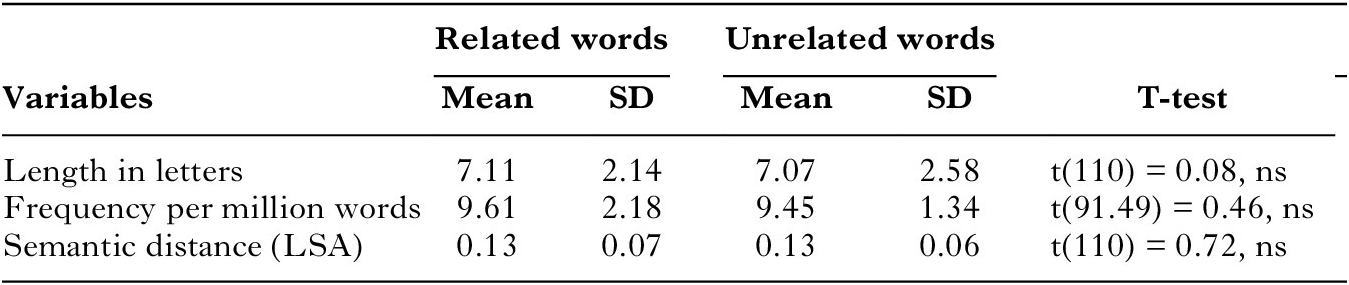
NOTES: Degrees of freedom were corrected in case of significantly unequal variance. Frequency per million words was taken from the Hyperspace Analogue to Language (HAL; Lund & Burgess, Reference Lund and Burgess1996) and extracted from the English Lexicon Project (ELP; Balota et al., Reference Balota, Yap, Cortese, Hutchison, Kessler, Loftis, Neely, Nelson, Simpson and Treiman2007). Semantic distance is based on Latent Semantic Analysis (LSA; Landauer and Dumais, Reference Landauer and Dumais1997).
3.2.3. Task 2: conceptual metaphor selection
In Task 2, participants read 8 poetic stanzas, all of similar length (Mean = 7 lines), and were asked to select up to 3 conceptual metaphors from a list of 6 metaphors. The instructions to Task 2 provided the participants with an explanation of what a conceptual metaphor is, and an example of a poem and its underlying conceptual metaphor were given (see ‘Appendix B’). Then, the participants were asked to select those metaphors that they thought best describe the meaning of each stanza.
In contrast to the previous task, we used longer stretches of the poems to provide the participants with more text, i.e., potential confounds for their metaphor selections (see ‘Appendix D’). The lists of metaphors contained at least one conceptual metaphor and not more than three that occurred in the stanzas, and reflected the meanings of the selected stanzas. These were considered as target metaphors. Additionally, each of the lists included at least one conceptual metaphor that was postulated based on the responses of the authors (see footnote 2). Frank Beck, for instance, said in his response to the question about his choice of metaphors that he was thinking of the cold winter season. Beck said that ‘being still’ or ‘sleeping’, in the farmhouse is still, may be interpreted as people in the farmhouse that are suffering or dead (Beck, Reference Beck and Rasse2017). For this reason, the conceptual metaphor DEATH IS SLEEP was added to the list. In addition, each list comprised at least one conceptual metaphor that was lexically or semantically similar to one underlying conceptual metaphor, but was actually unrelated, such as FIELDS ARE PEOPLE for the same stanza. The remaining conceptual metaphors in the list were unrelated to the poem but are common ways of thinking about abstract concepts, such as NEGATIVE IS DOWN or LIFE IS A JOURNEY. The rationale for creating such sets of conceptual metaphors for each of the poetic excerpts was to hone in on the question of whether participants choose the proper metaphors from the sets.
3.3. PROCEDURE
Participants were recruited through the SONA System, a web-based resource for participant recruitment used at Lancaster University. The study was also advertised at the Departments of Psychology and of Linguistics & English Language at Lancaster as well as on social media. In the advert, a quick description of the study was provided, and it was explicitly mentioned that no knowledge in literary interpretation was required. If candidates decided to participate in the study, they were given a URL to complete the online survey, which was designed using Qualtrics. There was no time limit to complete the task.
In Task 1 (relatedness rating), participants were asked to read 14 two-line stanzas taken from different contemporary poems and to rate the relatedness of 8 words displayed on a list next to the stanza. The related and unrelated items on this list were presented in the same random order (see list of words for each stanza in ‘Appendix A’). The degree of relatedness was indicated on a Likert scale from 1 (not at all related) to 4 (very much related). The two-line stanzas and their corresponding sets of words were presented in different randomized orders across participants.
After completing the relatedness ratings, the participants continued with Task 2. To introduce the task, a definition of metaphor was provided, and an example of a conceptual metaphor in poetry illustrated how conceptual metaphors work (see ‘Appendix B’). After that, the participants were presented with 8 excerpts of poetry (one after the other), each followed by a list of 6 conceptual metaphors which were given in the same random order. For each of the excerpts, the participants were asked to select up to 3 metaphors that “best describe the theme or topic of the poem”. The participants were asked to decide intuitively and not to think about each poem for too long.
3.4. DATA ANALYSIS
The data was analyzed using SPSS. Significance thresholds are set to p < .05 in both tasks unless otherwise specified in the ‘Results and discussion’ section. To calculate effect sizes for independent-samples and paired-samples t-tests, Cohen’s d has been used: d = 0.20 is considered a small effect size, d = 0.50 medium, d = 0.80 or above large. For ANOVAs, partial eta squared (η2) has been calculated: η2 = 0.01 is considered a small effect size, η2 = 0.06 medium, η2 > 0.14 large.
3.4.1. Task 1
For each related and unrelated word, mean relatedness ratings across all participants were calculated. An independent-samples t-test was conducted to compare all single related and unrelated words, across the two-line stanzas. In addition, to further explore differences within each stanza, the individual ratings from each participant for each stanza and each related and unrelated word were analyzed through a series of repeated-measures ANOVAs, one per stanza, with factors Relatedness (related, unrelated) and Individual word (word 1, 2, 3, 4). We are aware of the fact that this latter factor is rather unconventional because the words from 1 to 4 in the related and unrelated sets have nothing specific in common. Nevertheless, considering individual words as a factor in the ANOVA allows us to look at the individual contributions that the words have to the overall relatedness scores within the related and unrelated sets. In these analyses, only the main effects of Relatedness and interactions between Relatedness and Individual words were tested. If a significant interaction between the two factors was observed at p ≤ .001, then further post-hoc comparisons between the individual words were conducted to identify any ‘unexpected cases’, i.e., any instances in which words receive particularly high or low ratings.
3.4.2. Task 2
Out of the 6 conceptual metaphors that participants could choose from, the number of target metaphors that relate to the theme of the poems varied between 2 and 4. The remaining ones functioned as unrelated distractors. Because of the variability in number between target metaphors and distractors across poems, the following scoring procedure was devised: for each participant and poem, the number of correct choices was divided by the total number of target metaphors for that poem; similarly, the number of incorrect answers was divided by the total number of distractor metaphors for that poem. The two proportional scores of correct and incorrect choices were averaged across all participants, separately for each poem. A paired-samples t-test was conducted to compare the mean proportions of correctly selected target metaphors to the mean proportions of incorrect selections for the 8 poems. In addition, differences for each single poem were analyzed by comparing the raw proportions of target and distractor metaphors from all participants in 8 separate paired-samples t-tests for each of the 8 poems.
4. Results and discussion
The raw data collected in both tasks will be publicly available at <https://osf.io/zqm82/> after the first author has completed her doctoral thesis.
4.1. TASK 1: RELATEDNESS RATINGS
On a scale from 1 (not at all related) to 4 (very much related),Footnote 4 metaphor-related words were rated as significantly more strongly related to their respective stanza (Mean = 2.45, SD = 0.64, min–max = 1.24–3.87) compared to unrelated words (Mean = 1.46, SD = 0.38, min–max = 1.03–2.63; t(89.60) = 9.90, p < .001, Cohen’s d = 1.86), and the effect size is large. This result may be taken as an indication that associative relatedness is influenced by underlying conceptual metaphors. When taking a close look at the ratings per poetic stanza, this finding is confirmed in that a significant main effect of relatedness is found in each stanza, and all effect sizes are large (all ηs2 > 0.14; Table 2).
Descriptive statistics of relatedness ratings for related and unrelated words for each stanza, and main effects of relatedness and interactions of relatedness by individual word
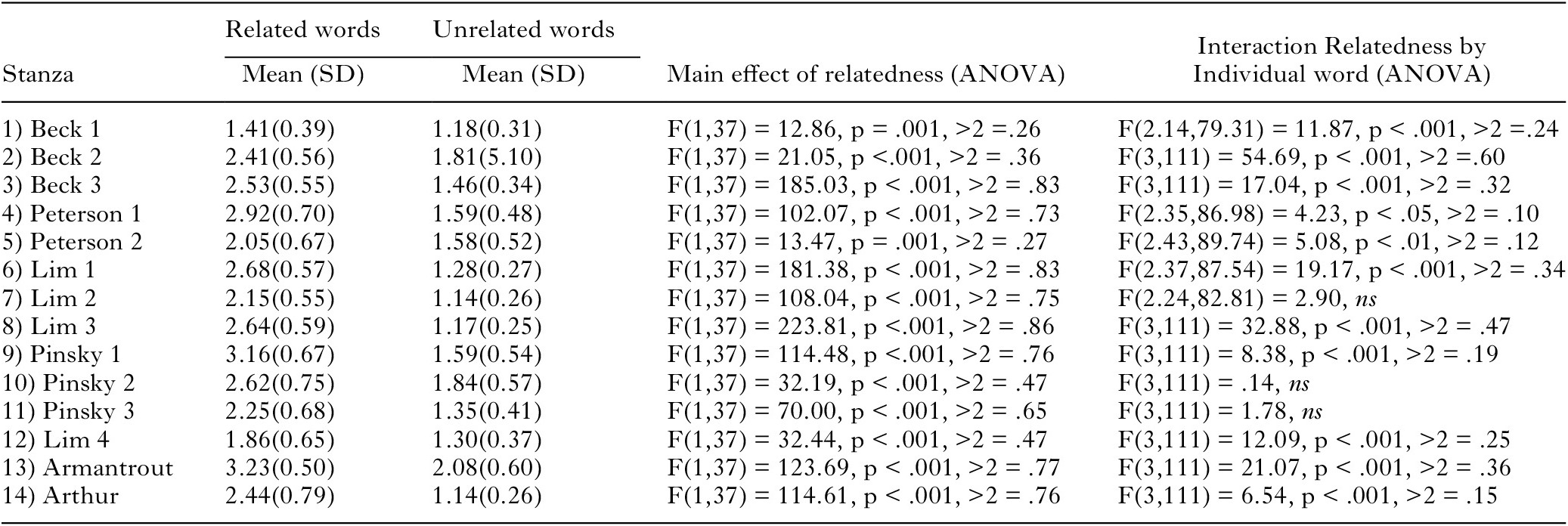
NOTE: Only significant interactions at p ≤ .001 were further explored post-hoc.
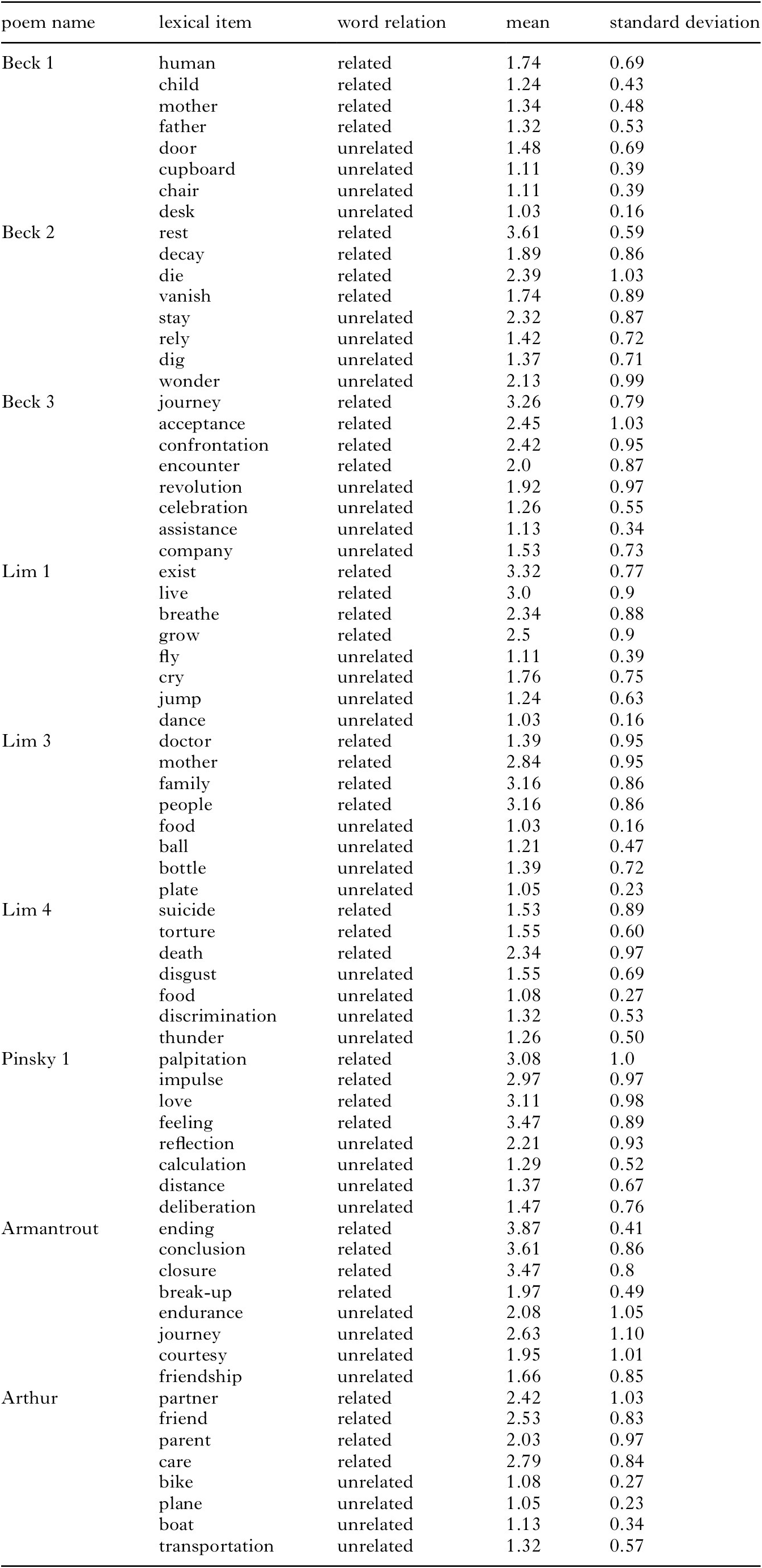
While the statistical results can be interpreted as providing support for the hypothesis that readers access conceptual metaphors when reading the different poetic stanzas, it is worth taking a closer look at the individual un/related words to determine potential effects of their individual ratings. A first quantitative gauge of that is given in Table 2, which reports the ANOVA results of the interaction between relatedness and the individual words. The results show that significant interactions between relatedness and individual words at p ≤ .001, all with large effect sizes (ηs2 > 0.14), were found in 9 out of the 14 stanzas. A post-hoc analysis of these instances serves as the basis for drawing further conclusions on differences between individual words. To single out the individual words, two repeated-measures ANOVAs were conducted for each stanza for the related and unrelated word sets separately (factor individual word). Because of the inevitable differences between single words and, therefore, the likelihood of finding significant differences between all words, a significance threshold of p ≤ .001 was set for the main effects of individual word too. Only for word sets that would reach this threshold were further contrasts explored. The contrasts were defined after visual inspection of the descriptive statistics: for sets in which one word would differ from all others, Helmert contrasts were defined; for sets in which two words would differ from two other words, simple contrasts were defined comparing word pairs. As these contrasts were exploratory (we had no specific a priori directional hypothesis), and because 16 possible comparisons were possible within each set, the standard significance threshold of p < .05 was divided by 16 and the new threshold set to p < .003. Only contrasts reaching this threshold were deemed significant and therefore interpreted and discussed. Table 3 shows only the significant contrasts conducted for each stanza when the main effects of an individual word were significant. Descriptive statistics (means and standard deviation) of all metaphor-related and metaphor-unrelated target items discussed in this section are summarized in ‘Appendix C’.
List of significant contrasts between individual words conducted for each stanza with specification of their direction. All significant contrasts have large effect sizes (all ηs2 > 0.14)

NOTE: Only significant main effects of Individual word at p ≤ .001 were investigated further through contrasts. For contrasts, the significance threshold was set at p < .003. Refer to the main text for the rationale behind these thresholds.
To exemplify the results summarized in Table 3, let us take a closer look at poem 14. In ‘Arthur’ (At times the wind embraces you so lightly / in ways you don’t even register as touch), we postulated the conceptual metaphor WIND IS A PERSON based on the personification of the wind in the stanza. If readers unconsciously draw on this association, the lexical items ‘partner’, ‘friend’, ‘parent’, and ‘care’, all of which relate to the source domain of the metaphor (PERSON), should receive higher ratings than the unrelated words ‘bike’, ‘plane’, ‘boat’, and ‘transportation’. Figure 1 shows that this was indeed the case.
Mean ratings of metaphor-related (a) and metaphor-unrelated (b) words for the poem ‘Arthur’. Relatedness ratings range from 1 (not at all related) to 4 (very much related). Error bars represent ±1 SEM.
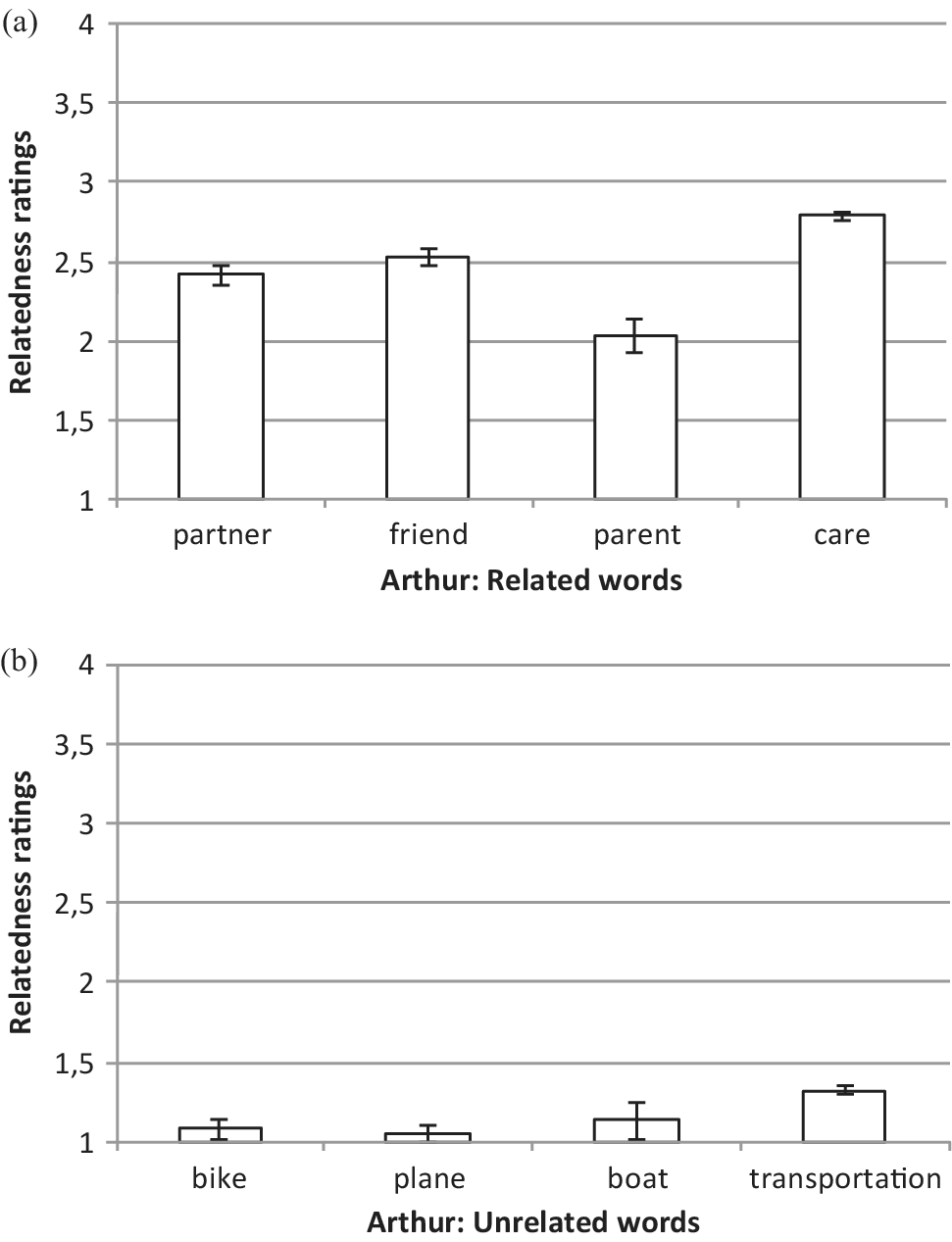
Among related words, the target item ‘care’ got the highest mean rating (2.79), followed by ‘friend’ (2.53) and ‘partner’ (2.42). The related item ‘parent’ got the lowest mean rating (2.03) and was significantly lower than all other 3 words in the set. We propose that the participants’ ratings might have been shaped by people’s understanding of the concept ‘parent’, which might not prototypically be associated to the level of intimacy expressed in the poetic imagery in “Arthur’. The line At times the wind embraces you so lightly / in ways you don’t even register as touch prompted readers to think of a person that shares a more intimate relationship (e.g., a lover or friend). As a hyperonym, ‘parent’ is also a more formal and possibly less affectively laden term than, for example, ‘mum’ and ‘dad’. This finding suggests that participants’ relatedness ratings were also influenced by different semantic associations between the stanzas and the lexical items. All four metaphor-unrelated words were given low ratings (all lower than 1.4) with no significant differences between individual words.
Similar to the previous example, semantic specificity has most likely influenced the ratings of words related to another poem in which significant contrasts between individual words were found (see Table 3). In ‘Lim 3’ (Years later than in a crib / floating among the white moon faces that beam and grasp), the target word ‘doctor’ received significantly lower ratings than the three related words ‘mother’, ‘family’, and ‘people’ (see ‘Appendix C’). Our assumption is that ‘doctor’ is too specific for the scene described in the poem.
Literal relations between certain words in the list and the excerpts of poetry have apparently encouraged participants to rate certain target items higher than the others within a set. In ‘Beck 2’ (One farmer is sitting in the darkened barn / The motor’s singing him to sleep), for instance, the related item ‘rest’, which refers to the literal meaning of the stanza, got the highest mean rating and was significantly higher than the other 3 items ‘decay’, ‘die’, and ‘vanish’, which refer to the metaphorical meaning instead. This could also be an explanation for why the item ‘stay’, which is semantically similar to ‘rest’, but was considered as unrelated to the underlying conceptual metaphor DEATH IS SLEEP, still got significantly higher ratings than the items ‘rely’ and ‘dig’ in the set of metaphor-unrelated words. To ‘wonder’ got the highest mean rating within the set of metaphor-unrelated words as it matches the literal scene depicted in the poem: a farmer is sitting and reflecting on things.
A similar pattern was found in the set of unrelated words in ‘Pinsky 1’. In that case, ‘reflection’ was rated significantly higher than the other 3 words (‘calculation’, ‘distance’, and ‘deliberation’). Our assumption is that ‘wanting’ and ‘grieving’ in The legendary muscle that wants and grieves / The organ of attachment, the pump of thrills describe mental states which are closer to the conceptualization of reflection as a mental state, and consequently prompted readers to see ‘reflection’ as being more closely related to the stanza.
In some other cases, the literal meaning of the stanza seemed to be the main reason why certain lexical items received particularly low ratings. For instance, in ‘Lim 4’ (Years later, I awaken to see / Dust falling in the dark, in the house), the related items ‘suicide’ and ‘torture’ were rated significantly lower than ‘death’. Our explanation is that the notions of ‘suicide’ and ‘torture’ conflict with the lyrical ‘I’ in the poem being alive and observing a scene of decay, which is more in synchrony with the more general notion of death rather than the specific, more aggressive and arousing concepts of torture and suicide. In the case of ‘Beck 1’, the concept of house in The farmhouse is still / Against a voiceless hill has, most likely, encouraged people to see the metaphor-unrelated but semantically close item ‘door’ as being more related to the stanza compared to the other 3 unrelated words ‘cupboard’, ‘chair’, and ‘desk’.
Some of the results give rise to the observation that, within the sets of metaphor-related words, participants’ relatedness ratings were influenced by whether certain metaphor-related words were linked to either the domain or the entailments of certain conceptual metaphors. In ‘Beck 3’, ‘journey’ connects directly to the source domain as lexically prompted by ‘way’ in Only one farmer / has sought the way of pain and got significantly higher ratings than all other 3 related words ‘acceptance’, ‘confrontation’, and ‘encounter’, which are entailments of the conceptual metaphor LIFE IS A DIFFICULT JOURNEY. The same is true for ‘Lim 1’, where ‘exist’ and ‘live’, both relating directly to the conceptual metaphor ALIVE IS AWAKE, were each rated significantly more related to the poem than ‘breathe’ and ‘grow’, which can be considered as entailments of the conceptual metaphor. Also in ‘Armantrout’, the 3 items ‘ending’, ‘conclusion’, and ‘closure’, which relate directly to the conceptual metaphor ENDINGS ARE ROLLING CREDITS, received higher ratings than ‘break-up’, which relates to an entailment of the conceptual metaphor.
Overall, our results have shown that participants perceived connections between the metaphor-related terms and the conceptual metaphors expressed in the poem. In fact, the metaphor-related words were rated as significantly more strongly connected to their respective stanzas compared to the unrelated words. The occurrence of some outliers (target items which were rated significantly higher or lower than the other words within one set) indicates that the processing of metaphors is complex and is shaped by different interacting factors. One of these factors was semantic specificity which, depending on the context, led participants to give specific words particularly high or low ratings. Additionally, we could observe that participants’ relatedness ratings varied depending on whether the target words referred to the literal meaning of the poetic stanza or to the metaphorical. When there was a close literal match, people rated these items as more related than the non-literal ones within related and unrelated sets of words. Furthermore, participants’ relatedness ratings varied depending on whether the target items related directly to the conceptual metaphors or to their entailments. The latter finding is particularly interesting as it suggests that there is usually not one single, fixed conceptual metaphor that is accessed during the processing of poetic metaphors. Instead, readers may recruit aspects of the underlying conceptual metaphor without necessarily activating a fully composed structure that includes the cross-domain mapping and all of its entailments, or even two or more conceptual metaphors and/or their entailments at the same time. This assumption will be further discussed in Section 4.2.
4.2. TASK 2: CONCEPTUAL METAPHOR SELECTION TASK
The target metaphors were chosen significantly more often (Mean = 0.56, SD = 0.08) than the distractor metaphors, and the effect size is large (Mean = 0.12, SD = 0.08; t(7) = 10.19, p < .001, Cohen’s d = 5.50). This was the case for each single poem, too, as can be seen in Table 4. The first 2 poems have medium effect sizes (Cohen’s d ≥ 0.45), while the remaining 6 poems have large effect sizes (Cohen’s d ≥ 0.80).
Mean proportions of correct and incorrect metaphors for each poem and their t-test results
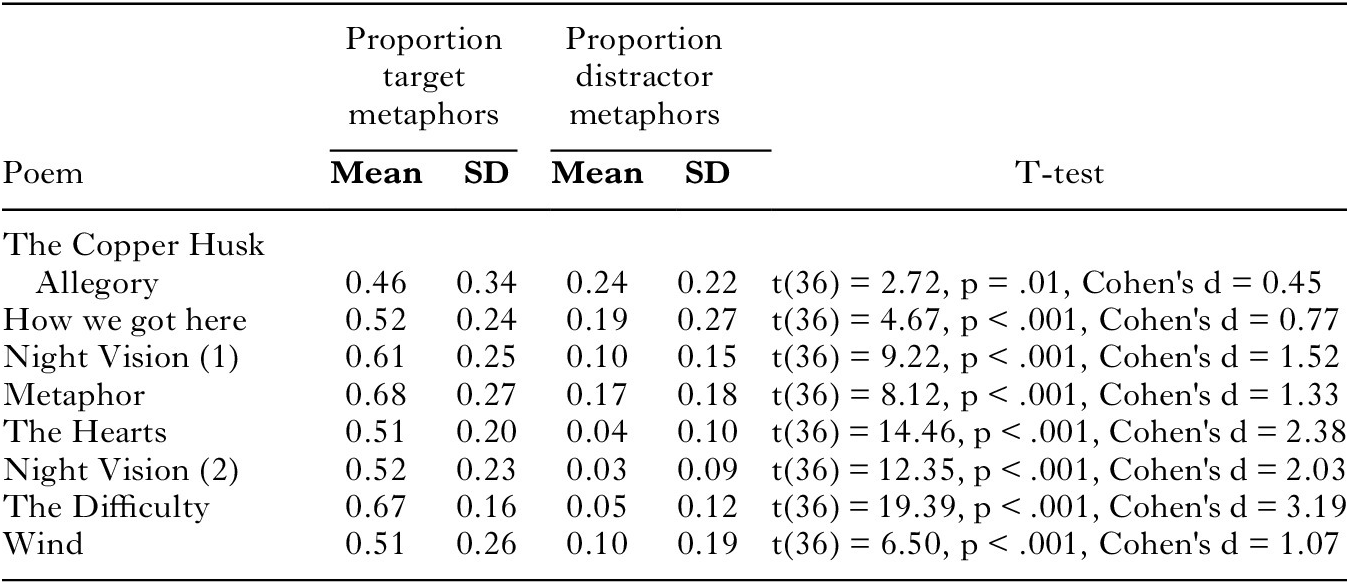
Compared to Task 1, which confirmed the participants’ implicit activation of conceptual metaphors when reading poetry, Task 2 shows that people’s explicit reflection on conceptual metaphors guides them towards appropriate choices. Table 5 summarizes how often in each of the poems the individual conceptual metaphors were selected.
Overview of results in Task 2 (target conceptual metaphors in bold)
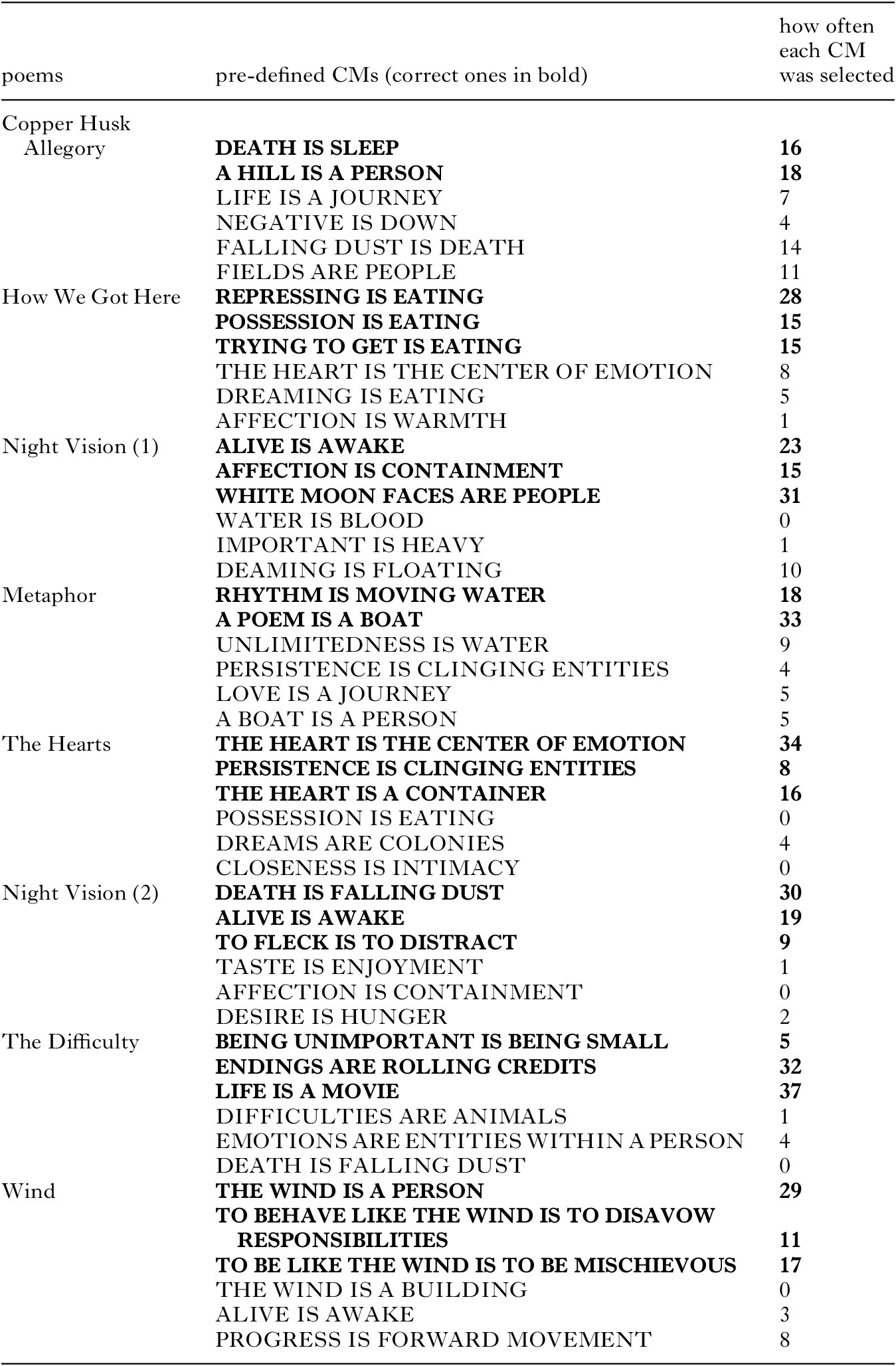
Table 5 shows that, in general, various metaphorical conceptualizations are at play when people read poetry. In ‘How We Got Here’, for instance, the conceptual metaphor REPRESSING IS EATING was selected most frequently. The same conceptual metaphor was also used indirectly in Task 1, as the four mapping-related items ‘to subdue’, ‘to suppress’, ‘to control, and ‘to keep back’ are based on this conceptual metaphor. In this sense, Task 2 supports the findings of Task 1 in that conceptual metaphors are evoked as the participants read the poetic stanzas. Frequently, this does not only hold for one of the metaphors, but it tends to extend to all related metaphors in a stanza, e.g., POSSESSION IS EATING and TRYING TO GET IS EATING were selected 15 times each in ‘How We Got Here’.
In general, participants always selected more than one conceptual metaphor from the pre-given list. These findings suggest that people can recruit more than one conceptual metaphor when they encounter abstract topics. In the case of ‘Night Vision 2’, for instance, participants saw the context-specific, creative conceptual metaphor DEATH IS FALLING DUST as a fitting conceptualization of the themes that the poem depicts. In addition, participants also selected the much broader, more common conceptual metaphor ALIVE IS AWAKE from the list. This implies that people thought about the poem in different metaphorical ways. This was the case for all poems that were used in the study.
5. General discussion and conclusion
The present study used a novel empirical approach to explore whether readers access conceptual metaphors during poetry interpretation. Task 1 consisted of relatedness-ratings that studied people’s implicit retrieval of conceptual metaphors in contemporary poetry. The results showed that words which relate to a conceptual metaphor that underlies the meaning of the presented poem were rated as significantly more related to the poetic stanza compared to metaphor-unrelated words. This result supports our assumption that associative relatedness is influenced by conceptual metaphors. Importantly, our results could not be explained by more general factors such as semantic distance between target words and their stanza, as this was equal between related and unrelated words. When taking a close look at the ratings per poetic stanza, this finding was confirmed in that a significant main effect of relatedness was found in each stanza. In addition, significant interactions between relatedness and individual words were found in 9 out of the 14 stanzas. This finding showed that participants’ ratings varied within the set of related and unrelated lexical items. We analyzed the individual words in detail through post-hoc tests to explore what factors have possibly influenced the ratings. This step was crucial as previous studies have often assumed that metaphor is a final, static product that has only one specific kind of linguistic meaning (see Gibbs, Reference Gibbs, Koller, Semino and Demjen2017c, for a critical discussion).
So far, little attention has been paid to the fact that different, interacting factors may influence the production and processing of metaphors. Besides the association between source and target domains, the present study considers alternative associative pathways that have possibly influenced the results. Our interpretations of the collected data suggest that different semantic processes seem to be at play. Participants’ relatedness-ratings varied depending on whether the lexical items related directly to the underlying conceptual metaphors or to their entailments. In some cases, the expressions in the poetic stanzas seemed to have prompted readers to associate certain target items that represent superordinate or basic level terms linked to the underlying conceptual metaphor. Moreover, relations between certain words in the list and the literal description of the poetic scene sometimes influenced participants’ ratings. Since we did not find a single overall pattern of choices (e.g., participants did not always rate words that depict the literal meaning of the poem higher than words that depict the metaphorical meaning), we concluded that the context of the poem together with the conceptual metaphors play a significant role in people’s relatedness ratings.
This assumption was supported by the results from Task 2, which showed that participants selected the expected conceptual metaphors significantly more often than the distractors. Furthermore, our discussion has shown that, in all cases, more than one conceptual metaphor was seen as being representative of the meaning of the presented poetic stanza. Our assumption, again, is that the selection of conceptual metaphors was strongly influenced by the context of the poem. For instance, some poems evoked very specific images (e.g., a child lying in a crib or the wind flipping an umbrella inside out), others depicted more abstract topics (e.g., starving memories, clinging troubles). In some poems, the narrative voice was positive, optimistic, in others gloomy or melancholic. Depending on these factors, participants’ selections of the ‘fitting’ conceptual metaphors ranged from conceptualizations at a schematic level to conceptualizations at a more specific, conceptually rich level.
One possible limitation of our study is that the findings from the relatedness-rating and the conceptual metaphor selection tasks reflect processing that takes place after the poems/stanzas have been read rather than during reading. Hence, readers may have seen the connections between lexical items or conceptual mappings and the presented stanzas only after reading comprehension, and because of being prompted by the tasks. However, previous research has shown that comprehension and interpretation processes unfold over a long time-window, well beyond word meaning retrieval (e. g., Sitnikova, Holcomb, & Kuperberg, Reference Sitnikova, Holcomb, Kuperberg, Shipley and Zacks2008), and especially so in the case of literary metaphors (Bambini, Canal, Resta, & Grimaldi, Reference Bambini, Canal, Resta and Grimaldi2019). Although our tasks do not tap into cognitive processes at the point of poetic text exposure, they nonetheless reflect residual comprehension and interpretation processes generated during text exposure. In fact, consistent association to conceptual-metaphor-related words and to underlying conceptual metaphors in each stanza would not be possible if readers had not accessed such metaphors during exposure. By explicitly asking participants to evaluate the relevance of different words and to choose between different metaphors, conceptual metaphor access and usage is enhanced. Still, a proper analysis requires a combination of different methods. In the case of our study, think-aloud protocols may be used in future investigations to get verbal justifications for why certain conceptual metaphors or lexical items were selected or rated particularly highly by the participants. Furthermore, one could prime readers to interpret specific metaphors under different conditions (e.g., no information on the author vs. adding biographical details about the poet’s life). This method would enable one to define, more precisely, how context shapes the interpretation of poetic metaphors.
Despite these limitations, the findings of our study are of value to readers and writers of poetry alike. Knowing how individual words, which form the basis of metaphorical conceptualizations, shape the interpretation and creation processes of poetic metaphors may help poets to better understand the readers’ reactions to specific metaphors. Readers, on the other hand, can gain insights into how metaphors in poetry work on an implicit level and trigger certain associations and emotions. A further step would be to ascertain whether our methods may also be applied to the study of metaphors in other types of discourse and how far these findings are also representative of metaphor processing in non-verbal forms of communication.
Appendices
Appendix A
Poetic excerpts used in Task 1, their underlying conceptual metaphors, and related/unrelated target words.

Appendix B
Instructions for Task 2.
Please read the following instructions carefully. These will help you to complete the final part of this survey:
Metaphors describe one thing in terms of another. Usually they describe something abstract in more concrete terms.
For example, in the common English sayings “She’s without direction in life” or “He’s at a crossroads”, life is conceptualized as a journey.
Another example is talking about ideas in terms of food, e.g., “That class gave me food for thought”, or about theories in terms of buildings, e.g., “Is that the foundation of your theory?”.
The mapping between an abstract concept, e.g., LIFE, and a more concrete concept, e.g., JOURNEY, is called conceptual metaphor. Some common conceptual metaphors are:
LIFE IS A JOURNEY, e.g., I don’t know where I’m headed; He just sails through life.
LOVE IS MADNESS, e.g., I’m crazy about him; She’s madly in love.
GOOD IS UP / BAD IS DOWN, e.g., I’m over the moon; He’s feeling down.
Metaphors are not only present in everyday conversations, but also pervasive in literature. Take Emily Dickinson’s poem as an example
And Immortality
In this poem, death is conceptualized as departure. Dickinson talks about death as if it was a person; for example, she explains how death, like a coachman, comes to take away someone who is dying. This way, the author makes use of the metaphorical conception of DEATH IS DEPARTURE.
Appendix C
Descriptive statistics of items significantly different among related and unrelated words.
Appendix D
Poetic excerpts used in Task 2.
-
1. ‘Copper Husk Allegory’
The sky is mufflingThe fields with flakesThe farmhouse is stillAgainst a voiceless hillThe wind rushes inThrough the open kitchen door,and snow drifts over the chairs -
2. ‘How We Got Here’
We ate everything in the house.The yard picked clean –Nothing even that anyStarving memory could hold out for.We ate our angerand soon our loveand the patience of others.We ate our hunger and moanedas it grew heavier inside us. -
3. ‘Night Vision’ (1)
Years later, I lie awakeIn the deep enclosing heart of a household.Years later than in a crib,Floating among the white moon faces that beam and grasp. -
4. ‘Night Vision’ (2)
Years later, flecking the eyes,Faces like spheres wheeling, savoring my self.Years later, I awaken to seeDust falling in the dark, in the house -
5. ‘Metaphor’
A poem is a weather-tested craftwhose worthiness is ultimately foundby how it sails the oceanic riftbetween assaulting waves that never end -
6. ‘The Hearts’
The legendary muscle that wants and grieves,The organ of attachment, the pump of thrillsAnd troubles, clinging in stubborn colonies -
7. ‘The Difficulty”
The film, like many others,Claims we’ll enjoy lifeNow that we’ve come throughDifficulties, dangersSo incredibly condensedThat they must be overwhen the credits rolland we don’t knowwhen to stand -
8. ‘Wind’
it’s true sometimes I cannotstop myself from spillingthe recyclingunpetalling apple blossoms raidinga picnicmaking off with napkins I’m nothinguntil I happenflipping an umbrella outside-inthrowing its ownerinto a fumbleat times embracing you so lightlyin ways you don’t even registeras touch


 Open access

