

We hold Mr. Savimbi and UNITA responsible for the continuation of the conflict because of their refusal to discharge their obligations under the peace agreements, the Lusaka Protocol and the relevant resolutions of the Security Council. UNITA persists in following a logic of war by continuing to attack innocent civilians and the economic facilities in Angola. We firmly condemn these actions, and we urge UNITA to put an end to them immediately.
—Moctar Ouane, Permanent Representative of Mali to the UN, speech at the UNSC 2001
Following Hamas’s 7 October 2023 attack on Israel, many states swiftly condemned Hamas—though not all. States’ responses varied remarkably within the United Nations Security Council (UNSC) and other international forums. While Malta condemned the “barbaric attacks by Hamas,”Footnote 1 others, such as China, did not censure Hamas. This lack of condemnation did not go unnoticed. Israel announced that China’s refusal to name and shame Hamas was “deeply disappointing” and “disturbing.”Footnote 2 States’ varying degrees of public scorn for Hamas sparked extensive global debate, protests, and media coverage. Such a stark divergence in international reactions raises a central question: why do some states choose to publicly condemn nonstate armed groups (NSAGs) but others do not?
Considerable research examines when international actors publicly criticize states for unacceptable behavior, a practice known as naming and shaming.Footnote 3 However, scholars have not brought equal attention to the naming and shaming of NSAGs and explanations for why it occurs. This is an unfortunate gap; the historic rise in civil wars’ frequency and severity have made NSAGs central actors in international politics.Footnote 4 The practice of naming and shaming NSAGs offers a critical point of entry for understanding states’ responses to human rights violations and armed conflicts. Moreover, studying states’ diplomatic responses to NSAGs can help us understand states’ foreign policy priorities and their commitments to international norms.
This research is the first to systematically study the naming and shaming of NSAGs. Leveraging a novel data set, we empirically describe the naming and shaming of NSAGs at the UNSC from 1995 to 2016. As the foremost global arena for issues of peace and security where “semantics are serious business,” the UNSC offers a critical window into how states diplomatically respond to NSAGs.Footnote 5 We find that NSAGs are publicly condemned at the UNSC almost as often as states. These censures typically focus on acts of violence rather than other unaccepted behaviors, like disrupting humanitarian aid or violating women’s rights. Naming and shaming NSAGs has increased significantly over time. Criticism is concentrated, with a small number of geographically diverse NSAGs—primarily Islamist organizations—bearing the majority of the condemnations.
We propose two explanations for why states name and shame NSAGs: geopolitical partnerships in conflicts and global human rights norms on the protection of civilians. Diverging responses among UNSC members, we argue, stem from their distinct strategic interests. For the permanent five members (P5), public condemnations of NSAGs signal support for allied governments and project influence to both domestic and international audiences. The P5 thereby leverage the UNSC to shape civil conflicts to the benefit of their geopolitical partners.Footnote 6 By contrast, the international standing of the ten elected members (E10) rests on upholding the UNSC’s mandate and defending global norms.Footnote 7 Consequently, the E10 are more likely to affirm civilian protection norms and direct condemnation toward NSAGs that commit deliberate violence against civilians. Our analysis supports this distinction: P5 behavior is shaped primarily by their state partnerships, while E10 behavior aligns more closely with global norms.
We contribute to the literature on naming and shaming by offering two key theoretical insights. First, the conventional wisdom on the politicized nature of international human rights enforcement suggests that geopolitical relationships best explain why states shame some states over others.Footnote 8 Our findings challenge this assumption by showing how, for E10 members, the strategic benefits of naming and shaming can also affirm, rather than undermine, human rights norms. Moreover, while previous research on naming and shaming has largely framed states’ responses to norm violations as efforts to induce compliance or harm reputations,Footnote 9 we theorize that naming and shaming also functions as a form of value-signaling, broadcasting the shaming state’s own normative commitments to an international audience. Second, as international organizations struggle to overcome deadlocks that hinder collective decision making, our analysis highlights naming and shaming as a tool wielded by individual states to uphold norms on the protection of civilians in conflict. At the same time, naming and shaming NSAGs also enable powerful states to leverage international organizations to advance their geopolitical interests. By disaggregating state interests and actions within global governance institutions, our findings contribute to a more nuanced understanding of how the UNSC and other international bodies respond to conflicts.
This research note is structured in four parts. First, we situate our research within the literature on naming and shaming, highlighting the importance of understanding condemnations made by states in the UNSC. Second, we present our theoretical expectations on why states name and shame NSAGs. Third, we provide novel descriptive insights into the naming and shaming of NSAGs at the UNSC. Finally, we analyze the data to test our theories and conclude.
Beyond Denouncing States
The literature has examined why nongovernmental and international organizations, such as Amnesty International, Human Rights Watch, and the UN Human Rights Council, name and shame states.Footnote 10 Scholars have also researched states’ decisions to publicly censure the behavior of other states, either within international organizationsFootnote 11 or as independent foreign policy strategies.Footnote 12 In the literature, the state is nearly always the object of shaming.Footnote 13 Squatrito and colleagues is a rare exception.Footnote 14 Looking at patterns of shaming by twenty-seven international organizations from 1980 to 2015, the authors find that organizations increasingly condemn nonstate actors, including civil society organizations, terror groups, and private individuals. However, their research does not disentangle heterogeneous groups of actors or study the determinants of shaming.
The unprecedented levels of intrastate conflict since the turn of the century,Footnote 15 with NSAGs responsible for most direct and deliberate killings of civilians in recent years,Footnote 16 underscores the importance of understanding how the international community responds to NSAGs. Moreover, civil wars are increasingly internationalized, with the vast majority of modern conflicts involving third-party state support to government forces.Footnote 17 Governments and international organizations concerned about their allies and civilians in these conflicts must therefore grapple with NSAG violence. While its effectiveness remains uncertain, naming and shaming represents one option in their response arsenal.
The United Nations Security Council
This research contributes to a growing literature on interactions between international organizations and armed groups.Footnote 18 The UNSC serves as the principal international body in matters of peace and security.Footnote 19 It is an excellent forum to test how geopolitical relations in civil conflicts and global protection norms motivate member states to publicly condemn nonstate actors. Some argue that the UNSC is a platform for “organized hypocrisy”: a system where states selectively observe global norms and subordinate them to the principles of power politics.Footnote 20 Supporting this argument, previous research shows that the P5’s interests influence the UN’s responses to civil wars.Footnote 21 P5 members, particularly the United States, also use foreign aid to influence the E10’s votes.Footnote 22 In sum, the UNSC is a site where powerful states exercise their power.
However, our period of analysis, 1995–2016, also encompasses the emergence and strengthening of global protection norms. Affirming norms of civilian protection has become a top priority for many in the UNSC and central to the UNSC’s mandate to maintain international peace and security.Footnote 23 The UNSC is more likely to adopt resolutions and deploy peacekeepers to civil conflicts when warring parties target civilians.Footnote 24 In UN organizations such as the Universal Periodic Review (UPR) and UN High Commissioner for Refugees (UNCHR), states name and shame governments that commit the worst human rights violations.Footnote 25 Recent studies challenge the idea that the E10 have no power within the Council or that they willingly trade away their influence.Footnote 26 The E10 act as policy entrepreneurs,Footnote 27 and gain influence through normative appeals and by upholding the UNSC’s credibility to respond to global challenges.Footnote 28 Consequently, the UNSC offers an exceptional venue for examining what drives different types of states to name and shame NSAGs.
Analyzing condemnations by UNSC member states in public meetings offers several advantages. Previous research has shown that the language used in the UNSC matters for addressing violence.Footnote 29 Yet unlike UNSC resolutions, states can publicly criticize others without obtaining consensus. Discussions among states in the Council are an increasingly important part of international politicsFootnote 30 and public debates remain the best gateway into understanding the UNSC.Footnote 31 Representatives’ speeches at the UN provide meaningful information about underlying state interestsFootnote 32 and can signal support for UNSC resolutions and actions.Footnote 33 When powerful members are willing to engage in vote buying, other states can secure concessions by indicating different preferences in speeches before a vote.Footnote 34 Thus public condemnations serve as a vital lens through which to understand the genuine strategic interests and political dynamics at play within the Council.
UNSC public meetings are the most common type of meeting, widely reported on, and officially documented.Footnote 35 While previous research on naming and shaming at the UN has focused on the UPR,Footnote 36 the UNSC presents a more frequent and comprehensive platform.Footnote 37 If Council members want to name and shame actors, they can bring related issues to the agenda. Moreover, representatives can, and frequently do, stray from the meeting’s agenda. For example, in 2004, the US Representative condemned a terror attack in Moscow, despite a meeting agenda dedicated to Kosovo.Footnote 38 Individual members can use their speaking time to condemn actors as they see fit.
Who to Shame?
Naming and shaming is a strategic tool, allowing states to influence conflict dynamics and signal political priorities, without bearing the material or political costs of direct intervention, such as military engagement.Footnote 39 Through naming and shaming, states can communicate their foreign policy priorities to domestic and international audiences, including to other states that monitor UNSC speeches “meticulously.”Footnote 40 States employ this diplomatic tool carefully and selectively. Overuse of naming and shaming may weaken the impact of condemnations and UNSC member states may hesitate to broadly apply naming and shaming because they fear rhetorical entrapment.Footnote 41 Our theory, therefore, contends that this need to prioritize causes acts of naming and shaming to reflect the distinct strategic interests that divide the P5 and E10.
We argue that UNSC member states name and shame NSAGs when doing so serves their strategic interests; however, these interests differ significantly between the P5 and E10 members. Given that the P5 use the UNSC both to promote their interests and to legitimize their external involvement in civil wars,Footnote 42 we expect the P5 to be more likely to name and shame NSAGs that are fighting their partner governments. In contrast, less powerful states may be more hesitant to signal political alignments, even when engaged in civil conflicts. Since the international standing of the E10 stem from upholding the mandate of the UNSC and defending global norms, rather than through bilateral ties,Footnote 43 we expect the E10 to be more likely to name and shame NSAGs who commit significant, deliberate violence against civilians. While publicly admonishing states risk reprisals,Footnote 44 NSAGs lack the capacity to retaliate through economic or diplomatic means. Thus naming and shaming offer states a valuable opportunity to advance their respective agendas—be they geopolitical or normative—with minimal political risk.
Partnerships
States may use the UNSC’s platform to support partner governments embroiled in wars against NSAGs. Through a complex network of relationships, UNSC member states have strategic interests in civil conflicts around the world. States form partnerships to combat external and internal threatsFootnote 45 and the vast majority of modern conflicts involve third-party state support to government forces.Footnote 46 A key way this support is demonstrated is through naming and shaming, a diplomatic tool that “disseminates powerful signals regarding political relationships between states.”Footnote 47 The public debates surrounding the Hamas attack on 7 October 2023 illustrate this dynamic. Member states’ decisions to denounce or refrain from condemning Hamas revealed broader patterns of international support, sending clear signals to domestic and international audiences about whether their government backed Israel or Palestine. These stances sparked intense domestic debates and protests against governments, highlighting the role public condemnations can play in shaping perceptions of political alliances and foreign policy priorities.
States can advance their geopolitical interests in conflicts by naming and shaming a nonstate actor, thereby signaling their political alignment with the government fighting that group while using human rights as a pretext for the condemnation. For example, in 2013, the United States condemned the Lord’s Resistance Army (LRA) for its atrocities, while emphasizing its military support for Uganda and the regional forces fighting the group.
The Council has repeatedly condemned LRA atrocities and supported decisive measures to end them. Our goal of permanently ending the LRA threat is within reach, but it will require sustained regional leadership and international support. The US commends the African Union (AU) and Governments of the region, in particular Uganda, for their concerted and continuing efforts to neutralize the LRA threat. The US has provided significant assistance to support those regional efforts.Footnote 48
When condemning the LRA, the United States aimed not only to isolate the group but also reaffirm its backing of the Ugandan government. By naming and shaming NSAGs, UNSC member states can publicly reassure partner governments of continued support. Moreover, governments seeking support in their fight advocate for UNSC members states to condemn NSAGs. For example, in 2021, the Government of Afghanistan spoke in the Council calling on the international community to condemn the Taliban.Footnote 49 Allied governments already involved in a conflict are likely to heed such calls. However, other states may hesitate to signal support, either due to their alignment with governments backing the NSAGs, or concerns about entanglement in complex conflicts and perceptions of partiality.
Not all states are equally likely to use the UNSC to support their partners. Historically, the P5 have advanced their self-interests through the UN agendaFootnote 50 and peacekeeping deployments.Footnote 51 The UN often prioritizes conflicts involving the military allies of P5 nations because the P5 have both a vested interest in the outcome and the power to leverage the UN to advance their influence.Footnote 52 While advancing strategic objectives through UNSC action requires consensus among Council members—making it difficult when interests diverge—naming and shaming NSAGs allows the P5 to back their allies unilaterally, without needing broader approval.
The P5 use the UNSC to legitimize military support before domestic and international audiences.Footnote 53 Condemning NSAGs can be seen as a part of this effort to aid partner governments. In the case of the United States and the LRA, the US State Department highlighted the condemnation of the LRA at the UNSC as part of its public diplomacy, emphasizing its alignment with the Ugandan government.Footnote 54 Among others, US Ambassador to the UN Samantha Power has expressed that the UNSC meetings have been valuable for the United States as they provided means to “mobilise global support for the US position.”Footnote 55 The United States also received praise for its diplomatic efforts and “active engagement on ensuring success on the LRA issue” from the African Union representative in the UNSC, among others.Footnote 56 In this context, naming and shaming NSAGs provides the P5 with a means to justify their involvement in civil wars and reinforce existing support efforts. Because the P5 must prioritize when deploying naming and shaming, we expect the P5 to be most likely to name and shame in support of partner governments fighting NSAGs.
H1: A permanent member of the UNSC is more likely to name and shame an NSAG when the UNSC member state is providing external support to a government fighting the NSAG.
Global Protection Norms
The 1990s marked a transition in the global security agenda; the international community’s prerogative shifted from defending states’ sovereignty toward a responsibility to protect populations from mass violence.Footnote 57 This shift established the closely linked norms on the protection of civilians (POC) and the responsibility to protect (R2P).Footnote 58 The POC norm is broadly defined as “measures that can be undertaken to ensure the safety of civilians during times of armed conflict and which are rooted in obligations under international humanitarian law, refugee law and human rights law.”Footnote 59 The R2P commitment stems from the same normative goal of protecting populations, asserting that when states fail to protect their populations, the international community must intervene.Footnote 60
Protecting civilians has become central to the UNSC’s mandate to maintain international peace and security.Footnote 61 As the primary perpetrators of deliberate violence against civilians,Footnote 62 NSAGs challenge protection norms and pressure UNSC member states to respond. Public condemnations of NSAGs serve as low-cost but visible signals that states uphold these international norms.Footnote 63 By naming and shaming NSAGs that commit atrocities, states with varying resources can demonstrate commitment to global norms without risking reprisals associated with the naming and shaming of states. Moreover, failure to respond to civilian atrocities by NSAGs risks undermining the UNSC’s credibility in its core mission.Footnote 64
Not all UNSC members are equally invested in upholding international norms or the credibility of the UNSC. Election as a nonpermanent member entails a multilateral responsibility to represent the interests of all UN members and to contribute to the core mandate of the UNSC. Thus even during election campaigns, states begin shifting their focus from narrow national interests to priorities of broader relevance to the international community.Footnote 65 Leaders of states promote and follow norms to be viewed favorablyFootnote 66 and to signal membership in the elected group. The E10 often build influence as norm entrepreneurs aligned with one another.Footnote 67 While serving in the Council, states such as South Africa, Brazil, and Norway have prioritized the UNSC’s protection agenda.Footnote 68 Naming and shaming NSAGs lets E10 members communicate normative commitment during their limited tenure and signal affinity with E10 peers who foreground interests of the broader international community. Aligning with international norms enhances their influence, status, and reputation.Footnote 69
The E10 directly benefit from a UNSC that prioritizes shared norms and institutional mandates over the interests of its most powerful members. Given their limited military and economic clout, smaller states are especially invested in multilateralism.Footnote 70 Naming and shaming can position them as custodians of international norms, reinforcing the UNSC’s impartial enforcement role. Conversely, silence in the face of grave violations erodes institutions from which the E10 benefit. Thus the E10 consider a seat in the UNSC as an opportunity to actively contribute to multilateral cooperation and the efficacy of the UNSC.Footnote 71 During its membership, Bolivia, for instance, highlighted its commitment to upholding multilateralism and the principles outlined in the UN Charter. It framed its 2018 condemnations related to Lebanon and Israel as a part of its track record as an E10 member defending UNSC resolutions.Footnote 72 In short, naming and shaming NSAGs both strengthens an institutional order the E10 rely on and advances their reputational interests.
States name and shame to signal their commitments to both international audiences and domestic constituencies.Footnote 73 While the primary aim of naming and shaming is not necessarily to foster compliance, different actors are aware of the debates in the UNSC and failure to respond to violations can cause representational harm to the E10. For instance, in 2019, Iran criticized states in the UNSC for not condemning the Israeli violence: “Have those breaches [of the UN Charter] been condemned by certain Western members of the Council?”Footnote 74 Similarly, in 2024, Hezbollah called on the international community to condemn Israeli attacks in Southern Lebanon for its civilian fatalities and as a violation of international norms.Footnote 75 Other members of the UNSC are also an important target audience to whom the E10 wish to signal their policy preferences. While the P5 often use naming and shaming to support their allies and highlight conflicts of geopolitical interest, elected members gain influence in the UNSC through normative appeals and communicative action.Footnote 76 Failing to align with the Council’s normative agenda can provoke criticism from fellow Council members. For instance, in 2014, Lithuania blamed Russia for not condemning separatist NSAGs in Ukraine,Footnote 77 signaling its own adherence to global norms while leveraging the moment to criticize a P5 member’s noncompliance. Due to interests that the E10 have in promoting norms and upholding the credibility of the UNSC and broader multilateral system, we expect that the UNSC’s elected members are most likely to target NSAGs that are responsible for significant violence against civilians.
H2: An elected member of the UNSC is more likely to name and shame an NSAG as the fatalities from the NSAG’s direct and deliberate killings of civilians rise.
Naming and Shaming at the UNSC
In this section, we outline patterns and trends in the naming and shaming of NSAGs. The literature lacks even basic statistics about how often NSAGs are named and shamed. To remedy this, we constructed an original data set of all instances of naming and shaming NSAGs at the UNSC from 1995 to 2016, an ideal period as it covers the emergence and entrenchment of the global norms on protecting civilians in conflict. To capture all instances of naming and shaming, we relied on the UNSC Debates data set, which includes all speeches made by participants of public UNSC meetings.Footnote 78 In over 60,118 speeches, we searched for variations of “condemn,” “deplore,” and “denounce.” These three terms are “conventionally used to signal reproach in international policy-making and diplomacy” and have been used in previous research to capture naming and shaming by different international organizations.Footnote 79 We exclude speeches given by invited speakers, rather than UNSC member states.
We then hand-coded any paragraph that included one or more of these terms. We coded a speech as naming and shaming if (1) behavior is being condemned and (2) the actor engaging in this behavior is clearly named.Footnote 80 Statements condemning general practices, such as terrorism or sexual violence, without identifying an actor, are excluded. Eighty-five percent of the condemnations in our sample name and shame only one side of a conflict. The remaining 15 percent condemn two or more opposing forces. For the purpose of this research note, condemnations of both sides of a conflict, for example, denouncing violence by both Hamas and the Israeli Government, are recorded as separate condemnations of each actor. A UNSC member state that condemns an actor multiple times in a single speech is coded as a single condemnation.
The data show that the public condemnation of NSAGs is almost as prevalent as the naming and shaming of states. Despite the lacuna of research on naming and shaming NSAGs, condemnations of NSAGs constitute nearing half of all condemnations made at the UNSC from 1995 to 2016. Of 1,470 unique condemnations of state and nonstate actors, 643 (44 percent) denounce NSAGs and 827 (56 percent) condemn governments. The prevalence of NSAG shaming underlines the importance of examining the conditions under which NSAGs are targeted.
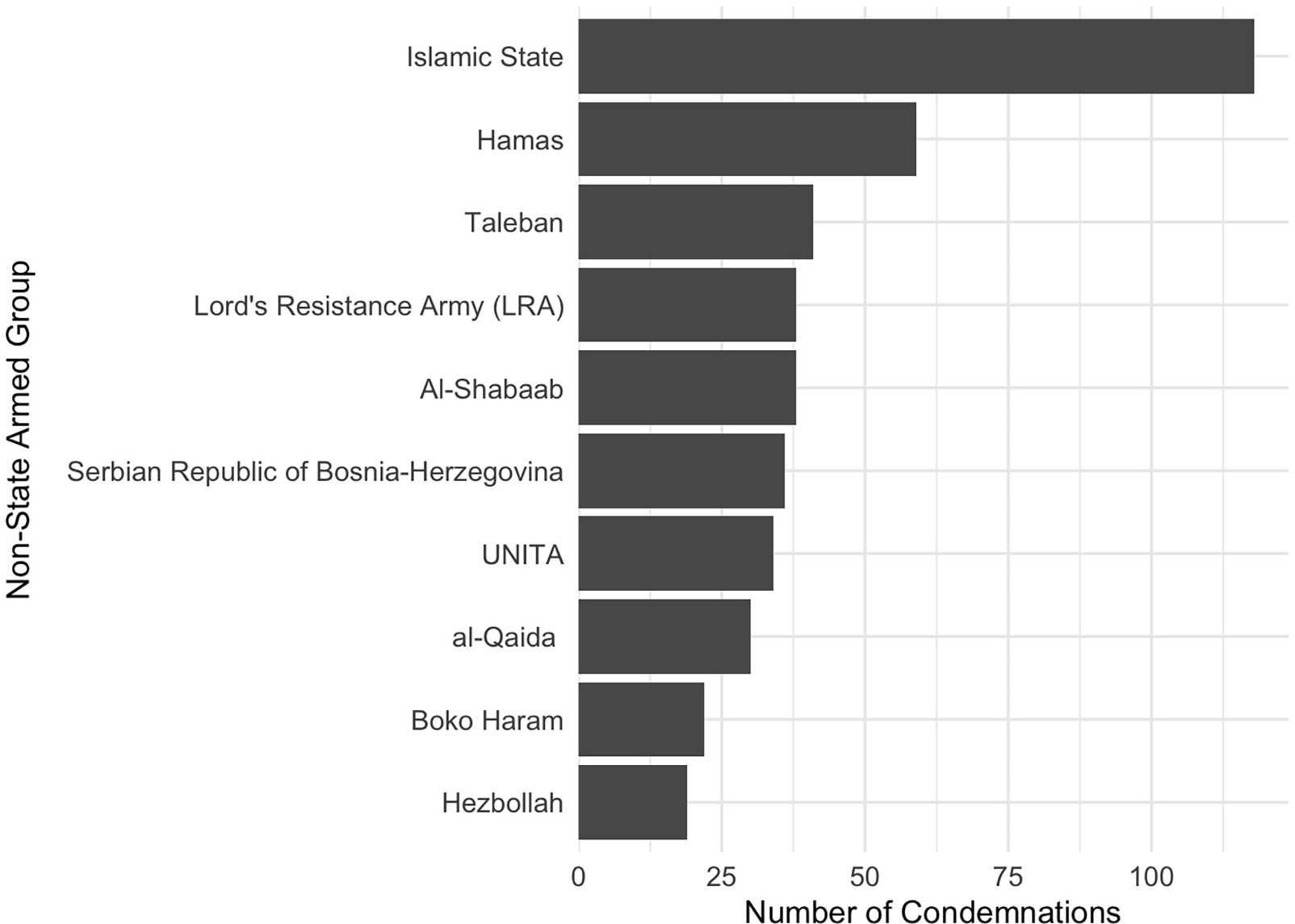
A relatively small number of NSAGs bear the brunt of censure from UNSC member states. From 1995 to 2016, 247 distinct active NSAGs are recorded.Footnote 81 Only seventy-seven groups experienced shaming during this period. Figure 1 shows the distribution of admonishments for the most condemned NSAGs in the data.Footnote 82 The most frequently condemned NSAGs are the Islamic State, Hamas, the Taliban, the LRA, and Al-Shabaab. Although geographically diverse, the majority of the most widely condemned NSAGs have Islamist political agendas.
Condemnations by group, 1995–2016
Notes: The Taliban is recorded as an NSAG only before its 1996 seizure of Kabul and after its 2003 ousting.

Figure 1 Long description
The bar graph compares the number of condemnations of various non-state armed groups by UNSC member states from 1995 to 2016. The x-axis represents the number of condemnations, ranging from 0 to 100. The y-axis lists the non-state armed groups, including Islamic State, Hamas, Taleban, Lord's Resistance Army (LRA), Al-Shabaab, Serbian Republic of Bosnia-Herzegovina, UNITA, al-Qaida, Boko Haram, and Hezbollah. The bars are horizontal and vary in length, indicating the number of condemnations each group received. Islamic State has the highest number of condemnations, followed by Hamas and Taleban. The other groups have fewer condemnations, with Hezbollah having the least. All values are approximated.
What practices are NSAGs condemned for? NSAGs are most frequently shamed for violence. The focus on NSAG violence is not surprising, given that the UNSC is the most important global forum for issues of international security. In many cases, actors were condemned for “attacks” or “atrocities” without further description of the condemned behavior. In other cases, speeches included precise descriptions. For example, in 2012 Guatemala named and shamed the LRA as follows:
With regard to the threat that the Lord’s Resistance Army (LRA) continues to pose … We condemn the atrocities that that group continues to commit, including kidnappings and the recruitment of minors for criminal activities, as well as the recent acts that resulted in the deaths of a number of humanitarian personnel.Footnote 83
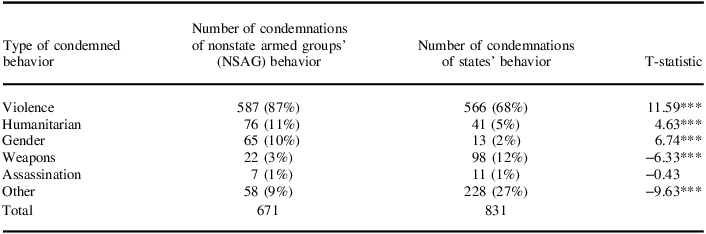
Table 1 shows the full distribution of the types of behaviors for which NSAGs are condemned. It highlights the UNSC’s emphasis on reacting to violence committed by NSAGs. Condemnations of attacks against humanitarian or peacekeeping personnel are also common, underlying the political importance of the issue to UNSC member states. Rarely are NSAGs shamed for gender-related practices, including rape, female genital mutilation, or violations of girls’ rights to education. This is surprising given that the UNSC has adopted several resolutions on gender and conflict, but in line with existing research on how rarely governments shame each other for conflict-related sexual violence (CRSV).Footnote 84 NSAGs are rarely condemned for using, selling, or constructing specific types of weapons and almost never named and shamed for executing political assassinations. UNSC members also rarely denounce political projects such as diplomatic efforts or secession attempts by NSAGs, although these tactics challenge the status quo of international politics. While NSAGs commit a wide range of behaviors contrary to UNSC member states’ interests—including trafficking drugs, obstructing humanitarian aid, and coercing rents from civilians—they are rarely shamed for these activities at the UNSC.
Categories of acts condemned by United Nations Security Council (UNSC) member states
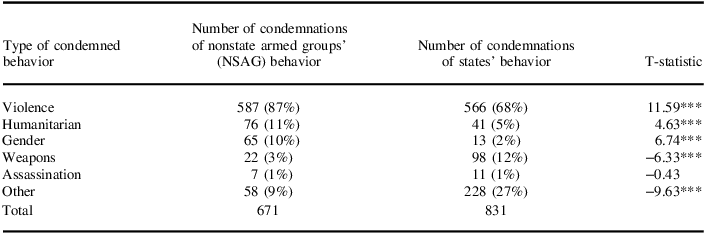
Table 1 Long description
The table presents data on the types of behaviors condemned by United Nations Security Council member states, comparing nonstate armed groups (NSAG) and states' behavior. It includes six categories of condemned behavior: Violence, Humanitarian, Gender, Weapons, Assassination, and Other. The table has six rows for each behavior type and three columns: Type of condemned behavior, Number of condemnations of nonstate armed groups' behavior, Number of condemnations of states' behavior, and T-statistic. Violence has the highest number of condemnations for both NSAGs (587) and states (566). Humanitarian behavior is the second most condemned for NSAGs (76) and states (41). Gender-related condemnations are relatively low for both NSAGs (65) and states (13). Weapons-related condemnations are higher for states (98) compared to NSAGs (22). Assassination condemnations are minimal for both NSAGs (7) and states (11). The Other category has a notable difference, with 58 condemnations for NSAGs and 228 for states. The total number of condemnations is 671 for NSAGs and 831 for states.
Notes: The table’s final column shows the t-statistic value from a Student’s two-sample t-test. *p <.05; ** p <.01; *** p <.001. A condemnation is coded as violence if it refers to the use or the threat of physical force, including “attacks” and “atrocities.” A humanitarian statement condemns attacks against humanitarian or UN personnel. A condemnation is coded as related to gender if the statement condemns gender-related practices, including sexual violence and violations of girls’ education. A weapons statement condemns the use, creation, buying, or selling of specific weapons. Assassinations refer to condemnations of attempted or successful executions of political figures. A condemnation is coded as other if the type of action is not captured by the above categories. The sum is greater than the total number of condemnations, as categories are not mutually exclusive. For example, condemning attacks against UN peacekeepers is considered both “violence” and “humanitarian.”
How does the public condemnation of NSAGs compare to the naming and shaming of states? Table 1 shows the distribution of condemned state behaviors over the same time period. It also presents a Student’s two-sample t-test to determine if the proportions of condemnations for specific behaviors differ significantly between states and NSAGs. First, states are primarily condemned for executing violence, consistent with prior research on naming and shaming as a means to hold governments accountable for serious human rights abuses. However, the difference is statistically significant, indicating NSAG condemnations are more likely related to violence than state condemnations. Second, NSAGs were significantly more likely than states to be condemned for attacks on UN and humanitarian personnel. This is not unexpected, as peacekeeping and humanitarian operations often rely on government consent and NSAGs are more likely than governments to attack peacekeeping personnel.Footnote 85 Third, while public discourse often focuses on CRSV by NSAGs, governments are implicated in a significantly larger number of reported incidents.Footnote 86 The condemnations made at the UNSC appear to follow this pattern. Naming and shaming NSAGs was more likely to cite gender-based infringements. Fourth, condemnations of states were, unsurprisingly, much more likely to concern chemical, biological, or nuclear weapons, or landmines. Few NSAGs have the capability to develop or procure advanced weaponry. Fifth, while states were condemned more frequently for attempted and executed assassinations, the difference is not statistically significant.
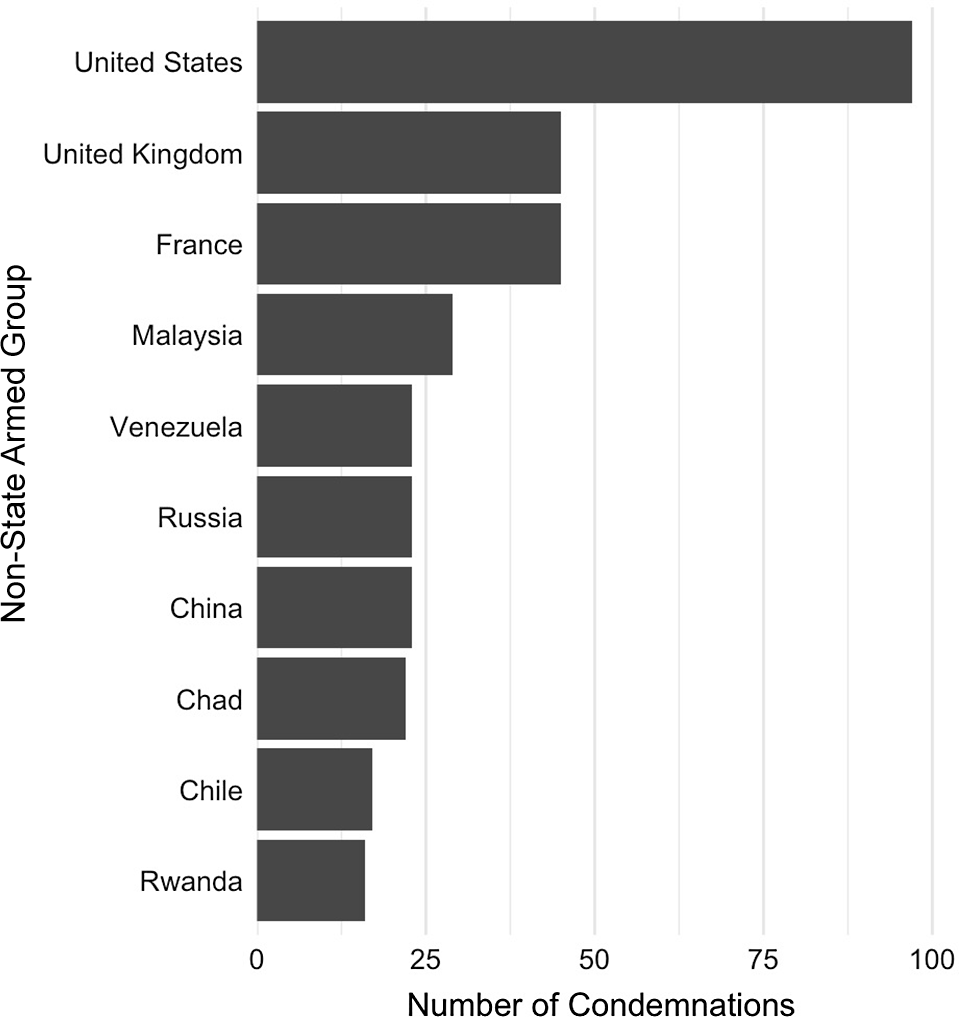
Who names and shames NSAGs at the UNSC? Figure 2 displays the UNSC member states that most frequently condemn NSAGs. The P5 states, continuously present on the Council, have the most opportunities to name and shame NSAGs, and, unsurprisingly, the Western P5 states—the United States, United Kingdom, and France—do so most frequently.Footnote 87 A diverse group of states are the most frequent shamers of NSAGs after these three. The United States is the most likely state to condemn NSAGs. After the September 11, 2001 attacks, the US spearheaded a global war on terrorism and may be more likely to condemn NSAGs considered terrorist organizations. In this context, we may expect the naming and shaming of NSAGs to be most likely to reflect geostrategic concerns.
Most frequent UNSC member states to name and shame NSAGs, 1995–2016
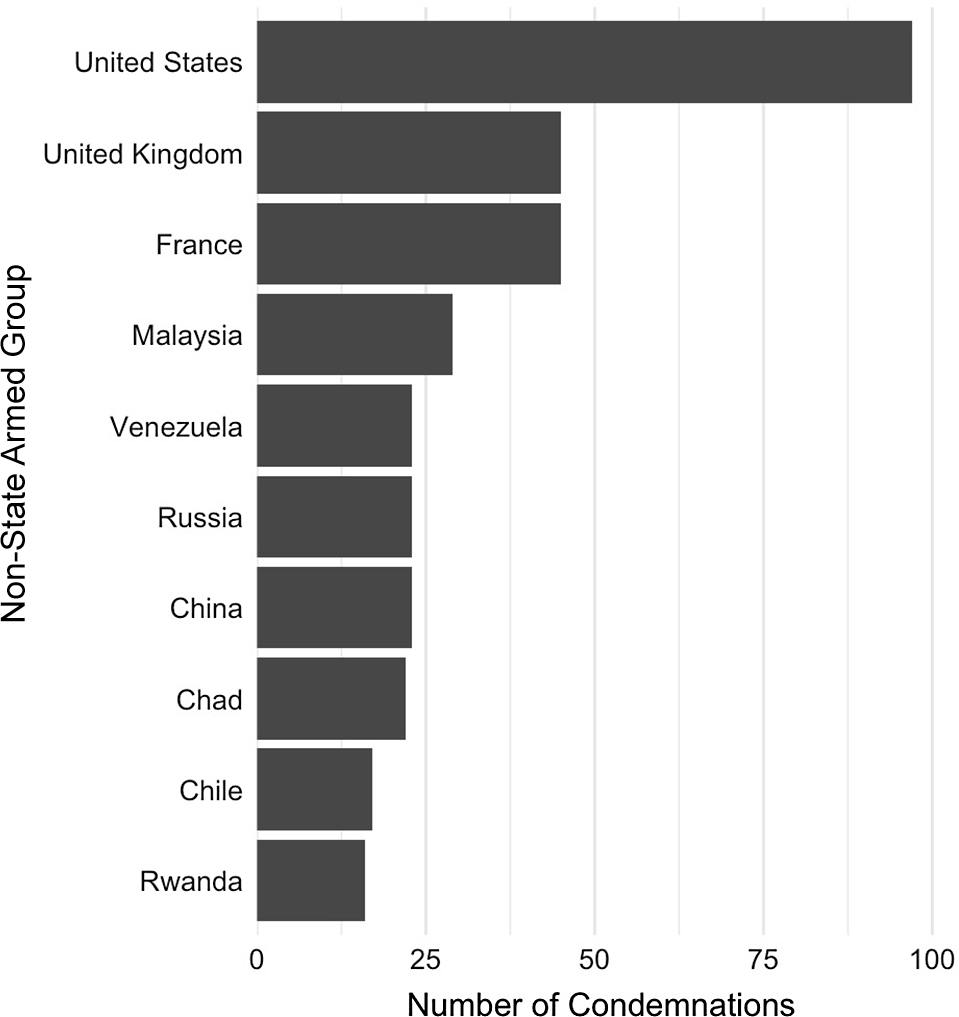
Figure 2 Long description
The bar graph compares the number of condemnations by non-state armed groups across different countries. The x-axis represents the number of condemnations, ranging from 0 to 100. The y-axis lists the countries: United States, United Kingdom, France, Malaysia, Venezuela, Russia, China, Chad, Chile, and Rwanda. The bars are horizontal. The United States has the highest number of condemnations, followed by the United Kingdom and France. Malaysia, Venezuela, Russia, China, and Chad have moderate numbers of condemnations. Chile and Rwanda have the lowest numbers. The color scheme is uniform, with all bars in dark gray. All values are approximated.
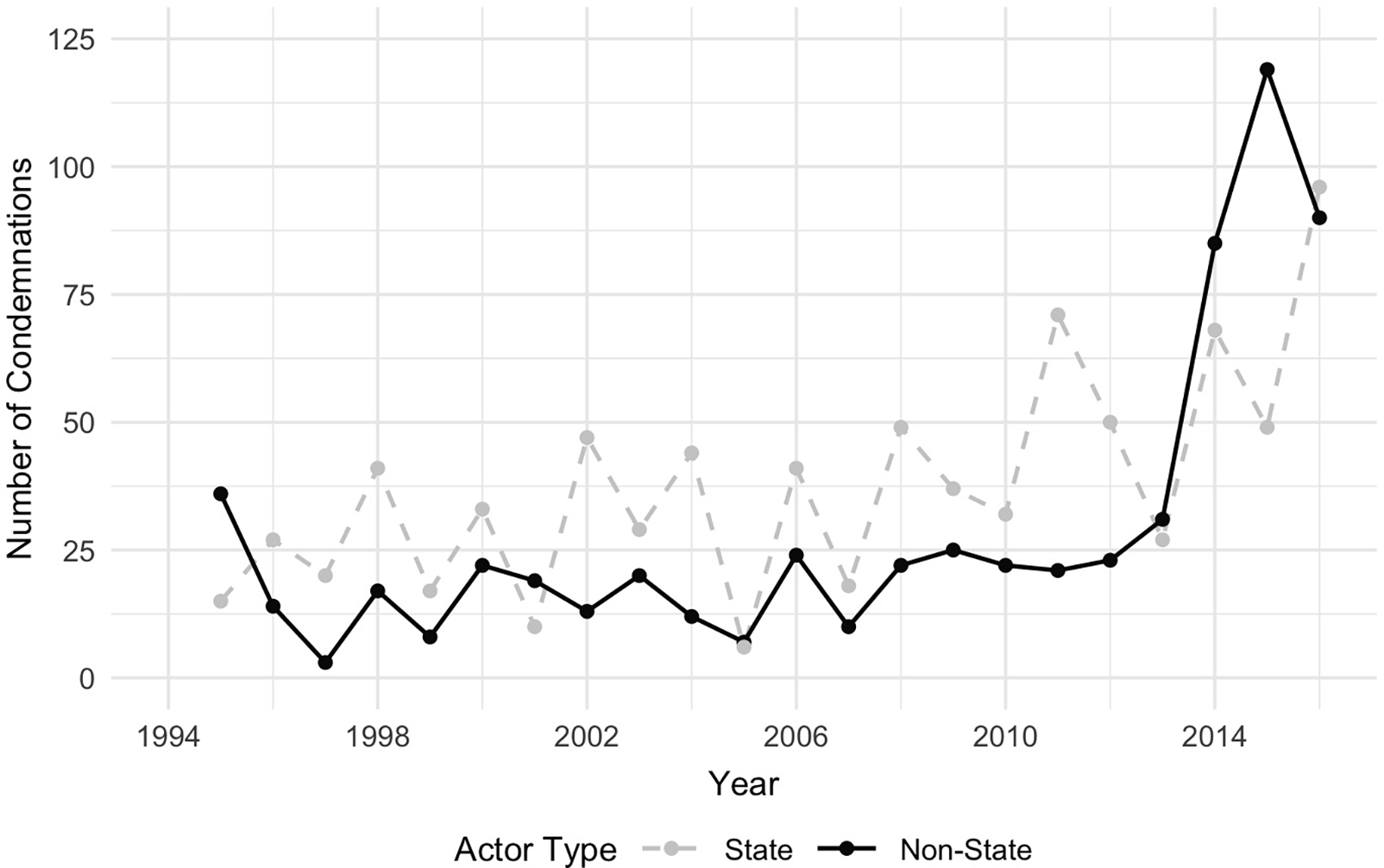
Figure 3 illustrates shaming trends over time. Because norms on the responsibilities to protect civilians gained acceptance over time, we would expect more frequent naming and shaming. We see an upward spike in the naming and shaming of NSAGs, but not until 2014. The spike reflects two contemporary events: the escalation of the Syrian civil war and the transformation of the Islamic State and al-Qaida into global terror networks, expanded to include Boko Haram and Jabhat al-Nusra. Naming and shaming these groups could be consistent with governments’ efforts to combat them by providing support to their opponents. However, these groups also committed large acts of deliberate violence against civilians between 2014 and 2016.
Condemnations over time, 1995–2016

Figure 3 Long description
The line graph displays the number of condemnations over time from 1994 to 2014, categorized by state and non-state actors. The x-axis represents the years, ranging from 1994 to 2014, while the y-axis represents the number of condemnations, ranging from 0 to 125. The graph includes two data lines: one for state actors, represented by a dashed line, and one for non-state actors, represented by a solid line. The number of condemnations for state actors fluctuates between approximately 10 and 75, with notable peaks around 2000 and 2014. The number of condemnations for non-state actors remains relatively stable, ranging from approximately 10 to 30, with a significant increase around 2014. All values are approximated.
In summary, our data reveal that NSAGs are frequently named and shamed. Almost half of all naming and shaming at the UNSC targets NSAGs. A small set of NSAGs bear the majority of censure. NSAGs are predominantly shamed for acts of violence and are significantly more likely to be shamed for violence, acts against humanitarian personnel, and gender-related behavior than states. While there was an increase in the naming and shaming of NSAGs, this trend does not start until 2014, largely driven by the Syrian civil war and the rise of global terror networks.
Research Design
Dependent Variable and Empirical Approach
We now use this novel data to test how partnerships and global protection norms explain the naming and shaming of NSAGs by the P5 and E10. Our unit of analysis is the NSAG-UNSC member state-year. A dyadic approach captures the fundamentally relational nature of naming and shaming, which is shaped by the political dynamics between states and targets.Footnote 88 A NSAG becomes a potential target for condemnation during the years it is actively fighting government forces. A NSAG enters the universe of cases during years when it is participating in a civil conflict resulting in at least twenty-five battle-related deaths per year.Footnote 89
We transform the data earlier to create our dependent variable Naming and Shaming. Naming and Shaming is a dummy variable that indicates whether a UNSC member names and shames a NSAG, for any type of behavior, in a given year. Multiple occurrences of condemnations within a year are consolidated into a single binary indicator. We use a binary variable instead of a count variable to minimize noisy variation. This approach addresses the question of whether a single emphatically strong condemnation is equivalent to multiple weaker ones, and whether several condemnations within a single speech hold the same weight as condemnations dispersed throughout the year. Standard errors are bootstrapped to ensure robustness against heteroskedasticity and are clustered at the level of the UNSC member state.
Independent Variables
States may name and shame NSAGs to convey support to their geopolitical allies fighting these armed groups. To test H1, we create a dummy variable External Support that indicates whether the UNSC member state is providing militarily relevant assistance to governments fighting NSAGs.Footnote 90 External Support includes not only providing war-fighting troops, but also weapons and other materiel, access to infrastructure or territory, logistics, training, funding, or intelligence. To test H2, the variable One-Sided Violence is the log of the best estimate of the number of fatalities that result from an NSAG’s direct and deliberate killings of civilians.Footnote 91 We expect the P5 and E10 to have different priorities in naming and shaming NSAG. Reflecting this, we interact the independent variables with the dummy variable P5, which indicates whether or not the UNSC member state is a permanent member.
Control Variables
We include several control variables to account for potential spurious relationships. First, global protection norms elevate human rights over sovereignty, provoking resistance from regimes that violate those rights. Additionally, states with strong human rights records may care more about their reputation and be more likely to condemn rights violators.Footnote 92 To control for this, the variable Physical Integrity measures the UNSC member states’ domestic respect for physical integrity rights: the freedom from political killings and torture.Footnote 93 Second, the UNSC reacts to conflicts producing the greatest number of combatant battle deathsFootnote 94 and we expect UNSC members to be more likely to name and shame groups involved in these severe conflicts. NSAGs may also be more likely to target civilians in conflicts with high numbers of combatant battle deaths.Footnote 95 To account for this, the variable Intensity is the logged total number of battle-related causalities in conflicts between a given NSAG and government forces in a year.Footnote 96 Third, with few exceptions, states support the international borders of the status quo;Footnote 97 consequently, they may be more likely to publicly deride NSAGs that challenge this order. To account for this, we include a dummy variable Secessionist, indicating whether an NSAG is fighting over a territory’s political status.Footnote 98
In addition, we employ three variables to capture the conflicts that have previously received the UNSC’s attention. We expect UNSC members to pay greater attention to NSAGs where the UN has deployed peacekeepers. At the same time, peacekeeping has been found to reduce civilian targeting by NSAGs.Footnote 99 To capture this, the variable Peacekeeping is the log of the number of UN troops deployed to the country where a NSAG primarily operates in a given year.Footnote 100 Similarly, to capture the level of UNSC engagement with a conflict, the variable Resolutions is the log of the number of UNSC resolutions on that conflict in a year.Footnote 101 Finally, we may anticipate interdependence between actors. If one UNSC member names and shames an NSAG, we may expect others to follow. To account for this process, Prior Shaming is a dummy variable that indicates whether any UNSC member has named and shamed a given NSAG in the three prior years.Footnote 102 All time-varying independent variables are lagged by one year out of a concern for endogeneity. The appendix provides summary statistics for all variables.
Results
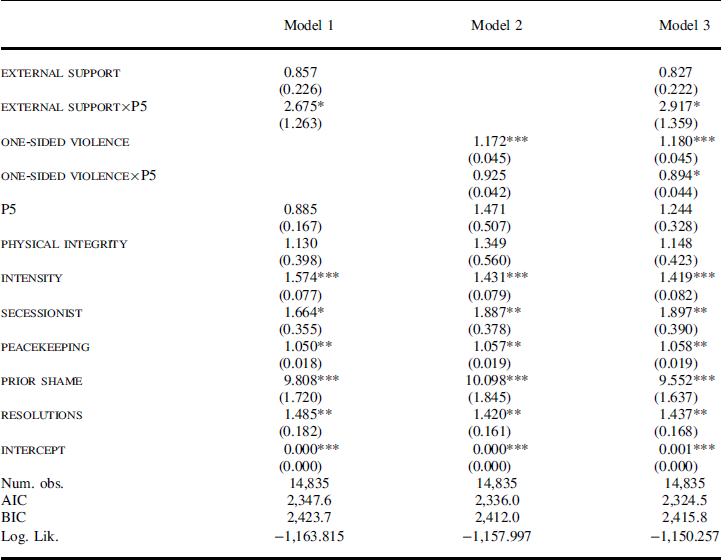
Table 2 shows the results of a logistic regression on Naming and Shaming, predicting the binary outcome that a given UNSC member state condemns a specific NSAG in a given year. Coefficients are expressed as odds ratios. An odds ratio greater than one indicates a positive association, where an increase in the predictor variable corresponds to higher odds of naming and shaming. Conversely, an odds ratio less than one signifies a negative association, implying that the event’s odds decrease with an increase in the predictor. If the odds ratio is exactly one, there is no change in odds, indicating no effect of the predictor on the likelihood of naming and shaming.
Odds ratios from logistic regression on naming and shaming
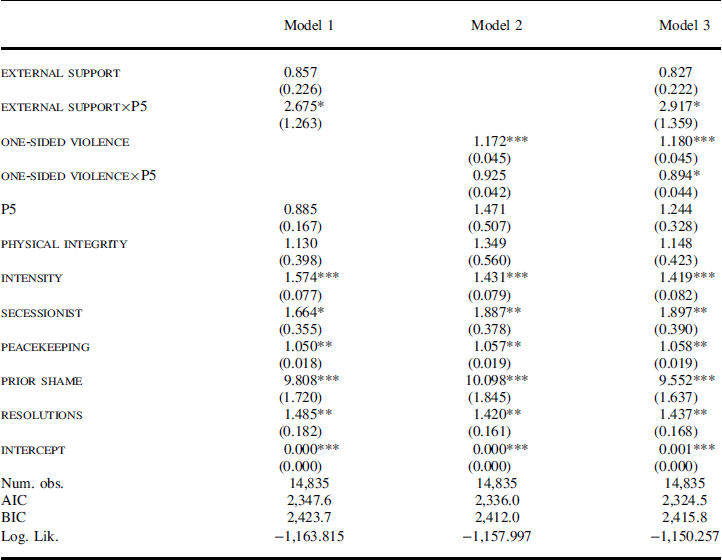
Table 2 Long description
The table presents the results of a logistic regression analysis on naming and shaming, predicting whether a UN Security Council member state condemns a specific non-state armed group in a given year. The table includes three models with various predictor variables. Each model lists the coefficients expressed as odds ratios. An odds ratio greater than one indicates a positive association, meaning an increase in the predictor variable corresponds to higher odds of naming and shaming. Conversely, an odds ratio less than one signifies a negative association, implying that the events odds decrease with an increase in the predictor. If the odds ratio is exactly one, there is no change in odds, indicating no effect of the predictor on the likelihood of naming and shaming. The table includes variables such as external support, one-sided violence, physical integrity, intensity, secessionist, peacekeeping, prior shame, and resolutions. Each variable is listed with its corresponding odds ratio and standard error for the three models. The table also includes the number of observations, AIC, BIC, and log-likelihood values for each model.
Notes: Bootstrapped standard errors clustered by country. *p <.05; **p <.01; ***p <.001.
Model 1 provides an initial test of H1, that strategic partnerships influence the P5’s decisions to name and shame NSAGs. While the variable External Support is not statistically significant, the interaction effect between External Support and P5 is greater than one and statistically significant. This finding supports H1, demonstrating that the effect of external support on the likelihood of naming and shaming is conditional on P5 membership. For a P5 member, providing external support to a government increases the odds of them naming and shaming the opposing NSAG.Footnote 103 Model 2 is our initial test of H2, whether the emerging global POC norms explain the E10’s decisions to name and shame some NSAGs but not others. The variable One-Sided Violence, measuring the yearly deaths from direct and deliberate violence committed against civilians, is statistically significant and greater than one.Footnote 104 As an NSAG perpetuates more violence against civilians, the odds that it will be named and shamed in the UNSC increases significantly. This effect is consistent across all types of UNSC members, because interaction with the P5 is not statistically significant.
Model 3 is a saturated model. A saturated model incorporates both theories to assess if the effects of one theory persist when controlling for the other. In model 3, the interaction between External Support and P5 status remains a significant predictor of naming and shaming. Holding all other variables at their means or medians, the predicted probability that a P5 state names and shames a NSAG increases by about 139 percent when the P5 state provides external support compared to when it does not. We find support for H1: a P5 member providing external support to a government fighting a given NSAG is more likely to name and shame that NSAG.
In model 3, the variable one-sided violence remains greater than one and statistically significant. However, once the external support states give to regimes is accounted for, the interaction between one-sided violence and P5 is statistically significant. The interaction term’s odds ratio of 0.898 indicates a dampening of the main effect; the positive impact of violence is significantly weaker for P5 states. Holding other variables constant, the predicted probability of an NSAG being named and shamed by an E10 state increases by about 54 percent when moving from zero deliberate civilian deaths to one standard deviation above the mean in one-sided violence. By contrast, for P5 states the increase is more modest, at about 15 percent under the same conditions. These findings support H2: E10 members are more likely to shame groups committing atrocities against civilians.
Across all models, NSAGs that participate in conflicts with greater battle deaths, as measured by the variable intensity, are more likely to be condemned than other NSAGs. Secessionist groups, as challengers to international sovereignty norms, are more likely to be named and shamed than other NSAGs. The variables peacekeeping, prior shame, and resolutions are positive and statistically significant. Groups in conflict that have captured international attention—by necessitating a peacekeeping force, prior condemnations, or resolution—are more likely to remain in the international spotlight, facing continued scrutiny.
Conclusion
This research note is the first to systematically study the naming and shaming of NSAGs. Despite the lack of academic attention to the condemnation of nonstate actors, we show that NSAGs are frequently named and shamed at the UNSC for violence. Our study highlights a dual dynamic within international organizations. On one hand, less powerful member states affirm civilian protection norms and uphold the organization’s mandate. On the other hand, naming and shaming NSAGs offers powerful states an opportunity to support their partners and legitimize their involvement in civil wars. While the P5’s decisions are driven by strategic interests in civil wars, the international human rights regime may not be as politicized as some have argued. Elected members of the UNSC, guided by emerging global norms such as R2P and POC, tend to shame NSAGs that commit the gravest atrocities against civilians. These results are consistent with emerging literature on the importance of the E10 in the UNSC. However, our theorization suggests that elected members may not use naming and shaming to enforce compliance by these groups, but rather to showcase their own commitment to these norms. Our findings also speak to fundamental debates in international relations about hierarchies in world politics. By unpacking the diverging interests of the P5 and the E10, we show that actors’ priorities and behaviors are shaped in part by their position within a hierarchical order. These insights emerge when world politics is understood as a system in which nonstate actors play key roles.Footnote 105
While our findings suggest that UNSC member states may hope to address threats to civilian safety, we do not assess the effectiveness of naming and shaming NSAGs. Future research should examine the consequences of public condemnation, including whether NSAGs adapt their behavior in response. The data and theoretical insights presented in this research note also open avenues for studying the effects of naming and shaming on outcomes such as regimes’ domestic support and international standing. Furthermore, UNSC member states may use naming and shaming as a prelude to further action. Existing research has highlighted how language used in the UNSC is connected to Council decisions.Footnote 106 Understanding patterns of naming and shaming by individual states can contribute to existing research on the determinants of UN action and international decision making. This research note calls for additional research to deepen our understanding of the available tools to address violence by NSAGs. Future scholarship should provide a full account of the consequences of states’ unequal commitment to norms designed to protect civilian lives.
Acknowledgments
We thank Lisa Hultman for her support and guidance on this project. We also thank Carlotta Wichmann, Paige Thielke, and Ornella Corsant-Colat for their invaluable research assistance on this project.
Data Availability Statement
Replication files for this research note may be found at <https://doi.org/10.7910/DVN/JQAUQE>.
Supplementary Material
Supplementary material for this research note is available at <https://doi.org/10.1017/S0020818326101337>.
Funding
The project was supported by the Vetenskapsrådet Grant no. 2018–00835.


 Open access

