





Explanation of correction:
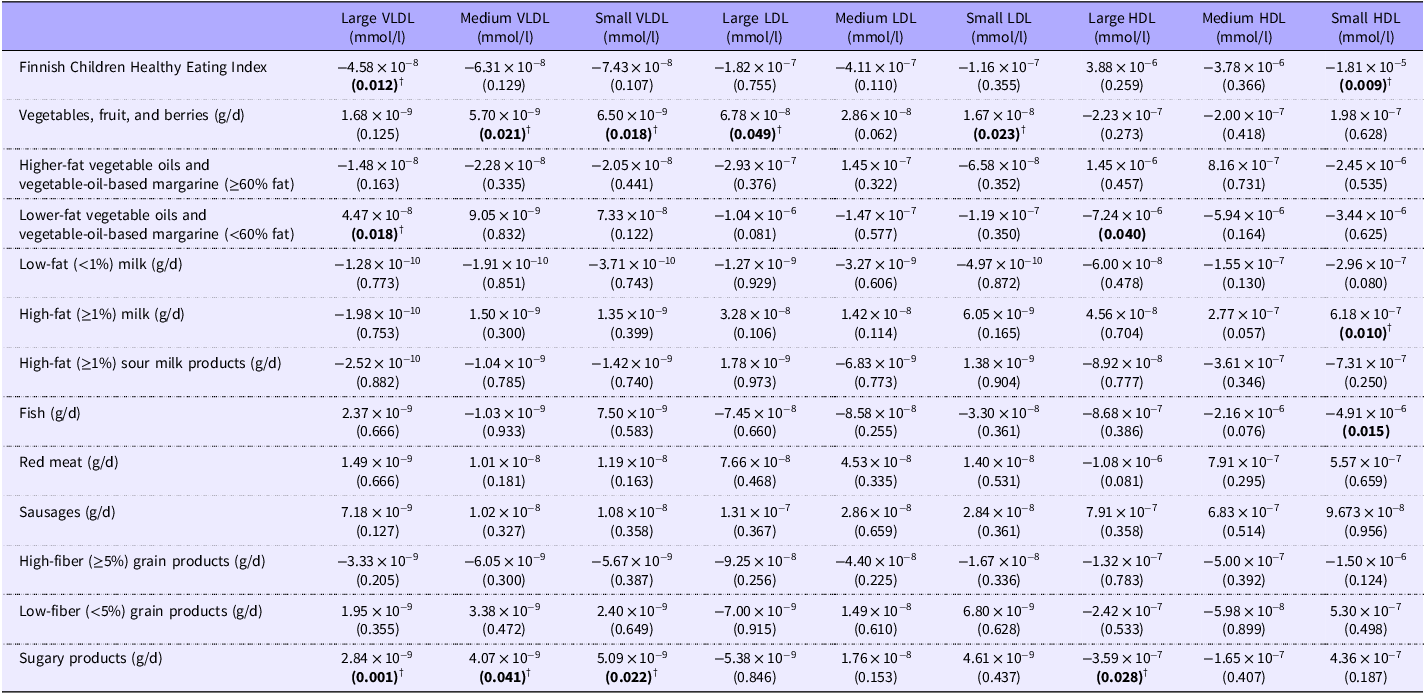
In table 7, the results concerning the longitudinal associations of diet and the concentration of small HDL particles are incorrect as these were mistakenly duplicated as the results for diet and small LDL particles. The corrected table 7 is given in this corrigendum. We performed the correction for multiple testing (Benjamini–Hochberg false discovery rate correction for multiple testing) again after noticing this error and corrected the results in the texts given below. The authors apologize for this inconvenience.
Original text:
Associations of changes in diet quality with changes in serum fatty acids over 8 years
Increased consumption of sugary products was associated with increased SFA%, MUFA% and n-6-FA/n-3-FA and decreased n-3-FA, degree of FA unsaturation, PUFA%, n-3-FA% and LA%.
The associations of vegetable, fruit and berry consumption with SFA%, consumption of higher-fat vegetable oils and vegetable oil-based margarine (≥ 60 % fat) with a degree of FA unsaturation, low-fat milk consumption with a degree of FA unsaturation, fish consumption with n-3-FA and n-3-FA%, red meat consumption with a degree of FA unsaturation, sausage consumption with SFA%, PUFA%, n-3- FA% and n-6-FA/n-3-FA and sugary product consumption with n-6-FA/n-3-FA did not remain statistically significant after false discovery rate correction.
Correction:
The association of consumption of sugary products with the degree of FA unsaturation was not statistically significant as reported in the text.
The associations of consumption of vegetables, fruit and berries with SFA%, consumption of fish with omega-3-FA%, and the consumption of sugary products with omega-6-FA/omega-3-FA remained statistically significant after the correction for multiple testing, although reported otherwise.
Original text:
Associations of changes in diet quality with changes in serum amino acids over 8 years
All these longitudinal associations except the association between lower-fat vegetable oils and vegetable-oil-based margarine (< 60 % fat) with alanine, low-fat (< 1 %) milk and alanine, leucine and phenylalanine, high-fat (≥ 1 %) milk with glycine, high-fat (≥ 1 %) sour milk products and total BCAA and valine and the association between red meat consumption with histidine and isoleucine remained statistically significant after false discovery rate correction.
Correction:
The association of consumption of high-fat milk (>1 % of fat) and glycine remained statistically significant after the correction for multiple testing, although reported otherwise.
Original text:
Associations of changes in diet quality with changes in serum lipoprotein particle sizes and serum apolipoproteins over 8 years
Increased FCHEI was associated with decreased VLDL particle size and lower concentration of large VLDL particles after adjustment for sex, age, body fat percentage, pubertal status and physical activity (Tables 6 and 7). Increased consumption of vegetables, fruit and berries was associated with higher concentrations of medium and small VLDL particles and large and small LDL particles. Increased consumptions of lower-fat vegetable oils and vegetable-oil-based margarine (< 60 % fat) were associated with increased VLDL particle size and higher concentration of large VLDL particles, decreased LDL particle size and lower concentration of large HDL particles. Increased consumption of sugary products was associated with increased VLDL particle size and higher concentration of large and small VLDL particles and a smaller HDL particle size and lower concentration of large HDL particles. The associations of lower-fat vegetable oils and vegetable oil-based margarine (< 60 % fat) with VLDL particle size and lower concentrations of large HDL particles, and consumption of sugar products with the concentration of medium VLDL did not remain statistically significant after false discovery rate correction.
Correction:
In addition to the results given in the original text, increased FCHEI and fish consumption were associated with decreased concentration of small HDL particles and increased consumption of high-fat milk (>1 % of fat) was associated with increased concentration of small HDL particles. The associations of FCHEI and consumption of high-fat milk (>1 % of fat) with small HDL particles remained statistically significant after correction for multiple testing.
Further, the association of consumption of sugary products with medium VLDL particles remained statistically significant after the correction for multiple testing, although reported otherwise.
Longitudinal associations of diet quality and dietary factors with lipoprotein subclasses over 8 years*

*Data are unstandardised regression coefficients from linear mixed-effects models adjusted for sex, age, body fat percentage, pubertal status and physical activity. P-values are reported in parentheses. Statistically significant associations are indicated by bolded P-values.
†Association remained statistically significant after Benjamini–Hochberg false discovery rate correction for multiple testing.

 Open access

