





In the 1970s Franz Halberg and his group at the University of Minnesota were the first to suggest an interaction in humans between the timing of eating, ‘chrono-metabolism’, and bodyweight regulation(Reference Halberg1–Reference Hirsch, Halberg and Goetz3). Their work compared the effects of a single daily meal comprising either a fixed 2000 kcal or ad libitum energy intake, consumed either 1 h or 12 h after waking, respectively. During both the fixed and ad libitum energy conditions, the morning meal resulted in greater weight loss compared to the later meal(Reference Jacobs, Thompson and Halberg2,Reference Hirsch, Halberg and Goetz3) . During the ad libitum condition, weight gain was observed in some participants when consuming a single daily meal 12 h after waking, for three consecutive weeks(Reference Jacobs, Thompson and Halberg2). However, a 1986 paper by Sensi and Capani(Reference Sensi and Capani4) that compared very low-energy diets (684 kcal/d) consumed either at 10.00 or 18.00, respectively, found no significant differences in weight loss between the respective timed eating conditions. Nevertheless, the hypothesis that timed eating may, to quote a 1989 Halberg review, ‘have important implications regarding the ability to obtain “more for less” in a world of persistent hunger…’ found favour based on the limited data at the time(Reference Halberg1). With the benefit of the current evidence base, is it possible to conclude that timed eating interventions provide ‘more for less’ for weight loss? This review aims to critically evaluate whether timed eating interventions offer an advantage for weight loss in humans, considering components of energy balance and behavioural mediators of the timing of energy intake.
Conceptual and methodological challenges in timing of eating research
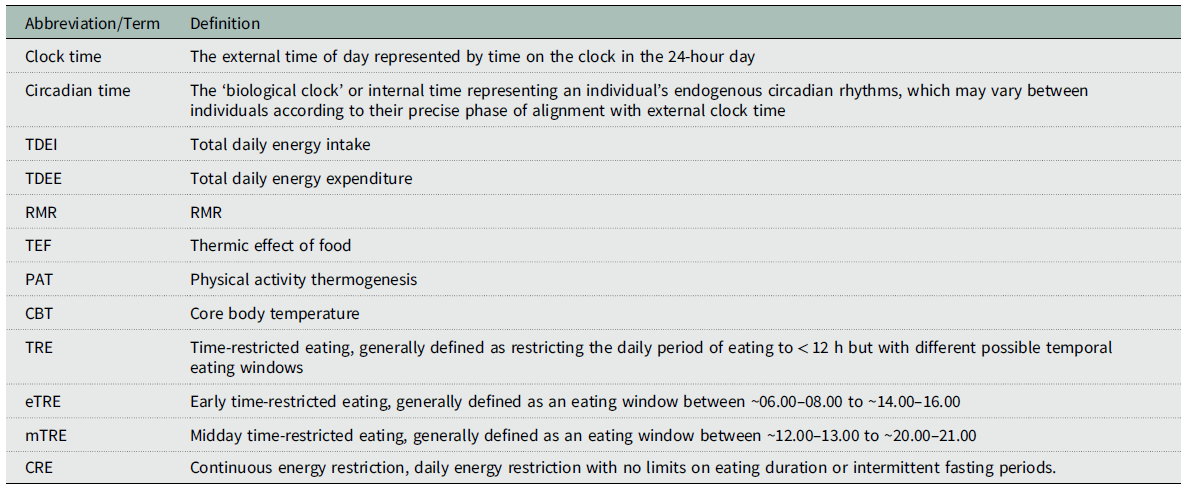
Heterogenous definitions of ‘meal timing’ may be found in the literature(Reference O’Connor, O’Connor and Higgins5–Reference Leech, Worsley and Timperio7). This may reflect the fact that ‘meal timing’ encompasses two distinct but related concepts, i.e. the definition of ‘meal’ and the definition of ‘timing’. The concept of a ‘meal’ remains primarily defined by pre-defined labels such as ‘breakfast’, ‘lunch’ and ‘dinner’, which are insufficient to capture the nutritional characteristics of those meals, including the time of day at which they may occur(Reference Leech, Worsley and Timperio7,Reference Mäkelä, Kjærnes and Ekström8) . In addition, general definitions such as ‘morning’, ‘afternoon’ and ‘evening’, are insensitive to both the clock (i.e. external) time and circadian (i.e. internal) time (see Table 1 for definitions), including their interaction, at which eating within those periods may occur(Reference Flanagan, Bechtold and Pot6). The definitions of ‘timing’ also vary substantially and may include the clock time at which eating occasions occur and related underlying circadian timing, the temporal distribution of total daily energy intake, the inter-day regularity of the timing of eating, the intra-day frequency of eating occasions and duration between eating occasions, and/or the total duration of the daily period of eating(Reference O’Connor, O’Connor and Higgins5,Reference Flanagan, Bechtold and Pot6) .
Definitions of abbreviations and terminology
A comprehensive recent review by O’Connor et al. (Reference O’Connor, O’Connor and Higgins5) summarised the heterogeneous definitions of the timing of eating applied in 136 nutritional epidemiological studies and 126 intervention trials. The timing of eating was most commonly defined in both epidemiology and intervention studies as the clock time of eating. Of note, intervention trials often considered multiple definitions of ‘timing’, with duration and timepoint, duration and distribution, or distribution and timepoint the most commonly utilised combinations. Given the overall evidence indicates that temporal eating patterns in humans exhibit within-person, between-person, within-population and between-population variation(Reference Flanagan, Bechtold and Pot6), the need for standardised operational definitions for meal/eating timing, and the development of dietary assessment instruments specifically validated to capture the timing of eating, is crucial to developing a rigorous and coherent evidence-base for the timing of eating and human health outcomes(Reference O’Connor, O’Connor and Higgins5). Where possible, the present review expresses the timing of eating as clock time if this was presented in the primary study.
Timing of eating and bodyweight in humans: energetic and behavioural hypotheses
Broadly, we may delineate two hypothesis-driven avenues of inquiry into the potential relevance of timed eating for weight loss and/or management. The first is the energetic hypothesis, i.e. that timed eating alters energy balance by influencing energy intake and/or expenditure. An important element of the energetic hypothesis has been the suggestion that greater weight loss may be observed with certain timed eating regimens independent of total daily energy intake (TDEI) (Table 1)(Reference Garaulet, Gómez-Abellán and Alburquerque-Béjar9,Reference Jakubowicz, Barnea and Wainstein10) . In turn, to explain differences in weight loss which appear to be independent of TDEI, the core theory within the energetic hypothesis has related to energy expenditure, specifically that the thermic effect of food (TEF) may be enhanced by timed eating interventions that result in greater proportional energy intake early in the day compared to later(Reference Jakubowicz, Barnea and Wainstein10–Reference Richter, Herzog and Janka12). Such a time-of-day effect of TEF, if indeed a real effect, would imply a role for the human circadian system(Reference Morris, Garcia and Myers13), the endogenous biological timing system which regulates temporal physiological and metabolic processes in synchrony with the 24-hour external environment(Reference Flanagan, Bechtold and Pot6,Reference Ruddick-Collins, Morgan and Johnstone14,Reference Johnston, Ordovas and Scheer15) . For example, several controlled trials have found a ∼1·5–2·5-fold greater TEF response to meals consumed at breakfast (corresponding to the biological morning in circadian time) compared to dinner (the biological evening in circadian time)(Reference Richter, Herzog and Janka12,Reference Morris, Garcia and Myers13,Reference Romon, Boulenguez and Frimat16) . The evidence supporting the energetic hypothesis of timed eating for weight loss will be critically discussed by reference to available human intervention trials, below.
The second may be characterised as the behavioural hypothesis, i.e. that behavioural factors mediate any relationship between timed eating and body weight regulation. It is important to note that the behavioural and energetic hypotheses are not mutually exclusive, but related, as insofar as behavioural factors mediate a relationship with timed eating and weight loss, it is likely through influencing reductions in TDEI. Behavioural factors may also relate to circadian biology, for example in the behavioural correlates related to an individual’s ‘chronotype’(Reference Maukonen, Kanerva and Partonen17,Reference Kanerva, Kronholm and Partonen18) , and diurnal variation in hunger and appetite regulation(Reference Vujović, Piron and Qian19–Reference Scheer, Morris and Shea21). Chronotype denotes an individual’s behavioural expression of sleep-wake timing preferences, often colloquially referred to as ‘morning larks’ or ‘night owls’, related to the period of their internal biological time(Reference Roenneberg, Wirz-Justice and Merrow22). This latter characteristic indicates that chronotype is conceptualised as a biological construct, strongly influenced by genetic factors and reflecting endogenous circadian timing, rather than a psychological construct or trait(Reference Roenneberg, Pilz and Zerbini23). In particular, associations between evening chronotypes and redistribution of energy and macronutrient intake to later in the wake cycle(Reference Kanerva, Kronholm and Partonen18,Reference Maukonen, Kanerva and Partonen24) , suggest a potential behavioural influence of chronotype on time-of-day energy intake that may be relevant for weight management. The extent to which behavioural factors related to timed eating may influence weight loss is expanded in later sections.
Timing of eating and energy balance: energy expenditure
Total daily energy expenditure (TDEE) is comprised of three components; RMR, physical activity thermogenesis (PAT; including exercise and non-exercise activity thermogenesis), and the TEF(Reference Westerterp25). RMR constitutes the largest component (∼60–70 %), while TEF contributes the least at ∼10 %, and PAT constitutes the most variable component at ∼30–40 % depending on activity level(Reference Westerterp25). All three components may be influenced by dietary energy intake; RMR exhibits decreases or increases as a function of energy balance relative to, respectively, loss or gains in body fat-free mass(Reference Westerterp25), while PAT may vary according to body size and composition, and energy balance, in particular restricted energy intake(Reference Westerterp25,Reference Taylor and Keys26) . TEF, as the postprandial energy expenditure arising from the digestion, utilisation and storage of nutrients, represents the primary influence of diet on TDEE, and the absolute magnitude of TEF may be influenced by variation in diet composition(Reference Westerterp-Plantenga, Rolland and Wilson27).
In 1993, Romon et al. (Reference Romon, Boulenguez and Frimat16) demonstrated diurnal variation in the magnitude of postprandial TEF in response to a standardised test meal consumed at 09.00, 17.00, or 01.00, in which TEF as a proportion of the energy content of the meal was, respectively, 15·9 % (sd ± 1·6 %), 13·5 % (±1·8 %) and 10·9 % (±2·2 %). This generated a long-standing interest in the potential for time-of-day effects of TEF to provide a ‘metabolic advantage’ for influencing energy balance and body weight regulation. For example, in an randomised controlled trial (RCT) from Jakubowicz et al. (Reference Jakubowicz, Barnea and Wainstein10) which showed 2·5–fold greater weight loss with high-energy intake at breakfast (700 kcal, 06.00–09.00) compared to a high-energy intake at dinner (700 kcal, 18.00–21.00), the authors suggested, citing Romon et al. (Reference Romon, Boulenguez and Frimat16), that greater TEF responses to the high-energy breakfast may have influenced body weight differences between the two conditions. This hypothesis was subsequently supported by repeated findings of significantly greater TEF responses to early compared to later energy intake. Morris et al. (Reference Morris, Garcia and Myers13) demonstrated that ‘early TEF’, i.e. confined to measurements over ∼114 min postprandial, was 44 % higher in the morning compared to the evening, indicating a circadian timing effect. Comparing identical standardised test meals consumed at either 08.00 or 20.00, Bo et al. (Reference Bo, Fadda and Castiglione11) found that TEF responses were ∼28 % lower following the evening meal. Richter et al. (Reference Richter, Herzog and Janka12) compared TEF in response to both high-energy meals (69 % of TDEI) and low-energy meals (11 % of TDEI) consumed at 09.00 and 19.00, respectively, and found that the TEF response to the 09.00 breakfast was 2·5 times greater compared to the 19.00 dinner, irrespective of high or low-energy content. These lines of evidence collectively appeared to support the hypothesis that greater weight loss observed with high-energy intake in the morning reflected the apparent energetic advantage of TEF responses at that time of day.
However, this purported effect of TEF on weight loss related to high early/morning energy distribution does not appear to stand up to detailed scrutiny. The first point in this regard is that TEF comprises the smallest component of TDEE and while relative differences in TEF between a morning and evening meal may, particularly when expressed as a percentage, appear substantial, the absolute differences in TEF are minor, e.g. ∼14 kcal (over 120 min postprandial measures) in Richter et al. (Reference Richter, Herzog and Janka12), and ∼12 kcal (over 114 min of postprandial measurements) in Morris et al. (Reference Morris, Garcia and Myers13). Bo et al. (Reference Bo, Fadda and Castiglione11) expressed TEF as calories per kilogram of fat-free mass in their participants, with a morning-evening difference of 1·8 kcal/kg/fat-free mass (measured over 60 min). Even extrapolating these absolute differences to an entire postprandial period that may last for up to 6 h(Reference Reed and Hill28), or a full 24-hour day, these differences in TEF are insufficient to explain differences in weight loss associated with early energy intake in the magnitudes observed in free-living studies(Reference Garaulet, Gómez-Abellán and Alburquerque-Béjar9,Reference Jakubowicz, Barnea and Wainstein10,Reference Lombardo, Bellia and Padua29) . A controlled, in-patient metabolic ward intervention by Ravussin et al. (Reference Ravussin, Beyl and Poggiogalle30) which compared isocaloric diets of three meals per day consumed either between a 6-hour (08.00–14.00) early time-restricted eating (eTRE) condition or a 12-hour (08.00–20.00) control condition, is illustrative of this point. While the proximity of energy intake in the condensed 6-hour eTRE condition did result in elevated postprandial TEF in response to the second and third meals, this effect was transient and ultimately amounted to a difference in 24-hour TDEE of just ∼10 kcal(Reference Ravussin, Beyl and Poggiogalle30). The fact that there were no significant differences in TDEE provides evidence against the contention that minor and transient differences in TEF would be sufficient to manipulate energy balance in favour of weight loss in humans.
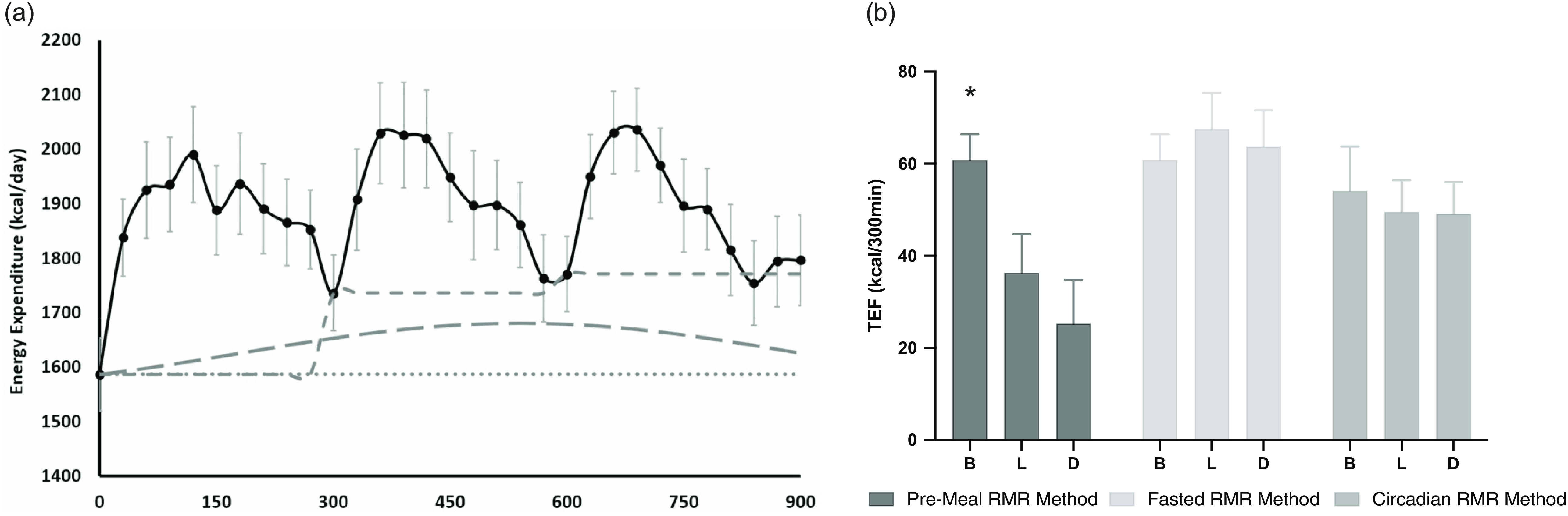
The second point against the potential role of diurnal variation in TEF in weight loss is, however, arguably more fundamental as it relates to the methods by which large diurnal differences in TEF have been demonstrated. Oscillating diurnal rhythms in resting respiratory metabolism were identified as early as 1973, with the implication that such variation, if unaccounted for, could confound measures of postprandial metabolism(Reference Bailey, Harry and Johnson31). In 2018, Zitting et al. (Reference Zitting, Vujovic and Yuan32) demonstrated a robust circadian rhythm in RMR, with the nadir in RMR corresponding to the nadir of core body temperature (CBT) at ∼05.00, and the peak corresponding to the peak in CBT at ∼17.00. The nadir-to-peak difference of ∼129 kcal is of such a magnitude that any RMR measure at a given clock time would be superimposed over meaningful time-of-day variance in underlying RMR. We have recently shown that the methods by which TEF is calculated and resulting values for postprandial energy expenditure are inextricably linked to underlying variation in RMR (Fig. 1(a) and (b))(Reference Ruddick-Collins, Flanagan and Johnston33). TEF is typically calculated as the incremental AUC in postprandial energy expenditure over and above a preceding measure of RMR. However, the timing of the RMR measurement which is used as the ‘baseline’ for the calculation, above which postprandial energy expenditure is calculated, has a crucial influence on the calculated TEF value. Uniformly, the research showing large diurnal variation in TEF has calculated TEF as the postprandial energy expenditure above an RMR measured immediately preceding a meal, irrespective of the timing of the meal(Reference Bo, Fadda and Castiglione11–Reference Morris, Garcia and Myers13). This method, however, has the effect of resulting in a TEF calculation for a first meal which is above a fasted basal RMR measure, while the RMR measured preceding subsequent meals is inflated both from the energy intake at prior meal(s) and/or the underlying circadian RMR value at the specific clock time of the measurement(Reference Ruddick-Collins, Flanagan and Johnston33). Consequently, this method results in lower values for TEF calculated postprandial to lunch and dinner, reflecting the overinflated value of the RMR measure immediately preceding those respective meals. Another method is to calculate TEF responses to all meals, irrespective of the clock time at which they occur, as the postprandial energy expenditure above the first fasted RMR measure(Reference Romon, Boulenguez and Frimat16,Reference Ravussin, Beyl and Poggiogalle30) . While this method abolishes the artefact in TEF values from calculations based on immediate pre-meal RMR measures for meals following breakfast, it introduces another source of error in assuming that the value for the fasted RMR represents a constant value across the day, when as stated RMR exhibits circadian variance(Reference Bailey, Harry and Johnson31,Reference Zitting, Vujovic and Yuan32) .
(a) Energy expenditure (solid black line) measured fasted for 30 min immediately after waking and over subsequent 15 h (900 min) following three isocaloric (33 % total daily energy intake) test meals: breakfast 1 h after waking (0 min); lunch 5 h after breakfast (300 min); dinner 5 h after lunch (600 min). Grey lines represent the underlying RMR for different calculation methods: dotted line represents the ‘fasted RMR method’, i.e. constant underlying RMR; short grey dashes represent the ‘pre-meal RMR method’, i.e. underlying RMR inflated from carryover energy of preceding meals and underlying circadian variance in RMR; long grey dashes represent the ‘circadian RMR method’, variation in underlying RMR across the day. (b) Thermic effect of food (TEF) responses to the same isocaloric test meals measured over 5 h (300 min) postprandial, calculated according to the pre-meal RMR method, the fasted RMR method and the circadian RMR method, respectively. All data are presented as means and se. Fig. 1(a) and data for Fig. 1(b) from Ruddick-Collins et al. (Reference Ruddick-Collins, Flanagan and Johnston33), reproduced with permission.

Using data from Zitting et al. (Reference Zitting, Vujovic and Yuan32) to model underlying circadian changes in RMR across the day, we have demonstrated that any apparent differences in TEF are unlikely to reflect any true variation in postprandial energy expenditure, but represent an artefact of underlying circadian variance in RMR (Fig. 1(a) and (b))(Reference Ruddick-Collins, Flanagan and Johnston33). Our analysis, as part of the Big Breakfast Study(Reference Ruddick-Collins, Johnston and Morgan34), utilised energy expenditure measurements taken over a full 16-hour day, including 5 h of postprandial energy expenditure following three isocaloric meals (consumed 1-, 6- and 11 h after waking, respectively), to calculate TEF responses to each meal according to each aforementioned method; above the RMR immediately preceding each meal (‘pre-meal RMR method’); above the fasted baseline RMR only (‘fasted RMR method’); and as the postprandial energy expenditure above the modelled underlying circadian RMR value (‘circadian RMR method’)(Reference Ruddick-Collins, Flanagan and Johnston33). Calculating TEF according to the pre-meal RMR method replicated the findings of previous research using this method(Reference Bo, Fadda and Castiglione11–Reference Morris, Garcia and Myers13), showing a 2·4-fold greater TEF response following breakfast compared to dinner (Fig. 1(b)). The fasted RMR method abolished this apparent diurnal difference and significant between-meal effect of TEF but resulted in higher absolute values for TEF for each meal compared to the circadian RMR method. Finally, the circadian RMR method not only abolished the apparent diurnal variation in TEF but further attenuated the magnitude of the postprandial TEF estimates relative to the fasted RMR method (Fig. 1(b)). Thus, TEF is not a component of TDEE that may be manipulated by timed eating strategies to influence energy balance and is likely of little importance in the context of weight loss and weight management.
This lack of effect of timed eating on energy expenditure and weight loss has been further confirmed by the related findings from the Big Breakfast Study RCT(Reference Ruddick-Collins, Morgan and Fyfe20) which accounted for all components of energy balance by controlling the energy intake of participants and measuring energy expenditure using the doubly labelled water technique, the gold standard for free-living energy expenditure measurements(Reference Westerterp35). The intervention compared two temporal energy distributions, a sequence of 45 %, 35 % and 20 % energy at breakfast (∼08.00), lunch (∼13.00), and dinner (∼18.30), respectively, compared to the inverse of 20 %, 35 % and 45 % energy, respectively, for four weeks. TDEE was unaffected by the distribution of energy intake and there was no difference in TDEE between the two conditions, and at matched, controlled, hypocaloric energy intakes, weight loss was practically identical at –3·33 kg and –3·38 kg (se diff., 0·51) in the high morning energy and high evening energy diets, respectively. The similar magnitude of weight loss between diets corresponded to a similar magnitude of decrease in RMR, as would be anticipated from energy restriction and weight loss(Reference Rosenbaum, Hirsch and Gallagher36–Reference Martins, Gower and Hill38), with RMR thus unaffected by the respective energy distributions. This extended the findings of Ravussin et al. (Reference Ravussin, Beyl and Poggiogalle30) that showed no significant effect of eTRE on TDEE, thus it appears that temporal energy distribution patterns do not alter RMR in humans.
As the final component of TDEE, it should be noted that PAT was assessed in the Bath Breakfast Project(Reference Betts, Richardson and Chowdhury39,Reference Chowdhury, Richardson and Holman40) , an RCT which compared the consumption of > 700 kcal before 11.00, with at least 50 % within 2 h of waking, to fasting until lunch, in both lean participants and participants with obesity. While PAT was elevated in the high-energy breakfast group compared to fasting until noon, the increase was proportional to the additional energy intake in the breakfast group, thus maintaining energy balance(Reference Betts, Richardson and Chowdhury39). The increase in PAT was only observed concurrently with the additional morning energy intake compared to the fasted morning group, with no differences beyond 12.00 following the onset of eating in the morning fasting group, and no significant differences in whole-day PAT(Reference Chowdhury, Richardson and Holman40). Thus, the short-term elevations in PAT were proportional to the greater energy intake in the breakfast group, maintaining energy balance and demonstrating a lack of overall difference in PAT between the respective timed eating regimens in the Bath Breakfast Project(Reference Betts, Richardson and Chowdhury39,Reference Chowdhury, Richardson and Holman40) .
Cumulatively, there is little evidence that timed eating interventions exert any meaningful effect on individual components of energy expenditure or TDEE, in humans. However, the fact that several trials have reported greater weight loss despite similar self-reported energy intakes(Reference Jakubowicz, Barnea and Wainstein10,Reference Lombardo, Bellia and Padua29,Reference Jakubowicz, Froy and Wainstein41) , warrants further scrutiny.
Timing of eating and energy balance: energy intake
Energy balance in humans is a function of exogenous dietary energy intake and endogenous energy expenditure requirements for physiological functions and activity, and the relationship between intake, expenditure and energy storage(Reference Hill42). Thus, the stability, net gain, or net loss, of body mass is relative to whether energy intake is, respectively, equivalent to, surplus to, or in deficit to, the energy level required for expenditure(Reference Hill42). While this energy balance principle is fundamental to human nutrition, a multiplicity of factors may influence the ultimate state of energy balance, including biological, behavioural, social, economic and environmental factors(Reference Hill42–Reference Fazzino, Courville and Guo49). Nevertheless, it is important to emphasise in the context of weight loss that the essential principle, established for up to 60 years, holds that at a constancy of energy intake and relatively constant physical activity, the rate of weight loss is relatively unaffected by dietary modifications(Reference Kinsell, Gunning and Michaels50). This is important to reiterate as a guiding interpretative principle for considering the potential effect of timed eating interventions on weight loss, i.e. whether there is a biologically plausible explanation for differences in weight loss observed between timed eating interventions and a comparative/control group, but with similar self-reported energy intakes(Reference Garaulet, Gómez-Abellán and Alburquerque-Béjar9,Reference Jakubowicz, Barnea and Wainstein10,Reference Jamshed, Steger and Bryan51) . Given the well-established systematic bias and underestimation of energy intake in self-reported dietary assessment methods(Reference Black, Goldberg and Jebb52,Reference Johansson, Solvoll and Bjorneboe53) and the fact that nutrition intervention trials seldom adjust for energy misreporting, differences in weight loss should be considered an indication of differences in self-reported energy intake(Reference Sanghvi, Redman and Martin54,Reference Hall, Sacks and Chandramohan55) .
Two papers published in the same year, 2013, showed that participants consuming a greater proportion of energy intake earlier had significantly greater weight loss compared to those consuming energy later in the day(Reference Garaulet, Gómez-Abellán and Alburquerque-Béjar9,Reference Jakubowicz, Barnea and Wainstein10) . The first was an observational analysis of female participants consuming their largest energy meal of the day at lunch (∼40 % TDEI), which categorised participants as ‘early eaters’ or ‘late eaters’ depending on whether they consumed that meal before or after, respectively, the median reported time of 15.00(Reference Garaulet, Gómez-Abellán and Alburquerque-Béjar9). Despite similar self-reported energy intake, the early eaters lost ∼2·2 kg more total weight over 20 weeks compared to the late eaters. The findings, however, were primarily hypothesis-generating given the observational nature of the design. However, the second study by Jakubowicz et al. (Reference Jakubowicz, Barnea and Wainstein10) cited previously showed in an RCT that women with overweight/obesity in the high-energy breakfast group lost –8·7 kg (± 1·4 kg) compared to –3·6 kg (± 1·5 kg) in the high-energy dinner group, despite similar self-reported energy intakes.
The fact that the latter trial was an RCT invites the assumption that the difference in weight loss between diet groups was the downstream effect of the intervention, i.e. was independent of other potential causes of the outcome(Reference Deaton and Cartwright56,Reference Cook57) . However, this assumes that no post-randomisation differences but for the addition of the intervention are introduced between groups, which may be an untenable assumption for many free-living diet RCTs given that changes in dietary intake and behaviours may occur in both intervention and control groups(Reference Flanagan, Bradfield and Kohlmeier58). In particular, modelled differences in free-living energy intake, based on the energy balance principle of estimated energy intakes as a function of dynamic changes in weight(Reference Sanghvi, Redman and Martin54), may be present post-randomisation even with no significant differences in self-reported energy intakes between comparative diet groups(Reference Guo, Robinson and Gardner59). The energy balance principle, i.e. that changes in body mass reflect the balance between energy intake from food and daily energy expenditure, remains fundamental to human nutrition(Reference Hill42,Reference Hall, Sacks and Chandramohan55) . Thus, in the absence of control of energy intake, mathematically modelled changes in energy intake may provide more representative assessments of changes in energy intake during an intervention and correlate strongly with observed changes in bodyweight(Reference Hall, Sacks and Chandramohan55,Reference Guo, Robinson and Gardner59) .
This principle holds important implications for timed eating research as it indicates that the most parsimonious explanation for differential weight loss in a free-living context is differences in energy intake, similar self-reported energy intake notwithstanding. As a case study in point, Jamshed et al. (Reference Jamshed, Steger and Bryan51) randomised participants with obesity to an 8-hour eTRE intervention or a ≥ 12-hour eating duration control, with both groups counselled to achieve the same energy restriction of 500 kcal/d. Over 14 weeks the eTRE group lost 2·3 kg (95 % CI, –3·7, –0·9 kg), despite a self-reported difference of 1 kcal/d. However, applying energy intake-balance modelling(Reference Hall, Sacks and Chandramohan55) to participants with repeated bodyweight measurements showed an average decrease in energy intake in the eTRE group of ∼214 kcal/d greater than the control group. This additional energy deficit would be sufficient to explain the differential weight loss observed between groups(Reference Jamshed, Steger and Bryan51). Similarly, the TREAT trial randomised participants with overweight/obesity to either time-restricted eating (TRE; 12.00–20.00) or a conventional meal timing (CMT; 3 main meals between 06.00–10.00; 11.00–15.00; 17.00–22.00, respectively), with no limitations on energy intake or dietary prescriptions provided(Reference Lowe, Wu and Rohdin-bibby60). The intervention was delivered through a mobile app, and participants were provided with a Bluetooth weight scale to weigh weekly, which the app would record. Over 12 weeks there was no significant difference in weight loss between groups, with weight loss of 0·94 kg (95 % CI, –1·68, –0·20 kg) and 0·68 kg (95 % CI, –1·41, 0·05 kg) in the TRE and CMT groups, respectively. Using the same energy intake-balance modelling approach(Reference Sanghvi, Redman and Martin54,Reference Guo, Robinson and Gardner59) based on the at-home scale weight measurements, there were no significant differences in estimated energy intake between the TRE and CMT groups(Reference Lowe, Wu and Rohdin-bibby60).
Other TRE research is indicative of the issue of the validity of energy intake assessments related to weight loss in human RCTs. A 5-week trial by Xie et al. (Reference Xie, Sun and Ye61) compared an eTRE (06.00–15.00) and midday TRE (mTRE; 12.00–20.00) against a control group with a habitual daily eating window of > 8 h. Compared to the control group, the eTRE group lost 1·6 kg (± 1·4 kg) while the mTRE group lost 0·2 kg (± 2·2 kg), despite relatively estimated decreases in energy intake (–240 kcal/d and –159 kcal/d for eTRE and mTRE, respectively). However, energy intake was estimated from food photographs using an unvalidated methodology, with the potential for misestimations of energy intake and no adjustments for the potential measurement error. The differential in weight loss likely reflects differences in energy intake, with greater reductions in energy intake in the eTRE group(Reference Xie, Sun and Ye61). Conversely, Liu et al. (Reference Liu, Huang and Huang62) compared prescribed 25 % energy restriction with additional eTRE (08.00–16.00) to 25 % continuous energy restriction (CER, i.e. daily energy restriction with no limits on eating duration) alone over 1 year of intervention; achieved weight loss was similar between groups at ∼7–8 % initial body weight while self-reported energy intake was also similar. A recent meta-analysis by Schroor et al. (Reference Schroor, Joris and Plat63) provided an instructive synthesis of the relationship between TRE, weight loss and reported energy intakes. Based on six included trials, the summary estimate was –0·93 kg (95 % CI, –1·69, –0·17 kg) greater weight loss in the TRE group compared to CER. However, the included primary trials reported either no differences in weight loss and no differences in energy intake(Reference de Oliveira Maranhão Pureza, da Silva Junior and Praxedes64,Reference Isenmann, Dissemond and Geisler65) , or no differences in energy intake but greater weight loss in the TRE groups(Reference Jamshed, Steger and Bryan51,Reference Thomas, Zaman and Sloggett66,Reference Lin, Wang and Chan67) , one of which was the Jamshed et al. (Reference Jamshed, Steger and Bryan51) trial where the lack of differences in energy intake was no longer evident after correction for weight loss modelling. Such discrepancies between the included trials preclude any inference that the magnitude of the effect between TRE and CER was independent of energy intake(Reference Schroor, Joris and Plat63). Further, the point estimate of < 1 kg of weight loss and confidence intervals < 2 kg places the entire range of the effect estimate far short of clinically meaningful thresholds (i.e. a minimum of 5 %) for weight loss(Reference Douketis, Macie and Thabane68,Reference Blackburn69) , and thus of questionable validity for clinical practice. Taken together, TRE interventions appear to influence weight loss through influencing reductions in energy intake, but there is little to no additional weight loss advantage to TRE compared to CER at the same magnitude of energy restriction(Reference Jamshed, Steger and Bryan51,Reference Lowe, Wu and Rohdin-bibby60,Reference Liu, Huang and Huang62,Reference Schroor, Joris and Plat63) .
The evidence for other timed eating interventions exhibits similar characteristics. A 1997 review of human eating frequency research found that, among seven experimental interventions, six showed no significant difference in weight loss across a range from 1–9 meals per day(Reference Bellisle, McDevitt and Prentice70). In particular, as no differences in energy expenditure were observed between eating frequencies, the authors emphasised that any effect of meal frequency on weight loss was explained by energy restriction, and the frequency of eating had no significant impact on the rate of weight loss under hypocaloric conditions. A 2020 network meta-analysis of the effect of eating frequency included 22 RCTs, of which 13 had prescribed energy-restricted diets(Reference Schwingshackl, Nitschke and Zähringer71). Compared to ≥ 8/d ‘meals’, there were no significant effects of 1/d, 3/d, 4/d, or 6/d meals. 2/d meals, however, showed a decrease in weight of –1·32 kg (95 % CI, –2·19, –0·45 kg) when compared to ≥ 8/d meals, –1·29 kg (95 % CI, –1·74, –0·84 kg) compared to 6/d meals, and –1·02 kg (95 % CI, –1·70, –0·35 kg) compared, 3/d meals. However, this effect of the 2/d meal frequency appeared to be mediated by energy restriction, with a sensitivity analysis confined to hypocaloric studies indicating that decreases in weight evident for the 2/d meals condition were explained by energy restriction. More particularly, the entire range of the effect estimates for the 2/d eating frequency were of an insufficient magnitude to be considered clinically relevant for weight loss(Reference Douketis, Macie and Thabane68,Reference Blackburn69) . A more recent 2023 systematic review and meta-analysis of eating frequency from Blazey et al. (Reference Blazey, Habibi and Hassen72) included 16 RCTs that compared either ‘low’ (≤ 3/d) or ‘high’ (≥ 4/d) meal frequencies. Based on eight trials that met the criteria for meta-analysis, there was no significant difference in weight loss observed, with a mean difference of –0·62 kg (95 % CI, –2·75, 1·52 kg). The trials included in the meta-analysis included three with prescribed energy deficits, four trials with prescribed energy balance, and one with an unclear energy prescription. Overall, there is little to no evidence that eating frequency modifies weight loss independent of restricted energy intake.
However, arguably the form of timed eating intervention, other than TRE, that has received the most attention is the temporal distribution of energy, in particular high morning/breakfast energy intake(Reference Jakubowicz, Barnea and Wainstein10,Reference Lombardo, Bellia and Padua29,Reference Jakubowicz, Froy and Wainstein41) . Lombardo et al. (Reference Lombardo, Bellia and Padua29) reported that distribution of ∼35 %, 35 % and 30 % energy intake at breakfast, lunch and dinner, respectively (no data provided on clock time), resulted in an 8·2 kg (± 3·0 kg) weight loss compared to weight loss of 6·5 kg (± 3·4 kg) on a 20 %, 35 % and 45 % energy distribution, respectively. Similar to the Jakubowicz et al. (Reference Jakubowicz, Barnea and Wainstein10) trial, the difference showed by Lombardo et al. (Reference Lombardo, Bellia and Padua29) was also observed in the context of similar self-reported energy intakes. Conversely, in the Bath Breakfast Project, while the breakfast group consumed more TDEI compared to the extended fasting group, this was reflected in a proportional increase in TDEE, such that energy balance was maintained and there was no difference in weight after 6 weeks in either lean or participants with obesity(Reference Betts, Richardson and Chowdhury39,Reference Chowdhury, Richardson and Holman40) . However, methodologically the Big Breakfast Study supersedes prior evidence given that energy intake was controlled with full provision of meals to participants tailored to individual energy-restriction requirements(Reference Ruddick-Collins, Morgan and Fyfe20). As highlighted in the previous section, weight loss was practically identical at ∼3·3 kg over four weeks between the morning-loaded and evening-loaded diets, matched for energy intakes. Thus, with control over energy intake, any apparent differences in weight loss from timed eating interventions are no longer evident.
Behavioural mediators of time-of-day energy intakes
While timed eating interventions may not lead to greater weight loss under conditions of controlled energy intake, in the free-living context in which individuals are required to achieve weight loss, behavioural factors which influence energy intake may act as important mediators of weight loss and management. In particular, appetite regulation appears to exhibit time-of-day variation which may be influenced by the timing of energy intake. In the Big Breakfast Study(Reference Ruddick-Collins, Morgan and Fyfe20), the high morning energy condition exhibited significantly reduced subjective appetite ratings, both acutely in response to an in-laboratory test breakfast comparing 45 % to 20 % meal energy, and over three days of hourly subjective appetite ratings during the high morning energy and high evening energy diets, respectively. This corresponded with greater suppression of ghrelin and elevations in gastrointestinal incretin hormones related to satiety, such as glucagon-like peptide 1 (GLP-1) and gastric inhibitory polypeptide (GIP)(Reference Ruddick-Collins, Morgan and Fyfe20). Suppression of ghrelin, lower subjective appetite and greater subjective satiety associated with higher energy intake in the morning have previously been shown in the context of hypocaloric weight loss interventions(Reference Jakubowicz, Barnea and Wainstein10,Reference Jakubowicz, Froy and Wainstein41) , and also with an eTRE (08.00–14.00) intervention conducted in energy balance(Reference Ravussin, Beyl and Poggiogalle30). It is interesting to note that GLP-1 and GIP have previously been shown to exhibit diurnal variation, with greater responsiveness to a test meal consumed at 08.00 compared to the same isocaloric meal consumed at 17.00(Reference Lindgren, Mari and Deacon73).
The potential for enhanced appetite regulation associated with earlier temporal energy distribution may reflect diurnal variation in appetite(Reference Scheer, Morris and Shea21), and a tendency for greater proportions of energy consumed in the evening to be positively associated with TDEI(Reference Reid, Baron and Zee74,Reference Dattilo, Crispim and Zimberg75) . Scheer et al. (Reference Scheer, Morris and Shea21) demonstrated a circadian rhythm in subjective hunger and appetite, increasing over the day with a peak at a clock time of ∼20.00. Such rhythms in subjective appetite may explain why satiety appears to decrease over the course of the day(Reference de Castro76). Using a metric known as the satiety ratio, reflecting the duration between meals relative to the energy content of the preceding meal, de Castro showed that the satiety ratio was highest in the morning and declined steadily over the remainder of the day(Reference de Castro76). This could explain why greater earlier temporal distribution of energy appears to exert an influence on appetite over the rest of the day(Reference Jakubowicz, Barnea and Wainstein10,Reference Ruddick-Collins, Morgan and Fyfe20,Reference Jakubowicz, Froy and Wainstein41) , i.e. mitigating against a pattern of increasing meal size over the day, and a shorter duration between meals as the day progresses, combining with higher evening subjective appetite to promote overeating. In a rigorous recent in-patient laboratory study using a crossover design, Vujović et al. (Reference Vujović, Piron and Qian19) compared two meal schedules, one with isocaloric meals consumed 1-, 5- and 9-hours, respectively, after wake time and the other a delayed schedule with meals consumed 5-, 9- and 13-hours, respectively, after wake time. Despite the isocaloric energy content of the diets, the later meal schedule resulted in significantly elevated subjective hunger and appetite scores, decreased 24-hour leptin levels and a 34 % increase in the ratio of leptin to ghrelin during waking hours, all indicative of dysregulated appetite regulation associated with later temporal meal timing(Reference Vujović, Piron and Qian19).
Such time-of-day associations may provide a more plausible explanation for the difference in weight loss observed with high-energy intake at breakfast compared to dinner in previous trials(Reference Jakubowicz, Barnea and Wainstein10,Reference Lombardo, Bellia and Padua29,Reference Jakubowicz, Froy and Wainstein41) . However, some caution is required against the temptation to fill in evidential gaps. In the wider literature on the relationship between appetite regulation and weight loss, it remains unclear whether interventions targeting appetite enhancement improve weight loss outcomes(Reference Hansen, Andersen and Astrup77,Reference Hansen, Mead and García-Gavilán78) . Differences in subjective appetite ratings may be present independent of significant differences in weight loss between intervention and control groups(Reference Hansen, Andersen and Astrup77). In the SATIN study, which was not a specific timed eating intervention but aimed to assess the effects of a satiety-enhancing diet on weight loss, there were weak inverse correlations (r = –0·33) between appetite suppression scores and weight loss and maintenance(Reference Hansen, Mead and García-Gavilán78). Further, elevated subjective appetite and hunger hormones do not appear to correlate with weight regain(Reference Sumithran, Prendergast and Delbridge79,Reference Nymo, Coutinho and Rehfeld80) . These evidential gaps highlight some potential disconnects in the hypothesised chain of causation, which is that reduced appetite leads to reduced energy intake, which leads to improved body weight regulation. In the context of timed eating interventions, it should be noted that the potential for such interventions to influence weight loss through enhanced appetite regulation remains to be directly tested as an a priori hypothesis. In the Big Breakfast Study(Reference Ruddick-Collins, Morgan and Fyfe20), the controlled and isocaloric diets meant that any effect of appetite on enhancing weight loss could not be demonstrated. Thus, to what extent any diurnal variation in appetite regulatory hormones, and subjective appetite and satiety, may influence energy intake and weight loss, remains to be directly tested in human intervention trials.
Other novel research opportunities exist, particularly with regard to the relationship between circadian typology and behavioural factors. As a behavioural phenotype, chronotype has attracted interest in potential relationships with personality traits(Reference Tsaousis81). In particular, chronotype exhibits associations with Big Five Factor Inventory (BFI) personality traits, with early chronotypes (‘morning larks’) tending to correlate with traits like conscientiousness and agreeableness, while late chronotypes (‘night owls’) show stronger correlations with traits such as neuroticism and extraversion(Reference Tsaousis81,Reference Lenneis, Vainik and Teder-Laving82) . A late chronotype has been associated with several negative health-related behaviours, including low diet quality, higher prevalence of smoking, and less physical activity(Reference Maukonen, Kanerva and Partonen17,Reference Kanerva, Kronholm and Partonen18) . In addition, BFI personality traits such as conscientiousness have been associated with breakfast consumption, and chronotype has been shown to mediate the relationship between attitudes toward breakfast consumption and personality traits(Reference Walker and Christopher83). Breakfast consumption also correlates strongly with wider health-promoting behaviours(Reference Reeves, Halsey and McMeel84), therefore the potential for chronotype to mediate relationships between behaviours and time-of-day energy intake preferences may have important implications for health outcomes(Reference Walker and Christopher83,Reference Reeves, Halsey and McMeel84) . Specifically, chronotype may influence time-of-day energy intake, given associations between evening chronotypes and a tendency to redistribute energy and macronutrient intake later in the wake cycle(Reference Kanerva, Kronholm and Partonen18,Reference Maukonen, Kanerva and Partonen24) . This may be relevant given that several cross-sectional studies have demonstrated an association between energy intake close to dim-light melatonin onset, a marker of endogenous circadian timing used to determine chronotype, and higher adiposity(Reference Baron, Reid and Wolfe85–Reference McHill, Phillips and Czeisler87). However, the relevance of any potential interaction in the context of weight loss has yet to be tested in a human intervention.
Thus, the extent to which chronotype may mediate relationships between chronotype, timing of eating, weight loss and management, remains unclear. Xiao et al. (Reference Xiao, Garaulet and Scheer88) investigated the associations between chronotype, meal timing and obesity in a U.S. cohort, and found that increasing levels of energy consumed within 2 h of waking were only associated with lower odds of obesity in early chronotypes, while neither higher nor lower energy intake within 2 h of waking was protective in late chronotypes. Late chronotypes also exhibited a ∼5-fold (OR 4·94; 95 % CI, 1·61, 15·14) higher odds of overweight and obesity associated with the highest quintile of energy intake within 2 h of bedtime(Reference Xiao, Garaulet and Scheer88). This suggests that chronotype may mediate associations between time-of-day energy intake and health outcomes. The lower odds for overweight/obesity associated with high morning energy intake in early chronotypes observed by Xiao et al. (Reference Xiao, Garaulet and Scheer88) may reflect a correlation between chronotype and meal timing with a genetic heritability component. Lopez-Minguez et al. (Reference Lopez-minguez, Dashti and Madrid-valero89) investigated the heritability of food timing among 56 pairs of monozygotic and dizygotic female twins, which showed 56 % and 38 % heritability for breakfast and lunch timing, respectively, but no such heritability was found for dinner timing. This suggests that, while earlier temporal energy intake may have a strong genetic component, evening energy intake may be influenced by behavioural factors and preferences(Reference Lopez-minguez, Dashti and Madrid-valero89). However, to date, there is a dearth of interventions specifically testing the potential interaction between chronotype, the timing of eating and weight loss. In one such RCT published in 2020 by Galindo Muñoz et al. (Reference Galindo Muñoz, Gómez Gallego and Díaz Soler90), a control diet of CER was compared against the same prescription of energy restriction, but with the distribution of energy-adjusted according to individual chronotype. Thus, early chronotypes consumed 40 %, 40 % and 20 % energy between breakfast, lunch and dinner, respectively, while late chronotypes consumed 30 %, 45 %, and 25 % energy between breakfast, lunch and dinner, respectively(Reference Galindo Muñoz, Gómez Gallego and Díaz Soler90). Both the CER and chronotype-adjusted diet groups achieved a significant weight loss of 7–8 kg, with a between-group difference of –1 kg (95 % CI, –1·4, –0·06 kg) in favour of the chronotype-adjusted diet. Thus, the magnitude of the difference is unconvincing. A further protocol for a similar chronotype-adjusted diet RCT was published this year, for which we await the results(Reference Dinu, Lotti and Pagliai91). At this juncture, however, the evidence in relation to behavioural mediation of chronotype remains suggestive but lacks the probity to come to any confident conclusions.
Conclusions
Insofar as timed eating interventions may be effective for weight loss, this effect is proportional to the magnitude of energy restriction and is not superior to CER when matched for hypocaloric energy intakes. Manipulations of eating duration or distribution of energy confer no additional energetic advantage in the form of enhanced TEF, PAT or TDEE. The apparent diurnal difference in TEF between morning and evening meals represents an artefact of the method of calculating TEF, when in fact underlying circadian rhythms in RMR better explain such apparent time-of-day differences in TEF. Consequently, evidence is lacking for time-of-day variation in TEF that would be of any relevance, as a component of TDEE, for weight loss and management. In relation to behavioural mediators of time-of-day energy intake, however, the existing evidence offers potential for timed eating interventions directed toward specific behavioural mediators, such as appetite regulation or behavioural correlates of chronotype, to be further investigated and directly tested as a priori hypotheses.
Acknowledgements
A.F. would like to thank the organisers of the Scottish Section Conference 2024 for the speaker invitation. With thanks to Prof Alexandra M. Johnstone, Prof Jonathan D. Johnston, Dr Leonie Ruddick-Collins, Prof Peter J. Morgan, Dr Barbara Fielding and the Big Breakfast Study academic and clinical research teams.
Authorship
A.F. wrote the manuscript and related editing and is responsible for the final contents.
Financial support
This review received no specific grant from any funding agency, commercial or not-for-profit sectors. The Big Breakfast Study was funded by a Medical Research Council grant (MR/P012205/1).
Competing interests
There are no competing interests to declare.

 Open access

