


In May 2012, Ethiopia's Prime Minister Meles Zenawi spoke at the African session of the World Economic Forum in Addis Ababa. On stage, he lectured to an audience of economists, journalists, and politicians about the need to keep some sectors of the economy under state control. Telecommunications was cited as among the sectors that should not be privatized, as well as roads and infrastructure. Likewise, the banking sector should remain out of the reach of foreign investors. Meles calmly concluded: “we cannot please everyone”.Footnote 1 This was enough to shock people not used to the Ethiopian government's parlance, but it was not a surprise to observers familiar with the man and his regime. This speech was among his last public appearances; Meles died three months later.
Meles was the leader of a party that had fought its way to power over seventeen years of guerrilla warfare. Before toppling the Marxist military regime known as the derg in May 1991, Meles and his comrades led an ethno-nationalist party with a strong Marxist–Leninist stance, the Tigray People's Liberation Front (TPLF). Fighting their way from their Northern province to the capital city, they created a pan-ethnic coalition known as the Ethiopian Peoples’ Revolutionary Democratic Front (EPRDF). The EPRDF led the country from 1991 to 2019, when it was rebranded by Meles's most famous successor, Abiy Ahmed. The latter made substantial promises to liberalize political life and economic activity.
By the time they took power, EPRDF cadres were still calling themselves Marxists, following the Albanian model.Footnote 2 In subsequent years, they had to temper their leftist stance and negotiate a long and rather jerky process of adaptation to the market economy. Compared with most other post-socialist countries, however, the opening and liberalization of the economy proceeded slowly.Footnote 3 The ruling party followed its own version of the “developmental state”, inspired by neo-Keynesian models of the Asian “tigers”.Footnote 4 This implied a slow opening of the economy to foreign capital under tight and growing control by the party elites, who continued to publicly denounce the international financial institutions as Trojan horses aiming at importing their Western neoliberal ideology into Ethiopia.
Unlike several West African countries, the slow adoption of free-market policies in Ethiopia took place without substantial political liberalization. Ethiopia had no place in any of the successive “waves of democratization”, as the EPRDF took command of the derg's control apparatus and expanded it even further.Footnote 5 Successive elections saw EPRDF landslide victories. In court, opposition leaders and journalists were facing “terrorism” charges, especially after the 2009 Anti-Terrorism Proclamation considerably extended the definition of this crime.Footnote 6 In rural areas, where until the mid-2010s around eighty per cent of the population lived, government programmes aimed first and foremost at controlling the peasantry through party and state structures, in the name of development.Footnote 7 Chronic humanitarian emergencies and persistent food insecurity legitimized growing state control, embedded within the policies of the developmental state.Footnote 8
Although Ethiopia saw massive unrest in 2005, 2012, and again from 2014 onwards, there were no “adjustment riots” similar to those described in other pieces published in this volume. Repression, coupled with regular state interventions to control prices and the distribution of food and energy, prevented urban populations from rising up. But the absence of a nationwide social movement does not amount to the absence of small-scale opposition and day-to-day resistance. Under the EPRDF, rural dwellers found ways to subvert state policies and managed to address growing inequalities driven by liberalization and its effect on their livelihoods. Food riots and social movements opposing neoliberal policies in Africa remained largely urban-based, often led by trade unions, unemployed youth, and student activists.Footnote 9 However, rural inhabitants did not stay away from political settlements.
Given that the Ethiopian regime's adoption of neoliberalism differs from global patterns of neoliberalization, this article analyses processes of neoliberalization at various scales. It considers neoliberalization of government action as a scalar structuration process that frames power relations and access to state resources by delimiting scales.Footnote 10 For the sake of clarity, we will nevertheless focus on two opposing scales: elite politics and field-level peasant voices. Although in-between situations are not directly addressed, considering adjustment through its scalar dimensions nevertheless allows us to take them into account.
We question how peasant attitudes of apparent conformism can actually challenge authority.Footnote 11 Various swathes of the population engage in criticism of the government, displaying different strategies depending on their social status and the roles they play in their communities and in the state apparatus. The capacity to politicize material issues and social practices is not granted equally to all social groups; peasants are mostly denied such ability.Footnote 12 Civil servants who have daily contact with peasants often claim that the latter do not understand what is at stake in state policies. Farmers elected as local representatives also define social and farming good practices based on their understanding of the EPRDF motto. On the one hand, small acts of defiance such as foot dragging or absenteeism are interpreted as laziness, not as political practices. On the other hand, any open expression of grievances is taken as political, if not partisan, opposition, and is met with harsh repression. Accordingly, the ability of state agents or representatives to frame the limits of politics means they play a part in the manufacturing of consent in a constantly evolving authoritarian context.Footnote 13
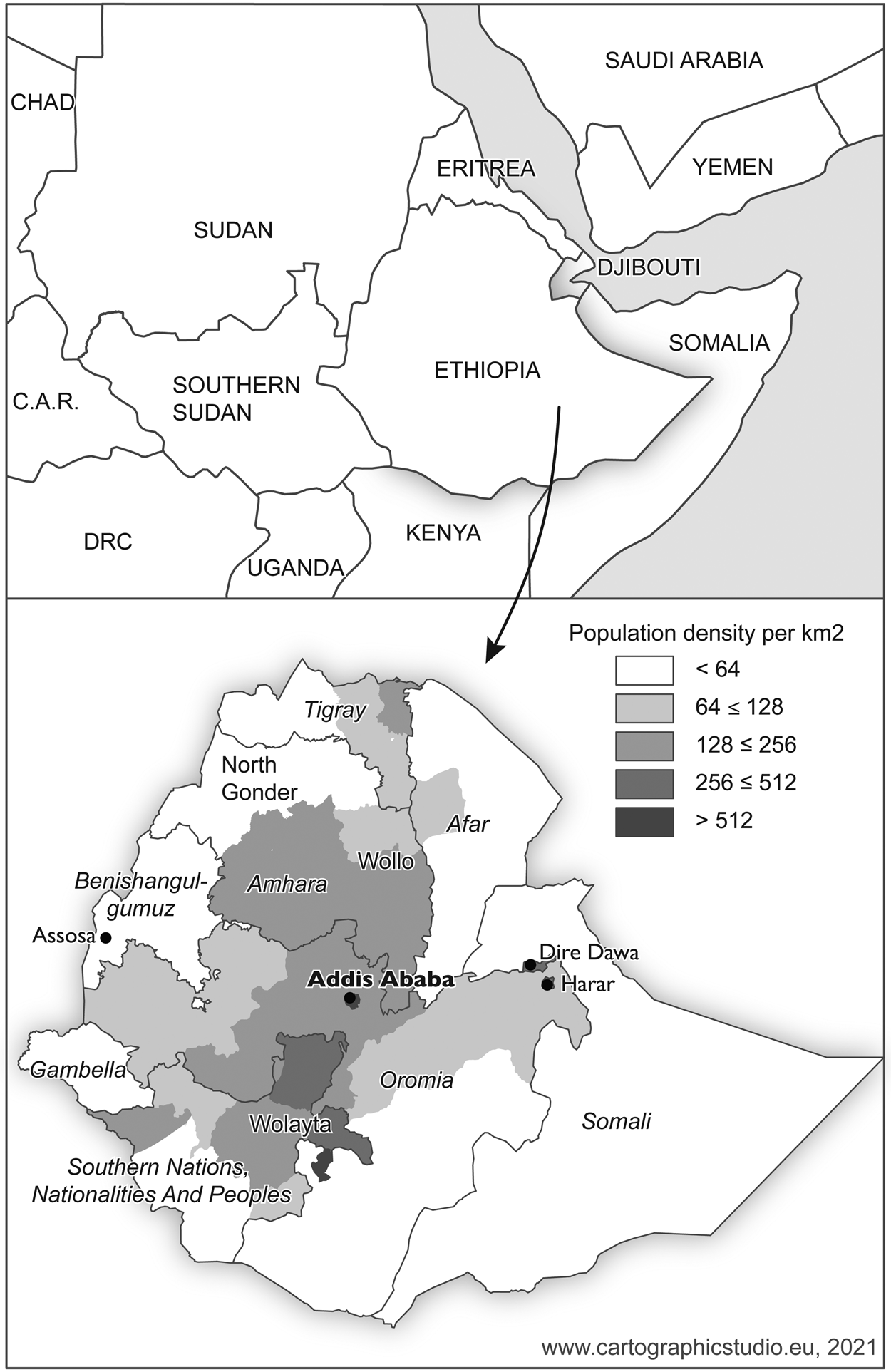
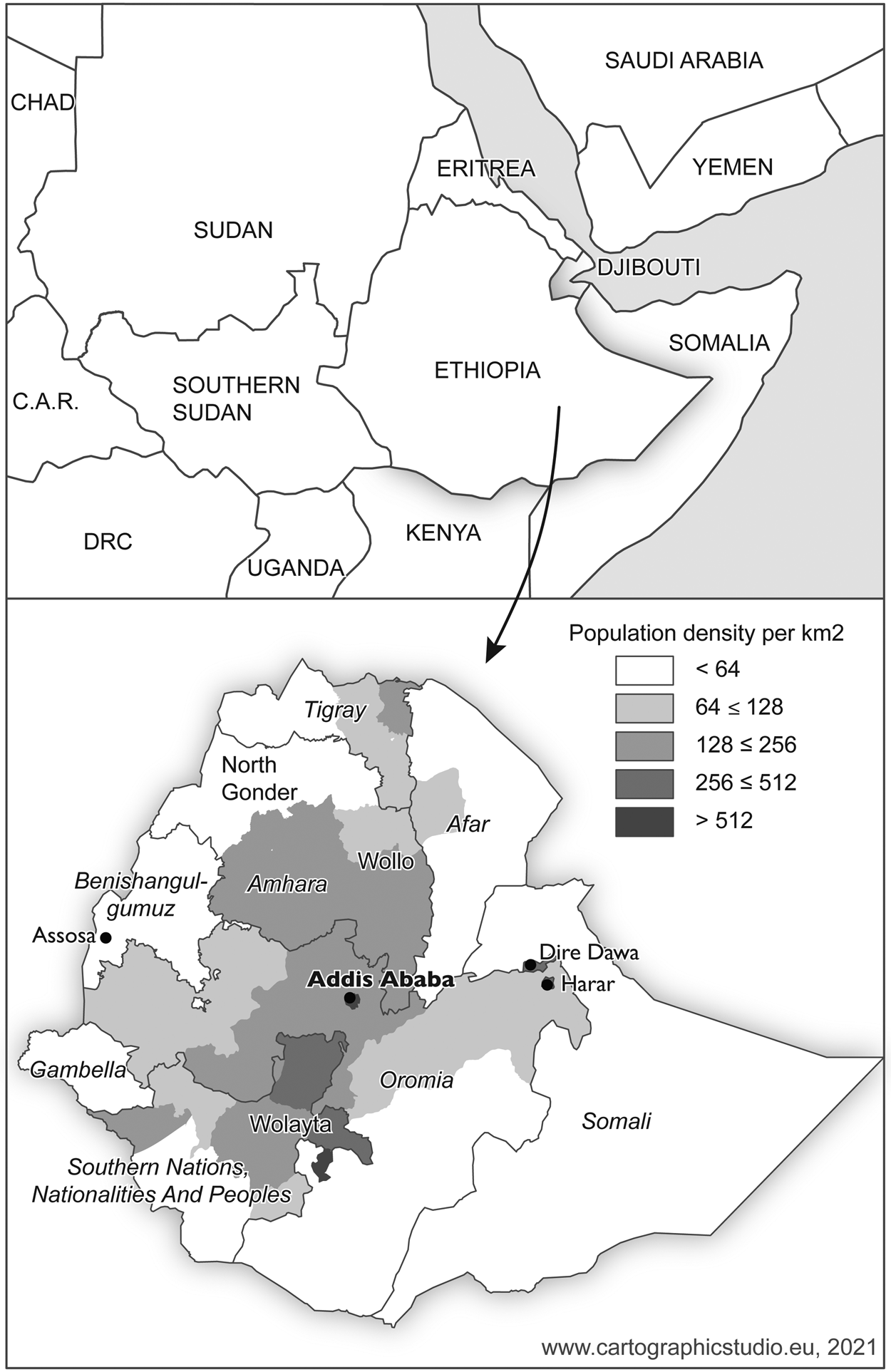
As a consequence, the article is divided into two parts. The first part describes how EPRDF elites coined their own ideology of a “developmental state” and how they subverted international injunctions to pursue privatization and liberalization. This jerky process of economic liberalization is analysed through written production by party cadres. The article shows the evolutions in the practical translation of this doctrine that was adapted in party crises and purges. The second part of the article focuses on the rural level and offers a more embedded vision of power relations in the local, highly politicized context. Based on enquiries regarding agricultural policies conducted during repeated stays in the countryside between 2010 and 2018 (Figure 1), the text shows how rural inhabitants reacted to government policies.Footnote 14 Though structural adjustment was not high on the developmental agenda, ethnographical data shows how increasingly selective economic policies, marking more and more market-oriented tendencies, were met with popular resistance.
Map of the Federal Democratic Republic of Ethiopia displaying fieldwork sites and population densities.
THE DEFERRED EPRDF ADJUSTMENT
The EPRDF way of adapting reforms, 1991–2001
The year 1991 was an awkward moment for a socialist movement to reach state power. After seventeen years of civil war and state predation, the TPLF had to rebuild the national economy. And this could hardly be done without substantial foreign aid,Footnote 15 at a time when donors had no taste for the Marxist concepts put forward by the EPRDF coalition. New rulers had to craft a new economic policy, one that would satisfy both foreign donors and the rank and file of the party who had hitherto been fighting in the name of a socialist ideal. The party's inner circle forged its way out of Marxist–Leninism through practical and theoretical arrangements. Himself a TPLF sympathizer before breaking with the movement, Medhane Tadesse writes: “TPLF leaders who had venerated Enver Hoxha of Albania only months before triumphantly entering Addis Ababa had to show a great deal of pragmatism and adapt to the changing international context.”Footnote 16
In order to win the confidence of, and loans from, the Bretton Woods pair, the new regime had to adopt adjustment plans. However, the timing and scope of the adjustment differed from those in other sub-Saharan countries:Footnote 17 it was more about negotiating a smooth exit from the socialist economy than it was about liberalizing markets and organizing the rolling back of the state. The government adopted its first structural adjustment programme (SAP) in 1993. This first step essentially consisted of the privatization of formerly non-profitable state enterprises, including many state farms created by the previous regime. Accounting for less than ten per cent of GDP, industry was very weak and highly concentrated in Addis Ababa and to a lesser extent Dire Dawa.Footnote 18 The economy remained agrarian, and most of the workforce was engaged in household agriculture. The state owned almost ninety per cent of industrial enterprises, and the entire banking sector.Footnote 19 Attempts to control prices and agricultural production through quotas set by the Agricultural Marketing Corporation led to losses in agricultural productivity over the derg period, while industry remained nascent.Footnote 20 State farms were found suitable for privatization, since they could not be kept afloat without a high degree of coercion and forced labour. Dismantling them was more of a relief for the new regime. In 1996, a second SAP was declared, but a clash with the International Monetary Fund (IMF) in subsequent years brought it to an end. The 1998–2000 war with Eritrea slowed negotiations with the international financial institutions. In the late 1990s, Meles Zenawi had several arguments with the Fund's economists, who were (unsuccessfully) pushing for opening up the banking sector to foreign capital.Footnote 21 In the 1990s, tariffs were lowered and foreign exchange offices were opened within the private banking system.
Instituting and controlling the private sector
In terms of structural reform, getting rid of unprofitable units of production was not enough to satisfy international organizations; more needed to be done in order to secure donors’ support. Former guerrilla fighters then crafted their own model to bring privatization to a higher level. State enterprises were sold to “endowment funds” created for this very purpose. Legally speaking, these funds consisted of private holdings. However, they were completely controlled by the central committees of EPRDF branches. From its creation in 1989, the EPRDF had been a coalition of parties closely affiliated to the TPLF. Each branch of the party administrated one of the newly created regional states, within a federal framework. Each endowment fund's board membership largely overlapped with each regional party's central committee. What the state had to sell was bought by the party.
Gebru Asrat, a long-time member of the TPLF central committee and President of the Tigray region from 1991 to 2001, describes the process as follows:
[A]t governmental level, we had agreed to work with imperialist institutions such as the International Monetary Fund and the World Bank. This is why we had to accept the practical policy ameliorations at each level. When these institutions gave us directives calling for structural adjustment, we accepted it without debate. […] These programmes framed by foreign influences were contrary to the revolutionary democracy we pretended to follow, it didn't fail to create confusion. […] To the question “but then, doesn't this process destroy the pillars of our programme?”, we had prepared an answer stating than in order not to lose benefits expected from international institutions and the World Bank, we should accept to implement their policies. We stated that to realise the programme whereby the state plays a huge role in the economy, that we were following hitherto, we would operate through development institutes kept under the parties’ control. We also stated that to avoid opposition from the IMF and the World Bank, these economic enterprises controlled by the parties should be registered as foundations involved in charity works.Footnote 22
Behind closed doors and towards their party members, TPLF cadres were crystal clear about the fool's game they were playing with the Bretton Woods institutions. The latter eventually accepted it. They designed a complex para-statal economy made up of investment funds, state enterprises, and private companies, and restricted to national investors supporting the EPRDF only.
Breweries, transportation and shipping companies, cement factories, and public works companies were sold off to these funds. The biggest among them was the Endowment Fund for the Rehabilitation of Tigray (EFFORT), created in 1995 and affiliated to the TPLF. In 1995, some enterprises were simply given to EFFORT.Footnote 23 EFFORT's original capital was made up of what the Front had gathered from its administration of the liberated regions during the civil war, added to a 320-USD-investment operated by each of the twenty-five Tigrayan businessmen, including sixteen members of the party's central committee.Footnote 24 Subsequent presidents of the funds were all prominent TPLF members, including a Minister of Defence (Siye Abraha), Meles's special counsellor (Sebhat Nega), a regional Vice-President (Abadi Zemo), and eventually Meles's own wife, Azeb Mesfin.Footnote 25
Other companies were used to keep control of the national economy. In June 2010, major state companies were brought together in a new military corporation called Metal and Engineering Corporation (Metec). With an original capital amount of 10 billion birrs, the conglomerate gathered ninety-eight companies. Metec soon became the state's and the army's main business partner.
Party-controlled endowment funds were not the only beneficiaries of privatization. Some enterprises were genuinely sold to private entrepreneurs. But here again, EPRDF planners managed to keep control over potential newcomers to the Ethiopian market. As a former mayor of Addis Ababa and long-time economic special advisor to the Prime Minister wrote, eighty-five per cent of the privatized enterprises were sold to national investors: of the 295 state companies sold over the 1991–2011 period, 264 found Ethiopian acquirers.Footnote 26 But one man, in particular, took the biggest share in the clean-out of state assets: Mohamed Al Amoudi, the Ethio-Saudi billionaire running the Mohamed International Development Research and Organization Company (MIDROC).
MIDROC bought the most profitable enterprises, with the blessing of the TPLF. In 2008, worried US diplomats wrote that the Sheikh's acquisitions accounted for fifty-five per cent of the total number of privatized companies. They specified: “Al Almoudi is known to have close ties to the ruling TPLF/EPRDF regime, and rumours persist of favourable treatment.”Footnote 27 Born to a Yemeni father and an Ethiopian mother in the Ethiopian province of Wollo, Al Amoudi built his fortune in Jeddah before taking advantage of the privatization of refineries in Morocco and Sweden, where he became one of the biggest foreign investors. When the TPLF came to power, Al Amoudi owned millions of petrodollars to invest in a market under reconstruction following years of civil war. He soon took an oligopolistic position in his homeland.
Links between the ruling elite and the Sheikh are not obvious. However, the Sheikh repeatedly brought his support to the ruling coalition. He wore the usual EPRDF T-shirt flocked with a bee for each electoral campaign. He announced a million-dollar gift for the funding of the Grand Ethiopian Renaissance Dam.Footnote 28 When Meles Zenawi died, the Sheikh appeared on public television to express his sympathy.Footnote 29 Many government contracts were granted to the Sheikh's conglomerate, most often cloaked with great opacity. In 2017, the conglomerate owned the country's biggest gold mine, the majority of the country's public works and construction enterprises (Dil Paints, Vision Aluminium, Kombocha Steel Products, etc.), the first private university (Unity), real estate groups (Huda, Modern Building Industries), flower and tea farms (Jittu, Wushwush), drink retailers (Moha), giant farms (Saudi Star), hotels, and so forth.
EFFORT and MIDROC exemplify how the new ruling class profited from its accession to power to secure its economic accumulations following the classical “straddling” pattern.Footnote 30 The whole process can be described as what Jean-François Bayart called a “Thermidorian situation”, in which a small revolutionary elite abandons its radicalism when securing its political position through economic reforms that in turn open up unprecedented business opportunities for them. Cambodia and Iran followed similar trajectories, as did the Indian state of West Bengal throughout the 1990s and 2000s.Footnote 31 Former guerrilla fighters did not become businessmen overnight, and for a long time the enrichment of a small Tigrayan elite remained hidden. But the political crisis that occurred in Ethiopia after 2015 led to the public exposure of many scandals.Footnote 32
The eventual acceptance of capitalism and the birth of the developmental state
Throughout the 1990s, selling public enterprises to party holdings and to a tycoon did not amount to full acceptance of capitalism by TPLF elites. The recognition of the ineluctability of capitalism by Meles Zenawi himself occurred in 2001. This had more to do with internal party struggles than with debates and negotiation with foreign donors.
In 1998–2000, members of the TPLF central committee were highly divided in their positions on the war with Eritrea. The conflict started with skirmishes on the border in a remote village but soon escalated. Most TPLF leaders, including Defence Minister Siyé Abraha, Tigray President Gebru Asrat, and Army Chief of Staff Tsadqan Gebretensae, positioned themselves as hardliners and wanted to invade Eritrea in order to remind their northern neighbour that its success in guerrilla warfare was long over. These hardliners were both strongly nationalist and leftist. Meles, Arkebe Oqubay, and Abay Tsehaye were more concerned about the reaction of the international community and less eager to punish the Eritrean regime militarily.Footnote 33 After a ceasefire was negotiated in Algiers, conflicts between Meles and most of his party continued in inner-circle meetings.
The quarrel ended in late 2001, when Meles managed to rally most of the EPRDF members – and especially its Amhara branch – to his side.Footnote 34 Internal debates focused more on political economy than on national interests. Meles managed to marginalize the leftist group by denouncing their “Bonapartist tendencies”.Footnote 35 Debates were framed in the old-fashioned Marxist idiom that TPLF insiders had mastered perfectly, although the ideological content of the argument differed from its terminology.Footnote 36 The quality and complexity of these arguments certainly played a role in the delay of the Ethiopian adjustment. Meles depicted the leftists as too radical and persuaded his comrades that an official acceptance of capitalism was a sine qua non for foreign capital and international aid to flow in.Footnote 37 He won a slim majority of the votes in an internal party evaluation in December 2001. His opponents were purged. Corruption accusations were crafted to send the then Defence Minister Siye Abraha to jail.
Making amends to capitalism did not amount to an outright acceptance of the free market. Ideologically, the TPLF then promoted the “developmental state”, according to which state investment was to lead industrialization.Footnote 38 In the name of the fight against “neoliberal forces”, it advocated for strong control of the state over the economy. In this framework, economic expansion and (the absence of) political opening up were closely linked. A market economy could be adopted only after the economy was sufficiently industrialized. Until then, agriculture had to remain the engine driving economic growth.Footnote 39 The rural population, amounting to more than eighty percent of the population up until the late 2000s, had to be enrolled in public works and in political “participation” through government activities. Large state-funded industrial projects were launched with much governmental fanfare: the Great Ethiopian Renaissance Dam on the Blue Nile, sugar factories, industrial parks – all were built with Metec's involvement.
The party's hegemony was seen as a sine qua non for development, even at the cost of successive unfair electoral campaigns and clampdowns on opposition parties. According to TPLF elites, Ethiopia could not yet afford democracy, for democracy and the free market would only profit “rent-seeking forces”Footnote 40 and worsen inequalities. In short, the EPRDF had to drive the country towards development, and both the total adoption of a market economy and the opening up of the political field could only occur once the peasantry was lifted out of poverty.
Rural policies of the developmental state
As tools intended to drive industrialization over the long run, agrarian policies were the pillars of EPRDF thought. Until the mid-2000s, agriculture was conceived as the engine of economic growth. Through learning and mobilization, smallholders would make productivity gains, ensure food security, and eventually drive industrialization.Footnote 41 Echoing the party's socialist origins, land and agricultural policies were deemed “pro-poor policies”.
The privatization of land was continuously rejected in the name of protecting smallholders.Footnote 42 Land sales were officially forbidden and the right to ownership of land “is exclusively vested in the State and in the Peoples of Ethiopia”.Footnote 43 In EPRDF thought, privatization of land could only foster land concentration and eventually amount to the re-formation of a feudal class that the 1975 land reform and subsequent redistributions had eradicated. This credo was maintained despite continuous urging by foreign donors and “progressive” party members to establish a land market. That was partly done through land registration programmes fostering land rentals.
But after the 2001 internal crisis, noticeable shifts occurred in land policies. With the assistance of donors, access to land was reorganized. In towns, urban land leases were promoted, with strong state control over subsequent construction activities. In rural areas, georeferenced cadastral maps were drawn, containing information about landholders. Although prepared with donor assistance, these programmes greatly increased state control in rural areas. With the introduction of landholding books, rental land markets became a major means to access land. Distributing certificates also prepared peasants for a deeper inclusion in the banking system, by accessing credit through using land as collateral. Large estates were leased to foreign and national investors, mainly in the lowland peripheries.
By adopting the Growth and Transformation Plan (GTP) in 2010, the government implicitly acknowledged the failure of the egalitarian “pro-poor policies”.Footnote 44 Agrarian policies then shifted towards a more selective development model that still aimed at food sufficiency but counted on investors rather than on smallholders. Non-competitive farmers were consequently relegated to social protection.Footnote 45 Before the adoption of such reforms, each farmer was supposed to equally invest in agricultural inputs and, above all, to buy selected seeds and fertilizer on credit (Figure 2). Rural authorities closely and rigorously monitored the implementation of agricultural modernization programmes, paying more and more attention to the recovery of the “fertilizer debt”.Footnote 46 The supply and management of agricultural inputs entailed a great deal of political control, through the routinized and bureaucratized exercise of state domination.
Farmer carrying a bag of fertiliser he has just collected from the local authorities in Tigray (2012). Photograph by the authors.

In the name of development, forcing farmers to buy fertilizer regardless of their specific needs was the norm. Such a non-liberal articulation to the market properly reflects the jerky adjustment of Ethiopia to global capitalism. Forcing farmers to buy fertilizer offered an unprecedented opportunity to strengthen the banking sector while developing party-affiliated regional microfinance institutions. It promoted the financial inclusion of the poorest, in a surprising level of understanding of egalitarian and free access to finance. Before the adoption of the most selective GTP programmes, social distinction in rural areas largely mirrored state action.
Rural policies constitute the main vehicle through which local populations are integrated into a lower level of state administration and into a market economy. They are the means through which local society encounters the state. Ethiopian “street-level bureaucrats” were first and foremost agents of the Ministry of Agriculture, the Development Agents (DA) tasked with the setting up of various farmers’ lists, the teaching of improved farming techniques, and the distribution of agricultural inputs.Footnote 47
Like land redistribution a few decades ago, agricultural policies contributed to state formation at the local level by giving state power its concrete and most local embodiments and by giving content to local political fields.Footnote 48 Elites, though small, had to support the party-state, at least publicly. Although officially elected by fellow peasants, farmers were called to act as local militiamen enforcing law and order, as leaders of the many working groups active at village level, as secretaries of local assemblies for the most literate, or as judges for communal affairs in the case of the oldest ones. Some productive and compliant people were awarded the status of “model farmers”,Footnote 49 and hence they were invited to become more active in party mobilization. Partially as a result of the very implementation of the regime's development policies, this small elite was expected to be numerous and under constant renewal, so that ideally the EPRDF could reach every single house, if not every single individual.Footnote 50 Unlike the high-level national cadres discussed above, these men had limited resources to contest the party's hegemony. As a result, hierarchies among rural societies echoed state action.
POPULAR ADJUSTMENTS: PEASANT WAYS OF ADAPTING TO REFORMS
Satisfaction or repression? On the demobilizing role of state structures
Adaptations by party elites to “lefticize” injunctions towards free-market policies were made in the name of protecting the peasantry, whether the latter agreed or not. But from 1991 to 2014, rural Ethiopia saw very little large-scale opposition to the regime. Was the economic content of the developmental state sufficient to prevent the rural masses from contesting it? For a long time the party claimed there was a strong economic dimension to its redistribution policies. But although party elites held a paternalistic view of the rural masses, local authorities took a much more authoritarian approach to the people they governed. Social and political mobilization was deterred more by repression than by unfair redistributive policies. As James Scott wrote, “agrarian peace […] may well be the peace of repression (remembered or anticipated) rather than the peace of consent and complicity”.Footnote 51 The ability of the regime to meet popular expectations and provide necessities for the survival of the poorest was not total, and it was insufficient to explain the absence of outright rebellion.Footnote 52
Furthermore, elaborate state domination discouraged farmers from openly expressing their opinions. Political mobilization and control were routinized and ubiquitous in everyday lives, occasional episodes of repression were brutal, and street-level bureaucrats often resorted to coercion with those they considered as reluctant. Farmers not willing to accept land registration, opposed to their expropriation for “development” purposes, or unable to repay their fertilizer debt could then be jailed. Similarly, civil servants were subjected to harsh evaluations by party cadres, where their careers could be severely damaged.Footnote 53 Surveillance was ubiquitous. In towns, shopkeepers and hotel owners could be asked to make daily reports at the kebele – the smallest administrative unit. In rural villages, such reports were made by members of the kebele cabinet, who could also denounce civil servants to the next level of administration, called wereda. From 2011 onwards, a system of surveillance and propaganda called “one-to-five” was put in force. For every five households, a man was in charge of gathering his neighbours to teach them about the latest government programmes, advise them how to use the right agricultural techniques, or prompt them to attend meetings. He also made regular reports to the kebele.
Before 2014, the absence of riots or large-scale peasant revolt did not amount to the absence of critical opinions about the regime and its developmental policies.Footnote 54 The next section describes how rural people voiced criticisms of a regime that promoted development while leaving the poorest behind.Footnote 55 For peasants, any comment not in line with the party's credo could be interpreted as an act of organized opposition and met with repression. But as always in such power-laden relations, subordinates were not passively subjected to power, and their compliance could hide forms of discontent. Voicing criticism or opposition required some acting,Footnote 56 but mundane gestures can also be understood as a form of protest.
Low-scale criticisms of the adjusted developmental state
Whether or not they expressed resentment regarding their growing inclusion in market-oriented policies, rural dwellers resorted to many different ways of criticizing the EPRDF regime. The poorest focused on the deprivation resulting from government policies. Peasants tried to escape debts, missed as many meetings as they could, adapted to land registration by keeping parcels hidden from the surveyors, and more generally avoided top-down mobilization state structures.
Public reproaches were tolerated from highly marginalized farmers, isolated elders, or people deemed insane, but never from poor people, who accounted for the majority of the population and whose willingness and capacity to cooperate with the government was commonly praised by local civil servants.Footnote 57 Criticisms and reproaches most often came from older farmers, who could rely on their relative social status and refer to local cultural practices such as poetry.Footnote 58 These peasants were not necessarily the richest, but they had land and enough cattle to plough without borrowing oxen from their neighbours, sometimes had children working in town and bringing them some cash money, and enjoyed relative social respectability in their neighbourhood. For them, there were routinized ways of expressing dissent that were tolerated by the authorities.
Playing the old, surly man. In the presence of state agents (Figure 3), these old men would generally cultivate an image of old grouchy farmers, continually grumbling against the government. Drunkenness – real, exaggerated, or entirely performed – could help them make reproaches sound less aggressive. Civil servants would usually listen to them, often with a wry smile, not being entirely sure about the seriousness of the accusations made by the old fellow:
February 2013, in a remote Gumuz village. Sisay, a land administration agent, talks to an old farmer, Hailu, whose land is to be expropriated: “That's what the law says, only 5 hectares per person!”
Empty calabashes at Hailu's feet suggest that he has already drunk a lot. Sipping his homemade beer, he answers: “This is YOUR law!” While civil servants threaten the arrival of high-ranking party officials to settle the dispute, Hailu continues, laughing: “Bah! No work, they're not working! They couldn't care less! They're just party members; apart from that, they don't do anything!”
Sisay: “That's enough, Mister Hailu, that's enough!”
Hailu: “You, land administration, shut up!”Footnote 59
Comparing the EPRDF with the former socialist regime constitutes another very common way to question the EPRDF's so-called pro-poor policies. Since the mid-2000s, such policies were turned towards greater promotion of new development entrepreneurs. This was rightly perceived by many elders as covert acceptance of inequalities by the regime. Most elders would acknowledge the EPRDF's success in bringing a more peaceful life and the end of forced conscription, whereas the derg's repression and military campaigns fuelled civil war for seventeen years. But farmers questioned the EPRDF's official condemnation of the socialist regime, arguing that by that time, equality was not only a slogan. Strategies of this kind were mostly used when land issues were concerned, echoing the 1975 land reform. Elders might embellish their recollections of life under socialism. But romanticizing the good old days remains a means to voice strong criticism of the current regime, as shown in this abstract:
March 2013, in one of the villages surrounding Assosa. Zerihun, a land administration agent advises Alemayehu, an old farmer, to invest more in his parcel: “You could ask the state to have a pump and a generator that would allow you to irrigate. From the river to the road, you could irrigate all this! […]” His colleague insists: “Come on, move on, use the generator! […] You could become an investor, you could ask new parcels, if you have the capacity, you'll get it!”
Alemayehu answers: “Our land is narrow! What capital do we have to buy these machines?”
Zerihun: “If you show the government that you have the capacity, you could become investors, and you'll get new parcels. There's a Development Agent in your kebelé who teaches you how to do it, right?”
Alemayehu: “Yes, there is one! And we are the ones teaching him! […] The government, me, I never saw him! It's been 21 years that this regime is in place, but it didn't even complete what the Derg had started! By the time of the Derg, we were working and we were sure of getting something to eat. We were sure to get the harvest, everything was in common!”
Civil servants looked at each other with a sickly grin and went to the next parcel. They are too young to remember what life under the Derg looked like, and had nothing to answer to Alemayehu.Footnote 60
A visit of land administration civil servants to rural parcels for survey in Benishangul-Gumuz (2015). Photograph by the authors.

Peasant utilitarianism as political gesture
Peasant utilitarianism results from their relegation to a subaltern position in power relations and reflects their restricted capacity to enrich themselves, to get better livelihoods, and to gain assets. This structural position narrows their ability to confront the local government administration. The required participation in government policies left them little room for manoeuvre, but peasants managed to deviate somewhat from the rules and thus express their dissatisfaction. Peasants were familiar with the EPRDF propaganda that had reached every village; they collectively experienced state repression when dismissing government advice: they had learned the political meaning of their gestures. Such strategies, although mostly silent, individual, and usually relegated as quasi-folkloric traditional behaviours by analysts, can truly be political.Footnote 61
Farmers’ mobilization for the sake of government objectives varied, often depending on the benefits they expected from participation in state programmes. As a matter of consequence, it might evolve quickly. To this regard, the case of Haïle, a relatively wealthy farmer, is of particular interest:
I've been serving the government and the country for 24 years [as local agricultural trainer], I was committed to the people and worked for the others for 24 years. But I've resigned now. The government didn't even assist me when I asked the agricultural office for a generator. I will manage on my own, I won't ask anything. I fell down the mountain within a day, when they chose not to assist me. Now, I don't want to participate anymore, I quit. Now, I don't want to owe them anything.Footnote 62
Being enrolled in party-state structures and hence acting as a state representative was a collective responsibility that might concern every farmer – regardless of his material and social position. Control was tight, close, and highly embodied. Individuals had to continuously adjust their positions towards the state, and moreover towards the party. Expressions of discontent were very discreet and often blurred, so as to allow the one who protested to publicly change his mind and show compliance in case his turn came to integrate state structures. Be it actual or simply potential, the enrolment into party-state structures concerns every farmer and consequently prevents farming communities from mobilizing against the government.
Obvious signs of disobedience were not favoured, but incomplete obedience constituted a day-to-day answer to top-down incentives, as shown by Abeba's rhetoric in the following abstract. Married to an old and idle man, she was raising five children still living in the family house and ran the farm by herself. Full of enthusiasm, she had hopes for her future and wanted to start a dairy farm with one of the new cow breeds that the DA had advised her to buy:
I've taken 1 quintal of fertilizer, they forced me to take 1 quintal for half a parcel of land […] they warned me: “if you don't take the whole amount of fertiliser, a quintal, we will drop you from the Safety Net and from every other support provided by the government”.Footnote 63 Me, I want fertilizer, but not a quintal. So, last summer I took only half a quintal. It's the same situation every season, they tell us to use 1 quintal but me I've taken only 50 kg. They don't have any evidence to remove me from the programme, they just want to threaten me. And if they finally do so, then they would only take one or two persons off the beneficiaries list […] Nowadays, if you experience a conflict with people from the village administration, then you receive only half of your share, the remaining part disappears and never goes back to the district [wereda].Footnote 64
Mobilization and political control concerned both men and women, although in different policy sectors.Footnote 65 Abeba's response exemplifies a quite common way of dealing with threats. Farmers often pretended to consent, dragging their feet, responding late, and thus balancing between governmental requests and their awareness of their rights. They resorted to partial forms of obedience, fully endorsing and exposing an image of the simple, ignorant, and reluctant farmer, very similar to what Alf Lüdtke described among working-class groups.Footnote 66 Commonly acknowledged, especially by civil servants, peasant backwardness was relatively tolerated, and farmers often mobilized it to resist daily state domination:
When civil servants ask peasants to take part in the drawing of a “land use map” of their kebele, with chalk powder on the bare ground, one of the farmers answers: “But what is the peasant's thought? What is it? The peasant's thought is not right! Haven't you already drawn this map? You already went everywhere with your devices. […] What are we useful for?”Footnote 67
Nevertheless, in trying to adjust unreachable government expectations to their own plans and capacities, farmers might place themselves in a very delicate position, reinforcing their dependence on government agents – be they civil servants or farmers, powerful or not, rich or poor. For most of them, but especially for the poorest, coping with policies in an authoritarian context represented such a risky strategy. This was particularly true when farmers were trying to engage with micro-credit programmes:
Speaking freely and joking around, Kidane catches his neighbours’ attention. Aged 55, he owns a small plot of land and raises 4 children. He knows how to request governmental support, and was engaged in several programmes when we met. Registered as a vulnerable farmer, he is an early member of the Safety Net programme but had multiple uses of micro-credit in the past, although micro-credit loans are officially earmarked for small income generating projects. When we raised this point, he answered: “Dedebit [the regional micro-credit institution in his region] always asks for the reason we have to borrow money, but we cannot answer that it is to refund a neighbour. I never say so. Mentioning the true motive would be an insult [all farmers gathered around busted out with laughter as he had used a slightly irreverent term]. It can't be done. Dedebit people come here to check how properly we use the money. If it's not the case, they won't provide us anymore. So, we have to pretend.”Footnote 68
Farmers regularly diverted the so-called development tools from their formal and politicized uses, adapting them for their own benefit. Since the latter are partially seasonally based and quickly evolve (especially for the poorest households), such strategies constitute a sensitive and delicate exercise. People who play such games remain discreet, since it can lead to harsh punishment. Confinement remains in use in rural administration as a tool to improve the implementation of public policies and to politically control rural populations.
Reselling fertilizer on the black market constituted one of these strategies. Fertilizer distribution officially counted among state monopolies and represented a flagship point in the EPRDF development strategy. The political content of fertilizer distribution was well known to peasants and local civil servants. Thus, the resale of fertilizer on the black market, which emerged and grew steadily from the turn of the 2010s,Footnote 69 constitutes a strategy to cope with and adapt government programmes to individual views and needs. Although it was common knowledge that peasants resold some of their fertilizer, transactions were carried out with the utmost discretion.Footnote 70 As an old peasant explained: “It is done secretly, using spoken agreement, not on the market and not with traders – otherwise you get caught and sent to prison.”Footnote 71
On this specific point, we need to tone down the acknowledgement of vulnerable peasant agency – and its empowering effects. In this context, labelling such practices as “farmers’ agency” and granting them empowering effects might be something of an overinterpretation. When farmers engage in dangerous, illegal strategies, as seen in the above case, they expose themselves to risky situations that often accelerate their dispossession. True, it may be considered at an individual level as a resisting strategy – the only way to escape the fertilizer debt circle while offering access to the input. But at a collective level, it mainly exposes vulnerable farmers and increases inequalities by including wealthy farmers in adjusted policies and denying social protection to “non-competitive agents”.Footnote 72 The eventual result is an increased role of the market in regulating public life within communities.
CONCLUSION
In July 2019, Prime Minister Abiy Ahmed gave a speech at the World Economic Forum in Davos. It appeared that his views could not be more different from Meles's lessons. Inviting investors to his country, he presented Ethiopia as “a large market of over 100 million people”, while endlessly repeating that his government was now entirely committed to installing a functioning free-market economy.Footnote 73 A new round of privatization was announced, the banking and telecom sectors would be open to foreign capital, and Ethiopia was about to resume its World Trade Organization membership negotiations. Discursively at least, the EPRDF aggiornamento had reached its end.
Interestingly, Abiy's rise to power in 2018 was the result of more than two years of demonstrations, riots, repression, and internal party negotiations. The trigger for the movement was the planned extension of the federal capital Addis Ababa into the surrounding Oromia region, the largest in Ethiopia. Students took to the streets first and were soon followed by large swathes of the population. Claims were first oriented towards social justice: jobs for youngsters, better prices for average peasants, removal of corrupted elites. It seemed that although SAPs were adapted to the party's views, these liberal measures were eventually met with opposition.
However, the peasants’ behaviours demonstrate that they did not remain idle and passive in the twenty-three years preceding the movement that toppled the regime. Rural inhabitants resorted to myriad ways of adapting to political control. Listening to farmers, we heard multiple grievances, expressions of anger towards the government, complaints about the way food aid was or was not delivered, denunciations of the capture of resources by party elites (be they local or not), and rebukes of the misbehaviour of field-level bureaucrats and fellow peasants perceived as vehicles of state power.
When faced with such elaborate ways of diverting state power, we need to question the categories by which we differentiate resistance from compliance. Actions such as taking out credit to divert its use from the original purpose, reporting a neighbour for this misbehaviour, or being elected to a land administration committee only to secure better repartition of land holdings are all coping strategies that involve taking part in control structures. By doing so and by getting involved in political activities, peasants give substance to structures of control while they divert it, to some extent, for their own purposes. Control and diversion are two sides of the same coin, but their political effects differ significantly at the individual and the collective level.
The routinized state-party embodiment in rural society prevents the scaling up of individual protests. This unnoticed fact undercuts peasants’ political voices, with three main consequences. Firstly, it prevents individual actions from scaling up to collective mobilization. Secondly, it prevents these individual tactics from producing tangible results, even at the local level and for mundane purposes. By remaining individual, resisting strategies are easily circumcised by local authorities and communities. Thirdly and for the worst, it has a de-politicizing effect on peasant voices, by denying them any legitimacy to take part in political settlements outside of state-party structures. Although their participation is constantly required, peasants are assigned to the margins of politics. In turn, they act as if they were actually convinced that “the peasant's thought” has no value. As social scientists, our work is first and foremost to document and unravel such practices and reflections.Footnote 74